![[*]](/icons/foot_motif.gif)
A&A 443, 195-199 (2005)
DOI: 10.1051/0004-6361:20053362
R. Silvotti1 - B. Voss2 - I. Bruni3 - D. Koester2 - D. Reimers4 - R. Napiwotzki5 - D. Homeier6
1 - INAF - Osservatorio Astronomico di Capodimonte, via Moiariello 16,
80131 Napoli, Italy
2 -
Institut für Theoretische Physik und Astrophysik der Universität Kiel,
Leibnizstraße 15, 24098 Kiel, Germany
3 -
INAF - Osservatorio Astronomico di Bologna, via Ranzani 1,
40127 Bologna, Italy
4 -
Hamburger Sternwarte, Gojenbergsweg 112, 21029 Hamburg, Germany
5 -
Centre for Astrophysics Research, University of Hertfordshire, College Lane,
Hatfield AL10 9AB, UK
6 -
Institut für Astrophysik, Georg-August-Universität,
Friedrich-Hund-Platz 1, 37077 Göttingen, Germany
Received 3 May 2005 / Accepted 9 June 2005
Abstract
We report the detection of nonradial g-mode oscillations in the DA white
dwarfs HS 1039+4112 (B=15.9) and HE 1429-0343 (B=15.8) from time-series
photometry made at the Loiano 1.5 m telescope.
The two stars were previously selected as probable pulsators based on
two-color photometry and spectral analysis respectively.
Following our temperature and surface gravity determinations, HS 1039+4112
(
 K,
K,
 )
is located near the red edge of the
ZZ Ceti instability strip, whereas HE 1429-0343 (
)
is located near the red edge of the
ZZ Ceti instability strip, whereas HE 1429-0343 (
 K,
K,
 )
falls in the middle of the strip.
Both stars show a multi-mode behavior with the main periods at about 850
and 970 s respectively, and relatively large amplitudes (
)
falls in the middle of the strip.
Both stars show a multi-mode behavior with the main periods at about 850
and 970 s respectively, and relatively large amplitudes ( 7% and 2.5%).
Key words: stars: white dwarfs - stars: oscillations - stars: individual: HS 1039+4112, HE 1429-0343
The ZZ Ceti stars (or DAVs=DA Variables) are old DA (H-rich) white dwarfs (WDs)
showing multi-periodic luminosity variations with typical periods between
100 and 1200 s and amplitudes between a few percent down to less
than 0.1%, generally interpreted as nonradial g-mode oscillations.
The importance of studying the ZZ Ceti variables is related to the
possibility, given by seismological analysis, of studying in detail
their interiors and deriving numerous basic stellar parameters
such as the mass, the rotation and the thickness of the external layers
of H and He.
Due to the high stability of the stellar structure, the pulsation periods
of the DAV white dwarfs are extremely stable in time, with values of
 that can be as small as
  10-15 (Mukadam et al.
2003, and references therein).
More in general, WD seismology can help to improve our knowledge of the
poorly known rate of the
10-15 (Mukadam et al.
2003, and references therein).
More in general, WD seismology can help to improve our knowledge of the
poorly known rate of the
 nuclear reaction (see e.g.
Metcalfe 2003 and Straniero et al. 2003
and references therein), and of the WD cooling rates, including
crystallization processes (Kanaan et al. 2005, and references therein; see
also Fontaine et al. 2001 for a detailed review on this argument).
nuclear reaction (see e.g.
Metcalfe 2003 and Straniero et al. 2003
and references therein), and of the WD cooling rates, including
crystallization processes (Kanaan et al. 2005, and references therein; see
also Fontaine et al. 2001 for a detailed review on this argument).
The effective temperatures of the ZZ Ceti stars are confined between about
10 700 and 12 100 K for a canonical surface gravity
 (Bergeron et al. 1995, 2004; Koester & Holberg
2001; Mukadam et al. 2004a).
The blue edge of the DAV instability strip can be interpreted as the limit
where the base of the surface convective zone becomes sufficiently deep
for the local thermal time-scale to be comparable to the shortest observable
g-mode pulsation period (100 s for typical WD masses,
see Tassoul et al. 1990, and references therein).
(Bergeron et al. 1995, 2004; Koester & Holberg
2001; Mukadam et al. 2004a).
The blue edge of the DAV instability strip can be interpreted as the limit
where the base of the surface convective zone becomes sufficiently deep
for the local thermal time-scale to be comparable to the shortest observable
g-mode pulsation period (100 s for typical WD masses,
see Tassoul et al. 1990, and references therein).
This scenario is in agreement with an observed trend on temperature:
the hottest DAVs have shorter pulsation periods and lower amplitudes than
the cooler ones.
More uncertain is the interpretation of the red edge: convection-pulsation
interaction (Winget & Fontaine 1982), convective mixing between
hydrogen and helium (Bergeron et al. 1990) or another
mechanism ?
This is related to the driving of the pulsations which could be based on
the  -
- mechanism, active in a hydrogen layer near the
surface (Dziembowski & Koester 1981; Dolez & Vauclair
1981; Winget et al. 1982), although an alternative
"convective driving'' has been proposed by Brickhill (1991,
see also Gautschy et al. 1996; and Goldreich & Wu
1999).
mechanism, active in a hydrogen layer near the
surface (Dziembowski & Koester 1981; Dolez & Vauclair
1981; Winget et al. 1982), although an alternative
"convective driving'' has been proposed by Brickhill (1991,
see also Gautschy et al. 1996; and Goldreich & Wu
1999).
Recently, thanks to the results of the Sloan Digital Sky Survey, the number
of known ZZ Ceti pulsators has increased by a factor of two, reaching a total
number of 83 (Bergeron et al. 2004; Mukadam et al.
2004a; Mullally et al. 2005; Silvotti et al. in
preparation).
Moreover another 5 (possibly 6) DAVs have been observed in cataclysmic
variable systems (Woudt & Warner 2004; Warner & Woudt
2005; Araujo-Betancor et al. 2005).
Following Mukadam et al. (2004b), it is still not clear whether
there might be some non-variable stars within the strip, although these stars
could simply have very low pulsation amplitudes, below the detection limit.
In this article we present two new ZZ Ceti stars, selected from the HS (Hamburg Schmidt, Hagen et al. 1995) and HE (Hamburg ESO, Christlieb et al. 2001) surveys, which bring the total number of known non-interacting ZZ Ceti to 85.
The candidates were selected based on two-color photometry and spectral analysis.
A list of 3000 possible cool white dwarf stars was derived from the
low-resolution photographic objective prism spectra of the Hamburg
Quasar Survey (HQS) by Homeier & Koester (2001).
One thousand of these objects are cool (
 K) and, because of
the large errors on the temperature (up to 6000 K), all of them are
potential ZZ Ceti pulsators.
In order to select the best ZZ Ceti candidates, preparatory observations are
currently being conducted, aimed to derive more precise temperatures and
gravities for the 500 brightest stars (B<16.5 mag).
K) and, because of
the large errors on the temperature (up to 6000 K), all of them are
potential ZZ Ceti pulsators.
In order to select the best ZZ Ceti candidates, preparatory observations are
currently being conducted, aimed to derive more precise temperatures and
gravities for the 500 brightest stars (B<16.5 mag).
We obtained photometry in the Strömgren u, b, y and Johnson I bands
at the Calar Alto 2.2 m telescope using the BUSCA four-channel CCD camera
(Reif et al. 1999).
The colours u-b and b-y show a strong dependency on
 and
and  ,
which is strongest in the region of the ZZ Ceti instability strip.
In the course of our analysis, we noticed technical problems with the BUSCA
y filter as well as an even stronger temperature dependency of b-I than
that of b-y.
Therefore we use the u-b vs. b-I two-color diagram for the analysis
of our data.
,
which is strongest in the region of the ZZ Ceti instability strip.
In the course of our analysis, we noticed technical problems with the BUSCA
y filter as well as an even stronger temperature dependency of b-I than
that of b-y.
Therefore we use the u-b vs. b-I two-color diagram for the analysis
of our data.
To derive atmospheric parameters from the two-color data, we compare them to a
grid of synthetic colors.
This grid was computed from Koester DA model atmospheres (described e.g. in
Finley et al. 1997) by convolving the model spectra with the BUSCA filter
transmission curves.
Temperatures and gravities were determined by interpolating linearly between
the grid points.
The observational and calibration errors of the colors are
 mag, which
translates into an error of
mag, which
translates into an error of
 in
and
in
and
 K in
.
This temperature error is small compared to the width of the instability strip,
and thus most objects are clearly placed either outside or inside the
instability strip by the photometry.
K in
.
This temperature error is small compared to the width of the instability strip,
and thus most objects are clearly placed either outside or inside the
instability strip by the photometry.
![\begin{figure}
\par\includegraphics[angle=270,width=7.5cm,clip]{3362fig1.eps}
\end{figure}](/articles/aa/full/2005/43/aa3362-05/img22.gif) |
Figure 1:
Two-color data and the grid of synthetic colors from model
atmospheres. Solid lines are lines of constant gravity and dotted lines are
lines of constant temperature (
 K, 18 000, 16 000, 15 000
and down to 9000 in steps of 1000 K).
Dashed lines show the boundaries of the instability strip,
according to Bergeron et al. (2004).
The crosses represent the four stars selected as possible pulsators:
from left to right HS 1610+1639, HS 1443+2934, HS 1253+1033 and
HS 1039+4112.
The squares are two previously known ZZ Ceti stars, GD 244 ( left) and
PG 2303+242, that were included in the preparatory observations as a check
of our methods. K, 18 000, 16 000, 15 000
and down to 9000 in steps of 1000 K).
Dashed lines show the boundaries of the instability strip,
according to Bergeron et al. (2004).
The crosses represent the four stars selected as possible pulsators:
from left to right HS 1610+1639, HS 1443+2934, HS 1253+1033 and
HS 1039+4112.
The squares are two previously known ZZ Ceti stars, GD 244 ( left) and
PG 2303+242, that were included in the preparatory observations as a check
of our methods. |
| Open with DEXTER | |
Four objects that were selected as potential pulsators in this way are
studied here.
Their two-color data are plotted in Fig. 1, together with the
temperature/gravity grid and the instability strip edges, taken from Bergeron
et al. (2004).
For one of the new pulsators, HS 1039+4112 (RA
2000=10 42 33.5,
Dec
2000=+40 57 16, B=15.9 mag), we find
 K and
K and
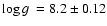 .
The parameters of the three remaining objects are given in Table 2.
.
The parameters of the three remaining objects are given in Table 2.
The selection of the object HS 1610+1639 is problematic:
using the now obsolete b-y data, we obtained
 K and
,
corresponding to the middle of the instability strip.
This is the reason why HS 1610+1639 was included in the sample observed
at Loiano.
However, after the time series observations at Loiano had been made,
the re-analysis of the data using the b-I color yielded a higher
temperature for this object,
K and
,
corresponding to the middle of the instability strip.
This is the reason why HS 1610+1639 was included in the sample observed
at Loiano.
However, after the time series observations at Loiano had been made,
the re-analysis of the data using the b-I color yielded a higher
temperature for this object,
 K (and
 ),
definitively too hot for ZZ Ceti pulsations.
),
definitively too hot for ZZ Ceti pulsations.
The other new pulsator, HE 1429-0343 (RA
2000=14 32 03.2,
Dec
2000=-03 56 38, B=15.8), was selected based on high-resolution
spectra from the SPY survey (Napiwotzki et al. 2003).
An analysis of these spectra for 754 white dwarfs, many of which are first
spectroscopic confirmations of WDs from the HS and HE surveys, was conducted
by Voss et al. (2005, in preparation).
Details about theoretical spectra and fitting procedures can be found in
Finley et al. (1997).
Figure 2 displays the model atmosphere fit for HE 1429-0343, from which we
obtain
 K and
K and
 .
.
![\begin{figure}
\par\includegraphics[angle=270,width=7.2cm,clip]{3362fig2.eps}
\end{figure}](/articles/aa/full/2005/43/aa3362-05/img30.gif) |
Figure 2:
The SPY spectrum and fit of HE 1429-0343.
The spectrum was rebinned to a resolution of 1 Å for this plot, the fit was
done with the original resolution of 0.1 Å.
The deep core of H is not real but is caused by a cosmic ray, which
however does not significantly affect the fitting process.
is not real but is caused by a cosmic ray, which
however does not significantly affect the fitting process. |
| Open with DEXTER | |
![\begin{figure}
\par\includegraphics[angle=270,width=7.2cm,clip]{3362fig3.eps}
\end{figure}](/articles/aa/full/2005/43/aa3362-05/img31.gif) |
Figure 3:
Spectrum of HS 1641+7132 and fits for
= 15 350 K,
= 7.9 (solid line), and for 11 800 K, = 8.1 (dashed) |
| Open with DEXTER | |
The other object selected from spectroscopy is HS 1641+7132, one of the 12
possible DAVs identified from medium-resolution spectroscopy by Homeier et al.
(1998).
HS 1641+7132 was selected for time-series photometry because of its
atmospheric parameters,
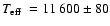 K and
K and
 ,
which correspond to the middle of the instability strip.
While the formal errors are small despite the low S/N and the resolution
(6 Å), line profile fits near the Balmer line maximum are known to
easily lead to degenerate solutions for
and .
Indeed, upon re-analyzing the original data from 1998, we found
that even small changes to the startup values of the fitting procedure would
produce temperatures as much as 200 K apart, with a mean value of 11 800 K.
More important, we found a second solution for the fit at a
much higher temperature
,
which correspond to the middle of the instability strip.
While the formal errors are small despite the low S/N and the resolution
(6 Å), line profile fits near the Balmer line maximum are known to
easily lead to degenerate solutions for
and .
Indeed, upon re-analyzing the original data from 1998, we found
that even small changes to the startup values of the fitting procedure would
produce temperatures as much as 200 K apart, with a mean value of 11 800 K.
More important, we found a second solution for the fit at a
much higher temperature
 K and
K and
 ,
with a reduced
,
with a reduced
 as compared to 1.45 for the cooler solution.
The two fits of the spectrum are shown in Fig. 3.
as compared to 1.45 for the cooler solution.
The two fits of the spectrum are shown in Fig. 3.
![\begin{figure}
\par\includegraphics[width=7.5cm,clip]{3362fig4.eps}\par\includegraphics[width=7.3cm,clip]{3362fig5.eps}
\end{figure}](/articles/aa/full/2005/43/aa3362-05/img37.gif) |
Figure 4: Light curves, spectral window and amplitude spectrum of HS 1039+4112 (1 mma = 0.1% change in intensity). The observations were performed on June 20 and 22, 2004. The amplitude spectrum is obtained joining together the two runs in order to increase the frequency resolution. The lower panels show the behavior of the spectrum when we subtract, at each iteration, the highest peak (pre-whitening); note that the intensity scale is not the same in all panels. |
| Open with DEXTER | |
The time-series observations were performed in June 2004 at the 1.5 m Loiano
telescope using the BFOSC
instrument without any filter.
A recent version of the software allows one to launch a series of exposures
where the CCD is read only in a small box around the target, in order
to decrease the read-out time.
With a box of typically
 pixels, we were able
to measure at least two reference stars in each field.
The integration times used were between 12 and 18 s, giving an effective
resolution of about 24 to 30 s, because of the CCD reading plus some extra
time due to internal control of the software.
pixels, we were able
to measure at least two reference stars in each field.
The integration times used were between 12 and 18 s, giving an effective
resolution of about 24 to 30 s, because of the CCD reading plus some extra
time due to internal control of the software.
The data were then reduced using IRAF aperture photometry.
The flux of each target was divided by a combination of the reference stars
with different weights, and then normalized to the mean ratio.
Finally a residual extinction correction was applied and the times were
converted to Barycentric Julian Date (BJD), using the algorithm of
Stumpff (1980).
The light curves of the two new ZZ Ceti stars are shown in Figs. 4 and 5.
The variable amplitudes in the light curves, presumably due to beating effects,
suggest that both targets have more than one excited pulsation mode.
Each target was observed on two different nights to confirm the pulsations.
In this way, joining together the two runs, the frequency resolution of
the Fourier Transform is improved and it is possible to make a first
separation of the different peaks (Figs. 4 and 5).
The light curve of HS 1039+4112 has the typical large amplitude of many
of the cool ZZ Ceti; moreover the spectrum shows the
possible presence of the first and second harmonic of the main peak
at 1.181 mHz (846.6 s).
In the case of HE 1429-0343, which is located more close to the center
of the instability strip, the pulsation amplitude is lower.
Close to the highest peak of the spectrum at 1.032 mHz (969.0 s)
there are at least two other signals at 0.922 and 1.206 mHz (1084.9 and 829.3 s
respectively).
![\begin{figure}
\includegraphics[width=7.5cm,clip]{3362fig6.eps}\par\includegraphics[width=7.3cm,clip]{3362fig7.eps}
\end{figure}](/articles/aa/full/2005/43/aa3362-05/img39.gif) |
Figure 5: Same as Fig. 4, but for HE 1429-0343. The observations of HE 1429-0343 were performed on June 18 and 21, 2004. |
| Open with DEXTER | |
In Table 1 we report an attempt to fit the observed light curves (both nights together) with sinusoidal fits; the results of the fits are also shown in the upper panels of Figs. 4 and 5. However, due to the poor coverage, the pulsation spectra are not resolved and therefore these results should be taken with some prudence, in particular regarding the frequencies with lower amplitudes (3F1 and F4), which are quite close to the noise level. Concerning HS 1039+4112, the first and second harmonics suggest that the true value of the main frequency could be 1.169 mHz, whereas the value of 1.181 detected in the power spectrum could correspond to the 1-day alias (1.169 + 0.012 mHz). Indeed, using 1.169 mHz, the least-squares fit is more stable and therefore we adopt this solution in Table 1 (the alternative solution is also given in square brackets for completeness). In the case of HE 1429-0343, the results of the sinusoidal fits favor a higher amplitude of F3 and F1 respect to F2 which, however, is the highest peak in the Fourier spectrum (24.9 mma).
Table 1: Results of the non-linear least-squares fits.
Table 2: Objects which do not show pulsations.
In Fig. 6
the location of the two new ZZ Ceti stars in a (
,
)
plane
is shown and compared with the edges of the observational ZZ Ceti instability
strip as defined by Bergeron et al. (2004).
Both stars are within the strip, although HS 1039+4112 is very close to the
red edge.
![\begin{figure}
\par\includegraphics[width=7.6cm,clip]{3362fig8.eps}
\end{figure}](/articles/aa/full/2005/43/aa3362-05/img43.gif) |
Figure 6: The observational ZZ Ceti instability strip updated: the two new pulsators are represented by the two asterisks with error bars, whereas the two objects close to the blue edge are HS 1253+1033 and HS 1443+2934 (from left to right), for which no pulsations were found. The filled circles are the known ZZ Ceti stars from Bergeron et al. (2004), the open circles are the new pulsators discovered from the SDSS (Mukadam et al. 2004a; Mullally et al. 2005). |
| Open with DEXTER | |
On the other hand, if we consider the other four targets observed in the same run at Loiano, none of them shows pulsations. Their upper limits (i.e. the amplitude of the highest peak in the region of interest of their temporal spectra) are reported in Table 2, together with their B magnitudes, effective temperatures and surface gravities, date and duration of the observations.
Concerning HS 1641+7132, its non-variability is compatible with the
higher temperature solution which was found upon re-analyzing the spectroscopic
data, as described in Sect. 2.2.
Therefore we conclude that this star is likely to be a non-variable DA
with
between 15 000 and 16 000 K.
The same applies to HS 1610+1639, which is clearly far from the blue edge of
the instability strip, having an effective temperature of about 14 500 K.
Finally, concerning the other two stars that do not show luminosity
variations, HS 1253+1033 and HS 1443+2934, both lie near the blue edge.
The case of HS 1253+1033 is the most intriguing as this star apparently falls
inside the observational strip of Bergeron et al. (2004).
However, even in this case, the relatively large uncertainties in
and
cannot completely exclude the possibility that HS 1253+1033 is actually
slightly beyond the blue edge.
Moreover, looking at Fig. 6, both stars would be outside the observational
strip as defined by the SDSS sample alone. Considering that we used the same
Koester model atmospheres as used by the SDSS team, the stability against
g-modes of HS 1253+1033 and HS 1443+2934 appears even less surprising.
Acknowledgements
R.S. acknowledges support from the funds COFIN "Astrosismologia'' (PI L. Paternò). D.K. and B.V. thank the Deutsche Forschungsgemeinschaft (DFG) for their support (KO738/21-1, KO738/22-1, KO738/23-1). R.N. acknowledges support by a PPARC Advanced Fellowship. D.H. thanks the DFG for grant KO738/10. The authors wish to thank Anjum Mukadam for a very accurate referee report that contributed to improve the quality of this article.
Note added in proof: The discovery of 23 new DAVs was presented recently by B.G. Castanheira during the workshop on "Stellar pulsation and evolution'' (Monte Porzio Catone, Roma, 20-24 June 2005).