![[*]](/icons/foot_motif.gif)
A&A 440, 693-700 (2005)
DOI: 10.1051/0004-6361:20052987
Yu. A. Shibanov1 - J. Sollerman2 - P. Lundqvist2 - T. Gull3 - D. Lindler3,4
1 - Ioffe Physico-Technical Institute, Politekhnicheskaya 26,
194021 St. Petersburg, Russia
2 -
Stockholm Observatory, AlbaNova Science Center, Department
of Astronomy, 106 91 Stockholm, Sweden
3 -
Goddard Space Flight Center, Exploration of the Universe Division, Code 667, USA
4 -
Advanced Computer Concepts, Inc. Potomac, MD, USA
Received 4 March 2005 / Accepted 1 June 2005
Abstract
We have observed the middle-aged pulsar
PSR B0656+14 with the prism and the NUV MAMA detector
of the Space Telescope
Imaging Spectrograph (STIS) to measure the pulsar spectrum and
periodic pulsations in
the near-ultraviolet (NUV).
The pulsations are clearly detected,
double-peaked
and very similar to the optical pulse profile.
The NUV pulsed fraction is  %.
The spectral slope of the dereddened phase-integrated spectrum in the
%.
The spectral slope of the dereddened phase-integrated spectrum in the
 1800-3200 Å range is
 which
together with the high pulse fraction
indicates a non-thermal origin for the NUV emission.
The total flux in the range
1700-3400 Å is estimated to be
which
together with the high pulse fraction
indicates a non-thermal origin for the NUV emission.
The total flux in the range
1700-3400 Å is estimated to be
 erg s-1 cm-2 when corrected for
E(B-V)=0.03 mag. At a distance of 288 pc this corresponds to
a luminosity
erg s-1 cm-2 when corrected for
E(B-V)=0.03 mag. At a distance of 288 pc this corresponds to
a luminosity
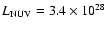 erg s-1 assuming isotropy of the
emission.
We compare the NUV pulse profile with observations from radio to gamma-rays.
The first NUV sub-pulse is in phase with the
gamma-ray pulse marginally detected with EGRET,
while the second NUV sub-pulse
is similar both in shape and in phase with the non-thermal pulse in hard
X-rays. This indicates a single origin of the non-thermal emission in the
optical-NUV and in the X-rays. This is also supported by the
observed NUV spectral slope, which is
compatible with a blackbody plus power-law fit
extended from the X-ray range,
but dominated by the power-law component in most of the NUV range.
erg s-1 assuming isotropy of the
emission.
We compare the NUV pulse profile with observations from radio to gamma-rays.
The first NUV sub-pulse is in phase with the
gamma-ray pulse marginally detected with EGRET,
while the second NUV sub-pulse
is similar both in shape and in phase with the non-thermal pulse in hard
X-rays. This indicates a single origin of the non-thermal emission in the
optical-NUV and in the X-rays. This is also supported by the
observed NUV spectral slope, which is
compatible with a blackbody plus power-law fit
extended from the X-ray range,
but dominated by the power-law component in most of the NUV range.
Key words: stars: pulsars: individual: PSR B0656+14 - stars: pulsars: individual: PSR J0659+1414
 0.385 s, spin-down
age,
0.385 s, spin-down
age,
 years, and several other pulsar parameters
are given in Table 1.
This is one of the brightest isolated neutron stars
(NSs) in the X-ray sky (Córdova et al. 1989),
and also the optical counterpart
is brighter (
years, and several other pulsar parameters
are given in Table 1.
This is one of the brightest isolated neutron stars
(NSs) in the X-ray sky (Córdova et al. 1989),
and also the optical counterpart
is brighter ( )
than most
other middle-aged pulsars (Caraveo et al. 1994).
This made it possible to study the
optical pulsations of PSR B0656+14 (Shearer et al. 1997; Kern et al. 2003), which has previously only
been convincingly done for a few
much younger pulsars.
)
than most
other middle-aged pulsars (Caraveo et al. 1994).
This made it possible to study the
optical pulsations of PSR B0656+14 (Shearer et al. 1997; Kern et al. 2003), which has previously only
been convincingly done for a few
much younger pulsars.
Owing to its relative brightness and proximity, PSR B0656+14 is one of the most intensively studied isolated NSs in different wavelength bands. The combined phase integrated spectrum of the pulsar, from radio to gamma-rays (cf. Koptsevich et al. 2001), shows that its radiation consists of two parts. One component is non-thermal emission from the pulsar magnetosphere described by a power-law spectrum with different spectral indices in different spectral ranges. The other component is thermal blackbody like emission from the whole surface of the cooling NS and from much smaller and significantly hotter polar caps of the pulsar.
While the thermal emission from the whole surface dominates in the extreme UV (EUV) and soft X-rays (e.g., Edelstein 2000; Greiveldinger et al. 1996; Zavlin & Pavlov 2004; De Luca et al. 2005), the emission at longer wavelengths is mainly of non-thermal origin and has a negative spectral slope (Pavlov et al. 1996; Pavlov et al. 1997; Koptsevich et al. 2001; Komarova et al. 2003). Ground-based and HST UV to near-IR photometry suggest that a main spectral change from the near-IR to EUV occurs somewhere between the B band and the far-UV (FUV).
Table 1: Parameters of PSR B0656+14 (from Taylor et al. 1993).
Here we report on time-resolved HST STIS NUV-MAMA prism spectroscopy of PSR B0656+14 in the near-UV (NUV). This is the first time the pulse profile of PSR B0656+14 has been revealed in the UV. The detection of UV pulsations from another middle-aged pulsar, Geminga, and the younger Vela-pulsar was very recently reported by Kargaltsev et al. (2005) and Romani et al. (2005), but was previously only obtained for the Crab pulsar (NUV, Gull et al. 1998; FUV, Sollerman et al. 2000). In this paper we study the properties of the NUV emission of PSR B0656+14 and compare them with available data in other wavelength ranges. We describe our observations and data reduction in Sect. 2. The results are discussed in Sect. 3, and we then draw our conclusions in Sect. 4.
Time-resolved spectroscopy of PSR B0656+14 in the near-UV (
1700-3400 Å)
range was performed with the
HST/STIS during two visits in fall 2001 using the UV PRISM, the
 slit
and the
NUV MAMA detector in TIMETAG recording mode.
The PRISM mode was used because of the very low pulsar flux.
The relative time resolution was 125
slit
and the
NUV MAMA detector in TIMETAG recording mode.
The PRISM mode was used because of the very low pulsar flux.
The relative time resolution was 125  s.
Accurate target coordinates were obtained from earlier WFPC2
images.
The target acquisition was performed using a B=17.9 field star,
U0975-04374987, which
is positioned 13
s.
Accurate target coordinates were obtained from earlier WFPC2
images.
The target acquisition was performed using a B=17.9 field star,
U0975-04374987, which
is positioned 13
 9 away from the pulsar
(Fig. 1).
We requested
and received two visits,
with the first being on 1 September and the second on 16 November.
The slit position angle was
9 away from the pulsar
(Fig. 1).
We requested
and received two visits,
with the first being on 1 September and the second on 16 November.
The slit position angle was
 east of north
during the first visit and -122
east of north
during the first visit and -122 .45 during the second visit.
These position angles allowed us to avoid
any contamination of the pulsar flux by a faint extended background
object only 1
.45 during the second visit.
These position angles allowed us to avoid
any contamination of the pulsar flux by a faint extended background
object only 1
 north of our target
(Koptsevich et al. 2001; Komarova et al. 2003)
as well as to exclude other nearby objects
(Fig. 1).
The two visits also
allowed initial data evaluation and checks to ensure proper astrometry
had been used. Details of the individual science observations are listed in
Table 2.
north of our target
(Koptsevich et al. 2001; Komarova et al. 2003)
as well as to exclude other nearby objects
(Fig. 1).
The two visits also
allowed initial data evaluation and checks to ensure proper astrometry
had been used. Details of the individual science observations are listed in
Table 2.
![\begin{figure}
\par\includegraphics[width=8.8cm,clip]{2987fig1.ps}
\end{figure}](/articles/aa/full/2005/35/aa2987-05/img28.gif) |
Figure 1:
A portion of the PSR B0656+14 field obtained with the
HST/STIS CCD using the clear filter mode. The long thin lines indicate
the boundaries of the
aperture for the first visit with
PA = -135
 3. The pulsar is indicated as the faint, point-like object
centered in the aperture.
We have also marked the
reference star, U0975-04374987, used to center the aperture on the
pulsar position. 3. The pulsar is indicated as the faint, point-like object
centered in the aperture.
We have also marked the
reference star, U0975-04374987, used to center the aperture on the
pulsar position.
|
| Open with DEXTER | |
Table 2: Log of observations.
The initial visit, three orbits in length, began with normal
acquisition plus three STIS/CCD clear aperture images,
each with 120 s exposure time, for a control image of the pulsar position.
Figure 1 shows the composite field image
with the
aperture boundaries inscribed.
An internal
lamp-illuminated image of the
slit was
then recorded, and then
the pulsar was viewed through the same
aperture by the CCD to confirm that the pulsar was well-centered in the slit.
This also precisely determines the pulsar position for the prism dispersion
wavelength reference. The remainder of the first visit was allocated to
three science exposures with the PRISM and NUV MAMA detector (Table 2).
Internal WAVECAL exposures
were interspersed between science exposures
to ensure good reference for wavelength scale.
The total UV PRISM science exposure time in the first visit
was 6790 s.
The second visit was five orbits long.
CCD images of the pulsar viewed through the
slit were performed
at thebeginning of the first and the third orbits to check
for any target or image drift internal to the telescope,
but no such drift was detected.
Five TIMETAG exposures,
one during each orbit, were recorded
during 12 760 s (Table 2).
The total TIMETAG science exposure time
for the two visits was thus 19.55 ks.
Additional information can be obtained through the HST archive under GO program 9156.
013/pix). The backgrounds were extracted
with a 7 pixels wide slit centered 20 pixels above and below the center of
the pulsar spectrum. The associated wavecals recorded between science
exposures were used to adjust the zeropoint of the wavelength scale.
The two extracted spectra were then registered and averaged with
weights scaled to the total exposure times for each visit. As the PRISM
dispersion increases with decreasing wavelength and the detector
sensitivity falls, we binned the flux below 2000 Å in 4 pixel bins.
Between 2000 Å and 2300 Å, the binning was for 2 pixels and above 2300 Å,
the data were left at the original PRISM resolution.
This resulted in bins from 20 Å in the blue to 60 Å towards the red.
The detector sensitivity and prism dispersion cut the sensitivity
considerably below 2000 Å, but in the range
2000-3200 Å the pulsar is detected
with  per bin.
The NUV MAMA detector
is the dominating source of the background and the
total sky+detector background
was 700 and 3600 counts for the 1st and 2nd visits, while the signal+background was 1200 and 5000 counts,
respectively.
per bin.
The NUV MAMA detector
is the dominating source of the background and the
total sky+detector background
was 700 and 3600 counts for the 1st and 2nd visits, while the signal+background was 1200 and 5000 counts,
respectively.
The pulse period was determined from the data stream by the following
process. All events within a rectangular patch centered on the pulsar
spectrum were selected. Likewise, we selected all events in background patches
above and below the pulsar spectrum.
The pulse period was determined by
maximizing the rms of the pulse profile of the target events
(see Sollerman et al. 2000).
For the two visits, the computed periods are:
Visit 1: 0.384902 s
Visit 2: 0.384903 s.
This is in excellent agreement to within the last digit with
the radio pulsar period (Table 1).
Using the
ephemeris from Kern et al. (2003) we obtain:
Visit 1: 0.3849028 s
Visit 2: 0.3849031 s
at the epochs of our observations.
The measaured period is also in agreement
with earlier radio observations presented by Taylor (1993)
and Chang & Ho (1999), and there is thus no evidence for glitches in PSR B0656+14
over
the last 16 years.
This also ensures us that the obtained pulse profile is correct.
To increase the S/N, the data were binned into phase bins at intervals 1/16th that of
the pulse period. The background data were likewise binned, but showed
no structure with phase. We then subtracted
the combined
background average bin count.
The TIME-TAG mode provided relative time resolution of 125 s,
but absolute time determination is not known to better
than one second due to design limitations of the STIS computer timing
updates.
Internal clock stability is sufficient to ensure good
time stability from orbit to orbit, even up to several days apart, but not for a ten week interval. We were thus forced to use the pulse profile shapes in the NUV and in the optical to phase align the two visits and to determine the NUV pulse position with respect to the radio pulse (see Sects. 3.1 and 3.2).
![\begin{figure}
\par\includegraphics[width=8.5cm,clip]{2987fig2.ps}
\end{figure}](/articles/aa/full/2005/35/aa2987-05/img31.gif) |
Figure 2: The background subtracted pulse profiles of PSR B0656+14 in the near-UV from visit 1 ( top), visit 2 ( middle), and after combining of the data from the two visits ( bottom). |
| Open with DEXTER | |
The background subtracted spectral integrated pulse
profiles obtained from the data of visits 1 and 2
are shown in the top and middle
panels of Fig. 2, respectively.
While the pulsations in the first
visit are only significant at the  level, the
significance of the
pulsations in the second, longer visit
is
level, the
significance of the
pulsations in the second, longer visit
is  .
The pulse profile contains two sub-pulses whose
maxima are separated by 0.5 in phase and
are connected by an emission "bridge''. The shape of
the first sub-pulse is rather symmetric,
while the second sub-pulse is characterized by a linear
flux increase in its leading part as well as by a sharp
edge in the trailing part. This sharp drop
and the bridge can also be seen in the first visit
profile.
We have used
these features
to align both
pulse profiles in phase and combined
them.
The result is shown in the bottom panel of
Fig. 2. The significance of the
pulsations increased in the combined profile to
.
The pulse profile contains two sub-pulses whose
maxima are separated by 0.5 in phase and
are connected by an emission "bridge''. The shape of
the first sub-pulse is rather symmetric,
while the second sub-pulse is characterized by a linear
flux increase in its leading part as well as by a sharp
edge in the trailing part. This sharp drop
and the bridge can also be seen in the first visit
profile.
We have used
these features
to align both
pulse profiles in phase and combined
them.
The result is shown in the bottom panel of
Fig. 2. The significance of the
pulsations increased in the combined profile to  .
.
We cannot exclude the presence of a persistent (or a
weakly variable) flux component from the pulsar in the
NUV range. As shown in Fig. 2, the estimated pulse
fraction Pf (the ratio of the number of counts above the
minimum of the profile to the total number of counts) is in
the range
 representing
a
representing
a  confidence interval
based on count statistics.
The persistent flux
contribution into the pulse integrated flux is
thus within the
confidence interval
based on count statistics.
The persistent flux
contribution into the pulse integrated flux is
thus within the  range.
The lower boundary of this
uncertainty range is compatible with the published
upper limit
range.
The lower boundary of this
uncertainty range is compatible with the published
upper limit  16%
in the optical range (Kern et al. 2003).
16%
in the optical range (Kern et al. 2003).
The shape of the observed NUV double pulse profile is very similar to what is seen in the optical range by Kern et al. (2003). This supports a single emission mechanism being responsible for the emission in both ranges. We note that the Kern et al. (2003) pulse profile was actually very different from the optical pulse profile for PSR B0656+14 earlier reported by Shearer et al. (1997). Kern et al. (2003) discussed whether this large discrepancy could be due to differences in pass bands, or due to a pulse profile variation with time. Our NUV profile clearly supports the findings of Kern et al. (2003) and disfavours the explanations to accomodate the earlier profile by Shearer et al. (1997).
The optical pulse profile by Kern et al. (2003)
was obtained with absolute timing
which allowed a phase alignment between
the optical and the radio pulse profiles.
The same was done for X-ray data obtained with the Chandra and
XMM-Newton observatories
(Pavlov et al. 2002; Zavlin & Pavlov
2004; De Luca et al. 2005), and for gamma-ray data obtained with EGRET
(Ramanamurthy et al. 1996). We have used the similarity of the optical and
NUV profiles to align our data with the radio pulse
and to compare
its absolute position in phase and
morphology with the available data
in a wide spectral range, from radio
through gamma-rays
(Fig. 3).
![\begin{figure}
\par\includegraphics[width=7cm,clip]{2987fig3.ps}
\end{figure}](/articles/aa/full/2005/35/aa2987-05/img39.gif) |
Figure 3: Pulse profiles of PSR B0656+14 measured by different telescopes from radio through gamma-rays. Dashed and dotted lines mark the position of the radio and the two optical pulses, respectively. Note the similar morphology of the optical and NUV profiles and the hints of the soft X-ray counterparts to the optical sub-pulses seen roughly at the same phases in the soft X-rays. The second NUV sub-pulse is similar in shape and position to the pulse in hard X-rays, while the first NUV sub-pulse coincides with the gamma-ray pulse. The dynamic range for the various pulse profiles are chosen to illustrate the different pulse fractions in different spectral bands. To better see the actual pulse shapes in the soft X-ray range, we refer to Fig. 4, as well as to Pavlov et al. (2002), Zavlin & Pavlov (2004), and De Luca et al. (2005). |
| Open with DEXTER | |
In the radio (Gould & Lyne 1998)
the pulsar has a sharp single pulse with a
width of about 0.2 of the NS rotational
period
(Fig. 3a).
In the soft
X-rays it instead displays shallow (
 %)
pulsations with a sine-like light curve. It has a
single broad maximum per pulsar period, typical
for the thermal emission from the
surface of a NS with non-uniform temperature distribution over the
surface
(Fig. 3d).
This is completely
different from the optical and NUV profiles
(Figs. 3b-c)
and underline
the difference in the emission mechanisms
dominating
in the optical-NUV (non-thermal) and in the soft X-rays (thermal).
However, in the smooth light curves in soft X-rays one can
discover small, but significant, features
approximately coinciding in phase with the positions of
the NUV sub-pulses
(Figs. 3c and 3d-g).
This can be more easily seen in the zoomed
examples of the X-ray profiles (Fig. 4, see also Pavlov et al. 2002 and Zavlin & Pavlov 2004).
With increasing photon energy, where the thermal emission is
assumed to be dominated
by the pulsars hot polar caps, the
maximum of the X-ray profile is shifted
toward the position of the 2nd NUV
sub-pulse
(Fig. 3g).
However,
this
emission can not contribute significantly
to the NUV because the hot spot area is too small
(
%)
pulsations with a sine-like light curve. It has a
single broad maximum per pulsar period, typical
for the thermal emission from the
surface of a NS with non-uniform temperature distribution over the
surface
(Fig. 3d).
This is completely
different from the optical and NUV profiles
(Figs. 3b-c)
and underline
the difference in the emission mechanisms
dominating
in the optical-NUV (non-thermal) and in the soft X-rays (thermal).
However, in the smooth light curves in soft X-rays one can
discover small, but significant, features
approximately coinciding in phase with the positions of
the NUV sub-pulses
(Figs. 3c and 3d-g).
This can be more easily seen in the zoomed
examples of the X-ray profiles (Fig. 4, see also Pavlov et al. 2002 and Zavlin & Pavlov 2004).
With increasing photon energy, where the thermal emission is
assumed to be dominated
by the pulsars hot polar caps, the
maximum of the X-ray profile is shifted
toward the position of the 2nd NUV
sub-pulse
(Fig. 3g).
However,
this
emission can not contribute significantly
to the NUV because the hot spot area is too small
(
 km, De Luca et al. 2005).
In the hard X-rays
(Fig. 3h),
where the
spectrum is dominated by a non-thermal magnetospheric
component, both the position and
the morphology of the profile is
similar to that of the 2nd NUV
sub-pulse. The counterpart of the 1st NUV sub-pulse is
not observed at the low S/N available in the
hard X-ray range,
while it coincides in position with
the gamma-ray pulse marginally detected
with the EGRET (Ramanamurthy et al. 1996).
The pulsar has not yet been reliably detected
in the intermediate energy range between the hard X-rays
and gamma-rays.
Available RXTE observations obtained in the 15-250 keV range
provide only an upper limit on the pulsar flux
and a very uncertain pulse profile
(Chang & Ho 1999).
km, De Luca et al. 2005).
In the hard X-rays
(Fig. 3h),
where the
spectrum is dominated by a non-thermal magnetospheric
component, both the position and
the morphology of the profile is
similar to that of the 2nd NUV
sub-pulse. The counterpart of the 1st NUV sub-pulse is
not observed at the low S/N available in the
hard X-ray range,
while it coincides in position with
the gamma-ray pulse marginally detected
with the EGRET (Ramanamurthy et al. 1996).
The pulsar has not yet been reliably detected
in the intermediate energy range between the hard X-rays
and gamma-rays.
Available RXTE observations obtained in the 15-250 keV range
provide only an upper limit on the pulsar flux
and a very uncertain pulse profile
(Chang & Ho 1999).
To summarize, the observed profiles suggest that the pulsed emission outside the radio range is a sum of at least two components. One component, likely non-thermal emission, displays a two peak pulse profile which is clearly resolved in the optical and in the NUV. The other component, likely thermal emission, has a shallow broad sine-like profile with a single pulse per period. This component could potentially be partially responsible for the persistent and bridge emission seen in the NUV, since its maximum coincides with the NUV inter-pulse position. The counterparts of the optical-NUV sub-pulses can be resolved from the thermal background in soft X-rays. The 2nd NUV sub-pulse counterpart is clearly resolved in hard X-rays, while the 1st sub-pulse may be seen in gamma-rays. The coincidence of the position and morphology of the 2nd NUV sub-pulse and the X-ray profile supports a strong correlation of the non-thermal emission in these ranges, which has also been deduced from phase averaged spectral analysis (e.g., Koptsevich et al. 2001). The radio pulse is centered at the off-pulse emission in all other ranges.
The variation of the thermal flux with the NS rotation may
be understood in terms of anisotropic heat conduction
through the strongly magnetized envelope of a
cooling NS.
The regions of the star with radial magnetic
fields are hotter than the regions with tangential fields
(e.g., Greenstein & Hartke 1983;
Page 1995; Shibanov & Yakovlev 1996; Potekhin &
Yakovlev 2001).
The observed flux modulation
in the soft X-rays
is in agreement with
a 14% modulation
expected from a middle-aged cooling NS with
a dipole magnetic field of a few times 1012 G
(e.g., Potekhin & Yakovlev 2001).
A single maximum per period with a relatively symmetric pulse profile
suggests that only one magnetic pole is visible in
the X-rays during
the pulsar rotation. This is also compatible with the
pulsar viewing geometry derived from the radio (Everett & Weisberg 2001)
and optical (Kern et al. 2003) polarization measurements.
However, the 0.5 phase lag between the maxima
in the radio and soft X-rays suggests
that the hollow polar cap magnetospheric cone assumed to
be responsible for the radio and optical emission
must be strongly curved with height.
Alternatively,
the magnetic field surface structure is different from a simple
centered dipole configuration. The latter
is supported by the significant phase lag (De Luca
et al. 2005) between
the pulse maximum of the cool
blackbody component from the whole
surface of the NS and the hot blackbody
component from the hot spots
(Figs. 3d and 3g).
To investigate if the NUV bridge
flux is dominated by the thermal emission we
have applied a simplified model (Greenstein & Hartke 1983) assuming
that the NUV and soft
X-rays fluxes (F) vary with rotational phase ( )
as
)
as
 ,
where
,
where
 ,
,
 are the fluxes at the minimum
and maximum of the pulse profile, respectively. These are assumed to
originate from the surface regions with predominantly
radial and tangential magnetic
fields, and
are the fluxes at the minimum
and maximum of the pulse profile, respectively. These are assumed to
originate from the surface regions with predominantly
radial and tangential magnetic
fields, and  accounts for a small shift (
 )
of the profile minimum from the zero phase.
)
of the profile minimum from the zero phase.
![\begin{figure}
\par\includegraphics[width=8.5cm, clip]{2987fig4.ps}
\end{figure}](/articles/aa/full/2005/35/aa2987-05/img48.gif) |
Figure 4: Enlarged NUV and soft X-ray pulse profiles. The dashed lines are model profiles of thermal emission from a NS with anisotropic surface temperature distribution (e.g., Greenstein & Hartke 1983). The minimum and maximum fluxes of the model are specific for each energy range and are selected to be equal to the count levels around the phases corresponding to the minimum and the inter-pulse bridge of the NUV-profile, respectively. The dotted horizontal line in the upper panel represents the extrapolation of the X-ray model profile of the thermal emission to the NUV (see text for details). |
| Open with DEXTER | |
Figure 4 shows that this model
provides a qualitative fit (dashed curves) to the
soft X-ray profiles and to the smooth part of the NUV profile including the bridge.
It also brings out the non-thermal counterparts of the NUV sub-pulses
in X-rays.
However, assuming a blackbody
spectrum of the thermal emission with a maximum in
the soft X-rays (e.g., Zavlin & Pavlov 2004),
and that the temperature
 in this range, we
can estimate from the X-ray model light curves with
in this range, we
can estimate from the X-ray model light curves with
 that the effective temperature variations averaged over the visible
surface of the NS are 5%.
The smooth flux variation over the NUV is larger:
that the effective temperature variations averaged over the visible
surface of the NS are 5%.
The smooth flux variation over the NUV is larger:
 .
Taking into account that any thermal NUV is in the Rayleigh-Jeans (RJ) part
of the blackbody spectrum where
.
Taking into account that any thermal NUV is in the Rayleigh-Jeans (RJ) part
of the blackbody spectrum where
 ,
we obtain much larger temperature variations
(
,
we obtain much larger temperature variations
( 50%) from the NUV fit. This
contradiction with the X-rays can
hardly be accounted for by any
variations of the visible emitting area
during the NS rotation (
50%) from the NUV fit. This
contradiction with the X-rays can
hardly be accounted for by any
variations of the visible emitting area
during the NS rotation ( ,
De Luca et al. 2005).
An extrapolation of
the estimated X-ray temperature variations to the NUV (Fig. 4, dotted
horisontal curve), shows that the pulsed
bridge emission in the NUV can not be due to this
mechanism, but the resulting NUV emission is
compatible with the observed persistent flux.
This means that the bridge emission is probably not
thermal. It could instead result from overlapping of
the two non-thermal sub-pulses.
,
De Luca et al. 2005).
An extrapolation of
the estimated X-ray temperature variations to the NUV (Fig. 4, dotted
horisontal curve), shows that the pulsed
bridge emission in the NUV can not be due to this
mechanism, but the resulting NUV emission is
compatible with the observed persistent flux.
This means that the bridge emission is probably not
thermal. It could instead result from overlapping of
the two non-thermal sub-pulses.
To further investigate if the NUV persistent flux
is thermal, we can compare its relative
contribution to the total flux, 30%, with the expected
contribution from the thermal cool
blackbody component provided by extrapolation
of the combined two blackbody
+ power-law fit obtained in X-rays for
the phase averaged spectrum (e.g.,
Koptsevich et al. 2001) to
the NUV.
Such a model is further discussed in Sect. 3.3 and shown in Fig. 5, and
yields 25% thermal contribution at 2800 Å, where the PRISM throughput peaks.
This is consistent with the unpulsed fraction in the NUV observations.
For comparison,
the expected blackbody contribution in
the optical range at 5000 Å
is several times smaller,
7%. In this region,
Kern et al. (2003) were not able
to detect any persistent flux at 16%.
In this interpretation, we are actually
resolving the surface of the NS during the off-pulse in the NUV.
Future observations,
allowing for phase resolved spectroscopy in
the NUV, FUV, and optical as well as detailed
comparison with the phase resolved
spectroscopy in the X-rays, are necessary to confirm
such an interpretation.
![\begin{figure}
\par\includegraphics[width=8.5cm,clip]{2987fig5.ps}
\end{figure}](/articles/aa/full/2005/35/aa2987-05/img55.gif) |
Figure 5:
The dereddened spectrum of PSR B0656+14 using
E(B-V)=0.03.
The data have been binned.
The best power-law fit is shown by the solid line. It has a
spectral index of
.
To demonstrate that the effect of the reddening is small we also show the
best power-law fit for the non-dereddened data (dotted line).
We have also included the
contributions from a cool blackbody
(BB, dashed), power-law (PL, dash-dot), and their sum
(BB+PL; thick dashed) resulting from the spectral fit
of X-ray data and extended to the NUV (Koptsevich et al. 2001).
|
| Open with DEXTER | |
2150-3200 Å, where the
NUV-MAMA/PRISM has its maximal throughput, the S/N is 3 per bin.
The spectral energy distribution is rather flat with
the flux
apparently increasing
with increasing frequency.
A power-law (PL;
 )
fit to the spectrum results in a spectral index of
)
fit to the spectrum results in a spectral index of
 .
This is indicated by the flat dotted line in
Fig. 5.
The slope may be slightly positive, but a negative index is
also consistent with the data.
.
This is indicated by the flat dotted line in
Fig. 5.
The slope may be slightly positive, but a negative index is
also consistent with the data.
To check the absolute flux calibration we compared the NUV spectrum with the available broadband NUV photometric data obtained with the HST/FOC in the F342W and F195W bands (Pavlov et al. 1997). Within the uncertainties the spectral data are consistent with the photometric magnitudes.
The interstellar color excess E(B-V) toward PSR B0656+14 has been
estimated to be in the range of
0.01-0.05 mag with a
likely value of
E(B-V)=0.03 mag
(Pavlov et al. 1996; Kurt et al. 1999).
The dereddened [
E(B-V)=0.03] spectral index is
.
This is shown by the solid line in Fig. 5.
Dereddening the spectrum by this amount gives an integrated flux in
the range
1700-3400 Å of
erg s-1 cm-2.
At a distance of 288 pc this corresponds to the
luminosity
erg s-1,
assuming isotropy of the emission.
Even for an extinction of
E(B-V)=0.05 mag, the one sigma limit of the
spectral index remains smaller than unity. This is significantly lower
than
the index of the RJ part of the blackbody spectrum (
 ),
and strongly favors a non-thermal
component for the bulk of the emission in the NUV range.
To state this in a different way, to reach the RJ spectral index would
require
an extinction of
E(B-V)=0.2, which is much outside the suggested range.
Even the maps of Schlegel et al. (1998) only indicate
E(B-V)=0.09throughout the entire Galaxy along this line-of-sight.
),
and strongly favors a non-thermal
component for the bulk of the emission in the NUV range.
To state this in a different way, to reach the RJ spectral index would
require
an extinction of
E(B-V)=0.2, which is much outside the suggested range.
Even the maps of Schlegel et al. (1998) only indicate
E(B-V)=0.09throughout the entire Galaxy along this line-of-sight.
The observed NUV spectrum is actually compatible with the extension of the absorbed combined spectral fit, two blackbodies (BB) + power-law (PL), of the X-ray data (the hot blackbody component does not contribute significantly in the NUV and is not shown in Fig. 5). Although such an extrapolation is uncertain (see, e.g., Kargaltsev et al. 2005), we note that the shape of the dereddened sum BB+PL (Fig. 5, thick dashed line) in the NUV is very similar to the observed NUV spectrum, although the PL clearly dominates in most of the NUV range. A non-thermal origin for the bulk of the NUV emission is also consistent with our analysis of the pulse profile. The change-over from the PL-component to the BB-slope seems to occur at the high frequency boundary of the observed NUV-range (Fig. 5). If this is true, we expect a higher spectral slope and a larger fraction of the persistent flux in the FUV range.
A possible absorption feature
is hinted at 2400 Å (15.10 in Log  ).
The formal significance is low
(
).
The formal significance is low
( ,
see Fig. 5), but a flux
depression around this wavelength is present in both visits.
If confirmed by future observations, such a feature could be interpreted
as an electron/positron cyclotron line formed at
,
see Fig. 5), but a flux
depression around this wavelength is present in both visits.
If confirmed by future observations, such a feature could be interpreted
as an electron/positron cyclotron line formed at
 G.
Assuming the dipole surface field
obtained from the pulsar spin-down rate
(Table 1) this places the absorbing
plasma at 220 km above the NS surface.
This
is roughly consistent with the minimum
height (350 km) for the optical emission
estimated from the assumed critical synchrotron
frequency
by Kern et al. (2003).
The faintness of the
absorption feature suggests that
the obscuring magnetospheric plasma
is optically thin and cannot affect
the radiation in X-rays.
No spectral features or depressions
have been detected in the soft X-rays.
This disfavors interpretations
of the phase lags between the maxima of
the cool and hot BB profiles and the
radio pulse based on existence of a magnetospheric "blanket''
affecting the pulse shape (e.g., De Luca et al. 2005, and references
therein).
These phase lags could instead be the
result of a strong inhomogeneity of the
surface magnetic field of the NS.
On the other hand, the spectral energy
distribution of PSR B0656+14 in the
optical/near-IR range appears to be non-monotonic and shows
potential depressions
(Koptsevich et al. 2001; Komarova et al. 2003).
These features are deeper than
the possible absorption line in the NUV. This could be
explained by increasing the optical
depth of the absorbing magnetospheric plasma
with the wavelength. Optical spectroscopy and
timing observations of the pulsar in different
optical bands are needed to study the nature of
the dips and their relation to the marginal
absorption line in the NUV.
G.
Assuming the dipole surface field
obtained from the pulsar spin-down rate
(Table 1) this places the absorbing
plasma at 220 km above the NS surface.
This
is roughly consistent with the minimum
height (350 km) for the optical emission
estimated from the assumed critical synchrotron
frequency
by Kern et al. (2003).
The faintness of the
absorption feature suggests that
the obscuring magnetospheric plasma
is optically thin and cannot affect
the radiation in X-rays.
No spectral features or depressions
have been detected in the soft X-rays.
This disfavors interpretations
of the phase lags between the maxima of
the cool and hot BB profiles and the
radio pulse based on existence of a magnetospheric "blanket''
affecting the pulse shape (e.g., De Luca et al. 2005, and references
therein).
These phase lags could instead be the
result of a strong inhomogeneity of the
surface magnetic field of the NS.
On the other hand, the spectral energy
distribution of PSR B0656+14 in the
optical/near-IR range appears to be non-monotonic and shows
potential depressions
(Koptsevich et al. 2001; Komarova et al. 2003).
These features are deeper than
the possible absorption line in the NUV. This could be
explained by increasing the optical
depth of the absorbing magnetospheric plasma
with the wavelength. Optical spectroscopy and
timing observations of the pulsar in different
optical bands are needed to study the nature of
the dips and their relation to the marginal
absorption line in the NUV.
We have detected the near-UV pulsations of
PSR B0656+14 using the STIS NUV-MAMA onboard the HST.
The pulse period we derive is in agreement with previous estimates.
The pulse profile is double-peaked with an inter-pulse bridge and is very
similar to the profile detected in the optical range by Kern et al. (2003).
Sharp pulses and a high NUV pulse fraction, %,
suggest a non-thermal origin of the
emission.
We have compared the NUV pulse profile with pulse profiles from the radio to gamma-rays. The first NUV sub-pulse is in phase with the marginal gamma-ray pulse, while the second NUV sub-pulse is similar in both shape and phase with the pulse detected in the hard X-rays. This favors a single origin for the non-thermal pulsed part of the emission from the optical to the X-ray range, as previously has also been seen from the broadband photometric observations in the optical and NIR (e.g., Koptsevich et al. 2001). The NUV sub-pulse counterparts can also be resolved from the shallow soft X-ray profiles dominated by thermal emission from the surface of the NS.
A simple model for the thermal X-ray flux, in terms of an anisotropic
heat distribution of the NS surface, does not explain the pulsating
NUV bridge emission, which is therefore likely non-thermal.
However, any persistent flux in the NUV could contribute
at the  % level, which is potentially
higher than the upper limit 16%
measured in the optical (Kern et al. 2003).
This is in qualitative agreement with the thermal flux from the
abovementioned model,
and we therefore argue that the non-pulsed NUV emission is
due to the RJ part of the thermal emission component.
% level, which is potentially
higher than the upper limit 16%
measured in the optical (Kern et al. 2003).
This is in qualitative agreement with the thermal flux from the
abovementioned model,
and we therefore argue that the non-pulsed NUV emission is
due to the RJ part of the thermal emission component.
We have also measured the NUV spectrum of PSR B0656+14.
The phase averaged spectrum is basically flat,
.
This slope is consistent with contributions from both a thermal component
from the whole surface of the cooling NS and from a magnetospheric power-law
component extrapolated from the X-rays.
The main spectral change from the power-law
dominating magnetospheric emission to
the thermal RJ from the NS surface is likely to occur
at the boundary between the NUV and FUV ranges.
Preliminary reports on FUV emission from PSR B0656+14
indicate that the
FUV is indeed thermal (Pavlov et al. 2004).
This also agrees with our model where the non-pulsed NUV flux is thermal.
We therefore predict a higher spectral slope and a
lower pulse fraction
in the FUV.
We note that a similar situation applies to the middle-aged Geminga pulsar (Kargaltsev et al. 2005, their Figs. 7 and 10). However, the younger Vela pulsar (Shibanov et al. 2003; Romani et al. 2005) and the Crab pulsar (Sollerman 2003) display a relatively flat spectrum from the near-IR to UV range. Moreover, the non-thermal emission of the young Crab pulsar and the Crab twin PSR B0540-69 (Boyd et al. 1995) display pulse-profiles that also does not change significantly from the optical to the UV. The same seems to be true for Geminga (Kargaltsev et al. 2005) and for Vela (Romani et al. 2005). This could indicate that a unique mechanism, which apparently does not strongly depends on pulsar age, drives the non-thermal pulsed emission in the optical and UV.
Acknowledgements
We are grateful for help from Alexei Koptsevich in the initial phase of this study. Part of this research has made use of the database of published pulse profiles maintained by the European Pulsar Network. This work was supported by NASA and The Royal Swedish Academy of Sciences. YAS were supported by the RFBR (grants 03-02-17423, 03-07-90200 and 05-02-16245) and RLSS programme 1115.2003.2. The research of PL is further sponsored by the Swedish Research Council. PL is a Research Fellow at the Royal Swedish Academy supported by a grant from the Wallenberg Foundation. DL was supported in part by funding through GO proposal 9156. TG and DL were supported in part through the STIS Guaranteed Time Observations resources.