![[*]](/icons/foot_motif.gif) ,
,
A&A 440, 111-120 (2005)
DOI: 10.1051/0004-6361:20052982
,A. E. Piatti1 - J. F. C. Santos Jr.2 - J. J. Clariá3 - E. Bica4 - A. V. Ahumada3 - M. C. Parisi3
1 - Instituto de Astronomía y Física del Espacio, CC 67, Suc.
28, 1428 Buenos Aires, Argentina
2 - Departamento de Física, ICEx, UFMG,
CP 702, 30123-970 Belo Horizonte, MG, Brazil
3 - Observatorio Astronómico,
Laprida 854, 5000 Córdoba, Argentina
4 - Depto. de Astronomia, UFRGS,
CP 15051, 91500-970 Porto Alegre, Brazil
Received 3 March 2005 / Accepted 18 May 2005
Abstract
We present in this study flux-calibrated integrated spectra in the
range (3600-6800) Å for 18 concentrated SMC clusters. Cluster reddening
values were estimated by interpolation between the extinction maps of Burstein
& Heiles (1982, AJ, 87, 1165) and Schlegel et al. (1998, ApJ, 500, 525). The
cluster parameters were derived from the template matching procedure by
comparing the line strengths and continuum distribution of the cluster spectra
with those of template cluster spectra with known parameters and from the
equivalent width (EW) method. In this case, new calibrations were used together
with diagnostic diagrams involving the sum of EWs of selected spectral lines.
A very good agreement between ages derived from both methods was found. The
final cluster ages obtained from the weighted average of values taken from the
literature and the present measured ones range from 15 Mr (e.g. L 51) to 7
Gyr (K 3). Metal abundances have been derived for only 5 clusters from the
present sample, while metallicity values directly averaged from published
values for other 4 clusters have been adopted. Combining the present cluster
sample with 19 additional SMC clusters whose ages and metal abundances were put
onto a homogeneous scale, we analyse the age and metallicity distributions in
order to explore the SMC star formation history and its spatial extent. By
considering the distances of the clusters from the SMC centre instead of their
projections onto the right ascension and declination axes, the present
age-position relation suggests that the SMC inner disk could have been related
to a cluster formation episode which reached the peak  2.5 Gyr
ago. Evidence for an age gradient in the inner SMC disk is also presented.
2.5 Gyr
ago. Evidence for an age gradient in the inner SMC disk is also presented.
Key words: galaxies: star clusters - techniques: spectroscopic - Magellanic Clouds
The Small Magellanic Cloud (SMC) is a galaxy rich in star clusters of all ages
and different types of field populations (Hodge 1989; Dolphin et al. 2001; Hodge 1988). An
interesting feature in the chemical enrichment history of the SMC known up to
now is that no very metal-poor old cluster has been observed in this galaxy
(Da Costa 1991; Dutra et al. 2001). Piatti et al. (2001) studied 5 outlying intermediate-age
clusters in the SMC and, combined to other data in the literature, studied the
age-metallicity relationship, showing that epochs of sudden chemical enrichment
take place in the age-metallicity plane. This favours a bursting star formation
history for the SMC as opposed to a continuous one. Recently, Piatti et al. (2005)
confirmed, with new observations, the occurrence of an important bursting star
formation episode at 2.5 Gyr.
A star cluster spectral library at the SMC metallicity level can be useful for analyses of star clusters in dwarf galaxies observable by means of ground-based large telescopes as well as the Hubble Space Telescope (HST). In addition, such metal-poor library appears to be also useful for the study of a fraction of star clusters in massive galaxies, due to cannibalism. Indeed, in the Milky Way galaxy at least four globular clusters have been accreted from the Sagittarius dwarf galaxy (Da Costa & Armandroff 1995), and the open clusters AM-2 and Tombaugh 5 appear to be related to the Canis Major dwarf galaxy (Bellazzini et al. 2004).
In this sense, spectral libraries of stars (e.g., Silva & Cornell 1992), open clusters (Piatti et al. 2002a) or star clusters in general (Bica & Alloin 1986) are important datasets for spectral classifications and extraction of parameter information for target stars or star clusters (e.g., Piatti et al. 2002b) and galaxies (e.g., Bica 1988).
Samples of integrated spectra of SMC clusters were initially small, corresponding to the most prominent clusters such as NGC 121, NGC 419, NGC 330 and others (Santos et al. 1995; Bica & Alloin 1986). Ahumada et al. (2002) analysed integrated spectra in the range 3600-6800 Å for 16 star clusters in the SMC, estimating ages and reddening values. That study has constituted a fundamental step forward towards a cluster spectral library at low metallicities.
A comprehensive catalogue of SMC clusters was produced by Bica & Schmitt (1995), and updated in Bica & Dutra (2000). In it, cross-identifications for different designations, coordinates, angular sizes and references to previous catalogues are provided. The angular distribution of SMC clusters has been discussed in Bica & Schmitt (1995): most clusters are projected on the SMC main body and a significant fraction are outlyers. The line-of-sight (LOS) depth of populous clusters in the SMC was analysed by Crowl et al. (2001), who found significant depth effects, with a triaxial shape of 1:2:4 for the declination, the right ascension, and the LOS depth of the SMC, respectively.
The present cluster sample complements previous ones, in an effort to provide a spectral library with several clusters per age bin. At the same time, we study the clusters themselves individually, determining their parameters and analysing the age distribution, in order to explore the SMC star formation history and its spatial extent. To estimate the clusters' ages, we employ the new calibrations and diagnostic diagrams recently provided by Santos & Piatti (2004, hereafter SP) for visible integrated spectra, along with template spectra (e.g., Ahumada et al. 2002; Santos et al. 1995). We confirm the reliability of the procedure proposed by SP in determining clusters' ages, since we included in the sample not only unstudied or poorly studied clusters but also some control clusters with well-known fundamental parameters.
In Sect. 2 we describe the different sets of observations and the reduction procedure performed. The analyses of the integrated spectra through the template matching and equivalent width methods are developed in Sect. 3, in which we also include some considerations for individual clusters. In Sect. 4 we discuss the present results in the light of the star formation history of the SMC. Finally, in Sect. 5 we summarize the main conclusions of this work.
The observations analysed in this study were carried out with the CASLEO 2.15 m
telescope during four nights in November 2001 and five nights in October 2002
and with the CTIO 1.5 m telescope during four nights in September 2003. In all
the CASLEO runs we empoyed a CCD camera containing a Tektroniks chip of
 pixels attached to a REOSC spectrograph (simple mode), the size of each
pixel being 24
pixels attached to a REOSC spectrograph (simple mode), the size of each
pixel being 24  m
m  24 m; one pixel corresponds to 0.94
 on
the sky. The slit was set in the East-West direction and the observations were
performed by scanning the slit across the objects in the North-South direction
in order to get a proper sampling of cluster stars. The long slit corresponding
to 4.7
on
the sky. The slit was set in the East-West direction and the observations were
performed by scanning the slit across the objects in the North-South direction
in order to get a proper sampling of cluster stars. The long slit corresponding
to 4.7
 on the sky, allowed us to sample regions of the background sky.
We used a grating of 300 grooves mm
on the sky, allowed us to sample regions of the background sky.
We used a grating of 300 grooves mm ,
producing an average dispersion
in the observed region of
,
producing an average dispersion
in the observed region of  140 Å/mm (3.46 Å/pixel). The spectral
coverage was 3600-6800 Å. The seeing during the CASLEO nights was
typically 2.0
.
The slit width was 4.2
,
providing a resolution
[full width at half-maximum (FWHM)] of 14 Å, as deduced from the
comparison lamp lines. For the CTIO observations, we used a CCD Loral 1K chip
of
140 Å/mm (3.46 Å/pixel). The spectral
coverage was 3600-6800 Å. The seeing during the CASLEO nights was
typically 2.0
.
The slit width was 4.2
,
providing a resolution
[full width at half-maximum (FWHM)] of 14 Å, as deduced from the
comparison lamp lines. For the CTIO observations, we used a CCD Loral 1K chip
of
 pixels (pixel diameter = 15 m), controlled by the CTIO ARCON
3.9 data acquisition system at a gain of 2.05 e- ADU-1 with a readout
noise of 7.4 e- ADU-1. The same slit width of 4.2
as in CASLEO
was used at CTIO, thus providing a resolution of about 11 Å. The seeing
during the CTIO observations was typically 1.0
.
At least two exposures
of 30 min of each object were taken in order to correct for cosmic rays.
Standard stars from the list of Stone & Baldwin (1983) were also observed at both
observatories for flux calibrations. Bias, darks, dome and twilight sky and
tungsten lamp flats were taken and employed in the reductions.
pixels (pixel diameter = 15 m), controlled by the CTIO ARCON
3.9 data acquisition system at a gain of 2.05 e- ADU-1 with a readout
noise of 7.4 e- ADU-1. The same slit width of 4.2
as in CASLEO
was used at CTIO, thus providing a resolution of about 11 Å. The seeing
during the CTIO observations was typically 1.0
.
At least two exposures
of 30 min of each object were taken in order to correct for cosmic rays.
Standard stars from the list of Stone & Baldwin (1983) were also observed at both
observatories for flux calibrations. Bias, darks, dome and twilight sky and
tungsten lamp flats were taken and employed in the reductions.
The reduction of the spectra was carried out with the IRAF package at the Observatorio
Astronómico de Córdoba (Argentina - CASLEO data) and at the Instituto de
Astronomía y Física del Espacio (Argentina - CTIO data) following the
standard procedures. Summing up, we subtracted the bias and used flat-field
frames- previously combined - to correct the frames for high and low spatial
frequency variations. We also checked the instrumental signature with the
acquisition of dark frames. Then, we performed the background sky subtraction
using pixel rows from the same frame, after having cleaned the background sky
regions from cosmic rays. We controlled that no significant background sky
residuals were present on the resulting spectra. The cluster spectra were
extracted along the slit according to the cluster size and available flux.
Five of these clusters (K 5, K 7, NGC 269, K 28 and NGC 411) have one very
bright star located close to their main bodies. The spectra were then
wavelength calibrated by fitting observed He-Ne-Cu (CASLEO) or He-Ar (CTIO)
comparison lamp spectra with template spectra. The rms errors involved in these
calibrations are in average 0.40 Å for both observatories. Finally, we
applied to the cluster spectra extinction corrections and flux calibrations
derived from the observed standard stars. We decided to use the sensitivity
function derived from all the standard stars observed each night. This
calibrated function turned out to be nearly the same as the nightly sensitivity
functions, but more robustly defined and with a smaller rms error. In addition,
cosmic rays on the cluster spectra were eliminated. Table 1 presents the
cluster sample including the averaged signal-to-noise (S/N) ratios of the
spectra.
| Namea |
 |
 |
D | Origin | S/N |
| (h:m:s) | (
 :
:
) :
:
) |
(
) |
|||
| L 5, ESO 28-SC 16 | 0:22:40 | -75:04:29 | 1.10 | CTIO | 20 |
| K 5, L 7, ESO 28-SC 18 | 0:24:43 | -73:45:18 | 1.80 | CTIO | 30 |
| K 3, L 8, ESO 28-SC 19 | 0:24:47 | -72:47:39 | 3.40 | CTIO | 30 |
| K 6, L 9, ESO 28-SC 20 | 0:25:26 | -74:04:33 | 1.00 | CTIO | 35 |
| K 7, L 11, ESO 28-SC 22 | 0:27:46 | -72:46:55 | 1.70 | CTIO | 30 |
| HW 8 | 0:33:46 | -73:37:59 | 1.70 | CASLEO | 20 |
| NGC 269, K 26, L 37, ESO 29-SC 16 | 0:48:21 | -73:31:49 | 1.20 | CASLEO | 30 |
| L 39, SMC_OGLE 54 | 0:49:18 | -73:22:20 | 0.70 | CASLEO | 35 |
| K 28, L 43, ESO 51-SC 4 | 0:51:42 | -71:59:52 | 1.70 | CTIO | 15 |
| NGC 294, L 47, ESO 29-SC 22, SMC_OGLE 90 | 0:53:06 | -73:22:49 | 1.70 | CASLEO | 45 |
| L 51, ESO 51-SC 7 | 0:54:54 | -72:06:46 | 1.00 | CASLEO | 50 |
| K 42, L 63, SMC_OGLE 124 | 1:00:34 | -72:21:56 | 0.85 | CASLEO | 40 |
| L 66, SMC_OGLE 129 | 1:01:45 | -72:33:52 | 1.10 | CASLEO | 100 |
| NGC 411, K 60, L 82, ESO 51-SC 19 | 1:07:55 | -71:46:08 | 2.10 | CTIO | 55 |
| NGC 419, K 58, L 85, ESO 29-SC 33, SMC_OGLE 159 | 1:08:19 | -72:53:03 | 2.80 | CASLEO | 70 |
| NGC 422, K 62, L 87, ESO 51-SC 22 | 1:09:25 | -71:46:00 | 1.00 | CASLEO | 30 |
| IC 1641, HW 62, ESO 51-SC 21 | 1:09:39 | -71:46:07 | 0.75 | CASLEO | 45 |
| NGC 458, K 69, L 96, ESO 51-SC 26 | 1:14:52 | -71:33:00 | 2.60 | CASLEO | 45 |
|
a Cluster identifications are from Kron (1956, K),
Lindsay (1958, L), Hodge & Wright (1974, HW), Lauberts (1982, ESO), Pietrzynski et al. (1998, SMC_OGLE). |
The cluster parameters were derived by means of two methods: the template matching method, in which the observed spectra are compared and matched to template spectra with well-determined properties (e.g. Piatti et al. 2002a, and references therein), and the equivalent width (EW) method, in which diagnostic diagrams involving the sum of EWs of selected spectral lines were employed together with their calibrations with age and metallicity (SP). In the first method, a high weight is assigned to the matching of the overall continuum, while in the second method the spectral lines are the observables that define cluster parameters. Both methods rely on the library of star cluster integrated spectra with well-determined properties, accomplished in various studies (e.g. Piatti et al. 2002a; Bica & Alloin 1986, and references therein) and made available through the CDS/Vizier catalogue database at http://vizier.u-strasbg.fr/cgi-bin/VizieR?-source=III/219 (Santos et al. 2002).
All 18 clusters in our sample are well represented by a wide variety of stellar
populations, as may be noticed from their spectra overall appearance. The
template spectra useful for the present sample are: Yb (5-10 Myr), Yd (40 Myr),
Ye (45-75 Myr), Yg (200-350 Myr), Yh (0.5 Gyr), Ia (1 Gyr) and Ib (3-4 Gyr),
which represent young and intermediate-age populations built from Galactic open
clusters (Piatti et al. 2002a), and G3 (>10 Gyr, [Fe/H] = -1.0), G4 (>10 Gyr,
![${\rm [Fe/H]} = -1.5$](/articles/aa/full/2005/34/aa2982-05/img13.gif) )
and G5 (>10 Gyr, [Fe/H] = -2.0), which represent old stellar
populations built from Galactic globular clusters (Bica 1988).
)
and G5 (>10 Gyr, [Fe/H] = -2.0), which represent old stellar
populations built from Galactic globular clusters (Bica 1988).
The template matching method consists of achieving the best possible match between the analysed cluster spectrum and a template spectrum of known age and metallicity. In this process we selected, among the available template spectra, the ones which minimize the flux residuals, calculated as the difference (cluster - template)/cluster. Note that differences between the cluster and template spectra are expected to be found due to variations in the stellar composition of the cluster, such as the presence of a relatively bright star with particular spectral features or contamination of a field star close to the direction towards the cluster.
| Feature | K Ca II | H |
G band (CH) | H |
H |
Mg I |  |
 |
| Windows (Å) | 3908-3952 | 4082-4124 | 4284-4318 | 4318-4364 | 4846-4884 | 5156-5196 | ||
| Cluster | ||||||||
| L 5 | 5.2 | 7.3 | 5.1 | 8.8 | 7.2 | 4.0 | 23.3 | 14.3 |
| K 5 | 6.9 | 8.5 | 5.1 | 9.7 | 6.3 | 3.5 | 24.5 | 15.5 |
| K 3 | 6.8 | 5.4 | 6.2 | 3.9 | 4.5 | 3.4 | 13.9 | 16.5 |
| K 28 | 9.1 | 2.9 | 4.1 | 3.4 | 2.9 | 3.4 | 9.3 | 16.6 |
| K 6 | 5.5 | 8.2 | 4.7 | 6.6 | 4.6 | 4.0 | 19.4 | 14.3 |
| K 7 | 10.4 | 2.5 | 7.0 | 4.7 | 4.6 | 4.0 | 11.8 | 21.4 |
| HW 8 | 4.4 | 7.9 | 1.3 | 6.3 | 6.3 | 3.2 | 20.4 | 8.9 |
| NGC 269a | 4.7 | 11.9 | 3.3 | 9.6 | - | 4.0 | - | 11.9 |
| L 39 | 2.3 | 3.1 | 1.3 | 3.1 | 2.2 | 0.7 | 8.4 | 4.2 |
| K 28 | 9.1 | 2.9 | 4.1 | 3.4 | 2.9 | 3.4 | 9.3 | 16.6 |
| NGC 294 | 4.1 | 10.3 | 2.1 | 11.2 | 7.0 | 1.7 | 28.5 | 7.8 |
| L 51 | 1.0 | 7.6 | 0.6 | 4.3 | 4.9 | 1.2 | 16.8 | 2.7 |
| K 42 | 1.2 | 4.5 | 1.1 | 4.8 | 4.2 | 0.5 | 13.4 | 2.8 |
| L 66 | 0.6 | 5.8 | -0.3 | 2.7 | 3.8 | 1.0 | 12.3 | 1.2 |
| NGC 411 | 6.5 | 8.7 | 5.3 | 8.9 | 6.0 | 2.7 | 23.6 | 14.5 |
| NGC 419 | 6.9 | 8.2 | 3.5 | 7.7 | 7.1 | 1.9 | 22.9 | 12.3 |
| NGC 422 | 2.1 | 8.2 | 1.3 | 6.2 | 6.1 | 1.2 | 20.5 | 4.6 |
| IC 1641 | 4.0 | 9.6 | 2.3 | 8.1 | 6.2 | 1.5 | 23.9 | 7.7 |
| NGC 458 | 1.9 | 8.6 | 0.8 | 8.3 | 7.9 | 2.1 | 24.8 | 4.8 |
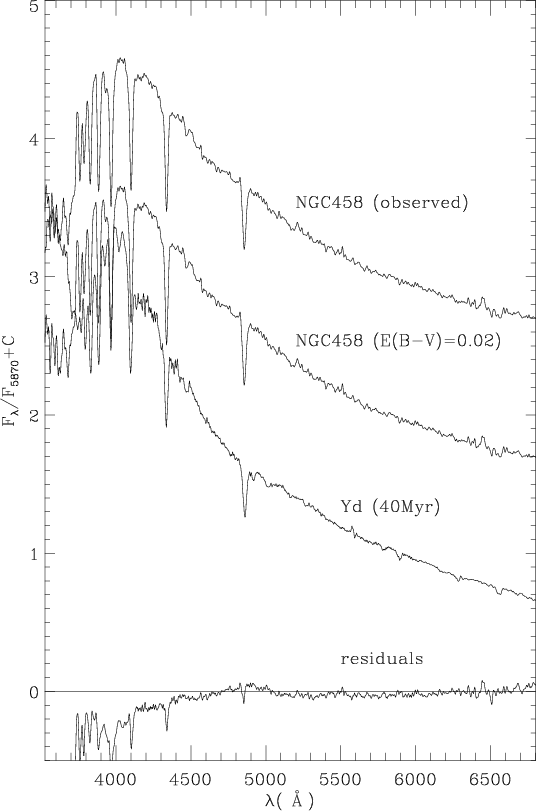
Since the continuum distribution is also affected by reddening, we first adopted a colour excess E(B-V) for each cluster, taking into account the Burstein & Heiles (1982, hereafter BH) and Schlegel et al. (1998, hereafter SFD) extinction maps, and then corrected the observed spectra accordingly before applying the template match method. We recall that one can deredden an integrated spectrum and simultaneously estimate the cluster age. However, in order to make the age estimate more robust, we preferred to match reddening corrected cluster spectra with template spectra. Thus, instead of having to handle two variables in the match (reddening and age), we limit it to find only the cluster age.
The maps of BH and SFD are frequently used to estimate the colour excesses of
clusters located in the direction towards the Magellanic Clouds (see,
e.g., Dutra et al. 2001; Piatti et al. 2001). SFD found that at high-latitude regions, their dust
maps correlate well with maps of H I emission, but deviations are coherent in
the sky and are especially conspicuous in regions of saturation of HI emission
towards denser clouds and of formation of H2 in molecular clouds. The SMC
is quite transparent, the average foreground and internal reddenings being 0.01
and 0.04, respectively (Dutra et al. 2001). The typical reddening towards the SMC
estimated from the median dust emission in annuli surrounding the galaxy is
E(B-V)=0.037 (SFD). Therefore, we assume that relatively high SFD values
are saturated and we then use the BH values. For clusters with non saturated
SFD values, the difference between SFD and BH colour excesses resulted in, at
the most, 0.02 mag; the SFD zero-point being made consistent with the BH
maps by subtracting 0.02 mag in
 .
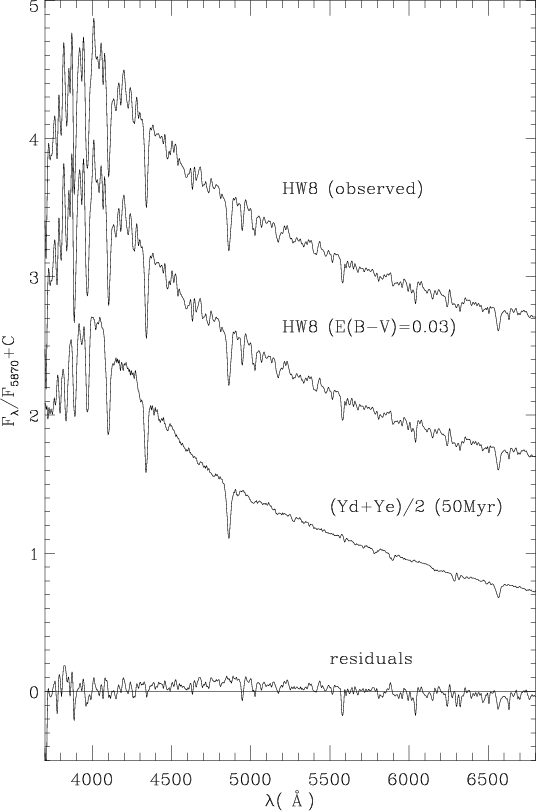
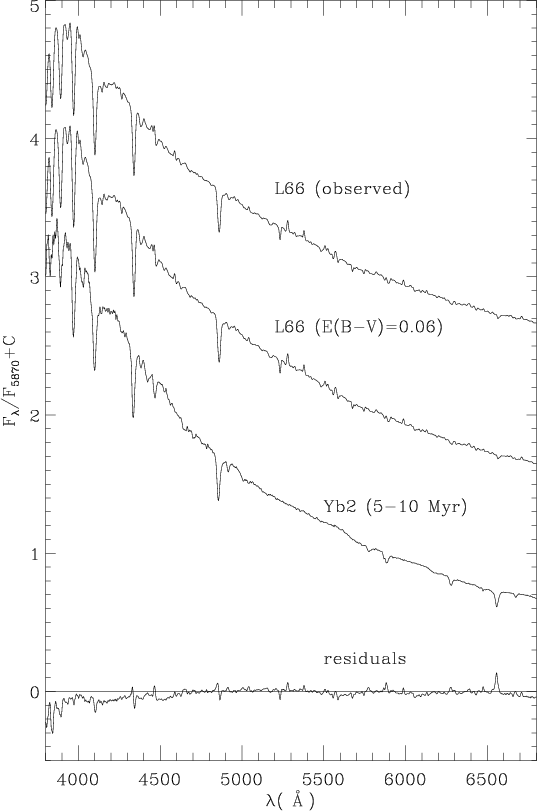
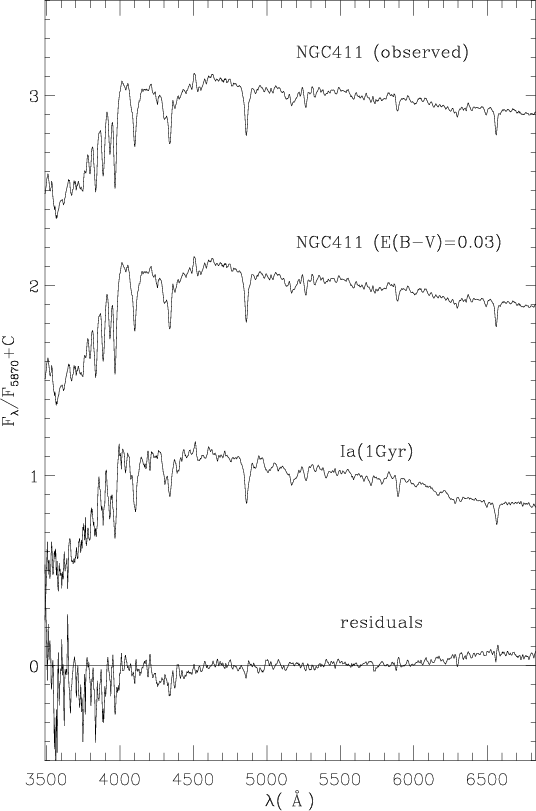
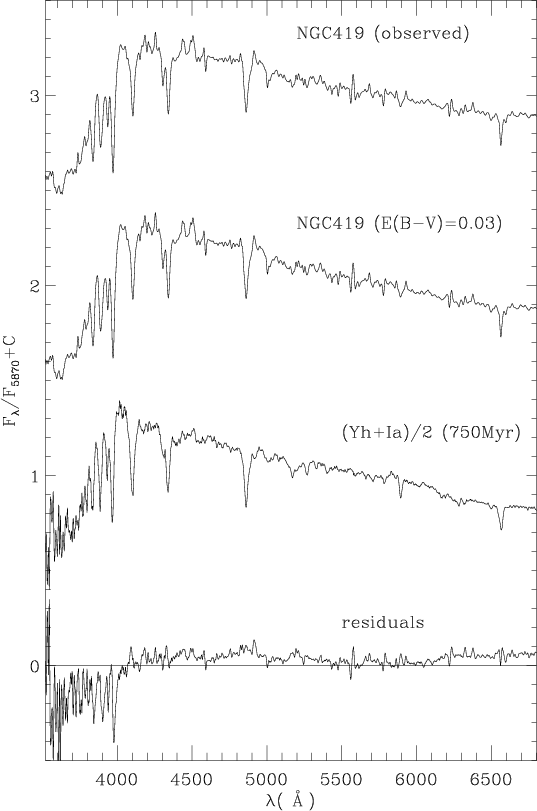
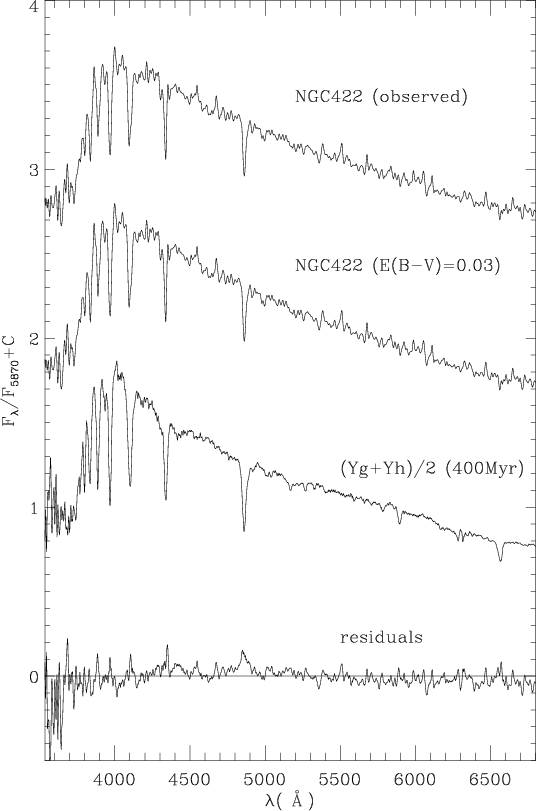
The results are shown in
Figs. 1 to 18.
.
The results are shown in
Figs. 1 to 18.
Before measuring EWs in the observed spectra, they were set to the
rest-frame according to the Doppler shift of H Balmer lines. Next, the spectra
were normalized to
 at 5870 Å and smoothed to the typical
resolution of the database (10-15 Å).
at 5870 Å and smoothed to the typical
resolution of the database (10-15 Å).
Spectral fluxes at 3860, 4020, 4150, 4570, 4834, 4914 and 6630 Å were used
as guidelines in order to define the continuum according to Bica & Alloin (1986). The
EWs of H Balmer, K Ca II, G band (CH) and Mg I (5167 + 5173 + 5184 Å)
were measured within the spectral windows defined by Bica & Alloin (1986) and using IRAF
task splot. Boundaries for the K Ca II, G band (CH), Mg I, H ,
H
,
H and H
and H spectral windows are, respectively, (
3908-3952) Å,
(
4284-4318) Å, (
5156-5196) Å, (
4082-4124) Å, (
4318-4364) Å, and
(
4846-4884) Å. Such a procedure has been applied consistently making the
EWs from integrated spectra safely comparable with the well-known cluster
database. Table 2 presents these measurements as well as the sum of EWs of
the three metallic lines ()
and of the three Balmer lines H,
H
and H
().
and
are shown to be useful in
the discrimination of old, intermediate-age and young systems
(Dutra et al. 1999; Rabin 1982, SP). Typical errors of 10% on individual EW
measurements were obtained by tracing slightly different continua. By using
the sums of EWs
and
separately, the EW relative errors are
lowered (7% smaller range than the individual EW errors), improving
their sensitivity to cluster age and metallicity (SP).
spectral windows are, respectively, (
3908-3952) Å,
(
4284-4318) Å, (
5156-5196) Å, (
4082-4124) Å, (
4318-4364) Å, and
(
4846-4884) Å. Such a procedure has been applied consistently making the
EWs from integrated spectra safely comparable with the well-known cluster
database. Table 2 presents these measurements as well as the sum of EWs of
the three metallic lines ()
and of the three Balmer lines H,
H
and H
().
and
are shown to be useful in
the discrimination of old, intermediate-age and young systems
(Dutra et al. 1999; Rabin 1982, SP). Typical errors of 10% on individual EW
measurements were obtained by tracing slightly different continua. By using
the sums of EWs
and
separately, the EW relative errors are
lowered (7% smaller range than the individual EW errors), improving
their sensitivity to cluster age and metallicity (SP).
| Cluster | E(B-V) |
 |
Ref. |  |
method |
 |
[Fe/H] | Ref. |
| (Gyr) | (Gyr) | (Gyr) | ||||||
| L 5 | 0.03 | 4.1 | 1 | 0.8 | ,
- template |
 |
 |
1, 9 |
| K 5 | 0.02 | 2.0 | 1 | 0.8 | ,
- template |
 |
 |
1, 9 |
| K 3 | 0.02 |  |
2, 4 | 7.0 | ,
+ template |
|
 |
2, 9 |
| K 6 | 0.03 | 1.3 | 7 | 2.0 | ,
+ template |
 |
-0.7 | 9 |
| K 7 | 0.02 | 3.5 | 3 | 4.0 | ,
+ template |
 |
-1.0 | 3 |
| HW 8 | 0.03 | 0.05 | ,
- template |
 |
||||
| NGC 269 | 0.01 | 0.6 |
- template |
 |
||||
| L 39 | 0.01 | 0.015 | ,
- template |
 |
||||
| K 28 | 0.06 | 2.1 | 2 | 1.0 | template |  |
 |
2, 9 |
| NGC 294 | 0.02 | 0.3 | ,
- template |
 |
||||
| L 51 | 0.07 | 0.015 | ,
- template |
|
||||
| K 42 | 0.06 | 0.045 | ,
- template |
 |
||||
| L 66 | 0.06 | 0.015 | ,
- template |
|
||||
| NGC 411 | 0.03 |  |
2, 6, 8 | 1.0 | ,
- template |
 |
 |
2, 6, 8 |
| NGC 419 | 0.03 | |
2, 4 | 0.8 | ,
- template |
 |
-0.7 | 2 |
| NGC 422 | 0.03 | 0.3 | ,
- template |
|
||||
| IC 1641 | 0.03 | 0.3 | ,
- template |
|
||||
| NGC 458 | 0.02 |
 |
2, 5 | 0.05 | ,
- template |
 |
-0.23 | 2 |
|
References: (1) Piatti et al. (2005); (2) Piatti et al. (2002b);
(3) Mould et al. (1992); (4) Rich et al. (2000); (5)
Alcaino et al. (2003); (6) Alves & Sarajedini (1999); (7) Matteucci et al. (2002); (8) Leonardi & Rose (2003); (9) this work. |
The sums of EWs
and
presented in Table 2 were used to estimate
cluster parameters according to their calibrations as a function of age and
metallicity given by SP. Such calibrations are based on visible integrated
spectra of Galactic and Magellanic Cloud clusters for which age and metallicity
were well-determined and put within homogeneous scales. In summary, the
calibrations, aided by diagnostic diagrams involving
and ,
allow
one to obtain age for star clusters younger than 10 Gyr and
metallicity for older ones. Yet, a degeneracy occurs for globular age-like
clusters with
![${\rm [Fe/H]} > -1.4$](/articles/aa/full/2005/34/aa2982-05/img48.gif) and intermediate-age clusters
(
and intermediate-age clusters
(
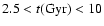 ), which cannot be discriminated using this
method. In this case, it is necessary to constrain age by using an independent
method (e.g., the template matching one) and then obtain metallicity with the
SP's calibration, if the cluster is old. It is worth mentioning that
only 5 SMC clusters are included in the SP's calibration, but since they
follow the general trend of Galactic clusters in the diagnostic diagrams,
we judged safe to apply that calibration to the present sample.
The derived ages and metallicities for the cluster sample are summarized in
Table 3. In Cols. 6 and 9, the methods used to obtain age and metallicity
are indicated. Except for K 28, with a low S/N spectrum, all remaining
clusters were age-ranked according to the EW method based on
and
measurements. In the case of NGC 269, we decided to use only ,
since the
substraction of the spectrum of the symbiotic nova SMC 3 could affect the
EWs of the cluster H Balmer lines (see details in Sect. 3.3.7). The
template method was applied to the whole sample either independently from the
EW method (minus sign in Col. 6) or in conjunction with the EW method
(plus sign in Col. 6). Note that we only had to employ template and EWs
methods in conjunction for clusters in the age-metallicity degeneracy range.
We found a very good agreement between ages derived from both methods. The
final cluster ages obtained from the weighted average of values taken from the
literature (Cols. 3 and 4) and the measured present ones ()
are listed in Col. 7. Their respective errors take into account the
dispersion of the values averaged and/or the estimated uncertainties for
.
Column 2 lists the colour excesses adopted for the
clusters.
), which cannot be discriminated using this
method. In this case, it is necessary to constrain age by using an independent
method (e.g., the template matching one) and then obtain metallicity with the
SP's calibration, if the cluster is old. It is worth mentioning that
only 5 SMC clusters are included in the SP's calibration, but since they
follow the general trend of Galactic clusters in the diagnostic diagrams,
we judged safe to apply that calibration to the present sample.
The derived ages and metallicities for the cluster sample are summarized in
Table 3. In Cols. 6 and 9, the methods used to obtain age and metallicity
are indicated. Except for K 28, with a low S/N spectrum, all remaining
clusters were age-ranked according to the EW method based on
and
measurements. In the case of NGC 269, we decided to use only ,
since the
substraction of the spectrum of the symbiotic nova SMC 3 could affect the
EWs of the cluster H Balmer lines (see details in Sect. 3.3.7). The
template method was applied to the whole sample either independently from the
EW method (minus sign in Col. 6) or in conjunction with the EW method
(plus sign in Col. 6). Note that we only had to employ template and EWs
methods in conjunction for clusters in the age-metallicity degeneracy range.
We found a very good agreement between ages derived from both methods. The
final cluster ages obtained from the weighted average of values taken from the
literature (Cols. 3 and 4) and the measured present ones ()
are listed in Col. 7. Their respective errors take into account the
dispersion of the values averaged and/or the estimated uncertainties for
.
Column 2 lists the colour excesses adopted for the
clusters.
The last two columns of Table 3 show the cluster metallicities adopted whenever
possible and their corresponding sources, respectively. Some clusters have
metal abundances directly averaged from published values. For K 3, we used
Eq. (8) of SP. Three clusters (L 5, K 5 and K 28) have metallicities
derived from a technique involving morphological features in the cluster
colour-magnitude diagram (CMD) (Piatti et al. 2005,2002b), which we corrected
for age degeneracy using the present ages. Finally, we fitted Padova isochrones
(Girardi et al. 2002) to the K 6 CMD obtained by Matteucci et al. (2002) and yielded a cluster
metallicity of
![${\rm [Fe/H]} = -0.7$](/articles/aa/full/2005/34/aa2982-05/img50.gif) ,
assuming for the cluster the reddening and age of
Table 3 and the SMC apparent distance modulus (m-M) = 19.0 (Cioni et al 2000).
The fit was performed on an extracted CMD containing stars distributed around
2
from the cluster centre, with the aim of avoiding field star
contamination.
,
assuming for the cluster the reddening and age of
Table 3 and the SMC apparent distance modulus (m-M) = 19.0 (Cioni et al 2000).
The fit was performed on an extracted CMD containing stars distributed around
2
from the cluster centre, with the aim of avoiding field star
contamination.
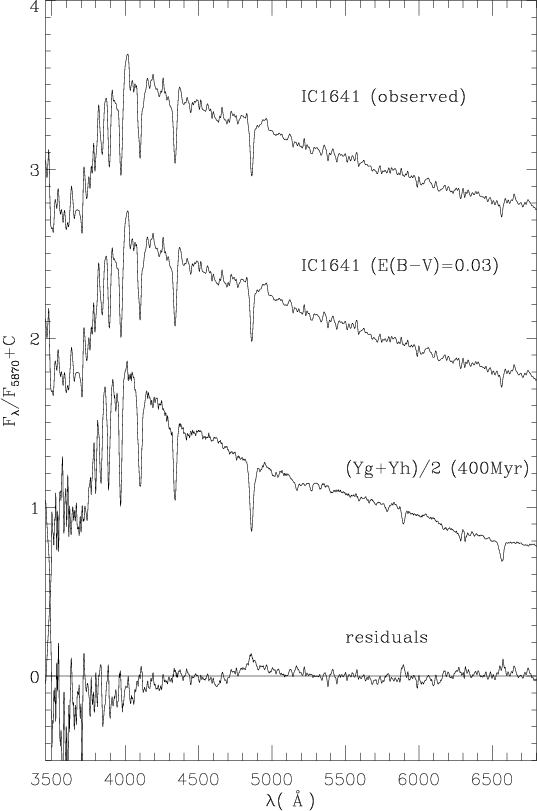
We have revised the literature on the cluster parameters below. More weight has been assigned to ages determined from isochrone fitting to CMD data, but when such information was not available, ages based on integrated indices were also considered. No previous age information was found either for HW 8 (Fig. 6) or IC 1641 (Fig. 17).
Piatti et al. (2005) have derived t=4.3 Gyr and
![${\rm [Fe/H]}=-1.2$](/articles/aa/full/2005/34/aa2982-05/img51.gif) for this cluster.
Much like K 5, the age of L 5 has been estimated to be 0.8 Gyr according to
both methods employed in the present work. A correction to the metallicity
provided by Piatti et al. (2005) revised it to
for this cluster.
Much like K 5, the age of L 5 has been estimated to be 0.8 Gyr according to
both methods employed in the present work. A correction to the metallicity
provided by Piatti et al. (2005) revised it to
![${\rm [Fe/H]}=-1.1$](/articles/aa/full/2005/34/aa2982-05/img52.gif) for its significantly
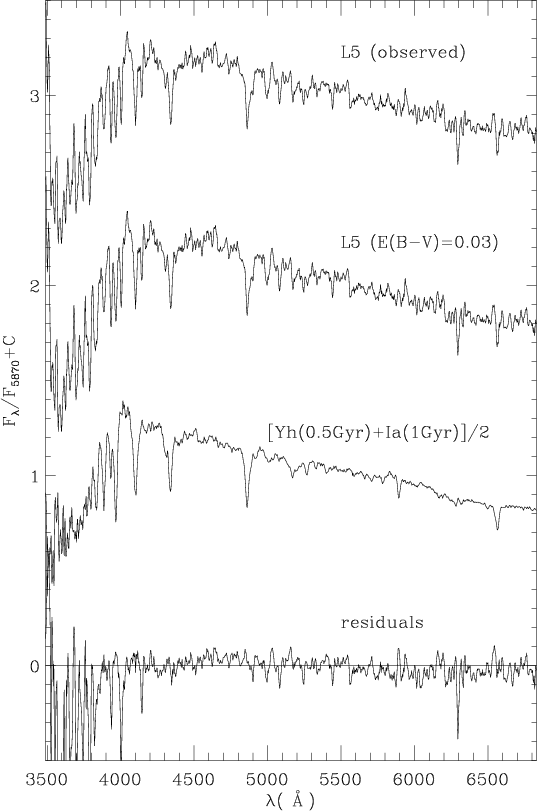
younger age. Figure 1 shows the best template combination for L 5, i.e., the
average of Ia and Yh templates with a reddening of
E(B-V) = 0.03. This is the
cluster with the most discrepant age in the sample with respect to the
published cluster ages. We did not find any reason for such difference, apart
from a relative low S/N ratio in the observed spectrum.
for its significantly
younger age. Figure 1 shows the best template combination for L 5, i.e., the
average of Ia and Yh templates with a reddening of
E(B-V) = 0.03. This is the
cluster with the most discrepant age in the sample with respect to the
published cluster ages. We did not find any reason for such difference, apart
from a relative low S/N ratio in the observed spectrum.
Bica et al. (1986) derived for K 5 the following parameters from integrated
photometry of the H
and G band absorption features:
![$[Z/Z_\odot] = -1.1
\pm 0.2$](/articles/aa/full/2005/34/aa2982-05/img53.gif) and
and
 Gyr, while the recent study by Piatti et al. (2005)
yields
Gyr, while the recent study by Piatti et al. (2005)
yields
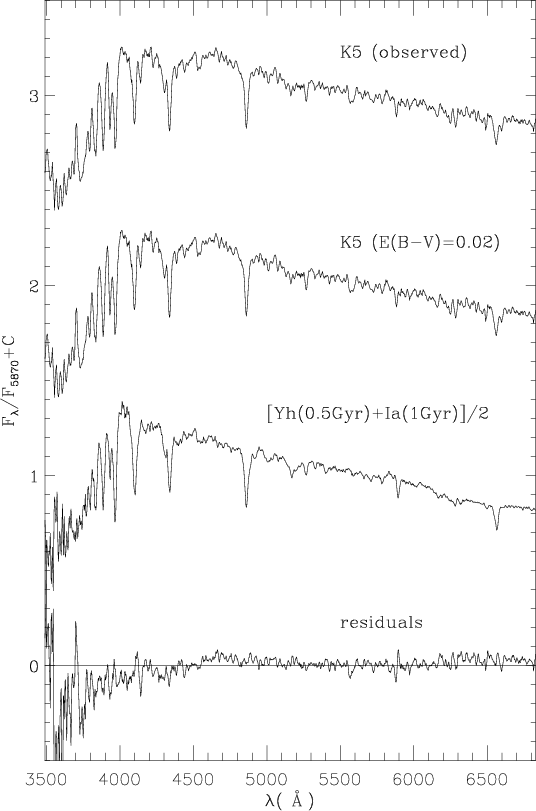
![${\rm [Fe/H]} = -0.6$](/articles/aa/full/2005/34/aa2982-05/img55.gif) and t = 2.0 Gyr. The template method estimate
for K 5 age is t = 0.8 Gyr, according to its spectral resemblance to an
average of templates Ia and Yh, after applying a reddening correction of
E(B-V)
= 0.02 (Fig. 2). Its metallicity has been corrected to
and t = 2.0 Gyr. The template method estimate
for K 5 age is t = 0.8 Gyr, according to its spectral resemblance to an
average of templates Ia and Yh, after applying a reddening correction of
E(B-V)
= 0.02 (Fig. 2). Its metallicity has been corrected to
![${\rm [Fe/H]}=-0.5$](/articles/aa/full/2005/34/aa2982-05/img56.gif) ,
following an age revision on the Piatti et al. (2005) value.
,
following an age revision on the Piatti et al. (2005) value.
Rich et al. (1984) determined an age of 5-8 Gyr from BR photometry and isochrone
fitting. K 3 was included in the integrated photometric study by Bica et al. (1986),
who derived  10 Gyr and
![$[Z/Z_{\odot}] = -1.5 \pm 0.2$](/articles/aa/full/2005/34/aa2982-05/img58.gif) .
Mighell et al. (1998)
obtained
.
Mighell et al. (1998)
obtained
![${\rm [Fe/H]} = -1.16 \pm 0.09$](/articles/aa/full/2005/34/aa2982-05/img59.gif) ,
,
 Gyr and E(B-V) = 0.0
from HST observations and morphological parameters defined in the CMD. More
recently, Brocato et al. (2001) presented a HST CMD of K 3 making available its
photometry, on which we have superimposed Padova isochrones (Girardi et al. 2002) to
obtain essentially the same parameters as those derived by Mighell et al. (1998).
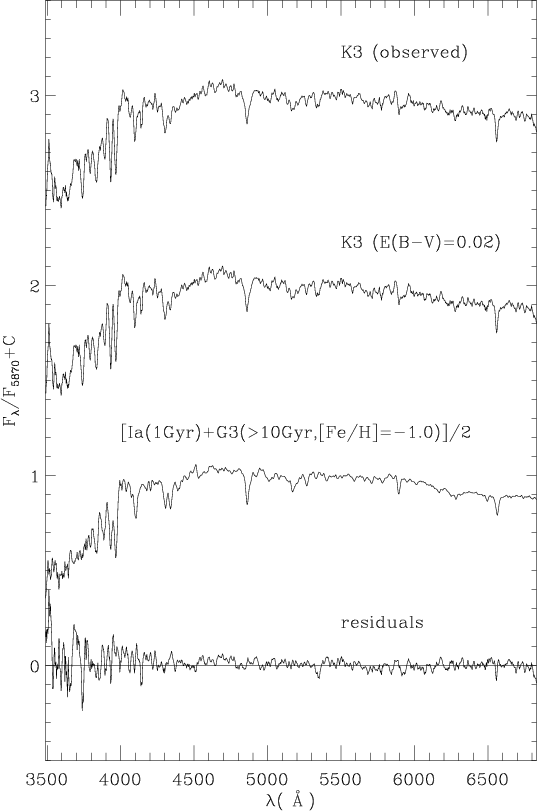
In the present study, an intermediate age for K 3 is confirmed, being
this the oldest cluster in the present sample. The template matching method
gives for this cluster 7 Gyr as a result of averaging the G3 and Ia
templates (Fig. 3). Both age and metallicity obtained in the present analysis
show good agreement with results from previous studies.
Gyr and E(B-V) = 0.0
from HST observations and morphological parameters defined in the CMD. More
recently, Brocato et al. (2001) presented a HST CMD of K 3 making available its
photometry, on which we have superimposed Padova isochrones (Girardi et al. 2002) to
obtain essentially the same parameters as those derived by Mighell et al. (1998).
In the present study, an intermediate age for K 3 is confirmed, being
this the oldest cluster in the present sample. The template matching method
gives for this cluster 7 Gyr as a result of averaging the G3 and Ia
templates (Fig. 3). Both age and metallicity obtained in the present analysis
show good agreement with results from previous studies.
From CCD BV photometry selected for an inner region (
 )
of
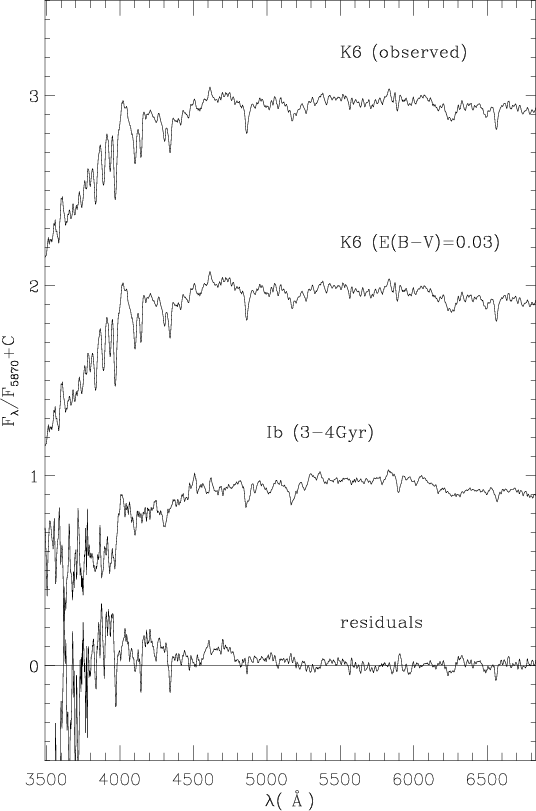
K 6, Matteucci et al. (2002) derived an age of 1-1.3 Gyr for this cluster. The spectrum
comparison leads to a match of K 6 spectrum with the template Ib (3-4 Gyr),
combined with a reddening correction of
E(B-V) = 0.03 (Fig. 4). However, a
smaller age is suggested by the EW method, being t = 1.6 Gyr the final
adopted value. By fitting Padova isochrones (Girardi et al. 2002) to the CMD data of
Matteucci et al. (2002) and assuming the above mentioned age and the apparent distance
modulus
(m-M) = 19 (Cioni et al 2000), an estimate of the cluster metallicity
was also obtained, i.e.,
.
)
of
K 6, Matteucci et al. (2002) derived an age of 1-1.3 Gyr for this cluster. The spectrum
comparison leads to a match of K 6 spectrum with the template Ib (3-4 Gyr),
combined with a reddening correction of
E(B-V) = 0.03 (Fig. 4). However, a
smaller age is suggested by the EW method, being t = 1.6 Gyr the final
adopted value. By fitting Padova isochrones (Girardi et al. 2002) to the CMD data of
Matteucci et al. (2002) and assuming the above mentioned age and the apparent distance
modulus
(m-M) = 19 (Cioni et al 2000), an estimate of the cluster metallicity
was also obtained, i.e.,
.
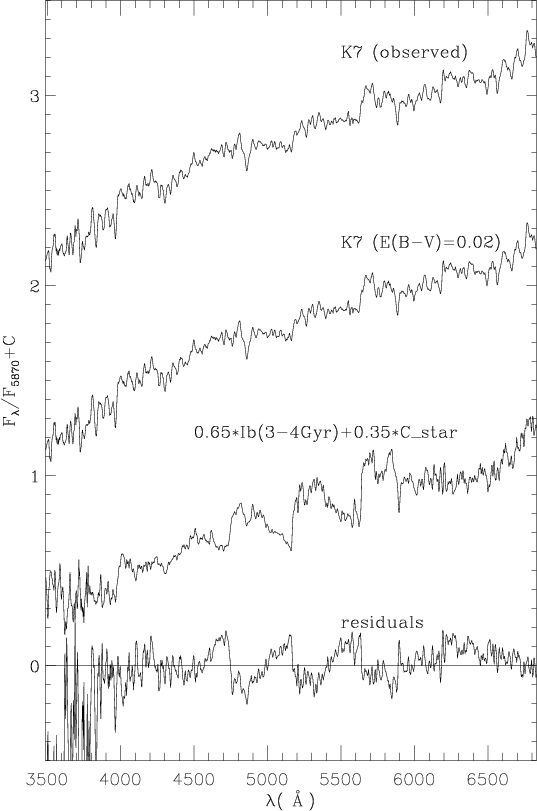
Mould et al. (1992) carried out CCD BR photometry of K 7 obtaining
 Gyr by isochrone fitting with
E(B-V) = 0.04. The template spectrum Ib
(3-4 Gyr) was initially tried as a match to the K 7 spectrum, but its redder
colour cannot be accounted for by a large reddening correction exclusively.
Mould et al. (1992) pointed out the presence of two carbon stars close to the cluster
centre, which are the probable contributors to the red appearance of its
integrated spectrum. In order to check whether this is the case, a combination
of the Ib spectrum with a carbon star spectrum taken from Barnbaum et al. (1996) spectral
library was tried. Specifically, the spectrum of the nearly solar metallicity
carbon star BM Gem (Abia & Isern 2000) was used in the analysis. According to our
observations, in the cluster spatial profile the presence of the bright star
stands out over the bulk of the cluster light. We then extracted the integrated
spectrum of the cluster plus the carbon star and of the carbon star spectrum
alone. The flux ratio at 5870 Å between the carbon star spectrum and
the integrated one turned out to be 0.35. As a matter of fact, there is a good
match to K 7 spectrum if the template Ib is combined with the carbon star in
a proportion of 65% and 35% of the total light at 5870 Å, respectively, and
the resulting spectrum is reddening corrected by
E(B-V) = 0.02 (Fig. 5).
Relatively large residual spectral differences still remain between the
spectra, which may be attributed to the higher metallicity of the carbon star
employed as template. No metallicity has been estimated for this cluster.
Gyr by isochrone fitting with
E(B-V) = 0.04. The template spectrum Ib
(3-4 Gyr) was initially tried as a match to the K 7 spectrum, but its redder
colour cannot be accounted for by a large reddening correction exclusively.
Mould et al. (1992) pointed out the presence of two carbon stars close to the cluster
centre, which are the probable contributors to the red appearance of its
integrated spectrum. In order to check whether this is the case, a combination
of the Ib spectrum with a carbon star spectrum taken from Barnbaum et al. (1996) spectral
library was tried. Specifically, the spectrum of the nearly solar metallicity
carbon star BM Gem (Abia & Isern 2000) was used in the analysis. According to our
observations, in the cluster spatial profile the presence of the bright star
stands out over the bulk of the cluster light. We then extracted the integrated
spectrum of the cluster plus the carbon star and of the carbon star spectrum
alone. The flux ratio at 5870 Å between the carbon star spectrum and
the integrated one turned out to be 0.35. As a matter of fact, there is a good
match to K 7 spectrum if the template Ib is combined with the carbon star in
a proportion of 65% and 35% of the total light at 5870 Å, respectively, and
the resulting spectrum is reddening corrected by
E(B-V) = 0.02 (Fig. 5).
Relatively large residual spectral differences still remain between the
spectra, which may be attributed to the higher metallicity of the carbon star
employed as template. No metallicity has been estimated for this cluster.
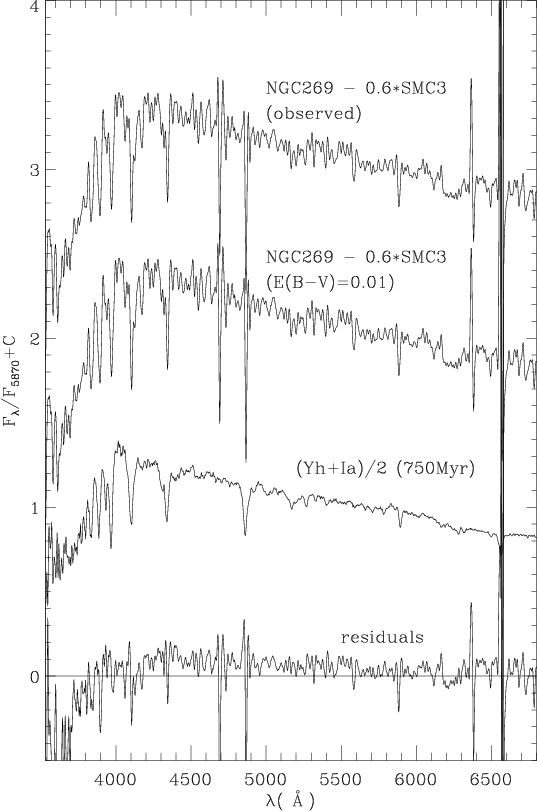
This is an interesting case in which there is a bright emission line star
contributing significantly to the cluster integrated spectrum. Such a
situation, which we had found in previous cluster observations
(e.g. Santos et al. 1995), has been successfully treated by subtracting the star
spectrum from the total integrated one, leaving a spectrum which better
represents the cluster average population. Although such a procedure introduced
noise in the resulting spectrum, it allowed us to estimate the cluster age
using the template matching method. The bright star in NGC 269 spectrum is
SMC 3, a symbiotic nova composed by a M0 giant and a white dwarf orbiting
each other in a period of 4 years (Kahabka 2004). Its spectrum
was published in the spectrophotometric atlas of Munari & Zwitter (2002). The OGLE database
includes a CMD for this cluster (OGLE-CL-SMC0046), although an age estimate
was not provided there (Pietrzynski & Udalski 1999; Pietrzynski et al. 1998). This CMD shows that SMC 3 is
2 mag brighter in V than the next bright star in the cluster. In
detail, the procedure adopted was to subtract the total integrated spectrum
from a scaled SMC 3 spectrum by assuming that all the emission present in the
integrated spectrum is due to SMC 3. In this manner, the difference between
the spectra which minimizes the emission line residuals was obtained
when the star contributes with 60% of the total flux at 5870 Å. Since the
spectra were observed at different epochs and SMC 3 is variable, the small but
clearly visible residuals reflect such irregularities. Another point that
allows one to check the reliability of this procedure is the fact that
absorption molecular bands present in SMC 3 spectrum almost disappear in the
resulting spectrum. The subtracted spectrum was then submitted to the template
matching method (Fig. 7), being similar to an average of the templates Yh and
Ia (750 Myr). Such an age is in agreement with the clusters SWB type III-IV
(Searle et al. 1980). González et al. (2004) have assigned an age of 500 Myr to NGC 269, based
on the integrated colour parameterization ("s'' parameter) by Elson & Fall (1988).
However, it should be kept in mind that González et al. (2004) age ranking is intended
to group clusters of similar integrated properties and their age groups
encompass wide age ranges.
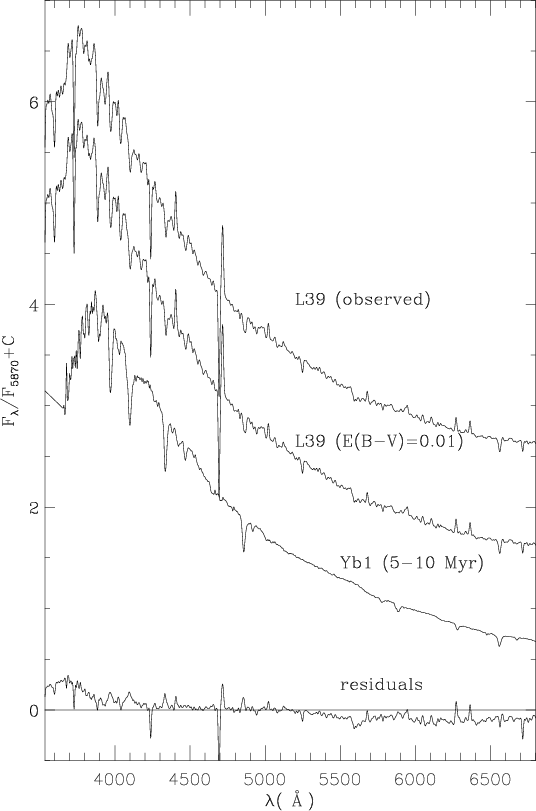
The OGLE database includes a CMD for this cluster (OGLE-CL-SMC0054), with an
isochrone based age estimate of
 Myr (Pietrzynski & Udalski 1999; Pietrzynski et al. 1998). A new
age estimate based both on a different areal extraction of the same data and
on the same isochrones revises it down to
Myr (Pietrzynski & Udalski 1999; Pietrzynski et al. 1998). A new
age estimate based both on a different areal extraction of the same data and
on the same isochrones revises it down to  Myr (de Oliveira et al. 2000).
According to González et al. (2004), L 39 is similar to 50 Myr old clusters. We have
found that the cluster is
Myr (de Oliveira et al. 2000).
According to González et al. (2004), L 39 is similar to 50 Myr old clusters. We have
found that the cluster is  Myr old, its steep continuum resembling
those of L 51 and L 66 (Fig. 8).
Myr old, its steep continuum resembling
those of L 51 and L 66 (Fig. 8).
Piatti et al. (2001) obtained CCD Washington photometry for this cluster deriving
![${\rm [Fe/H]} = -1.45 \pm 0.13$](/articles/aa/full/2005/34/aa2982-05/img66.gif) and
and
 Gyr, with a reddening within
the range
0.06 < E(B-V) < 0.16. In the present analysis, we have not
applied the EW method to derive parameters for K 28 because its integrated
spectrum has low S/N ratio, although it still seems to be adequate to the
template matching method. Indeed, using the latter, we have
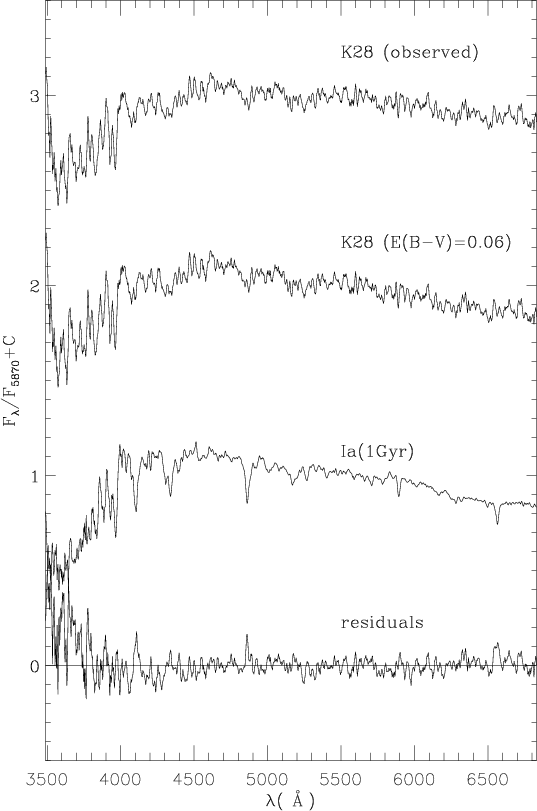
got a good match for the template Ia (1 Gyr) combined with a reddening of
E(B-V) = 0.06 (Fig. 9). By revising down the age obtained by Piatti et al. (2001), a
corrected metallicity of
Gyr, with a reddening within
the range
0.06 < E(B-V) < 0.16. In the present analysis, we have not
applied the EW method to derive parameters for K 28 because its integrated
spectrum has low S/N ratio, although it still seems to be adequate to the
template matching method. Indeed, using the latter, we have
got a good match for the template Ia (1 Gyr) combined with a reddening of
E(B-V) = 0.06 (Fig. 9). By revising down the age obtained by Piatti et al. (2001), a
corrected metallicity of
![${\rm [Fe/H]} = -1.0$](/articles/aa/full/2005/34/aa2982-05/img68.gif) was derived.
was derived.
 73 Myr
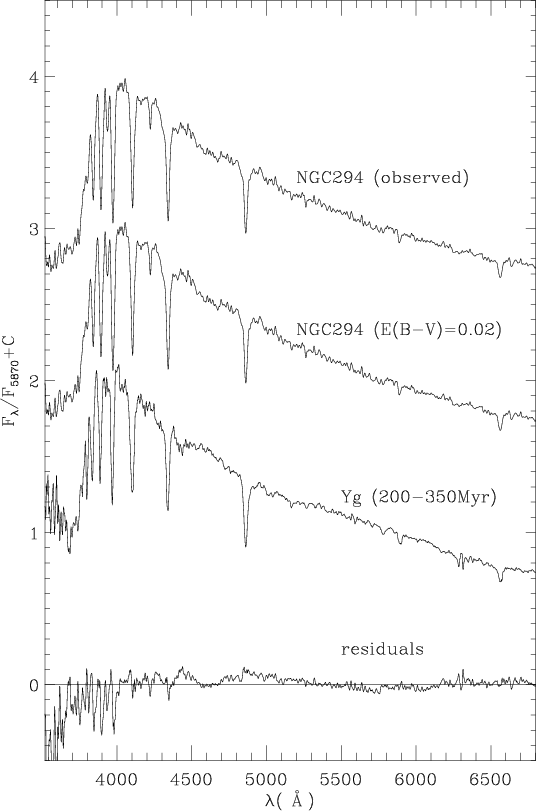
(Pietrzynski & Udalski 1999; Pietrzynski et al. 1998). The study published by de Oliveira et al. (2000) gives 300
50
Myr. Since there is no SWB type assigned to this cluster, González et al. (2004)
included NGC 294 in their 1 Gyr cluster group due to the similarity of its
integrated colours to the colours of SWB IV clusters. This age seems to be
in disagreement with the previously mentioned works and also with ours, which
gives
73 Myr
(Pietrzynski & Udalski 1999; Pietrzynski et al. 1998). The study published by de Oliveira et al. (2000) gives 300
50
Myr. Since there is no SWB type assigned to this cluster, González et al. (2004)
included NGC 294 in their 1 Gyr cluster group due to the similarity of its
integrated colours to the colours of SWB IV clusters. This age seems to be
in disagreement with the previously mentioned works and also with ours, which
gives
 Myr (Fig. 10). Visible cluster images do not show
any bright star in the cluster core, and therefore the age discrepancy cannot
be due to sampling effects.
Myr (Fig. 10). Visible cluster images do not show
any bright star in the cluster core, and therefore the age discrepancy cannot
be due to sampling effects.
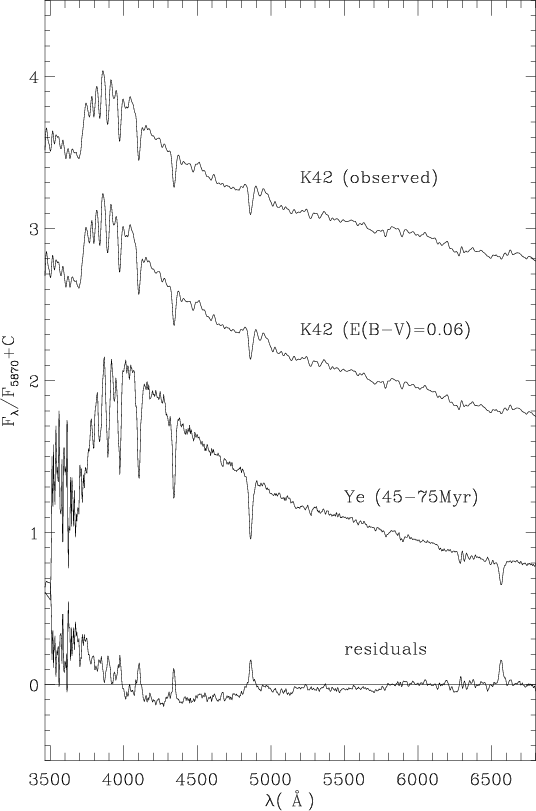
 Myr (Fig. 11).
 Myr (Pietrzynski & Udalski 1999; Pietrzynski et al. 1998). The
study by de Oliveira et al. (2000) obtained for it a younger age,
Myr (Pietrzynski & Udalski 1999; Pietrzynski et al. 1998). The
study by de Oliveira et al. (2000) obtained for it a younger age,  Myr, which
seems too low compared to our estimate,
Myr, which
seems too low compared to our estimate,
 Myr (Fig. 12).
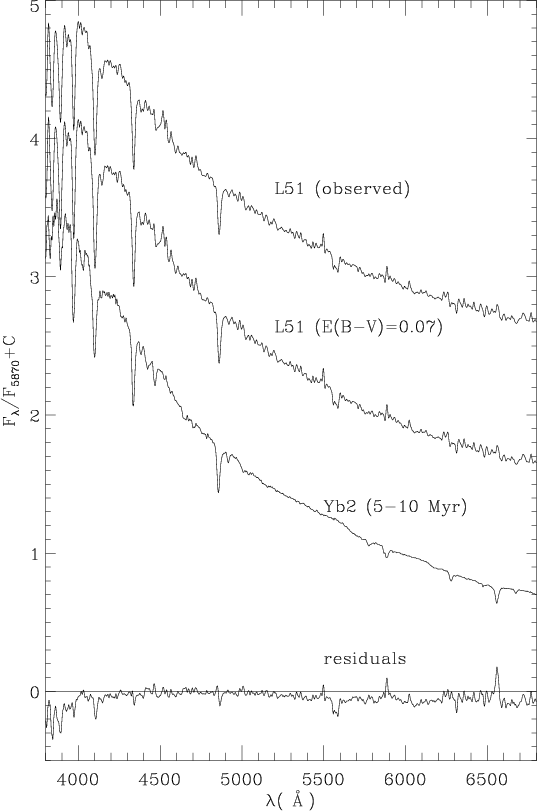
4.6 Myr (Pietrzynski & Udalski 1999; Pietrzynski et al. 1998). This result
is comparable to our age estimate of t = 15
10 Myr (Fig. 13).
The spectral features and continuum slope of NGC 411 are comparable to the
template spectrum Ia (1 Gyr), when a reddening correction of E(B-V) = 0.03
is applied to the observed spectrum (Fig. 14). Although this age estimate is
lower than that obtained by Bica et al. (1986), i.e.,
 Gyr (and
![$[Z/Z_{\odot}] = -1.3 \pm 0.2$](/articles/aa/full/2005/34/aa2982-05/img76.gif) ), the present result agrees with the study by
Leonardi & Rose (2003) involving integrated spectroscopy at a higher resolution who
obtained
), the present result agrees with the study by
Leonardi & Rose (2003) involving integrated spectroscopy at a higher resolution who
obtained
 Gyr and
![${\rm [Fe/H]} = -0.43 \pm 0.14$](/articles/aa/full/2005/34/aa2982-05/img78.gif) .
In addition,
two studies involving isochrone fittings to CMDs yield similar results:
Da Costa & Mould (1986) obtain
.
In addition,
two studies involving isochrone fittings to CMDs yield similar results:
Da Costa & Mould (1986) obtain
 Gyr and
![${\rm [Fe/H]} = -0.9 \pm 0.3$](/articles/aa/full/2005/34/aa2982-05/img80.gif) ,
adopting a reddening of
E(B-V) = 0.04 and Alves & Sarajedini (1999) determined
,
adopting a reddening of
E(B-V) = 0.04 and Alves & Sarajedini (1999) determined
 Gyr and
![${\rm [Fe/H]} = -0.68 \pm 0.07$](/articles/aa/full/2005/34/aa2982-05/img82.gif) ,
based on HST data. By using CCD
Washington photometry, a metallicity of
,
based on HST data. By using CCD
Washington photometry, a metallicity of
![${\rm [Fe/H]} = -0.84$](/articles/aa/full/2005/34/aa2982-05/img83.gif) ,
which agrees with
the previous, more recent estimates, was derived for this cluster by
Piatti et al. (2002b).
,
which agrees with
the previous, more recent estimates, was derived for this cluster by
Piatti et al. (2002b).
0.2 Gyr by means of isochrone fitting to the cluster HST CMD, and by
Durand et al. (1984), who estimated
Gyr by using isochrone fitting to
photographic CMDs. The template matching method yields t = 0.75 Gyr (Fig. 15), but when this value is combined with an independent estimate from the
EW method, the age converges to
Gyr, in close agreement with
the result found by Durand et al. (1984). This age is consistent with
(Piatti et al. 2002b).
Myr, which results from the independent methods employed
in the present work.
 Myr was adopted, which is consistent with
![${\rm [Fe/H]} = -0.23$](/articles/aa/full/2005/34/aa2982-05/img85.gif) (Piatti et al. 2002b).
(Piatti et al. 2002b).
Figure 19 shows the positions of the studied clusters (crossed boxes) relative to
the SMC optical centre (cross), assumed to be placed (J2000) at: 00 52
52 45
45 ,
-72
49
43
(Crowl et al. 2001). For the sake of
completeness, we included 19 additional clusters (triangles) taken from Table 4
of Piatti et al. (2002b) and studied by Piatti et al. (2005), which have ages and
metallicities put onto a homogeneous scale. The collection of these 37 objects
constitutes at the present time the largest sample of SMC clusters used to
address the issue of the galaxy chemical evolution.
Thus, the results derived from this sample are valuable in the sense
that they give us the opportunity to have some clues about the galaxy history,
which obviously needs later confirmation from a larger database.
Besides the SMC Bar,
represented by a straight line in Fig. 19, we traced two ellipses centred at
the SMC optical centre with their major axes aligned with the galaxy Bar. We
adopted a b/a ratio which equals to 1/2. The semi-major axes of the ellipses
drawn in the figure have 2
and 4
,
respectively. Note that this
elliptical geometry matches the space distribution of clusters more properly
than a circular one.
,
-72
49
43
(Crowl et al. 2001). For the sake of
completeness, we included 19 additional clusters (triangles) taken from Table 4
of Piatti et al. (2002b) and studied by Piatti et al. (2005), which have ages and
metallicities put onto a homogeneous scale. The collection of these 37 objects
constitutes at the present time the largest sample of SMC clusters used to
address the issue of the galaxy chemical evolution.
Thus, the results derived from this sample are valuable in the sense
that they give us the opportunity to have some clues about the galaxy history,
which obviously needs later confirmation from a larger database.
Besides the SMC Bar,
represented by a straight line in Fig. 19, we traced two ellipses centred at
the SMC optical centre with their major axes aligned with the galaxy Bar. We
adopted a b/a ratio which equals to 1/2. The semi-major axes of the ellipses
drawn in the figure have 2
and 4
,
respectively. Note that this
elliptical geometry matches the space distribution of clusters more properly
than a circular one.
When describing the cluster age and metallicity distributions, the interpretation of the results can depend on the spatial framework used. For example, one can adopt as a reference system the one corresponding to the right ascension and declination axes, or that centred on the galaxy with a coordinate axis parallel to the Bar. Thus, if there existed an abundance gradient from the centre and along the SMC Bar, its projection to the right ascension and declination axes would appear steeper. Similarly, it could be possible to affirm the existence of features which are actually the result of projection effects on these directions. By considering the distances of the clusters from the SMC centre instead of their projections onto the right ascension and declination axes, the genuine cluster age and metal abundance variations can be traced. Moreover, although it may be advantageous to plot ages and metallicities as a function of the distance from the galaxy centre, these plottings can result even more meaningful when the spatial variable reflects the flattening of the system. In the case of the SMC, this can be accomplished by using ellipses instead of circles around the SMC centre.
In order to examine how the cluster ages vary in terms of the distances from
the SMC centre, we computed for each cluster the value of the semi-major axis
(a) that an ellipse would have if it were centred at the SMC centre, had a
b/a ratio of 1/2, and one point of its trajectory coincided with the cluster
position. Figure 20 shows the result obtained, in which we used the same symbols
as in Fig. 19. The figure reveals that there are very few clusters younger than
4 Gyr in the outer disk, defined as the portion of the SMC disk with a  3.5
.
Conversely, it would appear that there are very few clusters older
than 4 Gyr in the inner disk. Furthermore, in the inner disk, the older the
clusters, the larger their corresponding semi-major axes, which astonishingly
suggests the possibility that the clusters were formed outside in, like in a
relatively rapid collapse. As far as we are aware, this is the first time such
an evidence is presented.
3.5
.
Conversely, it would appear that there are very few clusters older
than 4 Gyr in the inner disk. Furthermore, in the inner disk, the older the
clusters, the larger their corresponding semi-major axes, which astonishingly
suggests the possibility that the clusters were formed outside in, like in a
relatively rapid collapse. As far as we are aware, this is the first time such
an evidence is presented.
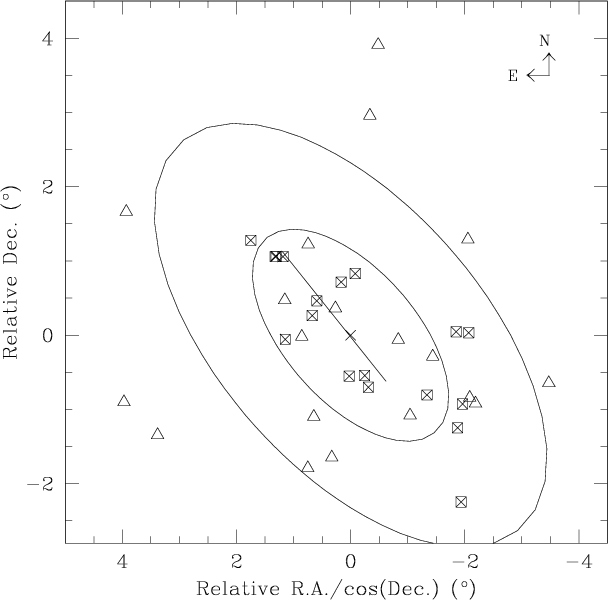 |
Figure 19:
Positions of the eighteen studied cluster fields (crossed boxes)
and of the nineteen additional clusters taken from Piatti et al. (2002b) and
Piatti et al. (2005) (triangles) with relation to the SMC bar (straight line) and
optical centre (cross). Two ellipses of semi-major axes of 2
and
4
(b/a = 1/2), aligned along the SMC Bar, are
also drawn. |
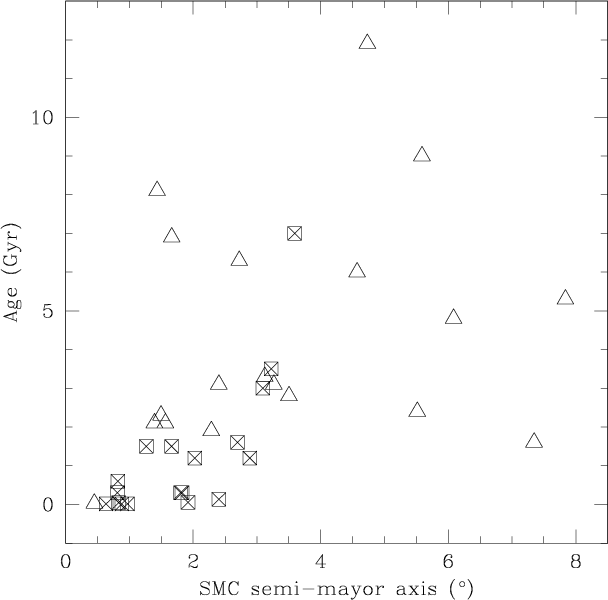 |
Figure 20: Cluster ages versus semi-major axes of ellipses with b/a = 1/2, centred at the SMC optical centre, aligned along the SMC Bar, that pass through the cluster positions. Symbols are as in Fig. 19. |
Harris & Zaritsky (2004) recently determined the global star
formation and chemical enrichment history of the SMC within the inner
4
4.5
area of the main body, based on UBVI photometry
of 6 million
stars from their Magellanic Clouds Photometric Survey (Zaritsky et al. 1997).
Among other results, they found that there was a rise in the mean
star formation rate during the most recent 3 Gyr punctuated by bursts at
2.5 Gyr, 400 Myr, and 60 Myr. The two older events coincide with past
perigalactic passages of the SMC around the Milky Way
(see, e.g., Lin et al. 1995). In addition, Harris & Zaritsky (2004) derived a
chemical enrichment history
in agreement with the age-metallicity relation of the SMC clusters
and field variable stars. This chemical enrichment history is consistent
with the model of Pagel & Tautvaisiene (1999), lending further support to
the presence of a long quiescent period (3 < age(Gyr) < 8.4) in the SMC
early history. Piatti et al. (2005) confirmed that 2.5 Gyr ago the SMC
reached the peak of a burst of cluster formation, which corresponds to a
very close encounter with the LMC according to recent dynamic models of
Bekki et al. (2004). It would seem reasonable, therefore, to accept that
the burst which took place 2 Gyr ago formed both clusters and stars
simultaneously. Particularly, the 2.5 Gyr star burst appears to have an
annular structure and an inward propagation spanning 1 Gyr (Harris & Zaritsky 2004).
Piatti et al. (2005) studied 10 clusters mainly located in the southern half of the
SMC with ages and metallicities in the ranges 1.5-4 Gyr and
![$-1.3 < {\rm [Fe/H]}
< -0.6$](/articles/aa/full/2005/34/aa2982-05/img92.gif) ,
respectively. They also favoured a bursting cluster formation
history as opposed to a continuous one for the SMC. The age-position relation
shown in Fig. 20 for clusters younger than 4 Gyr adds, if it is confirmed, a
new piece of evidence to the bursting conception of cluster formation. In the
case of the cluster formation episode peaking at 2.5 Gyr
(Piatti et al. 2005), the burst could have triggered the formation process which
continued producing clusters from the outermost regions to the innermost
ones in the inner SMC disk. On this basis, the inner disk could have been
formed during this period.
,
respectively. They also favoured a bursting cluster formation
history as opposed to a continuous one for the SMC. The age-position relation
shown in Fig. 20 for clusters younger than 4 Gyr adds, if it is confirmed, a
new piece of evidence to the bursting conception of cluster formation. In the
case of the cluster formation episode peaking at 2.5 Gyr
(Piatti et al. 2005), the burst could have triggered the formation process which
continued producing clusters from the outermost regions to the innermost
ones in the inner SMC disk. On this basis, the inner disk could have been
formed during this period.
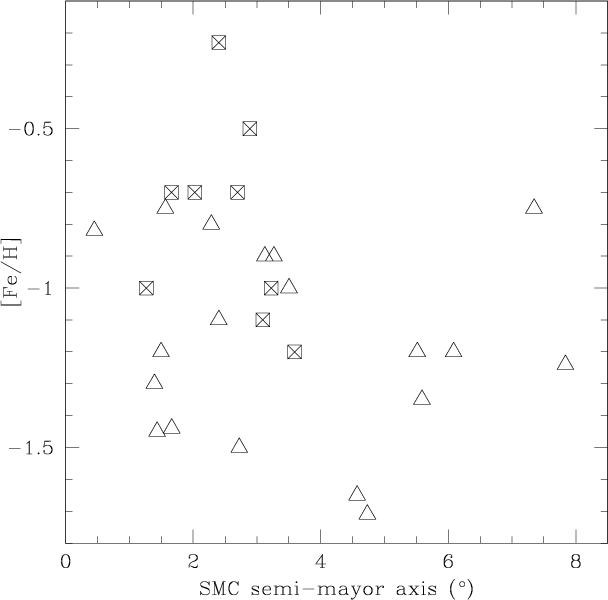 |
Figure 21: Cluster metallicity versus semi-major axes of ellipses with b/a = 1/2, centred at the SMC optical centre, aligned along the SMC Bar, that pass through the cluster positions. Symbols are as in Fig. 19. |
The distribution of the cluster metal abundances as a function of the distances
from the SMC centre is depicted in Fig. 21, where we used the same symbols as
in Fig. 19. Note that in the outer disk, there are no clusters with
iron-to-hydrogen ratios larger than
,
with only one exception. On
the other hand, the inner disk is shared by both metal-poor and metal-rich
clusters, the averaged metallicity being clearly larger
than that for the outer disk. We thus confirm the existence of a metal
abundance gradient for the SMC disk, in the sense that the farther a cluster
from the galaxy centre, the poorer its metal content. However, all the clusters
with
![${\rm [Fe/H]} > -1.2$](/articles/aa/full/2005/34/aa2982-05/img94.gif) in the inner disk were formed during the last 4 Gyr,
whereas the metal-poor ones are as old as those in the outer disk (see Fig. 20). Consequently, the abundance gradient seems to reflect the combination
between an older and more metal-poor population of clusters spread
throughout the SMC and a younger and metal-richer one mainly formed in the
inner disk. Note that some few clusters were also formed in the inner disk
with
in the inner disk were formed during the last 4 Gyr,
whereas the metal-poor ones are as old as those in the outer disk (see Fig. 20). Consequently, the abundance gradient seems to reflect the combination
between an older and more metal-poor population of clusters spread
throughout the SMC and a younger and metal-richer one mainly formed in the
inner disk. Note that some few clusters were also formed in the inner disk
with
![${\rm [Fe/H]} \sim -1.2$](/articles/aa/full/2005/34/aa2982-05/img95.gif) (Fig. 21). We also recall that the present cluster
sample follows the age-metallicity relation discussed in a previous work
(Piatti et al. 2005, see their Fig. 6).
(Fig. 21). We also recall that the present cluster
sample follows the age-metallicity relation discussed in a previous work
(Piatti et al. 2005, see their Fig. 6).
E(B-V) colour excesses were derived for the present cluster sample by
interpolation between the extinction maps published by Burstein & Heiles (1982) and by
Schlegel et al. (1998). Using template spectra with well determined cluster properties
and equivalent widths (EWs) of the Balmer and several metallic lines, we
determined ages and, in some cases, metallicities as well. For the SMC
clusters HW 8 and IC 1641, the ages have been determined for the first time,
while for the rest of the studied sample the ages derived from the template
matching and EW methods exhibit very good agreement. Metal abundances have been
derived for five clusters (L 5, K 5, K 3, K 6 and K 28), while we have
adopted averaged metallicities from published values for other 4 clusters
(K 7, NGC 411, NGC 419 and NGC 458). By combining the present cluster
sample with 19 additional SMC clusters with ages and metallicities in a
homogeneous scale, we analise the age and metallicity distributions in
different regions of the SMC to probe the galaxy chemical enrichment and its
spatial distribution. Very few clusters younger than 4 Gyr are found in the
outer disk and, conversely, very few clusters older than 4 Gyr lie in the inner
disk. Furthermore, the present age-position relation for the SMC clusters in
the inner disk suggests not only the possibility that the clusters were formed
outside in, like in a relatively rapid collapse, but also that the inner disk
itself could have been formed during a bursting formation mechanism, with an
important cluster formation event centred at 2.5 Gyr.
According to the recent
results obtained by Harris & Zaritsky (2004), this cluster burst, which
occurred 2.5 Gyr ago, is clearly related to an episode of enhanced star
formation having taken place about the same time ago.
Evidence is also
presented on the existence of a radial metal abundance gradient for the SMC
disk, which reflects the combination between an older and more metal-poor
population of clusters distributed throughout the SMC and a younger and
metal-richer one mainly formed in the inner disk.
Acknowledgements
We are grateful for the use of the CCD and data acquisition system at CASLEO, supported under US National Science Foundation (NSF) grant AST-90-15827. This work is based on observations made at CTIO, which is operated by AURA, Inc., under cooperative agreement with the NSF. We thank the staff members and technicians at CASLEO and CTIO for their kind hospitality and assistance during the observing runs. We gratefully acknowledge financial support from the Argentinian institutions CONICET, Agencia Nacional de Promoción Científica y Tecnológica (ANPCyT) and Agencia Córdoba Ciencia. We thank Dr. Munari for sending us the spectrum of SMC 3. This work was also partially supported by the Brazilian institution FAPEMIG and CNPq.