![[*]](/icons/foot_motif.gif)
A&A 440, 151-161 (2005)
DOI: 10.1051/0004-6361:20041836
J. Hatchell1,2 - J. S. Richer3 - G. A. Fuller4 - C. J. Qualtrough3 - E. F. Ladd5 - C. J. Chandler6
1 - Max-Planck-Institut für Radioastronomie, Auf dem
Hügel 69, 53121 Bonn, Germany
2 - School of Physics, University of Exeter, Stocker Road, Exeter
EX4 4QL, UK
3 - Cavendish Laboratory,
Madingley Road,
Cambridge CB3 0HE, UK
4 - Department of Physics, UMIST, PO Box 88, Manchester M60 1QD, UK
5 - Department of Physics, Bucknell University, Lewisburg, PA 17837, USA
6 - National Radio Astronomy Observatory, PO Box O, Socorro, NM
87801, USA
Received 12 August 2004 / Accepted 4 May 2005
Abstract
We present a complete survey of current star formation in
the Perseus molecular cloud, made at 850 and 450
 with
SCUBA at the JCMT. Covering 3 deg2, this submillimetre continuum
survey for protostellar activity is second in size only to that of
with
SCUBA at the JCMT. Covering 3 deg2, this submillimetre continuum
survey for protostellar activity is second in size only to that of
 Ophiuchus (Johnstone et al. 2004, ApJ, 611, L45). Complete above 0.4
  (
( detection in a 14'' beam), we detect a total of 91 protostars and prestellar cores. Of these, 80% lie in clusters,
representative of star formation across the Galaxy. Two of the groups
of cores are associated with the young stellar clusters IC 348 and
NGC 1333, and are consistent with a steady or reduced star formation
rate in the last 0.5 Myr, but not an increasing one. In Perseus,
40-60% of cores are in small clusters (<50 )
and isolated
objects, much more than the 10% suggested from infrared studies.
Complementing the dust continuum, we present a C18O map of the
whole cloud at 1' resolution. The gas and dust show filamentary
structure of the dense gas on large and small scales, with the
high column density filaments breaking up into clusters of cores.
The filament mass per unit length is 5-11 per 0.1 pc.
Given these filament masses, there is no requirement for substantial
large scale flows along or onto the filaments in order to gather
sufficient material for star formation. We find that the probability
of finding a submillimetre core is a strongly increasing function
of column density, as measured by C18O integrated intensity,
detection in a 14'' beam), we detect a total of 91 protostars and prestellar cores. Of these, 80% lie in clusters,
representative of star formation across the Galaxy. Two of the groups
of cores are associated with the young stellar clusters IC 348 and
NGC 1333, and are consistent with a steady or reduced star formation
rate in the last 0.5 Myr, but not an increasing one. In Perseus,
40-60% of cores are in small clusters (<50 )
and isolated
objects, much more than the 10% suggested from infrared studies.
Complementing the dust continuum, we present a C18O map of the
whole cloud at 1' resolution. The gas and dust show filamentary
structure of the dense gas on large and small scales, with the
high column density filaments breaking up into clusters of cores.
The filament mass per unit length is 5-11 per 0.1 pc.
Given these filament masses, there is no requirement for substantial
large scale flows along or onto the filaments in order to gather
sufficient material for star formation. We find that the probability
of finding a submillimetre core is a strongly increasing function
of column density, as measured by C18O integrated intensity,
 .
This power law relation holds
down to low column density, suggesting that there is no
.
This power law relation holds
down to low column density, suggesting that there is no  threshold for star formation in Perseus, unless all the low-
submm cores can be demonstrated to be older protostars which have
begun to lose their natal molecular cloud.
threshold for star formation in Perseus, unless all the low-
submm cores can be demonstrated to be older protostars which have
begun to lose their natal molecular cloud.
Key words: stars: formation - submillimeter - dust, extinction - ISM: molecules - ISM: clouds - ISM: structure
Recent advances in submillimetre (submm) detector technology now make it possible to image entire star forming regions and detect all the protostellar and starless cores within. For the first time, we can gather statistically significant samples of stars at the earliest stages of their evolution. At the same time, theories of star formation are moving on from the formation of individual, isolated objects (e.g., Shu et al. 1987) to the formation of clusters (e.g., Mac Low & Klessen 2004). It is thus hugely important at this time to make large surveys of star formation regions to compare with the theories.
An important question which we can only address with submm surveys is where in molecular clouds stars form. This cannot be answered by looking at older populations of pre-main-sequence stars detectable in the infrared and optical because the typical velocities of the stars lead them to wander by 1 pc/Myr, and the environment in which they formed may no longer exist. Therefore we are driven to look for stars at the point of formation or shortly after, at protostellar cores and deeply embedded Class 0 objects, with ages less than or of order 104 years. With submm surveys we can relate the positions of the young protostars to the properties of the dust and gas in the molecular clouds in which they form. This has led other authors (Johnstone et al. 2004; Onishi et al. 1998) to conclude that there is an extinction or column density threshold for star formation, that is, that stars only form in the densest parts of molecular clouds. We investigate this conclusion further in this paper.
We have carried out a complete survey of star formation above 0.4
in the Perseus molecular cloud. Perseus was selected as it is known to
be forming clusters of stars and more massive stars than, e.g., Taurus.
The Perseus molecular cloud contains a total of 17 000
of gas,
estimated from
visual
extinction (Bachiller & Cernicharo 1986b). Our survey area of  3 deg2was selected to include all the moderate to high extinction material
(
3 deg2was selected to include all the moderate to high extinction material
(
 )
where star formation might occur. Imaging dust
emission at 850 and 450
with the Submillimetre Common User
Bolometer Array (SCUBA) at the James Clerk Maxwell Telescope (JCMT), we
detect all the protostars and starless cores above 0.4 /14'' beam.
Complementing the dust continuum images, we
present
molecular line (C18O J=1-0) data at 1' resolution. Thus,
we can relate the star formation activity to the underlying physical
properties of the molecular cloud and to the kinematics. By imaging a
single molecular cloud we minimise the uncertainties in derived masses,
sizes, etc., due to distance.
)
where star formation might occur. Imaging dust
emission at 850 and 450
with the Submillimetre Common User
Bolometer Array (SCUBA) at the James Clerk Maxwell Telescope (JCMT), we
detect all the protostars and starless cores above 0.4 /14'' beam.
Complementing the dust continuum images, we
present
molecular line (C18O J=1-0) data at 1' resolution. Thus,
we can relate the star formation activity to the underlying physical
properties of the molecular cloud and to the kinematics. By imaging a
single molecular cloud we minimise the uncertainties in derived masses,
sizes, etc., due to distance.
The Perseus molecular cloud is a well known star forming cloud in
the nearby Galaxy. It is associated with two clusters containing
pre-main-sequence stars: IC 348, with
an estimated age of 2 Myr (and spread of  1.5 Myr;
Luhman et al. 2003); NGC 1333,
which is less than 1 Myr in age (Lada et al. 1996; Wilking et al. 2004); and the
Per 0B2 association, which contains a B0.5 star (Steenbrugge et al. 2003)
and therefore must be less than 13 Myr in age (Meynet & Maeder 2000).
These clusters therefore all show evidence of
star formation activity within the last 107 years. The molecular
cloud itself contains a number of previously known protoclusters and
isolated protostars but until now there has been no complete census of
the current star formation activity.
1.5 Myr;
Luhman et al. 2003); NGC 1333,
which is less than 1 Myr in age (Lada et al. 1996; Wilking et al. 2004); and the
Per 0B2 association, which contains a B0.5 star (Steenbrugge et al. 2003)
and therefore must be less than 13 Myr in age (Meynet & Maeder 2000).
These clusters therefore all show evidence of
star formation activity within the last 107 years. The molecular
cloud itself contains a number of previously known protoclusters and
isolated protostars but until now there has been no complete census of
the current star formation activity.
We assume the distance to the Perseus molecular cloud to be the same as the Hipparcos distance to the embedded clusters, and use 320 pc throughout (de Zeeuw et al. 1999).
![\begin{figure}
\par\includegraphics[angle=-90,width=13cm,clip]{1836c1at.eps}\\
\includegraphics[angle=-90,width=13cm,clip]{1836c1ab.eps}
\end{figure}](/articles/aa/full/2005/34/aa1836-04/img15.gif) |
Figure 1:
a) The eastern part of the Perseus molecular cloud
complex. Top: SCUBA 850
map. The colourscale (greyscale) is from
0 to 2281 mJy/beam on a square root (flux density) scale to bring out
the low intensity features. Bottom: contours of C18O 1-0
integrated intensity at 1' resolution overlaid on 850
colourscale (greyscale). Contours are 1, 2, 4, 8, 16 K km s-1. In both maps
the black boundary marks the area mapped with SCUBA and the grey
boundary marks the area mapped in C18O (note, B5 was not mapped
in C18O). Some well-known clusters and IRAS sources are marked. |
| Open with DEXTER | |
![\begin{figure}
\par\includegraphics[angle=-90,width=17.3cm,clip]{1836c1bt.eps}\\
\includegraphics[angle=-90,width=17.3cm,clip]{1836c1bb.eps}
\end{figure}](/articles/aa/full/2005/34/aa1836-04/img16.gif) |
Figure 1:
b) The western part of the Perseus molecular cloud
complex. Top: SCUBA 850
map. The colourscale (greyscale) is from
0 to 2281 mJy/beam on a square root (flux density) scale to bring out
the low intensity features. Bottom: contours of C18O 1-0
integrated intensity at 1' resolution overlaid on 850
colourscale (greyscale). Contours are 1, 2, 4, 8, 16 K km s-1. In both maps
the black boundary marks the area mapped with SCUBA and the grey
boundary marks the area mapped in C18O (note, B5 was not mapped
in C18O). Some well-known clusters and IRAS sources are marked. |
| Open with DEXTER | |
![\begin{figure}
\includegraphics[width=17.3cm,angle=0]{1836c2.eps}
\end{figure}](/articles/aa/full/2005/34/aa1836-04/img17.gif) |
Figure 2:
SCUBA 850
maps of the a) B5, b) HH211, c) B1,
d)
L1448, e) NGC 1333, f) L1455, g) IRAS 03292+3039, h) IRAS 03282+3035
and i) IRAS 03271+3213 regions. Colourscale (greyscale) is 850
continuum
from 0 (white) to 2281 mJy/beam (black) on a square root (flux density)
scale to bring out the low intensity features. Black contours are
850
100, 200, 400, 800, 1600, 3200 mJy/beam. White contours
are 450
2, 4, 8 Jy/beam. Dark green contours (thick grey contours) are where the
C18O integrated intensity = 1 K km s-1. |
| Open with DEXTER | |
Images of Perseus were obtained at 850 and 450
using SCUBA on
the JCMT
during
20 nights between 1999 and 2003. The region selected
corresponds roughly to the
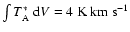 contour of the Bell labs 7m 13CO
map,
although not all of this area was mapped with both SCUBA and C18O,
while some regions outside this contour were mapped with each.
For completeness and calibration consistency we
included
the NGC 1333 region although it was mapped previously with SCUBA by
Sandell & Knee (2001). The whole region
covered
contains more than 10 000
of gas, estimated from 13CO.
Fields of size
contour of the Bell labs 7m 13CO
map,
although not all of this area was mapped with both SCUBA and C18O,
while some regions outside this contour were mapped with each.
For completeness and calibration consistency we
included
the NGC 1333 region although it was mapped previously with SCUBA by
Sandell & Knee (2001). The whole region
covered
contains more than 10 000
of gas, estimated from 13CO.
Fields of size
 were scan-mapped 6 times with each of 3
chop throws (30'', 44'' and 68'') and 2 chop directions (RA and
Dec). The data were reduced using SURF (Jenness & Lightfoot 1998). The typical rms
noise level is 35 mJy/beam at 850
.
The
weather
conditions for
the
450
observations were more variable: for the clusters
(observed in the best conditions as we expected to find sources here)
the noise level is 200 mJy/beam, but increases to >1 Jy/beam
in other regions. The 450 and 850
beam sizes are 8'' and
14'' respectively or 0.012 and 0.022 pc at the distance of Perseus.
We assume a dust emissivity of
were scan-mapped 6 times with each of 3
chop throws (30'', 44'' and 68'') and 2 chop directions (RA and
Dec). The data were reduced using SURF (Jenness & Lightfoot 1998). The typical rms
noise level is 35 mJy/beam at 850
.
The
weather
conditions for
the
450
observations were more variable: for the clusters
(observed in the best conditions as we expected to find sources here)
the noise level is 200 mJy/beam, but increases to >1 Jy/beam
in other regions. The 450 and 850
beam sizes are 8'' and
14'' respectively or 0.012 and 0.022 pc at the distance of Perseus.
We assume a dust emissivity of
 cm2 g-1(gas+dust), from Ossenkopf & Henning (1994) model 5 for icy coagulated grains and
a gas-to-dust mass ratio of 161 (
cm2 g-1(gas+dust), from Ossenkopf & Henning (1994) model 5 for icy coagulated grains and
a gas-to-dust mass ratio of 161 (
 g of dust per
H atom; Draine & Lee 1984), assuming gas is 0.89% H by number
(Churchwell et al. 1990). Our beam mass sensitivity to a 12 K core is then
0.4
at 850
,
although we also detect warmer, less massive
objects, and our beam-averaged column density sensitivity is
g of dust per
H atom; Draine & Lee 1984), assuming gas is 0.89% H by number
(Churchwell et al. 1990). Our beam mass sensitivity to a 12 K core is then
0.4
at 850
,
although we also detect warmer, less massive
objects, and our beam-averaged column density sensitivity is
 cm-2 (both limits given for
detections).
cm-2 (both limits given for
detections).
Maps of the molecular cloud in C18O J=1-0 were made in January
and December 2000 using the  array SEQUOIA on the FCRAO 14 m
telescope. The beamsize was 46'', corresponding to 0.07 pc at the
distance of Perseus. The 92 500 spectra were baselined, calibrated to
array SEQUOIA on the FCRAO 14 m
telescope. The beamsize was 46'', corresponding to 0.07 pc at the
distance of Perseus. The 92 500 spectra were baselined, calibrated to
 with an efficiency of 0.45, smoothed to 0.25 km s-1resolution, gridded and integrated
in
velocity over 0-12 km s-1 using the GILDAS software, to produce
the integrated intensity map shown in Fig. 1.
Visualisation and further analysis of the C18O were carried out
using the Karma visualisation suite (Gooch 1996).
Maps of 13CO(1-0) were also obtained during this same observing
period, the results from which will be presented at a later date.
with an efficiency of 0.45, smoothed to 0.25 km s-1resolution, gridded and integrated
in
velocity over 0-12 km s-1 using the GILDAS software, to produce
the integrated intensity map shown in Fig. 1.
Visualisation and further analysis of the C18O were carried out
using the Karma visualisation suite (Gooch 1996).
Maps of 13CO(1-0) were also obtained during this same observing
period, the results from which will be presented at a later date.
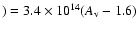
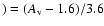
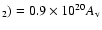
We take
N(C18O
 cm-2(Bachiller & Cernicharo 1986b), or alternatively, I(C18O
 K km s-1, assuming LTE at 12 K. We also
assume N(H+2H
K km s-1, assuming LTE at 12 K. We also
assume N(H+2H
 (Bohlin et al. 1978).
The temperature of the molecular gas is typically 10-12 K from NH3observations (Bachiller & Cernicharo 1986a), although protostellar cores are
warmer (30-50 K: Motte & André 2001; Jennings et al. 1987).
(Bohlin et al. 1978).
The temperature of the molecular gas is typically 10-12 K from NH3observations (Bachiller & Cernicharo 1986a), although protostellar cores are
warmer (30-50 K: Motte & André 2001; Jennings et al. 1987).
Our definition of a core for the purposes of this paper is a flux
peak with closed contours at the 500, 250 or 150 mJy ( )
levels. Elongated regions at those levels were divided into subpeaks at
subsidiary maxima. It should be borne in mind that it is not necessarily
straightforward to convert our observational sensitivity of 0.4 /beam
to the minimum total mass of a core identifiable in our survey as this
limit depends on the core density distribution and size: massive but
extended cores could easily remain undetected. As a consequence it is
likely we are least sensitive to the youngest and hence least centrally
condensed prestellar cores. In addition if the pressure external to a
core determines its size for a given mass, our core mass sensitivity
may vary from region to region in the cloud giving a higher limit in
the lower pressure regions away from the clusters (Johnstone et al. 2004).
We are also insensitive to weak sources in the emission wings of strong
ones and therefore underestimate the number of weak sources in clusters,
an effect which is discussed further in the next section.
)
levels. Elongated regions at those levels were divided into subpeaks at
subsidiary maxima. It should be borne in mind that it is not necessarily
straightforward to convert our observational sensitivity of 0.4 /beam
to the minimum total mass of a core identifiable in our survey as this
limit depends on the core density distribution and size: massive but
extended cores could easily remain undetected. As a consequence it is
likely we are least sensitive to the youngest and hence least centrally
condensed prestellar cores. In addition if the pressure external to a
core determines its size for a given mass, our core mass sensitivity
may vary from region to region in the cloud giving a higher limit in
the lower pressure regions away from the clusters (Johnstone et al. 2004).
We are also insensitive to weak sources in the emission wings of strong
ones and therefore underestimate the number of weak sources in clusters,
an effect which is discussed further in the next section.
The complete 850
image in Fig. 1 shows
emission from dust cores and high column density gas. In many cases the
cores already show central concentration indicative of gravitational
collapse, and must be associated with the earliest stages of star
formation.
We detect 91 dust cores with an 850
flux above 150 mJy/beam
(>
detections).
These are
listed in
Table A.1. About half of these are new submm
detections. We see from Fig. 1 that most of the
cores lie in five main groups: from east to west in the cloud, the
HH211 region, B1, NGC 1333, L1455 and L1448. Additionally, there are a
few scattered isolated cores and two cores in B5. These groups are
shown in more detail in Fig. 2, where the individual
cores and the filamentary structure connecting them are more evident.
A full inventory of the pre/protostellar population of Perseus
including estimates of individual core masses will form the basis of a
later publication, but it is clear from the submm fluxes that these
groups contain up to a few solar masses of stars.
Lower flux sources appear slightly less clustered than stronger sources
(78% of sources
with
 mJy are in clusters compared to 88%
of sources with
mJy are in clusters compared to 88%
of sources with
 mJy),
but this may be due to our core selection technique, which is less
sensitive to weak cores in clusters (see Sect. 2).
While there may be additional physical reasons why higher mass (and
therefore brighter submm) sources preferentially form in clusters,
we are not yet in a position to test this.
mJy),
but this may be due to our core selection technique, which is less
sensitive to weak cores in clusters (see Sect. 2).
While there may be additional physical reasons why higher mass (and
therefore brighter submm) sources preferentially form in clusters,
we are not yet in a position to test this.
Making a count of cores, we find that more than 80% of the cores fall
into five main clusters.
We define a core
to be in a cluster if it has 2 or more neighbours within 0.5 pc.
With our sensitivity to all cores above 0.4 ,
this definition
guarantees a mass surface density of these regions of at least 1.2
within 1 pc2. This
definition is then consistent with the Spitzer tidal stability criterion
that a stellar density >1.0 pc-3 is required in order
for a cluster not to be disrupted on a timescale 108 yr
(Spitzer 1958), although during star formation clusters
almost certainly rely on the gravitational potential of the molecular gas
for binding. The remaining few isolated cores are scattered throughout
the molecular cloud. 80% is probably a lower limit on the fraction of
star formation in clusters in Perseus because we underestimate the number
of cores in clusters due to confusion (see below). Infrared studies of
embedded clusters of pre-main-sequence stars estimate the fraction of
stars in clusters as 60-90% (L1630; Lada et al. 1991) and 50-100%
(4 nearby clouds; Carpenter 2000), which are consistent with
our findings.
This clustered mode of star formation contrasts with the Taurus region (Andre & Montmerle 1994), where isolated star formation dominates. With the majority of stars in the Galaxy forming in clusters (Lada & Lada 2003), Perseus, like Orion B (Mitchell et al. 2001) is more likely representative of typical star formation in our Galaxy.
Two of the groups of cores are spatially associated with young stellar clusters: the HH211 group can be associated with IC 348, and the NGC 1333 cores with the NGC 1333 cluster, and may be evidence for continuing star formation in these clusters. We now consider the evolution of star formation in these regions by comparing the number of stars in the clusters with the likely stellar yield of the current protostellar cores.
As our pre/protostellar core sample is incomplete below 0.4 ,
we take
this as the lower mass limit for the count. The yield (in stars above
0.4 )
of the protostellar cores can only be a rough estimate because
of the unknown multiple star fraction and the unknown final masses of the
accreting stars. We assume each core yields between 1 and 2 stars above
0.4 ;
this takes into account complex cores forming multiple stars.
In IC 348, the infrared population is consistent with continuous
star formation at a rate of 50 stars
with masses
above 0.4
per Myr from 3.5 Myr to 0.5 Myr ago (Muench et al. 2003, based on
an estimate that 2/5 of the total of 348 stars shown on the IMF in
their Fig. 16, have masses above 0.4 ), This value and
a constant star formation rate, suggests 25 embedded protostars
would be expected, if the embedded phase has a lifetime of 0.5 Myr.
This is consistent with the 18 submm cores, containing an estimated
18-35 protostars, we detect in the HH211 region.
Taking an age spread and population for NGC 1333 of 0.5-1.5 Myr
and 143 pre-main-sequence stars (Wilking et al. 2004), a constant star
formation rate would predict 70 protostars in the last 0.5 Myr,
whereas we observe 36 cores containing an estimated 36-70 protostars.
Here the submm population appears consistent or
a little
less than that expected from a constant star formation rate and an
embedded phase lifetime of 0.5 Myr.
An embedded phase lifetime of 0.5 Myr is consistent with the
youngest T Tauri sources in IC 348 and NGC 1333, but is longer than
estimates for the embedded phase lifetime in Ophiuchus and
Taurus-Auriga, 0.1-0.4 Myr (Kenyon et al. 1990; Wilking et al. 1989).
The age spread of T Tauri populations is notoriously difficult to
estimate from isochrones (Hartmann 2001), and the youngest IC 348
and NGC 1333 infrared members may well be less than 0.5 Myr old.
However, an
embedded phase lifetime as short as 0.1 Myr would require either a
significant correction to the T Tauri ages or that we happen to be
looking at a star formation burst after a significant gap in both
IC 348 and NGC 1333, which seems unlikely.
In conclusion, in IC 348 and NGC 1333 our observations are consistent with a steady or reduced star formation rate over the last 0.5 Myr, but not an increasing one.
The small population
of cores in
many of the clusters in Perseus raises the question of the cluster IMF
- how many stars form in large/massive clusters compared to small ones?
The massive NGC 1333 cluster, which has a stellar population of 143 stars
with a total stellar mass of 79
(Lada et al. 1996) contains 40% of our
pre/protostellar cores. A further 15% lie in the HH211 region bordering
IC 348, which has >300 stellar members, and 160
(Luhman et al. 2003).
So, in Perseus, 40-60% of cores are in massive clusters having >50 .
On the other hand
small clusters and isolated objects also contribute
40-60%, much more than the 10% suggested from the infrared studies:
Lada & Lada (2003) suggest that 20-50
clusters contribute
no more than 10% of all stars. Unlike our statistics on cores, our
statistics on clusters are derived from a very small sample of 5, so are
less certain.
Nevertheless, although the infrared and submillimetre observations are
sensitive to similar ranges of masses of stars (>0.1-0.3;
Carpenter 2000), the difference in age between the
submillimetre sources and the infrared visible stars may explain this
discrepancy.
It is quite likely that the small protostellar clusters are not stable and
therefore do not classify as clusters by the Lada & Lada criteria (>35members obeying the Spitzer tidal stability criterion) by the time they
have become visible at near infrared wavelengths. At a typical velocity
of 1 km s-1 a star moves 1 pc in 1 Myr or 10' at the distance
of Perseus. A small group of <10 prestellar cores which evolved to
form a 1 Myr pre-main-sequence population scattered over a volume 20'in diameter could well remain unidentified as a cluster in the infrared.
Therefore infrared estimates of the amount of star formation in small
groups may be biassed
low.
On the other hand, in the submm, by taking a snapshot at the
earliest stages of star formation, we underestimate the count of
objects in clusters because future star formation is not counted.
The smaller clusters may yet go on to form many more stars.
Specifically, B1 has a large reservoir of molecular gas and no
known population later than Class I, and so may be at the earliest
stages of cluster formation.
The total mass of gas above a column density threshold of
cm-2 in the clusters and cores is estimated from
the dust emission to be 2600 .
This assumes isothermal 12 K dust: the mass will be lower if the
temperature is higher, as is the case around the protostars. Lowering
the flux threshold from the
level to include more low column
density material would result in a higher mass. A 5 cutoff is
used to avoid contributions from artefacts on large spatial scales due
to the reconstruction of the chopped map.
With the 5 cutoff, this contribution is
limited to be
less than 30% of the total: the mass estimate for the clusters alone
(NGC 1333, HH211, B1, L1448, L1455) is 1800 .
The mass fraction of
the molecular cloud actively involved in star formation at this time is
less than 20% of the total gas mass of 17 000
estimated from the
visual
extinction (Bachiller & Cernicharo 1986b). The mass of dense molecular gas traced
by C18O 1-0, which has a column density threshold for detection
of
cutoff is
used to avoid contributions from artefacts on large spatial scales due
to the reconstruction of the chopped map.
With the 5 cutoff, this contribution is
limited to be
less than 30% of the total: the mass estimate for the clusters alone
(NGC 1333, HH211, B1, L1448, L1455) is 1800 .
The mass fraction of
the molecular cloud actively involved in star formation at this time is
less than 20% of the total gas mass of 17 000
estimated from the
visual
extinction (Bachiller & Cernicharo 1986b). The mass of dense molecular gas traced
by C18O 1-0, which has a column density threshold for detection
of
 cm-2
cm-2
 and a critical
density of 400 cm-3, is 6000 ,
lower than the mass
estimate from extinction as it excludes low density and atomic gas.
Thus a greater fraction of high column density gas than low
column density gas is in the active star formation regions,
up to as much as half of the gas above
and a critical
density of 400 cm-3, is 6000 ,
lower than the mass
estimate from extinction as it excludes low density and atomic gas.
Thus a greater fraction of high column density gas than low
column density gas is in the active star formation regions,
up to as much as half of the gas above
 .
.
The SCUBA 850
image shows filamentary structure throughout the
cloud (Fig. 2). The active protostellar clusters are
linked to dense filaments: the horseshoes of HH211 and B1, the arcs of
L1455 and L1448, and the zigzag of dense gas in NGC 1333. Weaker filaments
imaged by SCUBA to the east of HH211, the south of B1, the south of
NGC 1333 and around L1448 each reach
up to
1 pc in length, with the upper limit here presumably set by our
sensitivity limit. The dust filaments have typical full width half
maxima of 1'. Filaments to the east of the HH211 cluster and to the
southwest of B1 do not appear to be connected to current protostellar
activity but may be fragmenting into cores to form the next round of
stars. All the filaments show intensity fluctuations along their length,
with the most fragmented filaments already identified as strings of cores.
On much larger scales, 20 pc, the C18O map
(Fig. 1), which traces material down to lower
column densities, also shows filamentary structure. The dust
filaments detected by SCUBA are found in regions of high C18O
column density. In fact the entire Perseus cloud can be described as
consisting of one filament with a continuous velocity structure along
the cloud (Bachiller & Cernicharo 1986a). SCUBA detects 850
emission
at the 5-
level at H2 column densities of
cm-2 (
 ), as the C18O starts to
become optically thick. This column density is rarely reached and the
SCUBA map is mostly empty. Some extended structure is also
lost in the reconstruction of the SCUBA maps because of the limited
range of chop throws.
), as the C18O starts to
become optically thick. This column density is rarely reached and the
SCUBA map is mostly empty. Some extended structure is also
lost in the reconstruction of the SCUBA maps because of the limited
range of chop throws.
The filaments are strongly reminiscent of structures formed in turbulent flows (Mac Low & Klessen 2004). What we see in the dust continuum is that the filaments are observed down to the small scales and high densities associated with cluster formation. This suggests that not only do molecular clouds on the parsec scales of the whole Perseus molecular cloud form by turbulence, but that the role of the filaments persists down to the cluster formation scale. A more detailed investigation of the role of turbulence, including kinematical information from molecular lines, is left to a future paper.
The mass in the filaments is substantial with a mean mass per unit
length of between 4.7 and 11.5
per 0.1 pc (1'), assuming
the filaments are isothermal at 12 K, and taking a sample of 43 filament
cross-sections. The uncertainty is due to the subtraction of background
flux, some of which is extended flux belonging the filaments and some
of which is an artefact of the reconstruction process. An estimate
of the artificial background in regions of blank sky suggests that
the true filament mass lies roughly midway between these values.
The filament mass per unit length of 5-11
per 0.1 pc (1')
is 2-4 times the traditional thermal Jeans mass for a Jeans length of
0.1 pc but this does not imply that the filaments have to be unstable.
The criteria for a filament are different for those of a uniform
medium (Larson 1985). Theoretical models for filaments range from a
simple non-magnetic isothermal filament (Ostriker 1964) to magnetised
filaments with helical fields which can be toroidal or poloidal or both
(Fiege et al. 2004; Fiege & Pudritz 2000; Tilley & Pudritz 2003). A key prediction
from these models is the ratio of the mass per unit length m to the
cylindrical virial mass per unit length
 ,
which is
given by
,
which is
given by

 is the 1-dimensional total (thermal
plus non-thermal) velocity dispersion of the average gas molecule.
For filaments with or without magnetic field,
is the 1-dimensional total (thermal
plus non-thermal) velocity dispersion of the average gas molecule.
For filaments with or without magnetic field,
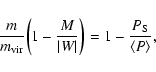
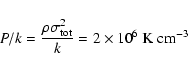
 ,
which is much less than 1, so there are three
regimes:
,
which is much less than 1, so there are three
regimes:
 ,
the filament can exist without
magnetic support,
,
the filament can exist without
magnetic support,
 a supporting poloidal field
is required, and
a supporting poloidal field
is required, and
 ,
when a binding toroidal field
is required (see Fiege et al. 2004; Fiege & Pudritz 2000, for details).
,
when a binding toroidal field
is required (see Fiege et al. 2004; Fiege & Pudritz 2000, for details).
From a sample of 7 C18O 1-0 spectra towards filaments,
we measure velocity FWHM of 0.6-1.0 km s-1. The conversion
from velocity FWHM
 measured in C18O to
,
taking into account that the C18O molecule
is more massive than the predominant H2, is
measured in C18O to
,
taking into account that the C18O molecule
is more massive than the predominant H2, is
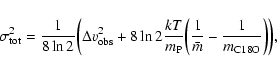
 is the proton mass,
 assuming 1 He for
every 5 H2 molecules, T=10 K, and
assuming 1 He for
every 5 H2 molecules, T=10 K, and
 .
.
The measured C18O linewidths correspond to virial masses of
45-100 pc-1, compared to the measured mass per unit length
of 47-115 pc-1. This simple analysis suggests that the
Perseus star forming filaments
are consistent with being non-magnetic filaments (Ostriker 1964).
This last
result disagrees with the Fiege & Pudritz (2000) studies of
star-forming filaments, which typically used 13CO linewidths,
and found
 .
From a sample of 8 13CO 1-0
spectra, we measure velocity FWHM of 1.4-2.0 km s-1, typically
a factor of 2 greater than C18O linewidths. If instead these
13CO linewidths are representative of the velocity field within
the filaments then ours too require additional binding by a toroidal
field. However, it seems more likely to us that the C18O
linewidths are more appropriate for the thermal support within the
dense filaments, as C18O profiles are less affected by optical
depth, and that the correct solution is one where the total toroidal
field is small.
.
From a sample of 8 13CO 1-0
spectra, we measure velocity FWHM of 1.4-2.0 km s-1, typically
a factor of 2 greater than C18O linewidths. If instead these
13CO linewidths are representative of the velocity field within
the filaments then ours too require additional binding by a toroidal
field. However, it seems more likely to us that the C18O
linewidths are more appropriate for the thermal support within the
dense filaments, as C18O profiles are less affected by optical
depth, and that the correct solution is one where the total toroidal
field is small.
The
mass derived from the dust emission, which increases if either the dust
temperature or the 850
emissivity is lower
than those assumed,
both of which are possibilities, adds another uncertainty. An examination
of the transverse column density structure and the dust polarisation
would provide a further test of the filament support but
this is beyond the scope of the current paper.
The alternative conclusion that could be reached from the high virial
mass is that the filaments are not stable but transient,
dispersing on the crossing time of 0.1 Myr (assuming a filament width of
0.1 pc and velocity dispersion from C18O of
 km s-1). If this is true, then the star formation which
is clearly occurring in the filaments must also happen on a crossing time.
km s-1). If this is true, then the star formation which
is clearly occurring in the filaments must also happen on a crossing time.
Given filament masses of 5-11
per 0.1 pc, there is no requirement
for substantial large scale flows along or onto the filaments in order
to gather sufficient material for further star formation. Typically,
in regions where cores have already formed, one or two cores are found
within 0.1 pc, and local fragmentation will suffice to explain their
masses. On the other hand, each filament does not hold a vast reservoir
of mass - a few tens of .
Therefore the filaments are not required
to disperse large fractions of their mass in order to remain consistent
with the observed stellar densities in IC 348 or NGC 1333. In other words
the conversion of dense molecular gas into stars may be fairly efficient
once the filament stage is reached, and most of the filament mass may
ultimately go into cores. This potentially high conversion efficiency
of dense molecular gas into stars has also been noticed for NH3cores (Fuller & Myers 1987). Alternatively, stellar clusters may be
built up by a series of filaments that form a few stars inefficiently,
disperse, and are replaced, requiring ongoing filament production in
the same location.
We are interested in the conditions under which stars form and it is
clear that the density of the parent molecular cloud is an important
factor. Density itself is not so easy to measure directly from dust
continuum or C18O emission, but what we can consider is how the
numbers of stars formed varies with the line-of-sight column density
(or equivalently visual extinction). An extinction threshold for star
formation at
 -9 was found in both Taurus and Ophiuchus
(Johnstone et al. 2004; Onishi et al. 1998), which could indicate that a certain amount
of shielding from the interstellar radiation field is required for star
formation to occur. Onishi et al. (1998) measured the column density of
C18O associated with sources in Taurus, and found that the cold IRAS
sources (assumed to be the younger protostars) and starless H13CO+cores had a average column density of at least
-9 was found in both Taurus and Ophiuchus
(Johnstone et al. 2004; Onishi et al. 1998), which could indicate that a certain amount
of shielding from the interstellar radiation field is required for star
formation to occur. Onishi et al. (1998) measured the column density of
C18O associated with sources in Taurus, and found that the cold IRAS
sources (assumed to be the younger protostars) and starless H13CO+cores had a average column density of at least
 cm-2or
 .
Johnstone et al. (2004) compared 850
.
Johnstone et al. (2004) compared 850  m cores in Ophiuchus with an optical/IR extinction map and found no submm
cores below an
of 7. In both cases the interpretation is
that star formation is inhibited below a certain .
m cores in Ophiuchus with an optical/IR extinction map and found no submm
cores below an
of 7. In both cases the interpretation is
that star formation is inhibited below a certain .
The C18O integrated intensity is a good tracer of total gas column
density over the typical range of column densities in molecular clouds,
but is less reliable at extreme column densities. At low column densities
the C18O abundance falls due to photodissociation.
On the other hand at high densities the line becomes optically thick
and in addition in low temperature, high density regions the C18O
depletes onto dust grains (e.g. Tafalla et al. 2004) and so ceases to
trace the gas. But between these extremes, a linear C18O -
relationship holds above
 (Frerking et al. 1982).
We see in Fig. 1 that the C18O is relatively
smooth on scales of a few arcminutes across the cloud, rather than peaking
at the submm cores. C18O integrated intensity at 1' resolution is
a poor tracer of submm cores, tracing instead the environment on larger
scales. This is probably largely due to beam dilution - the C18O
effective beam area
is
(1'/14'')2 =18 times greater than the 850
beam,
so a core of as much as 0.7
could produce
less than 1 K km s-1 in
 integrated
intensity if it had no extended envelope. Depletion
also helps reduce the contribution of core emission to the
C18O. C18O depletion has been measured in prestellar
cores on scales of 0.1 pc (Tafalla et al. 2004), with the C18O
abundance substantially reduced in the dense parts of the cores.
Finally, the C18O 1-0 line saturates at about the same column
density at which the SCUBA 850
emission becomes visible,
which further reduces the contribution from the highest column
density lines-of-sight. The result is that the C18O traces
the environment of the cores, and thus, if we look at young enough
cores, the environment in which cores form.
integrated
intensity if it had no extended envelope. Depletion
also helps reduce the contribution of core emission to the
C18O. C18O depletion has been measured in prestellar
cores on scales of 0.1 pc (Tafalla et al. 2004), with the C18O
abundance substantially reduced in the dense parts of the cores.
Finally, the C18O 1-0 line saturates at about the same column
density at which the SCUBA 850
emission becomes visible,
which further reduces the contribution from the highest column
density lines-of-sight. The result is that the C18O traces
the environment of the cores, and thus, if we look at young enough
cores, the environment in which cores form.
In this section we investigate how the probability of finding a core varies with the C18O integrated line intensity on arcminute scales.
Table 1: Fraction of cloud by area and number of cores in each C18O integrated intensity range.
Table 1 compares the area of the cloud in each C18O
integrated intensity range with the number of submm cores in that region.
Although there are clearly cores associated with areas of the cloud
with a wide range of cloud column densities, cores are much more likely
to be found in regions of high column density. In Fig. 3
we demonstrate this graphically by plotting the probability of finding a
submm core, P(core), as a function of integrated C18O
intensity,
 (K km s-1). The probability
of finding a core is derived from two observed distributions. The first
is the C18O integrated intensity towards the peak of each submm
core, determined from the C18O map (Fig. 1b).
We bin the results by C18O integrated intensity to generate
(K km s-1). The probability
of finding a core is derived from two observed distributions. The first
is the C18O integrated intensity towards the peak of each submm
core, determined from the C18O map (Fig. 1b).
We bin the results by C18O integrated intensity to generate
 ,
the number of submm cores in each integrated intensity
bin. The second is a count of the number of pixels in the map in each
integrated intensity bin,
,
the number of submm cores in each integrated intensity
bin. The second is a count of the number of pixels in the map in each
integrated intensity bin,
 .
This gives a measure
of the (probability) distribution of integrated intensities P(I)in the surveyed cloud, or in other words how much of the cloud area lies
in a particular integrated intensity range. The probability of finding
a submm core at a position with C18O integrated intensity I is
then given by
.
This gives a measure
of the (probability) distribution of integrated intensities P(I)in the surveyed cloud, or in other words how much of the cloud area lies
in a particular integrated intensity range. The probability of finding
a submm core at a position with C18O integrated intensity I is
then given by
 .
.
As both distributions
and
at some point contain very small numbers of counts we have to be very
careful with the error budget in calculating this quotient. We take
the Bayesian approach detailed in Appendix A to calculate P(core).
![\begin{figure}
\par\includegraphics[angle=-90,width=8.8cm,clip]{1836f3.eps}
\end{figure}](/articles/aa/full/2005/34/aa1836-04/img62.gif) |
Figure 3:
Probability of finding a submm core in a 22'' square pixel with
a given 1' beam-averaged C18O integrated intensity: observed (thin
black line) and probability distribution of
 for each integrated
intensity bin Ii (greyscale), and best-fit power law (thick black
line). To convert the probabilities to another pixel size use
for each integrated
intensity bin Ii (greyscale), and best-fit power law (thick black
line). To convert the probabilities to another pixel size use
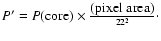 |
| Open with DEXTER | |
Figure 3 shows that
 is a steeply
increasing function of integrated intensity I. In other words,
the probability of finding a core increases rapidly with C18O
column density. Fitting (for simplicity, and for want of a theoretical
prediction) a power law
is a steeply
increasing function of integrated intensity I. In other words,
the probability of finding a core increases rapidly with C18O
column density. Fitting (for simplicity, and for want of a theoretical
prediction) a power law  to the distribution gives a best fit
result of
to the distribution gives a best fit
result of
 ,
,
 (uncertainties are 68.3% confidence limits). k is the scaling factor
which gives the probability of finding a core in a 22'' square pixel.
A power law must break down as a description of
at
high
as the probability of finding a core
in any one pixel approaches 1 but this limit is not approached with our
pixel size.
(uncertainties are 68.3% confidence limits). k is the scaling factor
which gives the probability of finding a core in a 22'' square pixel.
A power law must break down as a description of
at
high
as the probability of finding a core
in any one pixel approaches 1 but this limit is not approached with our
pixel size.
The exact shape of the distribution is uncertain at the low end
because of incomplete map coverage and lack of sensitivity. Both JCMT
and FCRAO maps have limited coverage of low column density regions,
and as the area mapped in C18O is larger, we may have missed
SCUBA cores. So we may underestimate (by only a few cores, we believe)
the probability of finding a core below
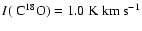 .
Figure 1 also shows that the C18O observations
were not biassed towards regions with SCUBA clumps, so we do not
overestimate the number of cores at low intensity.
The measurement uncertainties also become significant below
.
Figure 1 also shows that the C18O observations
were not biassed towards regions with SCUBA clumps, so we do not
overestimate the number of cores at low intensity.
The measurement uncertainties also become significant below
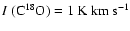 (
(
 )
- the C18O rms is 0.3 K km s-1. Therefore, the source count in the lower 5 integrated intensity
bins (Fig. 3) is also uncertain. We made a
fit excluding the lowest column density channels
(
)
- the C18O rms is 0.3 K km s-1. Therefore, the source count in the lower 5 integrated intensity
bins (Fig. 3) is also uncertain. We made a
fit excluding the lowest column density channels
(
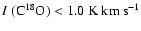 ), which
steepens the power law to
), which
steepens the power law to
 ,
a change which is
significant only at the 95% level.
,
a change which is
significant only at the 95% level.
What does
mean? We can rule
out an absolute threshold in
 )
(and by
implication )
for submm cores (though not necessarily for
star formation). There are clearly real submm cores at low C18O
integrated intensities of 4 K km s-1 or visual extinctions as low
as
)
(and by
implication )
for submm cores (though not necessarily for
star formation). There are clearly real submm cores at low C18O
integrated intensities of 4 K km s-1 or visual extinctions as low
as
 (N(H
(N(H
 cm-2). At these
column densities the uncertainty on the C18O data is high but the
low extinctions are independently confirmed by 13CO data from the
same observing run. There are submm cores at very low C18O column
density despite the fact that the peak column densities in the cores must
be high to be detected with SCUBA, and that the observations are less
sensitive to the larger, more diffuse cores which form in low pressure
regions (Sect. 2).
cm-2). At these
column densities the uncertainty on the C18O data is high but the
low extinctions are independently confirmed by 13CO data from the
same observing run. There are submm cores at very low C18O column
density despite the fact that the peak column densities in the cores must
be high to be detected with SCUBA, and that the observations are less
sensitive to the larger, more diffuse cores which form in low pressure
regions (Sect. 2).
The 10% of cores with I < 1.0 K km s-1 include the L1455 cluster
plus IRAS 03235+3004, 03422+3256, and 03262+3123. The question remains
whether stars can form at these low column densities or if these
low column density cores are all more evolved (Class I) protostars,
or whether the lower angular resolution of the line data is biasing
the column density estimate to a low value. Certainly the majority
of the I < 1 K km s-1 (
 )
sources have IRAS
identifications and are therefore likely to be classified as Class I.
Potentially less evolved cores are L1455 smm1
(
)
sources have IRAS
identifications and are therefore likely to be classified as Class I.
Potentially less evolved cores are L1455 smm1
(
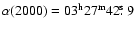 ,
,
 ,
which has a CO outflow, is
definitely protostellar, and has low IRAS fluxes, L1455 smm2
(
,
which has a CO outflow, is
definitely protostellar, and has low IRAS fluxes, L1455 smm2
(
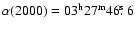 ,
,
 ;
probably starless),
and three weak cores to the west of B1 which may be noise artefacts.
Onishi et al. (1998) found that cold cores in Taurus were only found at a
high C18O threshold of
cm-2, equivalent
to
;
probably starless),
and three weak cores to the west of B1 which may be noise artefacts.
Onishi et al. (1998) found that cold cores in Taurus were only found at a
high C18O threshold of
cm-2, equivalent
to
 K km s-1 or
,
whereas warm cores (more evolved IRAS sources) could appear at lower
C18O column density. This appears to roughly hold in Perseus as well
as Taurus, but we need to investigate this further once we can better
classify the Perseus sources. All the submm cores in Ophiuchus lie at
K km s-1 or
,
whereas warm cores (more evolved IRAS sources) could appear at lower
C18O column density. This appears to roughly hold in Perseus as well
as Taurus, but we need to investigate this further once we can better
classify the Perseus sources. All the submm cores in Ophiuchus lie at
 (Johnstone et al. 2004). As the cores in Ophiuchus were
identified in the same way as in this study of Perseus, that is, from
SCUBA 850 m observations, there must either be a real difference
between star formation in the two clouds, or a significant difference in
the way that optical/IR extinction and C18O trace column density in
the range
(Johnstone et al. 2004). As the cores in Ophiuchus were
identified in the same way as in this study of Perseus, that is, from
SCUBA 850 m observations, there must either be a real difference
between star formation in the two clouds, or a significant difference in
the way that optical/IR extinction and C18O trace column density in
the range
 -7. Oph is lacking in starless cores and
Class 0 protostars compared to other dark clouds and there may have been
a burst of star formation 105 years ago in this region that has now
tailed off (Visser et al. 2002); in Perseus, however, we have clear evidence
for continuing star formation, so there are differences between the ages
of the populations in the two clouds which might underly the differing
column density thresholds, though the mechanism is unclear.
-7. Oph is lacking in starless cores and
Class 0 protostars compared to other dark clouds and there may have been
a burst of star formation 105 years ago in this region that has now
tailed off (Visser et al. 2002); in Perseus, however, we have clear evidence
for continuing star formation, so there are differences between the ages
of the populations in the two clouds which might underly the differing
column density thresholds, though the mechanism is unclear.
The I3.0 power law rules out simple models in which the
number of cores is proportional to the mass along the line-of-sight
(
 ). If density is the determining quantity
for star formation, central densities must rise steeply with increasing
column density. Theoretical models which reproduce the observed C18O
integrated intensity - core probability relationship are required to
find the actual physics behind the I 3.0 power law (if indeed a
power law is the right functional form).
). If density is the determining quantity
for star formation, central densities must rise steeply with increasing
column density. Theoretical models which reproduce the observed C18O
integrated intensity - core probability relationship are required to
find the actual physics behind the I 3.0 power law (if indeed a
power law is the right functional form).
This steep rise in P(core) with column density is consistent
with the overall trend seen in star forming regions for high column
density regions to be associated with formation of larger numbers
of stars. Isolated low mass star formation in Taurus occurs at
column densities of
 cm-2(Onishi et al. 1998). Column densities for clustered star formation in
Perseus reach
cm-2(Onishi et al. 1998). Column densities for clustered star formation in
Perseus reach
 cm-2. In contrast, column densities
in massive star forming regions typically exceed 1023 cm-2(Hatchell et al. 1998).
cm-2. In contrast, column densities
in massive star forming regions typically exceed 1023 cm-2(Hatchell et al. 1998).
We have already mentioned C18O depletion and optical depth, both
of which act to reduce the observed
for a
given H2 column density. If plotted against H2 column density,
the P(core) distribution would flatten at high column
densities. A rough correction for the optical depth suggests that
the power law index could reduce from 3.0 to 2.0 in the worst
case. This is still significantly steeper than linear.
Given a C18O map and the above P(core) vs.
relationship, we can now predict -
at least statistically - how many submm cores will be found and how
they will be distributed. It will be interesting to see how well this
relationship holds in regions other than Perseus. There are obviously
more factors involved in core formation than C18O column density,
and a better model of where stars form will need to take into account
filaments, clustering and other factors.
We have mapped the submm dust emission from the Perseus molecular
cloud with SCUBA at JCMT with 5000 AU resolution, revealing 91 embedded
starless and protostellar cores and the filamentary structures which
lead to star formation. The total mass of the Perseus cloud derived
from extinction measurements is 17 000
(Bachiller & Cernicharo 1986b).
Of this, 6000
is traced by C18O and 2600
by dust in
cores and clusters. We conclude:
pc-3. Some
current star formation activity may be associated with the larger
stellar clusters IC 348 and NGC 1333, but about half the star formation
is taking place in small clusters
containing less than 35 members.
per 0.1 pc are associated with the existing clusters. This range
of masses is in agreement with models of filaments with either
unmagnetised filaments or a slightly dominant toroidal field
(Fiege & Pudritz 2000).
.
There is no C18O column
density cutoff (and by implication )
below which there
are no cores.
Acknowledgements
We would like to thank Jane Buckle, Tak Fujiyoshi and others who spent long nights at the telescope collecting data as part of this project, and the referee Doug Johnstone for his careful reading and constructive suggestions. The James Clerk Maxwell Telescope is operated by the Joint Astronomy Centre on behalf of the Particle Physics and Astronomy Research Council of the UK, the Netherlands Organisation for Scientific Research, and the National Research Council of Canada. The FCRAO is supported by the NSF via AST-0100793. JH acknowledges support from DFG SFB 494 and the PPARC Advanced Fellowship programme. The National Radio Astronomy Observatory is a facility of the National Science Foundation operated under cooperative agreement by Associated Universities, Inc.
In this Appendix we give details of the analysis of the core probability
vs. C18O column density. We first assume that the counts in each
integrated intensity bin Ii,
 and
and
 ,
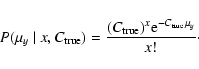
obey Poisson statistics, i.e., are related to
the true values
,
obey Poisson statistics, i.e., are related to
the true values  and
and  by:
by:
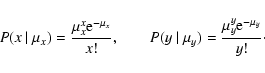 and ,
and ,
 and similarly for
(see, e.g.,
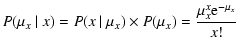
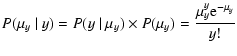
Sivia 1996 for an introduction to Bayesian data analysis). Then
.
and similarly for
(see, e.g.,
Sivia 1996 for an introduction to Bayesian data analysis). Then
.
We calculate the data-derived probability of finding a core at
integrated intensity Ii,
 directly.
However, this is only an estimate of the true value of C because of
the uncertainties in xi and yi. We next calculate the PDF for
the true value of finding a core
directly.
However, this is only an estimate of the true value of C because of
the uncertainties in xi and yi. We next calculate the PDF for
the true value of finding a core
 given
xi and yi. To obtain the probability distribution of the true
quotient
given
xi and yi. To obtain the probability distribution of the true
quotient
 given the observed x and y we rewrite the x distribution (Eq. (A.1)) in terms of
and
:
given the observed x and y we rewrite the x distribution (Eq. (A.1)) in terms of
and
:
(Eqs. (A.2) and (A.3)) we can multiply and
integrate out :
 |
 |
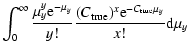 |
|
|
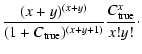 |
 from the previous formula and
 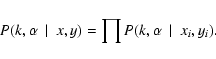 are plotted as greyscales and contours for each integrated intensity
bin in Fig. 3. We marginalise (integrate over) kand
are plotted as greyscales and contours for each integrated intensity
bin in Fig. 3. We marginalise (integrate over) kand  in turn to estimate the uncertainties in each parameter
individually as given in Sect. 5. The PDF for is shown in Fig. A.1.
in turn to estimate the uncertainties in each parameter
individually as given in Sect. 5. The PDF for is shown in Fig. A.1.
![\begin{figure}
\par\includegraphics[scale=0.35,angle=-90]{1836fa1.eps}
\end{figure}](/articles/aa/full/2005/34/aa1836-04/img105.gif) |
Figure A.1:
Probability density function for the power law index ,
 .
Verticals are 68.3%, 95.4% and 99.7%
confidence limits. .
Verticals are 68.3%, 95.4% and 99.7%
confidence limits. |
Table A.1:
SCUBA 850 m core positions, names and references, peak
850 m fluxes and C18O integrated intensity at the submm peak
position.