A&A 439, 771-775 (2005)
DOI: 10.1051/0004-6361:20052946
Roche lobe effects on expanded upper atmospheres of short-periodic giant exoplanets
G. F. Jaritz 1,2 -
S. Endler2,3 -
D. Langmayr 2 -
H. Lammer 2 -
J.-M. Grießmeier 4 -
N. V. Erkaev 5 -
H. K. Biernat 1,2,3
1 - Institute for Geophysics, Astrophysics, and Meteorology, University of Graz, Universitätsplatz 5, 8010 Graz, Austria
2 -
Space Research Institute, Austrian Academy of Sciences, Schmiedlstrasse 6,
8042 Graz, Austria
3 -
Institute for Theoretical Physics, University of Graz, Universitätsplatz 5,
8010 Graz, Austria
4 -
Institut für Theoretische Physik, Technische Universität
Braunschweig, Mendelssohnstrasse 3, 38106 Braunschweig, Germany
5 -
Institute for Computational Modelling, Russian Academy of Sciences,
Krasnoyarsk 36, Russian Federation
Received 13 December 2004 / Accepted 2 May 2005
Abstract
Theoretical studies and recent observational evidence of
the expansion of the atmospheres of short-periodic exoplanets show
that the atmospheres extend up to several planetary radii. This
indicates that the atmospheres experience blow-off conditions.
Because of the short orbital distance to their host stars, the
expansion of the upper atmosphere is no longer radially symmetric,
but depends on the direction to the central body, resulting in a
deformation of the expanded atmosphere. We show the connection
between atmospheric expansion, tidal forces and effects of the
Roche potential and find that HD 209458 b, OGLE-TR-10 b and
OGLE-TR-111 b are most likely in a state of classical
hydrodynamical blow-off, because the distance where blow-off can
occur is less than the distance to the Lagrangian point L1. On the
other hand, OGLE-TR-56 b, OGLE-TR-113 b, OGLE-TR-132 b and TreS-1 experience a geometrical blow-off defined by the Roche lobe as proposed by Lecavelier des Etangs et al. (2004, A&A, 418, L1). Our results have important implications for the evolution of short periodic gas giants,
because the Roche lobe overflow of the atmosphere can lead to
lower mass loss rates over the exoplanets history, compared to gas
giants which experience hydrodynamic expansion and loss unaffected
by this boundary. Thus, massive exoplanets like OGLE-TR-56 b in
very close orbital distances are subject to geometrical blow-off
conditions, this results in a total mass loss for this particular
exoplanet of the order of about 3  10-2
10-2
 over
the planets age, even if current mass loss rates of about 2
1011 g s-1 are calculated. If the exoplanet effected by the geometrical blow-off is more massive, the mass loss rate is even lower. However, giant exoplanets like HD 209458 b, OGLE-TR-10 b and OGLE-TR-111 b at orbital distances of about 0.05 AU may experience classical hydrodynamic blow-off conditions, which can result in higher mass loss rates. Thus, such planets may shrink to
their core sizes during the X-ray and EUV active periods of their
host stars as proposed by Lammer et al. (2003, ApJ, L121, 598) and Baraffe et al. (2004, A&A, 419, L13).
over
the planets age, even if current mass loss rates of about 2
1011 g s-1 are calculated. If the exoplanet effected by the geometrical blow-off is more massive, the mass loss rate is even lower. However, giant exoplanets like HD 209458 b, OGLE-TR-10 b and OGLE-TR-111 b at orbital distances of about 0.05 AU may experience classical hydrodynamic blow-off conditions, which can result in higher mass loss rates. Thus, such planets may shrink to
their core sizes during the X-ray and EUV active periods of their
host stars as proposed by Lammer et al. (2003, ApJ, L121, 598) and Baraffe et al. (2004, A&A, 419, L13).
Key words: radiation mechanisms: non-thermal - acceleration of particles - plasmas - turbulence - gamma rays: theory - methods: analytical
Tidal forces and mass transfer processes from short-periodic gas
giants to their host stars should act at  20
20 of the
presently known >150 exoplanets (status: June 2005), which
have orbital distances <0.1 AU, or orbital periods <11 days.
of the
presently known >150 exoplanets (status: June 2005), which
have orbital distances <0.1 AU, or orbital periods <11 days.
Since the observation of an extended upper atmosphere around
HD 209458 b by Vidal Madjar et al. (2003), different blow-off
scenarios for evaporating hydrogen-rich atmospheres are discussed
in the literature
(Lecavelier des Etangs et al. 2004; Baraffe et al. 2004; Lammer et al. 2003; Erkaev et al. 2005; Tian et al. 2005; Vidal Madjar et al. 2004; Sasselov 2003; Grießmeier et al. 2004; Yelle 2004).
It is shown by Lammer et al. (2003) and in more detail by
Yelle (2004) that exospheres of hydrogen-rich giant
exoplanets in orbits with semi-major axes from 0.01-0.1 AU can
be heated to temperatures of up to 10 000-20 000 K by X-rays and
extreme ultraviolet radiation (XUV) from the central star. The
lower thermosphere is cooled primarily by radiative emissions from H3+, created by photo-ionization of H2 and subsequent ion
chemistry (Yelle 2004). These high temperatures cause a large
escape flux of the atmospheric gas, implying that the upper
atmosphere is cooled primarily by atmospheric expansion and high
loss rates (Lammer et al. 2003; Tian et al. 2005; Yelle 2004).
With the Space Telescope Imaging Spectrograph (STIS) onboard of
the Hubble Space Telescope (HST), Vidal Madjar et al. (2003)
determined a lower limit of the atmospheric loss rate from
HD 209458 b of  1010 g s-1 by Lyman-
 absorption features. Assuming classical hydrodynamic conditions,
Lammer et al. (2003) calculated the maximum possible energy-limited
hydrogen loss rate of HD 209458 b corresponding to the present age
of its host star (5.2 Gyr) to be 1012 g s-1.
absorption features. Assuming classical hydrodynamic conditions,
Lammer et al. (2003) calculated the maximum possible energy-limited
hydrogen loss rate of HD 209458 b corresponding to the present age
of its host star (5.2 Gyr) to be 1012 g s-1.
However, Lecavelier des Etangs et al. (2004) proposed an alternative scenario
for short-periodic exoplanets, which they call geometrical
blow-off, by arguing that due to the high temperatures the
exobase level can reach the Roche lobe before classical
hydrodynamic conditions may develop. The Roche lobe is
defined as the last equipotential around a planet.
Beyond this, the surfaces of constant potential encompass the host star.
Because particles beyond the Roche lobe can definitely escape,
Lecavelier des Etangs et al. (2004)
argued that the Roche lobe can be seen as an equivalent to the
exobase level. However, depending on planetary and stellar masses, planetary
sizes, stellar types and orbital distances from the host stars
both scenarios, the classical hydrodynamic blow-off, or the geometrical blow-off may occur.
The aim of this paper is to investigate in more detail the
implications of both cases. In Sect. 2 we discuss the theory of
the Roche potential between short-periodic gas giants and their
host stars. In Sect. 3 we compare the Roche lobe distance with
calculated atmospheric expansion radii of seven short-periodic
giant exoplanets with known mass and radius, and discuss the
consequences for the atmospheric evolution.
By studying the three-dimensional Roche potential of
short-periodic gas giants, one takes into account the fact that the
atmosphere may be gravitationally distorted.
By assuming two point masses M1 and M2, separated by a distance a and in circular orbits around their common center of mass, the
energy per unit mass of a test particle inside the system can
be derived from the potential (Paczynski 1971)
 |
(1) |
where s is the distance of the particle from the binary's center of mass, and r1 and r2 stand for the particle's distance to the star and planet,
respectively. G is Newton's gravitational
constant. Surfaces on which  is constant correspond to
surfaces of constant potential energy, the Roche potentials.
is constant correspond to
surfaces of constant potential energy, the Roche potentials.
By introducing the mass ratio
 ,
between the exoplanet's mass and its host star and by normalizing
Eq. (1) one can write the potential
in a 3-D coordinate
system as
,
between the exoplanet's mass and its host star and by normalizing
Eq. (1) one can write the potential
in a 3-D coordinate
system as
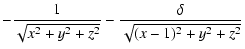
In Eq. (2), the first term represents the potential
of the primary star and the second the potential of the exoplanet.
The third term is a result of the orbital motion of the system and
includes the mass ratio. x-y is the orbital plane and z is
perpendicular to it. For illustration of the Roche potentials we
calculate the potentials for a planetary system with a mass ratio
of 0.013. The Roche potentials are shown with normalized
parameters in Fig. 1.
For this potential, there are two locations, the Lagrangian point L1 and the Lagrangian point L2 which are saddle points. Both points lie on the line which joins the planet and the host star,
where L1 is located between them and L2 is farther away from the star than the
planet. The planetocentric distances of L1 and L2 are (Gu et al. 2003)
![\begin{displaymath}%
r_{\rm L1,L2}=\left[\beta\mp\frac{\beta^2}{3}\right]a,
\end{displaymath}](/articles/aa/full/2005/32/aa2946-05/img16.gif) |
(3) |
with
 |
(4) |
The Roche potential has its largest planetocentric distance, which
is related to the last equipotential surface for which a particle
can be bound to the planet (Gu et al. 2003). At the distance of the
Lagrangian point
 an expanding atmosphere cause a flux
of gas towards the star, while the gas which expands beyond
an expanding atmosphere cause a flux
of gas towards the star, while the gas which expands beyond
 spirals outwards to form an excretion disk. The Roche potential has its largest planetocentric distance, which is
related to the last equipotential surface for which a particle can
be bound to the planet (Gu et al. 2003). Furthermore, it is
important to note that the equipotential surfaces containing the L1 and L2 points are distorted from spherical symmetry.
spirals outwards to form an excretion disk. The Roche potential has its largest planetocentric distance, which is
related to the last equipotential surface for which a particle can
be bound to the planet (Gu et al. 2003). Furthermore, it is
important to note that the equipotential surfaces containing the L1 and L2 points are distorted from spherical symmetry.
For studying the effect of the Roche potential on expanded
atmospheres of hot gas giants we have chosen HD 209458 b
(Vidal Madjar et al. 2003; Henry et al. 2000; Mazeh 2000; Barman et al. 2002; Charbonneau et al. 2000),
OGLE-TR-10 b (Konacki et al. 2005; Bouchy et al. 2005), OGLE-TR-56 b (Torres et al. 2004; Konacki et al. 2003; Burrows et al. 2004; Baraffe et al. 2004),
OGLE-TR-111 b (Pont et al. 2004), OGLE-TR-113 b
(Konacki et al. 2004; Bouchy et al. 2004), OGLE-TR-132 b
(Moutou et al. 2004; Bouchy et al. 2004), and TreS-1 (Alonso et al. 2004) where
the mass and radius are known. The parameters of these exoplanets
and their host stars, as well as
and their
atmospheric expansion radii
 calculated for classical
hydrodynamic conditions by using the equations of
Watson et al. (1981) and Lammer et al. (2003) are shown in Table 1.
calculated for classical
hydrodynamic conditions by using the equations of
Watson et al. (1981) and Lammer et al. (2003) are shown in Table 1.
![\begin{figure}
\par\includegraphics[width=6.5cm,clip]{2946fig1.eps}\end{figure}](/articles/aa/full/2005/32/aa2946-05/Timg19.gif) |
Figure 1:
For illustration of the Roche potentials we calculate
the potentials for a planetary system with a mass ratio of 0.013 a) in three dimensions and b) as contours. The square in b) is blown up in c). The two peaks in a) show the potential close to the star and planet, respectively. |
| Open with DEXTER |
The effective temperatures used in our calculations for HD 209458 b
and OGLE-TR-56 b are taken from Barman et al. (2002),
Sasselov (2003) and Konacki et al. (2005). For the other
exoplanets in our study we calculated
 with the
following formula:
with the
following formula:
 |
|
|
(5) |
where  is the optical depth,
 is the effective
temperature of the star, A the albedo of the planet,
is the effective
temperature of the star, A the albedo of the planet,
 stands for the radius of the star, and d is the distance
to the star in AU. It is based on the Stefan-Boltzmann Law, which
describes the radiation of a black body. Since exoplanetary
atmospheres are no ideal black bodies we use Eddington's
approximation (Böhm-Vitense 1989) to calculate
at a certain optical depth
for a grey atmosphere. For the
albedo of the planet, we use Jupiter's value A = 0.52.
stands for the radius of the star, and d is the distance
to the star in AU. It is based on the Stefan-Boltzmann Law, which
describes the radiation of a black body. Since exoplanetary
atmospheres are no ideal black bodies we use Eddington's
approximation (Böhm-Vitense 1989) to calculate
at a certain optical depth
for a grey atmosphere. For the
albedo of the planet, we use Jupiter's value A = 0.52.
Lecavelier des Etangs et al. (2004) pointed out that at temperatures of
10 000 K, the exobase of HD 209458 b merges with the Roche lobe, which they estimate to be
 3.6
3.6
 (2.67
(2.67
 ). This effective radius
 ,
however, corresponds to a spherical approximation of the Roche lobe (Eggleton 1983), which is generally used for binary stellar systems, where small distance variations are negligible.
The approximated radius
always yields results
smaller than
.
Note that the shape of the potential
will guarantee that the Roche lobe is reached everywhere at the
same time as in L1. This is the reason why the radius
,
however, corresponds to a spherical approximation of the Roche lobe (Eggleton 1983), which is generally used for binary stellar systems, where small distance variations are negligible.
The approximated radius
always yields results
smaller than
.
Note that the shape of the potential
will guarantee that the Roche lobe is reached everywhere at the
same time as in L1. This is the reason why the radius
![[*]](/icons/foot_motif.gif) of an expanded exoplanetary atmosphere should better be compared to
(Gu et al. 2003) rather than to the spherically averaged
(Eggleton 1983).
of an expanded exoplanetary atmosphere should better be compared to
(Gu et al. 2003) rather than to the spherically averaged
(Eggleton 1983).
Classical hydrodynamical blow-off occurs at the altitude level
rX=1.5, where the thermal escape parameter
X=(G M m)/(k T r) reaches values of 1.5. With the
planetary parameters of HD 209458 b and temperatures of 15 000 K, this altitude level is at rX=1.5 = 6.61
(4.9
), which is beyond
of
5.482
(4.06
). For temperatures of 18 000-20 000 K, classical hydrodynamic blow-off occurs close to
or even at lower altitudes
of
 4.85
(3.6
),
respectively. For these temperatures, one finds
4.85
(3.6
),
respectively. For these temperatures, one finds
 and the majority of the
XUV flux is deposited below
,
which results in
classical hydrodynamic blow-off conditions, not influenced by the Roche lobe.
and the majority of the
XUV flux is deposited below
,
which results in
classical hydrodynamic blow-off conditions, not influenced by the Roche lobe.
Table 1:
Relevant parameters of HD 209458 b (Vidal Madjar et al. 2003; Barman et al. 2002), OGLE-TR-56 b
(Baraffe et al. 2004; Burrows et al. 2004), OGLE-TR-132 b (Moutou et al. 2004),
OGLE-TR-113 b (Bouchy et al. 2004), OGLE-TR-111 b (Pont et al. 2004),
OGLE-TR-132 b (Moutou et al. 2004; Bouchy et al. 2004), OGLE-TR-10 b
(Konacki et al. 2005; Bouchy et al. 2005) and TreS-1 (Alonso et al. 2004) for
the calculation of the atmospheric expansion radius
and for the calculation of
.
![\begin{figure}
\par\includegraphics[width=7.35cm,clip]{2946fig2.eps}\end{figure}](/articles/aa/full/2005/32/aa2946-05/Timg34.gif) |
Figure 2:
Relevant radii
 and
for
OGLE-TR-56 b, OGLE-TR-10 b, OGLE-TR-111 b and HD 209458 b. For
OGLE-TR-56 b,
is clearly less than
,
which indicates that the exoplanet is most likely in a stage of
geometric blow-off, while the three other exoplanets are most
likely in a stage of a classical hydrodynamic blow-off regime.
and
for
OGLE-TR-56 b, OGLE-TR-10 b, OGLE-TR-111 b and HD 209458 b. For
OGLE-TR-56 b,
is clearly less than
,
which indicates that the exoplanet is most likely in a stage of
geometric blow-off, while the three other exoplanets are most
likely in a stage of a classical hydrodynamic blow-off regime. |
| Open with DEXTER |
As shown in Fig. 2, by using temperatures of 10 000 K and 20 000 K
we find that the escape parameter reaches 1.5 at altitudes of
about 3.24 and 1.62
for OGLE-TR-10 b and at
altitudes of about 5 and 2.65
for OGLE-111 b,
respectively. Because, the distance of
is at about 5
and 5.2
for OGLE-TR-10 b and OGLE-TR-111 b, these
exoplanets are most likely also in a state of classical
hydrodynamic blow-off.
As one can see in Table 1, for OGLE-TR-56 b, OGLE-TR-113 b and
OGLE-TR-132 b and TreS-1 b, the relevant distances
and rX=1.5(which is >
)
are much larger than
.
Because, the radius rX=1.5 where an exosphere changes to
hydrodynamic conditions is >
,
OGLE-TR-56 b (see Fig. 2), OGLE-TR-113 b, OGLE-TR-132 b and TreS-1 b should experience geometrical blow-off conditions as proposed for HD 209458 b by Lecavelier des Etangs et al. (2004).
Note that for the estimation of
,
the stellar XUV flux is required.
Because the XUV fluxes of the host stars for OGLE-TR-113 b (K star),
OGLE-TR-132 b (F star) and TreS-1 b (K0V star) are not known, we
use the XUV flux of the present Sun (G-star), scaled to the
orbital distance of the exoplanet.
However, we suggest that different XUV fluxes related to
the real spectral types of these host stars may not change the
fact that all three planets experience geometrical blow-off.
One should also note that the radiation pressure of the host star
can shift the gas below L1 towards the direction of the second
Lagrangian point L2 where the planetary wind may create a
cometary-like tail of the evaporating gas.
As described above, HD 209458 b may experience classical hydrodynamic blow-off if the
temperature of the upper atmosphere reaches the critical value
before the exobase level moves beyond
.
This
suggestion is consistent with recent observations of four transits
of HD 209458 b with the STIS spectrograph on board HST by
Vidal Madjar et al. (2004). During these transits oxygen and hydrogen were
observed in the extended upper atmosphere of HD 209458 b and up to
the Roche lobe. Because of that, the thermal escape
parameter X of O and C at
for 10 000 K considered by
Lecavelier des Etangs et al. (2004) are 60 and 44. Both species will
not diffuse in the kinetic regime upward to the planetocentric
distances where they were observed.
Figure 3 shows a 3-D simulation of part of the 3.52 day orbit period of
HD 209458 b and its expanded atmosphere which is deformed due to tidal forces.
The host star is shown as a point-mass and the red
line represents the direction of the orbital period.
![\begin{figure}
\par\includegraphics[height=3.8cm,width=7.65cm,clip]{2946fig3.eps}\end{figure}](/articles/aa/full/2005/32/aa2946-05/Timg35.gif) |
Figure 3:
Left panel: expanded atmosphere of HD 209458 b under the
influence of the tidal forces of its host star, which is pictured
as a point-mass. The size of the planet is not in scale. Right
panel: detailed view of the normalized expanded atmosphere of
HD 209458 b under the influence of tidal forces. Note that the
tidal deformation leads to an atmospheric radius which slightly
deviates form the more idealized expansion radius
. |
| Open with DEXTER |
The results of our study have important implications for
evolutionary aspects of planetary mass loss. If we apply a
hydrodynamical model and a upper atmospheric boundary at
corresponding to about 3.58
and temperatures of
about 15 000 K for OGLE-TR-56 b, we obtain atomic hydrogen loss
rates at the Roche Lobe overflow of about  2
1011 g s-1 for the present age of the system of 3
2
1011 g s-1 for the present age of the system of 3  1 Gyr (Sasselov 2003). These loss rates are several orders of
magnitude higher than estimated by Sasselov (2003), who
calculated the Jeans loss by using the effective temperature
of 1900 K, but 25 times lower than the energy-limited mass loss for OGLE-TR-56 b calculated by
Lammer et al. (2003). By integrating these loss rates over the age
of the planetary system and by considering a 100 times higher XUV flux at the early periods (Ribas et al. 2005; Lammer et al. 2003) we obtain a maximum mass loss for OGLE-TR-56 b of about 3.5
10-2
.
This total mass loss is lesser than the calculated
XUV-driven energy-limited loss as shown in Lammer et al. (2003, Fig. 3b# where the Roche lobe cut off was not taken into account.
1 Gyr (Sasselov 2003). These loss rates are several orders of
magnitude higher than estimated by Sasselov (2003), who
calculated the Jeans loss by using the effective temperature
of 1900 K, but 25 times lower than the energy-limited mass loss for OGLE-TR-56 b calculated by
Lammer et al. (2003). By integrating these loss rates over the age
of the planetary system and by considering a 100 times higher XUV flux at the early periods (Ribas et al. 2005; Lammer et al. 2003) we obtain a maximum mass loss for OGLE-TR-56 b of about 3.5
10-2
.
This total mass loss is lesser than the calculated
XUV-driven energy-limited loss as shown in Lammer et al. (2003, Fig. 3b# where the Roche lobe cut off was not taken into account.
Our results imply that Jovian-type exoplanets affected by Roche lobe-limited loss may be less effected on mass loss over their lifetimes compared to hot gas giants, which experience classical
hydrodynamical blow off. For planets like HD 209458 b, OGLE-TR-10 b
and OGLE-TR-111 b, which most likely experience classical
hydrodynamic blow-off, strong mass loss may be possible as
calculated for HD 209458 b by Lammer et al. (2003, Fig. 3a# and
Baraffe et al. (2004). As we have shown in our study, the influence
of the Roche lobe to an expanded atmosphere is very sensitive to
the parameters of the host star and the planet itself, therefore,
one can not generalize the calculated mass loss rates for all
exoplanets with short orbital periods.
The evaporation studies of Baraffe et al. (2004) lead to the
existence of a critical planetary mass
 which
depends on the orbital distance. Below this, the evaporation
timescale becomes shorter than the thermal timescale of the
exoplanet. For planets with initial masses below
,
strong hydrodynamic evaporation during XUV active stellar periods
can lead to a rapid expansion of the outer planetary layers and of
the total planetary radius
,
speeding up the
evaporation process. Consequently, they found that the exoplanet
does not survive as long as estimated by a simple application of
mass loss rates without following consistently its evolution.
Baraffe et al. (2004) speculate also that HD 209458 b might be in
such a dramatic phase. Future studies, which are beyond the scope
of this paper, should similarly investigate the mass-radius
evolution for OGLE-TR-10 b and OGLE-TR-111 b, which experience
most likely classical hydrodynamic blow off and have also larger
planetary radii compared to the massive OGLE-TR-56 b, which is
found to be in geometrical blow-off.
which
depends on the orbital distance. Below this, the evaporation
timescale becomes shorter than the thermal timescale of the
exoplanet. For planets with initial masses below
,
strong hydrodynamic evaporation during XUV active stellar periods
can lead to a rapid expansion of the outer planetary layers and of
the total planetary radius
,
speeding up the
evaporation process. Consequently, they found that the exoplanet
does not survive as long as estimated by a simple application of
mass loss rates without following consistently its evolution.
Baraffe et al. (2004) speculate also that HD 209458 b might be in
such a dramatic phase. Future studies, which are beyond the scope
of this paper, should similarly investigate the mass-radius
evolution for OGLE-TR-10 b and OGLE-TR-111 b, which experience
most likely classical hydrodynamic blow off and have also larger
planetary radii compared to the massive OGLE-TR-56 b, which is
found to be in geometrical blow-off.
A detailed investigation of Roche lobe effects to the expanded
atmospheres of seven short-periodic giant exoplanets indicate that
the atmospheres of HD 209458 b, OGLE-TR-10 b and OGLE-TR-111 b are
most likely in a state of classical hydrodynamical blow-off,
because the critical level where blow-off occurs can be reached
before the exobase level reaches the Lagrangian point
.
In the cases of OGLE-TR-56 b, OGLE-TR-113 b, OGLE-TR-132 b
and TreS-1 b the critical level for classical hydrodynamic
blow-off cannot be reached. These exoplanets experience geometrical blow-off as proposed by Lecavelier des Etangs et al. (2004)
resulting in less efficient atmospheric loss rates over their
lifetimes. However, the results of our study can be investigated
by the statistical analysis of CoRoT planet detections in the near
future, because it indicates that we may have two populations of
short periodic giant exoplanets, which depends on stellar and
planetary parameters: One population which is strongly effected by
a Roche lobe cut off resulting in less mass loss over evolutionary
periods and a second population, which experiences classical
hydrodynamical blow off, which may evaporate planets to their core sizes.
Acknowledgements
H. Lammer and H. K. Biernat thank the Austrian Academy of Sciences
"Verwaltungsstelle für Auslandsbeziehungen''. This work is
supported by the INTAS-ESA Project 99-01277, by the Austrian
"Fonds zur Förderung der wissenschaftlichen Forschung'' (FWF)
under project P17100-N08, by grants No. 01-05-02003 and No. 01-05-65070 from the Russian Foundation of Basic Research, and
by project No. I.2/04 from Österreichischer Austauschdienst
(ÖAD). The authors also thank the Austrian Ministry for Science,
Education and Culture (bm:bwk) and ASA for funding the CoRoT project. Finally, the authors thank an anonymous referee for constructive comments, which helped to improve the content of
the paper.
This study was supported by the International Space Science Institute (ISSI) and carried out in the frame of the ISSI Team "Formation, Structure and Evolution of Giant Planets".
- Alonso, R.,
Brown, T. M., Torres, G., et al. 2004, ApJ, 613, 153 [NASA ADS] [CrossRef] (In the text)
- Baraffe, I.,
Selsis, F., Chabrier, G., et al. 2004, A&A, 419, L13 [EDP Sciences] [NASA ADS] [CrossRef]
- Barman, T. S.,
Hauschildt, P. H., Schweitzer, A., et al. 2002, ApJ, 569,
L51 [NASA ADS] [CrossRef]
-
Böhm-Vitense, E. 1989, Introduction to stellar astrophysics,
Vol. 1 - Basic stellar observations and data, Vol. 2 - Stellar
atmospheres (Cambridge, New York: Cambridge University Press)
(In the text)
- Burrows, A.,
Hubeny, I., Hubbard, W., Sudarsky, D., & Fortney, J. 2004, ApJ,
610, L53 [NASA ADS] [CrossRef]
- Bouchy, F.,
Pont F., Santos N., Melo C., Mayor M., Queloz D. & Udry S.,
2004, A&A, 421, L13 [EDP Sciences] [NASA ADS] [CrossRef]
- Bouchy, F.,
Pont, F., Melo, C., et al. 2005, A&A, 431, 1105 [EDP Sciences] [NASA ADS] [CrossRef]
-
Charbonneau, D., Brown, T., Latham, D., & Mayor, M. 2000, ApJ,
529, L45 [NASA ADS] [CrossRef]
- Eggleton,
P. P. 2003, ApJ, 268, 368 [NASA ADS] [CrossRef] (In the text)
- Erkaev, N. V.,
Penz, T., Lammer, H., et al. 2005, ApJS, in press
-
Grießmeier, J.-M., Stadelmann, A., Penz, T., et al. 2004,
A&A, 425, 753 [EDP Sciences] [NASA ADS] [CrossRef]
- Gu, P.-G., Lin, D. N.
C., & Bodenheimer, P. H. 2003, ApJ, 588, 509 [NASA ADS] [CrossRef] (In the text)
- Henry, G. W.,
Marcy, G. W., Butler, R. P., & Vogt, S. S. 2000, ApJ, 529,
L41 [NASA ADS] [CrossRef]
- Konacki, M.,
Torres, G., Jha, S., & Sasselov, D. D. 2003, Nature, 421,
507 [NASA ADS] [CrossRef]
- Konacki, M.,
Torres, G., Sasselov, D., et al. 2004, ApJ, 609, L37 [NASA ADS] [CrossRef]
- Konacki, M.,
Torres, G., Sasselov, D., & Jha, S. 2005, ApJ, submitted
[arXiv:astro-ph/0412400]
- Lammer, H.,
Selsis, F., Ribas, I., et al. 2003, ApJ, L121, 598
-
Lecavelier des Etangs, A., Vidal-Madjar, A., McConnell, J. C.,
& Hébrard, G. 2004, A&A, 418, L1 [EDP Sciences] [NASA ADS] [CrossRef]
- Mazeh, T., Naef,
D., Torres, G., et al. 2000, ApJ, 532, L55 [NASA ADS] [CrossRef]
- Moutou, C.,
Coustenis, A., Schneider, J., et al. 2001, A&A, 371,
260 [EDP Sciences] [NASA ADS] [CrossRef]
- Moutou, C.,
Pont, F., Bouchy, F., & Mayor, M. 2004, A&A, 424, L31 [EDP Sciences] [NASA ADS] [CrossRef]
-
Paczynski, B. 1971, ARA&A, 9, 183 [NASA ADS] (In the text)
- Pont, F., Bouchy,
F., Queloz, D., et al. 2004, A&A, 426, L15 [EDP Sciences] [NASA ADS] [CrossRef] (In the text)
- Ribas, I.,
Guinan, E. F., Güdel, M., & Audard, M. 2005, ApJ, 622,
680 [NASA ADS] [CrossRef]
- Sasselov,
D. 2003, ApJ, 596, 1327 [NASA ADS] [CrossRef]
- Shkolnik,
E., Walker, G., & Bohlender, D. 2003, ApJ, 597, 1092 [NASA ADS] [CrossRef]
- Tian, F., Toon, O.
B., Pavlov, A. A., & Sterck, H. De. 2005, ApJ, 621,
1049 [NASA ADS] [CrossRef]
- Torres, G.,
Konacki, M., Sasselov, D., & Jha, S. 2004, ApJ, 609, 1071 [NASA ADS] [CrossRef]
-
Vidal Madjar, A., Lecavelier des Etangs, A., Desert, J.-M.,
et al. 2003, Nature, 422, 143 [NASA ADS] [CrossRef] (In the text)
-
Vidal Madjar, A., Lecavelier des Etangs, A., Desert, J.-M.,
et al. 2004, ApJ, in press
- Watson, A. J.,
Donahue, T. M., & Walker, J. C. G. 1981, Icarus, 48,
150 [NASA ADS] [CrossRef] (In the text)
- Yelle, R. V.
2004, Icarus, 170, 167 [NASA ADS] [CrossRef]
Copyright ESO 2005

![$\displaystyle -\frac{1}{2}\left(1+\delta\right)~\left[\left(x-\frac{\delta}{1+\delta}\right)^2+y^2\right].$](/articles/aa/full/2005/32/aa2946-05/img15.gif)
![\begin{figure}
\par\includegraphics[width=6.5cm,clip]{2946fig1.eps}\end{figure}](/articles/aa/full/2005/32/aa2946-05/img19.gif)
![\begin{figure}
\par\includegraphics[width=7.35cm,clip]{2946fig2.eps}\end{figure}](/articles/aa/full/2005/32/aa2946-05/img34.gif)
![\begin{figure}
\par\includegraphics[height=3.8cm,width=7.65cm,clip]{2946fig3.eps}\end{figure}](/articles/aa/full/2005/32/aa2946-05/img35.gif)