![[*]](/icons/foot_motif.gif)
A&A 439, 317-321 (2005)
DOI: 10.1051/0004-6361:20053058
D. Koester1 - R. Napiwotzki2,3 - B. Voss1 - D. Homeier4 - D. Reimers5
1 - Institut für Theoretische Physik und Astrophysik,
University of Kiel, 24098 Kiel, Germany
2 -
Dept. of Physics & Astronomy, University of Leicester, University Road, Leicester, LE1 7RH, UK
3 -
Dr.-Remeis-Sternwarte, Astronomisches Institut der Universität Erlangen-Nürnberg, Sternwartstr. 7, 96049 Bamberg, Germany
4 -
Institut für Astrophysik, Georg-August-Universität, Friedrich-Hund-Platz 1, 37077 Göttingen, Germany
5 -
Hamburger Sternwarte, Gojenbergsweg 112, 21029 Hamburg, Germany
Received 14 March 2005 / Accepted 22 April 2005
Abstract
HS 0146+1847, originally identified as a white dwarf candidate in
proper motion surveys, was rediscovered as a candidate in the
Hamburg Quasar Survey. Spectra obtained for the SPY (ESO
Supernova Ia Progenitor) survey show strong Balmer and Ca II lines,
suggesting a classification as DAZ white dwarf. Contrary to the
objects known so far in this class, HS 0146+1847 has a helium-rich
atmosphere at
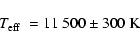
 = 11 500 K. This is confirmed by very weak He
lines, changing the classification to DAZB. Mg and Fe lines are
also detected. We discuss the physics of Balmer line broadening by
neutral helium, present a spectral analysis and note some
implications for the accretion/diffusion scenario of heavy elements
in cool white dwarfs.
= 11 500 K. This is confirmed by very weak He
lines, changing the classification to DAZB. Mg and Fe lines are
also detected. We discuss the physics of Balmer line broadening by
neutral helium, present a spectral analysis and note some
implications for the accretion/diffusion scenario of heavy elements
in cool white dwarfs.
Key words: stars: white dwarfs - stars: atmospheres - stars: abundances
 20 000 K. One of the first known white dwarfs (van Ma 2)
belongs to the DZ spectral type (only metal lines visible) in a
He-rich atmosphere, a well known and studied class of white
dwarfs. More recently, this metal contamination has also been found in
many hydrogen-rich white dwarfs (Zuckerman & Reid 1998; Koester et al. 2005; Zuckerman et al. 2003), enlarging the
class DAZ originally defined by the single object G 74-4
(Lacombe et al. 1983). The most plausible explanation of the metals
is accretion from interstellar matter, but some unsolved questions
remain (see e.g. discussion in Zuckerman & Reid 1998; Zuckerman et al. 2003).
20 000 K. One of the first known white dwarfs (van Ma 2)
belongs to the DZ spectral type (only metal lines visible) in a
He-rich atmosphere, a well known and studied class of white
dwarfs. More recently, this metal contamination has also been found in
many hydrogen-rich white dwarfs (Zuckerman & Reid 1998; Koester et al. 2005; Zuckerman et al. 2003), enlarging the
class DAZ originally defined by the single object G 74-4
(Lacombe et al. 1983). The most plausible explanation of the metals
is accretion from interstellar matter, but some unsolved questions
remain (see e.g. discussion in Zuckerman & Reid 1998; Zuckerman et al. 2003).
In this paper we report the analysis of a unique white dwarf, which at first sight looks like a DAZ with strong Ca II lines, but turns out to have a He-rich atmosphere with very strong H and metal contamination.
Two high resolution spectra were obtained as part of the search for
close double degenerate binary systems in the ESO SN Ia progenitor
survey (=SPY,
Napiwotzki et al. 2001,2003). The
selection of the sample, the specific nature of the search as a
"filler project'' for mediocre weather conditions, and the reduction
procedures are described in the cited papers and in
Koester et al. (2001). We therefore repeat here only the
most important characteristics.
The spectra were obtained with the UV-Visual Echelle Spectrograph
(UVES) at the Unit 2 Telescope (Kueyen) of the Very Large Telescope of
ESO on Paranal. The slit width is
 ,
leading to a resolution of
about 18 500 or better, depending on the seeing. The S/N per binned
pixel of 0.1 Å used in the present work is usually 15 or higher.
,
leading to a resolution of
about 18 500 or better, depending on the seeing. The S/N per binned
pixel of 0.1 Å used in the present work is usually 15 or higher.
Both spectra show the same features, but one is of much higher quality
and is the only one used for the detailed analysis presented here. The
spectrum is shown in Fig. 1.
![\begin{figure}
\includegraphics[width=8cm,clip]{3058fig1.ps}
\end{figure}](/articles/aa/full/2005/31/aa3058-05/img8.gif) |
Figure 1: UVES spectrum of HS 0146+1847, showing hydrogen Balmer lines and Ca II H and K. |
| Open with DEXTER | |
The Balmer lines and the resonance lines of Ca II are immediately
obvious and we therefore included this object in our study of DAZ
white dwarfs (Koester et al. 2005). The attempt to
determine atmospheric parameters from the lower Balmer lines up to
H ,
however, did not produce reasonable results. The "best fit''
within our normal DA model grid, resulted in
= 32 100 K,
,
however, did not produce reasonable results. The "best fit''
within our normal DA model grid, resulted in
= 32 100 K,  = 7.60, and is shown in Fig. 2.
![\begin{figure}
\includegraphics[width=8cm]{3058fig2.ps}
\end{figure}](/articles/aa/full/2005/31/aa3058-05/img10.gif) |
Figure 2:
Best fit of DA models to the Balmer lines H to
H
from bottom. The region with the Ca II lines, which also shows
H
to
H
from bottom. The region with the Ca II lines, which also shows
H in the left wing of the K line and a weak H8, is not included in
the fitting, but shown in the figure to preserve the same scale as in
the following figures. The profiles
have been shifted upwards by 0.4, 0.6, 0.8, 1.7 starting from
H
in the left wing of the K line and a weak H8, is not included in
the fitting, but shown in the figure to preserve the same scale as in
the following figures. The profiles
have been shifted upwards by 0.4, 0.6, 0.8, 1.7 starting from
H . . |
| Open with DEXTER | |
It is clear that the strong Balmer decrement of the observations is not reproduced by the models. In addition the observed line profiles seem to be asymmetric, which cannot originate from the symmetric Stark broadening of the Balmer lines. Another argument against this fit result are the Ca II lines. Photospheric lines of Ca II are not expected at such a high temperature, and the lines are much too strong to be of interstellar origin. This led us to consider the only plausible alternative - a helium-dominated atmosphere at much lower temperature - with hydrogen line broadening dominated by van der Waals interaction with neutral helium.
Very recently Gianninas et al. (2004) discovered a DAZ near
= 10 000 K with equally strong Balmer and Ca II lines. This opens
up the question, whether it is possible to decide upon the main
atmospheric constituent in this temperature range, where He lines
should be very weak or absent and hydrogen lines could theoretically
be of comparable strength (although such an object has not been
observed before HS 0146+1847). It is very instructive to compare their
spectrum (their Fig. 2) with our spectrum in Fig. 1, which
makes obvious the strong decrement and asymmetry of the Balmer lines
in our object.
A number of preliminary tests with helium-rich atmospheres
confirmed that this is indeed a possible solution, and led us to
estimates of the H and Ca abundances. A grid of model atmospheres was
then calculated with parameters in the range of these
estimates. Atmosphere parameters (besides the usual
and ),
were the abundances of Ca (around
 by numbers, compared
to He) and H (10-1 to 10-4). The solution is not well
determined when all parameters are allowed to vary, since e.g. the
hydrogen lines increase in strength both with abundances, but also
with
.
For our first determinations we therefore held
fixed at 8.0 and also the Ca abundance at
,
close to
the final best fit value. The solutions found with these constraints
are as expected at much lower temperature, e.g.
= 11 320 K, H/He
=
by numbers, compared
to He) and H (10-1 to 10-4). The solution is not well
determined when all parameters are allowed to vary, since e.g. the
hydrogen lines increase in strength both with abundances, but also
with
.
For our first determinations we therefore held
fixed at 8.0 and also the Ca abundance at
,
close to
the final best fit value. The solutions found with these constraints
are as expected at much lower temperature, e.g.
= 11 320 K, H/He
=
 .
This fit is shown in Fig. 3; it is
much better than the DA fit, but still far from perfect. While
H
is still somewhat too strong, the higher Balmer lines are too
weak.
We have repeated the fit procedure with different
within a
plausible range of 7.5-8.5, but the result does not improve
significantly.
.
This fit is shown in Fig. 3; it is
much better than the DA fit, but still far from perfect. While
H
is still somewhat too strong, the higher Balmer lines are too
weak.
We have repeated the fit procedure with different
within a
plausible range of 7.5-8.5, but the result does not improve
significantly.
![\begin{figure}
\includegraphics[width=8cm]{3058fig3.ps}
\end{figure}](/articles/aa/full/2005/31/aa3058-05/img13.gif) |
Figure 3: Best fit with He-rich models including H and Ca. See text for further description. |
| Open with DEXTER | |
With such an unsatisfactory fit, can we be certain to use the right
range of parameters as regarding major constituent and effective
temperatures? Fortunately there are strong arguments in favor. A close
inspection of the observed spectrum reveals the presence of weak, but
clearly identified He I lines at 5875 and 4471 Å. Figure 4
shows that our best fit model - considering the approximations in
the line broadening, see below - gives a very reasonable fit for both
lines (note that we show here the final model making use of the
changes in input physics discussed below). This is confirmation that
the dominant element is indeed helium and also excludes any
temperature outside the range
 K.
K.
![\begin{figure}
\includegraphics[width=8cm]{3058fig4.ps}
\end{figure}](/articles/aa/full/2005/31/aa3058-05/img15.gif) |
Figure 4: He I 5875 ( bottom) and 4471 ( top) lines in the observed spectrum and the best fit model. |
| Open with DEXTER | |
 ,
with Planck constant h and distance r) and the
damping parameter
,
with Planck constant h and distance r) and the
damping parameter  following Unsöld (1968), with the
improvements for hydrogen lines broadened by neutral helium as
described by Bergeron et al. (1991). We use the impact
approximation, which leads to a (shifted) Voigt profile. This is
usually a good approximation for the line center; its range of
validity can be estimated (see Unsöld 1968) as 55, 22, 15, 11
Å from the line center for H,
H,
H
following Unsöld (1968), with the
improvements for hydrogen lines broadened by neutral helium as
described by Bergeron et al. (1991). We use the impact
approximation, which leads to a (shifted) Voigt profile. This is
usually a good approximation for the line center; its range of
validity can be estimated (see Unsöld 1968) as 55, 22, 15, 11
Å from the line center for H,
H,
H ,
and
H.
Ideally we would prefer a unified theory valid for center and
line wing, which to our knowledge is not available for the conditions
needed here. Stark broadening is not important and is therefore
included in a very approximate way by using a Voigt profile with
appropriate width
,
and
H.
Ideally we would prefer a unified theory valid for center and
line wing, which to our knowledge is not available for the conditions
needed here. Stark broadening is not important and is therefore
included in a very approximate way by using a Voigt profile with
appropriate width  and
and  (for linear or quadratic
Stark effect the interaction energy is
(for linear or quadratic
Stark effect the interaction energy is  r-2 resp. r-4).
We have tested models with different
and also changes of the
damping parameters within plausible uncertainties, but none of the
calculations could produce the observed steep Balmer decrement. This
leaves as the most likely culprit for the unsatisfactory fit the
treatment of non-ideal effects in the gas with the Hummer-Mihalas (HM)
occupation probability mechanism (Däppen et al. 1988; Hummer & Mihalas 1988; Mihalas et al. 1988). In that theory the
occupation probability or the probability that a state still exists as
a bound state depends on interactions of the emitter with neutral and
charged perturbers. In our case only the neutral perturbers are
important which lead to increasingly lower probabilities for higher
exited states of hydrogen and as a consequence to a weakening of the
higher Balmer lines and finally to a smooth merging of the highest
series members into the continuum, as can be very well observed in
normal DA white dwarfs. Bergeron et al. (1991) noticed that
with the original description of the neutral interactions in HM -
which is based on a hard sphere model - they obtained a
systematically low surface gravity for cool DAs and concluded that the
interaction has to be smaller than assumed. They introduced a
correction factor of 0.5 (compared to 1.0 in the original HM) for the
interaction radius (their Eq. (15)). We have in our models in the
past been following this suggestion with the small change that we use
a correction factor of
f = 1/8 = 0.125 to the total excluded volume
(rn + rn')3 (their Eq. (16)). Since the higher level
dominates the volume this is very nearly equivalent to the
Bergeron et al. (1991) assumption. One should bear this in
mind, however, in the following discussion, where we use our notation
for the correction.
The model fit in Fig. 3 uses our standard model grids with f = 0.125. Although weaker than the standard HM model the interaction still seems to be too strong, unless we want to consider surface gravities much lower than 7.5. We have experimented with further decreasing f and find that a value as low as f = 0.005 is needed to give a reasonable fit. Further decreasing f does not lead to significant improvements anymore. This factor corresponds roughly to a correction factor of 0.17 in the Bergeron notation.
The final fit using a model grid calculated with this assumption is
shown in Fig. 5.
While the Balmer decrement still does not agree completely with the
observation, the improvement is very noticeable for H
and
H,
visible in the wings of the Ca II K line.
The parameters for the best fitting model are then (
= 8 assumed)
![\begin{displaymath}\mbox{[H/He]} = -2.89 \pm 0.3, \mbox{\qquad [Ca/He]} = -8.7 \pm 0.2
\end{displaymath}](/articles/aa/full/2005/31/aa3058-05/img23.gif)
 routine are
as usually significantly smaller than this.
routine are
as usually significantly smaller than this.
![\begin{figure}
\includegraphics[width=8cm]{3058fig5.ps}
\end{figure}](/articles/aa/full/2005/31/aa3058-05/img25.gif) |
Figure 5: Best fit with He-rich models including H and Ca, using a correction factor of 0.005 for the neutral interactions. |
| Open with DEXTER | |
 and [Fe/He] =
 .
Figure 6 shows these regions for the observed spectrum
and the model.
.
Figure 6 shows these regions for the observed spectrum
and the model.
![\begin{figure}
\includegraphics[width=8cm]{3058fig6.ps}
\end{figure}](/articles/aa/full/2005/31/aa3058-05/img28.gif) |
Figure 6: Metal lines of Mg and Fe in the blue part of the spectrum (thin dotted line) compared to the model (thick line). |
| Open with DEXTER | |
Since the Mg and Fe abundances are even higher than the Ca abundance
we have calculated a fully consistent atmosphere model with all
identified elements included in the equation of state. This did not
change the model or the Balmer and He lines, thus confirming the
validity of the atmospheric parameter determination. As a final test
we have kept fixed all metal abundances and the effective temperature,
with
remaining the only unknown parameter. The best fit model
was then found at
= 7.94. While this cannot be considered a
real determination, it at least suggests that our assumption of
= 8.0 is consistent.
The photographic magnitude
 of HS 0146+1847 is 15.5
(Giclas et al. 1965). Our final model has an absolute magnitude
MV = 12.05, assuming
= 8.0, and
B-V = 0.01. We can thus
assume that
of HS 0146+1847 is 15.5
(Giclas et al. 1965). Our final model has an absolute magnitude
MV = 12.05, assuming
= 8.0, and
B-V = 0.01. We can thus
assume that
 and derive a distance
 pc.
pc.
We do not believe that this result should be applied to hydrogen-rich
white dwarfs without further evidence and testing. There are still
some problems with the determination of surface gravities and masses
in cool DA white dwarfs; see e.g. Kleinman et al. (2004), who find an
increase in
at the cool end of the DA sequence. However, that
upturn starts above
10 000 K, where the interactions
with charged particles still dominate in hydrogen.
The only plausible explanation for metals in cool white dwarfs is accretion from the outside, since the timescales for gravitational settling are always short compared to evolutionary timescales. This scenario has a number of problems, which are related to the conditions of the ISM in the solar neighborhood (for a discussion of the problems and alternative models see Zuckerman et al. 2003). The problems have become very severe recently with the discovery of many hydrogen-rich objects with metals, where the timescale for diffusion is extremely short and the star has to be now practically at the place where accretion occurred.
This is not true for HS 0146+1847. The current distance places it (with very
large uncertainty because of the unknown )
possibly within the
local bubble with very low neutral hydrogen column densities. However,
the diffusion timescales in this helium-rich atmosphere are much
larger, of the order of 106 yr (Dupuis et al. 1993a), and
the object could have traveled many pc since the last accretion
episode.
The abundances relative to helium of the three metals are very comfortably within the range predicted by Dupuis et al. (1993b, their Figs. 1, 3, 4) for high and low accretion rates, and similar to those found in typical DZ and DBZ objects. What makes this object unique and important is the large hydrogen abundance. Looking at the abundance ratio of the heavy elements to hydrogen, we find [Ca/H] = -5.81 (-5.69), [Mg/H] = -4.33 (-4.47), and [Fe/H] = -4.81 (-4.55), where the numbers in parentheses are the solar ratios (Asplund et al. 2004). The ratios are very close to the solar values, slightly lower for Ca and Fe, and slightly higher for Mg. It is tempting to interpret the numbers for Ca and Fe with the fact that the diffusion timescale for Mg is more than a factor of 2 longer than for Ca and Fe (see Table 1 in Dupuis et al. 1993a), but this is probably over-interpreting the accuracy of the results. In any case hydrogen in this star is very likely accreted with solar abundances, in stark contrast to most other DZ and DBZ in this temperature range (Koester & Wolff 2000; Wolff et al. 2002). The only viable explanation which has been discussed for the missing hydrogen in these objects is the propeller mechanism (Wesemael & Truran 1982), which needs a magnetic field and non-zero rotation in the white dwarf to prevent hydrogen from accreting. Since this was obviously not the case for HS 0146+1847, further studies for rotation and magnetic fields along the lines of Friedrich et al. (2004) would be very interesting.
Acknowledgements
This work in Kiel was supported partly by grant KO 738/21-1 from the Deutsche Forschungsgemeinschaft. R.N. acknowledges support by a PPARC Advanced Fellowship.