![[*]](/icons/foot_motif.gif)
A&A 439, 361-366 (2005)
DOI: 10.1051/0004-6361:20052963
P. R. Young
CCLRC Rutherford Appleton Laboratory, Chilton, Didcot, Oxfordshire, OX11 0QX, UK
Received 1 March 2005 / Accepted 2 May 2005
Abstract
The Mg/Ne abundance ratio in the quiet Sun is measured in
both network and supergranule cell centre regions through EUV spectra
from the Coronal Diagnostic Spectrometer on SOHO. Twenty four sets of
data over
the period 1996 March to 1998 June (corresponding to solar minimum
and the onset of the next cycle)
are studied. Emission lines of the sequences Ne IV-VII and Mg
V-VIII are simultaneously analysed by comparing with theoretical
emissivities from the CHIANTI database to yield the Mg/Ne abundance
and emission measure over the temperature region
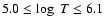 .
The average enhancements over the photospheric Mg/Ne abundance
are found to be
.
The average enhancements over the photospheric Mg/Ne abundance
are found to be
 (network) and
 (cell centres), implying that the structures making up the
transition region have close-to photospheric abundances. In
particular, this implies that
only a small fraction of the quiet Sun can connect to the solar
wind where the Mg/Ne abundance ratio is found to be factors 4-5 greater than the photospheric value.
The quiet
Sun spectra are also utilised to determine the coronal density and
temperature, leading to average values of
(cell centres), implying that the structures making up the
transition region have close-to photospheric abundances. In
particular, this implies that
only a small fraction of the quiet Sun can connect to the solar
wind where the Mg/Ne abundance ratio is found to be factors 4-5 greater than the photospheric value.
The quiet
Sun spectra are also utilised to determine the coronal density and
temperature, leading to average values of
 cm-3 and
 .
No significant trend with the rise
in solar activity during 1996-98 is found for any of the derived
quantities, implying that quiet Sun regions show little dependence on
the solar cycle.
.
No significant trend with the rise
in solar activity during 1996-98 is found for any of the derived
quantities, implying that quiet Sun regions show little dependence on
the solar cycle.
Key words: Sun: abundances - Sun: transition region - Sun: UV radiation - Sun corona
Abundance anomalies in the solar upper atmosphere and solar wind have been reported for over 40 years (see, e.g., review of Feldman & Laming 2000), with the general result that elements with a low first ionization potential (FIP) are often enhanced over those with a high FIP. The separation between low and high FIP is around 10 eV and thus, for example, Fe, Mg and Si are considered low-FIP elements and Ne and Ar are considered high-FIP elements. This abundance anomaly pattern is generally referred to as the "FIP Effect''. The FIP effect is important as it provides a constraint that models for the solar corona and solar wind must satisfy.
At solar minimum the slow solar wind originates from the quiet Sun and thus coronal and transition region plasma in the quiet Sun may be expected to show the FIP enhancement of a factor 4-5 typically found in the slow solar wind (Meyer 1985). Measurements of relative abundances are, however, rare for the quiet Sun partly due to limitations of solar instrumentation. The S082A spectroheliograph on Skylab had a slitless design that resulted in spectral and spatial dimensions being mixed and only small, isolated features could be studied for abundance work, ruling out quiet Sun observations on the solar disk. Feldman & Widing (1993), however, were able to use the limb-brightening of transition region lines at the solar limb to isolate emission from Ne VI and Mg VI ions, yielding a Mg/Ne abundance enhancement over the photosphere of a factor 1.5-2.0.
Spadaro et al. (1996) used the average supergranule cell centre and network region spectra of Vernazza & Reeves (1978) obtained with the S-055 instrument on board Skylab to investigate element abundances in the transition region and corona. They found no enhancement over photospheric values for the elements considered here (magnesium and neon), although there was only limited temperature overlap between the ions they considered.
A key advantage of the Normal Incidence Spectrometer of the Coronal Diagnostic Spectrometer on SOHO is that it obtains simultaneous spectral and spatial information for two large wavelength bands, allowing many ions from different species to be compared - an important requirement for abundance studies. There have been several analyses of CDS data that have yielded abundance measurements in quiet Sun regions. Landi & Landini (1998) performed a differential emission measure (DEM) analysis on an active region and a nearby area of quiet Sun, yielding a Mg/Ne enhancement over the photospheric value of 2.0 for the latter. MacPherson & Jordan (1999) studied the intensities of helium lines in the quiet Sun and a by-product of their analysis was that the low-FIP enhancement over high-FIP elements was at most a factor 1.4, with a small variation between supergranule cell centres and network regions. Young & Mason (1998) studied quiet Sun spectra averaged over many CDS rasters from 1996 and determined a Mg/Ne ratio enhanced over the photospheric value by a factor 2, with little difference between cell centres and network. It is to be noted that the present work differs from Young & Mason (1998) through the analysis method used, and the separate study of individual data-sets over time.
All of the results from these works refer to the transition
region. Results for the corona are not common in the
literature. Laming et al. (1995) re-analysed an EUV rocket spectrum of
Malinovsky & Heroux (1973) to determine a FIP enhancement of 3-4. Above the solar
limb, Feldman et al. (1998) have measured a low-FIP enhancement of a factor 4
using the SUMER instrument on board SOHO at a height of
1.03  .
Another effect seen further off-limb above the quiet
Sun is that of gravitational settling of heavier
elements. Raymond et al. (1997) used SOHO/UVCS spectra obtained at
1.5
to demonstrate that oxygen is underabundant relative
to hydrogen by an order of magnitude; for ions of comparable mass,
however, the FIP effect is still seen with a value around 4.
.
Another effect seen further off-limb above the quiet
Sun is that of gravitational settling of heavier
elements. Raymond et al. (1997) used SOHO/UVCS spectra obtained at
1.5
to demonstrate that oxygen is underabundant relative
to hydrogen by an order of magnitude; for ions of comparable mass,
however, the FIP effect is still seen with a value around 4.
The present work uses spectra from CDS to determine Mg/Ne relative abundance ratios in the quiet Sun for a number of data-sets over a period of 28 months from the most recent solar activity minimum (1996) through the rise in activity during 1997 and 1998. The aim is to provide definitive measurements for supergranule cell centres and network regions and to search for any long-term time variability.
The Coronal Diagnostic Spectrometer (CDS) is one of 12 scientific
instruments on board the Solar and Heliospheric Observatory (SOHO) and
obtains extreme ultraviolet (EUV)
spectra over the range 150-800 Å (Harrison et al. 1995). It consists of two separate
spectrometers (the Grazing Incidence, GIS, and Normal Incidence, NIS)
fed by the same telescope. Only data
from the NIS are presented here.
NIS simultaneously obtains spectral and one-dimensional spatial
information in single exposures, with images of a region built up
through rastering. Two wavebands are observed simultaneously:
308-381 Å and 513-633 Å. A rich selection of emission lines
from different ion species are found in these bands, covering
temperatures from
 to
to
 K.
K.
The data used here are from the NISAT_S CDS observing sequence that obtains
complete NIS spectra over a spatial area
 .
NISAT_S has
been run once per week on quiet Sun regions for the duration of the
SOHO mission as part of
the CDS synoptic programme. Only studies run up to the
(temporary) loss of SOHO
in 1998 June are considered here since CDS line profiles were
modified following the loss
making the weak magnesium lines difficult to measure.
.
NISAT_S has
been run once per week on quiet Sun regions for the duration of the
SOHO mission as part of
the CDS synoptic programme. Only studies run up to the
(temporary) loss of SOHO
in 1998 June are considered here since CDS line profiles were
modified following the loss
making the weak magnesium lines difficult to measure.
A list of all runs of the NISAT_S study between the start of science
observations (1996 February) and 1998 June 23 was extracted. Through
fields in the headers
of the data files only those studies positioned within
300
 of Sun centre and not located on an active region were
selected. The closest EIT 195 image in time was extracted from the
SOHO databases, and the position of the NISAT raster was overplotted
allowing the location relative to active regions to be determined.
Only rasters lying in clear quiet Sun patches, and not overlying
strong bright points were selected.
In all, 24 NISAT rasters were chosen. Each were processed with the latest
version of the CDS calibration software. The NIS spectra appear tilted
on the detector and this was corrected to ensure that each emission
line was spatially aligned. Cosmic rays were flagged with the
CDS_NEW_SPIKE IDL routine and were not included in the analysis. The
data were calibrated in both photon event
units and intensity (erg cm-2 s-1 sr-1) units. The
errors on the intensity are derived from the photon event values
following Thompson (2000). The intensities of some of the stronger
lines in the NIS2 wavelength band are affected by the narrow slit
burn-in correction (see Sect. 7.7.1 of Lang et al. 2002) that results
in line widths (and thus line intensities) falling by up to 10% over the period 1996-98. The
IDL routine
GET_WIDTH_CORR in the CDS analysis software corrects for this effect.
For the
neon lines used in the abundance analysis here, the effects are less
than 2% over the
time period considered, and are not accounted for. For the stronger
O V
of Sun centre and not located on an active region were
selected. The closest EIT 195 image in time was extracted from the
SOHO databases, and the position of the NISAT raster was overplotted
allowing the location relative to active regions to be determined.
Only rasters lying in clear quiet Sun patches, and not overlying
strong bright points were selected.
In all, 24 NISAT rasters were chosen. Each were processed with the latest
version of the CDS calibration software. The NIS spectra appear tilted
on the detector and this was corrected to ensure that each emission
line was spatially aligned. Cosmic rays were flagged with the
CDS_NEW_SPIKE IDL routine and were not included in the analysis. The
data were calibrated in both photon event
units and intensity (erg cm-2 s-1 sr-1) units. The
errors on the intensity are derived from the photon event values
following Thompson (2000). The intensities of some of the stronger
lines in the NIS2 wavelength band are affected by the narrow slit
burn-in correction (see Sect. 7.7.1 of Lang et al. 2002) that results
in line widths (and thus line intensities) falling by up to 10% over the period 1996-98. The
IDL routine
GET_WIDTH_CORR in the CDS analysis software corrects for this effect.
For the
neon lines used in the abundance analysis here, the effects are less
than 2% over the
time period considered, and are not accounted for. For the stronger
O V  629.7 and Mg X 624.9
lines considered in Sect. 6, however, the intensities
can be affected by up to 10% and have been corrected for.
629.7 and Mg X 624.9
lines considered in Sect. 6, however, the intensities
can be affected by up to 10% and have been corrected for.
After the data had been calibrated, the spatial separation into supergranule
network and cell centre regions was performed using the O V
629.7 line. This line is formed at
 and is the
strongest transition region line seen by CDS, giving sufficient signal
at each spatial pixel to allow a direct separation into network or
cell centre regions.
Based on the work of Gallagher et al. (1998), 50% of the quiet Sun is found
in network regions and 50% in cell centres at the
temperature of formation of O V. The spatial pixels in
the NISAT rasters were
thus divided according to intensity into network and cell centre
regions. The intensity value at which the division between network and cell
centres occurs for each of the data-sets is shown in
Fig. 1. For this and other plots in this paper, time
is represented as the number of days since the start of science
operations for CDS (1996 February 25).
All spatial pixels belonging to the two regions were then
summed, and complete NIS spectra extracted.
and is the
strongest transition region line seen by CDS, giving sufficient signal
at each spatial pixel to allow a direct separation into network or
cell centre regions.
Based on the work of Gallagher et al. (1998), 50% of the quiet Sun is found
in network regions and 50% in cell centres at the
temperature of formation of O V. The spatial pixels in
the NISAT rasters were
thus divided according to intensity into network and cell centre
regions. The intensity value at which the division between network and cell
centres occurs for each of the data-sets is shown in
Fig. 1. For this and other plots in this paper, time
is represented as the number of days since the start of science
operations for CDS (1996 February 25).
All spatial pixels belonging to the two regions were then
summed, and complete NIS spectra extracted.
![\begin{figure}
\par\includegraphics[width=8.1cm,clip]{2963fig1.eps}\end{figure}](/articles/aa/full/2005/31/aa2963-05/img21.gif) |
Figure 1:
The O V 629.7 intensity at which the division between
network and cell centre regions occurs for each of the 24 data-sets. |
| Open with DEXTER | |
A Gaussian fitting routine of the author
based on the MPFIT curve-fitting procedures of C. B. Markwardt was used
to fit lines in the spectrum. Line intensity errors derived from the
fitting procedure
were added in quadrature to flux calibration
uncertainties, taken as 15%.
Within the two NIS wavebands, CDS observes emission lines from the consecutive ion sequences Mg V-VIII and Ne IV-VII, for which there is significant temperature overlap (Fig. 2). Thus the Mg and Ne ions will be found in the same solar structures and, once the atomic physics parameters are corrected for, the ratios of the emission lines from the two elements allow a measure of the relative abundance of the two elements. By simulaneously comparing four ions from each element, errors due to atomic data uncertainties in any single ion are avoided.
The transitions used in the present work are listed in
Table 1. Whereas most of the lines are unblended and
simply fit with a single Gaussian, the Mg V and Mg VII
lines
are more difficult. The former lies close to the stronger
Fe XI 352.7
and Fe XII 352.1 lines and all three were fitted together
in a 3-Gaussian fit. In cases where the Mg V line was
particularly weak the widths of all three lines were forced to be the
same. The Mg VII 367.7 line is partially blended with the stronger
Mg IX 368.1 line and the lines were simultaneously fit with
two Gaussians forced to have the same width. Note that all lines
observed with NIS are dominated by instrumental broadening and thus
lines close in wavelength typically have the same width.
Table 1: Emission lines used in the present analysis. Transitions within 0.4 Å are blended in the CDS spectra. Wavelengths are from v4.2 of the CHIANTI database.
Table 1 also lists other emission lines used in this work.
![\begin{figure}
\par\includegraphics[width=8cm,clip]{2963fig2.eps}\end{figure}](/articles/aa/full/2005/31/aa2963-05/img23.gif) |
Figure 2: Ionization fraction curves from Mazzotta et al. (1998) for the magnesium and neon ions. |
| Open with DEXTER | |
The line fitting procedure resulted in eight intensity values corresponding to the eight magnesium and neon ions. A minimization procedure was then applied to derive the Mg/Ne relative abundance using atomic data from the CHIANTI database and a model for the plasma distribution with temperature.
The model discretises the plasma into temperature components
distributed at 0.1 dex intervals between
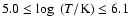 .
This region covers all temperatures at which the Mg and Ne ions
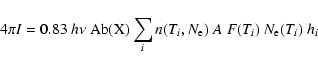
are formed (Fig. 2). The theoretical intensity for an
emission line is given by
.
This region covers all temperatures at which the Mg and Ne ions
are formed (Fig. 2). The theoretical intensity for an
emission line is given by
 the energy for the transition,
Ab(X) the abundance of element X, n the population of the upper
emitting level of the transition (normalised such that the total of
all the level populations
is set to 1), A the radiative
decay rate for the transition, F the ionization fraction,
the energy for the transition,
Ab(X) the abundance of element X, n the population of the upper
emitting level of the transition (normalised such that the total of
all the level populations
is set to 1), A the radiative
decay rate for the transition, F the ionization fraction,  the electron number density, and hi the plasma column depth
at temperature Ti. The n and A values are derived
from v4.2 of the CHIANTI database (Young et al. 2003) and the F(Ti)values are from Mazzotta et al. (1998). A constant pressure is assumed based
on the density derived from the Si IX density diagnostic
(Sect. 6). The pressure (
the electron number density, and hi the plasma column depth
at temperature Ti. The n and A values are derived
from v4.2 of the CHIANTI database (Young et al. 2003) and the F(Ti)values are from Mazzotta et al. (1998). A constant pressure is assumed based
on the density derived from the Si IX density diagnostic
(Sect. 6). The pressure (
 )
is set to
1014.5 K cm-3. The effects on the results of assuming
constant density instead are discussed below.
)
is set to
1014.5 K cm-3. The effects on the results of assuming
constant density instead are discussed below.
The hi values are determined through the minimization procedure,
although only three of the values enter as free parameters: the values
at
 ,
which we refer to as h0, h6 and
h11. The remaining values are determined by linear interpolation in
the
,
which we refer to as h0, h6 and
h11. The remaining values are determined by linear interpolation in
the
 plane. An example of the derived h values
for one data-set is shown in Fig. 3.
plane. An example of the derived h values
for one data-set is shown in Fig. 3.
![\begin{figure}
\par\includegraphics[width=8cm,clip]{2963fig3.eps}\end{figure}](/articles/aa/full/2005/31/aa2963-05/img32.gif) |
Figure 3:
Column depths (h) derived from the supergranule network
spectrum of CDS data-set s10133r00 (1998 January 10). The three
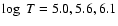
values at
 ,
5.6 and 6.1 were derived through the
minimization procedure, all other values are obtained by linear
interpolation from these three values. ,
5.6 and 6.1 were derived through the
minimization procedure, all other values are obtained by linear
interpolation from these three values. |
| Open with DEXTER | |
![\begin{figure}
\par\includegraphics[width=8cm,clip]{2963fig4.eps}\end{figure}](/articles/aa/full/2005/31/aa2963-05/img33.gif) |
Figure 4: The derived Mg/Ne abundance ratios for the network ( upper panel) and cell centre ( lower panel) regions as a function of time. The black horiontal line denotes the photospheric Mg/Ne abundance ratio. The grey line shows the variation in the sunspot number over the period of observations, from a value of 10 at day 0 to 68 at day 900. |
| Open with DEXTER | |
The MPFIT procedures mentioned previously were used to minimise the
difference between the theoretical intensities (derived from
Eq. (1)) and observed
intensities through the four parameters Ab(Mg)/Ab(Ne), h0, h6 and
h11.  values ranged from 0.66 to 3.2 over the different
data-sets.
The Ab(Mg)/Ab(Ne) values for the network and cell centre regions are
displayed in Fig. 4. The photospheric Mg/Ne abundance
is taken as 0.316 (Grevesse & Sauval 1998). In both types of region there
is no significant trend in time, and the average enhancements over the
photospheric Mg/Ne abundance are
(network) and
(cell centres). The average enhancement of the cell centres over
the network is
values ranged from 0.66 to 3.2 over the different
data-sets.
The Ab(Mg)/Ab(Ne) values for the network and cell centre regions are
displayed in Fig. 4. The photospheric Mg/Ne abundance
is taken as 0.316 (Grevesse & Sauval 1998). In both types of region there
is no significant trend in time, and the average enhancements over the
photospheric Mg/Ne abundance are
(network) and
(cell centres). The average enhancement of the cell centres over
the network is
 .
Also shown in Fig. 4 is the variation
in sunspot number over the
period of the CDS observations. This demonstrates that there is no
trend with solar activity. The abundance results are considered to
apply over the temperature range
.
Also shown in Fig. 4 is the variation
in sunspot number over the
period of the CDS observations. This demonstrates that there is no
trend with solar activity. The abundance results are considered to
apply over the temperature range
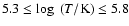 as
this is the principle range of overlap of the magnesium and neon ions
(Fig. 2), and the division into cell centres and network
does not apply at high temperatures.
as
this is the principle range of overlap of the magnesium and neon ions
(Fig. 2), and the division into cell centres and network
does not apply at high temperatures.
Assuming a constant density in the minimization procedure produces
only small changes in the results. E.g., for a density of
109 cm-3, the network and cell centre abundance ratios are
 and
and
 ;
while for a density of
1010 cm-3 they become
;
while for a density of
1010 cm-3 they become
 and
and
 .
.
In all data-sets the cell centre Mg/Ne ratio is greater than the network value. The largest enhancement of cell centre over network is 1.99 while the smallest enhancement is 1.03.
The average values for the column depths h0, h6 and h11are: 64.1, 165 and 72 800 km (cell centres); and 157, 350 and
104 000 km (network). Note that these values assume that neon has its
photospheric abundance (
 ,
Grevesse & Sauval 1998) in the transition region.
,
Grevesse & Sauval 1998) in the transition region.
Complete NIS spectra were extracted in order to study the Mg/Ne abundance ratio and other lines in these spectra can be used to determine additional properties of the quiet Sun. Presented below are coronal density and temperature measurements, and line intensities as a function of time.
Two emission lines of Si IX are found at 345.1 and 349.9 Å in the NIS spectra and they are blends of 2 and 3 Si IX
transitions (Table 1), respectively. The
349.9/345.1 ratio is density sensitive and the range of
sensitivity is particular useful
for coronal hole and quiet Sun regions (Fig. 5).
Si IX is formed at temperatures of  1 million
K, and so the separation of cell and network regions has limited
physical significance at coronal temperatures. The intensities are
thus averaged to yield quiet Sun intensities, and the
349.9/345.1 line ratio is converted to an electron density
through software in the CHIANTI database. Figure 6a
shows the density values for each of the data-sets. The average value
is
cm-3.
1 million
K, and so the separation of cell and network regions has limited
physical significance at coronal temperatures. The intensities are
thus averaged to yield quiet Sun intensities, and the
349.9/345.1 line ratio is converted to an electron density
through software in the CHIANTI database. Figure 6a
shows the density values for each of the data-sets. The average value
is
cm-3.
Landi & Landini (1998) found quiet Sun densities of
 and
and
 cm-3 using Si IX for
two quiet Sun regions. We note, however, that the high temperature
Si XII
520.7 intensity for these regions is 145 and 254 erg cm-2 s-1 sr-1,
respectively,
significantly higher than the values found in the present work (see
below and Fig. 6), indicating that there is some
contamination from the nearby active region.
cm-3 using Si IX for
two quiet Sun regions. We note, however, that the high temperature
Si XII
520.7 intensity for these regions is 145 and 254 erg cm-2 s-1 sr-1,
respectively,
significantly higher than the values found in the present work (see
below and Fig. 6), indicating that there is some
contamination from the nearby active region.
![\begin{figure}
\par\includegraphics[width=8.2cm,clip]{2963fig5.eps}\end{figure}](/articles/aa/full/2005/31/aa2963-05/img46.gif) |
Figure 5:
Variation of the Si IX 349.9/345.1 ratio as a
function of density. Calculated with v4.2 of the CHIANTI database at
a temperature of
 . . |
| Open with DEXTER | |
![\begin{figure}
\par\includegraphics[width=8.5cm,clip]{2963fig6.eps}\end{figure}](/articles/aa/full/2005/31/aa2963-05/img47.gif) |
Figure 6:
Variation of spectral properties over the 850 day period
considered. a)
electron density derived from Si IX 349.9/345.1
diagnostic; b) coronal isothermal temperature derived from
Mg X 624.9/368.1 ratio; c) absolute line intensities
for three species. In each plot linear fits to the data are shown. |
| Open with DEXTER | |
The ratio of the Mg X 624.9 line to the Mg IX
368.1 line can be used to yield a temperature estimate for the
quiet Sun if the plasma is assumed to be isothermal. Although the
solar atmosphere is clearly multithermal, the Mg X/Mg IX ratio
is useful since the peak of the emission measure distribution in the
quiet Sun is around
 -6.0 (Del Zanna & Bromage 1999), close to
the temperatures of
maximum formation of the two ions. Figure 6b shows
the temperatures derived from the line ratio. The values are all very
similar and there is no trend with time. The average value is
.
-6.0 (Del Zanna & Bromage 1999), close to
the temperatures of
maximum formation of the two ions. Figure 6b shows
the temperatures derived from the line ratio. The values are all very
similar and there is no trend with time. The average value is
.
Figure 6c shows the variation of three emission
lines with time: O V 629.7, Mg X 624.9 and
Si XII 520.7. The latter two are coronal lines and so are
averaged over the network and cell centre regions. The average
intensities in units
erg cm-2 s-1 sr-1 are  ,
,
 (O V network and cell centre),
 (Mg X) and
 (Si XII). The very low intensity of
Si XII 520.7 (one of the stronger lines in active region
spectra) means there is no significant plasma emission above
(Si XII). The very low intensity of
Si XII 520.7 (one of the stronger lines in active region
spectra) means there is no significant plasma emission above
 .
.
The Mg/Ne abundance ratio in the transition region of the Sun at
temperatures
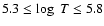 is enhanced over the value in the
photosphere by less than a factor 2. In supergranule cell centre
regions the enhancement factor is
,
while for network
regions it is
.
There is no trend with solar cycle over
the 28 month period (1996 Feb. to 1998 Jun.) for which data was
analysed.
is enhanced over the value in the
photosphere by less than a factor 2. In supergranule cell centre
regions the enhancement factor is
,
while for network
regions it is
.
There is no trend with solar cycle over
the 28 month period (1996 Feb. to 1998 Jun.) for which data was
analysed.
Simultaneous measurements of the electron density using the density
sensitive Si IX 349.9/345.1 line ratio yield an average
value of
cm-3 for the quiet
Sun. The Mg X 624.9/Mg IX 368.1 ratio yields an
average quiet Sun temperature
.
The quiet Sun seen at transition region temperatures
is known to be inhomogeneous and schematic models for the magnetic
structuring are suggested by Dowdy et al. (1986) and
Peter (2001). These indicate that
a significant proportion of the emission originates in small closed loops
that do not reach coronal temperatures. Direct evidence for these loops is
provided by high resolution spectroheliograms obtained by the SUMER
instrument on SOHO (Feldman et al. 1999).
The abundance results for the quiet
Sun presented here show that the slow solar wind Mg/Ne relative
abundance value is not found in the quiet Sun transition region:
Von Steiger et al. (2000) used in situ measurements from the SWICS
instrument on Ulysses to determine fast and slow solar wind
element abundances for a number of different elements. Their Mg/Ne
abundance ratio derived for the period 1997 July to 1998 April (which
overlaps with the present work) is a factor
 greater than
the photospheric value and much higher than the present values.
The consequences of this result are twofold. Only a small fraction of
the magnetic field lines that thread the quiet Sun transition region can
extend out into the solar wind (otherwise the abundance ratios would
be the same for both regions). Secondly the closed loops that dominate
the transition region emission show close-to photospheric abundances.
greater than
the photospheric value and much higher than the present values.
The consequences of this result are twofold. Only a small fraction of
the magnetic field lines that thread the quiet Sun transition region can
extend out into the solar wind (otherwise the abundance ratios would
be the same for both regions). Secondly the closed loops that dominate
the transition region emission show close-to photospheric abundances.
Supergranule cell centres contain less closed field and there is a clear enhancement of the Mg/Ne ratio over network regions as derived from the CDS data. This can be interpreted as a greater contribution of open field line plasma to the total emission from cell centres. The cell centre abundance values are, however, still considerably below the slow solar wind Mg/Ne ratio. High spatial resolution, high sensitivity observations of superganule cell centres are required to search for small open-field regions that would be expected to show the high Mg/Ne enhancements found in the solar wind.
None of the quantities (Mg/Ne abundance, density, temperature)
measured in the present work show a significant trend with time as
solar activity increases from its minimum in 1996. In particular, the
hottest line in this work (Si XII 520.7, formed at
![$\log~[T/{\rm K}]=6.3$](/articles/aa/full/2005/31/aa2963-05/img56.gif) )
shows an average constant trend with
time. This implies that true quiet Sun regions are not affected by the
solar cycle.
This is consistent with the relatively small changes in quiet Sun
magnetic flux during the solar cycle (Hagenaar et al. 2003), which may be
indicative of a separate, solar cycle independent, dynamo mechanism
that generates the ephemeral
regions found in the quiet Sun.
)
shows an average constant trend with
time. This implies that true quiet Sun regions are not affected by the
solar cycle.
This is consistent with the relatively small changes in quiet Sun
magnetic flux during the solar cycle (Hagenaar et al. 2003), which may be
indicative of a separate, solar cycle independent, dynamo mechanism
that generates the ephemeral
regions found in the quiet Sun.
CDS has allowed a detailed study of the FIP effect in the quiet Sun at transition region temperatures due to the simultaneous observation of several ions of magnesium and neon. A similar study for coronal plasma in the quiet sun is not possible with CDS as there are no useful lines of sulphur and argon (coronal lines of neon are found at X-ray wavelengths). However, the EUV Imaging Spectrometer to be flown on Solar-B (Culhane et al. 2000) will observe consecutive series of ions from iron and sulphur over 1 to 3 million K. An important project for EIS will be to measure the FIP enhancement at these temperatures in the quiet sun and determine whether it is closer to the solar wind value or the transition region value measured here.
Acknowledgements
The author thanks J. Schmelz, A. Fludra, J. Lang, and the referee, U. Feldman, for useful comments.