A&A 438, L5-L8 (2005)
DOI: 10.1051/0004-6361:200500140
Scattering of gravitational waves by the weak gravitational
fields of lens objects
R. Takahashi1 - T. Suyama2 - S. Michikoshi2
1 - Division of Theoretical Astronomy, National
Astronomical Observatory of Japan, Mitaka,
Tokyo 181-8588, Japan
2 -
Department of Physics, Kyoto University,
Kyoto 606-8502, Japan
Received 17 March 2005 / Accepted 7 June 2005
Abstract
We consider the scattering of gravitational waves by the
weak gravitational fields of lens objects.
We obtain the scattered gravitational waveform
by treating the gravitational potential of the lens
to first order, i.e. using the Born approximation.
We find that the effect of scattering on the
waveform is roughly given by the Schwarzschild radius of the lens
divided by the wavelength of gravitational wave
for a compact lens object.
If the lenses are smoothly distributed,
the effect of scattering is of the order of the convergence field  along the line of sight to the source.
In the short wavelength limit, the amplitude is magnified by
along the line of sight to the source.
In the short wavelength limit, the amplitude is magnified by
 ,
which is consistent with the result in weak gravitational
lensing.
,
which is consistent with the result in weak gravitational
lensing.
Key words: gravitational lensing -
gravitational waves - scattering
Ground-based laser interferometric detectors of gravitational waves
such as LIGO, VIRGO, TAMA and GEO are currently in operation to search
for astrophysical sources such as neutron star
binaries, black hole binaries and supernovae
(e.g. Cutler & Thorne 2002).
The gravitational wave signals from these binaries are extracted from the
data using matched filtering with a gravitational waveform template.
If the gravitational waves pass near massive compact
objects or pass through intervening inhomogeneous mass distribution,
the gravitational waveform is changed due to the scattering (or the
gravitational lensing) by the gravitational potential of these objects.
The gravitational waves do not directly interact with
matter (e.g. Thorne 1987), but the gravitational lensing occurs
in the same way as it does for electromagnetic waves.
In this letter, we investigate the effects of scattering by lens objects
on the gravitational waveform.
In the gravitational lensing of light, the scattering is
discussed in terms of gravitational lensing under the geometrical optics
approximation, which is valid because the wavelength is much smaller
than the typical size of lens objects.
But in the case of gravitational waves, since the wavelength is much
larger than that of light, geometrical optics is not valid
in some cases.
If the wavelength is larger than the Schwarzschild radius of the
lens, wave optics should be used (Peters 1974; Ohanian 1974;
Bontz & Haugan 1981; Thorne 1983;
Deguchi & Watson 1986).
This condition is rewritten as
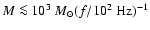 ,
where 102 Hz is the typical frequency of gravitational waves for
ground-based detectors.
Hence, we use wave optics in this letter.
,
where 102 Hz is the typical frequency of gravitational waves for
ground-based detectors.
Hence, we use wave optics in this letter.
In the geometrical optics for the lensing of light, the strong and weak
lensing are distinguished by the convergence field
which is the
ratio of surface density of lens  to a critical density
 ,
where
,
where  is
the distance to the lens
(Kaiser 1992; Bartelmann & Schneider 2001).
In the strong lensing regime,
is
the distance to the lens
(Kaiser 1992; Bartelmann & Schneider 2001).
In the strong lensing regime,
 ,
the multiple images of distant
source are formed.
But the strong lensing probability is small,
,
the multiple images of distant
source are formed.
But the strong lensing probability is small,  0.1%, for high
redshift sources.
Hence, the weak lensing approximation,
0.1%, for high
redshift sources.
Hence, the weak lensing approximation,
 ,
is valid for
most sources.
We use the weak field approximation in the wave optics.
,
is valid for
most sources.
We use the weak field approximation in the wave optics.
In the past, Peters (1974) studied the scattering by a point mass lens
and a thin sheet of matter in the weak field approximation,
and obtained the scattered waveform for these lens models.
The gravitationally lensed waveform (which is the solution of wave
Eq. (1)) was given in Schneider et al.
(1992), Sects. 4.7 and 7,
using the diffraction integral under the thin lens approximation.
Recently, several authors have been studying wave optics in the
gravitational
lensing of gravitational waves using this integral (Nakamura 1998;
Nakamura & Deguchi 1999; Ruffa 1999; Takahashi & Nakamura
2003; Yamamoto 2003; Macquart 2004; Takahashi
2004).
In this letter, we present another method to derive the solution of
Eq. (1) in the weak-field limit.
We treat the gravitational field of lens to first order, i.e. using
the Born approximation, and discuss its validity.
We use units of c=G=1.
We consider the scattering of gravitational waves by the weak
gravitational fields of lens objects.
We consider the scattering of scalar waves, instead of gravitational
waves, since the basic equation is the same as the scalar field wave
equation (see Sect. IIC of Peters 1974).
The gravitational fields of the lens objects are described by the metric
 as d
as d
 ,
where
,
where
 is the gravitational potential of the lens.
Since the propagation equation of the scalar wave is
is the gravitational potential of the lens.
Since the propagation equation of the scalar wave is
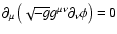 ,
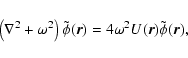
we have the wave equation as
,
we have the wave equation as
 |
(1) |
where  is the frequency of the gravitational waves and
we set
is the frequency of the gravitational waves and
we set
 .
.
![\begin{figure}
\par\includegraphics[width=4.2cm,clip]{Hc171_fig1.eps}
\end{figure}](/articles/aa/full/2005/28/aahc171/Timg30.gif) |
Figure 1:
Gravitational lens geometry for the source, the lens and the
observer. The lens is distributed around the origin.
The source position is
 ,
while
the observer position is ,
while
the observer position is
 where
where
 is a two-dimensional vector with
 .
and .
and
 are the distances from the lens to
the observer and to the source, respectively.
are the distances from the lens to
the observer and to the source, respectively.
 is the incident wave, while
 is
the scattered wave.
is
the scattered wave. |
| Open with DEXTER |
We show the lens geometry of the source, the lens and the observer
in Fig. 1.
The lens is distributed around the origin of the coordinate axes.
The source position is
,
while the observer position is
where
is a two-dimensional vector
with
.
and
are the distances from the lens to the
observer and to the source, respectively.
In the unlensed case U=0 in Eq. (1), we write
 as the solution of this equation.
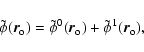
Including the effect of U to first order, the
scattered wave at the observer is written as
as the solution of this equation.
Including the effect of U to first order, the
scattered wave at the observer is written as
 |
(2) |
where
 represents the effect of scattering.
Using Green's function for the Helmholtz equation,
represents the effect of scattering.
Using Green's function for the Helmholtz equation,
 ,
we obtain
,
we obtain
 from Eqs. (1) and (2) as
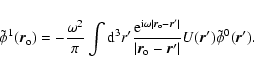 |
(3) |
Note that the above result (3) can be used if the lenses are broadly
distributed between the source and the observer since the thin lens
approximation is not assumed.
We use the spherical wave emitted by the source as ,
then we have
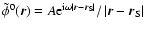 .
In Fig. 1,
represents the incident wave emitted by
the source, while
represents the scattered wave.
.
In Fig. 1,
represents the incident wave emitted by
the source, while
represents the scattered wave.
We assume that the lens objects are locally distributed at the origin.
Then we have
 and
and
 in Eq. (3).
Using the second-order Taylor series
in Eq. (3).
Using the second-order Taylor series![[*]](/icons/foot_motif.gif) for these small quantities
for these small quantities
 and
,
is reduced to
and
,
is reduced to
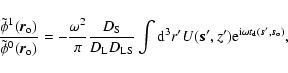 |
(4) |
where
 and we set
 .
Here,
.
Here,  is the geometrical time delay which is given by
![$t_{\rm d}(\vec{s}^{\prime},\vec{s}_{\rm o}) = {D_{\rm S}}
/{\left( 2 D_{\rm L}...
...ec{s}^\prime - \left({D_{\rm LS}}/{D_{\rm S}}\right)
\vec{s}_{\rm o} \right]^2$](/articles/aa/full/2005/28/aahc171/img47.gif) .
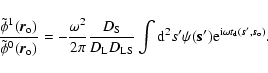
Using the two-dimensional gravitational potential
.
Using the two-dimensional gravitational potential
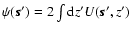 ,
the result in
Eq. (4) is reduced to
,
the result in
Eq. (4) is reduced to
 |
(5) |
The above equation is also derived by expanding  to first order
in the diffraction integral (see Schneider et al. 1992).
The surface density of the lens is defined as
to first order
in the diffraction integral (see Schneider et al. 1992).
The surface density of the lens is defined as
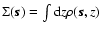 ,
where
,
where  is the
mass density.
Since the potential
is written using the surface density as
is the
mass density.
Since the potential
is written using the surface density as
 ,
the result (5) is rewritten as (Appendix A),
,
the result (5) is rewritten as (Appendix A),
![$\displaystyle \frac{\tilde{\phi}^1(\vec{r}_{\rm o})}{\tilde{\phi}^0
(\vec{r}_{\...
...s}^\prime - \frac{D_{\rm LS}}{D_{\rm S}}
\vec{s}_{\rm o} \right\vert^2 \right],$](/articles/aa/full/2005/28/aahc171/img54.gif) |
|
|
(6) |
where  is the exponential integral function:
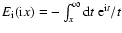 (e.g. Abramowitz & Stegun
1970).
If we shift the potential
by a constant value
(e.g. Abramowitz & Stegun
1970).
If we shift the potential
by a constant value  ,
,
 in Eq. (5) is shifted by
 .
Hence we can choose
so that the second term of
Eq. (6) vanishes, and we eliminate this term.
.
Hence we can choose
so that the second term of
Eq. (6) vanishes, and we eliminate this term.
Let us discuss the validity of the Born approximation.
If the scattered wave
 is not too
different from the incident wave
is not too
different from the incident wave
 ,
this approximation
is valid.
We discuss the condition of
,
this approximation
is valid.
We discuss the condition of
 for the two lens models, point mass lens and smoothly distributed lens,
in the following subsections.
for the two lens models, point mass lens and smoothly distributed lens,
in the following subsections.
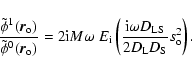
The surface density is
 where M is the lens mass.
Then,
in Eq. (6) is rewritten as
(see also Peters 1974, Sect. III A)
where M is the lens mass.
Then,
in Eq. (6) is rewritten as
(see also Peters 1974, Sect. III A)
 |
(7) |
In Fig. 2, we show
 as a function of x.
The solid line is the absolute value of ,
the dashed line is
the real part, and the dotted line is the imaginary part.
From this figure, except for small
as a function of x.
The solid line is the absolute value of ,
the dashed line is
the real part, and the dotted line is the imaginary part.
From this figure, except for small  ,
,
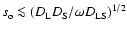
 is smaller than 1. Thus the Born approximation is valid
 in Eq. (7)
if the lens mass M is smaller than the wave length of the
gravitational waves
in Eq. (7)
if the lens mass M is smaller than the wave length of the
gravitational waves
 except for small
impact parameter
except for small
impact parameter
 .
.
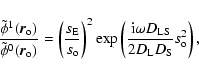
Especially for large impact parameter so,
since
 for
for
 ,
Eq. (7) is reduced to
,
Eq. (7) is reduced to
 |
(8) |
where  is the Einstein radius on the observer plane:
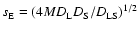 .
Hence if the observer position
.
Hence if the observer position  is larger than the Einstein
radius ,
the Born approximation is valid irrespective of the
wavelength of the gravitational waves.
is larger than the Einstein
radius ,
the Born approximation is valid irrespective of the
wavelength of the gravitational waves.
![\begin{figure}
\par\includegraphics[width=5.4cm,clip]{Hc171_fig2.eps}
\end{figure}](/articles/aa/full/2005/28/aahc171/Timg77.gif) |
Figure 2:
as a function of x. The solid line is the
absolute value of ,
the dashed line is the real part, and the
dotted line is the imaginary part. |
| Open with DEXTER |
We assume that the lenses are smoothly distributed on the z=0 plane
in Fig. 1.
In the unlensed case, the wave propagates through
 in the lens plane.
Expanding the lens potential
in the lens plane.
Expanding the lens potential
 around it,
in Eq. (5) is rewritten as
around it,
in Eq. (5) is rewritten as
![\begin{displaymath}\frac{\tilde{\phi}^1(\vec{r}_{\rm o})}{\tilde{\phi}^0(\vec{r}...
...}{\omega D_{\rm S}} \right)^2
\nabla^4_{\rm s}\kappa \right].
\end{displaymath}](/articles/aa/full/2005/28/aahc171/img80.gif) |
(9) |
The first term, being
 at
,
can be eliminated for
the same reason as the second term in Eq. (6).
In the second term,
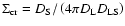
is the convergence field along the line of
sight to the source defined as
at
,
can be eliminated for
the same reason as the second term in Eq. (6).
In the second term,
is the convergence field along the line of
sight to the source defined as
 at
with
at
with
 .
The third term is a correction term arising from the effect of finite
wavelength.
If the scale of the density fluctuation
.
The third term is a correction term arising from the effect of finite
wavelength.
If the scale of the density fluctuation
 is much larger than
the Fresnel scale
is much larger than
the Fresnel scale
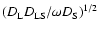 ,
or if the geometrical optics is valid
,
or if the geometrical optics is valid
 ,
the third term is negligible.
Then, the incident wave is magnified by ,
which is consistent
with the result in the weak gravitational lensing
(e.g. Bartelmann & Schneider 2001).
If
,
the Born approximation is valid.
,
the third term is negligible.
Then, the incident wave is magnified by ,
which is consistent
with the result in the weak gravitational lensing
(e.g. Bartelmann & Schneider 2001).
If
,
the Born approximation is valid.
We consider the lenses are broadly distributed between the source and
the observer.
It is easy to apply the previous result in Sect. 2.1 to this case.
in Eq. (5) is rewritten as
 |
|
|
(10) |
with
![$t_{\rm d}(\vec{s}^{\prime}, z^\prime, \vec{s}_{\rm o}) =
D_{\rm S}/ \left[ 2 z...
...imes \left[ \vec{s}^\prime -
({z^\prime}/{D_{\rm S}}) \vec{s}_{\rm o}\right]^2$](/articles/aa/full/2005/28/aahc171/img88.gif) .
If the lenses have a thickness of
.
If the lenses have a thickness of  in the z direction,
the correction for this thickness in the scattered wave
is of the order of
in the z direction,
the correction for this thickness in the scattered wave
is of the order of
 from
Eqs. (4) and (10).
Thus, if
from
Eqs. (4) and (10).
Thus, if
 the thin lens approximation is valid.
Especially, for smoothly distributed lenses the result (9) is
valid but
is replaced by
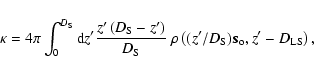 |
(11) |
where
is the mass density of the lens.
Recently, Macquart (2004, hereafter M04) derived the correlation
function in the wave amplitude of the two detectors under the thin lens
approximation.
He suggested that measurement of the correlation function provides
the power spectrum of the mass density fluctuation.
In this section, we derive it without the thin lens approximation,
but within the limit of weak gravitational fields.
We consider two observers at
 and
and
 with
with
 .
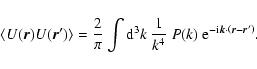
The mass fluctuation is usually characterized by the power spectrum
defined as
.
The mass fluctuation is usually characterized by the power spectrum
defined as
 .
The correlation in the potential
and
.
The correlation in the potential
and
 is written as
 |
(12) |
We obtain the correlation in the wave amplitudes
and
 from Eqs. (3) and (12) as
| |
|
 |
|
| |
|
 |
(13) |
It is useful to change the integral variables to
 and
and
 ,
and we assume that
,
and we assume that  is
much smaller than the distances
is
much smaller than the distances
 .
Then, expanding these small quantities
and
.
Then, expanding these small quantities
and  in
the exponentials, Eq. (13) is rewritten as
in
the exponentials, Eq. (13) is rewritten as
| |
|
 |
|
| |
|
![$\displaystyle ~~~~\times \frac{1}{\left\vert \vec{r}_{\rm o}- \vec{y} \right\ve...
...{y}} \right) \cdot
\vec{r}_1 \right]} ~{\rm e}^{-{\rm i}\vec{k} \cdot \vec{x}},$](/articles/aa/full/2005/28/aahc171/img108.gif) |
(14) |
where
 denotes the unit vector for
  .
A is the amplitude of the incident wave (see sentences after
Eq. (3)).
Performing the integral in Eq. (14), we obtain
.
A is the amplitude of the incident wave (see sentences after
Eq. (3)).
Performing the integral in Eq. (14), we obtain
 |
|
|
(15) |
where
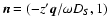 and
and
 is the (x,y) component of the wave vector
  .
In the geometrically thin lens at z=0 plane, P(q) is
replaced by
.
In the geometrically thin lens at z=0 plane, P(q) is
replaced by
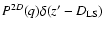 where
where
 is
is
 power spectrum.
Let us consider a single power law model for the power spectrum
as an example.
This model can be used for the fluctuation of cold dark matter
and gas (M04, Sects. 5.2 and 5.3).
The power spectrum is
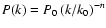 for
for
 ,
and P(k)=0 otherwise.
The index is
,
and P(k)=0 otherwise.
The index is
 ,
and
,
and
 .
Then, the integral in Eq. (15) is dominated by the fluctuation
at the largest scale of
.
Then, the integral in Eq. (15) is dominated by the fluctuation
at the largest scale of
 .
The exact solution of integral (15) was given by the
hypergeometric function, but we present an approximate solution
for simplicity.
Assuming that the separation of two detectors
.
The exact solution of integral (15) was given by the
hypergeometric function, but we present an approximate solution
for simplicity.
Assuming that the separation of two detectors
 is much
smaller than the largest scale of fluctuation
,
we have
is much
smaller than the largest scale of fluctuation
,
we have
 |
|
|
|
![$\displaystyle \times \left[ \frac{2\pi}{2-{n}} + \frac{\pi}{6 {n}}
\left( k_{\rm min} s_1 \right)^2 +
\mathcal{O} \left(k_{\rm min}^4 s_1^4\right) \right],$](/articles/aa/full/2005/28/aahc171/img125.gif) |
|
|
(16) |
where
 .
The first term represents the dispersion of the scattered wave,
while the second term is two-point correlation function.
If the lenses have a finite thickness
.
The first term represents the dispersion of the scattered wave,
while the second term is two-point correlation function.
If the lenses have a finite thickness  along the z-axis,
DS in Eq. (16) should be replaced by .
along the z-axis,
DS in Eq. (16) should be replaced by .
We have discussed the scattering of gravitational waves by the weak
gravitational fields of lenses by using the Born approximation.
We consider the two lens models, the point mass lens and the
smoothly distributed lens, and discuss the validity of the Born
approximation.
For the point mass lens, the effect of scattering is roughly given by
the Schwarzschild radius M of lens divided by the wavelength  .
If
.
If
 or if the impact parameter
is larger than the Einstein radius, the approximation is valid.
For the smoothly distributed lens, the effect of scattering is of the
order of the convergence ,
and if
the approximation
is valid.
In the short wavelength limit, the result is consistent with the
weak gravitational lensing.
We derive the correction term due to the effect of finite wavelength in
the magnification.
The two point correlation function is also discussed following the recent
paper (M04).
or if the impact parameter
is larger than the Einstein radius, the approximation is valid.
For the smoothly distributed lens, the effect of scattering is of the
order of the convergence ,
and if
the approximation
is valid.
In the short wavelength limit, the result is consistent with the
weak gravitational lensing.
We derive the correction term due to the effect of finite wavelength in
the magnification.
The two point correlation function is also discussed following the recent
paper (M04).
Acknowledgements
We would like to thank the referee for useful comments to improve
the manuscript.
Inserting
into Eq. (5), we change the
integral variable from
 to
to
 .
Then, we have
.
Then, we have
 |
|
|
(A.1) |
where
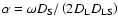 ,
,
 ,
and J0 is the 0th order Bessel function.
By using series
,
and J0 is the 0th order Bessel function.
By using series
 ,
the integral
in Eq. (A.1) is rewritten as,
,
the integral
in Eq. (A.1) is rewritten as,
![$\displaystyle \int_0^\infty {\rm d}u ~u \ln u ~{\rm e}^{{\rm i}\alpha u^2} J_0(...
...ac{{\rm i}}{4 \alpha} \left[ \gamma + \ln \left(- {\rm i}\alpha \right)
\right]$](/articles/aa/full/2005/28/aahc171/img139.gif) |
|
|
|
![$\displaystyle + \frac{{\rm i}}{4 \alpha} \sum_{{n}=1}^\infty \frac{1}{{n}!} \le...
...{{k}=1}^{n}
\frac{1}{{k}} - \gamma - \ln \left( -{\rm i}\alpha \right) \right],$](/articles/aa/full/2005/28/aahc171/img140.gif) |
|
|
(A.2) |
where  is the Euler constant (e.g. Gradshteyn & Ryzhik 2000).
Using identity
is the Euler constant (e.g. Gradshteyn & Ryzhik 2000).
Using identity
![$\sum_{{k}=1}^{n}1/{k}=\int_0^1 {\rm d}t [1-(1-t)^{n}]/t$](/articles/aa/full/2005/28/aahc171/img142.gif) ,
we have
,
we have
 |
|
|
|
![$\displaystyle = -{\rm e}^{-{\rm i}\beta^2/(4 \alpha)} \left[ E_{\rm i}\left({\r...
...
\right) - \ln \left( -{\rm i}\frac{\beta^2}{4 \alpha} \right) -\gamma \right].$](/articles/aa/full/2005/28/aahc171/img144.gif) |
|
|
(A.3) |
In the second equality, we use
 .
Inserting Eqs. (A.2) and (A.3) into Eq. (A.1), we obtain
Eq. (6).
.
Inserting Eqs. (A.2) and (A.3) into Eq. (A.1), we obtain
Eq. (6).
- Abramowitz, M., &
Stegun, I. A. 1970, Handbook of Mathematical Functions (New York:
Dover Publications)
(In the text)
- Bartelmann, M., &
Schneider, P. 2001, Phys. Rep., 340, 291 [NASA ADS] [CrossRef] (In the text)
- Bontz, R. J., & Haugan,
M. P. 1981, Ap&SS, 78, 199 [NASA ADS] (In the text)
- Cutler, C., & Thorne,
K. S. 2002, in Early Universe and Cosmological Observations: A
critical Review, ed. P. Dunsby, G. F. R. Ellis, & R. Maartens
(Bristol: IOP), 72
(In the text)
- Deguchi, S., & Watson,
W. D. 1986, Phys. Rev. D, 34, 1708 [NASA ADS] [CrossRef] (In the text)
- Gradshteyn, I. S., &
Ryzhik, I. M. 2000, Table of Integrals, Series, and Products, Sixth
Edition (San Diego: Academic Press)
(In the text)
- Ishimaru, A. 1978, Wave
Propagation and Scattering in Random Media (New York: Academic
Press)
- Kaiser, N. 1992, ApJ, 388,
272 [NASA ADS] [CrossRef] (In the text)
- Macquart, J. P. 2004,
A&A, 422, 761 [EDP Sciences] [NASA ADS] [CrossRef] (M04)
(In the text)
- Nakamura, T. T. 1998, , 80,
1138
(In the text)
- Nakamura, T. T., &
Deguchi, S. 1999, Prog. Theor. Phys. Suppl., 133, 137 [NASA ADS] (In the text)
- Ohanian, H. C. 1974, Int. J.
Theor. Phys., 9, 425 [CrossRef] (In the text)
- Peters, P. C. 1974, Phys.
Rev. D, 9, 2207 [NASA ADS] [CrossRef] (In the text)
- Ruffa, A. A. 1999, ApJ, 517,
L31 [NASA ADS] [CrossRef] (In the text)
- Schneider, P., Ehlers,
J., & Falco, E. E. 1992, Gravitational Lenses (New York:
Springer)
(In the text)
- Takahashi, R., &
Nakamura, T. 2003, ApJ, 595, 1039 [NASA ADS] [CrossRef] (In the text)
- Takahashi, R., A&A, 423,
787
(In the text)
- Tatarskii, V. I., &
Zavorotnyi, V. U. 1980, Progress in Optics XVIII, 207
- Thorne, K. S. 1983, in
Gravitational Radiation, ed. N. Deruelle, & T. Piran
(North-Holland, Amsterdam), 28
(In the text)
- Thorne, K. S. 1987, in 300
Years of Gravitation, ed. S. W. Hawking, & W. Israel
(Cambridge: Cambridge Univ. Press), 330
(In the text)
- Yamamoto, K. 2003
[arXiv:astro-ph/0309696]
(In the text)
Copyright ESO 2005
![\begin{figure}
\par\includegraphics[width=4.2cm,clip]{Hc171_fig1.eps}
\end{figure}](/articles/aa/full/2005/28/aahc171/img30.gif)
![\begin{figure}
\par\includegraphics[width=5.4cm,clip]{Hc171_fig2.eps}
\end{figure}](/articles/aa/full/2005/28/aahc171/img77.gif)