.
Nordlund3 - R. F. Stein4
.
Nordlund3 - R. F. Stein4
A&A 438, 365-376 (2005)
DOI: 10.1051/0004-6361:20052831
B. Dintrans1 - A. Brandenburg2 -
.
Nordlund3 - R. F. Stein4
1 - Observatoire
Midi-Pyrénées, UMR 5572, Université Paul Sabatier et CNRS,
31400 Toulouse, France
2 -
NORDITA, Blegdamsvej 17, 2100 Copenhagen Ø, Denmark
3 -
Niels Bohr Institute, Juliane Maries Vej 30, 2100 Copenhagen Ø,
Denmark
4 - Department of Physics and Astronomy, Michigan State
University, East Lansing, MI 48824, USA
Received 7 February 2005 / Accepted 5 April 2005
Abstract
The excitation of internal gravity waves by penetrative convective
plumes is investigated using 2-D direct simulations of compressible
convection. The wave generation is quantitatively studied from the
linear response of the radiative zone to the plumes penetration,
using projections onto the g-modes solutions of the associated linear
eigenvalue problem for the perturbations. This allows an accurate
determination of both the spectrum and amplitudes of the stochastically
excited modes. Using time-frequency diagrams of the mode amplitudes,
we then show that the lifetime of a mode is around twice its period
and that during times of significant excitation up to 40% of
the total kinetic energy may be contained into g-modes.
Key words: hydrodynamics - convection - waves - stars: oscillations - methods: numerical
Although their detection in the spectrum of solar oscillations has been not clearly confirmed (e.g., Turck-Chièze et al. 2004; Gabriel et al. 2002), internal gravity waves (hereafter IGWs) propagating in the radiative zones of late-type stars have recently been invoked in attempts to explain the Li abundance of cool stars and the rigid rotation of their radiative interiors.
The former problem is also referred to as the Li-dip problem and concerns the dependence of the lithium abundance on the spectral type for some main-sequence stars. Models based on the extension of the surface convection zone down to the nuclear burning region (Iben 1965) and models which take into account the transport of Li both by meridional circulation and shear-induced turbulence (Talon & Charbonnel 1998) are indeed not quite satisfactory to reproduce the Li-dip. The latter problem concerning the rigidity of the Sun's radiative interior is most clearly revealed by helioseismology (Brown et al. 1989). Both rotation-induced turbulent diffusion and wind-driven meridional circulation fail to redistribute enough angular momentum over the lifetime of the Sun to rotate rigidly (Zahn et al. 1997). Likewise, the hypothesis of a large-scale poloidal magnetic field leads to problems, because it may transmit under certain circumstances the differential rotation of the convection zone to the core (owing to Ferraro's law; e.g., MacGregor & Charbonneau 1999).
Zahn (1994) showed that the two problems are coupled and that they should to be
explained by a single model. Being inspired by meteorological studies of
the wave transport taking place in the Earth stratosphere (Bretherton
1969; Alexander & Pfister 1995), Schatzman (1993) was the first to
propose internal gravity waves as an efficient transport mechanism in stellar
radiative zones. Later, this idea was tested by many authors (Zahn et al. 1997; Kumar & Quataert 1997; Kumar et al. 1999; Talon et al. 2002) who showed that
internal gravity waves transport momentum on a rather short timescale such that the
rotation of the solar core becomes nearly uniform. A remaining problem is the
excitation of these deep gravity waves since, unlike pulsating white
dwarfs, a  -mechanism based on hydrogen and helium ionization
zones is not applicable here.
-mechanism based on hydrogen and helium ionization
zones is not applicable here.
The most wide-spread excitation model is based on penetrative convection from neighboring convection zones. Strong downward plumes are known to extend a substantial distance into the adjacent stable zones so that internal gravity waves can be randomly generated. 2-D and 3-D direct numerical simulations of superposed stable and unstable layers have confirmed this scenario since gravity-like waves have been well observed in stable regions (Hurlburt et al. 1986, 1994; Brandenburg et al. 1996; Brummell et al. 2002).
The aim of this paper is to investigate in detail the excitation of
IGWs by overshooting in an high-resolution 2-D
hydrodynamical simulation of a three-layer model, consisting of a convective
zone (hereafter CZ) embedded between an upper cooling zone and a lower
stably stratified radiative zone (hereafter RZ). In all
previous
numerical studies,
gravity waves have been detected using Fourier's analysis such as, for
example, the
 -diagram. However, the link with the eigenmodes of stable
regions was not investigated. In particular, it has not clearly been
demonstrated that the excited waves really correspond to gravity waves
since the only criterion was the Brunt-Väisälä frequency
as an upper bound.
-diagram. However, the link with the eigenmodes of stable
regions was not investigated. In particular, it has not clearly been
demonstrated that the excited waves really correspond to gravity waves
since the only criterion was the Brunt-Väisälä frequency
as an upper bound.
In this work, g-modes are rigorously measured using the method that we have presented and tested on the gravity mode oscillations of an isothermal atmosphere in Dintrans & Brandenburg (2004, hereafter Paper I). Our method mainly relies on the projection of the velocity field of the simulation onto the basis shaped from the solutions of the associated linear eigenvalue problem for the perturbations; i.e., the theoretical g-modes of the RZ. Hence the mode amplitudes are simply given by the time-dependent basis coefficients, which allows a quantitative study of the excitation mechanism. In other words, we investigate the generation of IGWs by penetrative convection from the linear response of the RZ to this penetration.
We begin by presenting our hydrodynamical 2-D model consisting in three superposed polytropic layers, and give some details on the code we use to solve it numerically (Sect. 2). We then give the main properties of the obtained simulation of penetrative convection and show that the classical detection method of gravity mode oscillations based on Fourier's transforms in both space and time fails to give reliable results on this problem (Sect. 3). We then introduce our detection technique based on the anelastic subspace and apply it to find the properties of the g-modes propagating in the numerical simulation (Sect. 4). Finally, we conclude in Sect. 5 by giving some outlooks of this work.
We adopt Cartesian coordinates (x,z) where x denotes the horizontal
direction and z is depth pointing downward as the gravity
 .
Our system is
composed of a convection zone of depth d=z3-z2, embedded
between two stable layers (Fig. 1). We assume that the
gas is monatomic and perfect, so its equation of state is given by
.
Our system is
composed of a convection zone of depth d=z3-z2, embedded
between two stable layers (Fig. 1). We assume that the
gas is monatomic and perfect, so its equation of state is given by
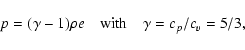
 the density, e the internal energy,
and
the density, e the internal energy,
and  is the ratio of specific heats cp and cv.
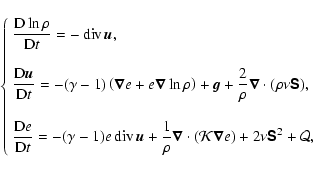
We solve the following set of hydrodynamical equations (conservation of mass, momentum and energy):
 is the velocity and
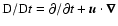 is
the total derivative. In addition,
is
the total derivative. In addition,  denotes the constant kinematic viscosity
![[*]](/icons/foot_motif.gif) and
and
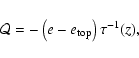
 the radiative conductivity divided by cv. To reproduce the radiative cooling taking
place at a star's surface, we add a cooling term
the radiative conductivity divided by cv. To reproduce the radiative cooling taking
place at a star's surface, we add a cooling term  in the energy
equation given by
in the energy
equation given by
 is the cooling rate profile which is set equal to zero
everywhere except close to the surface, i.e.
is the cooling rate profile which is set equal to zero
everywhere except close to the surface, i.e.
 only for
z=[z1,z2]. Because of this efficient cooling, the surface layer tends
to be isothermal and the internal energy e is almost constant
there. Finally,
only for
z=[z1,z2]. Because of this efficient cooling, the surface layer tends
to be isothermal and the internal energy e is almost constant
there. Finally,
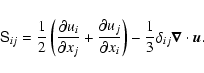
 denotes the traceless strain
tensor given by
denotes the traceless strain
tensor given by
![\begin{figure}
\psfrag{xaxis}{$x$ }
\psfrag{zaxis}{$z$ }
\psfrag{x1}{$x_1$ }
\ps...
...zone with index $m_3$ }
{\includegraphics[width=7cm]{2831fg1.eps} }
\end{figure}](/articles/aa/full/2005/28/aa2831-05/img42.gif) |
Figure 1: Geometry of the computational domain. |
| Open with DEXTER | |
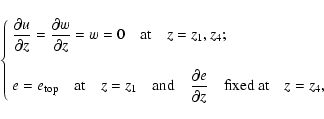
We assume that
 and e are periodic in
the horizontal direction and adopt the following conditions at the upper
and lower boundaries:
and e are periodic in
the horizontal direction and adopt the following conditions at the upper
and lower boundaries:
 |
(3) |
Following Brandenburg et al. (1996),
we choose the depth of the unstable layer d as the
unit of length,
(d/g)1/2 as the unit of time and the initial value
 of the density at the
bottom of the convection zone (hereafter BCZ) as the
unit of density [velocities are thus measured in units of
of the density at the
bottom of the convection zone (hereafter BCZ) as the
unit of density [velocities are thus measured in units of  ,
i.e. the free-fall velocity of the unstable layer divided by
,
i.e. the free-fall velocity of the unstable layer divided by  ,
and fluxes in units of
,
and fluxes in units of
 ].
Finally, the dimensionless gravity is set equal to unity in the whole
domain, i.e. g=1 everywhere.
].
Finally, the dimensionless gravity is set equal to unity in the whole
domain, i.e. g=1 everywhere.
The initial state is computed using polytropes in hydrostatic and radiative equilibrium (e.g., Hurlburt et al. 1986). In Appendix A we give the details of the initial setup, in particular the mixing length solution in the calculation of the CZ stratification, which helps to accelerate the numerical convergence towards the thermally relaxed state.
We use the hydrodynamical code described in Nordlund & Stein (1990) to
advance the fully nonlinear set of Eqs. (1). In this code, spatial
derivatives are computed using sixth order compact finite differences
(Lele 1992) whereas the time advance is performed using a third order
explicit Hyman scheme (Hyman 1979). Corresponding timesteps are usually
 of the Courant-Friedrich-Levy timestep defined by
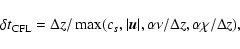
 the
radiative diffusivity and
the
radiative diffusivity and
 an empirical factor
determining the length of the diffusive timestep. In practice, it is the
radiative diffusion term which limits the timestep due to both the high
vertical resolution and large radiative diffusivities of radiative
zones.
an empirical factor
determining the length of the diffusive timestep. In practice, it is the
radiative diffusion term which limits the timestep due to both the high
vertical resolution and large radiative diffusivities of radiative
zones.
Contrary to acoustic modes, gravity modes correspond to waves with
long periods, of about twenty time units in our numerical simulations,
typically. Hence, once achieved the thermal relaxation of the radiative
zone, we still need to integrate the dynamical equations over very long
times to capture so much periods as possible (one typically needs runs
as long as one thousand time units). We then chose to concentrate on a
particular 2-D simulation with an high spatial resolution
 (i.e. 256 mesh points in the horizontal and 512 points in the vertical)
and an aspect ratio
(i.e. 256 mesh points in the horizontal and 512 points in the vertical)
and an aspect ratio
 (Lx being the horizontal extent
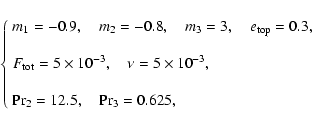
of the computational domain). The main properties of this simulation
are the following:
(Lx being the horizontal extent
of the computational domain). The main properties of this simulation
are the following:
 |
(4) |
 denotes the Prandtl number. The corresponding
Rayleigh number of the unstable layer is
denotes the Prandtl number. The corresponding
Rayleigh number of the unstable layer is
 ,
using the definition in Gough et al. (1976). The kinematic
viscosity
cannot be too small for a given resolution as it should
satisfy
,
using the definition in Gough et al. (1976). The kinematic
viscosity
cannot be too small for a given resolution as it should
satisfy
 ,
where
,
where  is the smallest
mesh interval in the vertical direction and Re is the Reynolds number
(e.g., Landau & Lifshitz 1980). The value we chose is a reasonably
"safe'' one as this
is around fifty times larger than the minimum viscosity
is the smallest
mesh interval in the vertical direction and Re is the Reynolds number
(e.g., Landau & Lifshitz 1980). The value we chose is a reasonably
"safe'' one as this
is around fifty times larger than the minimum viscosity
 imposed by both the resolution
and the mean
Reynolds number of our simulation.
imposed by both the resolution
and the mean
Reynolds number of our simulation.
Since the pioneering numerical simulations of Hurlburt et al. (1986), the general features of penetrative compressible convection are well known and we are simply giving here the main properties of such a flow.
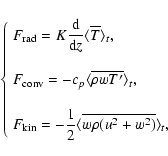
Figures 2 and 3 represent typical asymmetrical
patterns and mean vertical radiative, convective and kinetic fluxes that
we obtain in our numerical simulation of
compressible convection with penetration, the fluxes being computed from
their usual definition (e.g., Hurlburt et al. 1986)
 |
(5) |
![\begin{figure}
{\includegraphics[width=7.4cm,clip]{2831fg2.eps} }\par\end{figure}](/articles/aa/full/2005/28/aa2831-05/img62.gif) |
Figure 2:
Snapshots of the velocity field superimposed on a grey scale
representation of
the internal energy fluctuations (i.e. or temperature) at three different
times
![$t=[900,\ 903,\ 906]$](/articles/aa/full/2005/28/aa2831-05/img1.gif) .
The horizontal dashed
lines delimit the convection zone z=[0,1] located above the radiative
zone z=[1,3]. .
The horizontal dashed
lines delimit the convection zone z=[0,1] located above the radiative
zone z=[1,3]. |
| Open with DEXTER | |
![\begin{figure}
{\includegraphics[width=7.5cm,clip]{2831fg3.eps} }
\end{figure}](/articles/aa/full/2005/28/aa2831-05/img63.gif) |
Figure 3: Normalized vertical profiles of the radiative (solid dark line), convective (dotted line) and kinetic (dashed line) fluxes, with their sum (solid grey line). The vertical dotted lines denote the CZ limits. |
| Open with DEXTER | |
![\begin{figure}
{\includegraphics[width=8cm,clip]{2831fg4.eps} }
\end{figure}](/articles/aa/full/2005/28/aa2831-05/img64.gif) |
Figure 4:
Evolution with time of the penetration extent  ,
with its time-averaged value ,
with its time-averaged value
 denoted by the horizontal dotted line. denoted by the horizontal dotted line. |
| Open with DEXTER | |
![\begin{figure}
{\includegraphics[width=7cm,clip]{2831fg5.eps} }
\end{figure}](/articles/aa/full/2005/28/aa2831-05/img65.gif) |
Figure 5: Mean vertical profile of the Péclet number, where dotted lines mark the CZ limits. |
| Open with DEXTER | |
The presence of a lower stable layer below the convection zone allows
these
downward plumes to penetrate some distance into the RZ. This convective
penetration has been theoretically investigated in the astrophysical
context by Zahn (1991) who showed that it strongly depends on the
value of the local Péclet number
 (w and Lbeing the typical vertical velocity and size of those motions,
respectively).
(w and Lbeing the typical vertical velocity and size of those motions,
respectively).
Following Brummell et al. (2002), we define the penetration extent
as the vertical distance from the BCZ where the
horizontally-averaged kinetic flux decreases to 1% of its maximum value
and Fig. 4 shows an example of its evolution with
time. The averaged penetration is
,
that is,
of order the half-size of the CZ, which is typical of hydrodynamical
simulations at low Péclet numbers. Indeed,  falls down
very rapidly just below the CZ due to the large radiative diffusivity of
the radiative zone. In polytropic models, the radiative diffusivity is
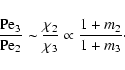
proportional to 1+m, where m is the polytropic index,
see Eq. (A.3), so a convective blob experiences
a jump in the Péclet number when it crosses the interface between the
CZ and RZ zones
falls down
very rapidly just below the CZ due to the large radiative diffusivity of
the radiative zone. In polytropic models, the radiative diffusivity is
proportional to 1+m, where m is the polytropic index,
see Eq. (A.3), so a convective blob experiences
a jump in the Péclet number when it crosses the interface between the
CZ and RZ zones
 or
or
 ,
which is
effectively the one in Fig. 6, where
,
which is
effectively the one in Fig. 6, where
 .
As a result, the cold blob thermalizes very rapidly
in the radiative zone and loses its identity compared to its environment:
the buoyancy braking thus disappears and allows the blob to continue by
inertia in the stable zone, leading to the observed large penetration.
(In solar-type stars the relevant extent is actually much smaller,
because here the thermal conductivity is still too large and therefore
the overall fluxes, and hence the amount of flux is too large.)
.
As a result, the cold blob thermalizes very rapidly
in the radiative zone and loses its identity compared to its environment:
the buoyancy braking thus disappears and allows the blob to continue by
inertia in the stable zone, leading to the observed large penetration.
(In solar-type stars the relevant extent is actually much smaller,
because here the thermal conductivity is still too large and therefore
the overall fluxes, and hence the amount of flux is too large.)
As discussed in Paper I,
the classical technique to detect the g-modes
propagating in an hydrodynamical simulation consists first of taking
horizontal Fourier transforms of the vertical mass flux
 for every time step, to get
 .
Second, one computes power spectra
for the
individual time series
,
to get
.
Second, one computes power spectra
for the
individual time series
,
to get
 ,
and plots the resulting power spectra at a given
degree
,
and plots the resulting power spectra at a given
degree  in a
in a
 -plane to highlight the "shark fin''
peaks corresponding to the eigenmodes (e.g., Fig. 5 in Paper I).
-plane to highlight the "shark fin''
peaks corresponding to the eigenmodes (e.g., Fig. 5 in Paper I).
Figure 6 shows the result of applying this method to the
detection of  ,
,
 and
and  g-modes propagating in
the simulation. Low-frequency peaks appear in the RZ (
g-modes propagating in
the simulation. Low-frequency peaks appear in the RZ (
 ), mainly in the
diagram, but these peaks are not as well
defined as in Paper I. Indeed, we have focused in the previous paper
on the simpler case of the g-modes of an isothermal atmosphere where IGWs
were excited by the vertical free oscillations of a cold bubble: once
emitted, each global mode "stayed in the box'' during a time that depends
on the efficiency of the dissipation, which was mainly due to a weak
viscosity. As a consequence, large-scale nonradial g-modes survived
over long times and were very well visible in the temporal spectra,
both in the
-plane and in its depth-integrated representation
(see Fig. 3 in Paper I).
), mainly in the
diagram, but these peaks are not as well
defined as in Paper I. Indeed, we have focused in the previous paper
on the simpler case of the g-modes of an isothermal atmosphere where IGWs
were excited by the vertical free oscillations of a cold bubble: once
emitted, each global mode "stayed in the box'' during a time that depends
on the efficiency of the dissipation, which was mainly due to a weak
viscosity. As a consequence, large-scale nonradial g-modes survived
over long times and were very well visible in the temporal spectra,
both in the
-plane and in its depth-integrated representation
(see Fig. 3 in Paper I).
![\begin{figure}
{\includegraphics[width=8.5cm,clip]{2831fg6.eps} }
\end{figure}](/articles/aa/full/2005/28/aa2831-05/img81.gif) |
Figure 6:
Left: gray scale representations in the
-plane
of the low-frequency part of the temporal power spectra for two degrees
![$\ell =[1,2]$](/articles/aa/full/2005/28/aa2831-05/img5.gif) .
Right: the resulting spectra after
integrating over depth. .
Right: the resulting spectra after
integrating over depth. |
| Open with DEXTER | |
The situation is clearly different with penetrative convection as we have now to deal with a random excitation of IGWs. Indeed, strong downward plumes are not stationary structures: they are born in the upper layers of the convection zone, are accelerated by the Archimedes force during their CZ crossing and, finally, end their life in the overshoot region where they transfer a large amount of their stored kinetic energy to the stably stratified medium, resulting in an internal gravity wave field. As the birth of these plumes is random, the resulting forcing of the RZ wave field is itself a random one, exactly as an hammer which randomly strikes the upper part of the RZ. We then understand why the detection of these IGWs is more difficult than the simpler case of free bubble oscillations: once emitted by a penetrating plume, a global mode first propagates in the radiative zone while being subjected to the viscous and radiative dissipations. However, if a second plume arrives shorter afterwards, the mode pattern may be destroyed, resulting in partial interference and the corresponding frequency peak may disappear from the spectrum. In other words, the lifetime of a mode is not simply related to the diffusive processes but also to the frequency of plume penetration (as we will show in Sect. 4.2).
With this in mind, it is also clear that the classical detection method based on successive Fourier transforms both in space and time of the vertical mass flux is not well adapted to detecting IGWs in simulations with penetrative convection. The temporal Fourier transforms are computed over the whole simulation while IGWs are only present during a short time interval. This results in a mixing of wave events with non-wavy turbulent events such that the spectra lack a well defined frequency (Fig. 6, right).
We have presented in Paper I a new detection method of IGWs
in hydrodynamical simulations which is based on the anelastic
subspace and we will give here only its main
stages. The idea is to project
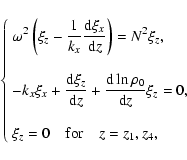
the simulated velocity field onto the basis built
with the anelastic eigenvectors which are solutions of the following
linear problem for the adiabatic perturbations (see also Dintrans &
Rieutord 2001; Rieutord & Dintrans 2002)
 denotes the Lagrangian displacement vector (the
velocity field being
denotes the Lagrangian displacement vector (the
velocity field being
 ),
),
 the mean density (i.e.,
 )
and N2 the
square of the Brunt-Väisälä
frequency given by
)
and N2 the
square of the Brunt-Väisälä
frequency given by
![\begin{displaymath}N^2 = g \left[ {1\over\gamma} \frac{{\rm d} \ln e_0}{{\rm d}z...
...er\gamma} \right)
\frac{{\rm d} \ln \rho_0}{{\rm d}z} \right].
\end{displaymath}](/articles/aa/full/2005/28/aa2831-05/img87.gif)
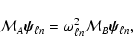
 and, finally, that their horizontal dependence
follows from the imposed periodicity in this direction as
and, finally, that their horizontal dependence
follows from the imposed periodicity in this direction as
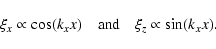
 is the eigenvector of degree
and radial order n associated with the eigenvalue
is the eigenvector of degree
and radial order n associated with the eigenvalue
 ,
while
,
while
 and
and
 denote two differential
operators.
denote two differential
operators.
The profile of the Brunt-Väisälä frequency N in the radiative zone is
shown in Fig. 7. The g-modes spectrum is bounded by its
maximum value,
 ,
while the typical frequency of
a low-degree and low-order g-mode is given by
,
while the typical frequency of
a low-degree and low-order g-mode is given by
 ,
hence a nondimensional period
,
hence a nondimensional period
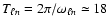 (e.g., Turner 1973).
Figure 8 shows the vertical profiles of the first three anelastic
eigenvectors of degree
and radial orders
![$n=[0,\ 1,\ 2]$](/articles/aa/full/2005/28/aa2831-05/img98.gif) .
The associated (dimensionless) eigenvalues are
.
The associated (dimensionless) eigenvalues are
 and
and
 .
As
g-modes are evanescent in a convectively unstable layer, each eigenvector is trapped
in the bottom stably stratified zone and its amplitude rapidly decreases
in the convection zone, as observed for
.
As
g-modes are evanescent in a convectively unstable layer, each eigenvector is trapped
in the bottom stably stratified zone and its amplitude rapidly decreases
in the convection zone, as observed for  where both
  and
and  stop oscillating and tend to zero.
![\begin{figure}
{\includegraphics[width=6cm,clip]{2831fg7.eps} }%
\end{figure}](/articles/aa/full/2005/28/aa2831-05/img104.gif) |
Figure 7: Mean vertical profile of the Brunt-Väisälä frequency N in the RZ, the dotted line denoting the BCZ. |
| Open with DEXTER | |
![\begin{figure}
{\includegraphics[width=7.6cm,clip]{2831fg8.eps} }
\end{figure}](/articles/aa/full/2005/28/aa2831-05/img106.gif) |
Figure 8:
First three anelastic eigenvectors
at
and radial orders n=0 (solid line),
n=1 (dashed line) and n=2 (dashed-dotted line). Upper and
lower panels show the vertical and horizontal displacements,
respectively. Eigenvectors have been normalized by imposing
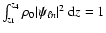 . . |
| Open with DEXTER | |
Once the anelastic eigenvectors
 are computed,
we can determine the amplitudes of the g-modes propagating in our
simulation. Indeed, we have showed in Paper I that these eigenvectors
are orthogonal to each other and form an orthogonal basis onto which the
simulated velocity field can be projected as
are computed,
we can determine the amplitudes of the g-modes propagating in our
simulation. Indeed, we have showed in Paper I that these eigenvectors
are orthogonal to each other and form an orthogonal basis onto which the
simulated velocity field can be projected as
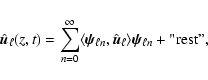 |
(9) |
 denotes a scalar product defined by
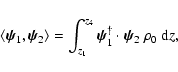
 denotes the velocity field of degree ,
that is, the horizontal Fourier transform of the velocity field
denotes the velocity field of degree ,
that is, the horizontal Fourier transform of the velocity field
 .
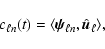
We then define the amplitude of the g-mode of degree and order n as the time-dependent complex coefficient
.
.
We then define the amplitude of the g-mode of degree and order n as the time-dependent complex coefficient
.
![\begin{figure}
{\includegraphics[width=8.5cm,clip]{2831fg9.eps} }
\end{figure}](/articles/aa/full/2005/28/aa2831-05/img114.gif) |
Figure 9:
Evolution with time of the real (solid lines) and imaginary
(dotted lines) parts of the amplitude
 of the g-modes of
degrees
and orders
of the g-modes of
degrees
and orders ![$n=[0,\ 1]$](/articles/aa/full/2005/28/aa2831-05/img10.gif) . . |
| Open with DEXTER | |
We show in Fig. 9 the resulting amplitudes obtained by
applying our projection technique to
the numerical simulation. In this figure, we have plotted the real and
imaginary parts
of the complex amplitude (10) for four g-modes of degrees
and radial orders .
When a standing gravity
wave occurs in a
hydrodynamical simulation, its complex amplitude
behaves as
 is the mode eigenfrequency and
  a
coefficient proportional to the diffusion process. For instance in
the case of an excitation by an oscillating bubble dealt with in Paper I,
the temporal Fourier transform of the mode amplitude leads to a single
peak centered around the eigenfrequency
,
with a width
that is proportional to the viscosity (see Fig. 6 in Paper I). In other
words, each g-mode obeys in this situation the same law as that of
a linearly damped free harmonic oscillator.
a
coefficient proportional to the diffusion process. For instance in
the case of an excitation by an oscillating bubble dealt with in Paper I,
the temporal Fourier transform of the mode amplitude leads to a single
peak centered around the eigenfrequency
,
with a width
that is proportional to the viscosity (see Fig. 6 in Paper I). In other
words, each g-mode obeys in this situation the same law as that of
a linearly damped free harmonic oscillator.
However, in the case of a random excitation by penetrating plumes shown
in Fig. 9, the real or imaginary parts now evolve either
chaotically around zero when the mode is not excited, or in a periodic
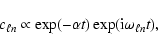
fashion as
 or
or
 when the mode is excited. Indeed, some wave events are well visible,
particularly for times
t=[400-600] in the
when the mode is excited. Indeed, some wave events are well visible,
particularly for times
t=[400-600] in the
 diagram,
but the time evolution is mainly chaotic, suggesting that
such wave events are difficult to extract. As a consequence, taking
a temporal Fourier transform over the whole simulation of the mode
amplitude
diagram,
but the time evolution is mainly chaotic, suggesting that
such wave events are difficult to extract. As a consequence, taking
a temporal Fourier transform over the whole simulation of the mode
amplitude
 makes no sense as we will mix together
wave and non-wave events. This is illustrated in Fig. 10 where
we computed the temporal Fourier transform of the mode amplitude in
Fig. 9
for
and n=0. Comparing to Paper I, single peaks centered
around the theoretical eigenfrequencies
have been
replaced by a forest of peaks roughly centered around
makes no sense as we will mix together
wave and non-wave events. This is illustrated in Fig. 10 where
we computed the temporal Fourier transform of the mode amplitude in
Fig. 9
for
and n=0. Comparing to Paper I, single peaks centered
around the theoretical eigenfrequencies
have been
replaced by a forest of peaks roughly centered around
 ,
i.e. the mixing of wave events with non-wave events degrades
the quality of the anelastic projection. Nevertheless, we remark that
the spectrum in Fig. 10 is better than the one obtained in
the right-hand panel of Fig. 6 with the classical method as peaks are now
concentrated around the theoretical eigenfrequency. However, such spectra
do not permit a detailed study of the amplitudes of g-modes propagating
in the RZ, as other contributions (e.g., convective velocities in the
overshoot region as well as penetrations of downward plumes)
interfere with the time evolution of each mode amplitude.
,
i.e. the mixing of wave events with non-wave events degrades
the quality of the anelastic projection. Nevertheless, we remark that
the spectrum in Fig. 10 is better than the one obtained in
the right-hand panel of Fig. 6 with the classical method as peaks are now
concentrated around the theoretical eigenfrequency. However, such spectra
do not permit a detailed study of the amplitudes of g-modes propagating
in the RZ, as other contributions (e.g., convective velocities in the
overshoot region as well as penetrations of downward plumes)
interfere with the time evolution of each mode amplitude.
![\begin{figure}
{\includegraphics[width=6.7cm]{2831fg10.eps} }
\end{figure}](/articles/aa/full/2005/28/aa2831-05/img120.gif) |
Figure 10:
Corresponding temporal power spectrum of the mode amplitude
used in Fig. 9, for
and n=0. The
vertical dotted line marks the location of the theoretical frequency
of the underlying g-mode. Amplitudes have been magnified by 105for clarity. |
| Open with DEXTER | |
In order to accurately extract the hidden wave events, we use
time-frequency diagrams of the mode amplitude
,
that is,
the temporal Fourier transforms
are computed by using a sliding window of fixed width
(e.g., Flandrin & Stockler 1999). Assuming that this width is
 (it is moreover beneficial to choose a multiple of the mode
period), we perform the following Fourier transform at time t
(it is moreover beneficial to choose a multiple of the mode
period), we perform the following Fourier transform at time t
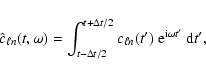
 ,
,
 being the
timestep of the simulation. We then obtain a 2-D representation of
the power spectrum
being the
timestep of the simulation. We then obtain a 2-D representation of
the power spectrum
 in a time-frequency
plane
in a time-frequency
plane
 which highlights the time intervals during which the
corresponding g-mode is really excited in the RZ.
which highlights the time intervals during which the
corresponding g-mode is really excited in the RZ.
To illustrate the utility of this method, we focus on the g-mode at
and n=0 before applying it to other modes; see Fig. 11.
Time intervals
during which this mode is excited to significant amplitudes are well extracted, as many bumps
appear along the line
,
especially in the
range
t=[400-600] where three bumps are present. In order to isolate
precisely and automatically the most powerful wave events, we apply the
following procedure, illustrated in Fig. 12 still with our test
mode at
and n=0:
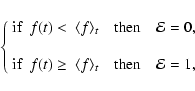
(shown in the upper panel);
 '', that
is, a function which is non-zero only when the previous mean profile
is higher than its mean value:
'', that
is, a function which is non-zero only when the previous mean profile
is higher than its mean value:
 .
We then obtain the final event
function
under a binary form (i.e. a succession of 0 and 1), shown in
the middle panel in Fig. 12.
Six events are clearly isolated, four of them being clustered
in the range
t=[250-620];
.
We then obtain the final event
function
under a binary form (i.e. a succession of 0 and 1), shown in
the middle panel in Fig. 12.
Six events are clearly isolated, four of them being clustered
in the range
t=[250-620];
to the
time-dependent amplitude
.
It thus
emphasizes the time intervals during which
behaves as
 ,
that is, during which the corresponding
g-mode is excited in the RZ; see the filtered real and imaginary
parts of c10 in the lower panel of Fig. 12.
,
that is, during which the corresponding
g-mode is excited in the RZ; see the filtered real and imaginary
parts of c10 in the lower panel of Fig. 12.
![\begin{figure}
{\includegraphics[width=8cm,clip]{2831fg11.eps} }\par\end{figure}](/articles/aa/full/2005/28/aa2831-05/img131.gif) |
Figure 11:
Time-frequency diagram of the amplitude of the g-mode at
and n=0 using a temporal window of width
 ,
with ,
with
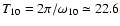 the mode period.
The horizontal dotted line corresponds to the mode
frequency
.
the mode period.
The horizontal dotted line corresponds to the mode
frequency
. |
| Open with DEXTER | |
We obtain the longest wave event at
and n=0 during times
t=[344-435], which approximately corresponds to four mode periods, i.e.
 .
This is confirmed in
the snapshot of the velocity field at time t=405 where a large-scale
velocity field, signature of the propagation of the g-mode at and n=0, is present in the bottom radiative zone (Fig. 13). Now, why do modes die out? The
answer lies in Fig. 14, where we plot four snapshots of the
velocity field for times
t=[618-624] which correspond to the end of
the events group clustered in the range
t=[250-620]. The mode pattern
is simply
destroyed by the penetration of a plume which is born in the upper
part of the CZ at time
.
This is confirmed in
the snapshot of the velocity field at time t=405 where a large-scale
velocity field, signature of the propagation of the g-mode at and n=0, is present in the bottom radiative zone (Fig. 13). Now, why do modes die out? The
answer lies in Fig. 14, where we plot four snapshots of the
velocity field for times
t=[618-624] which correspond to the end of
the events group clustered in the range
t=[250-620]. The mode pattern
is simply
destroyed by the penetration of a plume which is born in the upper
part of the CZ at time
 ,
then crosses the CZ and enters the RZ
at time
t=620 where it kills the mode propagation. As a consequence,
the large scale velocity field associated with the mode
disappears and the event
function
becomes zero.
,
then crosses the CZ and enters the RZ
at time
t=620 where it kills the mode propagation. As a consequence,
the large scale velocity field associated with the mode
disappears and the event
function
becomes zero.
![\begin{figure}
\psfrag{toto}{Event function $\cal E$ }
{\includegraphics[width=7.5cm,clip]{2831fg12.eps} }\par\end{figure}](/articles/aa/full/2005/28/aa2831-05/img134.gif) |
Figure 12:
Filtering of the mode ,
n=0:
zoom in Fig. 11 around the frequency
( upper
panel); the resulting event function
given by Eq. (12) ( middle
panel); the corresponding real (solid line) and imaginary (dotted line)
parts of the mode amplitude after the filtering ( lower panel). |
| Open with DEXTER | |
![\begin{figure}
{\includegraphics[width=7.1cm,clip]{2831fg13.eps} }\par\end{figure}](/articles/aa/full/2005/28/aa2831-05/img135.gif) |
Figure 13:
Snapshot of the velocity field superimposed on the internal
energy fluctuations for time t=405. Note the large-scale velocity field
in the bottom radiative zone mainly due to the standing g-mode at
and n=0. |
| Open with DEXTER | |
Before generalizing this formalism to more modes,
it is instructive to re-apply during this longest wave event the classical
method discussed in Sect. 3.1, in
order to compare both the spectrum and the simulated vertical mass flux
with the theoretical ones. This is what we did in Fig. 15,
which is the same as Fig. 6 at
except that we
focus now on times
t=[300-450]. As expected, the bump around
is more pronounced in the RZ (upper panel) and a comparison
between the shark fin vertical profile deduced from a zoom around
with the one computed from the theoretical anelastic mode
shows an almost perfect agreement there (lower panel). It means that
the dynamics of this region is well reproduced by our linear anelastic
model. On the contrary, as g-modes cannot propagate in an unstable layer,
it is normal to find a large discrepancy between these two profiles in
the convection zone.
![\begin{figure}
{\includegraphics[width=8.8cm,clip]{2831fg14.eps} }
\end{figure}](/articles/aa/full/2005/28/aa2831-05/img136.gif) |
Figure 14:
Destruction of the g-mode
by a penetrating
plume entering in the RZ at time
 . . |
| Open with DEXTER | |
![\begin{figure}
{\includegraphics[width=7.1cm,clip]{2831fg15.eps} }\par\end{figure}](/articles/aa/full/2005/28/aa2831-05/img138.gif) |
Figure 15:
Upper panel: same as in Fig. 6 for except that the temporal Fourier transform has been computed for time
t=[300-450] only. Lower panel: comparison between the
corresponding vertical mass flux
 (solid line) and the
theoretical
one (dashed line) computed from the anelastic eigenvector at and n=0.
(solid line) and the
theoretical
one (dashed line) computed from the anelastic eigenvector at and n=0. |
| Open with DEXTER | |
![\begin{figure}
{\includegraphics[width=7.4cm,clip]{2831fg16.eps} }
\end{figure}](/articles/aa/full/2005/28/aa2831-05/img139.gif) |
Figure 16:
The event functions
for g-modes of degrees
![$\ell =[1,2,3]$](/articles/aa/full/2005/28/aa2831-05/img19.gif) and radial orders n=[0,1,2], with their associated
periods
and radial orders n=[0,1,2], with their associated
periods
 . . |
| Open with DEXTER | |
![\begin{figure}
{\includegraphics[width=7.6cm,clip]{2831fg17.eps} }\par\end{figure}](/articles/aa/full/2005/28/aa2831-05/img140.gif) |
Figure 17: PDF of the lifetime of wave events, in units of the modeperiods. |
| Open with DEXTER | |
We then apply this method to the g-modes of the first three degrees
and radial orders
,
with resulting event functions
given in Fig. 16. That allows us first to show that
the second bump located
around
 in the upper panel in Fig. 15 is due
to the propagation of the mode
in the upper panel in Fig. 15 is due
to the propagation of the mode
 ,
as the corresponding event
function is not zero for times
,
as the corresponding event
function is not zero for times
 .
Second, the assembly of the whole event function permits us to perform a
statistical study of the mode lifetimes, that is, to compute the PDF of the
duration of events (Fig. 17). This PDF is peaked around
2, meaning that the lifetime of a mode is approximately twice its
period. Compared to the solar acoustic modes for which
.
Second, the assembly of the whole event function permits us to perform a
statistical study of the mode lifetimes, that is, to compute the PDF of the
duration of events (Fig. 17). This PDF is peaked around
2, meaning that the lifetime of a mode is approximately twice its
period. Compared to the solar acoustic modes for which
 5 min and
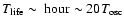 ,
such a ratio is
very small, i.e. g-modes patterns are rapidly destroyed by the following
penetrating plumes and it may be a problem for their detection at the
star surface.
,
such a ratio is
very small, i.e. g-modes patterns are rapidly destroyed by the following
penetrating plumes and it may be a problem for their detection at the
star surface.
Using the previous time-frequency diagrams for every g-mode allows
us to find the time intervals during which IGWs propagate
in the RZ. Now we want to quantify the efficiency of this
stochastic excitation by using, say, some wave flux in the vertical
direction. However, as we impose the reflective boundary condition w=0for the vertical velocity
both at the surface z=z1 and the bottom z=z4 of our computational
domain, we have standing waves rather than propagating waves
and no flux is carried by waves in the vertical direction. As in Paper
I, we thus chose to focus on the kinetic energy embedded in g-modes
using the following Parseval type relation valid in the anelastic
subspace
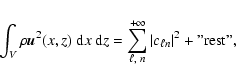
 .
Indeed, using
the classical Parseval relation just allows one to quantify
the amount of (say) kinetic energy contained in a mode of given degree
and contributions coming from g-modes as well as p-modes or any
turbulent motion are mixed together. The advantage of our anelastic
subspace relation (13) is that it lifts this degeneracy in
the radial order n by isolating the g-mode contributions. Of course,
this relation should be applied only during times when IGWs effectively
propagate, i.e. when
.
Indeed, using
the classical Parseval relation just allows one to quantify
the amount of (say) kinetic energy contained in a mode of given degree
and contributions coming from g-modes as well as p-modes or any
turbulent motion are mixed together. The advantage of our anelastic
subspace relation (13) is that it lifts this degeneracy in
the radial order n by isolating the g-mode contributions. Of course,
this relation should be applied only during times when IGWs effectively
propagate, i.e. when
 or
or
 ,
such that the
,
such that the
 contributions
make sense.
contributions
make sense.
The temporal evolution of the total kinetic energy
 embedded in the
simulation (i.e. the left-hand
side in Eq. (13)) is illustrated
as the solid line in Fig. 18a, while the
dot-dashed line in the same panel corresponds to the contribution
embedded in the
simulation (i.e. the left-hand
side in Eq. (13)) is illustrated
as the solid line in Fig. 18a, while the
dot-dashed line in the same panel corresponds to the contribution
 coming
from g-modes only (the right-hand side sum in Eq. (13),
where the
coming
from g-modes only (the right-hand side sum in Eq. (13),
where the
![$\ell=[1{-}3]$](/articles/aa/full/2005/28/aa2831-05/img153.gif) and n=[0-2] modes have been considered).
The interesting quantity is of course the ratio between the two, that is
and n=[0-2] modes have been considered).
The interesting quantity is of course the ratio between the two, that is
 ,
which emphasizes
the efficiency of the IGW excitation by the downward plumes (Fig. 18b). It emerges that g-modes contribute up to about 40% of the
total kinetic energy when they are excited, for example in the range
,
which emphasizes
the efficiency of the IGW excitation by the downward plumes (Fig. 18b). It emerges that g-modes contribute up to about 40% of the
total kinetic energy when they are excited, for example in the range
![$t\simeq
[400{-}600]$](/articles/aa/full/2005/28/aa2831-05/img155.gif) when the
when the  mode is strongly excited.
This large ratio is interesting, since it means that internal gravity waves may
contain a non-negligible part of the total kinetic energy of the coupled
system formed by the two neighboring convective and radiative zones.
This is a direct demonstration that the excitation of IGWs by penetration
plumes can be quite efficient, at least in 2-D.
mode is strongly excited.
This large ratio is interesting, since it means that internal gravity waves may
contain a non-negligible part of the total kinetic energy of the coupled
system formed by the two neighboring convective and radiative zones.
This is a direct demonstration that the excitation of IGWs by penetration
plumes can be quite efficient, at least in 2-D.
![\begin{figure}
\par {\includegraphics[width=7.2cm,clip]{2831fg18.eps} }\par\end{figure}](/articles/aa/full/2005/28/aa2831-05/img157.gif) |
Figure 18: a) Time evolution of the total kinetic energy (solid line) embedded in the simulation, with its component which is only due to g-modes (dot-dashed line); b) ratio between the two. |
| Open with DEXTER | |
We have investigated numerically the excitation of internal gravity waves by the penetration of convective plumes into an adjacent stably stratified zone. This problem is intimately related to the transport processes of chemicals and/or angular momentum in radiative zones of cool stars, such as the Sun. The knowledge of both spectrum and amplitudes of the internal waves field is crucial.
After recalling the main features of 2-D hydrodynamical simulations of penetrative convection, we focused on the problem of the mode identification by first using a classical method based on successive Fourier transforms of the vertical mass flux over the whole simulation. We thus showed that this tool is not adapted to detect the g-modes propagating in these simulations as the resulting spectra are very noisy, preventing a quantitative study of the phenomenon.
We then introduced our method for detecting accurately the internal waves
in the radiative zone. It is based on the projection of the simulated
velocity field onto the anelastic eigenmodes that are solutions of the
associated linear eigenvalue problem for the perturbations. Indeed, when
a standing wave is present near the bottom radiative zone, its spatial
structure is that of an eigenmode and the coefficient of the projection
onto this eigenmode gives the mode amplitude. This amplitude is of
course time-dependent as the internal wave is only generated after the
penetration of plumes, and is then dissipated under the action of both
viscous and radiative diffusions. This leads us to use time-frequency
diagrams to isolate the most powerful wave events and to construct what
we called "the event function '', that is, a binary function
(0/1) which is set to 1 only when the mode amplitude is higher than a
given threshold. As an example, we focused on the g-mode at and n=0, whose period is
T10 = 22.6. We extracted six wave
events in our particular 2-D simulation, the longest one corresponding to
four mode periods. We then showed the intricate link existing between the
mode and the downward plumes as they can either excite it or destroy it!
The extension of this study to the g-modes at
and n=[0-2]allowed us to compute the PDF of the mode lifetimes. We found that
the mean lifetime is only around twice the period of the mode.
The shortness of this
lifetime may be a problem from an observational point of view where one
needs lifetimes as big as possible (the large-scale solar acoustic modes
have lifetimes of about the day, i.e. several hundreds of
times
their mean period).
Finally, we looked at the kinetic energy content of the excited g-modes
and showed that up to 40% of the total kinetic energy at times may
reside in g-modes. This level is only reached during a fraction of
the time, and the mode kinetic energy varies considerable with time.
Nevertheless, when the modes are excited, the corresponding
velocity field in the radiative zone has an amplitude that may
lead to an efficient wave transport there (through the advective term
 ).
).
It is clear that our detection method allows a quantitative analysis of the problem of g-mode excitation by penetrative convection. Following this work, we have been doing a parametric study of the influence of the convective flux on the mode amplitudes, by trying to predict these amplitudes from mixing-length arguments. Some recent 2-D simulations by Kiraga et al. (2003) indeed suggest that such mixing length models systematically underestimate the strength of the internal wave field.
In the same way, the depth of the penetration in the stably stratified zone is without doubt a key parameter in the excitation mechanism by penetrative plumes. This penetration strongly depends on the local value of the Péclet number Pe: (i) large values of Pe mean that the advection is greater than the radiative diffusion such that the plume keeps its identity and is stopped very rapidly by the buoyancy braking, leading to a tiny penetration; (ii) small values of Pe mean that the plume thermalizes very rapidly with its surrounding and the buoyancy braking disappears, leading to a large penetration. It would then be interesting to further study the influence of the Péclet number on the mode amplitudes, by computing for example a grid of 2-D polytropic models with different indexes m3, in order to play with the Péclet number jump at the base of the convection zone (Eq. (6)). Likewise, the influence of the dimensionality; i.e. the differences between 2-D and 3-D also need be investigated.
Acknowledgements
This work has been supported by the European Commission under Marie-Curie grant No. HPMF-CT-1999-00411. Calculations were carried out on the CalMip machine of the "Centre Interuniversitaire de Toulouse'' (CICT) which is acknowledged. We thank Sylvie Roques and the referee (J.-P. Zahn) for their meaningful comments.
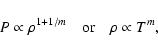
The initial vertical stratification is computed using polytropes of
various indexes for which
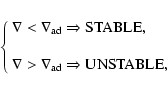 |
(A.1) |
 and
and
 is its value
in the case of an adiabatic stratification. The using of polytropic
solutions leads to the following simple form for the "del''
is its value
in the case of an adiabatic stratification. The using of polytropic
solutions leads to the following simple form for the "del''

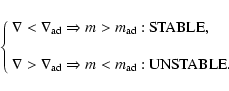 |
(A.2) |
 ,
we have
,
we have
 and
and
 in this case and a polytropic layer will be
convectively stable if m>3/2 and unstable if m<3/2.
in this case and a polytropic layer will be
convectively stable if m>3/2 and unstable if m<3/2.
Once the three polytropic indexes of the superposed layers have been fixed
we first compute the corresponding radiative conductivity profile by
assuming that all of the energy flux
 that we impose at the bottom is
initially transported by radiation, that is,
that we impose at the bottom is
initially transported by radiation, that is,
In Fig. A.1a we show an example of such a profile for a polytropic
layered system with indexes
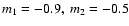 and m3=3. As expected,
the radiative conductivity in the CZ is below the critical value
and m3=3. As expected,
the radiative conductivity in the CZ is below the critical value
 given by
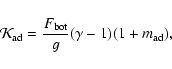
 .
More
surprising could be the value
.
More
surprising could be the value
 in the surface layer as one rather expects a stably stratified layer
here, as observed in solar-like stars where a very thin superficial stable
layer exists. In fact, this layer is stable due to its efficient cooling
(Eq. (2)) such that the Schwarzschild criterion does not
apply. We thus adopt a very weak value for
in the surface layer as one rather expects a stably stratified layer
here, as observed in solar-like stars where a very thin superficial stable
layer exists. In fact, this layer is stable due to its efficient cooling
(Eq. (2)) such that the Schwarzschild criterion does not
apply. We thus adopt a very weak value for
 ,
by taking
m1=-0.9 in all of the simulations, and compute the initial hydrostatic
stratification of this layer by assuming that it is already isothermal
with
,
by taking
m1=-0.9 in all of the simulations, and compute the initial hydrostatic
stratification of this layer by assuming that it is already isothermal
with
 .
.
Concerning the initial stratification of the CZ, things are more
involved. Assuming an initial polytropic stratification with
 is clearly not a good idea, as an efficient convection is
always associated with an almost adiabatic stratification with
is clearly not a good idea, as an efficient convection is
always associated with an almost adiabatic stratification with
 .
In this case, the relaxation of the CZ towards
its adiabatic state would take a lot of numerical timesteps. One
simple solution of this problem consists in starting from an adiabatic
stratification in the CZ by imposing
.
In this case, the relaxation of the CZ towards
its adiabatic state would take a lot of numerical timesteps. One
simple solution of this problem consists in starting from an adiabatic
stratification in the CZ by imposing
 .
However, this
solution does not take into account the entropy jump which appears at
the top of the CZ (the difference between constant entropy in the CZ and
the entropy minimum in the photosphere; see e.g., Abbett et al. 1997;
Ludwig et al. 1999) such that the relaxation time would
stay important.
.
However, this
solution does not take into account the entropy jump which appears at
the top of the CZ (the difference between constant entropy in the CZ and
the entropy minimum in the photosphere; see e.g., Abbett et al. 1997;
Ludwig et al. 1999) such that the relaxation time would
stay important.
One solution of this relaxation time problem consists in starting from
a mixing length stratification where the (local) superadiabatic gradient
in the CZ is modeled using the following mixing-length argument
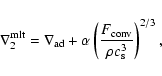
 denotes the local sound speed,
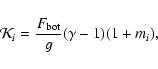
 is a free mixing-length parameter and
 is the convective
flux given by
is the convective
flux given by
![\begin{displaymath}F_{\hbox{\scriptsize conv}}= F_{\hbox{\scriptsize bot}}- F_{\...
...iptsize bot}}\left[ 1 - \frac{1}{g}(\gamma -1)(1+m_2) \right].
\end{displaymath}](/articles/aa/full/2005/28/aa2831-05/img185.gif)
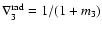 .
.
To summarize, the initial stratification of our three-layer model is
computed from
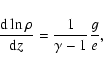
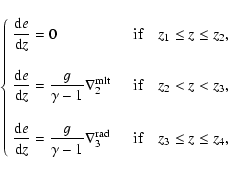
 .
.
In Fig. A.1b we show the resulting vertical profile of the initial
entropy
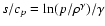 for the same
indexes
m=[-0.9,-0.5,3.]. The solid line denotes the
initial entropy whereas the dot-dashed line corresponds to its profile
in the relaxed state. First, as the entropy gradient in an isothermal
layer is a constant, one verifies that
for the same
indexes
m=[-0.9,-0.5,3.]. The solid line denotes the
initial entropy whereas the dot-dashed line corresponds to its profile
in the relaxed state. First, as the entropy gradient in an isothermal
layer is a constant, one verifies that
 for
z=[z1,z2].
Second, the comparison between the initial and relaxed profiles shows
that the mixing-length stratification well reproduces the entropy jump at
the top of the CZ: the strong mixing taking place in the deep layers of
the CZ leads to an almost flat entropy profile, which disappears at the
base of the photosphere. As a consequence, the computing time needed to
relax towards this solution is considerably reduced by using mixing-length
solutions.
for
z=[z1,z2].
Second, the comparison between the initial and relaxed profiles shows
that the mixing-length stratification well reproduces the entropy jump at
the top of the CZ: the strong mixing taking place in the deep layers of
the CZ leads to an almost flat entropy profile, which disappears at the
base of the photosphere. As a consequence, the computing time needed to
relax towards this solution is considerably reduced by using mixing-length
solutions.
![\begin{figure}
{\includegraphics[width=7.7cm]{2831fg19.eps} }
\par\end{figure}](/articles/aa/full/2005/28/aa2831-05/img169.gif)