![\begin{figure}
\psfrag{xaxis}{$x$ }
\psfrag{zaxis}{$z$ }
\psfrag{x1}{$x_1$ }
\ps...
...zone with index $m_3$ }
{\includegraphics[width=7cm]{2831fg1.eps} }
\end{figure}](/articles/aa/full/2005/28/aa2831-05/img42.gif) |
Figure 1: Geometry of the computational domain. |
| Open with DEXTER | |
In the text
![\begin{figure}
{\includegraphics[width=7.4cm,clip]{2831fg2.eps} }\par\end{figure}](/articles/aa/full/2005/28/aa2831-05/img62.gif) |
Figure 2:
Snapshots of the velocity field superimposed on a grey scale
representation of
the internal energy fluctuations (i.e. or temperature) at three different
times
![$t=[900,\ 903,\ 906]$](/articles/aa/full/2005/28/aa2831-05/img1.gif) .
The horizontal dashed
lines delimit the convection zone z=[0,1] located above the radiative
zone z=[1,3]. .
The horizontal dashed
lines delimit the convection zone z=[0,1] located above the radiative
zone z=[1,3]. |
| Open with DEXTER | |
In the text
![\begin{figure}
{\includegraphics[width=7.5cm,clip]{2831fg3.eps} }
\end{figure}](/articles/aa/full/2005/28/aa2831-05/img63.gif) |
Figure 3: Normalized vertical profiles of the radiative (solid dark line), convective (dotted line) and kinetic (dashed line) fluxes, with their sum (solid grey line). The vertical dotted lines denote the CZ limits. |
| Open with DEXTER | |
In the text
![\begin{figure}
{\includegraphics[width=8cm,clip]{2831fg4.eps} }
\end{figure}](/articles/aa/full/2005/28/aa2831-05/img64.gif) |
Figure 4:
Evolution with time of the penetration extent  ,
with its time-averaged value ,
with its time-averaged value
 denoted by the horizontal dotted line. denoted by the horizontal dotted line. |
| Open with DEXTER | |
In the text
![\begin{figure}
{\includegraphics[width=7cm,clip]{2831fg5.eps} }
\end{figure}](/articles/aa/full/2005/28/aa2831-05/img65.gif) |
Figure 5: Mean vertical profile of the Péclet number, where dotted lines mark the CZ limits. |
| Open with DEXTER | |
In the text
![\begin{figure}
{\includegraphics[width=8.5cm,clip]{2831fg6.eps} }
\end{figure}](/articles/aa/full/2005/28/aa2831-05/img81.gif) |
Figure 6:
Left: gray scale representations in the
 -plane
of the low-frequency part of the temporal power spectra for two degrees -plane
of the low-frequency part of the temporal power spectra for two degrees
![$\ell =[1,2]$](/articles/aa/full/2005/28/aa2831-05/img5.gif) .
Right: the resulting spectra after
integrating over depth. .
Right: the resulting spectra after
integrating over depth. |
| Open with DEXTER | |
In the text
![\begin{figure}
{\includegraphics[width=6cm,clip]{2831fg7.eps} }%
\end{figure}](/articles/aa/full/2005/28/aa2831-05/img104.gif) |
Figure 7: Mean vertical profile of the Brunt-Väisälä frequency N in the RZ, the dotted line denoting the BCZ. |
| Open with DEXTER | |
In the text
![\begin{figure}
{\includegraphics[width=7.6cm,clip]{2831fg8.eps} }
\end{figure}](/articles/aa/full/2005/28/aa2831-05/img106.gif) |
Figure 8:
First three anelastic eigenvectors
 at
at  and radial orders n=0 (solid line),
n=1 (dashed line) and n=2 (dashed-dotted line). Upper and
lower panels show the vertical and horizontal displacements,
respectively. Eigenvectors have been normalized by imposing
and radial orders n=0 (solid line),
n=1 (dashed line) and n=2 (dashed-dotted line). Upper and
lower panels show the vertical and horizontal displacements,
respectively. Eigenvectors have been normalized by imposing
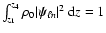 . . |
| Open with DEXTER | |
In the text
![\begin{figure}
{\includegraphics[width=8.5cm,clip]{2831fg9.eps} }
\end{figure}](/articles/aa/full/2005/28/aa2831-05/img114.gif) |
Figure 9:
Evolution with time of the real (solid lines) and imaginary
(dotted lines) parts of the amplitude
 of the g-modes of
degrees
and orders
of the g-modes of
degrees
and orders ![$n=[0,\ 1]$](/articles/aa/full/2005/28/aa2831-05/img10.gif) . . |
| Open with DEXTER | |
In the text
![\begin{figure}
{\includegraphics[width=6.7cm]{2831fg10.eps} }
\end{figure}](/articles/aa/full/2005/28/aa2831-05/img120.gif) |
Figure 10:
Corresponding temporal power spectrum of the mode amplitude
 used in Fig. 9, for
and n=0. The
vertical dotted line marks the location of the theoretical frequency
used in Fig. 9, for
and n=0. The
vertical dotted line marks the location of the theoretical frequency
 of the underlying g-mode. Amplitudes have been magnified by 105for clarity. of the underlying g-mode. Amplitudes have been magnified by 105for clarity. |
| Open with DEXTER | |
In the text
![\begin{figure}
{\includegraphics[width=8cm,clip]{2831fg11.eps} }\par\end{figure}](/articles/aa/full/2005/28/aa2831-05/img131.gif) |
Figure 11:
Time-frequency diagram of the amplitude of the g-mode at
and n=0 using a temporal window of width
 ,
with ,
with
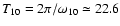 the mode period.
The horizontal dotted line corresponds to the mode
frequency
.
the mode period.
The horizontal dotted line corresponds to the mode
frequency
. |
| Open with DEXTER | |
In the text
![\begin{figure}
\psfrag{toto}{Event function $\cal E$ }
{\includegraphics[width=7.5cm,clip]{2831fg12.eps} }\par\end{figure}](/articles/aa/full/2005/28/aa2831-05/img134.gif) |
Figure 12:
Filtering of the mode ,
n=0:
zoom in Fig. 11 around the frequency
( upper
panel); the resulting event function  given by Eq. (12) ( middle
panel); the corresponding real (solid line) and imaginary (dotted line)
parts of the mode amplitude after the filtering ( lower panel).
given by Eq. (12) ( middle
panel); the corresponding real (solid line) and imaginary (dotted line)
parts of the mode amplitude after the filtering ( lower panel). |
| Open with DEXTER | |
In the text
![\begin{figure}
{\includegraphics[width=7.1cm,clip]{2831fg13.eps} }\par\end{figure}](/articles/aa/full/2005/28/aa2831-05/img135.gif) |
Figure 13:
Snapshot of the velocity field superimposed on the internal
energy fluctuations for time t=405. Note the large-scale velocity field
in the bottom radiative zone mainly due to the standing g-mode at
and n=0. |
| Open with DEXTER | |
In the text
![\begin{figure}
{\includegraphics[width=8.8cm,clip]{2831fg14.eps} }
\end{figure}](/articles/aa/full/2005/28/aa2831-05/img136.gif) |
Figure 14:
Destruction of the g-mode
 by a penetrating
plume entering in the RZ at time
by a penetrating
plume entering in the RZ at time
 . . |
| Open with DEXTER | |
In the text
![\begin{figure}
{\includegraphics[width=7.1cm,clip]{2831fg15.eps} }\par\end{figure}](/articles/aa/full/2005/28/aa2831-05/img138.gif) |
Figure 15:
Upper panel: same as in Fig. 6 for except that the temporal Fourier transform has been computed for time
t=[300-450] only. Lower panel: comparison between the
corresponding vertical mass flux
 (solid line) and the
theoretical
one (dashed line) computed from the anelastic eigenvector at and n=0.
(solid line) and the
theoretical
one (dashed line) computed from the anelastic eigenvector at and n=0. |
| Open with DEXTER | |
In the text
![\begin{figure}
{\includegraphics[width=7.4cm,clip]{2831fg16.eps} }
\end{figure}](/articles/aa/full/2005/28/aa2831-05/img139.gif) |
Figure 16:
The event functions
for g-modes of degrees
![$\ell =[1,2,3]$](/articles/aa/full/2005/28/aa2831-05/img19.gif) and radial orders n=[0,1,2], with their associated
periods
and radial orders n=[0,1,2], with their associated
periods
 . . |
| Open with DEXTER | |
In the text
![\begin{figure}
{\includegraphics[width=7.6cm,clip]{2831fg17.eps} }\par\end{figure}](/articles/aa/full/2005/28/aa2831-05/img140.gif) |
Figure 17: PDF of the lifetime of wave events, in units of the modeperiods. |
| Open with DEXTER | |
In the text
![\begin{figure}
\par {\includegraphics[width=7.2cm,clip]{2831fg18.eps} }\par\end{figure}](/articles/aa/full/2005/28/aa2831-05/img157.gif) |
Figure 18: a) Time evolution of the total kinetic energy (solid line) embedded in the simulation, with its component which is only due to g-modes (dot-dashed line); b) ratio between the two. |
| Open with DEXTER | |
In the text
![\begin{figure}
{\includegraphics[width=7.7cm]{2831fg19.eps} }
\par\end{figure}](/articles/aa/full/2005/28/aa2831-05/img169.gif)
 below which the layer is convectively
unstable. The dot-dashed line in the b)-plot corresponds to the entropy
profile in the relaxed state.
below which the layer is convectively
unstable. The dot-dashed line in the b)-plot corresponds to the entropy
profile in the relaxed state.In the text