A&A 438, 1-9 (2005)
DOI: 10.1051/0004-6361:20042327
Further experiments on collisional tribocharging of cosmic grains
T. Poppe - R. Schräpler
Institut für Geophysik und extraterrestrische Physik, Technische Universität Braunschweig,
Mendelssohnstraße 3, 38106 Braunschweig, Germany
Received 8 November 2004 / Accepted 8 March 2005
Abstract
We experimentally investigated
tribocharging in bouncing dust grain collisions
under conditions
which are relevant for the early solar nebula.
We used silica, diamond, graphite,
and silicon carbide grains and
cm-sized targets of aluminum, iron, and graphite.
We varied particle size around 1  ,
collision velocity
between 38 to 106
,
collision velocity
between 38 to 106
 ,
and target temperature between 240 K and 360 K.
Generally, the grains acquire
something in the order of hundreds or thousands of negative elementary charges,
which is at the upper end of the range previously
discussed in astrophysical research.
Mainly, a temperature difference caused by the dissipation of collisional energy
or by initial temperatures determines
the amount of charge transfer.
It suggests a thermally diffusive charge transfer process
of negative charge carriers.
Nevertheless, also other processes
of secondary importance were effective.
Material-dependent contact charging is ruled out as the dominant charge
transfer process in our experiments.
For most particle-target combinations,
the charge transfer can be described
by an empirical function of collision energy
which we propose for future astrophysical applications, especially for applications on the sticking efficiency
in the preplanetary dust aggregation process, on the particle motion in the solar nebula,
and on the possibility of nebular lightning.
,
and target temperature between 240 K and 360 K.
Generally, the grains acquire
something in the order of hundreds or thousands of negative elementary charges,
which is at the upper end of the range previously
discussed in astrophysical research.
Mainly, a temperature difference caused by the dissipation of collisional energy
or by initial temperatures determines
the amount of charge transfer.
It suggests a thermally diffusive charge transfer process
of negative charge carriers.
Nevertheless, also other processes
of secondary importance were effective.
Material-dependent contact charging is ruled out as the dominant charge
transfer process in our experiments.
For most particle-target combinations,
the charge transfer can be described
by an empirical function of collision energy
which we propose for future astrophysical applications, especially for applications on the sticking efficiency
in the preplanetary dust aggregation process, on the particle motion in the solar nebula,
and on the possibility of nebular lightning.
Key words: solar system: formation - methods: laboratory - dust, extinction
1 Introduction
When solid grains collide, an electrical charge transfer
can occur due to tribocharging. This process
was regarded as important for numerous applications in various disciplines
and was also relevant for physical processes which formed the solar system.
In the solar nebula, the planet formation process
began with a dust aggregation of
grains of primarily micrometer size, which were embedded in dilute gas,
collided, and then stuck (e.g. Weidenschilling & Cuzzi 1993).
For this process,
the sticking efficiency in dust
grain collisions is an important parameter.
In experimental work with the aim of investigating sticking probabilities
(Poppe et al. 2000a,b),
it became obvious that triboelectrification
can contribute to the sticking efficiency.
Grains which mechanically bounced off were reattracted
by collision-induced electrostatic forces and finally stuck.
Also in the solar nebula, lightning-like gas discharges
could have occurred.
Steps in this process are that particles
embedded in an almost neutral gas collided and charged each other.
Then they were separated and concentrated by gas flow patterns
of the solar nebula such that
electric fields built up to compete with particle discharging
due to a weak ionisation of the gas, e.g. resulting from the
decay of radioactive elements. If the field is strong enough
an electrical breakthrough will occur and equilibrate the
electrical charges by "lightning''.
The discussion dates back to Whipple (1966)
and is linked to meteoritic chondrule formation.
Chondrules are spheroid stony meteoritic
components of typically 0.1-1 mm diameter
which underwent a transient heating process that melted them;
the heating process, whether lightning or not,
is believed to have taken place outside those meteorites in which
the chondrules are found today (e.g. Hewins 1996).
Important work on the possibility of lightning
has been done by Morfill et al. (1993),
Love et al. (1995), Gibbard et al. (1997), Pilipp et al. (1998),
and Desch & Cuzzi (2000).
Furthermore, the dynamics of dust populations is influenced
by electric and magnetic fields when the dust is charged.
With respect to particle charge-to-mass ratios which were
even lower than most measured
in this work,
Poppe et al. (2000b) already pointed out that forces caused by
magnetic fields could
be stronger than aerodynamical forces in the early solar nebula.
For the above-mentioned applications,
solar nebula conditions are important,
and particle
sizes and collision velocities must be considered.
Typical particle sizes are in the
micrometer range as supported by meteoritic studies
on preplanetary dust before particle
accretion (Kerridge 1993).
Evidence based on the investigation of
interplanetary dust particles (IDPs)
often of cometary origin
(Rietmeijer 2002; Brownlee 1985;
Jessberger et al. 2001; Sandford 1996)
makes a size range around
 appear typical for preplanetary dust.
Rietmeijer (2002) measured sizes of "granular units'' in an IDP
and found a range of 64 nm to 7580 nm
with a mean value of 585 nm.
Jessberger et al. (2001) mentioned 0.3
appear typical for preplanetary dust.
Rietmeijer (2002) measured sizes of "granular units'' in an IDP
and found a range of 64 nm to 7580 nm
with a mean value of 585 nm.
Jessberger et al. (2001) mentioned 0.3
 as typical size of the original grains.
The collision velocities in the solar nebula
range up to 50
,
which
is believed to be characteristic for collisions of micron-sized grains
with large objects of m size (Weidenschilling & Cuzzi 1993),
if only inward drift and sedimentation are treated.
Eddies may cause even higher collision velocities.
The turbulent velocity was
between 20 and
as typical size of the original grains.
The collision velocities in the solar nebula
range up to 50
,
which
is believed to be characteristic for collisions of micron-sized grains
with large objects of m size (Weidenschilling & Cuzzi 1993),
if only inward drift and sedimentation are treated.
Eddies may cause even higher collision velocities.
The turbulent velocity was
between 20 and
 at 1 AU (Cuzzi et al. 1993).
Assuming collisions of micron-sized particles
that are fully coupled to the turbulent nebula
gas with large objects that are decoupled from the turbulent motions,
the collision velocities fall in the same range (Schräpler & Henning 2004).
at 1 AU (Cuzzi et al. 1993).
Assuming collisions of micron-sized particles
that are fully coupled to the turbulent nebula
gas with large objects that are decoupled from the turbulent motions,
the collision velocities fall in the same range (Schräpler & Henning 2004).
It was our intention to investigate tribocharging by
experiments on the charge transfer in bouncing
grain-target collisions with cosmic dust analogues.
We introduce tribocharging,
then describe the analogous materials and report
measurements of collisional charge transfer
with varying conditions:
particle samples, target materials, and collision energy.
The results indicated that a collision-induced
temperature gradient is important for grain charging.
Consequently, we then conducted further experiments
varying the target temperature.
Finally, we discuss the results with regard
to the physical nature of tribocharging and
to astrophysical applications.
2 Tribocharging: An overview
Tribocharging is one of the oldest problems in physical science,
which however, still lacks an established theory.
It is a collective term for numerous
processes of charge transfer between solids or liquids.
Possibly the most comprehensive treatment is found in Harper (1967).
Probably the widest-spread physical
idea is the one of contact charging for which the
work functions of the contacting materials are important.
The idea is that a difference in the work function makes
it energetically favorable
for electrons to change the objects in contact,
and a charge imbalance remains after separation leaving
the objects electrified.
As a consequence of this hypothesis, triboelectric series predict
the charging sign of an object according to the material it is made of.
However there is neither a reason
why contact charging should be the most important process
nor why it should be regarded as well-understood.
Problems are firstly that triboelectric series
have numerous contradictions (Harper 1967; Vercoulen 1995).
Secondly, the work function of insulators are, at least,
hard to determine.
To overcome this problem, many authors (e.g. Lowell & Rose-Innes 1980;
Sternovsky et al. 2002) introduced
"effective work functions'' fitted to the results of tribocharging experiments.
One objection to this is that it would theoretically explain a wide variety of
electrification processes
in the frame of contact charging, and
the more or less arbitrary effective work functions
assigned to insulators
evade any verification by other than tribocharging experiments.
In contrast to insulators, the work functions of metals are well
known but the application is difficult because the
separation process of conducting materials
allows a reflow of charges and thus
plays a major role in electrification,
as well as the fact that due to conductance the
charge does not accumulate at the surface (e.g. Lowell & Rose-Innes 1980).
The role of motion and friction in contact charging is
as intricate as their role in tribocharging in general.
It is known from the contact with liquid mercury that
charge transfer can occur without friction (Lowell 1986; Harper 1967),
and effort has been made to eliminate
relative motion in tribocharging experiments (Lowell 1986).
If motion is involved, a subtle distinction
between "sliding''
and "rubbing'' is made, the first involving
gentle motion, the latter harder motion, whether with respect to
contact pressure or velocity (Harper 1967, and references therein;
Lowell & Rose-Innes 1980).
Sliding is believed to increase contact charging by
multiplying the contact points while rubbing
itself is a cause for charge transfer, as
can be seen from one of few well-established facts that
identical objects like sticks which are rubbed against each other
can charge upon contact (Harper 1967; Lowell & Rose-Innes 1980).
Even the sign can change
depending on the way of rubbing, i.e. on the role as rubbing
or as rubbed object, or as "bow'' or as "string''.
One among other hypotheses is that "hot spots'' (Harper 1967) are important
where charge carriers are more mobile and
where motion-induced temperature differences cause a diffusive
transfer of charge carriers.
Thus temperature gradients in general must be regarded
as important for charge transfer.
Bowles's (1961) experiments on collisions of macroscopic bodies
with different temperatures showed
a diffusive electrification which involved
positive charge carriers, and aside from
the diffusive process at least one further electrification
process had been effective.
Lowell and Rose-Innes (1980) related former descriptions and the experimental results (Bowles 1961)
of temperature-dependent
charge carrier transfer to
the transfer of ions which they present as explanation of
charge transfer between like surfaces at temperature differences.
Beyond the electrification processes listed above, also
the transfer of charged
impurities or charged rubbed-off bulk material
is discussed in the afore mentioned
literature on tribocharging.
There is also literature on charge transfer
in particle collisions which treats aerosol particles colliding
with macroscopic objects. Many authors treat their results within the hypothesis of
contact charging (Matsuyama & Yamamoto 1989;
John et al. 1980; Kacprzyk & Gajewski 2001; Masuda et al. 1976;
Cheng & Soo 1970),
although the explanation of results is not fully satisfying.
The application of former tribocharging
experiments with small particles is restricted
by the experimental
parameters because mostly the velocities were smaller, the particles larger than
desirable, the materials were hardly relevant
for our applications, and the role of surrounding gas
is an open issue as is suggested by a particle measurement technique
which involves ions adhering to charged particles.
It worked such that charge of the ions is detected when transferred to
to the target upon particle impact (Prochazka 1966).
More tribocharging processes than discussed so far
were treated in astrophysical literature on the possibility of nebular lightning.
The processes of thunderstorm electrification were adressed
by Morfill et al. (1993).
However, in two of these processes, liquid water
plays a role, so it is questionable whether these processes
are relevant.
Another approach has been to consider the so-called Elster-Geitel
effect, which allows a straightforward calculation
and requires
a preexisting electrical field. Due to this field the charge carriers
of objects in a conducting contact distribute unequally.
If the objects are separated, a net charge remains on each.
Pilipp et al. (1998) chose
the Elster-Geitel effect
and another "unspecified'' charging process.
The Elster-Geitel effect
is extremely weak and was therefore already refused
by Gibbard et al. (1997), Pilipp et al. (1998), and Poppe et al. (2000b).
Furthermore, it is questionable
whether a sufficient electrical charge flow can occur beetween nonconducting materials
in the short contact time of a collision.
Desch & Cuzzi (2000) used triboelectric series by Harper (1967) based
on the elemental composition of grains in the solar nebula.
They assumed by far the strongest charge transfer
compared to other literature on nebular lightning;
as an example, they describe
the charging such that a fine metal grain of 1 diameter colliding with a 600
diameter
silicate object will accept 3000 negative elementary charges
independent of collision velocity.
Also Sternovsky et al. (2002) used work function differences for
explaining experimental results
on regolith-simulant charging.
With the lack of a satisfying theoretical description,
it does not seem surprising that authors of astrophysical
literature often avoided to address the nature of tribocharging
(Gibbard et al. 1997; Love et al. 1995). Gibbard et al. (1997)
assumed an amount of charge transfer extrapolated from
an empirical formula by Norville et al. (1991)
for the charge transfer between colliding hail and graupel
in terrestrial thunderstorms.
![\begin{figure}
\par\includegraphics[height=4.5cm,width=5.5cm,clip]{2327f1a.ps}\i...
...7f1e.ps}\includegraphics[height=4.5cm,width=5.5cm,clip]{2327f1f.ps}
\end{figure}](/articles/aa/full/2005/28/aa2327-04/Timg14.gif) |
Figure 1:
SEM images of the dust samples. From left to right, from top to bottom: Large silica spheres, small silica spheres, diamond grains, SiC grains, graphite grains, and iron spheres. |
| Open with DEXTER |
The literature study showed that numerous electrification processes are
treated, which are hard to separate,
and that the criteria for prediction are vague if available at all.
Both negative and positive charge carriers are considered
as changing the objects,
and at least the material, relative motion, temperature,
the details of the separation process, and impurities are
among the several causes of charge transfer.
As a consequence, we refuse
to assume the contact charging hypothesis without further reasoning
or to explain tribocharging
by a single process.
Former astrophysical assumptions about the amount of charge transfer
had a wide range over three orders of magnitude, so
both the processes and the amount of charge transfer are problems
which call for new laboratory measurments.
The selection of material was lead by the intention of resembling
properties of grains in the solar nebula. Hard grains
of micron size consisting
of elements with high cosmic abundance were chosen,
both of spherical and irregular shapes.
![\begin{figure}
\par\includegraphics[width=5.2cm,clip]{2327f2a.ps}\hspace*{2mm}
\...
...f2e.ps}\hspace*{2mm}
\includegraphics[width=5.2cm,clip]{2327f2f.ps}
\end{figure}](/articles/aa/full/2005/28/aa2327-04/Timg15.gif) |
Figure 2:
Size distributions with average diameter,
mean axes ratio, and the size of a particle
with average mass. |
| Open with DEXTER |
Figures 1 and 2 describe the micrometer-sized dust
samples by SEM (scanning electron microscope) images
and size distributions.
Most of the grains had already been used in other experiments, so that further
details about the grains and their relevance
can be found in Poppe et al. (2000a) and Poppe (2003).
The size distribution was determined from SEM images
and needs some explanation.
The "diameter'' di of particle i is
the mean of long and short axes presented on the SEM images.
The average diameter is the mean d of n particles.
The nominal diameters dn, which were assigned above to the particles,
represent the diameter of a particle close to average mass
(
 )).
The nominal diameter dn is not only a measured value
but also defines
a characteristic example particle of each powder sample,
which has the mass of a spherical particle with dnand to which a certain charge transfer
given in elementary charges is later related.
)).
The nominal diameter dn is not only a measured value
but also defines
a characteristic example particle of each powder sample,
which has the mass of a spherical particle with dnand to which a certain charge transfer
given in elementary charges is later related.
The targets were plates (53 mm by 38 mm) of aluminum,
pure iron, and graphite. This choice was guided not only by astrophysical relevance but also by the necessity
to use conductive materials.
The targets were cleaned by being
wiped with paper, purged with ethylene, and subsequently dried
by pressurized air.
3.2 Experimental procedure
We created particle jets in a vacuum chamber
by pushing a dust sample onto the front side of a rotating cogwheel
as described in Poppe et al. (1997) and as shown in Fig. 3.
This creates jets of single particles
which tangentially leave the cogwheel and which we
directed onto electrically-conducting targets.
For a single experimental run,
a piston was pushed with a feed of 1 mm through the dust storage hole.
According to Fig. 3, the target and the cogwheel (diameter 200 mm, width 5 mm)
were electrically connected to separate channels of an oscilloscope such that
we had an independent charge separation measurement
both at the cogwheel and at the target.
The charge flow is typically on the order of Q=10-7 C for a feed of 1 mm.
The oscilloscope indicated the values of
 and
and
 from which the charge separation at the target
  and at the cogwheel
 can be calculated.
Typically 10-20 of these values were taken for each combination
of particle sample and target in order to prove reproducibility.
The air pressure in the experimental setup was normally 0.006 mbar,
it never exceeded 0.008 mbar.
Experiments took place at room temperature.
can be calculated.
Typically 10-20 of these values were taken for each combination
of particle sample and target in order to prove reproducibility.
The air pressure in the experimental setup was normally 0.006 mbar,
it never exceeded 0.008 mbar.
Experiments took place at room temperature.
Table 1:
Average number of elementary charges
given to the targets made of aluminum (Al), iron (Fe),
or graphite (C) by a particle of nominal size dn (i.e. positive sign
means that the target charged positively, the particle negatively).
The precharge is the number of elementary charges given
on average to the cogwheel. Error is
 13%.
13%.
The particle mass in the dust storage hole
was determined by weighing.
With
measured,
the charge separation at the cogwheel per powder mass dispersed
was calculated.
The charge separation at the cogwheel
and the dust mass dispersed are correlated within a few percent.
This was obvious from the appearance of
the U(t) functions of target and of cogwheel which are displayed by the
oscilloscope and which show a proportionality.
A further indication for this is the scatter of the data points in Fig. 6,
which is presented in Sect. 3.4. For a given condition,
 varies with
  5%.
(As an exception to be explained in Sect. 3.3,
the correlation does not occur with iron grains.)
With this calibration,
allowed us to calculate
the powder mass dispersed in an individual experimental run
within 5%.
5%.
(As an exception to be explained in Sect. 3.3,
the correlation does not occur with iron grains.)
With this calibration,
allowed us to calculate
the powder mass dispersed in an individual experimental run
within 5%.
Because some particles passed beside the target,
the percentage of
particles hitting the target was determined by weighing
a greased target, to which all hitting particles
stuck, before and after dust flux exposure.
Several repeated measurements with weighing the dust reservoir
and the greased target both before and after an experimental run
showed that, depending on the dust sample,
between 36 and 45 percent of the grains dispersed hit the target and
that the standard deviation is 8%.
Two cogwheel circumference velocities,
38 and 67
,
were applied.
The velocity distribution of the  spheres
was measured by imaging the particle trajectory
using the forward scattered light of a modulated laser diode
as described
in Poppe et al. (2002, 2000a).
This method was not applicable for any of the other
dust samples because the scattered light was too faint.
As a consequence, we had to find a best estimate for the
average particle velocity which should mainly lie between
the circumference velocity of the cogwheel
(fully inelastic collision) or twice this value
(fully elastic collision). According to Poppe et al. (2000a),
irregularly-shaped grains
tend to almost fully inelastic collisions.
We therefore assume that, after contact with the cogwheel,
the particle speed equals the circumference velocity.
spheres
was measured by imaging the particle trajectory
using the forward scattered light of a modulated laser diode
as described
in Poppe et al. (2002, 2000a).
This method was not applicable for any of the other
dust samples because the scattered light was too faint.
As a consequence, we had to find a best estimate for the
average particle velocity which should mainly lie between
the circumference velocity of the cogwheel
(fully inelastic collision) or twice this value
(fully elastic collision). According to Poppe et al. (2000a),
irregularly-shaped grains
tend to almost fully inelastic collisions.
We therefore assume that, after contact with the cogwheel,
the particle speed equals the circumference velocity.
3.3 Results with varied material,
grain size, and velocity
The average charge separation per particle
was calculated using
and the particle mass and percentage
hitting the target according to Sect. 3.2.
As said in that section, this procedure is not feasible for the iron spheres,
which will therefore be treated separately below.
The results of all other samples are shown in Table 1.
The errors correlating
and the dust mass dispersed (5%),
as well as the error of the percentage of dust hitting the target
(8%, Sect. 3.2), add up to a total error of 13%.
Particles were precharged before target collision
due to contact with the cogwheel,
and therefore, also the average number of elementary charges
given to the cogwheel dust disperser is listed.
We find:
(1) in general, particles charge negatively when hitting targets and
when hitting the dust disperser;
(2) micron-sized grains with
collision velocities around 100
normally acquire
something in the order of hundreds or thousands of negative elementary charges
when hitting the target;
(3) the generally equal sign of charging at cogwheel and at target shows that precharged particles do not discharge or
share their charge with the target but acquire
additional charge upon collision. This means the contact is not characterized
by conductance, which would allow the precharge to flow to the target.
Obviously, electrical charges are localized
at the spot where the particle was hit by the cogwheel,
which is in general not the same spot where it hits the target;
(4) in order to find a functional dependence
of collisional tribocharging,
the average grain charging according to Table 1
are shown over the kinetic particle energy
(Fig. 4).
For comparison, results of Poppe et al. (2000b),
who investigated individual charging events of spheres
with 0.5
and 1.2
diameter hitting
silicon and silica targets, are indicated as well.
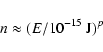
Poppe et al. (2000b) gave the empirical relation
 |
(1) |
where n denotes the number of elementary charges
and E the kinetic energy.
The slope p was found to equal 0.83.
Since we had the best-defined experimental
conditions (narrow size distribution and uniform spherical shape)
with the
grains,
we used the results of collisions with the iron and the aluminum
target to calculate a corresponding slope for our new data obtained
at higher energies and with other target materials.
We find p=0.79, which is very similar;
(5) only two particle-target combinations exhibit an exceptionally weak
charging (less than 1/3 of that one of the
spheres)
of non-uniform sign (particles: graphite grains, ;
target: graphite).
All other 12 combinations of this work
(particles: ,
diamond, SiC, graphite;
targets: aluminum, iron, graphite)
and a further three combinations of former work
(particles: ;
target: ,
Silicon; Poppe et al. 2000b) are
to be described as in Eqs. (1), (2), and (4).
![\begin{figure}
\par\includegraphics[width=8.8cm,clip]{2327f4.ps}
\end{figure}](/articles/aa/full/2005/28/aa2327-04/Timg28.gif) |
Figure 4:
Comparison of former measurements on
charging of individual
spheres colliding with quartz targets or a silicon wafer
(Poppe et al. 2000b, small symbols) and the new measurements of the average charge transfer
to conducting targets.
The meaning of the codes a-j is the same as
in Table 1, and their position
on the abscissa shows
where to find the corresponding data points.
The symbols indicate the target type.
Square: aluminium, cross: iron,  -cross: graphite.
The center interrupted line represents Eq. (1),
the center solid line the one derived from the new data a, b, c, and d.
The thin outer lines are the center lines times 3 and 1/3. -cross: graphite.
The center interrupted line represents Eq. (1),
the center solid line the one derived from the new data a, b, c, and d.
The thin outer lines are the center lines times 3 and 1/3. |
| Open with DEXTER |
Figure 5 shows
and
measured in experimental runs
with iron spheres. Using iron spheres,
the dust reservoir was electrically insulated.
With 1 mm feed and a measured fraction of 44% hitting
the target, a best estimate is that
 kg
iron spheres hit the target.
A particle mass of
kg
iron spheres hit the target.
A particle mass of
 kg then means that
the maximum absolute value of
kg then means that
the maximum absolute value of
 corresponds to a separation of 510 elementary charges per particle.
This is the same order of magnitude as found with most other particles.
However, the
values seem
to scatter arbitrarily. There is no proportionality between
and ;
instead often almost no charging occurs, and
if any correlation of
with
can be seen, then
it is in some cases instead that
decreases with ,
i.e. the higher the particle was precharged the more
of the precharge is given to the target.
corresponds to a separation of 510 elementary charges per particle.
This is the same order of magnitude as found with most other particles.
However, the
values seem
to scatter arbitrarily. There is no proportionality between
and ;
instead often almost no charging occurs, and
if any correlation of
with
can be seen, then
it is in some cases instead that
decreases with ,
i.e. the higher the particle was precharged the more
of the precharge is given to the target.
![\begin{figure}
\par\includegraphics[width=8.8cm,clip]{2327f5a.ps}\par\vspace*{3mm}
\includegraphics[width=8.8cm,clip]{2327f5b.ps}
\end{figure}](/articles/aa/full/2005/28/aa2327-04/Timg32.gif) |
Figure 5:
The measured charge separations with iron spheres at cogwheel ()
and targets ()
for a given feed of 1 mm.
On top with a cogwheel velocity of 38
,
on the bottom
with 67
.
Square: aluminum target. Cross: iron target.
-cross: graphite target. |
| Open with DEXTER |
3.4 Results with target temperature variation
To explore the influence of a temperature gradient between colliding
objects, we connected a thermocouple to the target.
We then heated the target by a hot air stream,
evacuated the chamber, and did measurements as described in
Sect. 3.2 while the target slowly cooled down to room temperature.
Thus measurement data at numerous temperature differences between target and
particle could be obtained.
Corresponding experiments were made after cooling the target with
a piece of dry ice before evacuation.
Figure 6 shows the charge ratio
 as a function of target temperature while
the powder sample was at room temperature.
Since the particle mass dispersed
and
are correlated, the charge ratio
over target temperature is a relative measure for the
charge transfer in a single particle collision at the target.
The absolute value of charge transfer at room temperature
can be seen from Sect. 3.3.
Data are available for spheres colliding with an
iron and with an aluminum target and for diamond grains
hitting an aluminum target.
With all material combinations, a target temperature rising
above particle temperature increased charge transfer.
Reducing the target temperature below particle temperature
at first reduced the charge transfer to a minimum,
and further cooling then led again to an increase in the charge transfer.
While this qualitative description is true for all
particle-target combinations,
there are quantitative differences.
The target temperature changed the charging of
spheres
by up to 50% while this is in the 10% range for diamond grains.
Also, the minimum charging occurs with diamonds at target
temperatures 5-10 K below the particle temperature whereas this is 24 K
for the silica spheres. Whether an iron or aluminum target
is hit by
spheres makes minor differences, if any.
as a function of target temperature while
the powder sample was at room temperature.
Since the particle mass dispersed
and
are correlated, the charge ratio
over target temperature is a relative measure for the
charge transfer in a single particle collision at the target.
The absolute value of charge transfer at room temperature
can be seen from Sect. 3.3.
Data are available for spheres colliding with an
iron and with an aluminum target and for diamond grains
hitting an aluminum target.
With all material combinations, a target temperature rising
above particle temperature increased charge transfer.
Reducing the target temperature below particle temperature
at first reduced the charge transfer to a minimum,
and further cooling then led again to an increase in the charge transfer.
While this qualitative description is true for all
particle-target combinations,
there are quantitative differences.
The target temperature changed the charging of
spheres
by up to 50% while this is in the 10% range for diamond grains.
Also, the minimum charging occurs with diamonds at target
temperatures 5-10 K below the particle temperature whereas this is 24 K
for the silica spheres. Whether an iron or aluminum target
is hit by
spheres makes minor differences, if any.
![\begin{figure}
\par\includegraphics[width=8.8cm,clip]{2327f6.ps}
\end{figure}](/articles/aa/full/2005/28/aa2327-04/Timg35.gif) |
Figure 6:
The charge ratio
as a function of target temperature. The vertical lines
mark the range of particle temperature (room temperature).
Cross: iron target and
spheres.
-cross: aluminum target and
spheres.
Square: aluminum target and diamond grains.
All experimental runs were carried out at
 circumference velocity of the cogwheel dust disperser. circumference velocity of the cogwheel dust disperser. |
| Open with DEXTER |
Temperature differences between
colliding objects turned out to play
a major role in influencing the charge
transfer by up to a factor of three and to be effective
with all three material combinations tested.
We also see a major influence of the collision energy,
i.e. grain mass and velocity are important
as already found before with lower collision velocities
(Poppe et al. 2000b).
This suggests that both effects are linked
if we assume a collision-induced temperature
gradient which results from hardness differences of the materials
and the mainly plastic character of the collision.
The assumption is based on the fact that generally the target deforms because all
particle materials except the graphite grains are harder than the targets
(Lautz & Taubert 1968, p. 23).
Furthermore, this deformation should mainly be plastic, as measurements on the
kinetic energy loss of colliding micrometer-sized grains indicated which were partially carried
out with the same particle samples (Poppe et al. 2000a).
As known from the experiments
with heated targets, a target temperature increase favors the
transfer of negative charges to the particle.
Both the temperature and the energy dependence of charge transfer are in agreement with the
hypothesis that negative charge carriers
move by thermal diffusion.
An upper limit for the collision-induced temperature gradient can be estimated
by assuming that a volume plastically deforms
at the yield strength  and that the
collision energy is converted into thermal energy.
The volume deformed is
and that the
collision energy is converted into thermal energy.
The volume deformed is
 ,
it
heats up by
,
it
heats up by
 with
with  the density and c the heat capacity.
For pure iron,
we find
the density and c the heat capacity.
For pure iron,
we find
 K
with
K
with
 Pa (manufacturer's specification),
 ,
and
,
and
 .
In reality, the heat will be conducted into the target or to the particle,
which may reduce
.
In reality, the heat will be conducted into the target or to the particle,
which may reduce  at the contact surface,
and cooling should be the more effective
the smaller the volume V is, i.e. the smaller E is.
If the temperature gradient vanishes,
the charge transfer should be minimal.
Regarding the experiments with best defined
conditions (
and iron or aluminum target),
the target temperature of minimum charge transfer
is 24 K below the particle temperature,
a value below the upper limit of .
According to Lowell and Rose-Innes (1980),
a small temperature difference is necessary for significant charging.
They describe an example
of thermally diffusive ion transfer in which a gradient
of only 1 K results in a surface charge density of
at the contact surface,
and cooling should be the more effective
the smaller the volume V is, i.e. the smaller E is.
If the temperature gradient vanishes,
the charge transfer should be minimal.
Regarding the experiments with best defined
conditions (
and iron or aluminum target),
the target temperature of minimum charge transfer
is 24 K below the particle temperature,
a value below the upper limit of .
According to Lowell and Rose-Innes (1980),
a small temperature difference is necessary for significant charging.
They describe an example
of thermally diffusive ion transfer in which a gradient
of only 1 K results in a surface charge density of
 .
Graphite targets are soft,
which means the effect as described would be weak.
Then the heat distributes over a large volume
and the temperature increase ,
the driving force, is small.
In fact, graphite targets charged weakly with most grains.
Hence, a temperature gradient
caused by initial temperature
or by collision-induced energy dissipation in the softer of
the colliding objects explains many observations.
A temperature gradient as driving force
is consistent with the idea of thermally
diffusing charge carriers as treated by
Lowell & Rose-Innes (1980), Bowles (1961) and Harper (1967).
In our case with generally negative particle charging,
thermal diffusion would
primarily involve negative charge carriers.
.
Graphite targets are soft,
which means the effect as described would be weak.
Then the heat distributes over a large volume
and the temperature increase ,
the driving force, is small.
In fact, graphite targets charged weakly with most grains.
Hence, a temperature gradient
caused by initial temperature
or by collision-induced energy dissipation in the softer of
the colliding objects explains many observations.
A temperature gradient as driving force
is consistent with the idea of thermally
diffusing charge carriers as treated by
Lowell & Rose-Innes (1980), Bowles (1961) and Harper (1967).
In our case with generally negative particle charging,
thermal diffusion would
primarily involve negative charge carriers.
Thermal diffusion of negative charge carriers
does not explain
our results completely.
Undoubtedly, there is one or more
competing processes of tribocharging
besides the most important one, a finding which should not be surprising
in light of the numerous tribocharging processes (Sect. 2).
We see this from the results with the cooled target
which, at a certain temperature, should compensate for any
collision-induced temperature increase, thus, with the temperature difference of zero,
the driving force of thermal diffusion vanishes.
Nevertheless, a reduced charge transfer remained,
suggesting that there was more than one charge transfer process.
Further cooling increases the charge transfer again
which, in the frame of thermal diffusion,
must be explained with positive charge carriers moving
from the particle to the target.
The consideration of positive charge carriers
should keep us from restricting our interpretation
of charge transfer on electron transfer.
If positive ions apparently play a role and were previously found
to play a role in thermally diffusive charge transfer (Bowles 1961) there
is per se no reason to refuse the idea that
tribocharging may also involve negative ions.
Furthermore, there are additional observations
which do not fit in the frame of thermal diffusion
and make us aware that other tribocharging processes are effective.
Graphite grains are softer than the metallic targets
and so, one would expect them to deform and heat up,
resulting in the opposite sign of charging
compared to the hard grains which instead deform the target.
However, this is not the case.
Also, thermally-diffusive charge transfer cannot
explain why diamond and SiC grains accepted so many
negative charges when hitting the graphite target,
whereas the other grains charged weakly with non-uniform sign.
The maximum charge transfer to the iron spheres
is comparable with the one found with other particles.
However, their further behavior is different and marked by their conductivity.
In contrast to other particles,
and thus their precharge, varies, which
could be caused by a reflow of charges during the separation from the
dust reservoir and from the cogwheel. Such a reflow could then reduce electrification to a certain extent.
Also, conducting particles can give their precharge to the target,
as can be seen from the results with the graphite target,
where we often find decreasing
with increasing .
We rule out
material-dependent contact charging as the
dominant process of tribocharging in our experiments
for several reasons:
if it had been dominant,
the choice of material would have been the major influence
on charge transfer, which was not true.
Also, like materials
get charged at a strength comparable
to other combinations, which cannot be explained by
material-dependent contact charging.
This is true based on elemental compositions
such as diamond grains and
graphite targets or even on molecular compositions, as found by
Poppe et al. (2000b) using
both as particle sample
and as target.
Finally, triboelectric series require
the sign of charging to depend on the material combination.
According to the series used by Desch & Cuzzi (2000),
silicates would charge positively when hitting iron,
while they charged negatively in our experiments.
Refusing material-dependent contact charging does not mean
that we deny the existence of contact charging,
not even that it does not play a role
as a secondary process in our experiments.
However, material-dependent contact charging is not of major importance in our experimental conditions.
Independent of the physical details of tribocharging,
there is a need for assumptions on the amount of
collisional charge transfer between solids
in the solar nebula or in comparable environments.
For future applications, we propose Eq. (1) with p=0.8, if
collision energies E in single grain collisions are below
 J and conductivity is so low that
there is no significant reflow of charges during the separation process.
The latter criterion is always fulfilled if one object is an insulator.
If two metals collide, grain electrification is
in the same order of magnitude as for other materials;
however, details of the separation process
become important, which can lead to a reflow of charge accumulations (Lowell & Rose-Innes 1980)
and which
cannot be treated in this article.
Accuracy of the prediction is within a factor of three,
for which only a few exceptions were
found (Sect. 3.3).
Concerning grain size, grain material, and collision velocities,
our experimental parameters are relevant for preplanetary dust aggregation (see Sect. 1).
On the other hand,
the preplanetary grain growth is expected to have lead to
porous aggregates. Consequently, the charge transfer of
aggregates colliding with single grains or other aggregates
is an important case.
Although physical details
of aggregate collisions have been
investigated experimentally (e.g. Wurm & Blum 1998, 2000), there are no measurements
of triboelectrification
in collisions of such aggregates.
On a macroscopic scale, aggregates have other mechanical and thermal properties than single grains,
and so the question arises as to what extent our results can be transferred to aggregate collisions.
Since there is no reason why the dominating temperature-driven
mechanism of charge transfer should work fundamentally different
if a micron-sized particle hits an equally-sized particle or a larger object, such as our cm-sized targets,
the charge transfer of particles that constitute an aggregate can be estimated from our results.
In the velocity regime investigated here (38 to 106
),
aggregates are expected to fragment in their constituent particles (Wurm & Blum 2000),
and a charge transfer will then occur according to the number and energy of all single grain collisions.
J and conductivity is so low that
there is no significant reflow of charges during the separation process.
The latter criterion is always fulfilled if one object is an insulator.
If two metals collide, grain electrification is
in the same order of magnitude as for other materials;
however, details of the separation process
become important, which can lead to a reflow of charge accumulations (Lowell & Rose-Innes 1980)
and which
cannot be treated in this article.
Accuracy of the prediction is within a factor of three,
for which only a few exceptions were
found (Sect. 3.3).
Concerning grain size, grain material, and collision velocities,
our experimental parameters are relevant for preplanetary dust aggregation (see Sect. 1).
On the other hand,
the preplanetary grain growth is expected to have lead to
porous aggregates. Consequently, the charge transfer of
aggregates colliding with single grains or other aggregates
is an important case.
Although physical details
of aggregate collisions have been
investigated experimentally (e.g. Wurm & Blum 1998, 2000), there are no measurements
of triboelectrification
in collisions of such aggregates.
On a macroscopic scale, aggregates have other mechanical and thermal properties than single grains,
and so the question arises as to what extent our results can be transferred to aggregate collisions.
Since there is no reason why the dominating temperature-driven
mechanism of charge transfer should work fundamentally different
if a micron-sized particle hits an equally-sized particle or a larger object, such as our cm-sized targets,
the charge transfer of particles that constitute an aggregate can be estimated from our results.
In the velocity regime investigated here (38 to 106
),
aggregates are expected to fragment in their constituent particles (Wurm & Blum 2000),
and a charge transfer will then occur according to the number and energy of all single grain collisions.
The preplanetary dust aggregation process requires a relative motion between solids, collisions, and sticking.
The particle relative motion has been addressed as a result of forces only caused by the dilute gas
of the solar nebula (Weidenschilling & Cuzzi 1993),
and such forces and motions were investigated in detail
(Wurm & Blum 1998; Blum et al. 2000).
In the light of tribocharging experiments, Poppe et al. (2000b) pointed out the possiblity that
interactions with a magnetic field could exert larger forces on the particles than the gas does.
We now find even higher grain charging for higher collision velocities, and therefore
the question whether this restriction to aerodynamic forces is adequate seems even more justified
but can, on the other hand, not be answered by experiments on tribocharging alone.
Also the sticking efficiency is an important parameter for the dust aggregation.
Experimental studies by Poppe et al. (2000a)
showed a considerably higher sticking probability
than thought before according to theoretical work
by Chokshi et al. (1993).
It has also already been shown in experiments that tribocharging
can contribute to the sticking
efficiency (Poppe et al. 2000b, Sect. 1).
This can happen if a particle bounces off and is subsequently trapped
in a field of the target which was electrified by preceeding collisions.
While so far particle trapping was only observed for collision velocities
below 20
and only charge transfer
measurements in this range were available,
our experiments showed
a high and energy-dependent tribocharging up to 100
,
i.e. over a wide range of collision velocities expected for the solar nebula,
which thus stresses the importance of tribocharging for favoring the preplanetary dust aggregation process.
However, whether electrostatic trapping happened or not depended on the
individual collision conditions, i.e. on the amount and sign of collisional charge transfer,
on the charge carried by the target
due to preceeding collisions or other charging or discharging effects, and on the energy loss
in the bouncing collision.
This means, that non-sticking collisions should have existed as well, and that
the charge transfer in such collisions
is a key process for the possibility of lightning (Sect. 1).
As an example, for an iron
grain colliding with a silicate grain, Desch & Cuzzi (2000) assumed a charge
separation of 3000 elementary charges (Sect. 2).
According to Sect. 3.3,
we expect that
an iron grain of this size (
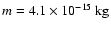 )
will carry 200, 900, or 2800 negative charges
in the case of 20, 50, or 100
collision speed,
respectively.
Compared to all work on nebular lightning cited
in the introduction, the one by Desch & Cuzzi (2000) was based on modelling assumptions on
the amount of charge transfer, which are closer to our results
than the assumptions of other authors.
It therefore seems that nebular lightning was not hampered by a too low charge exchange in particle collisions because
Desch & Cuzzi (2000) concluded that lightning
over large regions (100 km)
could have been both possible and sufficiently energetic to
have formed chondrules.
)
will carry 200, 900, or 2800 negative charges
in the case of 20, 50, or 100
collision speed,
respectively.
Compared to all work on nebular lightning cited
in the introduction, the one by Desch & Cuzzi (2000) was based on modelling assumptions on
the amount of charge transfer, which are closer to our results
than the assumptions of other authors.
It therefore seems that nebular lightning was not hampered by a too low charge exchange in particle collisions because
Desch & Cuzzi (2000) concluded that lightning
over large regions (100 km)
could have been both possible and sufficiently energetic to
have formed chondrules.
We presented charge transfer measurements in grain-target collisions
under conditions relevant to the solar nebula.
Our results enlarged the experimental
data base such that higher collision energies,
more material combinations including conductive solids,
and temperature differences among colliding objects were investigated than before.
The charge transfer was a function of the collision energy and of the temperature difference
of the colliding objects. The most plausible explanation for these and other
results is that thermal diffusion of negative charge carriers
was the most important, but not the only, charge transfer process,
whereas material-dependent contact charging which is a very often discussed hypothesis
on tribocharging was not the dominant process.
Compared to former assumptions in astrophysical literature, the charge transfer is high
thus stressing the importance of tribocharging in solid grain collisions in the solar nebula.
- Blum, J., Wurm, G., Kempf,
S., et al. 2000, Phys. Rev. Lett., 85, 2426 [NASA ADS] [CrossRef]
- Bowles, A. H. 1961, The
effect of a Thermal Gradient upon Charge Separation between Similar
Polyethylene Surfaces, Proc. Phys. Soc., 78, 958
(In the text)
- Brownlee, D. E.
1985, Ann. Rev. Earth Planet Sci., 13, 147 [NASA ADS] (In the text)
- Cheng, L., & Soo, S.
L. 1970, J. Appl. Physics, 41, 585 [CrossRef] (In the text)
- Chokshi, A., Tielens,
A. G. G. M., & Hollenbach, D. 1993, ApJ, 407, 806 [NASA ADS] [CrossRef] (In the text)
- Cuzzi, J. N.,
Dobrovolskis, A. R., & Champney, J. N. 1993, Icarus, 106,
496 (In the text)
- Desch, S. J., &
Cuzzi, J. N. 2000, Icarus, 143, 87 [NASA ADS] [CrossRef] (In the text)
- Gibbard, S. G., Levy,
E. H., & Morfill, G. E. 1997, On the Possibility of Lightning
in the Protosolar Nebula, Icarus, 130, 517
(In the text)
- Harper, W. R. 1967,
Contact and Frictional Electrification, (Oxford: Clarendon
Press)
(In the text)
- Hewins, R. H. 1996,
Chondrules and the Protoplanetary Disk: An Overview, in Chondrules
and the Protoplanetary Disk, ed. R. H. Hewins, R. H. Jones, &
E. R. D. Scott (Cambridge: Cambridge University Press), 3
- Jessberger, E.
K., Stephan, T., Rost, D., et al. 2001, Properties of
interplanetary dust: Information from collected samples, in
Interplanetary dust, ed. E. Grün, B. Å. S. Gustafson, S.
F. Dermott, & H. Fechtig (Berlin and Heidelberg: Springer
Verlag), 253
(In the text)
- John, W., Reischl, G.,
& Devor, W. 1980, J. Aerosol Sci., 11, 115 (In the text)
- Kacprzyk, R., &
Gajewski, J. 2001, J. Electrostatics, 51/52, 124
(In the text)
- Kerridge, J. F.
1993, Icarus, 106, 135 [NASA ADS] [CrossRef] (In the text)
- Lautz, G., & Taubert,
R. 1968, Kohlrausch - praktische Physik, Band 3, Tafeln (Stuttgart:
B.G. Teubner)
(In the text)
- Love, S. G., Keil, K.,
& Scott, E. R. D. 1995, Icarus, 115, 97 [NASA ADS] [CrossRef] (In the text)
- Lowell, J.
1986, J. Phys. D: Appl. Phys., 19, 105 [NASA ADS] [CrossRef] (In the text)
- Lowell, J.,
& Rose-Innes, A. C. 1980, Adv. Phys. 29, 947
(In the text)
- Masuda, H., Komatsu,
T., & Iinoya, K. 1976, A.I.Ch.E.J., 22, 558 [CrossRef] (In the text)
- Matsuyama, T.,
& Yamamoto, H. 1989, IEEE Transactions on Industry Applications
30, 602
(In the text)
- Morfill, G., Spruit,
H., & Levy, E. H. 1993, Physical Processes and Conditions
Associated with the Formation of Protoplanetary Disks, Protostars
and Planets III, ed. E. Levy, & J. Lunine (Tucson: University
of Arizona Press), 939
(In the text)
- Norville, K.,
Baker, M., & Latham, J. 1991, J. Geophys. Res., 96, 7463 [NASA ADS] (In the text)
- Pilipp, W., Hartquist,
T. W., Morfill, G. E., & Levy, E. H. 1998, A&A, 331,
121 [NASA ADS] (In the text)
- Poppe, T. 2003,
Icarus, 164, 139 [NASA ADS] [CrossRef] (In the text)
- Poppe, T., Blum,
J., & Henning, T. 1997, Rev. Sci. Instrum., 68, 2529 [NASA ADS] [CrossRef] (In the text)
- Poppe, T.,
Blum, J., & Henning, T. 2000a, ApJ, 533, 454 [NASA ADS] [CrossRef] (In the text)
- Poppe, T.,
Blum, J., & Henning, T. 2000b, ApJ, 533, 472 [NASA ADS] [CrossRef] (In the text)
- Poppe, T., Wurm,
G., & Krieg, R. 2002, Measurement Sci. Technol., 13, 796 [NASA ADS] (In the text)
- Prochazka, R.
1966, Staub, 26(5), 202
(In the text)
- Rietmeijer,
F. J. M. 1993, Earth and Planet. Sci. Lett., 117, 609 [NASA ADS] [CrossRef]
- Rietmeijer, F.
J. M. 2002, Chemie der Erde, 62, 1 (In the text)
- Sandford, S. A.
1996, Meteor. Planet. Sci., 31, 446 [NASA ADS] (In the text)
- Schräpler,
R., & Henning, T. 2004, ApJ, 614, 960 [NASA ADS] [CrossRef] (In the text)
- Sternovsky, Z.,
Robertson, S., Sickafoose, A., Colwell, J., & Horányi, M.
2002, J. Geophys. Res., Planets, 107, 5105
(In the text)
- Vercoulen, P.
1995, Electrostatic Processing of Particles, - a Tool in Particle
Technology, Thesis Technical University of Delft
(In the text)
-
Weidenschilling, S. J., & Cuzzi, J. N. 1993, Formation of
Planetesimals in the Solar Nebula, in Protostars and Planets III,
ed. E. Levy, J. Lunine, & M. S. Matthews (Tucson: University of
Arizona Press) 1031
(In the text)
- Wurm, G., &
Blum, J. 1998, Icarus, 132, 125 [NASA ADS] [CrossRef] (In the text)
- Wurm, G., &
Blum, J. 2000, Icarus, 143, 138 [NASA ADS] [CrossRef] (In the text)
- Whipple, F. L. 1966,
A Suggestion as to the Origin of Chondrules, SAO Special Report
206
(In the text)
Copyright ESO 2005
![\begin{figure}
\par\includegraphics[height=4.5cm,width=5.5cm,clip]{2327f1a.ps}\i...
...7f1e.ps}\includegraphics[height=4.5cm,width=5.5cm,clip]{2327f1f.ps}
\end{figure}](/articles/aa/full/2005/28/aa2327-04/img14.gif)
![\begin{figure}
\par\includegraphics[width=5.2cm,clip]{2327f2a.ps}\hspace*{2mm}
\...
...f2e.ps}\hspace*{2mm}
\includegraphics[width=5.2cm,clip]{2327f2f.ps}
\end{figure}](/articles/aa/full/2005/28/aa2327-04/img15.gif)
![\begin{figure}
\par\includegraphics[width=8.6cm,clip]{2327f3.ps}
\end{figure}](/articles/aa/full/2005/28/aa2327-04/img19.gif)
![\begin{figure}
\par\includegraphics[width=8.8cm,clip]{2327f4.ps}
\end{figure}](/articles/aa/full/2005/28/aa2327-04/img28.gif)
![\begin{figure}
\par\includegraphics[width=8.8cm,clip]{2327f5a.ps}\par\vspace*{3mm}
\includegraphics[width=8.8cm,clip]{2327f5b.ps}
\end{figure}](/articles/aa/full/2005/28/aa2327-04/img32.gif)
![\begin{figure}
\par\includegraphics[width=8.8cm,clip]{2327f6.ps}
\end{figure}](/articles/aa/full/2005/28/aa2327-04/img35.gif)