![[*]](/icons/foot_motif.gif)
A&A 438, 169-185 (2005)
DOI: 10.1051/0004-6361:20042267
M. Lombardi1,2
1 - European Southern Observatory, Karl-Schwarzschild-Straße 2,
85748 Garching bei München, Germany
2 -
University of Milan, Department of Physics, via Celoria 16, 20133
Milan, Italy
Received 27 October 2004 / Accepted 22 March 2005
Abstract
We consider from a general point of view the problem of determining
the extinction in dense molecular clouds. We use a rigorous
statistical approach to characterize the properties of the most
widely used optical and infrared techniques, namely the star count
and the color excess methods. We propose a new maximum-likelihood
method that takes advantage of both star counts and star colors to
provide an optimal estimate of the extinction. Detailed numerical
simulations show that our method performs optimally under a wide
range of conditions and, in particular, is significantly superior to
the standard techniques for clouds with high column-densities and
affected by contamination by foreground stars.
Key words: dust, extinction - methods: statistical - ISM: clouds - infrared: ISM - stars: formation
A detailed comprehension of the structure and physical properties of dark molecular clouds is a critical step to understand fundamental processes such as star and planet formation. Still, after several decades of investigations, very little is known about dark clouds, about their relationship to the diffuse interstellar medium, and about the composition and evolution of the dust grains present in the clouds.
Molecular clouds are composed of approximately  molecular
hydrogen and helium, but due to the absence of a dipole moment these
molecules are virtually undetectable at the low temperature (
molecular
hydrogen and helium, but due to the absence of a dipole moment these
molecules are virtually undetectable at the low temperature (
 )
that characterize these objects. As a result, astronomers
have been using different tracers to study the density distribution of
molecular clouds. Historically, the first technique was based on a
statistical analysis of the angular density of stars observed through
a cloud (Wolf 1923; Bok 1937). This
method, known as star counts, uses the dust (which is responsible for
the extinction of light) as a tracer of
)
that characterize these objects. As a result, astronomers
have been using different tracers to study the density distribution of
molecular clouds. Historically, the first technique was based on a
statistical analysis of the angular density of stars observed through
a cloud (Wolf 1923; Bok 1937). This
method, known as star counts, uses the dust (which is responsible for
the extinction of light) as a tracer of  and
and  .
.
More recently, radio observations of carbon monoxide (CO) and its
isotopes have been used to study the spatial distribution and the
physical conditions of molecular clouds, under the assumption that CO
is a reliable tracer of the matter in the cloud, i.e. that the ratio
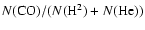 is
approximately constant. Radio spectroscopy techniques have provided
extremely effective in studying the most dense regions (above
is
approximately constant. Radio spectroscopy techniques have provided
extremely effective in studying the most dense regions (above
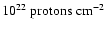 )
and, more importantly, give dynamical
information on the cloud structure. However, with the advent of
various dust detectors in the near-infrared (NIR), far infrared,
millimeter, and sub-millimeter bands, it has become clear that several
poorly constrained processes (e.g., deviations from thermodynamic
equilibrium, opacity variations, chemical evolution, and more
importantly depletion of molecules) can significantly affect the
results of analyses based on radio observations
(e.g. Harjunpää et al. 2004; Lada et al. 1994; Alves et al. 1999).
)
and, more importantly, give dynamical
information on the cloud structure. However, with the advent of
various dust detectors in the near-infrared (NIR), far infrared,
millimeter, and sub-millimeter bands, it has become clear that several
poorly constrained processes (e.g., deviations from thermodynamic
equilibrium, opacity variations, chemical evolution, and more
importantly depletion of molecules) can significantly affect the
results of analyses based on radio observations
(e.g. Harjunpää et al. 2004; Lada et al. 1994; Alves et al. 1999).
The reddening of background stars offers a natural method to study the distribution of dust in molecular clouds, and thus the hydrogen column density. This technique can be better applied to the infrared bands, which compared to optical bands are less affected by extinction and are less sensitive to the physical properties of the dust grains (Mathis 1990). Before the advent of large format array cameras, the lack of instrumental sensitivity clogged infrared observations to small, dense clouds (e.g. Casali 1986; Frerking et al. 1982; Jones et al. 1980,1984). More recently, infrared arrays have made it possible to measure thousands of stars and to extend the original technique to entire molecular cloud complexes (Alves et al. 2001; Lada et al. 1999; Lombardi & Alves 2001; Lada et al. 1994). Such measurements are free of the complications that plague molecular-line data and permit a detailed analysis of the cloud density distribution.
Although the success of the NIR color excess method is evident, there is still a need for a deeper understanding of its limitations, statistical biases, and uncertainties. The aim of this paper is twofold: (i) to study in detail the statistical properties of the star count and color excess methods and (ii) to describe a new, optimal method based on a maximum-likelihood analysis. The method is described here for NIR observations, but could equally well be applied to other infrared bands for which the extinction law and the intrinsic color distribution are known with good accuracy. The paper is organized as follows. In Sect. 2 we introduce our formalism and consider from a statistical point of view the extinction of stars by a foreground cloud. The two main techniques used to obtain extinction measurements, namely the star count and the NIR color excess methods, are discussed in Sect. 3. In Sect. 4 we describe the new maximum-likelihood method and show by means of numerical simulations that it performs excellently even in the presence of a significant contamination by foreground stars. Our conclusions are briefly reported in Sect. 5. Finally, in Appendix A we consider the statistical properties of the median and of related estimators used often in infrared studies of dark clouds to remove the effects of foreground stars.
Suppose that N stars with magnitudes (on a given band)
 are observed in a given region of the sky (hereafter we will use
the hat
are observed in a given region of the sky (hereafter we will use
the hat  to denote measured quantities). These observed
magnitudes depend on the original, unreddened, absolute star
magnitudes
to denote measured quantities). These observed
magnitudes depend on the original, unreddened, absolute star
magnitudes  ,
on the star distances
,
on the star distances  ,
on the
individual extinctions
,
on the
individual extinctions  ,
and on the photometric errors
,
and on the photometric errors
 .
In particular, we have
.
In particular, we have
are taken to be expressed in parsecs.
The quantity mn that appears in the r.h.s. of this equation is the
reddened magnitude of the nth star free from measurement errors
(i.e., the magnitude that would be observed in the limit of an
extremely long exposure time).
In order to consider the most general situation in a proper statistical way, we introduce several probability distributions:
 :
:
 :
:
 for a star given that its true reddened magnitude
is m.
the case of
undetected objects, i.e. the case where a star of true
magnitude m close to the detection limit produces no detectable
flux; in this case we write
for a star given that its true reddened magnitude
is m.
the case of
undetected objects, i.e. the case where a star of true
magnitude m close to the detection limit produces no detectable
flux; in this case we write
 .
Hence, the
quantity
.
Hence, the
quantity
We assume that both
pA(A | D) and
are
normalized to unity, i.e.
to be normalized so that the quantity
![$[D, D + \rm dD]$](/articles/aa/full/2005/28/aa2267-04/img50.gif) in a patch of the sky of solid angle
in a patch of the sky of solid angle
 ,
and with absolute magnitudes between M and
,
and with absolute magnitudes between M and
 .
.
Equation (1) can be used to obtain the probability
distribution of reddened magnitudes pm(m). Using the previous
definitions we find
 by convolving it with the measurement
error probability distribution
:
is defined,
Eq. (7) includes also the case
.
Note also that
is normalized so that
by convolving it with the measurement
error probability distribution
:
is defined,
Eq. (7) includes also the case
.
Note also that
is normalized so that
 represents the expected angular density
of stars with observed magnitudes on the range
represents the expected angular density
of stars with observed magnitudes on the range
![$[\hat m, \hat m +
\rm d\hat m]$](/articles/aa/full/2005/28/aa2267-04/img57.gif) .
.
Equations (6) and (7) are basic equations of this paper. However, in the form they are written, they are by far too general to be useful in practical cases.
In order to make use of the general relations written above we introduce a number of useful simplifications.
First, we note that so far we have considered observations carried out
on a single band. In order to threat multi-band data, we
introduce a reddening law as follows: for any band
 ,
the extinction
,
the extinction  is given by
 is a constant and
  is the extinction in the Vband. In other words, Eq. (8) states that the ratio
 between the extinction in two bands
and
between the extinction in two bands
and  is a constant for a given cloud. In reality,
this ratio is known to vary with the environment for short
wavelengths, but is almost universal in the NIR (and, according to a
recent work of Indebetouw et al. 2004, for wavelengths in the
range 3-
is a constant for a given cloud. In reality,
this ratio is known to vary with the environment for short
wavelengths, but is almost universal in the NIR (and, according to a
recent work of Indebetouw et al. 2004, for wavelengths in the
range 3-
 as well). In the rest of this paper we
will follow the usual notation and express all extinctions in terms of
.
as well). In the rest of this paper we
will follow the usual notation and express all extinctions in terms of
.
A second important assumption that we will use regards the functional
form of
.
First, we will assume that this function can be
separated in M and D, i.e. can be written as the product of two
functions, one involving M only, and one involving D only:
 .
In practice, this assumption is
equivalent to saying that we observe a single "population'' of stars
at all distances. Since observations show that star number counts are
well approximated by an exponential law of the form
.
In practice, this assumption is
equivalent to saying that we observe a single "population'' of stars
at all distances. Since observations show that star number counts are
well approximated by an exponential law of the form
 (where the exponent
 is
approximately independent of the band considered in the NIR), we also
assume that pM(M) follows a similar law. We then write
is
approximately independent of the band considered in the NIR), we also
assume that pM(M) follows a similar law. We then write
 is a normalization factor. In the following we
will assume that
is a normalization factor. In the following we
will assume that  ,
similarly to
,
similarly to  ,
is independent of
the band considered, while
is not. Note also that,
because of the exponential form of this equation in M, a change of
the normalization factor
is in practice equivalent to a
change of the zero-point used for the magnitude M.
,
is independent of
the band considered, while
is not. Note also that,
because of the exponential form of this equation in M, a change of
the normalization factor
is in practice equivalent to a
change of the zero-point used for the magnitude M.
Using Eqs. (9) and (8) we can slightly simplify
Eq. (6) by performing the integration over D:
as
 is normalized to unity:
has a simple interpretation, being the
probability distribution for stars to have undergone a given
extinction regardless of their distance. For example, if all stars
were subject to the same extinction ,
we would have
is normalized to unity:
has a simple interpretation, being the
probability distribution for stars to have undergone a given
extinction regardless of their distance. For example, if all stars
were subject to the same extinction ,
we would have
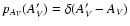 .
Note also that, since
can be taken to be approximately independent of the band
considered,
is also band-independent.
.
Note also that, since
can be taken to be approximately independent of the band
considered,
is also band-independent.
Equation (10) shows an interesting property of extinction
studies: the probability distribution pm(m) depends on
 only through
.
This point is particularly
important since it shows an intrinsic limitation of extinction
measurements. Indeed, all observables are derived from
,
the distribution of observed magnitudes, and this
function depends only on pm(m) (other than observational "limiting
factors'' such as
or
only through
.
This point is particularly
important since it shows an intrinsic limitation of extinction
measurements. Indeed, all observables are derived from
,
the distribution of observed magnitudes, and this
function depends only on pm(m) (other than observational "limiting
factors'' such as
or
 ).
Since, as noted above, pm(m) does not depend directly on
,
any estimator based on observed magnitudes
only will not provide any information on
directly but (in the best case scenario) only on
.
Since
is a sort of convolution of
,
in general it is not possible to have a complete
knowledge on
,
not even if we know the star density
distribution ;
this limitation, among other things, prevents
us from gathering information on the three-dimensional structure of a
molecular cloud.
).
Since, as noted above, pm(m) does not depend directly on
,
any estimator based on observed magnitudes
only will not provide any information on
directly but (in the best case scenario) only on
.
Since
is a sort of convolution of
,
in general it is not possible to have a complete
knowledge on
,
not even if we know the star density
distribution ;
this limitation, among other things, prevents
us from gathering information on the three-dimensional structure of a
molecular cloud.
A case where, instead, the function
can be
recovered is a deterministic model for the extinction,
i.e. a cloud complex whose extinction
depends directly on the
distance D (and, thus, is not a random variable). In this case we
have
 has a simple relationship with the integrated
gas column density
has a simple relationship with the integrated
gas column density
 :
:
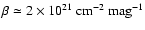 is the ratio between gas density and V-band extinction
(Bohlin et al. 1978; Lilley 1955). Suppose now that we
carry out observations on the cloud and measure
.
In
order to show that we can recover the structure of the cloud, let us
call
is the ratio between gas density and V-band extinction
(Bohlin et al. 1978; Lilley 1955). Suppose now that we
carry out observations on the cloud and measure
.
In
order to show that we can recover the structure of the cloud, let us
call
 the inverse of the function
defined in
Eq. (14), i.e. the distance at which the integrated
extinction is .
Then we have
the inverse of the function
defined in
Eq. (14), i.e. the distance at which the integrated
extinction is .
Then we have
![$\left [ D(A_{\it V}) \right ]^{3-5\alpha}$](/articles/aa/full/2005/28/aa2267-04/img91.gif) .
If
is known, using the
boundary condition D(0) = 0 we can in principle solve this
differential equation and obtain
which, in turn, can be
inverted into
and
.
If
is known, using the
boundary condition D(0) = 0 we can in principle solve this
differential equation and obtain
which, in turn, can be
inverted into
and
 .
It is superfluous
to stress that this process in reality is far from being trivial.
.
It is superfluous
to stress that this process in reality is far from being trivial.
Finally, we consider a very simple deterministic model for
that describes a thin cloud at a
distance D0 with uniform column density :
takes then the simple form
Above, in Eq. (2), we introduced the completeness function
c(m), which gives the probability to detect a star of
magnitude m. Typically, c(m) is close to unity for bright stars,
and vanishes for very faint stars; note however that c(m) might be
smaller than unity at low m in crowded fields or close to bright
objects. The completeness function c(m) enters naturally in the
definition of the error probability distribution
,
which can be written as
according to
.
Note also that this latter probability distribution is normalized
(cf. Eq. (4)).
In order to carry out some simplifications (see below
Sect. 4.2), we also consider a different
representation of the completeness function in which the order of the
two random processes described above is swapped: this leads to a
completeness function
defined in terms of the
observed magnitude. In other words, we first generate for
every star the "observed'' magnitude
according to
a probability distribution
 ,
and then
decide whether the star is really observed using a second random
process controlled by the completeness function
.
This implies, among other things, a modification of Eq. (7),
that now becomes
,
and then
decide whether the star is really observed using a second random
process controlled by the completeness function
.
This implies, among other things, a modification of Eq. (7),
that now becomes
 .
Since
represents the probability
that a star with measured magnitude
be detected,
we evaluate the probability that the star is not detected
as
and the new completeness function
,
which replace, respectively,
and c(m).
Indeed, both these couples of functions are intimately related, and
this was implicitly taken into account above by using a single
distribution
to describe both the photometric
errors and the completeness of the observations. Interestingly, it is
possible to find a relationship between the couple
,
and the couple
,
c(m) by requiring that, for any reddened
magnitude probability distribution pm(m), the observed magnitude
probability distribution
evaluated using
Eq. (7), or using Eqs. (20) and (21),
agrees. We find then
is normalized to unity, if we
integrate Eq. (22) over
and substitute the result
into Eq. (23), we find
.
Since
represents the probability
that a star with measured magnitude
be detected,
we evaluate the probability that the star is not detected
as
and the new completeness function
,
which replace, respectively,
and c(m).
Indeed, both these couples of functions are intimately related, and
this was implicitly taken into account above by using a single
distribution
to describe both the photometric
errors and the completeness of the observations. Interestingly, it is
possible to find a relationship between the couple
,
and the couple
,
c(m) by requiring that, for any reddened
magnitude probability distribution pm(m), the observed magnitude
probability distribution
evaluated using
Eq. (7), or using Eqs. (20) and (21),
agrees. We find then
is normalized to unity, if we
integrate Eq. (22) over
and substitute the result
into Eq. (23), we find
 is also normalized to unity. In summary
we have:
in terms of c(m).
Note that Eq. (26) is essentially Bayes' theorem applied to
.
is also normalized to unity. In summary
we have:
in terms of c(m).
Note that Eq. (26) is essentially Bayes' theorem applied to
.
Although Eqs. (25) and (26) show that the
description of the completeness c(m) in terms of the true reddened
magnitude m is more general than the description
in
terms of the observed magnitude ,
we argue that the latter is
more practical to use:
larger than a given
threshold
 .
This cut could be easily described in
terms of
:
allows us to evaluate analytically
for some special simple probability
distributions. This point is particularly valuable for the
practical applications that we will describe below in
Sect. 4.
.
This cut could be easily described in
terms of
:
allows us to evaluate analytically
for some special simple probability
distributions. This point is particularly valuable for the
practical applications that we will describe below in
Sect. 4.
So far we have focused our analysis on single-band measurements. In order to extend the discussion to observations carried out in different bands, we need to generalize the relevant probability distributions.
We denote
 the magnitudes
of a star in
the magnitudes
of a star in  different bands; in general, we use bold
symbols such as
different bands; in general, we use bold
symbols such as  to indicate quantities that have different
values in the various bands. We will threat these as vector
quantities; in this way, e.g., the generalization of Eq. (1)
can written as
to indicate quantities that have different
values in the various bands. We will threat these as vector
quantities; in this way, e.g., the generalization of Eq. (1)
can written as
Since we are now working with observations in different bands, we need
also to generalize
.
We define thus
 ,
the probability to have a star with absolute magnitudes
,
the probability to have a star with absolute magnitudes  at
distance D from us. Using this distribution we can rewrite
Eq. (6) as
at
distance D from us. Using this distribution we can rewrite
Eq. (6) as
different convolutions with the measurement error
probability distributions
 corresponding to the various bands:
The integral of
 over all admissible values
of
over all admissible values
of
 gives the expected local density of stars
  :
:
gives the normalization of
,
the conditional probability that a star with magnitudes
be observed given the fact that the star is detected is
 .
.
When using the alternate completeness functions
 expressed in terms of the observed
magnitudes
expressed in terms of the observed
magnitudes
 ,
Eq. (30) can be rewritten
as
,
Eq. (30) can be rewritten
as
 if
if
 ,
and that we integrate over
,
and that we integrate over
 (the probability of not
detecting the star) if
(the probability of not
detecting the star) if
 ;
the last
integration is the usual convolution with the measurement errors.
Similarly, Eq. (31) can also be written as
;
the last
integration is the usual convolution with the measurement errors.
Similarly, Eq. (31) can also be written as
As for the single-band case, we consider a number of realistic and useful simplifications that will allow us to take advantage of the formalism introduced above in practical cases.
First, we still take
to be separable into
 .
Furthermore, we adopt for
.
Furthermore, we adopt for
 a simple functional form, which is sufficiently accurate for our
purposes. Since we know that
with
approximately independent of the band, and since stars appear
to have a limited scatter in their NIR colors, we write
a simple functional form, which is sufficiently accurate for our
purposes. Since we know that
with
approximately independent of the band, and since stars appear
to have a limited scatter in their NIR colors, we write
 ;
C represents the
covariance of these colors. This distribution can be rewritten in a
more convenient way as (see also below Sect. 4.2)
is particularly convenient
for several reasons. First, we can greatly simplify Eq. (29)
and obtain a result similar to Eq. (10):
and a are still given by Eqs. (11) and
(12). Again, we observe that the fact that
;
C represents the
covariance of these colors. This distribution can be rewritten in a
more convenient way as (see also below Sect. 4.2)
is particularly convenient
for several reasons. First, we can greatly simplify Eq. (29)
and obtain a result similar to Eq. (10):
and a are still given by Eqs. (11) and
(12). Again, we observe that the fact that
 depends only on the distance-weighted
,
implies that
is not an observable. Moreover, the forms
(34) and (35) are unmodified by a reddening
depends only on the distance-weighted
,
implies that
is not an observable. Moreover, the forms
(34) and (35) are unmodified by a reddening
 and by a
convolution with Gaussian photometric errors (see below
Sect. 4.2).
and by a
convolution with Gaussian photometric errors (see below
Sect. 4.2).
We will describe in this section the star counts and color excess methods in order to better describe the advantages and limitations of them.
In the 18th century the English astronomer William Herschel noted that some regions presented few stars and, following Newton's idea of a perfectly transparent space, interpreted these "holes in the sky'' as a real lack of stars. This misconception survived the discovery of individual dark clouds (Barnard 1919) and had serious consequences on Shapley's calibration of the distance scale for Cepheids. The "discovery'' of dust in our Galaxy took place only in 1930 when Trumpler showed its importance in dimming the light coming from distant open clusters. Finally, in recent decades dust has no longer been seen only as annoying "fog'' obscuring the light of background sources, and has been shown to have a tremendous impact on the evolution of galaxies and on the formation of stars and stellar systems (see Li & Greenberg 2003 for a detailed historical review).
It has long been recognized (Wolf 1923) that measurements of the local density of stars in different regions of the sky can be used to map the extinction. The original technique consisted in comparing the number of stars in magnitude bins in regions subject to extinction with the number of stars in regions where the extinction is (supposedly) negligible. This technique was then improved by Bok (1956) which suggested to use counts up to a limiting magnitude to reduce the error. In the past, the star count technique was mainly applied to optical data (typically visually inspected Smith plates; e.g. Dickman 1978; Mattila 1986; Andreazza & Vilas-Boas 1996). In the last decade, however, near-infrared digital data have been available, and the star count technique has been finally applied to NIR observations (e.g. Cambresy et al. 1997). In this respect, a key role has been played by large NIR surveys such as the Two Micron All Sky Survey (2MASS; Kleinmann et al. 1994) and the Deep NIR southern Sky Survey (DENIS; Epchtein et al. 1997).
The star count method is easily described using our notation. We
first note that, as for multi-band probability distributions, the
integral of
over
gives the local density
of stars
(cf. Eq. (31)):
 is the average density expected in absence of
extinction:
is the average density expected in absence of
extinction:
 between the average densities expected in presence and in absence of
extinction is simply related to
.
between the average densities expected in presence and in absence of
extinction is simply related to
.
Clearly, a single measurement of
cannot be
used to derive the distribution
.
However, in the
simplest case where all stars are background to a thin cloud, so that
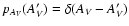 ,
we find the classical relation
,
we find the classical relation
(Bok 1956). Operationally, both densities and
are measured by dividing the number of stars
observed against the cloud and in a control field by the angular size
of the regions considered. Hence, the measurement errors on these
quantities are due to the randomness on the local number of stars. If
we ignore the correlation on the star positions, and thus assume that
these are a homogeneous Poisson process (see, e.g., Cressie 1993),
then the local number of stars follows a simple Poisson distribution.
Table 1: The extinction law in different infrared bands (taken from Rieke & Lebofsky 1985 and van de Hulst 1946).
Although the estimator (40) can be applied to thin clouds
only, in principle more general situations can also be handled by
taking advantage of the particular form of Eq. (38). We
first observe that the integral appearing in the r.h.s. of this
equation is reminiscent of a Laplace's transform. Given a real
function f(x) defined for non-negative values x, its Laplace's
transform is defined as
$](/articles/aa/full/2005/28/aa2267-04/img155.gif) for any non-negative k. Using the
notation just introduced, we can rewrite Eq. (38) as
for all positive values of the product
for any non-negative k. Using the
notation just introduced, we can rewrite Eq. (38) as
for all positive values of the product
 ,
we could in
principle derive
,
we could in
principle derive
 .
As indicated above, the constant
is approximately independent of the band considered;
however,
strongly depends on the band used to carry out
the observations (see Table 1). Hence, the product
that appears in Eq. (42) can be varied among a
limited set of values. In conclusion, although complete
knowledge of
is clearly impossible, we can still use
multiband observations to investigate
in more complex
situations than the one considered in Eq. (40).
.
As indicated above, the constant
is approximately independent of the band considered;
however,
strongly depends on the band used to carry out
the observations (see Table 1). Hence, the product
that appears in Eq. (42) can be varied among a
limited set of values. In conclusion, although complete
knowledge of
is clearly impossible, we can still use
multiband observations to investigate
in more complex
situations than the one considered in Eq. (40).
Let us consider, for example, the case of the thin cloud approximation
described in Eq. (17). Since, in general, the fraction fof foreground stars is not known, we want to estimate both
and
f in a given patch of the sky. (Although f can be taken to be
constant in many cases, changes on this quantity have to be expected
for different regions of large cloud complexes because of the geometry
of the cloud and of changes of star densities due to the Galactic
structure.) For this, we insert Eq. (17) in
Eq. (38), thus obtaining a simple generalization of
Eq. (40):
 in two different bands to deduce both f and
on
the region considered. In practice, it is preferable to follow the
approach described below in Sect. 4.
in two different bands to deduce both f and
on
the region considered. In practice, it is preferable to follow the
approach described below in Sect. 4.
![\begin{figure}
\par\includegraphics[width=8.4cm,clip]{2267f01.eps} \end{figure}](/articles/aa/full/2005/28/aa2267-04/img164.gif) |
Figure 1:
The cumulative probability distribution for
 .
The various curves are relative to a true extinction .
The various curves are relative to a true extinction
![$A_{\it V} = [0,2,4,6,8,10]$](/articles/aa/full/2005/28/aa2267-04/img2.gif) (from the left to the right); the average values
measured are instead
(from the left to the right); the average values
measured are instead
![$\langle \hat A_{\it V} \rangle = [0.24, 2.33,
4.47, 6.64, 8.79, 10.76]$](/articles/aa/full/2005/28/aa2267-04/img162.gif) (the scatters around these values ranges
from 1.9 to 4.3). In all cases we assumed
(the scatters around these values ranges
from 1.9 to 4.3). In all cases we assumed
 , ,
 ,
f = 0.1, and ,
f = 0.1, and
 .
Along the curves the dots mark the actual possible values of
that can be measured for different values of the observed
number of stars N. .
Along the curves the dots mark the actual possible values of
that can be measured for different values of the observed
number of stars N. |
| Open with DEXTER | |
It is interesting to investigate in more detail the estimator derived
from Eq. (43), i.e.
 is its area. Assuming that
is measured
without significant errors (this is possible by using a large control
field), we can deduce the expected error on
by noting that
N follows a Poisson distribution with average (cf.
Eq. (43))
is its area. Assuming that
is measured
without significant errors (this is possible by using a large control
field), we can deduce the expected error on
by noting that
N follows a Poisson distribution with average (cf.
Eq. (43))
Further statistical properties of the estimator (44) can be
better evaluated using numerical methods. Figure 1 shows,
as an example, the expected cumulative probability distributions for
for some typical cases. As expected, the cumulative
distributions reach 0.5 around the true value for ,
but the
expected measurement errors can be very large, especially at high
column densities. The numerical analysis of Eq. (44) also
shows that the estimator is significantly biased. In general, in the
limit
 ,
the estimator is biased toward
large values of
,
i.e.
,
the estimator is biased toward
large values of
,
i.e.
 ;
the opposite happens for
;
the opposite happens for
 (see
Fig. 2). This change in behavior can be understood by
observing that, if
is large, then
(see
Fig. 2). This change in behavior can be understood by
observing that, if
is large, then
 is
small and thus we simply do not have enough background stars to probe
high column densities.
is
small and thus we simply do not have enough background stars to probe
high column densities.
Interestingly, Eq. (46) is a reasonably good approximation of
the true variance of
.
Typically, this approximation
slightly underestimates the true variance of
,
but again the
opposite happens for low values of
 .
.
The dust present in molecular clouds produces different amounts of obscuration in different color bands (see Table 1), so that background stars appear reddened. Hence, the color excess in the red part of the spectrum of background stars can be used to measure the extinction along the line of sight.
Historically, the color excess technique has been impeded by the limited instrumental sensitivity to small regions (Jones et al. 1980; Frerking et al. 1982; Jones et al. 1984). However, in the early 1990s, with the advent of near-infrared arrays, it became possible to accurately measure the NIR magnitudes of many stars from single pointing observations. This new technology was first exploited by Lada et al. (1994), and since then has been successfully applied to many molecular clouds (e.g. Alves et al. 2001; Horner et al. 1997; Lada et al. 1999).
![\begin{figure}
\par\includegraphics[width=8.4cm,clip]{2267f02.eps} \end{figure}](/articles/aa/full/2005/28/aa2267-04/img176.gif) |
Figure 2:
The bias (thick lines) and error (thin lines) on
evaluated using Eq. (44) for different values of
 .
For this figure we used the same
parameters as in Fig.1, i.e.
,
,
and f = 0.1. .
For this figure we used the same
parameters as in Fig.1, i.e.
,
,
and f = 0.1. |
| Open with DEXTER | |
Lada's technique (called "near-infrared color excess'' or NICE) is based on measurements of a NIR color (e.g., H - K) of many stars. Since stars have relatively well defined colors in the infrared, a significant intervening extinction can be detected as a reddening. Note that a key point of the NICE method (and of similar methods based on the reddening of stars; see, e.g., Schultheis et al. 1999) is the assumption that all stars belong to a homogeneous population.
The NICE method can be quantitatively described using the
notation introduced so far. In particular, from Eq. (29) we
have
 the l.h.s. of
Eq. (29) for
the l.h.s. of
Eq. (29) for
 .
Naively, Eq. (48) can be
used to obtain a simple estimate of the intervening infrared
extinction .
For example, we find
.
Equation (49)
is better rewritten in terms of star colors. Calling
.
Naively, Eq. (48) can be
used to obtain a simple estimate of the intervening infrared
extinction .
For example, we find
.
Equation (49)
is better rewritten in terms of star colors. Calling
 and
and
 ,
we have
,
we have
 is an estimate of
 (obtained, e.g., by measuring the star colors on a control field where
presumably
(obtained, e.g., by measuring the star colors on a control field where
presumably
 ). As an example, consider the
NICE method applied to the
). As an example, consider the
NICE method applied to the
 color. Since
stars have a typical scatter of
color. Since
stars have a typical scatter of
 in this color, we
expect an error on
of
in this color, we
expect an error on
of
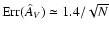 .
Hence, even in the presence of significant
photometric errors, the NICE method gives significantly more
accurate results than the star count method (cf. Eq. (47)).
.
Hence, even in the presence of significant
photometric errors, the NICE method gives significantly more
accurate results than the star count method (cf. Eq. (47)).
As shown by Lombardi & Alves (2001), one can indeed take full
advantage of observations carried out in different bands to obtain
more accurate column density measurements. The improved technique,
called NICER (NICE Revised) optimally balances the
information from different bands and different stars. As a by-product
of the analysis, NICER also allows us to evaluate the
expected error on the column density map, which is useful to estimate
the significance on the detection of substructures and cores. The
NICER technique can be described using the following simple
argument. Equation (50) written above can be taken to be a
system of
 equations to be approximately solved for
,
the approximation being made necessary because we can only
measure
equations to be approximately solved for
,
the approximation being made necessary because we can only
measure
 and
and
 with limited accuracy. The "best'' solution for can been obtained by minimizing the chi-square quantity
,
obtained by minimizing
the  of Eq. (52), is precisely the NICER
estimator.
of Eq. (52), is precisely the NICER
estimator.
Both the NICE and NICER estimators appear
to be unbiased provided that: (i) there are no foreground stars and
(ii) the measured colors
 are unbiased estimates of the
true colors
are unbiased estimates of the
true colors
 .
.
![\begin{figure}
\par\includegraphics[width=8.4cm,clip]{2267f03.eps} \end{figure}](/articles/aa/full/2005/28/aa2267-04/img198.gif) |
Figure 3:
The bias for the NICE method due to the different
completeness at low and high column densities. This plot is
evaluated by generating 100 000 stars for various values of
(marked as dots). Note that, as described in the text, for
 we observe a rapid increase in the bias due to
the change between a selection in the K band and a selection in
the H band (see Fig. 4). The small scale oscillations
on the plot are due to numeric effects.
we observe a rapid increase in the bias due to
the change between a selection in the K band and a selection in
the H band (see Fig. 4). The small scale oscillations
on the plot are due to numeric effects. |
| Open with DEXTER | |
In reality, even if the two conditions considered above are satisfied,
both color excess methods can still be biased because of selection
effects introduced by the completeness function. To understand this
point let us make a simple example. Suppose that we carry out our
observations in two bands,  and
and  ,
and that both
completeness functions
,
and that both
completeness functions
 are not vanishing only
on a narrow magnitude range. In this case we would always have
are not vanishing only
on a narrow magnitude range. In this case we would always have
 (because a star is observed in both bands
only if m1 and m2 are inside the narrow detection window), and
thus we would always measure
(because a star is observed in both bands
only if m1 and m2 are inside the narrow detection window), and
thus we would always measure
 ,
independently of the
real column density. Although unrealistic, this example shows that we
must expect a bias for the NICE method; the argument for the
NICER method is similar and leads to the same conclusion.
,
independently of the
real column density. Although unrealistic, this example shows that we
must expect a bias for the NICE method; the argument for the
NICER method is similar and leads to the same conclusion.
The bias of these two methods depends on the details of the
probability distribution
and of the completeness
functions
.
However, as an example, we
evaluated the expected bias for various values of the column density
and for the typical probability distributions that we expect for the
2MASS catalog. As shown in Fig. 3, the bias in the case
considered appears to be limited, below 0.2 in ,
and has a
characteristic shape: it vanishes for
,
increases quickly for
 ,
and finally saturates for
,
and finally saturates for
 .
This behavior has
a simple explanation:
.
This behavior has
a simple explanation:
), the bias has to vanish
for
.
can be understood with
the help of Fig. 4. At low ,
stars that are observed
in the K band are almost certainly also observed on the H band,
because of the values of the limiting magnitudes (approximately
14.9 in H and 14.3 in K) and of the average star colors
(
 ). When, instead, the reddening is
large, we have the opposite situation (because K is less affected
by reddening than H). This different selection at different
column densities is the source of the observed bias.
). When, instead, the reddening is
large, we have the opposite situation (because K is less affected
by reddening than H). This different selection at different
column densities is the source of the observed bias.
![\begin{figure}
\par\includegraphics[width=8.4cm,clip]{2267f04.eps} \end{figure}](/articles/aa/full/2005/28/aa2267-04/img207.gif) |
Figure 4: A graphic explanation of the bias plotted in Fig. 3. At low column densities, we select stars mainly on their K magnitude, while at high column densities we mainly select using their H magnitude. As a result, the average intrinsic color (dotted line) of the observed stars (gray bands) changes toward lower H - K values. |
| Open with DEXTER | |
![\begin{figure}
\par\includegraphics[width=8.4cm,clip]{2267f05.eps} \end{figure}](/articles/aa/full/2005/28/aa2267-04/img208.gif) |
Figure 5:
The bias for the NICE method due to the
contamination by foreground stars. Solid lines represents, for
different fractions of foreground stars, the median of the
distribution of the measured column densities. Dashed lines,
instead show the expectation value for the median of
obtained from the measurements of 15 reddenings. |
| Open with DEXTER | |
![\begin{figure}
\par\includegraphics[width=8.4cm,clip]{2267f06.eps} \end{figure}](/articles/aa/full/2005/28/aa2267-04/img209.gif) |
Figure 6:
The effect of a foreground star contamination f = 0.1 on the
distribution of column densities for different values of .
From the bottom to the top we show, for
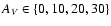 ,
both the distribution of background stars (solid plot, gray
filled), and foreground stars (dashed plot). Both distributions
are taken to be Gaussian, the first centered on ,
and the
second on 0. As the column density increases, the relative
contribution of foreground stars also increases because of
selection effects. At ,
both the distribution of background stars (solid plot, gray
filled), and foreground stars (dashed plot). Both distributions
are taken to be Gaussian, the first centered on ,
and the
second on 0. As the column density increases, the relative
contribution of foreground stars also increases because of
selection effects. At
 ,
they become predominant
and the median of the whole distribution quickly moves toward the
foreground distribution. ,
they become predominant
and the median of the whole distribution quickly moves toward the
foreground distribution. |
| Open with DEXTER | |
,
i.e. by averaging
the individual column densities measured in the direction of each star
with the median instead of the simple mean
(e.g. Cambrésy et al. 2002; Lombardi & Alves 2001). As shown in
Fig. 5, this simple technique is very effective and leads to
almost unbiased results at low column densities (see
Appendix A for a statistical discussion on
the median estimator). However, for a given fraction of foreground
stars f (which, as described above, is evaluated in regions with
negligible extinction) there is a threshold for
after which the
cloud extinction makes the expected number of background stars smaller
than the expected number of foreground stars. This threshold can be
evaluated using Eq. (43) and is
close to this value (see also Fig. 6). Note that the
relatively smooth transition observed in Fig. 5 (solid
lines) is due to the intrinsic scatter in the star colors; indeed, in
absence of any scatter, we would observe an "instantaneous'' change
from
 at low column densities to
 at high column densities. In
Fig. 5 we also plot the expectation value of a more
interesting quantity, the median over N = 15 measured column
densities. This quantity differs from the median over the whole
distribution because of the statistical variations on the local number
of foreground stars. In other words, since N = 15 is a relatively
small number, in different realizations of our simulations we can have
a significantly different number of foreground stars. For example,
even at low column density, we can have a large fraction of foreground
stars; similarly, even at very large column density, there is a finite
probability to have the majority of stars in the background. As a
result, the dashed line in Fig. 5 has a much smoother
transition around the value given by Eq. (53). This is at
the same time a good and a bad news. From one side, this means that
we can be significantly biased for values of
smaller than the
threshold value of Eq. (53); from the other side, this also
means that we can still partially make use of the median estimator at
relatively large column densities.
at high column densities. In
Fig. 5 we also plot the expectation value of a more
interesting quantity, the median over N = 15 measured column
densities. This quantity differs from the median over the whole
distribution because of the statistical variations on the local number
of foreground stars. In other words, since N = 15 is a relatively
small number, in different realizations of our simulations we can have
a significantly different number of foreground stars. For example,
even at low column density, we can have a large fraction of foreground
stars; similarly, even at very large column density, there is a finite
probability to have the majority of stars in the background. As a
result, the dashed line in Fig. 5 has a much smoother
transition around the value given by Eq. (53). This is at
the same time a good and a bad news. From one side, this means that
we can be significantly biased for values of
smaller than the
threshold value of Eq. (53); from the other side, this also
means that we can still partially make use of the median estimator at
relatively large column densities.
For regions with very high column density, it is normally quite easy
to identify and remove foreground stars because of their anomalous
colors with respect to the reddened background stars (see, e.g.,
Alves et al. 2001). Some authors
(e.g. Cambrésy et al. 2002) make use of this information to
also remove stars in less dense regions using the following strategy.
The angular density
 of foreground stars is
determined using dense regions (where the foreground/background
identification is easy); then, for any region of the cloud, the kbluer stars are thrown away, where
of foreground stars is
determined using dense regions (where the foreground/background
identification is easy); then, for any region of the cloud, the kbluer stars are thrown away, where
 is the expected number of foreground stars in the
analyzed region (deduced from the foreground density measured in the
dense regions). This technique is quite simple and reasonably
effective, but unfortunately introduces a bias at low extinctions.
Consider, indeed, the limiting case where we have a negligible
extinction
.
The distinction between foreground and
background stars is in this situation ambiguous, and thus the
is the expected number of foreground stars in the
analyzed region (deduced from the foreground density measured in the
dense regions). This technique is quite simple and reasonably
effective, but unfortunately introduces a bias at low extinctions.
Consider, indeed, the limiting case where we have a negligible
extinction
.
The distinction between foreground and
background stars is in this situation ambiguous, and thus the
 bluer objects will likely include also some background
stars. Hence, the results will be biased toward higher column
density. The exact evaluation of the bias is non trivial, but can be
carried out using the techniques described in
Appendix A. Here we report only an approximated
result valid for
(see Eq. (A.15)),
bluer objects will likely include also some background
stars. Hence, the results will be biased toward higher column
density. The exact evaluation of the bias is non trivial, but can be
carried out using the techniques described in
Appendix A. Here we report only an approximated
result valid for
(see Eq. (A.15)),
 is the average error of the
measured extinction from a single star. Note that the result given in
Eq. (54) can be taken to be an upper limit for the bias,
since we expect this to decrease at high column densities, where the
identification of foreground stars is secure.
is the average error of the
measured extinction from a single star. Note that the result given in
Eq. (54) can be taken to be an upper limit for the bias,
since we expect this to decrease at high column densities, where the
identification of foreground stars is secure.
From the discussion above, it is clear that both the star count and
the NICE(R) methods can produce unsatisfactory
results. On one hand, the star count technique has a low
signal-to-noise ratio and produces significantly biased results at
high column densities (see Fig. 2). On the other hand, the
color excess technique is more sensitive and has a smaller bias, but
can be severely affected by the contamination of foreground stars,
especially for large values of .
As pointed out by Cambrésy et al. (2002), we can take advantage of the different behavior of the star count and the color excess techniques in the various column density regimes to partially solve the problem of the contamination by foreground stars. In particular, Cambrésy et al. note that it is better to use the color excess method at low column densities because of its higher sensitivity, and to switch to the star count method at very large column densities where the NICE method is completely unreliable. The optimal "turning point'' where we need to change the technique can be evaluated empirically by comparing the individual results of the two methods at different column densities.
The solution proposed by Cambrésy et al. has the significant advantage of being relatively simple to implement and reasonably effective, but clearly is suboptimal in many respects:
still remains significantly biased
at high column densities because at large
the star counts are
used (and this method has a non-negligible bias, see
Fig. 2).
Suppose again that in a region of the sky of area
we
observe in various bands N stars with magnitudes
 .
Assuming that the area of the sky is small enough so that there
are no significant changes on the relevant parameters of the problem
(such as the unreddened density
,
local expected density
,
or the reddening probability distribution
),
then we can easily evaluate the joint probability distribution for
such a star configuration. First, we note that the number of stars
inside the region follows a Poisson distribution with average
:
.
Assuming that the area of the sky is small enough so that there
are no significant changes on the relevant parameters of the problem
(such as the unreddened density
,
local expected density
,
or the reddening probability distribution
),
then we can easily evaluate the joint probability distribution for
such a star configuration. First, we note that the number of stars
inside the region follows a Poisson distribution with average
:
,
through pN(N),
,
and :
hence,
assuming that there is no prior for these unknown
quantities, we can obtain an estimate of them by maximizing L or,
equivalently,  .
In the following subsections we will
investigate in more detail this maximum-likelihood estimator.
.
In the following subsections we will
investigate in more detail this maximum-likelihood estimator.
We implemented the maximum-likelihood estimator using the
simplification described above. In particular, we used the forms
(34) and (35) for the source magnitude probability
distribution
.
A simple calculation gives the following
relationships between the coefficients of Eqs. (34) and (35):
 ,
and R. In particular, the
transformation
,
and R. In particular, the
transformation
 can be rewritten
as
can be rewritten
as
For the following discussion, it is also convenient to introduce a new
vector
 ,
and a
,
and a
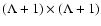 matrix S defined as
 .
In other words, assuming that the errors can
be represented as a convolution with the Gaussian kernel
.
In other words, assuming that the errors can
be represented as a convolution with the Gaussian kernel
 can be written as
 .
.
In conclusion, the simple implementation of the maximum-likelihood method considered here can be summarized in the following items:
,
and R appearing in
Eq. (35) are determined in a control field free from any
extinction. Similarly, for each band the photometric errors, i.e.
the functions
 ,
are calculated.
and f) are
taken to be unknown and constant on the field.
and of the star probability
when
the star is undetected in one or more bands is non-trivial and
requires integrations over the completeness functions (cf.
Eq. (32)).
was requested, we estimated the area in the
magnitude space where this function was significantly different from
zero, and performed the integral inside that area (as opposed to
performing the integral over the whole parameter space). This
optimization was found to have a significant impact on the overall
speed of our implementation.
,
are calculated.
and f) are
taken to be unknown and constant on the field.
and of the star probability
when
the star is undetected in one or more bands is non-trivial and
requires integrations over the completeness functions (cf.
Eq. (32)).
was requested, we estimated the area in the
magnitude space where this function was significantly different from
zero, and performed the integral inside that area (as opposed to
performing the integral over the whole parameter space). This
optimization was found to have a significant impact on the overall
speed of our implementation.
Table 2: The common parameters used for all numerical simulations.
The reliability and effectiveness of the maximum-likelihood approach were assessed through extensive numerical simulations. The simulations were designed to reproduce with reasonable accuracy the 2MASS near-infrared data. We simulated star observations in three bands, J, H, and K, and used the various parameters described in Table 2.
We initially considered an area of the sky
and a thin
cloud characterized by a fraction of foreground stars f (cf.
Eq. (18)) and a reddening .
We randomly generated there
stars inside this area using the following recipe:
using
Eqs. (31) and (32). We found that the needed
integrations could be performed more efficiently using a Monte-Carlo
technique.
.
 to each
magnitude; the magnitudes of foreground stars were left
unchanged.
to each
magnitude; the magnitudes of foreground stars were left
unchanged.
 independent of the band and of the
original magnitude.
independent of the band and of the
original magnitude.
 .
In the simulations discussed here we
used for simplicity Heaviside functions for the completeness
functions.
)
and the
associated measurement errors
.
In the simulations discussed here we
used for simplicity Heaviside functions for the completeness
functions.
)
and the
associated measurement errors  .
.
![\begin{figure}
\par\includegraphics[width=8.4cm,clip]{2267f07.eps} \end{figure}](/articles/aa/full/2005/28/aa2267-04/img259.gif) |
Figure 7:
Log-likelihood surface plot. The plot shows the
logarithmic of the likelihood ratio as a function of the two
unknown parameters
and f (the real values used for the
simulation are 10 and 0.2 respectively). The simulation has
been carried out using
 ,
but the
actual number of stars generated were N = 19 (because of the
Poisson noise on the number of stars). On the bottom we also plot
contours corresponding to ,
but the
actual number of stars generated were N = 19 (because of the
Poisson noise on the number of stars). On the bottom we also plot
contours corresponding to  , ,
 ,
and ,
and  confidence level regions. Note that the likelihood is very smooth
and has only a single well defined minimum.
confidence level regions. Note that the likelihood is very smooth
and has only a single well defined minimum. |
| Open with DEXTER | |
![\begin{figure}
\par\includegraphics[width=8.4cm,clip]{2267f08.eps} \end{figure}](/articles/aa/full/2005/28/aa2267-04/img263.gif) |
Figure 8:
The log-likelihood (ratio) as a function of
for different
source densities, extremized for f. The largest curve is
obtained using
 (in this particular
realization we had N = 8); the mid curve using
(in this particular
realization we had N = 8); the mid curve using
 (N = 12), and the most peaked curve
using
(N = 12), and the most peaked curve
using
 (N = 35). In all cases the
true value of the column density was
(N = 35). In all cases the
true value of the column density was
 ,
and the fraction
of foreground stars was f = 0.2. Note that all curves are very
well approximated by parabolas. The intersections of the
log-likelihood functions with the three dashed lines mark the
,
,
and
confidence level regions. ,
and the fraction
of foreground stars was f = 0.2. Note that all curves are very
well approximated by parabolas. The intersections of the
log-likelihood functions with the three dashed lines mark the
,
,
and
confidence level regions. |
| Open with DEXTER | |
We then used this dataset to test the reliability and efficiency of the maximum-likelihood estimator, and to compare it with the other column density estimators considered in Sect. 3. The maximum-likelihood method was implemented as described in Sect. 4.2, and was tested against the data generated as described in the items above.
Figure 7 shows the log-likelihood surface plot obtained in a typical simulation. The surface appears to be very smooth with a well defined minimum, an essential condition for the reliability of the maximum-likelihood approach. Moreover, the log-likelihood function is found to have approximately a parabolic shape, which further simplifies the interpretation of the results obtained. For example, this property allows us to use the likelihood ratio (see, e.g., Eadie et al. 1971) to draw confidence level regions on the parameter space (see the contours of Fig. 7).
Figure 8 represents the log-likelihood as a function of
for three different datasets. The figure was obtained by
minimizing the log-likelihood function with respect to f for each
value of
in the range [5, 15], and by plotting the value of
this function.
In order to assess more quantitatively the merits of the
maximum-likelihood method, we compared the statistical properties of
various column density estimators. In particular, we simulated a
large number of "observations'' using the technique described above,
and we studied the distribution of the column densities estimated
using the maximum-likelihood method, the NICE, and the
NICER methods. Simulations were carried out using a thin
cloud with true extinction in the range
![$A_{\it V} \in [0, 30]$](/articles/aa/full/2005/28/aa2267-04/img264.gif) and with
different values of the foreground fraction f. For the
NICE and NICER estimators we used both the simple
mean and the median of the individual extinction measured for each
star; moreover, assuming that the density of foreground stars
could be determined separately, we discarded in
each simulation the
and with
different values of the foreground fraction f. For the
NICE and NICER estimators we used both the simple
mean and the median of the individual extinction measured for each
star; moreover, assuming that the density of foreground stars
could be determined separately, we discarded in
each simulation the
 bluer stars, and
used only the remaining (redder) stars in the analysis. Note that in
some cases, for large values of
and relatively large values of
f we had no usable star for the NICE and NICER
analysis; in other words, all stars left after the foreground
selection had only one band available (typically the K band). In
this case we just obtained a lower limit on
by using the redder
usable star (even if this star was originally considered to be in the
foreground).
bluer stars, and
used only the remaining (redder) stars in the analysis. Note that in
some cases, for large values of
and relatively large values of
f we had no usable star for the NICE and NICER
analysis; in other words, all stars left after the foreground
selection had only one band available (typically the K band). In
this case we just obtained a lower limit on
by using the redder
usable star (even if this star was originally considered to be in the
foreground).
![\begin{figure}
\par\includegraphics[width=8.4cm,clip]{2267f09.eps} \end{figure}](/articles/aa/full/2005/28/aa2267-04/img267.gif) |
Figure 9:
The bias
 of various column
density measurement methods. The bias is evaluated from the
averages of 1 000 simulated fields with no foreground
contribution (f = 0) and with average number of stars
.
The maximum-likelihood method,
marked in the legend as ML for brevity, has negligible bias,
especially for
of various column
density measurement methods. The bias is evaluated from the
averages of 1 000 simulated fields with no foreground
contribution (f = 0) and with average number of stars
.
The maximum-likelihood method,
marked in the legend as ML for brevity, has negligible bias,
especially for
 . . |
| Open with DEXTER | |
![\begin{figure}
\par\includegraphics[width=8.4cm,clip]{2267f10.eps} \end{figure}](/articles/aa/full/2005/28/aa2267-04/img269.gif) |
Figure 10:
The total error
 of various column density measurement
methods, evaluated as in Fig. 9.
of various column density measurement
methods, evaluated as in Fig. 9. |
| Open with DEXTER | |
Figures 9 and 10 show, respectively, the bias and
the total error obtained from the three methods considered here for
and f = 0. From these plots it is evident that the
maximum-likelihood estimator does not have any significant bias up to
 and a very small one (of the order of 0.1) for larger
column densities. Since for f = 0 we never have foreground stars,
the bias of the NICE and NICER techniques does not
change if we use a mean or a median estimator. Note also that the
bias in Fig. 9 for these two methods is the one discussed in
detail above (cf. Fig. 3). Regarding the total error, we
observe a steady increase of it for large values of .
This can
be explained by noting that, although the average number of stars
is kept constant for all column densities,
when
is large most stars are only detected in the K band and
thus do not provide reddening information. Figure 10 also
shows that the maximum-likelihood method is clearly superior, although
NICER (with the mean estimator) also performs well. As
expected, both median estimators are more noisy than the simple mean
(which, for f = 0, is optimal).
and a very small one (of the order of 0.1) for larger
column densities. Since for f = 0 we never have foreground stars,
the bias of the NICE and NICER techniques does not
change if we use a mean or a median estimator. Note also that the
bias in Fig. 9 for these two methods is the one discussed in
detail above (cf. Fig. 3). Regarding the total error, we
observe a steady increase of it for large values of .
This can
be explained by noting that, although the average number of stars
is kept constant for all column densities,
when
is large most stars are only detected in the K band and
thus do not provide reddening information. Figure 10 also
shows that the maximum-likelihood method is clearly superior, although
NICER (with the mean estimator) also performs well. As
expected, both median estimators are more noisy than the simple mean
(which, for f = 0, is optimal).
![\begin{figure}
\par\includegraphics[width=8.4cm,clip]{2267f11.eps} \end{figure}](/articles/aa/full/2005/28/aa2267-04/img271.gif) |
Figure 11: As for Fig. 9, but with f = 0.02. |
| Open with DEXTER | |
![\begin{figure}
\par\includegraphics[width=8.4cm,clip]{2267f12.eps} \end{figure}](/articles/aa/full/2005/28/aa2267-04/img272.gif) |
Figure 12: As for Fig. 10, but with f = 0.02. |
| Open with DEXTER | |
![\begin{figure}
\par\includegraphics[width=8.4cm,clip]{2267f13.eps} \end{figure}](/articles/aa/full/2005/28/aa2267-04/img273.gif) |
Figure 13: As for Fig. 9, but with f = 0.05. |
| Open with DEXTER | |
![\begin{figure}
\par\includegraphics[width=8.4cm,clip]{2267f14.eps} \end{figure}](/articles/aa/full/2005/28/aa2267-04/img274.gif) |
Figure 14: As for Fig. 10, but with f = 0.05. |
| Open with DEXTER | |
![\begin{figure}
\par\includegraphics[width=8.4cm,clip]{2267f15.eps} \end{figure}](/articles/aa/full/2005/28/aa2267-04/img275.gif) |
Figure 15: As for Fig. 9, but with f = 0.10. |
| Open with DEXTER | |
The situation changes quite dramatically when f > 0. Figures 11-16 show the bias and the total error of the various methods for increasing values of f. A careful study of these results can reveal several interesting characteristics of the NICE and NICER techniques.
Let us initially focus on the bias plots, shown in Figs. 11,
13, and 15. At low column densities, i.e. for
 ,
we find again the bias described in
Sect. 3.2 and plotted in Fig. 3
(see also above Fig. 9 for the case f = 0). At median
column densities, i.e. for
,
we find again the bias described in
Sect. 3.2 and plotted in Fig. 3
(see also above Fig. 9 for the case f = 0). At median
column densities, i.e. for
 (or
(or
 for f =
0.02), the bias can be explained by the selection effect due to the
correction of foreground stars. As explained above (see
Eq. (54)), removing the
bluer stars introduces a systematic error on the
extinction estimate. This bias is positive (i.e. toward larger
extinctions) and can be as large as
for f =
0.02), the bias can be explained by the selection effect due to the
correction of foreground stars. As explained above (see
Eq. (54)), removing the
bluer stars introduces a systematic error on the
extinction estimate. This bias is positive (i.e. toward larger
extinctions) and can be as large as
 in .
Finally, at high column densities (
)
both methods
systematically underestimate the extinction. This is due to the heavy
contamination by foreground stars present at these large values of
reddening. To better understand this point, we note that the
subtraction of the
bluer stars is a simplistic
approximation because the actual number of foreground stars is not
fixed (it is a Poisson random variable with average ).
Depending on the number of foreground stars with respect to
we can have three different situations:
in .
Finally, at high column densities (
)
both methods
systematically underestimate the extinction. This is due to the heavy
contamination by foreground stars present at these large values of
reddening. To better understand this point, we note that the
subtraction of the
bluer stars is a simplistic
approximation because the actual number of foreground stars is not
fixed (it is a Poisson random variable with average ).
Depending on the number of foreground stars with respect to
we can have three different situations:
,
then at high column densities no bias is introduced and the estimate
of
is correctly performed;
,
a small bias toward higher column densities is
expected, because some of the bluer background stars are discarded;
the third effect is expected to
dominate. Indeed, Figs. 13 and 15 show that both
the NICE and NICER methods significantly
underestimate the reddening for large values of .
In theory, as
mentioned above, when applying the NICE or NICER
technique to high extinction regions, it should be relatively
straightforward to identify foreground stars by their color, and thus
the bias of these method could be smaller than suggested by the plot
shown here. Note that apparently NICER presents a larger
bias compared to NICE. This is due to the larger flexibility
of the NICER method, which is able to obtain a column density
estimate when any two of the three bands are available. As a result,
NICER is more affected by the contamination by foreground
stars described in the items above. Indeed, our simulations show that
if we force NICER to use only stars with observed H and Kbands (i.e. essentially the same stars as the ones used by
NICE), its bias and its noise are drastically reduced and
become compatible with the ones of NICE.
![\begin{figure}
\par\includegraphics[width=8.4cm,clip]{2267f16.eps} \end{figure}](/articles/aa/full/2005/28/aa2267-04/img280.gif) |
Figure 16: As for Fig. 10, but with f = 0.10. |
| Open with DEXTER | |
Figures 12, 14, and 16 show that the
total error of the NICE and NICER methods increases
very rapidly at large column densities, where the contamination by
foreground stars is very likely; the maximum-likelihood estimator,
instead, has an almost flat error curve. Hence, our novel method is
able to "recognize'' the presence of foreground stars; moreover, the
inclusion of the background density in the likelihood expression
allows this estimator to "switch'' to the number count technique in
regions with large extinction. Figure 12, in particularly,
shows that even in extreme cases with a large foreground star
contamination the maximum-likelihood method is still very reliable and
accurate. To better appreciate this point, we note that, in our
simulations, for
 and f = 0.2 on average only one tenth of
the 25 stars are background to the cloud.
and f = 0.2 on average only one tenth of
the 25 stars are background to the cloud.
The maximum-likelihood approach to the extinction measurements
presents clear advantages with respect to the standard techniques in
the simplified framework considered in this section (uniform over the cloud patch analysed, thin-cloud approximation, simple model
for the star intrinsic magnitude distribution). One could thus
legitimately ask whether the maximum-likelihood technique is
applicable to more realistic and complex situations.
Most clouds present clear sign of substructure at different scales and a statistical analysis of the radio and NIR observations seems to indicate the that these objects can be well described in terms of turbulent models (see, e.g.Padoan et al. 1997; Miesch & Bally 1994). In presence of significant inhomogeneities, most methods (including the maximum-likelihood one) are expected to be biased toward low values because the background stars will no longer be randomly distributed in the patch of the sky used to estimate the local extinction value, but will be preferentially detected in low-extinction regions (cf. Eq. (43)). Although a detailed discussion of this effect is behind the scope of this paper, it is worth considering the following points:
on the patch of the sky considered are of order
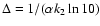 ,
where
,
where
 (cf.
Eq. (8)). For typical 2MASS observations we find
(cf.
Eq. (8)). For typical 2MASS observations we find
 ,
and hence all methods should still be
applicable to the analysis of regions with relatively low column
densities (approximately
,
and hence all methods should still be
applicable to the analysis of regions with relatively low column
densities (approximately
 ).
).
 )
for
,
while the bias increases dramatically for larger
extinction values (e.g., it reaches
at
)
for
,
while the bias increases dramatically for larger
extinction values (e.g., it reaches
at
 ). A similar bias behavior is expected for the
maximum-likelihood technique described in this section.
is expected to be a log-normal:
,
the
maximum-likelihood approach can be used in this more general
framework to obtain the relevant parameters of
(e.g., M and S in the case of the log-normal of Eq. (65));
moreover, the parameters estimated are asymptotically unbiased
(see Eadie et al. 1971). We will consider the use of a non-trivial
extinction probability distributions similar to the one of
Eq. (65) in a follow-up paper.
). A similar bias behavior is expected for the
maximum-likelihood technique described in this section.
is expected to be a log-normal:
,
the
maximum-likelihood approach can be used in this more general
framework to obtain the relevant parameters of
(e.g., M and S in the case of the log-normal of Eq. (65));
moreover, the parameters estimated are asymptotically unbiased
(see Eadie et al. 1971). We will consider the use of a non-trivial
extinction probability distributions similar to the one of
Eq. (65) in a follow-up paper.
In the implementation of the maximum-likelihood technique discussed in
this section, we used the simple model for the magnitude probability
distribution
(cf. Eq. (34)). However, the
functional form of
used can be inaccurate in describing
real data for several reasons:
(see,
e.g. Cambrésy et al. 2002). If the various stellar populations
also have different intrinsic mean colors, then the simple model
(34) could lead to inaccurate extinction measurements.
,
and R.
used here, and
not to the maximum-likelihood method itself. In other
words, it is possible (and relatively easy) to implement a
maximum-likelihood estimator based on a more realistic probability
distribution for the star magnitudes (e.g., synthetic stellar
population models; see Jarrett et al. 1994; Robin et al. 2004). For this purpose, we note that the most
computationally effective way to generalize
is by
writing it as a linear combination of functions of the form
(34) (with each function representing, de facto, a
different star population).
On of most significant drawback of the maximum-likelihood approach is its speed. The implementation used in this paper is approximately one order of magnitude slower than the NICER method (at least on a typical workstation), and this might prevent large applications of the method proposed here. On the other hand, the fast technological progress in the computer speed justifies the work presented in this paper, in the sense that soon it will be possible to use the maximum-likelihood method on large datasets composed of millions of stars.
Another possible issue related to the technique presented here is the
need for a more detailed knowledge of the properties of the data used.
As a comparison, we note that the original NICE technique
makes use only of the H and K magnitudes of stars and of the
average color
 of stars in the control field.
In addition to these data, NICER also requires the estimated
errors of star magnitudes in the NIR bands used. Finally, the
maximum-likelihood method requires a detailed knowledge of the
probability distribution
,
of the measurement errors
of stars in the control field.
In addition to these data, NICER also requires the estimated
errors of star magnitudes in the NIR bands used. Finally, the
maximum-likelihood method requires a detailed knowledge of the
probability distribution
,
of the measurement errors
 of each star, and
of the completeness functions
.
In
reality, in the Bayesian approach implicitly adopted in this paper,
the maximum-likelihood method can also be used if an
approximate knowledge of these parameters is available.
Suppose, for example, that the parameters P, ,
and R that
characterize
(see Eq. (35)) are only
approximately known from the measurements in the control field. In
this case we can take these parameters as unknowns in the
expression for the likelihood, and we can thus minimize L with
respect to them as well as with respect to the parameters that
characterize
(
and f in the case considered
here). As customary in standard maximum-likelihood problems, we
include the knowledge on P, ,
and R as a prior
in the function L. Note that this way the dimension of the space
over which we need to minimize L greatly increases (and this can
pose severe computational problems), but in principle the schema
proposed is applicable to real cases.
of each star, and
of the completeness functions
.
In
reality, in the Bayesian approach implicitly adopted in this paper,
the maximum-likelihood method can also be used if an
approximate knowledge of these parameters is available.
Suppose, for example, that the parameters P, ,
and R that
characterize
(see Eq. (35)) are only
approximately known from the measurements in the control field. In
this case we can take these parameters as unknowns in the
expression for the likelihood, and we can thus minimize L with
respect to them as well as with respect to the parameters that
characterize
(
and f in the case considered
here). As customary in standard maximum-likelihood problems, we
include the knowledge on P, ,
and R as a prior
in the function L. Note that this way the dimension of the space
over which we need to minimize L greatly increases (and this can
pose severe computational problems), but in principle the schema
proposed is applicable to real cases.
Interestingly, the NICE and NICER technique can be
seen as special cases of the maximum-likelihood method when no prior
knowledge on R is available: the complete lack information on the
normalization of
forces our method to use the only color
information of the stars. Similarly, the number counts method can be
recovered as special case when the knowledge on the average colors
 is absent (or, equivalently, when the scatter in the colors
Cab is very large; cf. Eq. (34)). This suggests that
the NICE(R)) techniques are not more robust of the
maximum-likelihood one, but just simpler.
is absent (or, equivalently, when the scatter in the colors
Cab is very large; cf. Eq. (34)). This suggests that
the NICE(R)) techniques are not more robust of the
maximum-likelihood one, but just simpler.
Finally, we mention that the presence of young stellar objects (that could be for example embedded in the dense cores) can in principle affect the extinction measurements. Hence, these objects should be "manually'' removed before using any extinction measurement method, including the maximum-likelihood described in this paper.
In this paper we have considered the problem of an accurate determination of the extinction toward a dark molecular cloud. The results obtained here can be summarized in the following items:
 in
in  )
as a result of selection effects.
and the fraction
of foreground stars f; alternatively, it would be also possible to
determine f globally on the cloud and take it as a constant on the
whole field (a good approximation for small clouds).
)
as a result of selection effects.
and the fraction
of foreground stars f; alternatively, it would be also possible to
determine f globally on the cloud and take it as a constant on the
whole field (a good approximation for small clouds).
In Sect. 4.4.1 we discussed one of the most
serious limitations of NIR color excess studies in molecular clouds,
namely the bias introduced by substructures. In our original
formulation, the maximum-likelihood method can be used not only in the
thin cloud approximation, but in general for any functional form of
.
Hence, as mentioned above, we could implement the
maximum-likelihood method using a more realistic probability
distribution for ,
such as the one of Eq. (65).
Another possibility offered by the maximum-likelihood approach is the
generalization of the thin-cloud approximation to a multi-layer case,
where two or more (thin) clouds located at different distances are
observed on overlapping areas of the sky. For example, in case of a
double cloud we could write (cf. Eq. (17))
 ,
,
 ,
or
,
or
 ).
Some of these possibilities will be investigated in detail in a
follow-up paper by using 2MASS data.
).
Some of these possibilities will be investigated in detail in a
follow-up paper by using 2MASS data.
Acknowledgements
We are very grateful to G. Bertin and J. Alves for useful and stimulating discussions, and to the referee, L. Cambresy for providing stimulating comments and for helping us improve the paper significantly.
The goal of this appendix is to derive the probability distribution of the median of n independent identical random variables. This analysis is useful to address some of the issues discussed in Sect. 3.2.
In the following we will often deal with ordered and
unordered n-tuples. The latter can be taken to be a set
of n elements, where typically each element is a random variable or
an element of another tuple; the former can be taken to be a list of
n elements, where thus each element is associated to a position in
the list. Hence, given a positive integer  ,
it makes sense
to talk about the kth element of an ordered n-tuple, while this
is meaningless for an unordered tuple.
,
it makes sense
to talk about the kth element of an ordered n-tuple, while this
is meaningless for an unordered tuple.
We will denote an ordered n-tuple using brackets, as in
![$[x_1,
\dots, x_n]$](/articles/aa/full/2005/28/aa2267-04/img298.gif) ;
instead, we will reserve braces for the unordered
tuples, as in
;
instead, we will reserve braces for the unordered
tuples, as in
 .
Note that, for consistency
with the definition, we identify unordered tuples if these differ just
by a permutation of the elements: thus
.
Note that, for consistency
with the definition, we identify unordered tuples if these differ just
by a permutation of the elements: thus
 is, for instance, identical to
 .
.
Let us call p(x) the probability distribution for the real random
variable x, and let us consider the generation of unordered
n-tuples
 of such variables. Suppose
that, after the random generation of a tuple, we order the tuple such
that
of such variables. Suppose
that, after the random generation of a tuple, we order the tuple such
that
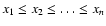 .
We consider now the probability
distribution
pnk(xk) for the kth element of the ordered tuple
.
We consider now the probability
distribution
pnk(xk) for the kth element of the ordered tuple
![$[x_1, x_2, \dots, x_n]$](/articles/aa/full/2005/28/aa2267-04/img304.gif) ,
which can be written as
,
which can be written as
![$[x, x +
\rm dx]$](/articles/aa/full/2005/28/aa2267-04/img307.gif) is the product of three terms:
is the product of three terms:
 to takes into account the intrinsic
probability distribution of x;
to takes into account the intrinsic
probability distribution of x;
![$\left(
\begin{array}{c}{n-1}\\ {k-1}\end{array}
\right) \bigl[ P(x_k) \bigr]^{k-1} \bigl[ 1 - P(x_k)
\bigr]^{n - k}$](/articles/aa/full/2005/28/aa2267-04/img309.gif) ,
which is a simple binomial distribution giving the
probability that the value chosen has k-1 elements of the order
n-tuple at its left, and n - k elements at its right;
,
which is a simple binomial distribution giving the
probability that the value chosen has k-1 elements of the order
n-tuple at its left, and n - k elements at its right;
The cumulative distribution Pnk(xk) is given by
 .
The final result obtained in Eq. (A.3) has the advantage
to be a simple (polynomial) expression in P(x).
.
The final result obtained in Eq. (A.3) has the advantage
to be a simple (polynomial) expression in P(x).
![\begin{figure}
\par\includegraphics[width=8.4cm,clip]{2267fA1.eps} \end{figure}](/articles/aa/full/2005/28/aa2267-04/img315.gif) |
Figure A.1: The cumulative probability distribution Pnk(xk) as a function of P(x) for n=7 and various values of k (marked close to the relative curves). |
![\begin{figure}
\par\includegraphics[width=8.4cm,clip]{2267fA2.eps} \end{figure}](/articles/aa/full/2005/28/aa2267-04/img316.gif) |
Figure A.2:
The cumulative probability distribution
Pnk(xk) as a
function of P(x) for
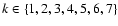 and
n=2 k - 1. Note that all curves pass through the point
(0.5,
0.5).
and
n=2 k - 1. Note that all curves pass through the point
(0.5,
0.5). |
Figures A.1 and A.2 show the polynomials Pnk(xk) as a function of P(xk) for various values of n and k. These figures suggest a number of properties for Pnk(xk)that can be verified analytically with the help of the equations written above:
The median of the probability distribution of the median estimator of the random variable x is the median of the probability distribution of x.Note that here we use the term "median'' to denote both the usual median of an n-tuple
,
and the median of a
distribution, defined as the value x such that the value cumulative
distribution is 1/2.
 and
and

For our purposes, it is also useful to define and study two
probability distributions closely related to
Pnk(xk). Let us
consider again the ordered n-tuple
,
where each
element is drawn from a probability distribution p(x). Now let us
retain only the first k elements of the ordered n-tuple, and let
us call
 the probability distribution for each
element of the unordered k-tuple
the probability distribution for each
element of the unordered k-tuple
 ;
similarly, we call
;
similarly, we call
 the probability
distribution for the tuple
the probability
distribution for the tuple
 where only the last
(n - k + 1) elements of the original ordered n-tuple are retained.
where only the last
(n - k + 1) elements of the original ordered n-tuple are retained.
The evaluation of the probability distribution
 can be
broken into two parts. Consider the (k-1)th element xk-1 of
the tuple
(i.e., the last element discarded);
then, clearly, each element of the (n-k+1)-tuple
cannot be smaller than xk-1. Moreover, each element of
this unordered tuple is distributed between xk-1and
can be
broken into two parts. Consider the (k-1)th element xk-1 of
the tuple
(i.e., the last element discarded);
then, clearly, each element of the (n-k+1)-tuple
cannot be smaller than xk-1. Moreover, each element of
this unordered tuple is distributed between xk-1and  according to the (truncated) original probability
distribution p(x). Finally, by repeating this argument for each
possible value of xk-1 (weighted by pnk-1), we obtain the
expression
according to the (truncated) original probability
distribution p(x). Finally, by repeating this argument for each
possible value of xk-1 (weighted by pnk-1), we obtain the
expression
As usual in this appendix, it is more convenient to consider the
cumulative probability distributions. We can thus integrate
over x and obtain, after a few manipulations, a closed
expression for
 .
Here, however, we prefer to follow a
different and simpler path.
.
Here, however, we prefer to follow a
different and simpler path.
Let us consider again the tuple
![$[ x_k, \dots, x_n ]$](/articles/aa/full/2005/28/aa2267-04/img328.gif) .
Each element
of this ordered tuple follows the probability distribution
pnk(xk) discussed in the previous section. Hence, if we consider
the unordered tuple, the elements
will follow the average distribution
.
Each element
of this ordered tuple follows the probability distribution
pnk(xk) discussed in the previous section. Hence, if we consider
the unordered tuple, the elements
will follow the average distribution
 ,
we can verify
that the same relation holds for the cumulative probability
distributions. Let us then evaluate the sum
follows the original distribution p(x), a very
natural result indeed.
,
we can verify
that the same relation holds for the cumulative probability
distributions. Let us then evaluate the sum
follows the original distribution p(x), a very
natural result indeed.
If, instead, k > 1, then using the properties of the binomial
coefficient we find
Similarly, we wish to investigate the cumulative probability
distribution
 for the k-tuple
.
This quantity is better evaluated using
:
for the k-tuple
.
This quantity is better evaluated using
:
As an application of the results obtained in this section, we evaluate
the bias introduced in the estimate of the column density when using
the technique described in Sect. 3.2 to
remove foreground stars (see Eq. (54)). Suppose that we
observe stars in a region with no significant extinction, so that both
foreground and background stars have the same distribution in colors.
For simplicity, we assume that the reddening estimates
for
each individual star is a Gaussian distribution with vanishing average
and variance
 .
In this situation, if we exclude
the k bluer stars (because they are taken to be foreground), we will
bias the estimate of
toward large column densities. In
particular, the column densities for the stars left will be
distributed according to
.
In this situation, if we exclude
the k bluer stars (because they are taken to be foreground), we will
bias the estimate of
toward large column densities. In
particular, the column densities for the stars left will be
distributed according to
 .
The median of this
distribution can be evaluated as follows. At
we have
.
The median of this
distribution can be evaluated as follows. At
we have
 ,
while
,
while
 ,
then each term in the sum above is approximately
unity (cf. above Fig. A.1). Hence we obtain
,
then each term in the sum above is approximately
unity (cf. above Fig. A.1). Hence we obtain
 .
Using Newton's
method we obtain then the approximate solution
.
Using Newton's
method we obtain then the approximate solution
 at low k, and retained only terms linear in
k/n. The final result obtained is thus given by Eq. (54).
at low k, and retained only terms linear in
k/n. The final result obtained is thus given by Eq. (54).

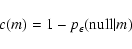
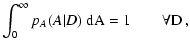

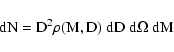

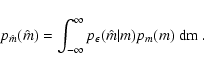

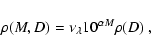
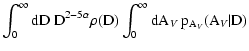
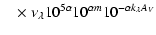

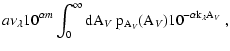
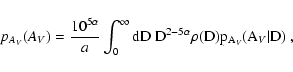
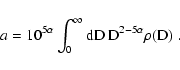
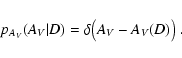
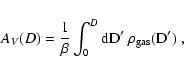

![$\displaystyle \frac{10^{5\alpha}}{a} \bigl[ D(A_{\it V})
\bigr]^{2-5\alpha} \rho\bigl( D(A_{\it V}) \bigr) D'(A_{\it V})$](/articles/aa/full/2005/28/aa2267-04/img89.gif)
![$\displaystyle \frac{10^{5\alpha}}{a} \frac{\rho\bigl( D(A_{\it V}) \bigr)}{3 -
...
...\rm d}{\rm dA_{\it V}} \Bigl[ \bigl[D(A_{\it V})
\bigr]^{3-5\alpha} \Bigr] \; .$](/articles/aa/full/2005/28/aa2267-04/img90.gif)
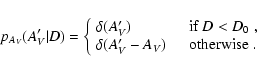
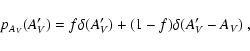
![\begin{displaymath}
f = \biggl[ \int_0^{D_0} \!\! \rm dD ~ D^{2 - 5\alpha} \rho...
...t_0^\infty \!\! \rm dD ~ D^{2 - 5\alpha}
\rho(D) \biggr] \; .
\end{displaymath}](/articles/aa/full/2005/28/aa2267-04/img95.gif)
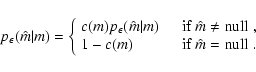
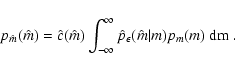
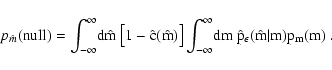


![$\displaystyle \int_{-\infty}^\infty \hat p_\epsilon(\hat m \vert
m) \bigl[ 1 - \hat c(\hat m) \bigr] ~ \rm d\hat m \ .$](/articles/aa/full/2005/28/aa2267-04/img103.gif)
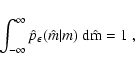
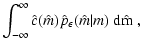

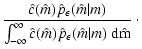
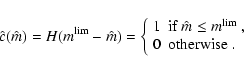


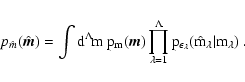
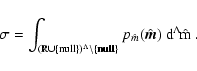

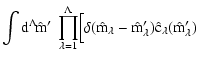
![$\displaystyle {} + \delta(\hat m_\lambda -
{\rm null}) \bigl( 1 -
\hat c_\lambda(\hat m'_\lambda) \bigr) \Bigr]$](/articles/aa/full/2005/28/aa2267-04/img130.gif)
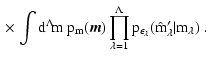

![$\displaystyle p_M(\vec M) = \nu 10^{\alpha M_1}
\exp \left[ -\frac{(M_a - M_1 - \chi_a) C^{-1}_{ab} (M_b -
M_1 - \chi_b)}{2} \right] \; ,$](/articles/aa/full/2005/28/aa2267-04/img139.gif)
![\begin{displaymath}
p_M(\vec M) = \exp \left[ - \frac{\vec M^{\rm T} P \vec M + 2
\vec Q^{\rm T} \vec M + R}{2} \right] \; .
\end{displaymath}](/articles/aa/full/2005/28/aa2267-04/img141.gif)
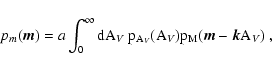


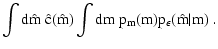
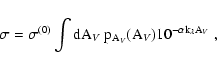
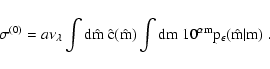
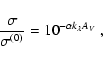
 = \int_0^\infty f(x) \exp( - k x) \; .
\end{displaymath}](/articles/aa/full/2005/28/aa2267-04/img154.gif)

\; .
\end{displaymath}](/articles/aa/full/2005/28/aa2267-04/img156.gif)
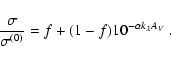
![\begin{displaymath}
\hat A_{\it V} = - \frac{1}{\alpha k_\lambda} \log_{10}\lef...
...gma^{(0)} f}{\mathcal{A} \sigma^{(0)} (1 - f) }
\right] \; ,
\end{displaymath}](/articles/aa/full/2005/28/aa2267-04/img165.gif)
![\begin{displaymath}
\langle N \rangle = \mathcal{A} \sigma^{(0)} \bigl[ f + (1-f)
10^{-\alpha k_\lambda A_{\it V}} \bigr] \; .
\end{displaymath}](/articles/aa/full/2005/28/aa2267-04/img167.gif)
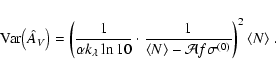
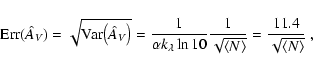
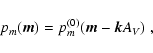
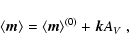
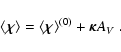
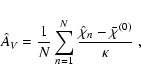
![\begin{displaymath}
\chi^2 = \sum_{n=1}^N \bigl[ \hat{\vec \chi}_n - \bar {\vec...
...n - \bar{\vec \chi}^{(0)} - \vec \kappa A_{\it V} \bigr]
\; ,
\end{displaymath}](/articles/aa/full/2005/28/aa2267-04/img194.gif)
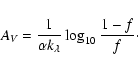
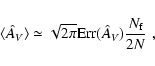
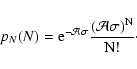

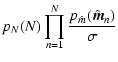
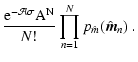


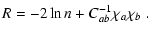


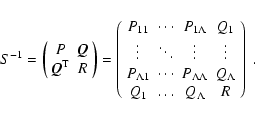
![\begin{displaymath}
p_M(\vec M) = \exp \left[ - \frac{\vec\mu^{\rm T} S^{-1} \vec\mu}{2}
\right] \cdot
\end{displaymath}](/articles/aa/full/2005/28/aa2267-04/img234.gif)
![\begin{displaymath}
p_\epsilon(\vec\epsilon) = \frac{1}{(2\pi)^{\Lambda/2}
\pr...
...ambda \frac{\epsilon^2_\lambda}{2 v_\lambda^2 }
\biggr] \; ,
\end{displaymath}](/articles/aa/full/2005/28/aa2267-04/img236.gif)
![\begin{displaymath}
(p_M * \Sigma)(\vec\mu) = \sqrt{\frac{\det S}{\det T}} \exp \left[
-\frac{\vec\mu^{\rm T} T^{-1} \vec\mu}{2} \right] \; ,
\end{displaymath}](/articles/aa/full/2005/28/aa2267-04/img238.gif)
![\begin{displaymath}
p_{A_{\it V}}(A_{\it V}) = \frac{1}{\sqrt{2 \pi} S A_{\it V...
...p \biggl[ -
\frac{(\ln A_{\it V} - M)^2}{2 S^2} \biggr] \; .
\end{displaymath}](/articles/aa/full/2005/28/aa2267-04/img288.gif)

![\begin{displaymath}
p^n_k(x_k) = n \left(
\begin{array}{c}
{n-1}\\ {k-1}
\end...
...gl[ P(x_k) \bigr]^{k-1}
\bigl[ 1 - P(x_k) \bigr]^{n - k} \; ,
\end{displaymath}](/articles/aa/full/2005/28/aa2267-04/img305.gif)
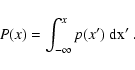

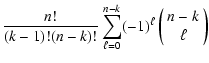
![$\displaystyle {} \times \int_{-\infty}^{x_k} \bigl[P(x'_k) \bigr]^{k-1 +
\ell} p(x'_k) ~ \rm dx'_k$](/articles/aa/full/2005/28/aa2267-04/img312.gif)
![$\displaystyle \sum_{m=k}^{n} (-1)^{m + k}
\left( \begin{array}{c}
n \\ m
\end{...
...\left(
\begin{array}{c}
m-1 \\ k-1
\end{array}\right)
\bigl[ P(x_k) \bigr]^m .$](/articles/aa/full/2005/28/aa2267-04/img313.gif)
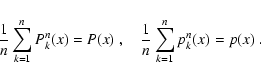
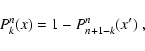
![\begin{displaymath}
P^n_1(x_1) {} = \bigl[ P(x_1) \bigr]^n \; , \quad
P^n_n(x_n) {} = 1 - \bigl[ 1 - P(x_n) \bigr]^n \; .
\end{displaymath}](/articles/aa/full/2005/28/aa2267-04/img319.gif)
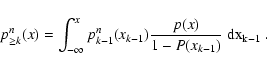
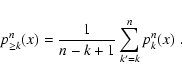

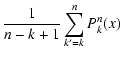
![$\displaystyle \frac{1}{n - k + 1} \sum_{m=k}^n
\left(\begin{array}{c}
n \\
m
\end{array}\right)
\bigl[ P(x) \bigr]^m$](/articles/aa/full/2005/28/aa2267-04/img333.gif)
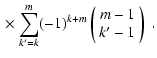
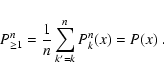
![\begin{displaymath}
P^n_{\ge k}(x) = \frac{1}{n - k + 1} \sum_{m=k}^n (-1)^{m +...
...
m - 2 \\
k - 2
\end{array}\right)
\bigl[ P(x) \bigr]^m .
\end{displaymath}](/articles/aa/full/2005/28/aa2267-04/img336.gif)


![$\displaystyle \frac{1}{k} \biggl[ \sum_{k'=1}^n P^n_{k'}(x) -
\sum_{k'=k+1}^n P^n_{k'}(x) \biggr]$](/articles/aa/full/2005/28/aa2267-04/img340.gif)
![$\displaystyle \frac{1}{k} \biggl[ n P(x) - (n - k) P^n_{\ge k+1}(x)
\biggr]$](/articles/aa/full/2005/28/aa2267-04/img341.gif)
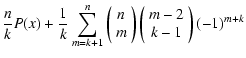
![$\displaystyle \phantom{\frac{n}{k} P(x) + \frac{1}{k} \sum_{m=k+1}^n}
\times \bigl[ P(x) \bigr]^m \; .$](/articles/aa/full/2005/28/aa2267-04/img343.gif)
![\begin{displaymath}
P^n_{\ge k+1}(0) = \frac{1}{n - k} \biggl[ \frac{n}{2} -
\sum_{k'=1}^k P^n_{k'}(1/2) \biggr] \; .
\end{displaymath}](/articles/aa/full/2005/28/aa2267-04/img347.gif)
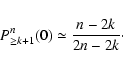
![\begin{displaymath}
x \simeq \left[ \frac{\rm dP^n_{\ge k+1}}{\rm dx}\right]^{-...
...{2} - P^n_{\ge k+1}(0) \right] \simeq \frac{k}{2 n p(0)} \cdot
\end{displaymath}](/articles/aa/full/2005/28/aa2267-04/img351.gif)