![[*]](/icons/foot_motif.gif)
R. M. C. Thomas - R. T. Gangadhara
Indian Institute of Astrophysics, Bangalore - 560034, India
Received 19 May 2004 / Accepted 15 February 2005
Abstract
We present a relativistic model for the motion of charged particles
in rotating magnetic field lines projected onto a plane
perpendicular to the rotation axis. By making an approximation that the
projected field lines are straight, an analytical expression is obtained
for the particle trajectory. The motive behind developing this model is
to elucidate some of the effects of rotation in pulsar profiles. There is
significant contribution to the curvature of a particle trajectory due to the
rotation of the pulsar, which is in addition to the inherent curvature of the
field lines. The asymmetry in the observed pulse shapes can be explained by
considering the aberration-retardation effects. The single sign circular
polarization observed in many pulsars
might be due to the relative orientation of sight line with respect to the
particle trajectory plane.
Key words: pulsars general - radiation mechanisms: non-thermal - stars: rotation - magnetic fields - radio continuum: general
The wide diversity in the radiation characteristics of pulsars makes it difficult to fully understand the emission process in the light of models that have been developed with some simplifying assumptions. Among all the many emission mechanisms, curvature emission has emerged as the most probable choice (Sturrock 1971; Ruderman & Sutherland 1975, hereafter RS75; Lyne & Manchester 1988; Gil & Snakowski 1990). In order to explain the high brightness temperature observed in pulsars, coherent emission by bunched particles has been postulated (Karpman et al. 1975; RS75; Buschauer & Benford 1977). Other models based on plasma effects have also been proposed for pulsar radiation (e.g., Melrose & Gedalin 1999; Asséo & Rozele 2000; Gil et al. 2004).
Most of these models emphasise explaining the high brightness temperature of pulsars, but leave the polarization poorly explained. However, polarization observations such as the polarization angle swing favors curvature radiation. It has been considered as a natural emission process for pulsars, though there are unresolved problems like bunch formation, orthogonal polarization modes, etc. (e.g., Stinebring et al. 1984; Gangadhara 1997; Gil et al. 2004).
It is imperative to understand the influence of rotation when closely studying the curvature emission mechanism. The idealized case of particle acceleration was discussed by Machabeli & Rogava (1994, hereafter MR94), who considered particles moving freely along an infinitely long, rigidly rotating straight tube and derived an expression for the trajectory of a particle. Gangadhara & Lesch (1997) proposed a model for the particle acceleration in rotating magnetosphere in the context of active galactic nuclei (AGN). Reiger & Mannhiem (2000) also discussed particle acceleration along the rotating straight magnetic field lines in AGN, by assuming that the angular velocity of particles is the same as that of AGN.
In the case of pulsars, Gold (1969) was the first to propose a pulsar emission mechanism based on rotation. This model was taken up further by many authors and found to encounter difficulties in explaining the interpulses (e.g., Sturrock 1971). Blaskiewicz et al. (1991) have studied the effects of corotation velocity on the pulsar radio emission by assuming a constant emission height. Hibschhman & Arons (2000) extended their work to include the first order effects to study delays in the phase of polarization angle sweep due to aberration. Later, Peyman & Gangadhara (2002) improvised the model of Blaskiewicz et al. (1991) by relaxing the assumption of constant emission height, and then analyzed the effect of rotation on the morphology of pulsar profiles and polarization.
Gangadhara (1996, hereafter G96) derived the equation of motion of a charged particle in pulsar magnetosphere, and considered the straight field lines, which are projected onto a two dimensional (2D) plane placed perpendicular to the rotation axis. The dominant forces, which act on a particle moving along rotating the field lines, are the magnetic Lorentz force, centrifugal force, and coriolis force. The rotational energy of the pulsar is transferred to the corotating plasma as it moves along the field lines. The magnetic Lorentz force acts as a constraining force and drags the plasma along the field lines. Because of the inclination of the magnetic axis relative to rotation axis, corotating plasma tends to rotate with an angular velocity that is less than that of pulsar on some field lines. The difference in the angular velocities of particle and pulsar had been already pointed out in RS75.
In the present work, a follow-up to G96, we consider the same 2D geometry and analyze the dynamics of a charged particle. Since the field line curvature radii of open field lines are comparable to the light cylinder radius, over a significant radial distance, we can approximate them to be straight lines.
In super strong magnetic fields, the drift velocity becomes negligible compared to the velocity parallel to the field lines. The Larmour radius of gyration becomes quite small, and hence particles almost stay on the same field lines all along their trajectories. This motion is considered as the bead-on-wire approximation. The particles are accelerated because of the unbalanced centrifugal force, and thus extract the rotational energy of the pulsar. The single particle emission is considered in this model, and we plan to consider the collective effects in later work. We take the non-uniform angular velocity of particles into consideration, which can be less than the pulsar angular velocity on field lines that are inclined with respect to the meridional plane. Since the particle trajectories are found to be curved, we estimate the curvature emission and analyze the effects of rotation on the radiation characteristics. In Sects. 2 and 3, we solve the equation of motion of a relativistic charged particle and find its trajectory. We compute the characteristic frequency of curvature radiation in Sect. 4. In Sect. 5 we estimate the polarization parameters and plot them with respect to different parameters.
We assume that the dipolar magnetic field lines are projected onto a
plane perpendicular to the rotation axis. Consider an inertial
Cartesian coordinate system as shown in Fig. 1, where
the "z'' axis is parallel to the rotation axis (
 )
of
pulsar. The projected magnetic axis on the x-y plane coincides with
the x-axis at time t =0. The equation of motion for a charged
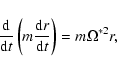
particle moving along a rotating magnetic field line is given by
(G96),
)
of
pulsar. The projected magnetic axis on the x-y plane coincides with
the x-axis at time t =0. The equation of motion for a charged
particle moving along a rotating magnetic field line is given by
(G96),
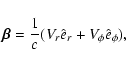
 is the relativistic mass,
  the
Lorentz factor, m0 the rest mass,
the
Lorentz factor, m0 the rest mass,
 the angular velocity
and r the radial position of a particle.
the angular velocity
and r the radial position of a particle.
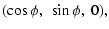
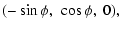
Let
 and
and
 be the components of
particle velocity, then
be the components of
particle velocity, then
 |
= |  |
(3) |
 |
= |  |
(4) |
 is the angle between the radial vector to particle and
the x-axis.
is the angle between the radial vector to particle and
the x-axis.
![\begin{figure}
\par\includegraphics[width=8cm,clip]{1319fig1.eps}
\end{figure}](/articles/aa/full/2005/26/aa1319-04/img31.gif) |
Figure 1: The coordinate system in which the particle motion is considered. The curve BQ represents the particle trajectory in the x-y plane. |
| Open with DEXTER | |
 with respect to the
x-axis at time t=0. Let
with respect to the
x-axis at time t=0. Let
 be the distance
between B and the rotation axis.
The effective angular velocity (G96) of a particle is given by
be the distance
between B and the rotation axis.
The effective angular velocity (G96) of a particle is given by
 is the angular velocity of pulsar,
 and
and
 is the angle
between the field line tangent and
is the angle
between the field line tangent and
 at B. Using the
relation for
at B. Using the
relation for
 we can write
as
we can write
as
 Thus, using the expression for
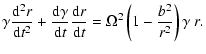
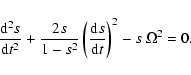
 we rewrite Eq. (1):
 and
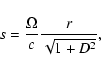
defining a dimensionless variable
and
defining a dimensionless variable
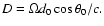
 is close to
  for the field lines, which are
close to the x-axis, we find
for the field lines, which are
close to the x-axis, we find
 for d0 < r.
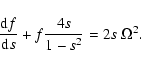
Therefore, we reduce Eq. (10) by dropping the terms
containing
D2/1+D2, and obtain
for d0 < r.
Therefore, we reduce Eq. (10) by dropping the terms
containing
D2/1+D2, and obtain
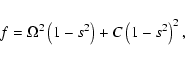
 ,
we
can reduce it to the following form:
,
we
can reduce it to the following form:
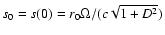 and
and
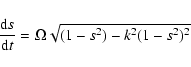
 where r0 and v0 are the particle's initial position and velocity.
Therefore, we obtain
where r0 and v0 are the particle's initial position and velocity.
Therefore, we obtain
 and
and
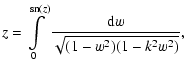
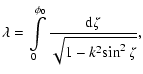
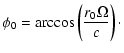
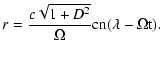
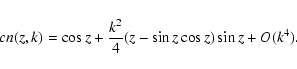
 is the Jacobian Elliptical cosine function
(Abramowicz & Stegun 1972), and
is the Jacobian Elliptical cosine function
(Abramowicz & Stegun 1972), and
 where P is the pulsar period. Next, the
particle returns back to origin, due to the reversal of the
centrifugal force. This type of oscillatory motion of a particle
in an infinitely long, straight and rigidly rotating tube has been
discussed by MR94.
where P is the pulsar period. Next, the
particle returns back to origin, due to the reversal of the
centrifugal force. This type of oscillatory motion of a particle
in an infinitely long, straight and rigidly rotating tube has been
discussed by MR94.
Though we have extended the calculation of r of a single particle
all the way up to light cylinder, it may not be realistic in the case
of plasma motion. Near the light cylinder, plasma inertia causes the
field lines to sweep back and break down of the rigid body motion.
![\begin{figure}
\par\includegraphics[width=6cm,clip]{1319fig2.eps}
\end{figure}](/articles/aa/full/2005/26/aa1319-04/img69.gif) |
Figure 2:
Radial position of the particle as a
function of time. Used
 d0=106 cm and
 . . |
| Open with DEXTER | |
 |
(21) |
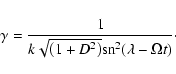
In Fig. 3 we consider a particle moving along the
field line BQ. The point A represents the particle injection point at time t=0 that
is at a distance d0 from the rotation axis. The particle
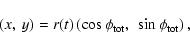
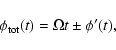
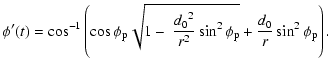
co-ordinates can be defined as
 is the angle between the radial vector to the
particle and the x-axis. Based on Fig. 3, we
define
is the angle between the radial vector to the
particle and the x-axis. Based on Fig. 3, we
define
 we find
 signs in Eq. (23) correspond to the sign
of the angle
signs in Eq. (23) correspond to the sign
of the angle
 In Fig. 4 we have
plotted the trajectories of the particles moving along different
magnetic field lines, which are marked with
It shows that the
trajectories are curved toward the direction of pulsar rotation.
The particles moving in those trajectories are accelerated, and thus
emit curvature radiation. The curvature radii of those
trajectories slightly differ from one another, as the particle
angular
is different for each field line.
In Fig. 4 we have
plotted the trajectories of the particles moving along different
magnetic field lines, which are marked with
It shows that the
trajectories are curved toward the direction of pulsar rotation.
The particles moving in those trajectories are accelerated, and thus
emit curvature radiation. The curvature radii of those
trajectories slightly differ from one another, as the particle
angular
is different for each field line.
![\begin{figure}
\par\includegraphics[width=5cm,clip]{1319fig3.eps}
\end{figure}](/articles/aa/full/2005/26/aa1319-04/img78.gif) |
Figure 3:
The geometry of motion of a particle along a rotating field line BQ.
The angles are

 and
and
 and the radius
 |
| Open with DEXTER | |
![\begin{figure}
\par\includegraphics[width=6cm,clip]{1319fig4.eps}
\end{figure}](/articles/aa/full/2005/26/aa1319-04/img79.gif) |
Figure 4:
Particle trajectories during the time
interval
 s in laboratory frame. We considered the
field lines which lie in the range of s in laboratory frame. We considered the
field lines which lie in the range of
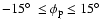 with
an interval of
with
an interval of
 Assumed neutron star radius
 Km. Km. |
| Open with DEXTER | |
To derive the curvature radii of the particle trajectory, we
approximate
 and r(t) using the
formalism given by Pearson (1974):
and r(t) using the
formalism given by Pearson (1974):
 and
and  ,
the series expansion
of r(t) is given by
,
the series expansion
of r(t) is given by
For
 Eq. (14) implies
 Therefore, using
Eqs. (16)-(19), we find
Therefore, using
Eqs. (16)-(19), we find
 and
and
 Thus,
we have
Thus,
we have
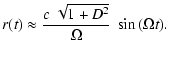 |
(28) |
 However, for other
values of
However, for other
values of  we find
  becomes slightly larger than rL/2.Note that these values of
are comparable to the intrinsic curvature
radii of dipolar field lines in the emission region given by Gangadhara
(2004). We find in the conal emission regions that the intrinsic
curvature radii of field lines
are comparable to the curvature radius induced by rotation on the particle
trajectory. If the core emission is believed to come from the field lines
that are close to the magnetic axis, then it becomes difficult to explain the
core emission due to the intrinsic curvature of field lines. This is because
the field lines that are very close to the magnetic axis have very large
curvature radii, and for the magnetic axis it is infinity. Therefore, in
the absence of rotation, we cannot expect any significant curvature emission
from the particles or plasma moving along the field lines that are close to
the magnetic axis. However, from the observations we do see many pulsars
emitting strong cores. In our model
we show that if we consider pulsar rotation
the core emission can be explained, because the
rotation induces significant curvature into the trajectory
of particles which move along the field lines
that are close to the magnetic axis.
becomes slightly larger than rL/2.Note that these values of
are comparable to the intrinsic curvature
radii of dipolar field lines in the emission region given by Gangadhara
(2004). We find in the conal emission regions that the intrinsic
curvature radii of field lines
are comparable to the curvature radius induced by rotation on the particle
trajectory. If the core emission is believed to come from the field lines
that are close to the magnetic axis, then it becomes difficult to explain the
core emission due to the intrinsic curvature of field lines. This is because
the field lines that are very close to the magnetic axis have very large
curvature radii, and for the magnetic axis it is infinity. Therefore, in
the absence of rotation, we cannot expect any significant curvature emission
from the particles or plasma moving along the field lines that are close to
the magnetic axis. However, from the observations we do see many pulsars
emitting strong cores. In our model
we show that if we consider pulsar rotation
the core emission can be explained, because the
rotation induces significant curvature into the trajectory
of particles which move along the field lines
that are close to the magnetic axis.
When the particles move along curved trajectories, they emit
curvature radiation. The characteristic frequency of the curvature
radiation is given by (RS75)
and
from Eqs. (7)
and (29), we can estimate
 The total power emitted by a particle is given by
 at
r =0.5 rL. We find maximum power
is emitted by the particles that move along the field line with
at
r =0.5 rL. We find maximum power
is emitted by the particles that move along the field line with
 as D=0, compared to those on the other field lines

![\begin{figure}
\par\includegraphics[width=6cm,clip]{1319fig5.eps}
\end{figure}](/articles/aa/full/2005/26/aa1319-04/img105.gif) |
Figure 5:
The power emitted by a particle as a function of
Theparameter
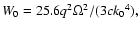 and k0=k at D=0.
 |
| Open with DEXTER | |
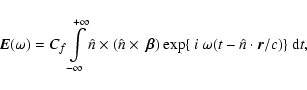
The radiation electric field is given by (e.g., Jackson 1972; Gangadhara 1997)
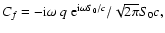 S0 is the distance from the origin to observer,
  the radiation
frequency and
the radiation
frequency and  the sight line. To solve the integral, we shall express
 (see Appendix A) and the
argument of exponential as series expansions in time t.
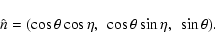
Consider the sight line which makes an angle
(see Appendix A) and the
argument of exponential as series expansions in time t.
Consider the sight line which makes an angle  with
the 2D plane, and
with
the 2D plane, and  with the x-axis:
 )
form an
orthogonal triad:
)
form an
orthogonal triad:
 aligns with
  and the observer receives radiation. We transform the time
variable t to t+t0 such that
and the observer receives radiation. We transform the time
variable t to t+t0 such that
 stands for an
initial phase. Thus, we find
stands for an
initial phase. Thus, we find
 replaced by

Using Eqs. (20) and (22), we find the series expansion of
the exponential argument in Eq. (32) and keep the terms up to the
order of t3:
 the series expansion of r behaves like the
trigonometric sine function. Since the angular width of emission beam is
the series expansion of r behaves like the
trigonometric sine function. Since the angular width of emission beam is

 the time taken by the particle to cross the angular
width of the order of emission beam is
the time taken by the particle to cross the angular
width of the order of emission beam is
 Thus the
truncation of higher order terms introduces a negligible error in our
calculations. Since we intend to reduce the integral in Eq. (32)
to a known form, we limit the series expansion terms up to the order of t3.
Thus the
truncation of higher order terms introduces a negligible error in our
calculations. Since we intend to reduce the integral in Eq. (32)
to a known form, we limit the series expansion terms up to the order of t3.
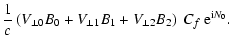
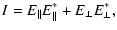
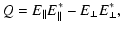
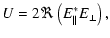
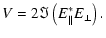
Using the transformation given by Buschauer & Benford (1976), we find the
electric field components (see Appendix B):
 |
= |  |
(39) |
 |
= |  |
(40) |
 |
|||
 |
|||
 |
|||
 |
(41) |
 |
(42) |
We consider a set of field lines on the 2D plane, and estimate the
total emission by particles accelerated along them. During pulsar
rotation, the sight line stays at a particular
with respect
to the 2D plane. Since the emission from each particle is
relativistically beamed in the direction of velocity
 the observer tends to receive the radiation from all those particles,
for which
falls with in the angular width of
the observer tends to receive the radiation from all those particles,
for which
falls with in the angular width of  with respect
to
with respect
to 
First we estimate the polarization parameters of the radiation
emitted by a single particle at the instant
 The
instant t0 is the time at which
The
instant t0 is the time at which
 for a
given initial
As the rotation progresses, new t0 is
computed for the advanced rotation phase by again solving
and computing the polarization parameters. This
procedure is continued till
for a
given initial
As the rotation progresses, new t0 is
computed for the advanced rotation phase by again solving
and computing the polarization parameters. This
procedure is continued till
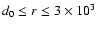
 where
where
 is
the time at which the particle goes out of radio emission zone
(
is
the time at which the particle goes out of radio emission zone
(
 Km). Since the radiation is emitted
over a range of r, and due to the aberration and retardation, the radiation
beam gets shifted to the leading side of the pulse. The role of
retardation and aberration phase shifts has been discussed by e.g.,
Phillips (1992) and Gangadhara & Gupta (2001).
Km). Since the radiation is emitted
over a range of r, and due to the aberration and retardation, the radiation
beam gets shifted to the leading side of the pulse. The role of
retardation and aberration phase shifts has been discussed by e.g.,
Phillips (1992) and Gangadhara & Gupta (2001).
In order to compute the total polarization parameters with respect to the rotation phase, we first the polarization parameters due to single particles into groups of phase bins and add them. In the following steps, we give the details of the procedure followed:
with respect to the 2D plane;
 with a successive line spacing of
 ;
;
 to find t0 at the point of
emission on the trajectory corresponding to each field line, and
estimate the polarization parameters at those points;
to find t0 at the point of
emission on the trajectory corresponding to each field line, and
estimate the polarization parameters at those points;
 from
assigned for each of the emission beam, and estimate the
effective rotation phase;
to a new phase,
and repeat the procedure (1-4) over the range of
from
assigned for each of the emission beam, and estimate the
effective rotation phase;
to a new phase,
and repeat the procedure (1-4) over the range of
 ;
;
 The profiles indicate that the peak emissions are
shifted to the earlier phase as a consequence
of the aberration-retardation effect.
The profiles indicate that the peak emissions are
shifted to the earlier phase as a consequence
of the aberration-retardation effect.
![\begin{figure}
\par\includegraphics[width=8.8cm,clip]{1319fig6.eps}
\end{figure}](/articles/aa/full/2005/26/aa1319-04/img152.gif) |
Figure 6:
The simulated profiles: panel a) for
 and
panel b) for
and
panel b) for
 The parameter
is the rotation phase.
Used
The parameter
is the rotation phase.
Used
 and d0 = 10 Km.
 |
| Open with DEXTER | |
For simplicity we considered the dipole field lines projected onto
a 2D plane. The relativistic particles are assumed to be streaming outward
along such a field configuration with an initial Lorentz factor in the range of
 Since our aim is to understand the rotation effects on
particle dynamics and pulse profile, we consider the single
particle emission and leave the collective plasma emissions to
later works. We are interested in the region which extends from a few stellar
radii to a radial distance well within the light cylinder, where the
radio emission is expected to occur and the bead-on-wire approximation holds.
Though we have approximated the particle motion to 2D, we are able to
investigate the influence of rotation on pulsar profiles. Our model is
more relevant for those
cases where the inclination angle
Since our aim is to understand the rotation effects on
particle dynamics and pulse profile, we consider the single
particle emission and leave the collective plasma emissions to
later works. We are interested in the region which extends from a few stellar
radii to a radial distance well within the light cylinder, where the
radio emission is expected to occur and the bead-on-wire approximation holds.
Though we have approximated the particle motion to 2D, we are able to
investigate the influence of rotation on pulsar profiles. Our model is
more relevant for those
cases where the inclination angle  of the magnetic axis
relative to rotation axis is large enough. In such cases, the
projected field lines may be approximated to be straight lines over a
significant radial distance. We derived an expression for
the radial position of a particle (Eq. (20)), which shows
an oscillatory behavior, as shown in Fig. 2. A
similar case of particle motion in an infinitely long, straight,
and rigidly rotating tube, was discussed by considering a
gedanken experiment by MR94, who show
that due to the centrifugal force reversal, the particle returns back
to the rotation axis after reaching a maximum distance at which the
rotation velocity reaches the speed of light. This turns out to be an
oscillatory motion in the radial direction.
Gangadhara (1996) showed that the particle
angular velocity cannot be same as the field line angular velocity
if the magnetic axis is inclined with respect to the rotation axis. We
considered this effect in our treatment of particle motion, and
found the particle trajectories and their curvature radii vary
with field line orientation.
of the magnetic axis
relative to rotation axis is large enough. In such cases, the
projected field lines may be approximated to be straight lines over a
significant radial distance. We derived an expression for
the radial position of a particle (Eq. (20)), which shows
an oscillatory behavior, as shown in Fig. 2. A
similar case of particle motion in an infinitely long, straight,
and rigidly rotating tube, was discussed by considering a
gedanken experiment by MR94, who show
that due to the centrifugal force reversal, the particle returns back
to the rotation axis after reaching a maximum distance at which the
rotation velocity reaches the speed of light. This turns out to be an
oscillatory motion in the radial direction.
Gangadhara (1996) showed that the particle
angular velocity cannot be same as the field line angular velocity
if the magnetic axis is inclined with respect to the rotation axis. We
considered this effect in our treatment of particle motion, and
found the particle trajectories and their curvature radii vary
with field line orientation.
Since the magnetic field is very strong, the Larmour radius of gyration and drift velocity of the charged particles become very small. So, the particles are assumed to follow the same set of field lines all along their trajectories. In the case of single particle dynamics, the magnetic field dominates so that the rigid body motion may be extended all the way up to the light cylinder. But in reality plasma corotates with the neutron star, and we must take the plasma inertia into account in the region close to the light cylinder. Therefore, it is possible that the magnetic field lines will sweep back and can lead to the generation of toroidal magnetic field. Hence the oscillatory motion that our solution predicts cannot be achieved in a real physical situation like pulsars, and the particle which reaches the vicinity of the light cylinder cannot come back, but escapes from the magnetosphere as a pulsar wind.
We find the energy of particle increases due to the centrifugal
force, as indicated by the Eq. (7) for Lorentz
factor  In this way the rotational energy of neutron star gets
transferred to the particles via the magnetic field lines.
In this way the rotational energy of neutron star gets
transferred to the particles via the magnetic field lines.
We find that the radius of curvature of particle trajectory is
approximately rL/2, which is comparable to the inherent radius of
curvature of dipolar field lines (Gangadhara 2004). We, therefore
believe that
curvature emission due to the rotational motion of particles should
be comparable to the actual curvature emission in a corotating frame.
Both the Lorentz factor and the characteristic frequency reach the maxima
in the region close to light cylinder. Our model
thus indicates that
high frequency radiation (e.g., X-ray, -ray) may be emitted in the
regions close to light cylinder.
In a later work, Rogava et al. (2003) show that if a particle
moves freely along a tube with an
arbitrary curvature, the centrifugal force does not always reverse.
They show that the particles move in the tube with
a variable angular velocity. This supports our result that the particles'
angular velocity on some field
lines differs from that of pulsar's;
that is, the particles moving along the field lines with
rotate with
the angular velocity that is same as the pulsar angular velocity.
But those moving along other field lines, for which
 rotate with the angular velocity which is smaller than the pulsar
angular velocity. The particles moving along the field lines with
rotate with the angular velocity which is smaller than the pulsar
angular velocity. The particles moving along the field lines with
 tend to emit more power than those moving along other
field lines, such that the profile in Fig. 5 shows a peak at
tend to emit more power than those moving along other
field lines, such that the profile in Fig. 5 shows a peak at
 Also, it is evident from observations that the peak of pulsar
profiles (core) is, probably, emitted from the field lines with
Also, it is evident from observations that the peak of pulsar
profiles (core) is, probably, emitted from the field lines with
We have reproduced a simulated pulse profile (Fig. 6)
adding the radiation emitted by particles accelerated on a set of
field lines, by taking aberration-retardation into account. The sign of
has been flipped to match with the
phase sign convention followed in pulsar profiles. The roughness
in the curves of Fig. 6 are due to the increments
of
in
and  This choice was made based on the
limitation in computing time. However, the smoother profiles can always
be generated by choosing smaller increments and opting for longer computing
time. Since we consider uniform plasma flow along the field lines, our
profiles do not have subpulse components.
This choice was made based on the
limitation in computing time. However, the smoother profiles can always
be generated by choosing smaller increments and opting for longer computing
time. Since we consider uniform plasma flow along the field lines, our
profiles do not have subpulse components.
Our model shows effects, such as aberration and retardation, which make the pulse profiles to become asymmetric about the pulse center. This phenomenon has been observed in most of the pulsar profiles (e.g., Gangadhara & Gupta 2001; Gupta & Gangadhara 2003).
In our model, we find that if the sight line is at a fixed angle
(
 see Fig. 6) to the
particle trajectory plane, the observer
tends to receive a single sign circular
polarization,
as observed in many pulsars (e.g., Han et al. 1998). As a followup to this
work, we plan to consider the full 3D dynamics of plasma in a rotating dipolar
magnetic field, and estimate the coherent radiation.
see Fig. 6) to the
particle trajectory plane, the observer
tends to receive a single sign circular
polarization,
as observed in many pulsars (e.g., Han et al. 1998). As a followup to this
work, we plan to consider the full 3D dynamics of plasma in a rotating dipolar
magnetic field, and estimate the coherent radiation.
By considering projected dipolar magnetic field lines on a plane perpendicular to the rotation axis, we have developed a 2D model for the particle dynamics in a pulsar magnetosphere. The motive behind developing this model was to elucidate some of the rotational effects induced in the pulsar profiles. We obtained the analytical expressions for the particle trajectory and its curvature radius. The energy of particles increase at the expense of the neutron star's rotational energy. We find the sight line orientation relative to the particle trajectory plane might determine the sign of circular polarization. The asymmetries observed in the pulse profiles can be explained by considering the aberration-retardation effects.
Acknowledgements
We thank Jayanth Murthy for comments.
 (n
)
that
appears in Eq. (32)
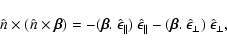
in Cartesian co-ordinates:
(n
)
that
appears in Eq. (32)
in Cartesian co-ordinates:
 and
and  are the unit vectors along the x and
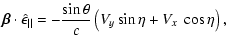
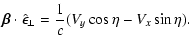
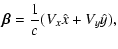
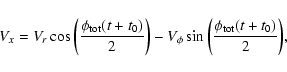
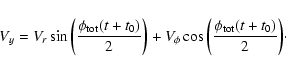
y-axes, respectively, (Fig. 1). Then it follows from
Eq. (2) that
are the unit vectors along the x and
y-axes, respectively, (Fig. 1). Then it follows from
Eq. (2) that
 :
:
 into
by Eqs. (A.2) and (A.3), we obtain
,
into
by Eqs. (A.2) and (A.3), we obtain
,
 and
and
 we obtain
 |
(A.7) |
 |
(A.8) | ||
 |
(A.9) |
 |
(A.11) | ||
 |
(A.12) |
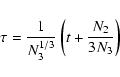
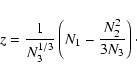
Consider
 |
(B.2) |
 |
(B.3) |
![$\displaystyle \int\limits_{-\infty}^{\infty} t ~\exp[{ \rm i}(N_1t+N_2t^2+N_3t^3)]~ {\rm d}t
=$](/articles/aa/full/2005/26/aa1319-04/img181.gif) |
|||
![$\displaystyle \frac{1}{N_3^{2/3}} {\rm e}^{{\rm i} C_{\rm n}} \Big[ \int\limits...
...^{\infty} \exp\left[{\rm i}\left(z\tau+\tau^3\right)\right]~{\rm d}\tau ~ \Big]$](/articles/aa/full/2005/26/aa1319-04/img182.gif) |
(B.4) |
![$\displaystyle \int\limits_{-\infty}^{\infty}t^2\exp\left[{\rm i}\left(N_1t+N_2t^2+N_3t^3\right)\right]~{\rm d}t =$](/articles/aa/full/2005/26/aa1319-04/img183.gif) |
|||
![$\displaystyle \frac{1}{N_3^{1/3}}{\rm e}^{{\rm i} C_{\rm n}}\Bigg[C_{\rm m}\int...
...^{\infty}
{\rm {exp}}\left[{\rm i}\left(z\tau+\tau^3\right)\right]~ {\rm d}\tau$](/articles/aa/full/2005/26/aa1319-04/img184.gif) |
|||
![$\displaystyle + C_{\rm {p}}\int\limits_{-\infty}^{\infty}~\tau
\exp\left[{\rm i}\left(z\tau+\tau^3\right)\right]~ {\rm d}\tau \Bigg] .$](/articles/aa/full/2005/26/aa1319-04/img185.gif) |
(B.5) |
| L1(z) | = | ![$\displaystyle \int\limits_{-\infty}^{\infty}
\exp\left[{\rm i}\left(z\tau+\tau^3\right)\right]~ {\rm d}\tau$](/articles/aa/full/2005/26/aa1319-04/img186.gif) |
|
| = | ![$\displaystyle \frac{2}{3}\sqrt{z}~{\rm K}_{1/3} \left[2(z/3)^{3/2}\right] ,$](/articles/aa/full/2005/26/aa1319-04/img187.gif) |
(B.6) | |
| L2(z) | = | ![$\displaystyle \int\limits_{-\infty}^{\infty}
\tau \exp\left[{\rm i}\left(~z\tau+\tau^3\right)\right]~ {\rm d}\tau$](/articles/aa/full/2005/26/aa1319-04/img188.gif) |
|
| = | ![$\displaystyle {\rm i}
\frac{2}{\sqrt{27}}~z~{\rm K}_{2/3}\left[2(z/3)^{3/2}\right] ,$](/articles/aa/full/2005/26/aa1319-04/img189.gif) |
(B.7) | |
| B0 | = |  |
(B.8) |
| B1 | = | ![$\displaystyle \frac{1}{N_3^{2/3}}{\rm e}^{{\rm i} C_{\rm n}}[{\rm L}_2(z)-C_{\rm l}{\rm L}_1(z)] ,$](/articles/aa/full/2005/26/aa1319-04/img191.gif) |
(B.9) |
| B2 | = | ![$\displaystyle \frac{1}{N_3^{1/3}} {\rm e}^{{\rm i} C_{\rm n}}\left[C_{\rm m}{\rm L}_1(z)-C_{\rm p}
{\rm L}_2(z)\right] ,$](/articles/aa/full/2005/26/aa1319-04/img192.gif) |
(B.10) |
| Cl | = |  |
(B.11) |
| Cn | = | ![$\displaystyle \frac{N_2}{3N_3}\left[\frac{2N_2^{2}}{9N_3}-N_1\right] ,$](/articles/aa/full/2005/26/aa1319-04/img194.gif) |
(B.12) |
| Cm | = | ![$\displaystyle \left[\frac{2N_2^2}{9N_3^2}-\frac{N_1}{3N_3}\right] ,$](/articles/aa/full/2005/26/aa1319-04/img195.gif) |
(B.13) |
| Cp | = |  |
(B.14) |
![\begin{displaymath}
\gamma = \frac{1}{\sqrt{1-\beta^2}} = \left[1-
\left(\frac...
...^2 -
\left(\frac{r\Omega^{*}}{c}\right)^2\right]^{-1/2}\cdot
\end{displaymath}](/articles/aa/full/2005/26/aa1319-04/img32.gif)

![$\displaystyle \Omega\left[\frac{r^2-d_0^2\cos^2\theta_0 -d_0
\sin\theta_0\sqrt{...
...a_0}}
{r\left(\sqrt{r^2-{d_0}^2\cos^2\theta_0}
- d_0\sin\theta_0\right)}\right]$](/articles/aa/full/2005/26/aa1319-04/img36.gif)

![\begin{displaymath}
{\gamma=\left [1+D^2 - \left(\frac{1}{c}\frac{{\rm d}r}{{\rm d}t}\right)^2-
\left(\frac{r\Omega}{c}\right)^2\right]^{-1/2}},
\end{displaymath}](/articles/aa/full/2005/26/aa1319-04/img43.gif)

![\begin{displaymath}
k^2=\frac{1}{1-s^2_0}\left[1-
\frac{{\dot{s_0}}^2}{(1-s^2_0)\Omega^2}\right]\cdot
\end{displaymath}](/articles/aa/full/2005/26/aa1319-04/img60.gif)



![$\displaystyle \frac{\left[({\rm d}x/{\rm d}t)^2+({\rm d}y/{\rm d}t)^2\right]^{3...
.../{\rm d}t)
({\rm d}^2y/{\rm d}t^2) -({\rm d}y/{\rm d}t)({\rm d}^2x/{\rm d}t^2)}$](/articles/aa/full/2005/26/aa1319-04/img90.gif)


![$\displaystyle 3~ \Omega \frac{1+D^2} {k^3\left[ 1+D^2-(r/r_L)^2\right]^3}\cdot$](/articles/aa/full/2005/26/aa1319-04/img98.gif)

![$\displaystyle \frac{8~ q^2}{3~ c}~ \frac{ \Omega^2 (1+D^2)}{k^4
[1+D^2-(r/r_L)^2 ]^4} ,$](/articles/aa/full/2005/26/aa1319-04/img101.gif)



![$\displaystyle \omega \left[(t+t_0)-\frac{\hat{n}.\vec{r}}{c}\right]$](/articles/aa/full/2005/26/aa1319-04/img123.gif)
![$\displaystyle \omega\left[t+t_0 - \frac{ r }{c}\cos\theta \left(\cos\eta~
\cos\phi_{\rm {tot}} + \sin\eta~ \sin\phi_{\rm {tot}}\right)\right] ,$](/articles/aa/full/2005/26/aa1319-04/img124.gif)


![$\displaystyle \hat{n}\times\left( \hat{n} \times \vec{\beta}\right)
= \frac{1}{...
...right)
+ \hat{\epsilon}_{\perp}(V_{\perp 0}
+V_{\perp~ 1}t+V_{\perp~ 2})\Big] ,$](/articles/aa/full/2005/26/aa1319-04/img175.gif)
![$\displaystyle \int\limits_{-\infty}^{\infty}
\ {\rm { exp}}\left[{\rm i}\left(N...
...limits_{-\infty}^{\infty}\exp[{\rm i} \left(z\tau+\tau^3\right)]~ {\rm d}\tau ,$](/articles/aa/full/2005/26/aa1319-04/img178.gif)