 Carinae
A&A 435, 183-189 (2005)
DOI: 10.1051/0004-6361:20041193
CarinaeS. Johansson 1 - T. R. Gull 2 - H. Hartman 1 - V. S. Letokhov 1,3
1 - Lund Observatory, Lund University, PO Box 43, 22100 Lund, Sweden
2 - Code 667, Goddard Space Flight Center, Greenbelt, MD, USA
3 - Institute of Spectroscopy, Russian Academy of Sciences, Troitsk, Moscow region, 142190, Russia
Received 29 April 2004 / Accepted 1 February 2005
Abstract
Spectroscopy with the high spatial resolution of the Hubble Space
Telescope (HST) reveals narrow absorption in the hydrogen Balmer lines in
spectra of Eta Carinae and the nearby nebular-scattered starlight. While
hydrogen Balmer absorption lines are seen in stellar photospheres and winds, we
are not aware of such being seen in galactic nebulae. This exceptional case is
caused by intense stellar UV radiation acting on high-density neutral
clumps of gas in the close vicinity of the central source. The interaction
of the UV radiation with hydrogen results in photo-ionization and photo-excitation leading to a non-equilibrium population of the metastable 2s 2S level. This occurs throughout the equatorial region surrounding Carinae in sufficient quantity to produce strong narrow absorption on top of the broad P Cygni emission profile. This absorption can be considered to be a probe of the very non-uniform ejecta in the disk region surrounding Carinae.
Key words: atomic processes - line: formation - line: profiles - H II regions -
radiation mechanisms: non-thermal - stars: individual:
Carinae
Eta Carinae (
Car) is a very massive (>
 ), variable star
emitting 5
), variable star
emitting 5 
 ,
and is considered a prototype for the
Luminous Blue Variables (LBV's) (Davidson & Humphreys 1997). The star itself, most likely a
binary (Damineli 1996; Pittard & Corcoran 2002), is surrounded by massive, mostly neutral material in
the form of the Homunculus, ejected during the Great Eruption of the 1840's. The
rapidly expanding bipolar-lobed structure now extends 18 arcsec across the sky
and is tilted from line of sight by 41 degrees (Davidson et al. 2001). Between
these lobes is a more slowly moving skirt, that extends from the very near
vicinity of Car radially outward. Three nearly pointlike knots, called
the Weigelt blobs B, C and D, were first observed by speckle interferometry
(Weigelt & Ebersberger 1986). The Weigelt blobs were later identified with HST's Faint
Object Spectrograph to be emission nebulae (Davidson et al. 1995). More recently
Smith et al. (2004) identified several more knots that form a complete chain
surrounding Car, but appear to be bright reflection knots. All these
knots are close to the central source (about 0.1 to 0.3 arcsec or a projected
distance of 230 to 700 AU at the adopted distance of 2300 pc to the star).
,
and is considered a prototype for the
Luminous Blue Variables (LBV's) (Davidson & Humphreys 1997). The star itself, most likely a
binary (Damineli 1996; Pittard & Corcoran 2002), is surrounded by massive, mostly neutral material in
the form of the Homunculus, ejected during the Great Eruption of the 1840's. The
rapidly expanding bipolar-lobed structure now extends 18 arcsec across the sky
and is tilted from line of sight by 41 degrees (Davidson et al. 2001). Between
these lobes is a more slowly moving skirt, that extends from the very near
vicinity of Car radially outward. Three nearly pointlike knots, called
the Weigelt blobs B, C and D, were first observed by speckle interferometry
(Weigelt & Ebersberger 1986). The Weigelt blobs were later identified with HST's Faint
Object Spectrograph to be emission nebulae (Davidson et al. 1995). More recently
Smith et al. (2004) identified several more knots that form a complete chain
surrounding Car, but appear to be bright reflection knots. All these
knots are close to the central source (about 0.1 to 0.3 arcsec or a projected
distance of 230 to 700 AU at the adopted distance of 2300 pc to the star).
Beginning in 1998, a series of observations have been accomplished with the HST's Space Telescope Imaging Spectrograph (STIS) taking advantage of its very
high angular resolution (Gull et al. 2001, see several HST Programs with Davidson or Gull
as Principal Investigator). From 1640-10 300 Å, CCD spectra of Car's central source, and thin slices of the Homunculus, were obtained with a
52
 0
0
 1 aperture and with a spectral resolving power
R =
1 aperture and with a spectral resolving power
R =
 7000. The observations reveal much detailed
information on the structure and the kinematics of the ejecta, plus temporal
variations during the 5.54-year period first noted by Damineli (1996). While the
Homunculus is primarily a reflection nebula centered on Car, its interior
surface is revealed in the local emission of singly-ionized metals such as [Ni II], and [Fe II] (Davidson et al. 2001). Interior to the Homunculus, and also centered
upon Car is the Little Homunculus (Ishibashi et al. 2003), an ionized bi-lobed
structure that extends about two arc seconds above and below. It, too, has an
associated skirt revealed by measurements of nebular emission line velocities
and proper motion. The Weigelt blobs are associated with this skirt structure
and consistent with the Little Homunculus being created by a lesser eruption in
the 1890's (Smith et al. 2003). The skirt region therefore contains many individual
ejecta moving at various velocities, produced by the two eruptions, and likely other events.
7000. The observations reveal much detailed
information on the structure and the kinematics of the ejecta, plus temporal
variations during the 5.54-year period first noted by Damineli (1996). While the
Homunculus is primarily a reflection nebula centered on Car, its interior
surface is revealed in the local emission of singly-ionized metals such as [Ni II], and [Fe II] (Davidson et al. 2001). Interior to the Homunculus, and also centered
upon Car is the Little Homunculus (Ishibashi et al. 2003), an ionized bi-lobed
structure that extends about two arc seconds above and below. It, too, has an
associated skirt revealed by measurements of nebular emission line velocities
and proper motion. The Weigelt blobs are associated with this skirt structure
and consistent with the Little Homunculus being created by a lesser eruption in
the 1890's (Smith et al. 2003). The skirt region therefore contains many individual
ejecta moving at various velocities, produced by the two eruptions, and likely other events.
![\begin{figure}
\par\includegraphics[width=13cm,clip]{1193fig1.eps}\end{figure}](/articles/aa/full/2005/19/aa1193-04/img21.gif) |
Figure 1:
Schematic picture of the HST/STIS observation. To the left the slit
position is superimposed on a WFPC2 image of Car and the Homunculus (Morse et al. 1998). To
the right is a three-dimensional image of a portion of the Balmer- spectrum
with intensity being the elevation. The stellar line profile is P-Cygni type in
shape, where the large valley feature (P Cygni) is the absorption of the massive
stellar wind moving in the direction of the observer. A narrow absorption
feature closer to the center originates from metastable hydrogen, 2s 2S,
located in extended low-density ejecta.
spectrum
with intensity being the elevation. The stellar line profile is P-Cygni type in
shape, where the large valley feature (P Cygni) is the absorption of the massive
stellar wind moving in the direction of the observer. A narrow absorption
feature closer to the center originates from metastable hydrogen, 2s 2S,
located in extended low-density ejecta. |
| Open with DEXTER | |
![\begin{figure}
\par\includegraphics[width=11.85cm,clip]{1193fig2.eps}\end{figure}](/articles/aa/full/2005/19/aa1193-04/img22.gif) |
Figure 2:
Balmer line profiles, Balmer-
(solid curve) and Balmer- (dashed curve),
in the line of sight to the central source ( left panel) and to the Weigelt blobs BD
( right panel). A narrow absorption component appears at different velocities
for the central source and the blobs.
(dashed curve),
in the line of sight to the central source ( left panel) and to the Weigelt blobs BD
( right panel). A narrow absorption component appears at different velocities
for the central source and the blobs. |
| Open with DEXTER | |
In the present paper we discuss the observation of narrow absorption components superimposed on the P Cygni profiles of Balmer lines in HST/STIS spectra of the central source and ejecta. We present an explanation based upon the double role of stellar radiation: first, the starlight produces metastable hydrogen in the 2s state in relatively cool, weakly ionized ejecta. Second, the extended, wind-driven atmosphere of the central source provides intense, broad Balmer emission line radiation. The interaction between the Balmer emission and the metastable hydrogen inside the ejecta results in narrow absorption superimposed on the wide Balmer lines. The broad P-Cygni Balmer emission profiles have been investigated by Davidson et al. (2005).
The radiation from the central source and its immediate vicinity (Figs. 1 and 2) exhibits narrow Balmer line absorption superimposed upon the emission portion of the P-Cygni Balmer line profiles. These narrow lines are present beginning with Balmer-
and continuing with several higher members of the Balmer series. In Fig. 1, we show an example of a long slit STIS spectrum
centered upon Balmer-
with the 0
1 wide aperture position
superimposed upon a WFPC2 image of Car and the Homunculus (Morse et al. 1998).
In heliocentric velocity space, the P-Cygni profile has a broad blue-shifted
absorption extending from -350 to -550 km s-1 and a broad emission with a red
tail. Superimposed on the direct stellar spectrum is a narrow absorption at
approximately -150 km s-1. An absorption component at the velocity -146 km s-1 is
also seen in multiple narrow lines of singly-ionized iron-group elements in the
UV STIS high-dispersion echelle spectra (Gull et al. 2004). As shown in Fig. 1 the
long aperture, oriented at -28 degrees position angle, extends from the
foreground Southeast (SE) lobe (bottom) across Car and the background
Northwest (NW) lobe, with the extended skirt region. To the NW, the Balmer- absorption is partially filled in by nebular emission from the Weigelt
blobs B and D, plus the Little Homunculus. Within a resolution width
(0
1 or 230 AU) of HST, a second velocity component appears at -45 km s-1. This corresponds very closely to -46 km s-1 measures of UV nebular emission
lines from Weigelt blobs B and D. Multiple slit spectra of Balmer-
recorded by STIS in March 2000 for mapping the Little Homunculus (Ishibashi et al. 2003),
show that the Balmer-
absorption is found against most of the skirt region.
In Fig. 2 we show the line profiles of Balmer-
and Balmer-
in
spectra centered on the star and on the Weigelt blobs B and D (note the
different intensity scales) at position angle -28 degrees. The emission profiles
are very different for each position due to scattered P-Cygni stellar profiles
and nebular emission in the line of sight. A narrow absorption component appears
at -150 km s-1 on the star, but to the NW the narrow
component abruptly shifts to -45 km s-1, in excellent agreement with the projected
blueshifts for blobs B and D (Davidson et al. 1997). The broad P-Cygni profile, centered
on -500 km s-1 is clearly present on the star, but is significantly less
pronounced in the nebular-scattered light.
On the star, the time behaviour of the narrow Balmer-
absorption
component at -150 km s-1 around the spectroscopic event in the summer of 2003 is
shown in Fig. 3. The equivalent width, normalized to the largest value, in the
Balmer-
emission profile seen in the spectrum in line-of-sight to the
central source is plotted as a function of time at seven different occasions.
The curve shows three distinct regions: a small amount of absorption before the
event ( -40 to -20 days), increasing absorption in the beginning of
the event (-20 to +30 days) and a slow decrease after the maximum
(>+30 days). A plausible interpretation of these three regions is given in
Sect. 6. The response of the ejecta (Weigelt blobs B and D) to changes in the
UV flux from the star, is represented in Fig. 3 by the average flux of the two fluorescent Fe II lines
-40 to -20 days), increasing absorption in the beginning of
the event (-20 to +30 days) and a slow decrease after the maximum
(>+30 days). A plausible interpretation of these three regions is given in
Sect. 6. The response of the ejecta (Weigelt blobs B and D) to changes in the
UV flux from the star, is represented in Fig. 3 by the average flux of the two fluorescent Fe II lines
 2507/2509 in the blob spectra. These
lines, excited by HLy,
start to decline by 40 days before the X-ray
drop. The decline is steepest when the Balmer-
absorption increases most
rapidly. The relative strength for the narrow absorption component of Balmer-
seen in the blob spectrum in Fig. 2 is difficult to measure reliably,
but it shows a similar time behaviour as the absorption along the line-of-sight
to the star.
2507/2509 in the blob spectra. These
lines, excited by HLy,
start to decline by 40 days before the X-ray
drop. The decline is steepest when the Balmer-
absorption increases most
rapidly. The relative strength for the narrow absorption component of Balmer-
seen in the blob spectrum in Fig. 2 is difficult to measure reliably,
but it shows a similar time behaviour as the absorption along the line-of-sight
to the star.
![\begin{figure}
\par\includegraphics[angle=270,width=8.8cm,clip]{1193Fig3.eps}\end{figure}](/articles/aa/full/2005/19/aa1193-04/img24.gif) |
Figure 3:
Changes with time of Balmer-
narrow-line absorption ()
and Ly-
pumped emission ( )
across the spectroscopic event (2003.5) of Car.
The Balmer-
narrow-line absorption was measured in the line-of-sight of the central
star (see Fig. 2a). The response of the ejecta to the stellar UV radiation is
represented by the average flux of two Ly
pumped fluorescence line of
Fe II (
2507/2509) in the spectrum of the Weigelt blobs B and D
(). Both curves are normalized to the largest values, respectively. )
across the spectroscopic event (2003.5) of Car.
The Balmer-
narrow-line absorption was measured in the line-of-sight of the central
star (see Fig. 2a). The response of the ejecta to the stellar UV radiation is
represented by the average flux of two Ly
pumped fluorescence line of
Fe II (
2507/2509) in the spectrum of the Weigelt blobs B and D
(). Both curves are normalized to the largest values, respectively. |
| Open with DEXTER | |
Car radiation
The narrow Balmer absorption lines can be explained by a simple model.
The nebular structure immediately surrounding Eta Carinae is very nonuniform,
consisting of many very dense clumps of neutral, or partially ionized, gas in a
sea of dense ionized gas, not the classical Strömgren H II region. The
Weigelt blobs B, C and D are large examples of these clumps. Each clump is
neutral, being shielded by H II and Fe II. Lyman radiation penetrates these
neutral clumps, leading to Ly-pumped Fe II emission (Johansson & Letokhov 2003), especially
during the broad spectroscopic maximum. The UV flux of an O-star companion is necessary to support the ionization structure of the gas surrounding these blobs during the maximum (Verner et al. 2005). Characteristic densities derived of the Weigelt blobs in the models were approximately 108 cm-3, much denser than the 10 to 103 cm-3 for most H II regions. Throughout the
skirt region between the bipolar lobes of the Homunculus these neutral clumps
are surrounded by an extended ionized hydrogen sea, with many H II/H I zones.
Within this rather non-classical Strömgren region, continuous
photoionization, radiative recombination and photoexcitation processes take
place leading to population of the metastable 2s 2S state of hydrogen. We
restrict ourselves to the H II zone extending out to several thousand AU. In
this H II region, we consider the most important processes: (1) photoionization
followed by recombination (Fig. 4a); and (2) photoexcitation (Fig. 4b).
![\begin{figure}
\par\includegraphics[angle=270,width=12cm,clip]{1193Fig4.eps}\end{figure}](/articles/aa/full/2005/19/aa1193-04/img25.gif) |
Figure 4:
Mechanisms for populating the metastable 2s 2S state of H I by stellar
radiation from Car: a) excitation due to recombination preceded by
photo-ionization by the Lyman continuum radiation; b) resonant excitation by the
Lyman lines, Ly,
Ly ,
etc. Only energy levels of relevance are included
in the diagram. ,
etc. Only energy levels of relevance are included
in the diagram. |
| Open with DEXTER | |
In H II regions the metastable level 2s 2S of H I can be
populated by the following two mechanisms: (1) photoionization of H I by
the Lyman continuum, followed by recombination to the 2s 2S level; and (2)
photoexcitation of the levels
 P (
P ( )
by the
Ly
)
by the
Ly
 radiation from Car with subsequent radiative
decay to the 2s 2S level. Both of these mechanisms provide comparable
population rates of the 2s 2S level within the Strömgren boundary,
wherein hydrogen is ionized with very small amounts of neutral hydrogen.
radiation from Car with subsequent radiative
decay to the 2s 2S level. Both of these mechanisms provide comparable
population rates of the 2s 2S level within the Strömgren boundary,
wherein hydrogen is ionized with very small amounts of neutral hydrogen.
However, the characteristic times for these two mechanisms are very different.
The photoexcitation (with rate
 )
is directly correlated
to the intensity of Ly.
But, the photoionization/recombination mechanism
is not correlated to the intensity of the Lyman continuum, Ly
)
is directly correlated
to the intensity of Ly.
But, the photoionization/recombination mechanism
is not correlated to the intensity of the Lyman continuum, Ly ;
it is delayed by the time of recombination, i.e. the inverse recombination rate
;
it is delayed by the time of recombination, i.e. the inverse recombination rate
 .
This difference is distinguishable during the spectroscopic event in Car.
.
This difference is distinguishable during the spectroscopic event in Car.
In Fig. 4b, a schematic diagram is presented of the quantum transitions that
are relevant for the population of the 2s 2S level by the scheme
1s
 np 2P
2s 2S together with the rates of the
corresponding radiative transitions. For the sake of brevity, we will restrict
ourselves to photoexcitation of the 2s 2S level by Ly radiation via
the 3p 2P level, which populates this state with a branching fraction
BF=A32/(A31+A32)=0.15. In the rarefied nebular component, the
collisional relaxation of the level 2s 2S can be neglected as the rate of the
two-photon decay 2s
1s,
np 2P
2s 2S together with the rates of the
corresponding radiative transitions. For the sake of brevity, we will restrict
ourselves to photoexcitation of the 2s 2S level by Ly radiation via
the 3p 2P level, which populates this state with a branching fraction
BF=A32/(A31+A32)=0.15. In the rarefied nebular component, the
collisional relaxation of the level 2s 2S can be neglected as the rate of the
two-photon decay 2s
1s,
 = 8.2 s-1, is much
higher than the rate of any collision. The steady-state population of the
2s 2S level due to photoexcitation by Ly
is defined by the expression:
= 8.2 s-1, is much
higher than the rate of any collision. The steady-state population of the
2s 2S level due to photoexcitation by Ly
is defined by the expression:
 |
(1) |
 everywhere except very near to the star (see Sect. 4), and that the ground state
population of hydrogen
everywhere except very near to the star (see Sect. 4), and that the ground state
population of hydrogen
 ).
).
 is the total density of hydrogen.
It is immediately evident from Eq. (1) that if the hydrogen distribution is
homogeneous in the nebular component, the population of the metastable 2s 2S state is independent of the distance R from the central star since both the
photoexcitation and photoionization rates,
and
 ,
are proportional to 1/R2. In the following we estimate the ratio
,
are proportional to 1/R2. In the following we estimate the ratio
 for H I, which will be taken as a constant in the following discussion. The photoexcitation rate,
,
of the H atoms may be represented in the form:
for H I, which will be taken as a constant in the following discussion. The photoexcitation rate,
,
of the H atoms may be represented in the form:
 |
(2) |
 and
and  are the photospheric temperature
and stellar radius of Car. It follows from Eq. (2) that at
are the photospheric temperature
and stellar radius of Car. It follows from Eq. (2) that at
 K,
K,
 1013 cm (Davidson & Humphreys 1997) and
 s-1, the condition
 is satisfied at a value of the distance
 1015 cm. Thus, the condition
 is valid at distances R> 3
1015 cm from the star, i.e. in the low-density extended ejecta expelled by the central star.
is valid at distances R> 3
1015 cm from the star, i.e. in the low-density extended ejecta expelled by the central star.
The rate of photoionization of H I from the ground state (Fig. 4a) can
be estimated using the expression
 |
 |
 |
|
|
 |
(3) |
 is the spectral
intensity of Ly
at a distance R from the photosphere of Car. For
simplicity we take the average values
is the spectral
intensity of Ly
at a distance R from the photosphere of Car. For
simplicity we take the average values
 and
and
 in the spectral band
 3 eV above the photoionization limit
 .
The frequency dependence on
.
The frequency dependence on  and
and
 above the ionization limit of HI implies a reduction by a factor of 2-3 of these parameters in the
3 eV spectral interval 13.6 to 16.6 eV, which we use for the estimate of their
average values
and
.
In that case, one can take
above the ionization limit of HI implies a reduction by a factor of 2-3 of these parameters in the
3 eV spectral interval 13.6 to 16.6 eV, which we use for the estimate of their
average values
and
.
In that case, one can take
 107 (photons/cm2 s Hz sr), or the ionizing
Lyman continuum radiation flux on the surface of Car:
107 (photons/cm2 s Hz sr), or the ionizing
Lyman continuum radiation flux on the surface of Car:
 1022 (photons/cm2 s sr).
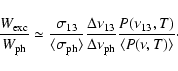
Using a general expression for
and Eq. (3) for
we get
 |
(4) |
of the central source at 30 000 K causing the photoexcitation by Ly
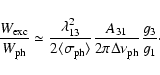
and the photoionization radiation from Car can be estimated to be around 3. Using the expression for
 ,
one can thus reduce Eq. (4) to the simple expression
,
one can thus reduce Eq. (4) to the simple expression
 |
(5) |
excitation and average values of
 10-18 cm2 and
 1014 Hz (from the 3 eV width), we get a simple, but important, estimate:
 .
Hence, we have the following expression for the density of metastable atoms expressed above in Eq. (1):
.
Hence, we have the following expression for the density of metastable atoms expressed above in Eq. (1):
 |
(6) |
 s-1,
s-1,
 10-13 cm3/s, and the branching fraction
 .
For example, at
.
For example, at
 cm3 the quantity
 is approximately
10-6-10-5 cm-3.
is approximately
10-6-10-5 cm-3.
We have obtained an estimate (Eq. (5)) of the ratio between the rates of
photoexcitation of H I by Ly radiation and of photoionization
,
from which it follows that they are of the same order of magnitude. Each photoionization event leads to recombination to the level 2s 2S (Fig. 4a) with the coefficient
 (
(
 ), and each
  -level photoexcitation event by Ly leads to
the population of the level 2s 2S with a branching fraction of 0.15.
Therefore, the steady-state population of the 2s 2S level within the
H II region (
-level photoexcitation event by Ly leads to
the population of the level 2s 2S with a branching fraction of 0.15.
Therefore, the steady-state population of the 2s 2S level within the
H II region (
 )
is defined by the relation
)
is defined by the relation
 |
(7) |
 according to Eq. (5).
In spite of a low fraction of neutral hydrogen and a low population of the
metastable 2s state it is shown in Sect. 5 that the population of the 2s 2S level by these mechanisms yields an optical depth, which is sufficient for
absorption in the transitions Balmer-,
Balmer-,
Balmer-,
through Balmer- .
However, the population of the 2s state will be
negligible in the near vicinity of Car because of depletion by
photoionization of this state provided by stellar radiation.
.
However, the population of the 2s state will be
negligible in the near vicinity of Car because of depletion by
photoionization of this state provided by stellar radiation.
The metastable state 2s 2S has a very low two-photon probability (the
radiative lifetime is 0.12 s) but it can be emptied through photoionization,
photoionization depletion, by photospheric radiation from the star. This
photoionization depletion of the 2s state is significant if the rate of
photoionization
 is comparable or higher than
the rate of two-photon decay
s-1. Let us define the
photoionization depletion radius
is comparable or higher than
the rate of two-photon decay
s-1. Let us define the
photoionization depletion radius
 as that distance from
the star where
as that distance from
the star where
 .
.
The rate of photoionization of the metastable 2s state
is determined by an expression of the same type as Eq. (3):
 |
= |  |
|
|
 |
(8) |
where h(
 ) = 3.4 eV is the photoionization energy and
 the photoionization cross-section of the 2s state. The maximum value of
is about 2.5
10-19 cm2. The spectral interval,
the photoionization cross-section of the 2s state. The maximum value of
is about 2.5
10-19 cm2. The spectral interval,
 ,
effective for photoionization by photospheric radiation is about 3 eV, since the
strong
,
effective for photoionization by photospheric radiation is about 3 eV, since the
strong  dependence reduces the photoionization cross-section at higher
frequencies and
dependence reduces the photoionization cross-section at higher
frequencies and
 cm2. This estimation gives
 |
(9) |
at the distance
from the star, given by
 |
(10) |
 1013 cm is the stellar radius of Car. At
distances
1013 cm is the stellar radius of Car. At
distances
 the two mechanisms considered above will provide the
population of the 2s state.
the two mechanisms considered above will provide the
population of the 2s state.
We now estimate the length
 over which the optical depth for the
Balmer-
absorption is
over which the optical depth for the
Balmer-
absorption is
 .
For a medium of length
.
For a medium of length
 we predict the observed Balmer nebular absorption. Setting

 to unity, sets the length to
 |
(11) |
absorption width
 cm-1 and
 10-14 cm2
we estimate
10-14 cm2
we estimate

 cm. Figure 5 shows the variation of
as a function of the total hydrogen density
in the absorbing nebular component of Car. The length
must be shorter than the radius
cm. Figure 5 shows the variation of
as a function of the total hydrogen density
in the absorbing nebular component of Car. The length
must be shorter than the radius
 of the Strömgren sphere, which contains H II and
a very small amount of H I (2s 2S). Therefore, we included in Fig. 5
the hydrogen density dependence of
.
Figure 5 also contains the limit values of
,
where the maximum value,
of the Strömgren sphere, which contains H II and
a very small amount of H I (2s 2S). Therefore, we included in Fig. 5
the hydrogen density dependence of
.
Figure 5 also contains the limit values of
,
where the maximum value,
 ,
corresponds to normal conditions in Car, and the minimum value,
,
corresponds to normal conditions in Car, and the minimum value,
 ,
refers to the
conditions during the spectroscopic event. However, note the different meaning
of
and
.
,
refers to the
conditions during the spectroscopic event. However, note the different meaning
of
and
.
![\begin{figure}
\par\includegraphics[width=8.8cm,clip]{1193Fig5.eps}\end{figure}](/articles/aa/full/2005/19/aa1193-04/img106.gif) |
Figure 5:
The dependence of absorption length, L, on the total hydrogen density,
 .
In a
uniform density gas the fully-ionized HII region surrounding Car would
lie below .
In a
uniform density gas the fully-ionized HII region surrounding Car would
lie below
 .
However, clumps of neutral
gas (H I) are surrounded by a sea of H II due to the ejection and wind
phenomena. Balmer absorption by these neutral clumps can occur beyond a distance L with a hydrogen density
that exceeds the critical absorption length .
However, clumps of neutral
gas (H I) are surrounded by a sea of H II due to the ejection and wind
phenomena. Balmer absorption by these neutral clumps can occur beyond a distance L with a hydrogen density
that exceeds the critical absorption length

 cm cm
 - the shaded area labeled Balmer absorption. The lower limit of this critical density is defined by the photoionization depletion of the 2s 2S state. For Car this boundary shifts between the spectroscopic maximum
(
), when UV radiation from the hot companion
escapes the wind of the binary system, downward during the spectroscopic minimum (
). - the shaded area labeled Balmer absorption. The lower limit of this critical density is defined by the photoionization depletion of the 2s 2S state. For Car this boundary shifts between the spectroscopic maximum
(
), when UV radiation from the hot companion
escapes the wind of the binary system, downward during the spectroscopic minimum (
). |
| Open with DEXTER | |
The region around
Car in terms of size L and hydrogen density ,
where
narrow-lined Balmer-
absorption can take place, is shown by the striped
triangular sector in Fig. 5. However, the real absorption length
cannot exceed the projected transversal size of the low-density extended equatorial media.
For example, based on the data for an equatorial torus in the work by Morris et al. (1999),
 cm and, accordingly,
 104 cm-3.
As far as the order of magnitude is concerned, these estimations are valid for
Balmer-
and Balmer-
as well, considering the decrease of the
Ly
and Ly intensities and the branching ratios Balmer-
/Ly
and Balmer-/Ly.
The time history of the observational data of Balmer absorption before and during
the spectroscopic event in 2003 (Fig. 3) can be understood in terms of the
photoprocesses discussed in the previous sections. As the steep curve in Fig. 3 shows the
emission intensity of Ly
excited Fe II lines in blob B and D, it also represents
the stellar ionizing radiation reaching the blob and the absorbing media.
We discuss the three consecutive phases of time variation of the Balmer-
absorption
illustrated in Fig. 3: 1) a small amount of absorption before the spectral event (-40 to -20 days); 2) increasing absorption during the interval (-20 to +30); and 3) a slow decrease
of absorption during the (+30 to +130) interval. The Balmer-
absorption
during these three periods is discussed in terms of three photo-processes: a) depletion of the
2s 2S state due to photoionization; b) resonant photoexcitation by Ly
with subsequent
population of the 2s 2S state; and c) photorecombination population of the 2s 2S state.
Firstly, the small amount of absorption before the spectroscopic event,
when a high level of stellar radiation is reaching the clumps, is
explained by rapid photoionization depletion of the 2s 2S state, as
discussed in Sect. 4. In Fig. 5 the maximum radius of photodepletion,
 corresponds to a "normal'' flux of stellar
radiation, i.e. before the spectroscopic event. As the X-ray drop
approaches, the increasing column density within the wind decreases the UV-
ionizing radiation. Even at 40 days before the X-ray drop, the UV flux is
decreasing, creating a smaller depletion radius,
corresponds to a "normal'' flux of stellar
radiation, i.e. before the spectroscopic event. As the X-ray drop
approaches, the increasing column density within the wind decreases the UV-
ionizing radiation. Even at 40 days before the X-ray drop, the UV flux is
decreasing, creating a smaller depletion radius,
 (see Fig. 5). Throughout the intermediate time zone (-40 days to +40 days about the X-ray drop) the depletion radius is reduced to the range
 resulting in a suppressed photoionization depletion. Absorption of the Balmer lines should increase, demonstrating qualitatively that the absorption regions are relatively close to the central source.
Secondly, the increase of absorption in the intermediate phase (-20 to +30 days)
in Fig. 5 can be qualitatively explained by suppression of photodepletion of the 2s 2S state and contribution from photoexcitation of Ly
at a modest flux of stellar radiation and photorecombination to the 2s 2S state. At a low UV-ionization flux the main population of the 2s 2S state is provided by recombination. The photoexcitation through the 1s-3p-2s pathway disappears, since the intensity of Ly
is weak during the spectroscopic event.
Thirdly, the existence of Balmer absorption during a significant reduction of starlight
reaching the absorbing medium confirms the involvement of recombination in the population
of the 2s 2S state, since of the three processes photorecombination is the only one that can populate the excited states (including 2s) of hydrogen. The duration time for this
mechanism is determined by the photorecombination time
 :
:
 |
(12) |
 assuming that hydrogen is the dominant
ionized species. For
assuming that hydrogen is the dominant
ionized species. For
 K we get
 10-13 cm3 s-1. During the period
 the electron density
  and recombination rate are reduced to the 1/e level. During the 90 days time interval (+30 days, +120 days) in Fig. 3 the intensity of the Balmer-
absorption is reduced by only 30%, which corresponds to a recombination time of about 2
90 = 180 days. According to Eq. (12)
and recombination rate are reduced to the 1/e level. During the 90 days time interval (+30 days, +120 days) in Fig. 3 the intensity of the Balmer-
absorption is reduced by only 30%, which corresponds to a recombination time of about 2
90 = 180 days. According to Eq. (12)
 180 days corresponds to
 105 cm-3. For the H II region
 ,
and the absorbing medium is an extended ejecta with higher density than a classical Strömgren HII region. The parameters are valid inside the striped triangle in Fig. 5.
,
and the absorbing medium is an extended ejecta with higher density than a classical Strömgren HII region. The parameters are valid inside the striped triangle in Fig. 5.
These high density clumps throughout the H II region close to Eta Carinae explain the presence of the strong Balmer absorption lines. They are exposed to the intense UV radiation of the central source, which, thanks to the three mechanisms considered above provides an overpopulation of metastable hydrogen atoms. In essence, measurement of these Balmer absorption lines provides a convenient diagnostic for detection of neutral clumps in an ionized medium and should be explored further, especially in consideration of the multiple lines arising from metastable lines of singly-ionized iron-peak elements.
In conclusion, the aim of the model presented in this paper was to
interpret the presence of the narrow Balmer absorption lines seen in
the spectra of Car and its surrounding nebulosities. We used average values
of the hydrogen densities in its ground
state and the excited metastable state, N1 and N2, respectively, to make a
simple model of metastable H I in line of sight of background starlight in the form of broad P-Cygni Balmer line emission. The strength of the Balmer line absorption gives information about the column density of metastable hydrogen, but it does not reveal the actual radial dependence of N2. More realistic models of the radial hydrogen distribution
 may
provide means of estimating the total hydrogen mass in the equatorial region. However, this problem is beyond the scope of the present paper.
may
provide means of estimating the total hydrogen mass in the equatorial region. However, this problem is beyond the scope of the present paper.
Acknowledgements
This paper is based upon observations made with the NASA/ESA Hubble Space Telescope, obtained at the Space Telescope Science Institute, which is operated by the Association of Universities for Research in Astronomy, Inc., under NASA contract NAS 5-26555. Funding was provided through the STIS Guaranteed Time Observations (GTO). V.S.L. acknowledges financial support through grants (S.J.) from the Royal Swedish Academy of Sciences and the Wenner-Gren Foundations, as well as Lund Observatory for hospitality and the Russian Foundation for Basic Research (grant No. 103-02- 16377). The research project is supported by a grant (S.J.) from the Swedish National Space Board.