 |
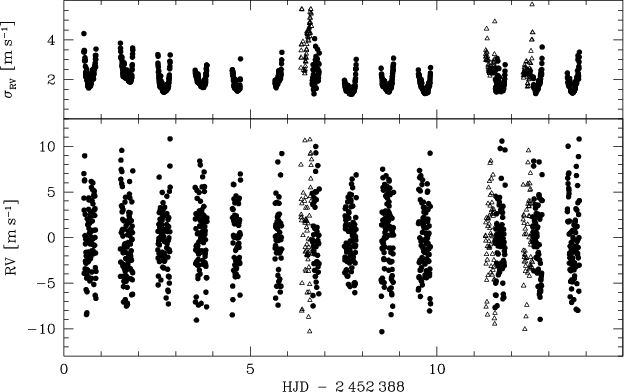
Figure 1:
Radial-velocity measurements of  Boo. The dispersion
reaches 3.8 m s-1. CORALIE and ELODIE data are represented with full circles and open
triangles respectively. The upper panel represents the photon noise uncertainties.
Boo. The dispersion
reaches 3.8 m s-1. CORALIE and ELODIE data are represented with full circles and open
triangles respectively. The upper panel represents the photon noise uncertainties. |
| Open with DEXTER | |
In the text
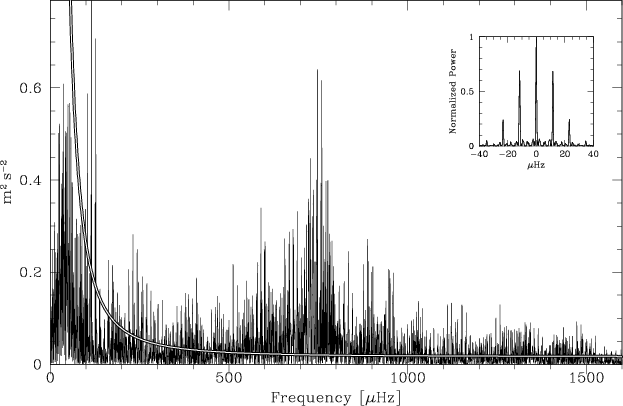 |
Figure 2:
Power spectrum of the radial velocity measurements of
Boo.
The window function is shown in the inset. The noise is represented by the white line. |
| Open with DEXTER | |
In the text
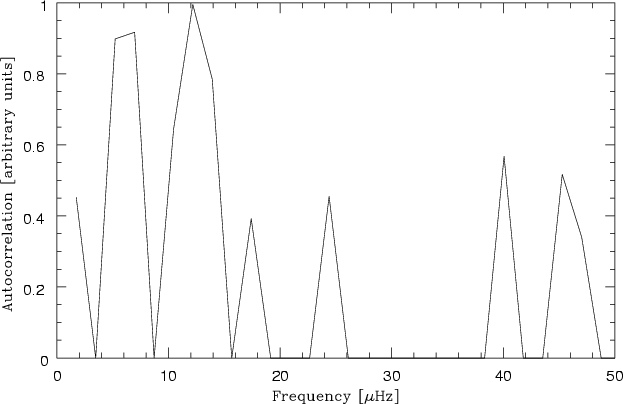 |
Figure 3:
Autocorrelation of the power spectrum undersampled with a resolution of
1.75  Hz and a threshold of 0.2 m2 s-1. The large splitting is estimated
to be about 40 Hz. Hz and a threshold of 0.2 m2 s-1. The large splitting is estimated
to be about 40 Hz. |
| Open with DEXTER | |
In the text
![\begin{figure}
\par\includegraphics[width=8.8cm,clip]{2140f4.eps}\end{figure}](/articles/aa/full/2005/18/aa2140/img37.gif) |
Figure 4:
Top: original power spectrum of
Boo. Bottom: cleaned power spectrum: all peaks listed
in Table 2 have been removed. The dot-dashed, dotted and dashed lines indicate an amplitude of 5 ,
4
and 3,
respectively. Numerous peaks are still present below 3,
since no peaks have been cleaned below this threshold. These peaks can be due to p-mode oscillations and noise or have
artificially been
added by the extraction algorithm due to the finite lifetimes of the modes ,
4
and 3,
respectively. Numerous peaks are still present below 3,
since no peaks have been cleaned below this threshold. These peaks can be due to p-mode oscillations and noise or have
artificially been
added by the extraction algorithm due to the finite lifetimes of the modes |
| Open with DEXTER | |
In the text
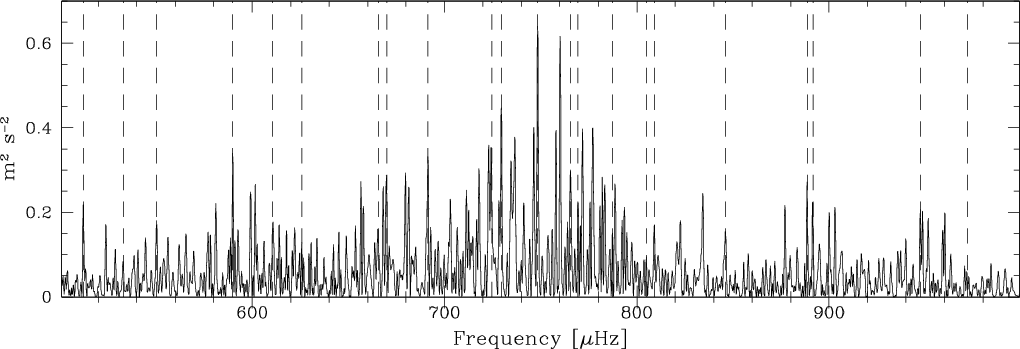 |
Figure 5:
Power spectrum of
Boo with the twenty-two extracted frequencies indicated by dashed lines.
The identification of each extracted frequency is given in Table 3. |
| Open with DEXTER | |
In the text
![\begin{figure}
\par\includegraphics[width=8.6cm,clip]{2140f6.eps}\end{figure}](/articles/aa/full/2005/18/aa2140/img40.gif) |
Figure 6:
Echelle diagram of identified modes (in black) with a
large separation of 39.9 Hz. The
modes  (
(
 ), ),  (
( ),
and ),
and  (
(
 )
are represented with a size proportional to
their amplitude. Open symbols correspond to modes determined
by Kjeldsen et al. (2003). Both identifications are
in good agreement at low frequency. However, at high frequency
their
mode frequencies ( )
are represented with a size proportional to
their amplitude. Open symbols correspond to modes determined
by Kjeldsen et al. (2003). Both identifications are
in good agreement at low frequency. However, at high frequency
their
mode frequencies ( )
seem to be identified in this paper
as
modes
(), and their
modes ( )
seem to be identified in this paper
as
modes
(), and their
modes (  )
are not present in our data. )
are not present in our data. |
| Open with DEXTER | |
In the text
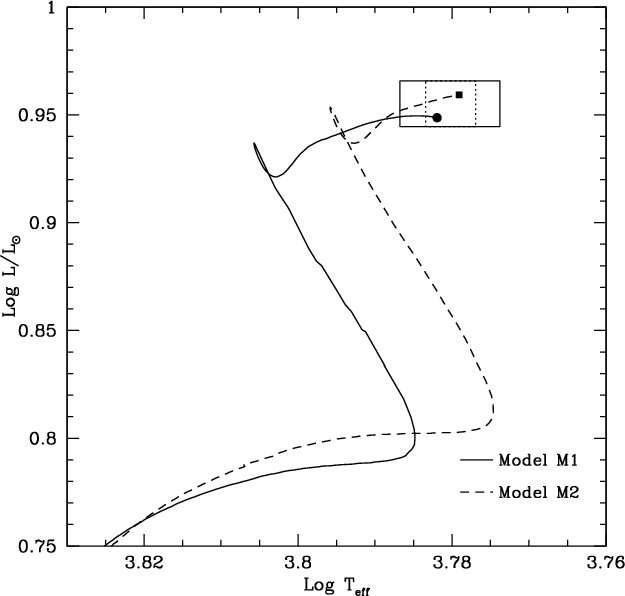 |
Figure 7:
Evolutionary tracks in the HR diagram for two models of
Boo.
The dot and the square indicate the location of the M1 and M2 model respectively.
The error box in continuous line indicates the observational constraints of L and
 used in our
analysis, while the dotted box corresponds to the constraints used by Di Mauro et al. (2003).
used in our
analysis, while the dotted box corresponds to the constraints used by Di Mauro et al. (2003). |
| Open with DEXTER | |
In the text
![\begin{figure}
\par\includegraphics[width=8.3cm,clip]{2140f8.eps} \end{figure}](/articles/aa/full/2005/18/aa2140/img108.gif) |
Figure 8:
Echelle diagram for the M1 model with a large spacing
 Hz. Open symbols refer to theoretical
frequencies, while the filled circles correspond to the observed frequencies
listed in Table 3. Open circles are used for modes with ,
triangles for ,
squares for
and pentagons for
Hz. Open symbols refer to theoretical
frequencies, while the filled circles correspond to the observed frequencies
listed in Table 3. Open circles are used for modes with ,
triangles for ,
squares for
and pentagons for  .
The
size of the open symbols is proportional to the relative surface amplitude of the mode (see text). Modes with too small
surface amplitudes (e.g. g modes) are not shown on this diagram. .
The
size of the open symbols is proportional to the relative surface amplitude of the mode (see text). Modes with too small
surface amplitudes (e.g. g modes) are not shown on this diagram. |
| Open with DEXTER | |
In the text
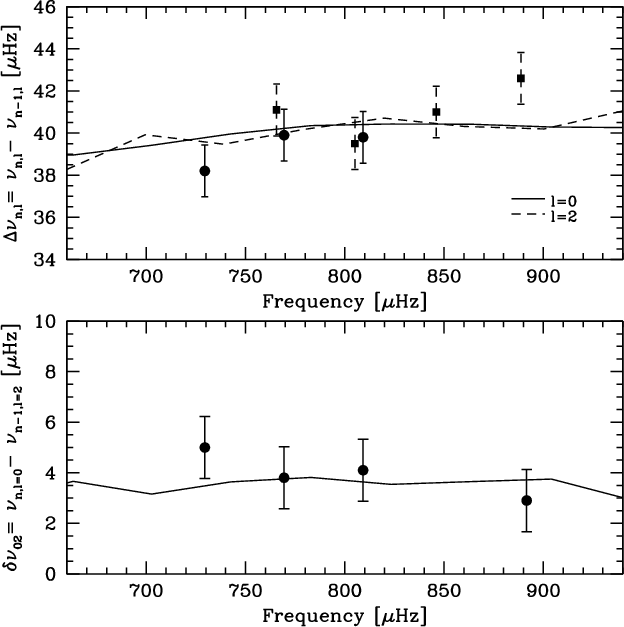 |
Figure 9:
Large and small spacings versus frequency for the M1 model.
Dots indicate the observed values of the large ()
and small spacings, while squares correspond
to the large spacing determined with
modes. |
| Open with DEXTER | |
In the text
![\begin{figure}
\par\includegraphics[width=8.3cm,clip]{2140f10.eps} \end{figure}](/articles/aa/full/2005/18/aa2140/img112.gif) |
Figure 10: Helium abundance profile in the external layers of the star at different ages during its evolution on the main-sequence. The model on the top only includes atomic diffusion, while the model on the bottom includes atomic diffusion and shellular rotation. Apart from the inclusion of rotation, the two models have been computed with the same initial parameters corresponding to the M1 model. |
| Open with DEXTER | |
In the text
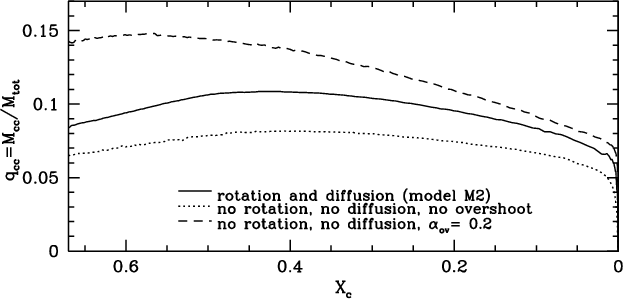 |
Figure 11:
Ratio of the mass of the convective core to the total mass of the star (
 )
as a function of the central hydrogen abundance ( )
as a function of the central hydrogen abundance (
 ), for a standard model without overshooting,
for a standard model with ), for a standard model without overshooting,
for a standard model with
 and for a model with rotation and atomic diffusion.
Apart from the inclusion of rotation and overshooting, the three models have been computed with the same initial
parameters corresponding to the M2 model.
and for a model with rotation and atomic diffusion.
Apart from the inclusion of rotation and overshooting, the three models have been computed with the same initial
parameters corresponding to the M2 model.
|
| Open with DEXTER | |
In the text
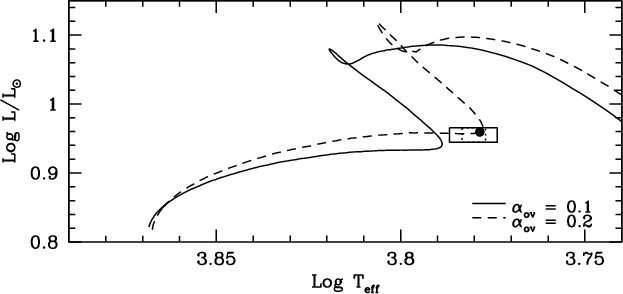 |
Figure 12:
Evolutionary tracks in the HR diagram for two models of 1.7  computed with a different amount of overshooting.
The dot indicates the location of the M3 model.
The error box in continuous line corresponds to the observational constraints of L and
used in our
analysis, while the dotted box corresponds to the constraints used by DM03.
computed with a different amount of overshooting.
The dot indicates the location of the M3 model.
The error box in continuous line corresponds to the observational constraints of L and
used in our
analysis, while the dotted box corresponds to the constraints used by DM03. |
| Open with DEXTER | |
In the text
![\begin{figure}
\par\includegraphics[width=8.3cm,clip]{2140f13.eps} \end{figure}](/articles/aa/full/2005/18/aa2140/img127.gif) |
Figure 13:
Echelle diagram for the M3 model with a large spacing
Hz. Open symbols refer to theoretical
frequencies, while the filled circles correspond to the observed frequencies
listed in Table 3. Open circles are used for modes with ,
triangles for ,
squares for
and pentagons for . |
| Open with DEXTER | |
In the text
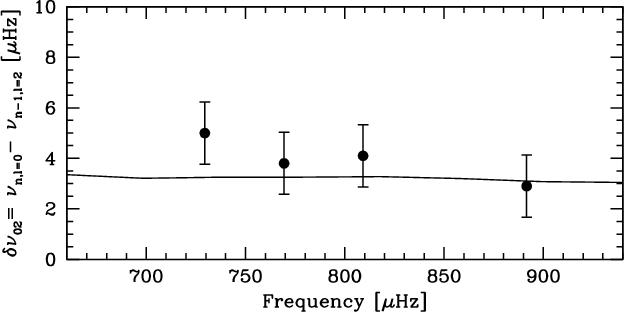 |
Figure 14: Small separations versus frequency for the M3 model. Dots indicate the observed values of the small separations. |
| Open with DEXTER | |
In the text