![[*]](/icons/foot_motif.gif)
A&A 433, L9-L12 (2005)
DOI: 10.1051/0004-6361:200500088
S. Mereghetti1 - D. Götz1 - I. F. Mirabel2 - K. Hurley3
1 -
Istituto di Astrofisica Spaziale e Fisica Cosmica -
Sezione di Milano "G. Occhialini'' - INAF,
via Bassini 15, 20133 Milano, Italy
2 -
European Southern Observatory,
Alonso de Cordova 3107, Santiago, Chile
3 -
University of California at Berkeley, Space Sciences Laboratory,
Berkeley, CA 94720-7450, USA
Received 26 November 2004 / Accepted 27 December 2004
Abstract
We report the discovery of persistent hard X-ray
emission extending up to 150 keV from the soft gamma-ray repeater
SGR 1806-20 using data obtained with the INTEGRAL satellite in
2003-2004. Previous observations of hard X-rays from objects of
this class were limited to short duration bursts and rare
transient episodes of strongly enhanced luminosity ("flares'').
The emission observed with the IBIS instrument above 20 keV has a
power law spectrum with photon index in the range 1.5-1.9 and a
flux of 3 milliCrabs, corresponding to a 20-100 keV luminosity of
 1036 erg s-1 (for a distance of 15 kpc). The
spectral hardness and the luminosity correlate with the level of
source activity as measured from the number of emitted bursts.
1036 erg s-1 (for a distance of 15 kpc). The
spectral hardness and the luminosity correlate with the level of
source activity as measured from the number of emitted bursts.
Key words: gamma rays: bursts - pulsars: general - stars: individual: SGR 1806-20
Soft gamma-ray repeaters (SGRs) are a small group of high-energy
sources that were discovered through the observation of short
bursts in the hard X/soft  -ray range (for a review see
Hurley 2000). The bursts have typical durations of the order of a
few hundred milliseconds and are emitted during sporadic
"active'' periods that can last from weeks to months. Their
spectra above 20 keV have been well described by optically
thin thermal bremsstrahlung with temperatures 30-40 keV (but
see Feroci et al. 2004 and Olive et al. 2004 for the spectra of
bursts at other energies).
-ray range (for a review see
Hurley 2000). The bursts have typical durations of the order of a
few hundred milliseconds and are emitted during sporadic
"active'' periods that can last from weeks to months. Their
spectra above 20 keV have been well described by optically
thin thermal bremsstrahlung with temperatures 30-40 keV (but
see Feroci et al. 2004 and Olive et al. 2004 for the spectra of
bursts at other energies).
For several years after their discovery, SGRs could not be
unambiguously associated with persistent sources at other
wavelengths, with the exception of SGR 0525-66. The precise
localization of the latter source placed it in the Large
Magellanic Cloud supernova remnant N49, hinting at a neutron star
origin (Cline et al. 1982). More recent observations of the SGR
burst locations with X-ray imaging satellites led to the
identification of their persistent counterparts in the 0.5-10 keV
X-ray range. This proved to be crucial in confirming the neutron
star hypothesis through the discovery of coherent pulsations
(periods of 7.5 and 5.2 s) and secular spin-down in the range
10-11-10-10 s s-1 in two of these sources (SGR 1806-20 and SGR 1900+14; Kouveliotou et al. 1998; Hurley et al. 1999a).
Furthermore, the association with clusters of massive stars
(Mirabel et al. 2000) indicates that SGRs are relatively young
objects. The most successful model advanced to explain the SGRs
involves neutron stars with a very high magnetic field, or
"magnetars'' (Duncan & Thompson 1992; Thompson & Duncan 1995).
In magnetars, which are assumed to have internal fields much
higher than the quantum critical value
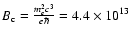 G, the dominant
source of free energy is the magnetic field, rather than rotation
as in the ordinary radio pulsars. This energy is enough to power
both the bursts and the persistent X-ray emission
(
G, the dominant
source of free energy is the magnetic field, rather than rotation
as in the ordinary radio pulsars. This energy is enough to power
both the bursts and the persistent X-ray emission
(
 erg s-1).
The study of the persistent emission from SGRs has been carried
out at energies below 10-20 keV to date. The only
observations of SGRs at higher energies, besides those of the
bursts, were limited to a small number of exceptionally bright
transient events, the so called "giant'' and "intermediate''
flares, which occurred in SGR 0525-66 (Mazets et al. 1979) and in
SGR 1900+14 (Hurley et al. 1999b; Guidorzi et al. 2004). Here we
report the discovery of emission extending up to 150 keV from the
quiescent counterpart of the soft gamma-ray repeater SGR 1806-20. Some
evidence for this high-energy component was reported in a
preliminary analysis of a subset of the data presented here
(Götz et al. 2004b; Bird et al. 2004). In a companion paper
Molkov et al. (2005) report independent evidence from different
INTEGRAL observations of persistent hard X-ray (>20 keV)
emission from this source.
Table 1: INTEGRAL core program observations of SGR 1806-20.
![\begin{figure}
\par\includegraphics[width=14.4cm,clip]{newimagebw.ps}
\end{figure}](/articles/aa/full/2005/14/aagk261/img16.gif) |
Figure 1:
Images of a 4
 region
containing the position of SGR 1806-20 obtained with the IBIS/ISGRI
instrument in the 20-60 keV ( left) and 60-100 keV energy range
( right). The other detected sources are (1) GX 9+1, (2) IGR J18027-2016 (Revnivtsev et al. 2004), and (3) IGR J17597-2201
(Lutovinov et al. 2003).
region
containing the position of SGR 1806-20 obtained with the IBIS/ISGRI
instrument in the 20-60 keV ( left) and 60-100 keV energy range
( right). The other detected sources are (1) GX 9+1, (2) IGR J18027-2016 (Revnivtsev et al. 2004), and (3) IGR J17597-2201
(Lutovinov et al. 2003). |
| Open with DEXTER | |
The location of SGR 1806-20 has been repeatedly observed by the INTEGRAL
gamma-ray satellite in 2003-2004 (Winkler et al. 2003) in the
course of Core Program (consisting of regular scans along the
Galactic plane and bulge), deep exposures of the Galactic Center
region, and Target of Opportunity observations. Here we
concentrate on the Core Program data obtained with the IBIS instrument (Ubertini et al. 2003), which provides imaging above 15 keV with an unprecedented combination of sensitivity
(milliCrab) and angular resolution (12') using the coded
mask imaging technique.
The available data consist of more than 500 individual pointings
in which SGR 1806-20 was observed at different off-axis angles. The
typical integration time of most pointings is 1800 s (those
obtained after May 2004 lasted 2200 s each). We restrict our
analysis to the pointings in which SGR 1806-20 was in the central part
of the field of view (radius < 8 ), where the
sensitivity is higher and the instrument calibration is better
known. This results in a total exposure time of one million
seconds (corrected for the vignetting effect). The observations,
spanning almost two years, were concentrated in four periods of
1-2 months each due to the visibility constraints of the
satellite, as indicated in Table 1. We used the data obtained
with the IBIS lower energy detector ISGRI (Lebrun et al. 2003), an
array of
), where the
sensitivity is higher and the instrument calibration is better
known. This results in a total exposure time of one million
seconds (corrected for the vignetting effect). The observations,
spanning almost two years, were concentrated in four periods of
1-2 months each due to the visibility constraints of the
satellite, as indicated in Table 1. We used the data obtained
with the IBIS lower energy detector ISGRI (Lebrun et al. 2003), an
array of
 CdTe pixels providing a geometric area of
2600 cm2 in the nominal energy range 15 keV-1 MeV.
CdTe pixels providing a geometric area of
2600 cm2 in the nominal energy range 15 keV-1 MeV.
The detector images in the 20-60 and 60-100 keV energy ranges of
the individual pointings were deconvolved, cleaned and co-added
using version 4.1 of the Offline Scientific Analysis software
(Goldwurm et al. 2003) provided by the INTEGRAL Science Data
Center (Courvoisier et al. 2003). A
 region of the resulting mosaics
is shown in Fig. 1. A source with a significance of 17.2
region of the resulting mosaics
is shown in Fig. 1. A source with a significance of 17.2 is detected in the lowest energy range at the Chandra position of
SGR 1806-20 (Kaplan et al. 2002). Several other sources are visible in
the image (see figure caption for details). SGR 1806-20 is also detected
in the 60-100 keV energy range, with a significance of 6.9.
The source count rates of
is detected in the lowest energy range at the Chandra position of
SGR 1806-20 (Kaplan et al. 2002). Several other sources are visible in
the image (see figure caption for details). SGR 1806-20 is also detected
in the 60-100 keV energy range, with a significance of 6.9.
The source count rates of
 counts s-1 and
 counts s-1 measured in the soft
and hard energy ranges correspond to a flux of 3 mCrabs.
counts s-1 measured in the soft
and hard energy ranges correspond to a flux of 3 mCrabs.
Except for the period March-April 2003, the source was in a
bursting state during the reported observations, leading to the
detection of several bursts in the IBIS data.
A few pointings
containing some strong bursts (Mereghetti et al. 2004a; Golenetski
et al. 2004) were removed from the analysis described above. The
effect of the remaining ones is negligible: their cumulative
contribution of 16 000 counts in about 50 bursts,
corresponds to 4% of the total number of source counts in the
integrated images.
Analyzing the data for the four observing periods separately in
the same way, we derived the fluxes reported in Table 1, which
give some evidence for an increase in the source hard X-ray
luminosity with time (see Fig. 3b). A fit of the 20-60 keV count
rate values with a constant flux gives a
 ,
corresponding to a
,
corresponding to a
 probability.
For the spectral analysis we produced images in 9 energy intervals
in the range 15-300 keV. The count rates extracted from the images
were fit using the latest available response matrices (RMF v11,
ARF v5). Since the first three observing periods yielded
consistent spectral parameters, we analyzed them together,
obtaining a best fit power law photon index
 and a 20-100 keV flux
 erg cm-2 s-1 (all errors are 1). During the last
observing campaign (Sept.-Oct. 2004) the corresponding parameters
were
erg cm-2 s-1 (all errors are 1). During the last
observing campaign (Sept.-Oct. 2004) the corresponding parameters
were
 and
and
 erg cm-2 s-1. Thus there is some evidence for a harder spectrum
coupled with a flux increase. The two spectra are shown in Figs. 2a
and 2b. Note that the higher flux and harder spectrum of the
Sept.-Oct. 2004 period lead to a significant detection of SGR 1806-20 up
to the 100-150 keV energy bin. For comparison, Fig. 2c shows the
typical spectrum of one of the bursts (note that the intensity has
been scaled down by a factor 104). It can be seen that the
bursts have a much softer spectrum than the persistent emission.
erg cm-2 s-1. Thus there is some evidence for a harder spectrum
coupled with a flux increase. The two spectra are shown in Figs. 2a
and 2b. Note that the higher flux and harder spectrum of the
Sept.-Oct. 2004 period lead to a significant detection of SGR 1806-20 up
to the 100-150 keV energy bin. For comparison, Fig. 2c shows the
typical spectrum of one of the bursts (note that the intensity has
been scaled down by a factor 104). It can be seen that the
bursts have a much softer spectrum than the persistent emission.
![\begin{figure}
\par\includegraphics[angle=90,width=8cm,clip]{spectranew.ps}
\end{figure}](/articles/aa/full/2005/14/aagk261/img27.gif) |
Figure 2: IBIS/ISGRI spectra of SGR 1806-20: a) persistent emission March 2003-Apr. 2004, b) persistent emission Sept.-Oct. 2004, c) one burst (scaled down by a factor 104). The solid lines are the best fits (power laws in a) and b), thermal bremsstrahlung in c)). The dashed lines indicate the extrapolation of power-law spectra measured in the 1-10 keV range with XMM-Newton (Mereghetti et al. 2004b). |
| Open with DEXTER | |
![\begin{figure}
\par\includegraphics[angle=-90,width=8.6cm,clip]{2plot.ps}
\end{figure}](/articles/aa/full/2005/14/aagk261/img28.gif) |
Figure 3: a) histogram of number of bursts per day detected by the third Interplanetary Network (IPN). This histogram includes mostly those bursts with fluences larger than 10-7 erg cm-2 and is not corrected for experiment duty cycles and source visibility. It therefore represents only the trend of the burst rate and not its true value. b) Count rate in the 20-60 keV range. The horizontal error bars indicate the time spanned by the (non continuous) observations. |
| Open with DEXTER | |
Observations of SGR 1806-20 below 10 keV carried out with BeppoSAX and
ASCA indicated a power law spectrum with photon index 2 and
unabsorbed 2-10 keV flux of
 erg cm-2 s-1 (Mereghetti et al. 2000). Although the
detection of pulsations in the 10-20 keV range with RossiXTE
(Gögüs et al. 2002) showed that the emission from
SGR 1806-20 extends above the soft X-ray range, no spectral information
was available above 10 keV and the BeppoSAX spectrum could be
fitted equally well by a thermal bremsstrahlung model with
temperature kT=11 keV. The extrapolation of the BeppoSAX power law
spectrum lies below the average value obtained with INTEGRAL. On
the other hand, a good agreement is found between the INTEGRAL
spectra and those measured below 10 keV with XMM-Newton in
2003-2004 (Mereghetti et al. 2004b). This is shown by the dashed
lines in Fig. 2, which indicate the extrapolations of the
XMM-Newton power law spectra measured at dates consistent with the
INTEGRAL observations (Fig. 2a: 7 October 2003; Fig. 2b: 6 October
2004).
erg cm-2 s-1 (Mereghetti et al. 2000). Although the
detection of pulsations in the 10-20 keV range with RossiXTE
(Gögüs et al. 2002) showed that the emission from
SGR 1806-20 extends above the soft X-ray range, no spectral information
was available above 10 keV and the BeppoSAX spectrum could be
fitted equally well by a thermal bremsstrahlung model with
temperature kT=11 keV. The extrapolation of the BeppoSAX power law
spectrum lies below the average value obtained with INTEGRAL. On
the other hand, a good agreement is found between the INTEGRAL
spectra and those measured below 10 keV with XMM-Newton in
2003-2004 (Mereghetti et al. 2004b). This is shown by the dashed
lines in Fig. 2, which indicate the extrapolations of the
XMM-Newton power law spectra measured at dates consistent with the
INTEGRAL observations (Fig. 2a: 7 October 2003; Fig. 2b: 6 October
2004).
In Fig. 3 we compare the hard X-ray flux measured with INTEGRAL with the level of activity from SGR 1806-20 as a function of time. This is indicated by the number of bursts detected by the Interplanetary Network (IPN). The source was quiescent during the first INTEGRAL observing period and moderately active in the two following periods. The last INTEGRAL observations, in which a harder and brighter persistent emission was detected, took place after the strong reactivation of the Summer 2004. SGR 1806-20 was still particularly active in September-October 2004 (Mereghetti et al. 2004a; Golenetski et al. 2004).
The detection of pulsed hard X-rays (20-150 keV) from the
Anomalous X-ray Pulsar 1E 1841-045 has been recently reported by
Kuiper et al. (2004). Anomalous X-ray Pulsars (AXPs) share many
similarities with the SGRs (Mereghetti et al. 2002) and are also
thought to be magnetars (see Woods & Thompson 2004 for a recent
review). It is therefore interesting to compare our results with
those obtained for this source. The high-energy emission from
1E 1841-045, with a power law photon index
 ,
is definitely harder than that displayed
by SGR 1806-20 before September 2004. This value of the photon index,
obtained with the RXTE/HEXTE instrument, refers to the total
(pulsed plus unpulsed) flux and is consistent with the results of
the INTEGRAL flux measurements in the 18-60 and 60-120 keV ranges
(Molkov et al. 2004). The spectrum of the pulsed component in
1E 1841-045 is even harder (
,
is definitely harder than that displayed
by SGR 1806-20 before September 2004. This value of the photon index,
obtained with the RXTE/HEXTE instrument, refers to the total
(pulsed plus unpulsed) flux and is consistent with the results of
the INTEGRAL flux measurements in the 18-60 and 60-120 keV ranges
(Molkov et al. 2004). The spectrum of the pulsed component in
1E 1841-045 is even harder (
 ;
Kuiper et al.
2004). When compared to lower energy measurements, these results
imply that the spectrum of the AXP has a significant hardening
above 10 keV. This contrasts with the situation seen in
Figs. 2a and 2b for SGR 1806-20.
;
Kuiper et al.
2004). When compared to lower energy measurements, these results
imply that the spectrum of the AXP has a significant hardening
above 10 keV. This contrasts with the situation seen in
Figs. 2a and 2b for SGR 1806-20.
The hard X-ray emission from magnetars has been discussed in the context of a model involving currents in a globally twisted magnetosphere by Thompson et al. (2002). A non-thermal tail in the X-ray spectrum is predicted as a result of multiple resonant cyclotron scattering. According to these authors, the differences between SGRs and AXPs, i.e. the emission of bursts in SGRs, as well as their harder spectra and faster spin down rate, are explained by a larger degree of twist in the external magnetic field. Our observation of a harder persistent spectrum when the bursting activity of SGR 1806-20 was at its highest level indicates that this correlation, previously seen when comparing different sources, also holds within the same object.
Thanks to the high sensitivity of the INTEGRAL IBIS instrument we have discovered a hard X-ray component extending to 150 keV in the persistent emission from SGR 1806-20. The imaging capabilities of IBIS have been crucial for the observation of this crowded region of the Galactic plane: they allow us to unambiguously associate the observed hard X-ray emission with SGR 1806-20.
The hard X-rays
correlate in intensity and spectral hardness with the level of
bursting activity, and, contrary to what is observed in the AXP
1E 1841-045, a comparison with lower energy data does not
indicate evidence for a spectral hardening at 10-20 keV. The
INTEGRAL data provide the first detection of persistent emission
in this energy range for a SGR and open a new important diagnostic
to study the physics of magnetars (see, e.g., Thompson &
Beloborodov 2004).
Acknowledgements
This work has been partially supported by the Italian Space Agency. K.H. is grateful for support under NASA's INTEGRAL US Guest Investigator program, grant NAG5-13738.