A&A 432, 1115-1129 (2005)
DOI: 10.1051/0004-6361:20041483
Families of periodic horseshoe orbits in the restricted three-body problem
E. Barrabés1 -
S. Mikkola2
1 - Dept. Informàtica i Matemàtica Aplicada, Universitat de Girona, Avd. LLuís Santaló s/n
17071 Girona, Spain
2 -
Tuorla Observatory, University of Turku, 21500, Piikkiö, Finland
Received 17 June 2004 / Accepted 15 November 2004
Abstract
We compute families of symmetric periodic horseshoe orbits
in the restricted three-body problem. Both the planar and three-dimensional
cases are considered and several families are found. We describe how these
families are organized as well as the behavior along and among the families of parameters such as
the Jacobi constant or the eccentricity. We also determine the
stability properties of individual orbits along the families. Interestingly,
we find stable horseshoe-shaped orbit up to the quite high inclination of  .
.
Key words: celestial mechanics
Until recently, horseshoe orbits were mostly theoretical concepts,
the only known such motion in the Solar System being the co-orbital
pair of Saturnian satellites Janus and Epimetheus.
Recently, however, several near Earth asteroids
have been found in horseshoe motion with respect to the Earth, examples include
Cruithne and 2002 AA29 (see e.g. Wiegert et al. 1997; Connors et al. 2002; Brasser et al. 2004).
In Fig. 1 the present orbit
of AA29 is illustrated.
Although the horseshoe motion of these asteroids is temporary,
it has awaken renewed interest in horseshoe motion and in the
theory of co-orbital motion in general (e.g.
Christou 2000; Namouni 1999; Namouni et al. 1999).
In the solar system all orbits are very complicated, when studied
in detail. However, considerable knowledge can be obtained
by studying the restricted three-body problem.
(Planet-asteroid interactions can often be seen as a restricted
three body problem in which the perturbation due to other bodies
slowly changes the orbit in the restricted problem phase space.)
The location and stability properties of periodic orbits are
basic features of a dynamical system.
Therefore it is of interest to find periodic horseshoe orbits,
which have been studied rather little, although numerous
other periodic orbit studies have been published since the so called Copenhagen problem by
Burrau & Strömgren (1915,1917,1916).
The dynamics of co-orbital satellites have been studied by several authors. One approach
is in the framework of the Restricted Three Body Problem, in which one of the satellites
is considered as a test particle with zero mass.
In this context, both analytical and numerical works have been developed:
Dermott & Murray (1981a,b) and Murray & Dermott (1999) studied the properties
of horseshoe orbits in general and the co-orbital satellites of Saturn in particular using
numerical integration and perturbation theory;
and Llibre & Ollé (2001) gave a mechanism for generation of horseshoe orbits.
They also performed extensive
numerical explorations.
Hénon & Petit (1986) dealt with the co-orbital motion in the context of Hill's problem
and
Salo & Yoder (1988) studied the dynamical behavior of several co-orbital
bodies moving with the same mean motion around a primary.
A different
approach considers the full Three Body Problem with two small masses.
Spirig & Waldvogel (1985) study this system as a singular-perturbation
problem using matching techniques.
Cors & Hall (2003) investigated the existence of co-orbital motion
in terms of two perturbed Kepler problems with
small parameters introduced in the equations of the problem.
In this paper we find families of planar and also fully three
dimensional symmetric periodic horseshoe orbits in the restricted
three-body problem. The objectives of this study are to:
- 1.
- find families of planar horseshoe orbits.
As a starting point
we use the mechanism of generation of
horseshoe orbits given by Llibre & Ollé (2001).
We describe how these families are organized and
how the Jacobi constant,
the eccentricity and the stability parameters vary along and between them;
- 2.
- look for bifurcation orbits where the families of spatial orbits are born;
- 3.
- compute some families of 3-dimensional horseshoe orbits to describe how
the Jacobi constant, the inclination and the stability vary. In particular, we
want to see if stable spatial orbits exist and what their inclinations are.
![\begin{figure}
\par {\includegraphics[height=7.1cm,width=8cm,clip]{1483f01.eps} }
\end{figure}](/articles/aa/full/2005/12/aa1483/Timg19.gif) |
Figure 1:
The present horseshoe orbit of the asteroid 2002 AA29.
This is an xy-projection in the rotating coordinate system in which the Earth
is located at the point (-1, 0). |
| Open with DEXTER |
First we briefly review the basic mathematics of the Restricted Three Body Problem (RTBP).
Let us consider two bodies S and E, called primaries, in an
inertial reference system (OXYZ, also called sidereal)
describing circular orbits around their center of mass, and a
massless particle P which moves under the gravitational
attraction of the primaries. The motion of P does not affect the
primaries. The description of the motion of the third mass P is
known as the circular restricted three body problem.
In suitable units the gravitational
constant and the distance between the primaries both equal 1.
The bodies Sand E have masses  and
and  respectively, with
![$\mu\in[0,1]$](/articles/aa/full/2005/12/aa1483/img21.gif) ,
and the period of their circular motion is
,
and the period of their circular motion is  time units.
In the present work we consider only small values of .
time units.
In the present work we consider only small values of .
When the orbit of P is confined in the Z=0 plane it is said to be planar,
otherwise it is a spatial orbit.
We consider the motions in a rotating reference system (oxyz,
called synodical), where the primaries S and E are fixed in
the x-axis at positions
and  ,
respectively. The
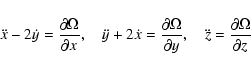
equations of motion of the third body in this system are
,
respectively. The
equations of motion of the third body in this system are
 |
(1) |
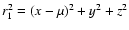
where
and
 ,
,
 are the distances from the third body
to S and E respectively. These equations have 5 equilibrium points: the
collinear points L1, L2 and L3 and the equilateral ones, L4 and L5.
These are called the Lagrangian points.
Furthermore,
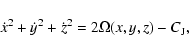
the Eqs. (1) have the first integral
are the distances from the third body
to S and E respectively. These equations have 5 equilibrium points: the
collinear points L1, L2 and L3 and the equilateral ones, L4 and L5.
These are called the Lagrangian points.
Furthermore,
the Eqs. (1) have the first integral
 |
(2) |
where  is called the Jacobi constant. From now on, we will denote the value
of the Jacobi constant at the equilibrium point Li by
is called the Jacobi constant. From now on, we will denote the value
of the Jacobi constant at the equilibrium point Li by
 ,
for
i=1,..., 5.
,
for
i=1,..., 5.
![\begin{figure}
\par\begin{tabular}{cc}
\includegraphics[totalheight=4cm]{1483f0...
... C_{{\rm J}_1} $\space & $ 3<C_{\rm J}<C_{{\rm J}_3} $ \end{tabular}\end{figure}](/articles/aa/full/2005/12/aa1483/Timg30.gif) |
Figure 2:
Zero velocity curves (the intersection of the zero velocity surfaces with the z=0 plane) for
 .
The motion is forbidden in the filled areas. The tick marks on the horizontal axis show the position
of the primaries. .
The motion is forbidden in the filled areas. The tick marks on the horizontal axis show the position
of the primaries. |
| Open with DEXTER |
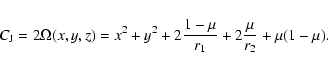
As it is well known, the Hill's regions, where the motion of the third body is possible, are
bounded by the zero velocity surfaces (zvs) given by the equation
 |
(3) |
For a fixed value of ,
the shape of these surfaces varies with (see, for instance, Szebehely 1967).
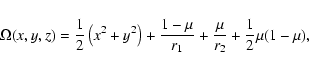
For large values of the Jacobi constant,
 ,
the regions where the motion
is possible are not connected, while for
,
the regions where the motion
is possible are not connected, while for
 the surfaces do not intersect the plane z=0 and
planar motion is possible everywhere. The intersection of the
zero velocity surfaces with the z=0 plane (the zero velocity curves) is shown in Fig. 2.
As we can see, for planar orbits, the natural range for horseshoe
periodic orbits is
the surfaces do not intersect the plane z=0 and
planar motion is possible everywhere. The intersection of the
zero velocity surfaces with the z=0 plane (the zero velocity curves) is shown in Fig. 2.
As we can see, for planar orbits, the natural range for horseshoe
periodic orbits is
 :
for
:
for
 the zero velocity curve is also horseshoe shaped.
In the next section, we look for periodic horseshoe orbits in this range of values of
the Jacobi constant; we find
that the orbits are embedded in families which continue for
the zero velocity curve is also horseshoe shaped.
In the next section, we look for periodic horseshoe orbits in this range of values of
the Jacobi constant; we find
that the orbits are embedded in families which continue for
 .
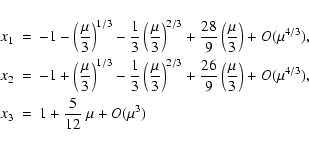
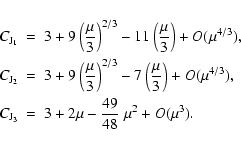
The collinear equilibrium points are situated at (xi,0,0), for i=1,2,3, where
.
The collinear equilibrium points are situated at (xi,0,0), for i=1,2,3, where
(see, for instance, Szebehely 1967). Using these expressions and Eq. (2),
the values of the Jacobi constant at the equilibrium points are
In Table 1 the values of xi and
,
i=1,2,3, for
 and
and
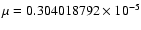 (Sun-(Earth+Moon) mass ratio) are shown.
Table 1:
Position and Jacobi constant for the collinear equilibrium points Li, i=1,2,3, and
values of
indicated. See the text for details.
In order to deal with a small value of ,
but big enough to show the behavior of the families,
the explorations presented in this work are done for
.
Whenever
a different value of
is taken
for comparison, it will be specified. For greater clarity, we include
two dots in the plots of orbits where the primaries are located.
- We integrate the equations of motion and the variational equations using a Taylor-series
method for ordinary differential equations. We use the software package for the numerical
integration of Ordinary Differential Equations provided
by Jorba & Zou (preprint).
- We find the periodic orbits using the Newton-Raphson method to correct
the initial values until periodicity with a tolerance of 10-12is achieved.
In this section, we suppose that the motion of the third body is planar, so
 for all t.
For simplicity, we denote
for all t.
For simplicity, we denote
 and
and
 .
(Later we will
re-introduce the z and
.
(Later we will
re-introduce the z and  components.)
According to Llibre & Ollé (2001), a planar symmetric periodic
horseshoe orbit is a planar periodic solution in which the
particle follows a path which surrounds only the equilibrium
points L3, L4 and L5 and has only two orthogonal
crossings with the x axis. This definition describes an orbit
with a horseshoe shape
resembling the
zero velocity curves (zvc from now on)
for
(see Fig. 2) and two
orthogonal crossings with the
horizontal synodical axis near L3.
In order to follow families of periodic horseshoe orbits, we begin with
horseshoe orbits with a value of
and initial conditions close to the zero velocity curve,
so their shape coincides with this definition
(see, for example, Fig. 3). But when we continue the families,
we find that the number of crossings with the x axis increases.
The orbits can have more intersections near
L3 due to the increase of loops (see Fig. 5). It is also possible to find
orbits that briefly enter the upper half plane but go back after a short time into the
lower half plane and vice versa (see Fig. 4).
In the first case, the horseshoe
shape is preserved, but not in the second one. Nevertheless, in the present work we consider all of them
as horseshoe orbits.
![\begin{figure}
\par {\includegraphics[height=7.5cm,width=8cm,clip]{1483f06.eps} }
\end{figure}](/articles/aa/full/2005/12/aa1483/Timg44.gif) |
Figure 3:
Planar symmetric horseshoe orbit with only two crossings with the synodical x axis. |
| Open with DEXTER |
![\begin{figure}
\par {\includegraphics[height=7.5cm,width=7.9cm,clip]{1483f07.eps...
...
\par {\includegraphics[height=5.2cm,width=8cm,clip]{1483f08.eps} }
\end{figure}](/articles/aa/full/2005/12/aa1483/Timg45.gif) |
Figure 4:
Planar symmetric horseshoe orbit with 14 crossings with the synodical x axis
and a detail of the passages near the small primary. On the top, one
period is plotted and on the bottom just a half period. |
| Open with DEXTER |
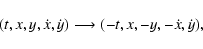
We restrict our attention to symmetric periodic orbits. Due to the fact that the
equations of motion (1) of the planar RTBP are invariant by
if a solution of these equations has two orthogonal crossings with the x axis, then it is symmetric
with respect to this axis. Thus, for a symmetric periodic orbit
we suppose that one orthogonal crossing occurs at t=0 and the other one at
t=T/2, where T is the period of the orbit. The initial conditions (at t=0) will be
 and
and
 and the
final condition (at t=T/2) will be
and the
final condition (at t=T/2) will be
 and
and
 .
Notice that for horseshoe orbits,
the initial and final positions are near L3.
.
Notice that for horseshoe orbits,
the initial and final positions are near L3.
Finally, due to the behavior of the zero velocity curves,
we look for periodic horseshoe orbits that satisfy
.
Next, we describe the steps followed to obtain families of periodic horseshoes. First,
we follow the same strategy as in Llibre & Ollé (2001), looking for horseshoes with the same
value of
less than
 .
As Llibre & Ollé pointed out in their work,
many periodic horseshoe orbits
can be found for small .
These orbits, far from the small primary, can be approximated
by a pair of orbits of the two-body problem (RTBP for
.
As Llibre & Ollé pointed out in their work,
many periodic horseshoe orbits
can be found for small .
These orbits, far from the small primary, can be approximated
by a pair of orbits of the two-body problem (RTBP for  ): a retrograde one, which is the outer
approximation (corresponding to the outer part of the orbit)
and a direct one, which is the inner approximation (corresponding
to the inner part of the orbit).
For ,
the effect of the small primary makes the third body to go back,
passing from the outer part of the orbit to the inner, or vice versa. The outer and
inner part of the orbit can be easily observed in the behavior of the eccentricity and
the semi-major axis of the orbits. The values of these parameters
change at every near(est) passage of the third body and the small
primary (Fig. 6).
): a retrograde one, which is the outer
approximation (corresponding to the outer part of the orbit)
and a direct one, which is the inner approximation (corresponding
to the inner part of the orbit).
For ,
the effect of the small primary makes the third body to go back,
passing from the outer part of the orbit to the inner, or vice versa. The outer and
inner part of the orbit can be easily observed in the behavior of the eccentricity and
the semi-major axis of the orbits. The values of these parameters
change at every near(est) passage of the third body and the small
primary (Fig. 6).
![\begin{figure}
\par {\includegraphics[height=7.4cm,width=7.9cm,clip]{1483f09.eps} }
\end{figure}](/articles/aa/full/2005/12/aa1483/Timg53.gif) |
Figure 5:
Planar symmetric horseshoe orbit with 16 crossings with the synodical x axis near L3. |
| Open with DEXTER |
![\begin{figure}
\par\includegraphics[height=3.7cm,width=3.6cm,clip]{1483f10.eps}\...
...*{5mm}
\includegraphics[height=3.7cm,width=3.6cm,clip]{1483f11.eps}\end{figure}](/articles/aa/full/2005/12/aa1483/Timg54.gif) |
Figure 6:
Behaviour of the eccentricity ( left) and semi-major axis ( right)
of the orbit shown in Fig. 3. Both parameters change at each
approach to the small primary. |
| Open with DEXTER |
For a fixed
,
the procedure is (for more details see Llibre & Ollé 2001):
- 1.
- we look for the intersection of the zvc with the horizontal axis at the right
side of L3. We start with a value of x0 close to and at the right side of
this intersection and with a negative initial
 given by Eq. (2);
- 2.
- we integrate the equations of motion until the next crossing with the x axis near L3 (rejecting the
orbits without a horseshoe shape), so the final point will be
 .
We are looking for the points x0 were the function
.
We are looking for the points x0 were the function
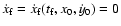 ,
so we increase x0 and continue
until a change in the sign of
,
so we increase x0 and continue
until a change in the sign of
 is
detected. Then, between the last two values of x0 there must exist one value which corresponds
to the initial conditions of a symmetric periodic orbit,
the exact value of which we find using the secant method.
is
detected. Then, between the last two values of x0 there must exist one value which corresponds
to the initial conditions of a symmetric periodic orbit,
the exact value of which we find using the secant method.
The function
 as a function
of x0 for two fixed values of
is shown in Fig. 7.
as a function
of x0 for two fixed values of
is shown in Fig. 7.
![\begin{figure}
\par {\includegraphics[width=8cm,clip]{1483f12.eps} }\vspace*{3.5mm}
\par {\includegraphics[width=8cm,clip]{1483f13.eps} }
\end{figure}](/articles/aa/full/2005/12/aa1483/Timg60.gif) |
Figure 7:
as a function of x0 for the the values of the Jacobi constant
 on
the top and
on
the top and
 on the bottom. See the text for more details.
 |
| Open with DEXTER |
As expected, many horseshoe orbits can be found.
It must be taken into account that the number of
intersections with the section y=0 can vary from one periodic orbit to the next.
Moreover, we can make several observations from the results obtained:
- 1.
- The function
oscillates around the horizontal axis, with variations in its
amplitude. The zeros of
are not distributed uniformly with respect to x0.
They are more concentrated near the intersection of the zvc with the x axis
than far from it.
- 2.
- The number of intersections of the periodic orbits
with the synodical horizontal axis increases both for values of their initial condition x0 near
the zvc and far from it,
while for the other values of x0, the horseshoe orbits obtained have only two
crossings with the x axis.
Furthermore, when x0 approaches the zvc or goes far from it, several zones (a range of
values of x0) appear where horseshoe orbits do not exist.
This behavior depends strongly on the value of :
for values near
the behavior of
is more irregular.
As we are looking for a method to obtain initial periodic orbits as starting point from which to compute the
families, we have not explored all the possible values of x0. So
we have represented the function only for a certain range of values.
- 3.
- For each periodic orbit, we compute the planar stability parameter s1, given by
 ,
where
,
where  is the monodromy matrix (obtained from the integration of the
variational equations with the equations of motion) at t=T (the period of the orbit).
We observe that there are (linearly) stable
(|s1|<2) and unstable orbits, and that the unstable ones have mostly
initial condition x0 very near or very far from the zvc.
is the monodromy matrix (obtained from the integration of the
variational equations with the equations of motion) at t=T (the period of the orbit).
We observe that there are (linearly) stable
(|s1|<2) and unstable orbits, and that the unstable ones have mostly
initial condition x0 very near or very far from the zvc.
- 4.
- As we know, the eccentricity of a horseshoe orbit is not constant.
However, the eccentricity at the initial conditions can be used
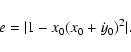
without loss of generality. This value of ecorresponds to the eccentricity of the outer approximation
two-body orbit.
Thus, for each orbit, we compute the eccentricity by
 |
(4) |
In Fig. 8 the behavior of the eccentricity as a function
of x0 for a fixed value of
is shown.
As long as the eccentricity is small, the number of intersections with the synodical horizontal axis
is two, whereas, when the eccentricity increases,
new loops can appear and the number of intersections increases as well.
Moreover, as we can see in Fig. 8,
there is a minimum (
 )
coinciding with a periodic orbit.
This horseshoe orbit corresponds to
a zero of the zone,
where the function
has low amplitude, and it is planar stable.
This is the orbit that we choose as the
starting point in the computation of a family of periodic orbits.
)
coinciding with a periodic orbit.
This horseshoe orbit corresponds to
a zero of the zone,
where the function
has low amplitude, and it is planar stable.
This is the orbit that we choose as the
starting point in the computation of a family of periodic orbits.
![\begin{figure}
\par {\includegraphics[width=8cm,clip]{1483f14.eps} }
\end{figure}](/articles/aa/full/2005/12/aa1483/Timg66.gif) |
Figure 8:
Eccentricity of the orbits computed
for
.
x0 is on the horizontal axis. The points marked correspond
to the points
 (periodic orbits) in Fig. 7.
 |
| Open with DEXTER |
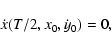
As is well known, periodic orbits are not isolated but form one-parameter families.
A family of planar symmetric periodic orbits with initial conditions
 is defined implicitly by the equation
 |
(5) |
where
 is given by the section
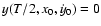 .
In order to compute a family
of periodic orbits we use a predictor-corrector method:
.
In order to compute a family
of periodic orbits we use a predictor-corrector method:
- 1.
- Once we have obtained a periodic orbit, we predict the next one
moving along the tangent of the Eq. (5).
- 2.
- We correct the initial conditions of the predicted orbit.
The Eq. (5) has two unknowns, thus two strategies can be followed:
- one may fix the value of the Jacobi constant and use Newton's method;
- one may ask for minimum variation of the initial conditions,
such that the new initial conditions verify Eq. (5).
In this case we have a constrained extrema problem.
In Gómez & Mondelo (2001) a method for the refinement and continuation
of periodic orbits is given in detail.
To begin with this method, it is necessary to have an initial periodic orbit.
The horseshoe orbit computed in the previous section with |s1|<2 and minimum
value of e, for different values of ,
is chosen for this purpose.
The families followed are shown in Fig. 9 for different ranges of values of .
They are represented in the
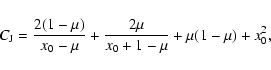
 plane. In these representations, the zero velocity curve
is also plotted. Its equation in the
plane is given by
plane. In these representations, the zero velocity curve
is also plotted. Its equation in the
plane is given by
 |
(6) |
which can be obtained substituting y=z=0 in Eq. (3). As we can see, the families are bounded on the left
by the zero velocity curve.
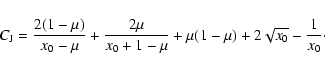
Moreover, we compute the values of x0 and
for which
the outer approximation with the same initial conditions has an eccentricity of zero.
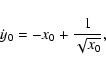
If we make e=0 in Eq. (4), then we can write
and substituting this expression in Eq. (2), we obtain
 |
(7) |
This curve (the skeleton) is the dashed line in the figures.
For ,
Eq. (7) represents
two families of the circular Kepler orbits (denoted by l-i in the literature)
which give the outer and inner approximations of the corresponding horseshoe orbits.
![\begin{figure}
\par {\includegraphics[width=7.9cm,clip]{1483f15.eps} }\vspace*{3...
...par\hspace*{-2mm}{\includegraphics[width=7.7cm,clip]{1483f16.eps} }
\end{figure}](/articles/aa/full/2005/12/aa1483/Timg74.gif) |
Figure 9:
Families of planar and symmetric horseshoe orbits in the
plane for
and different range of values for .
The dashed-dotted line on the
right represents the zero velocity curve (6).
The dashed line crossing all the families is the skeleton
given by Eq. (7). Three families, marked A, B and C,
have been chosen to illustrate the evolution of the orbits along and between the families.
See the text for more details.
a) Families with
 ;
b) families with ;
b) families with
 . . |
| Open with DEXTER |
From our results we observe the following:
- 1.
- the skeleton gives a first approach to find horseshoe orbits for values that are not too big.
The approximation is better when
decreases;
- 2.
- a priori, the maximum value of the Jacobi constant for which horseshoe orbits exist is
,
whose value is 3.008955890917 for
.
As we can see in Fig. 9,
the bigger the value of
the fewer families we find.
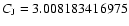 is the maximum value of the Jacobi constant for which we find a periodic orbit
(Fig. 4);
is the maximum value of the Jacobi constant for which we find a periodic orbit
(Fig. 4);
- 3.
- although in the previous section we dealt with initial conditions such that
 ,
when we continue the families we find horseshoe orbits with
,
when we continue the families we find horseshoe orbits with
 .
This happens, for example, when
one family reaches the zvc: the sign of the velocity changes;
.
This happens, for example, when
one family reaches the zvc: the sign of the velocity changes;
- 4.
- for each family, there exists a maximum for the Jacobi constant,
 .
If the Jacobi constant is not too big, the families are organized around
the skeleton in such a way that a structure consisting of 4 families is repeated (see Fig. 10).
Nevertheless, for large enough
this structure disappears;
.
If the Jacobi constant is not too big, the families are organized around
the skeleton in such a way that a structure consisting of 4 families is repeated (see Fig. 10).
Nevertheless, for large enough
this structure disappears;
![\begin{figure}
\par {\includegraphics[width=8.8cm,clip]{1483f17.eps} }
\end{figure}](/articles/aa/full/2005/12/aa1483/Timg78.gif) |
Figure 10:
Details around the skeleton of some families for
.
Apparently, the structure repeats after every four families. |
| Open with DEXTER |
- 5.
- the period of the
periodic orbits varies inside the families and between them.
The behavior of the period along the families is illustrated in Fig. 11.
The smaller the value of
of a family, the longer the period of the orbits.
For families with smaller values of
a structure exists
(see Fig. 11b) while as the value of
increases,
this structure disappears (see Fig. 11c).
Two orbits from different families typically have different periods,
while pairs of orbits from different families with the same period can be found
(for values of
greater than a certain value);
![\begin{figure}
\par {\includegraphics[width=8cm,clip]{1483f18.eps} }
\vspace*{2...
...e*{5mm}
\includegraphics[height=3.7cm,width=3.6cm,clip]{1483f20.eps}\end{figure}](/articles/aa/full/2005/12/aa1483/Timg79.gif) |
Figure 11:
Behaviour of the period (T in years) of the orbits on each family with respect to .
The bigger the value of
,
the smaller the period of the orbits. Families A, B and C
are the same of that of Fig. 9. a) The families shown are the same as in
Fig. 9a; b) families with  years; c) families with
 years.
 |
| Open with DEXTER |
- 6.
- in each family, as
decreases the
eccentricity (given by Eq. (4)) increases and so does the number of loops in the rotating frame. See
Fig. 5;
- 7.
- for each orbit, we compute the minimum distance
 of the third body to the small primary as well. Within
each family,
decreases as
decreases, except for
a small range of values in a neighborhood of
of the third body to the small primary as well. Within
each family,
decreases as
decreases, except for
a small range of values in a neighborhood of
 .
Between families, the bigger
the value of
,
the smaller the minimum distance.
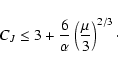
All the orbits computed for values of the Jacobi constant greater than
a certain value enter a neighborhood of the small primary. This fact is explained by
the Jacobi constant. If an orbit does not reach a neighborhood
of the small primary, say,
.
Between families, the bigger
the value of
,
the smaller the minimum distance.
All the orbits computed for values of the Jacobi constant greater than
a certain value enter a neighborhood of the small primary. This fact is explained by
the Jacobi constant. If an orbit does not reach a neighborhood
of the small primary, say,
 ,
then from Eq. (2)
we obtain
,
then from Eq. (2)
we obtain
See Fig. 12;
![\begin{figure}
\par {\includegraphics[width=8cm,clip]{1483f21.eps} }
\end{figure}](/articles/aa/full/2005/12/aa1483/Timg83.gif) |
Figure 12:
Behaviour of the minimum distance
to the small primary on each family with respect
to .
For greater clarity, just a few families are plotted. |
| Open with DEXTER |
- 8.
- orbits that briefly enter the upper half plane are found for values of
 .
These families are not shown in Fig. 9, which contains only
pure horseshoe orbits (orbits with a horseshoe shape);
.
These families are not shown in Fig. 9, which contains only
pure horseshoe orbits (orbits with a horseshoe shape);
- 9.
- it is known that, either a family of periodic orbits closes upon itself or it is an open family.
In the latter case, the family has, in both directions, a natural termination in which
the dimension of the orbit, the Jacobi constant or the period grow without limit (see Hénon 1997, p. 10).
Moreover, given a family we observe that
when
decreases |s1| increases.
We follow the families only up to a certain value of |s1|.
In order to show the evolution of the shape of the orbits along one family and the difference between different
families, we have chosen three families labeled A, B and C in Figs. 9 and 11.
The approximate values of
in each family are
3.0003841802 (A), 3.0011003259 (B) and 3.0022285012 (C).
Figures 13-15 illustrate some of the orbits in each family (A, B and C
respectively). In each figure, orbits from left to right and top to bottom correspond to increasing
values of the initial x0.
Table 2 contains the Jacobi constant
,
the period T in years, the initial conditions x0, and the stability parameter s1 of these orbits.
Both the orbit with the maximum value of the Jacobi constant
and the orbit with
the minimum value of the eccentricity of each family are included in the examples shown.
Along both branches of each family (this is, as
decreases),
the number of loops increases (corresponding to an increase of the eccentricity) as does
the width of the orbits.
Moreover, the larger the value of
of one family, the larger the width of the orbits of this family
and the shorter the minimum distance to the small primary.
This is because the horseshoe orbits with CJ>3 surround the
zero velocity curve, the width of which increases with the value of the Jacobi constant.
![\begin{figure}
\begin{tabular}{ccc}
(1) & (2) & (3)\\
\includegraphics[totalhei...
...udegraphics[totalheight=105pt,width=155pt]{1483f33.eps}\end{tabular}\end{figure}](/articles/aa/full/2005/12/aa1483/Timg85.gif) |
Figure 13:
Periodic horseshoe orbits from family A. On the top
of each figure the number of the orbit, according to
Table 2, is given. For greater clarity, only the half period of each
orbit is shown. |
| Open with DEXTER |
![\begin{figure}
\begin{tabular}{ccc}
(1) & (2) & (3)\\
\includegraphics[totalhei...
...udegraphics[totalheight=105pt,width=155pt]{1483f42.eps}\end{tabular}\end{figure}](/articles/aa/full/2005/12/aa1483/Timg86.gif) |
Figure 14:
Periodic horseshoe orbits from family B. On the top
of each figure the number of the orbit, according to
Table 2, is given. For greater clarity, only the half period of each
orbit is shown. |
| Open with DEXTER |
![\begin{figure}
\begin{tabular}{ccc}
(1) & (2) & (3)\\
\includegraphics[totalhei...
...udegraphics[totalheight=105pt,width=155pt]{1483f48.eps}\end{tabular}\end{figure}](/articles/aa/full/2005/12/aa1483/Timg87.gif) |
Figure 15:
Periodic horseshoe orbits from family C. On the top
of each figure the number of the orbit, according to
Table 2, is given. For greater clarity, only the half period of each
orbit is shown. |
| Open with DEXTER |
Table 2:
For the families A, B and C, Jacobi constant, period, initial conditions and planar stability
parameter of the orbits shown in Figs. 13-15. The orbits are identified
with the label of the family (capital letter) and a number. For each family, the orbit with the
minimum value of the eccentricity (*) and the orbit with maximum value of the Jacobi constant,
are included.
Summarizing, the resemblances between families are:
- there exists one orbit inside each family with the maximum value of the Jacobi constant,
.
Starting at this orbit, the family has two branches along which
decreases;
- there exists one orbit inside each family with a minimum value of the eccentricity.
Starting at this orbit, the eccentricity increases along each branch.
In general, the orbit with the minimum eccentricity
and the orbit with the maximum Jacobi constant do not coincide;
- as the eccentricity increases, the width of the orbits increases;
- planar stable orbits with values of the Jacobi constant near
can be found. Far from
this value, the planar stability parameter s1 increases as
decreases.
And the differences are:
- the period T of the orbits increases as
decreases;
- the width of the orbits increases as
increases;
- the bigger the value of
,
the faster the planar stability parameter s1 increases.
Although we are dealing with planar periodic orbits, which are confined in the xy plane,
we will next consider not only
planar perturbations but vertical ones as well (i.e. in the z direction).
Thus, we take into account the vertical component of the motion and
write
 for the position and velocity of the third body
with initial conditions
for the position and velocity of the third body
with initial conditions  .
.
Let
 be a periodic solution of period T of the equations of motion (1).
If we modify the initial conditions, then
be a periodic solution of period T of the equations of motion (1).
If we modify the initial conditions, then
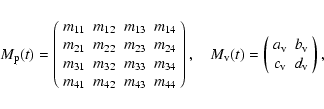
where M(t) is the monodromy matrix at time t.
In order to study the linear stability of the periodic orbits, we have to look at the eigenvalues of the
matrix M(T).
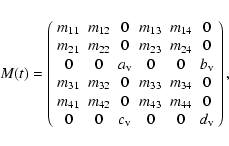
As the motion is planar, we know that the monodromy matrix is
which can be decoupled into two matrices,
called the planar monodromy matrix and vertical monodromy matrix, respectively.
For simplicity, we denote
 and
and
 .
Known properties include:
.
Known properties include:
- 1.
-
 ;
;
- 2.
- the eigenvalues of M(T) are 1, 1,
 ,
,
 ,
,
 ,
,
 .
In fact,
for planar orbits, 1, 1, ,
are eigenvalues of
and ,
are eigenvalues of
.
In fact,
for planar orbits, 1, 1, ,
are eigenvalues of
and ,
are eigenvalues of  ;
;
- 3.
- the stability parameters are defined as
 and
and
 .
For planar orbits, s1 and s2 are the planar and vertical stability parameter respectively;
.
For planar orbits, s1 and s2 are the planar and vertical stability parameter respectively;
- 4.
-
and
 ,
where
,
where
 means
the trace of the matrix M;
means
the trace of the matrix M;
- 5.
- for planar symmetric orbits
 (see, for instance, Henon 1973).
A periodic orbit is planar or vertically stable if |s1|<2 or |s2|<2 respectively. If
both values are between -2 and 2, then we will simply say that the orbit is (linearly) stable.
If the stability parameter equals 2 or -2, the orbit is critical.
For each planar horseshoe orbit, we compute both stability parameters. We are interested in
vertically stable or critical orbits because this is where bifurcations can occur, but
also where the planar stable orbits are located.
In Fig. 16, the zones of planar stability of each family are shown.
![\begin{figure}
\par {\includegraphics[width=8cm,clip]{1483f49.eps} }
\end{figure}](/articles/aa/full/2005/12/aa1483/Timg108.gif) |
Figure 16:
Planar stability in families of symmetric planar horseshoe orbits
in the
plane.
The zones corresponding to stable and unstable orbits are plotted in continuous and dotted
lines respectively. |
| Open with DEXTER |
From the results obtained, we observe that:
- 1.
- the stability parameter s1 varies from positive values to negative ones
covering the range [-2,2] a least twice.
Given a family, the smaller the value of
,
the bigger the zones on the
characteristic curves corresponding to planar stable orbits. The families with
 are not shown in Fig. 16 because the zones of planar stable
orbits cannot be observed. Nevertheless, all families have a least one zone of planar stable orbits;
are not shown in Fig. 16 because the zones of planar stable
orbits cannot be observed. Nevertheless, all families have a least one zone of planar stable orbits;
- 2.
- s1 grows in both branches of each family, while s2 seems to remain bounded.
See Fig. 17;
- 3.
- most orbits are vertically stable. There are vertically unstable orbits in some families
with values of
greater than 3.0009364257. For
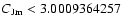 no
vertically unstable orbits are founded.
no
vertically unstable orbits are founded.
The next step is to find the bifurcation orbits from which families of
three dimensional orbits are born and compute them.
A 3D family is born from a perturbation of the z and
components of a planar
periodic orbit. If the perturbation is small enough, the motion of the third particle can be
decoupled in a planar motion plus a vertical one in a first approximation. If we
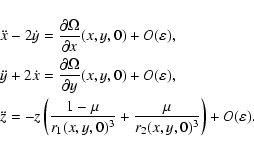
substitute
z by
 ,
on the Eqs. (1), we obtain
,
on the Eqs. (1), we obtain
 |
(8) |
Setting
 in Eq. (8), we obtain two decoupled motions where the first two equations
correspond to the planar RTBP. Thus, a periodic solution of Eq. (8) for
will be
a periodic solution of the planar RTBP plus a periodic motion in the vertical direction given by
the solution of the equation
in Eq. (8), we obtain two decoupled motions where the first two equations
correspond to the planar RTBP. Thus, a periodic solution of Eq. (8) for
will be
a periodic solution of the planar RTBP plus a periodic motion in the vertical direction given by
the solution of the equation
 |
(9) |
We are looking for 3D-periodic orbits, so both the planar and the vertical
motion must have the same period.
Let
 be the solution of the Eqs. (8) for
,
with
initial conditions
be the solution of the Eqs. (8) for
,
with
initial conditions
 and
and
 such that (x0,y0) and
 are the initial conditions of a planar T-periodic orbit.
Then, both the planar motion
(x(t),y(t)) and the function g(t) are T-periodic. Applying
Floquet's theorem (see, for example, Boccaletti & Pucacco 1999, p. 199) to the Eq. (9)
we get
are the initial conditions of a planar T-periodic orbit.
Then, both the planar motion
(x(t),y(t)) and the function g(t) are T-periodic. Applying
Floquet's theorem (see, for example, Boccaletti & Pucacco 1999, p. 199) to the Eq. (9)
we get
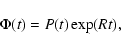 |
(10) |
where  is the fundamental matrix, P(t) is a continuous T-periodic matrix
and R is a constant matrix. This implies that the solutions of Eq. (9) can be written as
is the fundamental matrix, P(t) is a continuous T-periodic matrix
and R is a constant matrix. This implies that the solutions of Eq. (9) can be written as
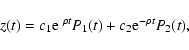 |
(11) |
where Pi(t), i=1,2, are T-periodic and  and
and  are the eigenvalues of R.
Moreover,
are the eigenvalues of R.
Moreover,
 ,
the vertical monodromy matrix of the planar
orbit. Using this fact and Eq. (10), we get
,
the vertical monodromy matrix of the planar
orbit. Using this fact and Eq. (10), we get
 |
(12) |
where
and
are the eigenvalues of .
![\begin{figure}
\par {\includegraphics[width=7.9cm,clip]{1483f50.eps} }\vspace*{3...
...\par\hspace*{2mm}{\includegraphics[width=8.1cm,clip]{1483f51.eps} }
\end{figure}](/articles/aa/full/2005/12/aa1483/Timg126.gif) |
Figure 17:
The stability parameters (on the vertical axis) versus the Jacobi constant (on the horizontal one)
are represented for some families of horseshoe orbits: on the top, the planar stability parameter s1,
and on the bottom, the vertical one s2. |
| Open with DEXTER |
Floquet's theorem tells when z(t) given by Eq. (11) is periodic. The vertical motion is
bounded if  and, in this case, the two periods involved are T and
  .
For periodicity of the 3D motion these periods must satisfy
the condition
.
For periodicity of the 3D motion these periods must satisfy
the condition
 for some mutually prime positive integers p and q, or equivalently
 |
(13) |
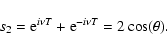
Using Eqs. (12), (13) and the definition of the vertical stability parameter,
we can write
 |
(14) |
Thus, if the planar orbit is vertically stable and Eq. (14) is verified,
is a periodic solution of period pT. From this we
know which planar orbits will be bifurcation orbits.
Critical orbits are bifurcation orbits as well.
Using the linear approximation given by the monodromy matrix
,
Henon (1973) has shown that critical orbits of the main
families of periodic orbits a, b, c, f, g, h, i, l, m, n
(in Strömgren's notation) correspond to an intersection of a planar family and a
spatial one.
If s2=2, the spatial orbit has the same period as the planar one, and
if s2=-2 the spatial orbit doubles the period of the planar one.
From now on, a bifurcation orbit with vertical stability parameter
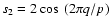 will be called a (p,q)-bifurcation orbit, or briefly,
p-bifurcation orbit if we do not care about the value of q.
Notice that, for every value of p, both q and p-q give the
same value of s2. Then, given a value of p, we will only consider
the values of
will be called a (p,q)-bifurcation orbit, or briefly,
p-bifurcation orbit if we do not care about the value of q.
Notice that, for every value of p, both q and p-q give the
same value of s2. Then, given a value of p, we will only consider
the values of
![$q\in\{ 1,2,\dots,[p/2]\}$](/articles/aa/full/2005/12/aa1483/img133.gif) such that p and q are relatively
prime ([x] means the integer part of x).
such that p and q are relatively
prime ([x] means the integer part of x).
For
 ,
this reasoning tells us which planar orbits are good to begin with.
In the next section, we explain the steps that we followed.
,
this reasoning tells us which planar orbits are good to begin with.
In the next section, we explain the steps that we followed.
As in the planar case,
we use a predictor-corrector method to compute the orbits embedded in the same family.
On the one hand, it is necessary to provide the equations that define the families of 3D-periodic orbits.
On the other hand, as a starting point of the method, we take a planar T-periodic orbit satisfying
Eqs. (13) and (14) and
we modify slightly the initial conditions in the vertical direction. These initial conditions
must then be corrected to have a 3D periodic orbit.
We restrict our attention to symmetric orbits.
In the three dimensional problem, the equations
of the RTBP satisfy the following symmetries:
It follows that if
 is a solution of Eq. (1), such that
 |
(15) |
or
 |
(16) |
the orbit is
 -periodic. If Eq. (15) is satisfied, the orbit is symmetric
with respect to the y=0 plane, and if Eq. (16) is satisfied, then it is symmetric
with respect to the z=0 and y=0 planes.
-periodic. If Eq. (15) is satisfied, the orbit is symmetric
with respect to the y=0 plane, and if Eq. (16) is satisfied, then it is symmetric
with respect to the z=0 and y=0 planes.
![\begin{figure}
\par\includegraphics[angle=-90,width=4cm,clip]{1483f52.eps}\hspace*{4mm}
\includegraphics[angle=-90,width=4cm,clip]{1483f53.eps}\end{figure}](/articles/aa/full/2005/12/aa1483/Timg141.gif) |
Figure 18:
The intersection of the zero velocity surfaces with the y=0 plane:
a) for
![$C_{\rm J}\in [C_{\rm J_3},C_{\rm J_1}]$](/articles/aa/full/2005/12/aa1483/img16.gif) ;
and b) for
. ;
and b) for
. |
| Open with DEXTER |
![\begin{figure}
\par\includegraphics[width=4.8cm,height=3.7cm,clip]{1483f54.eps}\...
...*{6mm}
\includegraphics[width=4.7cm,height=3.8cm,clip]{1483f59.eps}\end{figure}](/articles/aa/full/2005/12/aa1483/Timg142.gif) |
Figure 19:
Examples of 3D periodic horseshoe orbits. On the top, an orbit of a family of type 1/1 and
on the bottom, an orbit of a family of type 6/2. The figures in the center and right show the behavior of
the eccentricity and the inclination respectively, both along one period. The horseshoe orbital behavior can
be observed in the changes of the eccentricity and inclination every time the third body approaches the
small primary. |
| Open with DEXTER |
Let us suppose that we have a planar and stable
symmetric p-bifurcation orbit of period T and initial conditions
 .
Let
.
Let
 be a small perturbation in the vertical direction.
Keeping in mind that we are looking for a 3D periodic orbit of period
be a small perturbation in the vertical direction.
Keeping in mind that we are looking for a 3D periodic orbit of period
 ,
we consider again the motion as two decoupled motions,
thus the planar one is already symmetric.
Considering the vertical motion, we use the linear approximation given by the
monodromy matrix
,
we consider again the motion as two decoupled motions,
thus the planar one is already symmetric.
Considering the vertical motion, we use the linear approximation given by the
monodromy matrix
 .
Thus
.
Thus
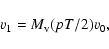
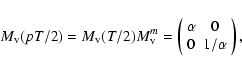
where v1 is the vertical perturbation at time t=p T/2.
The properties of
tell us that it has the form
with some constant b.
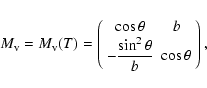
If p=2m, then
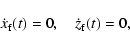
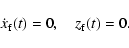
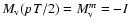 (I= identity matrix). For an initial
perturbation
(I= identity matrix). For an initial
perturbation
 ,
we have
,
we have
 ,
in agreement with Eq. (15).
Similarly, for
,
in agreement with Eq. (15).
Similarly, for
 ,
,
 ,
which agrees with Eq. (16).
In both cases we obtain a symmetric periodic orbit.
The same happens when p=2m+1, since then
,
which agrees with Eq. (16).
In both cases we obtain a symmetric periodic orbit.
The same happens when p=2m+1, since then
for some
 .
(For the relation between the matrix
.
(For the relation between the matrix
 and
and
 see Henon 1973.)
Thus the symmetric p-bifurcation orbits are bifurcation orbits from
which families of symmetric periodic 3D orbits arise. If we take one of them
and introduce a small perturbation in
the z or direction, we can expect to find symmetric and periodic spatial orbits.
Initially, the period will be approximately pT whereas, as the family is followed,
the period will change.
We proceed as follows:
- 1.
- first, we modify slightly the initial conditions z0 or
 (not both at the same time) in order to have initial conditions like in
Eqs. (15) or (16). For both symmetries, the orbit starts off perpendicular to
the plane y=0 and at half period it again crosses the same section perpendicularly.
If there are only two crossings of the plane y=0 per period,
the total number of crossings is 2p (since the period of the spatial orbit is =pT), so in
a half a period it is p. In the case of more crossings these numbers are increased accordingly;
(not both at the same time) in order to have initial conditions like in
Eqs. (15) or (16). For both symmetries, the orbit starts off perpendicular to
the plane y=0 and at half period it again crosses the same section perpendicularly.
If there are only two crossings of the plane y=0 per period,
the total number of crossings is 2p (since the period of the spatial orbit is =pT), so in
a half a period it is p. In the case of more crossings these numbers are increased accordingly;
- 2.
- if the initial perturbation is in the z direction, then by Eq. (15), the equations
defining the periodic orbits are
where t is defined implicitly by the condition y(t)=0at the pth time when the orbit crosses the plane y=0.
If the initial perturbation is in the
direction, using Eq. (16), the equations
are
These equations enable us to correct the starting point and predict a new one,
using the tangent space to the manifold defined by them.
Note that every initial planar stable periodic orbit generates
two families of spatial orbits. This is not true in general for critical orbits
(p=1,2), but from the
results obtained, we see that from every critical orbit of the horseshoe families
computed in the previous sections, two families of spatial orbits arise.
Given fixed values p and q, we take a stable planar p-bifurcation orbit. Such an orbit
always exists inside families with
 less than a certain value. For
:
less than a certain value. For
:
- in each family with
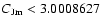 ,
for any value
,
for any value
 there exist at least
two stable orbits with
there exist at least
two stable orbits with
 ;
;
- in each family with higher values of
,
there exist values
such that no stable orbit has
.
We followed some spatial families for the values of p and s2 given in Table 3.
Table 3:
Values of p and s2 of the bifurcation orbits used.
As we have already said, from each bifurcation orbit two families of spatial orbits arise.
Orbits with initial conditions
 are called of type 1, and
orbits with initial conditions
are called of type 1, and
orbits with initial conditions
 ,
of
type 2 (the other initial coordinates are zero). We say that a family is of type p/iif it bifurcates from a p-bifurcation orbit and its orbits are of type i.
In Fig. 19 two spatial periodic horseshoe orbits
and their eccentricity and inclination are shown. As we can observe, the inclination
oscillates around a mean value.
,
of
type 2 (the other initial coordinates are zero). We say that a family is of type p/iif it bifurcates from a p-bifurcation orbit and its orbits are of type i.
In Fig. 19 two spatial periodic horseshoe orbits
and their eccentricity and inclination are shown. As we can observe, the inclination
oscillates around a mean value.
From the results obtained we observe the following:
- 1.
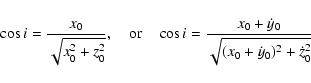
- For simplicity, we consider the inclination of one orbit as its value at the initial condition, instead of
its average value. The inclination will be given by
for orbits of type 1 and 2 respectively.
In each family, in general, as the Jacobi constant decreases, the inclination increases.
Nevertheless, we found some families where the inclination increases until a maximum value and
then decreases. See Fig. 20.
- 2.
- Within each family, the eccentricity (at the initial conditions) increases and
the minimum distance to the small primary always decreases. This means, as in the planar case,
that the number of loops increases and that the orbits briefly enter the half-space y>0.
- 3.
- For a fixed value of the Jacobi constant, there is a maximum possible inclination given
by the zero velocity surfaces. In the planar case, there are no zero velocity curves for
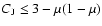 ,
but in the spatial case there are forbidden regions for the motion
for
,
but in the spatial case there are forbidden regions for the motion
for
 ,
although they do not intersect the z=0 plane. See Fig. 18.
As the initial conditions are near the zvs, the height of the orbit is almost
as larger as it can be, and so is the inclination.
,
although they do not intersect the z=0 plane. See Fig. 18.
As the initial conditions are near the zvs, the height of the orbit is almost
as larger as it can be, and so is the inclination.
- 4.
- Concerning stability, no simple rule seems to exist.
Each family may or may not have stable orbits. In general,
a larger inclination seems to imply stronger instability.
When a family contains stable orbits, there is a "critical''
inclination separating stable and unstable orbits
(Figs. 20 and 21).
For
,
we find stable orbits up to inclinations of 17
 .
.
![\begin{figure}
\par\includegraphics[height=3.9cm,width=3.9cm,clip]{1483f60.eps}\...
...*{6mm}
\includegraphics[height=3.9cm,width=3.9cm,clip]{1483f63.eps}\end{figure}](/articles/aa/full/2005/12/aa1483/Timg171.gif) |
Figure 20:
Jacobi constant versus inclination (in degrees) of four different families of spatial horseshoe orbits. The
stability zones are plotted in continuous and dotted lines respectively. From left to right and top
to bottom, the families are of type: a) 1/1; b) 1/2; c) 3/1; d) 3/2. |
| Open with DEXTER |
![\begin{figure}
\par\includegraphics[width=7.5cm,height=5.55cm,clip]{1483f64.eps}...
...}
\par\includegraphics[width=7.5cm,height=5.55cm,clip]{1483f66.eps}\end{figure}](/articles/aa/full/2005/12/aa1483/Timg172.gif) |
Figure 21:
Behaviour of the stability parameters (s1 on the horizontal axis and s2 on the vertical one) for
families of type p/1 (continuous line) and p/2 (dotted line) for different values of p.
a) p=1; b) p=2; and c)
p=3. |
| Open with DEXTER |
In this paper we have computed families of planar and spatial
symmetric periodic horseshoe orbits.
First we described the organization and stability of planar orbits.
This allowed us to find bifurcation orbits and to compute families
of three-dimensional horseshoe orbits, as well.
The values of the Jacobi constant, stability parameter, eccentricity and
inclination of these orbits were outlined.
We found that spatial stable orbits up to an inclination of
exist.
Our study does not exclude the possible existence of stable periodic
orbits of even higher inclination. This remains to be investigated.
Acknowledgements
The first author acknowledges the Tuorla Observatory where most of this work has been
carried out, and is partially supported by the Catalan grant CIRIT 2001SGR-00070
and Spanish grant DGICYT BFM2003-09504-C02-01.
- Boccaletti, D., & Pucacco, G.
1999, Theory of Orbits, 2: Perturbative and Geometrical Methods
(Berlin: Springer-Verlag)
(In the text)
- Brasser, R., Innanen, K.
A., Connors, H., et al. 2004, Icarus, in press
(In the text)
- Burrau, C., & Strömgren,
E. 1915, Astron. Nachr., 200, 313 [NASA ADS]
- Burrau, C., & Strömgren,
E. 1916, Astron. Nachr., 202, 185 [NASA ADS]
- Burrau, C., & Strömgren,
E. 1917, Astron. Nachr., 203, 277 [NASA ADS]
- Christou, A. 2000,
Icarus, 144, 1 [NASA ADS] [CrossRef] (In the text)
- Connors M., Chodas, P.,
Mikkola, S., et al. 2002, Meteoritics & Planetary Science, 37,
1435 [NASA ADS] (In the text)
- Cors, J. M.,
& Hall, G. R. 2003, SIAM J. Appl. Dyn. Syst., 2, 219 [CrossRef] [MathSciNet] (In the text)
-
Dermott, S. F., & Murray, C. D. 1981a, Icarus, 1
-
Dermott, S. F., & Murray, C. D. 1981b, Icarus,
12
-
Gómez, G., & Mondelo, J. 2001, Physica D, 157, 283 [NASA ADS] [MathSciNet] (In the text)
- Henon, M. 1973,
A&A, 28, 415 [NASA ADS] (In the text)
- Hénon, M. 1997,
Generating families in the restricted three-body problem (Berlin:
Springer-Verlag), 278
(In the text)
-
Hénon, M., & Petit, J. M. 1986, Cel. Mech., 38, 67 [NASA ADS] [MathSciNet] (In the text)
- Jorba, A., &
Zou, M., preprint
(In the text)
- Llibre, J.,
& Ollé, M. 2001, A&A, 378, 1087 [EDP Sciences] [NASA ADS] [CrossRef] (In the text)
- Namouni, F.
1999, Icarus, 137, 293 [NASA ADS] [CrossRef] (In the text)
- Namouni, F.,
Cristou, A. A., & Murray, C. D. 1999,
Phys. Rev. Lett., 83, 2506 [NASA ADS] [CrossRef] (In the text)
-
Murray, C. D., & Dermott, S. F. 1999, Solar system
dynamics (Cambridge: Cambridge University Press), 592
(In the text)
- Salo, H.,
& Yoder, F. 1988, A&A, 309
(In the text)
-
Spirig, F., & Waldvogel, J. 1985, in Stability of the Solar
System and its minor natural and artificial satellites (D. Reidel
Publishing Company), 53
(In the text)
- Szebehely, V. 1967, Theory of
Orbits. The Restricted Problem of Three Bodies (Academic Press,
Inc.)
(In the text)
- Wiegert, P., Innanen, K.,
& Mikkola, S. 1997, Nature, 387, 685 [NASA ADS] [CrossRef] (In the text)
Copyright ESO 2005
![\begin{figure}
\par {\includegraphics[height=7.1cm,width=8cm,clip]{1483f01.eps} }
\end{figure}](/articles/aa/full/2005/12/aa1483/img19.gif)
![\begin{figure}
\par\begin{tabular}{cc}
\includegraphics[totalheight=4cm]{1483f0...
... C_{{\rm J}_1} $\space & $ 3<C_{\rm J}<C_{{\rm J}_3} $ \end{tabular}\end{figure}](/articles/aa/full/2005/12/aa1483/img30.gif)
![\begin{figure}
\par {\includegraphics[height=7.5cm,width=8cm,clip]{1483f06.eps} }
\end{figure}](/articles/aa/full/2005/12/aa1483/img44.gif)
![\begin{figure}
\par {\includegraphics[height=7.5cm,width=7.9cm,clip]{1483f07.eps...
...
\par {\includegraphics[height=5.2cm,width=8cm,clip]{1483f08.eps} }
\end{figure}](/articles/aa/full/2005/12/aa1483/img45.gif)
![\begin{figure}
\par {\includegraphics[height=7.4cm,width=7.9cm,clip]{1483f09.eps} }
\end{figure}](/articles/aa/full/2005/12/aa1483/img53.gif)
![\begin{figure}
\par\includegraphics[height=3.7cm,width=3.6cm,clip]{1483f10.eps}\...
...*{5mm}
\includegraphics[height=3.7cm,width=3.6cm,clip]{1483f11.eps}\end{figure}](/articles/aa/full/2005/12/aa1483/img54.gif)
![\begin{figure}
\par {\includegraphics[width=8cm,clip]{1483f12.eps} }\vspace*{3.5mm}
\par {\includegraphics[width=8cm,clip]{1483f13.eps} }
\end{figure}](/articles/aa/full/2005/12/aa1483/img60.gif)
![\begin{figure}
\par {\includegraphics[width=8cm,clip]{1483f14.eps} }
\end{figure}](/articles/aa/full/2005/12/aa1483/img66.gif)
![\begin{figure}
\par {\includegraphics[width=7.9cm,clip]{1483f15.eps} }\vspace*{3...
...par\hspace*{-2mm}{\includegraphics[width=7.7cm,clip]{1483f16.eps} }
\end{figure}](/articles/aa/full/2005/12/aa1483/img74.gif)
![\begin{figure}
\par {\includegraphics[width=8.8cm,clip]{1483f17.eps} }
\end{figure}](/articles/aa/full/2005/12/aa1483/img78.gif)
![\begin{figure}
\par {\includegraphics[width=8cm,clip]{1483f18.eps} }
\vspace*{2...
...e*{5mm}
\includegraphics[height=3.7cm,width=3.6cm,clip]{1483f20.eps}\end{figure}](/articles/aa/full/2005/12/aa1483/img79.gif)
![\begin{figure}
\par {\includegraphics[width=8cm,clip]{1483f21.eps} }
\end{figure}](/articles/aa/full/2005/12/aa1483/img83.gif)
![\begin{figure}
\begin{tabular}{ccc}
(1) & (2) & (3)\\
\includegraphics[totalhei...
...udegraphics[totalheight=105pt,width=155pt]{1483f33.eps}\end{tabular}\end{figure}](/articles/aa/full/2005/12/aa1483/img85.gif)
![\begin{figure}
\begin{tabular}{ccc}
(1) & (2) & (3)\\
\includegraphics[totalhei...
...udegraphics[totalheight=105pt,width=155pt]{1483f42.eps}\end{tabular}\end{figure}](/articles/aa/full/2005/12/aa1483/img86.gif)
![\begin{figure}
\begin{tabular}{ccc}
(1) & (2) & (3)\\
\includegraphics[totalhei...
...udegraphics[totalheight=105pt,width=155pt]{1483f48.eps}\end{tabular}\end{figure}](/articles/aa/full/2005/12/aa1483/img87.gif)

![\begin{figure}
\par {\includegraphics[width=8cm,clip]{1483f49.eps} }
\end{figure}](/articles/aa/full/2005/12/aa1483/img108.gif)
![\begin{figure}
\par {\includegraphics[width=7.9cm,clip]{1483f50.eps} }\vspace*{3...
...\par\hspace*{2mm}{\includegraphics[width=8.1cm,clip]{1483f51.eps} }
\end{figure}](/articles/aa/full/2005/12/aa1483/img126.gif)


![\begin{figure}
\par\includegraphics[angle=-90,width=4cm,clip]{1483f52.eps}\hspace*{4mm}
\includegraphics[angle=-90,width=4cm,clip]{1483f53.eps}\end{figure}](/articles/aa/full/2005/12/aa1483/img141.gif)
![\begin{figure}
\par\includegraphics[width=4.8cm,height=3.7cm,clip]{1483f54.eps}\...
...*{6mm}
\includegraphics[width=4.7cm,height=3.8cm,clip]{1483f59.eps}\end{figure}](/articles/aa/full/2005/12/aa1483/img142.gif)
![\begin{figure}
\par\includegraphics[height=3.9cm,width=3.9cm,clip]{1483f60.eps}\...
...*{6mm}
\includegraphics[height=3.9cm,width=3.9cm,clip]{1483f63.eps}\end{figure}](/articles/aa/full/2005/12/aa1483/img171.gif)
![\begin{figure}
\par\includegraphics[width=7.5cm,height=5.55cm,clip]{1483f64.eps}...
...}
\par\includegraphics[width=7.5cm,height=5.55cm,clip]{1483f66.eps}\end{figure}](/articles/aa/full/2005/12/aa1483/img172.gif)