A&A 432, 937-953 (2005)
DOI: 10.1051/0004-6361:20041246
Effelsberg H I observations of compact high-velocity clouds
T. Westmeier - C. Brüns - J. Kerp
Radioastronomisches Institut der Universität Bonn, Auf dem Hügel 71, 53121 Bonn, Germany
Received 6 May 2004 / Accepted 24 November 2004
Abstract
We have mapped 11 compact high-velocity clouds (CHVCs) in the 21-cm line emission of neutral, atomic hydrogen, using
the Effelsberg 100-m radio telescope. The aim of our observations was to study the overall distribution of the warm neutral
medium of CHVCs with high sensitivity. The achieved baseline rms of
 at the
original
at the
original
 velocity resolution allows us to search for evidence of ram-pressure interaction with
the ambient medium. In addition, we have obtained spectra along an appropriate axis across each CHVC with longer integration
times and denser angular sampling. These deep slices with
velocity resolution allows us to search for evidence of ram-pressure interaction with
the ambient medium. In addition, we have obtained spectra along an appropriate axis across each CHVC with longer integration
times and denser angular sampling. These deep slices with
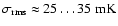 allow
us to determine the column density profile in greater detail as well as the velocity and line width gradient across each cloud.
allow
us to determine the column density profile in greater detail as well as the velocity and line width gradient across each cloud.
The most outstanding result of our observations is the complexity of the H I column density distribution and the line
profiles of the investigated CHVCs. We have found only one cloud with a spherically-symmetric appearance. Among
the remaining clouds we observe head-tail structures, bow-shock shapes, and objects with irregular shapes. These complex
morphologies in combination with the obtained physical parameters suggest that ram-pressure interactions with an ambient
medium may play a significant role in shaping some of the CHVCs from our sample. These results are consistent with a
circumgalactic distribution of CHVCs with typical distances of the order of 100 kpc. The pressure of the ambient medium might
also stabilise CHVCs in addition to their own gravitational potential.
Key words: ISM: clouds - Galaxy: halo - Galaxy: evolution - galaxies: Local Group - galaxies: ISM
High-velocity clouds (HVCs) were first detected by Muller et al. (1963) in the 21-cm line emission of neutral, atomic
hydrogen. HVCs are gas clouds which are characterised by high radial velocities incompatible with a participation in Galactic
rotation. Over the past decades, there have been a large number of definitions concerning the velocities of HVCs. Following a
suggested approach by Wakker (1991), their radial velocities have to be at least
 higher than
the maximum radial velocities allowed for Galactic gas in the same direction according to a simple model of Galactic rotation.
Apart from several small clouds, HVCs appear as large, homogeneous complexes, some of them spanning tens of degrees across the sky
(see Wakker & van Woerden 1997 for a detailed review).
higher than
the maximum radial velocities allowed for Galactic gas in the same direction according to a simple model of Galactic rotation.
Apart from several small clouds, HVCs appear as large, homogeneous complexes, some of them spanning tens of degrees across the sky
(see Wakker & van Woerden 1997 for a detailed review).
Among the numerous hypotheses proposed for the origin and distribution of HVCs (Wakker & van Woerden 1997), the Local
Group hypothesis has become the most discussed during recent years. In 1999, Blitz et al. argued that the observed properties
of HVCs were consistent with a distribution throughout the entire Local Group after excluding some of the large HVC complexes and
the Magellanic Stream. Furthermore, they suggested that HVCs might be the so-called missing dark-matter satellites predicted by
cosmological cold dark matter (CDM) models (Klypin et al. 1999; Moore et al. 1999). These models predict many more
dark-matter haloes for the Local Group than can be directly observed in the form of dwarf galaxies. Blitz et al. (1999)
argued that these dark-matter haloes might not have formed stars on a grand scale and could, therefore, be identified with a
population of HVCs spread across the entire Local Group.
Following the approach of Blitz et al. (1999), Braun & Burton (1999) defined a subclass of compact, isolated HVCs
on the basis of the Leiden/Dwingeloo Survey of Galactic neutral hydrogen (LDS, Hartmann & Burton 1997). They compiled
a catalogue of 66 so-called compact high-velocity clouds (CHVCs), characterised by angular sizes of less than  FWHM and
spatial isolation and separation from neighbouring H I emission. Braun & Burton (1999) found the statistical
properties of these CHVCs to be consistent with a distribution throughout the entire Local Group with typical distances of the
order of
FWHM and
spatial isolation and separation from neighbouring H I emission. Braun & Burton (1999) found the statistical
properties of these CHVCs to be consistent with a distribution throughout the entire Local Group with typical distances of the
order of
 .
CHVCs would then be quite large and massive objects with sizes of about
.
CHVCs would then be quite large and massive objects with sizes of about
 and typical H I masses of a few times
 .
.
An improved CHVC catalogue with 67 objects on the basis of the LDS was published by de Heij et al. (2002b), using an
automated search routine. In addition, Putman et al. (2002) extracted 179 CHVCs from the H I Parkes All-Sky Survey
(HIPASS, Barnes et al. 2001). Both catalogues for the northern and southern sky were then combined by de Heij et al.
(2002c) for an all-sky catalogue of 216 CHVCs (30 clouds were located in the overlap region between LDS and HIPASS).
First doubts about a Local Group population of CHVCs arose with the non-detection of similar H I clouds in other galaxy
groups. Zwaan (2000) investigated five galaxy groups with the Arecibo telescope to search for intragroup clouds. From
his non-detection he concluded that the Local Group scenario proposed by Blitz et al. (1999) can be ruled out with
>99% confidence level if the Local Group is typical among the investigated groups. A similar survey was conducted by
Pisano et al. (2004) who studied three galaxy groups with the Parkes 64-m telescope and the Australia Telescope
Compact Array (ATCA). They were not successful in detecting any H I clouds similar to CHVCs, concluding that the known population
of CHVCs has to be located within
 from the Milky Way.
Further support for a circumgalactic population of CHVCs comes from Brüns et al. (2001) who discovered a
pronounced head-tail structure of CHVC 125+41, suggesting that gas had been stripped off the cloud by ram-pressure interaction
with the surrounding medium. This suggests a location of the cloud in the vicinity of the Milky Way. By applying the virial theorem
to a compact clump within the cloud, Brüns et al. (2001) constrained the distance of CHVC 125+41 to
 (in the case of no additional molecular gas) which is consistent with a circumgalactic population of CHVCs. Head-tail
structures are also observed towards most of the large HVC complexes. Brüns et al. (2000) systematically searched
the LDS for distinct HVCs with
(in the case of no additional molecular gas) which is consistent with a circumgalactic population of CHVCs. Head-tail
structures are also observed towards most of the large HVC complexes. Brüns et al. (2000) systematically searched
the LDS for distinct HVCs with
 .
They found that about 20% of the 252 clouds
in their catalogue show a head-tail structure suggesting the presence of ram-pressure interaction between these HVCs and the
ambient medium.
.
They found that about 20% of the 252 clouds
in their catalogue show a head-tail structure suggesting the presence of ram-pressure interaction between these HVCs and the
ambient medium.
A circumgalactic CHVC population is also supported by hydrodynamical simulations of Sternberg et al. (2002) who
considered CHVCs as spherically-symmetric, pressure-supported gas clouds confined by a gravitationally dominant dark-matter halo.
They simulated both a Local Group population of CHVCs with a typical distance of
 and a circumgalactic
distribution with a distance of
and a circumgalactic
distribution with a distance of
 .
Sternberg et al. (2002) compared their simulations
with the observed properties of CHVCs according to high-resolution observations with the Westerbork Synthesis Radio Telescope (WSRT)
by Braun & Burton (2000) and Arecibo observations by Burton et al. (2001). They found the observed properties to
be consistent with the results of their circumgalactic model so that CHVCs might be associated with an extended Galactic corona.
At a typical distance of
the average H I mass of CHVCs would be
.
Sternberg et al. (2002) compared their simulations
with the observed properties of CHVCs according to high-resolution observations with the Westerbork Synthesis Radio Telescope (WSRT)
by Braun & Burton (2000) and Arecibo observations by Burton et al. (2001). They found the observed properties to
be consistent with the results of their circumgalactic model so that CHVCs might be associated with an extended Galactic corona.
At a typical distance of
the average H I mass of CHVCs would be
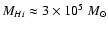 .
Furthermore, a diffuse Galactic corona gas can provide the external pressure required to additionally support CHVCs
and to account for head-tail structures like the one observed in the case of CHVC 125+41.
.
Furthermore, a diffuse Galactic corona gas can provide the external pressure required to additionally support CHVCs
and to account for head-tail structures like the one observed in the case of CHVC 125+41.
The results of Sternberg et al. (2002) also outline observational strategies to distinguish between a Local Group
origin of CHVCs and a circumgalactic CHVC population. In the circumgalactic case, their simulations predict a sharp drop in the
H I column density below
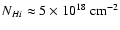 due to ionisation by the strong
intergalactic radiation field in the vicinity of the Galaxy. In addition, the circumgalactic model predicts possible gas wings
with H I column densities below
due to ionisation by the strong
intergalactic radiation field in the vicinity of the Galaxy. In addition, the circumgalactic model predicts possible gas wings
with H I column densities below
 .
In the Local Group scenario the H I colum density
shows a smooth decline at the edge of the clouds and no extended wings are expected. Sensitive observations with the 9' HPBW
of the 100-m telescope in Effelsberg should, thus, allow us to evaluate the distribution of CHVCs by investigating the column
density profile across a sample of objects in detail. Another aim of our observations is the search for head-tail structures
among CHVCs which would suggest the presence of an ambient medium and could provide an additional constraint on the distance
and distribution of CHVCs.
.
In the Local Group scenario the H I colum density
shows a smooth decline at the edge of the clouds and no extended wings are expected. Sensitive observations with the 9' HPBW
of the 100-m telescope in Effelsberg should, thus, allow us to evaluate the distribution of CHVCs by investigating the column
density profile across a sample of objects in detail. Another aim of our observations is the search for head-tail structures
among CHVCs which would suggest the presence of an ambient medium and could provide an additional constraint on the distance
and distribution of CHVCs.
This paper is organised as follows: in Sect. 2 we describe how the 11 investigated CHVCs were chosen.
Section 3 explains the entire data acquisition and reduction process. In Sect. 4 we present
the results of our survey and summarise the physical parameters of our 11 CHVCs. In Sect. 5 we
discuss the implications of our results for the origin and the properties of CHVCs. Sect. 6
summarises our results and conclusions.
2 Sample selection
10 of the 11 CHVCs were selected from the Braun & Burton (1999) catalogue on the basis of previous, less sensitive
Effelsberg H I observations of 41 CHVCs (Westmeier 2003) by two criteria. First, all clouds still had to be
classified as CHVCs in the improved catalogue by de Heij et al. (2002b). Second, we selected only those clouds with an
H I peak column density ratio of
 between the Effelsberg data and the LDS data. A high column density ratio implies that the clouds contain
compact substructure which is unresolved with the 25-m Dwingeloo telescope (36' HPBW). The obtained column density ratios are
all well below the value expected for point sources so that our 11 CHVCs must all be partly resolved with the 100-m Effelsberg
telescope (9' HPBW). Thus, the latter criterion selects the most compact clouds for re-investigation which are not completely
resolved with the existing LDS data and worth being re-observed with the higher angular resolution of the 100-m telescope.
between the Effelsberg data and the LDS data. A high column density ratio implies that the clouds contain
compact substructure which is unresolved with the 25-m Dwingeloo telescope (36' HPBW). The obtained column density ratios are
all well below the value expected for point sources so that our 11 CHVCs must all be partly resolved with the 100-m Effelsberg
telescope (9' HPBW). Thus, the latter criterion selects the most compact clouds for re-investigation which are not completely
resolved with the existing LDS data and worth being re-observed with the higher angular resolution of the 100-m telescope.
The remaining object, CHVC 218+29, was selected from the de Heij et al. (2002b) catalogue to obtain a complete coverage
of the available sidereal time interval. CHVC 218+29 was attractive because of its northern latitude, its small angular
size and its unusually narrow H I lines of only
 FWHM according to the de Heij et al.
(2002b) catalogue.
FWHM according to the de Heij et al.
(2002b) catalogue.
3 Data acquisition and reduction
A map of
 spectra on a 9' grid (beam-by-beam sampling) was observed for most clouds, resulting in
a field of view of
spectra on a 9' grid (beam-by-beam sampling) was observed for most clouds, resulting in
a field of view of
 .
The central position was derived from previous, less sensitive Effelsberg
observations (Westmeier 2003) so that the object should be centred in the map. Each H I spectrum was
integrated for 3 min in the in-band frequency switching mode, using the 1024-channel autocorrelator. The bandwidth was
.
The central position was derived from previous, less sensitive Effelsberg
observations (Westmeier 2003) so that the object should be centred in the map. Each H I spectrum was
integrated for 3 min in the in-band frequency switching mode, using the 1024-channel autocorrelator. The bandwidth was
 ,
resulting in a velocity resolution of
.
Signal and reference spectra were
shifted by
,
resulting in a velocity resolution of
.
Signal and reference spectra were
shifted by
 relative to the central frequency. The advantage of this in-band frequency switching method
is that the H I line of the CHVC is included in both the signal and reference spectra so that the entire integration time
is used for detection of the astronomical signal, resulting in a typical baseline rms of
at the original velocity resolution of
.
The maps allow us to determine the overall
morphology of the CHVCs and to identify possible head-tail structures or other signs of ram-pressure distortion.
relative to the central frequency. The advantage of this in-band frequency switching method
is that the H I line of the CHVC is included in both the signal and reference spectra so that the entire integration time
is used for detection of the astronomical signal, resulting in a typical baseline rms of
at the original velocity resolution of
.
The maps allow us to determine the overall
morphology of the CHVCs and to identify possible head-tail structures or other signs of ram-pressure distortion.
Furthermore, we intended to compare the column density profiles of CHVCs with the predictions of the numerical simulations
by Sternberg et al. (2002). For this purpose, we observed additional positions along the apparent symmetry axis of
each CHVC with a longer integration time of typically 10 min per spectrum and a denser angular sampling of 4.5' or 6.4'
between two adjacent spectra. These deep slices allow us to investigate the H I column density profile in more detail
and with higher sensitivity. The typical baseline rms along the deep slices is
at the original
velocity resolution. As the deep slices in most cases had to be
observed prior to a detailed analysis of the maps, there are two cases in which the slices were unfortunately not perfectly
placed along the symmetry axis of the corresponding clouds.
![\begin{figure}
\par\includegraphics[width=17.2cm,clip]{1246fig1.eps} \end{figure}](/articles/aa/full/2005/12/aa1246/Timg41.gif) |
Figure 1:
Example spectra of the five CHVCs with two-component line profiles and of CHVC 148-82. The dotted curves
represent a decomposition of the spectra into two Gaussian components. The superposition of a broad and a narrow Gaussian
component indicates the presence of two more or less distinct phases of warm and cold neutral gas. In the case of CHVC 148-82
a separation into two Gaussian components is not useful, although the narrow cusp on top of the H I lines
towards the centre of the cloud again indicates the existence of a compact core of cold neutral gas. |
| Open with DEXTER |
In the case of CHVC 218+29 we used a slightly different procedure. The object turned out to be very compact and elongated so
that we chose a map size of
 spectra on a 4.5' grid, corresponding to a field of view of roughly
 .
Furthermore, some H I lines of CHVC 218+29 turned out to be so narrow (
.
Furthermore, some H I lines of CHVC 218+29 turned out to be so narrow (
 FWHM) that
the velocity resolution of
could not sufficiently resolve them. Therefore, we had to observe CHVC 218+29 with a smaller bandwidth of
FWHM) that
the velocity resolution of
could not sufficiently resolve them. Therefore, we had to observe CHVC 218+29 with a smaller bandwidth of
 ,
leading to a velocity resolution of
,
leading to a velocity resolution of
 .
This made the use of the in-band frequency switching method inappropriate so that we had to observe CHVC 218+29 in the normal frequency
switching mode, resulting in a slightly higher baseline rms of
.
This made the use of the in-band frequency switching method inappropriate so that we had to observe CHVC 218+29 in the normal frequency
switching mode, resulting in a slightly higher baseline rms of
 at the original
velocity resolution.
at the original
velocity resolution.
All spectra were calibrated using the S7 standard calibration source (Kalberla et al. 1982). The statistical
uncertainties in the derived calibration factors are in the range of
 % for each observing session. Next, the
standard stray radiation correction was applied to the spectra (Kalberla et al. 1980). Because of their high radial
velocities most CHVCs are only marginally affected by Galactic stray radiation. However, a few of our CHVCs have radial velocities
of
% for each observing session. Next, the
standard stray radiation correction was applied to the spectra (Kalberla et al. 1980). Because of their high radial
velocities most CHVCs are only marginally affected by Galactic stray radiation. However, a few of our CHVCs have radial velocities
of
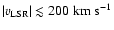 which is in the regime of Galactic H I gas towards some
directions so that a stray radiation correction was in general recommended and performed for all spectra. After calibration and
stray radiation correction all spectra were available in the form of brightness temperature
which is in the regime of Galactic H I gas towards some
directions so that a stray radiation correction was in general recommended and performed for all spectra. After calibration and
stray radiation correction all spectra were available in the form of brightness temperature
 versus radial
velocity in the local standard-of-rest frame
versus radial
velocity in the local standard-of-rest frame
 .
.
The baseline correction for each spectrum was done by visual inspection, using the GILDAS package. As a result of the
relatively narrow spectral lines of the CHVCs, the line windows could be set visually and a polynomial - usually of order 3 - was then subtracted from the spectra. To obtain the physical parameters of our CHVCs (e.g. H I column density, line width
and radial velocity of the gas) a single Gaussian was fit to each spectrum. Finally, only those H I lines with a brightness
temperature of
 were selected for further analysis and all other spectra were rejected.
Unless otherwise noted, all maps and slices presented in this paper are based on the results of these Gaussian fits. Only the column
density maps were derived from the zeroth moment of the spectra under the general assumption that the optical depth of the gas
is negligible. In some cases, the H I lines disclose a two-component structure indicating the presence of a cold and a warm
gas phase. If so, we additionally fitted two Gaussian components to the spectra in order to study the properties of the two
gas phases separately. Some examples of two-component line profiles are shown in Fig. 1.
were selected for further analysis and all other spectra were rejected.
Unless otherwise noted, all maps and slices presented in this paper are based on the results of these Gaussian fits. Only the column
density maps were derived from the zeroth moment of the spectra under the general assumption that the optical depth of the gas
is negligible. In some cases, the H I lines disclose a two-component structure indicating the presence of a cold and a warm
gas phase. If so, we additionally fitted two Gaussian components to the spectra in order to study the properties of the two
gas phases separately. Some examples of two-component line profiles are shown in Fig. 1.
Table 1:
Physical parameters of the 11 observed CHVCs. l and b are the Galactic longitude and
latitude of the column density maximum,  and
and  the corresponding equatorial coordinates,
and
the corresponding equatorial coordinates,
and
 the column density weighted average radial velocities in LSR and GSR frames,
  the average line
width ( FWHM),
the observed peak brightness temperature,
the average line
width ( FWHM),
the observed peak brightness temperature,
 the H I peak column density, and
e the ellipticity of the cloud. The last two rows give the mean value
the H I peak column density, and
e the ellipticity of the cloud. The last two rows give the mean value
 and the standard deviation
  for each parameter x.
4 Results
In this section we describe the physical parameters of the observed CHVCs. Section 4.1 gives a general
overview of the properties of our CHVC sample. Sections 4.2 to 4.5 address the properties of the
individual clouds in more detail.
4.1 Overall properties of the 11 CHVCs
One motivation for our observations was the search for head-tail structures like the ones found in the case of CHVC 125+41
(Brüns et al. 2001) and in many HVC complexes (Brüns et al. 2000). It turned out that only one object, CHVC 148-82,
has a spherically-symmetric appearance. All other CHVCs exhibit a more or less complex and irregular morphology. We identified
6 CHVCs with either a head-tail structure or a bow-shock shape which in many cases is suggestive of ram-pressure interaction
between the CHVCs and the ambient medium. The remaining clouds appear irregular in the sense that they do not exhibit a
simple radial or axial symmetry. In Sects. 4.2 to 4.5 we describe the properties of the individual CHVCs divided
into the four morphological categories mentioned above. This morphological classification, however, is subjective and not
based on a quantitative analysis. Nonetheless, we applied it to structure the description of the individual CHVCs with the objective
of improving the readability of the paper. Our attempt to quantify the different morphologies on the basis of ellipse fits was not successful
because of the relatively poor sampling of the CHVCs even with the 100-m telescope. A single pixel could significantly influence the
fits and, thus, the morphological classification of a cloud.
The derived physical parameters of the 11 investigated CHVCs are summarised in Table 1. With the exception of
CHVC 218+29 the radial velocities of the clouds are all negative in both the local standard-of-rest frame (LSR) and the
Galactic standard-of-rest frame (GSR). This is simply based on a selection effect: The motion of Galactic rotation is superposed
on the radial velocities of the CHVCs so that CHVCs in the northern sky have predominantly negative radial velocities in the LSR
frame while CHVCs in the southern hemisphere have mainly positive radial velocities (also see Braun & Burton 1999). We can
account for the contribution of Galactic rotation by converting the radial velocities into the GSR frame. The asymmetry between positive
and negative velocities, however, remains so that even in the GSR frame CHVCs in the northern hemisphere must have a net negative
radial velocity. This means that the net radial velocity of CHVCs is of no use if we do not consider a homogeneous
all-sky survey. Even in the latter case gas clouds of different origin (e.g. fragments of the Magellanic Stream or gas clouds
of Galactic origin) might significantly influence the obtained mean radial velocity of the CHVC population so that the
implications of the mean radial velocity of CHVCs must be considered with great care.
There is a wide range of different velocity gradients across the 11 investigated CHVCs. The two extreme cases are CHVC 218+29
which shows velocity variations of only
 and CHVC 358+12 with a total gradient of about
 .
In a few cases, rapid velocity changes seem to be induced by the presence of multiple gas components
along the line of sight with different radial velocities. This is likely the case for CHVC 050-68, where we observe a velocity
gradient of
.
In a few cases, rapid velocity changes seem to be induced by the presence of multiple gas components
along the line of sight with different radial velocities. This is likely the case for CHVC 050-68, where we observe a velocity
gradient of
 across an angular distance of only 20'. Broad and complex line profiles in this
area suggest that the gradient is induced by individual gas components along the line of sight. In
other cases, velocity variations are fairly regular with Gaussian line profiles, so that the velocity gradients
can be interpreted as a sign of rotation of the clouds. This is in particular the case for CHVC 358+12 where the velocity
profile along the major axis of the cloud resembles the rotation curve of a galaxy.
across an angular distance of only 20'. Broad and complex line profiles in this
area suggest that the gradient is induced by individual gas components along the line of sight. In
other cases, velocity variations are fairly regular with Gaussian line profiles, so that the velocity gradients
can be interpreted as a sign of rotation of the clouds. This is in particular the case for CHVC 358+12 where the velocity
profile along the major axis of the cloud resembles the rotation curve of a galaxy.
The average line width of the investigated CHVCs is
 FWHM. The narrowest lines by far are
found in the case of CHVC 218+29, measuring around
FWHM at the eastern edge of the cloud. This
corresponds to an upper limit in kinetic gas temperature of about
FWHM. The narrowest lines by far are
found in the case of CHVC 218+29, measuring around
FWHM at the eastern edge of the cloud. This
corresponds to an upper limit in kinetic gas temperature of about
 .
.![[*]](/icons/foot_motif.gif) The largest line widths of up to
FWHM are found in CHVC 358+12, but the complex line profiles in this case suggest that such
large line widths are caused by the superposition of multiple gas components with different radial velocities. In some CHVCs,
line profiles show a two-component structure. A narrow line component seems to be superposed on a broad component, indicating
the presence of two phases of cold neutral medium (CNM) and warm neutral medium (WNM). Such two-component line profiles can be
seen in CHVC 017-25, CHVC 039-33, CHVC 050-68, CHVC 218+29 and CHVC 221-88.
Example spectra of these clouds are shown in Fig 1. In the case of CHVC 148-82 (lower-right panel),
no clear two-component structure is present in the spectra. The shape of the spectral lines, however, is not perfectly Gaussian in the
central parts of the cloud. A narrow cusp on top of the H I line indicates the presence of a compact cold core which is not
resolved with the 9' HPBW of the 100-m telescope. Evidence for a cold core in CHVC 148-82 was also found by de Heij et al.
(2002a). Their high-resolution synthesis observations with the WSRT show a very compact clump with H I line widths of
The largest line widths of up to
FWHM are found in CHVC 358+12, but the complex line profiles in this case suggest that such
large line widths are caused by the superposition of multiple gas components with different radial velocities. In some CHVCs,
line profiles show a two-component structure. A narrow line component seems to be superposed on a broad component, indicating
the presence of two phases of cold neutral medium (CNM) and warm neutral medium (WNM). Such two-component line profiles can be
seen in CHVC 017-25, CHVC 039-33, CHVC 050-68, CHVC 218+29 and CHVC 221-88.
Example spectra of these clouds are shown in Fig 1. In the case of CHVC 148-82 (lower-right panel),
no clear two-component structure is present in the spectra. The shape of the spectral lines, however, is not perfectly Gaussian in the
central parts of the cloud. A narrow cusp on top of the H I line indicates the presence of a compact cold core which is not
resolved with the 9' HPBW of the 100-m telescope. Evidence for a cold core in CHVC 148-82 was also found by de Heij et al.
(2002a). Their high-resolution synthesis observations with the WSRT show a very compact clump with H I line widths of
 FWHM.
FWHM.
![\begin{figure}
\par\includegraphics[width=16.3cm,clip]{1246fig2.eps} \end{figure}](/articles/aa/full/2005/12/aa1246/Timg93.gif) |
Figure 2:
CHVC 148-82 as described in Sect. 4.2. a) Integrated H I column density map. Contours
start at
 with an increment of
 .
The crosses indicate
the positions of individual spectra along the deep slice (see Fig. 3). b) Distribution of LSR radial
velocities of the gas. c) Distribution of line widths ( FWHM). .
The crosses indicate
the positions of individual spectra along the deep slice (see Fig. 3). b) Distribution of LSR radial
velocities of the gas. c) Distribution of line widths ( FWHM). |
| Open with DEXTER |
The average H I peak column density of the CHVCs in the original catalogue by Braun & Burton (1999) is
 .
The observed peak column densities of our 11 CHVCs
are in the range of
.
The observed peak column densities of our 11 CHVCs
are in the range of
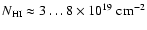 with a slightly larger average
value of
with a slightly larger average
value of
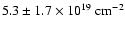 .
This is consistent with the value of
.
This is consistent with the value of
 following from the circumgalactic model of Sternberg et al. (2002). The peak brightness temperatures of the CHVCs in our
survey range from
following from the circumgalactic model of Sternberg et al. (2002). The peak brightness temperatures of the CHVCs in our
survey range from
 to
to
 with an average of
 .
.
The ellipticities of the clouds were determined by a second moment analysis following the procedure described by Banks et al.
(1995). First, a clip level of
was applied to the column density map of each cloud,
corresponding to about the 3-sigma detection limit of our data. Next, the central position of the cloud was derived from the column
density weighted first moment. Then we calculated the column density weighted second moments for each map from which we obtained the
major and minor axis, a and b, of the ellipse as described by Banks et al. (1995). From the major and minor axis we
finally calculated the ellipticity e, using the definition
 .
.
4.2 Spherically-symmetric CHVCs
CHVC 148-82 is the only cloud among our 11 investigated CHVCs which has an almost spherically-symmetric appearance.
It is located close to the Galactic south pole and the Magellanic Stream. The radial velocity of CHVC 148-82, however, is
different by about
 from the one observed for the Magellanic Stream (
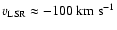 ,
Brüns et al. 2005) in this area so that an association between both objects is unlikely.
Figure 2 shows the distribution of H I column densities, line widths and radial velocities. We find a
clear velocity gradient across the cloud, measuring roughly
,
Brüns et al. 2005) in this area so that an association between both objects is unlikely.
Figure 2 shows the distribution of H I column densities, line widths and radial velocities. We find a
clear velocity gradient across the cloud, measuring roughly
 across an angular distance of about 45'.
The distribution of line widths is consistent with a spherical symmetry of CHVC 148-82 as the H I lines in the centre of
the cloud are typically narrower than those at the edge. This is what we would expect for a spherically-symmetric gas cloud with
decreasing gas temperature towards the centre.
across an angular distance of about 45'.
The distribution of line widths is consistent with a spherical symmetry of CHVC 148-82 as the H I lines in the centre of
the cloud are typically narrower than those at the edge. This is what we would expect for a spherically-symmetric gas cloud with
decreasing gas temperature towards the centre.
The results of the deep and more detailed observations performed along the slice indicated by the crosses in
Fig. 2a are presented in Fig. 3. The column density profile confirms the symmetric
appearance of CHVC 148-82 although towards the northern edge of the cloud the column density decreases more rapidly than
towards the southern edge. This slight asymmetry is already indicated in the map in Fig. 2a.
Unfortunately, the slice was not exactly chosen along the velocity gradient of CHVC 148-82. Nonetheless, the somewhat
irregular velocity gradient is well traced by the data. The line width profile across the deep slice clearly shows the
systematically smaller line widths in direction of the centre of CHVC 148-82 which suggests the existence of cold gas in
the centre of the cloud. Although a distinct cold gas component cannot directly be seen in the spectra, its existence is
indicated by narrow cusps on top of the H I lines in the direction of the cloud's centre (see Fig. 1).
These cusps are a direct hint of the existence of a compact core of cold neutral gas which is not resolved with the 9' HPBW
of the Effelsberg telescope. This compact core was directly detected by de Heij et al. (2002a) with
high-resolution WSRT observations.
4.3 Head-tail CHVCs
Four CHVCs from our sample exhibit a head-tail structure, suggesting the presence of ram-pressure
interaction between these CHVCs and the ambient medium. Maps of the integrated column density and the distribution of radial
velocities and line widths are shown in Fig. 4. The results of the deep and more detailed observations
performed along the slice indicated by the crosses in Fig. 4a are presented in Fig. 5
as a function of relative position along the slice.
CHVC 017-25 is located in the vicinity of the two HVC complexes GCP and GCN (Galactic Centre Positive/Negative). At first
glance, the head-tail structure of CHVC 017-25 does not seem very pronounced. The column density map shows that the spacings
between contour lines are noticeably wider towards the north-western edge of the cloud, indicating the existence of a diffuse,
faint gas tail in this direction. In the H I column density distribution along the deep slice the head-tail structure
of CHVC 017-25 can clearly be seen. At the south-eastern edge there is a sharp increase in column density while towards the
north-western edge we see a faint and extended tail. The behaviour of radial velocities is not completely regular; however,
there is a general north-south gradient of about
 .
Along the deep slice, radial velocities
show a semi-periodic variation without any clear trend. The observed H I line widths show a clear gradient with quite
narrow lines in the south-eastern part of the cloud. The narrowest lines at the south-eastern edge measure only about
FWHM corresponding to an upper limit for the gas temperature of about
.
Along the deep slice, radial velocities
show a semi-periodic variation without any clear trend. The observed H I line widths show a clear gradient with quite
narrow lines in the south-eastern part of the cloud. The narrowest lines at the south-eastern edge measure only about
FWHM corresponding to an upper limit for the gas temperature of about
 .
In the direction of the extended tail of CHVC 017-25 the line widths increase noticeably, reaching values around
.
In the direction of the extended tail of CHVC 017-25 the line widths increase noticeably, reaching values around
 FWHM which corresponds to an upper limit for the gas temperature of roughly
 .
These results suggest the separation of a cold and a warm gas component and substantiate the impression of a
head-tail structure of CHVC 017-25. The obvious distortion of CHVC 017-25 is discussed in more detail in
Sect. 5.2.
.
These results suggest the separation of a cold and a warm gas component and substantiate the impression of a
head-tail structure of CHVC 017-25. The obvious distortion of CHVC 017-25 is discussed in more detail in
Sect. 5.2.
![\begin{figure}
\par\includegraphics[width=17.2cm,clip]{1246fig3.eps} \end{figure}](/articles/aa/full/2005/12/aa1246/Timg109.gif) |
Figure 3:
CHVC 148-82 as described in Sect. 4.2. a) Integrated H I column density along the slice
indicated by the crosses in Fig. 2a. b) Distribution of LSR radial velocities of the gas along
the slice. c) Distribution of line widths ( FWHM) along the slice. |
| Open with DEXTER |
![\begin{figure}
\par\includegraphics[width=16.32cm,clip]{1246fig4.eps} \end{figure}](/articles/aa/full/2005/12/aa1246/Timg110.gif) |
Figure 4:
Head-tail CHVCs as described in Sect. 4.3. a) Integrated H I column density map. Contours
start at
(
in the case of CHVC 040+01) with an
increment of
.
The crosses indicate the positions of individual spectra along the deep
slice (see Fig. 5). b) Distribution of LSR radial velocities of the gas. c) Distribution
of line widths ( FWHM). |
| Open with DEXTER |
![\begin{figure}
\par\includegraphics[width=17.2cm,clip]{1246fig5.eps} \end{figure}](/articles/aa/full/2005/12/aa1246/Timg111.gif) |
Figure 5:
Head-tail CHVCs as described in Sect. 4.3. a) Integrated H I column density along the
slice indicated by the crosses in Fig. 4a. b) Distribution of LSR radial velocities of
the gas along the slice. c) Distribution of line widths ( FWHM) along the slice. |
| Open with DEXTER |
![\begin{figure}
\par\includegraphics[width=16.8cm,clip]{1246fig6.eps} \end{figure}](/articles/aa/full/2005/12/aa1246/Timg112.gif) |
Figure 6:
Bow-shock shaped CHVCs as described in Sect. 4.4. a) Integrated H I column density map.
Contours start at
with an increment of
.
The
crosses indicate the positions of individual spectra along the deep slice (see Fig. 7). b)
Distribution of LSR radial velocities of the gas. c) Distribution of line widths ( FWHM). |
| Open with DEXTER |
CHVC 032-31 can be found in the direction of the HVC complex GCN which combines several smaller clouds with similar negative
radial velocities. The head-tail structure of CHVC 032-31 is somewhat more pronounced than in the case of CHVC 017-25. At the
north-western edge there is a sharp increase in column density while in the opposite direction the H I emission is much
more extended and ends in a faint tail. Another remarkable feature is the isolated emission in the lower left corner of the
map. With a maximum H I column density of
 ,
this small
cloud lies clearly above our detection limit. Within the significance of our data, it is not connected to the main body of CHVC 032-31, resulting in an upper limit (
,
this small
cloud lies clearly above our detection limit. Within the significance of our data, it is not connected to the main body of CHVC 032-31, resulting in an upper limit (
 )
for the column density of a potential bridge of roughly
)
for the column density of a potential bridge of roughly
 if a line width of
 FWHM is assumed. The radial velocity
of the small isolated cloud is significantly lower (w.r.t. the absolute value) than the velocities observed across the main
cloud, indicating a separation in both position and velocity. The H I lines across CHVC 032-31 are comparatively broad
with a mean value of
FWHM is assumed. The radial velocity
of the small isolated cloud is significantly lower (w.r.t. the absolute value) than the velocities observed across the main
cloud, indicating a separation in both position and velocity. The H I lines across CHVC 032-31 are comparatively broad
with a mean value of
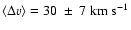 .
As in the case of CHVC 017-25, there is a
strong line width gradient between head and tail.
.
As in the case of CHVC 017-25, there is a
strong line width gradient between head and tail.
CHVC 040+01 is located very close to the Galactic plane. From the morphological point of view the head-tail structure of
CHVC 040+01 is the most pronounced among our 11 CHVCs. The column density map shows a compact head and an extended tail in
the north-eastern direction. This structure can also be seen in the column density profile along the deep slice although the
slice unfortunately is not perfectly aligned with the symmetry axis of CHVC 040+01. Moreover, there is evidence of very
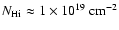
faint and diffuse emission all across the map with intensities typically below
.
This faint
emission is particularly prominent in the western part of the map where column densities of up to
 can be found. The observed radial velocities across CHVC 040+01 do not show
a regular behaviour. There is no clear gradient, and radial velocities along the deep slice again show a semi-periodic
variation as in the case of CHVC 017-25. The observed H I line widths are quite large, reaching about
FWHM in the south-western part of the cloud. Unlike in all other head-tail CHVCs, the broadest lines can be
found in the vicinity of the head of CHVC 040+01. Along the tail, line widths decrease to around
can be found. The observed radial velocities across CHVC 040+01 do not show
a regular behaviour. There is no clear gradient, and radial velocities along the deep slice again show a semi-periodic
variation as in the case of CHVC 017-25. The observed H I line widths are quite large, reaching about
FWHM in the south-western part of the cloud. Unlike in all other head-tail CHVCs, the broadest lines can be
found in the vicinity of the head of CHVC 040+01. Along the tail, line widths decrease to around
 FWHM.
FWHM.
CHVC 218+29 is one of the most remarkable objects among our 11 CHVCs because it reveals some extreme properties. It is
highly elongated with a major axis of about  but a minor axis of only 20' with respect to the
column density level. The head-tail structure is not very prominent but the deep column density profile
shows a steep slope on one side of the cloud and a more moderate slope on the other side, forming a short and diffuse tail.
Radial velocities across the object are nearly constant with
but a minor axis of only 20' with respect to the
column density level. The head-tail structure is not very prominent but the deep column density profile
shows a steep slope on one side of the cloud and a more moderate slope on the other side, forming a short and diffuse tail.
Radial velocities across the object are nearly constant with
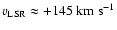 .
Only
towards the western edge is there a slight increase to about
.
Only
towards the western edge is there a slight increase to about
 .
The detected line widths are the
smallest by far among the CHVCs in our sample. At the eastern edge we observe line widths of only around
FWHM, corresponding to an upper limit for the gas temperature of only about
.
Moreover, we find a clear and
systematic gradient along the major axis of CHVC 218+29. Towards the eastern edge, line widths rise above
.
The detected line widths are the
smallest by far among the CHVCs in our sample. At the eastern edge we observe line widths of only around
FWHM, corresponding to an upper limit for the gas temperature of only about
.
Moreover, we find a clear and
systematic gradient along the major axis of CHVC 218+29. Towards the eastern edge, line widths rise above
 FWHM. This prominent line width gradient again suggests the separation of a warm envelope and a cold gas component.
4.4 Bow-shock shaped CHVCs
Two CHVCs from our sample exhibit a bow-shock shape, suggesting the presence of ram-pressure interaction between
these CHVCs and the ambient medium. Maps of the integrated column density and the distribution of radial velocities and line
widths are shown in Fig. 6. The results of the deep and more detailed observations performed along the
slice indicated by the crosses in Fig. 6a are presented in Fig. 7 as a function of
relative position along the slice.
CHVC 157+03 is located close to the Galactic plane and is characterised by a slightly condensed core and two symmetric gas
wings north-east and south-west of the core. It is a nice example of a CHVC with a bow-shock shape. Both radial
velocities and line widths follow the axial symmetry of the column density distribution. Across most of CHVC 157+03 the radial
velocities of the gas are more or less the same with
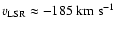 .
Only towards
the south-eastern edge do the radial velocities systematically decrease (w.r.t. their absolute values) by about
which is clearly traced by the velocity gradient along the deep slice. A similar behaviour is observed for the
H I line widths. Across most of the cloud the line widths are slightly above
FWHM, but towards
the south-eastern edge they systematically rise above
FWHM.
.
Only towards
the south-eastern edge do the radial velocities systematically decrease (w.r.t. their absolute values) by about
which is clearly traced by the velocity gradient along the deep slice. A similar behaviour is observed for the
H I line widths. Across most of the cloud the line widths are slightly above
FWHM, but towards
the south-eastern edge they systematically rise above
FWHM.
The appearance of CHVC 172-60 is similar to that of CHVC 157+03 although the core is more condensed and the wings are
clearly asymmetric. The wing in the eastern direction is significantly less extended than the wing in the western direction.
As in the case of CHVC 157+03, we observe a radial velocity gradient across the cloud which more or less follows the axial
symmetry of the column density distribution. While we observe radial velocities around
 or
higher across most of CHVC 172-60, velocities systematically decrease below
or
higher across most of CHVC 172-60, velocities systematically decrease below
 towards the
south-eastern and south-western flanks of the cloud. The behaviour of the H I line widths, however, is different from
that in CHVC 157+03. There is no clear increase in line width towards the southern edge of the cloud, but instead line widths
grow noticeably towards the opposite side.
towards the
south-eastern and south-western flanks of the cloud. The behaviour of the H I line widths, however, is different from
that in CHVC 157+03. There is no clear increase in line width towards the southern edge of the cloud, but instead line widths
grow noticeably towards the opposite side.
4.5 Irregular CHVCs
The remaining four CHVCs from our survey show an irregular structure in the sense that their morphologies
and the distribution of radial velocities and line widths do not exhibit a simple spherical or axial symmetry. Maps of
the integrated column density and the distribution of radial velocities and line widths are shown in Fig. 8.
The results of the deep and more detailed observations performed along the slice indicated by the crosses in
Fig. 8a are presented in Fig. 9 as a function of relative position along the slice.
CHVC 039-33 can be found near the HVC complex GCN. At first glance, CHVC 039-33 appears to be
a prime example of a head-tail CHVC. A very compact and condensed
core is accompanied by an extended, diffuse gas tail in the south-eastern direction. The distribution of radial velocities and
line widths, however, does not follow this axial symmetry. At both the northern and southern edge the highest radial velocities
of
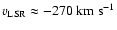 are observed, while the lowest velocities of
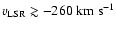 can be found along the eastern and western edge of CHVC 039-33. This "quadrupole''
symmetry of radial velocities does not fit into the simple picture of a head-tail CHVC. Concerning the distribution of H I line widths, there is a strong gradient from south-west to north-east. In the south-western part of CHVC 039-33 we observe
relatively narrow lines with
can be found along the eastern and western edge of CHVC 039-33. This "quadrupole''
symmetry of radial velocities does not fit into the simple picture of a head-tail CHVC. Concerning the distribution of H I line widths, there is a strong gradient from south-west to north-east. In the south-western part of CHVC 039-33 we observe
relatively narrow lines with
 FWHM. Towards the north-eastern edge, the line widths
reach
FWHM. Towards the north-eastern edge, the line widths
reach
 FWHM. Again, this clear gradient does not not follow the axial symmetry of
the observed column density distribution but instead is perpendicular to the major axis of the cloud. The column density
profile along the deep slice, which is shown in Fig. 9a, discloses a second maximum about 20'
south-east of the compact core. This smaller peak is not visible in the map because it is too compact and is located exactly
in between the individual pointings of the map. In addition, the deep column density profile affirms the impression of a
head-tail structure of CHVC 039-33. At the north-western edge, there is a sharp increase in column density, while towards
the south-eastern edge we detect a very faint and extended tail. But the structure of CHVC 039-33 is more complicated than
in the four cases of head-tail CHVCs discussed above. Therefore we classify it as an irregular CHVC.
FWHM. Again, this clear gradient does not not follow the axial symmetry of
the observed column density distribution but instead is perpendicular to the major axis of the cloud. The column density
profile along the deep slice, which is shown in Fig. 9a, discloses a second maximum about 20'
south-east of the compact core. This smaller peak is not visible in the map because it is too compact and is located exactly
in between the individual pointings of the map. In addition, the deep column density profile affirms the impression of a
head-tail structure of CHVC 039-33. At the north-western edge, there is a sharp increase in column density, while towards
the south-eastern edge we detect a very faint and extended tail. But the structure of CHVC 039-33 is more complicated than
in the four cases of head-tail CHVCs discussed above. Therefore we classify it as an irregular CHVC.
CHVC 050-68 is located about  away from the Magellanic Stream which has quite similar radial velocities in this
area with
away from the Magellanic Stream which has quite similar radial velocities in this
area with
 (Brüns et al. 2005). Because of its
extremely large radial velocity gradient CHVC 050-68 is among the most remarkable CHVCs in our sample. Another conspicuous
feature is a narrow, elongated arm in the north-eastern direction. This arm is rather faint, but at least one spectrum is clearly
above our
detection limit. The most amazing feature of CHVC 050-68, however, is its velocity
gradient. At the eastern edge, we find a radial velocity of
(Brüns et al. 2005). Because of its
extremely large radial velocity gradient CHVC 050-68 is among the most remarkable CHVCs in our sample. Another conspicuous
feature is a narrow, elongated arm in the north-eastern direction. This arm is rather faint, but at least one spectrum is clearly
above our
detection limit. The most amazing feature of CHVC 050-68, however, is its velocity
gradient. At the eastern edge, we find a radial velocity of
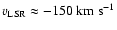 .
Towards
the centre of the cloud, the radial velocity increases to
.
Towards
the centre of the cloud, the radial velocity increases to
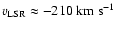 and then drops
again to reach
and then drops
again to reach
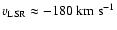 at the western edge. This means that in the eastern part
of CHVC 050-68 we see a velocity gradient of
across only about 20'. Across the western part
of the cloud the velocity gradient still measures
across 40' and has the opposite sign.
The somewhat smaller gradient in the western part of CHVC 050-68 might indicate a rotation of the cloud.
This is reasonable because the line widths observed in this part are almost constant. Moreover, the observed
line profiles are regular and reveal a clear two-component structure, indicating the presence of two distinct cold and warm
gas phases (see Fig. 1). The eastern part of CHVC 050-68, however, is characterised by a sudden
increase in line widths and complex, non-Gaussian line profiles. This indicates the presence of individual gas components
with different radial velocities along the line of sight, whose superposition could give the impression of a strong velocity
gradient across the eastern part of the cloud. This interpretation is supported by the extended, narrow arm in the north-eastern
direction which exhibits radial velocities around
,
consistent with the
values detected at the eastern edge of CHVC 050-68.
at the western edge. This means that in the eastern part
of CHVC 050-68 we see a velocity gradient of
across only about 20'. Across the western part
of the cloud the velocity gradient still measures
across 40' and has the opposite sign.
The somewhat smaller gradient in the western part of CHVC 050-68 might indicate a rotation of the cloud.
This is reasonable because the line widths observed in this part are almost constant. Moreover, the observed
line profiles are regular and reveal a clear two-component structure, indicating the presence of two distinct cold and warm
gas phases (see Fig. 1). The eastern part of CHVC 050-68, however, is characterised by a sudden
increase in line widths and complex, non-Gaussian line profiles. This indicates the presence of individual gas components
with different radial velocities along the line of sight, whose superposition could give the impression of a strong velocity
gradient across the eastern part of the cloud. This interpretation is supported by the extended, narrow arm in the north-eastern
direction which exhibits radial velocities around
,
consistent with the
values detected at the eastern edge of CHVC 050-68.
CHVC 221-88 is located near the Galactic south pole and about  away from the Magellanic Stream. Nonetheless, a
connection between both objects is unlikely because the Magellanic Stream reveals completely different radial velocities in this
area with
away from the Magellanic Stream. Nonetheless, a
connection between both objects is unlikely because the Magellanic Stream reveals completely different radial velocities in this
area with
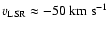 (Brüns et al. 2005). CHVC 221-88 is among the
most complex CHVCs investigated in our survey. It is quite elongated with a major axis of about
and a minor axis
between 20' and 30'. The column density map and, in more detail, the deep column density profile reveal three clumps, the
westernmost of which is the faintest. Additional emission is detected at the western edge of the map. This emission has
radial velocities around
which is about
(Brüns et al. 2005). CHVC 221-88 is among the
most complex CHVCs investigated in our survey. It is quite elongated with a major axis of about
and a minor axis
between 20' and 30'. The column density map and, in more detail, the deep column density profile reveal three clumps, the
westernmost of which is the faintest. Additional emission is detected at the western edge of the map. This emission has
radial velocities around
which is about
 different from the velocities observed across the main part of CHVC 221-88. This means that despite their
positional coincidence both clouds are kinematically clearly separated from each other. Unfortunately, we did not have enough
time to extend our map in the western direction to investigate the second cloud in more detail. Focussing on the main cloud,
its velocity structure is quite remarkable. While in the central and eastern parts of CHVC 221-88 radial velocities range
between
different from the velocities observed across the main part of CHVC 221-88. This means that despite their
positional coincidence both clouds are kinematically clearly separated from each other. Unfortunately, we did not have enough
time to extend our map in the western direction to investigate the second cloud in more detail. Focussing on the main cloud,
its velocity structure is quite remarkable. While in the central and eastern parts of CHVC 221-88 radial velocities range
between
 ,
they suddenly drop to
,
they suddenly drop to
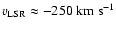 in the western part of the cloud. The velocity profile along the deep slice which is presented
in Fig. 9b shows that this drop by about
in the western part of the cloud. The velocity profile along the deep slice which is presented
in Fig. 9b shows that this drop by about
 is extremely abrupt and occurs across
only 9' (which is the HPBW of the Effelsberg telescope's main beam). In the intermediate region between both radial velocity
regimes the observed line widths suddenly increase, indicating an increased velocity dispersion along the line of sight. At
first glance, the velocity profile is reminiscent of a rotation curve. But the shape of the spectral lines in the intermediate region
clearly exhibits two distinct gas components so that the two parts of CHVC 221-88 with different radial velocities might be
two separate clouds on the same line of sight rather than a single rotating cloud. The separate cloud at the western edge of
the map supports this interpretation as it is also isolated in both velocity and position. It looks as if we see three individual
clouds across the map with radial velocities decreasing (in absolute value) from east to west.
is extremely abrupt and occurs across
only 9' (which is the HPBW of the Effelsberg telescope's main beam). In the intermediate region between both radial velocity
regimes the observed line widths suddenly increase, indicating an increased velocity dispersion along the line of sight. At
first glance, the velocity profile is reminiscent of a rotation curve. But the shape of the spectral lines in the intermediate region
clearly exhibits two distinct gas components so that the two parts of CHVC 221-88 with different radial velocities might be
two separate clouds on the same line of sight rather than a single rotating cloud. The separate cloud at the western edge of
the map supports this interpretation as it is also isolated in both velocity and position. It looks as if we see three individual
clouds across the map with radial velocities decreasing (in absolute value) from east to west.
![\begin{figure}
\par\includegraphics[width=17.2cm,clip]{1246fig7.eps} \end{figure}](/articles/aa/full/2005/12/aa1246/Timg142.gif) |
Figure 7:
Bow-shock shaped CHVCs as described in Sect. 4.4. a) Integrated H I column density along
the slice indicated by the black crosses in Fig. 6a. b) Distribution of LSR radial
velocities of the gas along the slice. c) Distribution of line widths ( FWHM) along the slice. |
| Open with DEXTER |
CHVC 358+12 is located about
 north of the Galactic centre. It is the largest among our 11 investigated
CHVCs and extends beyond the boundaries of our map in both the eastern and western direction. CHVC 358+12 reveals a rather
complex structure with a compact core in the centre and several fainter clumps and extensions all across the object. The most
remarkable feature, however, is the radial velocity gradient. In the south-western part of CHVC 358+12 radial velocities
up to
north of the Galactic centre. It is the largest among our 11 investigated
CHVCs and extends beyond the boundaries of our map in both the eastern and western direction. CHVC 358+12 reveals a rather
complex structure with a compact core in the centre and several fainter clumps and extensions all across the object. The most
remarkable feature, however, is the radial velocity gradient. In the south-western part of CHVC 358+12 radial velocities
up to
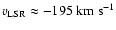 are observed. Towards the north-eastern edge the radial
velocities drop to
are observed. Towards the north-eastern edge the radial
velocities drop to
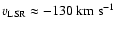 ,
and the deep spectra along the slice reveal a
faint gas component which has even lower velocities of
,
and the deep spectra along the slice reveal a
faint gas component which has even lower velocities of
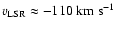 .
This results
in a total velocity gradient of
across the observed extent of the cloud. Furthermore, this velocity
gradient resembles the flat rotation curve of a galaxy. This is already obvious in the velocity map in Fig. 8b
and is clearly illustrated by the velocity profile along the deep slice which was chosen along the velocity gradient and
can be seen in Fig. 9b. This velocity gradient is accompanied by multiple line components especially in the
central parts of CHVC 358+12. The occurrence of such multiple components is traced by larger line widths of up to
FWHM near the centre of the cloud. The properties of this remarkable CHVC will be discussed in more
detail in a subsequent paper.
.
This results
in a total velocity gradient of
across the observed extent of the cloud. Furthermore, this velocity
gradient resembles the flat rotation curve of a galaxy. This is already obvious in the velocity map in Fig. 8b
and is clearly illustrated by the velocity profile along the deep slice which was chosen along the velocity gradient and
can be seen in Fig. 9b. This velocity gradient is accompanied by multiple line components especially in the
central parts of CHVC 358+12. The occurrence of such multiple components is traced by larger line widths of up to
FWHM near the centre of the cloud. The properties of this remarkable CHVC will be discussed in more
detail in a subsequent paper.
5 Discussion
5.1 Evidence of ram-pressure interaction
The most outstanding result of our observations is the morphological complexity of the investigated CHVCs. Ten out of eleven
clouds reveal an obviously non-spherical morphology with four CHVCs appearing irregular. When taking spectra along
an appropriate axis across each cloud, we originally intended to obtain sensitive and detailed column density profiles at the
clouds' edges and to compare our observations with the results of the hydrodynamical simulations by Sternberg et al. (2002).
But the explicitly irregular morphologies of most of the 11 observed CHVCs make a comparison of column density profiles and
scale lengths nearly impossible. The simulations by Sternberg et al. (2002) were based on the assumption of
spherically-symmetric and undisturbed gas clouds. In many cases, however, we see an obvious asymmetry in the H I distribution which may be an indication of interaction effects between the CHVCs and an ambient medium.
![\begin{figure}
\par\includegraphics[width=16.2cm,clip]{1246fig8.eps} \end{figure}](/articles/aa/full/2005/12/aa1246/Timg147.gif) |
Figure 8:
Irregular CHVCs as described in Sect. 4.5. a) Integrated H I column density map. Contours
start at
with an increment of
.
The crosses
indicate the positions of individual spectra along the deep slice (see Fig. 9). b) Distribution of
LSR radial velocities of the gas. c) Distribution of line widths ( FWHM). |
| Open with DEXTER |
![\begin{figure}
\par\includegraphics[width=17.4cm,clip]{1246fig9.eps} \end{figure}](/articles/aa/full/2005/12/aa1246/Timg148.gif) |
Figure 9:
Irregular CHVCs as described in Sect. 4.5. a) Integrated H I column density along the
slice indicated by the crosses in Fig. 8a. b) Distribution of LSR radial velocities of
the gas along the slice. c) Distribution of line widths ( FWHM) along the slice. |
| Open with DEXTER |
![\begin{figure}
\par\includegraphics[width=15.4cm,clip]{1246figa.eps} \end{figure}](/articles/aa/full/2005/12/aa1246/Timg149.gif) |
Figure 10:
CHVC 017-25. a) Typical spectrum near the centre of the cloud which shows a two-component line profile.
The dotted curves represent the decomposition of the spectrum into two Gaussian components. The three diagrams show the
distribution of b) line widths, c) H I column densities and d) LSR radial velocities
along the deep slice for the cold ( )
and warm ( )
and warm ( )
gas component. The error bars indicate the statistical
uncertainties of the Gaussian fit. )
gas component. The error bars indicate the statistical
uncertainties of the Gaussian fit. |
| Open with DEXTER |
The complex morphologies of the CHVCs in our sample are not a selection effect caused by the selection criteria discussed in
Sect. 2. Virtually all of the 41 CHVCs in our previous, less sensitive Effelsberg survey (Westmeier
2003) disclose a non-spherical morphology, although the data were not sensitive enough to trace the distribution
of the faint outer parts of the WNM. Thus, a complex, non-spherical distribution of H I column densities seems to be
typical for the known population of CHVCs, and spherically-symmetric clouds like CHVC 148-82 are a rare exception.
The effects of ram-pressure stripping of HVCs were investigated by Quilis & Moore (2001) using three-dimensional
hydrodynamical simulations. They present pure gas clouds as well as dark-matter confined clouds in an ambient medium with
a variety of different gas densities. They find that gas tails with H I column densities
 appear when the density of the ambient medium exceeds about
 .
Even with lower
gas densities around
.
Even with lower
gas densities around
 faint gas tails emerge in their simulations with H I column densities
of about
.
faint gas tails emerge in their simulations with H I column densities
of about
.
The most prominent candidates for interacting clouds in our sample are the four head-tail CHVCs (see Figs. 4
and 5). The head-tail morphology of these objects already suggests the presence of ram pressure. This impression
is additionally supported by the distribution of line widths. With the exception of CHVC 040+01, all head-tail CHVCs reveal
a clear line width gradient with the narrowest H I lines appearing close to the head at the apparent leading edge of
the cloud. This indicates a spatial separation of warm and cold neutral gas. In the case of CHVC 218+29, the bare cold gas lies
exposed to its environment on one edge of the cloud with line widths around
FWHM. A similar
situation is observed for CHVC 017-25, where line widths of about
FWHM are measured at the apparent
leading edge.
Ram-pressure distortion is also a possible explanation for our two cases of bow-shock shaped CHVCs (see Figs. 6 and 7). A detailed analysis of the distribution of radial velocities of the H I gas reveals a clear velocity gradient across both clouds. While radial velocities are more or less constant across most parts
of the two CHVCs, they decrease significantly towards the presumed leading edges. This suggests a deceleration of the gas due
to the ram pressure of the ambient medium. In the case of CHVC 157+03, this velocity gradient measures about
and is accompanied by a clear line width gradient with opposite sign. Line widths systematically
increase towards the apparent leading edge which may indicate heating or growing turbulence of the gas in the course of
ram-pressure interaction.
Burton et al. (2001) also reported significant asymmetries in the high column density regime (
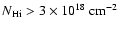 )
of their 10 CHVCs observed with the Arecibo telescope. In the low column density regime below about
)
of their 10 CHVCs observed with the Arecibo telescope. In the low column density regime below about
 ,
however, they found a high degree of reflection symmetry which they took as evidence against
an external mechanism producing the observed asymmetries in the high column density cores. But their analysis is based only on
one-dimensional drift scans at constant declination, whereas our deep slices were placed along the symmetry axis of each CHVC,
making an interpretation in the sense of object symmetry more meaningful.
,
however, they found a high degree of reflection symmetry which they took as evidence against
an external mechanism producing the observed asymmetries in the high column density cores. But their analysis is based only on
one-dimensional drift scans at constant declination, whereas our deep slices were placed along the symmetry axis of each CHVC,
making an interpretation in the sense of object symmetry more meaningful.
Another possible mechanism to produce the observed complex morphologies of most of our CHVCs is tidal interaction. Tidal
forces, however, would act on both the compact cold cores and the diffuse warm envelopes in the same manner so that a misalignment
between the core and the envelope, as in the case of head-tail CHVCs, cannot be explained by tidal interaction alone. But tidal
forces could have shaped some of the irregular CHVCs in our sample. Clouds like CHVC 221-88 or CHVC 358+12 are highly elliptical,
but they do not show any obvious misalignment between the diffuse envelope and the embedded cores, indicating that ram-pressure might
not have been the principal process shaping these clouds.
Radiation pressure could also act on gas clouds and cause a misalignment between compact cores and diffuse envelopes. This
process, however, can be excluded in the case of our CHVCs because it would require a strong radiation field as well as high density
clumps with a significant amount of dust which has not yet been found in CHVCs. Wakker & Boulanger (1986) investigated
parts of the HVC complexes A and M in IRAS observations, but they did not detect any dust in these HVCs, concluding that either the
dust was too cold to be detected or that the dust abundance was below their detection limit. CHVCs have even lower H I peak
column densities than the large HVC complexes so that the presence of large amounts of dust is not expected if one assumes the same dust
properties as for the low-velocity H I clouds in the Galaxy. In addition, the strong radiation field should ionise the part of
the CHVCs being exposed to the radiation. This should result in high H
intensities which are not consistent with the faint
H
emission found by Tufte et al. (2002) and Putman et al. (2003).
5.2 CHVC 017-25 as a prime example of ram-pressure interaction
The most compelling example of a presumably interacting cloud, CHVC 017-25, is discussed in more detail at this point as
the effects of ram-pressure distortion are quite pronounced and representative of other clouds in our sample. As already
mentioned in Sect. 4.3.1, the head-tail structure of CHVC 017-25 does not seem very prominent at first glance.
A more detailed analysis of the deep spectra along the apparent symmetry axis, however, provides evidence of a possible ram-pressure
distortion of the entire cloud. Many spectra around the central part of CHVC 017-25 show a more complex H I line profile,
indicating the superposition of two distinct gas components. Figure 10a presents an example spectrum in
which a narrow line component (
 FWHM) of cold neutral gas (
 )
seems to be superposed on a broad component (
)
seems to be superposed on a broad component (
 FWHM) of warm neutral gas
(
FWHM) of warm neutral gas
(
 ). Therefore, we decomposed the H I line profiles along the deep slice across CHVC 017-25,
where possible, into two Gaussian components.
). Therefore, we decomposed the H I line profiles along the deep slice across CHVC 017-25,
where possible, into two Gaussian components.
Of course, such a Gaussian decomposition is an approximation as we will never meet two completely distinct gas phases with
uniform temperatures. As de Heij et al. (2002a) have already pointed out, a decomposition of spectral lines into two
Gaussian components, therefore, does not necessarily refer to two physically distinct systems. Nonetheless, the homogeneous
physical parameters of the two line components justify the distinction of a cold and a warm gas phase as long as we only
consider the qualitative properties of these two gas phases and their implications.
The results of the Gaussian decomposition of the spectral lines of CHVC 017-25 are presented in Figs. 10b-d. In Fig. 10b we have plotted the line widths of the two gas components as a function of relative
position along the deep slice. The two gas phases are clearly separated by their different line widths of
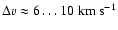 FWHM for the cold gas and
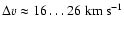 FWHM in the case of the
warm gas component. Figure 10c shows the column density profiles of both gas phases along the slice. The cold
gas phase forms a compact head while the warm gas component is spatially much more extended so that we can speak of a compact, cold
core embedded in a diffuse, warm envelope. The most remarkable result is that both gas phases are spatially separated from each other.
At the south-eastern edge of the cloud only the narrow lines of the cold gas component can be seen. Towards the north-western edge we
can only trace the warm gas phase which forms an extended, faint tail and justifies our classification of CHVC 017-25 as a
head-tail CHVC. This clear spatial separation of the cold core and the warm envelope could be explained if the
envelope is being stripped off the compact core by the ram pressure of an ambient medium through which CHVC 017-25 is moving.
FWHM in the case of the
warm gas component. Figure 10c shows the column density profiles of both gas phases along the slice. The cold
gas phase forms a compact head while the warm gas component is spatially much more extended so that we can speak of a compact, cold
core embedded in a diffuse, warm envelope. The most remarkable result is that both gas phases are spatially separated from each other.
At the south-eastern edge of the cloud only the narrow lines of the cold gas component can be seen. Towards the north-western edge we
can only trace the warm gas phase which forms an extended, faint tail and justifies our classification of CHVC 017-25 as a
head-tail CHVC. This clear spatial separation of the cold core and the warm envelope could be explained if the
envelope is being stripped off the compact core by the ram pressure of an ambient medium through which CHVC 017-25 is moving.
In Fig. 10d we have plotted the radial velocities of the two gas components across the deep slice.
There is no clear gradient but a semi-periodic variation of radial velocities along the major axis of the cloud. At the four
positions where both the cold and warm gas phases have been detected the velocity of the cold gas seems to be systematically
higher (in absolute value) than that of the warm gas. This would be consistent with the idea of the cold core moving
faster than the stripped-off warm envelope if we assume an infall of the cloud onto the Galaxy which is
suggested by the highly negative radial velocity of
 in the GSR frame. But the velocity
difference of about
in the GSR frame. But the velocity
difference of about
 between the core and the envelope is significantly smaller than the
velocity resolution of our spectra so that this result is not reliable.
between the core and the envelope is significantly smaller than the
velocity resolution of our spectra so that this result is not reliable.
The most controversial parameter of CHVCs is their distance. Distance is the key to most of the physical parameters
like the H I mass, the size, and, naturally, the overall distribution of the observed CHVC population within the Local Group.
As the distance of CHVCs cannot be determined directly we have to apply indirect distance estimates. Burton et al. (2001)
used an estimate of the thermal pressure at the interface of cold and warm neutral medium to obtain distances between 150 and
850 kpc for a number of CHVCs observed with the Arecibo telescope. Such distances would place the CHVC population throughout
the entire Local Group. Brüns et al. (2001) applied the virial theorem to a compact clump within CHVC 125+41 to
estimate a distance of the cloud of the order of 130 kpc. All these indirect distance determinations, however, require the
assumptions of spherical symmetry and dynamical equilibrium of the cloud. We have seen that most of the 11 investigated CHVCs
have a clearly non-spherical appearance and look highly disturbed so that in these cases simple distance estimates cannot be
applied.
Evidence for a distribution of CHVCs within the Milky Way halo was found by Tufte et al. (2002). They detected
H emission towards four out of five CHVCs investigated with the Wisconsin H-Alpha Mapper. The H
intensities are
comparable to those expected for clouds in the Galactic halo where the radiation field is strong enough to ionise the gas
(see also Weiner et al. 2001). The metagalactic radiation field throughout the Local Group would be too weak to account
for the detected H
intensities. Putman et al. (2003) were able to confirm these results with the detection of
H
emission towards two other CHVCs. These H
measurements suggest that CHVCs might constitute a circumgalactic
population with distances of only some 10 kpc from the Galaxy.
Our only cloud with a spherically-symmetric appearance is CHVC 148-82. We can try to derive a rough distance estimate for
this object by applying the following assumptions. Let us consider the cloud to be spherically-symmetric with radius R and
a constant mass density
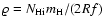 ,
where
,
where
 is the
central H I column density,
is the
central H I column density,
 is the mass of a hydrogen atom, and the factor
 has been introduced to account for additional mass components such as ionised gas or dark matter which are not traced by
the H I column density. The total mass of the cloud is
has been introduced to account for additional mass components such as ionised gas or dark matter which are not traced by
the H I column density. The total mass of the cloud is
 .
Furthermore, we consider CHVC 148-82
to be gravitationally bound and in dynamical equilibrium so that the virial theorem can be applied. Under the above assumptions the
virial theorem reads
.
Furthermore, we consider CHVC 148-82
to be gravitationally bound and in dynamical equilibrium so that the virial theorem can be applied. Under the above assumptions the
virial theorem reads
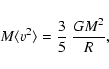 |
(1) |
where G is the gravitational constant, and
 denotes the mean-square velocity of the particles which is
related to the observed FWHM
of the spectral lines by
denotes the mean-square velocity of the particles which is
related to the observed FWHM
of the spectral lines by
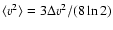 .
We can now
solve Eq. (1) for the distance d of the cloud:
.
We can now
solve Eq. (1) for the distance d of the cloud:
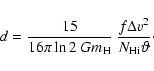 |
(2) |
Here,  denotes the angular radius of the cloud. In the case of CHVC 148-82, the average line width is
FWHM, the observed peak column density is
denotes the angular radius of the cloud. In the case of CHVC 148-82, the average line width is
FWHM, the observed peak column density is
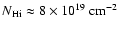 ,
and the angular diameter amounts
,
and the angular diameter amounts
 .
Inserting these values into Eq. (2)
results in a distance estimate for CHVC 148-82 of
.
Inserting these values into Eq. (2)
results in a distance estimate for CHVC 148-82 of
 .
Considering the expected additional
amount of helium of
.
Considering the expected additional
amount of helium of
 (i.e.
(i.e.
 ), CHVC 148-82 would lie at a distance
of about
), CHVC 148-82 would lie at a distance
of about
 and would have a total mass of
 and a radius of about
 .
These parameters are highly implausible. A closer distance can be achieved by assuming a significant amount of additional mass
(e.g. ionised gas or dark matter) or by rejecting the assumption of virialisation of CHVC 148-82. The problem that pure H I CHVCs cannot be gravitationally stable at reasonable distances was discussed in detail by Sternberg et al. (2002). They
consider the possibility of an additional pressure support of CHVCs by the presence of a surrounding medium. The presence of such an
ambient medium in which CHVCs are embedded is illustrated by the majority of disturbed clouds among our sample. We can
account for an external pressure support by inserting an additional pressure term into the virial theorem which then reads
.
These parameters are highly implausible. A closer distance can be achieved by assuming a significant amount of additional mass
(e.g. ionised gas or dark matter) or by rejecting the assumption of virialisation of CHVC 148-82. The problem that pure H I CHVCs cannot be gravitationally stable at reasonable distances was discussed in detail by Sternberg et al. (2002). They
consider the possibility of an additional pressure support of CHVCs by the presence of a surrounding medium. The presence of such an
ambient medium in which CHVCs are embedded is illustrated by the majority of disturbed clouds among our sample. We can
account for an external pressure support by inserting an additional pressure term into the virial theorem which then reads
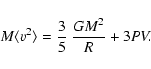 |
(3) |
Here,
 is the volume of the cloud, and P denotes the external pressure. This equation, however, is only
valid for clouds without any dark matter that is not governed by an external pressure component. Solving Eq. (3)
for P yields
is the volume of the cloud, and P denotes the external pressure. This equation, however, is only
valid for clouds without any dark matter that is not governed by an external pressure component. Solving Eq. (3)
for P yields
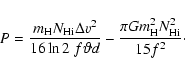 |
(4) |
According to Eq. (4), the distance of the cloud is influenced by two free parameters, the external pressure
P and the H I mass fraction f. In Fig. 11 we have plotted the mass M (dotted contours) and the
distance d (solid contours) of CHVC 148-82 as a function of these two parameters according to Eq. (4). For
very small
 both distance and mass of the cloud become independent of the external pressure because
stabilisation of the cloud is by far dominated by the mass. In this case, the distance would be
both distance and mass of the cloud become independent of the external pressure because
stabilisation of the cloud is by far dominated by the mass. In this case, the distance would be
 and the mass
 .
For more realistic values of f distance and mass strongly depend on the
strength of the external pressure. In the most reasonable parameter range of
.
For more realistic values of f distance and mass strongly depend on the
strength of the external pressure. In the most reasonable parameter range of
 and
and
 the distance of CHVC 148-82 is not well constrained and has values between 30 kpc and 2 Mpc. These results show that
we cannot obtain any reliable distance estimate for CHVC 148-82 due to the major uncertainties in parameter space in combination
with a number of doubtful assumptions such as constant mass density or virialisation of the cloud.
the distance of CHVC 148-82 is not well constrained and has values between 30 kpc and 2 Mpc. These results show that
we cannot obtain any reliable distance estimate for CHVC 148-82 due to the major uncertainties in parameter space in combination
with a number of doubtful assumptions such as constant mass density or virialisation of the cloud.
![\begin{figure}
\par\includegraphics[width=8.4cm,clip]{1246figb.eps} \end{figure}](/articles/aa/full/2005/12/aa1246/Timg189.gif) |
Figure 11:
Constraining the distance of CHVC 148-82. Distance (
 ,
solid contours, labelled from 0.5 to
3.5) and equilibrium mass ( ,
solid contours, labelled from 0.5 to
3.5) and equilibrium mass (
 ,
dotted contours, labelled from 6.0 to 9.0 but going down to 2.5 in
the upper right corner of the diagram) plotted as a function of external pressure P/k and H I mass fraction
according to Eq. (4). In the most reasonable parameter range of
and
the distance of CHVC 148-82 is not well constrained and has values between
30 kpc and 2 Mpc. ,
dotted contours, labelled from 6.0 to 9.0 but going down to 2.5 in
the upper right corner of the diagram) plotted as a function of external pressure P/k and H I mass fraction
according to Eq. (4). In the most reasonable parameter range of
and
the distance of CHVC 148-82 is not well constrained and has values between
30 kpc and 2 Mpc. |
| Open with DEXTER |
In other words, within a realistic range of values for the external pressure and the H I mass fraction we can derive any
distance within the Local Group for CHVC 148-82. This makes earlier distance estimates, placing CHVCs throughout the entire Local
Group, doubtful as they are governed by similar assumptions and uncertainties. On the other hand, we observe interaction
effects in our data. Head-tail structures and bow-shock shapes are suggestive of ram-pressure interaction between CHVCs
and the surrounding medium which may indicate a distribution of CHVCs in the vicinity of the Milky Way. Sternberg et al. (2002)
simulated a circumgalactic population of CHVCs with distances of
from the Milky Way. If we consider the same
distance for CHVC 148-82 we would need an external pressure of
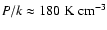 according to
Eq. (4) to stabilise the cloud in the case of no additional dark matter and gas content except helium. This seems
to be a rather high external pressure for such large distances from the Galaxy. Any dark matter content, however, will additionally
stabilise CHVC 148-82 and decrease the required amount of external pressure.
according to
Eq. (4) to stabilise the cloud in the case of no additional dark matter and gas content except helium. This seems
to be a rather high external pressure for such large distances from the Galaxy. Any dark matter content, however, will additionally
stabilise CHVC 148-82 and decrease the required amount of external pressure.
Furthermore, there are indications for the existence of a hot ionised intergalactic medium which could provide an additional
pressure stabilisation of CHVCs. Rasmussen et al. (2003) used X-ray absorption lines of O VII, O VIII,
C VI, and Ne IX detected against three active galactic nuclei to constrain the physical properties of the absorbing
gas. They obtained an upper limit for the electron density of the ionised medium of
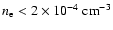 ,
corresponding to a thermal pressure of
,
corresponding to a thermal pressure of
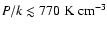 with a gas temperature of
 .
Following limitations in the possible scale lengths of the absorber, Rasmussen et al.
(2003) were able to locate the absorbing gas within the Local Group with a lower limit for the scale length of about
140 kpc. Even if the pressure provided by this ionised intergalactic medium is not sufficient to support CHVCs alone, a
combination of external pressure and dark matter content could stabilise clouds like CHVC 148-82 even at distances of the order
of
.
Following limitations in the possible scale lengths of the absorber, Rasmussen et al.
(2003) were able to locate the absorbing gas within the Local Group with a lower limit for the scale length of about
140 kpc. Even if the pressure provided by this ionised intergalactic medium is not sufficient to support CHVCs alone, a
combination of external pressure and dark matter content could stabilise clouds like CHVC 148-82 even at distances of the order
of
 from the Galaxy.
The above results and considerations lead to a consistent picture in which CHVCs might constitute a circumgalactic population
with typical distances of the order of 100 kpc from the Milky Way. At such distances, CHVCs could be embedded in a hot ionised
intergalactic gas or an extended Galactic corona and be distorted by ram-pressure interaction with this ambient medium. Furthermore,
the external pressure provided by the ambient medium could support CHVCs in addition to their own gravitational potential.
6 Summary
We have mapped 11 compact high-velocity clouds (CHVCs) in the 21-cm line emission of neutral, atomic hydrogen, using the Effelsberg
100-m radio telescope. We obtained a baseline rms of roughly
 at the original velocity
resolution of
,
leading to a 1-sigma H I column density detection limit of
about
at the original velocity
resolution of
,
leading to a 1-sigma H I column density detection limit of
about
 per spectral channel. These maps allow us to examine
the overall morphology of the clouds. In addition, we have obtained deep spectra along the symmetry axis across each CHVC with
denser angular sampling. Along these deep slices we reach a baseline rms of
at the original velocity resolution of
,
resulting in an average 1-sigma H I column density
detection limit of about
per spectral channel. These maps allow us to examine
the overall morphology of the clouds. In addition, we have obtained deep spectra along the symmetry axis across each CHVC with
denser angular sampling. Along these deep slices we reach a baseline rms of
at the original velocity resolution of
,
resulting in an average 1-sigma H I column density
detection limit of about
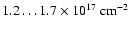 per spectral channel. These deep slices allow us to extract
the column density profile in great detail as well as the velocity and line width gradient across each cloud.
per spectral channel. These deep slices allow us to extract
the column density profile in great detail as well as the velocity and line width gradient across each cloud.
The most outstanding result of our observations is the complexity of the investigated CHVCs. The numerous head-tail structures
and bow-shock shapes point out that the head-tail structure of CHVC 125+41 found by Brüns et al. (2001) is not unique.
Among our 11 objects we found only one cloud with a spherically-symmetric appearance. Four CHVCs have a head-tail structure, two
CHVCs show a bow-shock shape, and the remaining four clouds are irregular. The complex morphologies of most of our 11 CHVCs
suggest that they may be disturbed by the ram pressure of the surrounding medium. In cases like CHVC 017-25, the diffuse
envelope of warm neutral gas appears to be stripped off the compact cold core of the cloud, forming a more or less extended, faint
H I tail with column densities of typically
 .
Some of the
irregular CHVCs in our sample are highly elliptical but do not show a noticeable misalignment between the diffuse envelope and the
embedded clumps. In these cases, tidal interactions instead of ram pressure might have played a significant role in shaping the clouds.
.
Some of the
irregular CHVCs in our sample are highly elliptical but do not show a noticeable misalignment between the diffuse envelope and the
embedded clumps. In these cases, tidal interactions instead of ram pressure might have played a significant role in shaping the clouds.
The existence of an ambient medium around CHVCs can also solve the problem of stability. If CHVCs were only made of H I
they would not be gravitationally stable at distances of less than a few Mpc. At such large distances, however, CHVCs would be
extremely large and diffuse objects with H I masses of a few times
 .
Additional mass components like
ionised gas, molecular gas or dark matter could solve this distance problem and help to stabilise CHVCs. Another option, however,
is stabilisation by external pressure. We showed that at a distance of
an external pressure of
would be sufficient to stabilise objects like CHVC 148-82 even without any additional
mass components except for the expected associated helium content.
.
Additional mass components like
ionised gas, molecular gas or dark matter could solve this distance problem and help to stabilise CHVCs. Another option, however,
is stabilisation by external pressure. We showed that at a distance of
an external pressure of
would be sufficient to stabilise objects like CHVC 148-82 even without any additional
mass components except for the expected associated helium content.
The above considerations show that our observations are consistent with a circumgalactic population of CHVCs with distances of
the order of
.
At such distances, CHVCs can be embedded in the gaseous environment of an extended Galactic
corona or an ionised intergalactic medium which not only stabilises the clouds but which can also provide the necessary ram
pressure to account for the observed complex morphologies of most of our CHVCs.
Acknowledgements
We wish to thank our anonymous referee for many useful comments which helped to improve this paper.
T.W. acknowledges support by the Deutsche Forschungsgemeinschaft (German Research Foundation) through project number
KE757/4-1. The results presented in this paper are based on observations with the 100-m telescope of the MPIfR
(Max-Planck-Institut für Radioastronomie) at Effelsberg.
- Banks, T., Dodd, R. J.,
& Sullivan, D. J. 1995, MNRAS, 272, 821 [NASA ADS] (In the text)
- Barnes, D. G.,
Staveley-Smith, L., de Blok, W. J. G., et al. 2001, MNRAS, 322,
468 [NASA ADS] (In the text)
- Blitz, L., Spergel, D.
N., Teuben, P. J., Hartman, D., & Burton, W. B. 1999, ApJ, 514,
818 [NASA ADS] [CrossRef] (In the text)
- Braun, R., & Burton,
W. B. 1999, A&A, 341, 437 [NASA ADS] (In the text)
- Braun, R., &
Burton, W. B. 2000, A&A, 354, 853 [NASA ADS] (In the text)
- Brüns, C., Kerp,
J., Kalberla, P. M. W., & Mebold, U. 2000, A&A, 357,
120 [NASA ADS] (In the text)
- Brüns, C., Kerp,
J., & Pagels, A. 2001, A&A, 370, L26 [EDP Sciences] [NASA ADS] [CrossRef] (In the text)
- Brüns, C., Kerp,
J., Staveley-Smith, L., et al. 2005, A&A, 432, 45 [EDP Sciences] [NASA ADS] [CrossRef] (In the text)
- Burton, W. B., Braun,
R., & Chengalur, J. N. 2001, A&A, 369, 616 [EDP Sciences] [NASA ADS] [CrossRef] (In the text)
- Hartmann, D., &
Burton, W. B. 1997, Atlas of Galactic Neutral Hydrogen (Cambridge
University Press)
(In the text)
- de Heij, V., Braun, R.,
& Burton, W. B. 2002a, A&A, 391, 67 [EDP Sciences] [NASA ADS] [CrossRef] (In the text)
- de Heij, V., Braun,
R., & Burton, W. B. 2002b, A&A, 391, 159 [EDP Sciences] [NASA ADS] [CrossRef] (In the text)
- de Heij, V., Braun,
R., & Burton, W. B. 2002c, A&A, 392, 417 [EDP Sciences] [NASA ADS] [CrossRef] (In the text)
- Kalberla, P. M. W.,
Mebold, U., & Reich, W. 1980, A&A, 82, 275 [NASA ADS] (In the text)
- Kalberla, P. M.
W., Mebold, U., & Reif, K. 1982, A&A, 106, 190 [NASA ADS] (In the text)
- Klypin, A., Kravtsov,
A. V., Valenzuela, O., & Prada, F. 1999, ApJ, 522, 82 [NASA ADS] [CrossRef] (In the text)
- Moore, B., Ghigna, S.,
Governato, G., Lake, G., Quinn, T., et al. 1999, ApJ, 524, L19 [NASA ADS] [CrossRef] (In the text)
- Muller, C. A., Oort, J.
H., & Raimond, E. 1963, C. R. Acad. Sci. Paris, 257, 1661 (In the text)
- Pisano, D. J., Barnes,
D. G., Gibson, B. K., et al. 2004, ApJ, 610, L17 [NASA ADS] [CrossRef] (In the text)
- Putman, M. E., de Heij,
V., Staveley-Smith, L., et al. 2002, AJ, 123, 873 [NASA ADS] [CrossRef] (In the text)
- Putman, M. E.,
Bland-Hawthorn, J., Veilleux, S., et al. 2003, ApJ, 597, 948 [NASA ADS] [CrossRef] (In the text)
- Quilis, V., &
Moore, B. 2001, ApJ, 555, L95 [NASA ADS] [CrossRef] (In the text)
- Rasmussen, A.,
Kahn, S. M., & Paerels, F. 2003, in The IGM/Galaxy Connection:
The Distribution of Baryons at z = 0, ed. J. L. Rosenberg,
& M. E. Putman, ASSL Conf. Proc., 281, 109
(In the text)
- Sternberg, A.,
McKee, C. F., & Wolfire, M. G. 2002, ApJS, 143, 419 [NASA ADS] [CrossRef] (In the text)
- Tufte, S. L., Wilson, J.
D., Madsen, G. J., Haffner, L. M., & Reynolds, R. J. 2002, ApJ,
572, L153 [NASA ADS] [CrossRef] (In the text)
- Wakker, B. P. 1991,
A&A, 250, 499 [NASA ADS] (In the text)
- Wakker, B. P., &
Boulanger, F. 1986, A&A, 170, 84 [NASA ADS] (In the text)
- Wakker, B. P., &
van Woerden, H. 1997, ARA&A, 35, 217 [NASA ADS] (In the text)
- Weiner, B. J., Vogel,
S. N., & Williams, T. B. 2001, in Gas and Galaxy Evolution, ed.
J. E. Hibbard, M. Rupen, & J. H. van Gorkom, ASP Conf. Proc.,
240, 515
(In the text)
- Westmeier, T.
2003, Diploma thesis, Rheinische
Friedrich-Wilhelms-Universität Bonn
(In the text)
- Zwaan, M. 2000, Ph.D.
Thesis, Rijksuniversiteit Groningen
(In the text)
Copyright ESO 2005
![\begin{figure}
\par\includegraphics[width=17.2cm,clip]{1246fig1.eps} \end{figure}](/articles/aa/full/2005/12/aa1246/img41.gif)
![\begin{figure}
\par\includegraphics[width=16.3cm,clip]{1246fig2.eps} \end{figure}](/articles/aa/full/2005/12/aa1246/img93.gif)
![\begin{figure}
\par\includegraphics[width=17.2cm,clip]{1246fig3.eps} \end{figure}](/articles/aa/full/2005/12/aa1246/img109.gif)
![\begin{figure}
\par\includegraphics[width=16.32cm,clip]{1246fig4.eps} \end{figure}](/articles/aa/full/2005/12/aa1246/img110.gif)
![\begin{figure}
\par\includegraphics[width=17.2cm,clip]{1246fig5.eps} \end{figure}](/articles/aa/full/2005/12/aa1246/img111.gif)
![\begin{figure}
\par\includegraphics[width=16.8cm,clip]{1246fig6.eps} \end{figure}](/articles/aa/full/2005/12/aa1246/img112.gif)
![\begin{figure}
\par\includegraphics[width=17.2cm,clip]{1246fig7.eps} \end{figure}](/articles/aa/full/2005/12/aa1246/img142.gif)
![\begin{figure}
\par\includegraphics[width=16.2cm,clip]{1246fig8.eps} \end{figure}](/articles/aa/full/2005/12/aa1246/img147.gif)
![\begin{figure}
\par\includegraphics[width=17.4cm,clip]{1246fig9.eps} \end{figure}](/articles/aa/full/2005/12/aa1246/img148.gif)
![\begin{figure}
\par\includegraphics[width=15.4cm,clip]{1246figa.eps} \end{figure}](/articles/aa/full/2005/12/aa1246/img149.gif)
![\begin{figure}
\par\includegraphics[width=8.4cm,clip]{1246figb.eps} \end{figure}](/articles/aa/full/2005/12/aa1246/img189.gif)