A&A 432, 687-698 (2005)
DOI: 10.1051/0004-6361:20041606
Nonradial and nonpolytropic astrophysical outflows
VII. Fitting ULYSSES solar wind data during minimum
C. Sauty
1 - J. J. G. Lima
2,3 - N. Iro
4 - K. Tsinganos
5
1 - Observatoire de Paris, LUTH,
92190 Meudon Cedex, France
2 - Centro de Astrofísica da Universidade do Porto,
Rua das Estrelas, 4150-762 Porto, Portugal
3 - Departamento de Matemática Aplicada da Faculdade de Ciências,
Universidade Porto, Rua do Campo Alegre, 657,
4150-007 Porto, Portugal
4 - Observatoire de Paris, LESIA, 92190
Meudon Cedex, France
5 - IASA and Section of Astrophysics, Astronomy & Mechanics,
Department of Physics, University of Athens,
Panepistimiopolis 157 84, Zografos, Greece
Received 7 July 2004 / Accepted 20 October 2004
Abstract
Exact axisymmetric analytical solutions of the governing MHD equations for
magnetized and rotating outflows are applied to the solar wind during
solar minimum as observed by ULYSSES.
Using the spacecraft data, the latitudinal dependences of physical quantities
such as the density, velocity, magnetic field and temperature are analytically
described.
The self-similar solutions are then compared to the global structure of the
wind from one solar radius to 5 AU and beyond, including consistently
the rotation of the outflow.
The model makes it possible to describe the initial flaring of the
magnetic dipolar structure, reproducing in a satisfactory way the observed
profiles of the velocity, density and temperature with heliocentric distance.
Finally, this model is in agreement with the conjecture that the solar wind
should not be collimated at large distances, even close to its rotational axis.
Key words:
magnetohydrodynamics (MHD) - solar wind - Sun: corona -
Sun: magnetic fields -
stars: winds, outflows
The modelling of the solar wind is usually performed either by basically
following
the fluid approach (Parker 1963) or by emphasizing the kinetic aspects of the
solar wind plasma as they emerge from relatively recent ULYSSES
observations
at several AU (e.g., Balogh et al. 2001). The kinetic approach has
been successful in reproducing, for example, the profile of the electron
temperature
at large distances (e.g., Zouganelis et al. 2004), but it fails to explain
proton behaviour closer to the Sun. In this study we shall largely
follow the fluid approach, confining our attention to the dynamics of the ions
in the solar
wind. In that context, various numerical attempts at modelling the rotating
steady solar wind
(e.g. Sakurai 1985; Washimi 1990; Tsinganos & Bogovalov 2000;
Keppens & Goedbloed 2000) have been successful at reproducing various of
its observed features, by using a polytropic equation of state.
In another study Usmanov et al. (2000) presented a sophisticated numerical
simulation
which reproduces many related solar wind observations by using a
realistic energy equation which includes heating by Alfvén waves in the WKB approximation, albeit by excluding rotation. This model has been
further refined (Usmanov & Goldstein 2003) by incorporating solar rotation
and a tilted dipole magnetic field up to 10 solar radii.
The full 3D MHD equations are solved in an inner computational domain while in
the outer one only the dynamics of the flow along radial fieldlines is solved
numerically.
Although the study reproduces with some good agreement the latidudinal
dependence
of the solar wind, there is still a problem in fitting simultaneously the
observational
data for the density and temperature, both in the inner solar corona and in
the extended
wind. This is also the case with other MHD simulations of the solar wind which
use a polytropic equation of state, unless they include a specific extra
heating (Riley et al. 2001).
However, such numerical simulations are rather time consuming for exploring
the full range of boundary conditions of the problem and solving at once the wind
structure at all distances.
Semi-empirical models have also been developed to model coronal
holes following Munro & Jackson (1977) (e.g. Guhathakurta et al. 1999;
Zangrilli et al. 2002; Zouganelis et al. 2004).
Such semi-empirical models usually adopt a global 3D structure of the wind
which is to zeroth order consistent with the observations, and then solve for
the energy budget along each fieldline. In this way, such models are able to
explore more sophisticated energy equations or kinetic effects but cannot solve
consistently the structure of the flow itself. Conversely, here we propose to use
exact MHD solutions to describe the average dynamical quantities
and their latitudinal and radial variations in the wind. As a byproduct, the use
of the ULYSSES data for the solar wind is a way to explore the limitations of such
analytical models when they are used to model analogous outflows in jets from young
stars where the observational constraints are not so well known.
Similarly to the pioneering work of Nerney & Suess (1975a,b,c) (see also
Nerney & Suess 1985, and references therein), the approach we use is
based on two different sets of meridionally self-similar solutions
(see Sect. 2) for the non-polytropic MHD equations presented in earlier
connections (Lima et al. 2001, hereafter LPT01; Sauty et al. 1999, hereafter STT99;
Sauty et al. 2002, hereafter STT02; Sauty et al. 2004, hereafter STT04).
These two approaches allow us to parametrize the latitudinal dependence of
the solar wind density, velocity and magnetic fields by solving consistently
the momentum equation, including not only solar rotation but also the rotation
of the wind itself and the resulting deviations from Parker's spiral.
The first set (following STT99, hereafter called model A) allows only
for a rather smooth variation of the density and wind speed with heliolatitude.
Although it is an exact solution of the MHD equations, it is derived by
keeping only the lowest harmonics in an expansion with the
latitude of the various variables of the wind. This model may describe
various MHD structures, including a fieldline flaring as in helmet streamers
around the equatorial plane or the collimation of the fieldlines
towards the axis due to magnetic stresses. It is this last property that
enables the model to be suitable for describing jets from young stars by combining
plasma ejection from both the central star and the surrounding disk (see STT02,
STT04).
The second set (using LPT01, hereafter called model B) assumes that
the wind is purely radial in the poloidal plane. Conversely to the previous
set, it may allow for a sharper variation of the wind variables in the
latitudinal direction.
This is well adapted to the radial solar wind of the outer corona and to the
observed sharp transition between the slow and the fast solar wind. Note
however that it is not equivalent to a pure 1D modelling as it consistently
solves the transfield equation in all space and not solely the conservation
of energy along the lines.
ULYSSES data for the first polar passages around the period of the last
solar minimum offer a complete set of observations of the dynamical variables
of the wind with latitude between 1.3 and 2.3 AU. Moreover, solar
minimum is a period where the solar wind is exceptionally close to axisymmetry
with two main polar coronal holes surrounded by equatorial streamers. In
addition, the wind may well be approximated as being rather close to a steady
state during that period. For all these reasons, we first constrain the
various parameters of the two models from ULYSSES data, as explained in
Sect. 3. Then, we use model A (Sect. 4) to predict the
inner structure of the solar wind dynamics and geometry consistent
with our analysis of the spacecraft data. In the inner region of the
corona, the lowest orders in the multipole development with colatitude
are more relevant, which justifies the use of model A. We postpone the
complete use of model B and its comparison with the present results to
a forthcoming paper.
We present different ways of constructing global solutions that describe
the solar wind from the stellar surface up to the
heliopause, and discuss the properties of the solutions thus obtained.
In particular, we compare the computed physical quantities close to
the solar surface with observations, and check how consistent they are.
2 Governing equations for meridional self-similar outflows
Model A (see also Tsinganos & Sauty 1992; Sauty & Tsinganos 1994) is an axisymmetric wind model
obtained by a self-consistent solution of the full system of the ideal
MHD equations. All three components of the velocity and magnetic
fields are considered in this particular description and so the model is able
to describe the usual flaring of the fieldlines observed in coronal holes,
especially during the phase of solar minimum, something which plays an important
role
in the initial acceleration of the solar wind. In tackling the difficult
problem of dealing with both variations, radial distance and latitude,
an expansion of the MHD integrals (angular momentum,
corotation frequency, etc.) in latitude is made using harmonics.
Such an expansion makes the whole system of MHD equations tractable from
an analytical point of view and also represents a heliolatitudinal variation of
the wind variables which is in accordance with observations.
In the limit of a hydrodynamical wind, application of this
model to the data analysis of Munro & Jackson (1977) is given in Tsinganos &
Sauty (1992).
A more detailed parametric study of the properties of this
particular solution has been presented in STT99, STT02 and STT04. Conversely to
Nerney & Suess (1975a,b,c) where an expansion is made around the equatorial plane
we use, in the present model, exact solutions of the whole set of equations
restricting the latitudinal variations
to their lowest order and using polar values as reference.
In the following we use spherical coordinates
![$[r,\theta,\varphi]$](/articles/aa/full/2005/11/aa1606/img14.gif) .
As is already
known from axisymmetric wind theory, the physically relevant solution passes
through various critical points (Weber & Davis, 1967).
One is at the Alfvén radius where the poloidal speed
.
As is already
known from axisymmetric wind theory, the physically relevant solution passes
through various critical points (Weber & Davis, 1967).
One is at the Alfvén radius where the poloidal speed  attains the poloidal Alfvén speed such that
 .
For numerical purposes all quantities have been normalized with respect to
values at the Alfvén radius r* along the polar axis
.
For numerical purposes all quantities have been normalized with respect to
values at the Alfvén radius r* along the polar axis  .
At this point the velocity is V*, the density
.
At this point the velocity is V*, the density  ,
and from the
definition of the Alfvén point the magnetic field is
,
and from the
definition of the Alfvén point the magnetic field is
 .
.
The dimensionless spherical radius is denoted by
R=r/r*.
The velocity, magnetic, density, and pressure fields of model A are given
below. They are functions of the spherical dimensionless radius R and of
the co-latitude  and can be written in the northern hemisphere as:
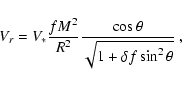 |
(1) |
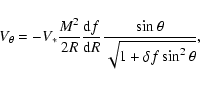 |
(2) |
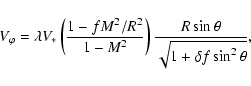 |
(3) |
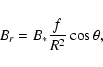 |
(4) |
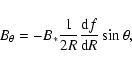 |
(5) |
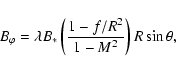 |
(6) |
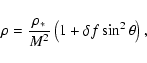 |
(7) |
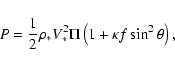 |
(8) |
where  ,
,
 and
and  are parameters while M(R),
 and f(R) are three radial functions. The parameter
governs the latitudinal variation of density, the latidudinal variation of the pressure and
of the
rotation. M(R) is the
poloidal Alfvén Mach number,
measures the radial variation of
the pressure and f(R) the geometry of the flow.
and f(R) are three radial functions. The parameter
governs the latitudinal variation of density, the latidudinal variation of the pressure and
of the
rotation. M(R) is the
poloidal Alfvén Mach number,
measures the radial variation of
the pressure and f(R) the geometry of the flow.
In the case of model B (Lima & Priest 1993; and LPT01,
where the magnetic field is implemented) the main idea is to keep the
latitudinal dependences of the various quantities as general as possible. This
meant sacrificing one of the components of the velocity
and magnetic field (the latitudinal
component) which was taken to be
zero. The two remaining non-zero components (the radial r and azimuthal  ones) yield stream and fieldlines
that, when projected on the meridional plane, are always radial. Although this
might constitute a drastic approximation especially in the accelerating part of
the solar wind, it is in good agreement with observations after the wind has
passed the critical points. The advantage of this approach is that the
latitudinal dependences are versatile enough to reproduce sharp
variations of the physical quantities, as was indeed observed during the first
ULYSSES fly-by pass from the southern to the northern ecliptic
hemispheres. A detailed parametric study of this solution can be found in
LPT01.
ones) yield stream and fieldlines
that, when projected on the meridional plane, are always radial. Although this
might constitute a drastic approximation especially in the accelerating part of
the solar wind, it is in good agreement with observations after the wind has
passed the critical points. The advantage of this approach is that the
latitudinal dependences are versatile enough to reproduce sharp
variations of the physical quantities, as was indeed observed during the first
ULYSSES fly-by pass from the southern to the northern ecliptic
hemispheres. A detailed parametric study of this solution can be found in
LPT01.
For consistency between the two models and conversely to the original
articles, we use below the same normalization (as in model A) at the Alfvén point
along the polar axis, where r=r*, by means of the dimensionless radius
R=r/r*.
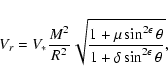
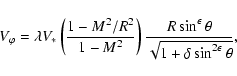
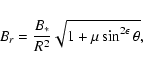
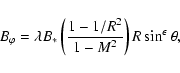
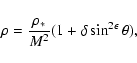
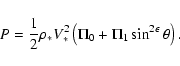
For this second model B the velocity, magnetic, density, and pressure fields
in the northern hemisphere are:
 |
(9) |
 |
(10) |
 |
(11) |
 |
(12) |
 |
(13) |
 |
(14) |
Where ,
 ,
,
 and
are parameters while
M(R),
and
are parameters while
M(R),  and
and  are three radial functions.
The parameters
and
and M(R) have the same role as in model A.
The parameter
controls the latitudinal variation of the momentum flux density
and
the sharpness of the density latidudinal variation.
and
control the radial variation of the pressure,
along the polar axis and out of the polar axis, respectively.
are three radial functions.
The parameters
and
and M(R) have the same role as in model A.
The parameter
controls the latitudinal variation of the momentum flux density
and
the sharpness of the density latidudinal variation.
and
control the radial variation of the pressure,
along the polar axis and out of the polar axis, respectively.
Substituting the forms of the physical quantities into the mass and
momentum conservation equations we get three ordinary differential equations in
radius for the three functions of the radial distance defined in Sects. 2.1 and 2.2.
Details of the numerical and analytical techniques can be found in LPT01 and STT02.
The function f(R) simply gives the geometry of the wind. It is a
constant if the poloidal fieldlines are radial. In model B,
we just need to consider that f=1 throughout the whole wind region, which
produces radial poloidal fieldlines. The function f(R) is, in fact, the
inverse of the well known expansion factor used in solar wind
theory (Kopp & Holzer 1976).
The function M(R) corresponds to the poloidal Alfvén Mach number which is
unity at the Alfvén radius, where corotation more or less ceases. In the
present approach it is assumed that Alfvénic surfaces of constant M
are spherical and do not depend on colatitude. This is a priori a very
restrictive assumption but crucial for using self-similarity
(Vlahakis & Tsinganos 1998).
To verify that it is consistent with ULYSSES
observations, we will start by assuming that between 1 and 5 AU M varies
like R. This comes from the fact that in this region the poloidal field
lines are radial, velocity is constant with distance and density drops
as the inverse of the square of the distance (cf. the following section).
Then, plotting the variations of M with latitude scaled down at 1 AU, as
shown in Fig. 1, we may conclude that this assumption is
a good approximation even far from the sun and despite the
obvious large scattering in the slow wind region due to the change in magnetic
polarity. We get as an average  AU
AU
 .
.
3 Using ULYSSES data to constrain the parameters
Using the least mean squares method we have fitted the
ULYSSES hourly averaged data for the protons at various latitudes
with models A and B. In the following sections we will take hourly averaged
data from the
Swoops Ions experiment onboard ULYSSES, try to fit this data and, from
those fits, estimate the corresponding
model parameters.
To plot the variation with latitude of the physical
quantities to be fitted at the orbit of the spacecraft, we
assume that the variation with distance is known such that we can normalize
all quantities to their values at 1 AU.
For instance, we assume that
the velocity at a given latitude is constant with distance and that the
poloidal streamlines and fieldlines are radial. From mass and magnetic flux
conservation we deduce as well the variation with distance of the mass and
particle density, assuming that the radial magnetic field decreases like
1/r2. This implies that the toroidal magnetic field varies like 1/r
(Tsinganos et al. 2003) such that the magnetic fieldlines trace out
Parker's spiral. To deduce the pressure variation with latitude we need an
extra
assumption on the temperature profile, which we shall explain later.
All quantities evaluated at 1 AU
along the polar axis are noted with the subscript 0, except the toroidal
field
 which is
evaluated in the equatorial plane.
which is
evaluated in the equatorial plane.
![\begin{figure}
\par\includegraphics[width=7.3cm,clip]{1606fig1.ps}
\end{figure}](/articles/aa/full/2005/11/aa1606/Timg45.gif) |
Figure 1:
Scaled Alfvén Mach number at 1 AU.
The points represent daily averaged data from the Swoops Ions experiment on
ULYSSES. |
| Open with DEXTER |
Following our previous argument, the density at 1 AU can be written for model A as
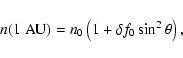 |
(15) |
while for model B
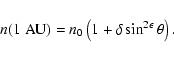 |
(16) |
n0 is the particle density on the polar axis and f0 is the value of f,
both at 1 AU. The function f is a constant if the streamlines are radial.
To fit these functions to the data on the density we simply scaled them up by
plotting (solid curves
in Fig. 2),
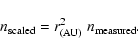 |
(17) |
If we want to go back to the mass density used in the model, we can simply
assume a fully ionized gas and use
 ,
where
is the mean molecular weight.
,
where
is the mean molecular weight.
![\begin{figure}
\par\includegraphics[width=7.1cm,clip]{1606fig2a.ps}\hspace*{4mm}
\includegraphics[width=7.1cm,clip]{1606fig2b.ps}
\end{figure}](/articles/aa/full/2005/11/aa1606/Timg50.gif) |
Figure 2:
Plot of the scaled proton density versus latitude. The points
represent hourly averaged data from the Swoops Ions experiment on
ULYSSES. The solid curve corresponds to the fit using model A in panel
a) and model B in panel b). |
| Open with DEXTER |
Fitting the data points with the curves resulting from model A
(Fig. 2a) and model B (Fig. 2b) we arrive at n0,
 and, for the case of model B,
(see Table 1).
and, for the case of model B,
(see Table 1).
With the streamlines assumed radial, the second step is to fit the
momentum flux density
 |
(18) |
We choose this function instead of the radial velocity because in the models
addressed here this quantity is independent of both the distance from the sun
and the value of
previously determined. For model A, at 1 AU we
have
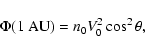 |
(19) |
while for model B
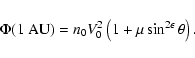 |
(20) |
Thus, from the two fits (Fig. 3)
we deduce the value of V0. In addition, for model B, we get the value of ,
as displayed in Table 1, assuming the value of n0
deduced from the fit of the density data. In Table 1
(in parenthesis with *) we
also show the two values of n0 and V0 for model A deduced by fitting
the data on the momentum flux density with two parameters (n0 and V0)
rather than one (V0). Although the discrepancy
between the two values of V0 obtained by fitting the momentum flux density as
given by models A and B, using a single parameter, is rather high, note that
the values of n0 and V0 obtained by fitting both parameters using model A
are close to the ones obtained with model B.
In the following, we have chosen to restrict ourselves to the first
set of parameters obtained by fitting both expressions with one single free
parameter.
A similar procedure can be used to deduce parameters referring to the
magnetic field. In particular, we plot in Fig. 4
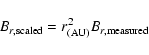 |
(21) |
and compare it to
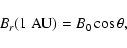 |
(22) |
for model A and
 |
|
|
|
| |
|
|
(23) |
 |
|
|
|
for model B. The fit gives us the value of the magnetic field on the polar
axis at 1 AU, B0 in Table 1. Because of the relative flip of
the magnetic axis and the rotation axis, northern and southern polar
coronal holes tend to mix at low latitudes around the equatorial plane.
Besides, the system is not exactly axisymmetric and part of the fast solar
wind coming from the northern polar coronal hole can reach southern latitudes
and vice versa. To avoid bias to the mixing at low latitudes, we can redo the
same procedure excluding data points in the range of latitudes between -20 and 20 degrees. This yields the values in Table 1
indicated by **. As far as the radial magnetic field is concerned this
does not change drastically the values obtained.
Table 1:
Parameters obtained from models A and B at 1 AU deduced from
the fitting of ULYSSES hourly averaged data. All quantities evaluated at
1 AU along the polar axis (except the toroidal field evaluated on the
equatorial plane) are noted with the subscript 0. (*) correspond
to those values determined by fitting the data on the momentum flux density
using least-mean squares and determining the two parameters simultaneously. (**) correspond to using the data on the magnetic field
without the points between
 and
and
 of latitude. Values in
parentheses were not taken into consideration in further calculations.
Note that for model B f0=1 and
has been defined
using Eq. (29).
of latitude. Values in
parentheses were not taken into consideration in further calculations.
Note that for model B f0=1 and
has been defined
using Eq. (29).
The toroidal or azimuthal component of the magnetic field  ,
denoted by
,
denoted by  ,
gives us a way to determine the value of the remaining free
parameter .
We proceed similarly to what we did for the radial
magnetic field, plotting in Fig. 5
,
gives us a way to determine the value of the remaining free
parameter .
We proceed similarly to what we did for the radial
magnetic field, plotting in Fig. 5
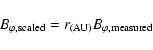 |
(24) |
and comparing it to
 |
|
|
|
| |
|
|
(25) |
 |
|
|
|
for model A and
 |
|
|
|
| |
|
|
(26) |
 |
|
|
|
for model B.
The fit gives us the value of the toroidal magnetic field in the
equatorial plane at 1 AU,
 ,
to which we refer in Table 1.
Because of the relative flip of the magnetic axis and the rotation axis,
northern and southern coronal holes of opposite polarities tend to mix, as we
have already pointed out in the previous section.
As it is almost impossible to disentangle them, we fit after excluding the data
points in the range of latitudes between -20 and 20 degrees (solid lines
in Fig. 5).
This yields the parameter
in Table 1
indicated by **. Conversely to the radial magnetic field, the reversal
around the equator is a rather drastic effect and tends to yield an underestimate of
the real value of
.
For this reason we prefer to use those
values to determine the parameter .
Unfortunately, depends on the values of the magnetic field, M0 and R0, the last
one being
,
to which we refer in Table 1.
Because of the relative flip of the magnetic axis and the rotation axis,
northern and southern coronal holes of opposite polarities tend to mix, as we
have already pointed out in the previous section.
As it is almost impossible to disentangle them, we fit after excluding the data
points in the range of latitudes between -20 and 20 degrees (solid lines
in Fig. 5).
This yields the parameter
in Table 1
indicated by **. Conversely to the radial magnetic field, the reversal
around the equator is a rather drastic effect and tends to yield an underestimate of
the real value of
.
For this reason we prefer to use those
values to determine the parameter .
Unfortunately, depends on the values of the magnetic field, M0 and R0, the last
one being
 |
(27) |
So,
cannot be determined without a knowledge of the location of the
Alfvén radius in real space.
In principle, we could constrain the value of
by using both
the toroidal magnetic and velocity fields. Unfortunately, as shown in
Fig. 6, the data on the toroidal velocity cannot be used
directly. Firstly, we would expect the velocity to be of the same sign
on both hemispheres as on the surface of the Sun, being zero
on the two polar axes. Secondly, the
rather small values of the measured velocities may be considered to be lower
than the capability of the instrument to measure them.
Strangely, what Fig. 6 really shows is a kind of reversal of the
toroidal velocity close to the equator, similarly to what happens with Brand .
In fact, in these models
if the poloidal velocity is constant after the Alfvén point and the lines
radial, then Vr=V* and
fM2 /R2=1 (Eqs. (1) and (9); of course in model B, f=1) then the toroidal velocity is
exactly 0 from Eqs. (3) and (10). Though we did not
consider this assumption before starting the integration,
the terminal toroidal velocity
ended
up being rather small compared to the radial one and the terminal radial
velocity close to the radial velocity at the Alfvén point.
![\begin{figure}
\par\includegraphics[width=7.5cm,clip]{1606fig3a.ps}\hspace*{5mm}
\includegraphics[width=7.5cm,clip]{1606fig3b.ps}
\end{figure}](/articles/aa/full/2005/11/aa1606/Timg73.gif) |
Figure 3:
Plot of the scaled momentum flux density versus latitude. As in
Fig. 2, the points represent hourly averaged data from the Swoops
Ions experiment, the solid curve corresponds to the fit using model A in panel
a) and model B in panel b). |
| Open with DEXTER |
![\begin{figure}
\par\includegraphics[width=7.4cm,clip]{1606fig4a.ps}\hspace*{4mm}
\includegraphics[width=7.4cm,clip]{1606fig4b.ps}
\end{figure}](/articles/aa/full/2005/11/aa1606/Timg74.gif) |
Figure 4:
Plot of the scaled radial magnetic field versus latitude.
The points represent hourly averaged data from the Swoops
Ions experiment, the solid curve corresponds to the fit using model A in panel
a) and model B in panel b). |
| Open with DEXTER |
![\begin{figure}
\par\includegraphics[width=7.4cm,clip]{1606fig5a.ps}\hspace*{4mm}
\includegraphics[width=7.4cm,clip]{1606fig5b.ps}
\end{figure}](/articles/aa/full/2005/11/aa1606/Timg75.gif) |
Figure 5:
Plot of the scaled toroidal magnetic field versus latitude.
The points represent hourly averaged data from the Swoops
Ions experiment. The curves correspond to the fit using model A in panel
a) and model B in panel b). In the fit with the dashed line all points
have been taken into account while in the fit with the solid line the points
between -20 and 20 degrees latitude (i.e. between the two dotted vertical
lines) have been excluded. Note that in panel a) the solid and dashed lines
almost coincide. |
| Open with DEXTER |
![\begin{figure}
\par\includegraphics[width=7.3cm,clip]{1606fig7.ps}
\end{figure}](/articles/aa/full/2005/11/aa1606/Timg76.gif) |
Figure 6:
Plot of the toroidal velocity. The lack of precision in the
data prevents them
from being used to constrain the parameters. As explained in the
main text, this corresponds however to rather small toroidal velocities
consistent with our calculations. |
| Open with DEXTER |
The last information from the Swoops Ion Experiment to constrain the two models
is the proton temperature profile. With the single fluid approximation used,
the average temperature corresponds mainly to that of the protons. The temperature
can be used to determine the last parameter
of model A.
However, as the energy equation is not properly defined, we may obtain
at the end of our calculation an effective temperature profile resulting from
considering all sorts of pressures, like wave pressure. This effective
temperature might
be much larger than the kinetic one. The adopted procedure is used to
constrain the latitudinal variation of the
pressure from the temperature profile but we cannot control the temperature
variation with distance. All we can do is to check a posteriori how
consistent it is with the measured profile and predict the distribution of the
heating in the corona needed to support the wind.
As the temperature varies, both with latitude and radial distance, we
have assumed
that the variation with latitude should be negligible inside the fast
solar wind part. Thus, taking out latitudes between  and
and  ,
we fit the proton temperature at high latitudes with a power law function
for the polar temperature of the form
,
we fit the proton temperature at high latitudes with a power law function
for the polar temperature of the form
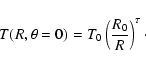 |
(28) |
This gives
 (Fig. 7). This is somewhat similar to the
fit for the electron temperature given in
Issautier et al. (2001). As another test, we also tried
to use only data points beyond 1.52 AU instead of 1.3 AU which yielded
(Fig. 7). This is somewhat similar to the
fit for the electron temperature given in
Issautier et al. (2001). As another test, we also tried
to use only data points beyond 1.52 AU instead of 1.3 AU which yielded
 which is very similar to the above value.
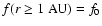
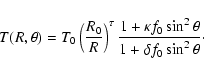
We then fitted a more general form of the temperature profile to the whole set
of points. The latitudinal dependence was chosen to be consistent with
Eqs. (7) and (8), assuming that the poloidal
streamlines are radial such that
 ,
,
 |
(29) |
As
is already known from the fit of the density, we deduce
from the present fit (Fig. 8) the values of
 shown in
Table 1.
shown in
Table 1.
![\begin{figure}
\par\includegraphics[width=7.3cm,clip]{1606fig8.ps}
\end{figure}](/articles/aa/full/2005/11/aa1606/Timg83.gif) |
Figure 7:
Plot of the scaled proton temperature versus distance, using
only data for the fast wind for colatitudes
above
 and below
 .
We fit the data with a simple
power law .
We fit the data with a simple
power law   which gives
.
which gives
. |
| Open with DEXTER |
Of course we cannot use directly the equations of model B to find
the latitudinal dependence of the pressure, as this is known only
a posteriori once the full solution is constructed. However, to
constrain model A using parameters of set II we
can use the same latitudinal dependence assuming of course
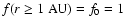 .
Then we get the value of
using Eq. (29), consistent with the value of
deduced
previously from model B.
.
Then we get the value of
using Eq. (29), consistent with the value of
deduced
previously from model B.
![\begin{figure}
\par\includegraphics[width=7cm,clip]{1606fig9a.ps}\hspace*{4mm}
\includegraphics[width=7cm,clip]{1606fig9b.ps}
\end{figure}](/articles/aa/full/2005/11/aa1606/Timg85.gif) |
Figure 8:
Plot of the scaled proton temperature versus latitude. As in
Fig. 2, the points represent hourly averaged data from the Swoops
Ions experiment, the solid curve corresponds to the fit using model A in panel
a) and model B in panel b). |
| Open with DEXTER |
To fit the temperature data we have been using the profile of the so
called small temperature from the experiment, which is likely
to be an underestimate of the real temperature. However, even using data on the
high temperature leads to equivalent values for
.
The parameters obtained are summarized in Table 1.
From the previous sections note that the more general form of the
latitudinal dependences of the various quantities shown in Eqs. (9)-(14) (model B) yields a more convincing
fit to the data than the form of Eqs. (1)-(6)
(model A). Model A tends to overestimate the polar speed V0 and
underestimate the polar density n0. Note, however, that the values
in parenthesis for SET I in Table 1, which were determined using
other statistical methods, are very close to those of set II.
In any case, considering the
precision to which we worked out the parameters, the discrepancy between
the two methods remains at a rather satisfactory level in the sense that
the two models did not give drastically different outputs.
4 Construction of a complete solution
So far, the appropriate fitting of the ULYSSES data has made it
possible to deduce all parameters of models A and B. Thus, we have
analytical expressions for the heliolatitudinal dependence of the
variables of the wind at 1 AU. The next step is to proceed towards
the construction of a complete solution for all heliocentric
radial distances. This may be accomplished by integrating over
radial distance the ODEs of each of the two models.
In order to do so, we need to estimate the parameters and physical
quantities such as the polar velocity and density at the Alfvén radius. This
cannot be done without further assumptions. A posteriori we will verify that
our estimations are in agreement with the general numerical output. If not we
will iterate and change consistently all our estimates until we find an agreement
between the input parametric values and their output.
In the following we have chosen to use the two sets of parameters
in Table 1 and integrate the equations of model A.
This choice is related to the fact that model A
is able to reproduce a more general geometry of the fieldlines
from the extreme case of flaring towards the equator, to collimation
towards the pole, passing by a configuration in which those lines are
purely radial. Model B is more limited in this sense since it
corresponds to this later geometry. However, we plan in future work
to integrate the equations of model B with the same parameters and compare the
obtained results with the present ones.
These two sets of parameters will thus yield two sets of solutions:
set I and set II, corresponding to the parameters previously obtained by
models A and B, respectively. On one hand, model B includes higher order
latitudinal variations than model A. Thus, as we have already mentioned, the
former fits more accurately the rapid latitudinal variations of the observed
data. On the other hand
we can assume that the dynamics is mainly affected by the lowest order
variations with latitude. Assuming this, we use set II and integrate the
equations of model A, ignoring the values of
and .
If we know the physical quantities at 1 AU, on the polar axis,  ,
V0 and B0, the value of the Alfvén Mach number at that same distance
follows from
,
V0 and B0, the value of the Alfvén Mach number at that same distance
follows from
 |
(30) |
Substituting Eq. (30) into Eq. (7) we get the value
of the mass density at the Alfvén surface,
 |
(31) |
The location of the Alfvén surface r* depends on the degree
of streamline flaring towards the equator or collimation towards the polar axis
and on the plasma acceleration beyond the Alfvén surface.
The expansion factor is given by f. At 1 AU, bearing in mind that
f=1 at R=1, the relative
variation in the streamline expansion is given by
 .
From Table 1, we see that guessing an initial value for f0
provides the initial values for
and .
.
From Table 1, we see that guessing an initial value for f0
provides the initial values for
and .
The total acceleration gained between the Alfvén surface and 1 AU
can be parametrized by the ratio
 |
(32) |
By guessing an initial value for  we immediately deduce some initial
guess for V* and
.
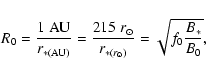
Then, the value of r* follows from,
we immediately deduce some initial
guess for V* and
.
Then, the value of r* follows from,
 |
(33) |
i.e., from R0 we get r* in AU or solar radii.
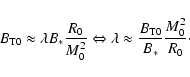
The next step is to get the value of
from r*, f0, B0 and
by combining Eqs. (4) and (6)
or Eqs. (11) and (12).
Assuming that the lines are almost radial and that we are at
large distances from the Alfvén radius ( ), we get
 |
(34) |
Finally,  provides also the value of the gravitational potential.
Since the mass of the Sun
provides also the value of the gravitational potential.
Since the mass of the Sun  and the gravitation constant
  are known, we can write
 |
(35) |
Altogether, we can summarize our procedure as follows:
- First, determine M0 and
from the data at 1 AU.
- Second, guess f0 and get as an output the parameters
and .
- Third, guess
 ,
which then gives V* and B*.
,
which then gives V* and B*.
- Finally, by combining all of the above, r*, ,
and
will follow.
The first set of guessed parameters allows us to compute the whole
solution using our set of equations and a Runge-Kutta integration algorithm.
At this point there is, of course, no reason why the final output should
correspond to the initial
input. In particular, the computed f0,
and r* may not necessarily
coincide with the initial values guessed for these parameters.
Then we either use these new values of f0 and
(or r*) from our
computation or some other estimates of those parameters to recalculate
consistently all the other parameters. Then, after trial and error, we hope
to get all parameters (on the input and output phases of our calculation)
to converge to each other.
A priori there is no reason why f0,
and r* should converge
simultaneously in this process. We were lucky enough that such convergence
was attained almost completely in the case
of the second set of parameters (set II, fom model B).
However, for the first set (set I, from model A),
as
is completely arbitrary we did not required that it remains
similar on input and output.
Instead, we have rescaled V* such that everything remains
consistent
with observations at 1 AU.
A more serious problem was that we were not able to produce physical solutions
with positive pressure everywhere considering the high values of the
magnetic field at 1 AU. This may be due to the fact that the simple latitudinal
dependence of model A does not allow consistent treatment of the role
played by the equatorial sheet in the total force balance. Nevertheless, we
were able to produce reasonable solutions with consistent magnetic field values
at the surface of the sun by dividing the obtained values of B0 by a factor
of 7 in the case of set I and by 10 for set II. We note that
Zangrilli et al. (2002) had similar problems in modelling physical
quantities and their variation with latitude and distance both in the
low and in the extended corona. A similar problem of negative pressure values at
low latitudes has been encountered in Tsinganos & Trussoni (1991).
In Table 2 we present the parameters of the final iteration
with which it is possible to solve the consistency problem
mentioned above.
Table 2:
Parameter sets I and II integrating with model A, on last
iteration.
![\begin{figure}
\par\includegraphics[width=8cm,clip]{1606fig10a.ps}\hspace*{4mm}
\includegraphics[width=8cm,clip]{1606fig10b.ps}
\end{figure}](/articles/aa/full/2005/11/aa1606/Timg130.gif) |
Figure 9:
Plot of the poloidal velocity as a function of distance for the
parameters of Table 2.
In panel a) we show the solution using parameters of set I and in panel b)
we show the solution using parameters of set II. In each graph, the upper
curve corresponds to  (at the pole) and
  increases by 0.1
between consecutive curves towards the lower curve ( increases by 0.1
between consecutive curves towards the lower curve (
 which
corresponds to the line crossing r* at
which
corresponds to the line crossing r* at
 ). ). |
| Open with DEXTER |
![\begin{figure}
\par\includegraphics[width=8cm,clip]{1606fig11a.ps}\hspace*{4mm}
\includegraphics[width=8cm,clip]{1606fig11b.ps}
\end{figure}](/articles/aa/full/2005/11/aa1606/Timg131.gif) |
Figure 10:
Plot of the effective poloidal temperature as a function of distance.
As in Fig. 9, panel a) corresponds to parameter set I and panel
b) to set II and
ranges from
to
. |
| Open with DEXTER |
![\begin{figure}
\par\includegraphics[angle=270,width=8cm,clip]{1606fig12a.ps}\hspace*{4mm}
\includegraphics[angle=270,width=8cm,clip]{1606fig12b.ps}
\end{figure}](/articles/aa/full/2005/11/aa1606/Timg132.gif) |
Figure 11:
Plot of the fieldlines on a) for the solution using parameters of
set I and on b) for the solution using parameters of set II. Distances are
given in units of r* which is given in Table 2. |
| Open with DEXTER |
![\begin{figure}
\par\includegraphics[width=15.8cm,clip]{1606fig13.ps}
\end{figure}](/articles/aa/full/2005/11/aa1606/Timg133.gif) |
Figure 12:
The same as Fig. 11 but zooming in on the central region,
in a) for the solution using parameters of set I and in b) for the solution
using parameters of set II. Distances are given in units of r*. |
| Open with DEXTER |
Clearly, set II is better, both from the viewpoint of
consistency between the parameters fed at the last iteration and obtained
after computation and also because it gives more reasonable
values of the velocity and effective temperature (compare Figs. 9 and 10). This is related to the fact we have
already mentioned that parameters of model A give overestimates of the polar
velocity and underestimates of the polar density.
The values for the effective temperature for set I are high
with a maximum of around
 K on the polar axis. Even considering
this temperature as an effective one this value may be regarded as unreasonably high.
In fact, the plotted effective temperature is defined as
K on the polar axis. Even considering
this temperature as an effective one this value may be regarded as unreasonably high.
In fact, the plotted effective temperature is defined as
 |
(36) |
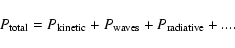
where the total pressure may include various terms besides the usual
kinetic pressure,
 |
(37) |
The values of the effective temperature for set II are still too high but they are in the
usual range of most MHD models of the solar wind. For instance, in the
kinetic simulations by Landi & Pantellini (2003), they obtain temperatures
around 3 times higher than the values usually adopted for the solar corona.
Similar problems appear in Zouganelis et al. (2004) for the electron
temperature, though they seem to have a better treatment of the proton
temperature.
The high values obtained in the present study might be related to the fact
that
a full energy equation is not included in the models. Yet, with set II,
the maximum effective temperature of
 K can be related to an important
deposit of torsional Alfvén waves.
K can be related to an important
deposit of torsional Alfvén waves.
Let us consider that the kinetic temperature of the protons may be of the
order of
 K at the maximum temperature.
This may even be an underestimate (e.g. see the values
given by Zangrilli et al. 2002).
The maximum temperature in the plot (set II) is below
K,
corresponding to distances between 1.1 and
K at the maximum temperature.
This may even be an underestimate (e.g. see the values
given by Zangrilli et al. 2002).
The maximum temperature in the plot (set II) is below
K,
corresponding to distances between 1.1 and
 .
In this range
the density decreases from around
.
In this range
the density decreases from around
 cm-3 to
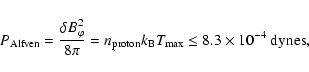
 cm-3. The extra
 K, if assumed to
be a result of torsional Alfvén waves, would then correspond
to a wave pressure that is at most
K, if assumed to
be a result of torsional Alfvén waves, would then correspond
to a wave pressure that is at most
 |
(38) |
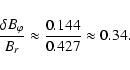
yielding a reasonable
fluctuation in the magnetic field of the order
 |
(39) |
By comparison, Usmanov et al. (2000) use a maximum of relative Alfvén
wave amplitudes
of the order
 ,
although using a WKB approximation.
So we may conclude that we get sensible results.
In fact, we could use our
constraints on the dynamic of the wind to predict the distribution of
wave damping and heating. This is something we intend to do in the future in a more
precise way.
,
although using a WKB approximation.
So we may conclude that we get sensible results.
In fact, we could use our
constraints on the dynamic of the wind to predict the distribution of
wave damping and heating. This is something we intend to do in the future in a more
precise way.
We plot in Fig. 9 the poloidal velocity for both sets of parameters
and for
 ranging between 0 and 0.5, i.e.,
between the pole and somewhere at mid-latitude as the line
is at an angle of
ranging between 0 and 0.5, i.e.,
between the pole and somewhere at mid-latitude as the line
is at an angle of  at r=r*.
In both cases the asymptotic speed has been attained by
at r=r*.
In both cases the asymptotic speed has been attained by
 along
the polar axis, which we believe to be a reasonable value. It may sound as if the
acceleration is rather fast compared to the usual measurements close to the
Sun. However, we should bear in mind that this constitutes
an upper limit on the velocity and acceleration, since at mid-latitudes the
radial speed is a fraction of the polar speed as shown in Fig. 9.
Observed velocity profiles in coronal holes are always integrated over the
line of sight, mixing various latitude inside the coronal hole.
This means that to make a detailed comparison with observations of our velocity
profile in the low corona we need a more sophisticated way
to plot the average speed inside the coronal hole by integrating over latitudes
along the line of sight.
along
the polar axis, which we believe to be a reasonable value. It may sound as if the
acceleration is rather fast compared to the usual measurements close to the
Sun. However, we should bear in mind that this constitutes
an upper limit on the velocity and acceleration, since at mid-latitudes the
radial speed is a fraction of the polar speed as shown in Fig. 9.
Observed velocity profiles in coronal holes are always integrated over the
line of sight, mixing various latitude inside the coronal hole.
This means that to make a detailed comparison with observations of our velocity
profile in the low corona we need a more sophisticated way
to plot the average speed inside the coronal hole by integrating over latitudes
along the line of sight.
Figure 10 shows the effective poloidal temperature for both sets of
parameters
and for
ranging between 0 and 0.5.
The values of the effective poloidal temperature, especially at mid-latitudes,
are in quite good agreement with observations for set II, although we have already
discussed that it is rather high close to the polar axis. Moreover, we
get very good agreement of the temperature profile at large distances where
ULYSSES measurements are made. This is a nice surprise as
we cannot constrain the temperature profile from the model. It is a
byproduct of our calculation.
However, another limitation of our modelling is that, although the
initial values of the magnetic field at the solar
surface in the coronal holes are quite reasonable, we have failed to reproduce
these
values observed by ULYSSES at 1 AU by a factor of 7 in set I to 10
in set II
as seen from the values we have used as input in Table 2.
Higher values of the magnetic field at large distances give too
high a value of the magnetic field at the surface of the sun ( 100 G)
and negative pressure, which is related to the dead zones in the equatorial
plane being too large. By taking only the lower dipolar order in the
latitudinal dependence we do not reproduce correctly the effect of the
current sheet on the equatorial plane at large distances. Usmanov et al. (2000)
showed that the current sheet is a rather important ingredient of the
force balance at large distances. We may solve this problem by using model B
instead of A to model the solar wind in the outer corona.
100 G)
and negative pressure, which is related to the dead zones in the equatorial
plane being too large. By taking only the lower dipolar order in the
latitudinal dependence we do not reproduce correctly the effect of the
current sheet on the equatorial plane at large distances. Usmanov et al. (2000)
showed that the current sheet is a rather important ingredient of the
force balance at large distances. We may solve this problem by using model B
instead of A to model the solar wind in the outer corona.
On the opposite, we should stress that our solutions, despite being constrained from
measurements at 1 AU, reproduce fairly well the dipolar structure of the
magnetic field close to the sun up to 2 solar radii as shown in Fig. 12
with  ,
,
 ,
,
 .
Moreover, one main result of these
calculations is that we are not getting any collimation at large distances so far.
This is in contradiction with our initial expectation
(see Heyvaerts & Norman 1989; Nerney & Suess 1985; Usmanov et al. 2000)
as the wind is carrying some current which closes into the equatorial
current sheet. We have shown in STT02 that collimation is not a necessary
condition as long as the force from the toroidal magnetic field can be
balanced by either the curvature of the poloidal velocity field or by the
pressure gradient. We also note that the efficiency of the magnetic rotator
as defined in STT99 is rather low with a value of the order
.
Moreover, one main result of these
calculations is that we are not getting any collimation at large distances so far.
This is in contradiction with our initial expectation
(see Heyvaerts & Norman 1989; Nerney & Suess 1985; Usmanov et al. 2000)
as the wind is carrying some current which closes into the equatorial
current sheet. We have shown in STT02 that collimation is not a necessary
condition as long as the force from the toroidal magnetic field can be
balanced by either the curvature of the poloidal velocity field or by the
pressure gradient. We also note that the efficiency of the magnetic rotator
as defined in STT99 is rather low with a value of the order
 .
We refer the reader to STT99 Eq. (3.12a)
for the definition, as it would be lengthy and out of order to reproduce it
here. Thus, the absence of collimation
was not really surprising considering the parametric analysis of STT02.
.
We refer the reader to STT99 Eq. (3.12a)
for the definition, as it would be lengthy and out of order to reproduce it
here. Thus, the absence of collimation
was not really surprising considering the parametric analysis of STT02.
5 Conclusions
We have proposed here a method for modelling the rotating and magnetized solar
wind constraining the parameters from ULYSSES data. We have used two models:
model A from STT99 and STT02 and model B from LPT01.
These axisymmetric solutions described in Sect. 2 include the effects
of both the fast and the slow components on the global structure and the
dynamics of the wind. Yet, they aim at describing the wind mainly close to
its polar axis, especially model A. They also consistently include rotation,
conversely to the usual axisymmetric models for the solar wind.
Model A tends to over- or
underestimate some physical quantities, especially along the polar axis.
Model B allows a better fit because it can account for faster
variations with latitude. In Sect. 3 we have described in detail how
to analyse the data in the frame of our modelling.
Then we have used model A and the two sets of parameters obtained through the
latitudinal dependences appearing in the solution for models A and B
(sets I and II, respectively) to construct the full solution from the solar surface up
to ULYSSES orbit as described in Sect. 4.
Our results show that there are still difficulties in trying both to fit the
latitudinal profile of the solar wind using ULYSSES data and to
reconstruct the solution all the way back from the spacecraft to the solar
wind base. These inconsistencies might be connected to intrinsic limitations
of the models used. They might also be associated with the
contamination of pure fast wind by pure slow wind flows,
which affects the
variation with latitude (Usmanov & Goldstein 2003).
On the whole, we have been able to reproduce the density and velocity profiles
from the solar surface to ULYSSES orbit reasonably well. We have also
obtained a good value for the rotation frequency of the Sun, which
was not in the initial input.
The acceleration along one streamline may appear quite strong when compared to the
usual velocity profile measurement.
Yet one should bear in mind that the observed profiles in
coronal holes are integrated over different latitudes. With variations
with latitude being quite rapid, the averaged velocity along the line of sight
increases much more slowly than along the polar axis.
One characteristic of this non-polytropic model is
that flux tubes and coronal holes with large expansion factors tend to give
lower asymptotic speeds than those with small expansion factors. This is
in contradiction with the usual polytropic models (e.g. Kopp & Holzer 1976) but
in good agreement with observations as shown by Wang (1995) and
Wang & Sheeley (2003).
We also reproduce fairly well the temperature profile at large distances.
In the low corona, the agreement is not too bad providing that this is
interpreted as an effective temperature, especially around its maximum between 1 and
 .
There, the total effective temperature can be divided roughly
into 1/3 of kinetic temperature and 2/3 of temperature
coming from wave pressure. If those waves are torsional Alfvén waves we find
that the toroidal magnetic field fluctuations need to be more or less
of the order of the radial magnetic field magnitude itself. Of course
a more complete study of heating and wave damping is needed to support
this conclusion. A more quantitative study
is in order but this has been postponed to the future because we need a realistic
energy equation to calculate it properly.
.
There, the total effective temperature can be divided roughly
into 1/3 of kinetic temperature and 2/3 of temperature
coming from wave pressure. If those waves are torsional Alfvén waves we find
that the toroidal magnetic field fluctuations need to be more or less
of the order of the radial magnetic field magnitude itself. Of course
a more complete study of heating and wave damping is needed to support
this conclusion. A more quantitative study
is in order but this has been postponed to the future because we need a realistic
energy equation to calculate it properly.
We could reproduce the dipolar structure of the magnetic field in the
first few solar radii with approximately 0.5 G at the surface of the coronal
hole. However, we were not able to model the correct magnitude of the field
up to 1 AU but only the shape of Parker's spiral. This also needs to be improved.
The ultimate goal would be to combine both this model (which uses STT99) at small
distances and the LPT model at large distances where the lines are radial, to
make a more consistent description of the whole wind.
Assuming radial fieldlines at large distances may solve the magnetic field
problem by reducing the way it decreases with distance and allowing the second model
to give better fits to the observed magnetic fields.
Acknowledgements
The authors thank the anonymous referee for his/her valuable comments which
helped to improve the presentation of this paper.
They wish to acknowledge the SWOOPS instrument team and the
ESA and NSSDC COHO Web archives for ULYSSES data. J. J. G. Lima wish to
acknowledge the financial support of the Université Paris VII and the
hospitality of everyone at the Observatoire de Paris, Meudon.
This work was supported by grant POCTI/1999/FIS/34549 approved by FCT
and POCTI, with funds from the European Community programme FEDER
and by the EEC RT Network HPRN-CT-2000-00153.
- Balogh, A.,
Marsden, R. G., & Smith, E. J. 2001, The Heliosphere near solar
minimum (Springer Praxis Books)
(In the text)
-
Guhathakurta, M., Fludra, A., Gibson, S. E., Biesecker, D., &
Fisher, R. 1999, JGR, 104, 9801 [NASA ADS] (In the text)
- Heyvaerts, J., &
Norman, N. 1989, ApJ, 347, 1055 [NASA ADS] [CrossRef] (In the text)
-
Issautier, K., Meyer-Vernet, N., Pierrard, V., & Lemaire, J.
2001, Ap&SS, 277, 189 [NASA ADS]
-
Keppens, R., & Goedbloed, J. P. 2000, ApJ, 530, 1036 [NASA ADS] [CrossRef] (In the text)
- Kopp, R.
A., & Holzer, T. E. 1976, Sol. Phys., 49, 43 [NASA ADS] (In the text)
-
Landi, S., & Pantellini, F. 2003, A&A, 400, 769 [EDP Sciences] [NASA ADS] [CrossRef] (In the text)
- Lima, J. J.
G., & Priest, E. R. 1993, A&A, 268, 641 [NASA ADS] (In the text)
- Lima, J. J. G., Priest,
E. R., & Tsinganos, K. 2001, A&A, 371, 240 [EDP Sciences] [NASA ADS] [CrossRef] (LPT01)
(In the text)
- Munro,
R. H., & Jackson, B. V. 1977, ApJ, 213, 874 [NASA ADS] [CrossRef] (In the text)
- Nerney,
S. F., & Suess, S. T. 1975a, ApJ, 196, 837 [NASA ADS] [CrossRef] (In the text)
- Nerney,
S. F., & Suess, S. T. 1975b, ApJ, 200, 503 [NASA ADS] [CrossRef]
- Nerney,
S. F., & Suess, S. T. 1975c, Sol. Phys., 45, 255 [NASA ADS] [CrossRef]
- Nerney,
S. F., & Suess, S. T. 1985, ApJ, 296, 259 [NASA ADS] [CrossRef] (In the text)
- Parker, E. N. 1963,
Interplanetary Dynamical Processes (New York: Wiley
Intersience)
- Riley, P.,
Linker, J. A., & Mikic, Z. 2001, JGR, 106 (A8), 15, 889
(In the text)
- Sakurai, T. 1985,
A&A, 152, 121 [NASA ADS] (In the text)
- Sauty, C., & Tsinganos,
K. 1994, A&A, 287, 893 [NASA ADS] (In the text)
- Sauty, C., Tsinganos, K.,
& Trussoni, E. 1999, A&A, 348, 327 [NASA ADS] (STT99)
(In the text)
- Sauty, C., Trussoni, E.,
& Tsinganos, K. 2002, A&A, 348, 327 [NASA ADS] (STT02)
(In the text)
- Sauty, C., Trussoni, E.,
& Tsinganos, K. 2004, A&A, 421, 797 [EDP Sciences] [NASA ADS] [CrossRef] (STT04)
(In the text)
- Tsinganos, K., & Bogovalov,
S. 2000, A&A, 356, 989 [NASA ADS] (In the text)
- Tsinganos, K., &
Sauty, C. 1992, A&A, 255, 405 [NASA ADS] (In the text)
- Tsinganos, K., &
Trussoni, E. 1991, A&A, 249, 156 [NASA ADS] (In the text)
-
Tsinganos, K., Vlahakis, N., Bogovalov, S., et al. 2003, Ap&SS,
287, 103 [NASA ADS] (In the text)
- Usmanov,
A. V., Goldstein, M. L., Besser, B. P., & Fritzer, J. M. 2000,
JGR 105 (A6), 12675
(In the text)
-
Usmanov, A. V., & Goldstein, M. L. 2003, JGR, 108 (A9),
1354
(In the text)
- Vlahakis, N., &
Tsinganos, K. 1998, MNRAS, 298, 777 [NASA ADS] [CrossRef] (In the text)
- Weber, E. J., & Davis,
L. J. 1967, ApJ, 148, 217 [NASA ADS] [CrossRef]
- Wang, Y.-M. 1995, ApJ,
449, L157 [NASA ADS] (In the text)
- Wang,
Y.-M., & Sheeley, N. R. 2003, ApJ, 587, 818 [NASA ADS] [CrossRef] (In the text)
- Washimi, H. 1990,
Geophys. Lett., 17, 33 [NASA ADS] (In the text)
-
Zangrilli, L., Poletto, G., Nicolosi, P., Noci, G., & Romoli,
M. 2002, ApJ, 574, 477 [NASA ADS] [CrossRef] (In the text)
-
Zouganelis, I., Maksimovic, M., Meyer-Vernet, N., Lamy, H., &
Issautier, K. 2004, ApJ, 606, 542 [NASA ADS] [CrossRef] (In the text)
Copyright ESO 2005
![\begin{figure}
\par\includegraphics[width=7.3cm,clip]{1606fig1.ps}
\end{figure}](/articles/aa/full/2005/11/aa1606/img45.gif)
![\begin{figure}
\par\includegraphics[width=7.1cm,clip]{1606fig2a.ps}\hspace*{4mm}
\includegraphics[width=7.1cm,clip]{1606fig2b.ps}
\end{figure}](/articles/aa/full/2005/11/aa1606/img50.gif)
![\begin{figure}
\par\includegraphics[width=7.5cm,clip]{1606fig3a.ps}\hspace*{5mm}
\includegraphics[width=7.5cm,clip]{1606fig3b.ps}
\end{figure}](/articles/aa/full/2005/11/aa1606/img73.gif)
![\begin{figure}
\par\includegraphics[width=7.4cm,clip]{1606fig4a.ps}\hspace*{4mm}
\includegraphics[width=7.4cm,clip]{1606fig4b.ps}
\end{figure}](/articles/aa/full/2005/11/aa1606/img74.gif)
![\begin{figure}
\par\includegraphics[width=7.4cm,clip]{1606fig5a.ps}\hspace*{4mm}
\includegraphics[width=7.4cm,clip]{1606fig5b.ps}
\end{figure}](/articles/aa/full/2005/11/aa1606/img75.gif)
![\begin{figure}
\par\includegraphics[width=7.3cm,clip]{1606fig7.ps}
\end{figure}](/articles/aa/full/2005/11/aa1606/img76.gif)
![\begin{figure}
\par\includegraphics[width=7.3cm,clip]{1606fig8.ps}
\end{figure}](/articles/aa/full/2005/11/aa1606/img83.gif)
![\begin{figure}
\par\includegraphics[width=7cm,clip]{1606fig9a.ps}\hspace*{4mm}
\includegraphics[width=7cm,clip]{1606fig9b.ps}
\end{figure}](/articles/aa/full/2005/11/aa1606/img85.gif)
![\begin{figure}
\par\includegraphics[width=8cm,clip]{1606fig10a.ps}\hspace*{4mm}
\includegraphics[width=8cm,clip]{1606fig10b.ps}
\end{figure}](/articles/aa/full/2005/11/aa1606/img130.gif)
![\begin{figure}
\par\includegraphics[width=8cm,clip]{1606fig11a.ps}\hspace*{4mm}
\includegraphics[width=8cm,clip]{1606fig11b.ps}
\end{figure}](/articles/aa/full/2005/11/aa1606/img131.gif)
![\begin{figure}
\par\includegraphics[angle=270,width=8cm,clip]{1606fig12a.ps}\hspace*{4mm}
\includegraphics[angle=270,width=8cm,clip]{1606fig12b.ps}
\end{figure}](/articles/aa/full/2005/11/aa1606/img132.gif)
![\begin{figure}
\par\includegraphics[width=15.8cm,clip]{1606fig13.ps}
\end{figure}](/articles/aa/full/2005/11/aa1606/img133.gif)