A&A 432, L9-L12 (2005)
DOI: 10.1051/0004-6361:200500008
Search for TeV emission from the region around PSR B1706-44 with the
HESS experiment
F. Aharonian1 - A. G. Akhperjanian2 - K.-M. Aye3 - A. R. Bazer-Bachi4 - M. Beilicke5 - W. Benbow1 - D. Berge1 - P. Berghaus6,![[*]](/icons/foot_motif.gif) - K. Bernlöhr1,7 - C. Boisson8 - O. Bolz1 - C. Borgmeier7 - I. Braun1 - F. Breitling7 - A. M. Brown3 - J. Bussons Gordo9 - P. M. Chadwick3 - L.-M. Chounet10 - R. Cornils5 - L. Costamante1,20 - B. Degrange10 - A. Djannati-Ataï6 - L. O'C. Drury11 - G. Dubus10 - T. Ergin7 - P. Espigat6 - F. Feinstein9 - P. Fleury10 - G. Fontaine10 - Y. Fuchs12 - S. Funk1 - Y. A. Gallant9 - B. Giebels10 - S. Gillessen1 - P. Goret13 - C. Hadjichristidis3 - M. Hauser14 - G. Heinzelmann5 - G. Henri12 - G. Hermann1 - J. A. Hinton1 - W. Hofmann1 - M. Holleran15 - D. Horns1 - O. C. de Jager15 - I. Jung1,14,
- B. Khélifi1 - Nu. Komin7 - A. Konopelko1,7 - I. J. Latham3 - R. Le Gallou3 - A. Lemière6 - M. Lemoine10 - N. Leroy10 - T. Lohse7 - A. Marcowith4 - C. Masterson1,20 - T. J. L. McComb3 - M. de Naurois16 - S. J. Nolan3 - A. Noutsos3 - K. J. Orford3 - J. L. Osborne3 - M. Ouchrif16,20 - M. Panter1 - G. Pelletier12 - S. Pita6 - G. Pühlhofer1,14 - M. Punch6 - B. C. Raubenheimer15 - M. Raue5 - J. Raux16 - S. M. Rayner3 - I. Redondo10,20,
- A. Reimer17 - O. Reimer17 - J. Ripken5 - L. Rob18 - L. Rolland16 - G. Rowell1 - V. Sahakian2 - L. Saugé12 - S. Schlenker7 - R. Schlickeiser17 - C. Schuster17 - U. Schwanke7 - M. Siewert17 - H. Sol8 - R. Steenkamp19 - C. Stegmann7 - J.-P. Tavernet16 - R. Terrier6 - C. G. Théoret6 - M. Tluczykont10,20 - G. Vasileiadis9 - C. Venter15 - P. Vincent16 - B. Visser15 - H. J. Völk1 - S. J. Wagner14
- K. Bernlöhr1,7 - C. Boisson8 - O. Bolz1 - C. Borgmeier7 - I. Braun1 - F. Breitling7 - A. M. Brown3 - J. Bussons Gordo9 - P. M. Chadwick3 - L.-M. Chounet10 - R. Cornils5 - L. Costamante1,20 - B. Degrange10 - A. Djannati-Ataï6 - L. O'C. Drury11 - G. Dubus10 - T. Ergin7 - P. Espigat6 - F. Feinstein9 - P. Fleury10 - G. Fontaine10 - Y. Fuchs12 - S. Funk1 - Y. A. Gallant9 - B. Giebels10 - S. Gillessen1 - P. Goret13 - C. Hadjichristidis3 - M. Hauser14 - G. Heinzelmann5 - G. Henri12 - G. Hermann1 - J. A. Hinton1 - W. Hofmann1 - M. Holleran15 - D. Horns1 - O. C. de Jager15 - I. Jung1,14,
- B. Khélifi1 - Nu. Komin7 - A. Konopelko1,7 - I. J. Latham3 - R. Le Gallou3 - A. Lemière6 - M. Lemoine10 - N. Leroy10 - T. Lohse7 - A. Marcowith4 - C. Masterson1,20 - T. J. L. McComb3 - M. de Naurois16 - S. J. Nolan3 - A. Noutsos3 - K. J. Orford3 - J. L. Osborne3 - M. Ouchrif16,20 - M. Panter1 - G. Pelletier12 - S. Pita6 - G. Pühlhofer1,14 - M. Punch6 - B. C. Raubenheimer15 - M. Raue5 - J. Raux16 - S. M. Rayner3 - I. Redondo10,20,
- A. Reimer17 - O. Reimer17 - J. Ripken5 - L. Rob18 - L. Rolland16 - G. Rowell1 - V. Sahakian2 - L. Saugé12 - S. Schlenker7 - R. Schlickeiser17 - C. Schuster17 - U. Schwanke7 - M. Siewert17 - H. Sol8 - R. Steenkamp19 - C. Stegmann7 - J.-P. Tavernet16 - R. Terrier6 - C. G. Théoret6 - M. Tluczykont10,20 - G. Vasileiadis9 - C. Venter15 - P. Vincent16 - B. Visser15 - H. J. Völk1 - S. J. Wagner14
1 - Max-Planck-Institut für Kernphysik, PO Box 103980, 69029
Heidelberg, Germany
2 -
Yerevan Physics Institute, 2 Alikhanian Brothers St., 375036 Yerevan,
Armenia
3 -
University of Durham, Department of Physics, South Road, Durham DH1 3LE,
UK
4 -
Centre d'Étude Spatiale des Rayonnements, CNRS/UPS, 9 Av. du Colonel Roche, BP
4346, 31029 Toulouse Cedex 4, France
5 -
Universität Hamburg, Institut für Experimentalphysik, Luruper Chaussee
149, 22761 Hamburg, Germany
6 -
Physique Corpusculaire et Cosmologie, IN2P3/CNRS, Collège de France, 11 place
Marcelin Berthelot, 75231 Paris Cedex 05, France
7 -
Institut für Physik, Humboldt-Universität zu Berlin, Newtonstr. 15,
12489 Berlin, Germany
8 -
LUTH, UMR 8102 du CNRS, Observatoire de Paris, Section de Meudon, 92195 Meudon Cedex,
France
9 -
Groupe d'Astroparticules de Montpellier, IN2P3/CNRS, Université Montpellier II, CC85,
Place Eugène Bataillon, 34095 Montpellier Cedex 5, France
10 -
Laboratoire Leprince-Ringuet, IN2P3/CNRS,
Ecole Polytechnique, 91128 Palaiseau, France
11 -
Dublin Institute for Advanced Studies, 5 Merrion Square, Dublin 2,
Ireland
12 -
Laboratoire d'Astrophysique de Grenoble, INSU/CNRS, Université Joseph Fourier, BP
53, 38041 Grenoble Cedex 9, France
13 -
Service d'Astrophysique, DAPNIA/DSM/CEA, CE Saclay, 91191
Gif-sur-Yvette, France
14 -
Landessternwarte, Königstuhl, 69117 Heidelberg, Germany
15 -
Unit for Space Physics, North-West University, Potchefstroom 2520,
South Africa
16 -
Laboratoire de Physique Nucléaire et de Hautes Energies, IN2P3/CNRS, Universités
Paris VI & VII, 4 place Jussieu, 75231 Paris Cedex 05, France
17 -
Institut für Theoretische Physik, Lehrstuhl IV: Weltraum und
Astrophysik,
Ruhr-Universität Bochum, 44780 Bochum, Germany
18 -
Institute of Particle and Nuclear Physics, Charles University,
V Holesovickach 2, 180 00 Prague 8, Czech Republic
19 -
University of Namibia, Private Bag 13301, Windhoek, Namibia
20 -
European Associated Laboratory for Gamma-Ray Astronomy, jointly
supported by CNRS and MPG
Received 22 December 2004 / Accepted 20 January 2005
Abstract
The region around PSR B1706-44 has been observed with the HESS imaging atmospheric Cherenkov telescopes in
2003. No evidence for  -ray emission in the TeV range was found at the pulsar position or at the radio arc
which corresponds to the supernova remnant G 343.1-2.3. The 99% confidence level flux upper limit at the
pulsar position is
-ray emission in the TeV range was found at the pulsar position or at the radio arc
which corresponds to the supernova remnant G 343.1-2.3. The 99% confidence level flux upper limit at the
pulsar position is
 (
(
 assuming a power law (
 )
with photon index of
)
with photon index of
 and
(
and
(
 without an
assumption on the spectral shape. The reported upper limits correspond to 8% of the flux from an earlier
detection by the CANGAROO experiment.
without an
assumption on the spectral shape. The reported upper limits correspond to 8% of the flux from an earlier
detection by the CANGAROO experiment.
Key words: gamma rays: observations -
ISM: individual objects: PSR B1706-44 - ISM: supernova remnants -
ISM: individual objects: G 343.1-2.3
PSR B1706-44 is a young pulsar (spin-down age of  17 kyr) with distance estimates ranging from 1.8 to
3.2 kpc with a period of 102 ms and a spin-down luminosity of about 1% of the Crab pulsar (
17 kyr) with distance estimates ranging from 1.8 to
3.2 kpc with a period of 102 ms and a spin-down luminosity of about 1% of the Crab pulsar (
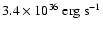 ). Pulsed emission has been observed at radio and X-ray wavelengths, and
in GeV -rays. An extended synchrotron nebula around this compact object has been found in radio
observations (Giacani et al. 2002) with an extension of 1'-4' and with a flat spectrum (energy index of 0.3), and
also in X-rays (Gotthelf et al. 2002) with an extension of 20'' and with a photon index of 1.34. These
characteristics suggest the existence of a pulsar wind nebula (PWN) powered by the pulsar. In the TeV range, the
CANGAROO experiment detected a steady emission coincident with the PWN position at a level of roughly 50% of
the Crab flux (Kifune et al. 1995; Kushida et al. 2003), suggesting that this PWN is the southern
equivalent of the Crab nebula. The Durham Mark 6 collaboration (Chadwick et al. 1998) reported also a
significant detection above 300 GeV. A flux upper limit above 500 GeV which is compatible with the CANGAROO
flux has been derived using data from the BIGRAT telescope (Rowell et al. 1998).
). Pulsed emission has been observed at radio and X-ray wavelengths, and
in GeV -rays. An extended synchrotron nebula around this compact object has been found in radio
observations (Giacani et al. 2002) with an extension of 1'-4' and with a flat spectrum (energy index of 0.3), and
also in X-rays (Gotthelf et al. 2002) with an extension of 20'' and with a photon index of 1.34. These
characteristics suggest the existence of a pulsar wind nebula (PWN) powered by the pulsar. In the TeV range, the
CANGAROO experiment detected a steady emission coincident with the PWN position at a level of roughly 50% of
the Crab flux (Kifune et al. 1995; Kushida et al. 2003), suggesting that this PWN is the southern
equivalent of the Crab nebula. The Durham Mark 6 collaboration (Chadwick et al. 1998) reported also a
significant detection above 300 GeV. A flux upper limit above 500 GeV which is compatible with the CANGAROO
flux has been derived using data from the BIGRAT telescope (Rowell et al. 1998).
PSR B1706-44 is coincident with an incomplete arc of radio emission (McAdam et al. 1993) which has been interpreted
as a shell-type supernova remnant (SNR) named G 343.1-2.3. This SNR has been detected only at radio wavelengths
(Duncan et al. 1995) and may be associated with the pulsar as discussed in Bock & Gvaramadze (2002).
We present here the results of the observation of the field of view around PSR B1706-44 with the HESS experiment. HESS is an atmospheric Cherenkov detector dedicated to the observation of TeV -rays
(Hofmann 2003). Situated in Namibia, the full four-telescope array is operational since December 2003. Each
telescope has a mirror area of 107  (Bernlöhr et al. 2003) and is equipped with a camera consisting of
960 photomultiplier tubes (PMT) (Vincent et al. 2003). The system has a field of view of
(Bernlöhr et al. 2003) and is equipped with a camera consisting of
960 photomultiplier tubes (PMT) (Vincent et al. 2003). The system has a field of view of  .
In stereoscopic
observation mode, it allows one to reconstruct the direction of individual showers with a precision better than
.
In stereoscopic
observation mode, it allows one to reconstruct the direction of individual showers with a precision better than  .
.
PSR B1706-44 was observed with two HESS telescopes between April and July 2003. During this commissioning phase,
GPS time stamps were used in the offline data analysis to identify showers observed in coincidence by the two
telescopes. This coincidence requirement allows for a higher background rejection and thus for a better sensitivity
than single telescope observations. In this configuration, a source with a flux of 5% of Crab nebula can be detected
with more than  in 4.5 hours at
  zenith angle. The pulsar was observed with 28-min runs in
wobble mode, whereby runs are taken pointing
zenith angle. The pulsar was observed with 28-min runs in
wobble mode, whereby runs are taken pointing 
 away from the pulsar position in declination. Data
affected by hardware problems or bad weather conditions were excluded from analysis. The proper functioning of the
detector system was verified by numerous checks. The telescope pointing has been confirmed by correlating high PMT
currents with bright stars in the field of view. The trigger rate of the system is well reproduced by simulations for
cosmic rays, and the shape of simulated -ray images is consistent with the result of Crab observations. Data
analysis is performed with two completely independent chains with different calibrations, with independent Monte Carlo
simulations and with different analysis techniques.
away from the pulsar position in declination. Data
affected by hardware problems or bad weather conditions were excluded from analysis. The proper functioning of the
detector system was verified by numerous checks. The telescope pointing has been confirmed by correlating high PMT
currents with bright stars in the field of view. The trigger rate of the system is well reproduced by simulations for
cosmic rays, and the shape of simulated -ray images is consistent with the result of Crab observations. Data
analysis is performed with two completely independent chains with different calibrations, with independent Monte Carlo
simulations and with different analysis techniques.
The selected data have a total live time of 14.3 h. The energy threshold estimated from Monte Carlo simulations
at the average observation zenith angle (
 )
is about 350 GeV. This threshold is higher than for the
four-telescope system since the telescopes were operated with higher trigger thresholds in the commissioning phase.
Data were analysed using standard shower reconstruction and standard background rejection methods (Aharonian et al. 2005).
Standard cuts, optimised on Monte Carlo simulations, have been applied on mean scaled Hillas parameters in order to
increase the signal-to-background ratio. Showers were classified using the angular distance
)
is about 350 GeV. This threshold is higher than for the
four-telescope system since the telescopes were operated with higher trigger thresholds in the commissioning phase.
Data were analysed using standard shower reconstruction and standard background rejection methods (Aharonian et al. 2005).
Standard cuts, optimised on Monte Carlo simulations, have been applied on mean scaled Hillas parameters in order to
increase the signal-to-background ratio. Showers were classified using the angular distance  between their
reconstructed direction and the direction of possible source. For this standard analysis, showers were accepted as
coming from the source (the ON region) when their
between their
reconstructed direction and the direction of possible source. For this standard analysis, showers were accepted as
coming from the source (the ON region) when their  was smaller than
 (i.e. angular
distance smaller than 8.5'). The background was determined by counting events in a ring (the OFF region) centered at
the investigated direction whose inner radius is larger (>
(i.e. angular
distance smaller than 8.5'). The background was determined by counting events in a ring (the OFF region) centered at
the investigated direction whose inner radius is larger (> )
than the
cut and whose area is 7 times larger than the ON region. A normalization factor
)
than the
cut and whose area is 7 times larger than the ON region. A normalization factor  is applied to these estimated background counts to
correct for the different size of ON and OFF regions and the different radial acceptance in the field of view.
is applied to these estimated background counts to
correct for the different size of ON and OFF regions and the different radial acceptance in the field of view.
A plot of
relative to the PWN position is shown in Fig. 1. The significance,
calculated according to Li & Ma (1983), is
 .
Table 1 provides an overview of the event
statistics in the column labelled Standard. The analysis described above was repeated with the same cuts
for every point in the field of view. The resulting significance map is presented in Fig. 2. It
exhibits no significant point source excess in the vicinity of the pulsar or on the radio emission arc.
.
Table 1 provides an overview of the event
statistics in the column labelled Standard. The analysis described above was repeated with the same cuts
for every point in the field of view. The resulting significance map is presented in Fig. 2. It
exhibits no significant point source excess in the vicinity of the pulsar or on the radio emission arc.
In order to roughly reproduce the conditions of the PSR B1706-44 detection by CANGAROO, the analysis at the pulsar
position was repeated using a looser
cut of
 and selecting events above an energy
of 1 TeV. The results are shown in the column labelled CANGAROO of Table 1 and give no
indication for a significant excess. For the analysis of the radio arc, a
cut of
and selecting events above an energy
of 1 TeV. The results are shown in the column labelled CANGAROO of Table 1 and give no
indication for a significant excess. For the analysis of the radio arc, a
cut of
 has been applied around the position (17h08m,
 )
and no significant excess is measured (column labelled
Radio arc of Table 1).
)
and no significant excess is measured (column labelled
Radio arc of Table 1).
![\begin{figure}
\par\includegraphics[width=7.5cm,clip]{Gl221_f1.eps}
\end{figure}](/articles/aa/full/2005/10/aagl221/Timg29.gif) |
Figure 1:
distribution calculated with respect to the PWN position. The dots denote events from the ON region,
the histogram are the events from the OFF region scaled by the normalization factor .
The dashed vertical line
indicates the applied angular cut. The inset shows the difference between the ON and the scaled OFF regions. |
| Open with DEXTER |
Table 1:
Analysis results:
 and
and
 are the event numbers in the ON and
OFF regions,
is the normalisation factor. The results are reported for the
standard
cut (column labelled Standard), for the cuts reproducing the
conditions of the CANGAROO detection (column CANGAROO) and for the analysis of the radio arc (column
Radio arc).
are the event numbers in the ON and
OFF regions,
is the normalisation factor. The results are reported for the
standard
cut (column labelled Standard), for the cuts reproducing the
conditions of the CANGAROO detection (column CANGAROO) and for the analysis of the radio arc (column
Radio arc).
Limits on the integral flux above certain energies ET were obtained using two different methods. The first
method (Method A) tests the hypothesis that the number of excess events with energies above ET result from a
source with a power law spectrum with a (positive) photon index  .
The photon index was varied between 2and 3. This range includes the value of
from the earlier CANGAROO detection. The second method
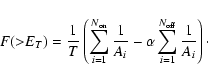
(Method B) makes no assumption about the source spectrum and calculates the integrated flux F directly as the
difference of the measured flux from the ON region and the flux of cosmic-rays from the OFF region:
.
The photon index was varied between 2and 3. This range includes the value of
from the earlier CANGAROO detection. The second method
(Method B) makes no assumption about the source spectrum and calculates the integrated flux F directly as the
difference of the measured flux from the ON region and the flux of cosmic-rays from the OFF region:
Here, T is the live time, and both sums on the ON and OFF regions run over all showers with reconstructed
energies greater than ET. The effective areas (Ai) depend on the zenith angle and energy of
each event, and
is the normalization factor. As Ai is determined using the reconstructed energy, the
energy threshold should be increased such that the bias of the reconstructed energy is less than 10%. The
upper limits derived with both methods were calculated using the unified approach of Feldman & Cousins
(1998) and a confidence level of 99%. To compare the upper limits from Method B with a prediction, the
investigated model spectrum must be integrated over all energies starting at ET.
![\begin{figure}
\par\includegraphics[width=7.5cm,clip]{Gl221_f2.eps}
\end{figure}](/articles/aa/full/2005/10/aagl221/Timg37.gif) |
Figure 2:
Significance map centered on PSR B1706-44. The cross marks the
pulsar position. The contour lines correspond to the 2.2 GHz image of G 343-2.3 (Duncan et al. 1995). The solid
circle indicates the integration region of the Standard cuts, the dashed circle the
CANGAROO cuts and the dot-dashed circle the Radio arc cuts. The significance distribution for the
entire HESS field of view is compatible with a Gaussian of mean -0.06 and of sigma 1.09. |
| Open with DEXTER |
Table 2 gives the values of flux upper limits at 99% confidence level for various cuts and methods;
both methods give similar results. With method A, the upper limit at the PWN position corresponds to 1%
of the flux from the Crab Nebula (at the same energy threshold) and the upper limit for the radio arc corresponds
to 5% of the flux from the Crab Nebula. The upper limit which reproduces the experimental
conditions of the CANGAROO experiment corresponds to 8% of the flux reported by that collaboration.
![\begin{figure}
\par\includegraphics[width=7.5cm,clip]{Gl221_f3.eps}
\end{figure}](/articles/aa/full/2005/10/aagl221/Timg38.gif) |
Figure 3:
Integral upper limits at 99% CL for the flux from the PWN position (solid, dotted and dot-dashed line).
The filled circle corresponds to the CANGAROO detection of Kifune et al. (1995) and the CANGAROO integrated flux (grey
area) is calculated from the result of a broken power law fit to the 2000 and 2001 differential spectrum
(Kushida et al. 2003). The open diamond and the triangle are from Rowell et al. (1998) and Chadwick et al. (1998), respectively. |
| Open with DEXTER |
Table 2:
Flux upper limits at 99% confidence level for the pulsar position in
 .
The upper limits from Method A were calculated assuming a photon index of
.
The numbers
in parentheses are the energy thresholds (in TeV) for which the upper limits were determined.
.
The upper limits from Method A were calculated assuming a photon index of
.
The numbers
in parentheses are the energy thresholds (in TeV) for which the upper limits were determined.
The reported upper limits on the flux of TeV -rays are roughly one order of magnitude lower than the reported
CANGAROO flux and a factor of 55 lower than earlier limits (Rowell et al. 1998). The CANGAROO observations
were not contemporaneous with the HESS observations, which raises the question of whether the TeV emission could be
variable on a time scale of years. Such a variability seems unlikely given our current understanding of PWN
(Blondin et al. 2001). Another potential reason for the discrepancy could be an object confusion along the line of sight.
There are, however, no BL Lac objects or variable galactic TeV -ray emitters known around the pulsar. It has
been pointed out (Aharonian et al. 1997; Kushida et al. 2003) that the high flux level reported by CANGAROO is
surprising. Since the X-ray luminosity is about 0.01% of that of the Crab PWN, the TeV -rays should be
emitted from a much larger volume than the X-rays, according to the inverse Compton (IC) scenario.
Using the HESS flux upper limit above 1 TeV, a lower limit on the magnetic field can be derived from Eq. (6) of
Aharonian et al. (1997). This requires a measurement of the flux in the X-ray band from the same electron
population that emits the hypothetical TeV radiation. Measurements by Chandra (Gotthelf et al. 2002) provide a flux
from the PWN, excluding the point-like emission of the central source; however, their chosen analysis region
(radius less than 10'') is smaller than the full extent of the PWN, for which Finley et al. (1998)
found a best-fit exponential scale length of 27''. The flux measured by ASCA (Finley et al. 1998)
encompasses the entire PWN, but also includes the pulsar emission. To estimate the PWN flux, we used the ASCA
spectrum but subtracted a point source contribution estimated from ROSAT HRI to be
 % (Finley et al.
1998), yielding an unabsorbed flux of
% (Finley et al.
1998), yielding an unabsorbed flux of
 erg s-1 cm-2 in the 2-10 keV
band for the PWN. The lack of observable X-ray emission below about 0.5 keV due to interstellar absorption means
that the electrons producing the observed X-rays have somewhat higher energy than those producing TeV
-rays, and an extrapolation of the X-ray spectrum to lower energies is necessary. The spectral index
measured with ASCA,
erg s-1 cm-2 in the 2-10 keV
band for the PWN. The lack of observable X-ray emission below about 0.5 keV due to interstellar absorption means
that the electrons producing the observed X-rays have somewhat higher energy than those producing TeV
-rays, and an extrapolation of the X-ray spectrum to lower energies is necessary. The spectral index
measured with ASCA,
 ,
is fully compatible with the more precise determination from
BeppoSAX,
,
is fully compatible with the more precise determination from
BeppoSAX,
 (Mineo et al. 2002). The derived lower limit on the magnetic field strength is
then about 1
(Mineo et al. 2002). The derived lower limit on the magnetic field strength is
then about 1  G when one assumes that the inverse Compton scattering involves only the photons of the
microwave background radiation and assuming the same photon index in the X-ray and TeV band. This value is however
not very constraining given that the mean Galactic magnetic field is of the same order of magnitude.
G when one assumes that the inverse Compton scattering involves only the photons of the
microwave background radiation and assuming the same photon index in the X-ray and TeV band. This value is however
not very constraining given that the mean Galactic magnetic field is of the same order of magnitude.
Acknowledgements
The support of the Namibian authorities and of the University of Namibia in facilitating the construction and
operation of HESS is gratefully acknowledged, as is the support by the German Ministry for Education and
Research (BMBF), the Max Planck Society, the French Ministry for Research, the CNRS-IN2P3 and the Astroparticle
Interdisciplinary Programme of the CNRS, the UK Particle Physics and Astronomy Research Council (PPARC), the
IPNP of the Charles University, the South African Department of Science and Technology and National Research
Foundation, and by the University of Namibia. We appreciate the excellent work of the technical support staff in
Berlin, Durham, Hamburg, Heidelberg, Palaiseau, Paris, Saclay, and in Namibia in the construction and operation
of the equipment. We would also like to thank the Australia Telescope National Facility (ATNF) for provision of 2.2 GHz radio data.
- Aharonian, F., Atoyan, A.
M., & Kifune, T. 1997, MNRAS, 291, 162 [NASA ADS] (In the text)
- Aharonian, F., Akhperjanian, A. G.,
Aye, K.-M., et al. 2005, A&A, 430, 865 [EDP Sciences] [NASA ADS] [CrossRef]
- Becker, W., Brazier, K.
T. S., & Trümper, J. 1995, A&A, 298, 528 [NASA ADS]
- Bernlöhr, K.,
Carrol, O., Cornils, R., et al. 2003, APh., 20, 111 [NASA ADS] (In the text)
- Blondin, J. M., Chevalier, R.
A., & Frierson, D. M. 2001, ApJ, 563, 80 [NASA ADS] [CrossRef] (In the text)
- Bock, D. C.-J., &
Gvaramadze, V. V. 2002, A&A, 394, 533 [EDP Sciences] [NASA ADS] [CrossRef] (In the text)
- Chadwick, P. M.,
Dickinson, M. R., Dipper, N. A., et al. 1998, APh, 9, 131 [NASA ADS] (In the text)
- Duncan, A. R., Steward,
R. T., Haynes, R. F., & Jones, K. L. 1995, MNRAS, 277, 36 [NASA ADS] (In the text)
- Feldman, G. J., &
Cousins, R. D. 1998, Phys. Rev. D, 57, 7 (In the text)
- Finley, J. P.,
Srinivasan, R., Saito, Y., et al. 1998, ApJ, 493, 884 [NASA ADS] [CrossRef] (In the text)
- Giacani, E. B., Frail, D. A.,
Goss, W. M., & Vieytes, M. 2001, AJ, 121, 313 [NASA ADS] (In the text)
- Gotthelf, E. V.,
Halpern, J. P., & Dodson, R. 2002, ApJ, 567, L125 [NASA ADS] (In the text)
- Hofmann, W. 2003, Proc.
28th ICRC, Tsukuba (Tokyo: Univ. Academy Press), 2811
(In the text)
- Kifune, T.,
Tanimori, T., Ogio, S., et al. 1995, ApJ, 438, L91 [NASA ADS] [CrossRef] (In the text)
- Kushida,
J., Tanimori, T., Kubo, H., et al. 2003, Proc. 28th Int. Cosmic Ray
Conf., Tsukuba (Tokyo: Univ. Academy Press), 2493
(In the text)
- Li, T.-P., & Ma, Y.-Q.
1983, ApJ, 272, 317 [NASA ADS] [CrossRef] (In the text)
- McAdam, W. B., Osborne,
J. L., & Parkinson, M. L. 1993, Nature, 361, L516 [NASA ADS] [CrossRef] (In the text)
- Mineo, T., Massaro, E.,
Cusumano, G., & Becker, W. 2002, A&A, 392, 181 [EDP Sciences] [NASA ADS] [CrossRef] (In the text)
- Rowell, G. P., Dazeley,
S. A., Edwards, P. G., Patterson, J. R., & Thornton, G. J.
1998, APh, 194, 332 (In the text)
- Vincent, P., Denance,
J.-P., Huppert, J.-F., et al. 2003, Proc. 28th ICRC, Tsukuba
(Tokyo: Univ. Academy Press), 2887
(In the text)
Copyright ESO 2005
![\begin{figure}
\par\includegraphics[width=7.5cm,clip]{Gl221_f1.eps}
\end{figure}](/articles/aa/full/2005/10/aagl221/img29.gif)
![\begin{figure}
\par\includegraphics[width=7.5cm,clip]{Gl221_f2.eps}
\end{figure}](/articles/aa/full/2005/10/aagl221/img37.gif)
![\begin{figure}
\par\includegraphics[width=7.5cm,clip]{Gl221_f3.eps}
\end{figure}](/articles/aa/full/2005/10/aagl221/img38.gif)