A&A 432, 355-367 (2005)
DOI: 10.1051/0004-6361:20041908
Improvement of the IAU 2000 precession model
N. Capitaine1 - P. T. Wallace2 - J. Chapront 1
1 - Observatoire de Paris, SYRTE/UMR 8630 - CNRS, 61 avenue de
l'Observatoire, 75014 Paris, France
2 - H. M. Nautical Almanac Office, Space Science and Technology Department,
CLRC / Rutherford Appleton Laboratory, UK
Received 26 August 2004 / Accepted 3 November 2004
Abstract
The IAU 2000 precession consists of the IAU 1976
ecliptic precession (Lieske et al. 1977, A&A, 58, 1)
and the precession part
of the IAU 2000A equator adopted by IAU 2000 Resolution B1.6
(Mathews et al. 2002, J. Geophys. Res., 107, B4, 10.1029/2001JB000390).
In this paper we provide a range of new
expressions as possible replacements for the IAU 2000 precession.
The new expressions are based upon the so-called P03 solution of
Capitaine et al. (2003b, A&A, 412, 567)
for the equator and the ecliptic. In
addition an improved model for the precession of the equator is
discussed. This improved solution was obtained in exactly the same
way as P03 but using a refined model for the contributions of the
non-rigid Earth (Mathews 2004, private communication) and revised integration constants
for the precession rates resulting from fits to the most recent
VLBI data. The paper reports on the procedure that was used for
improving the P03 solution and on the comparisons of this solution
with the MHB 2000, IAU 2000 and P03 solutions. It also discusses
the choices for the solution to be put forward as a replacement
for IAU 2000. We concluded that the existing VLBI data were
insufficient to provide convincing evidence that the improved
solutions would deliver better accuracy than the existing P03
solution, and we recommend retaining P03 as the replacement for
IAU 2000. P03, which unlike the IAU 2000 precession is dynamically
consistent, has the advantage of already having been used
experimentally by a number of groups; the model is recalled in
Tables 3-5. Due to the strong dependence of the precession
expressions on the precession rates and of the precession in
longitude (or equivalently the celestial CIP X coordinate) on
the J2 rate model, we also provide a parameterized P04 solution
for these quantities as functions of those parameters. The
expressions include the quantities to be used in both the
equinox-based and CIO-based (i.e. referred to the Celestial
Intermediate Origin) transformations.
Key words: astrometry -
reference systems - ephemerides - time
1 Introduction
The current IAU precession that is implemented in the IERS
Conventions 2003 consists of (i) the IAU 1976 precession (Lieske
et al. 1977) and (ii) the IAU 2000A precession components (Mathews
et al. 2002, denoted MHB in the following) adopted by Resolution
B1.6., which are merely corrections to the precession rates in
longitude and obliquity of the IAU 1976 precession. The IAU 2000
precession, although of practical utility for the next few years,
is in fact dynamically inconsistent and suffers, except for the
improvements in the precession rates, from the same limitations as
the IAU 1976 precession in the precision of the coefficients and
compliance with up to date models for the ecliptic motion. As
recommended by IAU Resolution B1.6, new precession models
consistent with IAU 2000A have been studied, and this work has
been reported in recent papers (Bretagnon et al. 2003; Fukushima
2003; Capitaine et al. 2003b). An IAU Division I Working
Group on "precession and the ecliptic'' was established at the
2003 General Assembly in order to look into these issues and
select an improved, dynamically consistent, precession model to be
proposed as a replacement for the precession component of
IAU 2000A.
The solution by Capitaine et al. (2003b) (denoted P03 in the
following) made a clear distinction between (i) the precession of
the ecliptic due to planetary perturbations and (ii) the
precession of the equator due to the luni-solar and planetary
torques on the oblate Earth, both motions being expressed with
respect to inertial space.
The P03 ecliptic precession was derived using
both the analytical solution VSOP87 (Bretagnon & Francou 1988),
which modeled the periodic terms, and the JPL numerical ephemeris DE406 (Standish 1998) fitted over a 2000-yr interval, which
provided the secular portion of the model. Capitaine et al. (2004) tested the various 2003 solutions against the best
numerical ephemerides and, after investigating the deficiencies in
the other models, concluded that P03 was the most accurate
ecliptic model currently available. This solution (the accuracy of
which is estimated to be about 0.05 mas/cy over a two-millennium
interval centered on J2000) is thus proposed as a replacement for
the current IAU 1976 model (Lieske et al. 1977) for the
precession of the ecliptic.
The P03 equator precession solution was obtained by solving the
dynamical precession equations, with (i) the P03 ecliptic
precession, (ii) theoretical contributions to precession rates for
a non-rigid Earth model from Williams (1994) and Mathews et al. (2002) and (iii) integration constants that were derived from the
MHB estimates of precession rates by applying corrections for
perturbing effects on the observed quantities (Capitaine et al. 2003b). One of these effects is due to the fact that the
"observed'' quantity for the precession in longitude has been
shown to be not the precession in longitude itself, as generally
considered, but instead its projection parallel to the equator on
the conventional ecliptic with the obliquity used in the VLBI software (i.e. the IAU 1976 value) resulting in a dependence of
the "observed'' quantity for a given model on the obliquity
value. Other spurious effects have been shown to be produced by
the pre-2003 VLBI procedures, such as applying the fixed "frame
bias'' corrections to the moving pole as if they were nutation
components. Although the P03 solution for the equator was shown in
Capitaine et al. (2004) to be dynamically consistent and based
upon both the most accurate model for the ecliptic precession and
the best available models for effects of the non-rigid Earth, it
was pointed out that (i) there were large uncertainties in
some of the models, especially for the J2 rate (i.e. the time
derivative of the second degree zonal coefficient of
the geopotential J2) and (ii) VLBI records were at that stage unable to discriminate between the
different solutions. It was therefore concluded that improvements
were still needed both in the models and the fit to observations
(for the integration constants) before a new model for the
precession of the equator could be adopted that would represent a
significant practical improvement with respect to IAU 2000.
Adopting the improved P03 ecliptic with the existing precession
for the equator has been discussed as one of the possible options
for replacing the current IAU precession. However, (i) retaining
the IAU 2000A equator would be dynamically inconsistent due to the
small dependence of the equator precession on a model for the
ecliptic and (ii) new expressions for all of the angles would in
any case be required. The reasons for the latter are (a) the
change in the obliquity of the ecliptic at epoch,
 ,
affects the expressions for the basic quantities for the
precession of the equator,
,
affects the expressions for the basic quantities for the
precession of the equator,  and
and  ,
referred to
the ecliptic of epoch and (b) the direct effect of the change in
the ecliptic precession on the expressions for
,
referred to
the ecliptic of epoch and (b) the direct effect of the change in
the ecliptic precession on the expressions for
 and
and  ,
referred to the ecliptic of date (see Table 7 of Capitaine et al. 2004) and for pA and GST as well, which are
derived from the former expressions. Therefore, the option that
was retained was to adopt both an improved ecliptic precession and
the best dynamically consistent solution for the precession of the
equator, albeit without any noticeable improvement in predictive
power so far as the CIP is concerned. During subsequent numerical
consistency tests (see Appendix B of the quoted paper) it emerged
that the corrections for the effects of the pre-2003 VLBI procedure should in fact be applied to the MHB values with the
opposite sign than that proposed in Paper P03. Furthermore, the
MHB theory had by then been slightly revised (Mathews 2004). These
factors suggested that a revision of the P03 solution for the
equator would be worthwhile.
This view was supported by the IAU Division I Working Group on "precession and the ecliptic'' that
recommended (April 2004) that the P03 solution be selected to be
proposed as the new IAU precession model once its component for
the precession of the equator had been revised.
,
referred to the ecliptic of date (see Table 7 of Capitaine et al. 2004) and for pA and GST as well, which are
derived from the former expressions. Therefore, the option that
was retained was to adopt both an improved ecliptic precession and
the best dynamically consistent solution for the precession of the
equator, albeit without any noticeable improvement in predictive
power so far as the CIP is concerned. During subsequent numerical
consistency tests (see Appendix B of the quoted paper) it emerged
that the corrections for the effects of the pre-2003 VLBI procedure should in fact be applied to the MHB values with the
opposite sign than that proposed in Paper P03. Furthermore, the
MHB theory had by then been slightly revised (Mathews 2004). These
factors suggested that a revision of the P03 solution for the
equator would be worthwhile.
This view was supported by the IAU Division I Working Group on "precession and the ecliptic'' that
recommended (April 2004) that the P03 solution be selected to be
proposed as the new IAU precession model once its component for
the precession of the equator had been revised.
This paper reports our attempts to refine the P03 solution for the
equator and provides expressions for an improved model. However,
the existing (unimproved) P03 solution, from Capitaine et al.
(2003b, 2004), was found to have differences with respect to this
improved model smaller than realistic uncertainties in the model
and to fit the existing VLBI series distinctly better than the MHB 2000
or IAU 2000 models. The agreement with the improved model as well
as with the VLBI results is evidence that the P03 model is trustworthy
in itself. Moreover, further significant gains in accuracy would require
revision of the IAU 2000A nutation model.
In view of these comparisons and of the fact that several groups already
have experience in using P03 experimentally we propose that the P03 solution
for both the ecliptic and equator be adopted as the replacement for the IAU 2000 precession. It is recalled in Tables 3-5.
The improvement of the P03 solution for the precession of
the equator was carried out in three steps, based on the set of
procedures developed in the P03 paper for generating precession
models but using improved observational inputs along with added
refinements in the model.
As the first step, we updated the integration constants of the
precession equations by using a revised MHB model (Mathews 2004)
for the effects of the non-rigid Earth on precession and revised
corrections for perturbing effects on the observed quantities
(Capitaine et al. 2004). We then solved the P03 precession
equations based on these revised integration constants and model
and on the P03 solution for the ecliptic precession. This provided
revised theoretical expressions for
and
which,
except for the linear terms, differ from the P03 solution by at
most a few tens of microarcseconds.
At this stage, comparisons between the precession models and VLBI
data showed clearly that: (i) the addition of four years of
accurate VLBI data to the 20 years available at the time of the
MHB work significantly modifies the linear fit of the models to VLBI, and (ii) the difference of about -7 mas/cy2 in
the quadratic term of the P03 expression in
with respect
to IAU 2000 due to the J2 rate effect considered in the P03 model has a
non-negligible contribution on the estimated precession rate in
longitude. We concluded that because of the strong dependence of
the linear fit of the theoretical expressions to VLBI on both the
span of the observations and the adopted theoretical t2 term,
the MHB precession rates, even when corrected for the improvement
in the model and for the perturbing effects on the observed
quantities mentioned above, may not be appropriate for providing
the most reliable precession solution.
Therefore, as a second step, the final precession rates
corresponding to the revised P03 solution were fitted to VLBI
data, using the longest available interval. The quantities fitted
were the residuals in the X and Y CIP coordinates, which
correspond to what VLBI actually determines (as opposed to
 and
and
 ). This provided the final values
for the precession rates for X and Y and therefore for
and .
). This provided the final values
for the precession rates for X and Y and therefore for
and .
In a third step, the finished solution was obtained by a final
integration of the precession equations based on the rates found
by fitting. As changes of 1 mas in the precession rates produce
changes smaller than 5 microarcseconds in the coefficients of the
higher-degree terms of these expressions, this last step
changed the solution by no more than a few microarcseconds (apart
from in the linear terms).
For solving the precession equations
(i.e. Eqs. (24) and (26) of the P03 paper), we used the
revised values for the MHB "non-linear'' contributions to the
precession rates (Mathews et al. 2002), recently computed by
P. M. Mathews and made available to us for this purpose (Mathews
2004). These effects, denoted here by the subscript "nl'', are,
in longitude and obliquity, respectively,
 |
|
|
(1) |
replacing the corresponding MHB values for these contributions of
 as/cy and
  as/cy, respectively (cf. Table 3
of the P03 paper). This modified the quadratic term (by 10 microarcseconds) in the solution for
and and changed the MHB value for the dynamical flattening of the
Earth and consequently the MHB correction to the precession rate
in longitude, which, according to P. M. Mathews has become:
as/cy, respectively (cf. Table 3
of the P03 paper). This modified the quadratic term (by 10 microarcseconds) in the solution for
and and changed the MHB value for the dynamical flattening of the
Earth and consequently the MHB correction to the precession rate
in longitude, which, according to P. M. Mathews has become:
 |
|
|
(2) |
replacing the MHB value of
 as/cy.
In paper P03 (Capitaine et al. 2003b), we evaluated the
corrections to be applied to the estimated MHB precession rates
for some perturbing effects on the observed quantities (see
expressions (32) and (33) of the quoted paper). As mentioned in
the introduction, subsequent to the P03 work being carried out a
re-examination of the VLBI procedures made us change our
interpretation of the spurious effects of the non-rigorous
pre-2003 VLBI procedure. This meant that the corrections for
these effects (expression (33) of the quoted paper) had in fact to
be applied to the estimated MHB values with the opposite sign than
that proposed in the P03 paper (see Appendix B of Capitaine et al. 2004). The correct relationship between the integration
constants in longitude and obliquity, r0 and u0, and the MHB estimates is (in  as/cy):
| r0 |
= |
 |
|
| u0 |
= |
 |
(3) |
The values for the precession rates derived from (i) the IAU 1976
precession rates, (ii) the revised MHB correction to these
precession rates (cf. Sect. 2.2) and (iii) the revised
P03 corrections to the MHB estimates, rounded off to a 5 as level, are, in arcseconds per
century:
| r0 |
= |
5038.7784 - 0.299110 + 0.001980 =5038.481270 |
|
| u0 |
= |
- 0.02524+ 0.000515 =-0.024725. |
(4) |
Revised theoretical expressions for
and
The revised expressions obtained by solving the P03 precession
equations with the updated values (4) for the
precession rates and the changes (1) in the model
for the theoretical non-linear contributions to these precession
rates are:
with
 ,
and:
,
and:
This solution will be denoted P03
 .
.
Note that the unit of time used in all the expressions is Julian
century after J2000 (i.e. 1 century of TDB, or TT in practice),
denoted cy.
The differences larger than 1 as of P03
with respect to
the P03 solution are, in longitude and obliquity, respectively (in as):
 |
|
|
(7) |
The above expressions show that, except from the linear terms, the
revised solution differs from the P03 solution by no more than a
few tens of microarcseconds. Note that, as compared with realistic
uncertainties in the precession rates (i.e. of the order of 500 as/cy in
longitude and 200 as/cy in obliquity), only the difference
in the linear term in obliquity can be considered as being
significant.
2.5 Checks against VLBI data
Checks of four different precession models,
namely MHB 2000, IAU 2000A, P03 of Capitaine et al. (2003) and P03
(i.e. expression (5) of this paper)
against several series of VLBI data were carried out. The checks
were based on the X and Y expressions of the components of the
CIP unit vector in the Geocentric Celestial Reference System (GCRS),
these being the parameters to which
VLBI is directly sensitive. The coordinates X,Y were computed as
the (1, 3) and (2, 3) elements, respectively, of the
nutation precessionbias matrix, using the
precession model in question and the IAU 2000A nutation and
frame bias. The "MHB 2000'' model corresponds to a
straightforward use (similar to the original MHB model) of the
MHB 2000 precession rates and frame biases as components of the
MHB 2000A nutation. The other models correspond to a rigorous use
of the MHB 2000 frame biases, precession expressions and MHB 2000A
nutation in the individual rotations for biases, precession and
nutation, respectively.
precessionbias matrix, using the
precession model in question and the IAU 2000A nutation and
frame bias. The "MHB 2000'' model corresponds to a
straightforward use (similar to the original MHB model) of the
MHB 2000 precession rates and frame biases as components of the
MHB 2000A nutation. The other models correspond to a rigorous use
of the MHB 2000 frame biases, precession expressions and MHB 2000A
nutation in the individual rotations for biases, precession and
nutation, respectively.
The observed X,Y were derived in the same way, namely by using
the IAU 1976 precession and adding the VLBI celestial pole offsets
to the IAU 1980 nutation. We verified that the fits of the models
against observations were identical when based on either (a) the
residuals in the X and Y parameters obtained as described
above or (b) the residuals of the differences between the models
for longitude
 and obliquity with respect
to IAU 1976/1980 and the series of VLBI observed "celestial pole
offsets''.
and obliquity with respect
to IAU 1976/1980 and the series of VLBI observed "celestial pole
offsets''.
We used in these fits individual solutions from the Goddard Space
Flight Center (GSFC), US Naval Observatory (USNO) and Institute of
Applied Astronomy (IAA) and also the C04 combined solution of the
IERS Product Center. These series were used for various intervals
from 1980.0 to 2004.3.
Preliminary checks revealed that:
- -
- the IAU 2000A precession-nutation model, not
surprisingly, gives a much better fit
to the data than IAU 1976/1980;
- -
- there is no significant difference in the overall rms
corresponding to the
fit of the above four models against VLBI observations;
- -
- fitting straight lines to the residuals between the
models and the observations
give results that are significantly different according to which precession model is used;
- -
- the time span of the data is too short to allow a
reliable quadratic fit in the
residuals between the models and the observations;
- -
- changing the quadratic term gives a significant
difference in the estimated linear fit because the data interval
is asymmetric about t = 0;
- -
- the VLBI data before 1987 are excessively noisy;
- -
- the free core nutation (FCN) must be corrected to avoid
systematic errors in the linear fits;
- -
- the C04 solution shows large structures and noise that do not appear in the
individual series.
We concluded that:
- -
- the limited span of the VLBI data prevents us estimating
the corrections to both the precession rate and the quadratic term in longitude;
- -
- as the quadratic term in longitude is strongly dependent
on the J2 rate model, the linear fits are dependent on the
value chosen for this parameter and
this effect has to be taken into account;
- -
- even if VLBI cannot at present allow us to discriminate
between these precession models, linear fits of the models against
observations might yield interesting information;
- -
- when performing the fits, it is essential to weight the
observations according to their formal errors, in order to benefit
from both the longest time spans and the most precise and
recent observations;
- -
- the inhomogeneous properties of the C04 IERS solution for
the celestial pole offsets, which is a combination of several
individual VLBI series of these parameters, makes this series less
appropriate for such fits than the individual series.
The first step was to remove from the observations the FCN, which
appears as a term of about 430 days period with a varying
amplitude and phase. We fitted sine and cosine terms at the FCN period to data series of (in most cases) two years, verified that
the results agreed with those supplied in the MHB_2000
Fortran code up to 2000 and then extended the model for a further
four years with our own results (see Table 2). We used
the extended model to remove from the observations the FCN effects,
prior to performing a linear least-squares fit. Each observation,
i, was weighted according to its formal error provided in the VLBI series,
 ,
,
 in longitude and
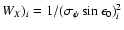
obliquity, respectively. The weights in X and Y were computed
as: (
in longitude and
obliquity, respectively. The weights in X and Y were computed
as: (
 ,
(
,
(
 .
.
We selected two different spans of data: (i) the interval
1980.0-2000.0, which was the interval used for the original MHB fit, and (ii) the interval 1980.0-2004.3, which is the longest
available and has an additional four years of low-noise data. We
also made some complementary linear fits for the interval
1990.0-2004.3. Results for these various fits are set out
in Table 1.
Figures 1 to 10 plot the differences between the MHB 2000,
 or P03 solutions and the GSFC, IAA or C04 VLBI series, over the interval 1980.0 to 2004.3
(Figs. 1 to 5 for X (i.e.
or P03 solutions and the GSFC, IAA or C04 VLBI series, over the interval 1980.0 to 2004.3
(Figs. 1 to 5 for X (i.e.
 )
and
Figs. 6 to 10 for Y (i.e.
)
and
Figs. 6 to 10 for Y (i.e.
 )).
)).
Table 1:
Linear fits (d
 )
of precession models for the
)
of precession models for the  coordinates of the CIP
in the GCRS against VLBI data; unit: microarcsecond.
coordinates of the CIP
in the GCRS against VLBI data; unit: microarcsecond.
These figures and Table 1 show the following results.
- -
- Fits of MHB 2000 to the GSFC and USNO VLBI series that
were used in the original MHB fits (i.e. identified as GSF1122 and
usn9901 IVS/IERS series according to Herring et al. (2002) and
denoted here GSFC
 and USNO
), are in very good
agreement with the MHB results, giving constant differences less
than 50 as and linear
differences less than 110 as/cy in both X and Y.
and USNO
), are in very good
agreement with the MHB results, giving constant differences less
than 50 as and linear
differences less than 110 as/cy in both X and Y.
- -
- There is a similar agreement of the fits of MHB 2000 to
revised GSFC and USNO series for the same interval and good
agreement with all the VLBI series for the period 1980-2000: a
linear fit to the residuals of any of these
series provides a slope smaller than 100 as/cy for X and 400 as/cy for Y.
- -
- There are significant differences between results for the
intervals 1990.0-2004.3 and 1980.0-2004.3 with respect to those
for the same models and
same VLBI series, but for the interval 1980.0-2000.0.
- -
- GSFC and USNO series provide results that are equivalent
within the formal
errors of the fits; therefore retaining one of them will be sufficient
for the present work.
- -
- The differences between the fits of IAU 2000 and MHB 2000
correspond, as expected, to the difference between the pre-2003
and post-2003 VLBI procedures (i.e. +152 as/cy for X
and -514 as/cy for Y).
- -
- The differences between the fits of P03 and IAU 2000
include, as expected, (i) the correction applied in P03 for
correcting the effect of the pre-2003 VLBI procedure, (ii) the
effect
![[*]](/icons/foot_motif.gif) of the difference
in the quadratic term in X between P03 and IAU 2000.
of the difference
in the quadratic term in X between P03 and IAU 2000.
- -
- The P03
solution in obliquity gives exactly the
same results as MHB 2000, which proves that this solution is
reproducing a precession rate that, when based on an
implementation that is different from MHB (due to the change in
obliquity at epoch, frame bias handling, etc.), reproduces
the MHB model.
- -
- The P03
solution in longitude does not give
similar results to MHB 2000, as might be expected given that
(i) it is based on the MHB
 precession rate which differs
by 540 as/cy from the MHB value and (ii) there is the
additional effect due to the difference in the t2 term between
the two solutions.
precession rate which differs
by 540 as/cy from the MHB value and (ii) there is the
additional effect due to the difference in the t2 term between
the two solutions.
- -
- The linear fit of MHB 2000 with respect to VLBI over this
interval 1980.0-2004.3 is of the order of 700 as/cy (for X)
and 900 as/cy for Y, using several series of VLBI data.
Note that such large residual linear terms in the VLBI fit of
MHB 2000 over the longest available span of data is consistent
with comparisons reported by Malkin (2004).
- -
- The P03 solution fits the VLBI series
distinctly better than the MHB 2000, IAU 2000 and P03
models.
We also performed similar fits for the Bretagnon et al. (2003) model
and saw the expected discrepancies with respect to the fits of the IAU 2000
model: i.e. the use of a value for
which is not appropriate
for the MHB precession rate in longitude has produced a -0.9 mas t effect
in X while the use of a rigid Earth model has led to a -1.3 mas t effect
in Y. The additional discrepancy with respect to the fits of the
P03 model comes from the fact that this model contains a -7 mas/cy2
contribution for the J2 rate.
2.6 Revised expressions based on precession rates fitted to VLBI
We have concluded from the various VLBI checks
that the MHB values do not fit well with the most recent and
accurate VLBI data. Therefore it appeared that it might be
preferable that the final precession solution rely on more recent
VLBI fits (1980.0-2004.3) than applying theoretical corrections to the
MHB precession rates (that result from a fit to VLBI data on the
interval 1980-2000). For the final estimates of the correction
to the precession rates of the models,
we have retained only the GSFC and IAA series which (i) both cover
the longest time span and (ii) are based upon independent
reduction software (viz. CALC for GSFC and OCCAM for IAA).
Table 2:
Amplitudes of the FCN mode fitted to VLBI data; unit:
milliarcsecond. For the fits made in this paper, the MHB model was used up to and including 2000/01/01, and
the fitted coefficients after this date.
The estimated correction to the P03
solution is:
 |
|
|
(8) |
from which we can derive the correction to the precession rates
in
and
corresponding to the IERS 2003 value for d of -14.6 mas:
 |
|
|
(9) |
and therefore:
We developed a solution like P03
in Sect. 2.2
by solving again the P03 precession equations but this time
using as integration constants the precession rates in longitude
and obliquity derived from VLBI fits given by Eq. (10). The final expressions,
that we will denote "the P03
 solutions'', are:
with
,
and:
The linear fits of the P03
 expressions to VLBI
over the time range of 1980.0-2004.3 are:
expressions to VLBI
over the time range of 1980.0-2004.3 are:
- (i)
- using the IAA series:

- (ii)
- using the GSFC series:

and the differences larger than 1 as
of P03
with respect to the P03 solution are, in as:
 |
|
|
(13) |
or equivalently:
 |
|
|
(14) |
We notice that this solution (i) fits well to the longest VLBI series and (ii) is very close to the P03 solution both in X and Y.
2.7 Precision of the coefficients
Regarding the precession of the ecliptic, we recall from
Sect. 1 that the accuracy of the secular variations of
the P03 solution in PA and QA was estimated to be about 0.05 mas/cy over a two-millennium interval centered on J2000.0.
Table 3:
The P03 primary precession quantities
compared with the IAU 2000 solution (IAU); unit: milliarcsecond.
Regarding the precession of the equator we have already mentioned
that, although the precision in computing the precession solution
has been significantly improved compared with that of the IAU 2000
precession by (i) using the best available model for the ecliptic
precession, (ii) using the best available model for the non-rigid
Earth effects and (iii) providing a solution that is dynamically
consistent, this model is dependent on the model for some
parameters of the non-rigid Earth, such as the J2 rate, that
have large uncertainties. The accuracy of the expression for the
precession in longitude is therefore strongly limited by the
uncertainty in the model for the J2 time variations, which is
if the order of 20% (Bourda & Capitaine 2004), resulting in
uncertainties of the order of 1.5 mas/cy2 in the quadratic term
in .
As noted in that paper, the J2 rate value used
for the P03 solution (i.e. of the order of
 /cy)
is in good agreement with the J2 rate evaluation of
/cy)
is in good agreement with the J2 rate evaluation of
 /cy by
Morrison & Stephenson (1997) from long term studies of the Earth rotation
variations, based upon eclipse data over two millennia.
/cy by
Morrison & Stephenson (1997) from long term studies of the Earth rotation
variations, based upon eclipse data over two millennia.
Moreover, the linear fit to VLBI is still spanning
too small an interval to provide a realistic uncertainty better
than about 150 as/cy for X and Y despite the smaller
formal uncertainty provided by the fit.
There are three choices for replacing the IAU 2000 precession of
the equator, all dynamically consistent: (i) use P03
,
based on the MHB precession rates but corrected for various
theoretical effects; (ii) use P03
,
based on the latest
VLBI estimated precession rates; and (iii) retain the existing P03
solution (the small change in the t2 term from P03 to
P03
being in fact smaller than the uncertainty in this
term). Given the results of Sects. 2.5 and 2.6, and
the evaluation of the precision provided in Sect. 2.7, choice (iii)
(i.e. retain P03) seems the most appropriate as long as it is associated with a
parameterized solution as a function of the parameters (i) to which the precession
expressions are the most sensitive and (ii) which are expected to be improved
in the future.
The final expressions proposed here as replacements for the
IAU 2000 precession quantities include (i) P03 expressions for the
ecliptic precession; (ii) P03 expressions for the primary
precession quantities for the equator; (iii) precession quantities
for classical use derived from the previous P03 quantities
including revised sidereal time and (iv) expressions for
precession quantities for use with the new paradigm based on the
positions of the celestial intermediate pole (CIP) and celestial
intermediate origin (CIO), respectively, in the GCRS. These P03 numerical
expressions are associated with a parameterized extension
comprising functions of the J2 rate model and of
the changes to the P03 precession rates.
Note that the coefficients of the P03 expressions are given in the
tables with more digits than the real uncertainty, for the purpose
of internal consistency.
Table 4:
The P03 expressions for the derived
precession quantities for classical use and Greenwich mean
sidereal time expressed in terms of the Earth rotation angle
 ;
unit: milliarcsecond.
;
unit: milliarcsecond.
Table 5:
The P03 expressions for the GCRS
components of the CIP and angular position of the CIO, and for the
rotation vector components; unit: milliarcsecond.
The most "fundamental'' parameters for the precession of the
equator are those (either angular variables or Cartesian
coordinates) providing the "dynamically derived'' position of the
equator (or equivalently the CIP) relative to the fixed ecliptic.
These are indeed the most basic variables due to the fact that the
most recent analytical theories for the solar system bodies, upon
which the Earth's rotation theory is based, are referred to the
fixed ecliptic. The dynamics of Earth rotation do not involve the
concept of an ecliptic, but are directly based on the dynamics of
the solar system bodies in an inertial frame, which means that
using the ecliptic as a reference is only an approximate
intermediate stage in obtaining simplified expressions for the
precession-nutation of the equator. Suitable precession parameters
for the ecliptic are the (x, y) coordinates of the ecliptic
pole in the mean ecliptic frame of epoch. Note that the x, y coordinates (either of the ecliptic pole or the equatorial pole)
are more basic quantities than individual angles that are
determined by their trigonometric relations.
The primary precession quantities selected for the P03 solution,
from which all the other quantities can be derived, are:
- (i)
- the expressions for the ecliptic quantities PA, QA which
may be regarded as, respectively, the x and -y components of
the secularly-moving ecliptic pole vector in a (right-handed)
coordinate system that has its x-axis through the J2000
(inertial) mean equinox and its z-axis through the J2000
ecliptic pole;
- (ii)
- the expressions for the quantities ,
for
the equator, which are the polar coordinates of the CIP with respect
to the J2000 ecliptic pole and J2000 (inertial) mean equinox.
The developments for these primary quantities are provided in
Table 3 together with the corresponding IAU 2000 expressions.
The P03 expressions for the ecliptic precession angles  and
and  were derived from the developments for the basic
ecliptic quantities PA and QA, which can be
written as
were derived from the developments for the basic
ecliptic quantities PA and QA, which can be
written as
 and
and
 .
Similarly,
the P03 expressions for the two first equatorial precession angles
.
Similarly,
the P03 expressions for the two first equatorial precession angles  and
and  were derived from the P03 developments for
and .
were derived from the P03 developments for
and .
The expressions for all the precession parameters that refer to
the ecliptic of date (i.e. the third equatorial precession angle,
zA, the obliquity of the equator on the moving ecliptic,
,
the planetary precession along the equator of date,
and the general precession in longitude, pA)
were derived from both the P03 ecliptic and equator primary
expressions.
Table 4 provides expressions for all the precession quantities for
classical use, along with the expression for GMST(UT1,TT) the
IAU 2000 expression for which (Capitaine et al. 2003a) must be
revised in order to take account of the changes in the expressions
for the precession quantities ,
and .
Note that, in contrast, the expressions for the complementary
terms in the equation of the equinoxes are unchanged.
A replacement for the IAU model must provide improved
precession in both the classical and new paradigms. The new
paradigm provides the CIP directly, without any concept of "mean
pole''. If "precession'' is to be a meaningful and useful concept
in the new paradigm, we should consider precession of the equator
as being the secular part of the "orientation parameters'' of the
CIP equator with respect to either J2000 mean equatorial system or
the GCRS. The precession expressions for X and Y are thus
identified with the polynomial part of the GCRS CIP direction
cosines, based on the P03 expressions for
and .
The P03 expressions for these quantities as well as for the
quantity s+XY/2 that provides the GCRS position of the
CIO are given in Table 5. Note that the only significant
change with respect to the IAU 2000 expression for the GCRS position of the CIO is of  as in the quadratic term, the
other changes all being less than
as in the quadratic term, the
other changes all being less than  as.
Table 5 also provides the components
as.
Table 5 also provides the components  ,
,
 ,
,
 of the
"rotation vector'' representing bias plus the P03 precession (see
Capitaine et al. 2003b). The rotation vector is a concise and
direct way to represent the rotation of the coordinate system, in
this case from GCRS axes to mean equator and equinox of date. Its
direction is the pole of the rotation (the Euler axis) and its
magnitude is the amount of rotation (the Euler angle). In this
case, to first order, the rotation vector points at the ecliptic
pole and its magnitude increases steadily by about 50 arcsec per year.
of the
"rotation vector'' representing bias plus the P03 precession (see
Capitaine et al. 2003b). The rotation vector is a concise and
direct way to represent the rotation of the coordinate system, in
this case from GCRS axes to mean equator and equinox of date. Its
direction is the pole of the rotation (the Euler axis) and its
magnitude is the amount of rotation (the Euler angle). In this
case, to first order, the rotation vector points at the ecliptic
pole and its magnitude increases steadily by about 50 arcsec per year.
Due to the strong dependence of (i) the precession expressions on
the precession rates r0 and u0 in longitude and obliquity,
respectively and (ii) the precession in longitude (or equivalently
in the GCRS CIP X coordinate) on the J2 rate model,
both of which are expected to be improved in the future, we
have developed a parameterized solution for these quantities as a
function of those parameters, calling it P04
 .
Such a
solution is intended to be used to produce (or check) future
precession models based on extended VLBI records and
improved geophysical models.
It is based on the P03 precession expressions (Capitaine et al. 2003b) and on the theoretical
relationship of their linear, quadratic, and cubic coefficients,
.
Such a
solution is intended to be used to produce (or check) future
precession models based on extended VLBI records and
improved geophysical models.
It is based on the P03 precession expressions (Capitaine et al. 2003b) and on the theoretical
relationship of their linear, quadratic, and cubic coefficients,  ,
,
 ,
,
 ,
,
 (with i=1, 2, 3 for the linear, quadratic and cubic coefficients,
respectively), with constant and linear contributions, r0, u0, r1, u1 to the
precession rates,
(with i=1, 2, 3 for the linear, quadratic and cubic coefficients,
respectively), with constant and linear contributions, r0, u0, r1, u1 to the
precession rates,  in longitude and
 in obliquity.
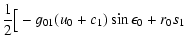
The theoretical relationships were derived from Tables 3 and 7 of the P03 Paper using the following expressions:
in obliquity.
The theoretical relationships were derived from Tables 3 and 7 of the P03 Paper using the following expressions:
and:
s1, c1 and s2, c2 being the linear and quadratic coefficients of
the precession ecliptic quantities PA and QA, respectively, and:
| r0 |
= |
 |
|
| u0 |
= |
 |
(17) |
| r1 |
= |
 |
|
| u1 |
= |
 |
(18) |
 and
and
 being the first-order luni-solar contributions to
and
,
respectively.
Note that these components are such that f01 and g01 are proportional to J2
and f11 and g11 contain a part proportional to
being the first-order luni-solar contributions to
and
,
respectively.
Note that these components are such that f01 and g01 are proportional to J2
and f11 and g11 contain a part proportional to  .
.
This gives for
and :
and similar relationships for the other precession quantities.
The parameterized expressions of the precession quantities as
functions of
and of corrections dr0, du0 to the
P03 precession rates r0 and u0, respectively, should retain
only the parameterized terms that, given the expected values for
the parameters considered, can contribute to the expressions with
amplitudes larger than one microarcsecond. The time derivative
of the coefficient J2 contributes to r1 as
follows:
 |
|
|
(20) |
According to Table 7 of the P03 Paper and to expected values lower than 1 mas/cy for
the corrections to the precession rates
and
 for the term
 (see Sect. 3.6), this requires considering
the following terms in the partials of the coefficients of the precession expressions:
(see Sect. 3.6), this requires considering
the following terms in the partials of the coefficients of the precession expressions:
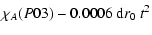
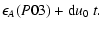
The resulting P04
expressions for classical use are, with dr0, du0 in arcseconds:
And the expression for Greenwich mean sidereal time is:
The additional t2 and t3 terms that appear between square brackets
in the expressions for the differences (P04
 P03) for the precession quantities ,
and
P03) for the precession quantities ,
and  (and also X, Y below) are for removing the
contribution to the P03 solution.
Taking into account additionally the effects of the corrections d
(and also X, Y below) are for removing the
contribution to the P03 solution.
Taking into account additionally the effects of the corrections d ,
d
,
d and d(d
 to the IAU 2000 frame biases, we get the parameterized P04
expressions for the GCRS X and Y quantities for use with the new paradigm:
to the IAU 2000 frame biases, we get the parameterized P04
expressions for the GCRS X and Y quantities for use with the new paradigm:
where dX1 (=
 )
is the correction to the linear term X1 of
the P03 X expression.
)
is the correction to the linear term X1 of
the P03 X expression.
Suitable precession-nutation parameters would integrate the
computation of bias, precession and nutation and provide a
transformation between celestial and terrestrial coordinates
that involves a minimum number of variables and coefficients.
Suitable candidates for replacing the classical precession angles ,
,
and nutation angles
,
,
,
which are usually
considered separately, are the combined precession-nutation angles
(Aoki & Kinoshita 1983)
 ,
,
 referred to the ecliptic of epoch,
which have the advantages:
referred to the ecliptic of epoch,
which have the advantages:
- (i)
- of being the "fundamental parameters'' mentioned above for
precession alone, associated with the parameter
 for positioning the true equinox along the equator;
note that the last quantity is not in fact necessary if it is
omitted both in the PN matrix and in the expression for GST; note
also that the combination of precession and nutation could easily
include the frame biases as well;
for positioning the true equinox along the equator;
note that the last quantity is not in fact necessary if it is
omitted both in the PN matrix and in the expression for GST; note
also that the combination of precession and nutation could easily
include the frame biases as well;
- (ii)
- of being referred to an inertial frame which is more in
agreement with the IAU adoption of the International Celestial
Reference System (ICRS) than referring to a
moving ecliptic that involves taking additional precession effects
into account.
The use of such parameters would mean using solutions for nutation
that are directly referred to the mean ecliptic at epoch instead
of ecliptic of date. Note that such an approach was already
followed by Woolard (1953) and Bretagnon et al. (1997) and would
be the natural choice for any numerical integration.
In the new paradigm, the basic quantities are the CIP coordinates X, Y
in the GCRS, that appear directly as the (1, 3) and (2, 3) elements of
the celestial-to-terrestrial transformation matrix. The polar coordinates E and d in the GCRS can easily be derived from X and Y.
A third option is to use the "rotation vector'' approach
(see Sect. 3.3), once it has been extended to include
nutation as well.
3.6 Changes in the IAU nutation corresponding to the adoption of the P03 precession
Adopting a new precession model requires slight adjustment in the
amplitudes of the nutation model that is used. The effects to be
considered are the following:
- (i)
- a change of the amplitudes of nutation in longitude due the
change in the obliquity of the ecliptic in the precession model as
compared with its value when estimating the nutation amplitudes of
the model, similar to the effect considered for the P03 precession as compared with the IAU 2000 precession; in order to
take this change into account, it is necessary to multiply the
amplitudes of the nutation in longitude by
 ;
;
- (ii)
- a change of the amplitudes of nutation (both in longitude and
obliquity) due to the secular variation of the Earth's dynamical
flattening (or equivalently J2) which is used in the P03 precession model,
whereas it was not considered in the IAU 2000 model; the
amplitudes of nutation being proportional to J2, this J2rate effect gives rise to additional Poisson terms that are
proportional to
.
The J2 rate contribution to the linear precession rate in
longitude, which was considered in the P03 precession to be -14 mas t,
corresponds to a value for
of
 ,
or
equivalently (with
,
or
equivalently (with
 )
a value
of
)
a value
of
 /cy.
/cy.
The corrections larger than 1 as to be added to the IAU 2000
nutation for these above effects are, respectively, in as:
 |
|
|
(26) |
Expressions (27) can also be provided in arcseconds in the following
parameterized form:
The above corrections can be written as functions of
 and
and
 ,
the IAU 2000 nutation angles in longitude and obliquity respectively:
,
the IAU 2000 nutation angles in longitude and obliquity respectively:
![$\displaystyle {\rm d}_1\psi= [(\sin\epsilon_{{\rm IAU2000}}/\sin\epsilon_{P03}) - 1]\
\Delta\psi_{{\rm IAU2000}}$](/articles/aa/full/2005/10/aa1908/img179.gif) |
|
|
(29) |
 |
|
|
|
 |
|
|
(30) |
In this paper we have provided expressions for precession as
possible replacements for the current IAU precession (adopted by
IAU 2000 Resolution B1.6, Mathews et al. 2002).
The proposed expressions are the P03 solution of Capitaine et al. (2003b) for the ecliptic and the equator. We have in addition
provided a parameterized P04 solution for the equator that could
be used for future improvement. Before recommending the P03 solution for the equator, we compared it with a revised version of
the solution, which is based on the P03 ecliptic and was obtained
in exactly the same way as P03 but using a refined model for the
contributions of the non-rigid Earth (Mathews 2004) and revised
integration constants for the precession rates that came from fits
to the latest and most reliable VLBI data. After considering
several options for the final precession expressions, we concluded
that retaining the P03 solution, which was already in experimental
use, was the preferred option.
In this paper we have described the different steps in obtaining
the improved solution and in making comparisons, and we have
summarized the expressions for all the usual precession quantities
as well as for sidereal time and for the quantities to be used in
the CIO-based transformation. We have also provided the
corresponding corrections to be applied to the IAU 2000 nutation.
Acknowledgements
We are grateful to P. M. Mathews for having provided his latest
pre-publication results for the effects of the non-rigid Earth on
precession, and for valuable discussion. We thank J. Hilton,
G. Kaplan and J. Vondrák for their interest and encouragement
and V. Dehant for helpful comments and suggestions
for improving the manuscript.
- Aoki, S., &
Kinoshita, H. 1983, Celest. Mech., 29, 335 [NASA ADS] (In the text)
- Bourda, G.,
& Capitaine, N. 2004, A&A, 428, 691 [EDP Sciences] [NASA ADS] [CrossRef] (In the text)
-
Bretagnon, P., & Francou, G. 1988, A&A, 202, 309 [NASA ADS] (In the text)
-
Bretagnon, P., Rocher, P., & Simon, J.-L. 1997, A&A, 319,
305 [NASA ADS] (In the text)
-
Bretagnon, P., Fienga, A., & Simon, J.-L. 2003, A&A, 400,
785 [EDP Sciences] [NASA ADS] [CrossRef] (In the text)
-
Capitaine, N., Wallace, P. T., & McCarthy, D. D. 2003a,
A&A, 406, 1135 [EDP Sciences] [NASA ADS] [CrossRef] (In the text)
-
Capitaine, N., Wallace, P. T., & Chapront, J. 2003b, A&A,
412, 567 [EDP Sciences] [NASA ADS] [CrossRef] (In the text)
-
Capitaine, N., Wallace, P. T., & Chapront, J. 2004, A&A,
421, 365 [EDP Sciences] [NASA ADS] [CrossRef] (In the text)
-
Fukushima, T. 2003, AJ, 126, 1 [CrossRef] (In the text)
- Herring, T.
A., Mathews, P. M., & Buffett, B. A. 2002, J. Geophys. Res.,
107, B4, 10.1029/2001JB000165
(In the text)
- IERS Conventions
2003, IERS Technical Note 32, ed. D. D. McCarthy, & G. Petit,
Frankfurt am Main: Verlag des Bundesamts für Kartographie und
Geodäsie, 2004
- Lieske, J. H.,
Lederle, T., Fricke, W., & Morando, B. 1977, A&A, 58,
1 [NASA ADS] (In the text)
- Malkin, Z.
2004, in Proc. of the Journées 2003, ed. A. Finkelstein, &
N. Capitaine, St. Petersburg, 24
(In the text)
- Mathews, P.
M. 2004, private communication
(In the text)
- Mathews, P.
M., Herring, T. A., & Buffett, B. A. 2002, J. Geophys. Res.,
107, B4, 10.1029/2001JB000390
(In the text)
- Morrison,
L., & Stephenson, R. 1997, Contemporary Physics, 38, 1 [CrossRef] (In the text)
- Standish,
E. M. 1998, JPL Planetary and Lunar Ephemerides, DE405/LE405, JPL
IOM 312.F-98-048
(In the text)
- Williams,
J. G. 1994, AJ, 108 (2), 711
(In the text)
- Woolard, E.
W. 1953, Astr. Pap. Amer. Ephem. Naut. Almanac XV, I, 1
(In the text)
Copyright ESO 2005





![\begin{figure}
\par\includegraphics[angle=270,width=7.5cm,clip]{1908fig1.ps}
\end{figure}](/articles/aa/full/2005/10/aa1908/img50.gif)
![\begin{figure}
\par\includegraphics[angle=270,width=7.5cm,clip]{1908fig2.ps}
\end{figure}](/articles/aa/full/2005/10/aa1908/img51.gif)
![\begin{figure}
\par\includegraphics[angle=270,width=7.5cm,clip]{1908fig3.ps}
\end{figure}](/articles/aa/full/2005/10/aa1908/img52.gif)
![\begin{figure}
\par\includegraphics[angle=270,width=7.5cm,clip]{1908fig4.ps}
\end{figure}](/articles/aa/full/2005/10/aa1908/img53.gif)
![\begin{figure}
\par\includegraphics[angle=270,width=7.5cm,clip]{1908fig5.ps}
\end{figure}](/articles/aa/full/2005/10/aa1908/img54.gif)
![\begin{figure}
\par\includegraphics[angle=270,width=7.5cm,clip]{1908fig6.ps}
\end{figure}](/articles/aa/full/2005/10/aa1908/img55.gif)
![\begin{figure}
\par\includegraphics[angle=270,width=7.5cm,clip]{1908fig7.ps}
\end{figure}](/articles/aa/full/2005/10/aa1908/img56.gif)
![\begin{figure}
\par\includegraphics[angle=270,width=7.5cm,clip]{1908fig8.ps}
\end{figure}](/articles/aa/full/2005/10/aa1908/img57.gif)
![\begin{figure}
\par\includegraphics[angle=270,width=7.5cm,clip]{1908fig9.ps}
\end{figure}](/articles/aa/full/2005/10/aa1908/img58.gif)
![\begin{figure}
\par\includegraphics[angle=270,width=7.5cm,clip]{1908fg10.ps}
\end{figure}](/articles/aa/full/2005/10/aa1908/img59.gif)









![$\displaystyle +f_{01} c_1(\cos^2\epsilon_0-\sin^2\epsilon_0)/\sin\epsilon_0 + r_{02}c_1 \cot\epsilon_0\Big]$](/articles/aa/full/2005/10/aa1908/img119.gif)
![$\displaystyle + g_{11}\cos\epsilon_0 + u_{12}\big],$](/articles/aa/full/2005/10/aa1908/img121.gif)





![$\displaystyle + \ \left[0\hspace{0.1em}'\hspace{-0.06em}'\hspace{-0.3em}.\hspac...
...space{0.1em}'\hspace{-0.06em}'\hspace{-0.3em}.\hspace{0.1em}{000002}~t^3\right]$](/articles/aa/full/2005/10/aa1908/img134.gif)








![$\displaystyle + \left[0\hspace{0.1em}'\hspace{-0.06em}'\hspace{-0.3em}.\hspace{...
...space{0.1em}'\hspace{-0.06em}'\hspace{-0.3em}.\hspace{0.1em}{000001}~t^3\right]$](/articles/aa/full/2005/10/aa1908/img154.gif)


![$\displaystyle - 0.2~ \sin(2F+2\Omega) + 0.2~ \sin2 \Omega]$](/articles/aa/full/2005/10/aa1908/img175.gif)
![$\displaystyle (\dot{J_2}/J_2)\ t~ [9.2~ \cos\Omega + 0.6~ \cos(2F-2D+2\Omega)].$](/articles/aa/full/2005/10/aa1908/img176.gif)