A&A 432, 175-179 (2005)
DOI: 10.1051/0004-6361:20041573
HST observations of the pulsating white dwarf GD 358
B. G. Castanheira1 -
A. Nitta2 -
S. O. Kepler1 -
D. E. Winget3 -
D. Koester4
1 -
Instituto de Física, Universidade Federal do Rio Grande do Sul,
91501-900 Porto-Alegre, RS, Brazil
2 - Sloan Digital Sky Survey, Apache Pt. Observatory, PO Box 59, Sunspot, NM
88349, USA
3 - Department of Astronomy and McDonald Observatory,
University of Texas,
Austin, TX 78712, USA
4 - Institut für Theoretische Physik und Astrophysik, Universität Kiel,
24098 Kiel, Germany
Received 2 July 2004 / Accepted 20 October 2004
Abstract
We used time-resolved ultraviolet spectroscopy obtained with the
FOS and STIS spectrographs of the Hubble Space Telescope (HST), together with
archival IUE observations
to measure the effective temperature (
 ), surface gravity
(
), surface gravity
( )
and distance (d) of the pulsating DB white dwarf GD 358
with unprecedented
accuracy, and to show that the temperature did not change
during the 1996 sforzando, when the star changed basically to a single
mode pulsator. We also measured for the first time for a DBV the
spherical harmonic degree (
)
and distance (d) of the pulsating DB white dwarf GD 358
with unprecedented
accuracy, and to show that the temperature did not change
during the 1996 sforzando, when the star changed basically to a single
mode pulsator. We also measured for the first time for a DBV the
spherical harmonic degree ( )
for two modes,
with k=8 and k=9,
which was only possible because the stellar light
curve was dominated by a single mode in 1996.
The independent spectra provide the following values:
)
for two modes,
with k=8 and k=9,
which was only possible because the stellar light
curve was dominated by a single mode in 1996.
The independent spectra provide the following values:
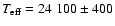 K,
K,
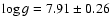 and
and
 pc. The ultraviolet spectroscopic distance is in better agreement with
the seismological value, than the one derived by parallax.
pc. The ultraviolet spectroscopic distance is in better agreement with
the seismological value, than the one derived by parallax.
Key words: stars: white dwarfs - stars: variables: general - stars: oscillations -
stars: individual: GD 358 - stars: evolution
GD 358, also called V777 Herculis, is the prototype of the helium atmosphere
pulsating white dwarf stars, the DBVs.
It was the first pulsating star detected based on a theoretical
prediction (Winget et al. 1982), and
is the one
with the largest number of detected periodicities,
after the Sun.
Detecting as many modes as possible is extremely important as each detected
periodicity
yields an independent constraint on the star's
structure, and identifying the pulsation indices is crucial to allow real
measurements.
The study of pulsating white dwarf stars has already
allowed us to measure stellar mass and composition layer thickness,
to probe the physics at high densities, including crystallization,
and has provided a chronometer to measure the age of the oldest stars and
consequently, the age of the Galaxy (Winget et al. 1987; Hansen et al. 2002;
Hansen & Liebert 2003).
Beauchamp et al. (1999) studied the optical spectra of the pulsating DBs
to determine their impure instability strip at
22 400 K
 K, and found
 K (24 700 K from models with traces of H),
 for
the brightest DBV,
GD 358 (V=13.85),
assuming no photospheric H. This H absence was confirmed by Provencal et al. (2000), who
studied the HST and EUVE spectra, deriving
for
the brightest DBV,
GD 358 (V=13.85),
assuming no photospheric H. This H absence was confirmed by Provencal et al. (2000), who
studied the HST and EUVE spectra, deriving
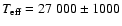 K.
They also detected Ly
K.
They also detected Ly ,
probably from the interstellar medium.
,
probably from the interstellar medium.
Winget et al. (1994) reported
the analysis of 154 h of nearly continuous time series optical
photometry on GD 358, obtained during
the Whole Earth Telescope (WET)![[*]](/icons/foot_motif.gif) run of May 1990. The Fourier temporal spectrum
of the light curve was dominated by periodicities in the range
1000-2400
run of May 1990. The Fourier temporal spectrum
of the light curve was dominated by periodicities in the range
1000-2400  Hz,
with more than 180 significant peaks.
They identify all of the triplet frequencies as
having spherical harmonic degree
Hz,
with more than 180 significant peaks.
They identify all of the triplet frequencies as
having spherical harmonic degree  and, from
the details of the triplet (differing k) spacings,
Bradley & Winget (1994)
derived the total stellar mass
as
and, from
the details of the triplet (differing k) spacings,
Bradley & Winget (1994)
derived the total stellar mass
as

 ,
the mass of the outer helium envelope as
,
the mass of the outer helium envelope as
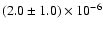 M*, the luminosity as
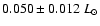 and,
deriving a temperature and bolometric correction,
the distance as
and,
deriving a temperature and bolometric correction,
the distance as  pc.
pc.
As a clear demonstration of the power of asteroseismology,
Metcalfe et al. (2001, 2002), and Metcalfe (2003)
used GD 358 observed periods from Winget et al. (1994)
and a genetic algorithm to search for
the optimum theoretical model
with static diffusion envelopes,
and constrained the
 cross section, or the envelope/core
symmetry (Metcalfe et al. 2003; Montgomery et al.
2003).
On the other hand,
Dehner & Kawaler (1995),
Brassard & Fontaine (2003) and
Fontaine & Brassard (2002) show that a thin helium
envelope is consistent with the evolutionary models starting as
PG1159 models and ending as DQs, as diffusion is still
ongoing around 25 000 K and lower temperatures.
Therefore, there could be two transition
zones in the envelope, one between the He envelope and the He/C/O layer,
where diffusion is still separating the elements, and another
transition between this layer and the C/O core.
The ongoing diffusion has also been calculated by
Córsico et al. (2002), and the double layer structure by
Althaus & Córsico (2004).
cross section, or the envelope/core
symmetry (Metcalfe et al. 2003; Montgomery et al.
2003).
On the other hand,
Dehner & Kawaler (1995),
Brassard & Fontaine (2003) and
Fontaine & Brassard (2002) show that a thin helium
envelope is consistent with the evolutionary models starting as
PG1159 models and ending as DQs, as diffusion is still
ongoing around 25 000 K and lower temperatures.
Therefore, there could be two transition
zones in the envelope, one between the He envelope and the He/C/O layer,
where diffusion is still separating the elements, and another
transition between this layer and the C/O core.
The ongoing diffusion has also been calculated by
Córsico et al. (2002), and the double layer structure by
Althaus & Córsico (2004).
The average IUE spectra of GD 358, consisting of 15 images taken over 11 years,
from 1981 to 1992, which we will use in Sect. 3 to derive
,
and distance (d), was published by Holberg et al. (2002).
In this paper we also report the determination in
,
and distance (d)
from our own FOS and STIS spectra in Sect. 3, and
the pulsation indices for the main pulsations in Sect. 4.
By observing the DBV star GD 358 with the HST, we have a unique opportunity
to cross-calibrate the identification of the triplets by their period spacings
(Winget et al. 1994; Kepler et al. 2003) and the amplitude variation with
wavelength. The chromatic amplitude variation method was used by
Robinson et al. (1995), Kepler et al. (2000), and Castanheira et al. (2004).
Two stars have their modes clearly identified by the period distribution
method: PG 1159-035 (Winget et al. 1991) and GD 358 (Winget et al. 1994).
The stars PG 2131+066 (Kawaler et al. 1995), PG 1707+427 (Kawaler et al. 2004)
and RX J2117 (Bond et al. 1996) have modes identified as
from their
period spacings and/or the presence of triplets.
We observed GD 358 for 4 h of time-resolved spectroscopy using the Faint
Object Spectrograph (FOS) on the Hubble Space Telescope (HST),
in August 1996 (Nitta et al. 1998). Unexpectedly, the pulsation spectra
changed dramatically,
passing basically to a single mode large amplitude pulsation,
which we will call sforzando,
and was called "forte'' by Kepler
et al. (2003).
We also
observed this star for 7.5 h with the Space Telescope Imaging Spectrograph
(STIS) in May 2000, when the Fourier spectrum indicates that the star
had returned
to its previous normal multiperiodic pulsation state.
The exposures with FOS used the blue Digicon detector and the G160L grating,
and consist of 764 useful pixels over the spectral region from 1150 to
2510 Å (UV), with 1.74 Å per pixel. Simultaneously to the UV spectra, we
have the zeroth-order observation, with an effective wavelength at 3400 Å,
which has a counting rate around 100 times larger than the UV data. Our FOS data
has a temporal frequency resolution of 23 Hz. The exposures with STIS used
the G140L grating, and consist of 833 useful pixels over the spectral region 1138 to 1736 Å, with 0.6 Å per pixel. Our STIS data has a temporal
frequency resolution of 5.5 Hz. The UV relative photometry from STIS and
FOS quoted in Table 2 were obtained by summing the ultraviolet
time-resolved spectra over all wavelengths.
Simultaneous optical data to STIS was obtained with the WET.
We also detected in the HST data a periodicity of around 45 min, which is
caused by the movement of the star in the aperture caused by the wobbling of
the HST solar panels when they come in and out of the shadow of the Earth. We
included this periodicity in our multisinusoidal fit, to reduce the
uncertainties.
We can measure
reliable pulsation amplitudes only for bins redder than approximately
1200 Å, because
of contamination of the observed spectra by geocoronal emission.
As we still have no explanation for why the pulsation feature changed so
drastically in August-September 1996 and returned to the normal state after
a month, as reported by Nitta et al. (1998) and Kepler et al. (2003), we started
by constraining the atmospheric parameters prior to the change. We used the
recalibrated average International Ultraviolet Explorer satellite (IUE) spectra
taken over 11 years (from 1981 to 1992) published by Holberg et al. (2003) to derive the effective temperature, surface gravity and
distance. It has a wavelength coverage from 1150 Å to 3100 Å.
We do not know the state of GD 358 when the IUE spectra were taken, but from
all optical observations, since 1983, we only saw a significant change in the
sforzando of August 1996.
Using a new grid of ML2/
 Koester's
model atmospheres, described in Finley et al. (1997), our best simultaneous
fit for
,
and d is
Koester's
model atmospheres, described in Finley et al. (1997), our best simultaneous
fit for
,
and d is
 K,
K,
 and
and
 pc. The distance is consistent with the value
derived by seismology, pc (Bradley & Winget 1994), but not within
one sigma of the one obtained from parallax measurement,
pc. The distance is consistent with the value
derived by seismology, pc (Bradley & Winget 1994), but not within
one sigma of the one obtained from parallax measurement,  pc
(Harrington et al. 1985).
pc
(Harrington et al. 1985).
Fitting the three parameters for both FOS and STIS spectra, independently,
we find the results shown in Table 1.
Table 1:
Atmospheric parameters derived from independent UV spectra.
We show in Fig. 1 all the UV
spectra fitted and the best model. The FOS and STIS spectra
match the same model as the IUE spectra within their uncertainties,
showing the star did not change its global parameters - effective
temperature and radius - during the sforzando in 1996.
The average values, from the three independent fits, are
K,
and
.
![\begin{figure}
\par\includegraphics[width=7.5cm,clip]{1573fig1.eps}
\end{figure}](/articles/aa/full/2005/10/aa1573/Timg33.gif) |
Figure 1:
Ultraviolet spectra taken with IUE ( upper panel), FOS ( middle panel),
and STIS ( lower panel), all in full line.
The best model (dashed line) is at d=42.3 pc with
 ,
and
,
in all three panels. ,
and
,
in all three panels. |
| Open with DEXTER |
We also tested for the possibility of significant extinction in the ultraviolet
spectra. Thejll et al. (1991) analyzed the available IUE spectra,
allowing for an extinction according to Seaton's (1979) reddening, but found
none. Our IUE spectrum includes more data than the one they analyzed, and
includes the
final calibration of IUE (Holberg et al. 2003). As the
interstellar feature around 2200 Å is not detected in the spectra,
extinction larger than
EB-V=0.01 is not likely. Our tests show extinction
would not improve the fits, which is consistent with there being
no significant extinction.
When we fit the intrinsically high S/N STIS spectra obtained in 2000, we note
its shape does not agree in detail with any of our models. Considering that the
highest S/N spectra of the standard star G 191-B2B in the STIS archives has only
 ,
we believe the problem lies in the flux calibration of the
spectra.
,
we believe the problem lies in the flux calibration of the
spectra.
Having determined that GD 358 did not change globally, we are ready to
apply the chromatic amplitude variation method to derive
atmospheric parameters in comparison to the ones derived through the spectra.
We are trying to answer the question: is the pulsation
the same as the model atmospheric
,
considering that the
region of period formation samples deeper layers, as the k=8 mode, dominant
during the sforzando, is probably trapped in the C to He transition
layers?
To detect which periodicities are present in the data, we calculated the Fourier
transform (FT) shown in Fig. 2: summed UV (right) and zeroth-order
(left) light curve (top panels), pre-whitening of the largest amplitude
periodicity at 423.2 s (top-middle panel) and only other significant
periodicity at 464.2 s (bottom-middle panel) and the spectral window
(bottom panel). The non-linear least squares fit for the two detected
periodicities is listed in Table 2. During this observation, the
energy transported by several modes present in previous runs was chained
basically into only one mode at 423.2 s, identified as k=8 by Winget et al.
(1994) and Kepler et al. (2003), which had never been the largest amplitude
mode in the reported data sets to date. Note that the k=8 mode observed in
1996 was the m=0 mode, not the  modes observed in 2000.
Kepler et al. (2003) indicate that after one month, the pulsation spectra
returned to the multiperiodic state.
modes observed in 2000.
Kepler et al. (2003) indicate that after one month, the pulsation spectra
returned to the multiperiodic state.
![\begin{figure}
\par\includegraphics[width=7.8cm,clip]{1573fig2.eps}
\end{figure}](/articles/aa/full/2005/10/aa1573/Timg36.gif) |
Figure 2:
The Fourier transform of the FOS data, obtained in 1996, for summed UV
( right panels) and zeroth-order data ( left panel). From top to bottom, we
show the dominant mode around P=423 s (k=8, m=0), another periodicity
at 464.2 s (k=9, m=0) identified by pre-whitening analysis, the noise after
both subtraction, and the spectral window. The mode
identification is described by Kepler et al. (2003). |
| Open with DEXTER |
Table 2:
Periodicities identified using pre-whitening analysis for the HST FOS
light curve, during the sforzando, in 1996, both for the total UV
(1196-2484 Å)
and zeroth-order light obtained with HST FOS. The times of maxima (
 )
for UV and zeroth-order data are given in relation to
T0=2 450 311.8058746 BCT.
)
for UV and zeroth-order data are given in relation to
T0=2 450 311.8058746 BCT.
Robinson et al. (1982) and Kepler (1984) demonstrated that the
variable white dwarf stars pulsate in non-radial g-modes, with buoyancy
providing the restoring force.
They also show that the amplitudes change with wavelength but the phases do
not, in the models with no non-adiabatic effects.
The chromatic amplitude variation method was applied to these two modes
detected in this data set.
To obtain significant amplitudes directly comparable to normalized binned
model values, we convolved the time-resolved FOS spectra into bins of 50 Å.
Then, we run a multisinusoidal nonlinear least squares fit for each convolved
spectrum and for the zeroth-order (at 3400 Å), using periodicities fixed
in frequency.
We then compared the observational changes in amplitude with wavelength to
those values
predicted by the g-mode pulsation models described by Robinson et al.
(1995) and Kepler et al. (2000), for the whole grid of
and
models. In Fig. 3, we show how the amplitude, normalized
at 3400 Å, changes with wavelength for the modes at P=423.2 s and
at P=464.2 s, in comparison with the theoretical ones calculated from
Koester's model atmospheres with
K and
 ,
for
and
,
for
and  .
Kepler et al. (2000) show in their Fig. 1 the
theoretical chromatic amplitudes for
to 4.
.
Kepler et al. (2000) show in their Fig. 1 the
theoretical chromatic amplitudes for
to 4.
![\begin{figure}
\par\includegraphics[width=7.7cm,clip]{1573fig3.eps}
\end{figure}](/articles/aa/full/2005/10/aa1573/Timg47.gif) |
Figure 3:
Chromatic amplitude changes the way the amplitudes normalized at
3400 Å changes with wavelength. The main mode at P=423.2 s and the
mode at P=464.2 s are most probably . |
| Open with DEXTER |
These amplitude calculations take into account the wavelength dependence of the
limb darkening and different cancellation of the flux variation for different
spherical harmonic degrees. Even though Ising & Koester (2001) and Weidner
& Koester (2003) show that the effect of the convective zone introduces
nonlinearities, the amplitude and inclination angle dependence in
 are negligible for small (or large) amplitudes.
At this point, we are ready to derive the
independent of
any other method. By fitting
 (3400 Å) to those predicted by
the models, which are
dependent, we determined
and ,
using only the values for
derived from the spectra, for
each periodicity. Kepler et al.
(2000) determined
for the main periodicities of the DAVs G 185-32,
G 226-29 and the DBV
PG 1351+489, using a fixed
and ,
calculated by other
methods. Castanheira et al. (2004) determined
for G 185-32 modes,
keeping all parameters free, using the constraint that solutions for each
mode must result in the same
and .
(3400 Å) to those predicted by
the models, which are
dependent, we determined
and ,
using only the values for
derived from the spectra, for
each periodicity. Kepler et al.
(2000) determined
for the main periodicities of the DAVs G 185-32,
G 226-29 and the DBV
PG 1351+489, using a fixed
and ,
calculated by other
methods. Castanheira et al. (2004) determined
for G 185-32 modes,
keeping all parameters free, using the constraint that solutions for each
mode must result in the same
and .
As each periodicity may fit a different value for
,
we calculated the local minima in  ,
which are the possible solutions
in the
difference between the observed amplitude versus wavelength curve and the
models (predicted amplitudes) for each
periodicity. Using a normal distribution, we estimated probability densities of
that local minimum fit. Because we do not know the
values for each
periodicity, their probability must be added, i.e., the probability for each
(
)
model is the sum of the probabilities for
to 4.
Higher values of
were discarded because of the extremely high
geometrical cancellation in the optical (Robinson et al. 1982).
For each periodicity, we summed all
probability densities resulting from local minima. By multiplying all the sums
for the different periodicities, we obtain the most probable value of
,
which are the possible solutions
in the
difference between the observed amplitude versus wavelength curve and the
models (predicted amplitudes) for each
periodicity. Using a normal distribution, we estimated probability densities of
that local minimum fit. Because we do not know the
values for each
periodicity, their probability must be added, i.e., the probability for each
(
)
model is the sum of the probabilities for
to 4.
Higher values of
were discarded because of the extremely high
geometrical cancellation in the optical (Robinson et al. 1982).
For each periodicity, we summed all
probability densities resulting from local minima. By multiplying all the sums
for the different periodicities, we obtain the most probable value of
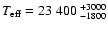 K, in excellent agreement with
the one derived from the spectra.
The
solution is independent of the
for this
chromatic amplitude analysis.
The probability distribution
for
K, in excellent agreement with
the one derived from the spectra.
The
solution is independent of the
for this
chromatic amplitude analysis.
The probability distribution
for
 models, derived by
amplitude vs. wavelength (or
models, derived by
amplitude vs. wavelength (or
 variation) is
shown in Fig. 4.
For the most probable fit, the best
values for each mode are ,
or 2 but with less probability, as shown in Table 3.
This is the first accurate determination of
for a DBV using the
chromatic amplitudes of pulsations.
We demonstrated that the chromatic amplitude variation method works and can
provide mode identifications.
variation) is
shown in Fig. 4.
For the most probable fit, the best
values for each mode are ,
or 2 but with less probability, as shown in Table 3.
This is the first accurate determination of
for a DBV using the
chromatic amplitudes of pulsations.
We demonstrated that the chromatic amplitude variation method works and can
provide mode identifications.
![\begin{figure}
\par\includegraphics[width=8.2cm,clip]{1573fig4.eps}
\end{figure}](/articles/aa/full/2005/10/aa1573/Timg54.gif) |
Figure 4:
The probability distribution of effective temperature
derived by amplitude variation with wavelength, using the two
periodicities detected
with FOS data in 1996. The most probable value is
23 400 +3000-1800 K. |
| Open with DEXTER |
Table 3:
Probability (P) for a mode to be
or 2, for the best model,
with
 K and
,
in the FOS data.
K and
,
in the FOS data.
To test if non-adiabatic effects, which could have arrived with the
sforzando, were present we calculated the difference between the times
of the maxima of the pulsation at different wavelengths. In Fig. 5
we show that phases for both P=423.2 s and P=464.2 s pulsations do not
change with wavelength, which agrees with theoretical predictions, if
non-adiabatic effects are not important (Robinson et al. 1982).
This is not the case for the 142 s pulsation of the DAV G 185-32 as
demonstrated
by Thompson et al. (2004).
![\begin{figure}
\par\includegraphics[width=7.7cm,clip]{1573fig5.eps}
\end{figure}](/articles/aa/full/2005/10/aa1573/Timg56.gif) |
Figure 5:
The phases (times of maxima)
do not change with wavelength for detected periodicities
at P=423.2 s ( upper panel) and at P=464.2 s ( lower panel), in FOS data,
in accordance with an mode. |
| Open with DEXTER |
In spite of the remarkable change in pulsation properties, the
physical parameters of the star did not change when the pulsations
changed in 1996. From the UV spectra we derived the distance
pc,
effective temperature of
K and
surface gravity of
.
When the star changed basically to one dominant mode, in 1996,
the amplitude variation with wavelength
provides an effective temperature in agreement with the value derived from the
spectra, i.e., the
independent determination of the physical quantities of pulsating white dwarf
stars
agrees with the value derived by ultraviolet spectra when the star has few modes
or the data is long enough to resolve all pulsations. We could derive for the k=8 and k=9 modes from the 1996 data because these two pulsations
were resolved even in the short HST data.
These results show that we can apply the chromatic amplitude method for
pulsating white dwarf stars with few modes or acquire long data sets with HST,
allowing us to measure their internal structure, a consequence of their prior
evolution.
Acknowledgements
Financial support: NASA-HST grant, CAPES/ UT grant, CNPq fellowship.
- Althaus, L. G.,
& Córsico, A. H. 2004, A&A, 417, 1115 [EDP Sciences] [NASA ADS] [CrossRef] (In the text)
- Beauchamp,
A., Wesemael, F., Bergeron, P., et al. 1999, ApJ, 516, 887 [NASA ADS] [CrossRef] (In the text)
- Bond, H. E., Kawaler,
S. D., Ciardullo, R., et al. 1996, AJ, 112, 2699 [NASA ADS] [CrossRef] (In the text)
- Bradley, P. A.,
& Winget, D. E. 1994, ApJ, 430, 850 [NASA ADS] [CrossRef] (In the text)
- Brassard, P.,
& Fontaine, G. 2003, NATO ASIB Proc., White Dwarfs, 105,
259
(In the text)
-
Castanheira, B. G., Kepler, S. O., Moskalik, P., et al. 2004,
A&A, 413, 623 [EDP Sciences] [NASA ADS] [CrossRef] (In the text)
- Dehner, B. T.,
& Kawaler, S. D. 1995, ApJ, 445, L141 [NASA ADS] [CrossRef] (In the text)
- Finley, D. S.,
Koester, D., & Basri, G. 1997, ApJ, 488, 375 [NASA ADS] [CrossRef] (In the text)
- Fontaine, G.,
& Brassard, P. 2002, ApJ, 581, L33 [NASA ADS] [CrossRef] (In the text)
- Hansen, B. M. S.,
Brewer, J., Fahlman, G. G., et al. 2002, ApJ, 574, L155 [NASA ADS] [CrossRef] (In the text)
- Hansen, B. M. S.,
& Liebert, J. 2003, ARA&A, 41, 465 [NASA ADS] (In the text)
- Harrington,
R. S., Kallarakal, V. V., Christy, J. W., et al. 1985, AJ, 90,
123 [NASA ADS] [CrossRef] (In the text)
- Holberg, J. B.,
Barstow, M. A., & Burleigh, M. R. 2003, ApJS, 147, 145 [NASA ADS] [CrossRef] (In the text)
- Ising, J., &
Koester, D. 2001, A&A, 374, 116 [EDP Sciences] [NASA ADS] [CrossRef] (In the text)
- Kawaler, S. D.,
O'Brien, M. S., Clemens, J. C., et al. 1995, ApJ, 450, 350 [NASA ADS] [CrossRef] (In the text)
- Kawaler, S. D.,
Sekii, T., & Gough, D. 1999, ApJ, 516, 349 [NASA ADS] [CrossRef]
- Kawaler, S. D.,
Potter, E. M., Vuckovic, M., et al. 2004, A&A, 428, 969 [EDP Sciences] [NASA ADS] [CrossRef] (In the text)
- Kepler, S. O. 1984,
ApJ, 286, 314 [NASA ADS] [CrossRef] (In the text)
- Kepler, S. O.,
Robinson, E. L., Koester, D., et al. 2000, ApJ, 539, 379 [CrossRef] (In the text)
- Kepler, S. O.,
Nather, R. E., Winget, D. E., et al. 2003, A&A, 401, 639 [EDP Sciences] [NASA ADS] [CrossRef] (In the text)
- Metcalfe, T.
S., Winget, D. E., & Charbonneau, P. 2001, ApJ, 557, 1021 [NASA ADS] [CrossRef] (In the text)
- Metcalfe, T.
S., Salaris, M., & Winget, D. E. 2002, ApJ, 573, 803 [NASA ADS] (In the text)
- Metcalfe, T. S.
2003, ApJ, 587, L43 [NASA ADS] [CrossRef] (In the text)
- Metcalfe, T.
S., Montgomery, M. H., & Kawaler, S. D. 2003, MNRAS, 344,
L88 [NASA ADS] [CrossRef]
- Montgomery,
M. H., Metcalfe, T. S., & Winget, D. E. 2003, MNRAS, 344,
657 [NASA ADS] [CrossRef] (In the text)
- Musielak, Z.
E., Noble, M., Porter, J. G., & Winget, D. E. 2003, ApJ, 593,
481 [NASA ADS] [CrossRef]
- Nather, R. E.,
Winget, D. E., Clemens, J. C., Hansen, C. J., & Hine, B. P.
1990, ApJ, 361, 309 [NASA ADS] [CrossRef]
- Nitta, A., Kepler, S.
O., Winget, D. E., et al. 1998, Baltic Astron., 7, 203 [NASA ADS] (In the text)
- Provencal, J.
L., Shipman, H. L., Thejll, P., & Vennes, S. 2000, ApJ, 542,
1041 [NASA ADS] [CrossRef] (In the text)
- Robinson, E.
L., Kepler, S. O., & Nather, R. E. 1982, ApJ, 259, 219 [NASA ADS] [CrossRef] (In the text)
- Robinson, E.
L., Mailloux, T. M., Zhang, E., et al. 1995, ApJ, 438, 908 [NASA ADS] [CrossRef] (In the text)
- Seaton, M. J. 1979,
MNRAS, 187, 73 [NASA ADS]
- Thejll, P., Vennes,
S., & Shipman, H. L. 1991, ApJ, 370, 355 [NASA ADS] [CrossRef] (In the text)
- Thompson, S.
E., Clemens, J. C., van Kerkwijk, M. H., O'Brien, M. S., &
Koester, D. 2004, [arXiv:astro-ph/0404577]
(In the text)
- Weidner, C.,
& Koester, D. 2003, A&A, 406, 657 [EDP Sciences] [NASA ADS] [CrossRef] (In the text)
- Winget, D. E.,
Robinson, E. L., Nather, R. D., & Fontaine, G. 1982, ApJ, 262,
L11 [NASA ADS] [CrossRef] (In the text)
- Winget, D. E.,
Hansen, C. J., Liebert, J., et al. 1987, ApJ, 315, L77 [NASA ADS] [CrossRef] (In the text)
- Winget, D. E.,
Nather, R. E., Clemens, J. C., et al. 1994, ApJ, 430, 839 [NASA ADS] [CrossRef] (In the text)
Copyright ESO 2005
![\begin{figure}
\par\includegraphics[width=7.5cm,clip]{1573fig1.eps}
\end{figure}](/articles/aa/full/2005/10/aa1573/img33.gif)
![\begin{figure}
\par\includegraphics[width=7.8cm,clip]{1573fig2.eps}
\end{figure}](/articles/aa/full/2005/10/aa1573/img36.gif)
![\begin{figure}
\par\includegraphics[width=7.7cm,clip]{1573fig3.eps}
\end{figure}](/articles/aa/full/2005/10/aa1573/img47.gif)
![\begin{figure}
\par\includegraphics[width=8.2cm,clip]{1573fig4.eps}
\end{figure}](/articles/aa/full/2005/10/aa1573/img54.gif)
![\begin{figure}
\par\includegraphics[width=7.7cm,clip]{1573fig5.eps}
\end{figure}](/articles/aa/full/2005/10/aa1573/img56.gif)