A&A 431, L17-L20 (2005)
DOI: 10.1051/0004-6361:200400137
Line broadening of EUV lines across the Solar limb: A spicule
contribution?
J. G. Doyle1 - J. Giannikakis1,2 - L. D.
Xia1,3 - M. S. Madjarska4,5
1 - Armagh Observatory, College Hill, Armagh, BT61 9DG,
N. Ireland
http://star.arm.ac.uk/preprints/
2 -
Sect. of Astrophysics, Astronomy and Mechanics, Dept. of Physics,
Univ. of Athens, Athens 15783, Greece
3 -
School of Earth and Space Sciences, University of Science and
Technology of China, Hefei, Anhui 230026, PR China
4 -
Max-Planck-Institut für
Sonnensystemforschung![[*]](/icons/foot_motif.gif) , Max-Planck-Str. 2, 37191 Katlenburg-Lindau, Germany
, Max-Planck-Str. 2, 37191 Katlenburg-Lindau, Germany
5 -
Department of Solar Physics, Royal Observatory of Belgium, Av.
Circulaire 3, 1180 Bruxelles, Belgium
Received 20 December 2004 / Accepted 28 December 2004
Abstract
Spectral lines formed in the solar transition region show an
increase in the line width, peaking at  10 000 km above the
limb. Looking at a region off-limb with no obvious spicules, the non-spicule
region has a significantly smaller line width above 6000 km compared
those taken in a spicule region. We suggest that this increase in line
broadening is not due to small scale random motions but rather to unresolved
line shifts due to spicules and/or macro-spicules activity.
10 000 km above the
limb. Looking at a region off-limb with no obvious spicules, the non-spicule
region has a significantly smaller line width above 6000 km compared
those taken in a spicule region. We suggest that this increase in line
broadening is not due to small scale random motions but rather to unresolved
line shifts due to spicules and/or macro-spicules activity.
Key words: Sun: atmosphere - transition region - off-limb - line
broadening -
spicules
Line width measurements can provide important details on small-scale
mass motions and ion temperatures, and if coronal lines are used,
informations on coronal heating may be obtained. Several authors have
searched for disk center
to limb changes (Chae et al. 1998; Erdelyi et al. 1998; Doyle et al.
2000)
finding a small variation. In off-limb data, Banerjee et al. (1998),
Doyle et al. (1999), Harrison et al. (2002) and O'Shea et al. (2003)
have all
used data relating to lines formed in the corona, finding a small
increase in
the line width before reaching a turn-over point. The data of Harrison
et al.
showed a significant narrowing of a coronal line above 50 000 km. which
the authors
suggested was related to the dissipation of wave energy. However,
O'Shea et al.
(2005) has shown that the line widths start to show a decrease in their
values at
exactly the same location where the dominant excitation changes from
being
collisionally to radiatively dominant.
For lines formed around 100 000 to 300 000 K, several authors, e.g.
Mariska
et al. (1979), Peter & Vocks (2003), have noted an increase in the
line
width at 10 to 15
 above the limb. Mariska et al. suggested that
this
broadening was unlikely to be simply due to an increase in the wave
flux above
the limb and proposed that inhomogeneous structures could be the cause.
More
recently, Peter & Vocks (2003) interpreted the increase as evidence of
a large
increase in the ion temperature to more than
above the limb. Mariska et al. suggested that
this
broadening was unlikely to be simply due to an increase in the wave
flux above
the limb and proposed that inhomogeneous structures could be the cause.
More
recently, Peter & Vocks (2003) interpreted the increase as evidence of
a large
increase in the ion temperature to more than
 K just above
the
limb. Here, we look at raster and time series data from lines formed
around
200 000 K, suggesting an explanation in terms of spicules. In Sect. 2
we discuss
the observational data which consists of both rasters and a time
series, with
the results presented in Sect. 3.
K just above
the
limb. Here, we look at raster and time series data from lines formed
around
200 000 K, suggesting an explanation in terms of spicules. In Sect. 2
we discuss
the observational data which consists of both rasters and a time
series, with
the results presented in Sect. 3.
![\begin{figure}
\par\includegraphics[angle=90,height=5.2cm,width=18cm,clip]{Gl203_fig1.ps}\end{figure}](/articles/aa/full/2005/09/aagl203/Timg4.gif) |
Figure 1:
A sub-set of the image as obtained in O V 629 Å on 10 August
1996 in the coronal polar region showing the position of the three data plots
given in Fig. 2. The scale on both axes are in arcsec. |
| Open with DEXTER |
![\begin{figure}
\par\includegraphics[width=5.5cm,clip]{Gl203_fig2a.ps}\hspace*{3....
...s}\hspace*{3.5mm}
\includegraphics[width=5.5cm,clip]{Gl203_fig2c.ps}\end{figure}](/articles/aa/full/2005/09/aagl203/Timg5.gif) |
Figure 2:
Non-thermal velocities as derived from the O V 629 Å
line calculated for three positions along the raster. Each point was derived
by averaging 21 pixels in the X-direction and a running mean of 9
pixels in
the Y-direction. Data is only plotted up to pixel 220 along the slit.
Also included are plots of the continuum region close to the O V
line
position. The vertical line shows the position of the continuum limb. |
| Open with DEXTER |
We used a raster sequence of the north solar limb (PCH) taken by the
spectrometer SUMER
on-board the SoHO satellite. The capabilities and specifications of the
SUMER instrument were described by Wilhelm et al. (1995, 1997) and Lemaire
et al. (1997). The observation was performed on 1996 August 10 from 00:03 to
16:09 UT.
The target was the north polar coronal hole region with a constant SoHO solar
Y at 950
and SoHO solar X moving from -699
to 721
.
The exposure time was 60 s using slit 2 (i.e. 1
 300
centered) with
a step size of 1
300
centered) with
a step size of 1
 5. Detector A was used for producing the four
50 spectral pixel windows at the wavelengths corresponding to the 2nd
order
spectral lines: Mg X 624.94 Å, O V 629.73 Å and to the
1st order: N V 1238.82 Å, Fe XII 1242.01 Å. Here, we select
only the O V (
5. Detector A was used for producing the four
50 spectral pixel windows at the wavelengths corresponding to the 2nd
order
spectral lines: Mg X 624.94 Å, O V 629.73 Å and to the
1st order: N V 1238.82 Å, Fe XII 1242.01 Å. Here, we select
only the O V (
 K) transition region line.
We used the standard SUMER data reduction procedures to apply all the
corrections
needed for the data. These corrections are dead time and local gain
correction,
flat field subtraction, and a correction for geometrical distortion.
Since our
interest in this study was focused on the line widths we did not
perform a
wavelength calibration. Additionally a correction for the spectral
line shift caused by thermal deformations of the optical bench of SUMER
was applied
(Dammasch et al. 1999).
For the line of interest i.e. O V 629 Å,
we performed a one
line Gaussian fit using the automated SolarSoft routine
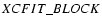 .
As a
result, a set of Gaussian line parameters (intensity, FWHM and
position) was
available for each pixel within the raster. For
studying the variations of the line width as we approach the limb from
the
disk and also the behavior in the off limb areas we analyzed vertical
stripes
(parallel to the slit) producing plots which show these variations
versus the
Solar Y-coordinate. In order to increase the counts in the line
profile, we
averaged 21 pixels in the
X-direction and a running mean of 9 pixels in the Y-direction.
.
As a
result, a set of Gaussian line parameters (intensity, FWHM and
position) was
available for each pixel within the raster. For
studying the variations of the line width as we approach the limb from
the
disk and also the behavior in the off limb areas we analyzed vertical
stripes
(parallel to the slit) producing plots which show these variations
versus the
Solar Y-coordinate. In order to increase the counts in the line
profile, we
averaged 21 pixels in the
X-direction and a running mean of 9 pixels in the Y-direction.
The data selected for this study were obtained as a time series in a
polar coronal
hole by SUMER/SoHO on 25 February 1997 starting at 00:03 UT.
During the
observation, the SUMER slit was fixed at positions solar X = 0
and
 .
Slit 2 (1
300
)
and detector B were used. The slit width determines the spatial
resolution
along the X-direction, while the resolution element along the slit in
the Y-direction
(north-south; positive towards north) is approximately 1
,
given
by
the pixel size of the detector. The exposure time was 60 s. The
spectral line observed
was N IV 765 Å (
.
Slit 2 (1
300
)
and detector B were used. The slit width determines the spatial
resolution
along the X-direction, while the resolution element along the slit in
the Y-direction
(north-south; positive towards north) is approximately 1
,
given
by
the pixel size of the detector. The exposure time was 60 s. The
spectral line observed
was N IV 765 Å (
 K).
K).
In addition to the data analysis steps already mentioned, we used a
different method to deduce the line parameters (radiance, central position of the
spectral line and width). This method is useful when dealing with reduced counts
or large datasets. The procedure has being frequently used to obtain SUMER
Dopplergrams (see details in Dammasch et al. 1999) and the results are statistically
consistent with those obtained by using standard Gaussian fitting program (Xia
2003). Here the central position for every pixel is derived by integrating the line
radiance across a certain spectral window and determining subsequently the
location of the 50% level with sub-pixel accuracy. As a check, we also used this
procedure in the raster data, finding a similar result to that obtained from the
Gaussian fits.
For Doppler shifts of the N IV 765 Å line, the zero velocity
is set to the value averaged over the whole period of the observation (794 time
steps) at a fixed spatial pixel. The limb position is defined as that derived based on
the continuum short-ward of the N IV line (see Xia et al. 2005 for
more details).
In Fig. 2 we plot the non-thermal velocities at three locations along
the X-direction in the raster as shown in Fig. 1; i.e. position -133
,
-59
and +15
,
with
the data being averaged over 21 pixels in X and 9 in Y. Here, we assume
ionization
equilibrium and that the ion temperature is identical to the electron
temperature where
the FWHM of the line is given by
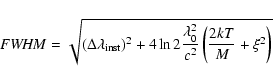 |
(1) |
 is the instrumental width,
  is the
unshifted wavelength,
c the speed of light, k the Boltzmann constant, T the ion
temperature, M the
atomic mass and
is the
unshifted wavelength,
c the speed of light, k the Boltzmann constant, T the ion
temperature, M the
atomic mass and  the non-thermal velocity. The line was corrected
for instrumental
broadening using the SolarSoft routine:
the non-thermal velocity. The line was corrected
for instrumental
broadening using the SolarSoft routine:
 .
.
![\begin{figure}
\par\includegraphics[width=8.7cm,clip]{Gl203_fig3a.ps}\\ \vspace*...
...space*{4.1mm}
\includegraphics[width=8.7cm,clip]{Gl203_fig3c.ps}\par\end{figure}](/articles/aa/full/2005/09/aagl203/Timg17.gif) |
Figure 3:
A selection of spicules and macro-spicules showing the
variation of the N IV 765 Å
intensity, non-thermal velocities and line-shift against height above
the limb. The
PCH was observed on 25 February 1997 between 00:03 and 13:58 UT. The
times shown
beside the curves are related to the starting time of the observation.
Those
at t=452 and 735 min are macro-spicules, while the others are spicules. |
| Open with DEXTER |
In each plot, we clearly see
a peak in the non-thermal velocity at 15
above the limb
as seen in the continuum short-ward of O V 629 Å. In the 450 and 500 plots, we
see an additional broadening at 25-30
.
In order to gain some
further insight into the nature of this off-limb broadening, we must look at
the time series data. In Fig. 3 we show the velocity profiles (non-thermal and
Doppler shift)
derived from the N IV 765 Å line as a function of height
above the limb.
Despite the fact that N IV is formed at around 140 000 K compared
to O V's 250 000 K, the non-thermal velocity variation is similar. It reaches
maximum around 5
off-limb and remains at this value until around 18
,
shows a
slight decrease before rising again around 25
off-limb.
Like the line radiance, the Doppler velocities are highly structured
with a time scale down to 1 minute. Among them
two examples (t=452 min and t=735 min) were identified as
macro-spicules (Xia et al. 2005). Others (t=34, 261, 546, 630 min) are deduced as
being "normal'' spicules.
In Fig. 3, one finds that the Doppler shifts of all selected
structures are small (around  5
5
 or smaller) just above the
limb, then quickly increases with height. After an initial acceleration, the
velocity reaches a rather constant value, although with some fluctuation. The
low velocity in this early stage of spicule evolution has also
been found with CDS observations (Pike & Harrison 1997; Pike & Mason
1998). We suggest that the observed increase in the line broadening
is not due to small scale motions but rather to unresolved line shifts
due to spicules around 10 to 15
,
and then macro-spicules further
off-limb.
or smaller) just above the
limb, then quickly increases with height. After an initial acceleration, the
velocity reaches a rather constant value, although with some fluctuation. The
low velocity in this early stage of spicule evolution has also
been found with CDS observations (Pike & Harrison 1997; Pike & Mason
1998). We suggest that the observed increase in the line broadening
is not due to small scale motions but rather to unresolved line shifts
due to spicules around 10 to 15
,
and then macro-spicules further
off-limb.
Figure 4 shows a plot of the non-thermal velocity above the limb, taken
from a region without obvious spicules (dotted line) and the whole observed data
averaged (solid line). The solid line is the non-thermal velocity averaged from
all the data, i.e.,
the line profile at every Y pixel is averaged across the entire 794 time
series, then getting the line parameter from this re-binned profile.
The dotted line is the non-thermal velocity averaged across a dark region from 554 min to 557 min.
Again, after getting an average line profile at every Y pixel, then the
line width. The non-spicule region has a peak non-thermal velocity between 7
and
10
off-limb, and shows a significantly smaller non-thermal
velocity
above 10
off-limb than that from the spicule region.
Note that the non-thermal velocities shown in Figs. 3 and 4 (obtained
by SUMER detector B)
are systematically larger than those shown in Fig. 2 (obtained by the
SUMER detector A). This is
possibly because of an insufficient subtraction of the instrumental
broadening of the detector B,
as discussed by Popescu et al. (2004).
![\begin{figure}
\par\includegraphics[width=8.2cm,clip]{Gl203_fig4.ps}\end{figure}](/articles/aa/full/2005/09/aagl203/Timg20.gif) |
Figure 4:
A plot of non-thermal velocities above the limb, taken from a
time-region
without obvious spicules (dotted line) and the whole observed data
averaged
(solid line). |
| Open with DEXTER |
There are many suggestions for the excess broadening of transition
region lines,
e.g. acoustic waves, Alfvén waves, opacity, turbulence, etc. Dere
(1989) showed
that the power in unresolved velocity variations (from line width
measurements) was greater than that predicted from the extrapolated
power of the
resolved velocity variations (from line shift measurements), therefore
suggesting the
unresolved motions could be driven by a process that is different from
those producing
the line shifts. The idea behind the present study was not to explain
the general broadening in
excess of the thermal width, but rather to explain the additional
increase in broadening seen in
transition region lines about 10 000 km above the limb. This seems to
be confined to a region of
 3000 km.
Tu & Marsch (1997) suggested that ion-cyclotron is an important
process in the solar
wind. Peter & Vocks (2003) have more recently suggested that
ion-cyclotron could be a possible
mechanism to explain this additional line broadening above the limb.
Although this is
an interesting idea, it is difficult to understand why it should be
confined to such a small
region. In the analysis of transition region lines, Chae et al. (1998)
and Doyle et al. (2000) both
noted a 2-3
difference in the line width from disk center to
the limb. This could be
explained via an increase in opacity from zero at disk center to unity
at the limb. Doyle
& McWhirter
(1980) showed many years ago that some transition region lines were
slightly effected by opacity at
the limb. However, to produce a 10 km s-1 increase via opacity
would imply unrealistic high
optical depths. The above authors also showed that the center-to-limb
increase in line width
could be reproduced assuming the presence of mass flows with a most
probable speed of 5 km s-1.
The present results suggest that spicule flows could play a role in
line broadening.
Macro-spicules (assumed to be the large-scale version of spicules) come
in two types;
erupting loops and spiked-jets. Yamauchi et al. (2004) found that 43%
are of
the erupting-loop type while 49% were the single-column spiked jet.
However,
even the erupting-loop type produces two columns when the loop top
rises and
probably reconnects with open-field structures. The velocities of both
types of
macro-spicules are in the range 32 to 42
.
It is expected that
the
velocities in spicules are smaller than these values. This is
consistent with the
observations that the spicules velocity just above the limb is small
and quickly
under-goes acceleration just above the limb. Tanaka (1972) found that
30% of
H spicules produced a double-column structure, hence adding an
increasing amount of line shift. The spicule contribution to the line widths
is confirmed in
Fig. 4 which shows that the line width taken from a
region without obvious spicules is substantially smaller above
10
than
that from a region with spicules.
spicules produced a double-column structure, hence adding an
increasing amount of line shift. The spicule contribution to the line widths
is confirmed in
Fig. 4 which shows that the line width taken from a
region without obvious spicules is substantially smaller above
10
than
that from a region with spicules.
Acknowledgements
Research at the Armagh Observatory is
grant-aided by the N.
Ireland Dept. of Culture, Arts and Leisure. L.D.X. is grateful for a PRTLI
research grant
for Grid-enabled Computational Physics of Natural Phenomena (Cosmogrid)
and J.G. to PPARC
for funding via the Armagh Observatory's visitors grant
PPA/V/S/1999/00628. This work was
also supported in part by PPARC grant PPA/G/S/2002/00020. We
thank Georgia Tsiropoula for valuable comments on an earlier draft.
- Banerjee, D.,
Teriaca, L., Doyle, J. G., & Wilhelm, K. 1998, A&A, 339,
208 [NASA ADS] (In the text)
- Chae, J., Schuhle, U.,
& Lemaire, P. 1998, ApJ, 505, 957 [NASA ADS] [CrossRef] (In the text)
- Dammasch, I. E.,
Wilhelm, K., Curdt, W., & Hassler, D. M. 1999, A&A, 346,
285 [NASA ADS] (In the text)
- Dere, K. P. 1989, ApJ,
340, 599 [NASA ADS] (In the text)
- Doyle, J. G., &
McWhirter, R. W. P. 1980, MNRAS, 193, 947 [NASA ADS] (In the text)
- Doyle, J. G., Teriaca,
L., & Banerjee, D. 1999, A&A, 349, 956 [NASA ADS] (In the text)
- Doyle, J. G., Teriaca,
L., & Banerjee, D. 2000, A&A, 356, 335 [NASA ADS] (In the text)
- Erdelyi, R.,
Doyle, J. G., Perez, M. E., & Wilhelm, K. 1998, A&A, 337,
287 [NASA ADS] (In the text)
- Harrison, R. A.,
Hood, A. W., & Pike, C. D., A&A, 392, 319
- Lemaire, P.,
Wilhelm, K., Curdt, W., et al. 1997, Sol. Phys., 170, 105 [NASA ADS] [CrossRef] (In the text)
- Mariska, J. T.,
Feldman, U., & Doschek, G. A. 1979, A&A, 73, 361 [NASA ADS] (In the text)
- O'Shea, E., Banerjee,
D., & Poedts, S. 2003, A&A, 400, 1065 [EDP Sciences] [NASA ADS] [CrossRef] (In the text)
- O'Shea, E., Banerjee,
D., & Doyle, J. G. 2005, A&A, submitted
(In the text)
- Peter, H., &
Vocks, C. 2003, A&A, 411, L481 [EDP Sciences] [NASA ADS] (In the text)
- Pike, C. D., &
Harrison, R. A. 1997, Sol. Phys., 175, 457 [NASA ADS] (In the text)
- Pike, C. D., &
Mason, H. E. 1998, Sol. Phys., 182, 333 [NASA ADS] (In the text)
- Popescu, M. D.,
Doyle, J. G., & Xia, L. D. 2004, A&A, 421, 339 [EDP Sciences] [NASA ADS] (In the text)
- Tanaka, K. 1972, Big
Bear Obs. Rep., 125
(In the text)
- Tu, C.-Y., & Marsch, E.
1997, Sol. Phys., 171, 363 [NASA ADS] (In the text)
- Wilhelm, K.,
Curdt, W., Marsch, E., et al. 1995, Sol. Phys., 162, 189 [NASA ADS] (In the text)
- Wilhelm, K.,
Lemaire, P., Curdt, W., et al. 1997, Sol. Phys., 170, 75 [NASA ADS] [CrossRef] (In the text)
- Xia, L. D. 2003, Ph.D.
Thesis, Georg-August-Univ., Göttingen
(In the text)
- Xia, L. D., Popescu, M.
D., Doyle, J. G., & Giannikakis, J. 2005, A&A,
submitted
(In the text)
- Yamauchi, Y.,
Moore, R. L., Suess, S. T., Wang, H., & Sakurai, T. 2004, ApJ,
605, 511 [NASA ADS] (In the text)
Copyright ESO 2005
![\begin{figure}
\par\includegraphics[angle=90,height=5.2cm,width=18cm,clip]{Gl203_fig1.ps}\end{figure}](/articles/aa/full/2005/09/aagl203/img4.gif)
![\begin{figure}
\par\includegraphics[width=5.5cm,clip]{Gl203_fig2a.ps}\hspace*{3....
...s}\hspace*{3.5mm}
\includegraphics[width=5.5cm,clip]{Gl203_fig2c.ps}\end{figure}](/articles/aa/full/2005/09/aagl203/img5.gif)
![\begin{figure}
\par\includegraphics[width=8.7cm,clip]{Gl203_fig3a.ps}\\ \vspace*...
...space*{4.1mm}
\includegraphics[width=8.7cm,clip]{Gl203_fig3c.ps}\par\end{figure}](/articles/aa/full/2005/09/aagl203/img17.gif)
![\begin{figure}
\par\includegraphics[width=8.2cm,clip]{Gl203_fig4.ps}\end{figure}](/articles/aa/full/2005/09/aagl203/img20.gif)