A&A 431, 659-665 (2005)
DOI: 10.1051/0004-6361:20041781
Search for the elusive optical counterpart of PSR J0537-6910
with the HST Advanced Camera for Surveys
R. P. Mignani1 -
L. Pulone2
-
G. Iannicola 2 -
G. G. Pavlov3 -
L. Townsley3 -
O. Y. Kargaltsev3
1 - European Southern Observatory, Karl-Schwarzschild-Str. 2,
85748 Garching, Germany
2 -
INAF - Osservatorio Astronomico di Roma, Via di Frascati 33,
00040 Monte Porzio Catone, Italy
3 -
Pennsylvania State University, 525 Davey Lab, University Park, PA 16802, USA
Received 3 August 2004 / Accepted 25 October 2004
Abstract
We present the results of deep, high-resolution,
multi-band optical observations of the field of the young (
 yr) 16 ms X-ray pulsar PSR J0537-6910 performed with the
Advanced Camera for Surveys (ACS) aboard the Hubble Space
Telescope (HST). Although a few new potential counterparts
have been detected within or close to the revised Chandra X-ray
error circle (
yr) 16 ms X-ray pulsar PSR J0537-6910 performed with the
Advanced Camera for Surveys (ACS) aboard the Hubble Space
Telescope (HST). Although a few new potential counterparts
have been detected within or close to the revised Chandra X-ray
error circle (
 )
of the pulsar, only two of them
(with magnitudes
)
of the pulsar, only two of them
(with magnitudes
 and
and
 )
show indications of a peculiar spectrum which could be related to
optical emission from the pulsar. This might be true also for a third,
fainter, candidate detected only in one filter (with magnitude
)
show indications of a peculiar spectrum which could be related to
optical emission from the pulsar. This might be true also for a third,
fainter, candidate detected only in one filter (with magnitude
 ). If either of the two brighter candidates is
indeed the actual counterpart, the optical output of PSR J0537-6910
would make it similar to young Crab-like pulsars. If not, it would
mean that PSR J0537-6910 is significantly underluminous with respect
to all pulsars detected in the optical.
). If either of the two brighter candidates is
indeed the actual counterpart, the optical output of PSR J0537-6910
would make it similar to young Crab-like pulsars. If not, it would
mean that PSR J0537-6910 is significantly underluminous with respect
to all pulsars detected in the optical.
Key words: stars: pulsars:
individual: PSR J0537-6910
PSR J0537-6910 is a young X-ray pulsar at the center of the
plerionic supernova remnant N157B in the LMC, close to the 30 Doradus
star forming region. Pulsations with a 16 ms period were
serendipitously discovered by RXTE (Marshall et al. 1998) and
immediately confirmed by ASCA and Beppo-SAX (Cusumano et
al. 1998). Thus, PSR J0537-6910 has taken over the Crab pulsar
(P=33 ms) as the fastest "ordinary'' pulsar (i.e., not spun up by
accretion from a companion star) discovered so far. The time
derivative of the pulsar period (
 s s-1), obtained from the multi-epoch timing (Marshall
et al. 1998; Cusumano et al. 1998) yielded a spin down age of
yr, similar to the age of N157B (Wang & Gotthelf 1998),
which makes PSR J0537-6910 one of the handful of known pulsars
younger than 10 000 yr. At the same time, with a derived rotational
energy loss
s s-1), obtained from the multi-epoch timing (Marshall
et al. 1998; Cusumano et al. 1998) yielded a spin down age of
yr, similar to the age of N157B (Wang & Gotthelf 1998),
which makes PSR J0537-6910 one of the handful of known pulsars
younger than 10 000 yr. At the same time, with a derived rotational
energy loss
 erg s-1, it is
the most energetic pulsar known. As expected for a young pulsar,
large glitches in the spindown have been repeatedly detected during
different RXTE timing campaigns (Middleditch et al. 2001;
Marshall et al. 2004). Observations of PSR J0537-6910 performed
with the Chandra X-ray Observatory (Wang et al. 2001; Townsley
et al. 2005) have resolved a compact (
erg s-1, it is
the most energetic pulsar known. As expected for a young pulsar,
large glitches in the spindown have been repeatedly detected during
different RXTE timing campaigns (Middleditch et al. 2001;
Marshall et al. 2004). Observations of PSR J0537-6910 performed
with the Chandra X-ray Observatory (Wang et al. 2001; Townsley
et al. 2005) have resolved a compact (
 )
pulsar-wind nebula (PWN) elongated perpendicular to the symmetry axis
of a larger comet-like structure (
)
pulsar-wind nebula (PWN) elongated perpendicular to the symmetry axis
of a larger comet-like structure (
 ). This
structure can be explained as a trail left behind by the pulsar
during its motion in the ISM. Although its large energy output makes
PSR J0537-6910 a natural target for multiwavelength observations, it
has not yet been detected outside the X-ray band. So far, searches
for its radio counterpart yielded null results, with an upper limit of
). This
structure can be explained as a trail left behind by the pulsar
during its motion in the ISM. Although its large energy output makes
PSR J0537-6910 a natural target for multiwavelength observations, it
has not yet been detected outside the X-ray band. So far, searches
for its radio counterpart yielded null results, with an upper limit of
 mJy (Crawford et al. 1998), which
suggests that its radio luminosity is significantly weaker than those
of the Crab pulsar and of the other young LMC pulsar B0540-69.
Searches for an optical counterpart of PSR J0537-6910 have also been
unsuccessful so far. First observations performed with the ESO NTT
(Mignani et al. 2000) and the ESO 3.6 m (Gouiffes & Ögelman 2000)
telescopes failed to detect any potential pulsar counterpart within
the original ROSAT 5'' error circle (Wang & Gotthelf 1998)
down to
mJy (Crawford et al. 1998), which
suggests that its radio luminosity is significantly weaker than those
of the Crab pulsar and of the other young LMC pulsar B0540-69.
Searches for an optical counterpart of PSR J0537-6910 have also been
unsuccessful so far. First observations performed with the ESO NTT
(Mignani et al. 2000) and the ESO 3.6 m (Gouiffes & Ögelman 2000)
telescopes failed to detect any potential pulsar counterpart within
the original ROSAT 5'' error circle (Wang & Gotthelf 1998)
down to
 .
The same conclusion was reached by Butler et al. (2002) using archived HST observations of the field and
exploiting the updated Chandra pulsar position (Wang et al. 2001). Here we report on the results of recent, much deeper, HST observations of the PSR J0537-6910 field. The same dataset has
been also used to search for the optical counterpart of the X-ray
Pulsar Wind Nebula (PWN); the results will be reported elsewhere. The
observations and data analysis are described in Sects. 2 and 3,
respectively, while the results are presented in Sect. 4 and discussed in
Sect. 5.
.
The same conclusion was reached by Butler et al. (2002) using archived HST observations of the field and
exploiting the updated Chandra pulsar position (Wang et al. 2001). Here we report on the results of recent, much deeper, HST observations of the PSR J0537-6910 field. The same dataset has
been also used to search for the optical counterpart of the X-ray
Pulsar Wind Nebula (PWN); the results will be reported elsewhere. The
observations and data analysis are described in Sects. 2 and 3,
respectively, while the results are presented in Sect. 4 and discussed in
Sect. 5.
The field of PSR J0537-6910 was observed on January 2003 with the
Wide Field Channel (WFC) of the Advanced Camera for Surveys (ACS) on
board the HST. The ACS/WFC, a two-CCD
 pixel
detector (Pavlovsky et al. 2003), has a combined field of view of
pixel
detector (Pavlovsky et al. 2003), has a combined field of view of
 and an average pixel size of
 .
Observations were performed during two consecutive HST orbits
through the 435W (
.
Observations were performed during two consecutive HST orbits
through the 435W (
 Å;
Å;
 Å),
555W (
Å),
555W (
 Å;
Å;
 Å) and 814W(
 Å;
Å;
 Å) filters, selected to
maximize the spectral coverage. For each filter, sequences of four
exposures were taken to allow cosmic ray filtering and to minimize
saturation effects of bright stars in the field close to the position
of our target. The corresponding total integration times were 3200 s,
2800 s and 2800 s in the 435W, 555W and 814W filters,
respectively. Standard data reduction (debiassing, flatfielding) and
photometric calibration were applied according to the standard ACS
pipeline. The default ACS photometric calibration available at the
time of image acquisition was later updated by using as a reference
the new instrument zero-points computed from the improved Detector
Quantum Efficiency (DQE) and filter throughput curves (De Marchi et
al. 2004). For each filter, the STSDAS drizzle task was used
to combine single exposures and produce a mosaic image from the two
ACS/WFC chips after correcting for the geometric distortions of the
CCDs.
Å) filters, selected to
maximize the spectral coverage. For each filter, sequences of four
exposures were taken to allow cosmic ray filtering and to minimize
saturation effects of bright stars in the field close to the position
of our target. The corresponding total integration times were 3200 s,
2800 s and 2800 s in the 435W, 555W and 814W filters,
respectively. Standard data reduction (debiassing, flatfielding) and
photometric calibration were applied according to the standard ACS
pipeline. The default ACS photometric calibration available at the
time of image acquisition was later updated by using as a reference
the new instrument zero-points computed from the improved Detector
Quantum Efficiency (DQE) and filter throughput curves (De Marchi et
al. 2004). For each filter, the STSDAS drizzle task was used
to combine single exposures and produce a mosaic image from the two
ACS/WFC chips after correcting for the geometric distortions of the
CCDs.
The absolute uncertainty of the astrometric solution in the HST
focal plane is still based on guide stars from the GSC1.1 (Lasker et
al. 1990) and is of the order of 1
 0 (Pavlovsky et al. 2003).
For this reason, we reassessed the ACS astrometry using more precise
catalogs as a reference. Although the
GSC2
0 (Pavlovsky et al. 2003).
For this reason, we reassessed the ACS astrometry using more precise
catalogs as a reference. Although the
GSC2![[*]](/icons/foot_motif.gif) seems
to be the first natural choice for this purpose, it has been discarded
because of coarser astrometric accuracy in this specific field. This
is likely caused by systematics affecting the catalog in the LMC
region, related to both the local crowding and the presence of diffuse
nebulosities associated with the N157B supernova remnant. On the
other hand, the recently released USNO-B1.0 catalog (Monet et al. 2003) seems also to be affected by some kinds of systematics and
provides only a poor and uneven coverage of the region, with most of
the reference stars located at the edge of the ACS field of view.
Therefore, we decided to use the Two Micron All Sky Survey (2MASS)
Point Source catalog (Skrutskie et al. 1997). After matching on the
ACS images the sky and pixel coordinates of 30 well distributed 2MASS
stars, a revised astrometric solution has been computed using the
package
ASTROM,
yielding an overall accuracy of
seems
to be the first natural choice for this purpose, it has been discarded
because of coarser astrometric accuracy in this specific field. This
is likely caused by systematics affecting the catalog in the LMC
region, related to both the local crowding and the presence of diffuse
nebulosities associated with the N157B supernova remnant. On the
other hand, the recently released USNO-B1.0 catalog (Monet et al. 2003) seems also to be affected by some kinds of systematics and
provides only a poor and uneven coverage of the region, with most of
the reference stars located at the edge of the ACS field of view.
Therefore, we decided to use the Two Micron All Sky Survey (2MASS)
Point Source catalog (Skrutskie et al. 1997). After matching on the
ACS images the sky and pixel coordinates of 30 well distributed 2MASS
stars, a revised astrometric solution has been computed using the
package
ASTROM,
yielding an overall accuracy of
 per coordinate. As an
independent check, we qualitatively evaluated the astrometric solution
using as a reference the positions of stars selected from the very
accurate (
per coordinate. As an
independent check, we qualitatively evaluated the astrometric solution
using as a reference the positions of stars selected from the very
accurate (
 )
UCAC2 catalog (Zacharias et al. 2004). The
matches between the actual and expected positions were found to be
consistent within the uncertainty of our astrometric calibration. We
note that since the UCAC2 is a relatively bright catalog (
)
UCAC2 catalog (Zacharias et al. 2004). The
matches between the actual and expected positions were found to be
consistent within the uncertainty of our astrometric calibration. We
note that since the UCAC2 is a relatively bright catalog ( ),
all the matched stars are saturated in the ACS images and cannot be
used directly for astrometric calibration.
),
all the matched stars are saturated in the ACS images and cannot be
used directly for astrometric calibration.
As a reference for the search of the pulsar counterpart we
use the most precise X-ray positions obtained with Chandra
(Weisskopf et al. 2002). The previous Chandra position
obtained with the imaging array of the High Resolution Camera (HRC-I)
by Wang et al. (2001) has been recently reassessed by improving the
aspect solution (Gotthelf 2003, private communication). Independent
position determinations have also been obtained through the analysis
of ACIS (Advanced CCD Imaging Spectrometer)
observations, taken in the ACIS-I (imaging array) and ACIS-S
(spectroscopy array) modes (Townsley et al. 2005). The original
ACIS-I data (ObsID 62520), taken in September 1999, were centered on
the R136 stellar cluster in 30 Doradus. The observations were
performed in "alternating'' mode consisting of sequences of ten
3.3 s frames followed by a single 0.3 s frame to eliminate pile-up
in N157B. We used the short frames of the ACIS-I observation
integrated over the full energy band (0.5-8 keV) to estimate the
pulsar position. Unfortunately, the small number of counts available
( 20) prevented us from obtaining the position in hard-band
channels, so that counts from the PWN and/or the SNR may be affecting
the determination of the actual pulsar centroid. To reduce the
uncertainty of the pulsar position, we tried to improve the ACIS-I
absolute astrometry by cross-matching the coordinates of 30 serendipitous X-ray sources with the 2MASS catalog, but,
unfortunately, found only 4 high-confidence matches, which did not
allow us to obtain a boresight correction more precise than
20) prevented us from obtaining the position in hard-band
channels, so that counts from the PWN and/or the SNR may be affecting
the determination of the actual pulsar centroid. To reduce the
uncertainty of the pulsar position, we tried to improve the ACIS-I
absolute astrometry by cross-matching the coordinates of 30 serendipitous X-ray sources with the 2MASS catalog, but,
unfortunately, found only 4 high-confidence matches, which did not
allow us to obtain a boresight correction more precise than
 .
Systematic uncertainties associated with the relatively large
off-axis angle may also affect the absolute position of the pulsar
measured from the ACIS-I data. Such systematics have been measured in
the Chandra Deep Field North (Alexander et al. 2002) and in Orion
(Getman et al. 2005) and at an off-axis angle of
.
Systematic uncertainties associated with the relatively large
off-axis angle may also affect the absolute position of the pulsar
measured from the ACIS-I data. Such systematics have been measured in
the Chandra Deep Field North (Alexander et al. 2002) and in Orion
(Getman et al. 2005) and at an off-axis angle of
 they turn
out to be
they turn
out to be
 .
.
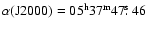
Given these caveats, the estimated pulsar position is
 ,
,
 ,
with an approximate error of
,
with an approximate error of
 ,
which
accounts for both the errors of the pulsar centroid and the
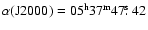
uncertainty of our boresight correction. The ACIS-S observation
(ObsID 2783) had N157B at the aim point, and it was taken in a
subarray mode to minimize pile-up. The pulsar centroid, measured
using wavdetect over the full energy band (0.5-8 keV), yields a
position of
,
which
accounts for both the errors of the pulsar centroid and the
uncertainty of our boresight correction. The ACIS-S observation
(ObsID 2783) had N157B at the aim point, and it was taken in a
subarray mode to minimize pile-up. The pulsar centroid, measured
using wavdetect over the full energy band (0.5-8 keV), yields a
position of
 ,
,
 .
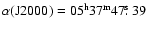
The same procedure,
but cutting in the 3-7 keV energy range to minimize contamination
from the PWN/SNR background, yields a position of
.
The same procedure,
but cutting in the 3-7 keV energy range to minimize contamination
from the PWN/SNR background, yields a position of
 ,
,
 ,
i.e. consistent with the previous one.
The errors on these positions lack the systematics present
in the off-axis ACIS-I observation. However, due to the smaller field
of view in sub-array mode, too few X-ray sources were detected to
compute the boresight correction by cross-matching with 2MASS or to
register the ACIS-S frame onto the ACIS-I one. As the effects on
the absolute astrometry are roughly of the same magnitude, we assume
that the global errors on the ACIS-S positions are similar to the
ACIS-I one (about
).
,
i.e. consistent with the previous one.
The errors on these positions lack the systematics present
in the off-axis ACIS-I observation. However, due to the smaller field
of view in sub-array mode, too few X-ray sources were detected to
compute the boresight correction by cross-matching with 2MASS or to
register the ACIS-S frame onto the ACIS-I one. As the effects on
the absolute astrometry are roughly of the same magnitude, we assume
that the global errors on the ACIS-S positions are similar to the
ACIS-I one (about
).
Table 1:
Chandra coordinates of PSR J0537-6910. In all cases an
error radius of 1'' is estimated (see text).
The available estimates for the Chandra position of PSR J0537-6910 (Table 1) are all consistent within the computed
errors. Figure 1 shows the HRC and ACIS pulsar positions superimposed
on the ACS/WFC 814W image after astrometric recalibration. A few objects
(numbered 1 through 12) can be identified within or close to the error
circles. The three candidates already investigated by Mignani et al. (2000) are highlighted in Fig. 1 (see caption). Because of their
faintness and proximity to brighter stars, all the other objects
identified within the error circles could not be detected in the less
deep and more confused ground-based NTT observations by Mignani et
al. (2000).
To perform accurate photometry on the ACS images, we run an object
detection program using the ROMAFOT package for photometry in crowded
fields (Buonanno & Iannicola 1989). The ROMAFOT parameters were
tuned to achieve a
 object detection in each filter. A
template PSF was obtained by fitting the intensity profiles of some of
the brightest, unsaturated, isolated stars in the field with a Moffat
function, plus a numerical map of the residual to better take into
account the contribution of the PSF wings. As a reference for object
detection, we used our 814W-band image, for which the effects of the
local absorption are minimized. The master list of objects was then
registered on the images taken in the 435W and 555W filters and used
as a reference for the fitting procedure. A careful check by eye was
performed to ensure that all the stellar objects found in the 814Wband were successfully fitted in the other images and to filter out
spurious detections. Aperture corrections were computed by fitting
the growth curve of a suitable set of standard stars. Instrumental
magnitudes were then converted into the
STMAG
photometric system by applying the updated ACS zero points given by De
Marchi et al. (2004).
object detection in each filter. A
template PSF was obtained by fitting the intensity profiles of some of
the brightest, unsaturated, isolated stars in the field with a Moffat
function, plus a numerical map of the residual to better take into
account the contribution of the PSF wings. As a reference for object
detection, we used our 814W-band image, for which the effects of the
local absorption are minimized. The master list of objects was then
registered on the images taken in the 435W and 555W filters and used
as a reference for the fitting procedure. A careful check by eye was
performed to ensure that all the stellar objects found in the 814Wband were successfully fitted in the other images and to filter out
spurious detections. Aperture corrections were computed by fitting
the growth curve of a suitable set of standard stars. Instrumental
magnitudes were then converted into the
STMAG
photometric system by applying the updated ACS zero points given by De
Marchi et al. (2004).
![\begin{figure}
\par\includegraphics[width=7.8cm,clip]{1781fig1.eps} \par\end{figure}](/articles/aa/full/2005/08/aa1781/Timg51.gif) |
Figure 1:
Field around PSR J0537-6910 (
 )
imaged with the ACS
filter 814W (2800 s exposure). The four circles indicate the X-ray
positions of the pulsar (see Table 1) as derived from observations
performed with the Chandra HRC (white; "old'' from Wang et al. 2001; "new'' from Gotthelf 2003, private communication) and ACIS
(black; Townsley et al. 2005). For each circle, the radius
corresponds to the overall uncertainty of the pulsar position
resulting from the combination of the estimated error of the
Chandra coordinates ( )
imaged with the ACS
filter 814W (2800 s exposure). The four circles indicate the X-ray
positions of the pulsar (see Table 1) as derived from observations
performed with the Chandra HRC (white; "old'' from Wang et al. 2001; "new'' from Gotthelf 2003, private communication) and ACIS
(black; Townsley et al. 2005). For each circle, the radius
corresponds to the overall uncertainty of the pulsar position
resulting from the combination of the estimated error of the
Chandra coordinates (
 )
and the ACS astrometric solution
( )
and the ACS astrometric solution
(
 ). Stars 4, 5 and 8 (marked by horizontal ticks) are stars
6, 3 and 4 of Mignani et al. (2000). ). Stars 4, 5 and 8 (marked by horizontal ticks) are stars
6, 3 and 4 of Mignani et al. (2000). |
| Open with DEXTER |
![\begin{figure}
\par\includegraphics[width=8.4cm,clip]{1781fig2.eps}\hspace*{7mm}
\includegraphics[width=8.4cm,clip]{1781fig3.eps} \end{figure}](/articles/aa/full/2005/08/aa1781/Timg52.gif) |
Figure 2:
Observed Color-Magnitude Diagrams (CMDs) of all the stars
detected at
significance within a
 box centered on the pulsar position.
Field stars are marked by small dots.
Objects 2 through 5 and 7 through 10 (Fig. 1) are marked by
filled squares and numbered accordingly. In the left diagram, the arrows indicate the
limits on the locations of objects 1, 6, 11 and 12.
As a reference, the locations of the Crab and PSR B0540-69 are also plotted (asterisks)
after renormalizing the fluxes to the N157B distance and extinction. The lines indicate stellar isochrones
computed from theoretical models
(Salasnich et al. 2000) for different age values
(starting from the top: 60 Myr, 600 Myr, and 3 Gyr, respectively)
and reddened for an assumed
E(B-V)=0.32 (see text). The filled circles indicate the locations
of stars at the Turn-off (1.1, 2 and 6
box centered on the pulsar position.
Field stars are marked by small dots.
Objects 2 through 5 and 7 through 10 (Fig. 1) are marked by
filled squares and numbered accordingly. In the left diagram, the arrows indicate the
limits on the locations of objects 1, 6, 11 and 12.
As a reference, the locations of the Crab and PSR B0540-69 are also plotted (asterisks)
after renormalizing the fluxes to the N157B distance and extinction. The lines indicate stellar isochrones
computed from theoretical models
(Salasnich et al. 2000) for different age values
(starting from the top: 60 Myr, 600 Myr, and 3 Gyr, respectively)
and reddened for an assumed
E(B-V)=0.32 (see text). The filled circles indicate the locations
of stars at the Turn-off (1.1, 2 and 6  )
and of stars close to the detection limit in the 814W and 555W passbands (0.6 and 0.7 ,
respectively). )
and of stars close to the detection limit in the 814W and 555W passbands (0.6 and 0.7 ,
respectively). |
| Open with DEXTER |
The observed magnitudes and colors of all the potential counterparts
identified in Fig. 1 are summarized in Table 2. No other objects
were identified within or close to the Chandra error circles
down to  limiting magnitudes of about 26.4, 26.2, and 27.2
in the 435W, 555W, and 814W passbands, respectively.
limiting magnitudes of about 26.4, 26.2, and 27.2
in the 435W, 555W, and 814W passbands, respectively.
Table 2:
Observed
magnitudes, colors and associated errors
(in parentheses) for all the objects
identified in Fig. 1 which have been detected at a
level
in at least one passband. Magnitudes and colors
are computed in the STMAG3 photometric system.
We note that
the photometry of star 7 is likely affected by an uncertainty larger
than the attached formal errors as it is partially blended with the
brighter star 5. The same is probably true also for object 2 which
might actually be a doublet of unresolved objects, as suggested by its
slightly elongated shape. However, our PSF analysis is affected by
the presence of a relatively bright filament crossing the object 2
position. Objects 1, 6, 11 and 12 have been clearly detected only in
the 814W passband and are probably very reddened. The interstellar
extinction toward PSR J0537-6910 is relatively uncertain.Taking as
a reference the measurements of the Balmer decrement around N157B
(Caplan & Deharveng 1985), we can derive a color index
E(B-V)=0.32.
On the other hand, from the X-ray spectral fits to the ACIS data of
PSR J0537-6910 we derive a hydrogen column density
 -
-
 cm-2, depending on the assumptions on
the metal abundance (see Sect. 5). By adopting the extinction law
appropriate for the 30 Doradus region (Fitzpatrick 1986), these values
correspond to
E(B-V)=0.22-0.42. This gives an average E(B-V)consistent with that derived from Caplan & Deharveng (1985). For
this reason, we will use
E(B-V) = 0.32 as an indicative value,
with an uncertainty of
cm-2, depending on the assumptions on
the metal abundance (see Sect. 5). By adopting the extinction law
appropriate for the 30 Doradus region (Fitzpatrick 1986), these values
correspond to
E(B-V)=0.22-0.42. This gives an average E(B-V)consistent with that derived from Caplan & Deharveng (1985). For
this reason, we will use
E(B-V) = 0.32 as an indicative value,
with an uncertainty of  0.1.
0.1.
![\begin{figure}
\par\includegraphics[width=7.5cm,clip]{1781fig4.eps} \end{figure}](/articles/aa/full/2005/08/aa1781/Timg66.gif) |
Figure 3:
Spectral energy distributions (SEDs) for the candidate
counterparts detected in the three passbands (filled circles) and the
814W spectral fluxes for the objects detected in this passband only
(open circles). Detection limits for the three filters are
indicated. The spectral fluxes were
computed at the central wavelengths of the ACS passbands and plotted
after correction for an interstellar extinction of
E(B-V)=0.32, with
 ;
A555W=3.41 E(B-V) and ;
A555W=3.41 E(B-V) and
 .
The numbers correspond to the identifications assigned
in Fig. 1. For comparison we have plotted the extinction-corrected
SEDs of the Crab and PSR B0540-69 (empty squares), reproduced from
Mignani & Caraveo (2001), after normalization to the N157B distance
(47 kpc). .
The numbers correspond to the identifications assigned
in Fig. 1. For comparison we have plotted the extinction-corrected
SEDs of the Crab and PSR B0540-69 (empty squares), reproduced from
Mignani & Caraveo (2001), after normalization to the N157B distance
(47 kpc).
|
| Open with DEXTER |
To assess the nature of the
candidates listed in Table 2, we compare their locations in the 814Wvs.
555W-814W and 555W vs.
435W-555W Color-Magnitude Diagrams
(CMDs) with those derived from the photometry of a representative
number of field stars. Figure 2 shows the CMDs built for all the
stars detected at
in a
region
centered on the pulsar position, including objects 2 through 5 and 7
through 10 which were detected in all the passbands (Table 2). For
convenience, the computed magnitudes and colors are renormalized to
the VEGAMAG3 photometric system because it is closer to the
Johnson-Cousins system. The conversion from the STMAG to VEGAMAG is
done by applying zero-point offsets of 0.61, 0.04, and -1.29
magnitudes for the 435W, 555W, and 814W filters, respectively (De
Marchi et al. 2004). As a reference, we overplot a set of stellar
isochrones computed from theoretical models of metallicity Z=0.008and helium abundance Y = 0.23 (Salasnich et al. 2000)
for different age values (60 Myr, 600 Myr and 3 Gyr). The assumed
stellar masses range from
 for the stars close to the
Turn-off of the 60 Myr isochrone, to
for the stars close to the
Turn-off of the 60 Myr isochrone, to
 for the
faintest detected objects. For a direct comparison
with the observed points, an interstellar extinction corresponding to
the assumed
E(B-V)=0.32 has been applied to the isochrones.
Most of the objects detected close to the pulsar position lie along
the Main Sequence (MS). The only exception is object 8 (star 4 of
Mignani et al. 2000) that lies on the giant branch of the 3 Gyr isochrone.
for the
faintest detected objects. For a direct comparison
with the observed points, an interstellar extinction corresponding to
the assumed
E(B-V)=0.32 has been applied to the isochrones.
Most of the objects detected close to the pulsar position lie along
the Main Sequence (MS). The only exception is object 8 (star 4 of
Mignani et al. 2000) that lies on the giant branch of the 3 Gyr isochrone.
Thus, none of these
objects is distinguishable from the local LMC stellar population and
can be identified as a pulsar counterpart based on the observed
colors. Unfortunately, very little can be said about the nature of
objects 1, 6, 11 and 12. Based on the
555W-814W
lower limits (Fig. 2),
only object 11 (and perhaps 6) might be substantially bluer compared
to the MS and field stars, but this can only be verified with deeper
observations.
To assess the spectral energy distributions (SEDs) of the candidates,
we computed their extinction-corrected spectral fluxes at the central
wavelengths of the ACS filters. They are plotted in Fig. 3,
together with the
upper limits and the extinction-corrected
spectral fluxes of the young pulsars Crab and PSR B0540-69 (Mignani
& Caraveo 2001), normalized to the N157B distance. For objects 1, 6,
11 and 12, we plotted only the 814W spectral fluxes. We see that the
SEDs for most of the objects detected in all the three passbands are
markedly different from the flattish spectra of the young Crab and PSR B0540-69. This is certainly the case for
objects 4, 5 and 8, and very likely also for objects 3, 7 and 10, even
when accounting for the
uncertainty of the interstellar
extinction correction. Thus, we conclude that these objects are most
likely LMC field stars, in agreement with the results of our CMD
analysis, and as such can be reasonably ruled out as potential
counterparts to PSR J0537-6910. The only possible exceptions are
object 9, which exhibits a flatter SED than the others, and, perhaps,
object 2. However, since the latter might actually be a blend of two
unresolved objects (see above), its SED is probably affected by an
unknown uncertainty. For objects 1, 6, 11 and 12, the SEDs are poorly
constrained. However, we note that for objects 1, 12 and 6 the 555Wand 435W upper limits indicate rather steep spectra suggesting that,
whatever is their nature, they can hardly be associated with the
pulsar. Only for object 11 the constraints on the SED do not allow us
to exclude a flat spectrum.
The results of our multicolor photometry suggest that only two
objects, 9 and 2, of the eight detected in more than one filter can be
considered as possible optical counterparts to the pulsar, although
object 9 is among the most distant from the revised Chandra pulsar
position, and object 2 might be a doublet. Of the others, object 11
is the only possible candidate. If either object 9 or object 2,
comparable in brightness, were the optical counterpart of PSR
J0537-6910, it would have an extinction-corrected luminosity
 or
or
 erg s-1 in
the 814W passband, for an assumed pulsar distance of 47 kpc (Gould 1995). This
would imply that the pulsar has an optical emission efficiency
erg s-1 in
the 814W passband, for an assumed pulsar distance of 47 kpc (Gould 1995). This
would imply that the pulsar has an optical emission efficiency
 or
or
 .
The values of the luminosity are slightly
below those of the young pulsars Crab and PSR B0540-69,
.
The values of the luminosity are slightly
below those of the young pulsars Crab and PSR B0540-69,
 and
and
 erg s-1, respectively, normalized to the 814W passband. On the
other hand, the efficiency would be still comparable with that of the
Crab (
erg s-1, respectively, normalized to the 814W passband. On the
other hand, the efficiency would be still comparable with that of the
Crab (
 )
but definitely
below the efficiency of PSR B0540-69 (
)
but definitely
below the efficiency of PSR B0540-69 (
 )
which is by far the most efficient optical pulsar to
date (see, e.g., Zharikov et al. 2004).
)
which is by far the most efficient optical pulsar to
date (see, e.g., Zharikov et al. 2004).
If, instead, object 11 were the pulsar counterpart, it would be
fainter by a factor of about 10 in the optical, with an
extinction-corrected luminosity
 erg s-1 and an efficiency
 .
Finally, if none of the present candidates were the
counterpart, the measured 814W upper limit would imply an optical
luminosity
.
Finally, if none of the present candidates were the
counterpart, the measured 814W upper limit would imply an optical
luminosity
 erg s-1 and a
corresponding efficiency
erg s-1 and a
corresponding efficiency
 .
In
both cases, PSR J0537-6910 would be significantly underluminous with
respect to the Crab and PSR B0540-69.
.
In
both cases, PSR J0537-6910 would be significantly underluminous with
respect to the Crab and PSR B0540-69.
We note that including the uncertainty on the optical extinction
correction affects the above estimates of
 and
and
 by
by  20% (in the 814W filter) and does not alter significantly our conclusions.
![\begin{figure}
\par\includegraphics[width=7.5cm,clip]{1781fig5.eps} \end{figure}](/articles/aa/full/2005/08/aa1781/Timg84.gif) |
Figure 4:
Comparison between the optical SEDs of objects 2, 9 and 11
and the extrapolations into the optical domain of the power-law (solid) and
curved power-law (dashed) models best fitting the Chandra
and BeppoSAX/ RXTE X-ray spectra, respectively (see text). |
| Open with DEXTER |
It is also interesting to confront the results of the optical
observations with the X-ray data on PSR J0537-6910. We analyzed the
30-ks Chandra ACIS-S3 observation of the pulsar, taken in 1/4
subarray mode (frame time 0.8 s). After correcting for pile-up
(pile-up fraction was about 5%-6%) and subtracting the contribution
from the bright PWN, we obtained a power-law fit of the pulsar
spectrum with a photon index
 and a photon
spectral flux
and a photon
spectral flux
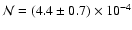 photons cm-2 s-1 keV-1 at E=1 keV. These values are almost
independent of the assumed metal abundance in the absorbing (LMC) ISM,
contrary to the hydrogen column density:
photons cm-2 s-1 keV-1 at E=1 keV. These values are almost
independent of the assumed metal abundance in the absorbing (LMC) ISM,
contrary to the hydrogen column density:
 cm-2 for metal abundances 40% of solar, and
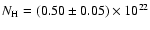 cm-2 for solar
abundances. The derived spectral parameters correspond to the X-ray
luminosity
cm-2 for solar
abundances. The derived spectral parameters correspond to the X-ray
luminosity
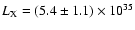 erg s-1 and X-ray
efficiency
erg s-1 and X-ray
efficiency
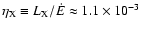 ,
in
the 1-10 keV band, significantly below those of the Crab
(
,
in
the 1-10 keV band, significantly below those of the Crab
(
 erg s-1,
 )
and
PSR B0540-69 (
)
and
PSR B0540-69 (
 erg s-1,
 ;
see Zavlin & Pavlov 2004).
;
see Zavlin & Pavlov 2004).
While the X-ray and optical efficiencies show very large scatter among
different pulsars, up to at least 3 orders of magnitude, their ratio
is much more stable, typically
 (for the optical and X-ray luminosities
measured in the 814W and 1-10 keV bands, respectively), which
suggests a common mechanism for the magnetospheric X-ray and optical
emission (Zavlin & Pavlov 2004). If object 9 (or 2) is the
counterpart of PSR J0537-6910, this ratio,
(for the optical and X-ray luminosities
measured in the 814W and 1-10 keV bands, respectively), which
suggests a common mechanism for the magnetospheric X-ray and optical
emission (Zavlin & Pavlov 2004). If object 9 (or 2) is the
counterpart of PSR J0537-6910, this ratio,
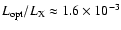 (or
(or
 ), would be comparable with
the average one for optically detected pulsars.
), would be comparable with
the average one for optically detected pulsars.
On the other hand, if object 11 is the pulsar counterpart (or the
counterpart is even fainter than our detection limit), then the
optical-to-X-ray luminosity ratio becomes
 ,
i.e. the lowest among all pulsars detected in the optical, which
strengthens the case for object 9 or 2 being the pulsar counterpart.
,
i.e. the lowest among all pulsars detected in the optical, which
strengthens the case for object 9 or 2 being the pulsar counterpart.
For additional comparison of the optical and X-ray data on PSR
J0537-6910, we show in Fig. 4 extrapolations of the pulsar's X-ray
spectrum into the optical and the optical spectral fluxes for three
putative candidates. We see that the extrapolation of the power-law
fit into the optical exceeds the fluxes of the brighter candidates
(objects 9 and 2) by a factor of 10-30, which suggests that the
broad-band (optical through X-ray) spectrum cannot be described by a
simple power law. A similar flattening of the spectrum with decreasing
frequency has been observed for other young pulsars (e.g., Mineo et
al. 2003). It can be described with a curved power law:
 ,
where the simplest form of the energy-dependent
photon index is
,
where the simplest form of the energy-dependent
photon index is
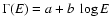 (fE is the photon
spectrum, E the photon energy in keV). In addition to the simple
power-law fit (b=0,
(fE is the photon
spectrum, E the photon energy in keV). In addition to the simple
power-law fit (b=0,  ), we show in Fig. 4 a curved
power-law fit (
), we show in Fig. 4 a curved
power-law fit (
 ,
,
 )
obtained by Mineo
et al. (2003) for the pulsed X-ray spectrum of PSR J0537-6910
observed with BeppoSAX and RXTE in the 1-30 keV band,
where we have scaled the normalization to the Chandra value to
account for the unpulsed component. Extrapolation of this fit into
the optical predicts optical fluxes comparable to the limits of our
observation, well below the fluxes of objects 9 and 2. However, the
example of the Crab pulsar (Massaro et al. 2000) shows that such an
extrapolation may underpredict the optical fluxes by an order of
magnitude. Therefore, the comparison with the X-ray spectrum of PSR
J0537-6910 suggests that one of our three candidates is the pulsar's
optical counterpart, unless the PSR J0537-6910 is unusually
underluminous in the optical.
)
obtained by Mineo
et al. (2003) for the pulsed X-ray spectrum of PSR J0537-6910
observed with BeppoSAX and RXTE in the 1-30 keV band,
where we have scaled the normalization to the Chandra value to
account for the unpulsed component. Extrapolation of this fit into
the optical predicts optical fluxes comparable to the limits of our
observation, well below the fluxes of objects 9 and 2. However, the
example of the Crab pulsar (Massaro et al. 2000) shows that such an
extrapolation may underpredict the optical fluxes by an order of
magnitude. Therefore, the comparison with the X-ray spectrum of PSR
J0537-6910 suggests that one of our three candidates is the pulsar's
optical counterpart, unless the PSR J0537-6910 is unusually
underluminous in the optical.
We have performed deep, high-resolution, multicolor observations of
the PSR J0537-6910 field with the ACS/WFC on board HST. Two
likely candidate counterparts, compatible with the revised Chandra position of the pulsar, have been identified based on the
color information. Although these candidates look interesting for
their spectra, the still limited multicolor information, as well as the
uncertainty of the interstellar extinction toward the pulsar, do not
allow yet to obtain a compelling spectral characterization. For the
third, fainter, candidate, detected in one filter only, the spectrum
is virtually unconstrained. Thus, it is not possible to determine yet
which of the three, if any, is indeed the actual pulsar counterpart.
A follow-up timing observation will allow a more in-depth
investigation of at least the two brighter candidates and, hopefully,
will provide the evidence required to finally establish the optical
identification of the pulsar.
Acknowledgements
We are indebted to Eric Gotthelf for providing the revised HRC
coordinates of the pulsar. It is a pleasure to thank Guido De Marchi
for providing us with the ACS photometric calibrations prior to
publication. The work of G.G.P. was partially supported by NASA
grant NAG5-10865.
- Alexander, D.
M., Bauer, F. E., Brandt, W. N., & Schneider 2003, AJ, 126,
539 [NASA ADS] [CrossRef]
- Buonanno, R.,
& Iannicola, G. 1989, PASP, 101, 294 [NASA ADS] [CrossRef] (In the text)
- Butler, R. F.,
Golden, A., Shearer, A., & Gouiffes, C. 2002, Proc. 270,
WE-Heraeus Seminar on Neutron Stars, Pulsars, and Supernova
Remnants, ed. W. Becker, H. Lesch, & J. Trümper, MPE
Report, 278
(In the text)
- Caplan, J., &
Deharveng, L. 1985, A&AS, 62, 63 [NASA ADS] (In the text)
- Crawford, F.,
Kaspi, V. M., Manchester, R. N., et al. 1998, MemSAIt, 69, 951 [NASA ADS] (In the text)
- Cusumano, G.,
Maccarone, M. C., Mineo, T., et al. 1998, A&A, 333, L55 [NASA ADS] (In the text)
- De Marchi, G.,
Sirianni, M., Gilliland, R., & the ACS team 2004, Instrument
Science Report ACS 04-06 (Baltimore: Space Telescope Science
Institute)
(In the text)
-
Fitzpatrick, E. L. 1986, AJ, 92, 1068 [NASA ADS] [CrossRef] (In the text)
- Getman, K. V.,
Flaccomio, E., Broos, P. S., et al. 2005, ApJS, in press
[arXiv:astro-ph/0410136]
(In the text)
- Gouiffes, K.,
& Ögelman, H. 2000, Proc. IAU Coll. 177, Pulsar Astronomy
- 2000 and Beyond, ed. M. Kramer, N. Wex, & R. Wielebinski, ASP
Conf. Ser., 301
(In the text)
- Gould, A. 1995, ApJ,
452, 189 [NASA ADS] [CrossRef] (In the text)
- Lasker, B., Sturch,
C. R., McLean, B. J., et al. 1990, AJ, 99, 2019 [NASA ADS] [CrossRef] (In the text)
- Marshall, F.
E., Gotthelf, E. V., Zhang, W., et al. 1998, ApJ, 499, L179 [NASA ADS] [CrossRef] (In the text)
- Marshall, F.
E., Gotthelf, E. V., Middleditch, J., Wang, Q. D., & Zhang, W.
2004, ApJ, 603, 682 [NASA ADS] [CrossRef] (In the text)
- Massaro, E.,
Cusumano, G., Litterio, M., & Mineo, T. 2000, A&A, 361,
695 [NASA ADS] (In the text)
-
Middleditch, J., Marshall, F. E., Zhang, W., Gotthelf, E. V., &
Wang, Q. D. 2001, A&AS, 32, 36.06
(In the text)
- Mignani, R. P.,
& Caraveo, P. A. 2001, A&A, 376, 213 [EDP Sciences] [NASA ADS] [CrossRef] (In the text)
- Mignani, R.,
Pulone, L., Marconi, G., Iannicola, G., & Caraveo, P. A. 2000,
A&A, 355, 603 [NASA ADS] (In the text)
- Mineo, T., Cusumano,
G., & Massaro, E. 2003, Proc. The Restless High-Energy
Universe, ed. E. P. J. van den Heuvel, J. J. M. in't Zand, & R.
A. M. J. Wijers [arXiv:astro-ph/0309523]
(In the text)
- Monet, D., Levine, S.
E., Canzian, B., et al. 2003, AJ, 125, 984 [NASA ADS] [CrossRef] (In the text)
- Pavlovsky,
C., Biretta, J., Boffi, F., et al. 2003, ACS Instrument Handbook,
Version 4.0 (Baltimore, STScI)
(In the text)
- Salasnich,
B., Girardi, L., Weiss, A., & Chiosi, C. 2000, A&A, 361,
1023 [NASA ADS] (In the text)
- Skrutskie, M.
F., Schneider, S. E., Stiening, R., et al. 1997, Proc. The Impact
of Large Scale Near-IR Sky Survey, ed. F. Garzon et al. (Dordrecht:
Kluwer), 25
(In the text)
- Townsley, L.,
et al. 2005, in preparation
(In the text)
- Wang, Q. D., &
Gotthelf, E. V. 1998, ApJ, 509, L109 [NASA ADS] [CrossRef] (In the text)
- Wang, Q. D., Gotthelf,
E. V., Chu, Y. N., & Dickel, J. R. 2001, ApJ, 559, 275 [NASA ADS] [CrossRef] (In the text)
- Zacharias,
N., Urban, S. E., Zacharias, M. I., et al. 2004, AJ, 127, 3043 [NASA ADS] [CrossRef] (In the text)
- Zavlin, V. E.,
& Pavlov, G. G. 2004, ApJ, 616, 452 [NASA ADS] [CrossRef] (In the text)
- Zharikov, S.
V., Shibanov, Yu. A., Mennickent, R. E., et al. 2004, A&A, 417,
1017 [EDP Sciences] [NASA ADS] [CrossRef] (In the text)
Copyright ESO 2005
![\begin{figure}
\par\includegraphics[width=7.8cm,clip]{1781fig1.eps} \par\end{figure}](/articles/aa/full/2005/08/aa1781/img51.gif)
![\begin{figure}
\par\includegraphics[width=8.4cm,clip]{1781fig2.eps}\hspace*{7mm}
\includegraphics[width=8.4cm,clip]{1781fig3.eps} \end{figure}](/articles/aa/full/2005/08/aa1781/img52.gif)
![\begin{figure}
\par\includegraphics[width=7.5cm,clip]{1781fig4.eps} \end{figure}](/articles/aa/full/2005/08/aa1781/img66.gif)
![\begin{figure}
\par\includegraphics[width=7.5cm,clip]{1781fig5.eps} \end{figure}](/articles/aa/full/2005/08/aa1781/img84.gif)