A&A 431, 747-755 (2005)
DOI: 10.1051/0004-6361:20040366
Restoration of interferometric images
IV. An algorithm for super-resolution of stellar systems
B. Anconelli1 - M. Bertero1 - P. Boccacci1 - M. Carbillet2
1 - INFM and DISI, Università di Genova, via Dodecaneso 35,
16146 Genova, Italy
2 -
Laboratoire Universitaire d'Astrophysique de Nice,
UMR 6525, Parc Valrose, 06108
Nice Cedex 02, France
Received 2 March 2004 / Accepted 13 October 2004
Abstract
In the framework of the methods we introduced for the restoration of images
of Fizeau interferometers such as the Large Binocular Telescope, we propose
an algorithm which is able to super-resolve compact stellar objects such
as a binary system with an angular separation smaller than the angular
resolution of the telescope.
The method, which works also in the case of a monolithic mirror, is based on
a simple modification of the Richardson-Lucy (RL) method or of the
Ordered Subsets - Expectation Maximization (OS-EM) method for image
deconvolution. In general, it consists of three steps: the first one requires
a large number of RL-iterations, which are used to identify and estimate the
domain of the unresolved object; the second one is a RL-restoration
initialized with the mask of the domain. These two steps can provide a
super-resolved image of the stellar system but the photometry of the stars
may not be correct. Therefore their positions are derived from the result of
the first two steps while their magnitudes are estimated in a third step by
solving a simple least-squares problem. In order to show that the method can
work in practice, we use (simulated) adaptive-optics-corrected point spread
functions (PSF), both in the case of a monolithic and in the case of a binocular
telescope, and we investigate mainly the case of binary systems. We analyze
the limitations of the method in evaluating the angular separation and the
relative magnitude of the two stars. The results we obtain are quite promising.
Key words: techniques: image processing - methods: data analysis - methods: numerical - techniques: high angular resolution
In two previous papers (Correia et al. 2002; Carbillet et al.
2002) we present the Software Package AIRY (Astronomical Image
Restoration in interferometrY), implementing methods for the simulation,
reconstruction and analysis of Fizeau interferometric images, as well as its
application to the case study of the Large Binocular Telescope (LBT). In
a third paper (Anconelli et al. 2005) we propose accelerated versions
of these methods which allow their use as quick-look methods to be routinely
used for data reduction. The quick-look image then can be used to investigate
the object and extract information for improved reconstruction.
A first example of this two-step approach is given in Correia et al.
(2002) where we sketch a possible method for the super-resolved
reconstruction of binary systems. In this paper we generalize and validate
this method; the implemented algorithms have been inserted in the Software
Package AIRY, version 2.0 (see http://dirac.disi.unige.it and
http://www.arcetri.astro.it/caos).
In astronomy and microscopy, super-resolution is a term which, in general,
is used to indicate any method able to improve resolution beyond the
diffraction limit. In the case of a telescope with a single mirror of
diameter D, perfect optics and no atmosphere, this limit is approximately
given by  ,
where
,
where  is the wavelength of the observed
radiation; in the case of interferometers such as LBT, it
is given by
is the wavelength of the observed
radiation; in the case of interferometers such as LBT, it
is given by  ,
where B is the maximum baseline. The idea of
overcoming such a limit with a suitable processing of the detected images is
an old one and dates back to papers by Toraldo di Francia (1955),
Wolter (1961), Harris (1964), McCutchen (1967),
Rushforth & Harris (1968) and others.
,
where B is the maximum baseline. The idea of
overcoming such a limit with a suitable processing of the detected images is
an old one and dates back to papers by Toraldo di Francia (1955),
Wolter (1961), Harris (1964), McCutchen (1967),
Rushforth & Harris (1968) and others.
Resolution beyond the diffraction limit requires the extrapolation of the
Fourier transform of the object outside the band of the optical
instrument and, as remarked in the papers by Wolter and Harris mentioned
above, this is possible if the object has a finite extent. Since the
extrapolation problem is ill-posed (in practice, very sensitive to noise
propagation from the data to the solution), unlimited super-resolution
is impossible in the presence of noise. A first attempt at estimating how
much super-resolution can be achieved in practice was developed in Bertero
& Pike (1982), where it is shown that the amount of super-resolution
is basically controlled by two parameters: the space-bandwidth product
(SBP) and the signal-to-noise ratio (SNR). In the case of a telescope
the SBP is approximately given by the ratio between the angular diameter of
the object and the diffraction limit; then the results derived in the paper
mentioned above imply that super-resolution is feasible when this parameter
is not much greater than one, namely in the case of compact and unresolved
objects. On the other hand the amount of super-resolution increases with
increasing SNR. An estimate in terms of the photon flux is given by Lucy
(1992a,b). A survey of the mathematical foundations of
super-resolution is given in Bertero & De Mol (1996)
(see also Bertero & Boccacci 1998).
According to the previous remarks, the development of a super-resolving
method requires an estimate of the domain  of the object, to be
used as a constraint in the restoration algorithm so that the total
flux of the restored object is concentrated within .
In addition,
it has been claimed by other authors that other constraints may provide
super-resolution. One is non-negativity, which is implemented, for instance,
in the maximum entropy method. However, it has been proved that maximum
entropy provides super-resolution in the case of the so-called nearly black objects, i.e. objects that are zero in the vast
majority of the pixels (Donoho et al. 1992). In general,
non-negativity works well when combined with the sparsity of the object,
as shown by Donoho (1992). It is also known that the restoration of a
sparse object is stable with respect to noise if the restoration algorithm
implements a constraint on the total flux of the object.
of the object, to be
used as a constraint in the restoration algorithm so that the total
flux of the restored object is concentrated within .
In addition,
it has been claimed by other authors that other constraints may provide
super-resolution. One is non-negativity, which is implemented, for instance,
in the maximum entropy method. However, it has been proved that maximum
entropy provides super-resolution in the case of the so-called nearly black objects, i.e. objects that are zero in the vast
majority of the pixels (Donoho et al. 1992). In general,
non-negativity works well when combined with the sparsity of the object,
as shown by Donoho (1992). It is also known that the restoration of a
sparse object is stable with respect to noise if the restoration algorithm
implements a constraint on the total flux of the object.
The frequently used RL method (Richardson 1972;
Lucy 1974), also known in emission tomography as the Expectation
Maximization (EM) method (Shepp & Vardi 1982), implements in a quite
natural way both the constraint of non-negativity and that on the total flux
of the image. Moreover it implements also the constraint on the domain of the
object if a suitable initialization of the iterations is used. The same
remarks apply to the OS-EM
method (Hudson & Larkin 1994) we have extended to LBT imaging
(Bertero & Boccacci 2000a,b). Therefore these methods
provide algorithms implementing all the relevant constraints and they
appear quite suitable for estimating the amount of super-resolution achievable
in practical situations.
In Sect. 2 we introduce the algorithm proposed in this paper and based on
RL-like methods. In Sect. 3 we describe the simulation of the PSFs
and their correction due to adaptive optics (AO),
together with the generation of the simulated images of binary systems.
In Sect. 4 we give the results obtained with the proposed algorithm both
in the case of a monolithic mirror and in the case of an interferometer
such as LBT. Possible applications and perspectives of the method are
discussed in Sect. 5.
The proposed super-resolving algorithm is based on the RL method in the
monolithic case and on the OS-EM method in the LBT case (the version of
these methods, implemented in AIRY, is given in Anconelli et al.
2005). It is a two-steps algorithm, each step
consisting of RL or OS-EM iterations. Moreover we introduce a third step
which may be required to estimate the correct photometry of stellar
systems such as binaries.
The basic property of the RL and OS-EM methods, which allows their use as
super-resolving algorithms, derives from the fact that the result of one
iteration contains as a factor the result of the previous one; therefore,
if the initial guess is zero at a given pixel, then the result of all the
iterations will be zero at that pixel. We call such a property the localization property of these methods, in the sense that we can constrain
the object to be localized in a given domain
by a suitable
initialization of the iterations, namely a function which is constant over
and zero elsewhere.
Our approach to super-resolution applies to the case where the astronomical
target consists of unresolved objects (angular size of the order of the
diffraction limit) separated by an angle considerably greater than the
diffraction limit (sparsity condition), so that there is no overlapping of
their images. For simplicity we assume that there is only one of these
unresolved objects, surrounded by empty sky. Then the approach consists of
the following steps.
Step 1 - Apply the RL or OS-EM method to the detected images, using
a constant array as initial guess and a number of iterations such that the
restored object is sufficiently well localized. If the angular separation is
not much smaller than the diffraction limit and the magnitude difference is
small, it may happen, in the case of a binary, that the two stars are already
resolved in this first step. In such a case one can estimate their positions
by computing the centroids and go directly to Step 3 for a more accurate
estimate of their magnitudes.
If the two stars are not resolved, then go to Step 2.
Step 2 - Define the domain
of the object by identifying the
pixels where the flux of the result of Step 1 is greater than a selected
threshold (for instance some percent of its maximum value); alternatively
one can take a disc with a diameter equal to the diffraction limit and
containing most of the flux of the reconstructed object.
Apply again the RL or OS-EM method to the detected images, but now
initialized with the mask of the domain, namely a function which is constant
over the domain and zero elsewhere. Each iterate is localized in the
selected domain; if, after a number of iterations, the two stars are
separated, their positions are obtained by computing their centroids.
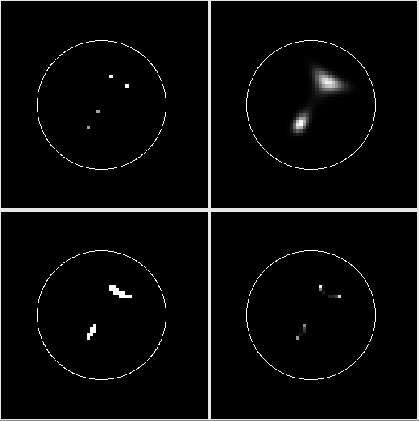
To illustrate the method, we show an example of its application in Fig. 1.
The parameters used in the simulation are described in
Sect. 3. The object, shown in the upper-left panel, consists of two
unresolved binaries, the angular separation of each binary being about 1/3
of the diffraction limit while the angular separation of the centres of the
two stars is about 2/3 of the diffraction limit. In each binary the
difference in magnitude is zero, while the difference in magnitude between
the two binaries is 0.5. The images were generated by convolving the
object with three ideal LBT PSFs, corresponding to equally spaced parallactic
angles
 ,
and
,
and  ), and by perturbing the result
with photon and read-out noise. For the first step we selected 1000 OS-EM
iterations initialized with a uniform array; the result is shown in the
upper-right panel of Fig. 1. The two binaries are resolved but not the
stars within each binary. Then a mask was estimated by selecting the
pixels where the flux is greater than 50 % of the maximum value of the
restored image; the result is shown in the lower-left panel. Finally
this mask is used for re-initializing OS-EM and the result is shown in
the lower-right panel. The two binaries are clearly resolved. In this
case also the magnitudes are obtained with a sufficient accuracy (few
percent errors), as the angular separations.
), and by perturbing the result
with photon and read-out noise. For the first step we selected 1000 OS-EM
iterations initialized with a uniform array; the result is shown in the
upper-right panel of Fig. 1. The two binaries are resolved but not the
stars within each binary. Then a mask was estimated by selecting the
pixels where the flux is greater than 50 % of the maximum value of the
restored image; the result is shown in the lower-left panel. Finally
this mask is used for re-initializing OS-EM and the result is shown in
the lower-right panel. The two binaries are clearly resolved. In this
case also the magnitudes are obtained with a sufficient accuracy (few
percent errors), as the angular separations.
 |
Figure 1:
Upper-left panel: the object; upper-right: the reconstruction
after 1000 OS-EM iterations (first step); lower-left: the mask obtained
with a thresholding of the previous reconstruction (50% of the maximum
value); lower-right: the restoration after 1000 OS-EM iterations,
initialized with the previous mask (second step). The diameter of the
circle shown in each picture is . |
| Open with DEXTER |
However, in our numerical simulations on binary systems we have verified
that, when there is a significant difference of magnitudes between the two
stars, these may not be correctly estimated at the end of the second step,
while their angular positions are, in general, correctly estimated. In order
to overcome this difficulty we propose the following third step.
 - Let us assume, in general, that the restored object,
provided by Step 1 or Step 2, consists of q stars localized at the pixels
P1, P2, ...,Pq. We denote by
- Let us assume, in general, that the restored object,
provided by Step 1 or Step 2, consists of q stars localized at the pixels
P1, P2, ...,Pq. We denote by
 (j=1,...,p) the
PSFs centered at Pi and given by:
(j=1,...,p) the
PSFs centered at Pi and given by:
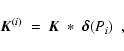 |
(1) |
where
 is the characteristic function of the pixel, i.e.
it is one at pixel Pi and zero elsewhere. Then we introduce the images:
is the characteristic function of the pixel, i.e.
it is one at pixel Pi and zero elsewhere. Then we introduce the images:
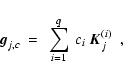 |
(2) |
depending on the unknown parameters
 .
These are
determined by means of a least-squares method, namely by minimizing the
discrepancy:
.
These are
determined by means of a least-squares method, namely by minimizing the
discrepancy:
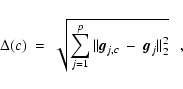 |
(3) |
where ||.||2 denotes the usual Euclidean norm.
In our numerical simulations we consider the case of LBT both in its
"first-light'' scheme (one pupil of 8.25 m effective diameter), and in its
"second-light'' scheme (two pupils separated by 14.4 m and
recombined interferometrically in a Fizeau way). The first scheme implies
the simulation of the first-light AO system of LBT
(Esposito et al. 2003), while the second scheme is to be considered
within the framework of the LINC-NIRVANA instrument (Ragazzoni et al.
2003; Herbts et al. 2003). The main features of
both systems are the use of pyramid wavefront sensors and the LBT 672
adaptive secondary mirror (Riccardi et al. 2003).
The tool employed for numerically simulating the PSFs relative to the two
cases is the Software Package CAOS (Carbillet et al. 2004) which
is used to simulate in detail the whole process of atmospheric propagation
of light, wavefront sensing (with a complete model of the pyramid wavefront
sensor), wavefront reconstruction (using the LBT 672 adaptive secondary
mirror modes), and dynamic closing of the loop. In the case of the
interferometric PSFs, the Fizeau recombination of light, together with the
related differential piston error, is also taken into account.
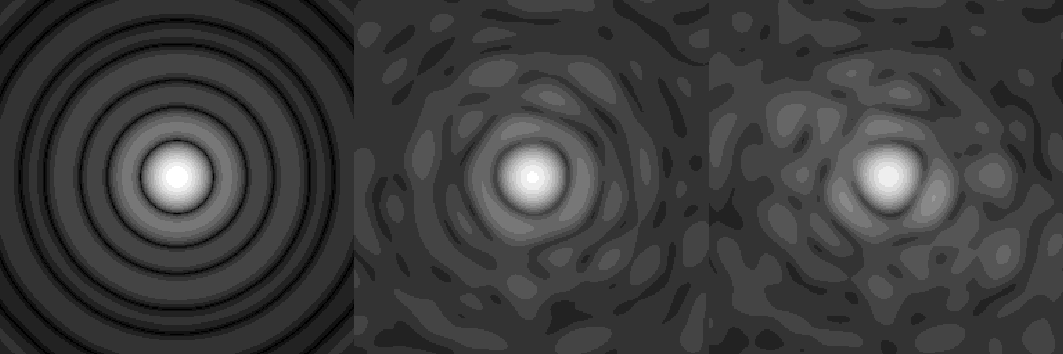
 |
Figure 2:
One-pupil AO-corrected K-band PSFs: ideal case ( left), on-axis
case ( middle), and
 off-axis case ( right). The total field is
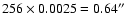 and for rendering purpose the images are
shown at the power of 0.2. Note the slight difference in image quality
between the on-axis PSF and the off-axis PSF.
and for rendering purpose the images are
shown at the power of 0.2. Note the slight difference in image quality
between the on-axis PSF and the off-axis PSF. |
| Open with DEXTER |
 |
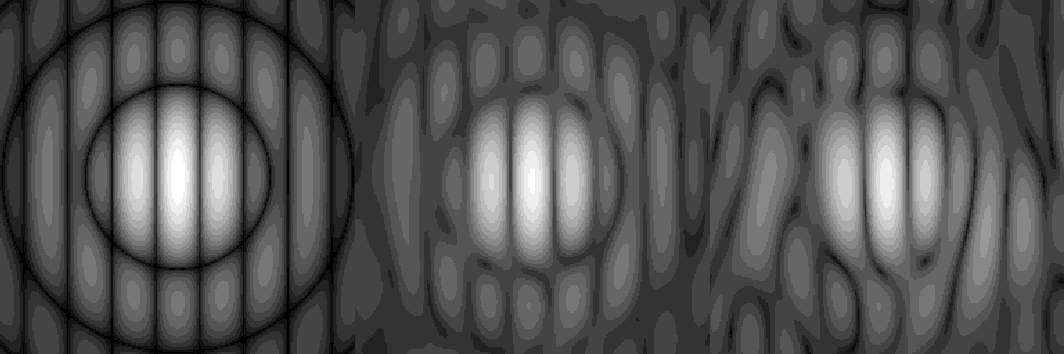
Figure 3:
Interferometric AO-corrected K-band PSFs: ideal case ( left), on-axis
case ( middle), and
off-axis case ( left). The total field is
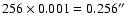 and for rendering purpose the images are
shown at the power of 0.2. The difference in image quality between
the on-axis PSF and the off-axis PSF is appreciable. The PSFs shown here
correspond to the case of
and for rendering purpose the images are
shown at the power of 0.2. The difference in image quality between
the on-axis PSF and the off-axis PSF is appreciable. The PSFs shown here
correspond to the case of  parallactic angle. Note that in
our simulations we use two other similar sets at
parallactic angle. Note that in
our simulations we use two other similar sets at  and .
and . |
| Open with DEXTER |
A detailed explanation of the method and of the tuning of the system
parameters for the simulation of our AO-corrected monolithic (one pupil) PSFs
can be found in Carbillet et al. (2003). We will here only briefly
recall the main physical parameters considered for the present case. The
multi-layer atmosphere has an average layer velocity of 15 m/s, a total
Fried parameter r0 (@500 nm) = 0.15 cm, a wavefront outer scale
 m, and a resulting seeing of roughly
 .
The guide
star considered has an R-band magnitude of 13 and is a K5 spectral type. The
sensing band is 600-900 nm (roughly R and the first part of I) and the
average total transmission related to the sensing is approximately of 40%.
Following Carbillet et al. (2003) the optimum sensor configuration is
therefore the one corresponding to 15
.
The guide
star considered has an R-band magnitude of 13 and is a K5 spectral type. The
sensing band is 600-900 nm (roughly R and the first part of I) and the
average total transmission related to the sensing is approximately of 40%.
Following Carbillet et al. (2003) the optimum sensor configuration is
therefore the one corresponding to 15 15 sub-apertures, with an
exposure time of 1.67 ms, and 150 LBT 672 modes reconstructed.
15 sub-apertures, with an
exposure time of 1.67 ms, and 150 LBT 672 modes reconstructed.
Figure 2 shows the resulting K-band PSFs, compared with the
ideal one that would be obtained in case of no perturbations at all from
the atmosphere. The on-axis PSF has a Strehl ratio of  79%, while the
off-axis PSF is at
away from it, with a resulting Strehl ratio of
67%. Note that the difference in Strehl ratio between the two PSFs
is highly dependent on the turbulent layers distribution (the higher the
turbulence, the lower the off-axis Strehl ratio). Moreover we assume the
optimistic case where a reference star is available in the
vicinity of the observed object. This may depend on the detector size.
In principle we require a very large detector because we assume that we
have a pixel size of 2.5 mas, which is a considerable over-sampling: since
the diffraction limit is about 50 mas (the considered band is K, 2200 nm),
we have approximately
79%, while the
off-axis PSF is at
away from it, with a resulting Strehl ratio of
67%. Note that the difference in Strehl ratio between the two PSFs
is highly dependent on the turbulent layers distribution (the higher the
turbulence, the lower the off-axis Strehl ratio). Moreover we assume the
optimistic case where a reference star is available in the
vicinity of the observed object. This may depend on the detector size.
In principle we require a very large detector because we assume that we
have a pixel size of 2.5 mas, which is a considerable over-sampling: since
the diffraction limit is about 50 mas (the considered band is K, 2200 nm),
we have approximately
 pixels within a resolution element.
However, as we discuss in Sect. 5, the required oversampling can be
obtained by a rebinning of the detected images if these are moderately
over-sampled, as it will be in the case of LBT.
pixels within a resolution element.
However, as we discuss in Sect. 5, the required oversampling can be
obtained by a rebinning of the detected images if these are moderately
over-sampled, as it will be in the case of LBT.
![\begin{figure}
\par\begin{tabular}{c}
\includegraphics[height=3cm,clip]{0366fg4...
...\includegraphics[height=3cm,clip]{0366fg4c.ps}\\
c)
\end{tabular}\end{figure}](/articles/aa/full/2005/08/aa0366-04/Timg35.gif) |
Figure 4:
Example of application of the two-step algorithm. The object is
a binary consisting of two stars with angular separation
 (B = maximum baseline of LBT) and with the same magnitude m=12;
three interferometric noisy images are generated by convolving the object
with the PSFs with an average Strehl ratio of 66% and are deconvolved by means
of the PSFs with an average Strehl ratio of 77% (see
Fig. 3):
a) the original object; b) the restored object obtained after Step 1; c)
the restored object obtained after Step 2.
(B = maximum baseline of LBT) and with the same magnitude m=12;
three interferometric noisy images are generated by convolving the object
with the PSFs with an average Strehl ratio of 66% and are deconvolved by means
of the PSFs with an average Strehl ratio of 77% (see
Fig. 3):
a) the original object; b) the restored object obtained after Step 1; c)
the restored object obtained after Step 2. |
| Open with DEXTER |
Starting from the known performance of the first-light AO system of LBT
(monolithic case explained above), and assuming that at least the
single-conjugate phase of LINC-NIRVANA will have a similar behaviour,
the resulting set of interferometric images is then composed
from observations at different parallactic angles (here
 ,
and ), corresponding to three different moments
during the observation night, and therefore to three different realizations
of the turbulent atmosphere.
The AO system behaviour is simulated with the same sets of parameters as
for the monolithic case, but with the additional effect of a differential
piston residual. The pixel size is 1 mas (again about 2020 pixels
within
a resolution element, since the diffraction limit is about 20 mas in K-band).
The resulting Strehl ratio of the on-axis PSF is 77% (averaged over
the 3 realizations), while that of the off-axis one (
)
is 66%. Figure 3 shows the resulting
interferometric PSFs corresponding to a
parallactic angle.
,
and ), corresponding to three different moments
during the observation night, and therefore to three different realizations
of the turbulent atmosphere.
The AO system behaviour is simulated with the same sets of parameters as
for the monolithic case, but with the additional effect of a differential
piston residual. The pixel size is 1 mas (again about 2020 pixels
within
a resolution element, since the diffraction limit is about 20 mas in K-band).
The resulting Strehl ratio of the on-axis PSF is 77% (averaged over
the 3 realizations), while that of the off-axis one (
)
is 66%. Figure 3 shows the resulting
interferometric PSFs corresponding to a
parallactic angle.
Sets of binary star images are formed starting from the sum of two shifted
PSFs (see Eq. (1)), centered on the pixels of the two stars, and
weighted with the desired magnitudes. Sky background emission is then added
and the resulting images are eventually corrupted with Poisson and
detector noise. The overall efficiency
taken into account for both the monolithic 8 m PSFs and the interferometric
PSFs is 30%. K-band sky background is 12.5 mag/arcsec2, read-out noise
is 2 e- rms, and dark current noise is neglected. The integration time
considered in both cases is 20 min, and the K-band magnitudes considered
(concerning the binary main component) range from 10 to 17. In such a
situation we can consider the images as dominated by photon noise, so that
the signal-to-noise ratio (SNR) simply depends on the square root of the
number of object photons. As a consequence the interferometric case shows a
SNR improvement by a factor of  with respect to the
monolithic case, since we are considering two 8m pupils and three different
parallactic angles. Such an improvement corresponds to roughly 1 mag
gain.
with respect to the
monolithic case, since we are considering two 8m pupils and three different
parallactic angles. Such an improvement corresponds to roughly 1 mag
gain.
In this section we validate the super-resolving algorithm proposed in this
paper by considering the problem of estimating the astrometric and
photometric parameters of unresolved binary systems. We consider first the
case of a single mirror and next the interferometric case. We estimate the
performance of the algorithm both when the ideal PSF is used for convolving
and deconvolving the binary (this simulation provides the maximum attainable
super-resolution for the given SNR) and when different AO-corrected PSFs are
used for convolution and deconvolution.
After an analysis of a few cases, we
decided to use 10 000 RL-iterations in Step 1 and up to 5000 RL-iterations
in Step 2; indeed, in Step 2, the number of iterations depends on the result
of Step 1 and, in some lucky cases can be small (about 250). In general the
analysis of each single case can be quite heavy from the computational point
of view, especially in the interferometric case (about a factor of 3 in
computation time with respect to the monolithic case). In Fig. 4 we give a typical result of the two-step algorithm together
with the original object. The parameters characterizing the numerical
experiment are given in the caption. In this case Step 3 is not required.
The super-resolution attainable for given values of the observational
parameters (efficiency, integration time, etc.) depends both on the magnitude
of the primary star and on the magnitude difference between the two stars.
Since a complete analysis should require the investigation of a very large
number of possible cases, we introduce a number of limitations in the
choice of the parameters.
The first study concerns the limit attainable in angular separation by
assuming that the magnitude difference between the two stars is zero and that
the K-band magnitude of the single component ranges from 10 to 17. For each
of these values we search for the minimum binary separation allowing for
detection and characterization of the system.
The second study concerns the limit attainable in the magnitude difference
 between the two stars by fixing their angular separation to
 (we think that this is a relevant value in the
potential applications of the method); moreover, as above, we assume that the
magnitude of the primary component ranges from 10 to 17. Again, for each value
of the primary magnitude we search for the maximum magnitude difference
allowing detection and characterization of the system.
(we think that this is a relevant value in the
potential applications of the method); moreover, as above, we assume that the
magnitude of the primary component ranges from 10 to 17. Again, for each value
of the primary magnitude we search for the maximum magnitude difference
allowing detection and characterization of the system.
We consider three different cases, denoted as A, B, and C.
In case A ideal PSFs are used both for convolution (image formation)
and deconvolution. Case B and case C concern AO-corrected PSFs.
In case B the observed object (the unresolved binary system) is also
used as the AO guide star while the image of an off-axis point-like
reference star is used as the PSF for deconvolution. This is probably the most
common case. We also consider the case where the image of the AO
guide star is used for deconvolving the binary image (case C), i. e.
the role of the two PSFs is exchanged with respect to case B; such a
situation is realistic when the observed object is fainter than the
reference star in the wavefront sensing band.
Table 1:
Summary of the results obtained in the case where the magnitude
difference between the two stars is zero - monolithic case.
Sep. is the minimum separation, in units of ,
allowing for detection and characterization of the binary system.
As stated above, in this simulation study we assume
 and
we fix to 10 000 the number of iterations of Step 1; the number of
iterations of Step 2 ranges from 250 to 5000 (iterations are pushed until
clear separation of the binary components is detected). In cases A
and B the mask used in Step 2 is based on an intensity thresholding
of the image reconstructed in Step 1,
while in case C we apply a circular mask of diameter
and
we fix to 10 000 the number of iterations of Step 1; the number of
iterations of Step 2 ranges from 250 to 5000 (iterations are pushed until
clear separation of the binary components is detected). In cases A
and B the mask used in Step 2 is based on an intensity thresholding
of the image reconstructed in Step 1,
while in case C we apply a circular mask of diameter  .
This mask suppresses artifacts which may appear outside the region of
interest (ROI), namely a region with a size of the order of the resolution
limit .
We point out that, since in all these cases we have
,
the first two steps provide both the angular positions and
the magnitudes with sufficient accuracy and Step 3 is not required.
.
This mask suppresses artifacts which may appear outside the region of
interest (ROI), namely a region with a size of the order of the resolution
limit .
We point out that, since in all these cases we have
,
the first two steps provide both the angular positions and
the magnitudes with sufficient accuracy and Step 3 is not required.
For the search of the minimum separation which can be resolved, we
consider angular separations which are integer multiples of the pixel size,
so that we have an accuracy of about one pixel. Since, as indicated in
Sect. 3, we have 20 pixels within a resolution element ,
our
accuracy is about
 .
Our results are summarized in
Table 1.
.
Our results are summarized in
Table 1.
As follows from this table, the amount of super-resolution obtained in
the ideal case is spectacular but the effect is greatly reduced by incomplete
AO correction, even if rather high AO corrections are considered in our
simulations. Moreover, as is expected, the effect decreases for increasing
magnitudes, because the SNR is decreasing. We also point out that the
difference between the super-resolution attainable in case B and that
attainable in case C is about one pixel and therefore these two cases
can be considered as equivalent within our accuracy. This result is
reasonable because, as follows from Fig. 1, the difference between the two
PSFs used in these simulations is not very relevant. A gain of a
factor of 4 in resolution, as estimated in both cases for the brightest
binaries, can be considered as remarkable.
In this study Step 2 is not necessary in cases A and B, except for
the fainter magnitude (17), while it is always necessary in case C in
order to eliminate artefacts outside the ROI. In all cases the magnitudes
must be estimated by means of Step 3. In order to reduce computation time
we have considered steps of 0.5 mag in the variation of the magnitude
difference between the two stars.
Table 2:
Summary of the results obtained in the case where the angular
separation of the two stars is
.
The quantities
 ,
,
 ,
and
,
and
 are defined in
the text.
are defined in
the text.
 |
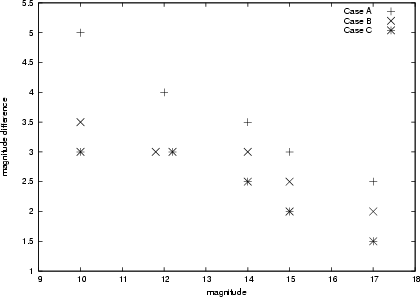
Figure 5:
Behaviour of the maximum magnitude difference
which
can be detected as a function of the magnitude m of the main component
- monolithic case. For the sake of clarity coincident points are represented
with a small horizontal shift. |
| Open with DEXTER |
Our results are summarized in Table 2 where the following notations
are used:
-
= maximum magnitude difference which can be detected;
-
= relative reconstruction error on the angular
separation;
-
= reconstructed magnitude difference.
Moreover in Fig. 5 we plot the behaviour of the magnitude
difference limit as a function of the magnitude of the main component, in the
three different cases.
Again the best results are obtained in the ideal case, even if the difference
between the three cases is not as significant as in the previous study
concerning angular separation. The reason probably is that,
in this study, we only require an improvement in resolution by a factor
of 2. The maximum difference in magnitude attainable
decreases with increasing values of the primary magnitude, namely with
decreasing SNR. Similarly, the error in estimating the magnitude
difference (i.e. the difference between
and
)
increases with decreasing SNR.
The magnitude difference is around 3 for the
brightest cases and is 1 even in the case of a binary with a
17th main component magnitude (hence corresponding to a binary star
combined magnitude of 16.6).
In the interferometric case, we follow
the same simulation strategy introduced in the monolithic case.
We investigate the minimum separation attainable in the case where
and the maximum difference magnitude attainable in the
case where the angular separation is
 ,
B now
being the maximum baseline of LBT. Again we consider three cases: A,
B, and C. In case A ideal interferometric PSFs are used
both for convolution (image formation) and deconvolution. In case B
the observed object (the unresolved binary system) is also used as the AO
guide star and therefore images are obtained by convolving the object
with the PSFs corresponding to a Strehl ratio of about 77% while the PSFs
corresponding to a Strehl ratio of about 66% are used for deconvolution
(see Fig. 3). In case C the role of the two sets
of PSFs is exchanged.
,
B now
being the maximum baseline of LBT. Again we consider three cases: A,
B, and C. In case A ideal interferometric PSFs are used
both for convolution (image formation) and deconvolution. In case B
the observed object (the unresolved binary system) is also used as the AO
guide star and therefore images are obtained by convolving the object
with the PSFs corresponding to a Strehl ratio of about 77% while the PSFs
corresponding to a Strehl ratio of about 66% are used for deconvolution
(see Fig. 3). In case C the role of the two sets
of PSFs is exchanged.
Table 3:
Summary of the results obtained in the case where the magnitude
difference between the two stars is zero - interferometric case.
Sep. is the minimum separation obtained in units of
,
where B is the maximum baseline of LBT.
As in the monolithic case we perform 10 000 iterations in Step 1 while the
iterations of Step 2 are pushed until clear separation of the two stars
is obtained. Again Step 3 is not required and we consider angular
separations which are integer multiples of the pixel size. Therefore our
accuracy is about
 .
Our numerical results are summarized
in Table 3.
.
Our numerical results are summarized
in Table 3.
 |
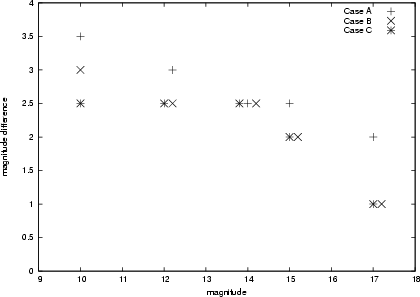
Figure 6:
Behaviour of the maximum magnitude difference limit
which
can be detected as a function of the magnitude m of the main
component - interferometric case. For the sake of clarity
coincident points are represented with a small horizontal shift. |
| Open with DEXTER |
These results look even better than those obtained in the monolithic case,
but one must take into account that each image of LBT has a higher
SNR than the image of the monolithic case (roughly a factor  )
and that we use three images corresponding to different baselines (see
the comment at the end of Sect. 3). The effect of this higher
SNR will be reconsidered in connection with the subsequent results.
At least for the brightest binaries, the amount of
super-resolution does not strongly depend on the amount of AO correction
and is considerable. As it is obvious, an improvement in resolution by a
factor of about 7 in the case m=10 is quite surprising; even if it will
not be attained in real observations, it indicates that LBT can be
compatible with a remarkable amount of super-resolution. This will probably
depend also on the orientation of the binary axis with respect to the
observation baselines, as can be expected from the angular coverage
study we made in Carbillet et al. (2002).
)
and that we use three images corresponding to different baselines (see
the comment at the end of Sect. 3). The effect of this higher
SNR will be reconsidered in connection with the subsequent results.
At least for the brightest binaries, the amount of
super-resolution does not strongly depend on the amount of AO correction
and is considerable. As it is obvious, an improvement in resolution by a
factor of about 7 in the case m=10 is quite surprising; even if it will
not be attained in real observations, it indicates that LBT can be
compatible with a remarkable amount of super-resolution. This will probably
depend also on the orientation of the binary axis with respect to the
observation baselines, as can be expected from the angular coverage
study we made in Carbillet et al. (2002).
Here one can appreciate the difference between the two AO-corrected cases,
namely B and C. Such a difference (case B permits a
higher amount of super-resolution for medium-high binary magnitude cases)
can be reasonably explained by the fact that in case B the images
correspond to PSFs with a higher AO correction and therefore intrinsically
contain more information than those of case C. As also
follows from Fig. 2, the difference between the two PSFs is much more
significant than that observed in the monolithic case.
To be very conservative we can conclude that a gain of a factor 5 in
resolution is clearly attainable in the brightest cases.
Table 4:
Summary of the results obtained in the case where the angular
separation of the two stars is
,
where
B is the maximum baseline of LBT.
In this simulation study the angular separation is fixed, as indicated above.
Moreover we use the same notations introduced in the monolithic case for
the maximum magnitude difference, the error on angular separation and the
reconstructed magnitude difference. Our numerical results are summarized
in Table 4. Moreover in Fig. 6 we plot
the behaviour of the magnitude difference limit as a function of the
magnitude of the main component, for the three cases we have considered.
Again we find better results than those obtained in the monolithic case.
However, if we compare the two tables, we find that in the interferometric
case we have an improvement of about one order of magnitude with respect to the
monolithic case and such an improvement is compatible with the higher
SNR of the interferometric images as discussed at the end of Sect. 3.
In this paper we have proposed an algorithm for the super-resolution of
stellar systems, with an application to binary stars. From a general point
of view we have shown that the well-known RL algorithm can be used for such
a purpose if it is joined with a suitable initialization of the iterations,
namely the mask of the domain where the unresolved object is localized.
We have shown that, in case of relatively high SNR (small magnitudes)
and relatively high AO correction, a gain of a factor from 4 to 5 in
resolution is clearly attainable. This would make similar the results from
an 8 m telescope, equipped with a high-order AO system and our deconvolution
method, to a 30 m future telescope, rescaling at least the object magnitude
because of the obvious differences. In an equivalent manner, this would
also allow comparison of a
telescope such as LBT in its interferometric mode to a 100 m Extremely
Large Telescope (ELT), or, more reasonably, to the VLTI with two Unit
Telescopes (UT) and a baseline of 50 m, considering that the limit
in resolution for a Michelson interferometer is typically
 .
.
However this remark does not mean that we propose Fizeau interferometers
as competitors to the Michelson ones for the analysis of, for instance,
binary systems. We only mean that an astronomer observing with LBT,
hence with a wide field of view (
 in the case of
the detector of the beam combiner LINC-NIRVANA), has a
method for investigating whether an unresolved stellar object in the field
has a structure or not and for attempting a quantitative analysis.
in the case of
the detector of the beam combiner LINC-NIRVANA), has a
method for investigating whether an unresolved stellar object in the field
has a structure or not and for attempting a quantitative analysis.
The crucial point in our approach is that it needs an oversampling
of the data which is not provided by the existing detectors. However, a
moderate oversampling will be available with the detectors designed for
the first light of LBT and for LINC-NIRVANA, as discussed below.
Therefore we performed a numerical experiment in order to verify
that the required oversampling can be obtained by a suitable
rebinning of the images. The experiment applies to the object of Fig. 1
and consists of the following steps:
- three LBT images, with a sampling distance of 1 mas, are
generated by convolving the object with ideal PSFs corresponding to
,
and ;
- the three images are rebinned to 5.12 mas (the sampling distance of
the detector of LINC-NIRVANA in K band) and then are perturbed with photon
and read-out noise;
- the noisy images are now re-rebinned to 1 mas;
- these final images are deconvolved with ideal PSFs.
In the third step the cubic interpolation provided by the standard IDL
routine congrid is used but, of course, more refined interpolation
methods could be devised.
The experiment was successfull, in the sense that the two binaries were
resolved and the accuracy in the estimation of the astrometric and
photometric parameters was still satisfactory. For instance we have a few
percent increase of the errors in the estimation of the angular separations;
as concerns the magnitude difference between the two binaries, we find
0.49 in the experiment of Fig. 1 and 0.4 in the rebinning experiment, the
correct value being 0.5. Of course our simulation does not correspond
exactly to the real detected images, but it is promising and
therefore we think that a rebinning strategy is a viable approach in
practice.
As an alternative to a numerical rebinning, one could also consider
dithering the data (see e.g. Fruchter & Hook 2001), although it can
be objected that this is probably not necessary since it does not add
information if the images are already sampled well beyond the Nyquist
limit. The super-resolution capabilities come from the fact that the
deconvolution algorithm tries to extrapolate information down to the pixel
limit, hence a numerical rebinning is probably sufficient. A study of
these two techniques, possibly combined to obtain over-sampled
data is beyond the scope of this paper but will soon be the object of further
study.
The results we have derived in the monolithic case could be applied to
observations with the first-light AO system of LBT together with the
near-infrared instrument LUCIFER (Mandel et al. 2001). Since the
pixel size of this instrument is 15 mas in J, H, K band and since
the resolution is 55 mas in K band, we see that the conditions for
applying the rebinning procedure outlined above are satisfied.
The same remark applies to interferometric observations with LINC-NIRVANA
in its single-conjugated AO configuration, since the pixel size will be
5.12 mas in J, H, K band, with a resolution of 20 mas in K band.
Another important problem is the PSFs determination, i. e. the
obtention of a suitable reference star for the PSF estimation and subsequent
deconvolution of the scientific images. This problem could in some cases
lower the performances evoked in this paper. Nevertheless, if a suitable
star is not present in the field of view of the detector, this problem
could be addressed by changing the pointing of the telecope in a
reasonable time, as is done routinely in speckle imaging (see, for
instance, Carbillet et al. 1996; Aristidi et al. 1997) to
take images of point-like sources.
A last crucial point in our approach is the choice of the mask, which is
fundamental for obtaining a good reconstruction. In the module DEC of
the software package AIRY, where we have implemented our approach, we
allow three possible choices: a circular mask with diameter equal to the
resolution limit of the telescope; a mask defined by a thresholding of
the image reconstructed in Step 1, the threshold being selected by the
user, and a user-defined mask. The first mask is useful when artifacts, clearly
due to noise amplification, are present outside the region of interest
while the second one requires the choice of the threshold. No precise rule
can be given for this but, in general, one must look for a
threshold between 30 and 50% of the maximum value of the reconstructed
image.
Acknowledgements
We wish to thank Serge Correia for fruitful interaction and early work
on this super-resolution algorithm, and Piero Salinari for
useful discussions on this topic in the framework of the LBT telescope.
- Anconelli, B., Bertero, M.,
Boccacci, P., Carbillet, M., & Lanteri, H. 2005, A&A, 430,
731 [EDP Sciences] [CrossRef] (In the text)
- Aristidi, É.,
Carbillet, M., Prieur, J.-P., et al. 1997, A&AS, 126, 555 [NASA ADS] (In the text)
- Bertero M., & Boccacci,
P. 1998, Introduction to Inverse Problems in Imaging (Bristol: IOP
Publishing)
(In the text)
- Bertero, M., &
Boccacci, P. 2000a, A&AS, 144, 181 [NASA ADS] (In the text)
- Bertero, M., &
Boccacci, P. 2000b, A&AS, 147, 323 [NASA ADS]
- Bertero, M., & De Mol,
C. 1996, in Progress in Optics 36, ed. E. Wolf, 129
(In the text)
- Bertero, M., & Pike, E.
R. 1982, Optica Acta, 29, 727 [MathSciNet] (In the text)
- Carbillet, M., Ricort,
G., Aime, C., & Perrier, Ch. 1997, A&A, 310, 508 [NASA ADS] (In the text)
- Carbillet, M., Correia,
S., Boccacci, P., & Bertero, M. 2002, A&A, 387, 744 [EDP Sciences] [NASA ADS] [CrossRef] (In the text)
- Carbillet, M.,
Vérinaud, C., Esposito, S., et al. 2003, in Proc. SPIE 4839,
ed. P. L. Winizowitch, & D. Bonaccini, 131
(In the text)
- Carbillet, M.,
Vérinaud, C., Femenía, B., et al. 2004, MNRAS, in
press
(In the text)
- Correia, S., Carbillet, M.,
Boccacci, P., Bertero, M., & Fini, L. 2002, A&A, 387,
733 [EDP Sciences] [NASA ADS] [CrossRef] (In the text)
- Donoho, D. L. 1992, SIAM J.
Math. Anal., 23, 1309 [MathSciNet] (In the text)
- Donoho, D. L., Johnstone,
I. M., Hoch, J. C., & Stern, A. S. 1992, J. R. Statist. Soc.,
B54, 41 (In the text)
- Esposito, S., Tozzi, A.,
Feruzzi, D., et al. 2003, in Proc. SPIE 4839, ed. P. L.
Winizowitch, & D. Bonaccini, 164
(In the text)
- Fruchter, A. S., & Hook,
R. N. 2001, http://xxx.lanl.gov/abs/astro-ph/9808087
(In the text)
- Harris, J. L. 1964, J.
Opt. Soc. Am., 54, 931 (In the text)
- Herbts, T. M.,
Andersen, D., Bizenberger, P., et al. 2003, in Proc. SPIE 4838, ed
W. A. Traub, 456
(In the text)
- Hudson, H. M., &
Larkin, R. S. 1994, IEEE Trans. Med. Im., 13, 601 (In the text)
- Lucy, L. B. 1974, AJ, 79,
745 [NASA ADS] [CrossRef] (In the text)
- Lucy, L. B. 1992a, A&A,
261, 706 [NASA ADS] (In the text)
- Lucy, L. B. 1992b, AJ, 104,
1260 [NASA ADS] [CrossRef]
- Mandel, H., Appenzeller, I.,
Bomans, D., et al. 2001, in Proc. SPIE 4008, ed. M. Iye, & A.
F. Moorwood, 767
(In the text)
- McCutchen, C. W. 1967, J.
Opt. Soc. Am., 57, 1190 (In the text)
- Ragazzoni, R., Herbst, T.,
Andersen, D., et al. 2003, in Proc. SPIE 4839, ed. P. L.
Winizowitch, & D. Bonaccini, 536
(In the text)
- Riccardi, A., Brusa, G.,
Salinari, P., et al. 2003, in Proc. SPIE 4839, ed. P. L.
Winizowitch, & D. Bonaccini, 721
(In the text)
- Richardson, W. H.
1972, J. Opt. Soc. Am., 62, 55 [NASA ADS] (In the text)
- Rushforth, C. K., &
Harris, R. W. 1968, J. Opt. Soc. Am., 58, 539 (In the text)
- Shepp, L. A., &
Vardi, Y. 1982, IEEE Trans. Med. Im., 1, 113 (In the text)
- Toraldo di Francia,
G. 1955, J. Opt. Soc. Am., 45, 497 (In the text)
- Wolter, H. 1961, in
Progress in Optics 1, ed. E. Wolf, 155
(In the text)
Copyright ESO 2005
![\begin{figure}
\par\begin{tabular}{c}
\includegraphics[height=3cm,clip]{0366fg4...
...\includegraphics[height=3cm,clip]{0366fg4c.ps}\\
c)
\end{tabular}\end{figure}](/articles/aa/full/2005/08/aa0366-04/img35.gif)