![[*]](/icons/foot_motif.gif)
P. Rodríguez-Gil1 - B. T. Gänsicke1 - H.-J. Hagen2 - T. R. Marsh1 - E. T. Harlaftis3 - S. Kitsionas4 - D. Engels2
1 - Department of Physics, University of Warwick, Coventry CV4 7AL, UK
2 -
Hamburger Sternwarte, Universität Hamburg, Gojenbergsweg 112,
21029 Hamburg, Germany
3 -
Institute of Space Applications and Remote Sensing, National
Observatory of Athens, PO Box 20048, Athens 11810, Greece
4 -
Institute of Astronomy and Astrophysics, National Observatory of Athens,
PO Box 20048, Athens 11810, Greece
Received 17 September 2004 / Accepted 28 September 2004
Abstract
We report the discovery of a new, non-eclipsing SU UMa-type dwarf nova,
HS 2219+1824. Photometry obtained in quiescence (
 )
reveals a double-humped light curve from which we derive an orbital
period of
)
reveals a double-humped light curve from which we derive an orbital
period of  86.2 min. Additional photometry obtained during a
superoutburst reaching
86.2 min. Additional photometry obtained during a
superoutburst reaching
 clearly shows superhumps with a
period of 89.05 min. The optical spectrum contains
double-peaked Balmer and He I emission lines from the accretion
disc as well as broad absorption troughs of
clearly shows superhumps with a
period of 89.05 min. The optical spectrum contains
double-peaked Balmer and He I emission lines from the accretion
disc as well as broad absorption troughs of
 ,
,
 ,
and
,
and
 from the white dwarf primary star. Modelling of the optical spectrum implies
a white dwarf temperature of
from the white dwarf primary star. Modelling of the optical spectrum implies
a white dwarf temperature of
 ,
a distance of
,
a distance of
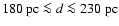 ,
and suggests that the
spectral type of the donor star is later than M 5. Phase-resolved
spectroscopy obtained during quiescence reveals a narrow
,
and suggests that the
spectral type of the donor star is later than M 5. Phase-resolved
spectroscopy obtained during quiescence reveals a narrow
 emission
line component which has a radial velocity amplitude and phase
consistent with an origin on the secondary star, possibly on the
irradiated hemisphere facing the white dwarf. This constitutes the first detection of line emission from the secondary star in a quiescent SU UMa star.
emission
line component which has a radial velocity amplitude and phase
consistent with an origin on the secondary star, possibly on the
irradiated hemisphere facing the white dwarf. This constitutes the first detection of line emission from the secondary star in a quiescent SU UMa star.
Key words: accretion, accretion disks - stars: binaries: close - stars: individual: HS 2219+1824 - stars: novae, cataclysmic variables - stars: dwarf novae
Here we report the discovery of a new short-period, SU UMa-type dwarf
nova with a long recurrence time between outbursts, HS 2219+1824. This system belongs to the
relatively small group of dwarf novae whose optical spectra clearly
reveal the photospheric emission of their white dwarf primary stars. More
exceptional is, however, the fact that we detect in the quiescent
spectrum of HS 2219+1824 a narrow
emission line component which we
believe to originate on the secondary star.
By inspection of the available sky surveys we discovered that the
USNO-A2.0 catalogue shows HS 2219+1824 in outburst with
B=12.9 and R=13.6. Both DSS 1 and DSS 2 show the system in
quiescence. ASAS-3 (Pojmanski 2001) monitored
HS 2219+1824 on 72 occasions between April 2003 and August
2004, and detected the July 2003 August superoutburst (also observed by us) as well as a second superoutburst reaching
 on June 24 2004. Even
though sparse, the data collected so far shows that
HS 2219+1824 does not belong to the class of
WZ Sge dwarf novae with recurrence times of tens of
years. So far, no normal outburst of HS 2219+1824 has been
recorded.
on June 24 2004. Even
though sparse, the data collected so far shows that
HS 2219+1824 does not belong to the class of
WZ Sge dwarf novae with recurrence times of tens of
years. So far, no normal outburst of HS 2219+1824 has been
recorded.
We describe our observational data in Sect. 2, the analysis of the photometry and spectroscopy in Sects. 3 and 4, respectively, and discuss on the system parameters of HS 2219+1824 in Sect. 5.
Table 1: Log of observations.
![\begin{figure}
\par\includegraphics[width=7cm,clip]{2026fig1.eps}
\end{figure}](/articles/aa/full/2005/07/aa2026/img27.gif) |
Figure 1:
 finding chart of
HS 2219+1824 obtained from the Digitized Sky Survey 2. The
coordinates of the CV are
finding chart of
HS 2219+1824 obtained from the Digitized Sky Survey 2. The
coordinates of the CV are
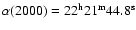 , ,
 .
The star "C'' has been
used as comparison for all the differential photometric data. .
The star "C'' has been
used as comparison for all the differential photometric data. |
| Open with DEXTER | |
 slit, providing a spectral
resolution of 10 Å (FWHM). A standard reduction of these data was
carried out using the CAFOS MIDAS quicklook package. The
detection of strong Balmer emission lines confirmed the CV nature of
HS 2219+1824 and triggered the additional follow-up observations
described below. The CAFOS acquisition image obtained just before the
B-200/R-200 spectroscopy showed HS 2219+1824 at
slit, providing a spectral
resolution of 10 Å (FWHM). A standard reduction of these data was
carried out using the CAFOS MIDAS quicklook package. The
detection of strong Balmer emission lines confirmed the CV nature of
HS 2219+1824 and triggered the additional follow-up observations
described below. The CAFOS acquisition image obtained just before the
B-200/R-200 spectroscopy showed HS 2219+1824 at
 .
.
 pixel2 CCD camera
(Table 1). Aperture photometry was carried out on all
images using the MIDAS & SEXTRACTOR
(Bertin & Arnouts 1996) pipeline described by
Gänsicke et al. (2004). The differential magnitudes of
HS 2219+1824 were derived relative to the comparison star
USNO-A2.0 1050-20233792, labelled "C'' in Fig. 1. The
differential measurements were converted into R-band magnitudes
using the USNO-A2.0 magnitude of the comparison star,
pixel2 CCD camera
(Table 1). Aperture photometry was carried out on all
images using the MIDAS & SEXTRACTOR
(Bertin & Arnouts 1996) pipeline described by
Gänsicke et al. (2004). The differential magnitudes of
HS 2219+1824 were derived relative to the comparison star
USNO-A2.0 1050-20233792, labelled "C'' in Fig. 1. The
differential measurements were converted into R-band magnitudes
using the USNO-A2.0 magnitude of the comparison star,
 .
The main source of uncertainty in this
conversion is the uncertainty in the USNO magnitudes, which is
typically 0.2 mag.
.
The main source of uncertainty in this
conversion is the uncertainty in the USNO magnitudes, which is
typically 0.2 mag.
 1024 pixel2 CCD camera and no filter. Exposure times
of 12 and 15 s (depending on sky transparency) were adopted and
1024 pixel2 CCD camera and no filter. Exposure times
of 12 and 15 s (depending on sky transparency) were adopted and
 binning and windowing were applied to improve the time
resolution. The raw images were de-biased and flat-field compensated,
and the instrumental magnitudes were obtained with the Point Spread
Function (PSF)-fitting packages within
IRAF. Differential
light curves were then computed relative to the same comparison star
used for the Kryoneri data.
binning and windowing were applied to improve the time
resolution. The raw images were de-biased and flat-field compensated,
and the instrumental magnitudes were obtained with the Point Spread
Function (PSF)-fitting packages within
IRAF. Differential
light curves were then computed relative to the same comparison star
used for the Kryoneri data.
The second night of observation at the OGS telescope offered us an unusually bright HS 2219+1824. Comparison with the brightness measured on the previous night showed that the object had brightened by nearly four magnitudes, indicating that an outburst was in progress. The subsequent detection of superhumps (see Fig. 2 and Sect. 3.2) confirmed that the brightening was actually an SU UMa-like superoutburst.
The July 2003 superoutburst was also recorded by ASAS-3 (Pojmanski 2001), and the V magnitudes from the ASAS-3 archive are plotted along with the OGS data in Fig. 2.
![\begin{figure}
\par\includegraphics[angle=-90,width=8.8cm,clip]{2026fig2.ps}
\end{figure}](/articles/aa/full/2005/07/aa2026/img33.gif) |
Figure 2:
Superoutburst of HS 2219+1824 recorded
at the OGS telescope. Superhumps set in  1 d after the outburst
maximum. The filterless magnitudes are approximatively equivalent to
V-band data. Shown as open triangles are the V magnitudes of
HS 2219+1824 from the ASAS-3 archive. 1 d after the outburst
maximum. The filterless magnitudes are approximatively equivalent to
V-band data. Shown as open triangles are the V magnitudes of
HS 2219+1824 from the ASAS-3 archive. |
| Open with DEXTER | |
1024 pixel2 CCD camera and an exposure time of
70 s (Table 1). Only a small part of the CCD was read
out (in binning
mode) in order to improve the time
resolution. The data were reduced in the same fashion as described
above for the OGS (Sect. 2.3). Differential magnitudes
of HS 2219+1824 were derived using the comparison star "C''
(Fig. 1). The average magnitude of 17.5 mag
indicates that HS 2219+1824 was in quiescence during the
IAC80 observations.
![\begin{figure}
\par\includegraphics[angle=-90,width=8.6cm,clip]{2026fig3.ps}
\end{figure}](/articles/aa/full/2005/07/aa2026/img34.gif) |
Figure 3: Sample light curves of HS 2219+1824 obtained during thesuperoutburst ( top panel) and in quiescence ( bottom panel). |
| Open with DEXTER | |
 pixel2 EEV12 CCD camera, while the R316Rgrating and the
 pixel2 Marconi CCD were in place
on the red arm. A 1
pixel2 Marconi CCD were in place
on the red arm. A 1
 slit gave a spectral resolution of 1.8 and
3.2 Å (FWHM), respectively, covering the wavelength ranges
slit gave a spectral resolution of 1.8 and
3.2 Å (FWHM), respectively, covering the wavelength ranges
 and
and
 .
The small
pixel size of both detectors produces oversampling of the best
possible resolution, so we applied a
.
The small
pixel size of both detectors produces oversampling of the best
possible resolution, so we applied a  binning (dispersion
direction) on both chips. This increased the signal in each wavelength
bin without losing spectral resolution.
binning (dispersion
direction) on both chips. This increased the signal in each wavelength
bin without losing spectral resolution.
A total of 28 blue and red spectra were obtained with an exposure time of 400 s (see Table 1). Spectra of the combined light of Cu-Ar and Cu-Ne arc lamps were taken regularly in order to achieve an optimal wavelength calibration. The raw images were de-biased, flat-fielded and sky-subtracted in the standard way. The target spectra were then optimally extracted (Horne 1986). These reduction processes were carried out within IRAF. A third-order polynomial was fitted to the arc wavelength-pixel function, the rms being always less than one tenth of the spectral dispersion on each arm.
![\begin{figure}
\par\includegraphics[angle=-90,width=17.6cm,clip]{2026fig4.ps}
\end{figure}](/articles/aa/full/2005/07/aa2026/img41.gif) |
Figure 4: Left and middle panels: AOV periodograms of the entire quiescent data (Kryoneri and IAC80). Right panel: AOV periodogram of the superoutburst data (OGS, 2003 July 11, 14 and 16). |
| Open with DEXTER | |
0.05 mag and a period
of 40 min (bottom panel of Fig. 3). The
analysis-of-variance periodograms (AOV,
Schwarzenberg-Czerny 1989) computed from the Kryoneri and IAC80 quiescent data
(Fig. 4) confirm this visual estimate, showing strong
signals at 43.1 min (33.4
 )
and 44.6 min
(32.3
). Significant power is also found at twice these
periods. By analogy to a number of
short-period CVs which show quiescent orbital light curves dominated
by a double-humped structure (WX Cet: Mennickent 1994; WZ Sge: Patterson 1998; RZ Leo, BC UMa, MM Hya, HV Vir:
Patterson et al. 2003; HS 2331+3905:
Araujo-Betancor et al. 2005), we identify the 43.1/44.6 min
photometric periodicity with orbital variability, and hence
)
and 44.6 min
(32.3
). Significant power is also found at twice these
periods. By analogy to a number of
short-period CVs which show quiescent orbital light curves dominated
by a double-humped structure (WX Cet: Mennickent 1994; WZ Sge: Patterson 1998; RZ Leo, BC UMa, MM Hya, HV Vir:
Patterson et al. 2003; HS 2331+3905:
Araujo-Betancor et al. 2005), we identify the 43.1/44.6 min
photometric periodicity with orbital variability, and hence
 min
or
min
or
 min.
min.
15.17
(94.92 min) and 16.17
(89.05 min). Both signals significantly differ from the two
possible orbital periods determined from the quiescent photometry. The longer period (
 )
and the shape of the outburst light curve are characteristic of a superhump wave, triggered by the precession of an eccentric accretion disc.
The fractional period excess
)
and the shape of the outburst light curve are characteristic of a superhump wave, triggered by the precession of an eccentric accretion disc.
The fractional period excess
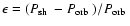 is
is
 % for
(
% for
(
 min,
min,
 min), and
 % for
(
% for
(
 min,
min,
 min). No dwarf nova with
 % is known below the period gap
(Patterson et al. 2003), which strongly suggests that
min
and
min are indeed the orbital and superhump periods of
HS 2219+1824. In Fig. 5 we show the superoutburst and quiescent light curves folded on 89.05 and 86.2 min, respectively.
% is known below the period gap
(Patterson et al. 2003), which strongly suggests that
min
and
min are indeed the orbital and superhump periods of
HS 2219+1824. In Fig. 5 we show the superoutburst and quiescent light curves folded on 89.05 and 86.2 min, respectively.
![\begin{figure}
\par\includegraphics[angle=-90,width=8.8cm,clip]{2026fig5.ps}
\end{figure}](/articles/aa/full/2005/07/aa2026/img54.gif) |
Figure 5:
Top panel: superoutburst photometry
obtained on 2003 July 11, 14 and 16 folded over the superhump period of
min and averaged into 40 phase bins. Bottom panel:
quiescent photometry (Kryoneri 2002 and IAC80 2003) folded over the
orbital period of 86.2 min and averaged into 40 phase bins. In both
cases, the mean magnitude of each individual night was subtracted
before folding and binning. The orbital cycle has been duplicated for continuity. |
| Open with DEXTER | |
![\begin{figure}
\par\includegraphics[angle=-90,width=8.7cm,clip]{2026fig6.ps}
\end{figure}](/articles/aa/full/2005/07/aa2026/img55.gif) |
Figure 6: Discovery spectrum of HS 2219+1824, obtained with the 2.2 m Telescope at Calar Alto. |
| Open with DEXTER | |
to
are embedded in very broad absorption troughs. Similar
broad Balmer absorption lines have been detected in a number of other
short period dwarf novae, e.g. WZ Sge (Greenstein 1957; Gilliland et al. 1986), GW Lib (Duerbeck & Seitter 1987), BC UMa
(Mukai et al. 1990), or BW Scl (Abbott et al. 1997). In all
these systems the hypothetical identification of the observed Balmer
absorption as the photospheric spectrum of the white dwarf has been confirmed by
the unambiguous detection of the white dwarf at ultraviolet
wavelengths (Gänsicke et al. 2004; Szkody et al. 2002; Sion et al. 1990).
The continuum displays a rather blue slope shortwards of
,
and a
nearly flat slope at the red end of our spectrum. No strong TiO
absorption lines, typical of mid-to-late M dwarfs are detected in the
red part of the spectrum.
The emission lines are clearly double-peaked in the higher resolution
WHT spectra (Fig. 7), a clear indication of the presence
of an accretion disc in the system. Figure 7
illustrates the evolution of the
profile throughout our 2003
October 19 WHT/ISIS observations. The relative strength of the two
peaks clearly changes with time, possibly indicating the presence of
an emission S-wave moving inside the double peaks. Remarkably, many of
the profiles seem to have three peaks, revealing the presence of
another emission component in the lines (see right panel of
Fig. 7).
![\begin{figure}
\par\includegraphics[width=8.8cm,clip]{2026fig7.ps}
\end{figure}](/articles/aa/full/2005/07/aa2026/img56.gif) |
Figure 7:
Left panel: evolution of the
profile during the WHT/ISIS observations. The time co-ordinate
runs from UT 19:35 to UT 22:58 (see Table 1). Right
panel: selected
profile displaying three peaks. |
| Open with DEXTER | |
 (0.6
(0.6
 ). The radius of the white dwarf is
determined from the Hamada & Salpeter (1961) mass-radius relation,
). The radius of the white dwarf is
determined from the Hamada & Salpeter (1961) mass-radius relation,
 cm. Free parameters in the model are the white
dwarf effective temperature,
cm. Free parameters in the model are the white
dwarf effective temperature,
 ,
and the distance to
HS 2219+1824. For the accretion disc, we use the isothermal/isobaric
hydrogen slab model described by Gänsicke et al. (1997,1999). Free parameters are the temperature of the slab
,
and the distance to
HS 2219+1824. For the accretion disc, we use the isothermal/isobaric
hydrogen slab model described by Gänsicke et al. (1997,1999). Free parameters are the temperature of the slab
 ,
the column density along the line of sight
,
the column density along the line of sight  ,
and a
flux scaling factor
,
and a
flux scaling factor  .
For the secondary star, we use the
observed spectra of late-type main sequence stars from
Beuermann et al. (1998) as templates. We assume an equivalent
Roche-lobe radius of the secondary star of
.
For the secondary star, we use the
observed spectra of late-type main sequence stars from
Beuermann et al. (1998) as templates. We assume an equivalent
Roche-lobe radius of the secondary star of
 cm,
which corresponds to a mass ratio of
cm,
which corresponds to a mass ratio of
 at the orbital
period of HS 2219+1824 (see the discussion in
Sect. 5). Free parameters for the secondary
star component are the spectral type Sp(2) and the distance to the
system.
at the orbital
period of HS 2219+1824 (see the discussion in
Sect. 5). Free parameters for the secondary
star component are the spectral type Sp(2) and the distance to the
system.
![\begin{figure}
\par\includegraphics[angle=-90,width=8.7cm,clip]{2026fig8.ps}
\end{figure}](/articles/aa/full/2005/07/aa2026/img68.gif) |
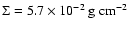
Figure 8:
Three-component model of the optical
spectrum of HS 2219+1824. The observed spectrum is the topmost grey
line. The grey lines below are a white dwarf model spectrum for
 K,
,
and d=215 pc (broad absorption
lines), the emission from an isothermal/isobaric slab with K,
,
and d=215 pc (broad absorption
lines), the emission from an isothermal/isobaric slab with
 K and K and
 ,
scaled to the observed
flux (emission lines). The secondary
star is represented by a M 6 template, assuming
cm and d=215 pc. The sum of the three
components is plotted as black line. ,
scaled to the observed
flux (emission lines). The secondary
star is represented by a M 6 template, assuming
cm and d=215 pc. The sum of the three
components is plotted as black line. |
| Open with DEXTER | |
We started modelling the observed optical spectrum of HS 2219+1824
by matching the width and depth of the
to
absorption
profiles with a synthetic white dwarf spectrum, and find
 K and
K and
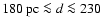 pc - with the white dwarf contributing 65% at
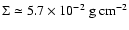
5500 Å. In a second step, we add the emission of the isobaric slab,
scaling it to the observed
flux. The main parameter determining
the Balmer decrement is
,
the optical depth ratio between the
emission lines and the continuum primarily depends on .
An
adequate match is found for
pc - with the white dwarf contributing 65% at
5500 Å. In a second step, we add the emission of the isobaric slab,
scaling it to the observed
flux. The main parameter determining
the Balmer decrement is
,
the optical depth ratio between the
emission lines and the continuum primarily depends on .
An
adequate match is found for
 K and
K and
 .
The "disc''
temperature is the canonical temperature expected for low mass
transfer discs (Williams 1980). For a distance of
.
The "disc''
temperature is the canonical temperature expected for low mass
transfer discs (Williams 1980). For a distance of
 pc, the radius of the "disc'' implied by the flux
scaling factor is
pc, the radius of the "disc'' implied by the flux
scaling factor is
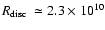 cm, well within the
Roche-lobe radius of the primary. This radius should, however, only be
considered as a rough estimate, as it is based on the assumption of our
very simplistic model for the disc emission. Finally, we add the
spectral contribution of the secondary star. The observed flux at the
red end of the optical spectrum constrains Sp(2) to be later than M 5
for a distance of
pc. A model for
K,
Sp(2) = M 6.0, d=215 pc and the disc parameters as above is shown
in Fig. 8.
cm, well within the
Roche-lobe radius of the primary. This radius should, however, only be
considered as a rough estimate, as it is based on the assumption of our
very simplistic model for the disc emission. Finally, we add the
spectral contribution of the secondary star. The observed flux at the
red end of the optical spectrum constrains Sp(2) to be later than M 5
for a distance of
pc. A model for
K,
Sp(2) = M 6.0, d=215 pc and the disc parameters as above is shown
in Fig. 8.
![\begin{figure}
\par\includegraphics[width=8.7cm,clip]{2026fig9.ps}
\end{figure}](/articles/aa/full/2005/07/aa2026/img75.gif) |
Figure 9:
Top:
radial velocity curves of
HS 2219+1824 in quiescence computed from the line wings
( filled circles) and the narrow component ( open triangles). Bottom: Scargle
periodogram of the
wing velocities. |
| Open with DEXTER | |
The light curves obtained during quiescence revealed a double-humped
variation at 86.2 min (see Sect. 3.1). In order to confirm
that this value represents the actual orbital period of
HS 2219+1824 we have analysed the radial velocity variations
of the
emission line, since this line is the least affected by the
broad absorption. Prior to measuring the velocities the individual
spectra were normalised using a low-order spline fit to the
continuum. The emission lines and the broad absorptions were masked
off the fitting procedure. We then resampled all the spectra on to an
uniform velocity scale centred on the
rest wavelength. We
computed the radial velocity curves of
using the technique of
Schneider & Young (1980) for a Gaussian FWHM of 300
 and
different values of the Gaussian separation (
a=1200-2600
in
steps of 100
), following the technique of "diagnostic diagrams''
(Shafter et al. 1995; Shafter 1983). A sine function was fitted to
each curve to establish the K1 velocity, and we find the maximum
useful separation to be
and
different values of the Gaussian separation (
a=1200-2600
in
steps of 100
), following the technique of "diagnostic diagrams''
(Shafter et al. 1995; Shafter 1983). A sine function was fitted to
each curve to establish the K1 velocity, and we find the maximum
useful separation to be
 ,
where
,
where
 .
The
radial velocity curve obtained is shown in the top
panel of Fig. 9 (plotted as filled circles). A Scargle periodogram
(Scargle 1982) of the velocities produced a broad peak centred at
a period of 85 min. A sine fit to the curve yielded a period of
.
The
radial velocity curve obtained is shown in the top
panel of Fig. 9 (plotted as filled circles). A Scargle periodogram
(Scargle 1982) of the velocities produced a broad peak centred at
a period of 85 min. A sine fit to the curve yielded a period of
 min, which is consistent with the more accurate
photometric determination of
min.
min, which is consistent with the more accurate
photometric determination of
min.
For the time being, we follow the usual convention and assume that
high-velocity wings of the double-peaked emission lines originate in
the inner accretion disc, and track the orbital motion of the white
dwarf. A sine fit of the form
![$\gamma_1 -
K_1~\sin\left[2\pi(t-T_{(1)0})/\mbox{$P_{\rm orb}$ }\right]$](/articles/aa/full/2005/07/aa2026/img80.gif) to the
radial
velocity curve shown in Fig. 9 gives
to the
radial
velocity curve shown in Fig. 9 gives
 (HJD),
 and
and
 ,
with the orbital period fixed to 86.2 min. The
amplitude K1 is quite typical for the radial velocity variation of
the emission line wings observed in short-period CVs
(e.g. Thorstensen & Fenton 2003). The lack of eclipses in
HS 2219+1824 does not allow us to establish absolute orbital
phases. However, under the assumption that the wings of the emission
lines come from disc material orbiting close to the white dwarf, the
red-to-blue crossing of the radial velocities provides a rough
estimate of the instant of inferior conjunction of the donor star
(i.e. zero phase).
,
with the orbital period fixed to 86.2 min. The
amplitude K1 is quite typical for the radial velocity variation of
the emission line wings observed in short-period CVs
(e.g. Thorstensen & Fenton 2003). The lack of eclipses in
HS 2219+1824 does not allow us to establish absolute orbital
phases. However, under the assumption that the wings of the emission
lines come from disc material orbiting close to the white dwarf, the
red-to-blue crossing of the radial velocities provides a rough
estimate of the instant of inferior conjunction of the donor star
(i.e. zero phase).
The triple-peaked shape of the
profiles
(Fig. 7) suggests the presence of an additional
narrow emission line component. This feature is intense enough to
follow its motion by eye through almost all the individual
profiles. We measured the velocities of this component by fitting
single Gaussians after masking the rest of the line. The resulting
radial velocity curve is presented in Fig. 9 (plotted as open triangles).
A sine fit to the velocities of the narrow component with the orbital
period fixed provided
 and
and
 ,
but this time the curve is delayed by 0.4 orbital cycle
with respect to the assumed zero phase. If the phasing of the radial
velocity curve obtained from the
wings indeed reflects the
primary's motion, then the narrow emission originates at a location
offset by
,
but this time the curve is delayed by 0.4 orbital cycle
with respect to the assumed zero phase. If the phasing of the radial
velocity curve obtained from the
wings indeed reflects the
primary's motion, then the narrow emission originates at a location
offset by
 in azimuth from the white dwarf. A very
likely source for a narrow emission line is the secondary star. The
velocity amplitude of the narrow component is much larger than that of
the broad line wings, in fact, K2=257
is not unexpected for
the orbital motion of the low-mass companion in a short period CV. We
thus identify this narrow emission component as chromospheric emission
from the donor star, possibly due to irradiation from the white
dwarf/inner disc. Whereas narrow emission from the secondary star has
been identified in short period dwarf novae during outburst
(e.g. Steeghs et al. 2001), HS 2219+1824 is the first
SU UMa dwarf nova where line emission from the secondary star is
unambiguously detected in quiescence.
in azimuth from the white dwarf. A very
likely source for a narrow emission line is the secondary star. The
velocity amplitude of the narrow component is much larger than that of
the broad line wings, in fact, K2=257
is not unexpected for
the orbital motion of the low-mass companion in a short period CV. We
thus identify this narrow emission component as chromospheric emission
from the donor star, possibly due to irradiation from the white
dwarf/inner disc. Whereas narrow emission from the secondary star has
been identified in short period dwarf novae during outburst
(e.g. Steeghs et al. 2001), HS 2219+1824 is the first
SU UMa dwarf nova where line emission from the secondary star is
unambiguously detected in quiescence.
We will adopt the new
 (HJD) as the
time of inferior conjunction of the secondary. The radial velocity
curves of the disc and secondary emissions folded on the orbital
period are shown in Fig. 10. The phase offset between
both velocity curves is not exactly 0.5 cycle, which is not surprising
as neither the velocity curves are perfectly sinusoidal nor are the
emissions expected to come from the centres of the stellar components
of the binary. Similar phase shifts have been observed in other
systems before (e.g. Stover et al. 1981).
(HJD) as the
time of inferior conjunction of the secondary. The radial velocity
curves of the disc and secondary emissions folded on the orbital
period are shown in Fig. 10. The phase offset between
both velocity curves is not exactly 0.5 cycle, which is not surprising
as neither the velocity curves are perfectly sinusoidal nor are the
emissions expected to come from the centres of the stellar components
of the binary. Similar phase shifts have been observed in other
systems before (e.g. Stover et al. 1981).
![\begin{figure}
\par\includegraphics[width=8.5cm,clip]{2026fg10.ps}
\end{figure}](/articles/aa/full/2005/07/aa2026/img91.gif) |
Figure 10:
radial velocity curves of the line
wings and the chromospheric emission from the companion. The
velocities are folded on the orbital period using
T0=2 452 932.3485(HJD) and no phase binning has been applied. The orbital cycle has
been plotted twice for continuity. |
| Open with DEXTER | |
We have constructed trailed spectrograms of the
,
and
lines
from the continuum-normalised data. In order to enhance the
signal-to-noise ratio we averaged the spectra into 20 orbital phase bins. The diagrams are presented in
Fig. 11. All the lines clearly show the alternating
changes in intensity of the double-peaked profiles. This is especially
obvious in
,
which also reveals the narrow
emission component from the irradiated secondary with maximum
excursion to the blue at
 .
Another emission S-wave
is visible in
moving in between the double peaks. This component
has the expected phasing for line emission from the bright spot
region, with maximum blue velocity at
.
Another emission S-wave
is visible in
moving in between the double peaks. This component
has the expected phasing for line emission from the bright spot
region, with maximum blue velocity at
 ,
and is
strongest during the first half of the orbital cycle.
,
and is
strongest during the first half of the orbital cycle.
In order to map the line emission distribution in velocity space we
computed Doppler maps of
,
and
using the maximum entropy
technique developed by Marsh & Horne (1988). The tomograms are shown
in Fig. 12. All the maps show a ring of emission,
revealing the presence of an accretion disc. There is an emission spot
in the
map located at
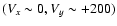 ,
where emission
from the secondary star is expected to be located in velocity
space. This strongly supports our hypothesis of an origin of the
narrow component seen in
on the donor star in
HS 2219+1824. Another emission spot is clearly seen in
and
,
superimposed on the disc emission at
,
where emission
from the secondary star is expected to be located in velocity
space. This strongly supports our hypothesis of an origin of the
narrow component seen in
on the donor star in
HS 2219+1824. Another emission spot is clearly seen in
and
,
superimposed on the disc emission at
 .
It is located close to the expected
position of the bright spot, as its phasing in the trailed spectra
already suggested. A third spot at
.
It is located close to the expected
position of the bright spot, as its phasing in the trailed spectra
already suggested. A third spot at
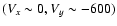 can
be seen in the
and
tomograms, but the corresponding S-wave is
not evident in the trailed spectra diagrams.
can
be seen in the
and
tomograms, but the corresponding S-wave is
not evident in the trailed spectra diagrams.
![\begin{figure}
\par\includegraphics[width=8.6cm,clip]{2026fg11.ps}
\end{figure}](/articles/aa/full/2005/07/aa2026/img96.gif) |
Figure 11:
,
and
trailed spectra
diagrams. The spectra have been folded on the orbital period and
averaged into 20 phase bins. Notice the narrow
emission component
from the secondary star. Another emission component with maximum blue
velocity at
is evident in
.
Dark represents
emission and a full cycle has been repeated for continuity. |
| Open with DEXTER | |
![\begin{figure}
\par\includegraphics[angle=-90,width=12.3cm,clip]{2026fg12.ps}
\end{figure}](/articles/aa/full/2005/07/aa2026/img97.gif) |
Figure 12:
,
and
Doppler tomograms. Dark
represents emission. Notice the
emission at the location of the
secondary and the two emission spots in
and
. |
| Open with DEXTER | |
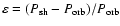 ,
through
the relation (Patterson 1998):
,
through
the relation (Patterson 1998):
 ,
corresponding
to a mass ratio of q=0.14. The uncertainty in q is typically
dominated by the scatter in the observed
,
corresponding
to a mass ratio of q=0.14. The uncertainty in q is typically
dominated by the scatter in the observed
 relation (and
hence Patterson's 1998 fit to this relation)
rather than by the uncertainty in
relation (and
hence Patterson's 1998 fit to this relation)
rather than by the uncertainty in
 .
.
We have measured in Sects. 4.3 and 4.4 the amplitudes
of the radial velocity variations of the broad wings of the Balmer
lines and of the narrow emission line component detected in
.
Attributing these radial velocity variations to material close to
the white dwarf and on the (irradiated face of the) secondary star,
respectively, implies
 for the radial velocity
amplitude of the white dwarf and
for the radial velocity
amplitude of the white dwarf and
 for the
secondary, which gives a mass ratio of
for the
secondary, which gives a mass ratio of
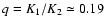 ,
somewhat
larger than the estimate from the fractional superhump period excess.
If, as we suggest, the chromospheric emission of the secondary star
originates primarily on the hemisphere facing the white dwarf then
our K2 underestimates the true radial velocity amplitude of the
secondary, and this dynamical measure of q is an upper limit. We
conclude that our observations suggest
,
somewhat
larger than the estimate from the fractional superhump period excess.
If, as we suggest, the chromospheric emission of the secondary star
originates primarily on the hemisphere facing the white dwarf then
our K2 underestimates the true radial velocity amplitude of the
secondary, and this dynamical measure of q is an upper limit. We
conclude that our observations suggest
 .
.
We can also derive an estimate of the accretion disc radius from the
measured double peak velocity separation. We have measured the
semi-separation in the
profiles which are not contaminated by the
maximum velocity excursions of the S-waves, obtaining an average value
of
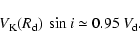
 .
This value gives a good estimate
of the projected velocity of the outer disc edge. Smak (1981)
provided a relation between the Keplerian projected velocity of the
outer disc material,
.
This value gives a good estimate
of the projected velocity of the outer disc edge. Smak (1981)
provided a relation between the Keplerian projected velocity of the
outer disc material,
 ,
where iis the orbital inclination of the system, and the velocity
semi-separation of the peaks,
,
where iis the orbital inclination of the system, and the velocity
semi-separation of the peaks,  :
:
 ,
and
,
and
 ,
we find
,
we find
 ,
where
,
where
 is the distance from the
white dwarf to the inner Lagrangian point, given by
Silber (1992). Thus the accretion disc in HS 2219+1824
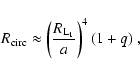
in quiescence is probably quite small. The circularisation radius of
the system is given by:
is the distance from the
white dwarf to the inner Lagrangian point, given by
Silber (1992). Thus the accretion disc in HS 2219+1824
in quiescence is probably quite small. The circularisation radius of
the system is given by:
 ,
smaller than the
derived disc radius.
,
smaller than the
derived disc radius.
86.2 min and a superhump period of 89.05 min. The
superoutburst amplitude is 5.5 mag, reaching  at maximum. No normal outburst has been recorded so far. The broad
,
,
and
absorption lines observed in the optical spectrum
of HS2219+1824 are consistent with the photospheric spectrum of a
white dwarf at a
distance of
.
The red part
of the optical spectrum constrains the spectral type of the donor to
be later than M 5. Quiescent phase-resolved spectroscopy reveals an
unusual narrow
emission line component which we tentatively attribute to
chromospheric emission from the irradiated inner hemisphere of the
secondary star. The superhump fractional period excess and the radial
velocities measured from this narrow
component, as well as from
the broad wings of the double-peaked emission lines suggest a mass ratio of
.
at maximum. No normal outburst has been recorded so far. The broad
,
,
and
absorption lines observed in the optical spectrum
of HS2219+1824 are consistent with the photospheric spectrum of a
white dwarf at a
distance of
.
The red part
of the optical spectrum constrains the spectral type of the donor to
be later than M 5. Quiescent phase-resolved spectroscopy reveals an
unusual narrow
emission line component which we tentatively attribute to
chromospheric emission from the irradiated inner hemisphere of the
secondary star. The superhump fractional period excess and the radial
velocities measured from this narrow
component, as well as from
the broad wings of the double-peaked emission lines suggest a mass ratio of
.
Acknowledgements
We thank the anonymous referee for his/her very favourable report on the paper. P.R.G. and B.T.G. were supported by a PPARC PDRA and a PPARC Advanced Fellowship, respectively. The H.Q.S. was supported by the Deutsche Forschungsgemeinschaft through grants Re 353/11 and Re 353/22. We are very grateful to Klaus Beuermann for giving us access to his M-dwarf spectral templates, and to Patrick Schmeer for alerting us of the 2004 outburst, as well as for drawing our attention to the ASAS-3 program.