![[*]](/icons/foot_motif.gif)
A&A 430, 655-668 (2005)
DOI: 10.1051/0004-6361:20041274
M. Spite1 - R. Cayrel1 - B. Plez2 - V. Hill1 - F. Spite1 - E. Depagne3 - P. François1 - P. Bonifacio4 - B. Barbuy5 - T. Beers6 - J. Andersen7,8 - P. Molaro4 - B. Nordström7,9 - F. Primas10
1 - GEPI, Observatoire de Paris-Meudon, 92125 Meudon Cedex, France
2 -
GRAAL, Université de Montpellier II, 34095 Montpellier Cedex
05, France
3 -
European Southern Observatory (ESO), 3107 Alonso de Cordova,
Vitacura, Casilla 19001, Santiago 19, Chile
4 -
Osservatorio Astronomico di Trieste, INAF,
via G.B. Tiepolo 11, 34131 Trieste, Italy
5 -
IAG, Universidade de Sao Paulo, Depto. de Astronomia,
rua do Matao 1226, Sao Paulo 05508-900, Brazil
6 -
Department of Physics & Astronomy and JINA: Joint Institute for Nuclear
Astrophysics, Michigan State University, East Lansing, MI 48824, USA
7 -
Astronomical Observatory, NBIfAFG, Juliane Maries Vej 30, 2100
Copenhagen, Denmark
8 -
Nordic Optical Telescope Scientific Association, Apartado 474,
38 700 Santa Cruz de La Palma, Spain
9 -
Lund Observatory, Box 43, 221 00 Lund, Sweden
10 -
European Southern Observatory, Karl Schwarzschild-Str. 2,
85749 Garching b. München, Germany
Received 11 May 2004 / Accepted 21 September 2004
Abstract
We have investigated the poorly-understood origin of nitrogen in the early
Galaxy by determining N abundances from the NH band at 336 nm in 35 extremely
metal-poor halo giants, with carbon and oxygen abundances from Cayrel et al.
(2004, A&A, 416, 1117), using high-quality ESO VLT/UVES spectra (30 of our 35 stars
are in the range -4.1 <
![$\rm [Fe/H]$](/articles/aa/full/2005/05/aa1274/img15.gif) < -2.7 and 22 stars have
< -3.0).
N abundances derived both from the NH band and from the CN band at 389 nm
for 10 stars correlate well, but show a systematic difference of 0.4 dex,
which we attribute to uncertainties in the physical parameters of the NH band
(line positions, gf values, dissociation energy, etc.).
Because any dredge-up of CNO processed material to the surface may
complicate the interpretation of CNO abundances in giants, we have
also measured the surface abundance of lithium in our stars as a
diagnostic of such mixing. Our sample shows a clear dichotomy between two groups of stars. The
first group shows evidence of C to N conversion through CN cycling and
strong Li dilution, a signature of mixing; these stars are generally
more evolved and located on the upper Red Giant Branch (RGB) or
Horizontal Branch (HB). The second group has
< -2.7 and 22 stars have
< -3.0).
N abundances derived both from the NH band and from the CN band at 389 nm
for 10 stars correlate well, but show a systematic difference of 0.4 dex,
which we attribute to uncertainties in the physical parameters of the NH band
(line positions, gf values, dissociation energy, etc.).
Because any dredge-up of CNO processed material to the surface may
complicate the interpretation of CNO abundances in giants, we have
also measured the surface abundance of lithium in our stars as a
diagnostic of such mixing. Our sample shows a clear dichotomy between two groups of stars. The
first group shows evidence of C to N conversion through CN cycling and
strong Li dilution, a signature of mixing; these stars are generally
more evolved and located on the upper Red Giant Branch (RGB) or
Horizontal Branch (HB). The second group has
![${\rm [N/Fe]}$](/articles/aa/full/2005/05/aa1274/img16.gif) < 0.5, shows no evidence for C to N conversion, and Li is only moderately diluted; these stars belong to the lower RGB
and we conclude that their C and N abundances are very close to those of the gas from which
they formed in the early Galaxy, they are called "unmixed stars''.
The [O/Fe] and [(C+N)/Fe] ratios are
the same in the two groups, confirming that the differences between
them are caused by dredge-up of CN-processed material in the first
group, with negligible contributions from the O-N cycle. The "unmixed'' stars reflect the abundances in the early Galaxy: the
[C/Fe] ratio is constant (about +0.2 dex) and the [C/Mg] ratio
is close to solar at low metallicity, favouring a high C production
by massive zero-metal supernovae. The [N/Fe] and [N/Mg] ratios
scatter widely. Their mean values in each metallicity bin decrease
with increasing metallicity, but this trend could be a
statistical effect. The larger values of these ratios define a flat
upper plateau ([N/Mg] = 0.0, [N/Fe] = +0.1), which could reflect higher values
within a wide range of yields of zero-metal SNe II. Alternatively, by
analogy with the DLAs, the lower abundances ([N/Mg] = -1.1, [N/Fe] = -0.7)
could reflect generally low yields from the first SNe II, the other
stars being N enhanced by winds of massive Asymptotic Giant Branch
(AGB) stars. Since all the stars show clear [
< 0.5, shows no evidence for C to N conversion, and Li is only moderately diluted; these stars belong to the lower RGB
and we conclude that their C and N abundances are very close to those of the gas from which
they formed in the early Galaxy, they are called "unmixed stars''.
The [O/Fe] and [(C+N)/Fe] ratios are
the same in the two groups, confirming that the differences between
them are caused by dredge-up of CN-processed material in the first
group, with negligible contributions from the O-N cycle. The "unmixed'' stars reflect the abundances in the early Galaxy: the
[C/Fe] ratio is constant (about +0.2 dex) and the [C/Mg] ratio
is close to solar at low metallicity, favouring a high C production
by massive zero-metal supernovae. The [N/Fe] and [N/Mg] ratios
scatter widely. Their mean values in each metallicity bin decrease
with increasing metallicity, but this trend could be a
statistical effect. The larger values of these ratios define a flat
upper plateau ([N/Mg] = 0.0, [N/Fe] = +0.1), which could reflect higher values
within a wide range of yields of zero-metal SNe II. Alternatively, by
analogy with the DLAs, the lower abundances ([N/Mg] = -1.1, [N/Fe] = -0.7)
could reflect generally low yields from the first SNe II, the other
stars being N enhanced by winds of massive Asymptotic Giant Branch
(AGB) stars. Since all the stars show clear [ /Fe] enhancements, they were formed before any significant enrichment of the
Galactic gas by SNe Ia, and their composition should reflect the yields of
the first SNe II. However, if massive AGB stars
or AGB supernovae evolved more rapidly than SNe Ia and contaminated
the ISM, our stars would also reflect the yields of these
AGB stars. At present it cannot be decided whether primary N is
produced primarily in SNe II or in massive AGB stars, or in both. The stellar N abundances and [N/O] ratios are compatible with those
found in Damped Lyman-
(DLA) systems. They extend the
well-known DLA "plateau'' at [N/O]
/Fe] enhancements, they were formed before any significant enrichment of the
Galactic gas by SNe Ia, and their composition should reflect the yields of
the first SNe II. However, if massive AGB stars
or AGB supernovae evolved more rapidly than SNe Ia and contaminated
the ISM, our stars would also reflect the yields of these
AGB stars. At present it cannot be decided whether primary N is
produced primarily in SNe II or in massive AGB stars, or in both. The stellar N abundances and [N/O] ratios are compatible with those
found in Damped Lyman-
(DLA) systems. They extend the
well-known DLA "plateau'' at [N/O]  -0.8 to lower
metallicities, albeit with more scatter; no star is found below the
putative "low [N/]
plateau'' at [N/O]
-1.55 in DLAs.
-0.8 to lower
metallicities, albeit with more scatter; no star is found below the
putative "low [N/]
plateau'' at [N/O]
-1.55 in DLAs.
Key words: Galaxy: abundances - Galaxy: halo - Galaxy: evolution - stars: abundances - stars: evolution - stars: supernovae: general
Carbon, nitrogen, and oxygen - the CNO elements - are key players in the chemical evolution of galaxies. They are the most abundant elements after hydrogen and helium and the most efficient coolants in the interstellar medium. Thus, understanding how the first CNO nuclei were synthesised is crucial for models of the first star formation and nucleosynthesis in the Universe after the Big Bang.
There is general consensus that oxygen is almost entirely contributed by massive type II SNe, primarily during the central hydrogen burning with some contribution from neon burning. Carbon can be produced in stars of all masses, essentially by He burning. In contrast to O and C, however, the initial formation of N is still not well understood (Pilyugin et al. 2003).
N is formed at the expense of C and O during hydrogen burning by the CNO cycle.
If N is formed directly from He, it is called primary; if pre-existing C nuclei
are required, it is called secondary. In massive stars, mixing (with or without
stellar rotation) between the helium-burning layer (which produces C) and the
hydrogen-burning layer can induce "primary'' N formation; the yield may be very
variable. In intermediate-mass stars with (approx.
 < M <
< M <
 ), abundant primary N may be produced during the AGB phase.
The production mechanisms of N are imprinted in the abundances of stars formed from the ejecta of massive progenitor stars. If the N production was secondary, the [N/O] ratio should increase with increasing metallicity. For primary N production, [N/O] should remain constant.
From a study of H II regions in irregular galaxies (Kobulnicky & Skillman
1996; Izotov & Thuan 1999), the [N/O] ratio does indeed appear to
be constant at low metallicity, at least between [O/H] = -1.6 and -1.2, or
about -2.1 <
< -1.7, suggesting that N is primary in this range.
From the small dispersion of their [N/O] measurements, Izotov & Thuan argue in
favor of N production by massive stars. However, this conclusion is challenged
by observations of DLAs, which exhibit large scatter and, in particular, lower
values of [N/O] than those of H II regions in irregular galaxies. Henry et al.
(2000) could reproduce the plateau in [N/O] by assuming N production by
AGB stars and different Star Formation Rates (SFRs), while Prochaska et al.
(2002) proposed a scenario involving a different IMF at earlier epochs
of star formation. The complex evidence suggests that primary production of N,
if confirmed, might require production by both massive stars or AGBs.
Recently, however, Chiappini et al. (2003) questioned the very presence of the plateau and its significance as an evolutionary curve. They further stressed that while the [N/O] vs. [O/H] diagram for DLAs and H II regions is often interpreted as an evolutionary diagram with [O/H] as the time axis, it does in fact represent final abundances achieved by objects that evolved in completely different ways from each other. Hence, the best way to determine the lower limit of the [N/O] ratio is to measure it in very old Galactic stars.
Among early discussions of the Galactic evolution of N in halo stars, Tomkin &
Lambert (1984) analysed 14 disk and halo dwarfs in the range -2.3  -0.3, using the ultraviolet NH band. They found [N/Fe] =
-0.25, [C/Fe] = -0.21, and an average [N/C] = -0.02
-0.3, using the ultraviolet NH band. They found [N/Fe] =
-0.25, [C/Fe] = -0.21, and an average [N/C] = -0.02  0.3. Laird (1985)
analysed 116 dwarfs with -2.45
[Fe/H]
+0.5 from observations of
the G band of CH and the violet NH band at low resolution and found
0.3. Laird (1985)
analysed 116 dwarfs with -2.45
[Fe/H]
+0.5 from observations of
the G band of CH and the violet NH band at low resolution and found
![${\rm [C/Fe]}$](/articles/aa/full/2005/05/aa1274/img21.gif) = -0.22
0.14 and
= -0.67
0.21. In both studies, the N abundances were corrected by +0.65 dex and C by +0.2 dex in order to obtain
[N/Fe] = [C/Fe] = 0 at solar metallicity. Carbon et al. (1987) also observed the
CH band and violet NH band at low resolution in 83 dwarfs, including 27 in the
range -2.7
[Fe/H]
-2.0. Assuming [O/Fe] = +0.6 (important for
the derived C abundance), they found [C/Fe] = -0.03
0.18, and [N/Fe] =
-0.45
0.28. These three sets of data suggested that Nitrogen
showed a behaviour as a primary element at the low metallicities
studied (-2.7
[Fe/H]
-2.0).
= -0.22
0.14 and
= -0.67
0.21. In both studies, the N abundances were corrected by +0.65 dex and C by +0.2 dex in order to obtain
[N/Fe] = [C/Fe] = 0 at solar metallicity. Carbon et al. (1987) also observed the
CH band and violet NH band at low resolution in 83 dwarfs, including 27 in the
range -2.7
[Fe/H]
-2.0. Assuming [O/Fe] = +0.6 (important for
the derived C abundance), they found [C/Fe] = -0.03
0.18, and [N/Fe] =
-0.45
0.28. These three sets of data suggested that Nitrogen
showed a behaviour as a primary element at the low metallicities
studied (-2.7
[Fe/H]
-2.0).
Very recently, Israelian et al. (2004) measured nitrogen abundances in
31 unevolved stars with -3.05
[Fe/H]
-0.35, using the near-UV
NH band. As only four stars in their sample have
![${\rm [Fe/H] < -2.5}$](/articles/aa/full/2005/05/aa1274/img22.gif) ,
their
metallicity range is complementary to the present work (see below). Israelian et al. find no trend of [N/Fe] vs. [Fe/H], suggesting also primary N production. For
stars of higher metallicity (
,
their
metallicity range is complementary to the present work (see below). Israelian et al. find no trend of [N/Fe] vs. [Fe/H], suggesting also primary N production. For
stars of higher metallicity (
![${\rm [O/H] > -1.8}$](/articles/aa/full/2005/05/aa1274/img23.gif) )
they find a significant slope
of [N/O] versus [O/H], indicative of secondary behaviour. Because they derive
[N/O] from similar analyses of the near-UV bands of OH and NH, systematic errors
in the molecular analysis should at least partly cancel.
)
they find a significant slope
of [N/O] versus [O/H], indicative of secondary behaviour. Because they derive
[N/O] from similar analyses of the near-UV bands of OH and NH, systematic errors
in the molecular analysis should at least partly cancel.
On this background, the aim of the present paper is to determine C and N abundances in stars from the very earliest phases of the evolution of the
Galaxy. Cayrel et al. (2004, hereafter Paper V) already analysed the
abundances of 17 elements from C to Zn in 35 extremely metal-poor (XMP) stars (-4.0 <
< -2.7). For most elements, the diagrams of [X/Fe] (or [X/Mg]) vs. [Fe/H] (or [Mg/H]) showed very small dispersion, and the trends (or absence
of trends) of the different element ratios with metallicity could be determined
rather easily. In contrast, the relations [C/Fe] vs. [Fe/H] (or [C/Mg] vs. [Mg/H])
showed so large scatter that no conclusions on the production of C could be
drawn. N abundances were measured from CN, but this band was only detected in
six stars.
In this paper we use the high UV efficiency of the VLT spectrograph UVES to push
the study of the Galactic evolution of N a step further. Using the NH band at
336 nm allows us to measure N abundances in the same large sample of extremely
metal-poor halo giants as that of Cayrel et al. (2004): 35 stars with
-4.1
[Fe/H]
-2.0, 30 of which have -4 <
< -2.7 (and
22 have
< -3.0). At these metallicities it is essentially
impossible to detect the NH band in main-sequence or turnoff stars (unless they
have a strong N excess), so the less-evolved, unmixed giants in our sample offer
essentially the only way to measure N at such low metallicities.
Mixing of the outer layers in these stars may invalidate conclusions
drawn from an abundance analysis of their surfaces. Its importance
can be estimated from several indicators, in particular from the
abundance of lithium, which is rapidly destroyed if convection drives it
to regions with temperatures above  2.5
2.5  106 K. For example 7Li is
destroyed in about 97% of the mass of a
106 K. For example 7Li is
destroyed in about 97% of the mass of a
 very
metal-poor star during its main-sequence evolution. When the outer
convective zone deepens, the remaining 3% is diluted by the full mass
of the convective zone, and the surface Li abundance becomes a
diagnostic of the depth of this convective zone. Accordingly, we have
also measured Li abundances in our giants to distinguish between mixed and
unmixed stars.
very
metal-poor star during its main-sequence evolution. When the outer
convective zone deepens, the remaining 3% is diluted by the full mass
of the convective zone, and the surface Li abundance becomes a
diagnostic of the depth of this convective zone. Accordingly, we have
also measured Li abundances in our giants to distinguish between mixed and
unmixed stars.
![\begin{figure}
\par\includegraphics[height=5.5cm,width=11.2cm,clip]{1274fig1a.ps}
\includegraphics[height=5.5cm,width=11.2cm,clip]{1274fig1b.ps}\end{figure}](/articles/aa/full/2005/05/aa1274/img27.gif) |
Figure 1: Reduced UVES spectra in the region of the NH band at 336 nm. Crosses represent the observed spectra, while the full lines show synthetic spectra computed for the best-fit N abundance as well as twice that value (thick and thin lines, respectively). The two stars have about the same metallicity, [Fe/H] = -3.06 (BD-18:5550) and [Fe/H] = -3.00 (CS 22186-025). |
| Open with DEXTER | |
In Sect. 2 we describe the observations, and Sect. 3 presents the analysis of the data. Section 4 discusses mixing in these stars, while Sect. 5 considers the abundances of the CNO elements in the early Galaxy and presents a comparison of our results with data from DLAs. Section 6 is a brief summary of our results and conclusions.
Table 1:
Adopted model parameters (
 ,
log g, vt, [Fe/H])
and light element abundances for the programme stars. For Li, C and N the
1
,
log g, vt, [Fe/H])
and light element abundances for the programme stars. For Li, C and N the
1 measurement error is given. The N abundances from the
NH band in Col. 10 are raw values, to be corrected by -0.4 dex (see Sect. 3.2.3 and Fig. 4), the adopted values of [N/H] are
given in Col. 11. Remark "m'' in the last column
identifies stars considered to be mixed (see Sect. 4.1).
The errors indicated in this table are only the measurement errors.
measurement error is given. The N abundances from the
NH band in Col. 10 are raw values, to be corrected by -0.4 dex (see Sect. 3.2.3 and Fig. 4), the adopted values of [N/H] are
given in Col. 11. Remark "m'' in the last column
identifies stars considered to be mixed (see Sect. 4.1).
The errors indicated in this table are only the measurement errors.
The observations were performed during several observing runs from April 2000 to November 2001 with the VLT-UT2 and UVES (Dekker et al. 2000), at a resolving power of R=47 000 at 400 nm. The spectra were reduced using the UVES context (Ballester et al. 2000) within MIDAS. Details of the observing and reduction procedures are presented in Paper V (Cayrel et al. 2004). Taking advantage of the high UV efficiency of UVES allows us to measure the NH band at 336 nm in most of our stars.
The signal-to-noise ratio of the spectra is difficult to estimate in this very
crowded region, but is typically
 (per pixel). An example of the
spectrum in the region of the NH band is shown in Fig. 1.
(per pixel). An example of the
spectrum in the region of the NH band is shown in Fig. 1.
As described in Paper V, we carried out a classical LTE analysis using OSMARCS model atmospheres (Gustafsson et al. 1975; Plez et al. 1992;
Edvardsson et al. 1993; Asplund et al. 1997; Gustafsson et al.
2003). Since our analysis uses 1D models we adopted, as in Paper V,
the solar abundances as obtained also from 1D models, i.e., log  (O) = 8.74, log (C) = 8.52, log (N) = 7.92, and the values
for other elements from Grevesse & Sauval (1998).
(O) = 8.74, log (C) = 8.52, log (N) = 7.92, and the values
for other elements from Grevesse & Sauval (1998).
Abundances were derived using the current version of the Turbospectrum code (Alvarez & Plez 1998), which accounts properly for continuum scattering (see Paper V), a feature that is particularly important in the violet part of the spectrum. For the CH, CN, and NH bands the abundances of C and N were determined from spectrum synthesis. Abundances of O from the forbidden line at 630.031 nm and of Li from the resonance line have been derived directly from the equivalent widths of these lines.
The procedures used to derive
,
log g, and the microturbulent velocity vt have been explained in detail in Paper V, Sect. 3. Briefly,
was
derived from broadband photometry (B-V, V-R, V-I, V-K, J-K),
calibrated by the IRFM method (Alonso et al. 1999). The log g
value was
obtained by requiring that identical Fe and Ti abundances be derived from Fe I
and Fe II, or Ti I, Ti II lines, respectively, and vt was determined to
eliminate any abundance trend of the Fe I lines with equivalent width.
The Li line at 670.7 nm is visible in about half of our stars. Table 1 lists the derived Li abundances for these stars, and upper limits for the remaining stars.
Figure 2 shows the Li feature in the neutron-capture-rich XMP star
CS 22892-052 (Sneden et al. 2003). We measure an equivalent width of
3.3 mÅ, in excellent agreement with the value
 = 3.5 mÅ by Sneden et al. (2003).
![\begin{figure}
\par\includegraphics[height=3.75cm,width=7.55cm,clip]{1274fig2.ps}\end{figure}](/articles/aa/full/2005/05/aa1274/img110.gif) |
Figure 2: Observed spectrum of CS 22892-52 near the Li line at 670.7 nm (crosses), and synthetic spectra computed with log N(Li) = 0.15 and 0.45 (thick and thin lines, respectively). |
| Open with DEXTER | |
Carbon and oxygen abundances for our stars were carefully determined in Paper V (specifically in Sects. 4.1 and 4.2) and are reproduced in Table 1 (see also Barbuy et al. 2003).
The O abundance was derived from the [O I] line at 630.031 nm (Table 1), generally considered to be the most reliable O abundance indicator since it is insensitive to non-LTE effects. However, these values were computed with classical 1D models, and the line has been shown to be sensitive to hydrodynamical (3D) effects: the [O/Fe] ratio based on the [O I] line is expected to decrease when computed with 3D models. So far, explicit 3D corrections have only been computed for dwarfs (Nissen et al. 2002). Following these authors, at least the sign of the correction should not change in giants; and we assume, as a first approximation, that the correction is the same as for dwarfs. The 1D values of [O/Fe] = [O/H]-[Fe/H] (Table 1) should then be corrected by about -0.23 dex (see Paper V).
C abundances were determined by a synthetic spectrum fit to the G band of CH (see Paper V).
Figure 3 shows the [C/Fe] and [C/Mg] ratios as functions of [Fe/H]
and [Mg/H]. They show substantially larger scatter around the mean value than
all other elements studied in Paper V. Even if the two peculiar stars with very
strong C enhancements are excluded, i.e. CS 22892-052 (Sneden et al.
1996, 2000, 2003) and CS 22949-037 (McWilliam et al.
1995; Norris et al. 2001; Depagne et al. 2002), the
scatter remains very large (
![${\rm\langle [C/Fe] \rangle}$](/articles/aa/full/2005/05/aa1274/img111.gif) = -0.09 and
= -0.09 and
 ). In
Paper V we studied a subset of stars with
> 4800 K (the hotter,
less evolved part of the RGB), but the scatter remained almost constant, with
= +0.01 and
). In
Paper V we studied a subset of stars with
> 4800 K (the hotter,
less evolved part of the RGB), but the scatter remained almost constant, with
= +0.01 and
 (see Figs. 5 and 12 in Paper V).
We conclude that either the gas from which the XMP stars formed had a wide range of C abundances, or the initial composition in the atmosphere of the stars has been altered by subsequent mixing episodes. In the latter case we would also expect a correspondingly large scatter in the relation of [N/Fe] vs. [Fe/H].
![\begin{figure}
\par\includegraphics[height=5.15cm,width=7.6cm,clip]{1274fig3a.ps...
...{5mm}
\includegraphics[height=5.15cm,width=7.6cm,clip]{1274fig3c.ps}\end{figure}](/articles/aa/full/2005/05/aa1274/img114.gif) |
Figure 3: [C/Fe] and [C/Mg] vs. [Fe/H] and [Mg/H]. Both diagrams show far more scatter than seen for other elements in Paper V. The peculiar "carbon-rich'' stars CS 22949-037 and CS 22892-052 are labelled; they cannot be directly compared to the other stars of the sample. |
| Open with DEXTER | |
In Paper V, N abundances were computed from the BX band of CN at 388.8 nm. This band is extremely weak in most of our sample and the nitrogen abundance had been computed in only six stars. After a careful examination of the spectra, we could in fact detect the CN band and measure it, in ten stars (Table 1).
Moreover in the present paper, we use the lines of the violet
 NH band at 336 nm (see Fig. 1),
which is not only more readily measurable but also insensitive to the C and O abundances (see e.g. Sneden 1973 or Norris et al. 2002). We have adopted the Kurucz (2001) data for the NH molecule (Table 1, Fig. 4), in particular a dissociation energy of 3.47 eV (Huber & Herzberg 1979).
NH band at 336 nm (see Fig. 1),
which is not only more readily measurable but also insensitive to the C and O abundances (see e.g. Sneden 1973 or Norris et al. 2002). We have adopted the Kurucz (2001) data for the NH molecule (Table 1, Fig. 4), in particular a dissociation energy of 3.47 eV (Huber & Herzberg 1979).
Figure 4 compares the N abundances derived from the NH and CN molecular
bands. The correlation is good, but there is a systematic difference of about
0.4 dex, well above the internal errors. The reason for this discrepancy is
unclear, but we recall that the physical parameters (line positions, gf values,
etc.) of the NH band are not yet well established. We use a dissociation
energy of 3.47 eV (Huber & Herzberg 1979), while Sneden (1973) and
Norris et al. (2002) preferred a value of 3.21 eV. However, adopting a
lower dissociation energy would further increase our N abundances from NH
and the discrepancy with the results from CN. In contrast, the dissociation
energy and other parameters of the CN molecule seem to be better established.
We have adopted
 (Huber & Herzberg 1979), which is
supported by more recent experimental
(e.g. 7.74
0.02, Huang et al. 1992) and theoretical values
(e.g. 7.72
0.02, Pradhan et al. 1994).
(Huber & Herzberg 1979), which is
supported by more recent experimental
(e.g. 7.74
0.02, Huang et al. 1992) and theoretical values
(e.g. 7.72
0.02, Pradhan et al. 1994).
We conclude that our nitrogen abundances from the NH band (Table 1) should be corrected by -0.4 dex and use these corrected values in the following discussions.
Figure 5 shows the relations [N/Fe] vs. [Fe/H] and [N/Mg] vs. [Mg/H]. Here again the scatter is extremely large, even greater than in the case of C.
![\begin{figure}
\par\includegraphics[height=5.5cm,width=5.5cm,clip]{1274fig4.ps}\end{figure}](/articles/aa/full/2005/05/aa1274/img117.gif) |
Figure 4: [N/H] values derived from the CN and NH bands. The correlation is good, but shows a systematic shift of about 0.4 dex. The two carbon-rich stars are identified. |
| Open with DEXTER | |
Except for measurement errors, the main source of error in the C,
N, and Li abundances is the uncertainty in
,
which is about 80 K
(Paper V). For given
,
the ionization equilibrium constrains log g with an internal error of 0.1 dex, while vt is constrained to
within 0.2 km s-1. In Table 2 we list the
uncertainties in log N(Li), [C/Fe], [N/Fe] and also [(C+N)/Fe] and
[C/N] arising from these sources for two stars, HD 122563 (
= 4600 K) and CS 22948-066 (
= 5100 K), at the cool and warm end of our sample.
![\begin{figure}
\par\includegraphics[height=5.2cm,width=7.55cm,clip]{1274fig5a.ps...
...5mm}
\includegraphics[height=5.2cm,width=7.55cm,clip]{1274fig5c.ps}\end{figure}](/articles/aa/full/2005/05/aa1274/img118.gif) |
Figure 5: [N/Fe] vs. [Fe/H] and [N/Mg] vs. [Mg/H] for our sample. The scatter of the points is even larger than in Fig. 3 (the scale of both figures is the same). |
| Open with DEXTER | |
The errors are very similar in both cases and thus are practically
independent of the temperature of the star between 4600 and 5100 K.
Since log g is derived from the ionization equilibrium, it is not
independent of
,
so a change in
also affects log g. The
total error budget therefore contains significant covariance terms.
To minimise these effects we have computed [C/Fe], [N/Fe] and
[(C+N)/Fe] relative to Fe I for each model, since these abundances are
affected similarly by a change in temperature.
The total error has been approximated by
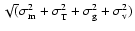 where
where
 is the measurement error (Table 1) and
 ,
,
 ,
,
 are derived from Table 2
(
are derived from Table 2
(
 ,
,
 ,
,
 ). Note that in
Table 2 the assumed change in
is 100 K.
). Note that in
Table 2 the assumed change in
is 100 K.
Table 2:
Changes ( )
in the derived N abundance caused by errors in
model atmosphere parameters for HD 122563, a cool star, and CS 22948-066
(hotter). A is the adopted model; B, C, and D vary log g, vt, and
individually as shown, while in model E, log g and vt have been re-adjusted
for consistency with the lower
(see also Paper V, Tables 6 and 7).
)
in the derived N abundance caused by errors in
model atmosphere parameters for HD 122563, a cool star, and CS 22948-066
(hotter). A is the adopted model; B, C, and D vary log g, vt, and
individually as shown, while in model E, log g and vt have been re-adjusted
for consistency with the lower
(see also Paper V, Tables 6 and 7).
The aim of this paper is to study the synthesis of the light elements in the Galaxy at the earliest times, i.e. their abundances in gas that was enriched by the first type II supernovae. Generally, the convective atmosphere of a cool star is a good tracer of the chemical composition of the interstellar gas at the time and place of its formation. However, in giant stars material from deeper layers may be dredged to the surface and thereby alter the initial composition (e.g. Gratton et al. 2000), so we must carefully check if such mixing has occurred in our stars.
In dredged-up matter that has been processed by the CNO cycle, N has been produced at the expense of C, and the atmosphere of the star becomes "N rich'' and "C poor'' relative to its initial composition (thus, mixing during any first dredge-up episodes cannot explain the C-rich stars, especially in our low-mass stars.)
Figure 6 shows [N/Fe] vs. [C/Fe] for all stars in our sample. The stars
clearly fall in two separate groups: the apparently unmixed stars with
[C/Fe]  0.0 and [N/Fe] < +0.5, and stars with [C/Fe] < 0.0 and
[N/Fe] > +0.5 which show evidence of mixing. These ratios are, by themselves,
no proof that the stars of the second group have been mixed internally; the gas
from which they were formed could have had this composition. However, for
simplicity we will continue to refer to these two groups as the unmixed and
mixed stars, respectively. The "mixed'' stars are identified by an "m'' in Table 1 (last column).
0.0 and [N/Fe] < +0.5, and stars with [C/Fe] < 0.0 and
[N/Fe] > +0.5 which show evidence of mixing. These ratios are, by themselves,
no proof that the stars of the second group have been mixed internally; the gas
from which they were formed could have had this composition. However, for
simplicity we will continue to refer to these two groups as the unmixed and
mixed stars, respectively. The "mixed'' stars are identified by an "m'' in Table 1 (last column).
Because the CNO process turns C into N, the [C/N] ratio is a sensitive indicator
of mixing. Figure 7 shows the [C/N] ratio vs.
.
Like in Fig. 6, the mixed and unmixed stars are well separated. Note that most of
the unmixed stars have
 4800 K (cf. Paper V, Sect. 4.1).
![\begin{figure}
\par\includegraphics[height=5.65cm,width=5.65cm,clip]{1274fig6.ps}\end{figure}](/articles/aa/full/2005/05/aa1274/img136.gif) |
Figure 6: [N/Fe] vs. [C/Fe] for our sample. Two groups are clearly separated: the "mixed'' stars ([N/Fe] > 0.5) shown as open circles, and the "unmixed'' stars ([N/Fe] < 0.5) shown as dots (both with error bars). CS 22892-52 and CS 22949-37 are the two peculiar carbon-rich stars. |
| Open with DEXTER | |
![\begin{figure}
\par\includegraphics[height=4.75cm,width=7.6cm,clip]{1274fig7.ps}\end{figure}](/articles/aa/full/2005/05/aa1274/img137.gif) |
Figure 7:
[C/N] vs.
for the sample; symbols as in Fig. 6. The
line [C/N] = -0.4 separates the mixed and unmixed stars. Stars with only upper
limits on C and/or N abundance have been omitted. Note that most unmixed stars
have
4800 K (cf. also Paper V, Sect. 4.1). |
| Open with DEXTER | |
Two stars in our sample are known to be C rich: CS 22892-052 (Sneden et al.
2003) falls close to the unmixed stars in Fig. 6, while
CS 22949-037 (Depagne et al. 2002) is quite peculiar, as its huge N abundance is suggestive of mixing (consistent with its low
 ratio), yet it falls quite far from the other mixed stars. None of these two
stars appears unusual in Fig. 7, however.
ratio), yet it falls quite far from the other mixed stars. None of these two
stars appears unusual in Fig. 7, however.
For three stars we have only upper abundance limits: CD-38:245 (C only), BS 16477-003 (N only), and BS 16467-032 (both C and N); they are marked with arrows in Fig. 6, but omitted in Fig. 7 as the [C/N] ratio is undefined in these stars.
When low-mass stars, such as those in our sample, evolve through the subgiant and red giant branches, the surface convection zone progressively deepens. This mixes the stellar atmosphere with material from deeper layers in which Li has been depleted by nuclear burning, and reduces the observed Li abundance of the star. The degree of dilution increases as the convective zone penetrates deeper; thus, one expects a steady decline of the observed Li abundance as a star ascends the RGB (Pilachowski et al. 1993). If mixing of the surface material is deep enough to reach the layers where C is burned into N, the atmospheric Li will a fortiori burn away rapidly. The mixed stars should thus show much lower Li abundances than the unmixed stars. We have performed this test.
Figure 8 shows the observed surface abundance of Li as a function of [N/Fe] and [C/N]. The Li line is not detected in any of the mixed stars ([N/Fe] > 0.6 or [C/N] < -0.6), with an upper limit to the Li abundance of log N(Li) < 0. In contrast, we find log N(Li) > 0.15 for all the unmixed stars, with the sole exception of CS 30325-094 (log N(Li) < -0.25). Several effects may deplete the fragile Li in individual stars (rotation, gravity waves, binary interaction, ...) so we have not sought to clarify this single anomaly.
![\begin{figure}
\par\includegraphics[height=4.7cm,width=7.05cm,clip]{1274fig8a.ps...
...{5mm}
\includegraphics[height=4.7cm,width=7.05cm,clip]{1274fig8c.ps}\end{figure}](/articles/aa/full/2005/05/aa1274/img139.gif) |
Figure 8: Lithium abundances vs. [N/Fe] and [C/N] (symbols as in Fig. 6). All the mixed stars ([N/Fe] > 0.6 or [C/N] < -0.6; dotted lines) have destroyed their original Li. |
| Open with DEXTER | |
The consistent results from the [N/Fe] and [C/N] ratios and the Li abundance are strong evidence that the stars with [N/Fe] > 0.6 or [C/N] < -0.6 did experience mixing between deeper CNO-processed layers and the surface of the stars.
Changes of abundances have been detected as stars evolve along the RGB in both globular cluster giants (Kraft 1994) and field stars (Gratton et al. 2000). It would thus be interesting to study the positions of our XMP stars in an H-R diagram to see at which phase of the evolution mixing has occurred. Unfortunately, these stars are too distant to have usable parallaxes, so their precise distances and luminosities are unknown.
![\begin{figure}
\par\includegraphics[height=7.52cm,width=4.7cm,clip]{1274fig9.ps}\end{figure}](/articles/aa/full/2005/05/aa1274/img140.gif) |
Figure 9:
log g vs. log
diagram for the sample (symbols as in Fig. 6).
The RGB and HB are fairly well-defined (dashed lines). At fixed
,
the
unmixed stars on the "low'' RGB have higher log g than the mixed stars. |
| Open with DEXTER | |
However, the spectroscopic value of log g is a first-order indicator of the luminosity of the star. These values of log g may suffer from NLTE effects and thus be different from the true gravity, but Gratton et al. (2000) argue that NLTE corrections to log gare smaller than suggested in most previous literature; moreover, our stars lie in relatively narrow intervals of temperature and gravity, and NLTE effects on iron should be constant in the metallicity range of our stars (Korn et al. 2003). Therefore, any corrections would be similar for all the stars, and abundance trends with log g should be robust against NLTE effects.
Figure 9 shows the log g-log
diagram for our sample. The unmixed
stars form a fairly well-defined lower RGB, while virtually all stars on and
above the HB have the spectroscopic characteristics of mixed stars, as
previously found for moderately metal-poor field stars by Gratton et al.
(2000). Three stars deviate from the general trend and are discussed in
the following:
BD 17:3248, a mixed star strongly enriched in r-process elements (Cowan et al.
2002), has been classified as an RHB star (Bond 1999;
Pilachowski et al. 1996; Alonso et al. 1998), in good agreement
with its position in Fig. 9. In contrast, the Hipparcos parallax,
 1.5 mas, would place BD 17:3248 on the subgiant branch. However, Cowan et al. (2002) conclude, from Strömgren photometry, that the star is
indeed highly evolved and the small Hipparcos parallax probably unreliable.
1.5 mas, would place BD 17:3248 on the subgiant branch. However, Cowan et al. (2002) conclude, from Strömgren photometry, that the star is
indeed highly evolved and the small Hipparcos parallax probably unreliable.
CS 22966-057, the hottest star of our sample, falls between the lower RGB and the HB. Our two spectra of this star from September and October 2001 yield radial velocities of +100.7 km s-1 and +103.0 km s-1, a variation too large to be explained by our observational error, 0.5 km s-1. This star is probably a binary.
CS 29518-051 falls on the low RGB, but has all the characteristics of a mixed star. A large error in its gravity is unlikely. Our single spectrum gives no information on any velocity variations, but the star clearly deserves close attention in the future.
A very deep mixing event might bring matter to the surface in which the O-N cycle has partially transformed O into N. It is thus interesting to compare the O abundances of the mixed and unmixed stars. As seen in Fig. 10, there is no significant difference in [O/Fe] between mixed and unmixed stars, and thus no evidence for contamination by deep mixing, as might occur in an AGB star of an earlier generation or in a hypothetical binary companion. This result is strong evidence that the O abundances determined in Paper V are indeed reliable indicators of the very early nucleosynthesis in the Galaxy.
![\begin{figure}
\par\includegraphics[height=4.5cm,width=7.6cm,clip]{1274fig10.ps}\end{figure}](/articles/aa/full/2005/05/aa1274/img142.gif) |
Figure 10: [O/Fe] vs. [Fe/H] for the sample; symbols as in Fig. 6. The lack of any significant difference between mixed and unmixed stars is strong evidence that deep mixing has not occurred (the O abundances shown here are not corrected for 3D effects; cf. Paper V). |
| Open with DEXTER | |
Figure 11 compares the [N/O] ratios in mixed and unmixed
stars. As expected, [N/O] is systematically higher in the mixed
stars, which have themselves produced N from C in the CN cycle. This
additional N must therefore be of secondary origin. Moreover, [N/O] and [O/H]
are tightly correlated in all the mixed stars, in contrast with the
large scatter observed in the unmixed stars. The large amount of N brought to the surface of the mixed stars has thus erased the large
scatter of the initial N abundances. If this amount of N brought to the surface
is assumed to be roughly independent of the metallicity of the star,
the [N/O] ratio should decrease with increasing [O/H], as indeed seen
in the data (Fig. 11, mixed stars, dashed line).
![\begin{figure}
\par\includegraphics[height=4.5cm,width=7.6cm,clip]{1274fig11.ps}\end{figure}](/articles/aa/full/2005/05/aa1274/img143.gif) |
Figure 11: [N/O] vs. [O/H] for the sample; symbols as in Fig. 6 (the carbon stars CS 22892-052 and CS22949-037 are shown as triangles). The [N/O] vs. [O/H] relation in the mixed stars is quite tight, [N/O] decreasing slightly with increasing [O/H] (dashed line). This suggests that the amount of N mixed to the surface does not depend strongly on metallicity. |
| Open with DEXTER | |
![\begin{figure}
\par\includegraphics[height=4.5cm,width=7.6cm,clip]{1274fig12.ps}\end{figure}](/articles/aa/full/2005/05/aa1274/img146.gif) |
Figure 12:
[(C+N)/Fe] vs. [Fe/H]; symbols as in Fig. 6. The
C+N abundance shows much smaller scatter than C or N alone (cf. Figs. 3 and 5).  [(C+N)/Fe] [(C+N)/Fe] 0.25 dex
at low [Fe/H]. CS 22949-037 and CS 22892-052 are not shown here.
0.25 dex
at low [Fe/H]. CS 22949-037 and CS 22892-052 are not shown here. |
| Open with DEXTER | |
Because we find no evidence for processing by the O-N cycle in the mixed stars, if the excess of N is due to internal mixing it results only from the transformation of C nuclei into N. Thus we would expect that the mean value of the C+N abundance in the mixed and unmixed stars should be the same. Figure 12 shows that within errors this hypothesis is compatible with the observations. Note that the three mixed stars which stand out towards the high [(C+N)/Fe] ratios may belong to the horizontal branch.
The peculiar C-rich stars CS 22949-037 and CS 22892-052 cannot be compared directly to the other stars of the sample. Both are included in Fig. 11, where CS 22892-052 has a rather high [N/O] ratio for an unmixed star while CS 22949-037 falls among the other mixed stars. Both have been omitted from Fig. 12, where they would fall far from the other stars in their groups.
The consistent evidence discussed above shows that our sample divides cleanly into two groups. In one, the stars have experienced mixing of their atmospheres over their lifetimes; in the other they have not.
We have presented strong evidence that the atmospheric CNO abundances of the unmixed stars represent the original abundances of these species in the gas from which the stars formed. We discuss the consequences of this identification in the following.
![\begin{figure}
\par\includegraphics[height=4.5cm,width=7.6cm,clip]{1274fig13a.ps...
...{5mm}
\includegraphics[height=4.5cm,width=7.6cm,clip]{1274fig13c.ps}\end{figure}](/articles/aa/full/2005/05/aa1274/img147.gif) |
Figure 13:
[C/Fe] and [C/Mg] vs. [Fe/H] and [Mg/H] for the unmixed stars. [C/Mg]
may increase slightly towards lower metallicity; for [Mg/H] < -2.9,
[C/Mg]
0.0 dex. |
| Open with DEXTER | |
Figure 13 shows the C abundance in our unmixed stars, with
both Fe and Mg as reference elements. The [C/Fe] vs. [Fe/H] relation
is remarkably flat; [C/Fe]
+0.18
0.16 dex over the entire
range -4.0 < [Fe/H] < -2.5. The dispersion of the [C/Mg] ratios is only slightly larger than for [C/Fe]; a mild decrease of [C/Mg] with increasing metallicity is suggested.
Akerman et al. (2004) recently studied the variation of the
[C/O] ratio vs. [O/H] in metal-poor halo stars. At low metallicity
(
![$\rm {[O/H] < -2.0}$](/articles/aa/full/2005/05/aa1274/img148.gif) ), [C/O] is expected to decrease because O from
massive supernovae increasingly dominates the enrichment process,
while C is produced in stars of all masses. However, Akerman et al.
(2004) found no decrease in [C/O] at low metallicity; on the
contrary, [C/O] appeared to actually increase below [O/H] = -1.5,
possibly to near-solar values at the lowest metallicities.
), [C/O] is expected to decrease because O from
massive supernovae increasingly dominates the enrichment process,
while C is produced in stars of all masses. However, Akerman et al.
(2004) found no decrease in [C/O] at low metallicity; on the
contrary, [C/O] appeared to actually increase below [O/H] = -1.5,
possibly to near-solar values at the lowest metallicities.
Figure 14 shows [C/O] vs. [O/H] for the combined data set; our stars extend to much lower metallicities than those of Akerman et al. Although the O and C indicators used in these two studies are completely different (high-excitation C and O lines in Akerman et al., CH and [OI] lines in our case), the results agree nicely where the samples overlap. Our XMP stars confirm that [C/O] increases to near solar values at very low metallicity.
![\begin{figure}
\par\includegraphics[height=4.45cm,width=7.5cm,clip]{1274fig14.ps}\end{figure}](/articles/aa/full/2005/05/aa1274/img150.gif) |
Figure 14:
[C/O] vs. [O/H] for our unmixed stars (dots) and the halo
stars from Akerman et al. (2004; squares). The lines show
the predictions of their standard model for C and O, using the yields
of Meynet & Maeder (2002, dotted), Chieffi & Limongi
(2002, dashed), and Chieffi & Limongi with a top-heavy IMF (M >
 ,
solid line). The data seem to favour substantial early C production in massive zero-metal supernovae. ,
solid line). The data seem to favour substantial early C production in massive zero-metal supernovae. |
| Open with DEXTER | |
Figure 14 also shows the predictions of different chemical evolution models, following Akerman et al. (2004):
 )
and the Kroupa et al. (1993)
IMF (dotted line).
)
and the Kroupa et al. (1993)
IMF (dotted line).
 (dashed line).
Chieffi & Limongi (2002) argue that the ejecta of metal-free supernovae
should be carbon rich, because the high core temperature in these stars during
helium burning would favour the reaction
(dashed line).
Chieffi & Limongi (2002) argue that the ejecta of metal-free supernovae
should be carbon rich, because the high core temperature in these stars during
helium burning would favour the reaction
 over
over
 .
.
 ;
solid line).
;
solid line).
]
ratio
Figure 15 shows [N/Fe] and [N/Mg] vs. [Fe/H] and [Mg/H] for the subsample of unmixed stars. The trends of these ratios are not compatible with secondary N production in the early Galaxy: instead, a decrease of [N/Mg] and [N/Fe] with decreasing metallicity would be expected. The early production of N was thus primary. It may be due to massive stars where it would be induced, e.g., by mixing between the C producing regions and the H burning layer where C is transformed into N. But it could also be due to contributions by AGB stars.
However, were our N measurements to suffer from metallicity-dependent systematic errors, a spurious slope might result. 3D effects in model atmopheres (see Sect. 3.2.3) might cause such metallicity-dependent errors. However, although one cannot yet be certain, it is unlikely that differential effects in stars with [Mg/H] between -2.8 and -3.8 could vary the N abundance by the 0.5 dex needed to eliminate the observed slope (Asplund 2004). Moreover, such a systematic effect could not explain the increased dispersion of [N/Fe] and [N/Mg] towards higher metallicity.
Such a decrease of the nitrogen production with increasing metallicity is not predicted by any massive-star yields at low metallicities.
![\begin{figure}
\par\includegraphics[height=4.5cm,width=7.55cm,clip]{1274fig15a.p...
...5mm}
\includegraphics[height=4.5cm,width=7.55cm,clip]{1274fig15c.ps}\end{figure}](/articles/aa/full/2005/05/aa1274/img157.gif) |
Figure 15: [N/Fe] and [N/Mg] vs. [Fe/H] and [Mg/H] for our unmixed stars. With increasing metallicity, [N/Fe] and [N/Mg] decrease (dashed lines) and the dispersion increases, a behaviour unexpected from theoretical expectations. |
| Open with DEXTER | |
![${\rm -3.7<[Mg/H]<-3}$](/articles/aa/full/2005/05/aa1274/img158.gif) where the dispersion seems to
vanish, so the absence of a spread at low metallicity could be just a
statistical effect. If so, the mean slope drawn in Fig. 15 would not be real, and [N/Mg] and [N/Fe] would simply
vary from star to star without any mean trend (Fig. 16). Two possible explanations are:0.0) reflects the primary
N production by normal massive supernovae, but with some stars showing
much lower production. N is not easily produced in massive SNe,
and the yields may depend critically on various
parameters, such as rotation (Maeder & Meynet 2002), explaining
the spread in the observed N abundance. The spread seems to appear at less
extreme deficiencies (
where the dispersion seems to
vanish, so the absence of a spread at low metallicity could be just a
statistical effect. If so, the mean slope drawn in Fig. 15 would not be real, and [N/Mg] and [N/Fe] would simply
vary from star to star without any mean trend (Fig. 16). Two possible explanations are:0.0) reflects the primary
N production by normal massive supernovae, but with some stars showing
much lower production. N is not easily produced in massive SNe,
and the yields may depend critically on various
parameters, such as rotation (Maeder & Meynet 2002), explaining
the spread in the observed N abundance. The spread seems to appear at less
extreme deficiencies (
![${\rm [Fe/H] > -3.4}$](/articles/aa/full/2005/05/aa1274/img159.gif) ), reflecting the yields of
later, i.e. lower-mass supernovae;
), reflecting the yields of
later, i.e. lower-mass supernovae;
In both tentative explanations there remains to explain why the
interstellar medium is enriched in N up to a fixed maximum
([N/Fe]
0.3 dex and [N/Mg]
0.2 dex), as clearly seen in
Fig. 16.
![\begin{figure}
\par\includegraphics[height=4.5cm,width=7.6cm,clip]{1274fig16a.ps...
...{5mm}
\includegraphics[height=4.5cm,width=7.6cm,clip]{1274fig16c.ps}\end{figure}](/articles/aa/full/2005/05/aa1274/img160.gif) |
Figure 16: The same data as in Fig. 15, but interpreted differently. We assume here that the low dispersion at low metallicity is a spurious effect due to the small size of the sample, while [N/Fe] and [N/Mg] in general shows large scatter from star to star, with 0.7 < [N/Fe] < 0.3 and -1.1 < [N/Mg] < 0.2 as seen for [Fe/H] > -3.3. |
| Open with DEXTER | |
We have argued that the N abundance in our unmixed XMP stars is very close to that of the gas from which the stars were formed. The stars on the lower RGB have possibly experienced the first dredge-up (if any), but this should only affect the [N/Fe] or [N/Mg] ratios slightly (Gratton et al. 2000), even in rapidly rotating stars (Meynet & Maeder 2002).
We now compare our results to the [N/]
ratios in DLAs and extragalactic
H II regions (or Blue Compact Galaxies, BCGs). E.g., both Prochaska et al.
(2002) and Centurión et al. (2003) suggest the existence of a plateau at
[N/]
-1.5 dex in addition to the well-known one at [N/] = -0.8 dex, which is common to DLAs and BCGs.
![\begin{figure}
\par\includegraphics[height=4.5cm,width=7.55cm,clip]{1274fig17.ps}\end{figure}](/articles/aa/full/2005/05/aa1274/img162.gif) |
Figure 17:
Light-element abundance ratios in metal-poor dwarfs (Israelian et al. 2004, open circles), in our unmixed giants
(filled circles), and in DLAs (crosses). [N/O] vs. [O/H] is
shown for the stars,
![${\rm [N/\alpha]~vs.~[\alpha/H]}$](/articles/aa/full/2005/05/aa1274/img161.gif) for the DLAs,
following Centurión et al. (2003), where
may
denote O, S, or Si in different DLAs. The DLAs with
for the DLAs,
following Centurión et al. (2003), where
may
denote O, S, or Si in different DLAs. The DLAs with
![${\rm [\alpha /H]<-2}$](/articles/aa/full/2005/05/aa1274/img11.gif) have have
![${\rm [N/\alpha ] \approx -1.4}$](/articles/aa/full/2005/05/aa1274/img12.gif) ,
while the most metal-poor stars
have ,
while the most metal-poor stars
have
![${\rm [N/\alpha ] \approx -0.8}$](/articles/aa/full/2005/05/aa1274/img13.gif) ;
but given the scatter in both
samples, this difference may not be significant. The
horizontal and sloping dotted lines show the relations for primary and
secondary N production, respectively. Neither sample shows any
dependence of N abundance on metallicity for [O/H] or ;
but given the scatter in both
samples, this difference may not be significant. The
horizontal and sloping dotted lines show the relations for primary and
secondary N production, respectively. Neither sample shows any
dependence of N abundance on metallicity for [O/H] or
![${\rm [\alpha /H] < -1.0}$](/articles/aa/full/2005/05/aa1274/img14.gif) dex; thus, early N production was mainly primary. dex; thus, early N production was mainly primary. |
| Open with DEXTER | |
Figure 17 shows [N/O] vs. [O/H] for our unmixed XMP giants, the
metal-poor dwarfs studied by Israelian et al. (2004), and
the DLAs studied by Centurión et al. (2003) and Molaro et al.
(2003). Because O abundances have been measured in very few DLAs, we
plot
![${\rm [N/\alpha]}$](/articles/aa/full/2005/05/aa1274/img163.gif) vs.
vs.
![${\rm [\alpha/H]}$](/articles/aa/full/2005/05/aa1274/img164.gif) for the DLAs (where
is O,
S, or Si, depending on the DLA), which should be equivalent to [N/O] vs., [O/H]
(Molaro 2003). Error bars have been omitted for the DLAs, but the (internal) error of [N/]
in DLAs is claimed to be of order 0.02 dex.
for the DLAs (where
is O,
S, or Si, depending on the DLA), which should be equivalent to [N/O] vs., [O/H]
(Molaro 2003). Error bars have been omitted for the DLAs, but the (internal) error of [N/]
in DLAs is claimed to be of order 0.02 dex.
In addition to the internal errors, systematic uncertainties affecting the two sets of observations include:
0.2 dex, but without a full 3D computation for the NH molecule the net effect on [N/O] is difficult to assess.
In addition, our absolute N abundances also depend on the uncertain physical
parameters for the NH band (see Sect. 3.2.3) and were corrected by -0.4 dex to force agreement with abundances from the CN band. Systematic offsets in
our N/O ratios can therefore neither be excluded nor assessed quantitatively at
present. New, accurate values of gf and dissociation energy for NH as well as
studies of 3D model atmosphere effects on the band strength are urgently
needed.
-0.9, similar to the metal-poor stars of Israelian et al.
(2004) but extending to much lower [O/H] values. This seems to agree
also with the main [N/] plateau of the DLAs. However, while
the DLA data hint at the existence of two distinct plateaus, the stars
also occupy the region between them. Note also that none of our stellar
[N/O] ratios is below the "lower'' [N/] plateau of the DLAs.
The similarities and differences between our stellar sample and the DLAs can be
summarised as follows:
Similarities:
-0.9,
independent of metallicity;
Differences:
-0.9 at the lowest values of [O/H].
Given the still-limited amount of data, it may be premature to attempt to fit
all of these facts into a simple and coherent picture. We believe, however, that
the lack of any significant trend of [N/O] with metallicity in both stars and
DLAs requires primary N production in both. In Fig. 17 the dotted lines
indicate the relations for primary and secondary N production from Centurión
et al. (2003). For
![${\rm [O/H] < -2}$](/articles/aa/full/2005/05/aa1274/img165.gif) ,
the mean value of [N/O] is close
to the primary production line, which suggests that massive stars have enriched
the ISM in N before our very old XMP stars and DLAs were formed.
,
the mean value of [N/O] is close
to the primary production line, which suggests that massive stars have enriched
the ISM in N before our very old XMP stars and DLAs were formed.
There is, however, no conclusive evidence whether the main site of this primary N production is massive Pop III stars (exploding as SNe II), AGB stars, or AGB supernovae (SN I.5). On the one hand, the positive correlation of [N/H] with [O/H] suggests an origin in massive stars, despite the large scatter in [N/O]. On the other hand, the large spread in [N/O] among Galactic stars might suggest that early AGB stars could play an important role. It may well be that N is produced in comparable amounts in both massive stars and AGB stars.
Our careful analysis of CNO and Li abundances in extremely metal-poor giants from high-quality spectra has demonstrated that they fall cleanly in two groups:
ratio to further study the extent of mixing in these
stars.
 and
and
![${\rm [C/N] > - 0.6}$](/articles/aa/full/2005/05/aa1274/img167.gif) .
These stars have higher log g and
lie on the lower RGB. They may still have experienced the first dredge-up,
but this is expected to change their atmospheric C and N abundances
very little (Gratton et al. 2000), or not at all (Denissenkov
& Weiss 2004).
+0.25 dex, indicating that the difference between the two groups
could be entirely due to internal mixing with CN-processed material. We
thus confirm the results on extra-mixing by Gratton et al. (2000)
and extend them towards lower metallicity.
.
These stars have higher log g and
lie on the lower RGB. They may still have experienced the first dredge-up,
but this is expected to change their atmospheric C and N abundances
very little (Gratton et al. 2000), or not at all (Denissenkov
& Weiss 2004).
+0.25 dex, indicating that the difference between the two groups
could be entirely due to internal mixing with CN-processed material. We
thus confirm the results on extra-mixing by Gratton et al. (2000)
and extend them towards lower metallicity.
We find that the C and N abundances in the unmixed XMP stars should be close to those of the gas from which they were formed. These abundances thus provide useful constraints on the yields of the first stars (Pop III supernovae, early AGBs, AGB supernovae,...) and on any trends of these yields with metallicity and perhaps time.
-3.5 and [O/H]
-3.0, respectively. We thus confirm the trends suggested by
Akerman (2004) and extend them to even lower metallicity.
Our sample of unmixed XMP stars shows ranges of
![${\rm -1.1<[N/Mg]<-0.0}$](/articles/aa/full/2005/05/aa1274/img168.gif) and
and
![${\rm -0.8<[N/Fe]<+0.2}$](/articles/aa/full/2005/05/aa1274/img169.gif) (Fig. 16). Two tentative
interpretations of this large spread are suggested:
(Fig. 16). Two tentative
interpretations of this large spread are suggested:
i) the primary N production by SNe II is close to the lower value of
[N/Mg] (-1.1), and stars with higher [N/Mg] values would be formed from
material enriched by the winds of massive AGB stars; or
ii) the primary N production by SNe II is close to the higher value of
[N/Mg] (0.0), explaining the [N/Mg] ratio in most of our XMP stars.
However, this primary production depends critically on various parameters and
could be less active in some cases, especially in less massive supernovae.
Some stars would then become "nitrogen-poor''.
In order to test these different interpretations of the trends of
[N/Mg] and [N/Fe] vs. metallicity, it would be important to measure
the N abundances in a larger sample of XMP stars (especially for
![${\rm
[Fe/H]<-3.4}$](/articles/aa/full/2005/05/aa1274/img170.gif) or
or
![${\rm [Mg/H] < -3.2}$](/articles/aa/full/2005/05/aa1274/img171.gif) )
to ascertain whether the small
spread of [N/Fe] and [N/Mg] at very low metallicity is real or just a
statistical effect.
)
to ascertain whether the small
spread of [N/Fe] and [N/Mg] at very low metallicity is real or just a
statistical effect.
![\begin{figure}
\par\includegraphics[height=4.5cm,width=7.6cm,clip]{1274fig18.ps}\end{figure}](/articles/aa/full/2005/05/aa1274/img172.gif) |
Figure 18: Same as Fig. 15, but only for stars included in Fig. 17. The general decrease of [N/Mg] with [Mg/H] and the different behaviors of [N/Mg] and [N/O] remain visible. |
| Open with DEXTER | |
![${\rm -2.8 < [O/H] < -1.6}$](/articles/aa/full/2005/05/aa1274/img173.gif) ,
but the dispersion is
very large (
,
but the dispersion is
very large ( 0.31). The different behaviour of [N/Mg] and [N/O] is
surprising, because both O and Mg are thought to be elements. Because O
was measurable in fewer stars than Mg, we have repeated the comparison using
only stars with both Mg and O abundances (Fig. 18). As seen,
the slope of [N/Mg] versus [Mg/H] remains visible. Although the sample is small,
the different trends in [N/Mg] and [N/O] seem hard to explain as just a
statistical effect; they are are probably real and do not favor secondary
production of N.
0.31). The different behaviour of [N/Mg] and [N/O] is
surprising, because both O and Mg are thought to be elements. Because O
was measurable in fewer stars than Mg, we have repeated the comparison using
only stars with both Mg and O abundances (Fig. 18). As seen,
the slope of [N/Mg] versus [Mg/H] remains visible. Although the sample is small,
the different trends in [N/Mg] and [N/O] seem hard to explain as just a
statistical effect; they are are probably real and do not favor secondary
production of N.
![${\rm [N/O]}$](/articles/aa/full/2005/05/aa1274/img175.gif) ratios in our XMP stars with
data for DLA systems. The metallicity ranges of the two samples are
complementary. In spite of the large scatter, the weight of the evidence
suggests that the N production was primary, especially in the first phases of
Galactic evolution. It cannot yet be decided, however, whether this primary N production was due to massive Population III supernovae, AGB stars, or perhaps AGB supernovae (SN I.5); all three sources may play significant roles.
ratios in our XMP stars with
data for DLA systems. The metallicity ranges of the two samples are
complementary. In spite of the large scatter, the weight of the evidence
suggests that the N production was primary, especially in the first phases of
Galactic evolution. It cannot yet be decided, however, whether this primary N production was due to massive Population III supernovae, AGB stars, or perhaps AGB supernovae (SN I.5); all three sources may play significant roles.
As another item for the future, we have found that the abundance anomalies observed in the "mixed'' stars are due to mixing between their surfaces and CNO-processing layers, similar to the scenario (extra mixing) inferred by Gratton et al. (2000) and theoretically explained by, e.g. Charbonnel (1995) and Denissenkov & VandenBerg (2003 and references therein). However, we cannot completely rule out the possibility that the observed anomalies could result from pollution by AGB binary companions. It would thus be interesting to search for any companions of the mixed stars (radial velocities, astrometric orbits, or interferometry) in order to check this alternative.
Acknowledgements
We thank the ESO staff for assistance during all the runs of our Large Programme. T.C.B. acknowledges partial funding for this work from grants AST 00-98508 and AST 00-98549, as well as from grant PHY 02-16783: Physics Frontiers Center/Joint Institute for Nuclear Astrophysics (JINA), awarded by the US National Science Foundation. B.N. and J.A. thank the Carlsberg Foundation and the Swedish and Danish Natural Science Research Councils for partial financial support of this work.