A&A 430, 491-505 (2005)
DOI: 10.1051/0004-6361:20048222
Quantifying the uncertainties of chemical evolution studies
I. Stellar lifetimes and initial mass function
D. Romano 1 -
C. Chiappini
2 -
F. Matteucci
3 -
M. Tosi1
1 - INAF - Osservatorio Astronomico di Bologna,
via Ranzani 1, 40127 Bologna, Italy
2 -
INAF - Osservatorio Astronomico di Trieste,
via G.B. Tiepolo 11, 34131 Trieste, Italy
3 -
Dipartimento di Astronomia, Università di Trieste,
via G.B. Tiepolo 11, 34131 Trieste, Italy
Received 4 May 2004 / Accepted 9 September 2004
Abstract
Stellar lifetimes and initial mass function are basic ingredients
of chemical evolution models, for which different recipes can be
found in the literature. In this paper, we quantify the effects
on chemical evolution studies of the uncertainties in these two
parameters. We concentrate on chemical evolution models for the
Milky Way, because of the large number of good observational
constraints. Such chemical evolution models have already ruled
out significant temporal variations for the stellar initial mass
function in our own Galaxy, with the exception perhaps of the
very early phases of its evolution. Therefore, here we assume a
Galactic initial mass function constant in time. Through an
accurate comparison of model predictions for the Milky Way with
carefully selected data sets, it is shown that specific
prescriptions for the initial mass function in particular mass
ranges should be rejected. As far as the stellar lifetimes are
concerned, the major differences among existing prescriptions are
found in the range of very low-mass stars. Because of this, the
model predictions differ widely for those elements which are
produced mostly by very long-lived objects, as for instance
3He and 7Li. However, we conclude that model predictions of
several important observed quantities, constraining the plausible
Galactic formation scenarios, are fairly robust with respect to
changes in both the stellar mass spectrum and lifetimes. For
instance, the metallicity distribution of low-mass stars is
nearly unaffected by these changes, since its shape is dictated
mostly by the time scale for thin-disk formation.
Key words: Galaxy: abundances - Galaxy: evolution - Galaxy: formation -
stars: luminosity function, mass function - stars: fundamental
parameters
The formation and evolution of galaxies is one of the outstanding problems
of astrophysics. In the last decade, a great deal of observational work has
shed light on the production and distribution of chemical elements inside
the Galaxy (e.g. Edvardsson et al. 1993; Cayrel 1996; Nissen & Schuster
1997; Gratton et al. 2000; Chen et al. 2003; Gratton et al. 2003; Ivans et
al. 2003; Reddy et al. 2003; Zoccali et al. 2003; Akerman et al. 2004),
often leading to an evolutionary scenario much more complicated than
assumed in many models. Even more recently, abundance data have accumulated
for external galaxies at both low and high redshift, thus providing
precious information on the chemical evolution of different types of
galaxies and on the early stages of galaxy evolution (e.g. Pettini 2001;
Centurión et al. 2003; Dietrich et al. 2003a,b; Prochaska et al.
2003; Tolstoy et al. 2003; Dessauges-Zavadsky et al. 2004; D'Odorico et al.
2004). In this framework, galactic chemical evolution models can be
regarded as useful tools to discriminate among different scenarios of
galaxy formation. In fact, as stressed many times in the literature,
abundances and abundance ratios play a major rôle as cosmic clocks and
give hints on the time scales of structure formation and evolution
(Wheeler et al. 1989; Matteucci & François 1992; Matteucci
2001).
In order to build up a chemical evolution model it is necessary to define
the initial conditions and the basic physical laws governing the evolution
of the system during the whole galactic lifetime. In short, one needs to
specify whether the system is closed or open (whether any inflow/outflow of
gas occurs), the chemical composition of the gas from which the computation
starts and that of any infalling material, the stellar birthrate function
and stellar evolution and nucleosynthesis. In particular, the stellar
birthrate is expressed as the product of two independent functions, the
star formation rate (SFR) and the stellar initial mass function (IMF). The
first is generally expressed as a function of time only, while the second,
which describes the stellar mass distribution at birth, is likely to be
universal (Kroupa 2002; but see e.g. Jeffries et al. 2004) and not vary as
a function of time (Chiappini et al. 2000).
The free parameters that one introduces in the model simply reflect our
poor understanding of the basic physical processes governing the formation
and evolution of galactic structures. However, having a number of
observational constraints formally larger than that of the free parameters
allows us to restrict the range of variation of the parameters themselves
and gain useful insight into the mechanisms of galaxy formation and
evolution (Matteucci 2001). This is the case for our own Galaxy and will
soon become the standard for an increasing number of external galaxies,
thanks to the capabilities of modern telescopes and instrumentation.
In an epoch where the uncertainties in the data have become really small,
it is worth trying to consider "theoretical error bars'' as well. An attempt
to do so has recently been made by Romano et al. (2003), who compare the
evolution of light elements predicted by two independent models of chemical
evolution for the Milky Way and try to ascertain the origin of the
differences in the model predictions. In the present paper we intend to
assess the uncertainties in the model predictions which arise when
exploring different prescriptions for the IMF and the stellar lifetimes in
a model for the Milky Way. To this purpose we adopt a chemical evolution
model which has been proven to successfully reproduce the main
observational features of the solar neighbourhood (Chiappini et al. 1997) and change the assumptions on the stellar IMF. As a result we
set up a range of possible variations for several predicted quantities.
Then we repeat the same analysis by changing the prescriptions for the
stellar lifetimes.
The paper is organized as follows. In Sect. 2 we review the general
features of the IMF which have emerged over the years, and emphasize
differences and similarities among the various IMFs adopted in this work.
In Sect. 3 we discuss the prescriptions for the stellar lifetimes. In
Sect. 4 we describe the chemical evolution model for the solar vicinity. In
Sect. 5 we present model results. Finally, Sect. 6 is devoted to a critical
discussion of the problem and some conclusions are drawn. Notice that the
paper is structured in such a way that it is easy to concentrate on only
one among the proposed topics, while skipping the others, if one wishes to
do so.
![\begin{figure}
\par\includegraphics[width=8.3cm,clip]{1222f1ac.eps}\hspace*{6mm}
\includegraphics[width=8.3cm,clip]{1222f1bc.eps} \end{figure}](/articles/aa/full/2005/05/aa1222/Timg17.gif) |
Figure 1:
a) Stellar IMF according to Salpeter (1955; triangles),
Tinsley (1980; stars), Scalo (1986; full circles),
Kroupa et al. (1993; squares), Scalo (1998; empty
circles) and Chabrier (2003; dots). Here
 is
the IMF by mass and
is
the IMF by mass and
 (x = 1.35 in
the case of Salpeter's IMF), except for Chabrier (2003), where
a lognormal form for the low-mass domain (
(x = 1.35 in
the case of Salpeter's IMF), except for Chabrier (2003), where
a lognormal form for the low-mass domain (
 )
is suggested instead (see text). Here the Chabrier IMF also has
x = 1.3 as the exponent in the )
is suggested instead (see text). Here the Chabrier IMF also has
x = 1.3 as the exponent in the
 mass domain.
b) Same as panel a), but with
divided by the
corresponding Salpeter value for each given mass. This allows a
first-sight comparison of the various mass distributions
expected according to the different IMFs with respect to the
"standard'' Salpeter choice.
mass domain.
b) Same as panel a), but with
divided by the
corresponding Salpeter value for each given mass. This allows a
first-sight comparison of the various mass distributions
expected according to the different IMFs with respect to the
"standard'' Salpeter choice. |
| Open with DEXTER |
Table 1:
I(m1, m2) (see text for a definition of this
quantity) for different mass intervals for the various IMFs
considered in this study.
The most widely used functional form for the IMF is an extension of that
proposed by Salpeter (1955) to the whole stellar mass range:
where x = 1.35 and
Here the IMF is by number;
 = 0.1
= 0.1  ,
,
 and
and
 0.17. The above formula is equivalent to
if using the IMF by mass,
 .
In what follows we always use the IMF by mass.
.
In what follows we always use the IMF by mass.
More realistic, multi-slope expressions give a better description of the
luminosity function of main sequence stars in the solar neighbourhood that
is actually observed (Tinsley 1980; Scalo 1986; Kroupa et al.
1993; Scalo 1998; see the original publications for details):
(notice that we adopt a simplified two-slope approximation to the actual
Scalo 1986 formula, similarly to what is done in Matteucci & François
1989);
 0.39,
0.39,
 0.16. All of them
are considered in the present work. The normalization is always performed
in the mass range 0.1-100 .
0.16. All of them
are considered in the present work. The normalization is always performed
in the mass range 0.1-100 .
More recently a lognormal form has been suggested for the low-mass part of
the IMF (
), eventually extending into the substellar
regime (Chabrier 2003):
According to Chabrier (2003) the IMF depends weakly on the environment,
except perhaps for early star formation conditions. Values of
 and
and  = 0.69 well characterize
the IMF for single objects belonging to the Milky Way disk. For
we assume a power-law exponent x equal to either 1.3 or 1.7. In
the latter case we study both an IMF truncated at
= 0.1
and one extending down to
= 0.001 ,
i.e., into the brown dwarf (BD) domain. The normalization constants are:
= 0.69 well characterize
the IMF for single objects belonging to the Milky Way disk. For
we assume a power-law exponent x equal to either 1.3 or 1.7. In
the latter case we study both an IMF truncated at
= 0.1
and one extending down to
= 0.001 ,
i.e., into the brown dwarf (BD) domain. The normalization constants are:
 0.85,
0.85,
 0.24 for x = 1.3,
 ;
1.16,
0.32 for x = 1.7,
;
1.06,
0.30 for x = 1.7,
= 0.001 .
;
1.16,
0.32 for x = 1.7,
;
1.06,
0.30 for x = 1.7,
= 0.001 .
![\begin{figure}
\par\includegraphics[width=8.3cm,clip]{1222f2c.eps} \end{figure}](/articles/aa/full/2005/05/aa1222/Timg48.gif) |
Figure 2:
Stellar IMF according to Chabrier (2003). A power law is
assumed for
 ,
with an exponent x = 1.3
(dots) or x = 1.7 (pentagons). For ,
with an exponent x = 1.3
(dots) or x = 1.7 (pentagons). For
 ,
a lognormal form is proposed, eventually extending
into the BD domain (open pentagons). ,
a lognormal form is proposed, eventually extending
into the BD domain (open pentagons).
|
| Open with DEXTER |
The question of whether the IMF is universal or varies with varying
star-forming conditions has been long debated in the past. Combining recent
IMF estimates for different populations in which individual stars have been
resolved unveils an extraordinary uniformity of the IMF (Kroupa 2002),
although some room for exceptions is left (e.g., Aloisi et al.
1999). Explaining the chemo-photometric properties of elliptical galaxies
has often required an IMF biased towards massive stars (e.g. Arimoto &
Yoshii 1987). However, the actual IMF slope cannot be inferred from direct
observations in this case.
Table 2:
I(m1, m2) for different mass ranges in case of
Chabrier (2003) IMF with x = 1.7. The normalization is
performed either in the mass range 0.1-100
(second
column) or in the mass range 0.001-100
(third
column).
In Fig. 1a we compare Salpeter (1955; triangles), Tinsley
(1980; stars), Scalo (1986; full circles), Kroupa et al. (1993;
squares), Scalo (1998; empty circles) and Chabrier (2003; dots) IMFs. For the Chabrier IMF the dots for
display
a power-law form with an exponent x = 1.3. For all these IMFs, the
normalization is performed in the mass range 0.1-100 .
It is immediately seen that a Salpeter or a Scalo (1986) IMF predicts many
more stars at the very low end of the distribution than a Scalo (1998) or a
Chabrier IMF. Tinsley's IMF lies somewhere in the middle, while it predicts
the highest fraction of stars in the mass range 2-10 .
These
features appear more clearly in Fig. 1b, where the IMFs are
divided by the corresponding Salpeter value for each given mass.
In order to quantify the relative weights of stars belonging to different
mass ranges according to different IMFs, we compute the following
quantities:
for each of the IMFs discussed above. The results are listed in Table 1.
The integration limits, m1 and m2, are properly chosen to allow a
meaningful comparison when discussing the rôle played by stars belonging
to different mass intervals in polluting the interstellar medium (ISM) with
different chemical elements while varying the IMF prescriptions (Sect. 5.1).
In Fig. 2 we show the effect of steepening the Chabrier (2003)
IMF for
.
A value of x = 1.7 (pentagons) is now
assumed instead of x = 1.3 (dots). A steeper IMF for stars more
massive than a few solar masses seems to be more likely, on the grounds of
recent results by Kroupa & Weidner (2003). Those authors argue that field
IMFs for early-type stars must be steeper than the Salpeter approximation,
owing to the fact that a Salpeter power law well describes the distribution
of stellar masses for local star formation events in star clusters. A steep
field-star IMF thus arises naturally because of the power-law cluster mass
function according to which star clusters are distributed.
![\begin{figure}
\par\includegraphics[width=8.3cm,clip]{1222f3ac.eps}\hspace*{7mm}
\includegraphics[width=8.3cm,clip]{1222f3bc.eps} \end{figure}](/articles/aa/full/2005/05/aa1222/Timg52.gif) |
Figure 3:
a) Stellar lifetimes as a function of the initial mass of the
star: Maeder & Meynet (1989; dots); Tinsley (1980;
pentagons); Schaller et al. (1992; stars); Padovani &
Matteucci (1993; empty circles); Kodama (1997;
filled circles); Portinari et al. (1998; asterisks).
b) Zooming in on the 1-10
stellar mass range.
|
| Open with DEXTER |
Figure 2 also shows the behaviour of the Chabrier IMF for
.
It is seen that the mass distribution flattens below
 ,
reaches a peak around
,
reaches a peak around
 and then
decreases smoothly for
and then
decreases smoothly for
 .
As a consequence, less than
10% of the stellar mass should be found in the form of BDs (see also
Table 2).
.
As a consequence, less than
10% of the stellar mass should be found in the form of BDs (see also
Table 2).
In Sect. 5.1 we illustrate the results obtained for the solar vicinity when
the different parametrizations listed above are adopted.
Different authors traditionally adopt different prescriptions for the
stellar lifetimes. For instance, Matteucci and coworkers have usually
assumed stellar lifetimes from Maeder & Meynet (1989):
with  in units of Gyr. Notice that they extrapolated the values for
 and
and
 ,
since Maeder & Meynet (1989)
do not give any formula for these mass ranges. The adopted extrapolation to
larger masses is compatible with the values reported by Maeder & Meynet
for stars of 85 and
,
since Maeder & Meynet (1989)
do not give any formula for these mass ranges. The adopted extrapolation to
larger masses is compatible with the values reported by Maeder & Meynet
for stars of 85 and
 (their Table 2).
These stellar lifetimes differ widely from other formulations available in
the literature, especially in the low-mass range (
).
Tinsley (1980) and Tosi (1982 and subsequent papers) have:
(see Tinsley 1980 for references).
Kodama (1997) reports:
similarly to what is suggested by Padovani & Matteucci (1993, and
references therein):
It is seen that ancient very low-mass stars (
 )
die in a Hubble time according to Matteucci & François (1989)
extrapolation of Maeder & Meynet (1989) formulæ, whereas they have a
longer life according to other authors. On the contrary, following Maeder
& Meynet (1989) stars with
)
die in a Hubble time according to Matteucci & François (1989)
extrapolation of Maeder & Meynet (1989) formulæ, whereas they have a
longer life according to other authors. On the contrary, following Maeder
& Meynet (1989) stars with
 live longer than in any
other study.
live longer than in any
other study.
In Fig. 3 we compare all the above-mentioned parametrizations,
as well as values obtained from Geneva (Schaller et al. 1992) and Padua
(Portinari et al. 1998 and references therein) stellar tracks. In the low-
and very low-mass stellar mass domain substantial differences are found,
while smaller, though not negligible, differences exist at higher masses.
Detailed analyses of the results obtained when integrating these
differences over the Galactic lifetime and IMF are reported in Sect. 5.2.
In order to follow the chemical evolution of the solar vicinity, we adopt
the two-infall model of Chiappini et al. (1997). According to this model,
the halo and part of the thick-disk population form out of a first infall
episode on a short time scale, while the thin disk accumulates much more
slowly during a second independent infall episode. The rate of accretion of
matter is
where
 is the mass surface density of the
infalling primordial matter at time t. The parameters
is the mass surface density of the
infalling primordial matter at time t. The parameters
 Gyr,
Gyr,
 = 0.8 Gyr and
 = 7 Gyr are
the time of maximum infall onto the disk and the time scales for mass
accretion onto the halo/thick-disk and thin-disk components, respectively.
They are fixed by the request that a number of observational constraints
should be reproduced (Matteucci 2001). The coefficients A and B are
derived from the condition that the current total mass surface density at
the solar position should be reproduced (Chiosi 1980). Obviously, the
coefficient B must be zero for
= 7 Gyr are
the time of maximum infall onto the disk and the time scales for mass
accretion onto the halo/thick-disk and thin-disk components, respectively.
They are fixed by the request that a number of observational constraints
should be reproduced (Matteucci 2001). The coefficients A and B are
derived from the condition that the current total mass surface density at
the solar position should be reproduced (Chiosi 1980). Obviously, the
coefficient B must be zero for
 .
.
The SFR is
proportional to both the total mass and gas surface densities. Here G(t)
is the normalized gas surface density,
 ,
and
,
and
 is the total mass surface density at the present
time,
is the total mass surface density at the present
time,
 = 13.7 Gyr
![[*]](/icons/foot_motif.gif) . A gas
exponent k = 1.5 gives a good agreement between model predictions and
observations (Chiappini et al. 1997). Moreover, it is found to agree with
inferences from observations (Kennicutt 1998) and N-body simulations
(Gerritsen & Icke 1997).
. A gas
exponent k = 1.5 gives a good agreement between model predictions and
observations (Chiappini et al. 1997). Moreover, it is found to agree with
inferences from observations (Kennicutt 1998) and N-body simulations
(Gerritsen & Icke 1997).
The star formation efficiency,  ,
is set to 2 Gyr-1 during the
halo/thick-disk phase and to 1.2 Gyr-1 during the thin-disk phase to
ensure the best fit to all the observed features of the solar vicinity,
unless the gas surface density drops below a critical threshold,
,
is set to 2 Gyr-1 during the
halo/thick-disk phase and to 1.2 Gyr-1 during the thin-disk phase to
ensure the best fit to all the observed features of the solar vicinity,
unless the gas surface density drops below a critical threshold,
 pc-2. In this
case
pc-2. In this
case  = 0 and the star formation ceases. This naturally explains the
existence of a gap in the SFR between the halo/thick-disk and the thin-disk
phase (Gratton et al. 1996, 2000; Fuhrmann 1998, 2004). Moreover, it delays
the beginning of the star formation in the halo to the time at which the
critical gas density can be reached.
= 0 and the star formation ceases. This naturally explains the
existence of a gap in the SFR between the halo/thick-disk and the thin-disk
phase (Gratton et al. 1996, 2000; Fuhrmann 1998, 2004). Moreover, it delays
the beginning of the star formation in the halo to the time at which the
critical gas density can be reached.
The instantaneous recycling approximation is relaxed, i.e. the stellar
lifetimes are taken into account in details. Stellar nucleosynthesis is
taken from (i) van den Hoek & Groenewegen (1997) for low- and
intermediate-mass stars (their case with metallicity-dependent mass loss
efficiency along the asymptotic giant branch); (ii) Woosley & Weaver
(1995) for massive stars; (iii) Thielemann et al. (1993) for
type Ia supernovae (SNeIa); (iv) José & Hernanz (1998) for classical
novae. The carbon yields from massive stars in the mass range
 are multiplied by a factor of three (arguments are given in
Chiappini et al. 2003a). Stellar production and/or
destruction of the light elements deuterium, 3He and 4He are included
in the model according to the prescriptions of Dearborn et al.
(1996), Galli et al. (1997) and Chiappini et al. (2002).
7Li production/destruction is accounted for following Romano et al.
(2001, 2003) and references therein.
are multiplied by a factor of three (arguments are given in
Chiappini et al. 2003a). Stellar production and/or
destruction of the light elements deuterium, 3He and 4He are included
in the model according to the prescriptions of Dearborn et al.
(1996), Galli et al. (1997) and Chiappini et al. (2002).
7Li production/destruction is accounted for following Romano et al.
(2001, 2003) and references therein.
The prescriptions for the IMF and the stellar lifetimes are changed
according to the above discussions (Sects. 2 and 3).
In this section we discuss the results obtained by varying the
prescriptions for the stellar IMF in the chemical evolution code for the
solar vicinity. The purpose is to associate errors due to uncertainties in
the stellar IMF to chemical evolution model results.
During the Galactic lifetime, many successive stellar generations form
according to the adopted IMF (see e.g. Tables 1 and 2). As a result, for
each IMF choice the proportion of stars falling in a given mass range for
the composite stellar population determining the global chemical properties
of the Galaxy is different. Hence the model predictions for specific
quantities related to the given mass range change when the IMF
prescriptions are changed.
As a first example, Fig. 4 displays the theoretical G-dwarf
metallicity distribution predicted by the model with different assumptions
for the IMF and with fixed stellar lifetimes (namely those by Maeder &
Meynet 1989). The theoretical distributions are convolved with a Gaussian
to account for both the observational and the intrinsic scatter. The
adopted total dispersion is
 dex in [Fe/H] (Arimoto et al. 1992; Kotoneva et al. 2002). The various panels show, clockwise
from top left, the theoretical distributions expected when assuming a Scalo
(1986), Salpeter (1955), Chabrier (2003) or Scalo (1998) IMF (thick
lines). In particular, Chabrier's IMF has x = 1.7 as the exponent of the
power law for
.
For all these IMFs the normalization is
performed in the mass range 0.1-100
dex in [Fe/H] (Arimoto et al. 1992; Kotoneva et al. 2002). The various panels show, clockwise
from top left, the theoretical distributions expected when assuming a Scalo
(1986), Salpeter (1955), Chabrier (2003) or Scalo (1998) IMF (thick
lines). In particular, Chabrier's IMF has x = 1.7 as the exponent of the
power law for
.
For all these IMFs the normalization is
performed in the mass range 0.1-100 .
The distribution obtained
assuming the Kroupa et al. IMF is indistinguishable from that obtained
adopting the Chabrier IMF. Similarly, the distribution obtained with the
Tinsley IMF looks like that predicted with that of Scalo (1998). Therefore
we do not show them. The position of the peak and, in general, the shape of
the distribution are rather insensitive to the assumed IMF. They rather
depend on the adopted time scale of disk formation (e.g. Chiappini et al.
1997). In particular, only a few stars are found at [Fe/H] < -0.7 dex,
independently of the choice of the IMF. Here we should point out that our
model predictions are for thin disk stars, whereas the observed metallicity
distribution cannot avoid some contribution from thick-disk stars,
especially at low metallicities.
.
The distribution obtained
assuming the Kroupa et al. IMF is indistinguishable from that obtained
adopting the Chabrier IMF. Similarly, the distribution obtained with the
Tinsley IMF looks like that predicted with that of Scalo (1998). Therefore
we do not show them. The position of the peak and, in general, the shape of
the distribution are rather insensitive to the assumed IMF. They rather
depend on the adopted time scale of disk formation (e.g. Chiappini et al.
1997). In particular, only a few stars are found at [Fe/H] < -0.7 dex,
independently of the choice of the IMF. Here we should point out that our
model predictions are for thin disk stars, whereas the observed metallicity
distribution cannot avoid some contribution from thick-disk stars,
especially at low metallicities.
![\begin{figure}
\par\includegraphics[width=13.6cm,clip]{1222f4c.eps} %
\end{figure}](/articles/aa/full/2005/05/aa1222/Timg82.gif) |
Figure 4:
Theoretical G-dwarf metallicity distribution as predicted by
the model with Maeder & Meynet (1989) stellar lifetimes and
different assumptions for the IMF (thick lines) compared
to the data ( histograms; solid: Rocha-Pinto & Maciel
1996; dotted: Jørgensen 2000). Theoretical [Fe/H] are
normalized to the iron to hydrogen ratios predicted by the
model at the Sun's birth, which are displayed in the upper left
corner of each panel. The first value refers to a common choice
for the parameter regulating the fraction of stars giving rise
to SNIa events, A = 0.05; the second value refers to the case
in which the A parameter is adjusted so as to predict the
same SNIa rate at the present time when changing the IMF (see
text for details). The theoretical distributions corresponding
to the latter case are shown as dashed areas. Remember that
SNeIa are the major iron producers in the Milky Way. Notice
that theoretical distributions are convolved with a Gaussian in
order to account for both the observational and the intrinsic
scatter. |
| Open with DEXTER |
Also shown are data from Rocha-Pinto & Maciel (1996; thin solid
histograms) and Jørgensen (2000; thin dotted histograms). The two
distributions look quite different. In the case of Jørgensen's, the peak
is shifted to higher metallicities and the low-metallicity tail is almost
absent, similarly to what was found by Wyse & Gilmore (1995). This is
because of the different metallicity calibrations and the different
corrections to the raw data applied by the authors. Indeed, in Rocha-Pinto
& Maciel (1996) the metallicity scale is biased towards metal-poor stars
(Martell & Laughlin 2002). This determines a shift of the peak of the
distribution towards lower metallicities. The actual peak position is
likely to be nearer -0.15 dex than -0.25 dex (H. Rocha-Pinto, private
communication), thus bringing model predictions and observational
distributions in better agreement.
It is worth recalling that iron originates mostly from SNIa explosions
occurring in binary systems with an intermediate-mass primary. Only one
third of its solar abundance is related to SNII events, occurring on much
shorter time scales. Therefore, the stars responsible for the observed
behaviour of the iron abundance belong mostly to the 1.5-8
stellar mass range, which is the one characterizing type Ia SN progenitors
in our model.
For each stellar generation the mass fraction in the form of binaries
having the right characteristics to end up as SNeIa is a free parameter of
the model, whose value is kept constant in time. Following Matteucci &
Greggio (1986), the rate of type Ia SNe is:
where
 is the IMF for the total mass of the binary system;
 is the distribution function for the mass fraction of the
secondary component (
is the distribution function for the mass fraction of the
secondary component ( = m2/mB);
 is the lifetime of
the secondary;
is the lifetime of
the secondary;
 and
and
 (see Matteucci & Recchi 2001 for a review and alternative
formulations). The parameter A is fixed by the request that the SNIa rate
currently observed in the disk should be reproduced, as should be the ratio
(see Matteucci & Recchi 2001 for a review and alternative
formulations). The parameter A is fixed by the request that the SNIa rate
currently observed in the disk should be reproduced, as should be the ratio
 between the type Ia and II SN rates in
the solar vicinity.
between the type Ia and II SN rates in
the solar vicinity.
Table 3:
Type Ia SN rates and type Ia to type II SN rate ratios at the
present time predicted by the model with different IMFs. All the
IMFs are normalized to the mass range 0.1-100.
The
value of the parameter A, determining the stellar mass
fraction belonging to binary systems with the right
characteristics to give rise to SNIa explosions, is the same
independent of the adopted IMF. Observed values are from van den Bergh & Tammann (1991) and Cappellaro et al. (1997).
Table 4:
Same as Table 3, but changing the value of A to recover the
same SNIa rate at the present time with different IMFs.
In Table 3 we list the present-day values of
 and
which are predicted by assuming different
IMFs while keeping the value of A constant (the often quoted value of
0.05 for A is adopted). If h = 0.7 and a factor of two of uncertainty
in the observations is assumed, it turns out that both a Tinsley (1980) and
a Scalo (1998) IMF provide only a marginal agreement with the observed SNIa
rate. The reason for this is that, among all the studied IMFs, Tinsley's
(1980) and Scalo's (1998) are those allocating the highest mass fraction to
the stellar mass range 1.5-8
typical of SNIa progenitors.
and
which are predicted by assuming different
IMFs while keeping the value of A constant (the often quoted value of
0.05 for A is adopted). If h = 0.7 and a factor of two of uncertainty
in the observations is assumed, it turns out that both a Tinsley (1980) and
a Scalo (1998) IMF provide only a marginal agreement with the observed SNIa
rate. The reason for this is that, among all the studied IMFs, Tinsley's
(1980) and Scalo's (1998) are those allocating the highest mass fraction to
the stellar mass range 1.5-8
typical of SNIa progenitors.
Table 4 illustrates what happens if the value of A is adjusted so as to
bring the value of
in agreement with the observations
when changing the IMF. The corresponding G-dwarf metallicity distributions
are shown in Fig. 4 (dashed areas). Lowering A from
0.05 to 0.04, 0.023 and 0.032, for Salpeter (1955), Scalo (1998) and
Chabrier (2003) IMF, respectively, results in narrower, more peaked
distributions. Nevertheless, after convolution with a Gaussian accounting
for the observational and intrinsic error, the differences are smoothed out
almost completely. The agreement with the observations is always
satisfactory. The Chabrier IMF also gives a good fit to the
ratio currently observed in the solar
vicinity. For the Scalo (1986) IMF, a better value for the
ratio can be obtained by further reducing
the A value. The Kroupa et al. (1993) IMF is an equally valid choice.
However, no firm conclusions can be drawn on the grounds of the SN rates,
given the high uncertainty level still affecting the data. In what follows,
for each IMF we discuss the results obtained with the corresponding A
value listed in Table 4, unless otherwise specified.
In Table 5 we display the abundances of 4He, C, N, O, Ne, Mg, Si, S, Fe
and the global metallicity, Z, predicted by the model at the time of the
Solar System formation 4.5 Gyr ago, under different prescriptions for the
IMF. Theoretical values are compared to observed ones from Grevesse &
Sauval (1998), Holweger (2001), Allende Prieto et al. (2001,
2002) and Asplund et al. (2004). One may wonder whether the use of the Sun
as representative of the chemical composition of the ISM of the local disc
4.5 Gyr ago is suitable for comparison with GCE model predictions. Indeed,
the empirical age-metallicity relationship for solar neighbourhood stars
shows a large dispersion (Edvardsson et al. 1993), with known
planet-harbouring stars being systematically more metal rich than stars
without planets (Ibukiyama & Arimoto 2002, their Fig. 21). On the other
hand, a recent reappraisal of the chemical composition of the Orion nebula
suggests heavy element abundances only slightly higher ( 0.1 dex)
than the solar ones, in agreement with GCE model predictions, challenging
the view that the Sun has abnormally high metal abundances (Esteban et al.
2004).
0.1 dex)
than the solar ones, in agreement with GCE model predictions, challenging
the view that the Sun has abnormally high metal abundances (Esteban et al.
2004).
Table 5:
Abundances in the Protosolar Cloud as predicted by the model at
t = 9.2 Gyr with different assumptions for the IMF. The
abundances are by number in
 (X), except for
helium (Y) and global metallicity (Z), for which the
abundances by mass are reported. Model predictions are compared
to observed photospheric solar abundances, unless otherwise
stated.
(X), except for
helium (Y) and global metallicity (Z), for which the
abundances by mass are reported. Model predictions are compared
to observed photospheric solar abundances, unless otherwise
stated.
It is seen that a model adopting the Tinsley (1980) or Scalo (1998) IMF is
in better agreement with the solar helium mass fraction (see also Romano et
al. 2003), but overestimates the overall metallicity of the gas and the
iron content. This is due to the high stellar mass fraction distributed
over the mass range 2-40
according to these IMFs (see Table 1),
coupled with the high helium and global metal yields predicted in this mass
range by stellar evolution theory (see Figs. 2.9, 2.10 of Matteucci 2001).
Trying to reduce the predicted solar iron abundance by further lowering the
A parameter is not a viable solution (although at first glance it could
appear a very simple and promising one), since a too low
ratio would be obtained in this case, in
disagreement with the available data. Notice that a better agreement with
the 4He data can be achieved by model S86a if one adopts the 4He
yields recently computed by Meynet & Maeder (2002), which include mass
loss and rotation in self-consistent stellar evolutionary models. Indeed, a
value of 0.272 for Y at the time of the formation of the Sun is predicted
in this case, in very good agreement with the observed solar value
(Chiappini et al. 2003b).
Salpeter's IMF also predicts far too high values for the solar abundances
of iron, oxygen and metals in general, because of its high percentage of
massive stars (see also Tosi 1988, 1996). In particular, with this IMF and
the star formation law adopted here, there happens to be no way to
reconcile the theoretical solar abundances with the observed ones, unless
one requires a SF process so inefficient that severe discrepancies with
other observational constraints do arise. In particular, by using
 Gyr-1 in the SFR expression reported in Sect. 4, the model
matches the actual metallicity of the Sun, but underestimates the
present-day stellar mass density in the solar vicinity. In fact, in this
case the expected stellar mass density at the present time turns out to be
Gyr-1 in the SFR expression reported in Sect. 4, the model
matches the actual metallicity of the Sun, but underestimates the
present-day stellar mass density in the solar vicinity. In fact, in this
case the expected stellar mass density at the present time turns out to be
 pc-2,
to be compared with an observed value of
pc-2,
to be compared with an observed value of
 pc-2.
pc-2.
The nitrogen solar abundance is overestimated by all the models, except by
the model assuming Scalo's (1986) IMF. This same model also predicts a
solar carbon abundance in good agreement with the observations, if one
believes that the solar photospheric abundance from Allende Prieto et al.
(2002) gives the best estimate of carbon in the Sun. A model assuming
Kroupa et al.'s or Chabrier's IMF also agrees with the CNO data, but only
at the 2-
level. However, it should be noticed that: (i) the
nitrogen and carbon yields from low- and intermediate-mass stars are very
uncertain and (ii) the carbon yields from stars with
 have been multiplied by a factor of three in order to mimic results from
recent models taking mass loss and stellar rotation into account (see
Chiappini et al. 2003a,b, and references therein) and both these mechanisms
are still far from being fully understood. In conclusion, it is likely that
the uncertainties in stellar nucleosynthesis are the most important sources
of errors as far as both carbon and nitrogen evolution are concerned.
have been multiplied by a factor of three in order to mimic results from
recent models taking mass loss and stellar rotation into account (see
Chiappini et al. 2003a,b, and references therein) and both these mechanisms
are still far from being fully understood. In conclusion, it is likely that
the uncertainties in stellar nucleosynthesis are the most important sources
of errors as far as both carbon and nitrogen evolution are concerned.
The effect of extending the lognormal form of the IMF derived by Chabrier
(2003) for
to the BD domain is also studied. BDs are
low-mass, long-living objects that act simply as sinks of matter from the
point of view of galactic chemical evolution. They were born throughout the
evolution of the Galaxy and never restored matter into the ISM. According
to what is reported in Table 2, only a small fraction (<10%) of the
total mass of a stellar generation should be locked up in BDs. Therefore,
only small effects are expected to appear when extending the IMF to the BD
domain. This is what is actually found (compare model C03a to model C03b
results in Table 5). Nevertheless, considering the existence of a
substellar mass regime reduces the amount of matter processed through
nuclear burning in stars during the whole Galactic lifetime. This results
in lower abundances in the gaseous matter at the time of the Sun's
formation, thus obtaining a better agreement with the observations. The
current stellar density we obtain in the solar neighbourhood in the two
cases is fairly similar, being
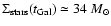 pc-2 if BDs are not taken into account and
 pc-2
if they are. Both values are within the errors associated with the
observational estimate, though the higher value is more likely.
pc-2
if they are. Both values are within the errors associated with the
observational estimate, though the higher value is more likely.
![\begin{figure}
\par\includegraphics[width=8.6cm,clip]{1222f5c.eps} \end{figure}](/articles/aa/full/2005/05/aa1222/Timg140.gif) |
Figure 5:
Upper panel: evolution of 3He/H in the solar
neighbourhood. Different lines refer to different IMF
prescriptions: short-dashed line: Salpeter (1955);
dotted line: Tinsley (1980); continuous line: Scalo
(1986); long-dashed line: Kroupa et al. (1993);
dot-short-dashed line: Scalo (1998); dot-long-dashed
line: Chabrier (2003) with x = 1.7 for m > 1 .
Data (vertical bars at t = 9.2 and 13.7 Gyr) are from Geiss
& Gloeckler (1998). Lower panel: evolution of
3He/4He in the solar neighbourhood. Models are labeled as
in the upper panel. Data are from Geiss & Gloeckler (1998; at
1 and 2
- thick and thin vertical bars,
respectively, at t = 9.2 and 13.7 Gyr) and Salerno et al.
(2003; 1 -bar on the right at t = 13.7 Gyr).
|
| Open with DEXTER |
![\begin{figure}
\par\includegraphics[width=8.2cm,clip]{1222f6c.eps} \end{figure}](/articles/aa/full/2005/05/aa1222/Timg141.gif) |
Figure 6:
[O/Fe] (upper panel) and [S/Fe] (lower panel)
ratios as functions of [Fe/H]. Models as in Fig. 5.
All the ratios are normalized to solar elemental abundances by
Grevesse & Sauval (1998), except for oxygen, for which the
solar value from Holweger (2001) is adopted. Data for oxygen
are from Meléndez & Barbuy (2002; stars: [O/Fe] values
from infrared OH lines; full circles: mean [O/Fe] from
[O I] line in bins of 0.2 dex in [Fe/H]; the size of
the circles represents the number of stars in each metallicity
bin). Data for sulphur are from Ryde & Lambert (2004;
pentagons: measurements from observations of S I
lines at 9212.9, 9228.1 and 9237.5 Å) and Chen et al. (2002;
crosses). For these latter measurements, the typical
error is also reported in the lower right corner of the panel.
|
| Open with DEXTER |
Figures 5 and 6 show the errors associated with chemical
evolution model predictions for several quantities, obtained by changing
the prescriptions for the stellar IMF and keeping the same stellar
lifetimes (Maeder & Meynet 1989). Model predictions for the evolution of
3He/H and 3He/4He as functions of time (Fig. 5, upper and lower panel, respectively) and [O/Fe] and [S/Fe] as
functions of [Fe/H] (Fig. 6, upper and lower panel,
respectively) in the solar neighbourhood are shown, as well as the
corresponding data. Model predictions are not normalized to the predicted
solar values, contrary to what is often done in chemical evolution studies.
This is to better appreciate the differences obtained with the various IMFs
in the last 4.5 Gyr of evolution, an effect which is not evident when the
solar normalization is applied. The elements displayed in Figs. 5
and 6 have not been chosen randomly. They are representative of
stellar progenitors belonging to different initial mass ranges: (i) 3He
is produced by stars belonging to the low-mass range, 1-2 ;
(ii)
4He comes from the whole stellar mass range; (iii) oxygen is almost
entirely produced on short time scales by stars with
 ;
(iv) sulphur is representative of elements produced partly by SNeII and
partly by SNeIa; finally, (v) Fe is mostly produced by type Ia SNe on long
timescales.
;
(iv) sulphur is representative of elements produced partly by SNeII and
partly by SNeIa; finally, (v) Fe is mostly produced by type Ia SNe on long
timescales.
![\begin{figure}
\par\includegraphics[width=8.5cm,clip]{1222f7c.eps} \end{figure}](/articles/aa/full/2005/05/aa1222/Timg143.gif) |
Figure 7:
Type Ia SN rates obtained with different assumptions for the
stellar lifetimes (Maeder & Meynet 1989 - thin solid
line; Tinsley 1980 - thick dotted line; Schaller et al.
1992 - thick solid line; Kodama 1997 - thick
dashed line). We also show the effect of changing the fraction
of mass entering the formation of type Ia SN progenitors. The
four curves lying in the lower part of the diagram have all
been computed with A = 0.05, while the value of A for the
curves lying in the upper part of the diagram has been changed
so as to produce the same present-day
in the
disk, independent of the adopted stellar lifetime
prescriptions. The type Ia SN rate observed in the Galaxy at
the present time is also shown ( vertical bar, for h =
0.7; Cappellaro et al. 1997).
|
| Open with DEXTER |
Table 6:
Abundances in the PSC as predicted by the model at t = 9.2 Gyr
for different assumptions for the stellar lifetimes. The
abundances are by number in
(X), except for
helium (Y) and global metallicity (Z), for which the
abundances by mass are reported. Model predictions are compared
with observed photospheric solar abundances, unless otherwise
stated. A value of A = 0.05 is assumed for all models (see
text).
Scalo's (1998) IMF, having the highest fractions of stars with
and 1
 (Fig. 1), predicts a too
large O/Fe ratio during the whole Galactic lifetime and an increase of
3He/H and 3He/4He from the time of the Sun's formation up to now
that hardly fits the data. This is because the stars in the range 1-2
are net 3He producers, even when 90% of them are
assumed to experience the cool bottom processes which strongly deplete
their 3He yields (see next section for more details and references),
whereas high-mass stars produce almost all the oxygen. On the contrary,
Salpeter (1955), Tinsley (1980) and Scalo (1986) IMFs predict enrichment histories for
3He/H and 3He/4He which better agree with the data, because of the
lower mass fraction falling in the 1-2
stellar mass range. The
Kroupa et al. and Chabrier IMFs, with x = 1.7 for
,
produce an intermediate behaviour. They also guarantee the best fit to the
[O/Fe] vs [Fe/H] data. The (small) differences in the S/Fe ratio in the
disc are mostly related to the (slightly) different behaviour of the SNIa
predicted rate in the past when adopting different IMFs.
(Fig. 1), predicts a too
large O/Fe ratio during the whole Galactic lifetime and an increase of
3He/H and 3He/4He from the time of the Sun's formation up to now
that hardly fits the data. This is because the stars in the range 1-2
are net 3He producers, even when 90% of them are
assumed to experience the cool bottom processes which strongly deplete
their 3He yields (see next section for more details and references),
whereas high-mass stars produce almost all the oxygen. On the contrary,
Salpeter (1955), Tinsley (1980) and Scalo (1986) IMFs predict enrichment histories for
3He/H and 3He/4He which better agree with the data, because of the
lower mass fraction falling in the 1-2
stellar mass range. The
Kroupa et al. and Chabrier IMFs, with x = 1.7 for
,
produce an intermediate behaviour. They also guarantee the best fit to the
[O/Fe] vs [Fe/H] data. The (small) differences in the S/Fe ratio in the
disc are mostly related to the (slightly) different behaviour of the SNIa
predicted rate in the past when adopting different IMFs.
In this section we keep fixed the prescriptions for the stellar IMF, while
varying those for the stellar lifetimes, according to what was discussed in
Sect. 3. We choose to adopt the Scalo (1986) IMF for the sake of comparison
with previous results published in a series of papers dealing with
different aspects of the Milky Way evolution (e.g. Chiappini et al. 1997;
Romano et al. 2003, and references therein).
In the following, we compare results of chemical evolution models for the
solar vicinity adopting stellar lifetimes from: (i) Tinsley (1980); (ii)
Maeder & Meynet (1989); (iii)
Schaller et al. (1992); (iv) Kodama (1997).
![\begin{figure}
\par\includegraphics[width=14cm,clip]{1222f8c.eps} \end{figure}](/articles/aa/full/2005/05/aa1222/Timg150.gif) |
Figure 8:
Theoretical G-dwarf metallicity distributions (thick
lines) predicted by the model with different assumptions for
the stellar lifetimes ( left panels: Tinsley 1980;
middle panels: Shaller et al. 1992; right panels: Kodama
1997) and for the fraction of mass entering the formation of
type Ia SN progenitors ( upper panels: A = 0.05;
lower panels: A = 0.08 in case of Schaller et al.'s and
Kodama's stellar lifetimes; A = 0.085 in case of Tinsley's
stellar lifetimes). Scalo's (1986) IMF is assumed in all cases.
Theoretical distributions are compared with observational
ones from Rocha-Pinto & Maciel (1996; solid histograms)
and Jørgensen (2000; dotted histograms). For each
model, the theoretical [Fe/H] ratios are normalized to the Fe/H
ratio at Sun's birth predicted by the model itself, given in
the upper left corner of each panel (middle row). This produces
a shift of the distribution along the x axis, thus allowing a
better comparison of the theoretical shape with the observed
one even if the model does not recover the actual iron
abundance of the Sun.
|
| Open with DEXTER |
In Chiappini et al. (1997) and subsequent work by that group, the
prescriptions of Maeder & Meynet (1989) were adopted. According to those
authors, stars with 1.3
 are characterized by
lifetimes longer than in any other study (see Fig. 3). This
causes the type Ia SN rate to increase smoothly during almost the whole
disk evolution, with a gentle decline starting only a couple of Gyrs ago
(thin solid line in Fig. 7). On the contrary, models with
different prescriptions for the stellar lifetimes all produce a
well-defined peak in the rate, followed by a steep decline afterward (thick
lines in Fig. 7). If one adopts Tinsley's (1980), Schaller et
al.'s (1992) or Kodama's (1997) stellar lifetimes, keeping A - i.e. the
fraction of mass belonging to binary systems which will give rise to type Ia SN explosions - constant and equal to 0.05 results in slightly more
iron produced until the time of the Sun's formation (see also Table 6,
Col. 10), while SNeIa are supposed to be less numerous in the disk at the
present time. However, their number still agrees with that inferred from
the observations (vertical bar in Fig. 7). To raise the
present-day SNIa rate to the value expected when adopting Maeder & Meynet
(1989) stellar lifetimes, it is necessary to increase the fraction of mass
belonging to SNIa progenitors. In particular, when adopting Schaller et al.
(1992) or Kodama (1997) s, A = 0.08 is required, while a slightly
higher value, A = 0.085, must be assumed if Tinsley's (1980) stellar
lifetimes are adopted (upper curves in Fig. 7).
Increasing the efficiency of star formation while leaving the A parameter
unchanged would also lead to an increase of the SNIa rate, but it would
also cause major problems in reproducing other important constraints
available for the immediate solar vicinity. From Fig. 7 and
Table 6, Col. 10, we conclude that, for a Scalo (1986) IMF, a small A
value of the order of 0.05 or even less should be preferred, because it
produces theoretical predictions matching remarkably well the solar iron
abundance and the present-day SNIa rate data at the same time.
are characterized by
lifetimes longer than in any other study (see Fig. 3). This
causes the type Ia SN rate to increase smoothly during almost the whole
disk evolution, with a gentle decline starting only a couple of Gyrs ago
(thin solid line in Fig. 7). On the contrary, models with
different prescriptions for the stellar lifetimes all produce a
well-defined peak in the rate, followed by a steep decline afterward (thick
lines in Fig. 7). If one adopts Tinsley's (1980), Schaller et
al.'s (1992) or Kodama's (1997) stellar lifetimes, keeping A - i.e. the
fraction of mass belonging to binary systems which will give rise to type Ia SN explosions - constant and equal to 0.05 results in slightly more
iron produced until the time of the Sun's formation (see also Table 6,
Col. 10), while SNeIa are supposed to be less numerous in the disk at the
present time. However, their number still agrees with that inferred from
the observations (vertical bar in Fig. 7). To raise the
present-day SNIa rate to the value expected when adopting Maeder & Meynet
(1989) stellar lifetimes, it is necessary to increase the fraction of mass
belonging to SNIa progenitors. In particular, when adopting Schaller et al.
(1992) or Kodama (1997) s, A = 0.08 is required, while a slightly
higher value, A = 0.085, must be assumed if Tinsley's (1980) stellar
lifetimes are adopted (upper curves in Fig. 7).
Increasing the efficiency of star formation while leaving the A parameter
unchanged would also lead to an increase of the SNIa rate, but it would
also cause major problems in reproducing other important constraints
available for the immediate solar vicinity. From Fig. 7 and
Table 6, Col. 10, we conclude that, for a Scalo (1986) IMF, a small A
value of the order of 0.05 or even less should be preferred, because it
produces theoretical predictions matching remarkably well the solar iron
abundance and the present-day SNIa rate data at the same time.
The G-dwarf metallicity distributions obtained with all the above-mentioned
prescriptions for
are displayed in Figs. 4 (upper left panel) and 8. Again, the theoretical distributions
are convolved with a Gaussian to account for both the observational and the
intrinsic scatter. The adopted total dispersion in [Fe/H] is
dex (Arimoto et al. 1992; Kotoneva et al. 2002). Since
most of the iron in the solar neighbourhood comes from type Ia SNe, the
shape of the distribution is expected to change according to changes
affecting type Ia SN progenitors. Indeed, adopting Tinsley (1980) or Kodama
(1997) stellar lifetimes (Fig. 8, left and right
panels, respectively) results in a more pronounced peak, independent of
the value of A (which is given in the upper left corner of each panel,
third row).
It is worth noticing that, independent of the choice of the stellar
lifetimes, we always get a strikingly good fit to the position of the peak
and to the high-metallicity tail of the distribution. We conclude that: (i)
the main parameter driving the location of the peak and the shape of the
distribution is the adopted time scale for thin-disk formation, which was
already well known (Chiappini et al. 1997); (ii) the adopted stellar
lifetimes affect the theoretical G-dwarf distribution as well, though
through a second order effect: they mostly act on the width and height of
the distribution. However, convolution with a Gaussian which accounts for
errors makes different distributions, obtained with different prescriptions
for the stellar lifetimes, look pretty much the same.
In Table 6 we report the abundances in the Protosolar Cloud (PSC) predicted
under different assumptions for the stellar lifetimes. Notice that for all
the models in Table 6 a value of 0.05 for A is adopted. A larger A
value would overestimate the iron content of the Sun. It can be seen that
the global metallicity, Z, is well reproduced by all the models and so
are the CNO abundances, with a possible exception for oxygen, whose
predicted solar abundance is a bit higher than observed. On the other hand,
the helium abundance turns out to be too low. Increasing the star formation
efficiency would provide a higher Y abundance, but the oxygen and global
metallicity would also increase, spoiling the agreement with the
observations. This clearly shows that some revision of the helium stellar
yields is necessary (see Meynet & Maeder 2002; Chiappini et al. 2003b).
Let us now comment on specific trends predicted for a handful of important
species: (i) 3He and (ii) 7Li, coming mostly from low-mass stellar
progenitors; (iii) oxygen, a typical massive star product; and (iv)
sulphur, with both a SNII and a SNIa component. Major differences are
expected in the model predictions for 3He and 7Li, because of the
large differences characterizing different
prescriptions for their
stellar progenitors.
To deal with 3He, one must keep in mind that it is mostly produced by
low-mass - hence long-living - stars. Standard stellar evolutionary
theory predicts a large production of 3He from low-mass stars leading to
a severe inconsistency between the observed 3He abundances and those
predicted by chemical evolution models assuming these standard yields
(Rood et al. 1976; Galli et al. 1995; Olive et al. 1995;
Dearborn et al. 1996; Prantzos 1996). This problem has now been superseded
by the inclusion of rotational mixing in stellar models (e.g. Charbonnel
1995; Sackmann & Boothroyd 1999). Indeed, extra mixing makes it possible
to reconcile predictions from Galactic chemical evolution models with
observations, as long as 3He is destroyed in a large enough fraction
(90%) of low-mass stars (e.g. Galli et al. 1997; Chiappini et al.
2002, and references therein). Figure 9 shows the 3He
evolution in the solar neighbourhood as predicted under different
assumptions for the stellar lifetimes: the thin solid lines are for
Maeder & Meynet (1989); the thick solid lines are for Schaller et
al. (1992); the thick dotted lines for Tinsley (1980) and the thick dashed ones for Kodama (1997). The prescriptions on 3He synthesis
are those from Dearborn et al. (1996) and Sackmann & Boothroyd (1999) for
stars without and with extra mixing. These 3He yields were recently
adopted also by Chiappini et al. (2002) and Romano et al. (2003) and take
extra mixing in 93% of low-mass stars into account. The lower 3He
production for t < 11-12 Gyr predicted assuming Maeder & Meynet (1989)
stellar lifetimes is due to the longer lifetimes in the mass range 1-2.
The subsequent steep rise is mostly due to the late contribution
from stars in the 0.6-0.9
mass range, which die if one adopts
the Matteucci & François (1989) extrapolation of Maeder & Meynet's
stellar lifetimes in the very low stellar mass range. Conversely, these
stars never die if the Schaller et al., Tinsley or Kodama stellar lifetimes
are adopted instead (Fig. 3; see also the discussion in Romano
et al. 2003). If one trusts the local value of the helium isotopic ratio as
measured with the COLLISA experiment on board the space station MIR
(Salerno et al. 2003 - Fig. 9, lower panel, vertical
bar on the right at t = 13.7 Gyr), longer lifetimes for stars with
should be preferred. In fact, this measurement supports the
hypothesis that negligible changes of the abundance of 3He occurred in
the Galaxy during the last 4.5 Gyr.
![\begin{figure}
\par\includegraphics[width=8.5cm,clip]{1222f9c.eps} \end{figure}](/articles/aa/full/2005/05/aa1222/Timg152.gif) |
Figure 9:
Same as Fig. 5, but here different line types refer
to different prescriptions for the stellar lifetimes. Thin
solid lines: Maeder & Meynet (1989); thick solid lines:
Schaller et al. (1992); thick dotted lines: Tinsley
(1980); thick dashed lines: Kodama (1997). The Scalo
(1986) IMF is assumed for all the models.
|
| Open with DEXTER |
![\begin{figure}
\par\includegraphics[width=8.5cm,clip]{1222f10c.eps} \end{figure}](/articles/aa/full/2005/05/aa1222/Timg153.gif) |
Figure 10:
Temporal evolution of lithium in the solar neighbourhood.
Different curves refer to model predictions obtained with
different recipes for the stellar lifetimes. Thin solid
line: Maeder & Meynet (1989); thick solid line:
Schaller et al. (1992); thick dotted line: Tinsley (1980);
thick dashed line: Kodama (1997). The meteoritic
(Nichiporuk & Moore 1974; pentagon) and the depletion
corrected value for the local ISM (Knauth et al. 2003; at 1-
and 2-
- thick and thin vertical bars,
respectively) are shown as well. Notice that the  value
(where
is the fraction of white dwarfs entering the
formation of nova systems) is adjusted so as to reproduce the
nova outburst rate currently observed in the Galaxy. In
particular, in the case of Tinsley, Schaller et al. and Kodama
stellar lifetimes
value
(where
is the fraction of white dwarfs entering the
formation of nova systems) is adjusted so as to reproduce the
nova outburst rate currently observed in the Galaxy. In
particular, in the case of Tinsley, Schaller et al. and Kodama
stellar lifetimes
 0.02, while
0.01
if Maeder & Meynet stellar lifetimes are adopted instead (see
text for details).
0.02, while
0.01
if Maeder & Meynet stellar lifetimes are adopted instead (see
text for details).
|
| Open with DEXTER |
Lithium is another element that originates mostly from low-mass stars
(Romano et al. 2001). According to our models, its meteoritic abundance is
due for 40% to low-mass (
 )
stars on the red
giant branch (RGB) and for 10% to novae, binary systems consisting
of a white dwarf plus a main sequence companion (Romano et al. 2001, 2003;
but see also Casuso & Beckman 2000 and Travaglio et al. 2001 for different
views). The predicted steep rise of the lithium abundance in the ISM at
late times is dictated by the long time scales for lithium production from
RGB stars and novae when adopting Maeder & Meynet stellar lifetimes. Here
we analyse what changes are introduced by adopting different stellar
lifetimes. In Fig. 10 we compare model predictions for the
temporal evolution of 7Li in the solar vicinity obtained by adopting
Maeder & Meynet (1989) stellar lifetimes (thin solid line) to what
we get if adopting Schaller et al. (1992 - thick solid line),
Tinsley (1980 - thick dotted line) or Kodama (1997 - thick
dashed line) prescriptions. The Schaller et al. stellar lifetimes result
in a more gentle rise during the last 3 Gyr, while almost no
evolution is expected during the same time interval with Tinsley (1980) or
Kodama (1997) prescriptions. These considerations are interesting in the
light of recent claims of a null 7Li evolution in the ISM during the
last several Gyrs inferred from cluster and field star lithium data
(Lambert & Reddy 2004). However, in our opinion these data do not rule out
a scenario of late lithium pollution from low-mass stars, if the
uncertainties in both the models and the data are properly taken into
account.
)
stars on the red
giant branch (RGB) and for 10% to novae, binary systems consisting
of a white dwarf plus a main sequence companion (Romano et al. 2001, 2003;
but see also Casuso & Beckman 2000 and Travaglio et al. 2001 for different
views). The predicted steep rise of the lithium abundance in the ISM at
late times is dictated by the long time scales for lithium production from
RGB stars and novae when adopting Maeder & Meynet stellar lifetimes. Here
we analyse what changes are introduced by adopting different stellar
lifetimes. In Fig. 10 we compare model predictions for the
temporal evolution of 7Li in the solar vicinity obtained by adopting
Maeder & Meynet (1989) stellar lifetimes (thin solid line) to what
we get if adopting Schaller et al. (1992 - thick solid line),
Tinsley (1980 - thick dotted line) or Kodama (1997 - thick
dashed line) prescriptions. The Schaller et al. stellar lifetimes result
in a more gentle rise during the last 3 Gyr, while almost no
evolution is expected during the same time interval with Tinsley (1980) or
Kodama (1997) prescriptions. These considerations are interesting in the
light of recent claims of a null 7Li evolution in the ISM during the
last several Gyrs inferred from cluster and field star lithium data
(Lambert & Reddy 2004). However, in our opinion these data do not rule out
a scenario of late lithium pollution from low-mass stars, if the
uncertainties in both the models and the data are properly taken into
account.
In our model, nearly 10% of lithium in meteorites is produced during nova
outbursts. These are periodical explosions that do not destroy the parent
system. When dealing with nova systems one must introduce in the model a
free parameter, ,
describing the fraction of white dwarfs which
enters the formation of nova systems (similar to what is done for SNeIa;
see D'Antona & Matteucci 1991; Romano et al. 1999; Matteucci et al. 2003).
Figure 10 shows model results obtained by changing the
value so as to obtain the same theoretical nova outburst rate in the Galaxy
at the present time, whatever the
choice. A value of
 yr-1 is found with
 in the case of Maeder & Meynet stellar lifetimes and
 in the remaining cases, to be compared with
 yr-1 (Shafter 1997). When
using Tinsley's, Schaller et al.'s or Kodama's stellar lifetimes, a 7Li
production from novae higher than expected when using Maeder & Meynet's
stellar lifetimes is obtained during the whole Galactic lifetime, owing to
the higher value assumed for .
Lowering the 7Li yields from red
giants and/or novae can bring the theoretical predictions into better
agreement with the observations. This goes in the right direction. In fact,
in order to reproduce the observed meteoritic lithium data, in previous
work we had to require that all low-mass red giants are displaying
the largest observed atmospheric lithium enrichment near the tip of
the RGB and couple this with the most efficient mass loss still
compatible with observations (Romano et al. 2001). Adopting stellar
lifetime prescriptions different from those of Maeder & Meynet (1989)
helps us to alleviate such an extreme ad hoc scenario.
yr-1 (Shafter 1997). When
using Tinsley's, Schaller et al.'s or Kodama's stellar lifetimes, a 7Li
production from novae higher than expected when using Maeder & Meynet's
stellar lifetimes is obtained during the whole Galactic lifetime, owing to
the higher value assumed for .
Lowering the 7Li yields from red
giants and/or novae can bring the theoretical predictions into better
agreement with the observations. This goes in the right direction. In fact,
in order to reproduce the observed meteoritic lithium data, in previous
work we had to require that all low-mass red giants are displaying
the largest observed atmospheric lithium enrichment near the tip of
the RGB and couple this with the most efficient mass loss still
compatible with observations (Romano et al. 2001). Adopting stellar
lifetime prescriptions different from those of Maeder & Meynet (1989)
helps us to alleviate such an extreme ad hoc scenario.
Finally, as far as the [O/Fe] and [S/Fe] ratios are concerned, it is worth
emphasizing that only small differences are found among models adopting
different stellar lifetimes. In the case of Tinsley's (1980) prescriptions
a flatter behaviour is predicted for [O/Fe] vs [Fe/H] at high
metallicities, at variance with observations (Bensby et al. 2004). However, no firm conclusions can be drawn on this point
alone.
Together with the time modulation of the SFR, the IMF dictates the
evolution and fate of galaxies. Nonluminous BDs and the lowest-mass stars
lock up an increasing fraction of the baryonic mass of galaxies over the
cosmological time. Short-lived massive stars and intermediate-mass stars
belonging to binary systems ending up as type Ia SNe heat the ISM,
eventually determining the occurrence of galactic outflows. It is therefore
of great importance to quantify the effect of changing the relative numbers
of stars in different mass ranges at different times on galactic chemical
evolution model predictions.
In this work we deal with our own Galaxy. We ascertain the range of
variations that affect several model predictions when accounting for
uncertainties in both the stellar IMF and the stellar lifetimes. First, we
show results of chemical evolution models for the Milky Way computed with
different assumptions for the stellar IMF. Then, we investigate the effects
of changing the prescriptions for the stellar lifetimes. "Theoretical
errors'' are associated to model predictions due to uncertainties in the IMF
and/or stellar lifetimes. We summarize our main conclusions as follows:
Among all the studied IMFs, the Salpeter (1955) and Scalo (1998) ones are
those that agree least with the data. The Scalo (1986), Kroupa et al.
(1993) and Chabrier (2003) IMFs all guarantee good fits to several
important observed properties of the solar vicinity.
Different stellar lifetime prescriptions differ mostly in the low and very
low stellar mass domain. Therefore, it is not surprising that models
adopting different prescriptions for the stellar lifetimes differ mostly in
the predicted evolution for those species originating mostly from low-mass
stars. We analyse the evolution of 3He and 7Li and show that it is
better reproduced if long lifetimes are adopted for the low stellar mass
range.
Oxygen abundance data recently derived for F and G dwarf stars in the solar
neighbourhood indicate that the [O/Fe] trend at super-solar [Fe/H]
continues downward, which is in concordance with models of Galactic
chemical evolution unless stellar lifetimes from Tinsley (1980) are
adopted. Notice that her prescriptions are characterized by very short
lifetimes for massive stars.
We conclude that, given the uncertainties still associated to current
observations, the main conclusions reached by chemical evolution models for
the Galaxy are left unchanged. However, it is clear that only further
observations and studying galaxies of different morphological type will
allow us to draw a firmer picture and obtain a better understanding of the
problem.
Acknowledgements
We thank H. Rocha-Pinto for interesting informations and the referee, N.
Arimoto, for useful suggestions. DR and MT acknowledge the illuminating
discussions with J. Geiss and the members of the ISSI-LoLaGE team. The work
of D.R. has been partially funded by the Italian Space Agency through grant
IR 11301 ZAM and by INAF. Financial support from MIUR/COFIN 2003029437
and MIUR/COFIN 2003028039 is also acknowledged.
- Akerman, C. J.,
Carigi, L., Nissen, P. E., Pettini, M., & Asplund, M. 2004,
A&A, 414, 931 [EDP Sciences] [NASA ADS] [CrossRef] (In the text)
- Allende Prieto,
C., Lambert, D. L., & Asplund, M. 2001, ApJ, 556, L63 [NASA ADS] [CrossRef] (In the text)
- Allende Prieto,
C., Lambert, D. L., & Asplund, M. 2002, ApJ, 573, L137 [NASA ADS] [CrossRef] (In the text)
- Aloisi, A., Tosi,
M., & Greggio, L. 1999, ApJ, 118, 302 [NASA ADS] (In the text)
- Arimoto, N.,
& Yoshii, Y. 1987, A&A, 173, 23 [NASA ADS] (In the text)
- Arimoto, N.,
Yoshii, Y., & Takahara, F. 1992, A&A, 253, 21 [NASA ADS] (In the text)
- Asplund, M.,
Grevesse, N., Sauval, A. J., Allende Prieto, C., & Kiselman, D.
2004, A&A, 417, 751 [EDP Sciences] [NASA ADS] [CrossRef] (In the text)
- Bensby, T.,
Feltzing, S., & Lundström, I. 2004, A&A, 415, 155 [EDP Sciences] [NASA ADS] [CrossRef] (In the text)
- Cappellaro,
E., Turatto, M., Tsvvetkov, D., et al. 1997, A&A, 322, 431 [NASA ADS] (In the text)
- Casuso, E., &
Beckman, J. E. 2000, PASP, 112, 942 [NASA ADS] [CrossRef] (In the text)
- Cayrel, R. 1996,
A&ARv, 7, 217 [NASA ADS] (In the text)
- Centurión,
M., Molaro, P., Vladilo, G., et al. 2003, A&A, 403, 55 [EDP Sciences] [NASA ADS] [CrossRef] (In the text)
- Chabrier, G.
2003, PASP, 115, 763 [NASA ADS] [CrossRef] (In the text)
- Charbonnel,
C. 1995, ApJ, 453, L41 [NASA ADS] (In the text)
- Chen, Y. Q., Nissen, P.
E., Zhao, G., & Asplund, M. 2002, A&A, 390, 225 [EDP Sciences] [NASA ADS] (In the text)
- Chen, Y. Q., Zhao, G.,
Nissen, P. E., Bai, G. S., & Qiu, H. M. 2003, ApJ, 591,
925 [NASA ADS] [CrossRef] (In the text)
- Chiappini,
C., Matteucci, F., & Gratton, R. 1997, ApJ, 477, 765 [NASA ADS] [CrossRef] (In the text)
- Chiappini,
C., Matteucci, F., & Padoan, P. 2000, ApJ, 528, 711 [NASA ADS] [CrossRef] (In the text)
- Chiappini,
C., Renda, A., & Matteucci, F. 2002, A&A, 395, 789 [EDP Sciences] [NASA ADS] [CrossRef] (In the text)
- Chiappini,
C., Romano, D., & Matteucci, F. 2003a, MNRAS, 339, 63 [NASA ADS] [CrossRef] (In the text)
- Chiappini,
C., Matteucci, F., & Meynet, G. 2003b, A&A, 410, 257 [EDP Sciences] [NASA ADS] [CrossRef] (In the text)
- Chiosi, C. 1980,
A&A, 83, 206 [NASA ADS] (In the text)
- D'Antona, F., &
Matteucci, F. 1991, A&A, 248, 62 [NASA ADS] (In the text)
- Dearborn, D. S.
P., Steigman, G., & Tosi, M. 1996, ApJ, 465, 887 [NASA ADS] [CrossRef] (In the text)
-
Dessauges-Zavadsky, M., Calura, F., Prochaska, J. X., D'Odorico,
S., & Matteucci, F. 2004, A&A, 416, 79 [EDP Sciences] [NASA ADS] [CrossRef] (In the text)
- Dietrich, M.,
Appenzeller, I., Hamann, F., et al. 2003a, A&A, 398, 891 [EDP Sciences] [NASA ADS] [CrossRef] (In the text)
- Dietrich, M.,
Hamann, F., Shields, J. C., et al. 2003b, ApJ, 589, 722 [NASA ADS] [CrossRef]
- D'Odorico, V.,
Cristiani, S., Romano, D., Granato, G. L., & Danese, L. 2004,
MNRAS, 351, 976 [NASA ADS] [CrossRef] (In the text)
- Edvardsson,
B., Andersen, J., Gustafsson, B., et al. 1993, A&A, 275,
101 [NASA ADS] (In the text)
- Esteban, C.,
Peimbert, M., García-Rojas, J., et al. 2004, MNRAS, in press
[arXiv:astro-ph/0408249]
(In the text)
- Fuhrmann, K.
1998, A&A, 338, 161 [NASA ADS] (In the text)
- Fuhrmann, K.
2004, AN, 325, 3 [NASA ADS] (In the text)
- Galli, D., Palla, F.,
Ferrini, F., & Penco, U. 1995, ApJ, 443, 536 [NASA ADS] [CrossRef] (In the text)
- Galli, D.,
Stanghellini, L., Tosi, M., & Palla, F. 1997, ApJ, 477,
218 [NASA ADS] [CrossRef] (In the text)
- Geiss, J., &
Gloeckler, G. 1998, Space Sci. Rev., 84, 239 [NASA ADS] [CrossRef] (In the text)
- Gerritsen, J.
P. E., & Icke, V. 1997, A&A, 325, 972 [NASA ADS] (In the text)
- Gibson, B. K. 1997,
MNRAS, 290, 471 [NASA ADS]
- Gratton, R. G.,
Carretta, E., Matteucci, F., & Sneden, C. 1996, in Formation of
the Galactic Halo Inside and Out, ed. H. Morrison, & A.
Sarajedini (San Francisco: ASP), ASP Conf. Ser., 92, 307
(In the text)
- Gratton, R. G.,
Carretta, E., Matteucci, F., & Sneden, C. 2000, A&A, 358,
671 (In the text)
- Gratton, R. G.,
Carretta, E., Desidera, S., et al. 2003, A&A, 406, 131 [EDP Sciences] [NASA ADS] [CrossRef] (In the text)
- Grevesse, N.,
& Sauval, A. J. 1998, Space Sci. Rev., 85, 161 [NASA ADS] [CrossRef] (In the text)
- Holweger, H.
2001, in Solar and Galactic Composition, ed. R. F.
Wimmer-Schweingruber, Am. Inst. Phys. Conf. Proc., 598, 23
(In the text)
- Ibukiyama,
A., & Arimoto, N. 2002, A&A, 394, 927 [EDP Sciences] [NASA ADS] [CrossRef] (In the text)
- Ivans, I. I., Sneden,
C., James, C. R., et al. 2003, ApJ, 592, 906 [NASA ADS] [CrossRef] (In the text)
- Jeffries, R.
D., Naylor, T., Devey, C. R., & Totten, E. J. 2004, MNRAS, in
press [arXiv:astro-ph/0404028]
(In the text)
- Jørgensen,
B. R. 2000, A&A, 363, 947 [NASA ADS] (In the text)
- Kennicutt, R.
C. 1998, ApJ, 498, 541 [NASA ADS] [CrossRef] (In the text)
- Knauth, D. C.,
Federman, S. R., & Lambert, D. L. 2003, ApJ, 586, 268 [NASA ADS] [CrossRef] (In the text)
- Kodama, T. 1997,
Ph.D. Thesis, Institute of Astronomy, Univ. of Tokyo
(In the text)
- Kotoneva, E.,
Flynn, C., Chiappini, C., & Matteucci, F. 2002, MNRAS, 336,
879 [NASA ADS] [CrossRef] (In the text)
- Kroupa, P. 2002,
Science, 295, 82 [NASA ADS] [CrossRef] (In the text)
- Kroupa, P., Tout,
C. A., & Gilmore, G. 1993, MNRAS, 262, 545 [NASA ADS] (In the text)
- Kroupa, P., &
Weidner, C. 2003, ApJ, 598, 1076 [NASA ADS] [CrossRef] (In the text)
- Lambert, D. L.,
& Reddy, B. E. 2004, MNRAS, 349, 757 [NASA ADS] [CrossRef] (In the text)
- Maeder, A., &
Meynet, G. 1989, A&A, 210, 155 [NASA ADS] (In the text)
- Martell, S.,
& Laughlin, G. 2002, ApJ, 577, L45 [NASA ADS] [CrossRef] (In the text)
- Matteucci, F.
2001, The Chemical Evolution of the Galaxy, ASSL, Vol. 253
(Dordrecht: Kluwer Academic Publishers)
(In the text)
- Matteucci,
F., & François, P. 1989, MNRAS, 239, 885 [NASA ADS] (In the text)
- Matteucci,
F., & François, P. 1992, A&A, 262, L1 [NASA ADS] (In the text)
- Matteucci,
F., & Greggio, L. 1986, A&A, 154, 279 [NASA ADS] (In the text)
- Matteucci,
F., & Recchi, S. 2001, ApJ, 558, 351 [NASA ADS] [CrossRef] (In the text)
- Matteucci,
F., Renda, A., Pipino, A., & Della Valle, M. 2003, A&A,
405, 23 [EDP Sciences] [NASA ADS] [CrossRef] (In the text)
- Meléndez, J., &
Barbuy, B. 2002, ApJ, 575, 474 [NASA ADS] [CrossRef] (In the text)
- Meynet, G., &
Maeder, A. 2002, A&A, 390, 561 [EDP Sciences] [NASA ADS] [CrossRef] (In the text)
- Nichiporuk,
W., & Moore, C. B. 1974, Geochim. Cosmochim. Acta, 38,
1691 [NASA ADS] [CrossRef] (In the text)
- Nissen, P. E.,
& Schuster, W. J. 1997, A&A, 326, 751 [NASA ADS] (In the text)
- Olive, K. A., Rood,
R. T., Schramm, D. N., Truran, J., & Vangioni-Flam, E. 1995,
ApJ, 444, 680 [NASA ADS] [CrossRef] (In the text)
- Padovani, P.,
& Matteucci, F. 1993, ApJ, 416, 26 [NASA ADS] [CrossRef] (In the text)
- Pettini, M. 2001,
in The Promise of the Herschel Space Observatory, ed. G. L.
Pilbratt, J. Cernicharo, A. M. Heras, T. Prusti, & R. Harris,
ESA-SP 460, 113
(In the text)
- Portinari,
L., Chiosi, C., & Bressan, A. 1998, A&A, 334, 505 [NASA ADS] (In the text)
- Prantzos, N.
1996, A&A, 310, 106 [NASA ADS] (In the text)
- Prochaska, J.
X., Howk, J. C., & Wolfe, A. M. 2003, Nature, 423, 57 [NASA ADS] [CrossRef] (In the text)
- Reddy, B. E., Tomkin,
J., Lambert, D. L., & Allende Prieto, C. 2003, MNRAS, 340,
304 [NASA ADS] [CrossRef] (In the text)
- Rocha-Pinto, H. J.,
& Maciel, W. J. 1996, MNRAS, 279, 447 [NASA ADS] (In the text)
- Romano, D.,
Matteucci, F., Molaro, P., & Bonifacio, P. 1999, A&A, 352,
117 [NASA ADS] (In the text)
- Romano, D.,
Matteucci, F., Ventura, P., & D'Antona, F. 2001, A&A, 374,
646 [EDP Sciences] [NASA ADS] [CrossRef] (In the text)
- Romano, D., Tosi,
M., Matteucci, F., & Chiappini, C. 2003, MNRAS, 346, 295 [NASA ADS] [CrossRef] (In the text)
- Rood, R. T., Steigman,
G., & Tinsley, B. M. 1976, ApJ, 207, L57 [NASA ADS] [CrossRef] (In the text)
- Ryde, N., &
Lambert, D. L. 2004, A&A, 415, 559 [EDP Sciences] [NASA ADS] [CrossRef] (In the text)
- Sackmann,
I.-J., & Boothroyd, A. I. 1999, ApJ, 510, 217 [NASA ADS] [CrossRef] (In the text)
- Salerno, E.,
Bühler, F., Bochsler, P., et al. 2003, ApJ, 585, 840 [NASA ADS] [CrossRef] (In the text)
- Salpeter, E. E.
1955, ApJ, 121, 161 [NASA ADS] [CrossRef] (In the text)
- Scalo, J. M. 1986,
Fund. Cosmic Phys., 11, 1 [NASA ADS] (In the text)
- Scalo, J. M. 1998, in
The Stellar Initial Mass Function, ed. G. Gilmore, & D. Howell
(San Francisco: ASP), ASP Conf. Ser., 142, 201
(In the text)
- Schaller, G.,
Schaerer, D., Meynet, G., & Maeder, A. 1992, A&AS, 96,
269 [NASA ADS] (In the text)
- Shafter, A. W.
1997, ApJ, 487, 226 [NASA ADS] [CrossRef] (In the text)
- Tinsley, B. M.
1980, Fund. Cosmic Phys., 5, 287 [NASA ADS] (In the text)
- Tolstoy, E.,
Venn, K. A., Shetrone, M., et al. 2003, AJ, 125, 707 [NASA ADS] [CrossRef] (In the text)
- Tosi, M. 1982, ApJ,
254, 699 [NASA ADS] [CrossRef] (In the text)
- Tosi, M. 1988, A&A,
197, 33 [NASA ADS] (In the text)
- Tosi, M. 1996, in From
Stars to Galaxies: The Impact of Stellar Physics on Galaxy
Evolution, ed. C. Leitherer, U. Fritze-von-Alvensleben, & J.
Huchra (San Francisco: ASP), ASP Conf. Ser., 98, 299
(In the text)
- Travaglio,
C., Randich, S., Galli, D., et al. 2001, ApJ, 559, 909 [NASA ADS] [CrossRef] (In the text)
- van den Bergh, S.,
& Tammann, G. 1991, ARA&A, 29, 363 [NASA ADS] (In the text)
- Wheeler, J. C.,
Sneden, C., & Truran, J. W., Jr. 1989, ARA&A, 27, 279 [NASA ADS] (In the text)
- Wyse, R. F. G., &
Gilmore, G. 1995, AJ, 110, 2771 [NASA ADS] [CrossRef] (In the text)
- Zoccali, M.,
Renzini, A., Ortolani, S., et al. 2003, A&A, 399, 931 [EDP Sciences] [NASA ADS] [CrossRef] (In the text)
Copyright ESO 2005
![\begin{figure}
\par\includegraphics[width=8.3cm,clip]{1222f1ac.eps}\hspace*{6mm}
\includegraphics[width=8.3cm,clip]{1222f1bc.eps} \end{figure}](/articles/aa/full/2005/05/aa1222/img17.gif)


![\begin{figure}
\par\includegraphics[width=8.3cm,clip]{1222f2c.eps} \end{figure}](/articles/aa/full/2005/05/aa1222/img48.gif)
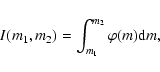
![\begin{figure}
\par\includegraphics[width=8.3cm,clip]{1222f3ac.eps}\hspace*{7mm}
\includegraphics[width=8.3cm,clip]{1222f3bc.eps} \end{figure}](/articles/aa/full/2005/05/aa1222/img52.gif)


![\begin{displaymath}\psi(t) = \nu(t) \bigg[ \frac{\Sigma(t_{{\rm Gal}})}{\Sigma(t)}
\bigg]^{k-1} G^k(t),
\end{displaymath}](/articles/aa/full/2005/05/aa1222/img72.gif)
![\begin{figure}
\par\includegraphics[width=13.6cm,clip]{1222f4c.eps} %
\end{figure}](/articles/aa/full/2005/05/aa1222/img82.gif)
![\begin{displaymath}R_{{\rm Ia}}(t) = A
\int_{m_{B_{{\rm m}}}}^{m_{B_{{\rm M}}}...
...(\mu) \psi(t - \tau_{m_2})
{{\rm d}}\mu \bigg] {{\rm d}}m_B,
\end{displaymath}](/articles/aa/full/2005/05/aa1222/img83.gif)
![\begin{figure}
\par\includegraphics[width=8.6cm,clip]{1222f5c.eps} \end{figure}](/articles/aa/full/2005/05/aa1222/img140.gif)
![\begin{figure}
\par\includegraphics[width=8.2cm,clip]{1222f6c.eps} \end{figure}](/articles/aa/full/2005/05/aa1222/img141.gif)
![\begin{figure}
\par\includegraphics[width=8.5cm,clip]{1222f7c.eps} \end{figure}](/articles/aa/full/2005/05/aa1222/img143.gif)
![\begin{figure}
\par\includegraphics[width=14cm,clip]{1222f8c.eps} \end{figure}](/articles/aa/full/2005/05/aa1222/img150.gif)
![\begin{figure}
\par\includegraphics[width=8.5cm,clip]{1222f9c.eps} \end{figure}](/articles/aa/full/2005/05/aa1222/img152.gif)
![\begin{figure}
\par\includegraphics[width=8.5cm,clip]{1222f10c.eps} \end{figure}](/articles/aa/full/2005/05/aa1222/img153.gif)