![[*]](/icons/foot_motif.gif) ,
,
, F. Boone 1 - N. Brouillet 2 - S. Hüttemeister 1 - C. Henkel 3 - J. Braine 2 - D. J. Bomans 1 - F. Herpin 2 - Z. Banhidi 1 - M. Albrecht 1
1 - Astronomisches Institut, Ruhr-Universität, Universitätstrasse 150, 44780 Bochum, Germany
2 -
Observatoire de Bordeaux, Université Bordeaux 1 - CNRS, BP 89, 33270 Floirac, France
3 -
Max-Planck-Institut für Radioastronomie, auf dem Hügel 69, 53121 Bonn, Germany
Received 30 April 2004 / Accepted 4 August 2004
Abstract
This paper is aimed at providing new insight into the nature and origin of the molecular complex situated near the line of sight toward Holmberg IX in the M 81 group of galaxies. The first high resolution CO maps of the complex as well as single dish 13CO(1-0), 12CO(3-2) and millimeter continuum observations and the results of a survey of 12CO in the region are presented. These data together with the available HI, optical and X-ray observations are analyzed to study the properties and environment of the complex. We confirm there is no unobscured massive star formation inside the complex, and from the millimeter constraint on the extinction it must have a low star formation rate or be forming only low mass stars. According to the CO line ratios the abundances and physical conditions could be similar to that of cold gas in spirals. We find from its dynamics (no rotation) and its mass (2-6 million solar masses) that it resembles a massive GMC. Also, re-inspecting N-body simulations of the M 81 group and the H I data we find that it might be located inside the extreme outer disk of M 81 and be cospatial with the H I feature known as Concentration I. The negative result of the CO survey suggests that the complex is unique in this region and calls for a peculiar local formation process. We find that the distribution of the CO emission in the data cube is asymmetrical in a way similar to a cometary object. The optical observations of the nearby supershell MH9/10 suggest the existence of an outflow toward the complex. We consider the possibility that the molecular complex is related to this hypothetical outflow.
Key words: ISM: clouds - galaxies: individual: M 81, Ho IX - galaxies: interactions - galaxies: ISM - radio lines: ISM - submillimeter
The M 81 group of galaxies is the nearest one with a significant
number of gravitationally interacting sources. With its small
distance (D  3.6 Mpc according to Freedman et al. 1994), high
declination (
3.6 Mpc according to Freedman et al. 1994), high
declination ( 69
69 )
and high galactic latitude
(
)
and high galactic latitude
(
 41)
the M 81 group is one of the prime
targets for studies of tidal tails and dense cool intergalactic matter.
41)
the M 81 group is one of the prime
targets for studies of tidal tails and dense cool intergalactic matter.
Searching for evidence of star formation in regions of high H I column
density, Brouillet et al. (1992, hereafter BHB92) detected CO emission east
of the dwarf irregular Holmberg IX. This emission was interpreted as the first direct evidence for the presence of intergalactic molecular clouds
formed out of tidal debris. Thus, the molecular complex was supposed to
provide the missing link between the extended H I clouds and newly formed
dwarf irregulars in this region. The mass of the molecular complex was
estimated to be 106-7  .
A CO J=2-1/J=1-0 line ratio
of 0.5 is consistent with values found in cold (
.
A CO J=2-1/J=1-0 line ratio
of 0.5 is consistent with values found in cold (
 10 K) galactic molecular clouds. IRAS (Infrared Astronomical Satellite) data
allowed BHB92 to obtain an upper limit for the star formation and ruled out a starburst in this region. Subsequent optical
observations (Henkel et al. 1993) did not detect the object, indicating an absence of unobscured individual stars with masses in excess of
10 .
10 K) galactic molecular clouds. IRAS (Infrared Astronomical Satellite) data
allowed BHB92 to obtain an upper limit for the star formation and ruled out a starburst in this region. Subsequent optical
observations (Henkel et al. 1993) did not detect the object, indicating an absence of unobscured individual stars with masses in excess of
10 .
These observations raise important questions about the nature and the origin of the complex. Is it too young to have started any star formation? How did it form if it is intergalactic? Is it related to Holmberg IX? Is it in a tidal arm? In this paper we show that the complex might not be intergalactic, but that it may instead be located in the extreme outer disk of M 81 and that its formation might be related to the nearby unusual supershell MH9/10. We present the first maps of the complex obtained with the Plateau de Bure Interferometer (PdBI) in 12CO(1-0) and 12CO(2-1). We also provide new single dish observations, including 13CO(1-0), 12CO(3-2), the millimeter continuum and a CO survey in the region surrounding the complex. These observations will be used together with archival data to study the properties and environment of the complex.
The J=1-0 and 2-1 lines of 12CO were measured with the PdBI between April and July 1997 with the configurations 5C, 5D (five antennas) and 4D (four antennas). The 15 m antennas were equipped with dual-band SIS receivers. The spectral correlators were centered at 115.271 GHz and 230.538 GHz respectively, with three correlator units at each frequency: one unit was centered on the line and two units with bandwidths of 160 MHz were placed on each side of the line to determine the continuum level and calibrate the data (see below). The two centered units have bandwidths of 40 MHz (104 km s-1) and 80 MHz (104 km s-1) and resolutions of 0.156 MHz (0.41 km s-1) and 0.625 MHz (0.82 km s-1) at 115 and 230 GHz respectively. The correlator was regularly calibrated by a noise source inserted into the system.
Visibilities were obtained with 20 min on-source integrations interspersed with short ( 5 min) observations of phase and amplitude calibrators toward the quasars 0836+710, 3C 454.3, 3C 273, 0954+658 and the stellar system MWC349. The data were phase calibrated in the antenna-based mode. From all the observing runs we used only those data for which the residual atmospheric phase jitter was less than or close to 30
  ,
consistent with a seeing disk of size 0
,
consistent with a seeing disk of size 0
 6-0
8 and a 5% loss of efficiency. The fluxes of the primary calibrators were determined from IRAM 30 m measurements and were taken as input to derive the absolute flux density scales for our visibilities, which are estimated to be accurate to
6-0
8 and a 5% loss of efficiency. The fluxes of the primary calibrators were determined from IRAM 30 m measurements and were taken as input to derive the absolute flux density scales for our visibilities, which are estimated to be accurate to  .
The bandpass calibration was carried out using 3C 273 and is accurate to better than
.
The bandpass calibration was carried out using 3C 273 and is accurate to better than  .
.
The data reduction was performed using the GILDAS software (e.g. Guilloteau & Lucas 2000). The short spacings were computed from the 30 m antenna observations of BHB92 and introduced into the uv-table using the task SHORT_SPACE. In this procedure the short spacings are computed from a map built by interpolation of the 30 m observations, deconvolved from the 30 m beam and multiplied by the PdBI primary beam. A first guess weight for the short spacings is estimated from the mean weight of the interferometer data in a ring of 1.25  to 2.5
(D=15 m) in the uv-plane. This first guess weight as well as the amplitude of the short spacings can be further adjusted by means of two free parameters. We found that for the flux of the map to be consistent with the flux of the 30 m data alone, scaling factors of 0.6 and 0.8 should be applied to the amplitudes and the weights respectively.
to 2.5
(D=15 m) in the uv-plane. This first guess weight as well as the amplitude of the short spacings can be further adjusted by means of two free parameters. We found that for the flux of the map to be consistent with the flux of the 30 m data alone, scaling factors of 0.6 and 0.8 should be applied to the amplitudes and the weights respectively.
Individual maps with 0
5 sampling and sizes of
 pixels at 115 GHz and
 pixels at 230 GHz were created for each frequency channel. Natural weighting and tapering was used at 115 GHz (Gaussian taper of 120 m Full Width at Half Maximum) and 230 GHz (Gaussian of 65 m FWHM). The dirty beam obtained at 115 GHz after tapering is close in size to that at 230 GHz. In the data cube thus obtained, the channel spacing was chosen to
be 2.6 km s-1. The maps were cleaned with the Clark (1980) method and restored with a beam of FWHM
pixels at 230 GHz were created for each frequency channel. Natural weighting and tapering was used at 115 GHz (Gaussian taper of 120 m Full Width at Half Maximum) and 230 GHz (Gaussian of 65 m FWHM). The dirty beam obtained at 115 GHz after tapering is close in size to that at 230 GHz. In the data cube thus obtained, the channel spacing was chosen to
be 2.6 km s-1. The maps were cleaned with the Clark (1980) method and restored with a beam of FWHM
 and a position angle of
 for both lines. Because of the poor signal-to-noise ratio in CO(2-1) the high resolution map (i.e. without tapering) for this line was found to be difficult to clean and only the map with the same beam as in CO(1-0) is discussed here. The rms noise levels in the cleaned maps are 9 mJy/beam and 20 mJy/beam at 115 GHz and 230 GHz respectively. No continuum emission was detected toward the molecular complex in a 320 MHz wide band down to rms noise levels of 0.5 mJy/beam and 1 mJy/beam at 115 GHz and 230 GHz respectively. The maps shown are not corrected for primary beam attenuation. The primary beam Full Widths at Half Maximum (FWHM) are equal to
 and
and
 at 115 GHz and 230 GHz, respectively.
13CO (J=1-0) (110 GHz) line emission was observed at the position
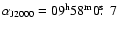 ,
,
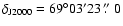 with the IRAM 30 m radiotelescope in May 1998. We used two SIS receivers in
parallel; the system temperature was 400 K on a main beam brightness temperature
(
with the IRAM 30 m radiotelescope in May 1998. We used two SIS receivers in
parallel; the system temperature was 400 K on a main beam brightness temperature
(
 )
scale. Two 1 MHz
filterbanks and an autocorrelator gave velocity resolutions of 2.6 and
1.3 km s-1 respectively. The half power beamwidth was
)
scale. Two 1 MHz
filterbanks and an autocorrelator gave velocity resolutions of 2.6 and
1.3 km s-1 respectively. The half power beamwidth was
 .
.
12CO (J=3-2) (345 GHz) line emission was observed
at the position
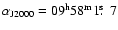 ,
,
 with the HHT (Heinrich-Hertz-Telescope) in Jan. 1999. The beamwidth
was 22'', the system temperature was 900 K on a
scale. The observations were carried out with a dual channel
SIS receiver, two 1024-channel 1 GHz wide Acousto-Optical Spectrometers
(AOS) with a mean channel spacing of 920 kHz
(0.8 km s-1) and a 256-channel filterbank with a channel
spacing of 250 kHz (0.2 km s-1). A main beam brightness temperature was
established using a beam efficiency of 0.5 and a forward hemisphere
efficiency of 0.9 (see e.g. Mao et al. 2002).
with the HHT (Heinrich-Hertz-Telescope) in Jan. 1999. The beamwidth
was 22'', the system temperature was 900 K on a
scale. The observations were carried out with a dual channel
SIS receiver, two 1024-channel 1 GHz wide Acousto-Optical Spectrometers
(AOS) with a mean channel spacing of 920 kHz
(0.8 km s-1) and a 256-channel filterbank with a channel
spacing of 250 kHz (0.2 km s-1). A main beam brightness temperature was
established using a beam efficiency of 0.5 and a forward hemisphere
efficiency of 0.9 (see e.g. Mao et al. 2002).
,
.
The data were reduced using the NIC package of the GILDAS software. The noise level is 0.3 mJy, no signal was detected.
![\begin{figure}
\par\includegraphics[width=9.5cm,height=4.5cm,clip]{1200fg01.eps}\includegraphics[width=4.5cm,height=4.5cm,clip]{1200fg02.eps}
\end{figure}](/articles/aa/full/2005/01/aa1200/img40.gif) |
Figure 1:
12CO(1-0) ( left), 12CO(2-1) ( middle) and model ( right) integrated maps from -45 km s-1 to -10 km s-1 (
 ). The axes give the RA and Dec offsets in arcseconds with respect to the phase center (
and
)
indicated by a cross. The 12CO(1-0) contours ( left panel) go from 340 mJy/beam km s-1 ( ). The axes give the RA and Dec offsets in arcseconds with respect to the phase center (
and
)
indicated by a cross. The 12CO(1-0) contours ( left panel) go from 340 mJy/beam km s-1 ( )
to 1.7 Jy/beam km s-1 ( )
to 1.7 Jy/beam km s-1 ( )
by steps of 170 mJy/beam km s-1 ( )
by steps of 170 mJy/beam km s-1 ( ). The 12CO(2-1) contours ( central panel) go from 0.8 Jy/beam km s-1 ()
to 3.2 Jy/beam km s-1 ( ). The 12CO(2-1) contours ( central panel) go from 0.8 Jy/beam km s-1 ()
to 3.2 Jy/beam km s-1 ( )
by steps of 0.4 Jy/beam km s-1 (). The segment correponding to the position-velocity diagram of Fig. 3 is shown on the CO(1-0) map. The cone model ( right panel) is discused in Sect. 5. )
by steps of 0.4 Jy/beam km s-1 (). The segment correponding to the position-velocity diagram of Fig. 3 is shown on the CO(1-0) map. The cone model ( right panel) is discused in Sect. 5. |
| Open with DEXTER | |
Several positions around the complex (for details, see Sect. 4.1) were observed with the IRAM 30 m and the NRAO 12 m telescopes. The 30 m measurements were made in the CO(1-0) line in Feb. 1998 in a similar way as described in Sect. 2.2.
In Nov. 1992 and Feb. 98 the 12CO(1-0) (115 GHz) line emission was observed with the NRAO 12 m telescope at Kitt Peak. Two SIS receivers were used in parallel and the system temperature was in the range 350-600 K (
 ). A 256-channel filterbank with a channel spacing of 1 MHz and the autocorrelator of 600 MHz bandwidth with a resolution of 781 kHz were used as backends. The beam FWHM is 55''.
In Feb. 1998 the 12CO(2-1) (230 GHz) line emission was observed with the 8-beam array at the NRAO 12 m. The same 256-channel filterbank was used, as well as an hybrid spectrometer of 300 MHz bandwidth. The system temperature was in the range 800-1400 K. The FWHM beam size is 27''.
The optical data were retrieved from the Canadian Astronomy Data Centre (CADC) archive. The B, R, and H images of the
field near Holmberg IX were taken by Pakull and Mirioni with the OSIS instrument at the 3.6 m Canada-France-Hawaii Telescope (CFHT) and were published in conference proceedings (Pakull & Mirioni 2002,2003).
Data reduction was perfomed using IRAF software (Tody 1993).
The data were bias subtracted and flatfielded using the
standard methods. Special care was taken to align the images
to a common reference using stars present on the B, R, and H
images. The continuum subtracted H image was produced
subtracting an intensity scaled R image, as described in
Bomans et al. (1997).
Flux calibration of the continuum subtracted H image was
performed by using the fluxes of three isolated H II regions present
in both our image and the data of Miller & Hodge (1994); Miller (1995).
images of the
field near Holmberg IX were taken by Pakull and Mirioni with the OSIS instrument at the 3.6 m Canada-France-Hawaii Telescope (CFHT) and were published in conference proceedings (Pakull & Mirioni 2002,2003).
Data reduction was perfomed using IRAF software (Tody 1993).
The data were bias subtracted and flatfielded using the
standard methods. Special care was taken to align the images
to a common reference using stars present on the B, R, and H
images. The continuum subtracted H image was produced
subtracting an intensity scaled R image, as described in
Bomans et al. (1997).
Flux calibration of the continuum subtracted H image was
performed by using the fluxes of three isolated H II regions present
in both our image and the data of Miller & Hodge (1994); Miller (1995).
![\begin{figure}
\par\includegraphics[angle=-90,width=14cm,clip]{1200fg03.eps}
\end{figure}](/articles/aa/full/2005/01/aa1200/img43.gif) |
Figure 2:
12CO(1-0) velocity-channel maps observed with the IRAM interferometer and the IRAM 30 m antenna for the short spacings. The resolution ( FWHM of the beam) is
 (PA =
(PA =  ). Velocity channels range from ). Velocity channels range from
 to -11.6 km s-1 by steps of 2.6 km s-1. The phase center is marked by a cross in each map. The contours begin at 27 mJy/beam (i.e.
  )
and are spaced by 18 mJy/beam (), the highest contour is at 99 mJy/beam ( )
and are spaced by 18 mJy/beam (), the highest contour is at 99 mJy/beam ( ). The dotted lines represent contours of a cone model, the levels are at 1/30, 4/30 and 7/30 of the maximum of the model data cube (The maximum of individual maps is decreasing when going from -11 to -40 km s-1 and the higher levels disappear accordingly). ). The dotted lines represent contours of a cone model, the levels are at 1/30, 4/30 and 7/30 of the maximum of the model data cube (The maximum of individual maps is decreasing when going from -11 to -40 km s-1 and the higher levels disappear accordingly). |
| Open with DEXTER | |
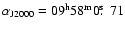
The overall 12CO(1-0) and 12CO(2-1) integrated maps are shown Fig. 1. The 12CO(1-0) maximum is 1.94 Jy/beam km s-1 at
 ,
,
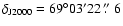 .
The integrated emission shows an abrupt edge on its N-W side and a smoother intensity gradient toward the S-E, with however a low-level filament to the N-W.
.
The integrated emission shows an abrupt edge on its N-W side and a smoother intensity gradient toward the S-E, with however a low-level filament to the N-W.
The 12CO(2-1) maximum is 3.57 Jy/beam km s-1 and is located at the same position as the CO(1-0) peak. The spatial distribution of the integrated emission also looks elongated in the N-W to S-E direction. Some extended emission at the 5 level appears on the N-E side of the main elongated shape. This could be a hint indicating the presence of warm diffuse gas at the periphery of the complex.
Figure 2 displays the 12 channel maps of the 12CO(1-0) line data cube showing emission over .
They cover a velocity range of 30 km s-1 from
 -40.2 km s-1 to -11.6 km s-1 with a resolution of 2.6 km s-1. Most of the emission stronger than
is found in a circular region of 20
-40.2 km s-1 to -11.6 km s-1 with a resolution of 2.6 km s-1. Most of the emission stronger than
is found in a circular region of 20
 (350 pc) in diameter.
Noticeable features are: (1) a compact region with high-level emission about 6
west from the phase center. It is most clearly seen in channels -24.6 to -19.4 km s-1. (2) Low-level extended emission in the form of filaments (channels from -29.8 to -22 km s-1) and clumps (mostly in channels from -37.6 to -32.4 km s-1). Although the clumps are close to the 3 level, the fact that they are mostly seen in three adjacent channels indicates that they are hinting at real low level emission. Most of the clumps have velocity widths of one channel only (2.6 km s-1).
![\begin{figure}
\par\includegraphics[width=8.2cm,clip]{1200fg04.eps}
\end{figure}](/articles/aa/full/2005/01/aa1200/img48.gif) |
Figure 3: 12CO(1-0) position-velocity diagram along the segment drawn in Fig. 1 ( left panel). The right end of the angular offset axis corresponds to the N-W end of the segment. |
| Open with DEXTER | |
As for the global properties of the distribution, we note: (1) There is no strong evidence of rotation at a velocity higher than 15 km s-1 over distances greater than 10
(i.e. 175 pc) or of disk-like structure. (2) Although Fig. 3 might suggest the presence of a cavity that appears as a loop in the diagram (between 0 and -5'' angular offset), it is not clear that this is caused by stellar activity such as bubble or outflow structures (BHB92, Henkel et al. 1993).
The global cloud morphology noted in the integrated maps (Fig. 1) and the filaments seen in the channel maps (Fig. 2) are reminiscent of a cometary object pointing toward the N-W. Even though giant molecular clouds (GMC) in general are expected to be assymmetric, this shape could give hints about the origin and the nature of the complex. This point will be discussed in Sect. 5.
Summing up the CO(1-0) data in a polygon enclosing the emission in the velocity interval [-45,-10] km s-1 gives a total flux of 18 Jy km s-1. The greatest uncertainty comes from the flux calibration that is estimated to be  20%.
By assuming a linear correlation between the H2 column density and the CO(1-0) line intensity, this flux can be converted into an H2 mass. For a distance to the object of D=3.6 Mpc we get:
20%.
By assuming a linear correlation between the H2 column density and the CO(1-0) line intensity, this flux can be converted into an H2 mass. For a distance to the object of D=3.6 Mpc we get:
![\begin{displaymath}M_{{\rm H}_2}=[2.7\pm 0.6] \left[\frac{X}{3\times 10^{20} }\right]\times 10^6~{M}_{\odot},
\end{displaymath}](/articles/aa/full/2005/01/aa1200/img50.gif) |
(1) |
![\begin{figure}
\par\includegraphics[width=8.2cm,clip]{aa1200f4_n.eps}
\end{figure}](/articles/aa/full/2005/01/aa1200/img51.gif) |
Figure 4: The 13CO(1-0) and 12CO(3-2) lines from the molecular complex. The 12CO(1-0) line divided by 6 and 2.5, respectively, is overlaid as a dashed line. |
| Open with DEXTER | |
The value of X for the Galactic disk is estimated to be in the range of 2-
 cm-2(K km s-1)-1 (Young & Scoville 1991; Solomon & Barrett 1991; Bloemen et al. 1986). Estimates of X in extragalactic sources have been addressed in numerous references and the conversion factor is thought to depend mostly on the radiation field, the gas-to-dust ratio and the metallicity (e.g. Israel 2001; Dettmar & Heithausen 1989; Bolatto et al. 1999; Arimoto et al. 1996). There does not seem to be any strong radiation source within the complex, but the gas-to-dust ratio of the complex discussed in Sect. 3.4 could be higher than the galactic value (150). In this case the conversion factor would also be higher.
The metallicity is expected to be lower than in central regions of galaxies. Indeed, regardless of whether the complex is situated in the disk of M 81 or outside of it, it is at a large distance from the nucleus and the metallicity is known to decrease with galactocentric distance. Therefore, X is probably higher than the galactic disk value and
 can be seen as a lower limit for the mass of the complex. More precisely, if we extrapolate the radial distribution of the [OII] + [OIII] to H
 ratio measured by Zaritsky (1992) to the deprojected radius of the complex, i.e. 23
 1, we get a value of 0.7 which corresponds, from the calibration of Edmunds & Pagel (1984), to an abundance of 12 + log(O/H) 8.6. If we take the relationship between X and the metallicity proposed by Israel (2001), namely log(X)=-2.7 log(O/H) + 11.6, we get
 which would mean a mass twice as large:
 .
We note that this estimate is subject to large uncertainties: the conversion of the [OII]+[OIII] to H
ratio into oxygen abundance is uncertain and the expression of X as a function of metallicity is empirical and is based on the data of a few objects only. To summarize, the mass of the complex is estimated to be in the range of
.
We note that this estimate is subject to large uncertainties: the conversion of the [OII]+[OIII] to H
ratio into oxygen abundance is uncertain and the expression of X as a function of metallicity is empirical and is based on the data of a few objects only. To summarize, the mass of the complex is estimated to be in the range of
 .
This mass is comparable to that of the largest GMCs, also called Giant Molecular Associations (GMAs), in the Galaxy.
.
This mass is comparable to that of the largest GMCs, also called Giant Molecular Associations (GMAs), in the Galaxy.
The integrated 12CO(2-1)/(1-0) line intensity ratio computed from the PdBI data with the zero spacings from the IRAM 30 m is in the range 0.4-1.6, and considering the uncertainties, most of the pixels are consistent with a value of 0.6-0.7. The highest values are reached at the periphery of the complex, which can be interpreted in terms of enhanced kinetic temperatures or low optical depths. The integrated 12CO(1-0)/13CO(1-0) and 12CO(1-0)/(3-2) ratios computed from the single dish data shown in Fig. 4 are given in Table 1 for different spectral windows.
The Large Velocity Gradient (LVG) approximation can be used to
compute the radiative transfer within a cloud of uniform
density and temperature. This is appropriate for a zero order
simulation of the physical conditions of the complex.
The input parameters are taken as follows: the column density obtained from the mass and size of the complex, N(H2) = (0.5-1.0) 1022 cm-2; the CO abundance from Bradford et al. (2003), [CO/H2] =
 ;
the abundance ratio [12CO/13CO] = 40-100 (Wilson & Rood 1994); and the line ratios from the data, 12CO(2-1)/(1-0) = 0.6-0.7, 12CO/13CO = 7-13, 12CO(3-2)/(1-0) = 0.11-0.26.
Then, the LVG model gives temperatures in the range of 10-30 K, densities in the range of 200-700 cm-3, area filling factors of the order of
;
the abundance ratio [12CO/13CO] = 40-100 (Wilson & Rood 1994); and the line ratios from the data, 12CO(2-1)/(1-0) = 0.6-0.7, 12CO/13CO = 7-13, 12CO(3-2)/(1-0) = 0.11-0.26.
Then, the LVG model gives temperatures in the range of 10-30 K, densities in the range of 200-700 cm-3, area filling factors of the order of  0.02 and a velocity gradient of 10 km s-1 pc-1. This velocity gradient is larger than the global velocity gradient obtained from the cloud size (300 pc) divided by the line width (30 km s-1), i.e. 0.1 km s-1 pc-1. This is probably due to a high dispersion in the central regions of the
complex.
0.02 and a velocity gradient of 10 km s-1 pc-1. This velocity gradient is larger than the global velocity gradient obtained from the cloud size (300 pc) divided by the line width (30 km s-1), i.e. 0.1 km s-1 pc-1. This is probably due to a high dispersion in the central regions of the
complex.
It is interesting to note that the line ratios (and therefore the solutions they admit in terms of abundances and physical conditions) are similar to those found in cold molecular gas in the inner disks of spiral galaxies, and that crucial parameters, like size of the complex, velocity dispersion and volume averaged densities, follow the relations established by Larson (1981) and Myers (1985).
Table 1: Integrated 12CO(1-0)/13CO(1-0) and 12CO(3-2)/(1-0) line ratios for different spectral windows.
The non-detection of the 1.2 mm continuum implies an upper
flux limit of 1 mJy in an 11'' beam. With a mass absorption coefficient
 m2 kg-1 (James et al. 2002) and an assumed dust temperature of 10 K, the limit corresponds to a dust mass of
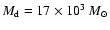 .
This is an upper limit because the mass is lower for higher temperatures. The H2 mass deduced from the CO seen in the same beam at the same position is
.
This is an upper limit because the mass is lower for higher temperatures. The H2 mass deduced from the CO seen in the same beam at the same position is
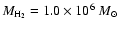 with the standard conversion factor
 cm-2 (K km s-1)-1 that was already introduced in Sect. 3.2 as a lower limit for outer disks. The corresponding H I flux is 0.1 mJy in a 12'' beam (data from Adler & Westpfahl 1996). Assuming a uniform distribution, this corresponds to an H I mass of
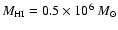 in a 11
beam. Taking into account the contribution of He as 40% of the H mass (28% of the ISM mass), this leads to a gas-to-dust ratio with a lower limit of
in a 11
beam. Taking into account the contribution of He as 40% of the H mass (28% of the ISM mass), this leads to a gas-to-dust ratio with a lower limit of
 .
This lower limit does not exclude the standard galactic value of 150.
.
This lower limit does not exclude the standard galactic value of 150.
The 3
upper limit of 1 mJy on the dust emission allows us to derive an upper limit for the visual extinction. In the optically thin limit  is given by:
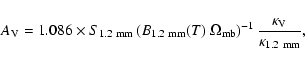 |
(2) |
 is the flux,
 is the black body brightness and
 is the antenna main beam.
Estimates of the ratio
is the antenna main beam.
Estimates of the ratio
 (Bianchi et al. 2003; Kramer et al. 1998) imply that it is most probably lower than
 .
Then, for a dust temperature of 10 K and a beamsize of 11'', the 1 mJy upper limit yields: < 5
.
Then, for a dust temperature of 10 K and a beamsize of 11'', the 1 mJy upper limit yields: < 5
 5.
5.
![\begin{figure}
\par\includegraphics[angle=-90,width=8.4cm,clip]{1200fg06.eps}
\end{figure}](/articles/aa/full/2005/01/aa1200/img76.gif) |
Figure 5:
H
emission (grey scale) from CFHT observations. The thin contours correspond to the low level H
(lowest contour at 3
with a contour smoothness of 10), the thick contours to the CO(1-0) levels (the lowest at 4). The cross in the shell shows the Chandra position of X-9. MH9/10 is a large supershell (Miller 1995). The MH11 nebula was catalogued as a separate H II region in Miller & Hodge (1994). |
| Open with DEXTER | |
The H
frame from the CFHT does not show any emission within the 4
CO contour, as shown in Fig. 5. The rms level of the continuum subtracted H
image is at 10-17 erg cm-2 s-1. To derive an upper limit of the star formation rate we use
 yr-1 (Hunter & Gallagher 1986) and we correct for the galactic extinction
  = 0
210. Without considering any intrinsic extinction this leads to:
= 0
210. Without considering any intrinsic extinction this leads to:
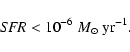 |
(3) |
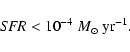 |
(4) |
 yr-1 - expected for
 of molecular gas - can be excluded for the Salpeter Initial Mass Function (IMF) implicit in the relation of Hunter & Gallagher (1986).
While no H
emission is seen within the complex, we identify a new small H II region on its western side about 10
from the CO peak with the coordinates
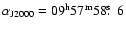 ,
,
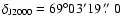 .
At D=3.6 Mpc the H
luminosity of this object corrected for galactic extinction is
.
At D=3.6 Mpc the H
luminosity of this object corrected for galactic extinction is
 erg s-1. Making the standard assumption that the total number of Lyman continuum photons is equal to the number of H
photons times the ratio of the recombination coefficient for "Case B'' to that of H
(Osterbrock 1989) we find the number of Lyman continuum photons emitted per sec:
erg s-1. Making the standard assumption that the total number of Lyman continuum photons is equal to the number of H
photons times the ratio of the recombination coefficient for "Case B'' to that of H
(Osterbrock 1989) we find the number of Lyman continuum photons emitted per sec:
 s-1. From the calibrations of Panagia (1973) this object is too faint to contain any O-type star, but 3 B0V stars could produce the computed ionising flux. This object is also seen in the blue band (Fig. 6 object B5) which is compatible with a small association of massive stars, arguing against a planetary nebula. We also note another blue object on the North of the
complex (B4). The two red objects mentioned in Henkel et al. (1993) and interpreted as possible background galaxies are also seen in the R band image (Fig. 7 objects R1
and R2). The fact that they lie outside the 4
level of the CO(1-0) emission supports the interpretation that they are background galaxies.
s-1. From the calibrations of Panagia (1973) this object is too faint to contain any O-type star, but 3 B0V stars could produce the computed ionising flux. This object is also seen in the blue band (Fig. 6 object B5) which is compatible with a small association of massive stars, arguing against a planetary nebula. We also note another blue object on the North of the
complex (B4). The two red objects mentioned in Henkel et al. (1993) and interpreted as possible background galaxies are also seen in the R band image (Fig. 7 objects R1
and R2). The fact that they lie outside the 4
level of the CO(1-0) emission supports the interpretation that they are background galaxies.
![\begin{figure}
\par\includegraphics[angle=-90,width=8.2cm,clip]{1200fg07.eps}
\end{figure}](/articles/aa/full/2005/01/aa1200/img87.gif) |
Figure 6:
B-band image (grey scale) from CFHT. The thin contours correspond to the low level H
(lowest contour at 3), the thick contours to the CO(1-0) levels (the lowest at 4). The cross in the shell shows the Chandra position of X-9. |
| Open with DEXTER | |
![\begin{figure}
\par\includegraphics[angle=-90,width=8.2cm,clip]{1200fg08.eps}
\end{figure}](/articles/aa/full/2005/01/aa1200/img88.gif) |
Figure 7:
R-band image (grey scale) from CFHT. The thin contours correspond to the low level H
(lowest contour at 3), the thick contours to the CO(1-0) levels (the lowest at 4). The cross in the shell shows the Chandra position of X-9. |
| Open with DEXTER | |
The molecular complex is found to coincide with a maximum of H I emission (see Fig. 8). This suggests a recent formation by condensation of the dense atomic gas in which it is embedded. It can therefore be expected that neighbouring regions of similar column density harbour similar complexes. To test this scenario, a survey of CO has been undertaken around the position of the complex, and in the nearby H I concentrations called "Concentrations I and II'' in Gottesman & Weliachew (1975). This survey of 125 pointings has been carried out with the IRAM 30 m and the Kitt Peak telescopes (see Fig. 8). None of the observations has given any detection suggesting that the molecular complex is unique in this region. The Kitt Peak 115 GHz observations smoothed to 5 km s-1 resolution have an rms in the range 6-10 mK on a
 scale and the 230 GHz observations smoothed to 4 km s-1 have an rms in the range 8-14 mK. The results of the 30 m observations are given in Table 2. The corresponding 3
upper limits for the H2 column density are close to 1020 cm-2 for a standard conversion factor, as given in Sect. 3.2.
scale and the 230 GHz observations smoothed to 4 km s-1 have an rms in the range 8-14 mK. The results of the 30 m observations are given in Table 2. The corresponding 3
upper limits for the H2 column density are close to 1020 cm-2 for a standard conversion factor, as given in Sect. 3.2.
The H I concentrations surveyed are large and it appears unlikely that the critical density can be reached at one location only if the physical conditions are similar throughout the H I concentrations. Instead, the uniqueness of the complex suggests the presence of a local peculiar phenomenon responsible for creating the physical conditions required for its formation.
![\begin{figure}
\par\includegraphics[width=14cm,clip]{1200fg09.eps}
\end{figure}](/articles/aa/full/2005/01/aa1200/img90.gif) |
Figure 8: Observed positions of the CO survey superposed onto a map of H I emission from Yun et al. (1994) ( left) and from Adler & Westpfahl (1996) ( right). The white cross on the right panel shows the position of the complex. The circles represent the beams of the IRAM 30 m (white) and the Kitt Peak telescope (black; large circles 3 mm; small circles 1 mm). The dashed ellipses show the locations of Concentration I and Concentration II. |
| Open with DEXTER | |
Understanding the situation of the complex with respect to the dynamics of the M 81 group of interacting galaxies can help in the understanding of its origin and properties. Is the complex at the interface of two H I structures? Where is it located exactly: is it intergalactic as was proposed in previous papers, is it in the disk of M 81, is it in Holmberg IX? These are open questions that we address in this subsection.
As already noted in BHB92, H I observations show that the complex could be located at the boundary of two H I entities of different velocities. Indeed, the H I spectrum at the position of the complex (Fig. 9) consists of two distinct velocity components centered at
 km s-1 and
 km s-1, and from their spatial distribution (Fig. 10) each one appears to be prominent on one side of the complex.
The first component is more prominent to the East and the second component, corresponding to Concentration I, is more prominent to the West. Are these two components cospatial (i.e. in physical contact or very close to each other) or is it just a projection effect? Where are they located with respect to the disk of M 81?
km s-1, and from their spatial distribution (Fig. 10) each one appears to be prominent on one side of the complex.
The first component is more prominent to the East and the second component, corresponding to Concentration I, is more prominent to the West. Are these two components cospatial (i.e. in physical contact or very close to each other) or is it just a projection effect? Where are they located with respect to the disk of M 81?
To answer this question, we investigated the N-body simulations of the M 81 group of galaxies from Yun et al. (1993). Though these simulations are not supposed to exactly reproduce the morphology and the velocities on a small scale, they can be used as a guide when trying to deproject the observations. The simulations show two components overlapping at the location of the complex as well as an overdensity at the edge of the disk of M 81 similar to Concentration I (Fig. 10). Rotating the cube of particles we find that it cannot be excluded that the two H I components are cospatial. Indeed, some particles with the two velocities are found to be cospatial in the simulated 3-D cube at the edge of the perturbed disk of M 81 and at the beginning of the tidal bridge toward M 82. This is consistent with the H I observations of Yun et al. (1994) that suggested that Concentration I is inside the disk of M 81. It would have resulted from the collision with M 82 about
 years earlier.
What does it imply for the complex? The velocity of the complex is consistent with the first H I component (-35 km s-1). Therefore, it could be cospatial to this component which we just showed could itself be cospatial to Concentration I (the second H I component) and be inside the extreme outer disk of M 81. Thus, despite the velocity difference, it is not excluded that the molecular complex is inside or very close to Concentration I and in the disk of M 81.
Holmberg IX, having a velocity of
 km s-1, may neither be related to the complex (and therefore the first H I component), nor to Concentration I (and therefore the second H I component). It is moreover spatially offset by
 (2.9 kpc) from both objects.
Table 2:
Positions observed in CO(1-0) with the IRAM 30 m telescope.
Column 3 gives the rms noise level for each spectrum in milliKelvins (main beam brightness temperature) and
Col. 4 the  uncertainty in the CO integrated intensity in K km s-1.
The complex is at
 from the nucleus of M 81. Therefore, if it is inside the disk of M 81, it must be at a galactocentric radius of 24.2 kpc, assuming a distance of 3.6 Mpc, a disk inclination of 59
and a position angle of
from the nucleus of M 81. Therefore, if it is inside the disk of M 81, it must be at a galactocentric radius of 24.2 kpc, assuming a distance of 3.6 Mpc, a disk inclination of 59
and a position angle of  for M 81. This would be the most massive molecular association found in the extreme outer disk of a galaxy, but not the most distant one: less massive molecular clouds are found at up to 28 kpc in our own galaxy (Digel et al. 1994).
We note that for extreme outer regions of perturbed disks the boundary between "galactic'' and "intergalactic'' cannot be clearly defined. Also, without having a clear understanding of the dynamics in this region, a distinction between galactic and intergalactic is difficult to make.
for M 81. This would be the most massive molecular association found in the extreme outer disk of a galaxy, but not the most distant one: less massive molecular clouds are found at up to 28 kpc in our own galaxy (Digel et al. 1994).
We note that for extreme outer regions of perturbed disks the boundary between "galactic'' and "intergalactic'' cannot be clearly defined. Also, without having a clear understanding of the dynamics in this region, a distinction between galactic and intergalactic is difficult to make.
First identified by Fabbiano (1988), X-9 is an ultraluminous X-ray source (ULX) situated 40'' N-W of the complex. At the distance of M 81 its X-ray luminosity is 1040 erg s-1, i.e. about half that of the nucleus of M 81. Miller (1995) identified the extended emission already observed by Henkel et al. (1993) to be a bright H
shell, "MH9/10'', of 250 pc by 475 pc in size (at the distance of M 81) coincident with X-9. The large dimension of the shell - comparable to the size of supershells rather than supernova remnants - and the high X-ray luminosity of X-9 make the nature of these two associated objects puzzling. One possibility is that both objects are in the Galaxy and that X-9 is a runaway accreting white dwarf. But X-ray spectral and variability analysis argue against this and instead suggest an extragalactic accreting Kerr black hole binary (Wang 2002; La Parola et al. 2001). According to the velocity of the H emission (
 km s-1), the supershell could actually be located inside Concentration I. The dynamical timescale of the shell
 yr (where
 is the shock velocity in units of 102 km s-1) is consistent with this picture: it is younger than Concentration I resulting from the pass by of M 82
 yr ago (see previous section).
If the radiation of the compact object is unbeamed, X-9 should be an intermediate mass black hole (IMBH) of
 ;
otherwise it could be a stellar-mass object like a microquasar. The H
supershell could fit in either scenario: it could have formed during a hypernova explosion at the collapse of the IMBH or been powered by an intense outflow from a microquasar. Few other ULX associated with nebulae have been observed, and for all of them it remains difficult to choose between these scenarios (Roberts et al. 2003; Pakull & Mirioni 2003). The roundish shape of MH9/10 seems to argue against the outflow hypothesis, but 20 cm radio continuum observations by Bash & Kaufman (1986) suggest non-thermal emission. Also some blue emission at the center of the supershell described as a "blue knot'' is coincident with X-9 (Miller 1995) and could well be the signature of an outflow rather than that of an accreting disk. Recent XMM-Newton observations lend support to the IMBH hypothesis (Miller et al. 2004).
;
otherwise it could be a stellar-mass object like a microquasar. The H
supershell could fit in either scenario: it could have formed during a hypernova explosion at the collapse of the IMBH or been powered by an intense outflow from a microquasar. Few other ULX associated with nebulae have been observed, and for all of them it remains difficult to choose between these scenarios (Roberts et al. 2003; Pakull & Mirioni 2003). The roundish shape of MH9/10 seems to argue against the outflow hypothesis, but 20 cm radio continuum observations by Bash & Kaufman (1986) suggest non-thermal emission. Also some blue emission at the center of the supershell described as a "blue knot'' is coincident with X-9 (Miller 1995) and could well be the signature of an outflow rather than that of an accreting disk. Recent XMM-Newton observations lend support to the IMBH hypothesis (Miller et al. 2004).
The new H
observations (Fig. 5) show for the first time that the emission at the S-E of the supershell, known as MH11, is actually connected to the supershell and is as large as the supershell itself. This emission appears as an extension of the supershell in the direction of the complex and covers about half of the distance to it, i.e. 20
(350 pc). It appears to be composed of two parallel ridges elongated in the direction of the molecular complex with some lower level emission in between.
The B-band image (Fig. 6) shows that the "blue knot'' (B1) inside the supershell mentioned by Miller (1995) is actually of elongated shape oriented in the E-W direction. Most remarkably its Western end coincides with the Chandra position of X-9, i.e.
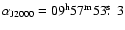 ,
,
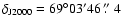 (from Chandra archival data presented in Eriksen et al. 2002). The Chandra absolute position accuracy is better than 1'' and we can conservatively estimate that our astrometric error does not exceed 2''. Thus, the uncertainty is less than 3'', which corresponds to the size of the cross in Figs. 5-7. On its Eastern side the elongated emission seems to end in front of a small structure (B2) coinciding with the inner boundary of the H
supershell.
Another small blue structure (B3) can be seen on the other side of the supershell boundary (on the external side) but slightly more to the South, i.e. at the beginning of the H extension.
(from Chandra archival data presented in Eriksen et al. 2002). The Chandra absolute position accuracy is better than 1'' and we can conservatively estimate that our astrometric error does not exceed 2''. Thus, the uncertainty is less than 3'', which corresponds to the size of the cross in Figs. 5-7. On its Eastern side the elongated emission seems to end in front of a small structure (B2) coinciding with the inner boundary of the H
supershell.
Another small blue structure (B3) can be seen on the other side of the supershell boundary (on the external side) but slightly more to the South, i.e. at the beginning of the H extension.
All these features can also be seen at a lower level in the R-band frame (Fig. 7). Some granularity can be seen in the R-band emission extending from X-9.
![\begin{figure}
\par\includegraphics[width=7.5cm,clip]{1200fg10.ps}
\end{figure}](/articles/aa/full/2005/01/aa1200/img106.gif) |
Figure 9:
The H I spectrum (thick line) taken at the position of the complex from the data of Adler & Westpfahl (1996) and spatially smoothed (beamsize: 18''). The CO(1-0) spectrum of the data inside the 4 level of the integrated map (Fig. 1) is superimposed (thin line). To match the H I flux range, the CO flux was divided by 700. |
| Open with DEXTER | |
![\begin{figure}
\par\includegraphics[width=14cm,clip]{1200fg11.eps}
\end{figure}](/articles/aa/full/2005/01/aa1200/img107.gif) |
Figure 10: Left: H I emission integrated over [-132,239] km s-1 from Yun et al. (1994) overlaid with contours of the same emission integrated over [-80,0] km s-1 (white) and [0,80] km s-1 (black). The levels are respectively (0.15, 0.55, 0.95, 1.35) Jy/beam km s-1 and (0.1, 0.7, 1.3, 1.9) Jy/beam km s-1. The crosses show the positions of the molecular complex, Holmberg IX, and the center of M 81. Right: simulations of the interaction of M 81 with M 82 and NGC 3077 from Yun et al. (1993). |
| Open with DEXTER | |
The H
morphology suggests that the extension could be a large outflow from the supershell. The supershell would have poured out its inner high pressure medium into a medium with lower density, according to the well-known champagne effect. A similar blowout with a radial velocity of 90 km s-1 and from a superbubble of 60 pc in diameter was observed in the
H II complex N44 of the LMC by Magnier et al. (1996). We lack the velocity information to check any gradient along the H
extension. However, from the geometry we can compare the energetics of such a large outflow with that of the supershell. If the supershell is assumed to be a sphere of radius  with kinetic energy
  and the outflow is a cylinder of same radius, of length
 (i being the angle of the outflow with the line of sight) and of kinetic energy
  ,
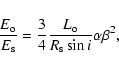
then the ratio of the energies is given by:
,
then the ratio of the energies is given by:
is the ratio of the average initial density in the region of the outflow to the preshock density of the supershell, and
is the ratio of the average velocity in the outflow to the velocity of the shock of the supershell. We have 150 pc,  150 pc. The orientation of the outflow is unknown, but for i>
 ,
,
 > 0.25, then
 .
If the outflow is due to the champagne effect, the initial density must be lower in the region of the outflow, i.e.
.
If the outflow is due to the champagne effect, the initial density must be lower in the region of the outflow, i.e.  ,
and the gas must be accelerated further in the blowout; but, averaged over the whole outflow, the velocity is expected to be comparable to the shock velocity of the shell i.e.
,
and the gas must be accelerated further in the blowout; but, averaged over the whole outflow, the velocity is expected to be comparable to the shock velocity of the shell i.e.
 .
A variation by a factor 10 in density is possible, i.e.
.
A variation by a factor 10 in density is possible, i.e.
 is possible, and therefore
 cannot be excluded. We conclude that, considering its extension, the energetics of such a blowout is not inconsistent with that of the supershell.
The blue structure B1 (the "blue knot'') could be a jet powered by X-9. On the plane of the sky it appears oriented in a direction  away from that of the ouflow, but this might be a projection effect and both might be better aligned. In this case, this hypothetical jet could inject kinetic energy into the outflow. The orientation could also have changed if the jet is precessing like in SS 433 (e.g. Margon 1982). Even if were misaligned with the extension, the jet could be responsible for the formation of the supershell and for maintaining the high inner pressure feeding the large outflow. B2 (Fig. 6) could be the impact of the jet onto the shell and the granularity of the red emission could correspond to knots in the jet.
However, other interpretations of the H
extension and the blue features are possible. The H
extension could result from X-ray photoionisation rather than a blowout. Such a process was proposed for the H
emission of 800 pc in extent near the ULX NGC 1313 X-1 (Pakull & Mirioni 2002). Also, B1, B2 and B3 could be associations of young stars similar to those seen around the shell. Thus, B1 could well be a central cluster and B2 and B3 could result from star formation inside the wall of the supershell. For the hypothetical jet from the X-ray source, high resolution radio continuum observations would be useful. Deeper H I interferometric observations might also help verify the dynamics of the gas at the location of the supershell.
Could the complex have formed at the interface of the two H I components discussed in Sect. 4.2? Such a scenario was proposed by Odenwald et al. (1992) for the cometary cloud G110-13. This hypothesis leads, however, to a cloud that is elongated along the interface, i.e. in the N-S direction (Fig. 10). Instead the complex is elongated toward the S-E, >45
away from the interface orientation.
Is the molecular complex shaped by an outflow from MH9/10?
It was noted in Sect. 3.1 that, according to the CO emission, the molecular complex had a filamentary/cometary morphology with the head oriented toward the N-W. The optical observations of the supershell situated on the N-W of the complex revealed an H
extension toward the complex that could be interpreted as an outflow (Sect. 4.3). The apparent coincidence of these two observations leads us to consider the possibility that the complex is shaped by the hypothetical outflow from MH9/10.
Such filamentary/cometary shapes have been observed in molecular clouds for years, e.g. in the Orion cloud (Bally et al. 1987) with a mass of
 and a size of 13 pc, the Draco cloud (Odenwald & Rickard 1987) with a mass of
 and a size of 10 pc and at galactic scales in the Magellanic Clouds (e.g. Mathewson et al. 1977). A sample of 15 comet-like clouds selected in the IRAS survey was studied by Odenwald (1988).
One of the scenarios invoked to account for these morphologies involves interaction of the clouds with the surrounding interstellar medium.
and a size of 10 pc and at galactic scales in the Magellanic Clouds (e.g. Mathewson et al. 1977). A sample of 15 comet-like clouds selected in the IRAS survey was studied by Odenwald (1988).
One of the scenarios invoked to account for these morphologies involves interaction of the clouds with the surrounding interstellar medium.
In the present case, if the outflow is interacting with the complex it has to extend over 50'', i.e. it must be 2.5 times larger than the H
extension. Its energy can be compared to that of the supershell in the same way, as done in the previous section (Eq. (5)). Assuming the cometary shape is oriented like the outflow, the distribution of CO in the data cube can help to estimate the
parameter, i.e. the angle between the outflow and the line of sight. For this purpose we fit the CO(1-0) data cube with a simple cometary model consisting of a cone in which the density decreases exponentially with the distance from the head and the modulus of the velocity increases linearly. Such a conical shape is suggested by the way the clumps and the filaments discussed in Sect. 3.1 are distributed (Fig. 2). The distribution of the emission in the channel maps changes almost monotonically from compact at -10 km s-1, to extended or spread mostly on the S-E side of the compact emission at -35 km s-1. This can be interpreted as a cometary shape with the head pointing to the N-W and away from the observer and a tail expanding toward the S-E and the observer. The best fit of the cone model gives i  .
The channel maps of the model are overlaid in contours to the CO(1-0) in Fig. 2 and its integrated intensity is shown on the right-hand side of Fig. 1. While it does not reproduce the details of the individual CO(1-0) channel maps correctly, it reproduces the general trend noted above. It is interesting to note here that this interpretation of the morphology and dynamics of the CO emission would provide an explanation of the discrepancy by a factor of 10 between the virial mass and the molecular mass determined from the CO line intensity noted in BHB92, as the complex would then be gravitationally unbound.
Thus, according to the calculations of the previous section, the kinetic energy of this outflow relates to that of the supershell as:
.
The channel maps of the model are overlaid in contours to the CO(1-0) in Fig. 2 and its integrated intensity is shown on the right-hand side of Fig. 1. While it does not reproduce the details of the individual CO(1-0) channel maps correctly, it reproduces the general trend noted above. It is interesting to note here that this interpretation of the morphology and dynamics of the CO emission would provide an explanation of the discrepancy by a factor of 10 between the virial mass and the molecular mass determined from the CO line intensity noted in BHB92, as the complex would then be gravitationally unbound.
Thus, according to the calculations of the previous section, the kinetic energy of this outflow relates to that of the supershell as:
 .
Hence, for this outflow to be realistic we must have
.
Hence, for this outflow to be realistic we must have
 .
As discussed in Sect. 4.3.3, this is not impossible, e.g.
.
As discussed in Sect. 4.3.3, this is not impossible, e.g.
 and
and  .
The size of the outflow would then be 1.8 kpc, which is larger than any shell blowout observed so far.
.
The size of the outflow would then be 1.8 kpc, which is larger than any shell blowout observed so far.
In this hypothesis the complex could result from the compression of a higher density cloud embedded in the low density region of the outflow, with an initial line of sight LSR velocity
 -10 km s-1 (velocity of the head of the cometary shape). This scenario would then provide an explanation for the isolation of the complex (Sect. 4). For molecular gas to be seen at such a large galactocentric radius, peculiar physical conditions might be required that this unusual supershell outflow would provide. Conversely it was already noted in Miller (1995) and Wang (2002) that X-9 and the nearby stars are young objects that formed out of molecular gas and therefore one expects to find molecular gas in the surrounding region. The complex may not only result from the condensation of the compressed H I, but also from the concentration of pre-existing molecular gas under the action of the outflow.
Following this scenario, star formation might occur inside the head of the cometary complex, however, that is not seen. Spectral observations of the H
extension would be useful because they provide information on the kinematics of the ionized gas as it moves toward the molecular complex. Deeper H
imaging is also needed to check how close the S-E extension of the ionized gas gets to the molecular complex.
106 ,
13' east of M 81, leads to the following main results:
 yr-1 for a Salpeter IMF). Furthermore, the upper limit on the extinction ( < 5.5) imposed by the millimeter continuum observations implies that the SFR, even obscured, must be lower than expected for such a mass of molecular gas (SFR <
 yr-1 for a Salpeter IMF).
 )
that the complex resembles a massive GMC (or a GMA) rather than a dwarf galaxy.
)
that the complex resembles a massive GMC (or a GMA) rather than a dwarf galaxy.
 yr-1 in the complex near NGC 3077.
Acknowledgements
We are greatful to the referee, Ute Lisenfeld, for comments that helped to significantly improve the quality of the paper. We acknowledge M. Yun and D.S. Adler for having kindly provided their H I data several years ago. We also thank F. Gueth for providing the SHORT_SPACE task before it was included in the GILDAS software. We used the Karma software developed by Gooch (1995). We also thank the IRAM staff of Grenoble and Granada and the NRAO staff of Tucson/Kitt Peak. Research by F. B. was supported by a postdoctoral fellowship from the Universities of Bochum and Bonn in the frame of the Graduiertenkolleg 787.