A&A 427, 1019-1030 (2004)
DOI: 10.1051/0004-6361:20041199
Full-sphere simulations of a circulation-dominated solar dynamo: Exploring the parity issue
P. Chatterjee1 - D. Nandy2 - A. R. Choudhuri1
1 - Department of Physics, Indian Institute of Science, Bangalore-560012, India
2 -
Department of Physics, Montana State University, Bozeman, MT 59717, USA
Received 30 April 2004 / Accepted 23 July 2004
Abstract
We explore a two-dimensional kinematic solar dynamo model
in a full sphere, based on the
helioseismically determined solar rotation profile and with an  effect concentrated near the solar surface, which captures the Babcock-Leighton idea that the poloidal field is created from the decay of tilted bipolar active regions. The meridional
circulation, assumed to penetrate slightly below the tachocline,
plays an important role. Some doubts have recently been raised regarding the ability of such a model to reproduce solar-like dipolar parity. We specifically address the parity issue
and show that the dipolar mode is preferred when certain reasonable conditions are satisfied, the most important condition being the requirement that the poloidal field should diffuse efficiently
to get coupled across the equator. Our model is shown to reproduce
various aspects of observational data, including the phase relation
between sunspots and the weak, diffuse field.
effect concentrated near the solar surface, which captures the Babcock-Leighton idea that the poloidal field is created from the decay of tilted bipolar active regions. The meridional
circulation, assumed to penetrate slightly below the tachocline,
plays an important role. Some doubts have recently been raised regarding the ability of such a model to reproduce solar-like dipolar parity. We specifically address the parity issue
and show that the dipolar mode is preferred when certain reasonable conditions are satisfied, the most important condition being the requirement that the poloidal field should diffuse efficiently
to get coupled across the equator. Our model is shown to reproduce
various aspects of observational data, including the phase relation
between sunspots and the weak, diffuse field.
Key words: Sun: activity - Sun: magnetic fields - Sun: sunspots
Ever since Parker (1955) formulated the turbulent dynamo theory,
varieties of very different dynamo models for the Sun have
appeared in the literature.
Within the last few years, however, a concensus view seems to be
emerging as to what should be the basic characteristics of a
solar dynamo model. The history of how this concensus
view emerged is discussed in the Introduction of
Nandy & Choudhuri (2001),
with citations to important original papers. A more detailed
account of the history can be found in the review by Choudhuri (2003a).
We, therefore,
begin here by summarizing the main aspects of this concensus view
without getting into the details of history again.
One important ingredient of a solar dynamo model is the differential
rotation, which has now been mapped by helioseismology.
The toroidal magnetic field must be produced by the
stretching of poloidal field lines primarily within the tachocline - the
region of concentrated vertical shear at the base of the solar convection
zone (SCZ). The toroidal field produced in the tachocline would then rise
from there due to magnetic buoyancy to produce active regions. Simulations
of flux rise through the SCZ suggested that the toroidal
field at the bottom must be of order 105 G (Choudhuri & Gilman
1987; Choudhuri 1989; D'Silva & Choudhuri 1993; Fan et al. 1993; D'Silva &
Howard 1993; Caligari et al. 1995). Since such a strong field is expected to
quench the usual mean field effect (Parker 1955; Steenbeck et al. 1966), one possibility being considered by many researchers is that
the poloidal field is generated at the surface
from the decay of tilted bipolar regions - an idea that goes back to
Babcock (1961) and Leighton (1969). The poloidal component generated
at the surface is first advected poleward by a meridional circulation
(Wang et al. 1989a,b; Dikpati & Choudhuri 1994, 1995; Choudhuri
& Dikpati 1999). Finally,
the poloidal component sinks with the downward flow at the poles and
is brought to the tachocline where it can be stretched by the
differential rotation to generate the toroidal field - thus completing
the full cycle. Since advection by the meridional circulation
plays such a crucial role in such a model, we would refer to this
model as the circulation-dominated solar dynamo or CDSD model.
Although the above view of the solar dynamo arose by assimilating
the ideas of many researchers over the years, Wang et al. (1991),
Choudhuri et al. (1995) and Durney (1995, 1996, 1997) were amongst the first
to demonstrate the crucial role which meridional circulation is expected
to play in modern solar dynamo models. It may be noted that an early
paper by Roberts & Stix (1972) already demonstrated that meridional
circulation affects the nature of dynamo solutions (they also looked
at the parity issue which we discuss in detail in the present paper).
While Choudhuri et al. (1995)
modeled the generation of poloidal field from the decay of active regions
by introducing a phenomenological parameter concentrated
at the surface, Durney (1995, 1996, 1997) followed
Leighton (1969) more closely to capture
this effect by taking two flux rings of opposite polarity at the surface.
Afterwards, Nandy & Choudhuri (2001) have demonstrated that these two
approaches give qualitatively similar results. We shall develop our models
by prescribing an coefficient concentrated near the surface.
Dikpati & Charbonneau (1999) and Küker et al. (2001) presented
CDSD models with solar-like internal rotation and with
such a specification of effect. Since
 has a larger amplitude
at the high latitudes within the tachocline (where it is negative) rather
than at low latitudes (where it is positive), solar-like rotation tends
to produce strong toroidal fields at high latitudes, in apparent contradiction
to the observed fact that sunspots always appear at low latitudes. Commenting
on this problem, Dikpati & Charbonneau (1999) write: "this is an unavoidable
inductive effect ... and no change in model parameters can do away
entirely with this feature''. Küker et al. (2001) point out: "all
recent dynamo models with the observed rotation law are faced with this
problem, even when the effect has been strongly reduced in the
polar region by the relation
has a larger amplitude
at the high latitudes within the tachocline (where it is negative) rather
than at low latitudes (where it is positive), solar-like rotation tends
to produce strong toroidal fields at high latitudes, in apparent contradiction
to the observed fact that sunspots always appear at low latitudes. Commenting
on this problem, Dikpati & Charbonneau (1999) write: "this is an unavoidable
inductive effect ... and no change in model parameters can do away
entirely with this feature''. Küker et al. (2001) point out: "all
recent dynamo models with the observed rotation law are faced with this
problem, even when the effect has been strongly reduced in the
polar region by the relation
 ,
as we
also did''.
,
as we
also did''.
Nandy & Choudhuri (2002) have recently shown in a brief
communication that this problem can be
solved by postulating a meridional flow penetrating somewhat deeper
than hitherto believed. If the meridional flow goes below the tachocline
near the poles, then the strong toroidal field produced within the
tachocline at high latitudes
is immediately pushed underneath into the convectively
stable layers and cannot emerge at the high latitudes. The meridional
flow then carries this toroidal field through the stable layers to low
latitudes. There the meridional flow rises and the toroidal flux
enters the SCZ to become buoyantly unstable and produce
active regions at low latitudes. Such a penetrating meridional flow
produces theoretical butterfly diagrams in remarkable agreement with the
observed butterfly diagram. The conventional wisdom was that the toroidal
field which forms sunspots at low latitudes must have been produced
at the low latitude. With the helioseismically determined rotation
profile, this seems unlikely and it may well be
that the toroidal field is actually generated at the high latitude,
even though it is not allowed to erupt there. Recent calculations
by Guerrero & Muñoz (2004) support the findings of Nandy &
Choudhuri (2002).
Recently it has been pointed out by Dikpati & Gilman (2001) and
Bonanno et al. (2002) that the CDSD model with the Babcock-Leighton
mechanism for producing the poloidal field near the surface may
not give the magnetic configuration with the observed parity.
Hale's polarity law of bipolar sunspots suggests that the toroidal
magnetic field is anti-symmetric across the solar equator,
implying a dipolar parity. A majority
of the CDSD models were solved within one hemisphere and the boundary
conditions at the equator were taken such that the dipolar mode
was forced. Dikpati & Gilman (2001) solved
the dynamo problem in the full sphere and found that the
CDSD model with the effect concentrated near the top of the
SCZ preferentially excites the quadrupolar mode in which the toroidal
field is symmetric across the equator - opposite to what is observed.
Only when the effect was concentrated near the bottom of
the SCZ, they found the dipolar parity in conformity with observations. Bonanno et al. (2002) confirmed these findings.
The aim of the present paper is to provide the technical details of our
dynamo models not given in the earlier brief paper of Nandy & Choudhuri (2002),
to check the parity of these dynamo models by extending our code from a
hemisphere to a full sphere and to address some related issues.
In the dipolar mode, the poloidal field lines have to connect across
the equator. It is necessary for the poloidal field to diffuse efficiently
for this to be possible. On the other hand, the diffusion of the toroidal
field has to be suppressed if we want to ensure that the toroidal field
has opposite signs on the two sides of the equator. Since the toroidal
component is much stronger than the poloidal component, we expect
the turbulent diffusion to be much less effective on the toroidal
component than on the poloidal component. On using a high diffusivity
for the poloidal field and a low diffusivity for the toroidal field,
we find that the dipolar parity is preferred. There is no need to
include an additional effect at the bottom of SCZ to ensure
dipolar parity.
Since the nature of the meridional circulation plays such a crucial
role in our model, let us make a few comments on it.
Within the last few years, helioseismic techniques have given
us some information about the sub-surface meridional circulation
to a depth of about 15% of the solar radius (Giles et al. 1997;
Braun & Fan 1999). So far there is no direct observational
evidence for an equatorward counter-flow deeper down, though it
must exist to conserve mass. It is generally believed that the
turbulent stresses in the SCZ drive the meridional
circulation, although the details of how this happens are not
understood (see, for example, Gilman 1986, Sect. 3.4.2). So the
meridional circulation is expected to be confined to the convection
zone. However, it is conceivable that an equatorward meridional
transport of material takes place in the overshoot layer below
the bottom of SCZ. This view is supported by recent simulations
of solar convection (Miesch et al. 2000). A dynamo model with
a meridional flow through the convectively stable overshoot
layer seems, at the present time, to be
the model with minimal extraneous assumptions which gives
satisfactory results.
In the next section, we describe the basic features of our
model. Then Sect. 3 focuses on the parity question and discusses
the conditions to be satisfied to ensure the correct parity.
In Sect. 4 we present some more details of what we consider our
standard solar dynamo model, along with comparisons with observations. Finally
our conclusions are summarized in Sect. 6.
All our calculations are done with a code for solving the
axisymmetric kinematic dynamo problem. An axisymmetric magnetic
field can be represented in the form
![\begin{displaymath}%
{\vec B} = B (r, \theta) {\vec e}_{\phi} + \nabla \times [ A
(r, \theta) {\vec e}_{\phi}],
\end{displaymath}](/articles/aa/full/2004/45/aa1199/img17.gif) |
(1) |
where
 and
and
 respectively correspond
to the toroidal and poloidal components. The standard equations
for the so-called
respectively correspond
to the toroidal and poloidal components. The standard equations
for the so-called
 dynamo problem are:
 |
(2) |
 |
|
|
(3) |
where
 .
Here
.
Here  is the meridional flow,
  is the internal angular velocity of the Sun
and
is the coefficient which describes the generation
of poloidal field at the solar surface from the decay of bipolar
sunspots. We allow the turbulent diffusivities
is the internal angular velocity of the Sun
and
is the coefficient which describes the generation
of poloidal field at the solar surface from the decay of bipolar
sunspots. We allow the turbulent diffusivities
 and
and
 for the poloidal and toroidal components to be different.
We describe below how we specify ,
,
,
,
and .
Once these quantities are specified, we can solve Eqs. (2) and (3) to study the behaviour of the dynamo. Apart from the specification
of these parameters, we also include magnetic buoyancy in a way described
below. We carry out our calculations in a meridional slab
for the poloidal and toroidal components to be different.
We describe below how we specify ,
,
,
,
and .
Once these quantities are specified, we can solve Eqs. (2) and (3) to study the behaviour of the dynamo. Apart from the specification
of these parameters, we also include magnetic buoyancy in a way described
below. We carry out our calculations in a meridional slab
 ,
,
 .
.
The boundary conditions are as follows.
At the poles
(
 )
we have
)
we have
 |
(4) |
For a perfectly conducting solar core, the bottom boundary (
 )
condition should be
)
condition should be
|
(5) |
However, if the bottom of the integration region is taken well below
the depths to which the meridional circulation reaches (and hence
below the depths to which magnetic fields are carried), then the solutions
are rather insensitive to the bottom boundary condition. We carried
out some calculations by changing the bottom boundary condition of
the toroidal field from B = 0 to
 |
(6) |
The solutions
remained virtually unchanged.
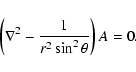
At the top (
 ), the toroidal field has to be zero (B = 0)
and A has to match smoothly to a potential field satisfying
the free space equation
), the toroidal field has to be zero (B = 0)
and A has to match smoothly to a potential field satisfying
the free space equation
 |
(7) |
Dikpati & Choudhuri (1994) describe how this is done.
We have used a finer grid resolution as compared to other models existing
in the literature, with 129  129 grid cells in the latitudinal and
radial directions. The algorithm used by us in developing the numerical code
is described in the Appendix of Dikpati & Choudhuri (1994) and the Appendix
of Choudhuri & Konar (2002). If either the coefficient has a quenching factor
or magnetic buoyancy is included to suppress the growth of the magnetic field,
then any arbitrary initial condition either asymptotically goes to zero
(sub-critical condition) or relaxes to a steady dynamo solution (super-critical
condition). We now discuss how the various parameters are specified.
129 grid cells in the latitudinal and
radial directions. The algorithm used by us in developing the numerical code
is described in the Appendix of Dikpati & Choudhuri (1994) and the Appendix
of Choudhuri & Konar (2002). If either the coefficient has a quenching factor
or magnetic buoyancy is included to suppress the growth of the magnetic field,
then any arbitrary initial condition either asymptotically goes to zero
(sub-critical condition) or relaxes to a steady dynamo solution (super-critical
condition). We now discuss how the various parameters are specified.
We use the following analytic form to represent the solar internal
rotation (Schou et al. 1998; Charbonneau et al. 1999):
![$\displaystyle %
\Omega(r,\theta) = \Omega_{{\rm RZ}} +
\frac{1}{2}\left[1 + \mb...
... t}}\right) \right]\left[\Omega_{{\rm SCZ}}(\theta)
- \Omega_{{\rm RZ}}\right].$](/articles/aa/full/2004/45/aa1199/img35.gif) |
|
|
(8) |
This analytical expression fits the results of helioseismology
fairly closely for the following values of parameters:
 ,
,

 nHz,
nHz,
 ,
with
,
with
 nHz,
nHz,
 nHz and
 nHz.
A contour plot of
generated by the above expression is shown in
Fig. 1, in which the tachocline is shown as a shaded region. Since
helioseismology has already determined ,
we do not have much
freedom to vary its parameters. At the present time, however, there
exist some uncertainties as to the exact location of the tachocline
and its thickness. These are indicated by the parameters
nHz.
A contour plot of
generated by the above expression is shown in
Fig. 1, in which the tachocline is shown as a shaded region. Since
helioseismology has already determined ,
we do not have much
freedom to vary its parameters. At the present time, however, there
exist some uncertainties as to the exact location of the tachocline
and its thickness. These are indicated by the parameters  and
and  .
Especially, it is still not completely clear how the tachocline is located
with respect to the bottom of the convection zone (whether it is completely
below the convection zone or partly inside it). There are some indications
that the tachocline may actually have a prolate shape, such that more of
the tachocline comes within the convection zone at higher latitudes than
at the lower latitudes. Given the many other uncertainties in the problem,
we have not taken this effect into account in our calculations.
.
Especially, it is still not completely clear how the tachocline is located
with respect to the bottom of the convection zone (whether it is completely
below the convection zone or partly inside it). There are some indications
that the tachocline may actually have a prolate shape, such that more of
the tachocline comes within the convection zone at higher latitudes than
at the lower latitudes. Given the many other uncertainties in the problem,
we have not taken this effect into account in our calculations.
We take the bottom of the convection zone at
 ,
which is
marked in Fig. 1. By bottom of the convection zone,
we mean the depth at which the temperature gradient changes from being
sub-adiabatic below to super-adiabatic above. As we point out later,
magnetic buoyancy is assumed to be operative only above the bottom of
the convection zone. Since the strong toroidal field is generated in the
tachocline, a tachocline below the convection zone would imply a situation
where the toroidal field is created at a location which is immune to
magnetic buoyancy. Hence, the location of the tachocline with respect to
the base of the convection zone is of considerable importance in our problem.
As seen in Fig. 1, we take part of the tachocline above the bottom of the
convection zone. All our calculations are done with this analytic fit to the
helioseismically deduced profile of .
,
which is
marked in Fig. 1. By bottom of the convection zone,
we mean the depth at which the temperature gradient changes from being
sub-adiabatic below to super-adiabatic above. As we point out later,
magnetic buoyancy is assumed to be operative only above the bottom of
the convection zone. Since the strong toroidal field is generated in the
tachocline, a tachocline below the convection zone would imply a situation
where the toroidal field is created at a location which is immune to
magnetic buoyancy. Hence, the location of the tachocline with respect to
the base of the convection zone is of considerable importance in our problem.
As seen in Fig. 1, we take part of the tachocline above the bottom of the
convection zone. All our calculations are done with this analytic fit to the
helioseismically deduced profile of .
![\begin{figure}
\par\includegraphics[height=6.8cm,width=6.55cm,clip]{1199f1.eps}\end{figure}](/articles/aa/full/2004/45/aa1199/Timg46.gif) |
Figure 1:
Contours of constant angular velocity as obtained from Eq. (8)
and used in all of our calculations. The tachocline is
indicated as the shaded region. The bottom of the convection zone (BCZ) is at
0.71  .
The differential rotation being symmetric
about the equator, only one quadrant is shown. .
The differential rotation being symmetric
about the equator, only one quadrant is shown. |
| Open with DEXTER |
![\begin{figure}
\par\includegraphics[height=6.55cm,width=3.6cm,clip]{1199f2.eps}\end{figure}](/articles/aa/full/2004/45/aa1199/Timg48.gif) |
Figure 2:
Streamlines of meridional circulation
obtained by taking penetration radius
 .
The tachocline
is shown as a shaded region. Arrows denote the direction of flow. .
The tachocline
is shown as a shaded region. Arrows denote the direction of flow. |
| Open with DEXTER |
In some of our earlier work (Choudhuri et al. 1995; Nandy & Choudhuri 2001;
Nandy 2002), we had taken
to be independent of  and used
a radial variation appropriate for the equatorial region. If
is
taken to be a function of r alone, then the behaviour of the dynamo is
much simpler. On the other hand, when
is a function of both r and
as given by Eq. (8), the problem becomes immensely more complicated.
and used
a radial variation appropriate for the equatorial region. If
is
taken to be a function of r alone, then the behaviour of the dynamo is
much simpler. On the other hand, when
is a function of both r and
as given by Eq. (8), the problem becomes immensely more complicated.
We now describe how the meridional circulation is specified in the northern
hemisphere. The circulation in the southern hemisphere is simply obtained
by a mirror reflection of the velocity field across the equator.
We get the meridional circulation from the stream function  defined through the equation
![\begin{displaymath}%
\rho {\vec v}= \nabla \times [\psi (r, \theta) {\vec e}_{\phi}].
\end{displaymath}](/articles/aa/full/2004/45/aa1199/img50.gif) |
(9) |
Assuming a density stratification
 |
(10) |
we take
 |
|
|
(11) |
![\begin{figure}
\par\includegraphics[height=5.9cm,width=7.85cm,clip]{1199f3.eps}\end{figure}](/articles/aa/full/2004/45/aa1199/Timg53.gif) |
Figure 3:
Plot of
 (in m s-1) as a function of
 at the
mid-latitude =
at the
mid-latitude =
 . .
|
| Open with DEXTER |
with the following values of the parameters:
 10-8 m-1,
 10-8 m-1,
 ,
,
 ,
,
 108 m,
 ,
m=3/2. It is the parameter
,
m=3/2. It is the parameter  which determines the depth to which the meridional circulation
penetrates. Figure 2 shows the streamlines of the meridional circulation
obtained by taking
,
which is used in all our
calculations and which corresponds to the meridional flow going slightly
below the tachocline. The amplitude of the meridional circulation is
fixed by
which determines the depth to which the meridional circulation
penetrates. Figure 2 shows the streamlines of the meridional circulation
obtained by taking
,
which is used in all our
calculations and which corresponds to the meridional flow going slightly
below the tachocline. The amplitude of the meridional circulation is
fixed by  .
We choose it such that the poleward flow near
the surface at mid-latitudes peaks typically around v0=22 m s-1. The equatorward
counterflow peaks at the core-convection zone interface and has a value of 1.8 m s-1, which
is similar to what observational analysis of sunspot drift suggests (Hathaway et al. 2003).
Since the form of the meridional circulation seems crucial for the
stability for the dynamo, let us make some comments on it. On comparing
Eqs. (11) with (9) of Nandy & Choudhuri (2001), it will be found
that we have now added an extra factor
.
We choose it such that the poleward flow near
the surface at mid-latitudes peaks typically around v0=22 m s-1. The equatorward
counterflow peaks at the core-convection zone interface and has a value of 1.8 m s-1, which
is similar to what observational analysis of sunspot drift suggests (Hathaway et al. 2003).
Since the form of the meridional circulation seems crucial for the
stability for the dynamo, let us make some comments on it. On comparing
Eqs. (11) with (9) of Nandy & Choudhuri (2001), it will be found
that we have now added an extra factor
 just after
  .
This extra factor ensures that
smoothly falls to zero at .
If this factor is not included, then
has a finite value at ,
leading to a discontinuity at
if there is no flow below. Figure 3 shows the profile of
at the mid-latitude obtained with the factor
included. It should also be noted in
Fig. 3 that
in our model decreases monotonically
below the bottom of the SCZ and becomes very small in the tachocline.
We want to emphasize that we need very modest flows below the tachocline
(presumably not much beyond the region of overshooting) to make our model work.
.
This extra factor ensures that
smoothly falls to zero at .
If this factor is not included, then
has a finite value at ,
leading to a discontinuity at
if there is no flow below. Figure 3 shows the profile of
at the mid-latitude obtained with the factor
included. It should also be noted in
Fig. 3 that
in our model decreases monotonically
below the bottom of the SCZ and becomes very small in the tachocline.
We want to emphasize that we need very modest flows below the tachocline
(presumably not much beyond the region of overshooting) to make our model work.
We point out that we find well-behaved periodic solutions only for
certain forms of the meridional circulation.
Küker et al. (2001) also found oscillatory solutions only within
limited regions of parameter space. However, the dynamo becomes very
robust and stable with a sufficiently deeply penetrating meridional
flow having a smooth
profile.
The toroidal fields at the bottom of SCZ, from which the active regions
form, have values of order 105 G. We expect these strong fields to
be confined in limited regions (Choudhuri 2003b).
Much of the remaining space would be
filled with much weaker magnetic field which would primarily contribute to
the poloidal component. We expect the turbulent diffusivity to be highly
suppressed in the regions of strong field. An approximate way of taking
account of this is to take a lower diffusion coefficient for the toroidal
component (which is mainly associated with the concentrated strong fields)
compared to the poloidal component (which is associated with the more widely
dispersed weak field).
We expect the turbulent diffusivity inside the convection zone
 to be much larger than the diffusivity
 in the radiative interior,
the overshoot layer being the region within which the value of diffusivity
makes a transition from
to
.
Since the poloidal
component is weak, the turbulent diffusivity acts on it without any difficulty.
We take the diffusivity for the poloidal component to be
in the radiative interior,
the overshoot layer being the region within which the value of diffusivity
makes a transition from
to
.
Since the poloidal
component is weak, the turbulent diffusivity acts on it without any difficulty.
We take the diffusivity for the poloidal component to be
![\begin{displaymath}%
\eta_{\rm p}(r) = \eta_{{\rm RZ}} + \frac{\eta_{{\rm SCZ}}}...
...\left(\frac{r - r_{{\rm BCZ}}}
{d_{\rm t}}\right) \right]\cdot
\end{displaymath}](/articles/aa/full/2004/45/aa1199/img66.gif) |
(12) |
Figure 4 shows a plot of
with the following values of the parameters:
 1012 cm2 s-1,
 108 cm2 s-1,
 ,
,
 .
.
![\begin{figure}
\par\includegraphics[height=5.4cm,width=5.9cm,clip]{1199f4.eps}\end{figure}](/articles/aa/full/2004/45/aa1199/Timg71.gif) |
Figure 4:
Plots of
 (solid) and (solid) and
 (dashed)
as given by Eqs. (12) and (13) as functions of the fractional radial distance (
). The y-axis is in units of cm2 s-1.
(dashed)
as given by Eqs. (12) and (13) as functions of the fractional radial distance (
). The y-axis is in units of cm2 s-1. |
| Open with DEXTER |
The toroidal component inside a flux tube, however,
has a value larger than the equipartition
value till it rises to about 30 000 km or 40 000 km below the solar surface
(Longcope & Choudhuri 2002, Sect. 2). Only in the top layers of the SCZ, the
diffusion coefficient of the toroidal component should be equal to the usual
turbulent diffusivity value
.
Within the main body of SCZ, the
action of turbulent diffusivity on the toroidal component must be considerably
suppressed. In view of this, we take the diffusivity
of the toroidal
component as shown in Fig. 4, which is generated from the expression
![$\displaystyle %
\eta_{\rm t}(r) = \eta_{{\rm RZ}} + \frac{\eta_{{\rm SCZ1}}}{2}...
...{2}\left[ 1 + \mbox{erf}\left(\frac{r-r_{{\rm TCZ}}}{d_{\rm t}}
\right) \right]$](/articles/aa/full/2004/45/aa1199/img72.gif) |
|
|
(13) |
with
 1010 cm2 s-1,
 and
and
 ,
the
value of
being 2.4
1012 cm2 s-1 as specified
earlier. As we shall
see below,
and
specified in this way gives solutions with
dipolar parity. Except Sects. 3.2-3, everywhere else in our paper we use
and
as specified above.
,
the
value of
being 2.4
1012 cm2 s-1 as specified
earlier. As we shall
see below,
and
specified in this way gives solutions with
dipolar parity. Except Sects. 3.2-3, everywhere else in our paper we use
and
as specified above.
![\begin{figure}
\par\includegraphics[height=5.35cm,width=5.85cm,clip]{1199f5.eps}\end{figure}](/articles/aa/full/2004/45/aa1199/Timg76.gif) |
Figure 5:
Plots of
(solid) and
(dashed) in cm2 s-1 used in Sect. 3.2, as function of the fractional radial distance (
). |
| Open with DEXTER |
Simulations of the evolution of the weak, diffuse field on the solar surface (Wang et al. 1989a,b),
as well as observational estimates from sunspot
decay, point out that
must be of the order of 1012 cm2 s-1 in the upper layers of the convection zone. We have taken a
value of this order on the higher side and find that it allows sufficient
diffusion of the poloidal component across the equator to enforce the
dipolar mode. A low value of diffusivity below the bottom of the convection zone is very
important in dynamo models with meridional flow penetrating below the
tachocline. A low diffusivity in the tachocline and the overshoot
layer ensures that the toroidal field which is produced
in the high latitudes within the tachocline does not decay much while
being transported to low latitudes by the meridional flow (Nandy 2002).
The assumed value of
essentially ensures that the magnetic
field is frozen for time scales of the order of dynamo period. By taking
a low
at the bottom of SCZ, we also make sure that there is not much
cross-diffusion of the toroidal component
across the equator and it is possible for the toroidal
component to have opposite values in the two hemispheres. It may be noted
that there is a term involving
 in the evolution Eq. (3)
for the toroidal component. This term has the form of an advection term,
with
corresponding to a downward velocity. We discovered an
error in the original code which produced the results of Nandy & Choudhuri
(2002). The error made this term involving
somewhat smaller
than what it should have been. However, on incorporating the
suppression of
in the body of the SCZ as we do here,
the gradient
is moved to the upper layers (which can be seen
from Fig. 4) and the results essentially remain the
same as earlier.
in the evolution Eq. (3)
for the toroidal component. This term has the form of an advection term,
with
corresponding to a downward velocity. We discovered an
error in the original code which produced the results of Nandy & Choudhuri
(2002). The error made this term involving
somewhat smaller
than what it should have been. However, on incorporating the
suppression of
in the body of the SCZ as we do here,
the gradient
is moved to the upper layers (which can be seen
from Fig. 4) and the results essentially remain the
same as earlier.
For the sake of comparison, we present in Sects. 3.2-3 some results obtained with
a lower diffusivity for the poloidal field. The profile of this  is shown in Fig. 5. This low
diffusivity does not allow the poloidal components in the two hemispheres
to connect across the equator and usually the quadrupolar mode is preferred,
as we shall see in Sects. 3.2-3.
is shown in Fig. 5. This low
diffusivity does not allow the poloidal components in the two hemispheres
to connect across the equator and usually the quadrupolar mode is preferred,
as we shall see in Sects. 3.2-3.
The
coefficient is taken in the form
![$\displaystyle %
\alpha =\alpha_0 \cos \theta \frac{1}{4}
\left[ 1 + \mbox{erf}\...
...ht) \right]
\left[ 1 - \mbox{erf}\left(\frac{r - r_2}{d_2} \right) \right]\cdot$](/articles/aa/full/2004/45/aa1199/img79.gif) |
|
|
(14) |
The parameters we use are
 ,
,
 ,
,
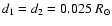 ,
making sure that the effect is concentrated
in the top layer
,
making sure that the effect is concentrated
in the top layer
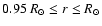 .
The solid line in Fig. 6 shows the variation of
with r. The amplitude
.
The solid line in Fig. 6 shows the variation of
with r. The amplitude  is taken such that the dynamo is super-critical.
We had taken
is taken such that the dynamo is super-critical.
We had taken
 25 m s-1 in most of our
calculations, where the solutions are found to be super-critical for
such a value of .
We use this form of coefficient
in all our calculations except in Sect. 3.3, where an additional effect within the SCZ is included. The dashed line in Fig. 6 shows
the radial profile of
used in Sect. 3.3, the angular variation
being taken as
25 m s-1 in most of our
calculations, where the solutions are found to be super-critical for
such a value of .
We use this form of coefficient
in all our calculations except in Sect. 3.3, where an additional effect within the SCZ is included. The dashed line in Fig. 6 shows
the radial profile of
used in Sect. 3.3, the angular variation
being taken as
 as used elsewhere in the paper.
![\begin{figure}
\par\includegraphics[height=7.85cm,width=7.9cm,clip]{1199f6.eps}\end{figure}](/articles/aa/full/2004/45/aa1199/Timg87.gif) |
Figure 6:
The Babcock-Leighton
used for most of our
calculations (solid line) and also in our standard model described in Sect. 3.1. The dashed line shows the
used in Sect. 3.3, as a function of fractional radial distance
.
Units are in m s-1. |
| Open with DEXTER |
Since there is some confusion in the literature as to what is meant by
a Babcock-Leighton dynamo, let us clarify that we use this term to
mean a solar dynamo in which the poloidal field is created near the surface
from the decay of tilted active regions.
It should be noted that coefficient in a Babcock-Leighton dynamo
is not given by the mean helicity of turbulence as in conventional
mean field MHD (see, for example, Choudhuri 1998, Sect. 16.5). In our approach
as well in the approach of several other authors (Choudhuri et al. 1995;
Dikpati & Charbonneau 1999; Nandy & Choudhuri 2001; Küker et al. 2001),
the coefficient phenomenologically captures the effect of
poloidal field generation from the decay of tilted active regions
near the solar surface. Since this arises from the averaging
over many active regions, what we provide is essentially a mean field
formulation of a Babcock-Leighton dynamo.
The angular factor
arises from
the angular dependence of the Coriolis force which causes the tilts of
active regions. Several groups suppressed artifically at high latitudes
to reduce the strength of the toroidal field at high latitudes.
Dikpati & Charbonneau (1999) used the angular factor
 ,
whereas Küker et al. (2001) used
,
whereas Küker et al. (2001) used
 .
Flux tube simulations which calculate
the tilts of emerging active regions (D'Silva & Choudhuri 1993; Fan
et al. 1993) give us some clues about the angular dependence of the
coefficient. If the
Coriolis force could freely produce the tilt without any
opposing force operative, then the tilts at different latitudes would
have been proportional to the Coriolis factor
and the
coefficient would have the same angular dependence. However,
the Coriolis force is opposed by magnetic tension which tries to prevent
the tilt from becoming very large. We thus find that the tilt does not
increase with latitude as fast as the Coriolis factor
.
On these grounds, we expect that
will not increase with latitude
as fast as
,
but taking the angular dependence to be
or
may be unrealistic.
.
Flux tube simulations which calculate
the tilts of emerging active regions (D'Silva & Choudhuri 1993; Fan
et al. 1993) give us some clues about the angular dependence of the
coefficient. If the
Coriolis force could freely produce the tilt without any
opposing force operative, then the tilts at different latitudes would
have been proportional to the Coriolis factor
and the
coefficient would have the same angular dependence. However,
the Coriolis force is opposed by magnetic tension which tries to prevent
the tilt from becoming very large. We thus find that the tilt does not
increase with latitude as fast as the Coriolis factor
.
On these grounds, we expect that
will not increase with latitude
as fast as
,
but taking the angular dependence to be
or
may be unrealistic.
We also point out that we have eliminated the
-quenching factor typically taken to be of the form
(1+B2/B02)-1. If magnetic buoyancy is not included,
then such a factor is the only
source of nonlinearity in the model and is essential to allow
the simulation to relax to steady solutions.
We found the -quenching to be redundant in presence of
magnetic buoyancy which limits
the toroidal field to values <105 G (see Sect. 2.5). On theoretical grounds
also, the removal of -quenching is quite
logical in the Babcock-Leighton dynamo models. In mean field MHD, the
effect comes
from helical turbulence which is quenched when the magnetic field is
super-equipartition. In our model, however, the effect is due to
the decay of tilted bipolar
regions. Flux tube simulations do show that the tilt is less for
stronger magnetic fields at the bottom of the SCZ
(see D'Silva & Choudhuri 1993). So the effect should depend
on the magnetic field at the bottom of SCZ, but not on the local
value of the magnetic field at the surface where the effect
is operative. Since our formulation of magnetic buoyancy (see Sect. 2.6) makes the toroidal field
erupt only when it is of order 105 G, we do not expect much variation
in
with the magnetic field.
We prescribe magnetic buoyancy in a way which has
been discussed in detail by Nandy & Choudhuri (2001) and
Nandy (2003). We search
for toroidal field B exceeding the critical field
 G,
above the base of the SCZ
taken at r =0.71 at intervals of time
G,
above the base of the SCZ
taken at r =0.71 at intervals of time
 105 s. Wherever B exceeds
  ,
a fraction f = 0.5 of
it is made to erupt to the surface layers, with the toroidal field values
adjusted appropriately to ensure flux conservation. The parameter f
measures the strength of magnetic buoyancy. It was found by Nandy &
Choudhuri (2001) that, when f was still small compared to 1 (f has to
be less than 1), magnetic buoyancy already reached saturation and the
character of the dynamo did not change any more on increasing f. The
value f = 0.5 used throughout our paper already puts the dynamo in the
buoyancy-saturated regime.
,
a fraction f = 0.5 of
it is made to erupt to the surface layers, with the toroidal field values
adjusted appropriately to ensure flux conservation. The parameter f
measures the strength of magnetic buoyancy. It was found by Nandy &
Choudhuri (2001) that, when f was still small compared to 1 (f has to
be less than 1), magnetic buoyancy already reached saturation and the
character of the dynamo did not change any more on increasing f. The
value f = 0.5 used throughout our paper already puts the dynamo in the
buoyancy-saturated regime.
Although A and B in general evolve according to Eqs. (2) and (3), we allow
abrupt changes in B after intervals of  to take account of
magnetic buoyancy. While our treatment of magnetic buoyancy may not
be fully satisfactory, note that uncertainties remain in the way buoyancy
has been handled earlier by other groups, e.g. by treating buoyancy as a
simple loss term (Schmitt & Schüssler 1989) or by treating it in a non-local manner by making the poloidal source term near the surface proportional to the toroidal
field strength at the bottom of the SCZ (Dikpati & Charbonneau 1999).
to take account of
magnetic buoyancy. While our treatment of magnetic buoyancy may not
be fully satisfactory, note that uncertainties remain in the way buoyancy
has been handled earlier by other groups, e.g. by treating buoyancy as a
simple loss term (Schmitt & Schüssler 1989) or by treating it in a non-local manner by making the poloidal source term near the surface proportional to the toroidal
field strength at the bottom of the SCZ (Dikpati & Charbonneau 1999).
All our calculations are done with internal rotation ,
meridional
circulation
and magnetic buoyancy as specified in Sects. 2.2, 2.3 and 2.6. We first present results in Sect. 3.1 obtained with the diffusion
coefficients shown in Fig. 4 and an effect concentrated
near the surface as shown in Fig. 6 by the solid line. The dipolar
mode is the clearly preferred mode and the results qualitatively match the
observational data quite well. Some authors (Dikpati & Gilman 2001;
Bonanno et al. 2002) obtained anti-solar quadrupolar modes in their
calculations. We believe that this was due to the low diffusivity of
the poloidal component which did not allow this component to connect across
the equator. We present results in Sect. 3.2 in which the diffusion coefficients
are as shown in Fig. 5, i.e. the diffusivity of the poloidal component is
reduced compared to what we use in Sect. 3.1 and that of the toroidal field is increased.
We end up with the anti-solar quadrupolar parity in this case. Then we
show in Sect. 3.3 that we get back the dipolar parity if we include an effect within the SCZ (as shown by dashed line in Fig. 6),
while keeping all the other things the same as in Sect. 3.2. This is again in
agreement with what Dikpati & Gilman (2001) and Bonanno et al. (2002) found.
We are thus able to reproduce the results of Dikpati & Gilman (2001) and
Bonanno et al. (2002). However, we do not agree with their conclusion
that a pure Babcock-Leighton effect concentrated
near the solar surface cannot give the dipolar parity. As we show in Sect. 3.1,
the dipolar parity is the preferred parity if the diffusivity of the poloidal
component is sufficiently high, even when the effect is concentrated
near the solar surface.
![\begin{figure}
\par\includegraphics[height=5.3cm,width=8.8cm,clip]{1199f7a.eps}\...
...e*{5mm}
\includegraphics[height=3.8cm,width=8.8cm,clip]{1199f7b.eps}\end{figure}](/articles/aa/full/2004/45/aa1199/Timg94.gif) |
Figure 7:
a) A time-latitude plot showing the evolution of the toroidal
field B at the bottom of the
convection zone (r = 0.71 ). Regions shaded in white show positive B,
whereas black regions denote negative B.
The magnetic configuration makes a transition
from an initial quadrupolar (anti-solar) mode to a
pure dipolar (solar-like) mode in about 3000 years. We show the intermediate phase during the transition (1500-2500 years). This figure is for the case presented in Sect. 3.1.
b) The variation of the correlation coefficient P(t)with time during the 4000 years of the model run. The initial value P(t) = 1 corresponds to quadrupolar parity, whereas the final relaxed value P(t) = -1 corresponds to dipolar parity. |
| Open with DEXTER |
We first present a purely Babcock-Leighton dynamo ( effect concentrated
near the surface as shown in Fig. 6 by solid line),
which settles into dipolar parity. As we discussed above, the preferred parity depends on the diffusion coefficients. Various experiments with the parameter space of the model tell us that there are two important conditions for getting the right parity.
- 1.
- The term
representing the molecular diffusivity in the overshoot layer and
the radiation zone below must be sufficiently small (
 2.2
108 cm2 s-1) to prevent the toroidal field from diffusing across the equator.
2.2
108 cm2 s-1) to prevent the toroidal field from diffusing across the equator.
- 2.
- The diffusivity of the poloidal field
within the SCZ must be
sufficiently large (2.4
1012 cm2 s-1) to allow diffusive
coupling of the poloidal field between two hemispheres.
Further, we have to avoid a large gradient
at the bottom of the SCZ in order to obtain well-behaved solutions.
The particular solution we present here is obtained with the diffusion coefficients
as given in Fig. 4.
To ensure that the dipolar parity is the dominant mode in the model, we start from
a pure quadrupolar initial condition and find that the solution eventually
relaxes to a pure dipolar parity.
Figure 7a shows the intermediate phase in the
evolution of the initial quadrupolar field into a dipolar
field. Let us consider the toroidal field B at two symmetric points
in the two hemispheres. We arbitrarily choose two points at latitudes
 and
and
 (i.e. at
 and
and
 ), both at
.
Let us write
), both at
.
Let us write
 and
and
 .
We must have
.
We must have
 for a purely dipolar field, whereas
 for a purely quadrupolar field. Hence the nature of the field can be found from
the correlation between
for a purely quadrupolar field. Hence the nature of the field can be found from
the correlation between
 and
and
 defined in the following way:
 |
|
|
(15) |
where
 denote the
averages of
and
fields respectively within a dynamo period T and are both equal to zero.
This correlation function P(t) should be -1 and +1 for dipolar and
quadrupolar fields respectively. Figure 7b shows the
evolution of this correlation function for 4000 years, during which the magnetic
field clearly relaxes from a quadrupolar to dipolar configuration.
We carried out the simulation for another 2000 years after
the initial run of 4000 years shown in Fig. 7b.
The solution remained in the solar-like parity state during the entire run.
Figure 8 gives a
snapshot of the relaxed magnetic field configuration which is dipolar. We find
that the poloidal field lines have connected across the equator, whereas the toroidal
field within the tachocline has opposite signs on the two sides of the equator.
We shall provide further details of this solution in Sect. 4.
denote the
averages of
and
fields respectively within a dynamo period T and are both equal to zero.
This correlation function P(t) should be -1 and +1 for dipolar and
quadrupolar fields respectively. Figure 7b shows the
evolution of this correlation function for 4000 years, during which the magnetic
field clearly relaxes from a quadrupolar to dipolar configuration.
We carried out the simulation for another 2000 years after
the initial run of 4000 years shown in Fig. 7b.
The solution remained in the solar-like parity state during the entire run.
Figure 8 gives a
snapshot of the relaxed magnetic field configuration which is dipolar. We find
that the poloidal field lines have connected across the equator, whereas the toroidal
field within the tachocline has opposite signs on the two sides of the equator.
We shall provide further details of this solution in Sect. 4.
![\begin{figure}
\par\includegraphics[height=7cm,width=8.05cm,clip]{1199f8.eps}\end{figure}](/articles/aa/full/2004/45/aa1199/Timg109.gif) |
Figure 8:
A snapshot of a) the contours of toroidal field B and
b) streamlines of the poloidal field, given by contours of constant
 ,
for
the case of dipolar parity solution presented in Sect. 3.1.
The solid lines denote positive B or A, whereas dashed lines denote negative B or A. ,
for
the case of dipolar parity solution presented in Sect. 3.1.
The solid lines denote positive B or A, whereas dashed lines denote negative B or A. |
| Open with DEXTER |
We now present a solution obtained by keeping all the parameters the same as in Sect. 3.1,
except that we change the diffusion coefficients to what is shown in Fig. 5
rather than what is shown in Fig. 4 (as used in Sect. 3.1).
The lower diffusivity of the
poloidal field does not allow it to connect across the equator and we find that
the quadrupolar mode is preferred. To make sure that indeed the dominant mode in this case
is the quadrupolar mode, we started with an initial condition having dipolar parity and found
that it relaxed to a quadrupolar parity. Figure 9
shows the evolution of the correlation coefficient P(t) during this transition,
whereas Fig. 10 illustrates the magnetic field configuration
after the dynamo has settled into a quadrupolar
mode. We find that the poloidal field has not diffused enough to connect across the equator,
but has remained separated on the two sides of the equator. On the other hand, the toroidal
field in the tachocline has the same sign on the two sides of the equator and makes up
a patch of a common sign across the equator.
We have made many runs for other values of diffusion coefficients. As we already mentioned,
a low diffusivity
below the bottom of the SCZ is an
essential requirement to
obtain the dipolar parity (to ensure that the toroidal field in the tachocline cannot
diffuse much across the equator). When we take
larger than about
2
109 cm2 s-1, we found that we always got quadrupolar solutions
and it was not possible to get dipolar solutions even by increasing
in the
SCZ to facilitate the coupling of the poloidal field across the equator. We have shown
in Fig. 9 a transition from a dipolar parity to a quadrupolar parity
in a case in which
the quadrupolar parity is preferred. How fast such a transition takes place depends on
the value of
.
On using
 1010 cm2 s-1, the change-over takes place within just 300 years,
whereas decreasing
by two orders of magnitude stretches
the time scale of transition to the quadrupolar parity to 2000 years.
1010 cm2 s-1, the change-over takes place within just 300 years,
whereas decreasing
by two orders of magnitude stretches
the time scale of transition to the quadrupolar parity to 2000 years.
![\begin{figure}
\par\includegraphics[height=4.5cm,width=8.8cm,clip]{1199f9.eps}\end{figure}](/articles/aa/full/2004/45/aa1199/Timg111.gif) |
Figure 9:
The evolution of the correlation coefficient P(t)defined in Eq. (15), for the case presented in Sect. 3.2. A transition from dipolar
to quadrupolar parity is seen. |
| Open with DEXTER |
![\begin{figure}
\par\includegraphics[height=7cm,width=8.1cm,clip]{1199f10.eps}\end{figure}](/articles/aa/full/2004/45/aa1199/Timg112.gif) |
Figure 10:
A snapshot of a) the contours of the toroidal field and
b) streamlines of the poloidal field, for the quadrupolar parity solution presented in Sect. 3.2. |
| Open with DEXTER |
Finally we consider what influence an additional effect within
the SCZ has on the parity of the solution. For this purpose, we change the radial
profile of the effect to what is shown in Fig. 6 by a dashed line
rather than the solid line in the same figure, keeping the other things the same as in
Sect. 3.2 (including the diffusion coefficients which are as shown in
Fig. 5). We find that the solution relaxes to dipolar
parity even if we start from quadrupolar parity, as shown in
Fig. 11. A snapshot of the field configuration is
presented in Fig. 12. This is a case in which the quadrupolar parity would have
been preferred if the additional effect inside the SCZ were not
present, as we saw in Sect. 3.2. However, this additional effect, even though
its value inside the SCZ is much smaller than the value of the
Babcock-Leighton
at the surface, can make the solution dipolar. This is in
agreement with what has been found by Dikpati & Gilman (2001) and Bonanno et al.
(2002). One has to keep in mind that the coefficient has to be multiplied
by the toroidal field B to provide the source term for the poloidal
field. Since B is very large at the bottom of the SCZ, even a very small
there can make  as large as what it is near the surface. That
is why we find that even a very small
inside the SCZ or at its base
can affect the nature of the solution so drastically. Presumably, an
effect within the SCZ creates some poloidal field there
which can diffuse across the equator more efficiently than poloidal
field created near the surface (where there is a meridional flow
diverging away from the equator), thereby enforcing the dipolar parity.
Note that in the presence of a small
inside the SCZ the magnitude of the Babcock-Leighton
required at the surface for steady oscillating solutions decreases by almost
a factor of 10 (dashed line in Fig. 6).
as large as what it is near the surface. That
is why we find that even a very small
inside the SCZ or at its base
can affect the nature of the solution so drastically. Presumably, an
effect within the SCZ creates some poloidal field there
which can diffuse across the equator more efficiently than poloidal
field created near the surface (where there is a meridional flow
diverging away from the equator), thereby enforcing the dipolar parity.
Note that in the presence of a small
inside the SCZ the magnitude of the Babcock-Leighton
required at the surface for steady oscillating solutions decreases by almost
a factor of 10 (dashed line in Fig. 6).
![\begin{figure}
\par\includegraphics[height=3.6cm,width=8.8cm,clip]{1199f11.eps}\end{figure}](/articles/aa/full/2004/45/aa1199/Timg114.gif) |
Figure 11:
The evolution of the correlation coefficient P(t)defined in Eq. (15), for the case presented in Sect. 3.3 (with an additional
introduced
inside the SCZ). A transition from quadrupolar
to dipolar parity is seen. |
| Open with DEXTER |
Choudhuri (2003b) has argued that the strong toroidal field at the bottom
of the SCZ would be highly intermittent and the effect may be
operative in the intervening regions of weak field. Several other authors
(Ferriz-Mas et al. 1994; Dikpati & Gilman 2001) argue that the various instabilities
associated with the strong field or the differential rotation also can
produce something like an
effect. So an additional effect within the SCZ or at
its bottom is certainly a realistic possibility. However, our knowledge
about it at the present time is very incomplete and uncertain. On the
other hand, we see tilted active regions decay on the solar surface and
we directly know from observations that there is an effect at the
solar surface. By the Occam's razor argument, we feel that it is desirable
to first construct solar dynamo models with this Babcock-Leighton
alone - especially since we have shown in Sect. 3.1 that it is possible to get
solar-like dipolar parity with such dynamo models. We present a more
detailed discussion of such pure Babcock-Leighton dynamo models in Sect. 4.
![\begin{figure}
\par\includegraphics[height=7cm,width=8.1cm,clip]{1199f12.eps}\end{figure}](/articles/aa/full/2004/45/aa1199/Timg115.gif) |
Figure 12:
Snapshots of a) the toroidal field contours and b) streamlines of the poloidal
field, for the solution presented in Sect. 3.3. |
| Open with DEXTER |
We have seen in Sect. 3.1 that a CDSD model with an effect concentrated
near the surface and with appropriate values of various parameters can give
a solution with the dipolar parity. We would refer to this solution as our
standard model. We have focused primarily on the parity of this solution
in Sect. 3.1. Now we discuss other aspects of this solution and show that this
solution matches observational data quite well. We have already discussed
in Sects. 2 and 3.1 how the various parameters of this particular case are
specified. The amplitude
of the Babcock-Leighton effect used to generate our standard
solution is 25 m s-1. For this standard case, we refined our
grid to have 257
257 points, and the results remained unchanged with this finer resolution.
Figure 13 shows the time-latitude contour plot of the radial field
at the solar surface, with the theoretical butterfly diagram superimposed upon it.
The butterfly diagram is produced by marking the locations of eruption, "+''
indicating the positive value of B at the bottom of the SCZ which erupts and "o'' indicating the negative value. The sunspot eruptions are confined within  40
40 and the butterfly diagrams have shapes similar to what is observationally
found (see, for example, Fig. 6.2 in Choudhuri 2003a; Hathaway
et al. 2003). The weak radial field
migrates poleward at higher latitudes, in conformity with observations.
One of the important aspects of observational data is the phase relation between
the sunspots and the weak diffuse field. See Sect. 1 of Choudhuri & Dikpati (1999)
for a detailed discussion of this (especially note Fig. 1 there).
The polar field changes from positive to negative at the time of a sunspot maximum corresponding
to a negative toroidal field B at the base of SCZ. This is clearly seen in the
theoretical results shown in Fig. 13.
In Fig. 14 we
show four snapshots of the toroidal field contours and poloidal field lines
taken successively at an interval of
and the butterfly diagrams have shapes similar to what is observationally
found (see, for example, Fig. 6.2 in Choudhuri 2003a; Hathaway
et al. 2003). The weak radial field
migrates poleward at higher latitudes, in conformity with observations.
One of the important aspects of observational data is the phase relation between
the sunspots and the weak diffuse field. See Sect. 1 of Choudhuri & Dikpati (1999)
for a detailed discussion of this (especially note Fig. 1 there).
The polar field changes from positive to negative at the time of a sunspot maximum corresponding
to a negative toroidal field B at the base of SCZ. This is clearly seen in the
theoretical results shown in Fig. 13.
In Fig. 14 we
show four snapshots of the toroidal field contours and poloidal field lines
taken successively at an interval of
 the solar cycle period which happens to be about 25 years in this case.
In all the snapshots we see that the poloidal field lines are symmetric about the equator.
The
in the convection zone is sufficiently high (2.4
1012 cm2 s-1) to ensure that the poloidal fields connect smoothly across the equator. On the other hand, the toroidal fields on the two sides of the equator, which have opposite signs,
cannot diffuse together due to the low
near the base of SCZ.
the solar cycle period which happens to be about 25 years in this case.
In all the snapshots we see that the poloidal field lines are symmetric about the equator.
The
in the convection zone is sufficiently high (2.4
1012 cm2 s-1) to ensure that the poloidal fields connect smoothly across the equator. On the other hand, the toroidal fields on the two sides of the equator, which have opposite signs,
cannot diffuse together due to the low
near the base of SCZ.
![\begin{figure}
\par\includegraphics[height=7.75cm,width=8.8cm,clip]{1199f13.eps}\end{figure}](/articles/aa/full/2004/45/aa1199/Timg119.gif) |
Figure 13:
Theoretical butterfly diagram of eruptions for our standard model.
The background shows contours of diffuse radial field. Eruption latitudes are denoted by symbols "o'' and "+'', indicating
negative and positive toroidal field respectively.
The dashed contours are for negative Br, whereas
the solid contours are for positive Br. Note that negative toroidal fields give rise to negative radial field near the poles after decaying and vice versa
in accordance with Hale's polarity law. The time is in years from the start of the run. |
| Open with DEXTER |
![\begin{figure}
\par\includegraphics[height=5cm,width=7cm,clip]{1199f14a.eps}\par...
...4c.eps}\par\includegraphics[height=5cm,width=7cm,clip]{1199f14d.eps}\end{figure}](/articles/aa/full/2004/45/aa1199/Timg120.gif) |
Figure 14:
Four snapshots of the toroidal field contours ( left panel), and the
poloidal field lines ( right panel) separated by 1/8
 of the dynamo period T.
The case t = 0 is shown in Fig. 8. The line styles are same as in
Fig. 8.
of the dynamo period T.
The case t = 0 is shown in Fig. 8. The line styles are same as in
Fig. 8. |
| Open with DEXTER |
One important question is whether the equatorward meridional circulation
at the base of SCZ should be able to
advect the strong toroidal field, working against the magnetic tension.
It has been argued by Choudhuri (2003b) that this should be possible if
the strong toroidal field is highly intermittent. However, Choudhuri (2003b)
concluded that the meridional flow may be barely strong enough to advect
the toroidal field. If B becomes larger than some critical value, then
the meridional flow may not be able to carry it.
We try to capture this effect by checking at intervals of 10 days if the toroidal
field exceeds a critical value of 1.5
105 G in
a region of thickness 0.11
below a depth of 0.73 .
Whenever B is larger than this critical value, we reduce the velocity at that grid
point by a factor of eight. A butterfly diagram similar to Fig. 13
is produced in this case and is shown in Fig. 15. On comparing
Figs. 13 and 15, we find that this velocity
quenching improves the
appearance of the butterfly diagram. We saw in Fig. 13 that eruptions for
a new half-cycle began at high latitudes before the eruptions at low latitudes
stopped for the previous half-cycle, leading to a tail-like attachment in the
butterfly diagram. We see in Fig. 15 that this is gone and a new half-cycle
begins at the high latitude at about the time when the old half-cycle dies
off at the low latitude - in conformity with observational data (see Fig. 6.2
of Choudhuri 2003a).
![\begin{figure}
\par\includegraphics[height=7.7cm,width=8.8cm,clip]{1199f15.eps}\end{figure}](/articles/aa/full/2004/45/aa1199/Timg121.gif) |
Figure 15:
Theoretical butterfly diagram of eruptions for the case presented in
Sect. 4.1. The various conventions used are the same as in Fig. 13. |
| Open with DEXTER |
We show that a CDSD model with an effect concentrated near the
surface and a meridional circulation penetrating below the tachocline
provides a satisfactory explanation for various aspects of the solar cycle.
The helioseismically determined differential rotation is
strongest at high latitudes within the tachocline
and there is little doubt that the strong toroidal field should be produced
there, to be advected by the meridional flow to low latitudes where it erupts.
This view, which was first put forth by Nandy & Choudhuri (2002), is a
departure from the traditional viewpoint that the toroidal field is produced
basically at the same latitude where it erupts. Ironically, this new
viewpoint makes the original motivation of Choudhuri et al. (1995) in
introducing the meridional circulation somewhat redundant. A standard
result of dynamo theory (without any flow in the meridional plane), which
was first derived by Parker (1955), is that the product of and
should be negative in the northern hemisphere, to ensure
the equatorward propagation of the dynamo wave (see, for example, Choudhuri
1998, Sect. 16.5). The tilts of bipolar regions on the solar surface suggest that should be positive in the northern hemisphere, whereas helioseismology
found
also to be positive in the lower latitudes. If the
strong toroidal field is produced within the tachocline at low latitudes
where it erupts,
then the simple sign rule would suggest a poleward propagation. Choudhuri
et al. (1995) introduced the meridional circulation primarily to overcome
this tendency of poleward propagation, forcing the dynamo wave to propagate
equatorward. If the toroidal field is produced at high latitudes where
is negative, then the dynamo wave should propagate equatorward
even in the absence of meridional circulation. Although the original motivation
of Choudhuri et al. (1995) in introducing the meridional circulation may
no longer be so relevant, it has become increasingly clear in the last few
years that the meridional circulation plays a crucial role in the solar
dynamo. There are indications that the meridional circulation may actually
be the time-keeper of the solar cycle (Hathaway et al. 2003). We hope that
within the next few years helioseismology will discover the equatorward
return flow of meridional circulation and may even be able to establish if
this return flow really penetrates below the tachocline, as required by us.
Dikpati & Gilman (2001) and Bonanno et al. (2002) had earlier argued
that a pure Babcock-Leighton dynamo with
concentrated near the
surface may not give the correct dipolar parity. We have clearly demonstrated
that this is not the case. If the poloidal field has sufficient diffusivity
to get coupled across the equator, whereas the toroidal field is not able
to diffuse across the equator (since turbulent diffusion is suppressed for
the strong toroidal field), then we find that the dipolar mode is preferred.
We saw in Sect. 3.3 that an additional effect in the interior of SCZ
would help in establishing dipolar parity. However, in view of the fact
that our knowledge about such an effect is very uncertain, we felt
that it is first necessary to study pure Babcock-Leighton dynamo models
with effect concentrated near the surface alone. Accordingly, we
have taken such a dynamo model which gives the correct dipolar parity as
our standard model. We have shown in Sect. 4 that this standard model explains many
aspects of observational data very well. We are right now exploring whether
this standard model can explain some other aspects of observational data not
discussed by us here. For example, active regions in the northern hemisphere
are known to have a preferred negative helicity. A theoretical explanation
for this has been provided by Choudhuri (2003b). Our preliminary
investigations based on the idea of Choudhuri (2003b)
show that our standard model presented in this paper would give
the right type of helicity (Choudhuri et al. 2004). We are
now carrying out more detailed calculations, which will be reported in a
forthcoming paper. We may mention that our code can be used for other
MHD calculations besides the solar problem. A modified version of the
code has been used to study the evolution of magnetic fields in
neutron stars (Choudhuri & Konar 2002; Konar & Choudhuri 2004;
Choudhuri & Konar 2004).
Acknowledgements
We thank the referee of our paper, Michael Stix, for helpful suggestions. Most of our calculations were carried out on Sankhya,
the parallel cluster computer in Centre for High Energy Physics, Indian Institute
of Science. D.N. acknowledges financial support from NASA through SR&T grant NAG5-11873.
- Babcock, H. W. 1961, ApJ,
133, 572 [NASA ADS] [CrossRef] (In the text)
- Bonanno, A., Elstner, D.,
Rüdiger, G., & Belvedere, G. 2002, A&A, 390, 673 [EDP Sciences] [NASA ADS] [CrossRef] (In the text)
- Braun, D. C., & Fan,
Y. 1998, ApJ, 508, L105 [NASA ADS] [CrossRef]
- Caligari, P.,
Moreno-Insertis, F., & Schüssler, M. 1995, ApJ, 441,
886 [NASA ADS] [CrossRef] (In the text)
- Charbonneau, P.,
Christensen-Dalsgaard, J., Henning, R., et al. 1999, ApJ, 527,
445 [NASA ADS] [CrossRef] (In the text)
- Choudhuri, A. R. 1989,
Sol. Phys., 123, 217 [NASA ADS] [CrossRef] (In the text)
- Choudhuri, A. R. 1998,
The Physics of Fluids and Plasmas: An Introduction for
Astrophysicists (Cambridge: Cambridge University Press)
(In the text)
- Choudhuri, A. R. 2003a,
in Dynamic Sun, ed. B. N. Dwivedi (Cambridge: Cambridge University
Press), 103
(In the text)
- Choudhuri, A. R. 2003b,
Sol. Phys., 215, 31 [NASA ADS] [CrossRef] (In the text)
- Choudhuri, A. R., &
Dikpati, M. 1999, Sol. Phys., 184, 61 [NASA ADS] [CrossRef] (In the text)
- Choudhuri, A. R., &
Gilman, P. A. 1987, ApJ, 316, 788 [NASA ADS] [CrossRef] (In the text)
- Choudhuri, A. R., &
Konar, S. 2002, MNRAS, 332, 933 [NASA ADS] [CrossRef] (In the text)
- Choudhuri, A. R., &
Konar, S. 2004, Current Science, 86, 444 [NASA ADS] (In the text)
- Choudhuri, A. R.,
Schüssler M., & Dikpati, M. 1995, A&A, 303, L29 [NASA ADS] (In the text)
- Choudhuri, A. R.,
Chatterjee, P., & Nandy, D. 2004, Proc. IAU Symp., 223, in
press [arXiv:astro-ph/0406598]
(In the text)
- Dikpati, M., &
Charbonneau, P. 1999, ApJ, 518, 508 [NASA ADS] [CrossRef] (In the text)
- Dikpati, M., &
Choudhuri, A. R. 1994, A&A, 291, 975 [NASA ADS] (In the text)
- Dikpati, M., &
Choudhuri, A. R. 1995, Sol. Phys., 161, 9 [NASA ADS] (In the text)
- Dikpati, M., &
Gilman, P. A. 2001, ApJ, 559, 428 [NASA ADS] [CrossRef] (In the text)
- D'Silva, S., &
Choudhuri, A. R. 1993, A&A, 272, 621 [NASA ADS] (In the text)
- D'Silva, S., &
Howard, R. F. 1993, Sol. Phys., 148, 1 [NASA ADS] (In the text)
- Durney, B. R. 1995, Sol.
Phys., 160, 213 [NASA ADS] (In the text)
- Durney, B. R. 1996, Sol.
Phys., 160, 231 [NASA ADS] (In the text)
- Durney, B. R. 1997, ApJ,
486, 1065 [NASA ADS] [CrossRef] (In the text)
- Fan, Y., Fisher, G. H.,
& DeLuca, E. E. 1993, ApJ, 405, 390 [NASA ADS] [CrossRef] (In the text)
- Ferriz-Mas, A., Schmitt,
D., & Schüssler, M. 1994, ApJ, 289, 949 [NASA ADS] (In the text)
- Giles, P. M., Duvall, T.
L., Jr., Kosovichev, A. G., & Scherrer, P. H. 1997, Nature,
390, 52 [NASA ADS] [CrossRef] (In the text)
- Gilman, P. A. 1986, in
Physics of the Sun (Dordrecht: D. Reidel Publishing Co.), 1,
95
(In the text)
- Guerrero, G. A., &
Munõz, J. D. 2004, MNRAS, 350, 317 [NASA ADS] [CrossRef] (In the text)
- Hathaway, D. H., Nandy,
D., Wilson, R. M., & Reichmann, E. J. 2003, ApJ, 589, 665 [NASA ADS] [CrossRef] (In the text)
- Konar, S., &
Choudhuri, A. R. 2004, MNRAS, 348, 661 [NASA ADS] [CrossRef] (In the text)
- Küker, M.,
Rüdiger, G., & Schultz, M. 2001, A&A, 374, 301 [EDP Sciences] [NASA ADS] [CrossRef] (In the text)
- Leighton, R. B. 1969,
ApJ, 156, 1 [NASA ADS] [CrossRef] (In the text)
- Longcope, D., &
Choudhuri, A. R. 2002, Sol. Phys., 205, 63 [NASA ADS] [CrossRef] (In the text)
- Miesch, M. S., Elliott,
J. R., Toomre, J., et al. 2000, ApJ, 532, 593 [NASA ADS] [CrossRef] (In the text)
- Nandy, D. 2002,
Ap&SS, 282, 209 [NASA ADS] (In the text)
- Nandy, D. 2003, Modelling
the Solar Magnetic Cycle, Ph.D. Thesis, Dept of Physics, Indian
Institute of Science
(In the text)
- Nandy, D., &
Choudhuri, A. R. 2000, J. Astrophys. Astron., 21, 381 [NASA ADS]
- Nandy, D., &
Choudhuri, A. R. 2001, ApJ, 551, 576 [NASA ADS] (In the text)
- Nandy, D., &
Choudhuri, A. R. 2002, Science, 296, 1671 [NASA ADS] [CrossRef] (In the text)
- Parker, E. N. 1955, ApJ,
122, 293 [NASA ADS] [CrossRef] (In the text)
- Roberts, P. H., &
Stix, M. 1972, A&A, 18, 453 [NASA ADS] (In the text)
- Schmitt, D., &
Schüssler, M. 1989, A&A, 223, 343 [NASA ADS] (In the text)
- Schou, J., Antia, H. M.,
Basu, S., et al. 1998, ApJ, 505, 390 [NASA ADS] [CrossRef] (In the text)
- Steenbeck, M., Krause,
F., & Rädler, K. H. 1966, Z. Naturforsch., 21a, 369 [NASA ADS] (In the text)
- Wang, Y.-M., Nash, A.
G., & Sheeley, N. R. 1989a, ApJ, 347, 529 [NASA ADS] [CrossRef] (In the text)
- Wang, Y.-M., Nash, A.
G., & Sheeley, N. R. 1989b, Science, 245, 712 [NASA ADS]
- Wang, Y.-M., Sheeley, N.
R., & Nash, A. G. 1991, ApJ, 383, 431 [NASA ADS] [CrossRef] (In the text)
Copyright ESO 2004
![\begin{figure}
\par\includegraphics[height=6.8cm,width=6.55cm,clip]{1199f1.eps}\end{figure}](/articles/aa/full/2004/45/aa1199/img46.gif)
![\begin{figure}
\par\includegraphics[height=6.55cm,width=3.6cm,clip]{1199f2.eps}\end{figure}](/articles/aa/full/2004/45/aa1199/img48.gif)
![\begin{figure}
\par\includegraphics[height=5.9cm,width=7.85cm,clip]{1199f3.eps}\end{figure}](/articles/aa/full/2004/45/aa1199/img53.gif)
 and
and
![\begin{figure}
\par\includegraphics[height=5.4cm,width=5.9cm,clip]{1199f4.eps}\end{figure}](/articles/aa/full/2004/45/aa1199/img71.gif)
![\begin{figure}
\par\includegraphics[height=5.35cm,width=5.85cm,clip]{1199f5.eps}\end{figure}](/articles/aa/full/2004/45/aa1199/img76.gif)
![\begin{figure}
\par\includegraphics[height=7.85cm,width=7.9cm,clip]{1199f6.eps}\end{figure}](/articles/aa/full/2004/45/aa1199/img87.gif)
![\begin{figure}
\par\includegraphics[height=5.3cm,width=8.8cm,clip]{1199f7a.eps}\...
...e*{5mm}
\includegraphics[height=3.8cm,width=8.8cm,clip]{1199f7b.eps}\end{figure}](/articles/aa/full/2004/45/aa1199/img94.gif)
![\begin{figure}
\par\includegraphics[height=7cm,width=8.05cm,clip]{1199f8.eps}\end{figure}](/articles/aa/full/2004/45/aa1199/img109.gif)
![\begin{figure}
\par\includegraphics[height=4.5cm,width=8.8cm,clip]{1199f9.eps}\end{figure}](/articles/aa/full/2004/45/aa1199/img111.gif)
![\begin{figure}
\par\includegraphics[height=7cm,width=8.1cm,clip]{1199f10.eps}\end{figure}](/articles/aa/full/2004/45/aa1199/img112.gif)
![\begin{figure}
\par\includegraphics[height=3.6cm,width=8.8cm,clip]{1199f11.eps}\end{figure}](/articles/aa/full/2004/45/aa1199/img114.gif)
![\begin{figure}
\par\includegraphics[height=7cm,width=8.1cm,clip]{1199f12.eps}\end{figure}](/articles/aa/full/2004/45/aa1199/img115.gif)
![\begin{figure}
\par\includegraphics[height=7.75cm,width=8.8cm,clip]{1199f13.eps}\end{figure}](/articles/aa/full/2004/45/aa1199/img119.gif)
![\begin{figure}
\par\includegraphics[height=5cm,width=7cm,clip]{1199f14a.eps}\par...
...4c.eps}\par\includegraphics[height=5cm,width=7cm,clip]{1199f14d.eps}\end{figure}](/articles/aa/full/2004/45/aa1199/img120.gif)
![\begin{figure}
\par\includegraphics[height=7.7cm,width=8.8cm,clip]{1199f15.eps}\end{figure}](/articles/aa/full/2004/45/aa1199/img121.gif)