![[*]](/icons/foot_motif.gif) -
J. A. Zensus
-
J. A. Zensus
A&A 426, 481-493 (2004)
DOI: 10.1051/0004-6361:20041051
M. Kadler
-
E. Ros
-
A. P. Lobanov
-
H. Falcke
-
J. A. Zensus
Max-Planck-Institut für Radioastronomie, Auf dem Hügel 69, 53121 Bonn, Germany
Received 8 April 2004 / Accepted 8 July 2004
Abstract
NGC 1052 offers the possibility to study the obscuring torus
around a supermassive black hole,
predicted by the standard model of active galactic nuclei,
over a wide range of wavelengths
from the radio to the X-ray regime. We present
a detailed VLBI study of the parsec-scale structure of the "twin-jet''
system in NGC 1052 in both total and polarized intensity and at multiple
frequencies. We report the detection of linearly polarized emission from the
base of the eastern jet at 5 GHz. While the radio spectrum in this region
might be still consistent with synchrotron self absorption, the highly
inverted spectrum of the western jet base represents a clear sign of
pronounced free-free absorption in a circumnuclear torus. We observe
an abrupt change of the brightness temperature gradient at a distance of
 0.2 pc to 0.3 pc east of the central engine. This might provide
an observational signature of the edge of the central torus, where the transition
from an external pressure-dominated jet regime to a more or less freely expanding
jet takes place.
We determine the absorbing column density towards the western jet core
to be
0.2 pc to 0.3 pc east of the central engine. This might provide
an observational signature of the edge of the central torus, where the transition
from an external pressure-dominated jet regime to a more or less freely expanding
jet takes place.
We determine the absorbing column density towards the western jet core
to be
 cm-2 in good agreement with the
values derived from various X-ray observations. This suggests
that the nuclear X-ray emission and the jet emission imaged by VLBI originate
on the same scales.
cm-2 in good agreement with the
values derived from various X-ray observations. This suggests
that the nuclear X-ray emission and the jet emission imaged by VLBI originate
on the same scales.
Key words: galaxies: individual: NGC 1052 - galaxies: individual: PKS B0238-084 - galaxies: active - galaxies: jets
NGC 1052 is a moderately strong, variable source
in the radio regime, with a luminosity
(integrated between 1 GHz and 100 GHz) of
 erg s-1(Wrobel 1984)
and an unusually bright and compact radio core.
Together with
the proximity of the source of only 22.6 Mpc this makes NGC 1052 a
premier object for VLBI studies, aiming at the ultimate goal of revealing
the physical properties of obscuring tori in AGNs.
The parsec-scale structure of NGC 1052
shows a twin jet with an emission gap between the brighter (approaching)
eastern jet and the western (receding) jet
and free-free absorption towards the western jet
(Kellermann et al. 1999).
Kameno et al. (2001) suggested the presence of a geometrically
thick plasma torus and
a geometry of the jet-torus system in which 0.1 pc of the eastern jet and 0.7 pc
of the western jet are obscured.
The multi-frequency VLBI
structure of NGC 1052 has been further studied
by Kameno et al. (2003) and Vermeulen et al. (2003).
The kinematics of both jets at 2 cm have been
investigated
by Vermeulen et al. (2003) who report outward
motions on both sides of the gap with similar velocities around 0.6 to 0.7 mas yr-1 corresponding to 0.25 c.
erg s-1(Wrobel 1984)
and an unusually bright and compact radio core.
Together with
the proximity of the source of only 22.6 Mpc this makes NGC 1052 a
premier object for VLBI studies, aiming at the ultimate goal of revealing
the physical properties of obscuring tori in AGNs.
The parsec-scale structure of NGC 1052
shows a twin jet with an emission gap between the brighter (approaching)
eastern jet and the western (receding) jet
and free-free absorption towards the western jet
(Kellermann et al. 1999).
Kameno et al. (2001) suggested the presence of a geometrically
thick plasma torus and
a geometry of the jet-torus system in which 0.1 pc of the eastern jet and 0.7 pc
of the western jet are obscured.
The multi-frequency VLBI
structure of NGC 1052 has been further studied
by Kameno et al. (2003) and Vermeulen et al. (2003).
The kinematics of both jets at 2 cm have been
investigated
by Vermeulen et al. (2003) who report outward
motions on both sides of the gap with similar velocities around 0.6 to 0.7 mas yr-1 corresponding to 0.25 c.
Besides the ionized
(free-free absorbing) gas component there are multiple pieces of evidence for
atomic and molecular gas in the central region of NGC 1052.
H2O maser emission occurs towards the base of
the western jet (Claussen et al. 1998) within the same region
that is heavily affected
by free-free absorption.
Atomic hydrogen is known to exist in NGC 1052 on various scales.
Van Gorkom et al. (1986) imaged the distribution of the H I gas with a
resolution of
 using the VLA. They report a structure three
times the size of the optical galaxy.
Recent VLBI
observations resolved H I absorption features towards the
nuclear jet (Vermeulen et al. 2003).
Finally, an OH absorption line was also detected by Omar et al. (2002) and
Vermeulen et al. (2003)
but the distribution of
the OH gas on parsec-scales has not been investigated so far.
using the VLA. They report a structure three
times the size of the optical galaxy.
Recent VLBI
observations resolved H I absorption features towards the
nuclear jet (Vermeulen et al. 2003).
Finally, an OH absorption line was also detected by Omar et al. (2002) and
Vermeulen et al. (2003)
but the distribution of
the OH gas on parsec-scales has not been investigated so far.
In this work we analyse the multi-frequency structure of NGC 1052
on parsec-scales between 5 GHz and 43 GHz in both total and linearly
polarized intensity. In Sect. 2 we describe briefly the observations
with the Very Long Baseline Array (VLBA)
and the data reduction.
Sections 3 and 4 describe the modelling of the source
structure with Gaussian components and the process of aligning the images at
the four frequencies.
The VLBA images of NGC 1052 themselves in total and polarized intensity
are presented in
Sect. 5.
We analyse the frequency dependence of the
observed core position in both jets in Sects. 6 and
7 discusses the spectral analysis.
In Sect. 8 we present the brightness temperature distribution
along both jets of NGC 1052 and
summarize our results in Sect. 9.
The data calibration and imaging were performed applying standard methods using
the programs
 and DIFMAP (Shepherd et al. 1997).
The a priori data calibration
and fringe fitting were performed in
using the nominal gain curves
measured for each antenna.
Instrumental phase offsets and gradients were corrected using the
phase-cal signals injected into the data stream during the data recording
process.
The data were averaged over frequency and
exported from
.
Then, the data were read into DIFMAP,
edited, phase- and
amplitude self-calibrated, and imaged by making use of the CLEAN
algorithm. From a careful comparison of the uncalibrated and self-calibrated data,
the absolute flux calibration can be (conservatively) estimated to be accurate
on a level of
and DIFMAP (Shepherd et al. 1997).
The a priori data calibration
and fringe fitting were performed in
using the nominal gain curves
measured for each antenna.
Instrumental phase offsets and gradients were corrected using the
phase-cal signals injected into the data stream during the data recording
process.
The data were averaged over frequency and
exported from
.
Then, the data were read into DIFMAP,
edited, phase- and
amplitude self-calibrated, and imaged by making use of the CLEAN
algorithm. From a careful comparison of the uncalibrated and self-calibrated data,
the absolute flux calibration can be (conservatively) estimated to be accurate
on a level of  10 percent.
The data were corrected for the instrumental polarization of the VLBA using the method described by Leppänen et al. (1995). The absolute values of the electric vector position angles (EVPAs) at all four frequencies were calibrated using the source 3C 345, for which a large data base exists in the literature from which the EVPA in the core and jet regions of this source can be obtained (e.g., Ros et al. 2000).
The fits were initially performed independently at the different frequencies to avoid biasing one by another. Once good fits for all four frequencies were obtained, a cross comparison of the resulting maps was made and the fits were modified to get a set of model fits as consistent as possible. Criteria for consistency were:
Table 1: Model fit parameters.
![\begin{figure}
\par\includegraphics[width=12cm,clip]{1051fig1}
\end{figure}](/articles/aa/full/2004/41/aa1051/img15.gif) |
Figure 1: The aligned VLBA images of NGC 1052 at 5 GHz, 8.4 GHz, 22 GHz, and 43 GHz. Contours and beam sizes are given in Table 2. |
| Open with DEXTER | |
![\begin{figure}
\par\includegraphics[width=11.5cm,clip]{1051fig2}
\par\end{figure}](/articles/aa/full/2004/41/aa1051/img16.gif) |
Figure 2: The aligned model-fit maps. The circles represent the full width at half maximum ( FWHM) of the circular Gaussians. The vertical and oblique lines join the associated components between different frequencies. The components A 1 and D between 5 GHz and 8.4 GHz and A 7 between 8.4 GHz, 22 GHz and 43 GHz (joined by a thicker trace) were used for the alignment. The lowest contours are 1.9 mJy/beam for the 5 GHz model, 2.6 mJy/beam for the 8.4 GHz model, 5.0 mJy/beam for the 22 GHz model and 3.5 mJy/beam for the 43 GHz model. |
| Open with DEXTER | |
The image alignment was performed in two steps. I) The fitted components at the different frequencies were cross-identified and the relative shifts between the models were determined, assuming frequency-independent positions of optically thin features. II) An origin was determined from which absolute distances could be measured. This method of alignment is not a priori definite. It is based on the assumption that optically-thin components have frequency-independent positions and that the cross identification of the model components is correct. However, all possible alternative identifications could be ruled out for consistency reasons (by making use of the component flux densities at adjacent frequencies).
We used the two most distant components (A 1 and D) to align the 5 GHz and the 8.4 GHz models by assuming that the mid-point between both components was spatially coincident. Because these two outer components are optically thin and not detectable above 8.4 GHz, the position of component A 7, which is relatively strong at all three frequencies, was used to align the three high-frequency models relative to the origin determined from the alignment of the two low-frequency models. As a natural choice, the most probable position of the true center of jet activity, namely the center between the components A 15 and B 2b, was used as the origin (compare Sect. 6). The component positions in Table 1 are given relative to this reference point.
The basic source structure is formed of two oppositely directed jets divided by an emission gap. The source can be divided into four regions: region A makes up the whole (more or less continuous) eastward-directed jet emission; region B is not visible at 5 GHz, but becomes the brightest and most compact feature at high frequencies; regions C and D are bright only at low frequencies and become faint and diffuse at high frequencies. The main source characteristics are summarized in Table 3. A sub-division can be performed based on the Gaussian model fits, found to represent the source structure (see Fig. 2).
Whilst the eastern jet is only slightly curved at distances from the gap larger than 4 mas the counterjet exhibits strong curvature most pronounced at 22 GHz. The jets appear nearly symmetric in the 5 GHz and 8.4 GHz images, becoming asymmetric at higher frequencies. While the emission gap is most prominent at 5 GHz the images at 8.4 GHz, 22 GHz, and 43 GHz reveal jet components occupying this gap region, leaving a smaller but still prominent emission gap. The frequency dependence of the VLBI "core'' positions, the points were the eastern and the western jet become optically thin can clearly be seen in Fig. 1. This so-called "core shift'' will be analysed in detail in Sect. 6.
Table 2: Total intensity image parameters.
Table 3: Source characteristics on mas-scales.
 ,
roughly parallel to the jet.
To decide whether the region of linearly polarized emission is resolved,
slices along the jet axis of both the total intensity image and
the polarization image were produced, using the task SLICE in
(inlayed panel in Fig. 3). In
this plot, the polarized emission peaks about 1 mas offset
from the total-intensity maximum. A comparison to Fig. 2 ascribes
this part of the jet to component A 10, which is optically thick at 5 GHz.
The asymmetry of the polarized emission slice suggests the presence
of at least two components. The polarized emission is thus slightly resolved
and originates in the optically thick part of the eastern jet at 5 GHz.
,
roughly parallel to the jet.
To decide whether the region of linearly polarized emission is resolved,
slices along the jet axis of both the total intensity image and
the polarization image were produced, using the task SLICE in
(inlayed panel in Fig. 3). In
this plot, the polarized emission peaks about 1 mas offset
from the total-intensity maximum. A comparison to Fig. 2 ascribes
this part of the jet to component A 10, which is optically thick at 5 GHz.
The asymmetry of the polarized emission slice suggests the presence
of at least two components. The polarized emission is thus slightly resolved
and originates in the optically thick part of the eastern jet at 5 GHz.
No linearly polarized emission at a flux density level above 1 mJy
could be detected at the other three frequencies.
Usually, the
degree of polarization rises with frequency since beam depolarization
reduces the degree of polarization at lower frequencies more strongly
than at higher frequencies.
Thus, one expects
the eastern jet to exhibit polarized emission from the region around
component A 10 and A 11 at 8.4 GHz also. Assuming that the polarization has the same
(flat) spectrum as the total intensity in this region, it should reach
3 mJy per beam at 8.4 GHz (comparable to the polarized
flux at 5 GHz). However, this is not observed.
At higher frequencies
these components become optically thin
(compare Sect. 7)
and thus fall in total intensity.
Were their emission polarized to the same degree as at 5 GHz it would
be <1 mJy per beam and would thus lie below the detection threshold.
The non-detection of linear polarization at the high frequencies in our
observations is consistent with the results of Middelberg et al.
(2004) who report unpolarized emission from NGC 1052 at 15 GHz down to
a limit of 0.4%.
![\begin{figure}
\par\includegraphics[width=10cm,clip]{1051fig3}
\end{figure}](/articles/aa/full/2004/41/aa1051/img28.gif) |
Figure 3: 5 GHz image of the polarized emission in NGC 1052 (EVPA superimposed on the total intensity). The inlayed panel shows the total intensity and polarized emission profiles along the slice marked with the dashed line. |
| Open with DEXTER | |
 ,
where
the optical depth
,
where
the optical depth  has fallen to 1.
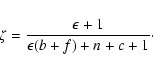
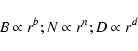
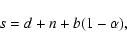
In a conical jet geometry
this distance is given
by:
has fallen to 1.
In a conical jet geometry
this distance is given
by:
 ,
(see, e.g., Lobanov 1998)
where
,
(see, e.g., Lobanov 1998)
where
 ,
with
,
with
 being the spectral index and
b and n the power
indices of the magnetic field and the density of the emitting particles:
being the spectral index and
b and n the power
indices of the magnetic field and the density of the emitting particles:
 ,
,
 (Lobanov 1998).
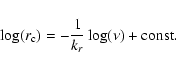
Taking logarithms leads to:
(Lobanov 1998).
Taking logarithms leads to:
 |
(1) |
at two frequencies allows one to determine kr in the corresponding region of the jet.
For a freely expanding jet in equipartition
(Blandford & Königl 1979), kr=1. The value of kr is larger in regions with steep pressure
gradients and may reach 2.5, for moderate values of m and n (Lobanov 1998).
If external absorption determines the apparent core
position, comparable density gradients of the external medium can alter kr to values above 2.5.
The values of kr deduced depend crucially on the absolute values of
on the two sides and therefore on the assumed position of the central
engine. Four scenarios have been tested with different reference points
(see Fig. 4). Table 4 gives the derived values of kr for each scenario. In each case the position of component A 14
has been assumed as the core of the eastern jet, rather than A 15. The latter
is comparably weak and, thus, most likely does not represent the true jet core.
A 15 might rather represent a bright but heavily self-absorbed new jet component.
Formally, however, the kr values for the scenarios 1, 2, and 4 between 22 GHz
and 43 GHz change to
 ,
,
 ,
and
,
and
 if A 15
instead of A 14 is used. For scenario 3, A 15 cannot be associated to the
eastern jet core (compare Fig. 4).
if A 15
instead of A 14 is used. For scenario 3, A 15 cannot be associated to the
eastern jet core (compare Fig. 4).
The area between the model components A 15
and B 2b is the most likely location of the central engine and the center
between both components is a natural choice for its exact position
(scenario 1). Shifting the
reference point eastwards (scenarios 2 and 3) alters the values of krinto unphysically large regimes (requiring density gradients  r-10 and higher). Assuming the true center of activity to be located
more westwards (closer to B 2b, scenario 4), the values of kr derived
are still acceptable.
r-10 and higher). Assuming the true center of activity to be located
more westwards (closer to B 2b, scenario 4), the values of kr derived
are still acceptable.
The positions of the bases of both jets at the different frequencies for
the first case (scenario 1) are shown in Fig. 5. The eastern
jet has rather high values of kr below 22 GHz, although still in
agreement with steep pressure gradients in the jet environment. Above
22 GHz kr is 3.9  0.8, which is a good indicator for free-free
absorption affecting the jet opacity. The western jet has values of kras high as 6.8 2.7 between 22 GHz and 43 GHz, suggesting a large
contribution from free-free absorption.
0.8, which is a good indicator for free-free
absorption affecting the jet opacity. The western jet has values of kras high as 6.8 2.7 between 22 GHz and 43 GHz, suggesting a large
contribution from free-free absorption.
The results from the core shift analysis support the picture of a
free-free absorbing torus covering mainly the inner part of the western
jet and also a smaller fraction of the eastern jet.
The true center of
activity in NGC 1052 can be determined to lie between the model components A 15 and B 2b, with an uncertainty of only 0.03 pc.
![\begin{figure}
\par\includegraphics[width=8.8cm,clip]{1051fig4}
\end{figure}](/articles/aa/full/2004/41/aa1051/img41.gif) |
Figure 4: Image with the model fitting results of the 43 GHz data. The innermost jet components are labeled. The putative locations of the central engine are indicated for four different scenarios (see discussion in the text). |
| Open with DEXTER | |
task
COMB.
For this, the total intensity has been reimaged with appropriate
tapering of the (u,v)-data to match the resolutions at adjacent
frequencies.
Information below 1 mJy/beam was discarded in both input images.
Table 5 gives the restoring beams and the other
relevant parameters of the derived images.
The spectral index images are shown in Fig. 6.
![\begin{figure}
\par\includegraphics[width=8.8cm,clip]{1051fig5}
\end{figure}](/articles/aa/full/2004/41/aa1051/img46.gif) |
Figure 5: Core positions in the two jets at the different frequencies for scenario 1 (see Fig. 4). Table 4 provides the values of kr for the other two scenarios. The inset panel shows the core locations in the source at the four frequencies. |
| Open with DEXTER | |
Table 4: Values of kr for the four different putative centers of activity.
Table 5: Spectral index image parameters.
The main feature in each image of the spectral index is an optically thick inner edge of
the innermost part of both jets. Outwards along the jets,
the spectral index tends to decrease.
The spectral index
exceeds the value of 2.5, the theoretical upper limit
for synchrotron self-absorption, on both sides of the gap in the (5-8.4) GHz
spectral index image
and on the eastern side of the gap also between 8.4 GHz and 22 GHz.
High values of
are also reached on the western side of the gap in the (8.4-22) GHz
spectral index image
and on both sides between 22 GHz and 43 GHz, which however do not exceed the critical
value of 2.5. Towards the outer jet regions the spectral index typically falls
to values -1 in the whole frequency range between 5 and 43 GHz. This
suggests that the emission from these outer jet regions far from the gap is
optically thin above 5 GHz.
of model components (A 1 to A 15 for the eastern jet and B 2b to D for the
western one).
![\begin{figure}
\par\includegraphics[width=8.6cm,clip]{1051fig6}
\end{figure}](/articles/aa/full/2004/41/aa1051/img48.gif) |
Figure 6: Spectral index images of NGC 1052. The contours and beam parameters are given in Table 5. Note the different scales in the three images and that the images are centered on component B 2. |
| Open with DEXTER | |
At the high frequencies both jets show similar spectra with an optically thin
decrease of the flux density above 22 GHz. The spectral index in this regime
is around -1 in both jets, with the eastern jet being significantly stronger
than the western one in agreement with the interpretation that the eastern jet
approaches the observer
whereas the western jet is the counterjet. However, below 22 GHz the
spectra of the two jets differs substantially. The eastern jet spectrum remains
optically thin above 8.4 GHz and flattens around 5 GHz.
The western jet,
on the other hand, exhibits a sharp decrease in flux below 22 GHz.
Although the spectral
index limit of 2.5 is not exceeded, synchrotron self-absorption
seems very unlikely to be responsible for the turnover of the
spectrum because of two reasons. First, the similarity of the spectra of
eastern and western jet at high frequencies suggests similar intrinsic
physical properties on both
sides so that the self absorption frequency should not differ by
a factor of three. Second, the kinematical analysis of Vermeulen et al.
(2003) shows the jet axis to be close to the plane of the sky and
the motions to be only weakly relativistic. There is little evidence for
strong Doppler boosting. Moreover, such an effect should shift the turnover
frequency of the counterjet to lower frequencies, rather than to higher ones.
In Sect. 8.3 we will use the moderate velocity differences,
on the one hand, and the
more pronounced brightness-temperature difference of jet and counterjet, on
the other hand, to
constrain the orientation of the jet-counterjet system.
![\begin{figure}
\par\includegraphics[width=8cm,clip]{1051fig7}
\end{figure}](/articles/aa/full/2004/41/aa1051/img49.gif) |
Figure 7: Spectrum of the parsec-scale structure of NGC 1052 between 5 GHz and 43 GHz (total and for both jets separately). Errorbars are shown only if they exceed the symbol size. |
| Open with DEXTER | |
If the spectrum of the western jet is decomposed into the spectra of the
different jet regions B, C and D (see Figs. 1 and 8) it turns
out that the region B, the innermost region on the western side, is
responsible for the inversion of the western jet spectrum below 22 GHz.
![\begin{figure}
\par\includegraphics[width=8cm,clip]{1051fig8}
\end{figure}](/articles/aa/full/2004/41/aa1051/img50.gif) |
Figure 8: Spectra of the four jet regions A, B, C and D (see Fig. 1 for the definition of the jet regions). The arrows indicate that component C is partly resolved at 43 GHz and component B is not detected at 5 GHz. Thus, the shown values represent only a lower and upper limit, respectively. Errorbars are shown only if they exceed the symbol size. |
| Open with DEXTER | |
It is not clear whether the eastern jet is also affected by
external absorption. Kameno et al. (2001)
proposed a geometry in which the obscuring torus covers
0.7 mas of the western jet and 0.1 mas of the eastern jet.
Emission from A 11 is not detected at 5 GHz. Estimating (conservatively)
a flux density of 10 mJy at 5 GHz
yields a spectral index of 5. This would suggest
that the innermost part of the eastern jet is also strongly affected
by external absorption.
However, if the flux densities of the two components A 10 and A 11
are summed at 5 GHz and 8.4 GHz, one
obtains a spectral
index of 2.3, which is close to that expected for
pure synchrotron self-absorption. Consequently, due to the small separations
between the inner
components in the eastern jet, we cannot finally judge
from this approach whether free-free
absorption plays an important role.
Kameno et al. (2003) determined a spectral index of
 for the base of the eastern jet between 1.6 GHz and 4.8 GHz and attribute this
to free-free absorption in the obscuring torus.
for the base of the eastern jet between 1.6 GHz and 4.8 GHz and attribute this
to free-free absorption in the obscuring torus.
The jet-to-counterjet ratio of NGC 1052 can be determined
from the model fitted flux densities of both jets.
Figure 9 shows the ratio of the flux densities of the
model components on either side of the gap as a function of frequency.
![\begin{figure}
\par\includegraphics[width=8cm,clip]{1051fig9}
\end{figure}](/articles/aa/full/2004/41/aa1051/img52.gif) |
Figure 9: The jet-to-counterjet ratio determined from the flux densities of the model fit components as a function of frequency. Errorbars are shown only if they exceed the symbol size. |
| Open with DEXTER | |
1.5 and starts rising
towards lower frequencies below 22 GHz.
At 8.4 GHz the jet is brighter than the counterjet by a factor of 5 and
at 5 GHz the jet outshines the counterjet even by a factor of 7.
The jet-to-counterjet ratio is known to keep rising at lower frequencies up to 50 at 2.3 GHz (Kameno et al. 2001). This suggests that a much bigger part
of the western jet is covered by the absorber
than apparent from our high-frequency data.
Alternatively, curvature effects may play
an important role.
In this case, the counterjet
bends away from the observer at a distance of a few milliarcseconds from the
core and its radiation is Doppler de-boosted.
 ,
is expected to fall
with increasing distance from the jet base like:
,
is expected to fall
with increasing distance from the jet base like:
 |
(3) |
 (Krolik 1999, Sect. 9.2.1)
and, implicitly, a constant Lorentz factor of the emitting electrons.
Under these assumptions the brightness temperature distribution is determined
by the jet-geometry (d=1 for a conical jet, d<0 for a collimated jet, and
d>0 for a decelerating jet), the course of the magnetic field and
the particle density via
is the spectral index. Typically, straight and continuous jets
exhibit values of
(Krolik 1999, Sect. 9.2.1)
and, implicitly, a constant Lorentz factor of the emitting electrons.
Under these assumptions the brightness temperature distribution is determined
by the jet-geometry (d=1 for a conical jet, d<0 for a collimated jet, and
d>0 for a decelerating jet), the course of the magnetic field and
the particle density via
is the spectral index. Typically, straight and continuous jets
exhibit values of
 on parsec-scales (Kadler et al., in prep).
The search for deviations from this power-law dependence provides a
tool to find regions in a jet which are affected by external
absorption or by abrupt changes of the jet parameters.
on parsec-scales (Kadler et al., in prep).
The search for deviations from this power-law dependence provides a
tool to find regions in a jet which are affected by external
absorption or by abrupt changes of the jet parameters.
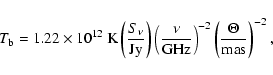
For a non-thermal source, the brightness temperature is a frequency-dependent
quantity (see e.g., Condon et al. 1982):
 the flux density of the source,
  the observing frequency,
and
the observing frequency,
and  the apparent diameter at half
maximum. In principle, the observing frequency has to be corrected for the
source redshift, but due to the small distance of NGC 1052 (z=0.0049)
this correction is negligible.
According to
Eq. (5), brightness temperatures have been computed for the model fit
components at all four frequencies.
The uncertainties
in
were computed using Gaussian error propagation
from the errors in flux density S and FWHM of the model components .
We assumed conservative values of 10% for
the apparent diameter at half
maximum. In principle, the observing frequency has to be corrected for the
source redshift, but due to the small distance of NGC 1052 (z=0.0049)
this correction is negligible.
According to
Eq. (5), brightness temperatures have been computed for the model fit
components at all four frequencies.
The uncertainties
in
were computed using Gaussian error propagation
from the errors in flux density S and FWHM of the model components .
We assumed conservative values of 10% for  and 20% for
 .
.
distribution along the eastern jet
rises towards the
center following roughly a r-4-law (compare Table 6).
Between 2 mas and 3 mas from the central engine, however,
there is an abrupt decrease of
(dashed line in Fig. 10).
This "cut-off'' is present at all four frequencies although the
inner components (only visible at 22 GHz and 43 GHz) exhibit again a
rise in .
The value of the
innermost component A 15 falls
significantly below the extrapolation of the curve defined by A 12, A 13, and A 14.
Table 6:
gradient along the eastern jet.
-distribution?
in the eastern jet:
2.5 mas from the central engine
the overhanging edge of the obscuring torus might
start to obscure a substantial fraction of the jet and thus reduce the brightness
temperature of its components via free-free absorption.
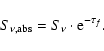
If this interpretation was correct the pronounced frequency
dependence of the optical depth due to free-free absorption
(
 )
should be measurable:
the free-free absorbed (i.e., observed) flux
density
)
should be measurable:
the free-free absorbed (i.e., observed) flux
density
 depends on the intrinsic flux density ,
the
optical depth of the absorber
depends on the intrinsic flux density ,
the
optical depth of the absorber  and the observing frequency
as
and the observing frequency
as
 |
(6) |
are given in Table 7
from which it is obvious that no pronounced effect of decreasing opacity with increasing
frequency is present. This makes the interpretation as free-free absorption
unlikely.
Table 7: Optical depth values - eastern jet.
 |
(8) |
 ,
is the observing frequency,
,
is the observing frequency,
 is the observed opening angle of the jet
(thus, implicitly assuming d=1; compare Eq. (2)),
is the observed opening angle of the jet
(thus, implicitly assuming d=1; compare Eq. (2)),
 is a bootstrap constant describing the jet conditions at a certain
characteristic distance (Lobanov 1998),
and
is a bootstrap constant describing the jet conditions at a certain
characteristic distance (Lobanov 1998),
and  is the jet bulk Doppler factor.
Acceleration and deceleration of the
flow may affect the dependence of Eq. (7), and ultimately even cause the observed
abrupt decrease of the brightness temperature at shorter distances
from the central engine (Fig. 10).
is the jet bulk Doppler factor.
Acceleration and deceleration of the
flow may affect the dependence of Eq. (7), and ultimately even cause the observed
abrupt decrease of the brightness temperature at shorter distances
from the central engine (Fig. 10).
The effect of deceleration can
be accounted for by assuming
 ,
with
,
with  ,
and
,
and
 ,
with
,
with  .
With these assumptions, the length of the
self-absorbed portion of the jet becomes
.
With these assumptions, the length of the
self-absorbed portion of the jet becomes
 ,
with
,
with
 (note that
 )
for the shallowest possible
slope of
)
for the shallowest possible
slope of  .
For a typical set of assumption about the jet flow (b=-2,
n=-1,
.
For a typical set of assumption about the jet flow (b=-2,
n=-1,
 )
this requires
)
this requires
 ,
which is implausible as
it implies extremely strong deceleration (
,
which is implausible as
it implies extremely strong deceleration (
 and
higher) of the flow. This scenario can therefore be ruled out.
and
higher) of the flow. This scenario can therefore be ruled out.
 ,
if density gradients at the outer edge of the torus are
stronger than
,
if density gradients at the outer edge of the torus are
stronger than
 (
(
 ). For the expected size of the
nuclear torus
). For the expected size of the
nuclear torus
 pc to 0.3 pc (corresponding to the distance
of 2 mas to 3 mas at which the brightness-temperature decrease sets on), and typical
densities in the absorbing torus (
pc to 0.3 pc (corresponding to the distance
of 2 mas to 3 mas at which the brightness-temperature decrease sets on), and typical
densities in the absorbing torus (
 cm-3 to 1012 cm-3,
Cassidy & Raine 1993) and in the nuclear medium of the host galaxy (
cm-3 to 1012 cm-3,
Cassidy & Raine 1993) and in the nuclear medium of the host galaxy (
 cm-3 to 108 cm-3, Ferguson et al. 1997), the density increase
should occur on scales of
cm-3 to 108 cm-3, Ferguson et al. 1997), the density increase
should occur on scales of
 .
This seems to
be the most plausible explanation for the observed brightness temperature
changes in the eastern jet.
.
This seems to
be the most plausible explanation for the observed brightness temperature
changes in the eastern jet.
-distribution at the location of a region of enhanced linearly polarized
emission (compare Sect. 5.2) is in agreement with the expected observational
signature of a standing shock. Part of the bulk flow energy of the jet can be
converted into magnetic energy of the jet plasma in such a standing-shock region.
This might cause
to increase abruptly. Beyond the shock, the jet flow
might be quasi-stationary and thus well described by our model.
:
Eq. (5) shows that the brightness temperature at a given
distance from the central engine depends on the spectral index as
 ,
if optically thin synchrotron emission is
assumed. A linear regression of the brightness temperature at a distance of
1 mas (
,
if optically thin synchrotron emission is
assumed. A linear regression of the brightness temperature at a distance of
1 mas (
 ;
see Table 6) as a function of frequency
yielded
;
see Table 6) as a function of frequency
yielded
 .
Thus, the
spectral index is
.
Thus, the
spectral index is
 .
This is in good agreement
with the results of the spectral index imaging (see Sect. 7.1).
.
This is in good agreement
with the results of the spectral index imaging (see Sect. 7.1).
 .
An alternative explanation would be that the magnetic flux of a dominant
longitudinal component of the magnetic field density along the jet axis
(
.
An alternative explanation would be that the magnetic flux of a dominant
longitudinal component of the magnetic field density along the jet axis
(
 )
might be conserved so that b = -2. In the extreme case
of no transverse magnetic field component this would lead to
)
might be conserved so that b = -2. In the extreme case
of no transverse magnetic field component this would lead to
 .
.
In principle, the detection of polarized emission in the eastern jet
(see Sect. 5.2) allows the direction of the dominant component
of the magnetic field to be determined.
The linearly polarized emission originates in the
region around component A 10, thus at the edge of the most compact component of
the obscuring torus. Faraday rotation in this region is expected to be large
so that we cannot directly derive a dominant transverse magnetic field from
the alignment of the EVPAs with the jet axis. Polarimetric observations
at multiple closely separated frequencies around 5 GHz would be necessary to derive
the amount of Faraday rotation, which in combination with the measured
opacity due to free-free absorption
additionally would allow to disentangle
the particle density and the magnetic field (the Faraday rotation at a given
frequency is proportional to the particle density  ,
while
,
while
 ).
).
![\begin{figure}
\par\includegraphics[width=8.8cm,clip]{1051fig10}
\end{figure}](/articles/aa/full/2004/41/aa1051/img122.gif) |
Figure 10:
Brightness temperature distribution along the eastern jet of NGC 1052. Above the
cut-off distance of 2.5 mas the data can be fitted by a power-law (see Table
6 for the fit parameters) with a
power-law index of
-4. The offset between the four data sets of brightness temperatures reflects
the frequency dependence of
(see Eq. (5)). |
| Open with DEXTER | |
![\begin{figure}
\par\includegraphics[width=8.2cm,clip]{1051fig11}
\end{figure}](/articles/aa/full/2004/41/aa1051/img123.gif) |
Figure 11: Brightness temperature distribution along the western jet of NGC 1052. No simple power-law can approximate the data, probably due to strong curvature effects. |
| Open with DEXTER | |
distribution along the western jet
decreases rapidly outwards between 3 and 12 mas. At a distance of
about 7 mas, however, in the area of component C 1,
the brightness temperature has a local minimum at 5 GHz and 8.4 GHz,
which might be due to Doppler de-boosting due
to a bend away from the line of sight.
Inwards of 3 mas, in region B, where the strongest effects of free-free
absorption were detected (see Sect. 7) the
distribution is flatter
and the peak brightness temperatures do not exceed values of a few times
1010 K.
Component B 2 is strongly absorbed and, thus,
its brightness temperature is substantially
reduced at 8.4 GHz, dropping even below the peak value at 22 GHz (as expected
due to its inverted spectrum discussed above).
This can be used to estimate the absorbing column density towards component
B 2, the area of the strongest effects of free-free absorption in NGC 1052.
Assuming an intrinsic symmetry between jet and counterjet we can use the
measured frequency-dependence of
from the eastern jet of NGC 1052 to estimate
the intrinsic brightness ratio of the counterjet at 8.4 GHz and 22 GHz.
Considering the slightly different fitted slopes (compare Table 6)
we derive from the best sampled region between 3 mas and 8 mas along the eastern jet that
the brightness temperature at 8.4 GHz should exceed
the value of
at 22 GHz by a factor of 15 to 20.
Component B 2 has approximately the same brightness temperature at 8.4 GHz
and at 22 GHz (mean value of B 2a and B 2b) which means that its flux density
at 8.4 GHz is reduced by a factor of
 -
-
 ,
i.e.,
,
i.e.,
 to 3.0.
This is in agreement with the results of Kameno et al. (2001).
These authors derive an optical depth of 300 at 1 GHz in the region corresponding
to our component B 2, yielding
to 3.0.
This is in agreement with the results of Kameno et al. (2001).
These authors derive an optical depth of 300 at 1 GHz in the region corresponding
to our component B 2, yielding
 at 8.4 GHz.
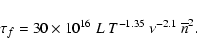
The optical depth due to free-free absorption is given by
(e.g., Lobanov 1998)
at 8.4 GHz.
The optical depth due to free-free absorption is given by
(e.g., Lobanov 1998)
 |
(11) |
 at
at  GHz at a temperature of T=104 K,
and a length of the absorber of L=0.3 pc
(comparable to the extent of the absorbing region in the plane of
the sky)
we derive a density of
GHz at a temperature of T=104 K,
and a length of the absorber of L=0.3 pc
(comparable to the extent of the absorbing region in the plane of
the sky)
we derive a density of
 cm-3 and an absorbing column density of
cm-2 towards component B 2.
Depending on the unknown ionization fraction of the torus material
this value is consistent with various
X-ray observations of NGC 1052, which imply a (model-dependent)
column density of
cm-3 and an absorbing column density of
cm-2 towards component B 2.
Depending on the unknown ionization fraction of the torus material
this value is consistent with various
X-ray observations of NGC 1052, which imply a (model-dependent)
column density of
 cm-2 to
 cm-2 towards the unresolved nuclear
X-ray core (Weaver et al. 1999;
Guainazzi et al. 1999; Kadler et al. 2004).
Because of the smaller absolute difference between the corresponding
values of
at 5 GHz and 8.4 GHz and the relatively larger uncertainties we
do not derive opacities for the outer components of the western jet. However,
from the inspection of Fig. 11 it is clear that the influence
of free-free absorption is weak beyond 4 mas west of the nucleus.
cm-2 towards the unresolved nuclear
X-ray core (Weaver et al. 1999;
Guainazzi et al. 1999; Kadler et al. 2004).
Because of the smaller absolute difference between the corresponding
values of
at 5 GHz and 8.4 GHz and the relatively larger uncertainties we
do not derive opacities for the outer components of the western jet. However,
from the inspection of Fig. 11 it is clear that the influence
of free-free absorption is weak beyond 4 mas west of the nucleus.
 |
(12) | ||
 |
(13) |
 and
and
 are the Doppler factor of the jet and
the counterjet, respectively.
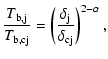
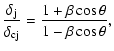
The mean ratio of the measured values of
on the western side
and the fitted value at the corresponding distance on the eastern side
(calculated for components
between 3 mas and 5 mas distance from the center where free-free absorption
effects are expected to be small) at all four frequencies
is
are the Doppler factor of the jet and
the counterjet, respectively.
The mean ratio of the measured values of
on the western side
and the fitted value at the corresponding distance on the eastern side
(calculated for components
between 3 mas and 5 mas distance from the center where free-free absorption
effects are expected to be small) at all four frequencies
is  .
Assuming a spectral index of -1, this gives
.
Assuming a spectral index of -1, this gives
 .
Since
.
Since  is an upper limit for
the jet speed this results in a maximum allowed angle of
is an upper limit for
the jet speed this results in a maximum allowed angle of  .
The minimum allowed angle derived by Vermeulen et al. (2003)
is
.
The minimum allowed angle derived by Vermeulen et al. (2003)
is  for which
 .
Thus, the jets are constrained to lie at an angle to the line of sight between
and .
.
Thus, the jets are constrained to lie at an angle to the line of sight between
and .
0.03 pc, superior to a kinematical derivation.
57
and 72.
 cm-2,
in good agreement with the value obtained from X-ray spectroscopy
(Kadler et al. 2004).
This suggests that the nuclear X-ray emission (which is
unresolved for all X-ray observatories currently in orbit) originates on
the same scales which are imaged by VLBI and underlines the importance of
combined future radio and X-ray observations of NGC 1052.
cm-2,
in good agreement with the value obtained from X-ray spectroscopy
(Kadler et al. 2004).
This suggests that the nuclear X-ray emission (which is
unresolved for all X-ray observatories currently in orbit) originates on
the same scales which are imaged by VLBI and underlines the importance of
combined future radio and X-ray observations of NGC 1052.
Acknowledgements
We are grateful to T. Beckert, A. Kraus, T. P. Krichbaum, and A. Roy for many helpful discussions and suggestions. We thank the referee, Seiji Kameno, for his careful reading of the manuscript and his suggestions, which improved the paper. M.K. was supported for this research through a stipend from the International Max Planck Research School (IMPRS) for Radio and Infrared Astronomy at the University of Bonn.
![\begin{displaymath}r_{\nu} =\left[ \left(\frac{\nu}{K_{\rm
jet}}\right)^{\epsil...
...m j}^{\epsilon}
\phi_{\rm obs}} \right]^{1/(n+\epsilon~b+1)} ,
\end{displaymath}](/articles/aa/full/2004/41/aa1051/img87.gif)