PsA,
PsA,  Leo, Pic,
  Eri and
  Cet
Cet
PsA, Leo, Pic, Eri and CetE. Di Folco1 - F. Thévenin2 - P. Kervella3,4 - A. Domiciano de Souza5,6 - V. Coudé du Foresto4 - D. Ségransan7 - P. Morel2
1 - European Southern Observatory, Karl-Schwarzschild Straße 2, 85748 Garching, Germany
2 - Observatoire de la Côte d'Azur, BP 4229, 06304 Nice Cedex 4, France
3 - European Southern Observatory, Alonso de Cordova 3107, Casilla 19001, Vitacura, Santiago 19, Chile
4 - Laboratoire d'Études Spatiales et d'Instrumentation Astrophysique, Observatoire de Paris, Meudon, France
5 - Max-Planck-Institut für Radioastronomie, Auf dem Hügel 69, 53121 Bonn, Germany
6 - Laboratoire Universitaire d'Astrophysique de Nice - UNSA, CNRS UMR 6525, Parc Valrose, Nice, France
7 - Observatoire de Genève, 51 chemin des maillettes, 1290 Sauverny, Switzerland
Received 3 February 2004 / Accepted 11 May 2004
Abstract
We report in this paper the direct interferometric measurement
of the angular diameter of five nearby Vega-like stars: PsA, Leo, Pic, Eri and Cet.
The near-infrared (K and H bands) observations
were conducted at the VLTI during the commissioning period with
the VINCI instrument and three different baselines ranging from 66 m to 140 m. The
five stellar photospheres are resolved and we
derive their angular diameters with a 1 to 2 accuracy,
except for Pic (14). We discuss the detectability and the influence of a possible small amount of warm
circumstellar dust on our measurements. In addition, we have used the stellar
evolution code CESAM (Morel 1997) to compare the computed
fundamental parameters to the observed values
(linear diameter, luminosity, temperature and chemical abundance).
As a result of the simulation, the age of the stars is inferred and
found to be in good agreement
with previous estimates from various other methods.
accuracy,
except for Pic (14). We discuss the detectability and the influence of a possible small amount of warm
circumstellar dust on our measurements. In addition, we have used the stellar
evolution code CESAM (Morel 1997) to compare the computed
fundamental parameters to the observed values
(linear diameter, luminosity, temperature and chemical abundance).
As a result of the simulation, the age of the stars is inferred and
found to be in good agreement
with previous estimates from various other methods.
Key words: techniques: interferometric - infrared: stars - stars: fundamental parameters - stars: circumstellar matter - stars: general
PsA (HD 216956), Pic (HD 39060) and Eri (HD 22049),
as well as Leo (HD 102647) and Cet (HD 10700).
Vega/ Pic-type stars are MS or "old Pre-MS''
stars of spectral type A to M presenting a far infrared (IR) excess. Discovered
with the IRAS satellite (Aumann et al. 1984), this excess
has been commonly identified with second-generation circumstellar (CS) dust
in optically thin disks, presumably cleared of gas and
possibly associated with planetary systems.
Submillimetric interferometers have resolved a few
disks through the thermal emission of cool grains (e.g., Greaves et al. 1998; Holland et al. 1998),
revealing extended structures analog to the Kuiper Belt in our solar system. For
the closest Vega-like stars, adaptive optics and coronagraphs
in the visible and IR have provided high resolution images of
scattered and thermal light down to 15 astronomical units (AU) from the
central stars, thus unveiling asymmetries (like disk
warps around Pic or asymmetric rings) interpreted as the suspected
signature of already formed planets (Mouillet et al. 1997;
Artymowicz et al. 1997).
Sub-mm images have also revealed large scale
asymmetries and clumpy structures around Eridani
(Greaves et al. 1998) and more recently around
Fomalhaut (Holland et al. 2003) which were tentatively
interpreted as the interaction of a planet with the external part
of the disk (e.g., Quillen & Thorndike 2002; Wyatt & Dent 2002).
Table 1: Observational parameters for the selected targets.
However, current techniques do not provide yet enough
spatial resolution and dynamic range to probe the first 10 AU
where planets or planetesimals might be found. A 10 m
class telescope can reach a theoretical angular resolution
of about 200 mas at 10  m (20 AU at a distance of 100 pc), and long-baseline optical
interferometers are required in order to probe the innermost
regions. Only mid-IR imaging has succeeded so far in
revealing dust grains as close as 10 AU from the central star for the nearby
Pic, owing to the favorable dust/stellar brightness
ratio in this spectral domain (Pantin et al. 1997).
With baseline lengths in the order of 100 m, the VLT interferometer
(Glindemann et al. 2000) can reach a
resolution of about 4 mas (less than 0.1 AU at the distance of Pic) in a
70 mas field of view (FOV) with 8 m telescopes operating at
m (20 AU at a distance of 100 pc), and long-baseline optical
interferometers are required in order to probe the innermost
regions. Only mid-IR imaging has succeeded so far in
revealing dust grains as close as 10 AU from the central star for the nearby
Pic, owing to the favorable dust/stellar brightness
ratio in this spectral domain (Pantin et al. 1997).
With baseline lengths in the order of 100 m, the VLT interferometer
(Glindemann et al. 2000) can reach a
resolution of about 4 mas (less than 0.1 AU at the distance of Pic) in a
70 mas field of view (FOV) with 8 m telescopes operating at
 m.
Thus, the single-mode FOV of the telescope (Table 1) makes it possible to concentrate the observations on the central few AUs.
m.
Thus, the single-mode FOV of the telescope (Table 1) makes it possible to concentrate the observations on the central few AUs.
The simplest result that can be derived from interferometric observations is the size of the stellar photospheres, obtained by adjusting the visibility curve of a disk to the data. From the stellar size one can infer an improved estimation of the age. Precise age determination should feed the debate on the relationship between the fractional dust luminosity and the age of Vega-like stars (see recent discussion by Decin et al. 2003).
IR interferometry can also potentially reveal the
presence of very small amounts of dust, whose signature
in the visibility function is proportional to the dust to star
flux ratio. Observing at 2 m could reveal dust grains
close to the sublimation limit (
 K for refractory material),
although from theoretical modeling (Dent et al. 2000) only a very small amount of dust
is expected to be found in the inner region
of these disks. K-band excesses have never been reported so far
around MS stars older than
K for refractory material),
although from theoretical modeling (Dent et al. 2000) only a very small amount of dust
is expected to be found in the inner region
of these disks. K-band excesses have never been reported so far
around MS stars older than  10 Myr, but the combined
photometric and modeling accuracy generally does not
exceed a few percent.
10 Myr, but the combined
photometric and modeling accuracy generally does not
exceed a few percent.
We have used the VLTI first to
constrain the photospheric parameters of five bright
debris disk stars located within 20 pc from the Sun. With ages
from 10 Myr to about 7.5 Gyr, they cover a wide range
of representative cases of Vega-like stars. They were
selected on brightness criteria since the sensitivity of VINCI
is limited to  with the 40 cm siderostats. The derived
angular and linear diameters are presented in Sect. 3.
Based on a basic modeling of a dusty ring, we have derived
from the observed visibility variations an upper limit on the
presence of possible CS material (Sect. 4).
Finally, we model the central stars
(Sect. 5) with the stellar evolution code CESAM
(Morel 1997), using the observable constraints and the newly
derived diameters in order to estimate the age of the program stars.
with the 40 cm siderostats. The derived
angular and linear diameters are presented in Sect. 3.
Based on a basic modeling of a dusty ring, we have derived
from the observed visibility variations an upper limit on the
presence of possible CS material (Sect. 4).
Finally, we model the central stars
(Sect. 5) with the stellar evolution code CESAM
(Morel 1997), using the observable constraints and the newly
derived diameters in order to estimate the age of the program stars.
VINCI uses a fiber-based two-way beam
combiner which filters out the atmospheric turbulence and converts
it into temporal photometric fluctuations (except the piston mode).
The scans are obtained by a temporal modulation
of the optical path. In its standard mode, it has the spectral range and resolution of a standard K broadband filter (
 m),
VINCI was also occasionally operated in the H
band (
m),
VINCI was also occasionally operated in the H
band (
 m), replacing the fibers by an integrated optics beam
combiner, IONIC (Laurent et al. 2002).
The processing is based on a wavelet analysis of the fringe pattern. Details
can be found in Kervella et al. (2004a). The resulting
coherence factors measure the amplitude of the complex
degree of coherence of the two beams at the spatial frequency
determined by the baseline and effective wavelength.
m), replacing the fibers by an integrated optics beam
combiner, IONIC (Laurent et al. 2002).
The processing is based on a wavelet analysis of the fringe pattern. Details
can be found in Kervella et al. (2004a). The resulting
coherence factors measure the amplitude of the complex
degree of coherence of the two beams at the spatial frequency
determined by the baseline and effective wavelength.
20.
This bandwidth
smearing effect was taken into account in the calibration of Ceti only,
since one of its calibrators ( Cet) is significantly resolved (
 )
on the 140 m long baseline.
)
on the 140 m long baseline.
![\begin{figure}
\par\includegraphics[width=8.8cm,clip]{0189-F1.eps}
\end{figure}](/articles/aa/full/2004/41/aa0189-04/img58.gif) |
Figure 1: Geographic overview of the VLTI telescope stations on top of Cerro Paranal. Highlighted are the three baselines which have been used for the reported observations. |
| Open with DEXTER | |
The calibration is performed by converting the
raw squared coherence factors ( )
into normalized visibilities.
The transfer function is estimated with reference to interleaved observations of
stars with known diameter. Most of our calibrators were chosen from
the catalog by Bordé et al. (2002), based on the spectrophotometric
work of Cohen et al. (1999). Calibrator sizes are known with a typical precision of 1 to 2
(see Table 2).
)
into normalized visibilities.
The transfer function is estimated with reference to interleaved observations of
stars with known diameter. Most of our calibrators were chosen from
the catalog by Bordé et al. (2002), based on the spectrophotometric
work of Cohen et al. (1999). Calibrator sizes are known with a typical precision of 1 to 2
(see Table 2).
To compute the visibility uncertainty, we have separated
the statistical error (related to the dispersion of
values) and the systematic error (induced by the
uncertainty on the calibrator's diameter). Angular diameter values are then presented in the form
 .
Systematic errors
dominate all the angular diameter uncertainties. To reduce the systematics,
we used as many calibrators as possible. For most of our visibility measurements, we have actually computed
independent angular diameters for each calibrator and averaged
the individual values to infer the adopted final diameter.
The systematic errors thus decrease with the number and quality of the available calibrators.
.
Systematic errors
dominate all the angular diameter uncertainties. To reduce the systematics,
we used as many calibrators as possible. For most of our visibility measurements, we have actually computed
independent angular diameters for each calibrator and averaged
the individual values to infer the adopted final diameter.
The systematic errors thus decrease with the number and quality of the available calibrators.
Table 2: Relevant parameters for the calibrators used.
PsA.
Each visibility measurement is derived from a typical 500 scan observation set (equivalent to 6 min of effective observing time for one visibility point without calibration), each scan corresponding
to a temporal path-length modulation of about 150 m.
The resulting fringe frequency is between 500-700 Hz with the UTs and
300 Hz with the siderostats, depending on the adopted integration time.
The list of calibrating stars can be found in Table 2
with their estimated angular diameters. The large number of calibrators
observed during these two years allowed us to
evidence some discrepancies for a few targets between the diameter predicted by
Cohen et al. (1999) and that derived from the observed visibilities.
Using other reference stars from Cohen's catalog, we have determined
new diameters for five calibrators, which showed clear departures from their expected visibilities:
 Eri, 39 Eri and
  Gru, 16 Vir and Cet. The revised values are also
reported in Table 2, they ensure a better consistency between visibilities of all observed reference stars from Cohen's catalog.
Gru, 16 Vir and Cet. The revised values are also
reported in Table 2, they ensure a better consistency between visibilities of all observed reference stars from Cohen's catalog.
Ceti (HD 10700)
Ceti is an old metal deficient star of the galactic
disk located 3.6 pc away from the Sun. Its weak fractional
dust luminosity was estimated
by Backman et al. (1986) to be
 .
The CS emission has been very
recently resolved by Greaves et al. (2004),
who found a central radius at 60 AU for the dust from sub-mm
observations with SCUBA. Ceti is also a prime target
for the asteroseismic campaigns. Its size has already been
inferred from the VLTI data by Pijpers et al. (2003) and
we will give in this section a revised value for its angular
diameter, on the basis of a more extended calibration procedure
and after the revision of its main calibrator's size, Cet.
.
The CS emission has been very
recently resolved by Greaves et al. (2004),
who found a central radius at 60 AU for the dust from sub-mm
observations with SCUBA. Ceti is also a prime target
for the asteroseismic campaigns. Its size has already been
inferred from the VLTI data by Pijpers et al. (2003) and
we will give in this section a revised value for its angular
diameter, on the basis of a more extended calibration procedure
and after the revision of its main calibrator's size, Cet.
![\begin{figure}
\par\includegraphics[width=8.8cm,clip]{0189-F2.eps}
\end{figure}](/articles/aa/full/2004/41/aa0189-04/img77.gif) |
Figure 2:
Summary of the visibility measurements on Cet
with the E0-G1 and B3-M0 siderostats baselines. The UD model fit
leads to
 mas. mas. |
| Open with DEXTER | |
![\begin{figure}
\par\includegraphics[width=8.8cm,clip]{0189-F3.eps}
\end{figure}](/articles/aa/full/2004/41/aa0189-04/img78.gif) |
Figure 3: Enlargement of Fig. 2 showing the high spatial frequency points obtained with the B3-M0 140 m baseline (siderostats). |
| Open with DEXTER | |
1.5 h)
were acquired on this star,  of which
were obtained on the 140 m B3-M0 baseline. The associated
calibrators are Cet, Ori, HR 8685, Phe and PsA (measured hereafter in Sect. 3.2.5). The
measurements on the 66 m and 140 m long baselines are presented
in Figs. 2 and 3. The statistical uncertainty
is significantly larger on the short baseline, presumably due to
stronger atmosphere induced instabilities (piston). The
low number of observation sets on the short baseline does not allow
us to investigate possible discrepancies between both
baselines. The few visibilities obtained on E0-G1 are nevertheless
consistent within their error bars with the equivalent
uniform disk diameter derived from the 140 m baseline data:
of which
were obtained on the 140 m B3-M0 baseline. The associated
calibrators are Cet, Ori, HR 8685, Phe and PsA (measured hereafter in Sect. 3.2.5). The
measurements on the 66 m and 140 m long baselines are presented
in Figs. 2 and 3. The statistical uncertainty
is significantly larger on the short baseline, presumably due to
stronger atmosphere induced instabilities (piston). The
low number of observation sets on the short baseline does not allow
us to investigate possible discrepancies between both
baselines. The few visibilities obtained on E0-G1 are nevertheless
consistent within their error bars with the equivalent
uniform disk diameter derived from the 140 m baseline data:
 mas. The first error
refers to the statistical dispersion of the V2 measurements
whereas the second corresponds to the resulting
systematics due to the uncertainty on the calibrators diameters.
It results in a final error of 0.031 mas (1.5). Saar et al. (1997) report
a low rotational velocity
mas. The first error
refers to the statistical dispersion of the V2 measurements
whereas the second corresponds to the resulting
systematics due to the uncertainty on the calibrators diameters.
It results in a final error of 0.031 mas (1.5). Saar et al. (1997) report
a low rotational velocity
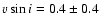 km s-1, consistent with a
nearly pole-on view and implying no azimuth angle dependence
of the visibility. As can be seen in Fig. 3, the squared visibilities never drop below 0.3 and we could neglect (as for most other stars) the wide band chromatic effect (bandwidth smearing).
Eridani (HD 22049)
Eri is a
chromospherically active star. It has been found to be orbited by a dusty ring of cold grains resolved at sub-mm wavelengths (Greaves et al. 1998).
The ring is seen nearly face-on and its fractional luminosity is
estimated to be
km s-1, consistent with a
nearly pole-on view and implying no azimuth angle dependence
of the visibility. As can be seen in Fig. 3, the squared visibilities never drop below 0.3 and we could neglect (as for most other stars) the wide band chromatic effect (bandwidth smearing).
Eridani (HD 22049)
Eri is a
chromospherically active star. It has been found to be orbited by a dusty ring of cold grains resolved at sub-mm wavelengths (Greaves et al. 1998).
The ring is seen nearly face-on and its fractional luminosity is
estimated to be
 .
Clumps have been evidenced
by Holland et al. (2003) and are thought to originate from
the interaction of the disk with a massive planet. The star
has been observed with the same baselines as Cet and
in addition with the UT1-UT3 102.5 m long baseline (see Fig. 1 for the orientations).
.
Clumps have been evidenced
by Holland et al. (2003) and are thought to originate from
the interaction of the disk with a massive planet. The star
has been observed with the same baselines as Cet and
in addition with the UT1-UT3 102.5 m long baseline (see Fig. 1 for the orientations).
About 8800 scans (equivalent to 2 h of integration) were successfully processed, the UTs data
representing 30
of the total scans. The two major reference
stars chosen for the data calibration are 39 Eri (for the
UTs data) and Eri (for the siderostats observations).
Although both calibrators are from the Cohen catalog,
their size has been revised thanks to additional VLTI
observations and the adopted diameters
are presented in Table 2. The resulting visibilities
plotted in Fig. 4 are very consistent for all baselines
and lead to similar diameter estimations. The fitted UD diameter is
 mas. With a global
uncertainty of 0.029 mas, the relative error on its angular diameter
is 1.4.
This result is the first direct
measurement of this star.
mas. With a global
uncertainty of 0.029 mas, the relative error on its angular diameter
is 1.4.
This result is the first direct
measurement of this star.
No significant azimuthal dependence of the visibility
was observed at our level of precision. Rotational velocity
measurements are consistent with an almost pole-on view
(Saar et al. 1997). The inclination of the disk on the sky
plane was estimated to be close to 20 deg (Greaves et al. 1998)
and it is thought to be aligned with the equatorial plane of the star. Our
measurement is in agreement with this configuration.
![\begin{figure}
\par\includegraphics[width=8.8cm,clip]{0189-F4.eps}
\end{figure}](/articles/aa/full/2004/41/aa0189-04/img85.gif) |
Figure 4:
Summary of the visibility measurements on Eri
with the three baselines in the K band and the associated best UD model fit:
 mas. mas. |
| Open with DEXTER | |
![\begin{figure}
\par\includegraphics[width=8.8cm,clip]{0189-F5.eps}
\end{figure}](/articles/aa/full/2004/41/aa0189-04/img86.gif) |
Figure 5: Enlargement of Fig. 4 presenting the best UD model fit with its total (statistic and systematic) uncertainty in the high spatial frequency domain. |
| Open with DEXTER | |
![\begin{figure}
\par\includegraphics[width=8.8cm,clip]{0189-F6.eps}
\end{figure}](/articles/aa/full/2004/41/aa0189-04/img87.gif) |
Figure 6:
Overview of the visibilities measured on Leo with
the B3-M0 140 m long baseline in Spring 2003 and best
UD model fit with its 1 (total) error:
 mas. mas. |
| Open with DEXTER | |
Leonis (HD 102647)
Leo is a relatively young A3 dwarf star located 11 pc away
from the Sun. Its fractional IR luminosity was first established by Aumann (1985) to be
 ,
Laureijs
et al. (2002) measured the 25 m emission with ISO and
derived from the 25/60 m flux ratio a dust temperature
of
,
Laureijs
et al. (2002) measured the 25 m emission with ISO and
derived from the 25/60 m flux ratio a dust temperature
of  K. The disk has not been imaged yet.
A few sets of observations were obtained with VINCI
on the 140 m long siderostat baseline (B3-M0) in April-May 2003.
A total of 3300 scans were selected
and processed (about 45 min of integration). The angular size of the main calibrator
(16 Vir) was also revised since a discrepancy of
3
from Cohen's prediction was evidenced by
other long baseline observations (see Table 2). Two
additional calibrators, namely 6 Leo and HR 4831, were also occasionally
used. The squared visibilities presented in Fig. 6 show
some dispersion and the fit of the UD model leads to
mas (relative error 1.9). Due to the small number of observations, the reduced chi-square is
 ,
but the goodness of the fit (23)
is still reasonable.
,
but the goodness of the fit (23)
is still reasonable.
![\begin{figure}
\par\includegraphics[width=8.5cm,clip]{0189-F7.eps}
\end{figure}](/articles/aa/full/2004/41/aa0189-04/img91.gif) |
Figure 7:
Measured visibility amplitude for Pic with
the UT1-UT3 102.5 m baseline in November 2001 and best
UD model fit (solid) with its 1
error (dashed):
 mas. mas. |
| Open with DEXTER | |
Pictoris (HD 38060)
Pictoris was observed only once in November 2001 with UT1 and UT3 (102.5 m long baseline). With a K magnitude
of 3.47 (19.4 pc away), it could not be observed with the siderostats. It has the largest IR excess
observed so far with a fractional luminosity
 .
Its edge-on disk has been resolved at optical and IR wavelengths.
Warps and a tilted inner disk were evidenced and
attributed to the interaction of the dust with a possible
giant planet. The UT1-UT3 baseline orientation is almost
colinear to the major axis of the circumstellar disk projected
on the sky.
.
Its edge-on disk has been resolved at optical and IR wavelengths.
Warps and a tilted inner disk were evidenced and
attributed to the interaction of the dust with a possible
giant planet. The UT1-UT3 baseline orientation is almost
colinear to the major axis of the circumstellar disk projected
on the sky.
Only five observation sets were obtained for a total of 1650
processed scans at two different acquisition frequencies.
 Phe and
 Vol were used as calibrators.
The major result, as shown in Fig. 7, is that
Pic is marginally resolved for the first time with
an average squared visibility of 92.5.
The low number
of observation sets recorded does not provide yet a very accurate
estimation of the equivalent UD diameter:
mas. The large total relative error
(about 14)
is due to unfavorable atmospheric
conditions (which can account for instability of the TF, bad
flux injection conditions and strong differential piston),
and tends to increase the dispersion of the visibilities
within an observation set. The small number of calibrators available
explain the large systematic (external) uncertainty.
Vol were used as calibrators.
The major result, as shown in Fig. 7, is that
Pic is marginally resolved for the first time with
an average squared visibility of 92.5.
The low number
of observation sets recorded does not provide yet a very accurate
estimation of the equivalent UD diameter:
mas. The large total relative error
(about 14)
is due to unfavorable atmospheric
conditions (which can account for instability of the TF, bad
flux injection conditions and strong differential piston),
and tends to increase the dispersion of the visibilities
within an observation set. The small number of calibrators available
explain the large systematic (external) uncertainty.
Piscinis Austrini (HD 216956)
PsA) is one of the 20 brightest stars in the
sky. The disk around this A3V star (at 7.7 pc) has been
imaged at 850 and 450 m (Holland et al. 1998, 2003).
A dust ring of cold grains is seen 20 deg
from edge-on, with a large radius of about 135 AU. A ring
asymmetry has been evidenced, accounting for some 5
of the dust cloud flux and could be attributed to collisions
or resonant trapping by a planet orbiting the star (Wyatt
et al. 2002; Kuchner et al. 2003).
![\begin{figure}
\par\includegraphics[width=4.2cm]{0189-F8.eps}\includegraphics[width=4cm]{0189-F9.eps}
\end{figure}](/articles/aa/full/2004/41/aa0189-04/img93.gif) |
Figure 8:
UV plane coverage (North is up and East to the right) for PsA
observations and comparison with the orientation of the disk resolved
in the sub-mm (adapted from Holland et al. 2003). Its major axis
is colinear to the short E0-G1 baseline (triangles for the K band,
crosses for the H band) and perpendicular to UT1-UT3 (diamonds)
and B3-M0 (circles) . The region probed by our interferometric observations
is smaller than the SCUBA beam at 450 m. |
| Open with DEXTER | |
2.6 h) were recorded in total,  on the long baseline
B3-M0,
on the long baseline
B3-M0,  with E0-G1 and
  with UT1-UT3.
In addition, Fomalhaut was observed during technical measurements in the H band
with the IONIC integrated optics beam combiner in July
2002 (Kern et al. 2002). We were
able to take advantage of some of these technical observations
when suitable calibrators were interleaved during the night.
A total of 1600 scans passed successfully the selection
process and are presented below. The accuracy of these H band measurements is however lower than in the K band since
the beam combiner comprises only one
interferometric signal (instead of two phase-opposite
interferometric outputs in the classical K band coupler),
and the atmospheric fluctuations are faster
at shorter wavelengths.
with UT1-UT3.
In addition, Fomalhaut was observed during technical measurements in the H band
with the IONIC integrated optics beam combiner in July
2002 (Kern et al. 2002). We were
able to take advantage of some of these technical observations
when suitable calibrators were interleaved during the night.
A total of 1600 scans passed successfully the selection
process and are presented below. The accuracy of these H band measurements is however lower than in the K band since
the beam combiner comprises only one
interferometric signal (instead of two phase-opposite
interferometric outputs in the classical K band coupler),
and the atmospheric fluctuations are faster
at shorter wavelengths.
The UV plane coverage, presented in Fig. 8,
illustrates the super-synthesis effect (due to Earth rotation),
which allows to cover a range of azimuth
angles with a single baseline. The map of the star with
its extended CS dust disk (as detected at sub-mm
wavelengths) is presented in order to compare the orientation
of the baselines with the circumstellar environment. The E0-G1
observations correspond to the measurement of the
intensity projected along the major-axis of the extended
dust disk. If we assume that this disk is weakly inclined on
the equatorial plane of the star, we will measure with this
baseline intensity profiles oriented along (or close to) the
equatorial diameter. Conversely, the B3-M0 140 m baseline
provides an estimation of intensity profiles along the polar
direction of the star, perpendicularly to the ring major axis.
It should be emphasized again that the interferometric
FOV is much narrower than
the structures revealed by the sub-mm observations
(actually smaller than SCUBA beam size at 450 m). We are
thus probing only the very inner part of the stellar
environment (over a diameter of 1 AU with the UTs and 20 to 40 AU
with the siderostats, at the distance of Fomalhaut, see Table 1).
![\begin{figure}
\par\includegraphics[width=8.8cm,clip]{0189-F10.eps}
\end{figure}](/articles/aa/full/2004/41/aa0189-04/img97.gif) |
Figure 9:
Overview of the azimuth averaged K band visibilities
obtained on three baselines for PsA. The
best UD model fit is superimposed (solid line):
 mas. The low spatial frequency measurements do not contribute much to the global fit due to their larger uncertainty. mas. The low spatial frequency measurements do not contribute much to the global fit due to their larger uncertainty. |
| Open with DEXTER | |
![\begin{figure}
\includegraphics[width=8.8cm,clip]{0189-F11.eps}\vspace*{4mm}
\in...
....eps}\vspace*{4mm}
\includegraphics[width=8.8cm,clip]{0189-F13.eps}
\end{figure}](/articles/aa/full/2004/41/aa0189-04/img98.gif) |
Figure 10:
Same data as in Fig. 9, but assumed to be representative of a non axisymetric brightness distribution. Best UD model fits for the perpendicular measurements are compared in the upper panel:
 mas (solid) and mas (solid) and
 mas (dash-dotted). Enlargement of the fits and related data are shown in the middle and lower panels, with their associated error (dashed). mas (dash-dotted). Enlargement of the fits and related data are shown in the middle and lower panels, with their associated error (dashed). |
| Open with DEXTER | |
The result of the K band observations is shown in Figs. 9 and 10.
Three different calibrators ( Gru,
HR 8685 and 7 Aqr) were used on the 140 m baseline, thus reducing the systematic errors. The UTs measurements were calibrated
with HR 8685 alone whereas the EO-G1 observations were mainly calibrated
with Gru (and marginally with 70 Aql,  Aqr and Psc). The visibilities measured on the long UTs and siderostats baseline are very consistent and lead to the angular diameters
 mas (1.2
relative error) and
mas (1.2
relative error) and
 mas respectively (1). The 66 m observations alone lead to a slightly different diameter but with a larger error due to the relatively unstable transfer function and smaller number of scans:
mas (i.e. 0.062 mas for a relative total error of 2.7).
mas respectively (1). The 66 m observations alone lead to a slightly different diameter but with a larger error due to the relatively unstable transfer function and smaller number of scans:
mas (i.e. 0.062 mas for a relative total error of 2.7).
Table 3: Limb darkened angular diameters and linear radii for the five program stars.
These data can be dealt with in two different ways: we can either assume a circularly symmetric brightness distribution (Fig. 9) and make a general fit to the data (thus averaging the UV coverage on the azimuth angle), or fit different UD models on each baseline direction (Fig. 10), assuming an asymmetric brightness distribution. The first hypothesis leads to an equivalent UD diameter of
mas (total error 0.022 mas = 1). The short spatial frequency observations do not constrain much the fit because of their large error. The probability for these visibilities to be well represented by a 2.197 mas UD model is still high: 88
(
 )
and therefore we cannot discriminate between a symmetric and an asymmetric brightness distribution from these perpendicular measurements.
Table 3 summarizes the angular LD diameters and reduced chi-square values obtained for the two baselines orientations.
)
and therefore we cannot discriminate between a symmetric and an asymmetric brightness distribution from these perpendicular measurements.
Table 3 summarizes the angular LD diameters and reduced chi-square values obtained for the two baselines orientations.
Finally, we mention the H band measurement even if
the visibility precision is lower compared to the K band.
The visibilities obtained on the E0-G1 baseline are coherent
with the rest of the observations, and lead to an equivalent diameter
 mas, a value compatible with the diameter obtained in the K band with other baselines, within its uncertainty (the linear limb darkened coefficients
are very similar, see hereafter).
mas, a value compatible with the diameter obtained in the K band with other baselines, within its uncertainty (the linear limb darkened coefficients
are very similar, see hereafter).
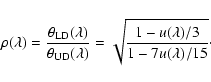
Hanbury-Brown et al. (1974) have established an approximate
formula linking the linear LD coefficient
 with the conversion factor
  defined by:
 ,
to be compared with our own minimum uncertainty of
,
to be compared with our own minimum uncertainty of  on the fit UD values. We will follow the tables
computed by Claret (2000) based on Kurucz models (Kurucz 1992),
which provide the relevant coefficients
for our spectral bands as a function of the turbulent velocity,
effective temperature, surface gravity and metallicity.
on the fit UD values. We will follow the tables
computed by Claret (2000) based on Kurucz models (Kurucz 1992),
which provide the relevant coefficients
for our spectral bands as a function of the turbulent velocity,
effective temperature, surface gravity and metallicity.
The LD diameters can be finally converted into linear
radii (in solar unit  )
using the distance of the stars (cf. Table 1).
Parallaxes are taken from the Hipparcos catalog (Perryman et al. 1997).
The LD angular diameters and the corresponding radii are summarized in Table 3.
)
using the distance of the stars (cf. Table 1).
Parallaxes are taken from the Hipparcos catalog (Perryman et al. 1997).
The LD angular diameters and the corresponding radii are summarized in Table 3.
.
The angular diameters inferred from our
interferometric observations reach a 1 to 2% accuracy
(including the systematics), except for Pic. The distance
of these nearby dwarf stars being well known from the
Hipparcos parallaxes, the final uncertainty on the linear
radii is only slightly increased. The gain obtained with
our direct measurements is visible in the Hertzsprung-Russell (HR)
diagrams presented in Figs. 12 to 16.
Ceti: The size of Cet has recently been estimated
by Pijpers et al. (2003) from the same initial set of observations.
They derived a radius
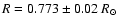 ,
which is smaller
than our estimate. The discrepancy arises from
the calibration of the raw visibilities. The authors used a single
reference star ( Ceti), which has a low visibility on the 140 m
long baseline. The estimation of the transfer function is consequently
very sensitive to a slight change of its diameter. We chose, instead, to take into account
a larger number of reference stars to minimize the systematic errors (as explained in Sect. 2.3)
and checked the consistency of this main calibrator
with other stars from Cohen's catalog. The revision of its angular
diameter (2
away from the value predicted by Cohen et al. 1999)
turns into a 5
decrease for
,
which is smaller
than our estimate. The discrepancy arises from
the calibration of the raw visibilities. The authors used a single
reference star ( Ceti), which has a low visibility on the 140 m
long baseline. The estimation of the transfer function is consequently
very sensitive to a slight change of its diameter. We chose, instead, to take into account
a larger number of reference stars to minimize the systematic errors (as explained in Sect. 2.3)
and checked the consistency of this main calibrator
with other stars from Cohen's catalog. The revision of its angular
diameter (2
away from the value predicted by Cohen et al. 1999)
turns into a 5
decrease for
 on the 140 m baseline. We have also adopted a slightly shorter effective
wavelength, based on the modeling of the overall transmission of
the instrument and atmosphere at Paranal. It is important to notice
how sensitive the V2 normalization is to the quality of the calibrators, since the same set of
data can lead to different astrophysical results. Indeed, we cannot
confirm from our analysis the discrepancy observed by Pijpers et al. (2003)
between the interferometric and spectroscopic diameters.
This will be discussed further in Sect. 5.3.
Both measurements are compared to the spectroscopic radius
on the HR diagram plotted in Fig. 12.
on the 140 m baseline. We have also adopted a slightly shorter effective
wavelength, based on the modeling of the overall transmission of
the instrument and atmosphere at Paranal. It is important to notice
how sensitive the V2 normalization is to the quality of the calibrators, since the same set of
data can lead to different astrophysical results. Indeed, we cannot
confirm from our analysis the discrepancy observed by Pijpers et al. (2003)
between the interferometric and spectroscopic diameters.
This will be discussed further in Sect. 5.3.
Both measurements are compared to the spectroscopic radius
on the HR diagram plotted in Fig. 12.
![\begin{figure}
\par\includegraphics[width=8.8cm,clip]{0189-F14.eps}
\end{figure}](/articles/aa/full/2004/41/aa0189-04/img114.gif) |
Figure 11:
H band visibility measurements of PsA
with the E0-G1 baseline in July 2002 during the IONIC experiment.
Despite the larger uncertainty on the transfer function
estimate and on the visibility points, the data are consistent
and the best UD model fit gives:
mas,
in good agreement with the K band measurement. |
| Open with DEXTER | |
Eridani: We have presented the first interferometric
measurement obtained for this star. The VLTI radius is in excellent agreement
with the spectrophotometric constraint, both values are compared on the
HR diagram in Fig. 14.
Leonis: The angular diameter of this A3 dwarf
has been first established by Hanbury-Brown et al. (1974)
at the Narrabri Interferometer but with a relative error
of about 8.
Their estimation in the visible led to
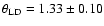 mas, which is in agreement with
(although slightly smaller than) the VLTI determination within its error bar. The
total uncertainty has been reduced by a factor 4.
The discrepancy could be related to a possible non circularly symmetric
brightness profile of the source (since the Narrabri observations were obtained at a different spatial
frequency and probably different azimuth angles as well) or to a possible faint environment emitting in the infrared only. Leo has an intermediate rotational velocity, which
may impact the shape of its photosphere and thus produce
azimuth dependent visibilities. The consistency of the VLTI
measurement with the spectroscopic radius is illustrated in Fig. 13.
mas, which is in agreement with
(although slightly smaller than) the VLTI determination within its error bar. The
total uncertainty has been reduced by a factor 4.
The discrepancy could be related to a possible non circularly symmetric
brightness profile of the source (since the Narrabri observations were obtained at a different spatial
frequency and probably different azimuth angles as well) or to a possible faint environment emitting in the infrared only. Leo has an intermediate rotational velocity, which
may impact the shape of its photosphere and thus produce
azimuth dependent visibilities. The consistency of the VLTI
measurement with the spectroscopic radius is illustrated in Fig. 13.
Pictoris: Following the revised value of Pic's parallax by
Hipparcos leading to a luminosity
 (Crifo et al. 1997) and adopting an
effective temperature
(Crifo et al. 1997) and adopting an
effective temperature
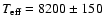 K (Lanz et al. 1995), one can derive a radius of
 ,
using the Stefan-Boltzmann relation. Despite the low precision,
it seems that we can at least conclude that the radius
inferred from interferometry is slightly too large compared to what we would have
expected. Our value is only consistent with the upper
limit given by the spectroscopy (see Fig. 15). If the
observed discrepancy is real and not biased by the
reference stars used, we might either incriminate an effect of the
photosphere (e.g., an equatorial oblateness induced by its rapid
rotation) or the signature of the close stellar environment
(dust, companion). In both cases, a better UV
coverage is required to evidence unambiguously such effects
and these possibilities are further discussed in the next section.
Given the mean temperature of 8200 K, an extinction of 0.15 to
0.6 mag is required to match the luminosities corresponding
to our VINCI 1
error box. This is larger than
the maximum extinction predicted by theoretical modeling
of the dusty disk or estimation derived from multi-wavelengths observations
(see discussion in Crifo et al. 1997).
,
using the Stefan-Boltzmann relation. Despite the low precision,
it seems that we can at least conclude that the radius
inferred from interferometry is slightly too large compared to what we would have
expected. Our value is only consistent with the upper
limit given by the spectroscopy (see Fig. 15). If the
observed discrepancy is real and not biased by the
reference stars used, we might either incriminate an effect of the
photosphere (e.g., an equatorial oblateness induced by its rapid
rotation) or the signature of the close stellar environment
(dust, companion). In both cases, a better UV
coverage is required to evidence unambiguously such effects
and these possibilities are further discussed in the next section.
Given the mean temperature of 8200 K, an extinction of 0.15 to
0.6 mag is required to match the luminosities corresponding
to our VINCI 1
error box. This is larger than
the maximum extinction predicted by theoretical modeling
of the dusty disk or estimation derived from multi-wavelengths observations
(see discussion in Crifo et al. 1997).
Piscinis Austrini: Like Leo, Fomalhaut was
measured first by Hanbury-Brown et al. (1974), who
derived a LD angular diameter
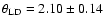 mas from observations in the visible at
 and 4608 Å. Our own result is consistent with the Narrabri
measurement, but far more precise. As mentioned in the previous section, our data set
and its related precision do not unambiguously support
an asymmetrical brightness distribution. Nevertheless, from the
visibilities gathered on the 66 m baseline we cannot exclude a
weak visibility modulation in this direction, parallel to the
disk major axis and thus also presumably aligned with
the stellar equatorial diameter. The effect of an hypothetical
photospheric oblateness is discussed hereafter as well as
the influence of a faint dusty ring.
Figure 16 presents
the VLTI constraint on the star's position in the HR diagram.
and 4608 Å. Our own result is consistent with the Narrabri
measurement, but far more precise. As mentioned in the previous section, our data set
and its related precision do not unambiguously support
an asymmetrical brightness distribution. Nevertheless, from the
visibilities gathered on the 66 m baseline we cannot exclude a
weak visibility modulation in this direction, parallel to the
disk major axis and thus also presumably aligned with
the stellar equatorial diameter. The effect of an hypothetical
photospheric oblateness is discussed hereafter as well as
the influence of a faint dusty ring.
Figure 16 presents
the VLTI constraint on the star's position in the HR diagram.
Figures 12 to 16 display in the HR diagram
the comparison between our interferometric (thick tilted box) constraints on the stellar radii and the spectrophotometric domains (thin box) corresponding to the adopted photospheric parameters (cf. Table 4).
Iso-radius lines are tilted and plotted for a few temperatures
close to those expected, to provide 1
(solid) and 2
(dashed) VINCI error boxes.
Filled diamonds correspond to the final evolution state
from the modeling with CESAM (Morel 1997),
see Table 5.
Increasing slightly the initial mass translates the star vertically
and to the left, whereas increasing only the initial metallicity ( )
makes it slide along the iso-radius line toward higher temperature.
Open circles represent other tentative modeling described in Sect. 5.
The present simulations show that we can reproduce both interferometric radius and spectroscopic characteristics with a maximum uncertainty of 2
on the mass
(for a given initial helium and metal abundance).
)
makes it slide along the iso-radius line toward higher temperature.
Open circles represent other tentative modeling described in Sect. 5.
The present simulations show that we can reproduce both interferometric radius and spectroscopic characteristics with a maximum uncertainty of 2
on the mass
(for a given initial helium and metal abundance).
![\begin{figure}
\par\includegraphics[width=7.8cm,clip]{0189-F15.eps}
\end{figure}](/articles/aa/full/2004/41/aa0189-04/img124.gif) |
Figure 12:
Position of Ceti in the HR diagram (rectangle = spectrophotometry, parallelograms are the VINCI error domains). The filled diamond corresponds to a model with
 , ,
 ,
the open circle to ,
the open circle to
 . . |
| Open with DEXTER | |
![\begin{figure}
\par\includegraphics[width=7.8cm,clip]{0189-F16.eps}
\end{figure}](/articles/aa/full/2004/41/aa0189-04/img127.gif) |
Figure 13:
Position of Leonis in the HR diagram. The filled diamond corresponds to
 , ,
 ,
the open circle to ,
the open circle to
 . . |
| Open with DEXTER | |
![\begin{figure}
\par\includegraphics[width=7.8cm,clip]{0189-F17.eps}
\end{figure}](/articles/aa/full/2004/41/aa0189-04/img129.gif) |
Figure 14:
Position of Eridani in the HR diagram. The filled diamond corresponds to
 , ,
 ,
the open diamond to
,
and the open circle to
, ,
the open diamond to
,
and the open circle to
,
 . . |
| Open with DEXTER | |
![\begin{figure}
\par\includegraphics[width=7.8cm,clip]{0189-F18.eps}
\end{figure}](/articles/aa/full/2004/41/aa0189-04/img132.gif) |
Figure 15:
Position of Pictoris in the HR diagram. The filled diamond corresponds to
 , ,
 ,
the open circle to ,
the open circle to
 .
Due to the large uncertainty, only the 1
error box is displayed. .
Due to the large uncertainty, only the 1
error box is displayed. |
| Open with DEXTER | |
![\begin{figure}
\par\includegraphics[width=7.8cm,clip]{0189-F19.eps}
\end{figure}](/articles/aa/full/2004/41/aa0189-04/img135.gif) |
Figure 16:
Position of PsA in the HR diagram. The filled diamond corresponds to
 , ,
 ,
the open circle to ,
the open circle to
 . . |
| Open with DEXTER | |
Pic
(Lagage & Pantin 1994; Pantin et al. 1997) have shown
a clear depletion of dust in the inner disk (down to 10 AU),
but no strict void of matter in the close vicinity
of the star. More recently, the first observations of the
Spitzer Space Telescope have also demonstrated the
presence of warm dust around Fomalhaut (Stapelfeldt et al. 2004).
Images obtained at 24 and 70 m revealed the presence of warm grains
in the first 100 AU, inside the central cavity observed
at sub-mm wavelengths.
Near Fomalhaut, the dust produced by the collision cascade and comets evaporation is permanently removed by the radiation pressure and sublimation process. Although theoretical models do not expect large amounts of dust to be found in the inner system, observational constraints in the first AUs can only be inferred from photometric measurements and spectral energy distribution (SED) fitting, since imaging techniques do not provide yet the required spatial resolution. This method is limited by the photometric precision itself, as well as the ability for the stellar atmosphere codes (e.g., Kurucz models) to predict the photospheric flux in the considered spectral window.
With a typical accuracy of 1
at best, no significant near-IR
excess has ever been reported so far around the selected
targets and a 1 or 2
flux excess cannot be
absolutely excluded.
Actually,
near-IR excesses are observed around old-PMS stars much younger
than our targets but too faint compared to our current sensitivity (like HD 100546, see spectra obtained by Malfait et al. 1998). These stars
are thought to show a transition phase in the disks evolution
between young gaseous protoplanetary disks
and second-generation dusty disks. From our interferometric
observations, we can tentatively constrain the excess due to a
putative warm environment, which is directly linked to
the shape and precision of our visibility curves.
0.1 to a few microns), the corresponding
sublimation distance around A stars ranges typically
between 0.1 and 0.5 AU (5 to 25 mas at the distance of
Pic). At such radii, the dust luminosity, enhanced
by the thermal emission of the particles, can reach a small
fraction of the stellar luminosity at 2 m. The detection
threshold is determined by the precision of the interferometric
measurement, since emission from an extended structure
will produce a visibility modulation dependent on the grains size
distribution and the geometry of the disk (or ring). The amplitude of the V2 modulation
is proportional to the contribution of the dust to the total brightness.
Figure 17 shows the expected visibility profile for a basic
disk modeling, which consists of a thin ring
observed face-on around a resolved star with
 mas.
The exact shape of the V2 modulation depends obviously
on the radial extension of the ring, its inclination and the orientation
of its major axis with respect to the baseline.
For simplicity, it is located at 40
mas.
The exact shape of the V2 modulation depends obviously
on the radial extension of the ring, its inclination and the orientation
of its major axis with respect to the baseline.
For simplicity, it is located at 40  ,
close to the sublimation
distance and contributes to 2
of the total flux in the K band. Detecting such a faint disk is
challenging since it requires to evidence the faint departure
from the Airy function of the stellar photosphere. The
largest modulation amplitude can be observed at very low spatial frequency,
indicating that the disk detection should be less difficult with very short baselines.
In addition, a small visibility deficit (less than 1)
can be observed even at
high spatial frequencies, where VINCI data were collected (the frequency range was arbitrarily limited to the domain scanned by the VLTI).
,
close to the sublimation
distance and contributes to 2
of the total flux in the K band. Detecting such a faint disk is
challenging since it requires to evidence the faint departure
from the Airy function of the stellar photosphere. The
largest modulation amplitude can be observed at very low spatial frequency,
indicating that the disk detection should be less difficult with very short baselines.
In addition, a small visibility deficit (less than 1)
can be observed even at
high spatial frequencies, where VINCI data were collected (the frequency range was arbitrarily limited to the domain scanned by the VLTI).
Leo,
Pic and PsA, are reported in the literature to be
rapid rotators. Their rotation speed collected from the
Royer et al. (2002) catalog indicates an intermediate velocity:
 = 128, 130 and 93 km s-1 respectively. This high
rotation rate may elongate their atmosphere in the equatorial
plane. The interferometric measurements along this direction
could lead to larger equivalent UD diameters, compared to those
measured in the perpendicular (polar) direction. Oblate
photospheres have already been successfully evidenced by
interferometric measurements (Van Belle et al. 2001; Domiciano et al. 2003)
on much faster rotating stars (Altaïr,
= 128, 130 and 93 km s-1 respectively. This high
rotation rate may elongate their atmosphere in the equatorial
plane. The interferometric measurements along this direction
could lead to larger equivalent UD diameters, compared to those
measured in the perpendicular (polar) direction. Oblate
photospheres have already been successfully evidenced by
interferometric measurements (Van Belle et al. 2001; Domiciano et al. 2003)
on much faster rotating stars (Altaïr,
 km s-1 and
Achernar,
km s-1 and
Achernar,
 km s-1).
Using the Roche model of a rigid rotation body described by
Domiciano et al. (2002), we have investigated the influence
of the rotation on the visibility curves for two perpendicular
baselines, in order to quantify the expected polar flattening for
our targets. Results of the modeling are presented for Pic
and PsA in Fig. 18. The
gravity darkening effect (Von Zeipel 1924), which makes the
polar regions hotter than the equatorial zone, is taken into account for the most rapid rotator.
We have plotted the V2 difference between a polar and an equatorial measurement. For Leo,
the orientation and inclination of its rotation axis are not known but the visibility modulation should be at least as large as that of Pic.
The modeling shows that, even for such intermediate rotation speeds,
the oblateness can produce a visibility modulation as high as
 in the case of Pic and 2
for Fomalhaut. With the
projected baseline range covered by the VLTI data (see the
arrows on the plots), the expected bias is in the order of 1.
Even if this effect
is not unambiguously detectable in the reported observations
because of our lack of precision, it could produce a
bias in our analysis. Assuming that the detected
dusty disks around these stars lie into their equatorial plane,
the UV coverage indicates that Fomalhaut was measured in the
polar direction with the long baselines and close to the equator
with the 66 m E0-G1 (see Fig. 8). As for Pic,
the UTs observations are almost aligned with the disk major axis.
The modeled deficit should then be subtracted to the measured
visibilities before estimating the constraint on the disk flux itself. As a
consequence, the derived upper values for the flux will depend
on the relevance of the modeling. Only observations at low
spatial frequency are not affected by the polar flattening.
in the case of Pic and 2
for Fomalhaut. With the
projected baseline range covered by the VLTI data (see the
arrows on the plots), the expected bias is in the order of 1.
Even if this effect
is not unambiguously detectable in the reported observations
because of our lack of precision, it could produce a
bias in our analysis. Assuming that the detected
dusty disks around these stars lie into their equatorial plane,
the UV coverage indicates that Fomalhaut was measured in the
polar direction with the long baselines and close to the equator
with the 66 m E0-G1 (see Fig. 8). As for Pic,
the UTs observations are almost aligned with the disk major axis.
The modeled deficit should then be subtracted to the measured
visibilities before estimating the constraint on the disk flux itself. As a
consequence, the derived upper values for the flux will depend
on the relevance of the modeling. Only observations at low
spatial frequency are not affected by the polar flattening.
![\begin{figure}
\par\includegraphics[width=8cm,clip]{0189-F20.eps}
\end{figure}](/articles/aa/full/2004/41/aa0189-04/img142.gif) |
Figure 17:
Simulated visibility profiles for a 2 mas UD diameter star with no environment (solid line) or surrounded by a faint and narrow uniform ring (
 )
located
at 40 stellar radii (dashed line). The departure from the Airy function reaches about 5
at very low spatial frequency whereas the curve can be approximated in the high frequency domain by the Airy function of a slightly bigger star. )
located
at 40 stellar radii (dashed line). The departure from the Airy function reaches about 5
at very low spatial frequency whereas the curve can be approximated in the high frequency domain by the Airy function of a slightly bigger star. |
| Open with DEXTER | |
![\begin{figure}
\par\includegraphics[width=8.7cm,clip]{0189-F21.eps}\par\includegraphics[width=8.7cm,clip]{0189-F22.eps}
\end{figure}](/articles/aa/full/2004/41/aa0189-04/img146.gif) |
Figure 18:
Oblateness of Pic (
 , ,
 km s-1) and PsA ( km s-1) and PsA (
 , ,
 km s-1). Predicted V2 difference between measurements along the polar and equatorial directions for various inclinations (z) of the rotation axis. The influence of the gravity-darkening (VZ) is also shown in the case of Pic. The arrows indicate the spatial frequency of our interferometric measurements. km s-1). Predicted V2 difference between measurements along the polar and equatorial directions for various inclinations (z) of the rotation axis. The influence of the gravity-darkening (VZ) is also shown in the case of Pic. The arrows indicate the spatial frequency of our interferometric measurements. |
| Open with DEXTER | |
![\begin{figure}
\par\includegraphics[width=8cm,clip]{0189-F23.eps}
\end{figure}](/articles/aa/full/2004/41/aa0189-04/img147.gif) |
Figure 19: Maximum dust/stellar flux ratio derived from the visibility measurements at different spatial frequencies, after correction of the expected oblateness for the fast rotating stars. The constraint on the presence of hot dust in a ring is only slightly weaker than that inferred from spectroscopic measurements. |
| Open with DEXTER | |
Pic visibility data are corrected
from the expected bias, the maximum disk brightness can be
estimated from the largest visibility deficit allowed by our
measurements. As shown in Fig. 17, the constraint
will arise from the short baseline observations since the visibilities
at the covered high frequencies can hardly be distinguished from an Airy function.
Actually, the quantity that we must consider is the difference between
the measured visibility at 66 m and the extrapolation of the best UD model fit
to the 140 m data (in the case of Pic, we can alternatively use the minimum diameter derived from photometry). Figure 19 shows this evolution
as a function of the disk brightness for the simple model of dust ring
mentioned previously. The measured maximum V2 deficit consistent
with our observations is reported on the plot for Ceti, Eri, Pic and PsA .
Table 4: Adopted stellar fundamental parameters.
Table 5: Stellar fundamental parameters from the modeling with CESAM. "s'' means at surface.
Even if the current precision of our instrument does not allow us to
detect unambiguously the disk or to put severe constraints on its brightness, the
modeling indicates that its presence might induce a
possible bias on the stellar diameter determination. Indeed, from
measurements in a limited range of spatial frequencies with a typical 1-2
accuracy, the inferred diameter might be too large due
to the weak visibility decrease induced by the ring. Computations
show that the relative bias on the equivalent UD diameter is of the order
of the excess due to the putative disk, which could be up to 1-2
and thus similar to the total uncertainty on our diameter measurements. For comparison, previous interferometric observations of Vega with PTI (Ciardi et al. 2001) at high spatial frequency were found to be consistent with the presence of a warm debris disk contibuting for 3 to 6
of the stellar flux. The corresponding stellar diameter was reduced by 2-2.5
compared to that derived from a simple photospheric model without disk.
The evolutionary models of the program stars were computed using the CESAM
code version 4 (Morel 1997) including the pre-main sequence evolution.
The ordinary assumptions of stellar modeling are made, i.e. spherical symmetry,
no rotation, no magnetic field, no mass loss. The relevant nuclear reaction rates
are taken from the NACRE compilation (Angulo et al. 1999). The equation of
state adopted is EFF (Eggleton et al. 1973), and
the OPAL opacities are from Iglesias & Rogers (1996) with the
Grevesse & Noels (1993) mixture.
Microscopic diffusion is described using the formalism of
Burgers (1969) with resistance coefficients from Paquette et al. (1986).
We take into account radiative diffusivity as
recommended by Morel & Thévenin (2002), that limits the efficiency
of microscopic diffusion in outer layers of stars with intermediate masses like
Pic and PsA. We have neglected radiative accelerations, as well as
the changes of abundance ratios between metals within Z.
The atmosphere is restored using Hopf's  law (Mihalas 1978).
The adopted radius of the star is the bolometric radius,
where
law (Mihalas 1978).
The adopted radius of the star is the bolometric radius,
where
 in the model.
In the convection zones the temperature gradient is
computed according to the
in the model.
In the convection zones the temperature gradient is
computed according to the
 convection
theory with a mixing length parameter of
convection
theory with a mixing length parameter of  (Canuto & Mazzitelli 1991, 1992).
Following the prescriptions of Schaller et al. (1992)
we have computed models that include convective core overshoot
(radius
(Canuto & Mazzitelli 1991, 1992).
Following the prescriptions of Schaller et al. (1992)
we have computed models that include convective core overshoot
(radius
 )
over a distance
)
over a distance
 for the three A type stars
and
for the three A type stars
and
 for the other two stars Eri and Ceti.
These adopted overshoot values are in agreement
with Ribas, Jordi & Carme (2000) for
a 2
for the other two stars Eri and Ceti.
These adopted overshoot values are in agreement
with Ribas, Jordi & Carme (2000) for
a 2  star. Our modeling does not take into
account the influence of rotation on stellar internal
structure, a condition that may impact the mixing and thus the surface abundance.
star. Our modeling does not take into
account the influence of rotation on stellar internal
structure, a condition that may impact the mixing and thus the surface abundance.
The initial helium content Yi of the program stars is unknown. This
parameter strongly correlates with the value of stellar radius. Its choice however is not free
and obeys to a galactic enrichment of helium starting from Yi=0.24 at the age of the Big Bang.
Adopting this primordial value of Izotov et al. (1997), Pagel & Portinari (1998)
have deduced a ratio
 of fresh helium supplied to the interstellar medium by stars.
Then for a metal-poor star like Ceti we can adopt an initial
of fresh helium supplied to the interstellar medium by stars.
Then for a metal-poor star like Ceti we can adopt an initial
 and a presumably very young star like Pic
has probably a higher value
and a presumably very young star like Pic
has probably a higher value
 .
This enrichment law of the helium content
is still debated and nothing is clear today, as regard to the Hyades, which do not fit this law with a
.
This enrichment law of the helium content
is still debated and nothing is clear today, as regard to the Hyades, which do not fit this law with a
 and a young age of 600 Myr.
 ), inferred from the high frequency domain of the oscillation spectrum, is defined as the average of differences between frequencies of modes with consecutive radial
orders (n). It is linked to the mean stellar density, following the relation:
), inferred from the high frequency domain of the oscillation spectrum, is defined as the average of differences between frequencies of modes with consecutive radial
orders (n). It is linked to the mean stellar density, following the relation:
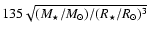 Hz (Brown & Gilliland 1994). Combining asteroseismic and interferometric observations may thus allow us to determine
precise estimations of the mass of the stars, one of the main parameters that govern their evolution. In the next sections, we predict from our modeling the expected large separation for our five targets. Instruments like HARPS at ESO or the space missions MONS and COROT will soon make it possible to determine these frequencies with high precision (down to 1 Hz).
Hz (Brown & Gilliland 1994). Combining asteroseismic and interferometric observations may thus allow us to determine
precise estimations of the mass of the stars, one of the main parameters that govern their evolution. In the next sections, we predict from our modeling the expected large separation for our five targets. Instruments like HARPS at ESO or the space missions MONS and COROT will soon make it possible to determine these frequencies with high precision (down to 1 Hz).
Ceti
Ceti consists in the choice of its initial
metallicity Z and its mass M. Indeed, the determination of iron abundance (Santos et al. 2001)
indicates that Ceti is a moderate metal-poor
star of the old disk of the Galaxy and consequently the well-known element enhancement
must be taken into account. For an old disk star of -0.5 dex
of metallicity, the mean trend ratio of alpha elements [/Fe] is about
0.2 dex. Therefore, an element like O is supposed to be
enhanced by a factor 1.7, and thus increases the stellar interior
opacity. Soubiran et al. (1998) derived a metal abundance
of -0.5 dex with
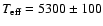 K. Thévenin (1998),
adopting
K. Thévenin (1998),
adopting
 K, derived from a detailed abundance
analysis [Fe/H] = -0.42. Increasing slightly the temperature
increases also the derived abundance and therefore
we prefer to adopt [Fe/H] = -0.4 dex for the iron abundance with
an effective temperature of 5300 K. Then, taking into account
the enhancement of elements abundance suggests us to
adopt an initial metallicity of
K, derived from a detailed abundance
analysis [Fe/H] = -0.42. Increasing slightly the temperature
increases also the derived abundance and therefore
we prefer to adopt [Fe/H] = -0.4 dex for the iron abundance with
an effective temperature of 5300 K. Then, taking into account
the enhancement of elements abundance suggests us to
adopt an initial metallicity of
 corresponding
to [Fe+/H]
corresponding
to [Fe+/H]
 and
and
 (close to
the primordial value of 0.24, corresponding to an helium
enrichment of the Galaxy of 0.01 since the Big Bang for a star of 10 Gyr).
(close to
the primordial value of 0.24, corresponding to an helium
enrichment of the Galaxy of 0.01 since the Big Bang for a star of 10 Gyr).
After 10 Gyr of time evolution, adopting an initial mass of
,
the surface abundance
is reduced to
 (after element diffusion). It corresponds to
a surface metallicity [Metal/H]
(after element diffusion). It corresponds to
a surface metallicity [Metal/H]
 with
with
 .
The simulation converges with a
luminosity
.
The simulation converges with a
luminosity
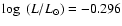 (to be compared with
 ,
Pijpers et al. 2003), an effective
temperature
,
Pijpers et al. 2003), an effective
temperature
 K and a linear radius of 0.821
in agreement with the VLTI determination. The final age
agrees with the estimation derived by Lachaume et al. (1999),
who found it in the range 4.4-12 Gyr, based on the
analysis of the CaII emission lines. We note that a model adopting a
metallicity around -0.5, as derived by Soubiran et al. (1998),
leads to a larger age (10.4 Gyr) and higher temperature (5550 K),
which seems less probable
on the view of the various published
K and a linear radius of 0.821
in agreement with the VLTI determination. The final age
agrees with the estimation derived by Lachaume et al. (1999),
who found it in the range 4.4-12 Gyr, based on the
analysis of the CaII emission lines. We note that a model adopting a
metallicity around -0.5, as derived by Soubiran et al. (1998),
leads to a larger age (10.4 Gyr) and higher temperature (5550 K),
which seems less probable
on the view of the various published
 in the literature. Our
modeling adopts an initial helium content
in the literature. Our
modeling adopts an initial helium content
 close to the primordial value. Choosing, instead,
 requires shifting the mass to 0.81 ,
resulting at 9.5 Gyr in
requires shifting the mass to 0.81 ,
resulting at 9.5 Gyr in
 K,
K,
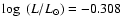 and
and
 (see open circle in the HR diagram, Fig. 12). This solution, on the edge of the error box, is less probable and we finally adopt the first model with a primordial helium abundance. Other derived parameters are summarized in Table 5.
Pijpers et al. (2003) have chosen to adopt a larger helium content but with a much smaller mass (0.77 )
to account for both spectroscopic observations and their interferometric measurement. It results (for the model based on the interferometric radius) in a temperature larger than 5500 K, which seems unlikely, as discussed previously. The authors predict for the large separation the value 173 Hz, which is very close to our own estimation:
 Hz. One must however keep in mind that both models assume different values for the mass and radius (their variations actually almost compensate in the computation of the large separation). Observations with HARPS at La Silla should soon provide an independent estimation of this parameter and make it possible to build a more precise model of this star.
Eridani
Eridani is a chromospherically
active star. Its mass is estimated in the range  and its
effective temperature around 5100 K. With
and its
effective temperature around 5100 K. With
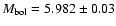 ,
adopting a mass of 0.84 ,
we have obtained a model with consistent
values for the luminosity and effective temperature (see Table 5).
The simulation converges toward a radius
,
adopting a mass of 0.84 ,
we have obtained a model with consistent
values for the luminosity and effective temperature (see Table 5).
The simulation converges toward a radius
 ,
in excellent agreement with our
interferometric measurement (see the filled
diamond in the HR diagram, Fig. 14). The corresponding age is 850 Myr for a
metallicity [Fe/H]
,
in excellent agreement with our
interferometric measurement (see the filled
diamond in the HR diagram, Fig. 14). The corresponding age is 850 Myr for a
metallicity [Fe/H]
 and the large spacing frequency is predicted to be
 Hz.
Observational data on its metallicity
show a large range of possible values and we have adopted
the recent iron abundance determination by Bodaghee et al. (2003).
Hz.
Observational data on its metallicity
show a large range of possible values and we have adopted
the recent iron abundance determination by Bodaghee et al. (2003).
Because there is no consensus about its metallicity and mass
we have built a second model, which led, at the same age,
to a metal abundance of -0.09 dex
with a smaller mass of 0.83 .
We derived a smaller diameter (0.727 ).
This value is just below the limit of our interferometric measurement
and the first model is preferred. This dwarf star
is believed to be older than the two other prototypes PsA and Pic, with an age
similar to the Hyades (800 Myr for Henry et al. 1996, from CaII lines;
 Myr for Song et al. 2000, from Li abundance, position in
the H-R diagram and kinematics). Even if our model does not represent
a unique solution (due to the unknown mass and exact metallicity),
it is successful in accounting for the adopted parameters and confirms
that Eri is substantially older than PsA and Pic.
Myr for Song et al. 2000, from Li abundance, position in
the H-R diagram and kinematics). Even if our model does not represent
a unique solution (due to the unknown mass and exact metallicity),
it is successful in accounting for the adopted parameters and confirms
that Eri is substantially older than PsA and Pic.
Leonis
Leo is a relatively young A3V star with a faint
debris disk. Its spectroscopic parameters have been
chosen following Decin et al. (2003) and we have built two
models in good agreement with our constraints. Adopting
an initial helium content
 ,
and a mass of 2.00 ,
the evolution converges in 100 Myr toward
,
and a mass of 2.00 ,
the evolution converges in 100 Myr toward
 K,
K,
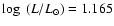 and
and
 (filled diamond in Fig. 13).
Decreasing its age would shift the star horizontally
in the HR diagram toward higher temperatures and
it would result in a smaller radius but an increased metallicity
([Fe/H]
 in the present case). The sensitivity to the initial
stellar mass is illustrated by
the open circle corresponding to
,
with the same
initial abundances and age. Our final age agrees with the
lower limit derived by Lachaume et al. (1999), who found it in
the range 100-380 Myr based on isochrones fitting. From our simulations,
it appears difficult to obtain an age larger than 200 Myr with our constraints.
in the present case). The sensitivity to the initial
stellar mass is illustrated by
the open circle corresponding to
,
with the same
initial abundances and age. Our final age agrees with the
lower limit derived by Lachaume et al. (1999), who found it in
the range 100-380 Myr based on isochrones fitting. From our simulations,
it appears difficult to obtain an age larger than 200 Myr with our constraints.
Pictoris
,
following Crifo et al. (1997)
(
 ).
Lanz et al. (1995) and Holweger et al. (1997)
argued that they fully reproduce the UV spectrum of the star
and spectral lines of absorption with a solar abundance and
an effective temperature of 8200 K. The detailed abundance analysis by
Holweger et al. (1997) revealed a mean metallicity close
to the solar one within a factor two. Individual abundances
of elements do not seem to depart strongly from the solar mixture. Therefore we
adopt
).
Lanz et al. (1995) and Holweger et al. (1997)
argued that they fully reproduce the UV spectrum of the star
and spectral lines of absorption with a solar abundance and
an effective temperature of 8200 K. The detailed abundance analysis by
Holweger et al. (1997) revealed a mean metallicity close
to the solar one within a factor two. Individual abundances
of elements do not seem to depart strongly from the solar mixture. Therefore we
adopt
 ,
which
corresponds to an initial surface iron abundance [Fe/H]
,
which
corresponds to an initial surface iron abundance [Fe/H]
 ,
expecting that at the age of the star, the surface abundance is close
to the solar one because of the gravitational settlement.
We do not take into account individual element abundance variations
from the adopted metallicity because of the rather large uncertainties on
the estimated abundances. The initial helium content is fixed to
,
expecting that at the age of the star, the surface abundance is close
to the solar one because of the gravitational settlement.
We do not take into account individual element abundance variations
from the adopted metallicity because of the rather large uncertainties on
the estimated abundances. The initial helium content is fixed to
 ,
according to the enrichment law mentioned previously.
,
according to the enrichment law mentioned previously.
Despite its large uncertainty, our interferometric measurement
forces the model to generate a quite
large diameter. The computed luminosity and effective
temperature are
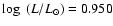 and
and
 K, both
within the error bars of the adopted observed values, and corresponding to
a radius of 1.53
consistent with our measurement.
The surface abundance is [Fe/H]
K, both
within the error bars of the adopted observed values, and corresponding to
a radius of 1.53
consistent with our measurement.
The surface abundance is [Fe/H]
 after 20 Myr of evolution.
There has been a debate on the age
of Pic, the estimations varying from 8 to 300 Myr.
Recent works favor the lowest values. Barrado y Navascués
et al. (1997) inferred an age of
after 20 Myr of evolution.
There has been a debate on the age
of Pic, the estimations varying from 8 to 300 Myr.
Recent works favor the lowest values. Barrado y Navascués
et al. (1997) inferred an age of  Myr,
studying two comoving low mass stars. Zuckerman et al. (2001)
estimated that it may be between 8 and 20 Myr old
(from a larger sample of 17 coeval stars in the Beta Pictoris
Moving Group (BPMG) on the basis of their positions in the H-R diagram and
on the time compatible with the Lithium depletion). This
extreme youth is also supported by Ortega et al. (2002),
whose estimation is based on the analysis of stellar velocities
among the BPMG. They derived an age of 11.5 Myr, in good
agreement with previous lower limit estimations. Our estimation
confirms this suspected youth, which can also be correlated with
the presence of the most massive disk among Vega-type stars,
even including a stable gaseous component.
Myr,
studying two comoving low mass stars. Zuckerman et al. (2001)
estimated that it may be between 8 and 20 Myr old
(from a larger sample of 17 coeval stars in the Beta Pictoris
Moving Group (BPMG) on the basis of their positions in the H-R diagram and
on the time compatible with the Lithium depletion). This
extreme youth is also supported by Ortega et al. (2002),
whose estimation is based on the analysis of stellar velocities
among the BPMG. They derived an age of 11.5 Myr, in good
agreement with previous lower limit estimations. Our estimation
confirms this suspected youth, which can also be correlated with
the presence of the most massive disk among Vega-type stars,
even including a stable gaseous component.
We noticed nevertheless that the radius at the age of 20 Myr
derived from our simulation
agrees only with the lower limit of the VLTI measurement.
From our analysis it appears difficult to build a model
of Pic's atmosphere leading to a much larger
diameter and reproducing correctly the spectroscopic quantities:
we would have indeed to increase its mass and thus to consider
a higher luminosity. Another tentative
modeling with
 led to a diameter of
1.63
after 45 Myr of evolution (open circle in Fig. 15). A
luminosity as large as 10
led to a diameter of
1.63
after 45 Myr of evolution (open circle in Fig. 15). A
luminosity as large as 10  is however required
to support this computation, which is unlikely or requires an
improbable enhanced extinction (at least 0.15 mag).
Therefore, the first scenario is preferred and we adopt
from this theoretical work a radius close to 1.53 .
We should emphasize that this simulation assumes that the VLTI measurement is not affected by the presence of warm dust or by a companion, two conditions that could bias (toward higher values) the apparent size of the photosphere.
is however required
to support this computation, which is unlikely or requires an
improbable enhanced extinction (at least 0.15 mag).
Therefore, the first scenario is preferred and we adopt
from this theoretical work a radius close to 1.53 .
We should emphasize that this simulation assumes that the VLTI measurement is not affected by the presence of warm dust or by a companion, two conditions that could bias (toward higher values) the apparent size of the photosphere.
Piscinis Austrini
PsA is also poorly constrained:
estimations in the literature vary around  .
The simulation was initialized with M=2.00
and an initial abundance
.
The simulation was initialized with M=2.00
and an initial abundance
 ,
corresponding to [Fe/H]
,
corresponding to [Fe/H]
 .
The helium content is
arbitrarily chosen as
.
The helium content is
arbitrarily chosen as
 .
The star is supposed to have a surface
abundance after evolution and diffusion of elements in agreement
(within the error bars) with the value found for its associated companion
Gl 879 (
.
The star is supposed to have a surface
abundance after evolution and diffusion of elements in agreement
(within the error bars) with the value found for its associated companion
Gl 879 (
 dex). The simulation converges toward
a radius
dex). The simulation converges toward
a radius
 at 290 Myr and a surface
abundance [Fe/H] = -0.10. The derived
diameter corresponds to a temperature
at 290 Myr and a surface
abundance [Fe/H] = -0.10. The derived
diameter corresponds to a temperature
 K
with a luminosity
K
with a luminosity
 and is compatible
with our interferometric diameter measurement on the long UTs and
siderostats baselines. The age of Fomalhaut has been estimated
by Barrado y Navascués (1997) thanks to its presumably comoving
companion Gl 879. An age of 200
and is compatible
with our interferometric diameter measurement on the long UTs and
siderostats baselines. The age of Fomalhaut has been estimated
by Barrado y Navascués (1997) thanks to its presumably comoving
companion Gl 879. An age of 200  100 Myr has been established
from various methods such as the analysis of the Lithium abundance,
the rotation speed, the stellar activity and it turned out that the
star should be significantly older than the Pleiades. A similar
estimation was obtained by Lachaume et al. (1999)
with an age bracketed between 105 and 340 Myr, in good agreement with our simulation.
Pictoris and Eridani have been resolved for the
first time, and we have improved by a significant factor our knowledge
of the fundamental parameters for the three other targets.
Modeling will further benefit from the coupled interferometric and
asteroseismic observations to determine precise estimations
of the age and mass of the stars. Three of our measured stellar radii
( Cet, Eri and PsA) have been used
together with other VINCI measurements of MS dwarf stars to calibrate
their surface brightness relations (Kervella et al. 2004b).
This work is especially useful to extend and refine the reference
star catalogs for long baseline interferometry.
100 Myr has been established
from various methods such as the analysis of the Lithium abundance,
the rotation speed, the stellar activity and it turned out that the
star should be significantly older than the Pleiades. A similar
estimation was obtained by Lachaume et al. (1999)
with an age bracketed between 105 and 340 Myr, in good agreement with our simulation.
Pictoris and Eridani have been resolved for the
first time, and we have improved by a significant factor our knowledge
of the fundamental parameters for the three other targets.
Modeling will further benefit from the coupled interferometric and
asteroseismic observations to determine precise estimations
of the age and mass of the stars. Three of our measured stellar radii
( Cet, Eri and PsA) have been used
together with other VINCI measurements of MS dwarf stars to calibrate
their surface brightness relations (Kervella et al. 2004b).
This work is especially useful to extend and refine the reference
star catalogs for long baseline interferometry.
Our analysis of the VINCI visibilities shows that the
current instrumental precision does not allow us yet to detect
unambiguously the signature of a small amount of warm
dust close to the selected stars. Further measurements at lower
spatial frequencies should however make it soon possible.
Nevertheless, our analysis of the present data provides
upper limits on the dust contribution to the total flux, which are of
the same order of magnitude as those derived from the photometry and should be
much improved in the near future thanks to the incoming fringe trackers.
We have also pointed out that the possible confusion with
photospheric effects strengthens the need for accurate
and validated models of fast rotating stellar atmospheres.
Visibility measurements at various IR wavelengths
may help disentangle the respective contribution of
such effects that can bias the detection of CS material. Finally we showed that even
a faint disk that cannot be detected could potentially bias our diameter estimations
by at most 1-2,
depending on its relative flux contribution.
Future observations with the VLTI will benefit from increased sensitivity with the use of Auxiliary Telescopes and adaptive optics on the Unit Telescopes, thus giving access to a large sample of Vega-like stars and also to younger stars surrounded by transition disks easier to detect. The first generation of scientific instruments, namely MIDI (Leinert et al. 2000) in the thermal IR and AMBER (Petrov et al. 2000) in the near-IR will tackle the planet formation scenarii. Thanks to the implementation of fringe tracking facilities (like FINITO and PRIMA/FSU), the instrumental precision in the K band is expected to be improved significantly and thus will make possible the detection of faint dusty disks or rings in the first AU around these stars.
Acknowledgements
These interferometric measurements have been obtained using the VLTI, operated by the European Southern Observatory at Cerro Paranal, Chile. We thank the VLTI Team (Garching and Paranal) for their essential support in this research. All the VINCI data presented in this letter are public and were retrieved from the ESO/ST-ECF Archive (Garching, Germany). The authors wish to acknowledge the anonymous referee for his/her precious help in improving the quality and readability of this paper. D.S. acknowledges the support of the Swiss FNRS. This research has made use of the SIMBAD database at CDS, Strasbourg (France).