![[*]](/icons/foot_motif.gif)
A&A 426, 81-96 (2004)
DOI: 10.1051/0004-6361:20034209
T. Paumard1,,
- J.-P. Maillard1,
- M. Morris2
1 - Institut d'astrophysique de Paris (CNRS), 98b Bd. Arago, 75014 Paris, France
2 -
University of California, Los Angeles, Div. of Astronomy, Dept of Physics and
Astronomy, Los Angeles, CA 90095-1562, USA
Received 19 August 2003 / Accepted 23 April 2004
Abstract
Integral field spectroscopy of the inner region of the Galactic
Center, over a field of roughly
 was obtained at
2.06
was obtained at
2.06  m (He I) and 2.16 m (Br
 )
using BEAR, an
imaging Fourier Transform Spectrometer, at spectral resolutions respectively
of 52.9 km s-1 and 21.3 km s-1, and a spatial resolution of
)
using BEAR, an
imaging Fourier Transform Spectrometer, at spectral resolutions respectively
of 52.9 km s-1 and 21.3 km s-1, and a spatial resolution of

 .
The analysis of the data was focused on the kinematics
of the gas flows, traditionally called the "Minispiral'',
concentrated in the neighborhood of the central black hole,
Sgr A
.
The analysis of the data was focused on the kinematics
of the gas flows, traditionally called the "Minispiral'',
concentrated in the neighborhood of the central black hole,
Sgr A . From the decomposition into several velocity
components (up to four) of the line profile extracted at each point of the
field, velocity features were identified. Nine distinguishable structures
are described: the standard Northern Arm, Eastern Arm,
Bar, Western Arc, and five additional, coherently-moving
patches of gas. From this analysis, the Northern Arm appears not
limited, as usually thought, to the bright, narrow North-South lane seen on
intensity images, but it consists instead of a weak, continuous,
triangular-shaped surface, drawn out into a narrow stream in the vicinity of
Sgr A where it shows a strong velocity gradient, and a
bright western rim. The Eastern Arm is split into three components
(a Ribbon and a Tip, separated by a cavity, and an elongated
feature parallel to the Ribbon: the Eastern Bridge). We also report
extinction of some interstellar structures by other components, providing
information on their relative position along the line of sight. A system of
Keplerian orbits can be fitted to most of the Northern Arm, and the
bright rim of this feature can be interpreted in terms of line-of-sight
orbit crowding caused by the warping of the flowing surface at the western
edge facing Sgr A. These results lead to a new picture
of the gas structures in Sgr A West, in which large-scale gas flows
and isolated gas patches coexist in the gravitational field of the central
Black Hole. The question of the origin of the ionized gas is addressed and
a discussion of the lifetime of these features is presented.
. From the decomposition into several velocity
components (up to four) of the line profile extracted at each point of the
field, velocity features were identified. Nine distinguishable structures
are described: the standard Northern Arm, Eastern Arm,
Bar, Western Arc, and five additional, coherently-moving
patches of gas. From this analysis, the Northern Arm appears not
limited, as usually thought, to the bright, narrow North-South lane seen on
intensity images, but it consists instead of a weak, continuous,
triangular-shaped surface, drawn out into a narrow stream in the vicinity of
Sgr A where it shows a strong velocity gradient, and a
bright western rim. The Eastern Arm is split into three components
(a Ribbon and a Tip, separated by a cavity, and an elongated
feature parallel to the Ribbon: the Eastern Bridge). We also report
extinction of some interstellar structures by other components, providing
information on their relative position along the line of sight. A system of
Keplerian orbits can be fitted to most of the Northern Arm, and the
bright rim of this feature can be interpreted in terms of line-of-sight
orbit crowding caused by the warping of the flowing surface at the western
edge facing Sgr A. These results lead to a new picture
of the gas structures in Sgr A West, in which large-scale gas flows
and isolated gas patches coexist in the gravitational field of the central
Black Hole. The question of the origin of the ionized gas is addressed and
a discussion of the lifetime of these features is presented.
Key words: Galaxy: center - ISM: individual objects: Sgr A West - ISM: kinematics and dynamics - infrared: ISM - Instrumentation: interferometers - line: profiles
Within the inner 2 pc of the Galactic Center (GC) lies the Sgr A West
region, dominated by ionized gas which, because of high obscuration along the
line of sight, has been detected only at infrared and radio wavelengths.
Infrared fine-structure line emission of [Ne II] at 12.8 m has been
used to map the gas distribution a number of times, with successively higher
spatial sampling and spatial and spectral resolutions, up to


 sampling, 30 km s-1 and
 resolution in the most recent paper (Lacy et al. 1991). In parallel, observations
with the Very Large Array (VLA) telescope provided a 6-cm map of the ionized gas
in the radio continuum at
resolution in the most recent paper (Lacy et al. 1991). In parallel, observations
with the Very Large Array (VLA) telescope provided a 6-cm map of the ionized gas
in the radio continuum at
 resolution (Lo & Claussen 1983). Later,
Roberts & Goss (1993) observed the Sgr A West complex in the radio recombination
H92
resolution (Lo & Claussen 1983). Later,
Roberts & Goss (1993) observed the Sgr A West complex in the radio recombination
H92 line at 3.6 cm (8.3 GHz), also at a resolution of
.
Much
higher spatial resolution was reached with the VLA at 13 mm, with a beam size of
line at 3.6 cm (8.3 GHz), also at a resolution of
.
Much
higher spatial resolution was reached with the VLA at 13 mm, with a beam size of

 ,
in the course of a project to measure proper
motions of the bright, compact blobs of ionized gas (Zhao & Goss 1998). This
ionized region is surrounded by a torus of neutral material, the
Circumnuclear Disk (CND, Becklin et al. 1982; Güsten et al. 1987; Liszt 1983; Yusef-Zadeh et al. 2001).
,
in the course of a project to measure proper
motions of the bright, compact blobs of ionized gas (Zhao & Goss 1998). This
ionized region is surrounded by a torus of neutral material, the
Circumnuclear Disk (CND, Becklin et al. 1982; Güsten et al. 1987; Liszt 1983; Yusef-Zadeh et al. 2001).
Br
at 2.166 m has also been used to trace the ionized gas. The
first detection consisted of a grid of spectra around GCIRS 16
(Geballe et al. 1991) which could not give an overview of the emission morphology.
The availability of near-infrared arrays has resulted in many images of the
Galactic Center. However, the ionized gas can only be detected in the
near-infrared by spectro-imaging or by narrow-band imaging of a strong emission
line. Broad-band images, for example in the infrared K band, are dominated by
the stellar content. A first attempt at spectro-imagery in Br
was made
by Wright et al. (1989) with a Fabry-Perot system scanning over
1000 km s-1, at a modest spectral resolution of 90 km s-1 in
a

 field. The data cube obtained in the same line
with BEAR, an Imaging Fourier Transform Spectrometer on the Canada-France-Hawaii
telescope represents a significant effort to cover most of the central ionized
region with a much better spectral resolution (FWHM 21.3 km s-1), at
seeing-limited resolution. A preliminary analysis was presented by
Morris & Maillard (2000). Data from the same instrument were obtained in the
2.06 m He I line, leading to the first identification of
interstellar Galactic center gas in this line (Paumard et al. 2001, hereafter
Paper I). Data were also obtained with NIRSPEC on Keck II, by
scanning the field with the
field. The data cube obtained in the same line
with BEAR, an Imaging Fourier Transform Spectrometer on the Canada-France-Hawaii
telescope represents a significant effort to cover most of the central ionized
region with a much better spectral resolution (FWHM 21.3 km s-1), at
seeing-limited resolution. A preliminary analysis was presented by
Morris & Maillard (2000). Data from the same instrument were obtained in the
2.06 m He I line, leading to the first identification of
interstellar Galactic center gas in this line (Paumard et al. 2001, hereafter
Paper I). Data were also obtained with NIRSPEC on Keck II, by
scanning the field with the
 slit used in a north-south orientation
to obtain a spectral cube covering 1.98 m to 2.28 m at resolution of
21.5 km s-1 (Figer et al. 2000). With the NICMOS cameras on board HST
the gas was observed in another infrared recombination line, Pa,
at a
spatial resolution of
slit used in a north-south orientation
to obtain a spectral cube covering 1.98 m to 2.28 m at resolution of
21.5 km s-1 (Figer et al. 2000). With the NICMOS cameras on board HST
the gas was observed in another infrared recombination line, Pa,
at a
spatial resolution of
 (Scoville et al. 2003). These data will be used
in this paper for comparison with the Br data.
(Scoville et al. 2003). These data will be used
in this paper for comparison with the Br data.
All these data show that the ionized gas in the inner few parsecs of the
Galactic Center is organized, in projection, into a spiral-like morphology
having several apparent "arms''. This has led to the widespread appellation,
"Minispiral'', for this entire pattern. The brightest features are
named "Northern Arm'', "Eastern Arm'', "Bar'', and
"Western Arc'', as if it imitates the morphology of a very small
spiral galaxy. These terms seem to imply that the ionized filamentary
structures constituting Sgr A West either form spiral patterns, or are portions
of spiral arms. This view was motivated by the gas dynamical study carried out
by Lacy et al. (1991), who interpreted the [Ne II] data in terms of a
one-armed linear spiral in a Keplerian disk. The various features of Sgr A West
give a spiral appearance primarily because of the way they are superposed on
each other. However, a new analysis of Lacy's data was conducted by
Vollmer & Duschl (2000) to re-examine the kinematic structure of the ionized gas.
Using a three-dimensional representation they confirm the standard features, but
with a more complex structure, including two features for the Eastern Arm: a
vertical finger of high density and a large ribbon extending to the east of
Sgr A, and two distinctly different components in the Bar.
These ISM features are tidally stretched while they orbit around the
supermassive black hole candidate Sgr A, the exact mass of
which, despite rapid progress, is still a matter of debate. From stellar proper
motion studies, Eisenhauer et al. (2003) give a mass of
3.6  0.6
0.6
 and a distance of 7.94
0.42 kpc whereas the
estimate of Ghez et al. (2003) is slightly higher at 4
0.3
,
assuming the same distance. However, Aschenbach et al. (2004) derive a
significantly lower value from their study of periodicity in the black hole's
flares:
2.72+0.12-0.19
.
On the other hand, even if
the supermassive black hole is dominating the potential well in the central
parsec, the stellar cusp (e.g., Genzel et al. 2003) may contain a significant
fraction of the mass in the central arcsecond. Mouawad et al. (2004) have explored
this possibility and shown that the stellar proper motion data are consistent
with a total mass as high as 4.8
for a
and a distance of 7.94
0.42 kpc whereas the
estimate of Ghez et al. (2003) is slightly higher at 4
0.3
,
assuming the same distance. However, Aschenbach et al. (2004) derive a
significantly lower value from their study of periodicity in the black hole's
flares:
2.72+0.12-0.19
.
On the other hand, even if
the supermassive black hole is dominating the potential well in the central
parsec, the stellar cusp (e.g., Genzel et al. 2003) may contain a significant
fraction of the mass in the central arcsecond. Mouawad et al. (2004) have explored
this possibility and shown that the stellar proper motion data are consistent
with a total mass as high as 4.8
for a  extended
component of the mass distribution, the possible nature of which they discuss.
Therefore, fairly large error bars must still be put on the mass responsible for
the gravitational potential at the parsec scale.
extended
component of the mass distribution, the possible nature of which they discuss.
Therefore, fairly large error bars must still be put on the mass responsible for
the gravitational potential at the parsec scale.
In the present paper, the gas content in the inner region of the GC is
presented and analyzed from high spectral resolution data cubes in the
Br
and He I 2.06-m lines, obtained with BEAR. The
He I data are from a new data cube (larger field, improved spectral
resolution) compared to the data used in Paper I. A multi-component
line-fitting procedure applied to the emission-line profiles at each point of
the field is described in Sect. 3. It was used first on
the Br
cube and then on the He I cube. From this decomposition
in Br,
the identification of defined gas structures comprising the
whole Sgr A West ionized region is presented in Sect. 4.
Attempts to adjust Keplerian orbits to the flowing gas are presented in
Sect. 5, which contains in Sect. 5.5 a
discussion of the implication of these identifications for the formation and
the lifetime of the inner ionized gas. All these elements allow us to discuss
the nature and origin of the ionized features in Sect. 6. More
details on this analysis are given in Paumard (2003).
The 3-D data analyzed in this paper were obtained during two runs with the
BEAR Imaging FTS (Maillard 2000,1995) at the f/35 infrared focus of
the 3.6-m CFH Telescope. In this mode, a 256
256 HgCdTe facility
camera is associated with the FTS, in which several narrow-band filters are
selectable. Two of them were used, one which contains the Br line
(4616.55 cm-1, bandpass 4585-4658 cm-1) and the other one
centered on the He I line at 4859.08 cm-1 (bandpass 4806-4906 cm-1). The field of view of the instrument is circular, with a
diameter of 24
 .
The Br data were acquired on July 25, 26,
1997 (UT) by observing two overlapping fields in order to cover most of a
field of
.
The Br data were acquired on July 25, 26,
1997 (UT) by observing two overlapping fields in order to cover most of a
field of

 ,
oriented in the East-West direction,
centered on the position of Sgr A
(Fig. 1). This
field contains the Bar and most of the Northern and Eastern Arms, but very
little of the Western Arc. The raw data consist of cubes of 512 planes with
an integration time of 7 s per image. The maximum path difference which was
reached in the spectrometer determines the corresponding limit of resolution
(FWHM) in velocity, equal in this study to 21.3 km s-1.
,
oriented in the East-West direction,
centered on the position of Sgr A
(Fig. 1). This
field contains the Bar and most of the Northern and Eastern Arms, but very
little of the Western Arc. The raw data consist of cubes of 512 planes with
an integration time of 7 s per image. The maximum path difference which was
reached in the spectrometer determines the corresponding limit of resolution
(FWHM) in velocity, equal in this study to 21.3 km s-1.
![\begin{figure}
\par\includegraphics[width=9.7cm,clip]{0209fig1.eps}\hfill
\end{figure}](/articles/aa/full/2004/40/aa0209-03/img35.gif) |
Figure 1:
Three-color image of the two mosaicked fields of Sgr A West
observed with BEAR in Br,
between -350 (purple) and
+350 km s-1 (red). The standard bright features, Northern and
Eastern Arms, Bar, and the Minicavity, are indicated. Also, a
few emission line stars show up as bright points in the
image. |
| Open with DEXTER | |
On the following night a single field centered on Sgr A
was recorded
with the 2.06 m He I filter. The analysis of the later high
resolution data was reported in Paper I, which brought new results on the
central cluster of massive, hot stars, and led to the detection of the
Minispiral in helium. However, the field was not large enough for a
significant areal coverage of the Minispiral. New observations through
the same filter were therefore obtained on June 9-11, 2000 in order to get
three overlapping circular fields covering, when merged, most of a total field
of
,
also centered on Sgr A.
The estimated
width of the interstellar 2.06-m line in Paper I called for an improved
spectral resolution. A value of 50 km s-1 (exactly FWHM
52.9 km s-1) was chosen instead of 74 km s-1 in the previous data, not
as high as for Br,
since the line is weaker. The raw data consist of
cubes of 401 planes with an integration of 20 s per image, double the time for
the previous data, to improve the detection depth.
The processing of the BEAR data was described in Paper I; the main steps are
standard cube reduction, atmospheric OH correction and correction of filter
transmission and telluric absorption - particularly important for the
2.06-m data. The various cubes of the same line are then merged into a
mosaic. The next step is the generation of the line cubes, spectral cubes
in which the continuum level at each point of the field is fitted and
subtracted, in order to keep only the emission lines. Figure 1
presents a three-color image obtained from the Br
merged line cube, and
is a first glance at the velocity field of the region.
The Br
line cube is dominated by the emission from the interstellar
medium (ISM), but some stars exhibit the Br line in emission
(Fig. 1). On the contrary, in the He I line cube the
stellar emission from the hot stars predominates (Paper I), but the ISM emission is clearly detected too.
The central parsec was observed with the NICMOS cameras on board HST, during a
few runs between Aug. 1997 and Aug. 1998, in 6 near-IR filters, including 2
narrow-band filters, F187N centered on 1.87 m Pa,
and F190N, the
nearby continuum. By subtracting the F190N filter from the other one,
Pa emission was obtained in a field of
 centered on Sgr A
(Stolovy 1999; Scoville et al. 2003) at a
spatial resolution of
,
and a wider field of 120
at a lower resolution of
centered on Sgr A
(Stolovy 1999; Scoville et al. 2003) at a
spatial resolution of
,
and a wider field of 120
at a lower resolution of
 .
We use an image covering the
central
field from these data for the purpose of
comparison, in Fig. 8.
.
We use an image covering the
central
field from these data for the purpose of
comparison, in Fig. 8.
At each point of the field the Br
and He I emission profiles
generally appear complex. The basic assumption is made that each observed
profile results from the combination of several velocity components, that is,
that along any given line of sight several flows are superposed. The first
goal of the present paper is to separate these various flows and to describe
them independently from each other. For this purpose, the development of a
multi-component line-fitting procedure able to work on 3D data appeared to be
absolutely required. From a coarse examination of the datacube, fitting with
a maximum of four distinct velocity components along each line of sight seemed
adequate.
A comparison of the velocity components from one line of sight to the next should usually reveal coherent velocity structures by continuity. In the end, it might be possible to conclude whether these structures are isolated, or form continuous flows. The process is thus split into two main parts: first the line profile decomposition at all the points of the field, and second, the structure identification. This work is based on original software developed by Miville-Deschênes (personal communication), which we have largely extended.
A single velocity component of the emission lines from the ISM has been
assumed to be a Gaussian I(v), with three free parameters: I0, the
amplitude of the Gaussian expressed in
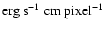 (
(
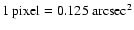 ); v0, the radial velocity of
the component; and
); v0, the radial velocity of
the component; and  ,
the width of the line, due to thermal agitation,
turbulence and any velocity gradient along the line of sight or across a
resolution element. The full width at half maximum (FWHM) of the line is
given by:
,
the width of the line, due to thermal agitation,
turbulence and any velocity gradient along the line of sight or across a
resolution element. The full width at half maximum (FWHM) of the line is
given by:
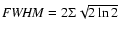 .
.
The instrumental line shape of the FTS is a sinc function:
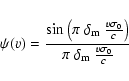 |
(1) |
 is the central wavenumber and
 the maximum path
difference between the two arms of the interferometer, which determines the
limit of resolution d
the maximum path
difference between the two arms of the interferometer, which determines the
limit of resolution d of the data with d
 (FWHM).
The measured line profile is thus the convolution product  ,
a
function of three free parameters I0,
and v0. Each single
spectrum of the field has been fitted to a set of four such lines, thus
implying twelve free parameters.
,
a
function of three free parameters I0,
and v0. Each single
spectrum of the field has been fitted to a set of four such lines, thus
implying twelve free parameters.
3 pixel box in our case. After several
attempts, we reached the conclusion that no structure containing fewer than
50 pixels was significant in our field: if such structures exist, their
overall signal-to-noise ratio is less than  .
The discarded fitted
lines corresponding to these abortive structures are either stellar lines,
noise spikes, or actual ISM lines under the detection threshold.
-
.
The discarded fitted
lines corresponding to these abortive structures are either stellar lines,
noise spikes, or actual ISM lines under the detection threshold.
- -velocity space, the procedure can falsely
cross-connect them, i.e. reconstruct two structures, each one being made
of parts of both physical structures (Fig. 2). The
second derivative of the velocity map, as well as continuity of the
intensity map, can be used by the operator to decide which connection is
the good one. Preliminary work has been done to automatically take these
criteria into account.
-velocity space, the procedure can falsely
cross-connect them, i.e. reconstruct two structures, each one being made
of parts of both physical structures (Fig. 2). The
second derivative of the velocity map, as well as continuity of the
intensity map, can be used by the operator to decide which connection is
the good one. Preliminary work has been done to automatically take these
criteria into account.
![\begin{figure}
\par\includegraphics[width=8.4cm,clip]{0209fig2.eps}
\end{figure}](/articles/aa/full/2004/40/aa0209-03/img49.gif) |
Figure 2:
Cross-connection problem. Left: two physical
structures (solid and dashed polygons) intersect each other in the
--velocity space. Right: the structures
reconstructed by the software can be erroneous. |
| Open with DEXTER | |
![\begin{figure}
\par\includegraphics[width=15.4cm,clip]{0209fi3a.eps}\par\includegraphics[width=6.9cm,clip]{0209fi3b.eps}\end{figure}](/articles/aa/full/2004/40/aa0209-03/img51.gif) |
Figure 3:
Above: outline of
every structure. The region filled in black corresponds to the points where
two lines associated with the Northern Arm are detected (see text).
Filled diamonds (resp. empty squares) represent narrow (resp. broad) line
helium stars. Left: IDs of the narrow (N) and broad (B) line stars, see
table below for common-names identification (Paper I, Paumard et al. 2003, and references
therein).
|
||||||||||||||||||||||||||||||||||||||||||||||||||
Both the Br
and He I data have been analyzed with the software
described above. This leads to a vision of the Minispiral more complex than
usually thought, one which is consistent with, but more detailed than the
description proposed by Vollmer & Duschl (2000). After a careful examination of the
Br data we identify 9 components of various sizes, labeled (a) to (i)
(Fig. 3). A description of these structures, and their radial
velocity and flux maps, are presented in Appendix A. Two types of
velocity maps appear, some with a significant overall velocity gradient,
others without any appreciable, large-scale velocity gradient. The deviation
from the mean motion, defined as the local difference between the velocity
measured at one point and the mean value for the neighboring points, and
divided by the uncertainty ( error bars from the multi-component
line-fitting procedure), ranges from roughly one tenth to ten for all the
features, which means that every velocity structure shows significant local
features.
The areal size of the structures (Table 1), expressed in terms of solid angle covered on the sky, ranges from 17 arcsec2 to 300 arcsec2 for the Northern Arm. The surface area of each structure must be considered as a lower limit because BEAR may not detect the weakest parts, and because the field of view does not cover the entire Minispiral.
Table 1:
Feature identifications, with surface areas (pixels
and square arcseconds), and minimum and maximum radial velocities
(km s-1). The last column gives [He I]/[Br]
for the
different structures, relative to the mean value
 [He I]/[Br]
 .
The Minicavity is separated from the
Northern Arm, as it warrants special attention.
.
The Minicavity is separated from the
Northern Arm, as it warrants special attention.
The same work of decomposition into velocity structures on the He I data was more difficult than for the Br data since the spectral
resolution and signal-to-noise ratio are lower. The fact that the He I data are dominated by the emission from the helium stars also contributes to
the greater complexity of this task. We thus skipped the preparatory step of
the decomposition process, and provided directly a complete set of initial
guesses based on the Br results, since at first sight the distribution
of ionized gas is globally the same in He I. This method precludes the
He I analysis from being fully independent, although steps 1 to 4 were
performed eight times, until the procedure converged satisfactorily.
Finally, all the structures detected in Br
are detected in He I
as well, except the Northern Arm Chunk (h), which is probably too weak
in this line. However, several differences in the appearance of these
structures are noticeable, and detailed in Appendix B. To
quantify these differences, we have built [He I]/[Br] line ratio
maps for each structure, normalized to the areal mean for this ratio over the
union of all the structures. The [He I]/[Br] line ratio varies
considerably across the field, so that, for instance, the Northern Arm
bright rim and the Minicavity do not show the same shape in He I and Br
(Fig. 4). The last column of Table 1 shows
the mean normalized [He I]/[Br] line ratio for the different
structures. It appears that this ratio is lower than the mean value for the
main, well-known features - the Northern Arm, the Ribbon, the
Bar and the Western Arc - and higher for the smaller
features. However, the values are computed only for the positions detected in
both Br
and He I, so they do not take into account the faintest,
least excited regions of each feature.
![\begin{figure}
\par\includegraphics[width=8.4cm,clip]{0209fig4.eps}
\end{figure}](/articles/aa/full/2004/40/aa0209-03/img54.gif) |
Figure 4:
Comparison between integrated flux in Br
(grey scale) and
He I (empty contours). Axes are offsets from Sgr A
in arcsec. |
| Open with DEXTER | |
Although all nine structures are thoroughly described in Appendices A
and B, we briefly summarize here the most important results.
Contrary to its standard description, the Northern Arm is not seen here
as a bright N-S lane, but as an extended, triangular surface. One edge of this
triangle is the bright rim generally noticed, but it extends all the way over to
the Eastern Arm. The third edge of the triangle is the edge of the field, so
viewing this feature in a larger field may yield a somewhat different
description. It contains the Minicavity. The [He I]/[Br] line
ratio is higher on the western side of the bright rim of the Northern Arm and on
the inner side of the Minicavity than in the rest of the structure.
As already described by Vollmer & Duschl (2000), the Eastern Arm region is split
into two parts: a Ribbon (c) and a Tip (g). For the sake of
clarity, we chose not to name any feature "Eastern Arm''. At the elbow
between the Ribbon and the Tip, in the GCIRS 9W region, is a
bubble-like feature, or a Microcavity (radius
 ),
with a rather bright rim (Fig. 5), which appears at a specific
velocity (230 km s-1). Finally, a secondary rim parallel to the Eastern
Arm (Fig. 8, from spot A eastwards) is often associated with
it. Here, we see that this feature belongs to an independent structure, the
Eastern Bridge (d).
),
with a rather bright rim (Fig. 5), which appears at a specific
velocity (230 km s-1). Finally, a secondary rim parallel to the Eastern
Arm (Fig. 8, from spot A eastwards) is often associated with
it. Here, we see that this feature belongs to an independent structure, the
Eastern Bridge (d).
![\begin{figure}
\par\includegraphics[width=8.4cm,clip]{0209fig5.eps}
\end{figure}](/articles/aa/full/2004/40/aa0209-03/img56.gif) |
Figure 5:
Microcavity feature in the region of GCIRS 9W, represented
by the black cross. Axes are offsets from Sgr A.
Integrated
velocity range: 220-240 km s-1. |
| Open with DEXTER | |
One of the most difficult questions concerning the ionized features is to determine their relative positions, i.e., when two structures overlap, which one is closer to the observer. On two occasions, the flux maps can be used to infer this information.
The flux map of the Northern Arm (Fig. A.1) shows a region of low
intensity, the northwestern boundary of which is a well defined line, oriented
approximately northeast-southwest. This intensity discontinuity is most
obvious south of GCIRS 1 and west of the Minicavity. This line follows
very closely the outline of the Eastern Bridge. It goes from
east and
 south to
 east and
 north of Sgr A,
where it becomes more difficult to locate precisely because of
a lower signal-to-noise ratio. If we interpret the intensity discontinuity in
terms of an increment of the extinction, this gives us two pieces of
information: the Northern Arm is behind the Eastern Bridge on the
line-of-sight, and the Eastern Bridge contains a substantial amount of dust,
responsible for the extinction of about
north of Sgr A,
where it becomes more difficult to locate precisely because of
a lower signal-to-noise ratio. If we interpret the intensity discontinuity in
terms of an increment of the extinction, this gives us two pieces of
information: the Northern Arm is behind the Eastern Bridge on the
line-of-sight, and the Eastern Bridge contains a substantial amount of dust,
responsible for the extinction of about  of the Br flux of the
Northern Arm, or about 0.76 mag at K. The ratio of K extinction to visual extinction being about 0.1, the inferred visual
extinction is around 7.6 mag. Using the area of the Eastern Bridge,
83.5 arcsec2 (Table 1), and the conversion factor of
2
1021 cm-2 per visual magnitude of extinction, we estimate the
mass of the Eastern Bridge to be
of the Br flux of the
Northern Arm, or about 0.76 mag at K. The ratio of K extinction to visual extinction being about 0.1, the inferred visual
extinction is around 7.6 mag. Using the area of the Eastern Bridge,
83.5 arcsec2 (Table 1), and the conversion factor of
2
1021 cm-2 per visual magnitude of extinction, we estimate the
mass of the Eastern Bridge to be
 .
This estimate is to
be considered with caution since the conversion factor may be different in
this extreme environment, and since we have only one measurement point for the
extinction, although the Br emission of the Eastern Bridge seems to correlate well with the
extinction map inferred from the Northen Arm's emission map, which is
difficult to interpret. Furthermore, this estimate does not include a possible
extension of the Eastern Bridge outside our field of view. However, it is
comparable to the mass of
.
This estimate is to
be considered with caution since the conversion factor may be different in
this extreme environment, and since we have only one measurement point for the
extinction, although the Br emission of the Eastern Bridge seems to correlate well with the
extinction map inferred from the Northen Arm's emission map, which is
difficult to interpret. Furthermore, this estimate does not include a possible
extension of the Eastern Bridge outside our field of view. However, it is
comparable to the mass of
 estimated by Liszt (2003)
for the Bar.
estimated by Liszt (2003)
for the Bar.
Although the flux map of the Bar (Fig. A.2) is less smooth than that of the Northern Arm, making such effects more difficult to see, the shape of the periphery of the Minicavity is clearly identified in extinction on this map, showing that the Bar is behind the Northern Arm along the line of sight.
The velocity maps give a view of the features very different from the usual flux
maps which, by themselves, can be misleading. For instance the morphology of
the Northern Arm with its typical rim may lead one to think of this rim
as the true path for most of the material, whereas the velocity map does not
show any peculiar feature at the location of the rim. We are thus led to the
idea that the kinematics of the Northern Arm should be studied independently
of its intensity distribution. To do so, we have tried to analyze the Northern
Arm as a Keplerian system, the location and mass of the central object being
those of Sgr A.
Its position with respect to GCIRS 7 is
taken from Menten et al. (1997), and the positions of the stars in the field
relative to GCIRS 7 from Ott et al. (1999). The distance to SgrA* is the
value of 8 kpc reported by Reid (1993). We have used a mass of
3
for most of our models, and we will discuss the impact of
changing this mass later.
For a first, simple approach, we created a dedicated IDL graphical package. With this tool, the operator can easily adjust one Keplerian orbit over a velocity map. A Keplerian orbit in 3D is defined by five orbital parameters: the eccentricity, two angles defining the orientation of the orbital plane, the periapse (distance of closest approach to the center of motion), and a third angle defining the position of the periapse.
Once the operator is almost satisfied with the orbital parameters found by trial and error, an automatic fitting procedure can be called. It is possible to fix parameters, and the orbit can be forced to go through a selected constraint point by tying the periapse to the other parameters. Good agreement can be found between observed and calculated velocities, except in the region of the Minicavity, so we attempted to model the full velocity field of the Northern Arm with a bundle of Keplerian orbits bounded by various constraints. We note that this model alone is not sufficient to decide whether the orbits are bound to the gravitational field of the black hole, since the bound and unbound solutions are not dramatically different within our field of view.
To fit several orbits at a time on a velocity map, we force each one to
pass through a different constraint point, as in the one-orbit case,
with the constraint points chosen to be on different physical orbits. The
result described here uses 50 constraint points, evenly
spaced on the solid line of Fig. A.1. Another constraint line has
been tried as well (dashed line), with consistent results. Each constraint
point is given an index, increasing from the point nearest Sgr Aoutwards, that is used to refer to a given orbit.
To ensure a smooth model - we are interested only in the global motion - the
four functions that map each constraint point to one of the orbital parameters
have been chosen to be described as spline functions, uniquely defined by
their value at a number of control points, chosen among the constraint points.
The number of points used to define the spline function can be freely chosen
to set the spatial resolution of the model across the flow. After several
attempts, we have chosen to fix this number to four in our final model
(yielding a resolution of
 ). Thus, having four functions (one for
each of the orbital parameters), each of them being defined by four values,
the model depends on sixteen parameters.
). Thus, having four functions (one for
each of the orbital parameters), each of them being defined by four values,
the model depends on sixteen parameters.
![\begin{figure}
\par\mbox{\includegraphics[width=5.35cm,clip]{0209fi6a.eps}\hspac...
...}\hspace*{4mm}
\includegraphics[width=5.45cm,clip]{0209fi6e.eps} }\end{figure}](/articles/aa/full/2004/40/aa0209-03/img66.gif) |
Figure 6:
These five plots show the laws
of each of the five orbital parameters in our two best models. Solid lines:
 .
Dashed lines:
.
Dashed lines:
 .
The gray hashed regions
correspond to the
.
The gray hashed regions
correspond to the  error bars. Angles are in degrees, the periapse
in equivalent arcsec on the sky. error bars. Angles are in degrees, the periapse
in equivalent arcsec on the sky. |
| Open with DEXTER | |
We designed a fitting procedure to adjust this model based on the observed
velocity map by minimizing the reduced
 .
It is
possible to either fix some parameters, or to force them to have the same
value for each orbit. This way, for example, it is possible to check whether
the observed velocity map is consistent with coplanar orbits or with uniform
eccentricity. To avoid studying only local minima in the parameter space, it
is also important to use several initial guesses.
.
It is
possible to either fix some parameters, or to force them to have the same
value for each orbit. This way, for example, it is possible to check whether
the observed velocity map is consistent with coplanar orbits or with uniform
eccentricity. To avoid studying only local minima in the parameter space, it
is also important to use several initial guesses.
We again designed an IDL graphical tool to easily study whether the data are
consistent with a homothetic set of orbits,
which is the simplest model.
With the hypothesis of a homothetic set of orbits, the eccentricity still
cannot be well constrained. Bound orbits seem to be preferred, but the
agreement is as good with circular orbits and very eccentric orbits, close to
parabolic. The residual map always has the same shape: the observed
velocities are always smaller than the computed ones along the inner edge of
the bundle of orbits, and higher along the outer edge. The global agreement
is always poor, with
 .
.
A few of these homothetic models have been chosen as initial guesses for other adjustments, with released constraints. It is first interesting to check the coplanar hypothesis, in which only the two parameters that define the orbital plane are kept uniform, and the uniform eccentricity hypothesis. The agreement is much better when leaving either the eccentricity or the orbital plane free. In the following, both parameters are free.
Even in the most general situation, the parameters are still not constrained
enough to extrapolate the model outside the field of view, or to derive
reliably the direction of proper motion. However, the models share a few
characteristics that we judge to be robust because of their repeatability: the
orbital planes are close to that of the CND; the orbits are not quite
coplanar, the two angles that define the orbital plane varying over a  range; the eccentricity varies from one orbit to another, the
innermost orbits being hyperbolic (e of the order of 2) and the outermost
closer to circular (
range; the eccentricity varies from one orbit to another, the
innermost orbits being hyperbolic (e of the order of 2) and the outermost
closer to circular ( ).
).
![\begin{figure}
\par\includegraphics[width=14cm,clip]{0209fi7a.eps}\par\includegraphics[width=9.5cm,clip]{0209fi7b.eps}\par
\end{figure}](/articles/aa/full/2004/40/aa0209-03/img71.gif) |
Figure 7:
Above: 3D velocity map for the Northern Arm from our
model. The arrows show the derived tangential
velocities. Left:
elevation map for the detected part of the Northern Arm from our
model, given in equivalent arcseconds for homogeneity. dd stands for
differential of the distance, positive dd means further away from the
observer than the center of mass, Sgr A,
at d ,
d ,
d ,
dd=0. ,
dd=0. |
| Open with DEXTER | |
We present here our best model, i.e., the one with the lowest
 among the realistic models that cover most of
the Northern Arm. The laws used for this model are shown in
Fig. 6. The agreement between the radial velocity map
of this model and the observed velocity map is good:
among the realistic models that cover most of
the Northern Arm. The laws used for this model are shown in
Fig. 6. The agreement between the radial velocity map
of this model and the observed velocity map is good:
 .
The histogram of the radial velocity
difference between our model and measurements is close to a Gaussian
distribution centered on zero with
.
The histogram of the radial velocity
difference between our model and measurements is close to a Gaussian
distribution centered on zero with  km s-1. That means that
the method is unbiased, and that the mean error is 10 km s-1.
Figure 7, also available at CDS in FITS format, shows the 3D velocity map of the Northern Arm derived from this model. The FITS version consists of four FITS files. The first gives the
geometry of the cloud by means of the distance to the observer at each point
of the field; the second contains a stack of three maps, each one giving one
velocity component. The two other files give the error bars for the two first files.
km s-1. That means that
the method is unbiased, and that the mean error is 10 km s-1.
Figure 7, also available at CDS in FITS format, shows the 3D velocity map of the Northern Arm derived from this model. The FITS version consists of four FITS files. The first gives the
geometry of the cloud by means of the distance to the observer at each point
of the field; the second contains a stack of three maps, each one giving one
velocity component. The two other files give the error bars for the two first files.
![\begin{figure}
\par\mbox{\subfigure[]{\includegraphics[width=8.45cm,clip]{0209fi...
...
\subfigure[]{\includegraphics[width=8.45cm,clip]{0209fi8b.eps} }}\end{figure}](/articles/aa/full/2004/40/aa0209-03/img75.gif) |
Figure 8:
a) on this Pa
map (Scoville et al. 2003), one
of the Keplerian models is overplotted. b) the most significant
deviations from Keplerian motion discussed in the text are labeled A to D,
and indicated as filled contour. |
| Open with DEXTER | |
The variations of the orbital parameters induce a particular 3D shape for the Northern Arm (Fig. 8): for all the non-coplanar models, the Northern Arm looks like a saddle-shaped surface, and this warped shape induces a crowding of orbits that closely follows the bright rim of the structure. Two different geometries could explain this saddle shape: the Northern Arm could be a warped planar structure, or have approximately the shape of the inner side of a torus. An infalling neutral cloud, tidally stretched by the black hole, would have such a torus-like geometry. If, in addition, its inner side was ionized by hot stars located still further inside, near the black hole, as the GCIRS 16 stars are, one must expect this ionized skin to have precisely the same saddle shape as the Northern Arm. The bright rim itself is not only due to the stronger UV field and a real local enhancement of the density, but also to an enhancement of the column density due to the warping. An interesting point is that, in some models, no orbit follows the bright rim, which emphasizes that it is really important to consider the dynamics independently from the morphology of the Northern Arm. Another characteristic present in all models is that the period of the orbits ranges from a few 104 years to a few 105 years, which implies that the Northern Arm would have a completely different shape in a few 104 years, and cannot be much older than that time-scale. These results are in good agreement with the conclusions of the model of Sanders (1998) for explaining the observed structure of the ionized gas filaments, in particular the Northern Arm, explained in term of disruption of gas clouds in the potential of a point mass.
Since the agreement in radial velocity is now rather good, it makes sense to look at the deviations from global motion by looking at the features on the residual velocity map (Fig. 8):
The geometry of the Northern Arm has been studied from its velocity
map, leading to the conclusion that it may not be planar, but rather is a
three-dimensional structure. The best model discussed above, which uses a
central mass of 3
,
has been used as the initial guess for
another adjustment using 4
.
With this value of the
central mass, every remark made above is still valid. The
is slightly degraded, but not significantly changed.
This analysis cannot provide stringent constraints on the central mass.
Figure 8a is quite compatible with the Northern Arm indeed
being the ionized surface of a neutral cloud (as suggested
by Jackson et al. 1993; Telesco et al. 1996). This figure also suggests that the Northern Arm and
the Western Arc may be two parts of the same physical structure. The velocity
derived from the model agrees with the measured velocity of the Western Arc
within 50 km s-1 (which is reasonable since it is an extrapolation)
and has the right gradient, but this coincidence is lost when a central mass of
4
is used. However, the adjustment is not made over the
entire Northern Arm, since our field of view is limited. The same study on a
complete map of the Northern Arm would probably show whether the Northern Arm
and Western Arc are one and the same physical feature. In any case, the orbital
plane of the Northern Arm is very close to that of the CND, which suggests that
the Northern Arm may have originated from a cloud in a stable orbit inside the
CND, which would have been extracted from there through a cloud-cloud collision
for instance. However, from their study of proper motions of features in the
Minispiral, Yusef-Zadeh et al. (1998) show that some material of the Northern Arm
seems to be on hyperbolic orbits, which we confirm, and which implies that the
captured clouds lose some mass in their process of evolution into long
filaments. The tangential velocity field of the Northern Arm
(Fig. 7) is interestingly similar to the magnetic field derived by
Aitken et al. (1998), which is easily explained by the shear in our model.
We have shown that at least two structures are thick, dusty clouds, because
their extinction factor is of the order of several  at 2 m: the
Eastern Bridge and the edges of the Minicavity in the Northern Arm. From the
wider field in Pa,
we can assume that the Eastern Bridge is an
east-west elongated cloud, of which only the western part is in the field of
view of BEAR. If this cloud is moving westwards along its principal axis, this
western part must be the leading side of the cloud along its orbit, which
would explain the lack of shear inferred from its velocity map.
at 2 m: the
Eastern Bridge and the edges of the Minicavity in the Northern Arm. From the
wider field in Pa,
we can assume that the Eastern Bridge is an
east-west elongated cloud, of which only the western part is in the field of
view of BEAR. If this cloud is moving westwards along its principal axis, this
western part must be the leading side of the cloud along its orbit, which
would explain the lack of shear inferred from its velocity map.
The presence of three isolated ionized gas structures (the Western Bridge, the
Northern Arm Chunk and the Bar Overlay) in addition to the standard large flows
and to the Eastern Bridge, which seems to be another flow, has been
demonstrated. Some of these structures may be isolated gas patches, but it is
also possible that some of them are regions of the neutral clouds in which
ionized fronts form the Minispiral, locally excited. For instance, the
Bar Overlay, the velocity map for which is very similar to that of the Bar, may
be a region belonging to the same neutral cloud as the Bar, which would be
locally excited by GCIRS 34W. The [He I]/[Br] line
ratio is significantly higher for these tenuous features than for the standard
Northern Arm, Eastern Arm and Bar. This ratio is variable across each
structure, which can basically be explained in two ways: first, it can be the
trace of local enrichment of the gas in helium, and second, it can be due to
local enhancements of the excitation, either because of a stronger UV field or
of shocks.
There are about 20 high mass loss stars in the region (Paper I and
references therein). A typical mass loss rate for stars of these spectral
types is of the order of
 yr-1(Najarro et al. 1994). This material must reside in the central parsec for a
duration similar to the time-scale of the Northern Arm: 104 yr. From
these considerations, the total mass of interstellar gas in the central parsec
coming from the mass loss of these stars must be around a few tens of solar
masses. On the other hand, if the ionized structures are really the ionized
fronts of neutral clouds, these clouds could have a mass similar to that of
the clouds that form the CND:
yr-1(Najarro et al. 1994). This material must reside in the central parsec for a
duration similar to the time-scale of the Northern Arm: 104 yr. From
these considerations, the total mass of interstellar gas in the central parsec
coming from the mass loss of these stars must be around a few tens of solar
masses. On the other hand, if the ionized structures are really the ionized
fronts of neutral clouds, these clouds could have a mass similar to that of
the clouds that form the CND:
 each
(Christopher & Scoville 2003). It would then be unlikely that interstellar gas of
stellar origin contribute significantly to the enrichment of these clouds.
However, such a significant contribution remains plausible if the individual
structures are indeed much less massive than
,
as suggested in Sect. 4.3.
each
(Christopher & Scoville 2003). It would then be unlikely that interstellar gas of
stellar origin contribute significantly to the enrichment of these clouds.
However, such a significant contribution remains plausible if the individual
structures are indeed much less massive than
,
as suggested in Sect. 4.3.
There is a clear correlation between the projected proximity of gas to the
helium stars and the [He I]/[Br] line ratio:
] ratio are coincident with the helium star
GCIRS 34W;
] ratio,
seems to be interacting with a stellar wind, as evidenced by the
Microcavity, and is on the same line of sight as the helium star
GCIRS 9W;
in the
southwestern parts of both the Minicavity and the Tip. However, this part of
the Minicavity is rather close in projection to the AF star, the flux
of which, if this proximity is not only in projection, could favor He I emission. Finally, our results remain consistent with interstellar material of
uniform composition, distributed in a non-uniform UV field, the exact value at
any given point depending on the 3D localization of nearby hot stars.
In addition to this, a Microcavity has been discovered at the elbow between the Eastern Arm Ribbon and Tip. It is probably a new example of interaction between stellar wind or polar jet and an ISM cloud, similar to the Minicavity. Another apparent star-ISM interaction phenomenon is the interaction of the Northern Arm gas flow with GCIRS 1W (spot A in Fig. 8b). These interactions show that the dynamics of the flows must be influenced by the stars, as Yusef-Zadeh & Wardle (1993) suggested for the wind of the GCIRS 16 cluster.
We begin to gain access to the relative positions of features along the line of sight: the Eastern Bridge is closer to the observer than the Northern Arm, and the Bar is behind the Northern Arm. In addition to that, knowledge of the radial velocity field of the Northern Arm has allowed us to propose a kinematic model, which provides a three dimensional map of this feature. Having such maps for all of the ISM features would give us the opportunity to estimate the UV field that hits these ISM features, taking the shadowing effects into account. It would then become possible to estimate the helium abundance in the different structures from their relative line ratios. and to assess the notion that these structures have incorporated enriched material processed through the post-main sequence stages of evolution of massive stars and then ejected as winds.
This work has been performed on a field covering most of the inner parts of the Minispiral. However, repeating the same analysis on a wider field containing the Minispiral to its full extent, would allow one to directly check whether the Northern Arm and the Western Arc are related features, an important constraint on their formation scenario. Moreover, obtaining the velocity maps of a wider field would allow one to better constrain the parameters of the Keplerian fit to the Northern Arm, and may then reveal deviations from the Keplerian model, due to momentum loss or to non-gravitational forces. This would be a very interesting clue to the accretion process. This program requires a wide-field spectro-imager with spectral and spatial resolutions comparable to those of BEAR.
Acknowledgements
We are grateful to M. A. Miville-Deschênes
A description based on the analysis of the Br data follows for each
identified velocity structure. Their Br line flux (peak intensity
width of the line) and radial velocity maps are given in
Figs. A.1 to A.8. Axes show offsets from Sgr A(represented as a cross), in arcseconds. The line flux maps are the gray scale
images, left-hand column; a black outline gives the full extent of the detected
structure. The velocity maps are the color level images, right-hand column; to
improve contrast, the color scale is not the same for each map. The
binocular-shaped black line shows approximately the field boundaries.
(a) Northern Arm (Fig. A.1): It extends from its well
known bright N-S lane all the way over to the Eastern Arm. The third edge of
this triangularly shaped feature is the edge of the field. Its flux is partly
absorbed (Sect. 4.3) by the Eastern Bridge, the outline of which
is shown as a dashed line on the Northern Arm flux map. As it reaches the
Minicavity, the Northern Arm is split into two layers in the spectral
direction: on the spectra of a few adjacent pixels (14), two lines are clearly
detected, indicating two layers of gas that both connect continuously with the
rest of the Northern Arm (each layer is separately found by our software
described Sect. 3.1.2). The main layer contains all of the
Minicavity, while the second layer seems to be deflected northward of the
Minicavity, and forms the small finger between the two helium stars
GCIRS 16SW (N3) and GCIRS 33SE (N5, Fig. 3). It
extends further away by  to the northwest, and contains the
point-like feature just above the aperture of the Minicavity (source
to the northwest, and contains the
point-like feature just above the aperture of the Minicavity (source
 of Yusef-Zadeh et al. 1990). On the few pixels where both features are
detected, the secondary layer is 50-80 km s-1 more blueshifted than
the main one. Both layers are represented in the velocity maps
(Figs. 7 and A.1), indicating the velocity of the secondary
one for the few points outlined in red, where both are detected. The flux map
(Fig. A.1) gives the sum of the two layers. The direction of the
Northern Arm motion (from north to south) has been established by
Yusef-Zadeh et al. (1998). The kinematics of the Northern Arm are thoroughly
discussed in Sect. 5. In the velocity map, the two
straight lines represent the constraint lines used for our Keplerian models
(Sect. 5.2).
of Yusef-Zadeh et al. 1990). On the few pixels where both features are
detected, the secondary layer is 50-80 km s-1 more blueshifted than
the main one. Both layers are represented in the velocity maps
(Figs. 7 and A.1), indicating the velocity of the secondary
one for the few points outlined in red, where both are detected. The flux map
(Fig. A.1) gives the sum of the two layers. The direction of the
Northern Arm motion (from north to south) has been established by
Yusef-Zadeh et al. (1998). The kinematics of the Northern Arm are thoroughly
discussed in Sect. 5. In the velocity map, the two
straight lines represent the constraint lines used for our Keplerian models
(Sect. 5.2).
(b) Bar (Fig. A.2): It is very extended (from the Ribbon of the Eastern Arm (c) to the Western Arc (e)), very straight, and shows a smooth overall velocity gradient. Its flux is partly absorbed by the edges of the Minicavity (Sect. 4.3), a few contours of which are given as dotted lines in the flux map of the Bar. The map peaks sharply at the location of the GCIRS 13E compact star cluster (Maillard et al. 2004), which seems to show that this object excites local material in the Bar, and thus must be either embedded in it, or very close to it. Thus, the coincidence between this bright spot and the northern end of the western edge of the Minicavity seems to be a projection effect, and not physical. Vollmer & Duschl (2000) mention two complementary components of the Bar, which they call Bar 1 and Bar 2, though their description is not sufficient to determine precisely the positions of these two suggested components. We also see two additional features, which we propose to call the Western Bridge (f) and Bar Overlay (i). Parts of the Bar are also superimposed on almost every other structure, including the Ribbon of the Eastern Arm (c), the Tip (g), the Eastern Bridge (d) and the Northern Arm (a).
(c) Ribbon (Fig. A.3): As already described by Vollmer & Duschl (2000), the Eastern Arm region is split into two parts: a Ribbon and a Tip (g). The velocity gradient of the Ribbon is directed along the minor axis of the structure, not along its major axis as expected for a flow.
(d) Eastern Bridge (Fig. A.4): A structure of
medium size extends from the Ribbon (c) to the bright rim of the Northern
Arm. It does not show any large-scale velocity gradient, and its shape
does not show any principal axis that would indicate a flow. It is
superimposed on the faint regions of the Northern Arm, and partly
superimposed on the Ribbon, the Bar and the Tip. Its southern side is
parallel to, as well as superimposed upon, the Ribbon; the two structures are
probably related, although their relative velocities differ by more than
50 km s-1. The name we propose is based on the fact that it lies between
the two Arms of the Minispiral, both in the spatial and spectral dimensions,
being close to the Ribbon in the spectral dimension on its southern side and
to the Northern Arm on its northern side. It is also inspired by the fact
that the most luminous part of it in our field is a small vertical bar,
seemingly connecting the bright parts of the Northern and Eastern Arms. This
bar is located around
 east of Sgr A,
and extends from about 1to
east of Sgr A,
and extends from about 1to
 south of Sgr A.
However, the Pa map
(Fig. 8) shows that this bar may extend outside our
field-of-view into an elongated feature parallel to the Ribbon, going from
about
east and
south to
south of Sgr A.
However, the Pa map
(Fig. 8) shows that this bar may extend outside our
field-of-view into an elongated feature parallel to the Ribbon, going from
about
east and
south to
 east and
 north of
Sgr A.
The lack of an overall gradient in the velocity map suggests
that this feature is not much affected by shear. It seems related to the
entity formed by the combination of the Ribbon and the Tip; it may belong to
it, or be interacting with it.
north of
Sgr A.
The lack of an overall gradient in the velocity map suggests
that this feature is not much affected by shear. It seems related to the
entity formed by the combination of the Ribbon and the Tip; it may belong to
it, or be interacting with it.
(e) Western Arc (Fig. A.5): The Western Arc lies just at the edge of the field, so we have access only to its innermost part. It is seen as a rather simple feature, with large scale velocity gradient. It is superimposed on the Western Bridge on a few pixels. The velocity field that we measure is basically in good agreement with that of Lacy et al. (1991).
(f) Western Bridge (Fig. A.6): The Western Bridge is a tenuous, elongated feature oriented east-west and extending from the Bar to the Western Arc. This structure, as well as the Bar and the Bar Overlay (i) upon which it is superimposed, contains in projection the helium star GCIRS 34W (N7, Fig. 3).
(g) Tip (Fig. A.7): The Tip is, in projection,
a very concentrated and relatively small object with the most redward velocity
in the region (300 km s-1). The Tip has already been noticed by
Vollmer & Duschl (2000) only on a morphological basis, as a finger-shaped portion of
the Eastern Arm in their three-dimensional data. Here, we see that the Ribbon
and the Tip are two distinct features, superimposed on the line of sight (we
detect two lines on 72 lines-of-sight), and separated by a Microcavity
(Fig. 5), thus we do not adopt the representation-dependent
denomination "Finger''.
(h) Northern Arm Chunk (Fig. A.8): A small
tenuous structure is seen superimposed on the Northern Arm, a few arcseconds
north of GCIRS 7. It lies at the edge of our field, so it could extend
further out; however the Pa image shows a small, horizontal bar at its
location, crossing the bright rim of the Northern Arm, that does not seem to
be much extended.
(i) Bar Overlay (Fig. A.8): The Bar Overlay
looks like a small cloud that is superimposed upon the western region of the Bar
and that shows a velocity gradient similar to the one of the main Bar at the
same location, with an offset of -40 km s-1. This may indicate
that these two features are closely related. They could, for example, be the
two faces of a single neutral cloud, ionized by two distinct UV sources.
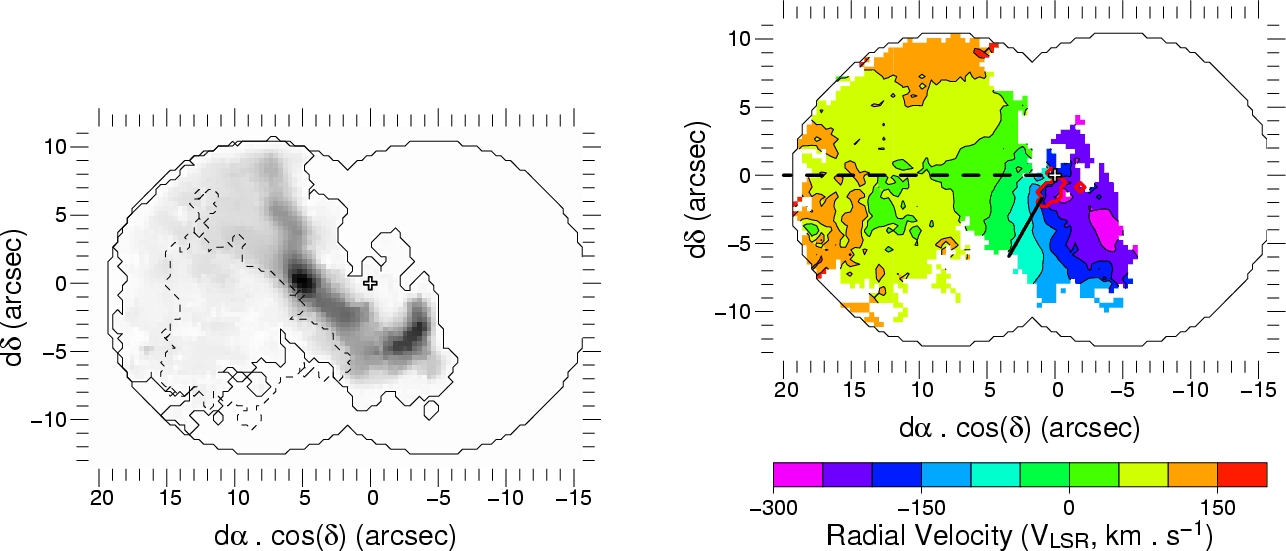 |
Figure A.1: a) Northern Arm. |
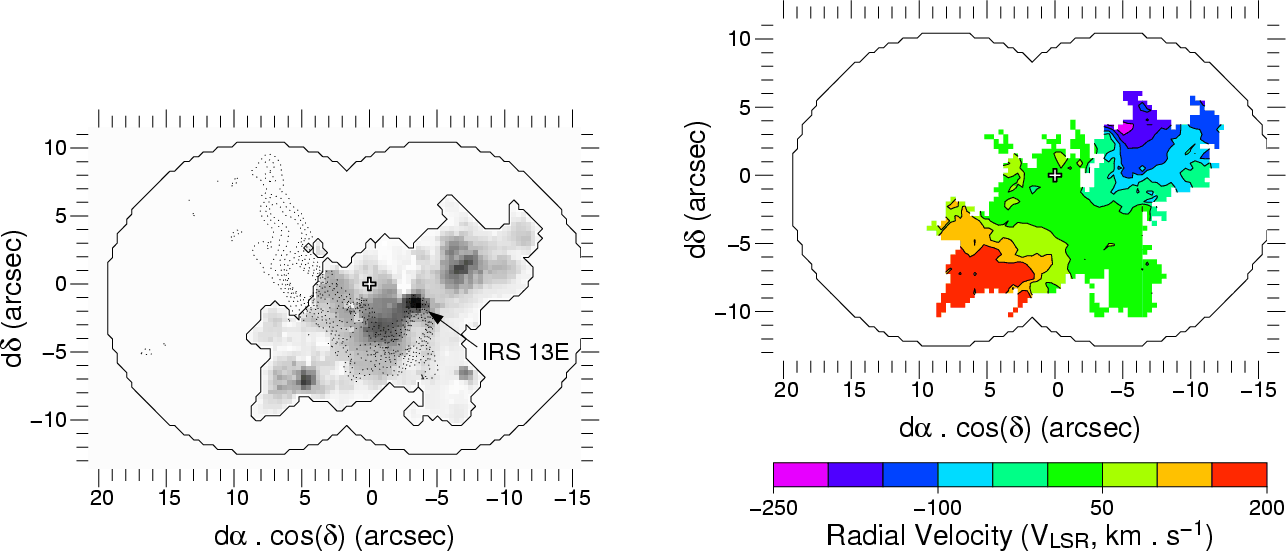 |
Figure A.2: b) Bar. |
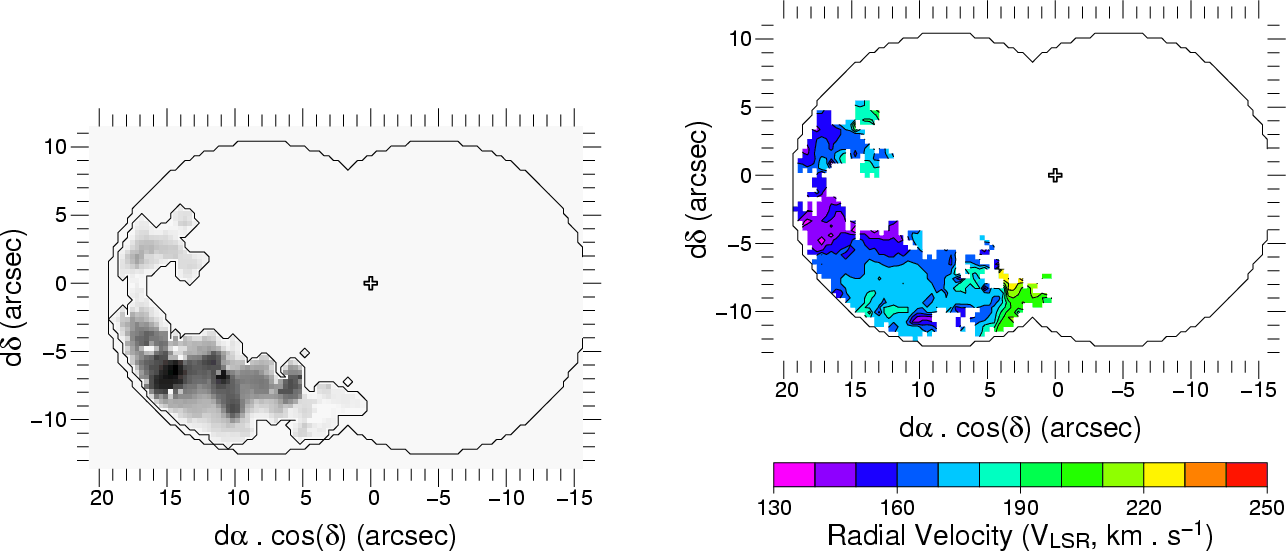 |
Figure A.3: c) Ribbon. |
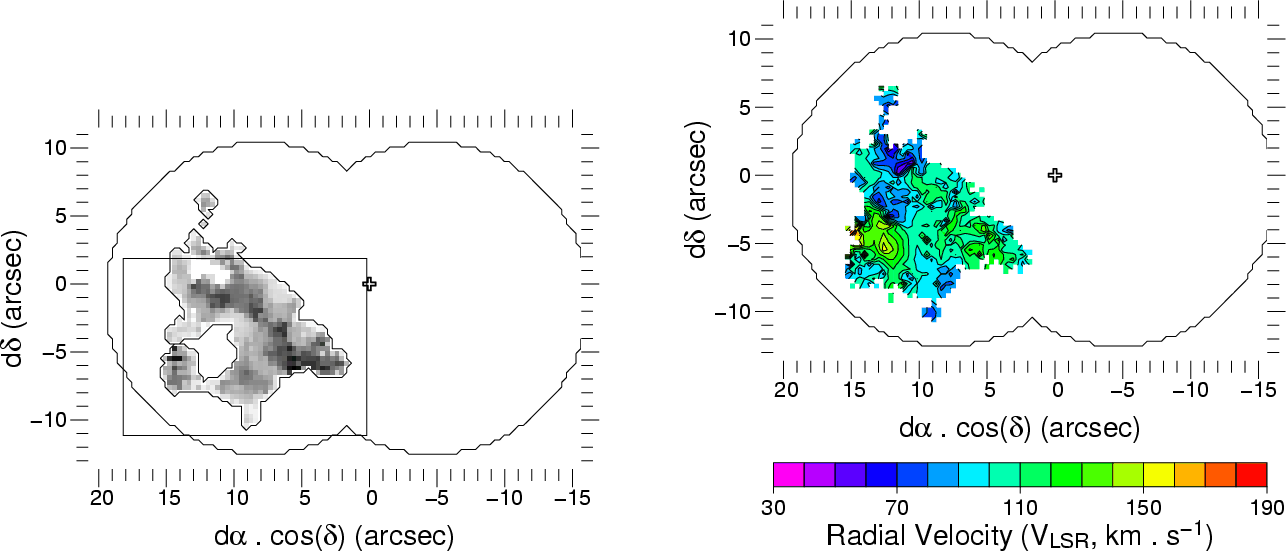 |
Figure A.4: d) Eastern Bridge. The box shows the field of Fig. B.1. |
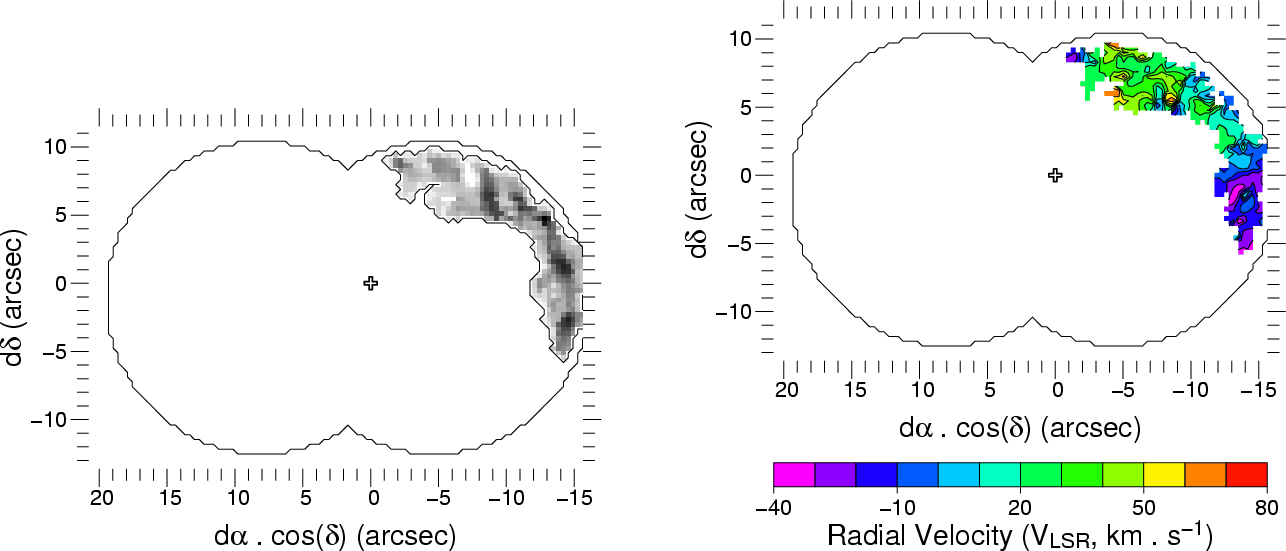 |
Figure A.5: e) Western Arc. |
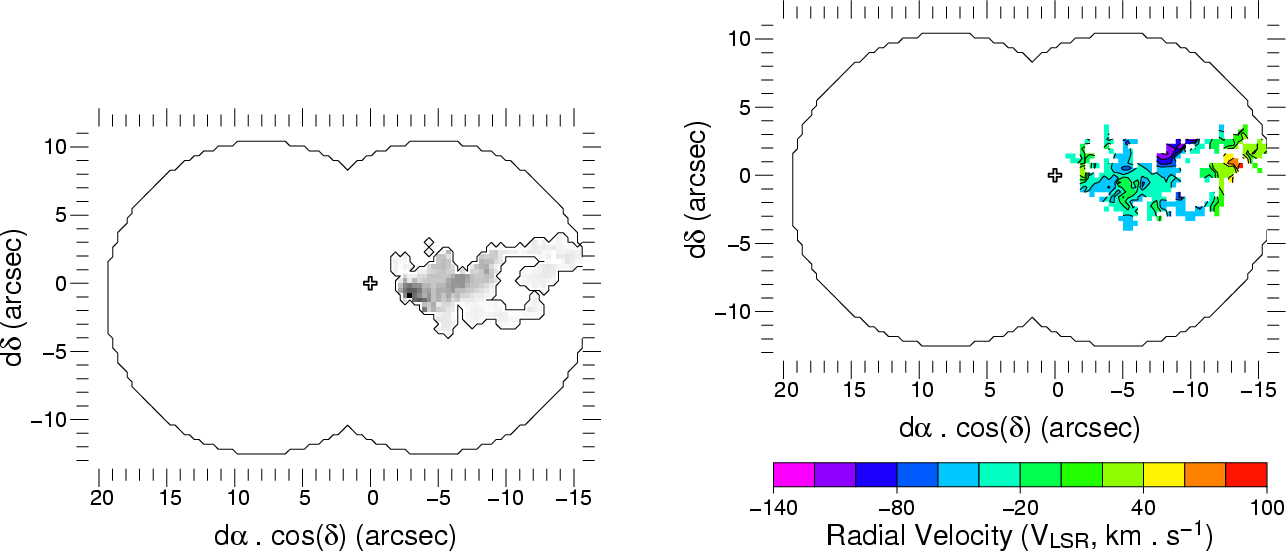 |
Figure A.6: f) Western Bridge. |
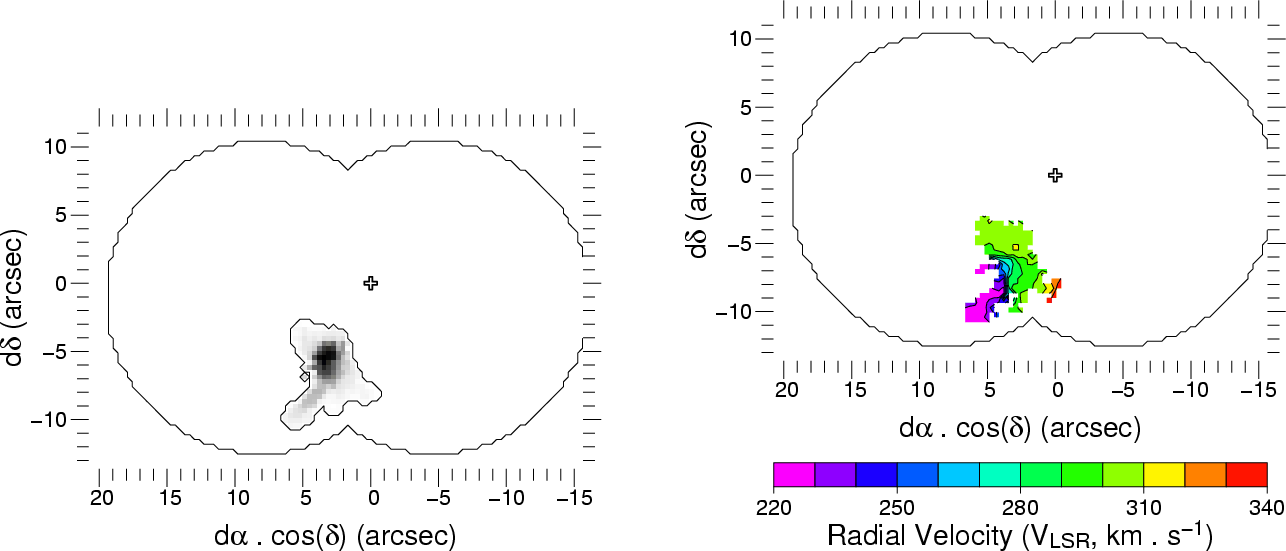 |
Figure A.7: g) Tip. |
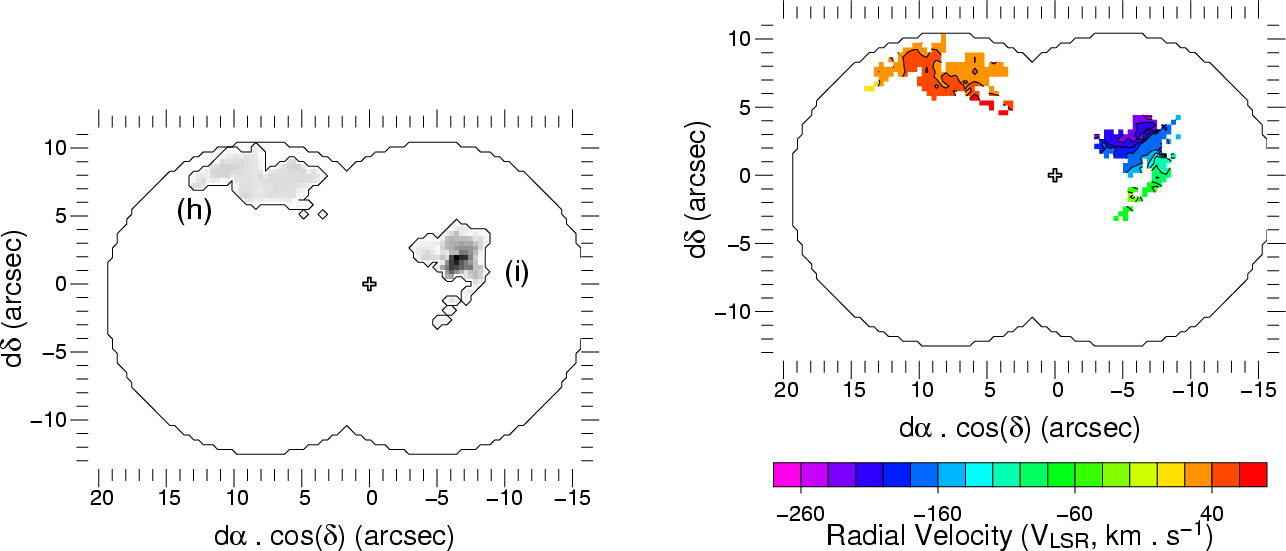 |
Figure A.8: h) Northern Arm Chunk and i) Bar Overlay. |
(a) Though the Northern Arm remains the most prominent feature of the
Minispiral, the mean value of its normalized [He I]/[Br] line ratio (Minicavity excluded) is one of the lowest (0.74), being only
higher than the value measured for the small part of the Western Arc that we
detect. Considering that the faintest parts of the Northern Arm are not
detected in He I, this value may be even smaller. The line ratio is
higher on the western side of the bright rim, and in He I this rim has
the shape of a part of a circle surrounding the GCIRS 16 cluster. This
circle continues further to the northwest, forming a rather faint horn at the
location where, in Br,
the rim bends abruptly (
to the north
and
to the east of Sgr A,
spot C
on Fig. 8).
The open ring of ionized gas surrounding the Minicavity is on average brighter
in He I than the rest of the Northern Arm relative to the intensity
distribution in Br.
Its innermost border is even brighter. Its western
edge, where GCIRS 13 and GCIRS 2 lie, is very bright, and
looks like a vertical bar going from GCIRS 13 almost to the declination
of the AF star, making the Minicavity look angular. Physical
implications of these variations of the line ratio are discussed in
Sect. 6.
![\begin{figure}
\par\includegraphics[width=9.5cm,clip]{0209fiB1.eps}
\end{figure}](/articles/aa/full/2004/40/aa0209-03/img93.gif) |
Figure B.1:
Composite image of the Eastern Bridge,
from images integrated from 50 to 100 km s-1 in the Br
(red) and He I (blue) cubes. The positions of four helium stars
at the upper right corner are given by red crosses (GCIRS 16NE, 16C, 16SW
and 33SE). The field is shown in Fig. A.4. |
(b) The Bar is the main feature with the highest
[He I]/[Br] ratio, with a normalized value of 0.99. However,
we do not detect helium towards the full extent of its Br counterpart.
(d) The Eastern Bridge (Fig. B.1) is clearly identified, but
it presents a shape much different from the one observed in Br.
It
is brighter on its southern side, and the northern parts are not detected by
the procedure. The southern parts extend horizontally, following the edge
of the Eastern Arm Ribbon upon which it is superimposed, with a velocity
offset between the Eastern Bridge and the Ribbon of about -50 km s-1
(measured in Br,
but the agreement is good between the two lines),
which again suggests that the two features are related. The bow-shaped
bright rim of the structure, which is almost vertical and gives its name to
the Eastern Bridge, is offset in He I by about
to the West
relative to Br.
(e) A small part of the Western Arc is detected within our field; its
[He I]/[Br] value is the smallest, but only a few points are
detected both in He I and Br.
(g) Due to the lower spectral resolution of the He I data
(52.9 km s-1, vs. 21.3 km s-1 in Br), the Tip is not
separated from the Ribbon by our procedure in this band. However, it is
clearly seen. It is the brightest feature relative to its Br counterpart, with a normalized line ratio of 2.64. The line ratio
is also noticeably brighter on its southwestern edge than on its
northeastern edge, which is not detected in He I by the decomposition
procedure. The Microcavity is also observed in He I.