![[*]](/icons/foot_motif.gif)
A&A 425, 997-1008 (2004)
DOI: 10.1051/0004-6361:20048006
J.-L. Beuzit 1,2 - D. Ségransan 1 - T. Forveille 1,2 - S. Udry 4 - X. Delfosse 1,3 - M. Mayor 4 - C. Perrier 1 - M.-C. Hainaut 2,5 - C. Roddier 6 - F. Roddier 6 - E. L. Martín 6
1 - Observatoire de Grenoble,
Université J. Fourier, BP 53,
38041 Grenoble,
France
2 -
Canada-France-Hawaii Telescope Corporation,
65-1238 Mamalahoa Highway,
Kamuela, HI 96743, Hawaii,
USA
3 -
Instituto de Astrofisica de Canarias
38200 La Laguna, Tenerife,
Canary Islands, Spain
4 -
Observatoire de Genève,
1290 Sauverny,
Switzerland
5 -
Now at, Gemini Observatory, Southern Operations Center,
c/o AURA Inc., Casilla 603, La Serena,
Chile
6 -
Institute for Astronomy,
University of Hawaii,
2680 Woodlawn Drive, Honolulu,
HI 96822, Hawaii, USA
Received 15 June 2001 / Accepted 26 May 2004
Abstract
We present some results of a CFHT adaptive optics search
for companions to nearby dwarfs. We identify 21 new components
in solar neighbourhood systems, of which 13 were found while surveying
a volume-limited sample of M dwarfs within 12 pc.
We are obtaining complete observations for this
subsample, to derive unbiased multiplicity statistics for the
very-low-mass disk population. Additionally, we resolve for the first time
6 known spectroscopic or astrometric binaries, for a total of 27 newly
resolved companions. A significant fraction of the new binaries has favourable
parameters for accurate mass determinations.
The newly resolved companion of Gl 120.1C was thought to have a
spectroscopic minimum mass in the brown-dwarf range (Duquennoy & Mayor
1991), and it contributed to the statistical evidence
that a few percent of solar-type stars might have close-in brown-dwarf
companions.
We find that Gl 120.1C actually is an unrecognised double-lined
spectroscopic pair. Its radial-velocity amplitude had therefore been strongly
underestimated by Duquennoy & Mayor (1991), and it
does not truly belong to their sample of single-lined systems with
minimum spectroscopic mass below the substellar limit.
We also present the first direct detection of Gl 494B, an astrometric
brown-dwarf candidate. Its luminosity straddles
the substellar limit, and it is a brown dwarf if its age is less than
 300 Myr. A few more years of observations will ascertain its mass
and status from first principles.
300 Myr. A few more years of observations will ascertain its mass
and status from first principles.
Key words: stars: binaries: general - stars: low-mass, brown dwarfs - techniques: miscellaneous
As discussed in more detail in the first paper of this series (Delfosse et al. 1999b), stellar multiplicity is a key input for a number of important astrophysical issues. The joint distributions of system masses, mass ratios, semi-major axes and eccentricities represent powerful diagnostics of the formation and early dynamical evolution of stellar systems (e.g. Duchêne 1999; Patience et al. 1998; Bonnell et al. 1998; Kroupa 2001). For most stellar classes, unresolved companions also represent the main uncertainty when deriving the mass or luminosity function (e.g. Kroupa 2001).
The multiplicity statistics are now fairly well determined for the G
and K dwarfs (Duquennoy & Mayor 1991; Halbwachs et al. 1998), but are considerably more uncertain for higher and
lower-mass stars. For M dwarfs the samples are either
very small (34 M dwarfs within 5.2 pc; Henry & McCarthy 1990;
Leinert et al. 1997), or they have significant and uncertain
completeness corrections (Reid & Gizis 1997; Fisher & Marcy
1992). The M-dwarf binary fractions derived from these data
range from 26% (Leinert et al. 1997) through 35% (Reid & Gizis
1997) to 42% (Fisher & Marcy 1992). This points
towards a smaller fraction of multiple stars than the 57% found
amongst G dwarfs (Duquennoy & Mayor 1991), but still
with relatively modest significance (3 for the 5.2 pc sample).
The parameter distributions, are determined only from the subsamples of
identified binaries, and are thus even more uncertain. As just one
consequence, contrasting assumptions on
stellar multiplicity (Kroupa 1995; Reid & Gizis 1997)
can remain compatible with the meager (and somewhat controversial)
observational constraints while leading to very different luminosity functions.
for the 5.2 pc sample).
The parameter distributions, are determined only from the subsamples of
identified binaries, and are thus even more uncertain. As just one
consequence, contrasting assumptions on
stellar multiplicity (Kroupa 1995; Reid & Gizis 1997)
can remain compatible with the meager (and somewhat controversial)
observational constraints while leading to very different luminosity functions.
To ascertain the multiplicity statistics of very low mass stars, we are surveying volume-limited samples of nearby M dwarfs for companions, combining accurate radial-velocity monitoring with adaptive optics imaging in the near-infrared. These observing techniques together ensure a good sensitivity to stars and brown dwarfs at all separations (Delfosse et al. 1999b), as well as some useful sensitivity to giant planets (Delfosse et al. 1998b). This work was initiated for a 9 pc northern sample (Delfosse et al. 1998a), using the ELODIE spectrograph at Observatoire de Haute-Provence (Baranne et al. 1996) and the PUEO adaptive optics system at CFHT (Rigaut et al. 1998). When the HIPPARCOS parallaxes became available in 1997 we altered the distance limit to 9.25 pc, to retain two stars that were already well observed at that point (GJ 2066 and Gl 424, neither of which is a binary). This also adds two other stars, LHS 2784 and the newly identified binary LHS 224. To further improve the statistics, we now monitor a larger 12 pc sample with the FEROS (Kaufer et al. 2000), ELODIE and HARPS (Mayor et al. 2003) spectrographs, and observe it with the NAOS adaptive optics system (Rousset et al. 2000) on the VLT, as well as with PUEO on CFHT.
As well as these volume-limited samples, we observe with the same instruments two smaller and more loosely defined collections of "interesting'' spectroscopic or astrometric binaries, selected based on their apparent potential for accurate mass measurements, or in a few cases for having a possibly substellar companion. The first of these samples was gathered during a number of published and unpublished CORAVEL programs, while the second was culled from the literature. Neither is statistically well defined.
As a result of these programs, we recently published 16 accurate masses (Ségransan et al. 2000), and re-discussed the Mass-Luminosity relation of the M dwarfs (Delfosse et al. 2000). Here we present stellar components that were newly identified, or newly resolved, during the adaptive optics observations. Section 2 presents the observing and data-reduction techniques, while Sect. 3 discusses the properties of the individual new detections. A statistical analysis of the northern 9.25 pc sample will be published in a forthcoming paper.
MONICA was used for the commissioning of the AOB during the first semester
of 1996 and for all science runs until November 1997. It was a facility
instrument based on a NICMOS-3 256  256 detector, and was
originally designed by the Université de Montréal for the Observatoire
du Mont Mégantic and CFHT F/8 Cassegrain focii. The camera was retrofitted
with new optics for use at the F/20 output focus of AOB. It produced a
plate scale of 0
256 detector, and was
originally designed by the Université de Montréal for the Observatoire
du Mont Mégantic and CFHT F/8 Cassegrain focii. The camera was retrofitted
with new optics for use at the F/20 output focus of AOB. It produced a
plate scale of 0
 034 per pixel, properly sampling diffraction-limited
CFHT images down to the J band (1.25
034 per pixel, properly sampling diffraction-limited
CFHT images down to the J band (1.25  m). The resulting field size is
 .
.
Since December 1997, MONICA has been replaced on PUEO by KIR, an
imaging camera which records a 16 times larger field on an HAWAII
1024 1024 HgCdTe array. KIR also has improved optical quality
and detector performances, and therefore a better detectivity. The KIR
plate scale is 0
035 per pixel, for a total field size of
 .
.
We also observed Gl 268.3 with the Keck II AO facility in February
2000. The Keck AO system uses a Shack-Hartmann wavefront sensor to measure
the atmospheric distortions and a 349-actuator piezo-stack deformable
mirror to correct for these distortions (Wizinowich et al.
2000a,b). The images
were recorded with the KCAM infrared camera, which has a plate scale of
0
0175 per pixel and an L-shaped field-of-view of 4
5 on a
long side.
m). Under good to moderate seeing conditions H represents the best
compromise between sensitivity, corrected image quality and sky
brightness. Under worse seeing conditions the Ks filter was used instead to
maintain acceptable image quality. Sources which saturate the detectors in
the minimum available integration time through the H (1.65 m) or Ks (2.23 m) broad-band filter (brighter than K=7 under typical
conditions) were observed through corresponding narrow-band filters,
usually [Fe+] (1.644 m) and either H2 (2.122 m) or
Brackett (2.166 m). Whenever a target appeared double or
elongated, it was usually observed with additional filters to
determine relative colour indices. Integration times per frame typically
range between a few tenths of a second and 20 s. In order to
improve the signal-to-noise ratio and to average the residual uncorrected
atmospheric turbulence, series of 4 min total integration times
were accumulated in a four or five positions mosaic pattern. This observing
sequence also provides for a well determined sky background and a good
correction for detector cosmetic defects. Wavefront sensing was performed
on the sources themselves, which are almost always bright enough (R<14) to
ensure diffraction-limited images in H and K bands under standard Mauna Kea
atmospheric conditions (i.e. seeing up to 1
(2.166 m). Whenever a target appeared double or
elongated, it was usually observed with additional filters to
determine relative colour indices. Integration times per frame typically
range between a few tenths of a second and 20 s. In order to
improve the signal-to-noise ratio and to average the residual uncorrected
atmospheric turbulence, series of 4 min total integration times
were accumulated in a four or five positions mosaic pattern. This observing
sequence also provides for a well determined sky background and a good
correction for detector cosmetic defects. Wavefront sensing was performed
on the sources themselves, which are almost always bright enough (R<14) to
ensure diffraction-limited images in H and K bands under standard Mauna Kea
atmospheric conditions (i.e. seeing up to 1
 ). The atmospheric
turbulence and AO correction for a given set of observations were
characterized by simultaneously recording the wavefront sensor measurements
and deformable mirror commands, from which an accurate synthetic PSF
was later generated (Sect. 2.3). Astrometric
calibration fields, such as the central region of the Trapezium Cluster in
the Orion Nebula (McCaughrean & Stauffer 1994), were
observed to accurately determine the actual detector plate scale and
position angle (PA) origin. Flat-field frames were obtained on the
illuminated dome for each filter.
). The atmospheric
turbulence and AO correction for a given set of observations were
characterized by simultaneously recording the wavefront sensor measurements
and deformable mirror commands, from which an accurate synthetic PSF
was later generated (Sect. 2.3). Astrometric
calibration fields, such as the central region of the Trapezium Cluster in
the Orion Nebula (McCaughrean & Stauffer 1994), were
observed to accurately determine the actual detector plate scale and
position angle (PA) origin. Flat-field frames were obtained on the
illuminated dome for each filter.
The Keck II observations of Gl 268.3 were obtained in H band using a
neutral density filter (ND2, attenuation of 100). A total of 20 individual exposures were co-added to obtain the final 40 s image.
Sky subtraction was performed using images of a close-by field observed
immediately after the science images. No flat-field correction was applied
for these data.
For resolved binary systems, the separation, position angle and magnitude difference between the two stars were then determined using deconvolution within the AOPHOT software developed by Véran (1998a). For the PUEO observations the long-exposure PSF associated with each AO corrected image was reconstructed from the wavefront sensor data and deformable mirror commands recorded during each data acquisition. The available tools (Véran et al. 1997; Thomas et al. 1998) provide an accurate estimate of the AO-corrected, long-exposure PSF, when the guide source is of magnitude 13 or brighter. No wavefront sensor and deformable mirror data were available for the Keck observation, and we therefore instead had to generate a theoretical estimate of the PSF. This has no adverse consequences for that particular observation: for such a well resolved and high contrast companion the derived parameters are quite insensitive to the adequacy of the estimated PSF. In a second stage, the reconstructed or estimated PSF is used to deconvolve the AO image and obtain the pixel coordinates of the primary and secondary stars, as well as their magnitude difference. Véran et al. (1998b) provide a complete description of this method and an assessment of its accuracy.
Application of the astrometric calibrations then yields the desired parameters. Images of the newly resolved binaries are presented in Figs. 1, 2 and 3.
 |
Figure 1: Adaptive optics images of new binaries in the volume-limited samples. The scale of each box is indicated by a 0.3'' bar at the bottom left corner. North is up and East is left. |
| Open with DEXTER | |
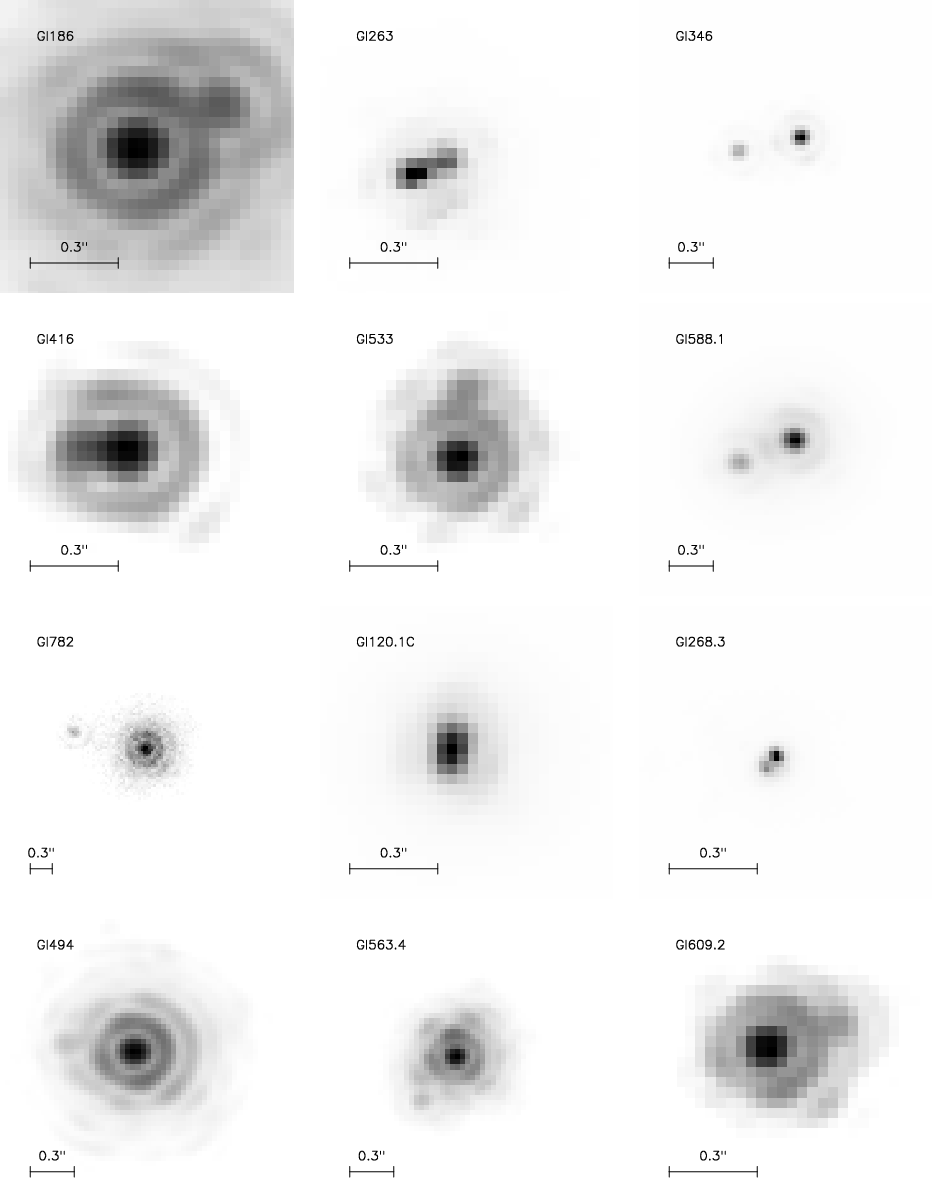 |
Figure 2: Adaptive optics images of additional newly resolved binaries. Scale and orientation are as in Fig. 1. |
| Open with DEXTER | |
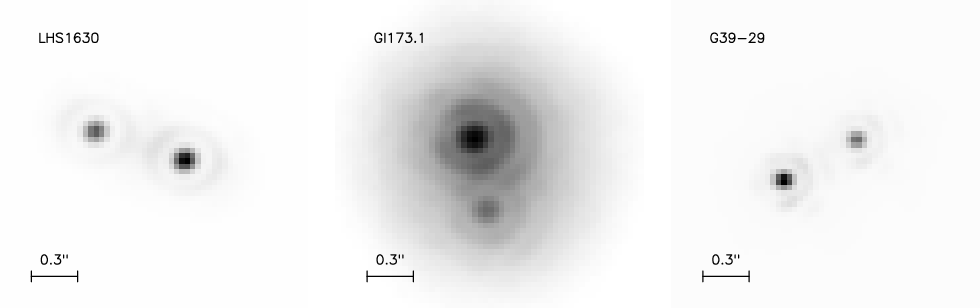 |
Figure 3: Continuation of Fig. 2. |
| Open with DEXTER | |
In this section we discuss the properties of the new companions. Table 1 summarizes the information available on the systems, and Table 2 presents the new adaptive optics information.
1 km s-1 drift of the
photocentric radial velocity, as well as variations in the width of the
correlation profile. From the measured K-band magnitude difference and the
relative slopes of the V and K Mass-Luminosity relations, we estimate a
V-band magnitude difference of
 .
Accounting for the
secondary star therefore changes the photometric parallax from
.
Accounting for the
secondary star therefore changes the photometric parallax from
 mas, as listed in the CNS3 catalogue, to 100 mas. This
pushes the system out of the 9.25 pc volume, but it probably remains within
12 pc.
mas, as listed in the CNS3 catalogue, to 100 mas. This
pushes the system out of the 9.25 pc volume, but it probably remains within
12 pc.
 .
We have now determined a combined
visual+spectroscopic
orbit for this system, with a period of 3.25 years. The visual part of the
orbit remains noisy because several observations were obtained under
mediocre weather conditions, and for a 4-m telescope the separation of
this pair often demands short-wavelength observations. With a few
additional good measurements at critical phases, LHS 224 should provide
two accurate masses.
.
We have now determined a combined
visual+spectroscopic
orbit for this system, with a period of 3.25 years. The visual part of the
orbit remains noisy because several observations were obtained under
mediocre weather conditions, and for a 4-m telescope the separation of
this pair often demands short-wavelength observations. With a few
additional good measurements at critical phases, LHS 224 should provide
two accurate masses.
Initially known as a wide (
 )
visual binary, the GJ 2069 system
was found to be quadruple by Delfosse et al. (1999b). They
identified GJ 2069A as an eclipsing double-lined spectroscopic binary,
GJ 2069Aab, and resolved a 0.36'' companion to GJ 2069B, GJ 2069C, with a
K-band magnitude difference of 0.45 (Table 2 contains a better
measurement on an additional date). Delfosse et al. (1999a)
and Ségransan et al. (2000) determined masses with 0.2%
precision for the two spectroscopic components of GJ 2069A, and suggest
that the system is metal-rich by 0.5 dex. We now find that adaptive
optics images of the GJ 2069A spectroscopic pair additionally resolve a
fainter companion, GJ 2069D, with
)
visual binary, the GJ 2069 system
was found to be quadruple by Delfosse et al. (1999b). They
identified GJ 2069A as an eclipsing double-lined spectroscopic binary,
GJ 2069Aab, and resolved a 0.36'' companion to GJ 2069B, GJ 2069C, with a
K-band magnitude difference of 0.45 (Table 2 contains a better
measurement on an additional date). Delfosse et al. (1999a)
and Ségransan et al. (2000) determined masses with 0.2%
precision for the two spectroscopic components of GJ 2069A, and suggest
that the system is metal-rich by 0.5 dex. We now find that adaptive
optics images of the GJ 2069A spectroscopic pair additionally resolve a
fainter companion, GJ 2069D, with
 and
and
 in
early 2000. The system is thus actually quintuple.
in
early 2000. The system is thus actually quintuple.
The extrapolated A-D luminosity contrast in the V band is
 ,
and detecting D in integrated visible spectra would therefore require a
much better S/N ratio than what we have secured up to now. Eventually the
gravitational pull of GJ 2069D will also cause a measurable drift in the
systemic velocity of GJ 2069Aab. We have attempted to fit the velocities of
Aa and Ab for this drift, in addition to the elements of the Aab orbit, but
find that this does not significantly decrease the
,
and detecting D in integrated visible spectra would therefore require a
much better S/N ratio than what we have secured up to now. Eventually the
gravitational pull of GJ 2069D will also cause a measurable drift in the
systemic velocity of GJ 2069Aab. We have attempted to fit the velocities of
Aa and Ab for this drift, in addition to the elements of the Aab orbit, but
find that this does not significantly decrease the  of the
adjusted model. The indeterminacy of this drift indicates that the period
of the Aab-D system is much longer than the present 6-year
span of our radial-velocity data, consistently with the period estimated
from the separation. In the long run masses can be determined for all 5 components of the GJ 2069 system, and the radii for the two components
of the eclipsing pair have been measured (Ribas 2003). The
system will eventually provide an extremely tight test of low-mass
theoretical isochrones.
of the
adjusted model. The indeterminacy of this drift indicates that the period
of the Aab-D system is much longer than the present 6-year
span of our radial-velocity data, consistently with the period estimated
from the separation. In the long run masses can be determined for all 5 components of the GJ 2069 system, and the radii for the two components
of the eclipsing pair have been measured (Ribas 2003). The
system will eventually provide an extremely tight test of low-mass
theoretical isochrones.
Table 1: Systems with new low-mass companions in the solar neighbourhood. Spectral types are from Reid et al. (1995), except for Gl 173.1, Gl 416, Gl 120.1C, Gl 563.4, and Gl 609.2 which were taken from SIMBAD. They always refer to the combined light of the system. Parallaxes (in milliarcseconds) are taken from (h) the HIPPARCOS catalogue (ESA 1997), (y) the Yale parallax catalogue (van Altena et al. 1995), (s) Söderhjelm 1999, or are photometric parallaxes from (g) the CNS3 (Gliese & Jahreiss 1991) or (r) spectrophotometric parallaxes from Reid et al. (1995) that we approximately correct for the previously unrecognized multiplicity. Program codes are S9 and S12 for the 9.25 and 12 pc volume-limited surveys, C for the unpublished CORAVEL spectroscopic binaries, and L for the spectroscopic and astrometric binaries from the literature. A number of objects belong to multiple samples, and some targets from the nominally volume-limited samples have now been found to lie at larger distances.
 km s-1, G 165-8 is one of only three known M dwarf ultra-fast
rotators (
km s-1, G 165-8 is one of only three known M dwarf ultra-fast
rotators (
 km s-1) within 10 pc (Delfosse et al. 1998a).
As a consequence of this fast rotation it is magnetically very active, as
illustrated by its figuring in the catalogues of both the FIRST radio and
the ROSAT X-ray surveys. An adaptive optics image shows that it is a binary
with
km s-1) within 10 pc (Delfosse et al. 1998a).
As a consequence of this fast rotation it is magnetically very active, as
illustrated by its figuring in the catalogues of both the FIRST radio and
the ROSAT X-ray surveys. An adaptive optics image shows that it is a binary
with
 and a separation of 0.17'' in early 2000. From this
we infer a V band magnitude difference of
and a separation of 0.17'' in early 2000. From this
we infer a V band magnitude difference of
 ,
and correct the
photometric parallax from the CNS3 value of
,
and correct the
photometric parallax from the CNS3 value of
 mas to
  mas.
G 165-8 therefore most likely does not truly belong to the 9.25 pc volume,
but probably remains within 12 pc.
mas.
G 165-8 therefore most likely does not truly belong to the 9.25 pc volume,
but probably remains within 12 pc.
Of the two other ultra-fast rotators, Gl 791.2 also is a binary (Hershey 1978; Benedict et al. 2000) with a similar separation. The third ultra-fast rotator, G 188-38, has to date no detected companion. Its fast rotation would prevent the radial-velocity detection of any close companion, so that a link between fast rotation and the presence of a companion remains a possibility. The apparent correlation, however, could well represent no more than a fluke of small number statistics.
10 pc, was identified as a 15 year
low amplitude single-lined spectroscopic binary by Nidever et al.
(2002), who derived preliminary orbital elements.
Our adaptive optics observations resolve the secondary at a 4 AU
projected separation, and the large contrast from the primary suggests
that it is a late-M dwarf. An unreduced observation confirms the relatively
rapid movement and the reasonable prospects for mass measurements.
 Wilson radial velocities from the mid-40s (Abt 1970). 11
CORAVEL measurements evenly spread over 6000 days however do show long-term
radial-velocity variations, but with an amplitude of only 4 km s-1. With
hindsight, the earlier report probably reflects underestimated
measurement errors for this faint star, even though Gl 277A truly is a
low-amplitude single-lined spectroscopic binary.
Adaptive optics images in April 2000 resolve it into a 0.68''pair with a K band contrast of 2 mag. The likely orbital period
is consistent with the spectroscopic lower bound.
Wilson radial velocities from the mid-40s (Abt 1970). 11
CORAVEL measurements evenly spread over 6000 days however do show long-term
radial-velocity variations, but with an amplitude of only 4 km s-1. With
hindsight, the earlier report probably reflects underestimated
measurement errors for this faint star, even though Gl 277A truly is a
low-amplitude single-lined spectroscopic binary.
Adaptive optics images in April 2000 resolve it into a 0.68''pair with a K band contrast of 2 mag. The likely orbital period
is consistent with the spectroscopic lower bound.
 century.
Individual masses for the two visual components were first determined by
Heintz (1969), and the system actually contributed two data points
to the classic Henry & Mc Carthy (1993) Mass-Luminosity paper.
The CNS3 catalogue however notes the primary as a possible spectroscopic
binary, the Fourth Catalogue of Interferometric Measurements of Binary
Stars (Hartkopf et al., on-line version)
similarly mentions tentative evidence for an additional faint component,
and Söderhjelm (1999) remarks that the primary is
overmassive. Gl 508 is indeed seen as a triple-lined spectroscopic
system in many CORAVEL scans, and a preliminary orbit for the inner
pair has P = 450 days.
Gl 508A is also obviously elongated in adaptive optics images
obtained in April 2000, with an estimated contrast of
century.
Individual masses for the two visual components were first determined by
Heintz (1969), and the system actually contributed two data points
to the classic Henry & Mc Carthy (1993) Mass-Luminosity paper.
The CNS3 catalogue however notes the primary as a possible spectroscopic
binary, the Fourth Catalogue of Interferometric Measurements of Binary
Stars (Hartkopf et al., on-line version)
similarly mentions tentative evidence for an additional faint component,
and Söderhjelm (1999) remarks that the primary is
overmassive. Gl 508 is indeed seen as a triple-lined spectroscopic
system in many CORAVEL scans, and a preliminary orbit for the inner
pair has P = 450 days.
Gl 508A is also obviously elongated in adaptive optics images
obtained in April 2000, with an estimated contrast of
 and a separation of approximately 0.1''. It is now clear that Gl 508
must be analysed as a triple system. Given the wealth of existing visual
data for the long-period orbit, the system offers excellent prospects
of shortly determining all three masses.
and a separation of approximately 0.1''. It is now clear that Gl 508
must be analysed as a triple system. Given the wealth of existing visual
data for the long-period orbit, the system offers excellent prospects
of shortly determining all three masses.
10 pc. April 2000 adaptive optics images
turn out to resolve it into a 0.30'' pair with a K band contrast of
2 mag. An unreduced measurement in 2001 demonstrates a rapid movement,
and confirms the excellent prospects for shortly obtaining two accurate
masses.
Table 2: Adaptive optics measurement of the new low-mass companions. Gl 268.3 was observed with the Keck adaptive optics system. All other observations were obtained at CFHT with the PUEO adaptive optics system. Periods listed within parentheses are estimated from the observed separation, the distance to the system and its approximate mass. They are uncertain by a factor of approximately 3. 0.5 dex.
The K3-dwarf Gl 173.1A forms a 34'' common proper motion pair with the
M3-dwarf Gl 173.1B. CORAVEL observations show that A is a single-lined
spectroscopic binary with a 610-day period.
A March 1999 adaptive optics image also resolves it into a 0.47'' pair with
 .
At the 28 pc distance of the system, the semi-major axis
of a one solar mass system with the 610 days spectroscopic period is 0.05'',
well below the observed separation.
The spectroscopic (Gl 173.1Ab) and adaptive optics Gl 173.1C) companions
of Gl 173.1Aa are therefore different objects, and the Gl 173.1 system is
at least quadruple. The expected period of the AC pair is of the order
of a century, making it of limited interest for mass determinations.
The spectroscopic pair could perhaps be resolved by adaptive optics systems on
8 m-class telescopes, but it may need long-baseline interferometric
observations if its contrast is large.
.
At the 28 pc distance of the system, the semi-major axis
of a one solar mass system with the 610 days spectroscopic period is 0.05'',
well below the observed separation.
The spectroscopic (Gl 173.1Ab) and adaptive optics Gl 173.1C) companions
of Gl 173.1Aa are therefore different objects, and the Gl 173.1 system is
at least quadruple. The expected period of the AC pair is of the order
of a century, making it of limited interest for mass determinations.
The spectroscopic pair could perhaps be resolved by adaptive optics systems on
8 m-class telescopes, but it may need long-baseline interferometric
observations if its contrast is large.
40 years, is compatible with the lower limit on the spectroscopic
period and the two most likely coincide.
1.2,
and as a result correct the  mas spectro-photometric parallax
(Reid et al. 1995) to
mas spectro-photometric parallax
(Reid et al. 1995) to  mas.This nominally pushes Gl 346
beyond the 25 pc limit of the successive Gliese catalogues.
mas.This nominally pushes Gl 346
beyond the 25 pc limit of the successive Gliese catalogues.
 mag.
This is small enough that neglecting the secondary light biases
the single-lined orbital elements, which we therefore refrain
from presenting. Modern spectrographs will easily detect the two
components at the next periastron in early 2005, and it will then produce
two accurate masses.
mag.
This is small enough that neglecting the secondary light biases
the single-lined orbital elements, which we therefore refrain
from presenting. Modern spectrographs will easily detect the two
components at the next periastron in early 2005, and it will then produce
two accurate masses.
 .
The extrapolated
contrast in the V band (3 mag) is sufficiently large that
any systematic error stemming from the neglected secondary light are
well below our current random errors on the orbital elements. Spectral
lines from the secondary can probably be detected at the maximum
radial-velocity separation (15 km s-1) though, and the system would
then offer excellent prospects for accurate mass measurements.
.
The extrapolated
contrast in the V band (3 mag) is sufficiently large that
any systematic error stemming from the neglected secondary light are
well below our current random errors on the orbital elements. Spectral
lines from the secondary can probably be detected at the maximum
radial-velocity separation (15 km s-1) though, and the system would
then offer excellent prospects for accurate mass measurements.
 .
The expected period is consistent with the
spectroscopic lower bound, strongly suggesting that the same companion
was detected.
.
The expected period is consistent with the
spectroscopic lower bound, strongly suggesting that the same companion
was detected.
3 km s-1 over 15 years. An adaptive optics image in July 2001
resolves the system into a 1'' pair with
.
The current angular
separation and the parallax indicate a very long period, consistent with the
spectroscopic lower bound.
The Gl 120.1 system associates Gl 120.1AB, a  yrs visual pair of
K1/K2 dwarfs, with Gl 120.1C, a K2 dwarf, at a projected distance of
30''. Duquennoy & Mayor (1991) found the C component
to be a spectroscopic binary and derived a 1.5-yr single-lined orbit. The
minimum mass of the secondary, for this orbit, is
yrs visual pair of
K1/K2 dwarfs, with Gl 120.1C, a K2 dwarf, at a projected distance of
30''. Duquennoy & Mayor (1991) found the C component
to be a spectroscopic binary and derived a 1.5-yr single-lined orbit. The
minimum mass of the secondary, for this orbit, is
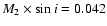 M
M
 and well below the limit for stable hydrogen
nuclear burning. Gl 120.1C therefore contributes to the statistical excess
of such companions that Duquennoy & Mayor (1991) found over
the numbers expected for distributions of companion masses that include no
brown dwarfs. As such it has been discussed in a number of the
papers (e.g. Mazeh 1987; Heacox 1999) which examine
the significance of the apparent dearth of close brown-dwarf companions
around solar-type stars (the "brown dwarf desert''), compared with the
larger number of stellar and planetary companion detections.
and well below the limit for stable hydrogen
nuclear burning. Gl 120.1C therefore contributes to the statistical excess
of such companions that Duquennoy & Mayor (1991) found over
the numbers expected for distributions of companion masses that include no
brown dwarfs. As such it has been discussed in a number of the
papers (e.g. Mazeh 1987; Heacox 1999) which examine
the significance of the apparent dearth of close brown-dwarf companions
around solar-type stars (the "brown dwarf desert''), compared with the
larger number of stellar and planetary companion detections.
Halbwachs et al. (2000) recently obtained an astrometric orbit
from the HIPPARCOS intermediate data, which demonstrates that the pair is
in fact fairly close to face-on, with
 .
Using the
Duquennoy & Mayor (1991) radial-velocity amplitude, they
derive a mass of 0.18 M
for the spectroscopic companion. This is well
over the maximum mass of a brown dwarf, but still only one quarter of the
primary mass. From Mass-Luminosity relations (e.g. Delfosse et al.
2000) such a star is over three magnitudes fainter in the
near-IR than a K2 dwarf. It was therefore a surprise when adaptive optics
images resolved the system with approximately the expected separation, but
showed that it has a very low contrast (Fig. 2). Because the
pair is not completely separated in Fig. 2, the (zero) magnitude
difference in Table 2 is slightly correlated with the measured
separation. Any contrast above 0.3 mag would however produce images
that are very obviously incompatible with the observation. The Gl 120.1CD
pair therefore consists of a pair of early K dwarfs, rather than of a K
dwarf and a mid/late M dwarf. With this additional information, it is now
clear that Gl 120.1C is not a true single-lined system: the Duquennoy &
Mayor (1991) orbit actually underestimates the actual
velocity amplitude of the primary, because both components of this
low-inclination system contribute a significant fraction of its integrated
light, and yet they are never perceptibly separated at the
.
Using the
Duquennoy & Mayor (1991) radial-velocity amplitude, they
derive a mass of 0.18 M
for the spectroscopic companion. This is well
over the maximum mass of a brown dwarf, but still only one quarter of the
primary mass. From Mass-Luminosity relations (e.g. Delfosse et al.
2000) such a star is over three magnitudes fainter in the
near-IR than a K2 dwarf. It was therefore a surprise when adaptive optics
images resolved the system with approximately the expected separation, but
showed that it has a very low contrast (Fig. 2). Because the
pair is not completely separated in Fig. 2, the (zero) magnitude
difference in Table 2 is slightly correlated with the measured
separation. Any contrast above 0.3 mag would however produce images
that are very obviously incompatible with the observation. The Gl 120.1CD
pair therefore consists of a pair of early K dwarfs, rather than of a K
dwarf and a mid/late M dwarf. With this additional information, it is now
clear that Gl 120.1C is not a true single-lined system: the Duquennoy &
Mayor (1991) orbit actually underestimates the actual
velocity amplitude of the primary, because both components of this
low-inclination system contribute a significant fraction of its integrated
light, and yet they are never perceptibly separated at the
 resolution of the CORAVEL instruments. It therefore doesn't truly belong to
a sample of single-lined systems with minimum companion masses in the
brown-dwarf range. Its removal obviously weakens the statistical
significance of an excess of such companions, which to date
represents most of the possible evidence for a population continuity across the
"brown-dwarf desert''. One should note in addition that Halbwachs et al.
(2003)
exclude a continuity between stellar and planetary
companions to solar-type stars, through an analysis of a sample that
includes the Duquennoy & Mayor (1991) objects but
benefits from additional CORAVEL observations and from a larger
and cleaner sample.
The case
for a population in the "brown-dwarf desert'' would be further weakened
if the Duquennoy & Mayor (1991) sample and its
Halbwachs et al. (2003) update turned out to still contain
a small number of unrecognized double-lined systems, as could conceivably
be the case. We are
currently obtaining data with the ELODIE and CORALIE spectrographs to
settle this issue.
resolution of the CORAVEL instruments. It therefore doesn't truly belong to
a sample of single-lined systems with minimum companion masses in the
brown-dwarf range. Its removal obviously weakens the statistical
significance of an excess of such companions, which to date
represents most of the possible evidence for a population continuity across the
"brown-dwarf desert''. One should note in addition that Halbwachs et al.
(2003)
exclude a continuity between stellar and planetary
companions to solar-type stars, through an analysis of a sample that
includes the Duquennoy & Mayor (1991) objects but
benefits from additional CORAVEL observations and from a larger
and cleaner sample.
The case
for a population in the "brown-dwarf desert'' would be further weakened
if the Duquennoy & Mayor (1991) sample and its
Halbwachs et al. (2003) update turned out to still contain
a small number of unrecognized double-lined systems, as could conceivably
be the case. We are
currently obtaining data with the ELODIE and CORALIE spectrographs to
settle this issue.
 ,
,
 and
and
 .
Preliminary
masses of 0.49 and 0.33 solar masses can be derived from the presently
available
data, and a few additional adaptive optics observations should pinpoint
them with excellent accuracy.
.
Preliminary
masses of 0.49 and 0.33 solar masses can be derived from the presently
available
data, and a few additional adaptive optics observations should pinpoint
them with excellent accuracy.
Gl 494A is a magnetically very active M0.5 dwarf, as a result of its fast
rotation (
 km s-1, determined with ELODIE). It
is not a tidally-locked short-period binary, and the age-rotation relation
therefore implies that it is fairly young, most likely younger than 1 Gyr.
Heintz (1990, 1994) obtained a convincing 14.5-yr
astrometric orbit for Gl 494, which established that the M0.5V primary has a
much lower-mass companion. 26 CORAVEL radial-velocity measurements
show
km s-1, determined with ELODIE). It
is not a tidally-locked short-period binary, and the age-rotation relation
therefore implies that it is fairly young, most likely younger than 1 Gyr.
Heintz (1990, 1994) obtained a convincing 14.5-yr
astrometric orbit for Gl 494, which established that the M0.5V primary has a
much lower-mass companion. 26 CORAVEL radial-velocity measurements
show  1.5 km s-1 variations at approximately this
orbital period, and therefore validate the astrometric detection. Heintz
asserted the
companion to be substellar, based however on an estimated mass of 0.4 M
for an M2V primary. Gl 494A has since been reclassified as M0.5V (Reid et al.
1995), so that 0.6 M
is now a more appropriate guess for its
mass. This rescaling brings the Heintz companion mass close to the
substellar limit.
1.5 km s-1 variations at approximately this
orbital period, and therefore validate the astrometric detection. Heintz
asserted the
companion to be substellar, based however on an estimated mass of 0.4 M
for an M2V primary. Gl 494A has since been reclassified as M0.5V (Reid et al.
1995), so that 0.6 M
is now a more appropriate guess for its
mass. This rescaling brings the Heintz companion mass close to the
substellar limit.
Henry et al. (1999) did not detect the companion in either of
two HST observations with FGS3 used in TRANS mode. At the 0.4''
separation, expected from the astrometric orbit and an estimated
0.6 M
mass for the M0.5V primary, this implies a V band contrast of at
least 3.5 mag and confirms that the companion is indeed rather faint.
K band adaptive optics images in February 2000 resolve the system into a
0.48'' pair, with
 .
With MK=9.7, its spectral type is
approximately M7V (Leggett 1992). The extrapolated contrast in
the V band is very large, and does explain why the FGS observations could
not detect the companion. It should on the other hand be within reach of
HST imaging observations.
.
With MK=9.7, its spectral type is
approximately M7V (Leggett 1992). The extrapolated contrast in
the V band is very large, and does explain why the FGS observations could
not detect the companion. It should on the other hand be within reach of
HST imaging observations.
From the orbital elements of the astrometric orbit of Heinz (1994)
and the observed separation in April 1999, we can in principle determine a
scale factor between the astrometric and relative orbits of 10.8. From this
a semi-major axis of 0.55'' immediately follows for the relative orbit.
Together with the HIPPARCOS parallax this results in a system mass of
1.19 M
,
which the scale factor then splits into 1.08 M
for the
M0.5V primary and 0.11 M
for the faint secondary. The elements of the Heintz (1994)
astrometric orbit are quoted without standard errors, so that we are not
in a position to evaluate precise confidence intervals.
Still, 1.08 M
cannot possibly be the mass of a single M 0.5 dwarf, and we
also note an 80 degrees discrepancy for the predicted position angle. We
therefore suspect that either the actual confidence intervals are so wide as
to be of little use, or perhaps there is a problem in the Heintz elements, for
instance because they force a circular orbit for a system which may have
some small eccentricity.
For the time being we therefore prefer to turn to its absolute magnitude to
evaluate the position of the secondary relative to the substellar
limit. From the Baraffe et al. (1998) models,
an object of MK=9.7 has to be younger than 300 Myr to be
a brown dwarf. If it has instead reached the main sequence, its mass for the
same models would be 0.09 M
.
The age range that can be inferred from the characteristics of its primary
is at present insufficiently constrained to presently ascertain whether
Gl 494B is a
brown dwarf or a star, but whatever its status it will clearly play an
important role in characterizing the substellar transition.
Together with the Gl 569 (Martín et al. 2000) and GJ 2005
(Leinert et al. 1994) systems, Gl 494 contains one of the
faintest known objects for which dynamical masses can be obtained on realistic
timescales. Continued
observations with adaptive optics, astrometric satellites, and radial-velocity
spectrographs, have together the potential to determine its mass from first
principles and with excellent accuracy.
 1 Lib, FK5 1387, HIP 72603, HD 130819)
 .
It most likely coincides with the
spectroscopic system and offers good prospects of determining reasonably
accurate masses.
.
It most likely coincides with the
spectroscopic system and offers good prospects of determining reasonably
accurate masses.
 infrared
contrast. This translates into values for visible bands that are
somewhat beyond
the typical dynamic range of speckle observations. The Gl 609.2 system will
provide accurate masses if spectral lines from the faint secundary can be
detected, as might be possible with improved analysis tools (e.g.
Zucker et al. 2003).
infrared
contrast. This translates into values for visible bands that are
somewhat beyond
the typical dynamic range of speckle observations. The Gl 609.2 system will
provide accurate masses if spectral lines from the faint secundary can be
detected, as might be possible with improved analysis tools (e.g.
Zucker et al. 2003).
Acknowledgements
We thank the technical staff and telescope operators of CFHT for their support during these long-term observations. J.-L.B. would also like to thank Meghan Gray and Diana Chaytor, who reduced part of the AO data while they were students at CFHT in 1997 and 1998.This research has made extensive use of the SIMBAD database, operated at CDS, Strasbourg, France, and of the Washington Double Star Catalog maintained at the US Naval Observatory.