A&A 425, 753-762 (2004)
DOI: 10.1051/0004-6361:20035684
The effect of tidal locking on the magnetospheric and atmospheric evolution of "Hot Jupiters''
J.-M. Grießmeier
1 -
A. Stadelmann2 -
T. Penz
3, 4 -
H. Lammer4 -
F. Selsis5 -
I. Ribas6,7 -
E. F. Guinan8 -
U. Motschmann
1 -
H. K. Biernat
4, 3 -
W. W. Weiss9
1 - Institut für Theoretische Physik, Technische Universität
Braunschweig,
Mendelssohnstraße 3, 38106 Braunschweig, Germany
2 -
Institut für Geophysik und extraterrestrische Physik, Technische Universität
Braunschweig, Mendelssohnstraße 3, 38106 Braunschweig, Germany
3 -
Institute for Theoretical Physics, University of Graz, Universitätsplatz 5,
8010 Graz, Austria
4 -
Space Research Institute, Austrian Academy of Sciences, Schmiedlstrasse 6,
8042 Graz, Austria
5 -
Centro de Astrobiología (CSIC-INTA),
Carretera de Ajalvir, km 4 28850 Torrejon de Ardoz, Madrid,
Spain
6 -
Institut de Ciències de l'Espai (CSIC-IEEC), c/Gran Capità, 2-4, 08034
Barcelona, Spain
7 -
Departament d' Astronomia i Meteorologia, Universitat de
Barcelona,
Av. Diagonal 647, 08028 Barcelona, Spain
8 -
Department of Astronomy and Astrophysics, Villanova University,
Villanova, PA 19085, USA
9 -
Department for Astronomy, University of Vienna, Türkenschanzstrasse 17,
1180 Vienna, Austria
Received 14 November 2003 / Accepted 14 June 2004
Abstract
We study the interaction between the planetary
magnetosphere and atmosphere of the close-in extrasolar planets
HD 209458b and OGLE-TR-56b with the stellar wind during the evolution
of their host stars. Recent astrophysical observations of
solar-like stars indicate that the radiation and particle
environments of young stars are orders of magnitudes larger than
for stars with ages comparable to the sun ( 4.6 Gyr).
We model the interaction for
the present and for early evolutionary stages, showing that it is
possible that "Hot Jupiters'' have an ionosphere-stellar wind
interaction like Venus. Our study suggests that the internal
magnetic field of exoplanets orbiting close to their host stars
may be very weak due to tidal locking. The magnetic moments
can be less than one tenth of the value presently
observed for the rapidly rotating planet Jupiter.
We find that the stronger stellar wind of younger solar-type stars compresses the
magnetosphere to a standoff distance at which the ionized part of
the upper atmosphere, hydrodynamically expanded by the XUV-flux,
builds an obstacle.
Because of a much larger stellar wind particle
flux during the first 0.5 Gyr after the host stars arrived on
the Zero-Age-Main-Sequence, "Hot Jupiters'' may have not been
protected by their intrinsic magnetic fields, even if one neglects
the effect of tidal locking. In such a case, the unshielded upper
atmosphere will be affected by different ionization and
non-thermal ion loss processes. This contributes to the estimated
neutral hydrogen loss rates of about
4.6 Gyr).
We model the interaction for
the present and for early evolutionary stages, showing that it is
possible that "Hot Jupiters'' have an ionosphere-stellar wind
interaction like Venus. Our study suggests that the internal
magnetic field of exoplanets orbiting close to their host stars
may be very weak due to tidal locking. The magnetic moments
can be less than one tenth of the value presently
observed for the rapidly rotating planet Jupiter.
We find that the stronger stellar wind of younger solar-type stars compresses the
magnetosphere to a standoff distance at which the ionized part of
the upper atmosphere, hydrodynamically expanded by the XUV-flux,
builds an obstacle.
Because of a much larger stellar wind particle
flux during the first 0.5 Gyr after the host stars arrived on
the Zero-Age-Main-Sequence, "Hot Jupiters'' may have not been
protected by their intrinsic magnetic fields, even if one neglects
the effect of tidal locking. In such a case, the unshielded upper
atmosphere will be affected by different ionization and
non-thermal ion loss processes. This contributes to the estimated
neutral hydrogen loss rates of about 
 of
the observed expanded exosphere of HD 209458b
(Vidal-Madjar et al. 2003) and will be an ionized part of the
estimated upper energy-limited neutral hydrogen loss rates of
about
of
the observed expanded exosphere of HD 209458b
(Vidal-Madjar et al. 2003) and will be an ionized part of the
estimated upper energy-limited neutral hydrogen loss rates of
about
 (Lammer et al. 2003a).
Key words: stars: planetary systems - stars: winds, outflows - magnetic fields
Since 1995, more than 100 Jupiter-class exoplanets were
detected![[*]](/icons/foot_motif.gif) , many of them in close
orbits around G and K stars. Two of these planets are HD 209458b and OGLE-TR-56b, and they orbit
their hosts stars at 0.045 AU and 0.0225 AU respectively. They
are known to be gas giants with
hydrogen as their main constituent (Sasselov 2003; Burrows et al. 2000). These gas
giants in an orbit very close to their parent star present a very special class
of planets and will be referred to as "Hot Jupiters'' throughout this study.
, many of them in close
orbits around G and K stars. Two of these planets are HD 209458b and OGLE-TR-56b, and they orbit
their hosts stars at 0.045 AU and 0.0225 AU respectively. They
are known to be gas giants with
hydrogen as their main constituent (Sasselov 2003; Burrows et al. 2000). These gas
giants in an orbit very close to their parent star present a very special class
of planets and will be referred to as "Hot Jupiters'' throughout this study.
Besides the strong stellar irradiation, one of the special
features of these planets is their low rotation
rate. This results from tidal locking due to gravitational
dissipation: the time scale for synchronous rotation depends on
the orbital radius d such as
 (Goldreich & Soter 1966). Thus a planet at 0.1 AU will be tidally
locked after much shorter time than a planet of comparable
composition at 1 AU or beyond. The reduced rotation rate has
severe implications for the planetary magnetic moment (due to a
weaker dynamo-effect), resulting in comparatively
weak magnetic fields and small magnetospheres.
For the calculation of the magnetic moment, a new and
more realistic approach for the determination of
the size of the dynamo-region is given. These
calculations indicate even smaller magnetic moments than the usual estimates.
The small size of the magnetosphere will in turn
contribute to enhanced particle loss.
(Goldreich & Soter 1966). Thus a planet at 0.1 AU will be tidally
locked after much shorter time than a planet of comparable
composition at 1 AU or beyond. The reduced rotation rate has
severe implications for the planetary magnetic moment (due to a
weaker dynamo-effect), resulting in comparatively
weak magnetic fields and small magnetospheres.
For the calculation of the magnetic moment, a new and
more realistic approach for the determination of
the size of the dynamo-region is given. These
calculations indicate even smaller magnetic moments than the usual estimates.
The small size of the magnetosphere will in turn
contribute to enhanced particle loss.
Recent Hubble Space Telescope (HST) observations of the upper
atmosphere expanding out to about three planetary radii as well as
neutral hydrogen escape rates larger than about 1010 g/s have been
found for HD 209458b (Vidal-Madjar et al. 2003,2004). This indicates
that XUV-driven hydrodynamic conditions are relevant for
"Hot Jupiters''.
Guillot et al. (1996) roughly estimated the total (ion and neutral gas) loss for
hydrogen. The obtained value of about 1010 g/s is compatible with the
lower limit of the observed values. We, however, suggest that it is
hydrodynamical expansion rather than these nonthermal loss processes which are
responsible for the observed expansion of the upper atmosphere.
In recent studies of close-in giant exoplanets, the radiative effective
temperature (which is not physically relevant for atmospheric
escape processes or atmospheric expansion) was used to estimate
atmospheric thermal loss rates (Sasselov 2003; Konacki et al. 2003).
Rather than the equilibrium temperature, it is the exospheric
temperature which is decisive for these processes. Therefore,
these studies lead to significant underestimations of thermal loss
rates and to conclusions of long-term atmospheric stability.
In a recent study Lammer et al. (2003a) estimated the exospheric
temperature of "Hot Jupiters'' by assuming that they have
hydrogen rich upper atmospheres which are heated by the absorption
of X-rays and extreme ultraviolet (XUV) radiation
(Gross 1972; Watson et al. 1981; Bauer 1971). Lammer et al. (2003a)
found that exospheric temperatures of the order of 104 K may
develop at orbital distances <0.2 AU. In this case the Jeans approach
fails and XUV-driven hydrodynamic atmospheric expansion as well as energy
or diffusion limited escape must be considered.
Because of high XUV-driven loss rates and atmospheric expansion,
the temperature can decrease to values comparable to the effective temperature
once the upper atmosphere reaches hydrodynamic conditions.
The
study agrees well with the observations of
Vidal-Madjar et al. (2003,2004) and results in moving the
atmospheric barrier closer to the magnetospheric boundary.
The aim of this paper is to study whether the magnetic moments of "Hot
Jupiters'' produce magnetospheres which are extensive enough to
protect the planet's expanded upper atmospheres. Otherwise, Venus-like
ion loss processes will be caused by the incoming stellar wind. In Sect. 2 we introduce some basic properties of exoplanets required in the following and examine
the effect of tidal locking on the magnetic moments of
close-in exoplanets.
Section 3 deals with the evolution of
the radiation (Sect. 3.1) and particle environment (Sect. 3.2)
of solar-like stars over their life-time.
In Sect. 4 results from Sects. 2 and 3.2 are used
to model the interaction of the
stellar wind with the magnetosphere. The
magnetospheric standoff distances of HD 209458b and OGLE-TR-56b
are calculated for
the conditions valid for a stellar system of an age comparable to
the solar system (4.6 Gyr)
and also for a younger stellar system (0.5 Gyr).
Finally, in Sect. 5 we use the results of Sect. 4 to
calculate the expansion of the upper atmospheres and also discuss
the atmospheric protection by intrinsic magnetic fields, ion
erosion and the implications for the evolution of "Hot Jupiters''.
2 Effect of tidal locking on planetary magnetic moments
To
properly estimate the size of the magnetosphere (Sect. 4) and the effects
of atmospheric expansion and stellar wind atmosphere interaction
in Sect. 5, it is necessary to know
the basic properties of the planet.
The planetary mass and radius can be
obtained directly from observational data.
Another fundamental property of the planet that is needed in this context
is the value of the planetary magnetic dipole moment.
Recently, the chromospheric activity of the planet-hosting star HD 179949 was suggested as a
first tentative proof for the existence of exomagnetospheres (Shkolnik et al. 2003).
However, at this time no further information on the strengths of exosolar
planetary magnetic fields can be obtained.
Fortunately, there are several analytical models that permit an estimation of the
planetary magnetic dipole moment parallel to the rotation axis.
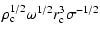
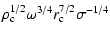
These models yield the following scaling laws:
where
 is the planetary magnetic dipole moment,
 the radius of the dynamo-region (frequently also called the "core radius'')
and
the radius of the dynamo-region (frequently also called the "core radius'')
and  the velocity of rotation of the
planet around its axis. In the dynamo region the mass density is
the velocity of rotation of the
planet around its axis. In the dynamo region the mass density is
 and the conductivity is
  .
At least two further scaling laws exist, but they are of no relevance in this context:
the first scaling ("Blackett's law'') originally proposed by
Blackett (1947) was based on a hypothesis that was later disproved experimentally.
As a result, the theory was withdrawn
(Blackett 1952). The scaling used by Curtis & Ness (1986)
requires the heat flux arising from internal sources of the planet.
This is an observable quantity in the case of planets in the solar system, but not for extrasolar
planets.
For close-in extrasolar giant planets highly different conditions are expected (i.e. strong external heating by
stellar irradiation). Thus it is difficult to estimate the heat flux arising from sources in the
dynamo-region of these planets from solar sytem data.
.
At least two further scaling laws exist, but they are of no relevance in this context:
the first scaling ("Blackett's law'') originally proposed by
Blackett (1947) was based on a hypothesis that was later disproved experimentally.
As a result, the theory was withdrawn
(Blackett 1952). The scaling used by Curtis & Ness (1986)
requires the heat flux arising from internal sources of the planet.
This is an observable quantity in the case of planets in the solar system, but not for extrasolar
planets.
For close-in extrasolar giant planets highly different conditions are expected (i.e. strong external heating by
stellar irradiation). Thus it is difficult to estimate the heat flux arising from sources in the
dynamo-region of these planets from solar sytem data.
It is clear from Eqs. (1) to (5)
that the magnetic moment
is determined by the internal properties of a planet
(i.e. the properties of the dynamo region
 )
and not so much by the external parameters which are
much easier to measure (like the planetary mass or radius).
To overcome this problem, Curtis & Ness (1986) use an
empirical scaling law to determine the core radius
as a function of the planetary mass M. The
best fit to our solar system (using the
planets Mercury, Earth, Jupiter and Saturn)
is found to be:
)
and not so much by the external parameters which are
much easier to measure (like the planetary mass or radius).
To overcome this problem, Curtis & Ness (1986) use an
empirical scaling law to determine the core radius
as a function of the planetary mass M. The
best fit to our solar system (using the
planets Mercury, Earth, Jupiter and Saturn)
is found to be:
 |
(6) |
where M is the mass of the planet.
In this approach the core radius only depends on the mass of the planet.
This seems reasonable for planets which have evolved to some equilibrium state, i.e. for which the radius R is
well determined by the mass M. For young planets, where for a given mass the radius is a function of the age,
mass M and radius R should better both be considered in a scaling law of the form
 |
(7) |
This situation is typical for "Hot Jupiters'', which have densities significantly lower than
Jupiter.
For this increased radius, different explanations are suggested. These include downward
transport of kinetic energy generated by the intense
stellar irradiation (Bodenheimer et al. 2003; Guillot & Showman 2002), or dissipation of energy arising from tidal circularisation
(Bodenheimer et al. 2003).
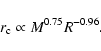
Normalizing ,
M and R to the respective values of Jupiter and using the best fit for the planets
Saturn, Uranus and Neptune to Eq. (7), one obtains
 |
(8) |
For this fit, the following values were adopted:
 for Jupiter and
 for Saturn (Nellis 2000),
 km (i.e.
 )
and
)
and
 km (i.e.
 )
for Uranus and Neptune (Hubbard 1984).
)
for Uranus and Neptune (Hubbard 1984).
Relation (8) yields the correct behaviour.
On the one hand, if the radius is kept constant, increasing mass will lead to a larger core.
On the other hand, keeping the mass constant and increasing the radius will decrease the average density, and the volume
of high enough density for dynamo generation will also decrease. Similarly, for a fixed average density (i.e.
 ), increasing the mass increases the core radius.
Of course, relations (6) and (8)
only have a physical meaning if
 is
fulfilled. For Eq. (6) this is not
the case if
is
fulfilled. For Eq. (6) this is not
the case if
 .
This is
satisfied for
the two planets considered here. To demonstrate that in these cases Eq. (8)
does not lead to unrealistic parameters, the core radii resulting from
Eq. (8), normalized to the planetary radius, are given in Table 1.
Note that Eqs. (6) and (8) do not include the effect of stellar
heating. For "Hot Jupiters'' the large temperatures could lead to additional
ionization, thus slightly increasing the core radius
and the magnetic
moment
.
.
This is
satisfied for
the two planets considered here. To demonstrate that in these cases Eq. (8)
does not lead to unrealistic parameters, the core radii resulting from
Eq. (8), normalized to the planetary radius, are given in Table 1.
Note that Eqs. (6) and (8) do not include the effect of stellar
heating. For "Hot Jupiters'' the large temperatures could lead to additional
ionization, thus slightly increasing the core radius
and the magnetic
moment
.
Table 1:
Parameters for two "Hot Jupiters''. The values used for the calculation of
the magnetic moments are given in units normalized to Jupiter, while
the relative core radius, resulting from Eqs. (6) and (8), is normalized to the
planetary radius.
The magnetic moment is given
for two cases: "tidal locking'' (using the value of
given above), and "fast rotation''
(for the hypothetical case
 ).
).
Inserting Eqs. (6) or (8) into the scalings (1) to (5)
the dipole moment can be expressed in terms of
planetary parameters for which reasonable estimates exist. For the planets HD 209458b and OGLE-TR-56b we adopt the values given in Table 1.
Most of the quantities in Table 1 are given in units normalized to Jupiter
(denoted by subscript J), with
 km,
km,
 kg,
kg,
 s-1,
s-1,
 Am2.
They were obtained in the following way:
mass M and radius R of the planets were measured during transits. The first
measurements were reported by
Henry et al. (2000), Charbonneau et al. (2000) for HD 209458b and Konacki et al. (2003) for OGLE-TR-56b.
We
adopt the more recent values given by Cody & Sasselov (2002) for the planet HD 209458b
and those given in
Torres et al. (2004)
for OGLE-TR-56b. The rotation rate
was calculated assuming tidal locking
(i.e. assuming the orbital period to be equal to the rotation period, see below),
taking orbital distances of 0.045 AU and 0.0225 AU (Konacki et al. 2003), respectively.
For the core density
,
we assume proportionality to
the mean density
Am2.
They were obtained in the following way:
mass M and radius R of the planets were measured during transits. The first
measurements were reported by
Henry et al. (2000), Charbonneau et al. (2000) for HD 209458b and Konacki et al. (2003) for OGLE-TR-56b.
We
adopt the more recent values given by Cody & Sasselov (2002) for the planet HD 209458b
and those given in
Torres et al. (2004)
for OGLE-TR-56b. The rotation rate
was calculated assuming tidal locking
(i.e. assuming the orbital period to be equal to the rotation period, see below),
taking orbital distances of 0.045 AU and 0.0225 AU (Konacki et al. 2003), respectively.
For the core density
,
we assume proportionality to
the mean density
 of the planet
(
of the planet
(
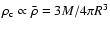 ).
Hubbard (1984) shows that for a planet like Jupiter the average density is expected
to be proportional to the
central density (i.e. the density in the center of the planet).
It can be shown that the same proportionality also holds for
the core density
,
i.e. the density which is found by averaging
from the center to .
More complex models for planetary interiors (Stevenson 1982) show that for
Jupiter and Saturn the mean density of the dynamo region,
,
is actually very close to the
mean density of the planet
(
).
Hubbard (1984) shows that for a planet like Jupiter the average density is expected
to be proportional to the
central density (i.e. the density in the center of the planet).
It can be shown that the same proportionality also holds for
the core density
,
i.e. the density which is found by averaging
from the center to .
More complex models for planetary interiors (Stevenson 1982) show that for
Jupiter and Saturn the mean density of the dynamo region,
,
is actually very close to the
mean density of the planet
(
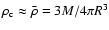 ).
The conductivity is assumed to be the same as for Jupiter, i.e.
).
The conductivity is assumed to be the same as for Jupiter, i.e.
 .
.
Similarly to Farrell et al. (1999), we compare different scaling relations and show that although the results differ
quantitatively, the qualitative picture remains the same. The planetary parameters described above were inserted in
Eqs. (1), (3), (4) and (5). Note that scalings
(2) and (4) are identical.
For the size of the core radius ,
the two approaches of Eqs. (6) and (8) were
adopted.
Equation (8) typically yields smaller values for
and thus also
for
than Eq. (6).
Of the eight results (four scalings for the magnetic moment with two models for the core radius each)
the smallest and the largest magnetic moments are given in Table 1.
Obviously, the results are not identical, but they are approximately of the same order
of magnitude.
For Saturn the same scaling laws yield a magnetic moment between
 ,
while the observed magnetic moment is
,
while the observed magnetic moment is
 .
This demonstrates that although the scalings relations are not
very precise, they do yield reasonable results.
.
This demonstrates that although the scalings relations are not
very precise, they do yield reasonable results.
It seems surprising to find magnetic moments that are much smaller than that of Jupiter, especially for the planet
HD 209458b.
This arises from the much lower rotation rate of the planet.
Planets in very close orbits around their host stars (i.e. semi-major axis smaller than
0.1 AU), like HD 209458b
and OGLE-TR-56b, are subject to strong tidal dissipation, leading to gravitational (tidal)
locking on
a very short timescale (Seager & Hui 2002).
For a hypothetical Jupiter-class exoplanet
orbiting the host star at about 0.05 AU, the synchronization timescale is approximately
 years.
For gravitationally locked planets, the rotation period is equal to the orbital period. In such a case, fast
rotation of the planet is not possible.
years.
For gravitationally locked planets, the rotation period is equal to the orbital period. In such a case, fast
rotation of the planet is not possible.
To be precise, "Hot Jupiters'' should not be expected to be exactly tidally locked. It is
known that thermal atmospheric tides can drive planets away from synchronous rotation
(Correia et al. 2003; Showman & Guillot 2002). The deviation from synchronous rotation was estimated by
Showman & Guillot (2002). They show
that the error this effect introduces for
could be as large as a factor of 2.
Even in this case the
rotation rate of "Hot Jupiters'' will still be far below that of the giant planets of the solar system.
Equations (1) to (5) show that all of the
commonly employed scaling-laws for the planetary magnetic moment yield a magnetic
moment rapidly decreasing with decreasing rotation rate.
For this reason small magnetic moments are
likely for "Hot Jupiters''.
To demonstrate this effect, the same calculation as above is repeated for the same planetary parameters, with
the only
difference being that the rotation rate is assumed to be identical to that of Jupiter (i.e.
)
rather than obtaining it from the
orbital parameters under the assumption of tidal locking. These values are also given in
Table 1.
Note that these
values do not represent realistic estimates of magnetic moments. They are given to
illustrate the effect of tidal
locking on the magnetic moment.
The effect of tidal locking on the size of the planetary magnetosphere will be discussed in Sect. 4.
Tidal locking will also strongly affect all processes involving
planetary magnetic fields or the size of the magnetosphere,
such as the generation of radio emission (Farrell et al. 1999; Zarka et al. 2001), the impact of
cosmic rays on the planet (Stadelmann et al. 2004)
and atmospheric erosion.
Implications on atmospheric erosion are discussed in Sect. 5.
The change of the stellar radiation in the X-ray and extreme
ultraviolet (EUV) wavelength range (
 Å) and the
particle flux of stellar winds play a major role in the evolution
of planetary atmospheres. Observations and studies of isotopic
anomalies in planetary atmospheres (Lammer & Bauer 2003b; Lammer et al. 2000), radiative fluxes, stellar magnetic fields, stellar
winds of solar-type stars with different ages (Zahnle & Walker 1982; Wood et al. 2002; Guinan & Ribas 2002; Ayres 1997) and lunar and meteorite fossil
records (Newkirk 1980) indicate that the young Sun underwent
a highly active phase after its arrival on the
Zero-Age-Main-Sequence (ZAMS).
Å) and the
particle flux of stellar winds play a major role in the evolution
of planetary atmospheres. Observations and studies of isotopic
anomalies in planetary atmospheres (Lammer & Bauer 2003b; Lammer et al. 2000), radiative fluxes, stellar magnetic fields, stellar
winds of solar-type stars with different ages (Zahnle & Walker 1982; Wood et al. 2002; Guinan & Ribas 2002; Ayres 1997) and lunar and meteorite fossil
records (Newkirk 1980) indicate that the young Sun underwent
a highly active phase after its arrival on the
Zero-Age-Main-Sequence (ZAMS).
This active phase of young solar-like stars lasted about 0.5 to
1.0 Gyr for G-type stars and include continuous flare events,
which indicate that the radiation and particle environment was
several hundred times more intense for young G stars. The high
radiation levels of the young stars
are produced by strong magnetic activity.
Observational evidence and theoretical models
suggest that the young solar-like stars rotate about 10 times
faster than the present Sun and have significantly enhanced
magnetically generated coronal and chromospheric XUV emission
(Keppens et al. 1995; Guinan & Ribas 2002).
X-UV observations, obtained from solar-like stars with
the ASCA, ROSAT, EUVE, FUSE and IUE satellites, cover a range
between 1 Å and 3300 Å, except for a gap between 400 Å and
920 Å, which is a region of very strong interstellar medium
absorption. Details of the data sets and the flux calibration
procedure employed are provided in Guinan & Ribas (2002). Full spectral
irradiance tables have already been completed inside the so called
Sun in Time program for five solar proxies
(Dorren & Guinan 1994).
As discussed above, for the present work we have focused on the
spectral range with
 Å, which includes X-rays
and EUV. A power-law relationship in the evolution of the XUV flux
with the age of G-type stars was found for EK Dra (130 Myr),
Å, which includes X-rays
and EUV. A power-law relationship in the evolution of the XUV flux
with the age of G-type stars was found for EK Dra (130 Myr),
 UMa (300 Myr),
  Cet (750 Myr),
  Com (1.6 Gyr) and Hyi (6.7 Gyr). These data show an excellent correlation
between the emitted flux and stellar age (Lammer et al. 2003a). This
study indicates that the solar XUV flux 2.5 Gyr and 3.5 Gyr
ago was about 3 and 6 times higher than today, respectively. Also, the
high-energy X-ray flux of the Zero-Age Main Sequence Sun was
stronger by up to several hundred times. These results are in general
agreement with former studies (Cohen & Kuhi 1979; Zahnle & Walker 1982; Iben 1965; Gaugh 1977; Ayres 1997), although some of these studies focused
on stars that are not necessarily true solar proxies.
Com (1.6 Gyr) and Hyi (6.7 Gyr). These data show an excellent correlation
between the emitted flux and stellar age (Lammer et al. 2003a). This
study indicates that the solar XUV flux 2.5 Gyr and 3.5 Gyr
ago was about 3 and 6 times higher than today, respectively. Also, the
high-energy X-ray flux of the Zero-Age Main Sequence Sun was
stronger by up to several hundred times. These results are in general
agreement with former studies (Cohen & Kuhi 1979; Zahnle & Walker 1982; Iben 1965; Gaugh 1977; Ayres 1997), although some of these studies focused
on stars that are not necessarily true solar proxies.
To obtain estimations of the evolution of the stellar wind velocity v and
stellar wind density n of solar-like stars, we use the scaling
for stellar mass loss provided by Wood et al. (2002) as well as the
scaling for the velocity determined by Newkirk (1980), which
was also used by Zhang et al. (1993).
The mass loss rates have been estimated by using recent indirect stellar wind
observations (Wood et al. 2002).
HST high-resolution spectroscopic observations of
the H I Lyman- feature of several nearby main-sequence stars
have revealed neutral hydrogen absorption associated with the
interaction between the stars' fully ionized coronal winds with
the partially ionized local interstellar medium. By modelling the
absorption features formed in the astrospheres of these stars,
the first empirically estimated coronal mass loss
rates for G and K main sequence stars were obtained by Wood et al. (2002).
feature of several nearby main-sequence stars
have revealed neutral hydrogen absorption associated with the
interaction between the stars' fully ionized coronal winds with
the partially ionized local interstellar medium. By modelling the
absorption features formed in the astrospheres of these stars,
the first empirically estimated coronal mass loss
rates for G and K main sequence stars were obtained by Wood et al. (2002).
The mass loss rates were found from a small sample of solar-like stars where
astrospheres can be observed. Wood et al. (2002) found
that the mass loss rate increases with
stellar activity. The observations of younger solar-like stars
indicate that the young Sun had a much denser solar wind than
today. The correlation between mass loss and X-ray surface flux
follows a power law relationship. This relation indicates that the average solar
wind density has been up to 1000 times higher
during the first 0.1 Gyr after the Sun reached the
ZAMS than it is today (at 4.6 Gyr).
The mass loss rate is related to the observed
X-ray flux
 of solar-like stars. When
the coronal activity is at its maximum, this relation can be written as a
power-law (Wood et al. 2002):
of solar-like stars. When
the coronal activity is at its maximum, this relation can be written as a
power-law (Wood et al. 2002):
 |
(9) |
The X-ray flux of a cool main sequence sun-like star depends
on the stellar
rotation period
 ,
which is in turn correlated with the star's
ages. According to Wood et al. (2002) these relations can be expressed
as
,
which is in turn correlated with the star's
ages. According to Wood et al. (2002) these relations can be expressed
as
 |
(10) |
and
 |
(11) |
respectively. In these relations t denotes the time elapsed since the formation of the stellar system.
For the present day solar system, t=4.6 Gyr.
From Eqs. (9) and (10),
one obtains a power law relationship for the mass loss rate as a
function of rotation period,
 .
Here, a
complication occurs. Equation (9) does look like a
scaling law for the mass loss, but what is really measured by
Wood et al. (2002) is the total ram pressure, i.e. the product
of mass loss and solar wind velocity. The mass loss given by Wood et al. (2002) was
obtained by assuming a constant velocity v. As we try to find
scaling relations for both n and v, we have to correct for this problem by
writing
.
Here, a
complication occurs. Equation (9) does look like a
scaling law for the mass loss, but what is really measured by
Wood et al. (2002) is the total ram pressure, i.e. the product
of mass loss and solar wind velocity. The mass loss given by Wood et al. (2002) was
obtained by assuming a constant velocity v. As we try to find
scaling relations for both n and v, we have to correct for this problem by
writing  rather than
  in Eq. (9). Thus:
 |
(12) |
To obtain the time dependence, the relation for
 is substituted into Eq. (12). In principle,
Eq. (11) could be used, but for consistency
with the velocity scaling law given below, we take the scaling relation
derived by Newkirk (1980):
is substituted into Eq. (12). In principle,
Eq. (11) could be used, but for consistency
with the velocity scaling law given below, we take the scaling relation
derived by Newkirk (1980):
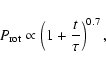 |
(13) |
with the time constant
 calculated from
Newkirk (1980).
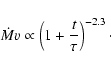
Combining Eqs. (12) and (13),
it is possible to derive a power law formula for the stellar mass loss as:
calculated from
Newkirk (1980).
Combining Eqs. (12) and (13),
it is possible to derive a power law formula for the stellar mass loss as:
 |
(14) |
On the other hand, the stellar mass loss linearly depends on v and n:
 |
(15) |
where A is the stellar surface and  the mass of the solar
wind protons. So, by finding an independent scaling relation for the
stellar wind velocity, the stellar wind density directly follows
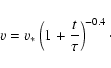
from Eq. (14). The time-dependent behaviour of the solar wind
velocity can be achieved by (Zhang et al. 1993; Newkirk 1980):
the mass of the solar
wind protons. So, by finding an independent scaling relation for the
stellar wind velocity, the stellar wind density directly follows
from Eq. (14). The time-dependent behaviour of the solar wind
velocity can be achieved by (Zhang et al. 1993; Newkirk 1980):
 |
(16) |
Note that the argumentation of Newkirk (1980) would lead to
a different stellar wind velocity v(t)if a different relation for
was used - such as Eq. (11). Using
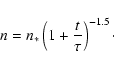
the mass loss relation Eq. (14) and combining with
Eq. (15), we can determine the particle density:
 |
(17) |
The proportionality constants are determined by the present-day
conditions. With
 and
and
 for
for
 and at
 (Schwenn 1990), one obtains v*=3200 km s-1,
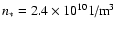 (density at 1 AU). The time constant is
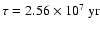 (Newkirk 1980). For distances
other than 1 AU, Eq. (17) is scaled with a 1/r2dependency. The time variation of n(t) at the orbits of
OGLE-TR-56b as well as HD 209458b and v(t) (used for both
planets) are shown in Fig. 1.
(Newkirk 1980). For distances
other than 1 AU, Eq. (17) is scaled with a 1/r2dependency. The time variation of n(t) at the orbits of
OGLE-TR-56b as well as HD 209458b and v(t) (used for both
planets) are shown in Fig. 1.
![\begin{figure}
\par\includegraphics[width=8.8cm,clip]{0684fig1.ps}
\end{figure}](/articles/aa/full/2004/38/aa0684/Timg83.gif) |
Figure 1:
Time evolution of the stellar wind density (solid lines) and velocity
(dashed line) at the orbits of OGLE-TR-56b and HD 209458b. |
| Open with DEXTER |
Obviously, for young stellar systems, the stellar wind pressure is much more important
than for a star of the age of the solar system. The resulting compression of the magnetosphere
by a stellar wind is discussed in the following section.
4 Qualitative model of the magnetospheric magnetic field
The magnetosphere of a planet results from the interaction of the
stellar wind with the internal planetary
magnetic field.
The shape of the magnetopause is determined by the pressure equilibrium between
the stellar wind ram pressure, the planetary magnetic field pressure
and a contribution from the atmospheric pressure.
Since we have no knowledge of the magnetospheric topology of exoplanets,
we have to use magnetospheric models
to estimate the size and shape of the magnetosphere of such a planet.
Several models have been developed during the last
decades. For example, there are semiempirical models which
describe the Earth very well. Analytical
models
using a potential field ansatz represent a slightly less realistic magnetosphere, but offer the possibility
to choose magnetic and geometrical parameters independently. Jordan (1994) and Siscoe (2001)
provide good
reviews of different magnetospheric models.
In order to model the magnetospheric magnetic field of exoplanets, we used the parametric
model that was developed by Voigt (1981) and generalized by Stadelmann et al. (2004).
The shape of the magnetosphere is not self-consistent, but described
by a semi-infinite cylinder on the nightside
and by a half-sphere on the dayside. Both have the same radius  .
The planet is
located within
the half-sphere at a standoff distance
.
The planet is
located within
the half-sphere at a standoff distance
 .
From observations and models of Jupiter (Joy et al. 2002)
and other planets (Voigt et al. 1987; Voigt & Ness 1990)
one can deduce that the ratio between the magnetotail radius and standoff distance is approximately 2
(i.e. one can assume
.
From observations and models of Jupiter (Joy et al. 2002)
and other planets (Voigt et al. 1987; Voigt & Ness 1990)
one can deduce that the ratio between the magnetotail radius and standoff distance is approximately 2
(i.e. one can assume
 ).
The determination of the standoff distance is given below.
The magnetic field within the magnetosphere is obtained as a superposition of the planetary magnetic field, which in this case
is derived from a dipole moment, and an external magnetic field driven by the magnetopause
currents. For the magnetic moment we use the results developed in Sect. 2.
Instead of modelling the magnetopause currents, its magnetic fields are given by a scalar
potential. This potential meets the boundary condition that the normal component of the
magnetospheric magnetic field vanishes at the magnetopause.
).
The determination of the standoff distance is given below.
The magnetic field within the magnetosphere is obtained as a superposition of the planetary magnetic field, which in this case
is derived from a dipole moment, and an external magnetic field driven by the magnetopause
currents. For the magnetic moment we use the results developed in Sect. 2.
Instead of modelling the magnetopause currents, its magnetic fields are given by a scalar
potential. This potential meets the boundary condition that the normal component of the
magnetospheric magnetic field vanishes at the magnetopause.
To obtain the standoff distance  ,
the planetocentric distance of the magnetopause
is calculated for the substellar point.
The standoff distance
can be obtained by the following pressure balance at the substellar point, i.e. for
,
the planetocentric distance of the magnetopause
is calculated for the substellar point.
The standoff distance
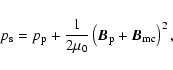
can be obtained by the following pressure balance at the substellar point, i.e. for
 :
:
 |
(18) |
where  denotes the stellar wind pressure,
 is due to the atmospheric pressure at the planet,
 is the planetary magnetic field and
 is the magnetic field of the magnetopause currents.
Note, that only a closed magnetosphere is considered.
is the magnetic field of the magnetopause currents.
Note, that only a closed magnetosphere is considered.
The stellar wind pressure can be expressed by
 |
(19) |
where n denotes the number density of the stellar wind protons, m is their mass
and v is their velocity.
In Sect. 5 it will be shown that the size of the upper atmosphere of "Hot Jupiters''
is of the same order as the magnetosphere. Thus, the contribution of
should also be
considered. But to demonstrate the effect
of atmospheric expansion, we will compare the two cases: a magnetosphere without atmosphere
(i.e.
 )
and a neutral atmosphere
without the influence of the magnetosphere. For this reason,
will not be considered
in the following.
)
and a neutral atmosphere
without the influence of the magnetosphere. For this reason,
will not be considered
in the following.
As already mentioned in Sect. 2, the internal magnetic field is assumed to
arise from a
zonal dipole moment.
Then the total value  of the magnetic field at the magnetopause is derived from a scalar potential:
 |
(20) |
As a worst case, the maximum value of the magnetic moment of Table 1 is
assumed.
Table 2:
Input parameters and results for the standoff distance .
The stellar wind parameters n and v are given for a young parent star (0.5 Gyr)
and for a parent star of the same age as the Sun (4.6 Gyr).
The magnetic moment is taken from the
results of Sect. 2 considering tidal locking (tidal lock.) and for
comparison the case
of fast rotation (fast rot.).
Since the magnetopause currents flow only on the boundary, their magnetic field can be deduced from a
scalar potential.
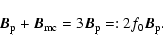
For a spherical magnetopause this potential can be described by spherical harmonics. At the substellar point
the expression for the magnetic field is similar to the planetary magnetic field in Eq. (20),
so the total
magnetic field can be written as
 |
(21) |
Here the form factor is f0 = 1.5 for a spherical magnetosphere.
For a more realistic magnetopause shape, but not a sphere, a factor f0=1.16 is given in Voigt (1995).
This value will be used in the following.
Inserting Eqs. (19)-(21) into the pressure equilibrium of
Eq. (18) and neglecting the contribution from the
atmospheric pressure ,
as mentioned above,
the standoff distance is found to be
![\begin{displaymath}R_{\rm s} = \left[ \frac{\mu_0 f_0^2 \mathcal{M}^2}{8\pi^2 n m v^2} \right]^{1/6}\cdot
\end{displaymath}](/articles/aa/full/2004/38/aa0684/img103.gif) |
(22) |
Note that the planetary magnetic moment
is assumed to be constant,
so that the time variation of the standoff distance originates only from variations
of v and n.
Table 2 summarizes the parameters for various configurations as well as
the standoff distance resulting from Eq. (22).
Note that the age of 4.6 Gyr merely serves as a reference case. The
age of the star HD 209458 is probably between 4 and 7 Gyr with 5.2 Gyr as a likely value
(Cody & Sasselov 2002; Mazeh et al. 2000). For OGLE-TR-56 the age is  Gyr (Sasselov 2003).
As discussed previously,
the shape of the magnetospheres is
derived using the parametric model of Stadelmann et al. (2004)
with the standoff distances from Table 2.
The resulting magnetospheres are shown in
Figs. 2 to 4.
Figure 2 shows the effect of tidal locking on the size of the magnetosphere.
As shown in Sect. 2a tidally locked planet has a significantly reduced magnetic moment,
which directly influences the size of the magnetosphere.
![\begin{figure}
\par\mbox{\includegraphics[width=5.0cm,clip]{0684fig2a.ps}\hspace{0.5cm}
\includegraphics[width=5.0cm,clip]{0684fig2b.ps} }
\end{figure}](/articles/aa/full/2004/38/aa0684/Timg105.gif) |
Figure 2:
Magnetosphere of the planet
HD 209458b, with field lines. Age of parent star: 4.6 Gyr.
The scale is given in planetary radii. Left: fast rotating planet (strong magnetic field).
Right: tidally locked planet (weak magnetic field). |
| Open with DEXTER |
Figures 3 and 4 demonstrate the compression of the magnetosphere by the dense
stellar wind during the early phase of the stellar evolution. The evolution of the
stellar wind with time was discussed
in Sect. 3.2.
![\begin{figure}
\par\mbox{\includegraphics[width=5.0cm,clip]{0684fig3a.ps}\hspace{0.5cm}
\includegraphics[width=5.0cm,clip]{0684fig3b.ps} }
\end{figure}](/articles/aa/full/2004/38/aa0684/Timg106.gif) |
Figure 3:
Magnetosphere of the tidally locked planet
HD 209458b, with field lines. The scale is given in planetary radii.
Left: age of parent star is 4.6 Gyr.
Right: age of parent star is 0.5 Gyr. |
| Open with DEXTER |
![\begin{figure}
\par\mbox{\includegraphics[width=5.0cm,clip]{0684fig4a.ps}\hspace{0.5cm}
\includegraphics[width=5.0cm,clip]{0684fig4b.ps} }
\end{figure}](/articles/aa/full/2004/38/aa0684/Timg107.gif) |
Figure 4:
Magnetosphere of the tidally locked planet
OGLE-TR-56b, with field lines. The scale is given in planetary radii.
Left: age of parent star is 4.6 Gyr.
Right: age of parent star is 0.5 Gyr. |
| Open with DEXTER |
5 Atmosphere protection and erosion
The recent detection of an extended H Lyman- exosphere
of HD 209458b, and its observation based estimated mass loss rate of
about 1010 g/s (Vidal-Madjar et al. 2003) indicate that the
upper atmospheres of "Hot Jupiters'' orbiting close to their host
stars may be affected by XUV-driven hydrodynamic conditions.
Moreover, new HST observations of the heavy atmospheric constituents
oxygen and carbon
beyond the Roche lobe of HD 209458b
by Vidal-Madjar et al. (2004) can be seen as a confirmation that the
hydrodynamically driven hydrogen wind also carries heavier species
away from the planet.
exosphere
of HD 209458b, and its observation based estimated mass loss rate of
about 1010 g/s (Vidal-Madjar et al. 2003) indicate that the
upper atmospheres of "Hot Jupiters'' orbiting close to their host
stars may be affected by XUV-driven hydrodynamic conditions.
Moreover, new HST observations of the heavy atmospheric constituents
oxygen and carbon
beyond the Roche lobe of HD 209458b
by Vidal-Madjar et al. (2004) can be seen as a confirmation that the
hydrodynamically driven hydrogen wind also carries heavier species
away from the planet.
In a recent study by Lammer et al. (2003a), a
scaling relation from solar system planets was used to estimate
the exospheric temperature for giant exoplanets at various orbital
distances.
The scaling relation in that study is based on the assumption of
equilibrium between the XUV heat input and downward heat transport
by conduction. It was found that large exospheric temperatures in
the order of about 10 000 K for hydrogen dominated atmospheres develop,
so that a hydrodynamic treatment must be considered
(Lammer et al. 2003a; Watson et al. 1981). This results in cooling and a
temperature decrease due to large XUV driven loss rates and
atmospheric expansion. These exospheric temperature values are in agreement with
previous suggestions of Schneider et al. (1998) and Moutou et al. (2001).
Jeans proposed a model of an isothermal atmosphere in diffusive
equilibrium that gives accurate thermal atmospheric escape rates. This law
is valid as long as the thermal escape parameter
 |
(23) |
at the exobase does not reach values much smaller than 1.5
(Öpik 1963). Here
 is the escape velocity of the
planet and
is the escape velocity of the
planet and
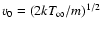 is the most probable
velocity of the exospheric particles in the exosphere,
is the most probable
velocity of the exospheric particles in the exosphere,
 is the exospheric temperature, k the Boltzmann
constant and m the mass of hydrogen. Lammer et al. (2003a) found
that if X reaches values <3 diffusive equilibrium no longer
applies. For this case the thermal energy exceeds the
gravitational potential energy (Gross 1972; Öpik 1963; Watson et al. 1981; Bauer 1971)
is the exospheric temperature, k the Boltzmann
constant and m the mass of hydrogen. Lammer et al. (2003a) found
that if X reaches values <3 diffusive equilibrium no longer
applies. For this case the thermal energy exceeds the
gravitational potential energy (Gross 1972; Öpik 1963; Watson et al. 1981; Bauer 1971)
 |
(24) |
where G is the gravitational constant and M is the planetary
mass. This leads to the onset of pure hydrogen winds only limited by
the incoming XUV flux (Lammer et al. 2003a; Watson et al. 1981). Therefore,
the Jeans treatment is not applied for small values of X because
mass loss can no longer be estimated from the Jeans equation. In this case,
hydrodynamic conditions must be taken into account. By considering
a dynamically expanding non-viscous gas of constant molecular
weight, one can use the following model (Lammer et al. 2003a; Watson et al. 1981):
- (1) At the distance r0, given by
 |
(25) |
the gas is bound to the planet and no escape takes place. Here
the temperature is fixed at T0 corresponding to the effective
temperature
 ,
and we set
,
and we set
 (for which less than 10-12 of the particles are escaping).
- (2) The main XUV-flux is absorbed at a distance
 ,
defined by
,
defined by
 |
(26) |
where X1 is the escape parameter numerically obtained from Eqs. (7) and (8) of Lammer et al. (2003a).
Above r1 the optical depth for the stellar XUV-flux is much smaller than 1, and
below r1 it is larger than 1. Absorption thus is important for  .
Because of the hydrodynamic expansion, r0 and r1are usually much larger than the altitudes at which the visible opacity
is about unity.
.
Because of the hydrodynamic expansion, r0 and r1are usually much larger than the altitudes at which the visible opacity
is about unity.
By solving simultaneously the equations for the flux of the
escaping particles and the escape parameter X1, one can
calculate the expanded radius r1 (Lammer et al. 2003a; Watson et al. 1981). This radius is shown for OGLE-TR-56b and HD 209458b in Fig. 5.
![\begin{figure}
\par\includegraphics[width=8cm,clip]{0684fig5.eps}
\end{figure}](/articles/aa/full/2004/38/aa0684/Timg120.gif) |
Figure 5:
XUV-driven hydrodynamic expansion of
the upper atmosphere for "Hot Jupiters'' with the mass of HD 209458b (dashed line) and OGLE-TR-56b (dotted line). Shown: expansion radius r1(in planetary radii) as a function of
orbital distance, T0 and stellar XUV flux. The expansion
depends on the XUV flux, T0, orbital distance and thus on the
age of the star and also on the escape parameter X0, which is
taken to be 30. One can see that our calculations of the
atmospheric expansion fit well with the Lyman-
radius
observed on HD 209458b at about 0.045 AU (Vidal-Madjar et al. 2003). |
| Open with DEXTER |
As shown in Fig. 5, HD 209458b has an extended upper atmosphere of about 3
planetary radii at its orbital distance of about 0.045 AU.
From Eq. (25) one can also see that for a
constant X0, r0 moves closer to the planet if T0and the incident XUV flux increases. As a result from Eq. (26),
r1 may also be closer to the defined planetary radius
although the XUV-driven hydrodynamic escape rates increase.
Corresponding to its planetary and stellar parameters OGLE-TR-56b,
should also have an extended upper atmosphere of about 3 planetary radii at an orbital
distance of about 0.0225 AU.
By using the modelled expansion of the upper atmospheres for HD 209458b, a present maximal energy limited mass loss rate of
non-ionized hydrogen atoms of about 1012 g/s was
calculated by Lammer et al. (2003a). This is in good agreement with
the observational value inferred by Vidal-Madjar et al. (2003).
It should be noted that the determined minimal escape rate of
non-ionized hydrogen atoms of about 1010 g/s by
Vidal-Madjar et al. (2003) may be of orders of magnitude higher because of
saturation of the absorption line (Vidal-Madjar, personal
communication). An estimation of the present mass loss rate for
OGLE-TR-56b is
 g/s
(Lammer et al. 2003a).
g/s
(Lammer et al. 2003a).
Figure 6 shows the magnetopause distance, where the
incoming stellar wind ram pressure equals the estimated magnetospheric
pressure of HD 209458b and OGLE-TR-56b without tidal locking
(dashed lines) and with tidal locking (solid lines). As
mentioned in Sect. 4,
the contribution of the atmosphere to the pressure balance (18) is not taken into account. One can see that
both "Hot Jupiters'' may not have been protected by their
intrinsic magnetic fields at least during the first 0.5 Gyr after
their host stars arrived at the ZAMS, even if the effect of
tidal locking is ignored. During this early epoch the
stellar wind of the young stars was so strong that HD 209458b and
OGLE-TR-56b would have had a Venus- or Mars-like interaction between the
stellar wind
and the atmosphere resulting in the erosion of
ionized atmospheric constituents.
![\begin{figure}
\par\includegraphics[width=8.8cm,clip]{0684fig6.ps}
\end{figure}](/articles/aa/full/2004/38/aa0684/Timg124.gif) |
Figure 6:
Standoff distance compared to the size of an expanded atmosphere
in planetary radii
(
 for HD 209458b, and
 for OGLE-TR-56b)
for HD 209458b and OGLE-TR-56b
as a function of time.
Tidally locked planets (solid lines) clearly have a smaller magnetosphere
than (hypothetical) fast rotating planets (dashed lines).
The shaded area shows the distance of
the modelled expanded upper atmospheres, inside a range related to
observation based uncertainties.
It can be seen that the atmosphere is not shielded by the magnetosphere over long periods of time.
for OGLE-TR-56b)
for HD 209458b and OGLE-TR-56b
as a function of time.
Tidally locked planets (solid lines) clearly have a smaller magnetosphere
than (hypothetical) fast rotating planets (dashed lines).
The shaded area shows the distance of
the modelled expanded upper atmospheres, inside a range related to
observation based uncertainties.
It can be seen that the atmosphere is not shielded by the magnetosphere over long periods of time. |
| Open with DEXTER |
If tidal locking is considered for the planet HD 209458b,
the magnetic field may even today not protect the atmosphere from
the stellar wind and hence from ion loss. The atmosphere of OGLE-TR-56b was not protected
by its magnetic field approximately over the first Gyr after its host star arrived on the ZAMS.
The compression of intrinsic planetary magnetic fields of "Hot
Jupiters'' should enhance the non-thermal ion loss rates caused by ion
pick up (Lammer & Bauer 1991; Lichtenegger & Dubinin 1998; Leblanc & Johnson 2002; Lichtenegger et al. 1995,2002; Leblanc & Johnson 2001) and detached
ionospheric clouds (Brace et al. 1982) caused by magnetohydrodynamic
plasma instabilities (Penz et al. 2003; Arshukova et al. 2003) at the
stellar wind-ionospheric boundaries. Ion loss was not studied by
Lammer et al. (2003a) but was estimated by Guillot et al. (1996). For
present stellar activity they estimate loss rates of the order of about 1010 g/s
for HD 209458b. However, their study included only
photo-ionized hydrogen and neglected compressed magnetospheres and
more complicated ion loss processes triggered by plasma
instabilities as observed above the Venus ionopause
(Brace et al. 1982; Penz et al. 2003; Arshukova et al. 2003). The
application of
models developed for the study of the solar wind-ionosphere
interaction processes on Venus is beyond the scope of this paper. These models
will be applied to "Hot Jupiters'' in the future, so that the
efficiency of ion erosion processes can be studied during periods
where these exoplanets may have had a Venus-like stellar
wind-interaction.
One should note that the non-thermal loss processes may not
give rise to an additional contribution besides
the total energy-limited escape rates estimated by
the hydrodynamic approach. Rather, it will lead to the
ionization of a large part of the escaping gas.
The estimation of the ionized population is
important for spectroscopic searches for atmospheric species in
the stellar spectra of the host star (Moutou et al. 2001).
It was shown by Lammer et al. (2003a) that the original mass of HD 209458b
after the exoplanet arrived or originated at the orbital distance of about 0.045 AU
may have been about 50% to 80% larger, than it is at present.
As one can see from Eqs. (6) or (8)
a larger mass at the beginning should result in a larger core. According to
Eqs. (1)-(5), this results in
a larger magnetic moment. Such a larger magnetic
moment may have better protected the upper atmospheres against
ionospheric erosion processes.
We have modeled the stellar wind magnetospheric interaction for
present and early stages of HD 209458b and OGLE-TR-56b. Our study
suggests that because of tidal locking, the magnetic moments of giant
exoplanets can be less than one tenth of the value presently observed for
Jupiter. Thus the intrinsic magnetic field cannot balance the
stellar wind pressure at orbital distances <0.05 AU. We found
that because of the expected effect of tidal locking, HD 209458b
may
have had an ionosphere-stellar wind interaction like Venus or Mars
during most of its lifetime. The upper atmosphere of
OGLE-TR-56b may have been unprotected during the first Gyr after the host star arrived on the ZAMS.
Estimates of planetary magnetic moments are improved by accounting
not only for the planetary mass, but also its radius. This appears to
be necessary, as the detected transiting "Hot Jupiters'' exhibit larger radii
(i.e. lower density)
than expected by comparing to the solar system.
The evolution of stellar wind density and stellar
wind velocity over the last 4.6 Gyr is discussed. We showed that,
due to a much larger stellar wind
ram pressure in early
stellar periods up to about 0.5 Gyr after the host stars arrived
on the ZAMS, "Hot Jupiters'' may have not been protected by their
intrinsic magnetic fields, even if one neglects the effect of
tidal locking. A stellar wind interaction like on Venus would not
be possible if "Hot Jupiters'' did not have a XUV-driven
hydrodynamic expanded upper atmosphere. We found that the stellar
wind pressure compresses the magnetosphere to a stand-off distance
of about 3 planetary radii. In this case the ionized part of the expanded
atmosphere forms a barrier. The calculated expansion distance
of the upper atmosphere agrees with the recent observation of an
expanded exosphere of HD 209458b (Vidal-Madjar et al. 2003).
As a consequence of hydrodynamic conditions, neutral
hydrogen escape rates on "Hot Jupiters'' are expected to be in the order
of about  1012 g/s. The dynamics of the outflow of an
expanding upper atmosphere against the pressure of the stellar
wind may be considered to be similar to a comet's tail (Moutou et al. 2001; Gross 1972; Schneider et al. 1998).
Because of the reduced magnetic moment resulting from tidal locking, our study
indicates that the upper
atmospheres of exoplanets orbiting at close distances around their
host stars may be unprotected by their intrinsic magnetic fields
over geological periods. Thus their atmosphere and ionosphere will be
affected like Venus by different non-thermal ion loss processes
such as ion pick up and detached ionospheric clouds triggered by
magnetohydrodynamic instabilities.
Our study suggests that because of the
much larger particle and radiation environment of young solar-like
stars, both thermal and ion loss rates from an unprotected
atmosphere may have been orders of magnitudes larger during the
first Gyr after their host star arrived at the ZAMS. Therefore they should
have significantly influenced the evolution of the mass
and radius of "Hot Jupiters''. The new generation of
space observatories like COROT may have the possibility to
detect the remaining cores (Rouan et al. 2000) of giant exoplanets
orbiting close to their host stars. These planetary cores may develop
after the loss of their dense
hydrogen atmospheres by thermal and non-thermal loss processes.
1012 g/s. The dynamics of the outflow of an
expanding upper atmosphere against the pressure of the stellar
wind may be considered to be similar to a comet's tail (Moutou et al. 2001; Gross 1972; Schneider et al. 1998).
Because of the reduced magnetic moment resulting from tidal locking, our study
indicates that the upper
atmospheres of exoplanets orbiting at close distances around their
host stars may be unprotected by their intrinsic magnetic fields
over geological periods. Thus their atmosphere and ionosphere will be
affected like Venus by different non-thermal ion loss processes
such as ion pick up and detached ionospheric clouds triggered by
magnetohydrodynamic instabilities.
Our study suggests that because of the
much larger particle and radiation environment of young solar-like
stars, both thermal and ion loss rates from an unprotected
atmosphere may have been orders of magnitudes larger during the
first Gyr after their host star arrived at the ZAMS. Therefore they should
have significantly influenced the evolution of the mass
and radius of "Hot Jupiters''. The new generation of
space observatories like COROT may have the possibility to
detect the remaining cores (Rouan et al. 2000) of giant exoplanets
orbiting close to their host stars. These planetary cores may develop
after the loss of their dense
hydrogen atmospheres by thermal and non-thermal loss processes.
Acknowledgements
We would like to thank T. Guillot for very useful comments and suggestions.
H. Lammer thanks J. Linsky from the University of Colorado,
Boulder, USA for discussions regarding stellar winds and the early
solar particle environment. T. Penz acknowledges support by a Paul
Urban scholarship from the Institute of Theoretical Physics of the
University of Graz, Austria. E. F. Guinan and I. Ribas acknowledge
support from NASA/FUSE grants NAG5-10387 and NAG5-12125.
W. W. Weiss is supported by the Austrian Ministery of Science (bm:bwk), the Austrian Space Agency (ASA) and the FWF
Austrian Science Fund (P14984). Part of this work is
supported by the Autrian Science Fund, FWF, under Project P17099-N08.
-
Arshukova, I. L., Erkaev, N. V., Biernat, H. K., & Vogl, D. F.
2004, Adv. Space Res., 33, 182 [NASA ADS] [CrossRef]
- Ayres, T. R.
1997, J. Geophys. Res., 102, 1641 [NASA ADS] [CrossRef]
- Bauer, S. J.
1971, Nature Phys. Sci., 232, 101 [NASA ADS]
- Blackett, P.
M. S. 1947, Nature, 159, 658 [NASA ADS] (In the text)
- Blackett, P.
M. S. 1952, Phil. Trans. R. Soc. A, 245, 309 [NASA ADS] (In the text)
-
Bodenheimer, P., Laughlin, G., & Lin, D. N. C. 2003, ApJ,
592, 555 [NASA ADS] [CrossRef]
- Brace, L. H.,
Theis, R. F., & Hoegy, W. R. 1982, Planet. Space Sci., 30,
29 [NASA ADS] (In the text)
- Burrows, A.,
Guillot, T., Hubbard, W. B., et al. 2000, ApJ, 534,
L97 [NASA ADS] [CrossRef]
- Busse, F. H.
1976, Phys. Earth Planet. Inter., 12, 350 [NASA ADS] [CrossRef]
-
Charbonneau, D., Brown, T. M., Latham, D. W., &
Mayor, M. 2000, ApJ, 529, L45 [CrossRef] (In the text)
- Cody, A. M., &
Sasselov, D. D. 2002, ApJ, 569, 451 [NASA ADS] [CrossRef] (In the text)
- Cohen, M., &
Kuhi, L. V. 1979, ApJS, 41, 743 [NASA ADS] [CrossRef]
- Correia, A.
C. M., Laskar, J., & de Surgy, O. N. 2003,
Icarus, 163, 1 [NASA ADS] [CrossRef]
- Curtis, S. A.,
& Ness, N. F. 1986, J. Geophys. Res., 91, 11003 [NASA ADS] (In the text)
- Dorren, J. D.,
& Guinan, E. F. 1994, The Sun in time: detecting and modelling
magnetic inhomogenities on solar-type stars, in The Sun as a
Variable Star, ed. J. M. Pap, C. Frölich, H. S. Hudson, &
S. K. Solanki, 206 (Cambridge: Cambridge University Press)
(In the text)
- Farrell,
W. M., Desch, M. D., & Zarka, P. 1999, J. Geophys.
Res., 104, 14025 [NASA ADS] [CrossRef] (In the text)
- Gough, D. O.
1977, Theoretical predictions of variations of the solar output, in
The Solar Output and its Variations, ed. O. R. White (Boulder:
University of Colorado Press), 451
- Goldreich,
P., & Soter, S. 1966, Icarus, 5, 375 [NASA ADS] [CrossRef] (In the text)
- Gross, S. H.
1972, J. Atmos. Sci., 29, 214 [NASA ADS] [CrossRef]
- Guillot, T.,
Burrows, A., Hubbard, W. B., Lunine, J. I., & Saumon, D. 1996,
ApJ, 459, L35 [NASA ADS] (In the text)
- Guillot, T.,
& Showman, A. P. 2002, A&A, 385, 156 [EDP Sciences] [NASA ADS] [CrossRef]
- Guinan, E. F.,
& Ribas, I. 2002, in The Evolving Sun and its Influence on
Planetary Environments, ASP Conf. Ser., 269, 85
- Henry, G. W.,
Marcy, G. W., Butler, R. P., & Vogt, S. S. 2000,
ApJ, 529, L41 [NASA ADS] [CrossRef] (In the text)
- Hubbard,
W. B. 1984, Planetary interiors (New York: Van
Nostrand Reinhold Co.)
(In the text)
- Iben, Jr. I. 1965,
ApJ, 141, 993 [NASA ADS] [CrossRef]
- Jordan, C. E.
1994, Rev. Geophys., 32, 139 [NASA ADS] [CrossRef] (In the text)
- Joy, S. P.,
Kivelson, M. G., Walker, R. J., Khurana, K. K.,
& Russel, C. T. 2002, J. Geophys. Res., 107
(In the text)
- Keppens, R.,
MacGregor, K. B., & Charbonneau, P. 1995, A&A, 294,
469 [NASA ADS]
- Konacki, M.,
Torres, G., Jha, S., & Sasselov, D. D. 2003, Nature, 421,
507 [NASA ADS] [CrossRef]
- Lammer, H.,
& Bauer, S. J. 1991, J. Geophys. Res., 96, 1819 [NASA ADS]
- Lammer, H.,
Stumptner, W., Molina-Cuberos, G. J., Bauer, S. J., & Owen, T.
2000, Planet. Space Sci., 48, 529 [NASA ADS]
- Lammer, H.,
Selsis, F., Ribas, I., et al. 2003a, ApJ, 598, L121 [NASA ADS] [CrossRef] (In the text)
- Lammer, H.,
& Bauer, S. J. 2003b, Space Sci. Rev., 106, 281 [NASA ADS] [CrossRef]
- Leblanc, F.,
& Johnson, R. E. 2001, Planet. Space Sci., 49, 645 [NASA ADS]
- Leblanc, F.,
& Johnson, R. E. 2002, J. Geophys. Res., 107, E2 [NASA ADS], (5), 1
-
Lichtenegger, H. I. M., Schwingenschuh, K., Dubinin, E. M., &
Lundin, R. 1995, J. Geophys. Res., 100, 21 [NASA ADS],659
-
Lichtenegger, H. I. M., & Dubinin, E. M. 1998, Earth Planets
Space, 50, 445 [NASA ADS]
-
Lichtenegger, H. I. M., Lammer, H., & Stumptner, W. 2002, J.
Geophys. Res., 107 (A10), 1279
- Mazeh, T., Naef, D.,
Torres, G., et al. 2000, ApJ, 532, L55 [NASA ADS] [CrossRef]
- Mizutani, H.,
Yamamoto, T., & Fujimura, A. 1992, Adv. Space Res., 12,
265 [NASA ADS]
- Moutou, C.,
Coustenis, A., Schneider, J., et al. 2001, A&A, 371,
260 [EDP Sciences] [NASA ADS] [CrossRef] (In the text)
- Nellis, W. J.
2000, Planet. Space Sci., 48, 671 [NASA ADS] (In the text)
- Newkirk, Jr.
G. 1980, Geochi. Cosmochi. Acta Suppl., 13, 293 [NASA ADS] (In the text)
- Öpik, E. J.
1963, Geophys. J. Roy. Astron. Soc., 7, 490 [NASA ADS] (In the text)
- Penz, T., Erkaev,
N. V., Biernat, H. K., et al. 2004, Planet. Space Sci.,
accepted
- Rouan, D.,
Baglin, A., Copet, E., et al. 2000, Earth, Moon, and Planets,
81, 79
(In the text)
- Sano, Y. 1993, J.
Geomag. Geoelectr., 45, 65 [NASA ADS]
- Sasselov,
D. D. 2003, ApJ, 596, 1327 [NASA ADS] [CrossRef]
- Schneider,
J., Rauer, H., Lasoto, S. P., Bonarrola, S., &
Chassefiére, E. 1998, in Brown Dwarfs and Extrasolar Planets,
ASP Conf. Ser., 134, 241
(In the text)
- Schwenn, R. 1990,
in Physics of the Inner Heliosphere (Berlin: Springer-Verlag),
99
(In the text)
- Seager, S., &
Hui, L. 2002, ApJ, 574, 1004 [NASA ADS] [CrossRef] (In the text)
- Shkolnik, E.,
Walker, G. A. H., & Bohlender, D. A. 2003, ApJ, 597,
1092 [NASA ADS] [CrossRef] (In the text)
- Showman,
A. P., & Guillot, T. 2002, A&A, 385, 166 [EDP Sciences] [NASA ADS] [CrossRef]
- Siscoe, G. L.
2001, in Space weather, ed. P. Song, H. J. Singer, &
G. L. Siscoe (Geophysical Monograph), 125, 211
(In the text)
- Stadelmann,
A., Vogt, J., Glassmeier, K.-H., Kallenrode, M.-B., & Voigt,
G.-H. 2004, Ann. Geophysicae, submitted
(In the text)
- Stevenson,
D. J. 1982, Ann. Rev. Earth Planet. Sci., 10, 257 [NASA ADS] (In the text)
- Stevenson,
D. J. 1983, Rep. Prog. Phys., 46, 555 [NASA ADS] [CrossRef]
- Torres, G.,
Konacki, M., Sasselov, D. D., & Jha, S. 2004, ApJ, in
press
(In the text)
-
Vidal-Madjar, A., des Etangs, A. L., Désert, J.-M.,
et al. 2003, Nature, 422, 143 [NASA ADS] [CrossRef] (In the text)
-
Vidal-Madjar, A., Désert, J.-M., Lecavelier des Etangs, A.,
et al. 2004, ApJ, 604, L69 [NASA ADS] [CrossRef]
- Voigt, G.-H. 1981,
Planet. Space Sci., 29, 1 [NASA ADS] (In the text)
- Voigt, G.-H. 1995, in
Handbook of atmospheric electrodynamics, ed. H. Volland,
Vol. II (CRC Press), 333
(In the text)
- Voigt, G.-H.,
Behannon, K. W., & Ness, N. F. 1987, J. Geophys.
Res., 92, 15337 [NASA ADS]
- Voigt, G.-H., &
Ness, N. F. 1990, Geophys. Res. Lett., 17, 1705 [NASA ADS]
- Wood, B. E.,
Müller, H.-R., Zank, G. P., & Linsky, J. L.
2002, ApJ, 574, 412 [NASA ADS] [CrossRef]
- Watson, A. J.,
Donahue, T. M., & Walker, J. C. G. 1981, Icarus, 48, 150 [NASA ADS] [CrossRef]
- Zahnle, K. J.,
& Walker, J. C. G., 1982 Rev. Geophys. Space Phys., 20,
280
- Zarka, P., Treumann,
R. A., Ryabov, B. P., & Ryabov, V. B. 2001,
Astrophys. Space Sci., 277, 293 [NASA ADS] [CrossRef]
- Zhang, M. G. H.,
Luhmann, J. G., Bougher, S. W., & Nagy, A. F. 1993, J. Geophys.
Res., 98, 10915 [NASA ADS] (In the text)
Copyright ESO 2004


![$\displaystyle \mbox{ \citep[ dissipative case]{Stevenson83} }\quad$](/articles/aa/full/2004/38/aa0684/img16.gif)



![\begin{figure}
\par\includegraphics[width=8.8cm,clip]{0684fig1.ps}
\end{figure}](/articles/aa/full/2004/38/aa0684/img83.gif)
![\begin{figure}
\par\mbox{\includegraphics[width=5.0cm,clip]{0684fig2a.ps}\hspace{0.5cm}
\includegraphics[width=5.0cm,clip]{0684fig2b.ps} }
\end{figure}](/articles/aa/full/2004/38/aa0684/img105.gif)
![\begin{figure}
\par\mbox{\includegraphics[width=5.0cm,clip]{0684fig3a.ps}\hspace{0.5cm}
\includegraphics[width=5.0cm,clip]{0684fig3b.ps} }
\end{figure}](/articles/aa/full/2004/38/aa0684/img106.gif)
![\begin{figure}
\par\mbox{\includegraphics[width=5.0cm,clip]{0684fig4a.ps}\hspace{0.5cm}
\includegraphics[width=5.0cm,clip]{0684fig4b.ps} }
\end{figure}](/articles/aa/full/2004/38/aa0684/img107.gif)
![\begin{figure}
\par\includegraphics[width=8cm,clip]{0684fig5.eps}
\end{figure}](/articles/aa/full/2004/38/aa0684/img120.gif)
![\begin{figure}
\par\includegraphics[width=8.8cm,clip]{0684fig6.ps}
\end{figure}](/articles/aa/full/2004/38/aa0684/img124.gif)