 |
(1) | ||
![$\displaystyle {\partial \left(\varrho{\vec V}\right)\over\partial t}+
\nabla\cd...
...ght){\vec V}\right]=
-\nabla p+{1\over\mu}(\nabla\times{\vec B})\times{\vec B},$](/articles/aa/full/2004/38/aa0505-04/img11.gif) |
(2) | ||
 |
(3) | ||
 |
(4) | ||
 |
(5) |
M. Selwa - K. Murawski
Institute of Physics, UMCS, ul. Radziszewskiego 10, 20-031 Lublin, Poland
Received 24 March 2004 / Accepted 9 June 2004
Abstract
Non-symmetric oscillations in a solar coronal loop
are numerically studied
in the limit of a two-dimensional plasma.
The obtained numerical results show that
impulses, which are launched
in the ambient plasma, excite oscillations
in mass density profiles that reveal asymmetry in a cross-section of the loop.
This asymmetry is a consequence of the fact that
the loop oscillates as a whole.
This feature has not been observed in the earlier numerical studies of impulsively generated waves,
and it is important for the detecion of the spatial location of the source of the loop oscillations.
It is also important for the observations because the density perturbations can produce
corresponding perturbations of EUV or thermal X-ray emission.
Key words: Sun: corona - Sun: oscillations - magnetohydrodynamics (MHD)
Oscillations in solar coronal loops have been observed for a few decades (see the reviews by Aschwanden 2003; Wang 2004). The importance of such oscillations lies in their potential for the diagnostics of coronal structure (magnetic field strength, gas density, etc.) through coronal seismology and their potential for heating the corona (Roberts et al. 1984; Roberts 2000; Nakariakov 2003; Nakariakov et al. 2004). However, before this potential can be realized a number of theoretical aspects of coronal loop oscillations need to be studied. The present investigation which is based on numerical modeling of MHD wave processes, aims to contribute to this topic.
One of the open questions regards the excitations of the various types of coronal waves that have now been observed. Here we consider the excitation of the transverse and vertical waves observed by TRACE (Aschwanden 2003; Wang & Solanki 2004) within the context of the models developed a few years ago by Murawski & Roberts (1993, 1994), Murawski et al. (1998), and recently by Nakariakov & Roberts (1995), Cooper et al. (2003) and Nakariakov et al. (2004), i.e. we consider impulsively excited waves. Such an excitation may be due to a flare or any other process leading to a sudden release of energy. We employ an adaptation of a modern numerical code and use a fine spatial and temporal resolution. These improvements lead to qualitatively new results which correspond to impulsive excitation of characteristic mass density fluctuations. Note that the usual kink mode does not perturb the density in the same fashion (Nakariakov & Roberts 1995). The density fluctuations that are associated with kink and sausage waves were seen recently by Cooper et al. (2003) and Wang & Solanki (2004).
One of our aims is to contribute to the development of the theory-led techniques for the search of the waves in observational data. The new numerical results are important from the observational point of view as they reveal that the line intensity signal should be stronger on the side of a loop. The results are important in coronal heating and seismology of the solar corona.
The paper is organized as follows. A simple model of a coronal loop is developed in Sect. 2. The next section contains results of the numerical simulations for impulsively generated MHD waves in a coronal loop. This paper is concluded by the presentation and discussion of the main results in Sect. 4.
We describe the coronal plasma by the ideal magnetohydrodynamic equations:
 is the mass density,
  is the flow velocity,
 is the magnetic field, p is the pressure,
  is the magnetic permeability,
and
is the magnetic permeability,
and
 is the adiabatic index.
In this paper we limit our discussion to a two-dimensional magnetically structured atmosphere
in which the plasma quantities are independent of the spatial coordinate y,
 ,
and
Vy=By=0.
This limitation, in combination with the chosen geometry (see below), removes the Alfvén wave from the system.
Additionally,
we assume that the initial, unperturbed (i.e. equilibrium)
magnetic field is directed in the z-direction
and approximates a coronal loop by smooth plasma profiles in which
the inhomogeneity occurs in the x-direction only; i.e.
,
and
Vy=By=0.
This limitation, in combination with the chosen geometry (see below), removes the Alfvén wave from the system.
Additionally,
we assume that the initial, unperturbed (i.e. equilibrium)
magnetic field is directed in the z-direction
and approximates a coronal loop by smooth plasma profiles in which
the inhomogeneity occurs in the x-direction only; i.e.
 .
In particular, we consider a loop in the form of a slab with a half-width
a, field strength
.
In particular, we consider a loop in the form of a slab with a half-width
a, field strength  at the center of the slab and
mass density
at the center of the slab and
mass density
 ,
embedded in a magnetic
environment with field strength
,
embedded in a magnetic
environment with field strength  and mass density
 reached at infinite distance from the slab axis.
The equilibrium mass density profile
reached at infinite distance from the slab axis.
The equilibrium mass density profile
 ,
is chosen as
,
is chosen as
The equilibrium magnetic field,
 ,
and pressure
,
and pressure
 profiles must satisfy the total pressure balance condition
is obtained.
Hence, in equilibrium
the total (gas plus magnetic) pressure is constant.
Instead of specifying
and
or
 and
separately, we divide Eq. (6) by
,
Eqs. (7) and (8) by
and
introduce the density ratio d and the ratio of Alfvén speeds v
and
separately, we divide Eq. (6) by
,
Eqs. (7) and (8) by
and
introduce the density ratio d and the ratio of Alfvén speeds v
 and
and
 .
Henceforth, we choose and hold fixed
.
Henceforth, we choose and hold fixed
 .
.
Introducing normalized variables, we measured
mass density in units of
,
temperature in  ,
spatial variables in aand time in units of the Alfvén transit time
,
spatial variables in aand time in units of the Alfvén transit time
 .
.
Although the model described above is not completely physically justifiable,
because we neglect the effects of gravity, field line curvature and non-circular cross-sections,
it is good enough to reveal
the presence of characteristic mass density oscillations, and thus should show
the scenario which should take place in a more realistic three-dimensional model.
It is also well known that in the limit of long wavelength waves
the properties of symmetric waves in magnetic slabs and
tubes are quite similar, while the properties of kink waves are different.
In particular, the phase-speed of the lowest order non-symmetric wave propagating
along the cylinder is ck, where
 |
(11) |
 .
Since we consider non-symmetric perturbations, our results are strictly valid
for a slab geometry only. However, we expect that wave propagation in real three-dimensional
structures would not differ significantly from the present scenario in spite of the fact that
the non-symmetric wave would propagate with
.
Since we consider non-symmetric perturbations, our results are strictly valid
for a slab geometry only. However, we expect that wave propagation in real three-dimensional
structures would not differ significantly from the present scenario in spite of the fact that
the non-symmetric wave would propagate with
 .
.
Small amplitude perturbations of the equilibrium described above obey the
following equations:
 ,
,
 and
and
 are the sound and fast speeds,
respectively.
are the sound and fast speeds,
respectively.
Equations (12) and (13)
describe the fast and slow magnetosonic waves, which are coupled.
The fast modes of plasma structures can be strongly dispersive when
their wavelength is comparable with the width of the structure, i.e. 2a in the present case,
while the slow waves are only weakly dispersive.
In the low  limit
the slow wave propagates with a speed that is close to the sound speed in the loop.
limit
the slow wave propagates with a speed that is close to the sound speed in the loop.
From Eq. (14) it follows that in the linear limit the mass density
 evolves
in time as a consequence of the non-zero velocity components Vx and Vz. On the other hand,
does not influence plasma evolution as
does not enter the equations for
,
evolves
in time as a consequence of the non-zero velocity components Vx and Vz. On the other hand,
does not influence plasma evolution as
does not enter the equations for
,
 and p. In this sense Eq. (14) decouples from the other equations.
It is instructive to envisage first the limit of cold plasma for which the gas pressure terms
are neglected.
In equilibrium the magnetic field is constant,
 .
Small amplitude oscillations are governed by the linear Eqs. (12)-(14)
with the gas pressure terms dropped. These equations then simplify to
.
Small amplitude oscillations are governed by the linear Eqs. (12)-(14)
with the gas pressure terms dropped. These equations then simplify to
Consider a coronal loop described by Eqs. (6) and
(7).
Perturbations can be excited in such a loop in numerous ways.
Here we focus our attention on impulsively excited waves.
We launch a pulse in the x-component of
the velocity having the form
 ,
and B is not perturbed.
This pulse expands rapidly and upon hitting the loop excites a packet of waves
in which fast kink waves have the highest contribution.
,
and B is not perturbed.
This pulse expands rapidly and upon hitting the loop excites a packet of waves
in which fast kink waves have the highest contribution.
We now consider three cases separately: (a) small amplitude cold plasma oscillations, (b)
small amplitude warm plasma oscillations and (c) large amplitude warm plasma oscillations.
In case (a) all gas pressure terms can be neglected compared to magnetic terms
because the plasma  .
For cases (b) and (c) these terms have to be retained in the MHD equations although they
are not as important as the magnetic field terms because
.
For cases (b) and (c) these terms have to be retained in the MHD equations although they
are not as important as the magnetic field terms because
 .
For case (a) the oscillations are described by the linear Eqs. (15)-(16).
In both cases the plasma equations are solved numerically in an Eulerian box
with the x and z dimension (-30,20) and (-25,25) (or (-50,50) in case (c)), respectively, in units of a.
Open boundary conditions were used in the case of warm plasma and
periodic ones in the case of cold plasma because of FFT code employed (Murawski & Roberts 1993).
This implies that in
both
cases we consider the central portion of
an infinitely long loop.
.
For case (a) the oscillations are described by the linear Eqs. (15)-(16).
In both cases the plasma equations are solved numerically in an Eulerian box
with the x and z dimension (-30,20) and (-25,25) (or (-50,50) in case (c)), respectively, in units of a.
Open boundary conditions were used in the case of warm plasma and
periodic ones in the case of cold plasma because of FFT code employed (Murawski & Roberts 1993).
This implies that in
both
cases we consider the central portion of
an infinitely long loop.
For cases (b) and (c) MHD Eqs. (1)-(5) are solved numerically using the FLASH code (Zingale et al. 2002) which is a nice tool for numerically solving MHD equations. The high-order Riemann solver of Roe type that is implemented in this code yields accurate results near steep gradients and moving contact discontinuities. The MHD part uses Powell's method (Powell 1999) which allows the magnetic field to be kept divergence-free to machine-dependent round-off errors. The computer code is formally second-order accurate in space and time.
In this section we discuss linear perturbations of cold plasma which are described by Eqs. (15) and (16).
These linear equations allowed us
to eliminate numerical errors which are
associated with an inhomogenous equilibrium.
In the nonlinear case we usually have to work with the total field
which contains
the inhomogeneous background
and
perturbations
 ,
,
 .
Because of various
numerical effects there are often some small departures of a numerical equilibrium from
the analytical one,
.
Due to these departures a spurious signal propagates
when one starts from the analytical equilibrium
until the equilibrium approaches its numerical limit.
As a consequence of its simplicity and of the fact that there are numerical
errors that are associated with the representation of the inhomogeneous equilibrium,
the case of cold plasma will serves as a reference
for more complex models of loop oscillations.
This role as a reference is strengthened by the fact that independent codes are employed
for the cold and warm plasma computations.
.
Because of various
numerical effects there are often some small departures of a numerical equilibrium from
the analytical one,
.
Due to these departures a spurious signal propagates
when one starts from the analytical equilibrium
until the equilibrium approaches its numerical limit.
As a consequence of its simplicity and of the fact that there are numerical
errors that are associated with the representation of the inhomogeneous equilibrium,
the case of cold plasma will serves as a reference
for more complex models of loop oscillations.
This role as a reference is strengthened by the fact that independent codes are employed
for the cold and warm plasma computations.
Figure 1 displays spatial profiles of the perturbed mass density
of cold plasma oscillations at t=25.
These profiles have been obtained with the use of the spectral fast Fourier code
(Murawski & Roberts 1993). The initial pulse was launched at (-5a,0),
while Murawski & Roberts (1993) generated the pulse at (0,0).
As a result of the initial impact
in the region x<0 (x>0)
 (
(
 )
in the sense that the loop is shifted as a whole and
two ridges in
)
in the sense that the loop is shifted as a whole and
two ridges in
 at the sides of the loop appear,
i.e. the loop is pushed to greater x-values (away from the pulse).
Note that along the loop
this displacement is almost independent of z, once it is set up by the above wave trains.
at the sides of the loop appear,
i.e. the loop is pushed to greater x-values (away from the pulse).
Note that along the loop
this displacement is almost independent of z, once it is set up by the above wave trains.
To explain the behaviour of
at the slab edges we consider the term
 which is dominant there. At the left (right) edge
  grows
(decreases) with x and
grows
(decreases) with x and
 is positive (negative) there. As Vxis positive the r.h.s. of Eq. (16) is negative (positive) and
declines (grows)
with time at the left (right) edge. As a consequence of this at the early stage
of the evolution of the waves we have a valley (peak) in
at the left (right) edge.
This results in the slab moving from the negative x direction (bottom panel of Fig. 1).
is positive (negative) there. As Vxis positive the r.h.s. of Eq. (16) is negative (positive) and
declines (grows)
with time at the left (right) edge. As a consequence of this at the early stage
of the evolution of the waves we have a valley (peak) in
at the left (right) edge.
This results in the slab moving from the negative x direction (bottom panel of Fig. 1).
as
 .
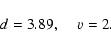
The mass density contrast d and the Alfvén speed ratio v are defined by Eq. (10).
For this choice we have
the plasma
.
The mass density contrast d and the Alfvén speed ratio v are defined by Eq. (10).
For this choice we have
the plasma
 .
.
For all numerical runs
we apply free-boundary conditions at the boundaries of the simulation region.
This choice of boundary conditions
reflects the fact that the real medium extends well beyond the computational domain. Thus
we assume that MHD waves have no time to travel the entire length of the loop
and that they have not reached the ends of the loop, where the dense lower
atmosphere causes reflection, and so the wave propagates freely as if the structure
were open.
Since we consider only open structures, i.e. we neglect
the reflection from the boundaries, our solution is valid only in a
finite time interval.
Assuming a typical loop length L=105 km and the Alfvén speed
 km s-1, we can estimate the time tv after which our
solution cannot be applied to a real bounded
structure as
km s-1, we can estimate the time tv after which our
solution cannot be applied to a real bounded
structure as
 s.
s.
![\begin{figure}
\par\includegraphics[width=7.9cm,clip]{0505fig1.eps}\vspace*{6mm}
\par\includegraphics[width=8cm,clip]{0505fig2.eps}\end{figure}](/articles/aa/full/2004/38/aa0505-04/img71.gif) |
Figure 1:
The spatial profile of
the perturbed mass density
 ( top panel) and
its cross-section at z=5 ( bottom panel).
These profiles correspond to the limit of cold plasma.
( top panel) and
its cross-section at z=5 ( bottom panel).
These profiles correspond to the limit of cold plasma.
|
| Open with DEXTER | |
![\begin{figure}
\par\includegraphics[width=7.6cm,clip]{0505fig3.eps}\vspace*{6mm}
\par\includegraphics[width=7.2cm,clip]{0505fig4.eps}\end{figure}](/articles/aa/full/2004/38/aa0505-04/img72.gif) |
Figure 2:
The spatial profile of the perturbed mass density
for
the initial amplitude
Vx0=0.1 ( top panel) and
its cross-section at z=5 ( bottom panel) in the case of warm plasma.
The position of the initial pulse
(-5, 0) is visible.
|
| Open with DEXTER | |
![\begin{figure}
\par\includegraphics[width=7.2cm,clip]{0505fig5.eps}\end{figure}](/articles/aa/full/2004/38/aa0505-04/img74.gif) |
Figure 3:
Time signatures which are obtained by measuring the mass density at the detection point
 z=0 (solid line),
z=10 (dotted line), z=20 (dashed line),
for the initial amplitude
Vx0=0.1. z=0 (solid line),
z=10 (dotted line), z=20 (dashed line),
for the initial amplitude
Vx0=0.1.
|
| Open with DEXTER | |
Figure 2 displays the spatial profiles of the perturbed mass density
at t=25. These profiles resemble the result of Fig. 1. As a consequence of
the finite value of the plasma
the slow wave is present in the system. Such a wave is seen
in Fig. 2 in the neighborhood of the point x=-5, z=0 in the form of two local
pulses which resulted from the splitting of the original pulse.
In general, the results are very similar to those of the cold plasma case: oppositely directed
disturbances propagate
along the loop (top panel of Fig. 2).
In this case
the perturbed mass density profile
reveals the presence of
two ridges.
Such a distribution of density results in the conclusion that
plasma in the loop is spread asymmetrically.
This behaviour can be explained in a similar way as in the case of the cold plasma.
At the initial stage the term
is dominant in Eq. (14).
At later times the other two terms of the r.h.s. of Eq. (14),
as well as the nonlinear terms in Eq. (1) contribute
to the scenario of
evolution in time and make
more complex.
This contribution results in loop movement as a whole.
The initial pulse of Eq. (17) produces complex time signatures which are obtained collecting in time wave signals at the detection point (Roberts et al. 1984; Murawski & Roberts 1993; Nakariakov et al. 2004). Figure 3 shows time signatures which are obtained collecting the perturbed mass density at different spatial points. It is discernible that with a larger distance from the exciter time signatures are shorter and more complex. These time signatures reveal time scales of the order of a dozen or so seconds.
Note that Fig. 3 shows a rapidly decaying oscillation with a very short period at the center of the slab. This oscillation results from a natural decaying response of the medium to an impulsive perturbation. The counterparts of these rapid oscillations are seen in Figs. 1 and 2 between |z|=15 and |z|=25. One can see the attenuated oscillation at the boundary between black and white signal which corresponds to a fast magnetosonic wave, propagating with the Alfvén speed. The signal gets more complex as it moves out as a consequence of dispersion which spreads the wave packet.
As the loop is slightly shifted in the case of
Vx0=0.1 we cannot observe this shift
directly but we can only measure the perturbed mass density
.
Note that this shift increases with the amplitude of the pulse (Fig. 4)
We can observe that for super-Alfenic pulse amplitudes
Vx0=2.0 and
Vx0=5.0
the scenario does not change very much.
![\begin{figure}
\par\includegraphics[width=3.6cm,clip]{0505fig6.eps}\hspace*{9mm}...
...8.eps}\hspace*{9mm}
\includegraphics[width=3.6cm,clip]{0505fig9.eps}\end{figure}](/articles/aa/full/2004/38/aa0505-04/img75.gif) |
Figure 4:
The cross-section of
the perturbed mass density
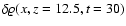 in the case of
Vx0=0.1 ( left top panel),
Vx0=0.5 ( right top panel),
Vx0=1.0 ( left bottom panel) and
Vx0=2.0 ( right bottom panel).
in the case of
Vx0=0.1 ( left top panel),
Vx0=0.5 ( right top panel),
Vx0=1.0 ( left bottom panel) and
Vx0=2.0 ( right bottom panel).
|
| Open with DEXTER | |
 and px0 denote amplitudes of the pulse in mass density and pressure,
respectively.
We choose the following values of these amplitudes:
Vx0=2.0,
and px0 denote amplitudes of the pulse in mass density and pressure,
respectively.
We choose the following values of these amplitudes:
Vx0=2.0,
 ,
px0=2.0.
,
px0=2.0.
![\begin{figure}
\par\includegraphics[width=6.7cm,clip]{0505fi10.eps}\vspace*{1cm}
\par\includegraphics[width=6.7cm,clip]{0505fi11.eps}\end{figure}](/articles/aa/full/2004/38/aa0505-04/img80.gif) |
Figure 5:
The mass density
 ( top panel)
and
( top panel)
and
 ( bottom panel)
in the case of
Vx0=2.0,
and
px0=2.0.
( bottom panel)
in the case of
Vx0=2.0,
and
px0=2.0.
|
| Open with DEXTER | |
![\begin{figure}
\par\includegraphics[width=6.7cm,clip]{0505fi12.eps}\end{figure}](/articles/aa/full/2004/38/aa0505-04/img81.gif) |
Figure 6:
The cross-section of
the mass density
 (solid line),
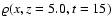 (dashed line) and
 (dotted line)
in the case of
Vx0=2.0,
and
px0=2.0. (dotted line)
in the case of
Vx0=2.0,
and
px0=2.0. |
| Open with DEXTER | |
The shift of the loop as a whole is shown
in Fig. 6 which displays mass density
 at given moments of time.
We observe that the loop is initially shifted very strongly to the right (dashed line)
and after some time it moves back towards its initial position (dotted line).
at given moments of time.
We observe that the loop is initially shifted very strongly to the right (dashed line)
and after some time it moves back towards its initial position (dotted line).
As the chosen values of the pulse amplitude are large the time signatures are more complex than in the weak amplitude case (Fig. 3).
![\begin{figure}
\par\includegraphics[width=6.9cm,clip]{0505fi13.eps}\end{figure}](/articles/aa/full/2004/38/aa0505-04/img83.gif) |
Figure 7:
Time signatures which are obtained by measuring the mass density at the detection point
z=0 (solid line),
z=10 (dotted line), z=20 (dashed line),
for
Vx0=2.0,
and
px0=2.0. |
| Open with DEXTER | |
We have developed a simple two dimensional model of the coronal plasma that makes no allowance for loop curvature, stratification, nor is there any realistic modeling of the coupling of the coronal plasma to the denser layers of the solar atmosphere. Using this model we have numerically simulated the response of the coronal plasma to the impulsively generated MHD waves.
Our main and new results are:
This finding is important from the point of view of future solar missions (Solar-B, STEREO, SDO and Solar Orbiter) whose instrumental capabilities would make it possible to detect possible asymmetries in the wave profiles.
Acknowledgements
The authors express their cordial thanks to Prof. Sami K. Solanki and Dr. Valery Nakariakov for their helpful comments on an earlier version of this paper and Dr. Mike Ruderman forhis constructive comment. This work was financially supported by the grant from the State Committee for Scientific Research Republic of Poland, with KBN grant No. 2 PO3D 016 25. The software used in this work was in part developed by the DOE-supported ASCI/Alliance Center for Astrophysical Thermonuclear Flashes at the University of Chicago.




![$\displaystyle V_x (x,z,t=0)=\frac{V_{x0}} {\cosh^2\left[\left({x+5z}\right)/ a\right]
\cosh^2\left(z/ a\right)},$](/articles/aa/full/2004/38/aa0505-04/img55.gif)
![$\displaystyle V_x (x,z,t=0)=\frac{V_{x0}} {\cosh^2\left[\left({x+10}\right)/ a\right]
\cosh^2\left(z/ a\right)},$](/articles/aa/full/2004/38/aa0505-04/img76.gif)
![$\displaystyle \varrho (x,z,t=0)=\frac{\varrho_{x0}} {\cosh^2\left[\left({x+10}\right)/ a\right]
\cosh^2\left(z/ a\right)},$](/articles/aa/full/2004/38/aa0505-04/img77.gif)
![$\displaystyle p (x,z,t=0)=\frac{p_{x0}} {\cosh^2\left[\left({x+10}\right)/ a\right]
\cosh^2\left(z/ a\right)}\cdot$](/articles/aa/full/2004/38/aa0505-04/img78.gif)