A&A 424, 1049-1053 (2004)
DOI: 10.1051/0004-6361:20041380
Asymmetrical appearance of dark-cored filaments in sunspot
penumbrae
P. Sütterlin1 -
L. R. Bellot Rubio2 -
R. Schlichenmaier2
1 - Sterrekundig Instituut Utrecht,
Postbus 80 000, 3508 TA Utrecht, The Netherlands
2 -
Kiepenheuer Institut für Sonnenphysik,
Schöneckstr. 6, 79104 Freiburg, Germany
Received 1 June 2004 / Accepted 2 June 2004
Abstract
Recent sunspot observations at unprecedented resolution have
led to the discovery of dark cores in the bright filaments that form
the penumbra (Scharmer et al. 2002). The discovery paper
considered spots at disk center only, so the properties of the dark-cored
filaments remain largely unknown. Here we analyze a speckle-reconstructed
time series of G-band and blue continuum images of a sunspot acquired
with the Dutch Open Telescope. The target was located at an heliocentric
angle of 27 deg. We confirm the existence of dark-cored penumbral
filaments also in spots outside the disk center, and report
on distinct differences between the center and limb-side
penumbra. In the inner center-side penumbra, filaments are
detected as two narrow bright streaks separated by a central
obscuration. These structures move together as a single entity. On
the limb side, dark cores are hardly seen. The time series is used to
determine the sizes ( 200-250 km), proper motions
(280 m s-1), and lifetimes (
200-250 km), proper motions
(280 m s-1), and lifetimes ( 45 min) of typical
dark-cored filaments.
45 min) of typical
dark-cored filaments.
Key words: Sun: sunspots - Sun: magnetic fields - Sun: photosphere - magnetohydrodynamics
The nature of sunspot penumbrae is still subject to intense debate,
both observational and theoretical (see, e.g., the reviews by
Solanki 2003; Bellot Rubio 2004;
Schlichenmaier 2002). The penumbra consists of a pattern of
radially aligned bright and dark filaments. The small size of these
filaments makes it difficult to characterize their properties and
structure. Recently, 0.1 arcsec
observations with the Swedish 1-m Solar Telescope have revealed a
hitherto unexpected feature of bright penumbral filaments: at this
resolution they often
show internal substructure in the form of two sharp, bright edges
separated by a central dark core (Scharmer et al. 2002;
Rouppe van der Voort et al. 2004). The edges of the filament and the dark
cores move synchronously and follow the same trajectories, suggesting
that they are intimately connected. This internal structuring may
hold the key to understand the nature of penumbral filaments.
No explanation for the existence of dark cores has been offered yet, although
first attempts to model them are underway (Ruiz Cobo, private communication).
In order to facilitate theoretical efforts, it is necessary to characterize
the properties and visibility of dark-cored penumbral filaments at
different viewing angles. It is also important to confirm
the very existence of such dark cores: so far, they have been observed
in just two spots and with only one telescope.
In this paper we present G-band and blue continuum filtergrams of
a sunspot located at an heliocentric angle of 27 deg. The observations
were taken with the Dutch Open Telescope (DOT) during more than 3.5 h.
Our data confirm the existence of the dark-cored penumbral filaments
reported by Scharmer et al. (2002), and demonstrate that spots
away from the center of the solar disk also show them. For the first
time, we detect clear differences in the visibility of dark-cored
filaments in the center and limb-side penumbra. Dark cores are very
distinct on the center side, but not on the limb side.
Section 2 gives details of the observations and the speckle
reconstruction. In Sect. 3 we present the best filtergrams and
describe the appearance of the dark-cored filaments. A few typical
examples are selected for estimating their sizes, proper motions, and
lifetimes. Finally, Sect. 4 summarizes our findings and speculates on
the origin of the center/limb asymmetry in the occurrence of dark
cores.
![\begin{figure}
\par\includegraphics[width=18cm,clip]{1380fig1.eps}
\end{figure}](/articles/aa/full/2004/36/aa1380/Timg8.gif) |
Figure 1:
Subfield of one of our best G-band ( left)
and blue continuum ( right) filtergrams. The arrow marks the direction
to disk center. The full field of view amounts to
 .
The images are corrected for
atmospheric distortions using the speckle masking method, and reach
the theoretical resolution limit of the telescope of 0.2 arcsec. .
The images are corrected for
atmospheric distortions using the speckle masking method, and reach
the theoretical resolution limit of the telescope of 0.2 arcsec. |
| Open with DEXTER |
On August 9, 2003 a four-wavelength image series of an isolated
spot (NOAA 10425) was obtained with the DOT at the Observatorio
del Roque de los Muchachos (La Palma, Spain) during UT 08:25-11:58.
The observations were part of a coordinated campaign with the
Vacuum Tower Telescope (Observatorio del Teide, Tenerife, Spain),
where full vector polarimetry of the same target was performed
at lower spatial resolution. The regular sunspot was
observed at an heliocentric angle of 27 deg ( ).
).
The series consists of simultaneous speckle bursts taken every 60 s
in the G band (
 nm), Ca II H (
 nm), blue
(
nm), blue
(
 nm) and red (
 nm) continuum. Each burst
contains 100 individual frames, covering a field of view of
nm) continuum. Each burst
contains 100 individual frames, covering a field of view of
 ,
with 0.071 arcsec per pixel. The
exposure times were
,
with 0.071 arcsec per pixel. The
exposure times were
 for the broad-band images and
 for Ca. The seeing quality, as measured by the Fried
parameter r0 at 430.5 nm, varied between 4.5 cm and 10.6 cm with
an average of 7.0 cm, ranking it as a standard quality series (cf. Fig. 3 in Rutten et al. 2004). Speckle reconstruction
(Weigelt 1977; de Boer 1993; de Boer & Kneer 1992) has been applied to
improve the spatial resolution of the observations. For r0 values
larger than 7 cm, the speckle masking algorithm is able to deliver
diffraction-limited (0.2 arcsec) images. So far only the first three
wavelengths have been reconstructed. Further details on the optical
setup of the DOT, the camera system, and the speckle reconstruction
applied to the raw data are given in Rutten et al. (2004).
for Ca. The seeing quality, as measured by the Fried
parameter r0 at 430.5 nm, varied between 4.5 cm and 10.6 cm with
an average of 7.0 cm, ranking it as a standard quality series (cf. Fig. 3 in Rutten et al. 2004). Speckle reconstruction
(Weigelt 1977; de Boer 1993; de Boer & Kneer 1992) has been applied to
improve the spatial resolution of the observations. For r0 values
larger than 7 cm, the speckle masking algorithm is able to deliver
diffraction-limited (0.2 arcsec) images. So far only the first three
wavelengths have been reconstructed. Further details on the optical
setup of the DOT, the camera system, and the speckle reconstruction
applied to the raw data are given in Rutten et al. (2004).
The reconstructed images have been used to create movies![[*]](/icons/foot_motif.gif) in the following way. To compensate for the imperfect reconstruction
in case of bad seeing (
in the following way. To compensate for the imperfect reconstruction
in case of bad seeing (
 ), the Fourier amplitudes
of the respective images were enhanced so that the radially averaged
power spectrum matched that of the fully reconstructed images. All
images of one wavelength were then temporally aligned using Fourier
correlation techniques. The image segmentation into isoplanar
subfields during the speckle reconstruction leaves some residual image
distortion that is only seen when playing the frames as a movie. Those
distortions were removed using local correlation tracking and
polynomial warping ("rubbersheeting''). Next, the data cubes for
all wavelengths were clipped to the common field of view (
). Finally, the data cubes
were low-pass filtered using a cone-shaped filter in the
three-dimensional
), the Fourier amplitudes
of the respective images were enhanced so that the radially averaged
power spectrum matched that of the fully reconstructed images. All
images of one wavelength were then temporally aligned using Fourier
correlation techniques. The image segmentation into isoplanar
subfields during the speckle reconstruction leaves some residual image
distortion that is only seen when playing the frames as a movie. Those
distortions were removed using local correlation tracking and
polynomial warping ("rubbersheeting''). Next, the data cubes for
all wavelengths were clipped to the common field of view (
). Finally, the data cubes
were low-pass filtered using a cone-shaped filter in the
three-dimensional
 Fourier space where the opening
angle of the cone corresponds to
Fourier space where the opening
angle of the cone corresponds to
 .
This
removed all apparently supersonic intensity signals stemming from
oscillatory phenomena.
.
This
removed all apparently supersonic intensity signals stemming from
oscillatory phenomena.
![\begin{figure}
\par\includegraphics[width=16cm,clip]{1380fig2.eps}
\end{figure}](/articles/aa/full/2004/36/aa1380/Timg20.gif) |
Figure 2:
Examples of dark-cored filaments
observed in the center-side penumbra. Each of the columns shows ( from
top to bottom) G-band intensity, continuum intensity, and a
bottom-to-top cut through the structure at the position indicated in
the images. Distances are expressed in arcsec. The intensities are
normalized to the mean quiet sun intensity. Each image is rotated to
similar orientation. Solid: G band. Dashed: blue
continuum. The dotted profile in the first plot depicts the Airy
point-spread function of the telescope at 430.5 nm, with a FWHM of 0.2 arcsec. |
| Open with DEXTER |
In Fig. 1 we display a subfield of one of the best
G-band and blue continuum images of NOAA 10425 taken at 10:55 UT (the
Fried parameter was
 ). The arrow points
toward disk center. The penumbra exhibits clear differences between
the center and the limb side: the almost point-like bright penumbral
grains at the border between umbra and penumbra are most prominent on
the limb side. Similar structures on the center side, while also
visible, have much lower intensity contrasts, as already pointed out
by Tritschler et al. (2004). Figure 1 also shows
bright filaments with dark cores in the center-side penumbra,
especially near the umbra where they stand out over a less crowded
background. By contrast, dark cores are hardly seen on the limb
side. This is difficult to prove with just one image, the claim is
based on careful inspection of the time-lapse movie and judging the
evolution of structures (see AR10425a.mpg available as online
material).
). The arrow points
toward disk center. The penumbra exhibits clear differences between
the center and the limb side: the almost point-like bright penumbral
grains at the border between umbra and penumbra are most prominent on
the limb side. Similar structures on the center side, while also
visible, have much lower intensity contrasts, as already pointed out
by Tritschler et al. (2004). Figure 1 also shows
bright filaments with dark cores in the center-side penumbra,
especially near the umbra where they stand out over a less crowded
background. By contrast, dark cores are hardly seen on the limb
side. This is difficult to prove with just one image, the claim is
based on careful inspection of the time-lapse movie and judging the
evolution of structures (see AR10425a.mpg available as online
material).
Figure 2 displays some examples of the dark-cored
filaments we observe on the center side. For each example a-d, the
G-band image (top), the blue continuum image (middle) and two intensity profiles (bottom) at the position indicated by a white tick
mark in the images are shown. The appearance of these structures is
very similar to that described by Scharmer et al. (2002): they
consist of two lateral brightenings separated by a darker region in
between. The brightenings and the central obscuration move
synchronously following the same trajectories (see Sect. 3.2). The
inner footpoint of the dark-cored filaments is usually associated with
a penumbral grain or peripheral umbral dot, but these bright
structures are only seldom centered on the dark cores: in most cases
they are seen closer to one of the lateral brightenings. The two
edges of the filaments may possess the same or different intensities,
with a typical average value of 0.7 times the mean
photospheric intensity. The intensity drop in the dark core is 0.1-0.2 in units of the mean photospheric intensity. For the bright
filaments there is no systematic intensity difference between G band
and blue continuum, however the dark cores exhibit larger intensity
dips in the G band. This is in line with the rms intensity variations
in the two wavelength bands: the G-band contrast is largely enhanced
in the penumbra. We do not find evidence for dark cores in our Ca images.
A comparison of the intensity profiles of the dark-cored filaments
with the theoretical point-spread function of the DOT (first plot in
Fig. 2) shows that the lateral brightenings are
unresolved. Giving widths of structures under these conditions is not
meaningful, so we restrict ourselves to measure the distance between
the two intensity maxima of the filaments. This distance varies
between 0.3 and 0.37 arcsec (220-270 km). The width of the dark-cored
filaments in our observations is thus slightly larger than that
reported by Scharmer et al. (2002), which may be a selection effect
due to the lower angular resolution of our observations. The length
of the dark-cored filaments is significantly larger than their widths.
Some of the dark-cored filaments in our images can be identified as
independent structures for more than 3 arcsec (2000 km). We
also note that there are filaments that do not exhibit dark cores, as
seen, e.g., in Fig. 2c at
 and in Fig. 2d at
 .
If dark cores were present in these
filaments, they would be substantially narrower than 0.2 arcsec
and/or have much less pronounced intensity dips.
.
If dark cores were present in these
filaments, they would be substantially narrower than 0.2 arcsec
and/or have much less pronounced intensity dips.
![\begin{figure}
\par\includegraphics[width=8.5cm,clip]{1380fig3.eps}
\par\end{figure}](/articles/aa/full/2004/36/aa1380/Timg24.gif) |
Figure 3:
Temporal evolution of a dark-cored filament between
10:21 a) and 11:36 UT h). For better visibility a non-linear intensity
scale (
 )
is used. Tick marks are arcsec. )
is used. Tick marks are arcsec. |
| Open with DEXTER |
It is not difficult to find small, dark structures between two bright
ones in a filamentary scene like the penumbra. The structures at
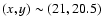 and (18.5,12) in Fig. 1, for
instance, do not look much different from our examples presented as
dark cores, but in reality they are inter-filament gaps. What makes
the dark cores special is the coherency of the motion of the
constituent parts when observed over long time
periods. Figure 3 displays the temporal evolution of a
dark-cored filament during 75 min (see also AR10425b.mpgOnline Material). At the beginning, the core is connected (or
identical?) to a dark filament extending over 4.5 arcsec (3200 km) across the inner penumbra. The two lateral edges end
in the same area that shows a slight brightening. This "grain''
migrates down and right into the umbra, covering a distance of roughly 725 km in 43 min (apparent velocity 280 m s-1) before it
fades to invisibility (frames a-f in Fig. 3). All the
time the structure moves as a unit, keeping the two lateral
brightenings parallel with a dark separation in between. As in other
cases, the intensities of the edges of the dark-cored filament change
both in time and along the filament, not necessarily in synchrony. In
frame g, only the trailing part of the filament remains
visible. The length of the dark-cored filament greatly reduces
during the whole process, mainly because it is overlaid by some
following structures. This scenario has also been mentioned by
Rouppe van der Voort et al. (2004). The filament in Fig. 3 was one of
the most durable in our data set, others were as short-lived as 20 min. The long-lived ones were located closer to the umbral border
or even extending into the umbral area like the presented example, so
it cannot be excluded that their longer lifetime is related to the
better visibility due to the higher local contrast.
and (18.5,12) in Fig. 1, for
instance, do not look much different from our examples presented as
dark cores, but in reality they are inter-filament gaps. What makes
the dark cores special is the coherency of the motion of the
constituent parts when observed over long time
periods. Figure 3 displays the temporal evolution of a
dark-cored filament during 75 min (see also AR10425b.mpgOnline Material). At the beginning, the core is connected (or
identical?) to a dark filament extending over 4.5 arcsec (3200 km) across the inner penumbra. The two lateral edges end
in the same area that shows a slight brightening. This "grain''
migrates down and right into the umbra, covering a distance of roughly 725 km in 43 min (apparent velocity 280 m s-1) before it
fades to invisibility (frames a-f in Fig. 3). All the
time the structure moves as a unit, keeping the two lateral
brightenings parallel with a dark separation in between. As in other
cases, the intensities of the edges of the dark-cored filament change
both in time and along the filament, not necessarily in synchrony. In
frame g, only the trailing part of the filament remains
visible. The length of the dark-cored filament greatly reduces
during the whole process, mainly because it is overlaid by some
following structures. This scenario has also been mentioned by
Rouppe van der Voort et al. (2004). The filament in Fig. 3 was one of
the most durable in our data set, others were as short-lived as 20 min. The long-lived ones were located closer to the umbral border
or even extending into the umbral area like the presented example, so
it cannot be excluded that their longer lifetime is related to the
better visibility due to the higher local contrast.
During their evolution, some of the dark-cored filaments are seen to
split into two identical offspring which also possess dark cores. The
fragmentation occurs at the position of a bright grain, located either
at the inner footpoint or at some distance from it in one of the edges
of the parent filament. After fragmentation, the two dark-cored
filaments move independently along more or less symmetrically
deflected trajectories.
We have shown that the dark-cored penumbral filaments observed by
Scharmer et al. (2002) at very high angular resolution in a sunspot
near the disk center can also be found within spots outside the disk center,
even at about half the resolution. The consistent detection of these
structures over long time spans and in different wavelengths rules
out that they are artifacts of seeing or image processing. We confirm
the dimensions (200-250 km, as measured from the lateral
brightenings) and lifetimes (around 1 h) of these structures. In
addition we observe a clear asymmetry in the occurrence of dark cores,
finding them only in the center-side penumbra.
![\begin{figure}
\par\includegraphics[width=8cm,clip]{1380fig4.eps}
\end{figure}](/articles/aa/full/2004/36/aa1380/Timg26.gif) |
Figure 4:
Top: Sketch of isotherms in a sunspot
observed at an heliocentric angle of 27 deg. The arrows indicate lines
of sight intersecting the center and limb-side penumbra. The dotted
lines represent the normal to the isotherms. Bottom: Cross
section of the same penumbral flux tube observed in the limb-side
( left) and center-side ( right) penumbra. The shaded areas in the tube
interior represent plasma at lower temperature. The dotted lines mark
isolines of optical depth. Depicted are three rays piercing the
central and lateral parts of the tube. In the center-side penumbra,
 is reached in the top part of the tube along the central
ray, and in the hotter interior along the lateral rays. This would be
observed as two bright streaks separated by a central obscuration.
is reached in the top part of the tube along the central
ray, and in the hotter interior along the lateral rays. This would be
observed as two bright streaks separated by a central obscuration. |
| Open with DEXTER |
In the following we speculate that projection effects
may cause the observed asymmetry between the center and limb-side
penumbra. In the inner penumbra, we expect isotherms to be tilted
upwards away from the umbra as in a tilted plane-parallel
atmosphere. The tilt may either be due to the Wilson depression
or to the presence of hot penumbral flux tubes that heat their
surroundings (Fig. 4, top panel). Bellot Rubio et al. (2003) suggest that the flux tubes are inclined upwards by 20 deg in the inner penumbra, and this is the tilt we use for the isotherms represented in Fig. 4. Thus,
lines of sight intersecting the center-side penumbra are more
inclined relative to the isotherms than those piercing the
limb side. Thus, the  1 level is reached in slightly
higher layers on the center side.
1 level is reached in slightly
higher layers on the center side.
![\begin{figure}
\par\includegraphics[width=8.8cm,clip]{1380fig5.eps}
\end{figure}](/articles/aa/full/2004/36/aa1380/Timg28.gif) |
Figure 5:
Subfield of a G-band filtergram of NOAA 10008 taken
on June 28, 2002. The arrow depicts the direction towards disk center. The
heliocentric angle of the spot is 48 deg ( ). Consistent with our
findings, dark-cored filaments are observed predominantly in the center-side
penumbra. ). Consistent with our
findings, dark-cored filaments are observed predominantly in the center-side
penumbra. |
| Open with DEXTER |
s
Now assume that each bright filament traces a single hot penumbral
flux tube embedded in a cool atmosphere and, further, that the top part of the
tube is cooler than its interior, as sketched in Fig. 4 (bottom
panel). Such a temperature structure is obtained for horizontal flux tubes
if one solves for the heat transport in stationary equilibrium for a
stratified umbral atmosphere (Ruiz Cobo, private communication). It may
also be the result of a hot tube that cools (dynamically) in a stratified
atmosphere.
Since rays on the center side sample higher geometrical heights, the
cool plasma at the top of the tube may become visible in the form of
a dark core. On the limb side, the level is reached deeper
into the hot tube, making the dark core invisible. This mechanism
could also explain the higher intensity contrast of the dark cores
in the G band relative to the blue continuum, taking into account
that the G-band intensities are formed slightly higher up in the
atmosphere. The assumption that isotherms are tilted upwards
may also explains the observation that limb-side penumbral
grains show larger intensities.
The different morphology of penumbral filaments on the center and limb
side described in this paper is also seen in other spots. An example
is given in Fig. 5 for a spot at a heliocentric angle of 48 deg. This
spot has not been included in this investigation since the time series
available is not long enough to trace the evolution of the dark-cored
filaments.
Acknowledgements
We thank B. Ruiz Cobo for sharing his calculations with us prior
to publication. This information was essential to prepare
Fig. 4. W. Schmidt made valuable comments on the
manuscript. The DOT project is funded by Utrecht University, the
Netherlands Graduate School for Astronomy NOVA and the Netherlands
Organization for Scientific Research NWO. P. Sütterlins research is
supported by NWO. We acknowledge financial support by the Deutsche
Forschungsgemeinschaft under project SCHL 514/2-1.
- Bellot
Rubio, L. R. 2004, Rev. Modern Astron., 17, 21 [NASA ADS] (In the text)
- Bellot Rubio,
L. R., Balthasar, H., Collados, M., & Schlichenmaier, R.
2003, A&A, 403, L47 [EDP Sciences] [NASA ADS] (In the text)
-
de Boer, C. 1993, Ph.D. Thesis, Universität
Göttingen
- de
Boer, C. R., & Kneer, F. 1992, A&A, 264, L24 [NASA ADS]
- Rouppe
van der Voort, L. H. M., Löfdahl, M. G.,
Kiselman, D., & Scharmer, G. B. 2004, A&A, 414,
717 [EDP Sciences] [NASA ADS] (In the text)
- Rutten,
R. J., Hammerschlag, R. H., Bettonvil,
F. C. M., Sütterlin, P., & de Wijn,
A. G. 2004, A&A, 413, 1183 [EDP Sciences] [NASA ADS] (In the text)
-
Scharmer, G. B., Gudiksen, B. V., Kiselman, D.,
Löfdahl, M. G., &
Rouppe van der Voort, L. H. M. 2002,
Nature, 420, 151 [NASA ADS] [CrossRef] (In the text)
-
Schlichenmaier, R. 2002, AN, 323, 303 [NASA ADS] (In the text)
-
Solanki, S. K. 2003, A&AR, 11, 153 [NASA ADS] (In the text)
-
Tritschler, A., Schlichenmaier, R., Bellot Rubio, L. R.,
& the KAOS Team 2004, A&A, 415, 717 [EDP Sciences] [NASA ADS] (In the text)
-
Weigelt, G. P. 1977, Opt. Commun., 21, 55 [NASA ADS]
Online Material
AR10425a.mpg
AR10425b.mpg
Copyright ESO 2004
![\begin{figure}
\par\includegraphics[width=18cm,clip]{1380fig1.eps}
\end{figure}](/articles/aa/full/2004/36/aa1380/img8.gif)
![\begin{figure}
\par\includegraphics[width=16cm,clip]{1380fig2.eps}
\end{figure}](/articles/aa/full/2004/36/aa1380/img20.gif)
![\begin{figure}
\par\includegraphics[width=8.5cm,clip]{1380fig3.eps}
\par\end{figure}](/articles/aa/full/2004/36/aa1380/img24.gif)
![\begin{figure}
\par\includegraphics[width=8cm,clip]{1380fig4.eps}
\end{figure}](/articles/aa/full/2004/36/aa1380/img26.gif)
![\begin{figure}
\par\includegraphics[width=8.8cm,clip]{1380fig5.eps}
\end{figure}](/articles/aa/full/2004/36/aa1380/img28.gif)