A&A 424, 509-517 (2004)
DOI: 10.1051/0004-6361:20041210
Kinematics of two dwarf galaxies in the NGC 6946 group
A. Begum -
J. N. Chengalur
National Centre for Radio Astrophysics,
Post Bag 3, Ganeshkhind, Pune 411 007, India
Received 1 May 2004 / Accepted 28 May 2004
Abstract
We present high velocity resolution ( 1.6 km s-1)
Giant Meterwave Radio Telescope (GMRT) HI 21 cm synthesis images of
the dwarf galaxies KK98 250 and KK98 251, as well as optical broad band images
of KK98 250. We find that, despite being faint (
1.6 km s-1)
Giant Meterwave Radio Telescope (GMRT) HI 21 cm synthesis images of
the dwarf galaxies KK98 250 and KK98 251, as well as optical broad band images
of KK98 250. We find that, despite being faint (
 ), both
galaxies have regular velocity fields. In both cases the
velocity fields are consistent with rigid body rotation. We derive
rotation curves for the galaxies and fit mass models to them. For both
galaxies, we find acceptable fits using isothermal halos while NFW halos
provide a poor fit. Finally, we compile from literature a sample of
galaxies with HI synthesis observations and I band magnitudes. From
this sample we find, in agreement with earlier studies (which used
single dish HI data), that dwarf galaxies tend to lie below the
I band Tully-Fisher relation defined by brighter galaxies.
), both
galaxies have regular velocity fields. In both cases the
velocity fields are consistent with rigid body rotation. We derive
rotation curves for the galaxies and fit mass models to them. For both
galaxies, we find acceptable fits using isothermal halos while NFW halos
provide a poor fit. Finally, we compile from literature a sample of
galaxies with HI synthesis observations and I band magnitudes. From
this sample we find, in agreement with earlier studies (which used
single dish HI data), that dwarf galaxies tend to lie below the
I band Tully-Fisher relation defined by brighter galaxies.
Key words: galaxies: dwarf -
Galaxy: kinematics and dynamics -
galaxies: individual: KK98 250 -
galaxies: individual: KK98 251 -
radio lines: galaxies - cosmology: dark matter
1 Introduction
There has been renewed interest in the kinematics of dwarf galaxies for two reasons.
(1) There appears to be a conflict between hierarchical galaxy formation model
predictions for, and observational determinations of, the dark matter halo density
profile of galaxies. In particular, these models predict a cuspy central halo,
which many observers find inconsistent with observations (e.g. Weldrake et al. 2003).
While the models predict
cuspy halos for all galaxies, dwarf galaxies are believed to be best suited for
tests of the models because these galaxies are in general held to be
dominated by dark matter, even in the innermost regions. In larger galaxies, uncertainties
in the stellar mass to light ratio limit one's ability to determine density profile of
the dark matter halo. (2) It appears that faint dwarf galaxies deviate significantly
from the Tully-Fisher relationship as defined by bright galaxies. While the TF relation
is generally studied using the inclination corrected 50% profile width (usually
obtained from single dish observations), it is unclear whether this is an appropriate
measure to use for the faintest dwarf galaxies, where the rotational velocities
are comparable to the velocity dispersion. For such galaxies, the "asymmetric drift''
corrected rotational velocity is probably a better measure. However, estimating
this quantity requires HI synthesis imaging. Further, for the faint dwarf irregulars,
even the inclination may be difficult to estimate from the optical image and may
only be obtainable from the HI distribution and kinematics. Unfortunately, the
number of faint dwarf galaxies with sufficiently high quality HI synthesis images
available is quite small. We discuss here GMRT HI observations of two dwarf
galaxies, KK98 250 and KK98 251, in light of both these issues. In discussing the TF
relation, we combine our data for KK98 250
and KK98 251 with our earlier data for still fainter galaxies and data for brighter
galaxies available from the literature.
Both KK98 250 and KK98 251 were identified as companions to the giant
spiral galaxy NGC 6946 by Karachentseva & Karachentsev (1998), and
have also been observed in HI at Effelsberg
(Huchtmeier et al. 1997) and at the DRAO (Pisano & Wilcots 2000). The data presented
here are of much higher sensitivity and resolution than the DRAO data.
Distance estimates to KK98 250 and KK98 251 vary from 5.3 Mpc (Sharina et al. 1997;
Karachentsev et al. 2000) to 8.2 Mpc (Sharina et al. 1997). Because of the proximity of
the two galaxies to each other and to NGC 6946, on the sky as well as in the velocity,
we feel that it is likely that all these galaxies belong to the same group viz. the
NGC 6946 group. Hence, in this paper we take the mean distance to the group (5.6 Mpc,
estimated from the brightest stars in eight members of the group) as the distance
to both the galaxies (Huchtmeier et al. 2000). At this distance, the absolute blue magnitude for KK98 250 and
KK98 251 are
 and -14.54 respectively.
The rest of the paper is divided as follows. The GMRT observations are detailed
in Sect. 2, while the results
are presented and discussed in Sect. 3.
2 Observations
2.1 Optical observations and analysis
CCD images of KK98 250 and KK98 251 in the Bessell I and V filters were obtained
on 29th and 30th May 2003, using the HFOSC (Himalayan Faint Object Spectrograph
Camera), at the 2.0 m Himalayan Chandra Telescope. The camera has a field of view of
 ,
with a scale of 0.3''/pixel. Both the galaxies were covered in the same pointing.
The total exposure time on the target was 40 min in I and 50 min in the V band. The FWHM
seeing of the co-added images was 1.7''. Since the first night was not
photometric, standard fields (from Landolt 1983) were observed only on the
second night.
,
with a scale of 0.3''/pixel. Both the galaxies were covered in the same pointing.
The total exposure time on the target was 40 min in I and 50 min in the V band. The FWHM
seeing of the co-added images was 1.7''. Since the first night was not
photometric, standard fields (from Landolt 1983) were observed only on the
second night.
Debiasing, flat-fielding and cosmic ray filtering were done in the
usual manner, using standard IRAF routines. The exposures taken on the 30th were
calibrated and then added after alignment. This combined frame was used to calibrate
the individual exposures taken on the 29th. No fringe subtraction was done for the
I band images.
Surface photometry for KK98 250 was done using the ellipse fitting algorithm
of Bender & Möllenhoff (1987). Ellipse fitting in the I band was restricted to
the inner regions of the galaxy, since the outer low surface brightness emission
is affected by fringing. The average ellipticity was found to be
 (corresponding to an inclination of
  ,
for an intrinsic thickness
ratio q0 =0.2). The position angle, measured between the north direction
on the sky and the major axis of the receding half of the galaxy (see
Sect. 3.3), was found to be
,
for an intrinsic thickness
ratio q0 =0.2). The position angle, measured between the north direction
on the sky and the major axis of the receding half of the galaxy (see
Sect. 3.3), was found to be  .
The surface brightness profiles obtained from the ellipse fitting in
V and I bands are well described by exponential disk with the scale
length of 41.0'' (1.1 kpc) and 62.0'' (1.7 kpc)
respectively. The average
.
The surface brightness profiles obtained from the ellipse fitting in
V and I bands are well described by exponential disk with the scale
length of 41.0'' (1.1 kpc) and 62.0'' (1.7 kpc)
respectively. The average
 color is 1.2, with
little variation with radius.
The total magnitude after correcting for galactic extinction (using AV=1.01 mag and AI=0.59 mag; Schlegel et al. 1998) is
color is 1.2, with
little variation with radius.
The total magnitude after correcting for galactic extinction (using AV=1.01 mag and AI=0.59 mag; Schlegel et al. 1998) is
 mag in V and
 mag in I. No correction for internal extinction was applied.
KK98 251 has several bright stars superposed on it which could not be accurately
removed. For this galaxy, we hence use the results of the I band photometry derived
by Karachnetsev et al. (2000), who derived an I band exponential scale length and
a total I magnitude of 22.8'' (0.6 kpc) and 14.42 mag respectively.
2.2 HI observations and analysis
Table 1:
Parameters of the GMRT observations.
The GMRT (Swarup et al. 1991) observations of KK98 250 and KK98 251 were conducted during
the commissioning phase of the telescope. The field of view of the telescope
(24') is large enough to cover both galaxies in a single pointing.
The setup for the observations is given in Table 1. The calibrators
were 3C 48 and 3C 286 (flux), 2022+616 (phase) and 3C 286 (bandpass).
The data were reduced in the usual way using standard tasks in classic AIPS.
The GMRT has a hybrid configuration which simultaneously provides both high angular
resolution (2'' if one uses baselines between the arm antennas) as well as
sensitivity to extended emission (from baselines between the antennas in the
central array). Data cubes were therefore made using various (u,v) cutoffs,
including 0-5 k ,
0-10 k,
0-15 k
and 0-20 k.
The corresponding angular resolutions are 43
,
0-10 k,
0-15 k
and 0-20 k.
The corresponding angular resolutions are 43
 ,
26
,
26
 ,
16
,
16
 and 11.5
 .
All the data cubes were deconvolved
using the AIPS task IMAGR and then corrected for primary beam attenuation.
.
All the data cubes were deconvolved
using the AIPS task IMAGR and then corrected for primary beam attenuation.
Moment maps of the data cubes were made using the AIPS task MOMNT. Maps of the
velocity field and line profile widths were also made in GIPSY, using single Gaussian
fits to the line profiles. The velocity fields produced by Gaussian fitting were
found to be in a reasonable agreement with that obtained from moment analysis.
As we discuss in more detail later, we need to know the velocity dispersion
of the gas in order to estimate the pressure support in the HI disk. For dwarf
galaxies, where the contribution from systematic rotation to the profile width
in a single synthesized beam is small, the velocity dispersion can generally be
estimated from the width of the line profiles. However, for a highly inclined
galaxy like KK98 250, the profile width is dominated by rotational motion even within
a single synthesized beam. For this galaxy, we hence assume that the velocity
dispersion is 8 km s-1, a typical value for dwarf galaxies
(e.g. Lake et al. 1990; Skillman et al. 1988). For KK98 251, from the widths obtained from
Gaussian fitting (which we prefer to use because the thresholding algorithm
used by the MOMNT task results in an underestimation of the true profile width),
we find that the profile widths vary from
 km s-1 in
the inner region (upto 80'') to
km s-1 in
the inner region (upto 80'') to
 km s-1 in the outer regions.
Finally, a continuum image was made using the average of the line free channels
but no extended continuum (to  limit of 1.8 mJy/beam for a beam size
of
limit of 1.8 mJy/beam for a beam size
of
 )
was detected from either galaxy. A high
resolution (
)
was detected from either galaxy. A high
resolution (
 )
image also showed no compact sources
associated with either galaxy down to a limit of 1.0 mJy/beam.
)
image also showed no compact sources
associated with either galaxy down to a limit of 1.0 mJy/beam.
3 Results and discussion
3.1 HI distribution
![\begin{figure}
\par\includegraphics[width=8.7cm,clip]{1210fig1.eps}
\end{figure}](/articles/aa/full/2004/35/aa1210/Timg50.gif) |
Figure 1:
A) HI profile for KK98 250 obtained from 43
data cube.
The channel separation is 1.65 km s-1. Integration of profile
gives a flux integral of 16.4 Jy km s-1 and an HI mass of
 .
B) HI profile for KK98 251 obtained from 43
data cube.
The channel separation is 1.65 km s-1. Integration of profile
gives a flux integral of 10.6 Jy km s-1 and an HI mass of .
B) HI profile for KK98 251 obtained from 43
data cube.
The channel separation is 1.65 km s-1. Integration of profile
gives a flux integral of 10.6 Jy km s-1 and an HI mass of
 .
The dotted line shows
a Gaussian fit to the profile. .
The dotted line shows
a Gaussian fit to the profile.
|
| Open with DEXTER |
The global HI emission profiles of KK98 250 and KK98 251 (obtained from 43
data cube), are shown in Fig. 1.
The integrated flux of KK98 250 is
 Jy km s-1, the (heliocentric) systemic
velocity and the velocity width at 50% level of peak emission (W50) are
Jy km s-1, the (heliocentric) systemic
velocity and the velocity width at 50% level of peak emission (W50) are
 km s-1 and
 km s-1.
The systemic velocity is a good match to the single dish value of
km s-1.
The systemic velocity is a good match to the single dish value of
 km s-1
(Huchtmeier et al. 1997), but the flux integral is considerably lower than the single dish
value of 20.0 Jy km s-1. For KK98 251, the integrated flux is
km s-1
(Huchtmeier et al. 1997), but the flux integral is considerably lower than the single dish
value of 20.0 Jy km s-1. For KK98 251, the integrated flux is
 Jy km s-1, the
systemic velocity is
Jy km s-1, the
systemic velocity is
 km s-1 and W50 is
 km s-1.
Again, the systemic velocity is in reasonable agreement with the value of
km s-1.
Again, the systemic velocity is in reasonable agreement with the value of
 km s-1 obtained from single dish observations (Huchtmeier et al. 1997), but
the integrated flux and W50 are considerably smaller than the single
dish values of 14.6 Jy km s-1 and 64.0 km s-1 respectively.
km s-1 obtained from single dish observations (Huchtmeier et al. 1997), but
the integrated flux and W50 are considerably smaller than the single
dish values of 14.6 Jy km s-1 and 64.0 km s-1 respectively.
The GMRT fluxes could be lower than those obtained from single dish measurements
either because of (i) a calibration error or (ii) a large fraction of the HI being in
an extended distribution that is resolved out. However, the flux of the point sources
seen in the GMRT image are in good agreement with those listed in NVSS, indicating that
our calibration is not at fault. Further, from our past experience in HI imaging
of galaxies (with sizes similar to KK98 250 and KK98 251) with the GMRT, it seems unlikely
that we have resolved out a large fraction of the total flux. Interestingly, a large
discrepancy between the interferometric fluxes and the single dish fluxes was also
seen in the DRAO images of these galaxies (Pisano & Wilcots 2000), although the comparison
in that case is complicated by the very poor signal to noise ratio of the DRAO data.
Finally, we note that for both the galaxies there is a strong local HI emission
at velocities very close to the systemic velocities. Hence, it is likely that the single
dish integrated flux measurements were contaminated by blending of the HI emission
from the galaxies with that of the galactic emission due to both the coarse
velocity resolution (10.0 km s-1), as well as imperfect subtraction of the
foreground emission in the position switching mode used
in those observations. If we assume that the
total fluxes are those measured at the GMRT, then the HI mass of KK98 250 is
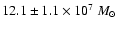 and
and
 .
For KK98 251, the corresponding numbers are
.
For KK98 251, the corresponding numbers are
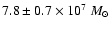 and 1.6.
Figure 2 shows the integrated HI emission from KK98 250 and KK98 251 at
26
resolution, overlayed on the digitized sky survey (DSS)
image. Although KK98 250 may be mildly warped, there is no clear signature
of interaction between the two galaxies. For KK98 251, two high density peaks
are seen near the center.
An estimate of the morphological center, position angle (PA) and inclination
(assuming an intrinsic thickness ratio q0 = 0.2) of the galaxies were obtained
by fitting elliptical annuli to the 43
,
26
and
16
resolution integrated HI column density maps. For KK98 250, the inclination and PA were found to be  and
and  degrees respectively. Due to the high
density clumps in the center, ellipse fitting for KK98 251 was restricted to the
outer contours of the 43
and 26
resolution images.
The inclination and PA of the HI disk were found to be
degrees respectively. Due to the high
density clumps in the center, ellipse fitting for KK98 251 was restricted to the
outer contours of the 43
and 26
resolution images.
The inclination and PA of the HI disk were found to be  and
and  degrees respectively. For each galaxy, the value of the PA and inclination estimated from different resolution images match
within the error bars. For KK98 250, the estimated parameters are also
in good agreement with the values obtained from the optical image.
degrees respectively. For each galaxy, the value of the PA and inclination estimated from different resolution images match
within the error bars. For KK98 250, the estimated parameters are also
in good agreement with the values obtained from the optical image.
![\begin{figure}
\par\includegraphics[angle=-90,width=6.7cm,clip]{1210fig2.eps}
\end{figure}](/articles/aa/full/2004/35/aa1210/Timg67.gif) |
Figure 2:
The optical DSS image of KK98 250 (north) and KK98 251 (south-east), shown
in greyscales, with the GMRT 26
 resolution integrated HI emission map (contours) overlayed. The contour levels are 0.02, 2.8, 5.7, 8.7,
11.6, 14.4, 17.5, 20.1, 22.9, 25.8, 28.9, 31.7, 34.4, 37.4 and
resolution integrated HI emission map (contours) overlayed. The contour levels are 0.02, 2.8, 5.7, 8.7,
11.6, 14.4, 17.5, 20.1, 22.9, 25.8, 28.9, 31.7, 34.4, 37.4 and
 atoms cm-2. atoms cm-2. |
| Open with DEXTER |
Another input that we require for estimating the pressure support of the HI disk is the deprojected HI radial surface density profile. For highly inclined galaxies,
deprojection using ellipse fitting does not lead to reliable estimates for the surface
density. Hence, in the case of KK98 250, Lucy's (1974) iterative decovolution scheme,
as adapted and developed by Warmels (1988), was used to derive the HI surface mass
density. Figure 3A shows the best fit HI radial profile obtained from the
26
resolution HI image using Lucy's scheme. Note that the deconvolved
HI surface density profile shows a steep rise of 40% in the central 25'', i.e. within one synthesized beam. This is likely to be an artifact
produced by the deconvolution; similar artifacts produced by this method have
been seen earlier, by for e.g. Swaters (1999). We therefore fit the surface
density
 by a double Gaussian (shown as dotted line in
Fig. 3A), and use only the broad component for further analysis.
For reference the full double Gaussian fit is given by:
by a double Gaussian (shown as dotted line in
Fig. 3A), and use only the broad component for further analysis.
For reference the full double Gaussian fit is given by:
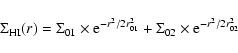 |
(1) |
with
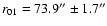 ,
,
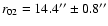 ,
,
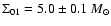 pc-2 and
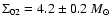 pc-2.
pc-2.
For KK98 251, the HI surface density profile was obtained in the usual way from
fitting elliptical annuli. The surface density
(shown
in Fig. 3B) was obtained from the integrated HI column density
image at 26
resolution image and is well represented by a Gaussian:
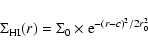 |
(2) |
with
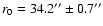 ,
,
 and
and
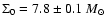 pc-2.
pc-2.
![\begin{figure}
\par\includegraphics[width=8.7cm,clip]{1210fig3.eps}
\end{figure}](/articles/aa/full/2004/35/aa1210/Timg78.gif) |
Figure 3:
A) The HI surface density profile of KK98 250 derived from the HI
distribution at
 resolution (points). A double
Gaussian fit to the HI distribution is shown as dotted line. A decomposition
of the double Gaussian fit into a narrow and broad Gaussian component is
shown as dashed lines. See the text for more details.
B) The HI surface density profile of KK98 251 derived from the HI distribution at
resolution (points). The adopted
Gaussian fit is shown as a dotted line.
resolution (points). A double
Gaussian fit to the HI distribution is shown as dotted line. A decomposition
of the double Gaussian fit into a narrow and broad Gaussian component is
shown as dashed lines. See the text for more details.
B) The HI surface density profile of KK98 251 derived from the HI distribution at
resolution (points). The adopted
Gaussian fit is shown as a dotted line. |
| Open with DEXTER |
3.2 HI kinematics
The velocity fields of KK98 250 and KK98 251, derived from the 26
resolution
HI data cube are shown in Fig. 4. The velocity fields are regular and
the isovelocity contours are approximately parallel, which is a signature of rigid
body rotation.
The velocity field of KK98 251 is slightly lopsided, the isovelocity contours
in the north-eastern half of the galaxy are more curved than the south-western
half. Some small scale kinks are also seen in the isovelocity contours in the outer
regions of the galaxy, indicative of a weak warping of the outer disk. These
effects are more prominent in the higher spatial resolution velocity fields
(not shown), which also show a mild twist in the kinematical major axis in the
outer region of the galaxy, consistent with warping.
![\begin{figure}
\par\includegraphics[width=7.5cm,clip]{1210fig4.eps}
\end{figure}](/articles/aa/full/2004/35/aa1210/Timg79.gif) |
Figure 4:
The HI velocity fields of KK98 250 and KK98 251 at 26
resolution. The contours are in steps of 5 km s-1 and
range from 80.0 km s-1 to 170.0 km s-1. |
| Open with DEXTER |
3.3 HI rotation curve
The rotation curves of the galaxies were derived separately for each of the
 ,
,
 and
and
 velocity fields, using the usual tilted ring model (Warner et al. 1973).
For the edge-on galaxy KK98 250, as described in more detail below, the rotation
curve was also derived by fitting to the position-velocity diagram.
velocity fields, using the usual tilted ring model (Warner et al. 1973).
For the edge-on galaxy KK98 250, as described in more detail below, the rotation
curve was also derived by fitting to the position-velocity diagram.
For each galaxy, the center and systemic velocity obtained from a global fit to
the various resolution velocity fields matched within the error bars; the systemic
velocity also matched with the values obtained from the global HI profiles. Keeping the
center and systemic velocity fixed, we fitted for the inclination and position
angle (PA) in each ring. For KK98 250, keeping inclination as a free parameter in
the tilted ring fit gave unphysical results, hence, the kinematical inclination
of the galaxy was fixed to the value estimated from the HI morphology,
viz  .
Note that at such high inclination angles, the uncertainty in
inclination has only a small effect on the derived rotation curve (Begeman 1989).
For example, if we fix the inclination to
.
Note that at such high inclination angles, the uncertainty in
inclination has only a small effect on the derived rotation curve (Begeman 1989).
For example, if we fix the inclination to  ,
the derived rotation curve
is the same, within the error bars. Fits for the position angle gave a value
of
,
the derived rotation curve
is the same, within the error bars. Fits for the position angle gave a value
of  (in good agreement with that derived from the optical image),
with no systematic variation across the galaxy. The rotation curves (derived
with the PA and inclination fixed to the values of
and )
are
shown in Fig. 5A. Note that the rotation curves derived
from the different resolution velocity fields match within the errorbars,
suggesting that, in spite of being highly inclined, the effects of beam
smearing are not significant. The final adopted rotation curve is shown in
Fig. 5A as a solid line.
(in good agreement with that derived from the optical image),
with no systematic variation across the galaxy. The rotation curves (derived
with the PA and inclination fixed to the values of
and )
are
shown in Fig. 5A. Note that the rotation curves derived
from the different resolution velocity fields match within the errorbars,
suggesting that, in spite of being highly inclined, the effects of beam
smearing are not significant. The final adopted rotation curve is shown in
Fig. 5A as a solid line.
For KK98 251, the inclination was found to be
 (which agrees with
that derived from ellipse fitting to the HI morphology, see Sect. 3.1),
with no systematic variation with the radius. The best fit position angle was
(which agrees with
that derived from ellipse fitting to the HI morphology, see Sect. 3.1),
with no systematic variation with the radius. The best fit position angle was  at all radii, except in the outermost regions of the galaxy where
it changes to
at all radii, except in the outermost regions of the galaxy where
it changes to  .
Ignoring this relatively small change, (which in any
case has negligible effect on the derived velocities),
the rotation curve was derived by keeping the inclination and PA fixed at
and
respectively. Figure 6A shows the rotation curves for KK98 251,
derived from the various resolution velocity fields. Note that all the rotation curves
match within the errorbars. Recall that KK98 251 shows slight kinematical lopsidedness.
Consistent with this, the rotation curve derived independently for the approaching
and receding sides are slightly different, although the difference is everywhere less
than 3.5 km s-1. For the purpose of mass modeling, we have used a mean of
the rotation curves for the two sides. The errorbars on the mean rotation
curve were obtained by adding quadratically the uncertainty reported by the
tilted-ring fit as well as the difference in rotation velocities between the
approaching and receding side.
.
Ignoring this relatively small change, (which in any
case has negligible effect on the derived velocities),
the rotation curve was derived by keeping the inclination and PA fixed at
and
respectively. Figure 6A shows the rotation curves for KK98 251,
derived from the various resolution velocity fields. Note that all the rotation curves
match within the errorbars. Recall that KK98 251 shows slight kinematical lopsidedness.
Consistent with this, the rotation curve derived independently for the approaching
and receding sides are slightly different, although the difference is everywhere less
than 3.5 km s-1. For the purpose of mass modeling, we have used a mean of
the rotation curves for the two sides. The errorbars on the mean rotation
curve were obtained by adding quadratically the uncertainty reported by the
tilted-ring fit as well as the difference in rotation velocities between the
approaching and receding side.
![\begin{figure}
\par\includegraphics[width=8.7cm,clip]{1210fig5.eps}
\end{figure}](/articles/aa/full/2004/35/aa1210/Timg89.gif) |
Figure 5:
A) The rotation curves for KK98 250 derived from the intensity weighted velocity
field at various resolutions. Circles, squares and triangles represent the rotation
velocity derived from the
 , ,
 and
and
 resolution respectively. The adopted rotation
curve is shown by solid line.
B) The adopted HI rotation curve for KK98 250 (dots) along with the H
resolution respectively. The adopted rotation
curve is shown by solid line.
B) The adopted HI rotation curve for KK98 250 (dots) along with the H rotation
 curve derived by de Blok et al. (2001) (triangles).
rotation
rotation curve derived by de Blok et al. (2001) (triangles).
|
| Open with DEXTER |
![\begin{figure}
\par\includegraphics[width=8.7cm,clip]{1210fig6.eps}
\end{figure}](/articles/aa/full/2004/35/aa1210/Timg90.gif) |
Figure 6:
A) The rotation curves for KK98 251 derived from the intensity weighted
velocity field at various resolutions. Circles, squares and triangles
show the rotation velocity derived from the
,
and
resolution
respectively. The adopted mean rotation curve is shown by dash-dot
line.
B) The adopted mean rotation curve for KK98 251 (squares) and the
rotation curve after applying "asymmetric drift'' correction
(circles). See the text for more details. |
| Open with DEXTER |
For highly inclined galaxies, rotation velocities derived from the titled ring
fits to the velocity field could underestimate the true rotation velocities, hence
in such cases the rotation curve is often estimated by fitting to the high velocity
edge of the emission (e.g. Sancisi & Allen 1979). While this method is well suited
to large galaxies with flat rotation curves, it is not appropriate for
galaxies with solid body rotation. Both the velocity field of KK98 250 as well as the
rotation curve derived from the tilted ring fit indicate solid body rotation,
hence, instead of using the "edge fitting'' technique, the rotation curve for KK98 250
was derived by interactively fitting to the PV diagram, using the task INSPECTOR in GIPSY (see Fig. 7A). The PA and the inclination in the interactive fitting
were fixed to the values used in the tilted ring fit. The derived rotation curve
matches, within the errorbars, to that derived from the tilted ring fit. As a
further check of the robustness of the derived rotation
curve, a model data cube for KK98 250 was constructed using the adopted rotation
curve and the observed HI column density profile, with the task GALMOD in GIPSY.
The model data cube was smoothed to a beam of 26
resolution
and the moment maps were derived in the same manner as for the real data.
Figure 8B shows the derived model velocity field for KK98 250.
A residual (data-model) velocity field is shown in Fig. 8C;
as can be seen, the model velocity field provides a good match to
the observed field.
![\begin{figure}
\par\includegraphics[width=8.7cm,clip]{1210fig7.eps}
\end{figure}](/articles/aa/full/2004/35/aa1210/Timg91.gif) |
Figure 7:
A) The PV diagram of the galaxy along the kinematical
major axis for KK98 250, with the adopted rotation curve overlayed.
B) The PV diagram of the galaxy along the kinematical
major axis for KK98 251, with the adopted rotation curve overlayed. |
| Open with DEXTER |
Although KK98 251 is less inclined, a similar exercise of estimating the
rotation velocities from the PV diagram was repeated for it.
Figure 7B shows the adopted mean rotation curve projected
onto the PV diagram - as can be seen, the mean rotation curve provides
a reasonably good fit to the data. A model data cube for KK98 251 was also
constructed using the derived rotation curve, in the same manner as for
KK98 250. Again, a good match between the model (not shown) and the
observed field was found.
The sensitivity of HI observations to the inner slope of the rotation
curve has been the subject of much recent discussion (e.g. van den Bosch
& Swaters 2001). One possible way of overcoming the relatively poor
resolution offered by HI observations is to instead use H observations.
For KK98 250, an H based rotation curve has been
derived by de Blok et al. (2001), and is shown with triangles
in Fig. 5B. As can be seen, although the H curve
is steeper than the HI curve at intermediate radii, in
the innermost regions of the galaxy, (where the effects of beam smearing
are expected to be most severe), the two rotation curves in fact
show an excellent agreement.
![\begin{figure}
\par\includegraphics[angle=-180,width=8.7cm,clip]{1210fig8.eps}
\end{figure}](/articles/aa/full/2004/35/aa1210/Timg92.gif) |
Figure 8:
A) The observed velocity field of KK98 250 at
resolution. B) The model
velocity field derived from the rotation curve at 26
resolution. The contours are in steps of 5 km s-1 and range
from 81.0 km s-1 to 171.0 km s-1. C) The residual velocity field ( A)-B)).
The contours are in steps of 1.0 km s-1 and range from -4.0 km s-1 to 4.0 km s-1. |
| Open with DEXTER |
As mentioned earlier, if one wishes to use the rotation curves to estimate the
total dynamical mass, then one needs to account for the pressure support of the
HI disk; this correction (generally called the "asymmetric drift'' correction)
is given by:
![\begin{displaymath}v^2_{\rm c}=v^2_{\rm o} - r\times{\sigma}^2\Big[\frac{\rm d}{...
... d}r}(\ln{\sigma}^2)-\frac{\rm d}{{\rm d}r}(\ln{2{h_z}})\Big],
\end{displaymath}](/articles/aa/full/2004/35/aa1210/img93.gif) |
(3) |
where  is the corrected circular velocity,
  is the observed rotation velocity,
  is the velocity dispersion, and hz is the scale height of the disk. Strictly speaking, "asymmetric drift'' corrections are applicable to collisionless stellar systems
for which the magnitude of the random motions is much smaller than that of the rotation
velocity. However, it is often used even for gaseous disks, where the assumption
being made is that the pressure support can be approximated as the gas density times the
square of the random velocity. The observed profile width can be used as an estimator
of the velocity dispersion, after correcting for instrumental broadening and the finite
size of the synthesized beam. This procedure doesn't work for very inclined galaxies,
so, as discussed in Sect. 2 for KK98 250 we assume a constant velocity
dispersion of 8 km s-1. For KK98 251 we find that, after putting in these corrections, the
estimated velocity dispersion is also
is the velocity dispersion, and hz is the scale height of the disk. Strictly speaking, "asymmetric drift'' corrections are applicable to collisionless stellar systems
for which the magnitude of the random motions is much smaller than that of the rotation
velocity. However, it is often used even for gaseous disks, where the assumption
being made is that the pressure support can be approximated as the gas density times the
square of the random velocity. The observed profile width can be used as an estimator
of the velocity dispersion, after correcting for instrumental broadening and the finite
size of the synthesized beam. This procedure doesn't work for very inclined galaxies,
so, as discussed in Sect. 2 for KK98 250 we assume a constant velocity
dispersion of 8 km s-1. For KK98 251 we find that, after putting in these corrections, the
estimated velocity dispersion is also  8 km s-1. Further, in the absence of
any measurement for hz, we assumed
8 km s-1. Further, in the absence of
any measurement for hz, we assumed
 (i.e. that the scale height
does not change with radius). Substituting these values back in the Eq. (3)
and using the fitted Gaussian profile to the radial surface density distribution,
the "asymmetric drift'' correction was calculated and applied to the observed
rotation velocities. For KK98 250 this correction is found to be small (less than 2.5 km s-1),
compared to the errorbars on the rotation curve. On the other hand, the correction
for KK98 251 is significant in the outer regions. The "asymmetric drift'' corrected
curve for KK98 251 is shown in Fig. 6B.
(i.e. that the scale height
does not change with radius). Substituting these values back in the Eq. (3)
and using the fitted Gaussian profile to the radial surface density distribution,
the "asymmetric drift'' correction was calculated and applied to the observed
rotation velocities. For KK98 250 this correction is found to be small (less than 2.5 km s-1),
compared to the errorbars on the rotation curve. On the other hand, the correction
for KK98 251 is significant in the outer regions. The "asymmetric drift'' corrected
curve for KK98 251 is shown in Fig. 6B.
3.4 Mass model
![\begin{figure}
\par\includegraphics[angle=-90,width=17cm,clip]{1210fig9.eps}
\end{figure}](/articles/aa/full/2004/35/aa1210/Timg105.gif) |
Figure 9:
A) Mass models for KK98 250 using the corrected rotation curve.
The points are the observed data. The total mass of gaseous disk (dashed line)
is
 .The stellar disk (short dash dot line) has .The stellar disk (short dash dot line) has
 ,
giving a stellar mass of ,
giving a stellar mass of
 .
The
best fit total rotation curve for the constant density halo model is shown as
a solid line, while the contribution of the halo itself is shown as a
long dash dot line (the halo density is .
The
best fit total rotation curve for the constant density halo model is shown as
a solid line, while the contribution of the halo itself is shown as a
long dash dot line (the halo density is
 pc-3 and core radius pc-3 and core radius
 ). The best fit
total rotation curve for an NFW type halo, using ). The best fit
total rotation curve for an NFW type halo, using
 ,
c=1.0 and
v200=331.0 km s-1 is shown as a dotted line.
B) The best fit mass model for an isothermal halo (solid line)
to the hybrid rotation curve of KK98 250 consisting of the H rotation velocities in
the center and the "asymmetric drift'' corrected HI data in the outer regions
of the galaxy. Also shown in the figure is the minimum disk fit mass model for an
NFW type halo (dotted line). C) Mass models for KK98 251 using the corrected rotation curve.
The total mass of gaseous disk
is ,
c=1.0 and
v200=331.0 km s-1 is shown as a dotted line.
B) The best fit mass model for an isothermal halo (solid line)
to the hybrid rotation curve of KK98 250 consisting of the H rotation velocities in
the center and the "asymmetric drift'' corrected HI data in the outer regions
of the galaxy. Also shown in the figure is the minimum disk fit mass model for an
NFW type halo (dotted line). C) Mass models for KK98 251 using the corrected rotation curve.
The total mass of gaseous disk
is
 .
The stellar disk has .
The stellar disk has
 ,
giving a stellar mass of ,
giving a stellar mass of
 .
The
best fit constant density halo model is .
The
best fit constant density halo model is
 pc-3
and core radius pc-3
and core radius
 (solid line). Also shown is the best fit total rotation
curve for an NFW type halo, using
(solid line). Also shown is the best fit total rotation
curve for an NFW type halo, using
 ,
c=1.0 and
v200=180.0 km s-1 as
a dotted line. See the text for more details. ,
c=1.0 and
v200=180.0 km s-1 as
a dotted line. See the text for more details. |
| Open with DEXTER |
In this section, we use the "asymmetric drift'' corrected rotation curves,
derived in the last section, to derive mass models for KK98 250 and KK98 251.
The contribution of the stellar mass to the observed rotation curves
were computed by assuming the galaxies to have exponential stellar disks, with
a constant mass to light ratio ( )
and an intrinsic thickness ratio (q0) of 0.2. We further assumed that the density distribution in the vertical
(z) direction falls off like sech2(z/z0), with z0 independent of
galacto-centric radius (see e.g. van der Kruit & Searle 1981; de Grijs & Peletier 1997).
The contribution of the gaseous disks to the observed rotation curves were
calculated using the observed HI surface mass density profiles, with the HI surface
density being scaled by a factor of 1.4 to account for the contribution from
helium. There is little evidence that dwarf galaxies contain substantial amounts
of molecular gas (e.g. Israel et al. 1995; Taylor et al. 1998), hence, no correction
was made for molecular gas. We also neglected the contribution of ionized gas,
if any. Since there is some evidence for similar vertical distributions of the HI and stellar disks (e.g. Bottema et al. 1986), we assumed the HI disks also to
have a sech2(z/z0) vertical profile, with an intrinsic thickness ratio of
q0=0.2. The circular velocities of the disk components were computed using the
formulae given by Casertano (1983). For the dark matter halo, we considered two
types of density profiles, viz. the modified isothermal profile and the NFW (Navarro et al. 1996) profile. For mass models using a modified isothermal halo,
the free parameters are the halo central density
)
and an intrinsic thickness ratio (q0) of 0.2. We further assumed that the density distribution in the vertical
(z) direction falls off like sech2(z/z0), with z0 independent of
galacto-centric radius (see e.g. van der Kruit & Searle 1981; de Grijs & Peletier 1997).
The contribution of the gaseous disks to the observed rotation curves were
calculated using the observed HI surface mass density profiles, with the HI surface
density being scaled by a factor of 1.4 to account for the contribution from
helium. There is little evidence that dwarf galaxies contain substantial amounts
of molecular gas (e.g. Israel et al. 1995; Taylor et al. 1998), hence, no correction
was made for molecular gas. We also neglected the contribution of ionized gas,
if any. Since there is some evidence for similar vertical distributions of the HI and stellar disks (e.g. Bottema et al. 1986), we assumed the HI disks also to
have a sech2(z/z0) vertical profile, with an intrinsic thickness ratio of
q0=0.2. The circular velocities of the disk components were computed using the
formulae given by Casertano (1983). For the dark matter halo, we considered two
types of density profiles, viz. the modified isothermal profile and the NFW (Navarro et al. 1996) profile. For mass models using a modified isothermal halo,
the free parameters are the halo central density  ,
core radius
,
core radius  and the mass to light ratio of the stellar disk, .
For the NFW models,
the free parameters are the halo concentration parameter c, v200 (the circular velocity
at the radius at which the halo density is 200 times the critical density) and
the mass to light ratio of the stellar disk, .
Mass model were fit using the
GIPSY task ROTMAS.
and the mass to light ratio of the stellar disk, .
For the NFW models,
the free parameters are the halo concentration parameter c, v200 (the circular velocity
at the radius at which the halo density is 200 times the critical density) and
the mass to light ratio of the stellar disk, .
Mass model were fit using the
GIPSY task ROTMAS.
Table 2:
Mass decomposition using isothermal halo.
Since we could trace emission only from the brightest central regions of the
galaxy in the I band, we use the more accurately determined V band scale length for the
mass modeling. Figure 9A shows the best fit mass models for KK98 250. The
derived halo parameters are given in Table 2. For comparison, apart from
the best fit mass model, the derived halo parameters are also given for the maximum disk,
minimum disk and
 (which was obtained from the observed color
of 1.3 using the low metallicity Bruzual
(which was obtained from the observed color
of 1.3 using the low metallicity Bruzual  Charlot SPS model using
a modified Salpeter IMF; Bell
de Jong 2001). The total dynamical mass of KK98 250,
estimated from the last measured point of the rotation curve is
Charlot SPS model using
a modified Salpeter IMF; Bell
de Jong 2001). The total dynamical mass of KK98 250,
estimated from the last measured point of the rotation curve is
 - at this radius more than 92% of the
mass of KK98 250 is dark.
- at this radius more than 92% of the
mass of KK98 250 is dark.
For mass models with an NFW halo, keeping
 as a free parameter
in the fit gave unphysical results. Even after setting
as a free parameter
in the fit gave unphysical results. Even after setting
 ,
no reasonable
fit could be obtained. As an illustration, Fig. 9A shows an NFW fit
to the data, keeping the concentration parameters c fixed to 1,
and v200 chosen to minimize
,
no reasonable
fit could be obtained. As an illustration, Fig. 9A shows an NFW fit
to the data, keeping the concentration parameters c fixed to 1,
and v200 chosen to minimize  .
As can be seen, even at these extreme values
for the parameters, the quality of fit is poor.
.
As can be seen, even at these extreme values
for the parameters, the quality of fit is poor.
We also fit mass models to a hybrid rotation curve (see Fig. 5B),
consisting of H data derived by de Blok et al. (2001) in the inner regions of the
galaxy and the "asymmetric drift'' corrected HI rotation curve in the outer regions.
Again, keeping
as a free parameter in the fit gave unphysical results, hence
it was fixed to the value of 0.2, obtained from the best fit isothermal halo model,
derived using the HI rotation curve alone. In any case, fixing
to a
common value allows a meaningful comparison of the halo parameters derived using
both the rotation curves. The derived halo parameters for the isothermal halo
are given in Table 2. The table also shows the isothermal halo
parameters derived by de Blok et al. (2001) using only the H rotation curve.
We note that apart from the (probably not physically meaningful) maximum disk
case, the halo parameters derived from the HI rotation curve are in good
agreement with one another, but that they are substantially different from
the parameters derived from the Hybrid or H rotation curves. In this
context it is worth repeating, that the discrepancy between the H rotation curve and the HI rotation curve is largest at intermediate radii, and
not at small radii as one would have expected, if the HI rotation curve
suffered from beam smearing.
Also shown in Fig. 9B is the
,
NFW halo fit
to the Hybrid rotation curve. As can be seen, this fit overestimates
the observed rotation velocity in the inner regions of the galaxy; fixing
to more reasonable values worsens this discrepancy.
The NFW halo parameters (corresponding to
)
are
 and
and
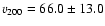 .
The value of 6.5 for the concentration parameter is
much lower than the range of NFW concentration parameters predicted by LCDM simulations (Bullock et al. 2001). It is worth mentioning here that even for
the H rotation curve alone, isothermal halos provide a substantially
better fit than an NFW halo (de Blok et al. 2001).
.
The value of 6.5 for the concentration parameter is
much lower than the range of NFW concentration parameters predicted by LCDM simulations (Bullock et al. 2001). It is worth mentioning here that even for
the H rotation curve alone, isothermal halos provide a substantially
better fit than an NFW halo (de Blok et al. 2001).
As discussed in Sect. 2.1 for KK98 251, we use the I band scale length
derived by Karachentsev et al. (2000). For isothermal halo models, keeping
 as a free parameter in the fit gave negative values for
.
Further, if one keeps
fixed, the
continuously decreases
as
is decreased. Figure 9C shows the best fit
mass model for KK98 251 for a constant density halo using
(which
corresponds to the observed
color, from the low metallicity Bruzual
Charlot SPS model using a modified Salpeter IMF). The derived halo parameters
using various values of
are given in Table 2. As can
be seen from Table 2, the halo parameters are relatively
insensitive to the assumed value of
.
The total dynamical mass (at
the last measured point of the rotation curve) is
as a free parameter in the fit gave negative values for
.
Further, if one keeps
fixed, the
continuously decreases
as
is decreased. Figure 9C shows the best fit
mass model for KK98 251 for a constant density halo using
(which
corresponds to the observed
color, from the low metallicity Bruzual
Charlot SPS model using a modified Salpeter IMF). The derived halo parameters
using various values of
are given in Table 2. As can
be seen from Table 2, the halo parameters are relatively
insensitive to the assumed value of
.
The total dynamical mass (at
the last measured point of the rotation curve) is
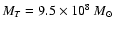 .
For KK98 251, we found that even for
.
For KK98 251, we found that even for
 ,
with no value of c and v200
could a good fit using an NFW halo be obtained. The best fit NFW model is also
shown in Fig. 9C; as can be seen, the data deviate substantially
from the model.
,
with no value of c and v200
could a good fit using an NFW halo be obtained. The best fit NFW model is also
shown in Fig. 9C; as can be seen, the data deviate substantially
from the model.
3.7 The Tully-Fisher relation
It has been recently suggested that dwarf galaxies deviate systematically
from the Tully-Fisher (TF) relation defined by bright galaxies (i.e. Stil 1999;
Swaters 1999; McGaugh et al. 2000), with small galaxies being underluminous
compared to what would be expected had they followed the same TF relation as L* galaxies. Contrary to this suggestion, Pierini & Tuffs (1999) found no
evidence of any break in the near-IR TF relation for faint dwarf galaxies.
The reason for this discrepancy is unclear. We note however that high
resolution HI images are probably crucial in studies of the TF relation for
very faint galaxies. This is because (i) the inclination may often be difficult
to obtain from images of faint irregular galaxies, and (ii) the 50% HI velocity
width may not be a good indicator of the rotation velocity in faint dwarf galaxies,
where random motions are comparable to the peak rotational velocities
(e.g. Camelopardalis B, Begum et al. 2003; DDO210, Begum & Chengalur 2004).
For such galaxies, it is important to accurately correct for the pressure
support ("asymmetric drift'' correction), which is possible only if one
has high resolution HI images. Unfortunately, there are only few dwarf
galaxies with both I band photometry and HI synthesis imaging available.
Interestingly enough, even without this correction, (or even a correction
for inclination), the HI velocity widths of dwarf galaxies with well
measured distances do correlate with the absolute blue luminosity,
albeit with large scatter (Huchtmeier et al. 2003). It is currently a
matter of speculation as to whether the scatter would reduce
significantly, once one puts in the corrections discussed above.
We show in Fig. 10, the TF relation for a sample of galaxies
(with both HI synthesis imaging and I band photometry) spanning a range of
I magnitude from -23.0 to -12.0. For the bright galaxies, the photometry
and rotation velocities are from Verheijen (2001), while for the fainter galaxies,
the I band magnitudes are from Patterson & Thuan (1996) and
Makarova & Karachentsev (1998), while the rotation velocities were taken
from Swaters (1999) and de Blok et al. (1996). The faintest two galaxies
(Camelopardalis B and DDO210) are from our
earlier work (Begum et al. 2003; Begum & Chengalur 2004). For Camelopardalis B,
the I magnitude is calculated using the relation
(B- V)T=0.85 (V - I)T-0.2
(Makarova & Karachentsev 1998). As can be seen from Fig. 10,
faint dwarf galaxies do tend to lie systematically below the TF relation defined
by bright galaxies (dotted line). This trend persists even if one excludes the
most discrepant bright galaxy (U7094, which has a poor quality rotation curve)
in determining the bright galaxy TF relation (dashed curve). Note also that
the scatter in the TF relation increases at the faint end - this may be in
part due to the uncertainty in the distances to the galaxies.
![\begin{figure}
\par\includegraphics[angle=-90,width=7cm,clip]{1210fig10.eps}
\end{figure}](/articles/aa/full/2004/35/aa1210/Timg140.gif) |
Figure 10:
I magnitude Tully-Fisher diagram. The filled circles are from Verheijen (2001),
empty circles from Swaters (1999) with I band magnitude from Patterson & Thuan (1996),
filled triangles from Swaters (1999) with I band magnitude from Makarova & Karachentsev (1998) and
crosses from de Blok et al. (1996) with I band from Patterson & Thuan (1996). Filled squares are from
galaxies in our sample including KK98 250, KK98 251, CamB and DDO210. The dotted line is
the best fit to Verheijen (2001) sample, while the dashed line is the best fit
to the Verheijen (2001) sample excluding the galaxy U7094. See the text for more details. |
| Open with DEXTER |
To conclude, we have presented high velocity resolution HI 21 cm
synthesis images of the dwarf galaxies, KK98 250 and KK98 251, as well as
optical broad band images of KK98 250. We find that the HI disks of the
galaxies do not show any clear signs of tidal disturbance and that
both galaxies have regular velocity fields, consistent with rigid body rotation.
We fit the rotation curves with dark matter halo mass models and find
that both rotation curves can be fit using modified isothermal halos
but not with NFW halos. Finally, for a small sample of galaxies with
both I band photometry and HI synthesis images, we find, in agreement
with earlier studies (which used single dish HI data),
that dwarf galaxies tend to lie below the I band TF relation defined
by brighter galaxies.
Acknowledgements
The HI observations presented in this paper would not have been possible without
the many years of dedicated effort put in by the GMRT staff in order to build the
telescope. The GMRT is operated by the National Centre for Radio Astrophysics of
the Tata Institute of Fundamental Research. We thank the staff of IAO, Hanle
and CREST, Hosakote, that made the optical observations possible. The facilities at IAO
and CREST are operated by the Indian Institute of Astrophysics, Bangalore. We are
also grateful to Dr Devendra Kumar Sahu invaluable help with the optical
observations.
- Begeman, K.
G. 1989, A&A, 223, 47 [NASA ADS] (In the text)
- Begum, A., &
Chengalur, J. N. 2004, A&A, 413, 525 [EDP Sciences] [NASA ADS] (In the text)
- Begum, A.,
Chengalur, J. N., & Hopp, U. 2003, New Astron., 8, 267 [NASA ADS] [CrossRef] (In the text)
- Bender, R.,
& Möllenhoff, C. 1987, A&A, 177, 71 [NASA ADS] (In the text)
- Bell, E. F., &
de Jong, R. S. 2001, ApJ, 550, 212 [NASA ADS] (In the text)
- Bottema, R.,
Shostak, G. S., & van der Kruit, P. C. 1986, A&A, 167,
34 [NASA ADS] (In the text)
- Bullock, J.
S., Kolatt, T. S., Sigad, Y., et al. 2001, MNRAS, 321, 559 [NASA ADS] (In the text)
-
Casertano, S. 1983, MNRAS, 203, 735 [NASA ADS] (In the text)
- de Blok, W. J. G.,
McGaugh, S. S., & Rubin, V. C. 2001, AJ, 122, 2396 [NASA ADS] (In the text)
- de Blok, W. J. G.,
McGaugh, S. S., & vander Hulst, J. M. 1996, MNRAS, 283, 15 [NASA ADS] (In the text)
- de Grijs, R.,
& Peletier, R. F. 1997, A&A, 320, L21 [NASA ADS] (In the text)
-
Huchtmeier, W. K., Karachentsev, I. D., & Karachentseva, V. E.
2003, A&A, 401, 483 [EDP Sciences] [NASA ADS] (In the text)
-
Huchtmeier, W. K., Karachentsev, I. D., Karachentseva, V. E., &
Ehle, M. 2000, A&AS, 141, 469 [NASA ADS] (In the text)
-
Huchtmeier, W. K., Karachentsev, I. D., & Karachentseva, V. E.
1997, A&A, 322, 375 [NASA ADS] (In the text)
- Israel, F. P.,
Tacconi, L. J., & Bass, F. 1995, A&A, 295, 599 [NASA ADS] (In the text)
-
Karachentsev, I. D., Sharina, M. E., & Huchtmeier, W. K. 2000,
A&A, 362, 544 [NASA ADS]
-
Karachentseva, V. E., & Karachentsev, I. D. 1998, A&AS,
127, 409 [NASA ADS] (In the text)
- Lake, G., Schommer,
R. A., & van Gorkom, J. H. 1990, AJ, 99, 547 [NASA ADS] (In the text)
- Landolt, A. U.
1983, AJ, 88, 439 [NASA ADS] (In the text)
- Makarova,
L. N., & Karachentsev, I. D. 1998, A&AS, 133, 181 [NASA ADS] (In the text)
- McGaugh, S.
S., Schombert, J. M., Bothun, G. D., & de Blok, W. J. G. 2000,
ApJL, 533, 99 [NASA ADS] (In the text)
- Navarro, J.
F., Frenk, C. S., & White, S. D. M. 1996, ApJ, 462, 563 [NASA ADS] (In the text)
-
Patterson, R. J., & Thuan, T. X. 1996, ApJS, 107, 103 [NASA ADS] (In the text)
- Pierini, D.,
& Tuffs, R. J. 1999, A&A, 343, 751 [NASA ADS] (In the text)
- Pisano, D. J.,
& Wilcots, E. M. 2000, MNRAS, 319, 821 [NASA ADS] (In the text)
- Sancisi, R.,
& Allen, R. J. 1979, A&A, 74, 73 [NASA ADS] (In the text)
- Schlegel,
D. J., Finkbeiner, D. P., & Davis, M. 1998, ApJ, 500, 525 [NASA ADS] (In the text)
- Sharina, M.
E., Karachentsev, I. D., & Tikhonov, N. A. 1997, Astron. Lett.,
23, 373 [NASA ADS] (In the text)
- Skillman,
E. D., Terlevich, R., Teuben, P. J., & van Woerden, H. 1988,
A&A, 198, 33 [NASA ADS] (In the text)
- Swarup, G.,
Ananthakrishnan, S., Kapahi, V. K., et al. 1991, Current Science,
60, 95 [NASA ADS] (In the text)
- Stil, J. N. 1999,
Ph.D. Thesis, Rijksuniversiteit Leiden
(In the text)
- Swaters, R.
1999, Ph.D. Thesis, Rijksuniversiteit Groningen
(In the text)
- Taylor, C. L.,
Kobulnicky, H. A., & Skillman, E. D. 1998, AJ, 116, 2746 [NASA ADS] (In the text)
- van der Kruit, P.
C., & Searle, L. 1981, A&A, 95, 105 [NASA ADS] (In the text)
- van den Bosch, F.
C., & Swaters, R. 2001, MNRAS, 325, 1017 [NASA ADS] (In the text)
-
Verheijen, M. A. W. 2001, ApJ, 563, 694 [NASA ADS] (In the text)
- Warmels, R.
H. 1988, A&AS, 72, 427 [NASA ADS] (In the text)
- Warner, P. J.,
Wright, M. C. H., & Baldwin, J. E. 1973, MNRAS, 163, 163 [NASA ADS] (In the text)
- Weldrake,
D. T. F., de Blok, W. J. G., & Walter, F. 2003, MNRAS, 340,
12 [NASA ADS] (In the text)
Copyright ESO 2004
![\begin{figure}
\par\includegraphics[width=8.7cm,clip]{1210fig1.eps}
\end{figure}](/articles/aa/full/2004/35/aa1210/img50.gif)
![\begin{figure}
\par\includegraphics[angle=-90,width=6.7cm,clip]{1210fig2.eps}
\end{figure}](/articles/aa/full/2004/35/aa1210/img67.gif)
![\begin{figure}
\par\includegraphics[width=8.7cm,clip]{1210fig3.eps}
\end{figure}](/articles/aa/full/2004/35/aa1210/img78.gif)
![\begin{figure}
\par\includegraphics[width=7.5cm,clip]{1210fig4.eps}
\end{figure}](/articles/aa/full/2004/35/aa1210/img79.gif)
![\begin{figure}
\par\includegraphics[width=8.7cm,clip]{1210fig5.eps}
\end{figure}](/articles/aa/full/2004/35/aa1210/img89.gif)
![\begin{figure}
\par\includegraphics[width=8.7cm,clip]{1210fig6.eps}
\end{figure}](/articles/aa/full/2004/35/aa1210/img90.gif)
![\begin{figure}
\par\includegraphics[width=8.7cm,clip]{1210fig7.eps}
\end{figure}](/articles/aa/full/2004/35/aa1210/img91.gif)
![\begin{figure}
\par\includegraphics[angle=-180,width=8.7cm,clip]{1210fig8.eps}
\end{figure}](/articles/aa/full/2004/35/aa1210/img92.gif)
![\begin{figure}
\par\includegraphics[angle=-90,width=17cm,clip]{1210fig9.eps}
\end{figure}](/articles/aa/full/2004/35/aa1210/img105.gif)
![\begin{figure}
\par\includegraphics[angle=-90,width=7cm,clip]{1210fig10.eps}
\end{figure}](/articles/aa/full/2004/35/aa1210/img140.gif)