A&A 420, 769-774 (2004)
DOI: 10.1051/0004-6361:20035728
Stark broadening parameters in singly and doubly ionized fluorine spectra
A. Sreckovic1,2 - S. Bukvic1,2 - S. Djenize1,2 - M. S. Dimitrijevic2,3
1 - Faculty of Physics, University of Belgrade,
11001 Belgrade, PO Box 368, Serbia
2 - Isaac Newton Institute of Chile, Yugoslavia Branch, Belgrade, Serbia
3 - Astronomical Observatory, 11160 Belgrade, Volgina 7, Serbia
Received 22 November 2003 / Accepted 1 March 2004
Abstract
Stark widths (W) and shifts (d) of 5 singly ionized
fluorine (F II) spectral lines within the
 ,
,
 and
and
 transitions and 5 doubly ionized fluorine (F III) spectral lines within the
transition have been measured in a linear, low-pressure,
pulsed arc discharge created in SF6 plasma at
30 400-33 600 K electron temperatures and at
transitions and 5 doubly ionized fluorine (F III) spectral lines within the
transition have been measured in a linear, low-pressure,
pulsed arc discharge created in SF6 plasma at
30 400-33 600 K electron temperatures and at
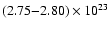 m-3 electron densities. For Stark parameters of two F II and five F III lines there are no other experimental data.
The widths and shifts have also been
calculated using the semiclassical perturbation formalism (SCPF)
(taking into account the impurity of energy levels, i.e. that the
atomic energy levels are expressed as a mix of different
configurations due to the configuration interaction). Calculations
have been performed for temperatures between 5000 K and 100 000 K
for the F II spectral lines and between 10 000 K and 300 000 K for
the F III spectral lines for electrons, protons and helium ions as
perturbers. Our measured and theoretical Stark parameters are
compared with existing experimental and theoretical data.
Tolerable agreement was found among them.
m-3 electron densities. For Stark parameters of two F II and five F III lines there are no other experimental data.
The widths and shifts have also been
calculated using the semiclassical perturbation formalism (SCPF)
(taking into account the impurity of energy levels, i.e. that the
atomic energy levels are expressed as a mix of different
configurations due to the configuration interaction). Calculations
have been performed for temperatures between 5000 K and 100 000 K
for the F II spectral lines and between 10 000 K and 300 000 K for
the F III spectral lines for electrons, protons and helium ions as
perturbers. Our measured and theoretical Stark parameters are
compared with existing experimental and theoretical data.
Tolerable agreement was found among them.
Key words: lines:
profiles - atomic data
Atomic data, such a Stark widths (W) and shifts (d)are useful for plasma diagnostic purposes in a wide range of
electron temperatures (T) for astrophysical and laboratory
plasmas. In the last five years fluorine spectral lines have become
important for
abundance investigations in various astrophysical
plasmas (Lodders 2003; Zhu et al. 2002; Highberger et al. 2001).
Only four experiments (Platisa et al. 1977; Puric et al.
1988; Djenize et al. 1991; Blagojevic et al. 1999; see also
Lesage & Fuhr 1999; Konjevic et al. 2002, and references
therein), deal with investigations of Stark broadening parameters
(W, d) of singly ionized fluorine spectral lines. A number of
calculations of the Stark parameters, related to the F II, F III spectral lines, on the basis of different theoretical approaches
is presented in the literature (Griem 1974; Hey 1976; Hey & Breger 1981;
Dimitrijevic & Konjevic 1981; Dimitrijevic 1988a,b). Furthermore, in Djenize
(2000), on the basis of regularities within an isonuclear
sequence, Stark widths of F II 402.50 nm spectral lines (
transition) are predicted. In Djenize et al. (1999)
regularities of Stark widths of several F II spectral lines within
the same transition (
)
are presented.
The aim of this work is to present measured Stark FWHM (full-width
at half intensity maximum, W) and shift (d) values at
(30 400
- 33 600) K electron temperatures and at
m-3 electron densities for 5 F II spectral lines
belonging to the
,
 and
transitions
and 5 doubly ionized fluorine (F III) spectral lines within the
and
transitions
and 5 doubly ionized fluorine (F III) spectral lines within the
 transition together with their calculated
values using the semiclassical
perturbation formalism (SCPF) updated several times (Sahal-Br
transition together with their calculated
values using the semiclassical
perturbation formalism (SCPF) updated several times (Sahal-Br
 chot 1969a,b, 1974, 1991;
Fleurier et al. 1977; Dimitrijevic & Sahal-Br
chot 1984, 1996b, see also a review in Dimitrijevic 1996).
A unique exception is the transition
chot 1969a,b, 1974, 1991;
Fleurier et al. 1977; Dimitrijevic & Sahal-Br
chot 1984, 1996b, see also a review in Dimitrijevic 1996).
A unique exception is the transition
 from the F II spectrum
(multiplet No. 3)
for which only calculated values are presented.
Our measured and calculated Stark parameters are compared with the
existing experimental and theoretical data (Griem 1974; Platisa
et al. 1977; Dimitrijevic & Konjevic
1981; Puric et al. 1988; Djenize et al. 1991).
from the F II spectrum
(multiplet No. 3)
for which only calculated values are presented.
Our measured and calculated Stark parameters are compared with the
existing experimental and theoretical data (Griem 1974; Platisa
et al. 1977; Dimitrijevic & Konjevic
1981; Puric et al. 1988; Djenize et al. 1991).
A linear pulsed arc, used as plasma source, was described in
detail in our previous publications (Djenize et al. 1992,
2002a; Sreckovic et al. 2001, 2003). The
working gas was SF6 at 130 Pa filling pressure in a flowing
regime (10 ml/min). The complete experimental procedure, plasma
diagnostic techniques and set-up of the system used are described in
Djenize et al. (2002a). The absence of self-absorption was
checked using the method described in Djenize & Bukvic
(2001). Part of the recorded F III spectrum, is presented, as an
example, in Fig. 1.
![\begin{figure}
\par\includegraphics[width=7.8cm,clip]{0728Fig1.eps}\end{figure}](/articles/aa/full/2004/23/aa0728/Timg23.gif) |
Figure 1:
Recorded spectrum with several investigated F III
spectral line profiles. |
| Open with DEXTER |
The obtained electron temperature (T) and the electron density (N)decays are presented in Fig. 1 of Djenize et al. (2002b).
The measured profiles were of the Voigt type due to the
convolutions of the Lorentzian Stark and Gaussian profiles caused
by Doppler and instrumental broadening. For the electron density
and temperature presented in our experiment, the Lorentzian
fraction was dominant. Van der Waals (Griem 1974) and resonance
(Griem 1974)
broadening were estimated to be smaller by more than one order of magnitude in comparison to Stark, Doppler
and instrumental broadening. The standard deconvolution procedure (Davies & Vaughan 1963) has been
applied using the least squares algorithm. The Stark widths were measured with  error at a given
N and T. Our measured Stark FWHM (Wm) values are presented in Table 1.
error at a given
N and T. Our measured Stark FWHM (Wm) values are presented in Table 1.
Table 1:
Measured F II and F III Stark FWHM
 in pm) and
shift
in pm) and
shift
 in pm) at a given T (in 104 K ) and N ( in
1023 m-3). Transitions and wavelengths (
in pm) at a given T (in 104 K ) and N ( in
1023 m-3). Transitions and wavelengths ( in nm)
are taken from NIST (2003). Negative shift is toward the blue.
in nm)
are taken from NIST (2003). Negative shift is toward the blue.
The Stark shifts were measured relative to the unshifted spectral
lines emitted by the same plasma using a method established and
applied first by Puric & Konjevic (1972). According to
this method the Stark shift of a spectral line can be measured
experimentally by evaluating the position of the spectral line
center
 recorded at different electron density values
during plasma decay (Sreckovic et al. 2000). In principle, the
method requires recording the spectral line profile at a higher
electron density (N1) resulting in an appreciable shift and
then, later, when the electron concentration has dropped to a
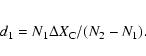
value (N2) lower by at least an order of magnitude. The difference of the line center position in these two cases is
recorded at different electron density values
during plasma decay (Sreckovic et al. 2000). In principle, the
method requires recording the spectral line profile at a higher
electron density (N1) resulting in an appreciable shift and
then, later, when the electron concentration has dropped to a
value (N2) lower by at least an order of magnitude. The difference of the line center position in these two cases is
 ,
so that the shift d1 at the higher electron density N1 is
,
so that the shift d1 at the higher electron density N1 is
Our Stark shift values have been obtained for line center
positions corresponding to the
 s and
s and
 s
after the beginning of the discharge. The dependence of the position of the observed line center
on the electron density (N) during
the plasma decay of the investigated 320.650 nm F II spectral
line is presented in Fig. 2, as an example.
s
after the beginning of the discharge. The dependence of the position of the observed line center
on the electron density (N) during
the plasma decay of the investigated 320.650 nm F II spectral
line is presented in Fig. 2, as an example.
![\begin{figure}
\par\includegraphics[width=7.6cm,clip]{0728Fig2.eps}\end{figure}](/articles/aa/full/2004/23/aa0728/Timg42.gif) |
Figure 2:
The dependence of the position of the observed line center ( )
as
a function of the electron density (N) during the plasma decay. )
as
a function of the electron density (N) during the plasma decay. |
| Open with DEXTER |
The Stark shift data are corrected for the electron temperature
decay (Popovic et al. 1992). Stark shift data are determined
with  0.8 pm error at a given N and T. Measured
 Stark shifts are presented in Table 1.
The semiclassical perturbation formalism, as well as the corresponding
computer code (Sahal-Bréchot 1969a,b), has been updated and optimized
several times (Sahal-Bréchot 1974; Fleurier et al. 1977; Dimitrijevic &
Sahal-Bréchot 1984, 1996b; Dimitrijevic et al. 1991). The calculation
procedure, with a discussion of updates and validity criteria, has
been briefly reviewed e.g. in Dimitrijevic & Sahal-Bréchot
(1996a,b) and in Dimitrijevic (1996)
so that only the
basic details of calculations will be presented here. Stark full width
(W) at intensity half maximum (FWHM) and shift (d) of an
isolated spectral line, may be expressed as
(Sahal-Bréchot 1969a,b; Fleurier et al. 1977):
| |
|
 |
|
| |
|
 |
(1) |
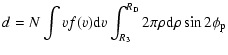
where N is the electron density, f(v) the Maxwellian
velocity distribution function for electrons,  denotes the
impact
parameter of the incoming electron, i and f denote the initial and
final
atomic energy levels, and i', f' their corresponding perturbing levels,
while
denotes the
impact
parameter of the incoming electron, i and f denote the initial and
final
atomic energy levels, and i', f' their corresponding perturbing levels,
while  gives the contribution of the Feshbach resonances
(Fleurier et al. 1977). The inelastic cross section
gives the contribution of the Feshbach resonances
(Fleurier et al. 1977). The inelastic cross section
 can be
expressed by an integral over the impact parameter of the transition
probability
can be
expressed by an integral over the impact parameter of the transition
probability
 as
as
 |
|
|
(2) |
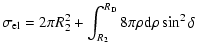
and the elastic cross section is given by
| |
|
 |
(3) |
| |
|
 |
(4) |
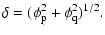
The phase shifts
 and
and
 due respectively to
the polarization potential (r-4) and to the quadrupolar
potential
(r-3), are given in Sect. 3 of Chapter 2 in Sahal-Bréchot (1969a).
due respectively to
the polarization potential (r-4) and to the quadrupolar
potential
(r-3), are given in Sect. 3 of Chapter 2 in Sahal-Bréchot (1969a).
 is the Debye radius. All the cut-offs R1, R2, R3 are described
in Sect. 1 of Chapter 3 in Sahal-Bréchot (1969b).
The formulae for the ion-impact widths and shifts are analogous to
Eqs. (1)-(3), without the resonance contribution to the width. The
difference
in calculation of the corresponding transition probabilities and phase
shifts as functions of the impact parameter in Eqs. (2) and (3) is in the
ion perturbing trajectories which are influenced by a repulsive
Coulomb force instead of an attractive one as for electrons.
is the Debye radius. All the cut-offs R1, R2, R3 are described
in Sect. 1 of Chapter 3 in Sahal-Bréchot (1969b).
The formulae for the ion-impact widths and shifts are analogous to
Eqs. (1)-(3), without the resonance contribution to the width. The
difference
in calculation of the corresponding transition probabilities and phase
shifts as functions of the impact parameter in Eqs. (2) and (3) is in the
ion perturbing trajectories which are influenced by a repulsive
Coulomb force instead of an attractive one as for electrons.
Atomic energy levels needed for the calculation have been taken from
Bashkin & Stoner (1975). The calculations have been performed for
electron temperatures between 5000 K and 100 000 K for
F II spectral lines and 10 000 K and 300 000 K for F III spectral lines for electrons, protons and helium ions
as perturbers.
Calculated W and d values are presented in Tables 2 and 3.
Our measured
and
 and calculated (W and d) values
at a given electron temperature (T) and density (N) are given in
Tables 1 and 2, respectively. For each value given in Table 2, the
collision volume multiplied by the perturber density is much less than
one and the impact approximation is valid (Sahal-Bréchot
1969a,b). When the impact approximation is not valid, the ion
broadening contribution may be estimated by using the quasistatic
approach (Sahal-Bréchot 1991; or Griem 1974).
and calculated (W and d) values
at a given electron temperature (T) and density (N) are given in
Tables 1 and 2, respectively. For each value given in Table 2, the
collision volume multiplied by the perturber density is much less than
one and the impact approximation is valid (Sahal-Bréchot
1969a,b). When the impact approximation is not valid, the ion
broadening contribution may be estimated by using the quasistatic
approach (Sahal-Bréchot 1991; or Griem 1974).
Table 2:
Calculated F II Stark FWHM (W in pm) and shift (d in
pm) values for electrons (a), protons (b) and helium ions (c) as
perturbers for various plasma temperatures (T in 103 K) and
1023 m-3 perturber density.
 is the mean wavelength in the multiplet. The negative shift is toward the blue.
Table 3:
Calculated F III Stark FWHM (W in pm) and shift (d in
pm) values for electrons (a), protons (b) and helium ions (c) as
perturbers for various plasma temperatures (T in 103 K) and
1023 m-3 perturber density.
represents the mean wavelength in the multiplet.
Negative shift is toward the blue.
To compare the measured and calculated Stark FWHM values,
we have presented in Figs. 3-8 an existing experimental data set
including our results, together with our (SCPF) theoretical
results and those from Griem (1974) (G). In the case of F III
lines the
previous calculations made by Dimitrijevic & Konjevic (1981) have also been included for comparison.
![\begin{figure}
\par\includegraphics[width=7.1cm,clip]{0728F3.eps}\end{figure}](/articles/aa/full/2004/23/aa0728/Timg61.gif) |
Figure 3:
F II Stark widths (W in pm) as a function of the
electron temperature (T) in the
transition at 1023m-3 electron density.  , our experimental results, , our experimental results,
 ,
Platisa et al. (1977) and ,
Platisa et al. (1977) and  ,
Djenize
et al. (1991). SCPF (full line) represents our calculations using
the semiclassical perturbation formalism. Error bars include the
uncertainties of the width and electron density measurements ,
Djenize
et al. (1991). SCPF (full line) represents our calculations using
the semiclassical perturbation formalism. Error bars include the
uncertainties of the width and electron density measurements
 |
| Open with DEXTER |
![\begin{figure}
\par\includegraphics[width=7.1cm,clip]{0728Fig4.eps}\end{figure}](/articles/aa/full/2004/23/aa0728/Timg62.gif) |
Figure 4:
F II Stark widths (W in pm) as a function of the
electron temperature (T) in the
,
and
transitions at 1023 m- 3 electron density.  our experimental results; our experimental results;
 Platisa et al. (1977)
and ,
Djenize et al. (1991). SCPF (full line)
represents our calculations using the semiclassical perturbation
formalism. G (dashed lines), denotes values calculated by Griem
(1974). Error bars include the uncertainties of the width and
electron density measurements
Platisa et al. (1977)
and ,
Djenize et al. (1991). SCPF (full line)
represents our calculations using the semiclassical perturbation
formalism. G (dashed lines), denotes values calculated by Griem
(1974). Error bars include the uncertainties of the width and
electron density measurements
 .
is the mean
wavelength in the multiplet. .
is the mean
wavelength in the multiplet. |
| Open with DEXTER |
![\begin{figure}
\par\includegraphics[width=7.3cm,clip]{0728F5.eps}\end{figure}](/articles/aa/full/2004/23/aa0728/Timg63.gif) |
Figure 5:
F II Stark shifts (d in pm) as a function of the
electron temperature (T) at 1023 m-3 electron density.
our experimental results and  results from
Djenize et al. (1991). SCPF (full line) represents our
calculations using the semiclassical perturbation formalism.
is the mean wavelength of the multiplet. results from
Djenize et al. (1991). SCPF (full line) represents our
calculations using the semiclassical perturbation formalism.
is the mean wavelength of the multiplet. |
| Open with DEXTER |
![\begin{figure}
\par\includegraphics[width=7.3cm,clip]{0728F6.eps}\end{figure}](/articles/aa/full/2004/23/aa0728/Timg64.gif) |
Figure 6:
F II electron Stark shifts (d in pm) as a function of
the electron temperature (T) in the
,
and
transitions at 1023 m-3 electron density. our experimental results and ,
from Djenize et al.
(1991). SCPF (full line) represents our calculations using the
semiclassical perturbation formalism. G (dashed line), denotes
calculations of Griem (1974).
is the mean wavelength of the multiplet. |
| Open with DEXTER |
![\begin{figure}
\par\includegraphics[width=8cm,clip]{0728Fig7.eps}\end{figure}](/articles/aa/full/2004/23/aa0728/Timg65.gif) |
Figure 7:
F III electron Stark FWHM vs. electron temperature at
1023 m-3 electron density. G represents (dashed line) results from
Dimitrijevic & Konjevic (1981) based on Griem's
semiclassical method (see Griem 1974, Eq. (526)). GM denotes its modification by
Dimitrijevic & Konjevic (1980). SEM denotes the modified
semiempirical method (Dimitrijevic & Konjevic 1980). SE denotes the result from
Griem's semiempirical calculation (Griem 1968). SCPF denotes our electron
Stark width values calculated on the basis of the semiclassical
perturbation formalism.
denotes our new experimental data and
 denotes results from Puric et al. (1988).
 |
| Open with DEXTER |
![\begin{figure}
\par\includegraphics[width=8cm,clip]{0728Fig8.eps}\end{figure}](/articles/aa/full/2004/23/aa0728/Timg66.gif) |
Figure 8:
F III electron Stark shift (d) vs. electron
temperature at 1023 m-3 electron density.
denotes our
experimental data. SCPF (full line) represents our electron Stark
shift values calculated on the basis of the semiclassical
perturbation formalism. |
| Open with DEXTER |
The F II W values generated by protons and helium ions are up to
5-10 times smaller than the widths generated by
electrons and show weak dependence on the temperature (see Table 2). The F II d values generated by electrons, protons and helium
ions are very small, except for the multiplet No. 9, and are of
the same magnitude. Similar conclusions can be obtained for the F
III W and d values in the multiplet No. 1 (see Table 3).
Very good agreement has been found among our measured and calculated F II W and d values.
Existing experimental W values (Djenize et al. 1991; Platisa et al. 1977) also agree with
our calculated values (see Figs. 3 and 4). Griem's (1974) W values lie below ours.
In the case of the F II d values our SCPF calculations provide smaller values than those
predicted by Griem (1974) (see Fig. 6).
Our measured and calculated F III W values agree mutually (within  )
and both lie above previously
calculated (Dimitrijevic & Konjevic 1981) and measured (Puric et al. 1988) values.
Measured F III d values show evident scatter and within the experimental accuracy are
practically equal to zero. Our calculation provides a very small negative shift which is practically independent
on the electron temperature.
)
and both lie above previously
calculated (Dimitrijevic & Konjevic 1981) and measured (Puric et al. 1988) values.
Measured F III d values show evident scatter and within the experimental accuracy are
practically equal to zero. Our calculation provides a very small negative shift which is practically independent
on the electron temperature.
On the basis of the obtained W and d values we can conclude
that a
good agreement is found between our measured and calculated (SCPF) W values (within the experimental
accuracy and uncertainties of the calculations) in the case of the F II lines that belong to the
,
and
 transition.
We found that the Stark width generated by electrons is dominant and that the proton and helium ion
contributions to the total Stark width can be neglected up to 150 000 K.
Our calculated Stark shift d values are generally very small (<1 pm) with negative sign in
the case of the F II lines belonging to the
and
transitions except for the muliplet
No. 8 where the calculated d values have a positive sign. Small d values with positive sign are
found for the
transition. In the case of the
transition the calculated d values
are less than 4 pm with a negative sign.
We hope that the results presented in this paper, for Stark broadening
parameters of the F II and F III spectral lines, will be of interest
for a number of problems in plasma physics and astrophysics.
Acknowledgements
This work is a part of the projects "Determina- tion of the atomic parameters on the basis
of the spectral line profiles" (OI 1228) and "Influence of collision
processes on astrophysical plasma line shapes" (GA 1195) supported by the
Ministry of Science, Technologies and Development of the Republic
of Serbia.
- Bashkin, S.,
& Stoner, J. J. Jr. 1975, Atomic Energy Levels and Grotrian
Diagrams (Amsterdam: North-Holland), 1
(In the text)
- Blagojevic,
B., Popovic, M. V., & Konjevic, N. 1999, Phys. Scr., 59,
374 [NASA ADS] (In the text)
- Davies, J. I.,
& Vaughan, J. M. 1963, ApJ, 137, 1302 [NASA ADS] [CrossRef] (In the text)
- Dimitrijevic, M. S. 1988a, A&AS, 76,
53 [NASA ADS] (In the text)
- Dimitrijevic, M. S. 1988b, Bull. Astron.
Belgrade, 139, 31 [NASA ADS]
-
Dimitrijevic, M. S. 1996, Zh. Prikl. Spectrosk., 63, 810 [NASA ADS] (In the text)
-
Dimitrijevic, M. S., & Konjevic, N. 1980, JQSRT, 24, 541 [NASA ADS] (In the text)
- Dimitrijevic, M. S., & Konjevic, N.
1981, in Spectral Line Shapes, ed. B. Wende (New York: Walter de
Gruyter, & Co.), 1, 211
(In the text)
- Dimitrijevic, M. S., &
Sahal-Bréchot, S. 1984, JQSRT, 31, 301 [NASA ADS] (In the text)
- Dimitrijevic, M. S., &
Sahal-Bréchot, S. 1996a, A&AS, 119, 369 [NASA ADS] (In the text)
- Dimitrijevic, M. S., &
Sahal-Bréchot, S. 1996b, Phys. Scr., 54, 50 [NASA ADS] (In the text)
- Djenize, S. 2000,
Serb. Astron. J., 161, 15 [NASA ADS] (In the text)
- Djenize, S., &
Bukvic, S. 2001, A&A, 365, 252 [EDP Sciences] [NASA ADS] [CrossRef] (In the text)
- Djenize, S., Labat,
J., Sreckovic, A., et al. 1991, Phys. Scr., 44, 148 [NASA ADS] (In the text)
- Djenize, S.,
Sreckovic, A., & Labat, J. 1992, A&A, 253, 632 [NASA ADS] (In the text)
- Djenize, S.,
Sreckovic, A., Labat, J., & Platisa, M. 1999, Phys. Scr., 53,
98 [NASA ADS] (In the text)
- Djenize, S.,
Sreckovic, A., Jelisavcic, M., & Bukvic, S. 2002a, A&A,
389, 1086 [EDP Sciences] [NASA ADS] [CrossRef] (In the text)
- Djenize, S.,
Dimitrijevic, M. S., Sreckovic, A., & Bukvic, S. 2002b,
A&A, 396, 331 [EDP Sciences] [NASA ADS] [CrossRef] (In the text)
- Fleurier, C.,
Sahal-Bréchot, S., & Chapelle, J. 1977, JQSRT, 17,
595 [NASA ADS] (In the text)
- Griem, H. R. 1968,
Phys. Rev., 165, 258 [NASA ADS] [CrossRef] (In the text)
- Griem, H. R. 1974,
Spectral Line Broadening by Plasmas (New York: Academic Press)
(In the text)
- Hey, J. D. 1976, JQSRT,
16, 69 [NASA ADS] (In the text)
- Hey, J. D., & Breger,
P. 1981, in Spectral Line Shapes, ed. B. Wende (New York: Walter de
Gruyter & Co.), 1, 201
(In the text)
- Highberger,
J. L., Savage, C., Bieging, J. H., & Ziurys, L. M. 2001, ApJ,
562, 790 [NASA ADS] [CrossRef] (In the text)
- NIST 2003, Atomic
Spectra Data Base Lines (Wavelengths ordered),
http://www.physics.nist.gov
(In the text)
- Konjevic, N.,
Lesage, A., Fuhr, J.R., & Wiese, W. L. 2002, J. Phys. Chem.
Ref. Data, 31, 3 [NASA ADS], 819
(In the text)
- Lesage, A., &
Fuhr, J. R. 1999, Bibliography of Atomic Line Shapes and Shifts
(April 1992 though June 1999), Observatoire de Paris
(In the text)
- Lodders, K. 2003,
ApJ, 591, 1220 [NASA ADS] [CrossRef] (In the text)
- Platisa, M.,
Dimitrijevic, M. S., Popovic, M. V., & Konjevic, N. 1977,
A&A, 54, 837 [NASA ADS] (In the text)
- Popovic, L. C.,
Sreckovic, A., & Djenize, S. 1992, Proc. 11th ICSLS, A25, Carry
de Rouet, France
(In the text)
- Puric, J., &
Konjevic, N. 1972, Z. Phys., 249, 440 [NASA ADS] (In the text)
- Puric, J., Sreckovic,
A., Djenize, S., & Platisa, M. 1988, Phys. Rev. A, 37, 11 [NASA ADS],
4380
(In the text)
- Sahal-Bréchot,
S. 1969a, A&A, 1, 91 [NASA ADS] (In the text)
- Sahal-Bréchot,
S. 1969b, A&A, 2, 322 [NASA ADS] (In the text)
- Sahal-Bréchot, S.
1974, A&A, 35, 321 [NASA ADS] (In the text)
- Sahal-Bréchot, S.
1991, A&A, 245, 322 [NASA ADS] (In the text)
- Sreckovic, A., Drincic,
V., Bukvic, S., & Djenize, S. 2000, J. Phys. B, 33, 4873 [NASA ADS] (In the text)
- Sreckovic, A.,
Dimitrijevic, M. S., & Djenize, S. 2001, A&A, 371, 354 [EDP Sciences] [NASA ADS] [CrossRef] (In the text)
- Sreckovic, A.,
Dimitrijevic, M. S., Djenize, S., & Bukvic, S. 2003, A&A,
400, 1155 [EDP Sciences] [NASA ADS] [CrossRef] (In the text)
- Zhu, C., Krems, R.,
Dolgano, A., & Balakrishnan, N. 2002, ApJ, 577, 795 [NASA ADS] [CrossRef] (In the text)
Copyright ESO 2004
![\begin{figure}
\par\includegraphics[width=7.8cm,clip]{0728Fig1.eps}\end{figure}](/articles/aa/full/2004/23/aa0728/img23.gif)
![\begin{figure}
\par\includegraphics[width=7.6cm,clip]{0728Fig2.eps}\end{figure}](/articles/aa/full/2004/23/aa0728/img42.gif)
![\begin{figure}
\par\includegraphics[width=7.1cm,clip]{0728F3.eps}\end{figure}](/articles/aa/full/2004/23/aa0728/img61.gif)
![\begin{figure}
\par\includegraphics[width=7.1cm,clip]{0728Fig4.eps}\end{figure}](/articles/aa/full/2004/23/aa0728/img62.gif)
![\begin{figure}
\par\includegraphics[width=7.3cm,clip]{0728F5.eps}\end{figure}](/articles/aa/full/2004/23/aa0728/img63.gif)
![\begin{figure}
\par\includegraphics[width=7.3cm,clip]{0728F6.eps}\end{figure}](/articles/aa/full/2004/23/aa0728/img64.gif)
![\begin{figure}
\par\includegraphics[width=8cm,clip]{0728Fig7.eps}\end{figure}](/articles/aa/full/2004/23/aa0728/img65.gif)
![\begin{figure}
\par\includegraphics[width=8cm,clip]{0728Fig8.eps}\end{figure}](/articles/aa/full/2004/23/aa0728/img66.gif)