![[*]](/icons/foot_motif.gif)
A&A 420, 533-546 (2004)
DOI: 10.1051/0004-6361:20035611
L. V. Tóth1,2
- M. Haas1,
- D. Lemke1
- K. Mattila3 - T. Onishi4
1 - Max-Planck-Instutute für Astronomie,
Königstuhl, 17, 69117, Heidelberg, Germany
2 -
Department of Astronomy of the Loránd Eötvös
University, Pázmány Péter sétány 1, 1117 Budapest, Hungary
3 -
Helsinki University Observatory, PO Box 14
Tähtitorninmäki, 00014 University of Helsinki, Finland
4 -
Department of Astrophysics, Nagoya University,
Chikusa-ku, Nagoya 464-8602, Japan
Received 1 November 2003 / Accepted 19 February 2004
Abstract
Three prominent cold objects of the Taurus Molecular Ring (TMR) were
revealed by our ISOPHOT 200  m map of the south-eastern part of the
Heiles Cloud 2 (HCL 2) cloud complex.
One corresponds to the cyanopolyyne peak region of the TMC-1 ridge,
(TMC-1 CP),
one is the HCL2-E cloud,
and one which we call HCL2-ES
lies south of TMC-1.
The 200/100 m colour temperatures and column densities
of the three ISOPHOT cold clouds
are
m map of the south-eastern part of the
Heiles Cloud 2 (HCL 2) cloud complex.
One corresponds to the cyanopolyyne peak region of the TMC-1 ridge,
(TMC-1 CP),
one is the HCL2-E cloud,
and one which we call HCL2-ES
lies south of TMC-1.
The 200/100 m colour temperatures and column densities
of the three ISOPHOT cold clouds
are  12 K, and 1.2
  0.7
0.7  1022 cm-2 respectively,
as calculated from ISO/IRAS surface brightnesses.
As Nagoya-4 m C
1022 cm-2 respectively,
as calculated from ISO/IRAS surface brightnesses.
As Nagoya-4 m C O (1-0) spectra show, these are dense
molecular clouds with
O (1-0) spectra show, these are dense
molecular clouds with
 cm-2 column density peaks.
The ISOPHOT 200 m surface brightness is well correlated
with the CO line intensity (
cm-2 column density peaks.
The ISOPHOT 200 m surface brightness is well correlated
with the CO line intensity (
 %).
The large dust particle emissivity is found to be increased
in the prototypical very dense core TMC-1 CP.
As the low linewidths (
%).
The large dust particle emissivity is found to be increased
in the prototypical very dense core TMC-1 CP.
As the low linewidths (
 0.2 km s-1) indicate,
the level of turbulent energy density is 50% lower in these three
clouds than in other clouds of HCL2.
Dense cores were identified inside the CO clouds
by NH3 measurements with the Effelsberg-100 m telescope and
Nobeyama-45 m H13CO+ data.
The density of the dense cores is
0.2 km s-1) indicate,
the level of turbulent energy density is 50% lower in these three
clouds than in other clouds of HCL2.
Dense cores were identified inside the CO clouds
by NH3 measurements with the Effelsberg-100 m telescope and
Nobeyama-45 m H13CO+ data.
The density of the dense cores is  105 cm-3, and
their kinetic
temperatures are
105 cm-3, and
their kinetic
temperatures are  10 K, in good agreement with
the FIR results.
The total molecular gas mass in the gravitationally bound cloud cores of
TMC-1 CP and HCL2-E is about 21
10 K, in good agreement with
the FIR results.
The total molecular gas mass in the gravitationally bound cloud cores of
TMC-1 CP and HCL2-E is about 21  and 8
respectively.
The cores, TMC-1 CPb and HCL2-Eab are associated
with 3 low mass
YSO candidate 2MASS point sources, while 35 other low mass YSO candidates are
seen elsewhere in TMR south, which we consider as
evidence for ongoing low mass star formation.
and 8
respectively.
The cores, TMC-1 CPb and HCL2-Eab are associated
with 3 low mass
YSO candidate 2MASS point sources, while 35 other low mass YSO candidates are
seen elsewhere in TMR south, which we consider as
evidence for ongoing low mass star formation.
Key words: ISM: clouds - dust, extinction - ISM: individual objects: Taurus clouds - ISM: molecules - ISM: structure - stars: formation
The process that transforms gravitationally bound cloud cores into collapsing protostars starts with effective cooling. We present a study of very cold and dense cloud cores in Taurus.
Star formation occurs in dense cores within molecular clouds (e.g. Williams et al. 2000), although the study of such regions was hampered for many years by their very large optical depths at near-infrared and optical wavelengths. It is only since the opening up of the far-infrared and submillimetre regimes that astronomers have been able to study molecular clouds in detail. Understanding the theory of star formation requires a detailed observational determination of the initial conditions of the collapse phase that forms a protostar. The pre-protostellar (or prestellar for short) core phase (Ward-Thompson et al. 1994) is believed to be the stage of star formation that precedes the formation of a protostar and hence should represent observationally the initial conditions of protostellar collapse. Theory predicts that the core geometry prior to this stage is critical in determining the manner of collapse (e.g. Whitworth et al. 1998).
![\begin{figure}
\par\includegraphics[width=12.35cm,clip]{0611fig1.eps}
\end{figure}](/articles/aa/full/2004/23/aa0611/img32.gif) |
Figure 1:
 grayscale map of HCL2 with black contours from 2 mag by 2 mag
based on the data of Padoan et al. (2002).
Four objects with high peak extinction (
grayscale map of HCL2 with black contours from 2 mag by 2 mag
based on the data of Padoan et al. (2002).
Four objects with high peak extinction (
 mag) surround
a low extinction region in the centre. These are in clockwise:
(1) TMC-1, (2) HCL2-A, (3) HCL2-B and (4) HCL2-E and HCL2-ES,
the main clouds of the Taurus Molecular Ring (TMR).
The IRAS point sources (see Table 3)
are marked with white symbols.
The white frame borders the region of our ISOPHOT 200 m map. mag) surround
a low extinction region in the centre. These are in clockwise:
(1) TMC-1, (2) HCL2-A, (3) HCL2-B and (4) HCL2-E and HCL2-ES,
the main clouds of the Taurus Molecular Ring (TMR).
The IRAS point sources (see Table 3)
are marked with white symbols.
The white frame borders the region of our ISOPHOT 200 m map. |
| Open with DEXTER | |
A region was selected in Taurus to observationally examine
the above mentioned processes in dense cold clouds with
multiwavelength data. Taurus is one of the coldest dusty regions
of nearby star formation. The Taurus clouds are at around 140 pc distance
(Elias 1978) or even closer at 126 pc (see recently Hartigan & Kenyon 2003).
The DIRBE-based cold dust temperatures are below 16 K at some
locations in Taurus as found e.g. by Lagache et al. (1998).
Heiles (1968) traced cold
interstellar gas with OH detections at positions of high visual extinction.
Since then the
"Heiles Cloud 2'' (HCL 2) identifies the most massive molecular
cloud in Taurus as was shown by a large scale C18O survey by
Onishi et al. (1996). The observed positions of Heiles
were marked with letters A to T. As a roadmap of HCL2 we present
a deep extinction map resulting from the NIR H-K colour study of the
Taurus region by Padoan et al. (2002). The map traces the total ISM column density distribution well up to 1022 cm-2. HCL2
breaks up to 4 main clouds (1) TMC-1, (2) HCL2-A, (3) HCL2-B and
(4) HCL2-E and HCL2-ES, as seen in Fig. 1.
While in TMR the visual extinction is
 mag, it drops in the
central hole to the value seen outside HCL2. A schematic view of TMR is
given in Fig. 2.
Subsequent studies focused mainly on the narrow molecular ridge at the eastern part of HCL2
which is often named just as Taurus Molecular Cloud 1 (TMC-1).
The elongated TMC-1 is a unique strong
source of emission from carbon chain and other complex molecules.
It is fragmented into a chain of at least five large clumps and several
small cores (see e.g. Hirahara et al. 1992, or Langer et al. 1995), with a
chemical gradient with distinct C5H, HC7N and NH3 maxima
(Little et al. 1979; Olano et al. 1988).
The southeastern part of TMC-1 which is abundant in
"carbon-chain" molecules (such as CCS and
cyanopolyynes) is also called as "cyanopolyyne peak", hereafter, TMC-1 CP.
The northwestern part of the ridge, which is abundant in molecules
such as NH3, N2H+, and SO is often cited as "ammonia peak",
hereafter TMC-1 (NH3). It is yet unclear what physical
conditions make TMC-1 such a unique laboratory of interstellar chemistry.
mag, it drops in the
central hole to the value seen outside HCL2. A schematic view of TMR is
given in Fig. 2.
Subsequent studies focused mainly on the narrow molecular ridge at the eastern part of HCL2
which is often named just as Taurus Molecular Cloud 1 (TMC-1).
The elongated TMC-1 is a unique strong
source of emission from carbon chain and other complex molecules.
It is fragmented into a chain of at least five large clumps and several
small cores (see e.g. Hirahara et al. 1992, or Langer et al. 1995), with a
chemical gradient with distinct C5H, HC7N and NH3 maxima
(Little et al. 1979; Olano et al. 1988).
The southeastern part of TMC-1 which is abundant in
"carbon-chain" molecules (such as CCS and
cyanopolyynes) is also called as "cyanopolyyne peak", hereafter, TMC-1 CP.
The northwestern part of the ridge, which is abundant in molecules
such as NH3, N2H+, and SO is often cited as "ammonia peak",
hereafter TMC-1 (NH3). It is yet unclear what physical
conditions make TMC-1 such a unique laboratory of interstellar chemistry.
![\begin{figure}
\par\includegraphics[width=7.35cm,clip]{0611fig2.eps}
\end{figure}](/articles/aa/full/2004/23/aa0611/img34.gif) |
Figure 2:
Roadmap of the TMR clouds. The outer frame corresponds roughly
to the extent of HCL2. The shaded elliptical ring follows
the
 mag extinction contours. The subclouds inside TMR are
marked with ellipses. The 3 clouds inside the ISO 200 m image frame (box) are drawn with
solid, the clouds outside with dashed lines. The TMC-1NH3 peak
HCL2 and TMR are elongated parallel to the galactic plane, but not all the dense subclouds follow that orientation. mag extinction contours. The subclouds inside TMR are
marked with ellipses. The 3 clouds inside the ISO 200 m image frame (box) are drawn with
solid, the clouds outside with dashed lines. The TMC-1NH3 peak
HCL2 and TMR are elongated parallel to the galactic plane, but not all the dense subclouds follow that orientation. |
| Open with DEXTER | |
Cernicharo et al. (1984) found three of the other opaque sub-clouds of HCL2
to be remarkably similar to TMC-1 with kinetic
temperature
 1 K, and density n> 104 cm-3.
Schloerb & Snell (1984) interpreted the structure of HCL2
based on 13CO and C18O data as a 400
1 K, and density n> 104 cm-3.
Schloerb & Snell (1984) interpreted the structure of HCL2
based on 13CO and C18O data as a 400
 rotating ring.
They identified 5 gravitationally bound subcondensations in the
Taurus Molecular Ring (TMR). Two of the subcondensations
roughly correspond to TMC-1, and HCL2-E.
The pre-ISO knowledge on the extended FIR emission in Taurus was
summarised by Abergel et al. (1994, 1995) however only on large scales.
HCL2 appeared
at the NW corner of their maps as a bright, cold region.
rotating ring.
They identified 5 gravitationally bound subcondensations in the
Taurus Molecular Ring (TMR). Two of the subcondensations
roughly correspond to TMC-1, and HCL2-E.
The pre-ISO knowledge on the extended FIR emission in Taurus was
summarised by Abergel et al. (1994, 1995) however only on large scales.
HCL2 appeared
at the NW corner of their maps as a bright, cold region.
We present a FIR study of TMC-1 and the southern, low star formation activity part of TMR. We investigate a full sampled C18O spectral line map zoomed into HCL2 and TMR. We derive physical properties of TMR and embedded very cold cloud cores based on FIR data, cm and mm spectroscopic data and discuss the conditions for star formation.
FIR observations were made using ISOPHOT's (Lemke et al. 1996)
raster mapping (AOT P22) centered on to
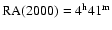
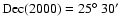 ,
during orbit 862 on 1998 March 26.
A
,
during orbit 862 on 1998 March 26.
A
 field in HLC2
was mapped with the PHT-C200 camera associated with
the C-200 filter, which has a
reference wavelength of 200 m and a
bandwidth full-width at half-maximum (FWHM) of 30 m.
The 200 m map covers the southern part of TMR:
the cyanopolyyne maximum region of the TMC-1 ridge (hereafter TMC-1 CP),
the opaque cloud at HCL2-E, and a small part of HCL2-B.
(see Figs. 9 and 3a).
field in HLC2
was mapped with the PHT-C200 camera associated with
the C-200 filter, which has a
reference wavelength of 200 m and a
bandwidth full-width at half-maximum (FWHM) of 30 m.
The 200 m map covers the southern part of TMR:
the cyanopolyyne maximum region of the TMC-1 ridge (hereafter TMC-1 CP),
the opaque cloud at HCL2-E, and a small part of HCL2-B.
(see Figs. 9 and 3a).
![\begin{figure}
\par\includegraphics[width=15cm,clip]{0611fig3.eps}
\end{figure}](/articles/aa/full/2004/23/aa0611/img40.gif) |
Figure 3:
The southern part of the Taurus Molecular Ring (TMR) with the 3 main clouds
(black ellipses) and the TMR hole in the multiwavelengh data.
a) ISOPHOT 200 m surface brightness I200 ( HPBW = 2 ), greyscale levels: from
100 MJy sr-1 to 190 MJy sr-1the NH3(1, 1) maximum at HCL2E is marked with a red contour
at HCL2-E ( HPBW = 2);
b) IRAS 100 m intensity I100 ( HPBW = 4)
contours: from 25 MJy sr-1 by 1.5 MJy sr-1;
c) IRAS 60 m intensity I60 ( HPBW = 4)
contours: from 2.5 MJy sr-1 by 0.3 MJy sr-1;
d) C18O line intensity W(C18O) ( HPBW = 2 ), greyscale levels: from
100 MJy sr-1 to 190 MJy sr-1the NH3(1, 1) maximum at HCL2E is marked with a red contour
at HCL2-E ( HPBW = 2);
b) IRAS 100 m intensity I100 ( HPBW = 4)
contours: from 25 MJy sr-1 by 1.5 MJy sr-1;
c) IRAS 60 m intensity I60 ( HPBW = 4)
contours: from 2.5 MJy sr-1 by 0.3 MJy sr-1;
d) C18O line intensity W(C18O) ( HPBW = 2
 7), greyscale levels: from
1 K km s-1 to 2 K km s-1.
The parameters of the marked regions are listed in Table 1. 7), greyscale levels: from
1 K km s-1 to 2 K km s-1.
The parameters of the marked regions are listed in Table 1. |
| Open with DEXTER | |
Table 1:
Parameters of 3 clouds of the southern part of TMR, TMR hole, and TMR
(see Fig. 3) Notes: TMR and the TMR hole are approximately two times larger than the part
seen in our ISOPHOT image. The
 and
and
 excess
surface brightness values are relative to the TMR hole. The FIR colour temperature
of the TMR hole was calculated from the absolute surface brightness values.
excess
surface brightness values are relative to the TMR hole. The FIR colour temperature
of the TMR hole was calculated from the absolute surface brightness values.
We assume a calibration accuracy of 30% for the ISOPHOT data
(see Klaas et al. 1998, 2002).
The data were reduced using the version 11 of the PHT Interactive Analysis (PIA) software (Gabriel et al. 1997).
We followed the standard pipeline data reduction procedure,
but used our own routines for the flatfield correction.
We note that the oversampled mapping mode (AOT P32)
200 m data of TMC-1 CP, as given in the archive (TDT No. 68502362),
show less than 10% difference from our values.
High Resolution IRAS Galaxy Atlas (IGA) images at 60
and 100 m (Cao et al. 1997) were used to identify uncatalogued
IRAS point sources and for
a comparison with the ISO 200 m surface brightness data.
The 100 m IGA image was calibrated with a corresponding
SFD 100 m image (Schlegel et al. 1998)
The SDF 100 m images are derived from ISSA data:
zodiacal foreground and confirmed point sources were removed,
as were artifacts from the IRAS scan pattern were removed.
The result of all these manipulations is a 100 m surface brightness
map with DIRBE-quality calibration and
 resolution.
(see Fig. 3)
resolution.
(see Fig. 3)
CO 2.6 mm line observations of TMR were taken with 2
spacing and a resolution of HPBW = 2
7 as part of the
Nagoya-Nanten CO survey of the Milky Way. Detailes of the Nagoya-4 m
measurements are given in Onishi et al. (1996, 1998).
Figure 4 displays average C18O(1-0) spectra of the 3 regions
marked in Fig. 3 and of the TMR hole.
NH3 (1, 1) and (2, 2) 1.3 cm line observations were carried out
in 2002 March, 2002 Sept., and 2003 Feb. with the Effelsberg-100 m
radiotelescope to trace dense
gas associated with the cores, and to derive kinetic temperatures.
The HPBW at the observing frequency of
23.7 GHz is
 .
The facility 1.3 cm receiver was used with a
typical system temperature (antenna temperature units)
on the sky of 180 K, 150 K, and 120 K for the
three observing runs respectively. The backend was the facility
8096 channel autocorelator split into 4 bands
in order to observe simultaneously both polarizations
at the NH3(1, 1) and (2, 2) rest frequencies of
23 694.495 MHz and 23 722.633 MHz, respectively.
The resulting spectral resolution was 0.06 km s-1, 0.12 km s-1,
and 0.06 km s-1 for the three observing runs respectively.
The ISOPHOT cold cloud at the HCL2-E position was mapped
with a resolution of 40
.
The facility 1.3 cm receiver was used with a
typical system temperature (antenna temperature units)
on the sky of 180 K, 150 K, and 120 K for the
three observing runs respectively. The backend was the facility
8096 channel autocorelator split into 4 bands
in order to observe simultaneously both polarizations
at the NH3(1, 1) and (2, 2) rest frequencies of
23 694.495 MHz and 23 722.633 MHz, respectively.
The resulting spectral resolution was 0.06 km s-1, 0.12 km s-1,
and 0.06 km s-1 for the three observing runs respectively.
The ISOPHOT cold cloud at the HCL2-E position was mapped
with a resolution of 40
 and the T(1,1) peak region
with 28
resolution.
Spectra at the NH3(1, 1) maxima of HCL2-E
are shown in Fig. 5.
and the T(1,1) peak region
with 28
resolution.
Spectra at the NH3(1, 1) maxima of HCL2-E
are shown in Fig. 5.
Pointing and calibration were checked by continuum
scans across 3C 123 3C 138 and NGC 7027.
We estimate a pointing accuracy of 5
 .
We calibrated our data
assuming a main beam brightness temperature of NGC 7027
of 8.03 K coresponding to 5.58 Jy at 1.3 cm (Peng et al. 2000).
We confirmed our calibration and velocity scale
observing also TMC-1 CP
at RA(2000) =
.
We calibrated our data
assuming a main beam brightness temperature of NGC 7027
of 8.03 K coresponding to 5.58 Jy at 1.3 cm (Peng et al. 2000).
We confirmed our calibration and velocity scale
observing also TMC-1 CP
at RA(2000) =
 ,
Dec(2000) = 25$^$4142
(see Effelsberg-100 m spectra by
Takano et al. 1998).
Our NH3 spectra were reduced using CLASS
software, and analysed following procedures described
by Harju et al. (1993).
The observed NH3 line parameters, and derived quantities are listed in
Table 2.
,
Dec(2000) = 25$^$4142
(see Effelsberg-100 m spectra by
Takano et al. 1998).
Our NH3 spectra were reduced using CLASS
software, and analysed following procedures described
by Harju et al. (1993).
The observed NH3 line parameters, and derived quantities are listed in
Table 2.
Table 2: Parameters of the ammonia spectra measured.
where the columns are: (1) position, (2) line, (3) main beam brightness temperature, (4) velocity ,
(5) line-width from single Gaussian fit
to the main group line, (6) line-width from hyperfine fit, (7) main group line
area, (8) total line area of satellites, (9) optical depth.
We note that the parameters at HCL2E (-240, -60) are derived from
average spectra in a 90
diameter region.
,
(5) line-width from single Gaussian fit
to the main group line, (6) line-width from hyperfine fit, (7) main group line
area, (8) total line area of satellites, (9) optical depth.
We note that the parameters at HCL2E (-240, -60) are derived from
average spectra in a 90
diameter region.
Morphology on FIR maps:
Figures 3a-c, show the ISOPHOT 200 m, IRAS 100 m,
and IRAS 60 m surface brightness distribution in the southern part
of HCL2.
The 200 m bright regions outline the Taurus Molecular Ring (TMR).
We define five regions on the 200 m image for our further studies:
(i) TMC-1 CP; (ii) HCL2-E; (iii) HCL2-ES; (iv) TMR hole; (v) TMR.
TMC-1 CP, HCL2-E, and HCL2-ES are the 3 local maxima on the 200 m
image. We define TMR as the region where
I200>140 MJy sr-1.
Coordinates and derived parameters are listed in Table 1.
The brightest FIR object of

 size at
RA(2000) = 4
size at
RA(2000) = 4 41
41 34
34
 97, Dec(2000) = +25$^$3853
2
with an intensity maximum of 210 MJy sr-1 corresponds to TMC-1 CP, the
HC3N (J= 1-0, F= 2-1) integrated line intensity peak region
(W(HC3N) > 0.3 K km s-1 by Tölle et al. 1981) of TMC-1.
The southern part of TMR appears as a 24
size
diffuse cloud with two maxima, one is at HCL2-E and one lies SE of it.
Each of these have sizes similar to the TMC-1 CP
core. The edge of the HCL2-B star forming cloud shows in at the NW corner
of the image.
The 98 MJy sr-1 intensity minimum of our ISOPHOT 200 m image
(Fig. 3a) occurs at the dark central hole of TMR.
97, Dec(2000) = +25$^$3853
2
with an intensity maximum of 210 MJy sr-1 corresponds to TMC-1 CP, the
HC3N (J= 1-0, F= 2-1) integrated line intensity peak region
(W(HC3N) > 0.3 K km s-1 by Tölle et al. 1981) of TMC-1.
The southern part of TMR appears as a 24
size
diffuse cloud with two maxima, one is at HCL2-E and one lies SE of it.
Each of these have sizes similar to the TMC-1 CP
core. The edge of the HCL2-B star forming cloud shows in at the NW corner
of the image.
The 98 MJy sr-1 intensity minimum of our ISOPHOT 200 m image
(Fig. 3a) occurs at the dark central hole of TMR.
![\begin{figure}
\par\includegraphics[width=8cm,clip]{0611fig4.eps}
\end{figure}](/articles/aa/full/2004/23/aa0611/img63.gif) |
Figure 4:
C18O(1-0) spectra at the 4 regions marked in Fig. 3.
a) TMC-1 CP at
 .
b) HCL2-E at .
b) HCL2-E at
 .
c) HCL2-ES at .
c) HCL2-ES at
 .
d) TMR hole at .
d) TMR hole at
 . . |
| Open with DEXTER | |
![\begin{figure}
\par\includegraphics[width=7.5cm,clip]{0611fig5.eps}
\end{figure}](/articles/aa/full/2004/23/aa0611/img64.gif) |
Figure 5: a) Effelsberg-100 m NH3 (1, 1) and (2, 2) spectra at HCL2-Ea the (1, 1) main group line area peak of HCL2-E (see Fig. 3). b) Effelsberg-100 m NH3 (1, 1) and (2, 2) spectra at the HCL2-Eb; the (2, 2) peak position of HCL2-E. (The middle part of the spectra is presented.) |
| Open with DEXTER | |
TMR is bright in the IRAS 100 m image (Fig. 3b) as well;
however, it peaks only at HCL2-B. A large diffuse cloud appears
associated with the other 200 m bright
cloudlets, with a 100 m maximum between them. The 100 m
surface brightness of the TMR hole appears to be as low as the value
outside TMR.
The 60 m IRAS image (Fig. 3c) shows sharp peaks at the
northern edge, namely
the SE boundary of HCL2-B with a group of low mass YSOs
and IRAS 04381+2540 a protostellar object (Brown & Chandler 1999)
in TMC-1. Three further diffuse local maxima are
seen in between TMC-1 CP, east of HCL2-ES, and west of HCL2-E.
FIR colours and column densities of the ISOPHOT cores and of TMR:
There is very little variation of the 60 m surface brightness I60seen in the 1/4 square degree field. All 5 regions we
defined have an average
I60=3.5
0.1 MJy sr-1, only those pixels
are slightly brighter
which correspond to the IRAS point sources of Table 3.
The low level and little variation of I60 indicate a very low
contribution of warm dust, this allows us to interpret the
I200 vs. I100 colour as an indicator of dust temperature.
The weak correlation between the I200 and I100 images
reflects a variation of colour temperature (see Figs. 3 and 7).
As the ratio of I200 to I100 indicates,
the low density regions of HCL2, like the TMR hole have the
characteristic temperature of the cold galactic clouds, i.e.
15 K (see e.g., Lagache et al. 1998, using COBE DIRBE).
The southern edge of the star forming HCL2-B appears warm, while
TMR south and the cloudlets HCL2-E and HCL2-ES are cold.
TMC-1 is clearly colder than the rest of TMR as seen in
Fig. 7b.
Since both the extinction (see Fig. 1) and emission
(see Fig. 3) of the
dust of the TMR hole look similar to those of the region outside
TMR, we define "background'' values of FIR surface brightnesses at
the TMR hole.
The average surface brightness values at the TMR hole were subtracted
accordingly, deriving background/foreground corrected
200, 100 and 60 m surface brightnesses
and
.
The
and
were used to
calculate the physical parameters of cold dust in TMR and in its clouds.
TMC-1 CP with
 0.5 K is one of
the coldest clouds in the Milky Way.
The apparently weak contribution
of warm dust radiation to the I100 surface brightness was estimated
applying an empirical
0.5 K is one of
the coldest clouds in the Milky Way.
The apparently weak contribution
of warm dust radiation to the I100 surface brightness was estimated
applying an empirical
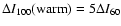 formula.
When the
values are corrected substracting
formula.
When the
values are corrected substracting
 the colour
temperatures become approximately 1 K lower than listed in
Table 1.
the colour
temperatures become approximately 1 K lower than listed in
Table 1.
Column densities were estimated from
and
assuming an opacity
 following Juvela et al. (2002),
 1022 cm-2 and
 1022 cm-2 were derived for
the peak column density in the TMC-1 CP region and as
an average for the whole TMR south respectively.
1022 cm-2 were derived for
the peak column density in the TMC-1 CP region and as
an average for the whole TMR south respectively.
Table 3:
IRAS point sources of TMR south. The first 4 sources are inside the region of the ISOPHOT frame, the rest are
 outside the field, but still seen at the boundary due
to the IRAS point spread function.
outside the field, but still seen at the boundary due
to the IRAS point spread function.
The C18O spectra of TMR (Fig. 4)
show two velocity components of which
one is an extended weak component at the velocity of the
thin molecular gas traced e.g. by 13CO. It peaks at
the HCL2-E/HCL2-B region. The strong
component is a narrow (
 km s-1)
line, with Ta(C18O) maxima at TMC-1 CP and HCL2-ES.
km s-1)
line, with Ta(C18O) maxima at TMC-1 CP and HCL2-ES.
Two main objects can be identified with the C18O line
intensity W(C18O) distribution in Fig. 3d:
TMC-1 (top left) and HCL2-E (centre right). There is also an elongated
complex seen including HCLSE-SE, HCL2-E, and HCL2-B.
The W(C18O) distribution is well correlated with that
of I200. The cloudy regions outline TMR.
W(C18O) increases with a high gradient
(1 K km s-1/10)
at the outer limits of TMR and drops
similarly quickly at the inner cavity.
The C18O antenna temperature T(C18O) maximum is located
inside TMC-1 CP, secondary maxima are
seen at the TMC-1 NH3 peak (outside our ISOPHOT map) and
in HCL2-ES similarly to the 13CO(1-0) line.
All the 3 objects of Fig. 3 have T(C18O) > 1.3 K.
While the 13CO(1-0) line intensity W(13CO) peaks at HCL2-E
the W(C18O) maximum is located at the TMC-1 NH3 peak and
secondary maxima are seen at TMC-1 CP, at HCL2-B, at HCL2-E and at HCL2-A (outside the ISO image area).
The N(H2) molecular hydrogen column density in TMR and in its sub-clouds
was estimated from the C18O spectra following Onishi et al. (1996).
An excitation temperature
of
 (C18O) = 10 K, and a C18O to H2 abundance ratio of
X(C18O) = 107 were assumed. The H2 column density ranges from
N(H2)=2
1021 cm-2 (in TMR hole) to
N(H2)=2
1022 cm-2 (in TMC-1 CP)
with a TMR south average of N(H2)
1022 cm-2.
(C18O) = 10 K, and a C18O to H2 abundance ratio of
X(C18O) = 107 were assumed. The H2 column density ranges from
N(H2)=2
1021 cm-2 (in TMR hole) to
N(H2)=2
1022 cm-2 (in TMC-1 CP)
with a TMR south average of N(H2)
1022 cm-2.
The NH3(1, 1) line is detected throughout HCL2-E with a brightness
temperature
 maximum at
RA(2000) = 44038.4
maximum at
RA(2000) = 44038.4 ,
Dec(2000) = 25
,
Dec(2000) = 25 2942
and line intensity maximum at
RA(2000) = 44029.5,
Dec(2000) = 252943
.
The NH3(1, 1) velocity is -0.7 km s-1 (blue) shifted
relative to the intensity weighted average velocity
2942
and line intensity maximum at
RA(2000) = 44029.5,
Dec(2000) = 252943
.
The NH3(1, 1) velocity is -0.7 km s-1 (blue) shifted
relative to the intensity weighted average velocity
 C18O) of the core.
The NH3(1, 1) line-width in HCL2-E (
C18O) of the core.
The NH3(1, 1) line-width in HCL2-E (
 km s-1) is
similar to that at TMC-1 CP.
The boundary of the NH3 core is drawn with the NH3(1, 1)
line area contour W(NH3) = 0.6 K km s-1.
It apparently coincides with a peak of I200.
The NH3(2, 2) line was detected at few positions
around the NH3(1, 1) peak.
km s-1) is
similar to that at TMC-1 CP.
The boundary of the NH3 core is drawn with the NH3(1, 1)
line area contour W(NH3) = 0.6 K km s-1.
It apparently coincides with a peak of I200.
The NH3(2, 2) line was detected at few positions
around the NH3(1, 1) peak.
The derived peak density n(H2)=2.6
105 cm-3, and
kinetic temperature minimum of
 K
indicate that HCL2-E is similar to TMC-1 but
less dense and less cold.
K
indicate that HCL2-E is similar to TMC-1 but
less dense and less cold.
FIR point sources of the region were selected from the IRAS Point Source Catalogue, and checking individual IRAS detector snips with Scanpi of the IRSA Server of the JPL (Helou & Kahn 1986).
The sources are listed in Table 3 where the columns
are (1) Name which contains RA(1950) and Dec(1950), (2-3) RA(2000) and
Dec(2000) coordinates, (4-7) 12, 25, 60 and 100 m fluxes respectively
(8) classification and reference.
The first two sources IRAS 04377+2518 and IRAS 04378+2521
were newly identified on the 60 m IGA image,
photometry was obtained using Scanpi of IPAC (HELOU et al. 1986).
IRAS 04378+2521 was repeatedly detected by IRAS
in 3 bands but the point source template could not
be fitted by the Scanpi software.
By its FIR colours IRAS 04378+2521 resembles to
an embedded young stellar object (Weintraub 1990). Its total
IRAS flux is F=3.3
10-13 W m-2 corresponding to
 ,
i.e. a YSO with
,
i.e. a YSO with
 .
We also obtained a 60 m flux for IRAS 04382+2527.
IRAS 04377+2518 is a 60 m only source.
.
We also obtained a 60 m flux for IRAS 04382+2527.
IRAS 04377+2518 is a 60 m only source.
NIR point sources as YSOs:
There are 804 point sources listed in the new release of the 2MASS
point source catalogue (Cutri et al. 2003) within the frame
of our ISOPHOT image. A rough classification is possible in the
J-H vs. H-K colour-colour diagram (see Fig. 6a).
![\begin{figure}
\par\includegraphics[width=17.6cm,clip]{0611fig6.eps}\par
\end{figure}](/articles/aa/full/2004/23/aa0611/img79.gif) |
Figure 6:
a)
 vs. J-H colours of 2MASS sources of the
region. Point sources falling inside the the locus of classical T Tauri stars
(CTT, Meyer et al. 1997) and having a good photometry are marked with
red -es.
The reddened MS and evolved stars (with good photometry)
are marked with small blue pluses.
Four extended 2MASS objects are marked with red triangles.
b) Grayscale map of the ISOPHOT 200 m surface brightness
with 2MASS sources overlaid. The 25 candidate classical T Tauris (CTTs)
(marked with black -es) are located around
the density peaks of the cores. The reddened MS and evolved stars
(with good photometry) are marked with small blue pluses. (This figure in available in colour in the electronic version.)
vs. J-H colours of 2MASS sources of the
region. Point sources falling inside the the locus of classical T Tauri stars
(CTT, Meyer et al. 1997) and having a good photometry are marked with
red -es.
The reddened MS and evolved stars (with good photometry)
are marked with small blue pluses.
Four extended 2MASS objects are marked with red triangles.
b) Grayscale map of the ISOPHOT 200 m surface brightness
with 2MASS sources overlaid. The 25 candidate classical T Tauris (CTTs)
(marked with black -es) are located around
the density peaks of the cores. The reddened MS and evolved stars
(with good photometry) are marked with small blue pluses. (This figure in available in colour in the electronic version.) |
| Open with DEXTER | |
 5 mag) young, low mass stars (
 )
in TMC-1 CP (2MASS TMRS 23),
in HCL2-B (2MASS TMRS 3),
in HCL2-E (2MASS TMRS 15 and 10)
at high I200 regions.
The 181 sources with CTT-like colours account for 23%, the 25 YSO candidates for 3% of all 2MASS point sources
towards the southern TMR.
We note that the same regions of the NIR colour-colour diagram
are populated with some evolutionary old objects (AGNs, PNs).
To estimate the fraction of misclassified objects, the classification
was repeated
in a similar size reference region at
)
in TMC-1 CP (2MASS TMRS 23),
in HCL2-B (2MASS TMRS 3),
in HCL2-E (2MASS TMRS 15 and 10)
at high I200 regions.
The 181 sources with CTT-like colours account for 23%, the 25 YSO candidates for 3% of all 2MASS point sources
towards the southern TMR.
We note that the same regions of the NIR colour-colour diagram
are populated with some evolutionary old objects (AGNs, PNs).
To estimate the fraction of misclassified objects, the classification
was repeated
in a similar size reference region at
 distance
from TMC-1.
Only 1.3% of the 2MASS point sources of the reference field have CTT-like
colours
and none has an unreddened H-K index over 0.9.
Further details on the nature of the 2MASS point
sources
of TMR and their relation to the cold and dense cores are given by
Tóth et al. (2004).
distance
from TMC-1.
Only 1.3% of the 2MASS point sources of the reference field have CTT-like
colours
and none has an unreddened H-K index over 0.9.
Further details on the nature of the 2MASS point
sources
of TMR and their relation to the cold and dense cores are given by
Tóth et al. (2004).
Four extended 2MASS objects appear in the southern TMR,
two of them with T Tauri-like colours (see triangles in Fig. 6).
Their average total elliptical
radius is
 which corresponds to 8.6
10-3 pc
at the distance of Taurus.
which corresponds to 8.6
10-3 pc
at the distance of Taurus.
Itoh et al. (1996 and 1999, ITG) carried out a near-infrared survey of
the central 1 square degree region of HCL2.
The limiting K magnitude of their survey
was 13.4 mag, and they detected 831 sources. Based on their colour-colour
diagram, 50 sources were classified as YSO candidates.
Recently Itoh et al. (2002) found that according to NIR spectra,
10 of their former YSO candidate sources were field stars,
but approved 12 of those as YSOs. From the 15 ITG sources seen towards
TMR south 5 are field stars and 1 source, ITG 40 is
a <
 YSO with an age of 106 to 107 years.
We listed the ITG YSO candidates
in Table 4 with their 2MASS identifications.
The confirmed field stars were left out.
Murphy & Myers (2003) detected 11 reddened NIR point sources in the
H and/or
YSO with an age of 106 to 107 years.
We listed the ITG YSO candidates
in Table 4 with their 2MASS identifications.
The confirmed field stars were left out.
Murphy & Myers (2003) detected 11 reddened NIR point sources in the
H and/or  bands towards TMC-1 CPa and considered none of those
as YSO; however, for about half of them it can not be excluded.
bands towards TMC-1 CPa and considered none of those
as YSO; however, for about half of them it can not be excluded.
Table 4: Candidate young stellar objects of the region: reddened NIR point sources and nebulosities with T Tauri-like NIR colours, X-ray point sources. The classification, as indicated, is based on J, H, K photometry, NIR spectroscopy, or X-ray hardness ratio (HR). The columns are: (1) object name, (2-3) equatorial coordinates, (4) classification method, (5) associated cloud and separation, (6) other identifications of the same source.
YSO candidates located by X-ray measurements:
Three ROSAT point sources appear
towards the southern part of TMR with YSO-like hardness ratios.
The first of them, HCL2 SE-2, is a very weak X-ray source,
detected with S/N>6 in the central 30
of the detector
field of view, which ensures the quality (Briceno et al. 1999).
It has no counterpart on any of the DSS2 blue, red, infrared plates.
However, it is associated with a NIR nebulosity
2MASSX J04404265+2525466 with multiple peaks and classical
T Tauri type NIR colours and a loose group of 5 reddened point sources
within 2
search radius.
HCL2 SE-2 is associated with HCL2-E and may be a
very young object obscured by TMR.
The 25, and 60 m IRAS images have a
slight excess at the position of HCL2 SE-2 and
we found the IRAS point source IRAS 04378+2521 within 1
distance.
Both the other two X-ray point sources were found in between HCL2-E and HCL2-B in TMR. The ROSAT source 1RXS J044001.3+253533 corresponds to TYC 1834-179-1 at a distance of 108 pc and with the error bars of the Taurus cloud distances can be considered as a loose member.
Table 4 indicates that the dense and cold clouds of TMR are associated with candidate YSOs. Figure 8 presents the YSO distribution around the very cold core of HCL2-E. With the present dataset we cannot exclude the possibility of pure projection. Nevertheless it is likely that some of the faint point sources were formed in the clouds of the southern part of TMR.
In this section we discuss the physical state of the clouds of TMR and the cores inside the clouds. Various possibilities are considered on the origin of TMR in view of the multiwavelength data.
The southern part of TMR
is a proper region for gas-dust comparative studies, since it lacks
luminous FIR point sources.
While Fig. 7a shows a general correlation,
the regions have slightly different 60 to 100 m colours.
The difference between TMC-1 CP and the rest of TMR south
is remarkable in Fig. 7b, i.e. TMC-1 CP has a
clear excess in 200 m surface brightness
(or deficit in 100 m).
To test the relation of gas column density and dust colour
the C18O intensity is plotted with the
 ratio in Fig. 7d. TMC-1 is again well off the trend,
further emphasizing the FIR colour
difference between TMC-1 CP and the rest of TMR south.
ratio in Fig. 7d. TMC-1 is again well off the trend,
further emphasizing the FIR colour
difference between TMC-1 CP and the rest of TMR south.
![\begin{figure}
\par\includegraphics[width=14cm,clip]{0611fig7.eps}
\end{figure}](/articles/aa/full/2004/23/aa0611/img86.gif) |
Figure 7:
a) I60 vs. I100 for all pixels of TMR (small dots).
Different symbols were overlaid
for the different parts of TMR and the hole, as indicated in the
upper left corner.
b) I200 vs. I100 with representative slopes fitted
to the data points of TMC-1 and HCL2-E.
c) I200 vs.
with line fitted to all points.
TMC-1 shows I200 excess
d) W(C18O) vs.
,
the high
ratios occur only inside the molecular cloud.
e) W(C18O) vs. I200 correlation in TMR.
The correlation coefficient is 73%. |
| Open with DEXTER | |
![\begin{figure}
\par\includegraphics[width=8cm,clip]{0611fig8.eps}
\end{figure}](/articles/aa/full/2004/23/aa0611/img87.gif) |
Figure 8:
Grayscale map of NH3 (1, 1) line area distribution
at the I200 peak in the HCL2-E cloud. The origin is at:
RA(1950) = 43742,
Dec(1950) = 25$^$25.
The continuous contours are
drawn from 0.4 K km s-1 (3 NH3(1, 1) line area)
by 0.2 K km s-1. The beam-width ( HPBW = 40
)
of the Effelsberg-100 m telescope is shown in the upper right corner.
The ISOPHOT 200 m surface brightness contours of 165 and
175 MJy sr-1 are drawn with dashed lines indicating the location
of the FIR peak in HCL2-E. The HPBW of ISOPHOT C200 is shown in the lower left corner.
The central positions of the H13CO+ cores of 42a,b,c of Onishi (2002)
are marked with black squares.
The HCL2 SE-2 X-ray/IRAS pointsource and two more YSO candidates
are marked with star and annotation.
NH3(1, 1) line area)
by 0.2 K km s-1. The beam-width ( HPBW = 40
)
of the Effelsberg-100 m telescope is shown in the upper right corner.
The ISOPHOT 200 m surface brightness contours of 165 and
175 MJy sr-1 are drawn with dashed lines indicating the location
of the FIR peak in HCL2-E. The HPBW of ISOPHOT C200 is shown in the lower left corner.
The central positions of the H13CO+ cores of 42a,b,c of Onishi (2002)
are marked with black squares.
The HCL2 SE-2 X-ray/IRAS pointsource and two more YSO candidates
are marked with star and annotation. |
| Open with DEXTER | |
Table 5: Parameters of cloud cores inside the cold ISOPHOT clouds TMC-1 CP and HCL2-E. References for other names: (1) Onishi et al. (2002), (2) Hirahara et al. (1992). (3) Lee et al. (2001), (4) Langer et al. (1995).
Figure 7c indicates a generally valid
linear correlation between extinction and FIR surface brightness
with the exception of the I200 brightest regions.
i.e. the relation is not valid at some positions
in HCL-2E and towards the densest cold cloud, TMC-1 CP.
Figure 6a shows a rough classification of the
2MASS point sources of TMR south. The
Padoan et al. (2002) 2MASS-based extinction values are strongly
contaminated by the associated T Tauri type stars in
the areas of highest extinction, since there appear to be
practically no background field stars in the densest cores
in Fig. 6b.
Accordingly the extinction of TMC-1 CP
is underestimated, and the corresponding points may actualy
fall near the fitted line in Fig. 7c.
Since the dust colour temperature is definitely lower in TMC-1 CP than
elsewhere in TMR south, a deficiency should be seen in the
FIR surface brightness (dominated by I200), while a
linear correlation was observed between W(C18O) and I200as shown in Fig. 7e.
There the relation found between
and I200 (see Fig. 7c)
is used to print the approximated values on the upper axis.
The reason that there is no relative drop in I200 can be an increased
FIR emissivity of dust in the densest regions. A similar effect has
been found recently by del Burgo et al. (2003) in dark clouds
with moderate extinction (1 mag < < 5 mag).
Such a variation was claimed to indicate the presence of large fluffy
dust particles, a dust population so far found in moderately
dense regions like an (  4 mag) clump in a filament in Taurus
(Stepnik et al. 2003). In the presented case of TMR the effect is shown in the > 4 mag regime.
4 mag) clump in a filament in Taurus
(Stepnik et al. 2003). In the presented case of TMR the effect is shown in the > 4 mag regime.
As Abergel et al. (1996) pointed out, in general
the cold component of the 100 m radiation is well
correlated with the 13CO (1-0) velocity integrated emission
in Taurus. The apparent 13CO distribution however looks smooth,
only the large structures are seen.
The C18O distribution pinpoints the density enhancement
regions. As our Fig. 3 shows,
the C18O intensity distributioncompares also much better to the
distribution of 200 m surface brightness than to any of the
IRAS images.
The linear correlation coefficient of W(C18O) vs. I200was found to be 73% (see Fig. 7e).
The correlation coefficient, when I200 is compared to the blue or
the red shifted (i.e. v < 6 km s-1 or v > 6 km s-1) part of the
integrated line area is below 60%.
We note that the correlation coefficient of 13CO vs. I100was 57% in Taurus (Abergel et al. 1994).
The correlation of the ISOPHOT FIR surface brightness with
the C18O integrated intensity is shown in Fig. 7e.
We have found
 in HCL-2E and in TMC-1 CP
which is expected for clouds with n(H2) > 105 cm-3densities. We note that the agreement is excellent when the 100 m
intensity is corrected for the warm dust contribution.
The combination of very
low dust temperatures and high column densities may be the
reason for the unique richness of TMC-1 CP in complex molecules.
The molecules are released from the dust grain surfaces
in a rate depending on the excitation of the grains. Consequently the
molecules are stuck longer on the grains in TMC-1 CP
than in other dark clouds.
When large dust particles with (organic) mantles dominate the
dust particle distribution, the rich chemistry in TMC-1 is achieved
through a mantle removal mechanism. An explosive desorption of
photolyzed ices can be induced by MHD waves as they propagate within the cloud
and the mantle molecules are ejected to the gas phase as proposed by
Markwick et al. (2000).
in HCL-2E and in TMC-1 CP
which is expected for clouds with n(H2) > 105 cm-3densities. We note that the agreement is excellent when the 100 m
intensity is corrected for the warm dust contribution.
The combination of very
low dust temperatures and high column densities may be the
reason for the unique richness of TMC-1 CP in complex molecules.
The molecules are released from the dust grain surfaces
in a rate depending on the excitation of the grains. Consequently the
molecules are stuck longer on the grains in TMC-1 CP
than in other dark clouds.
When large dust particles with (organic) mantles dominate the
dust particle distribution, the rich chemistry in TMC-1 is achieved
through a mantle removal mechanism. An explosive desorption of
photolyzed ices can be induced by MHD waves as they propagate within the cloud
and the mantle molecules are ejected to the gas phase as proposed by
Markwick et al. (2000).
 1.4 K km s-1) Taurus clouds,
and located 7 dense cores in TMR.
Exploring the substructure of the clouds of TMR south
we crosschecked H13CO+ channel maps with
similarly high resolution
observations of Langer et al. (1995), Olano et al. (1988) and
Takakuwa et al. (2000).
Physical parameters of the dense cores located are listed in
Table 5, where the columns are:
(1) core name, (2-3) J2000 equatorial coordinates of geometrical centre, (4) diameter,
(5) axial ratio (6) H13CO+ line width, (7) H13CO+ velocity, (8) total gas mass
(9) H2 density (10) estimated virial mass (11) other names for the core.
1.4 K km s-1) Taurus clouds,
and located 7 dense cores in TMR.
Exploring the substructure of the clouds of TMR south
we crosschecked H13CO+ channel maps with
similarly high resolution
observations of Langer et al. (1995), Olano et al. (1988) and
Takakuwa et al. (2000).
Physical parameters of the dense cores located are listed in
Table 5, where the columns are:
(1) core name, (2-3) J2000 equatorial coordinates of geometrical centre, (4) diameter,
(5) axial ratio (6) H13CO+ line width, (7) H13CO+ velocity, (8) total gas mass
(9) H2 density (10) estimated virial mass (11) other names for the core.
 to
to
 along
along
 with a width of
 ,
as outlined by the
W(H13CO+)=0.25 K km s-1 contour of the H13CO line intensity.
Its largest core is double peaked at TMC-1(NH3) the NH3maximum region of TMC-1, NE of IRAS 04381+2540, few arcminutes outside
of our ISOPHOT image.
Further local maxima of W(H13CO+)are seen in TMC-1 CP.
,
as outlined by the
W(H13CO+)=0.25 K km s-1 contour of the H13CO line intensity.
Its largest core is double peaked at TMC-1(NH3) the NH3maximum region of TMC-1, NE of IRAS 04381+2540, few arcminutes outside
of our ISOPHOT image.
Further local maxima of W(H13CO+)are seen in TMC-1 CP.
170 MJy sr-1region. i.e. TMC-1 CP, the SE half of the TMC-1 ridge is not only the
region of maximum line intensity of carbon chain molecules and OH,
but also a strong 200 m source. The cloud is on the other hand
practically free of 60 m emission and faint in 100 m; thus
it is a location of very cold dust with 11 K dust temperature.
The dense gas as traced by NH3 is also very cold with
 9 K.
9 K.
 0.05 pc (80
).
The cores TMC-1 CP a,b,c
lie along the cyanopolyyne peak region of TMC-1, with TMC-1 CPa falling at
the northern boundary of our ISOPHOT image.
0.05 pc (80
).
The cores TMC-1 CP a,b,c
lie along the cyanopolyyne peak region of TMC-1, with TMC-1 CPa falling at
the northern boundary of our ISOPHOT image.
TMC-1 CP-a: This core appears 4
south of TMC-1(NH3), at
the northern border of the ISOPHOT image. Both our
H13CO+ data and the C18O(1-0) data by Langer et al. (1995)
show a
 local maximum with integrated intensities
of 0.9 K km s-1 and >2 K km s-1 respectively.
This is also a HC7N local maximum of Olano et al. (1988) with
T(HC7N
(J=21-20)) > 1 K W. Lee et al. (2001) listed this source as TMC1
(RA(1950) = 043829
Dec(1950) = +25$^$3901
)
and derived 0.60
local maximum with integrated intensities
of 0.9 K km s-1 and >2 K km s-1 respectively.
This is also a HC7N local maximum of Olano et al. (1988) with
T(HC7N
(J=21-20)) > 1 K W. Lee et al. (2001) listed this source as TMC1
(RA(1950) = 043829
Dec(1950) = +25$^$3901
)
and derived 0.60
 yr-1 infall rate.
Murphy & Myers (2003) measured a very high reddening
E(B-V)=46.2 towards
TMC-1 CPa and derived density and mass lower limits of 1.6
105 cm-3and 2.2
respectively. Harvey et al. (2002) detected 3 point
sources
towards TMC-1 CPa in the 3.6 cm continuum with the VLA (in D configuration).
Two of their sources have 2MASS counterparts, both with YSO-like NIR colours
but with magnitude errors larger than 0.1 mag.
TMC-1 CP-a is a gravitationally bound core with detected infall.
yr-1 infall rate.
Murphy & Myers (2003) measured a very high reddening
E(B-V)=46.2 towards
TMC-1 CPa and derived density and mass lower limits of 1.6
105 cm-3and 2.2
respectively. Harvey et al. (2002) detected 3 point
sources
towards TMC-1 CPa in the 3.6 cm continuum with the VLA (in D configuration).
Two of their sources have 2MASS counterparts, both with YSO-like NIR colours
but with magnitude errors larger than 0.1 mag.
TMC-1 CP-a is a gravitationally bound core with detected infall.
TMC-1 CP-b was first isolated in column density maps by
Hirahara et al. (1992)
who named it as "core D'' it coincides with the HC7N
(J=21-20)
peak of TMC-1
with T(HC7N
(J=21-20)) > 2 K (Olano et al. 1988, see their Fig. 2).
It appears as a W(H13CO+) > 0.8 K km s-1 local
maximum in the Onishi et al. (2002) maps.
TMC-1 CP-b was also identified in C18O(1-0) by Langer et al.
(1995) who estimated a mass of 2.2
already enough to
gravitationally bind the core. We found that TMC-1 CP-b can be two
times more massive.
The Langer et al. (1995) CCS
(21-10) map resolved 3 (as they estimated) unbound clumps
inside TMC-1 CP-b. There is one YSO candidate seen projected
onto it and of further 2 are associated.
TMC-1 CP-c:
According to Olano et al. (1988, see their Fig. 1)
there is a more or less separated, small (
 )
)
 NH3(1,1)) > 2 K
local maximumum at the SE end of the elongated TMC-1.
It coincides with a
NH3(1,1)) > 2 K
local maximumum at the SE end of the elongated TMC-1.
It coincides with a
 C18O(1-0)) > 2 K peak
(Langer et al. 1995, see their Fig. 1a).
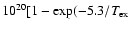
The column density is N(H2)
1.5
1021 cm-2 if their formula is applied with
C18O
(2-1))=7 K and
C18O(1-0)) > 2 K peak
(Langer et al. 1995, see their Fig. 1a).
The column density is N(H2)
1.5
1021 cm-2 if their formula is applied with
C18O
(2-1))=7 K and
 km s-1 i.e.
N(H2)=9.9
km s-1 i.e.
N(H2)=9.9
 C18O
(2-1))]-1
C18O
(2-1))]-1
 C18O
C18O
 .
The column density is similar (N(H
.
The column density is similar (N(H
 1021 cm-2)
when calculated from NH3(1, 1) according to Olano et al. (1988):
N(H
1021 cm-2)
when calculated from NH3(1, 1) according to Olano et al. (1988):
N(H
 107
N(NH3)=1.4
107
N(NH3)=1.4
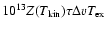 ,
where
,
where
 when
when
 K,
K,
 km s-1 and
 as we measured nearby.
With a total gas mass of 1.2
this is an unbound clump, since
the virial mass would be around 3
.
Still there are 2 YSO candidates associated.
as we measured nearby.
With a total gas mass of 1.2
this is an unbound clump, since
the virial mass would be around 3
.
Still there are 2 YSO candidates associated.
m surface brightness. With 12.6 K dust temperature
and to 10.3 to 14.7 K kinetic temperature HCL2-E is somewhat
warmer than TMC-1 CP.
HCL2-E appears as bright as TMC-1 CP in the 1667 MHz and 165 MHz
hyperfine lines of OH (see at the edge of Fig. 2 of Harju et al. 2000).
HCL2-E hosts two molecular cloud cores inside the
I200
175 MJy sr-1 region, according to our NH3 measurements
(see Fig. 8): the double peaked HCL2-Eab, and HCL2-Ec.
These lie inside the
I200= 175 MJy sr-1 contour.
A corresponding group of 3 H13CO+ cores OMK 42a,b,c
with densities of n(H2)= (1.5
0.2)
105 cm-3was listed by Onishi et al. (2002).
We note the agreement between the NH3
and the H13CO+ based densities.
The velocities of the H13CO+ cores agree with the NH3 velocities and both are significantly lower
than the C18O velocities towards the same positions. Since
C18O is becoming optically thick, it may trace only the envelope
gas of the dense cores; this gas envelope apparently has a
velocity offset being redshifted by 0.7
0.3 km s-1.
HCL2-Eab core is
 E-W elongated
with a velocity gradient of 0.1 km s
E-W elongated
with a velocity gradient of 0.1 km s
 from ENE to WSW.
A weak NH3(2, 2) line was detected after averaging spectra in a
1
diameter region at HLC2-Ea, while it was 4 times stronger
at the HLC2-Eb position (see Fig. 5).
We interpret this to mean that the HLC2-Eab core also shows a gradient
(increase from W to E) also in kinetic temperature,
as seen from T1,2 rotational temperature variations of NH3.
HLC2-Ea is the cold part with
from ENE to WSW.
A weak NH3(2, 2) line was detected after averaging spectra in a
1
diameter region at HLC2-Ea, while it was 4 times stronger
at the HLC2-Eb position (see Fig. 5).
We interpret this to mean that the HLC2-Eab core also shows a gradient
(increase from W to E) also in kinetic temperature,
as seen from T1,2 rotational temperature variations of NH3.
HLC2-Ea is the cold part with
 K
and the SE side, facing the YSO HCL2 SE-2
is warmer with
K
and the SE side, facing the YSO HCL2 SE-2
is warmer with
 K.
This, together with the velocity gradient may indicate an interaction with the
FIR pointsource HCL2 SE-2 south of HCL2-E.
K.
This, together with the velocity gradient may indicate an interaction with the
FIR pointsource HCL2 SE-2 south of HCL2-E.
HCL2-Eab's double peaked structure has been found by H13CO+mapping and was catalogued as #43a and #43b cores by Onishi et al. (2002).
While #43a corresponds well to the eastern local maximum of T(NH3(1,1)),
#43b is located 1
east of HCL2-Eb
(spectra are shown in Fig. 5) which corresponds to the
 NH3(1,1)) maximum position in HLC2-E.
HCL2-Eab is a gravitationally bound core and has an asociated
T Tauri like pointsource HCL2 SE-2, at <
distance,
a YSO candidate, 2MASS TMR15, seen at its northern boundary,
2MASS TMR10 (associated with IRAS 04378+2521) lies within 3
and
another one, ITG 26, at 4
distance.
The HLC2-Ec core is
 N-S elongated
We consider this as a separate core since its velocity
N-S elongated
We consider this as a separate core since its velocity
 km s-1 is 0.4 km s-1 different from that of HCL2-Eab,
it has a different orientation and is separate both in the NH3(1, 1)
and H13CO+ lines. It corresponds well to core #43c
by Onishi et al. (2002). It is gravitationally unbound.
km s-1 is 0.4 km s-1 different from that of HCL2-Eab,
it has a different orientation and is separate both in the NH3(1, 1)
and H13CO+ lines. It corresponds well to core #43c
by Onishi et al. (2002). It is gravitationally unbound.
13 K dust temperature, but less structured
than TMC-1 CP or HCL2-E. Visual starcount-based extinction maps and
13CO (1-0) maps show HCL2-E/HCL2-ES as one cloud; as Heyer (1988)
stated: the second most massive of the whole Taurus with 31.7
.
H13CO+ was not detected in HCL2-ES with
grid
spacing (3
under-sampled). Both the temperature and
the level of turbulence are low as seen from the narrow C18O lines.
It is however at a T(C18O) > 2 K
maximum of the southern TMR, and a local maximum of .
HCL2-ES is without any well defined cloud core.
We assume it is evolutionary the youngest sub-cloud in TMR;
still there is one YSO candidate, 2MASS TMRS 7, seen associated.
Stability of the very cold clouds and cloud cores:
The thermo dynamical virial mass
![$M_{{\rm vir}}/[M_{\hbox{$\odot$ }}]$](/articles/aa/full/2004/23/aa0611/img120.gif) of a
homogenous, spherical cloud can be estimated
from the radius R/[pc], and velocity dispersion
of a
homogenous, spherical cloud can be estimated
from the radius R/[pc], and velocity dispersion
 km s-1] as
 .
Accordingly TMC-1 CP and HCL2-E are
gravitationally bound, HCL2-ES is not. Three of the
five dense cores in Table 5 are gravitationally bound.
We consider these very cold cores of TMR as
pre-protostellar cores in thermo-dynamical instability.
If this is the case magnetic braking does not play a major role in
supporting the cloud cores, it only slows down the collapse.
Since various authors estimate the clouds of HCL2 to be older than
a few free fall times the magnetic pressure of the cores might
have already been decreased by ambipolar diffusion.
The associated YSO-like NIR point sources may trace an early
phase in the evolution of the cloud as they are seen are all over TMR
and not only at the ISM density peaks.
.
Accordingly TMC-1 CP and HCL2-E are
gravitationally bound, HCL2-ES is not. Three of the
five dense cores in Table 5 are gravitationally bound.
We consider these very cold cores of TMR as
pre-protostellar cores in thermo-dynamical instability.
If this is the case magnetic braking does not play a major role in
supporting the cloud cores, it only slows down the collapse.
Since various authors estimate the clouds of HCL2 to be older than
a few free fall times the magnetic pressure of the cores might
have already been decreased by ambipolar diffusion.
The associated YSO-like NIR point sources may trace an early
phase in the evolution of the cloud as they are seen are all over TMR
and not only at the ISM density peaks.
HI gas associated with HCL2:
A large HI cloud is apparent at HCL2 in the HI 21 cm data of the
Leiden/Dwingeloo HI survey (Hartmann & Burton 1999).
The 4.8
2.4 pc size HI cloud is associated with TMR
at 3.1 km s-1 <
< 7.2 km s-1 velocities.
The total HI column density is
 1020 cm-2towards the HCL2 cloud.
We compare the atomic and molecular gas distributions in Fig. 9.
1020 cm-2towards the HCL2 cloud.
We compare the atomic and molecular gas distributions in Fig. 9.
![\begin{figure}
\par\includegraphics[width=8cm,clip]{0611fig9.eps}
\end{figure}](/articles/aa/full/2004/23/aa0611/img124.gif) |
Figure 9:
HCL2 with TMR and its main clouds. C18O line intensity
W(C18O) distribution as observed by the Nagoya-4 m telescope
( HPBW = 2
7 shown in the upper left corner) in a 2
grid.
The W(C18O) contours (thin continuous lines) are drawn
from 0.33 K km-1 by 0.1 K km s-1.
The apparent W(C18O) maxima are at
TMC-1 ( top left), HCL2-E ( left), HCL2-B ( center down), HCL2-A ( center).
The area of the ISOPHOT image is marked with a black frame.
We represent the associated HI cloud with
HI 21 cm line area contours of 341 K km s-1 and 352 K km s-1(red dashed line). |
| Open with DEXTER | |
10 K km s-1 average excess 21 cm line intensity corresponds to
 1019 cm-2 HI column density
and a total HI mass of
1019 cm-2 HI column density
and a total HI mass of
 .
The HI 21 cm spectra were found by Wilson & Mink (1977) to be selfabsorbed
towards HCL2
indicating that HCL2 is associated
also with cold (
.
The HI 21 cm spectra were found by Wilson & Mink (1977) to be selfabsorbed
towards HCL2
indicating that HCL2 is associated
also with cold (
 K) HI gas. The cold HI distribution
generally follows the distribution of visual extinction.
According to Fig. 4a of Wilson & Mink (1977) the primary
maximum of the column density of cold HI coincides with the position
of the ISOPHOT cold clouds HCL2E/HCL2ES.
The TMR hole is near
the HI peak and no drop was seen in the HI column density with the
9
resolution of the Effelsberg-100 m telescope;
however, the TMR hole is approximately
K) HI gas. The cold HI distribution
generally follows the distribution of visual extinction.
According to Fig. 4a of Wilson & Mink (1977) the primary
maximum of the column density of cold HI coincides with the position
of the ISOPHOT cold clouds HCL2E/HCL2ES.
The TMR hole is near
the HI peak and no drop was seen in the HI column density with the
9
resolution of the Effelsberg-100 m telescope;
however, the TMR hole is approximately

 in size. The average cold HI column density is
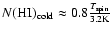 1019 cm-2and the total cold HI mass in HCL2 is
M(HI
1019 cm-2and the total cold HI mass in HCL2 is
M(HI

 (after Wilson & Mink 1977).
Both values depend on the assumed
(after Wilson & Mink 1977).
Both values depend on the assumed
 excitation temperature.
The estimated mass of HI gas in HCL2 is M(HI
excitation temperature.
The estimated mass of HI gas in HCL2 is M(HI
 .
The total molecular mass of HCL2 is over 800
(Onishi et al. 1996),
we thus interpret TMR as series of molecular condensations in
a massive cloud with >95% of its hydrogen content in molecular form.
.
The total molecular mass of HCL2 is over 800
(Onishi et al. 1996),
we thus interpret TMR as series of molecular condensations in
a massive cloud with >95% of its hydrogen content in molecular form.
Dynamics of TMR
TMR with 90% of the mass of HCL2, an effective radius of
 pc and a velocity dispersion of
 km s-1 is gravitationally bound.
We consider TMR as a torus that looks elliptical with an apparent axial
ratio of 0.6
at
km s-1 is gravitationally bound.
We consider TMR as a torus that looks elliptical with an apparent axial
ratio of 0.6
at
 inclination. Schloerb & Snell (1984) and Heyer (1988)
proposed that the ISM circulates in TMR, based on their 13CO data.
We did not find a velocity gradient along the apparent major axis
in our C18O spectra. A clear velocity difference is seen between the NE and NW parts of TMR south in C18O lines, with the NW part being
0.5 km s-1 more redshifted.
Accordingly we may assume that TMR is contracting.
inclination. Schloerb & Snell (1984) and Heyer (1988)
proposed that the ISM circulates in TMR, based on their 13CO data.
We did not find a velocity gradient along the apparent major axis
in our C18O spectra. A clear velocity difference is seen between the NE and NW parts of TMR south in C18O lines, with the NW part being
0.5 km s-1 more redshifted.
Accordingly we may assume that TMR is contracting.
A magnetic field is present in TMR as seen in well aligned K-band polarization, with a mean position angle of about 50 deg (Tamura et al. 1987). This is perpendicular to the direction of the elongation of the HCL2 cloud, which may indicate a formation by contraction along the magnetic field lines. That theory alone however does not explain the presence of the hole. After all, the structure of TMR can be interpreted as well as a couple of dense clouds arranged into two filaments, with a gap between them. Some of the simulated CO spectra and maps of Stenholm & Pudritz (1993) resembles to TMR. This means that an initially uniform, gravitating and radiating cloud with thermal and magnetic pressure (the latter due to a spectrum of Alfvénic waves) may look like TMR after 3.5 free fall times. We note also the remarkable differences between the sub-clouds (or in other words fragments) of TMR. As we found, TMC-1 CP and HCL2-E in the southern part of TMR are without bright IRAS pointsoures (however still showing star formation), while HCL-B in the northern part has a group of them.
Williams & Hartquist (1991) claimed that interaction between stellar winds and molecular gas causes a cyclic interchange between high and low density phases. The differences between the cloudlets of HCL2 is then explained by the different "interaction history'', and age. If there is an age gradient in TMR, it is from north to south. The southern part of TMR (the target of this paper) is evolutionary the youngest in TMR, with HCL2-ES in an assumed pre-core-formation phase. An age gradient of TMC-1 has already been proposed by several authors, Saito et al. (2002) recently claimed 105 yr as a possible age difference in TMC-1 between the ammonia peak and the cyanopolyyne peak.
Padoan et al. (2002) conclude that the observed column density distribution is very likely the result of turbulent fragmentation. Hartmann (2002) however explains the filamentary structures of the Taurus clouds as a result of converging large scale flows channeled by magnetic fields. A detailed numerical simulation is required to illustrate how the large scale effects gave rise to the density peaks in a ring and not simply in the middle of the HI cloud. It should show if such a structure can also be formed in a turbulent cloud.
m ISO image of HCL2 by ISOPHOT resolved the
dense southern part of the Taurus Molecular Ring (TMR) as a
complex of cold clouds.
m objects of the southern part
of TMR correspond to the cores of TMC-1 CP and HCL2-E, both of which have
dust
colour temperatures 12 K, like the coldest cloud cores of the nearby
ISM.
 cm-3.
cm-3.
Acknowledgements
We thank P. Padoan and L. Cambresy for providing us with their