![[*]](/icons/foot_motif.gif) -
R. W. Pogge3 -
J. A. Zensus1
-
R. W. Pogge3 -
J. A. Zensus1
A&A 420, 467-474 (2004)
DOI: 10.1051/0004-6361:20034126
M. Kadler
1 -
J. Kerp2 -
E. Ros1 -
H. Falcke1,
-
R. W. Pogge3 -
J. A. Zensus1
1 - Max-Planck-Institut für Radioastronomie Bonn,
Auf dem Hügel 69, 53121 Bonn, Germany
2 -
Radioastronomisches Institut, Universität Bonn,
Auf dem Hügel 71, 53121 Bonn, Germany
3 -
Department of Astronomy, Ohio State University,
140 West 18th Avenue, Columbus, OH 43210-1173, USA
Received 28 July 2003 / Accepted 19 February 2004
Abstract
We present a combined radio, optical, and X-ray study of the nearby LINER galaxy NGC 1052.
Data from a short (2.3 ks) CHANDRA observation of NGC 1052
reveal the presence of various jet-related X-ray emitting regions,
a bright compact core and unresolved knots in the jet structure as well as
an extended emitting region inside the galaxy well aligned with
the radio synchrotron jet-emission.
The spectrum of the extended X-ray emission can best be fitted with a
thermal model with
kT = (0.4-0.5) keV, while the compact core exhibits
a very flat spectrum, best approximated by an absorbed power-law with
 .
We compare the radio structure to an optical "structure map'' from a
Hubble Space Telescope (HST) observation and find a good
positional correlation between the radio jet and the optical emission cone.
Bright, compact knots in the jet structure are visible in all three
frequency bands whose spectrum is inconsistent with synchrotron emission.
.
We compare the radio structure to an optical "structure map'' from a
Hubble Space Telescope (HST) observation and find a good
positional correlation between the radio jet and the optical emission cone.
Bright, compact knots in the jet structure are visible in all three
frequency bands whose spectrum is inconsistent with synchrotron emission.
Key words: galaxies: individual: NGC 1052 - galaxies: individual: B 0238-084 - galaxies: active - galaxies: jets
elliptical galaxy
which harbors a low-luminosity
active galactic nucleus (LLAGN) in its very center (
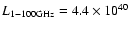 erg s-1; Wrobel 1984).
It hosts a two-sided radio jet
emanating from the nucleus and reaching out to kiloparsec-scales which
is, however, still fully enclosed within the stellar body of the optical
galaxy.
In the optical, the spectrum of NGC 1052 is characterized by strong forbidden
lines from low-ionization states which has made NGC 1052 the prototypical LINER (low-ionization nuclear emission line region; Heckman 1980) galaxy.
As for LINERs in general, it has long been argued whether these low-ionization
lines in NGC 1052 are excited by a central photo-ionizing source (e.g., Gabel et al.
2000) or if shock heating is the dominant mechanism (e.g., Sugai & Malkan
2000). While there is overwhelming evidence for the
presence of an active galactic nucleus (AGN) in NGC 1052,
the role of shocks in this galaxy is still unclear.
The improved angular resolution in X-rays offered by CHANDRA makes it possible
for the first time to image the distribution of X-ray emission on
the same scales as accomplished by connected radio
interferometers, e.g., MERLIN (Multi-Element Radio-Linked Interferometer
Network).
Disentangling the contributions of compact
(i.e., <1 arcsec) nuclear and extended (i.e., >1 arcsec) X-ray
emitting regions to the total amount of X-ray emission of NGC 1052
can serve as an important tool to study the interaction between the
radio jet plasma and the ambient interstellar medium.
erg s-1; Wrobel 1984).
It hosts a two-sided radio jet
emanating from the nucleus and reaching out to kiloparsec-scales which
is, however, still fully enclosed within the stellar body of the optical
galaxy.
In the optical, the spectrum of NGC 1052 is characterized by strong forbidden
lines from low-ionization states which has made NGC 1052 the prototypical LINER (low-ionization nuclear emission line region; Heckman 1980) galaxy.
As for LINERs in general, it has long been argued whether these low-ionization
lines in NGC 1052 are excited by a central photo-ionizing source (e.g., Gabel et al.
2000) or if shock heating is the dominant mechanism (e.g., Sugai & Malkan
2000). While there is overwhelming evidence for the
presence of an active galactic nucleus (AGN) in NGC 1052,
the role of shocks in this galaxy is still unclear.
The improved angular resolution in X-rays offered by CHANDRA makes it possible
for the first time to image the distribution of X-ray emission on
the same scales as accomplished by connected radio
interferometers, e.g., MERLIN (Multi-Element Radio-Linked Interferometer
Network).
Disentangling the contributions of compact
(i.e., <1 arcsec) nuclear and extended (i.e., >1 arcsec) X-ray
emitting regions to the total amount of X-ray emission of NGC 1052
can serve as an important tool to study the interaction between the
radio jet plasma and the ambient interstellar medium.
NGC 1052 has been observed by all major X-ray missions of the pre-CHANDRA era, like
Einstein (Mc Dowell 1994), ASCA and ROSAT (Weaver et al. 1999), and
Beppo Sax (Guainazzi & Antonelli 1999).
For these X-ray missions, NGC 1052 appeared as a point-like
X-ray source. The X-ray spectrum of NGC 1052
is extremely flat, a finding that led to the proposal
of an advection dominated accretion flow (ADAF) as the origin of the
observed X-ray
emission (Guainazzi et al. 2000).
To model the AGN X-ray spectrum above
 keV absorbing column
densities in excess of 1023 cm-2 have been discussed, supporting
the idea of a high density obscuring torus, comparable to column
densities found in other AGN (e.g., Malizia et al. 1997; Risaliti et al. 2002).
Independent evidence for the existence of an obscuring torus at the center of NGC 1052 is obtained from Very Long Baseline Interferometry (VLBI) observations
in the radio regime:
on parsec-scales NGC 1052 exhibits a twin jet structure with a prominent
emission gap between both jets (see e.g., Kadler et al. 2003b).
The inner part of the western jet shows
a strongly inverted radio spectrum, which was first discovered
by Kellermann et al. (1999) (see also Kameno et al. 2001). The cm-wavelength spectral
index in this central region is larger than 2.5, exceeding the
theoretical limit for synchrotron self-absorption.
keV absorbing column
densities in excess of 1023 cm-2 have been discussed, supporting
the idea of a high density obscuring torus, comparable to column
densities found in other AGN (e.g., Malizia et al. 1997; Risaliti et al. 2002).
Independent evidence for the existence of an obscuring torus at the center of NGC 1052 is obtained from Very Long Baseline Interferometry (VLBI) observations
in the radio regime:
on parsec-scales NGC 1052 exhibits a twin jet structure with a prominent
emission gap between both jets (see e.g., Kadler et al. 2003b).
The inner part of the western jet shows
a strongly inverted radio spectrum, which was first discovered
by Kellermann et al. (1999) (see also Kameno et al. 2001). The cm-wavelength spectral
index in this central region is larger than 2.5, exceeding the
theoretical limit for synchrotron self-absorption.
Combined studies of the core region of NGC 1052 in the radio and X-ray regime are of essential importance for constraining the physical properties of the parsec-scale radio jet and the obscuring torus as well as to determine the nature of the nuclear X-ray emission. In this paper we present a combined radio, optical, and X-ray study of the jet-related emission in NGC 1052 on arcsecond scales. In particular, we focus on the soft X-ray excess in the source-spectrum below E = 2 keV. This soft component was identified first by Weaver et al. (1999) based on ROSAT PSPC data. CHANDRAs superior angular resolution makes it possible to present evidence that this soft excess emission is associated with the well known radio jet.
In Sect. 2 we present the CHANDRA, MERLIN, and HST data as well as their reduction. In Sect. 3 we discuss the arcsecond-scale morphology of NGC 1052 in the radio, optical, and X-ray regime and the correlations between the different wave bands. In Sect. 4 we derive models for the nuclear and extended X-ray emission and Sect. 5 summarizes our conclusions.
CHANDRA observed NGC 1052 on August 29/30, 2000.
During the 2342 s observation, the Advanced CCD Imaging Spectrometer
(ACIS) Chip S3 was in the focus of the High Resolution Mirror Assembly (HRMA).
The ACIS-S3 detector offers high angular resolution as well as information on
the X-ray source spectrum because of its intrinsic energy resolution
and has a higher sensitivity in the soft X-ray energy regime below E<1 keV then the front-side illuminated detectors of CHANDRA.
The nucleus of NGC 1052 is the brightest X-ray source within the field of
interest.
The count rate of 0.12
 is sufficiently high to affect
the measured
AGN X-ray spectrum by the pile-up effect.
The pile-up effect changes the shape of the measured X-ray spectrum as well as
the measured count rate, because during a single read-out
period of the chip multiple X-ray photons may be detected within a single
pixel. Due to insufficient time resolution their combined signal is
registered as a single photon event.
The presented CHANDRA observation was performed using the standard
timed exposure mode.
Depending on the detailed shape of the AGN X-ray spectrum up to 27% of the available data can be affected by the pile-up effect.
In principle, this introduces a bias which results in spectral
hardening and mimics lower count rates.
is sufficiently high to affect
the measured
AGN X-ray spectrum by the pile-up effect.
The pile-up effect changes the shape of the measured X-ray spectrum as well as
the measured count rate, because during a single read-out
period of the chip multiple X-ray photons may be detected within a single
pixel. Due to insufficient time resolution their combined signal is
registered as a single photon event.
The presented CHANDRA observation was performed using the standard
timed exposure mode.
Depending on the detailed shape of the AGN X-ray spectrum up to 27% of the available data can be affected by the pile-up effect.
In principle, this introduces a bias which results in spectral
hardening and mimics lower count rates.
The spatial distribution of photon events on the ACIS-S3 chip during
the observation of NGC 1052 is shown in Fig. 1 for the
energy range (0.2-1) keV. Even from
the small number of counts during this snapshot observation the distribution
of soft X-rays clearly differs from a point spread function.
Using the CSMOOTH program which is part of the CIAO software
we also produced
an adaptively smoothed map of the field of interest (see Fig. 2)
for which we reduced the angular
resolution of the data from 0.5 arcsec to 4 arcsec and set a minimum
significance threshold to 3 .
.
![\begin{figure}
\par\includegraphics[width=8cm,clip]{0126fig1}
\end{figure}](/articles/aa/full/2004/23/aa0126/img9.gif) |
Figure 1: Raw CHANDRA image of NGC 1052 showing the spatial distribution of photon events in the energy range (0.2-1.0) keV. |
| Open with DEXTER | |
A MERLIN observation of NGC 1052 at 1.4 GHz was performed on November 22, 1995. The data from this
experiment have been obtained from the public archive and analyzed applying standard
methods using the program DIFMAP. Two different maps of the
brightness distribution of NGC 1052 at 1.4 GHz were produced. First,
a strong (u,v)-taper was used to map the extended
emission resulting in a restoring beam of (
 ) arcsec
at a position angle (PA) of
) arcsec
at a position angle (PA) of  .
Second, a pure naturally weighted
image was produced yielding a restoring beam of (
.
Second, a pure naturally weighted
image was produced yielding a restoring beam of (
 ) arcsec at a PA of
  .
.
 0.046 arcsec) with integration times of 200, 800, and 900 s, respectively. Cosmic rays were cleaned from the individual
images using a version of the L.A.Cosmic Laplacian edge-detection
algorithm described by van Dokkum (2001). The
cleaned images were added together after
registration using a field star in the image to remove the
inter-image offsets. To enhance the faint emission features noted by
Pogge et al. (2000), we created a "structure map'' of the
combined, cleaned images following the technique described by Pogge &
Martini (2002). We used a model point spread function
for the F658N filter and PC1 camera
generated using the TINYTIM package (Krist & Hook 1999). Structure
mapping is an improved method of image contrast enhancement
(compared to traditional unsharp masking).
In brief, the technique suppresses
the large-scale starlight distribution, enhancing faint emission and
absorption (e.g., dust extinction) features in the image.
0.046 arcsec) with integration times of 200, 800, and 900 s, respectively. Cosmic rays were cleaned from the individual
images using a version of the L.A.Cosmic Laplacian edge-detection
algorithm described by van Dokkum (2001). The
cleaned images were added together after
registration using a field star in the image to remove the
inter-image offsets. To enhance the faint emission features noted by
Pogge et al. (2000), we created a "structure map'' of the
combined, cleaned images following the technique described by Pogge &
Martini (2002). We used a model point spread function
for the F658N filter and PC1 camera
generated using the TINYTIM package (Krist & Hook 1999). Structure
mapping is an improved method of image contrast enhancement
(compared to traditional unsharp masking).
In brief, the technique suppresses
the large-scale starlight distribution, enhancing faint emission and
absorption (e.g., dust extinction) features in the image.
![\begin{figure}
\par\includegraphics[width=12cm,clip]{0126fig2}
\end{figure}](/articles/aa/full/2004/23/aa0126/img14.gif) |
Figure 2:
Three color CHANDRA image of the jet-associated X-ray emission in NGC 1052
with the 1.4 GHz MERLIN radio image overlaid in contours. The CHANDRA
image has been
smoothed to a resolution of 4
 to increase sensitivity.
Red represents photons between 0.1 keV and 1 keV, green between 1 keV and 2 keV
and blue (2-3) keV. The clipping level is 3.
The MERLIN image was
restored with a circular beam of 1.7 arcsec FWHM.
Contours are shown for (0.5, 1.5, 2.5, 3.5, 4.5, 5.5, 6.5)
to increase sensitivity.
Red represents photons between 0.1 keV and 1 keV, green between 1 keV and 2 keV
and blue (2-3) keV. The clipping level is 3.
The MERLIN image was
restored with a circular beam of 1.7 arcsec FWHM.
Contours are shown for (0.5, 1.5, 2.5, 3.5, 4.5, 5.5, 6.5)  1 mJy/beam.
The jet-associated emission is dominated by soft X-rays below 1 keV,
whereas the AGN appears white, representing a rather flat X-ray spectrum. 1 mJy/beam.
The jet-associated emission is dominated by soft X-rays below 1 keV,
whereas the AGN appears white, representing a rather flat X-ray spectrum. |
| Open with DEXTER | |
The CHANDRA image of NGC 1052 in the energy range (0.3-3.0) keV is shown in Fig. 2. Strong X-ray emission from the AGN is seen in this image, as well as diffuse extended emission well aligned with the radio jet, whose MERLIN image is superimposed in contours. In Sects. 4.1 and 4.2 we discuss the X-ray spectra in detail and present evidence that the soft excess component found previously in the ROSAT spectra of the nucleus (Weaver et al. 1999) is associated with this soft, extended jet-associated emission.
To the first order, the radio and the X-ray jet are aligned on arcsecond scales and their extent appears to be the same. However, the intensity of synchrotron emission in the radio lobes appears to be anti-correlated with the soft X-ray intensity distribution in so far as the radio hotspots on both sides correspond to regions on the ACIS-S3 chip which did not detect any photon events. East and west of the nucleus two relatively bright X-ray emitting regions coincide with emission knots in the radio regime. Bright optical emission knots are also present in these areas (Pogge et al. 2000).
The large-scale radio structure of NGC 1052 visible in the tapered MERLIN image
reveals some differences to the 1980 VLA image of
Wrobel (1984) (see Fig. 3).
The VLA, which was operated in its A configuration during the 1980 observations,
was more sensitive to extended structures, which partially have been
resolved out by MERLIN.
The core has varied, with a flux density of 0.74 Jy in December 1980
and 1.01 Jy in November 1995. The western hot spot has increased in
flux density. A knot in the western jet (labeled as B in the MERLIN image)
was not visible as a local maximum in the 1980 VLA image.
By aligning the core positions at both epochs,
we found that the eastern knot (labeled as A),
has moved about 0.5 arcsec inwards. However, an examination of the
pure naturally weighted MERLIN image (see Fig. 4) reveals that
knot A is composed of two isolated sub-components (A 1 and A 2)
separated by the same distance of 0.5 arcsec.
This suggests that the inner sub-component might have increased
in flux density between 1980 and 1995, causing an apparent shift of the
blended knot structure
in Fig. 2. This offers a more plausible explanation than an inward motion
with a velocity of 10 c.
![\begin{figure}
\par\includegraphics[width=8.5cm,clip]{0126fig3}
\end{figure}](/articles/aa/full/2004/23/aa0126/img15.gif) |
Figure 3:
Comparison
between the VLA image of NGC 1052 observed in 1980 (Wrobel 1984) and the MERLIN image from 1995, both at 1.4 GHz. Both maps have been convolved with the same (circular) restoring beam
of 1.7 arcsec FWHM. Contours at (-1, 1, 2, 3, 4, 5, 6, 7, 8, 9, 10, 11, 12, 13, 14, 15,
800) 0.5 mJy are given in both maps (the VLA map also shows negative
contours at (-4, -3, -2)
0.5 mJy). The hot spots (labeled as H1 and H2)
do not show any positional changes.
The emission peak of the eastern knot (A)
is about 0.5 arcsec closer to the core in 1995. |
| Open with DEXTER | |
![\begin{figure}
\par\includegraphics[width=12cm,clip]{0126fig4}
\end{figure}](/articles/aa/full/2004/23/aa0126/img16.gif) |
Figure 4:
HST structure map of NGC 1052. Dark regions represent dust obscuration while
bright regions are locations of enhanced emission. Overlaid is the pure naturally
weighted MERLIN map showing the core of NGC 1052 with sub-arcsecond resolution. Contours
at (-1, 1, 2, 4, 8, 16, 32, 64, 128, 256, 512, 1024) 0.5 mJy/beam
are shown. The inlaid panel shows an enlarged view of the marked box around the
area of the optical emission cone. |
| Open with DEXTER | |
The structure map of NGC 1052 is shown in Fig. 4 with the radio contours
of the untapered, full-resolution MERLIN image superimposed.
The jet-counterjet structure is aligned with the optical emission
cone. The dark band perpendicular to the radio jet might be an artifact of the
image processing. Two optical emission knots are located at the
edges of the two radio sub-components of knot A. The optical emission knot in the
west coincides roughly with a weak ( )
radio feature while the
stronger radio knot 1.5 arcsec further out has no corresponding bright
optical counterpart.
The origin of the optical emission remains unclear since there is no
continuum image to subtract from the H
)
radio feature while the
stronger radio knot 1.5 arcsec further out has no corresponding bright
optical counterpart.
The origin of the optical emission remains unclear since there is no
continuum image to subtract from the H filter image of NGC 1052.
The conical morphology in this LINER 1.9 galaxy is remarkably
similar
to the structure of the narrow-emission-line region typically observed
in Seyfert 2 galaxies (e.g., Falcke et al. 1998).
This suggests that the optical emission cone
is due to line emission rather than continuum emission.
The optical flux density of the two eastern knots of (
filter image of NGC 1052.
The conical morphology in this LINER 1.9 galaxy is remarkably
similar
to the structure of the narrow-emission-line region typically observed
in Seyfert 2 galaxies (e.g., Falcke et al. 1998).
This suggests that the optical emission cone
is due to line emission rather than continuum emission.
The optical flux density of the two eastern knots of ( )
)  Jy
exceeds the power-law extrapolation from the radio to the X-ray regime by
almost three orders of magnitude. This
is a strong argument against the synchrotron emission process,
but compatible with relatively strong line emission exceeding the
contimuum emission of the knots in this narrow band.
Jy
exceeds the power-law extrapolation from the radio to the X-ray regime by
almost three orders of magnitude. This
is a strong argument against the synchrotron emission process,
but compatible with relatively strong line emission exceeding the
contimuum emission of the knots in this narrow band.
Figure 5 reveals the much softer spectrum of the diffuse X-ray emission compared to the nuclear spectrum. The bulk emission originates below E < 2 keV, while the X-ray spectrum of the nucleus has an additional hard X-ray component. Remarkable is the soft X-ray emission below E<2 keV towards the nucleus. ASCA, as well as the ROSAT PSPC, could not separate the nucleus and the jet spatially, but a soft excess X-ray emission had already been detected in the X-ray spectrum from the PSPC data.
![\begin{figure}
\par\includegraphics[width=8.5cm,clip]{0126fig5}
\end{figure}](/articles/aa/full/2004/23/aa0126/img21.gif) |
Figure 5: Top panel: X-ray spectrum of the extended X-ray jet emission and the Raymond/Smith plasma model folded with the detector response matrix (solid line). Middle panel: X-ray spectrum of the nuclear emission and the best fit of model Ib (solid line, compare Table 4.2). Bottom panel: the unfolded model Ib spectrum representing an absorbed Raymond/Smith plasma whose model parameters have been held fixed at the best fitting values to the extended X-ray emission spectrum (see Table 1) plus a power-law with an additional absorber. |
| Open with DEXTER | |
To constrain the emission process of the diffuse extended emission, we fitted different models using XSPEC (version 11.2): the RAYMOND model corresponding to a Raymond/Smith plasma (Raymond & Smith 1977), the MEKAL model describing a Mewe/Kaastra plasma (e.g., Kaastra 1992) and a simple power-law. The results of the spectral fits are presented in Table 1.
Because the jet is located deep
inside the stellar body of the galaxy NGC 1052, we have to determine
the amount of photoelectric absorption distributed along the line of sight.
Using the thermal source models, we find an attenuating column
density value
about one order of magnitude higher than the galactic
foreground column density belonging to the Milky Way
(Hartmann & Burton 1997).
We attribute this additional X-ray attenuation to weakly ionized gas located
inside the galaxy itself.
The unabsorbed flux of the Raymond/Smith (Mewe/Kaastra) plasma in the range between 0.3 and 8 keV
corresponds to an intrinsic luminosity of
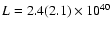 erg s-1 at the distance of the source
of 22.6 Mpc.
erg s-1 at the distance of the source
of 22.6 Mpc.
Both plasma models fall below the measured count rate above 2.5 keV (see Fig. 5) suggesting some contribution of an additional hard X-ray component to the spectrum of the extended emission. Due to the low photon statistics and the large uncertainties we have not tried to account for this additional spectral component by considering more complicated models.
Because of the low number of counts from the jet, we cannot
unequivocally dismiss the power-law model, which gave an
acceptable fit to the X-ray data.
However, we consider the power-law fit result of the X-ray jet as unreliable
because of the unusually steep photon
index (see
Table 1).
Below E=2 keV a soft excess is detected in the nuclear spectrum.
Assuming that a fraction of the diffuse jet-associated emission
originates within the immediate neighborhood of the nucleus,
we used a hybrid model for the X-ray spectral approximation of the
observed intensity distribution.
 is
the X-ray spectrum of the diffuse jet-associated emission
and
is
the X-ray spectrum of the diffuse jet-associated emission
and
 is the spectrum of the
nucleus.
Here, the photoelectric absorption produced by the torus is represented
by
is the spectrum of the
nucleus.
Here, the photoelectric absorption produced by the torus is represented
by
 ,
while the X-ray absorption produced by the
interstellar medium of the elliptical galaxy is
,
while the X-ray absorption produced by the
interstellar medium of the elliptical galaxy is
 .
.
We assumed a power-law type X-ray spectrum of the central X-ray source
and modeled the soft component as a thermal plasma spectrum of the
Raymond/Smith and Mewe/Kaastra type, (model I and II) respectively.
We did not try to fit for the metallicities and fixed these during the spectral
fitting procedure given the poor statistics from the short integration time.
Model Ia(IIa) assumes solar abundances of the Raymond/Smith (Mewe/Kaastra)
plasma and allows the other parameters to be varied. In model Ib(IIb) the temperatures of the
plasma and the absorbing column density of the interstellar medium of the galaxy were fixed
to the best fitting values to the extended X-ray emission (see Table 1).
In model Ic(IIc) the metal abundances were additionally changed to 25% of the solar composition.
Such low metal abundances typically occur only in dwarf galaxies but are
found in NGC 1052 from optical
line measurements of Sil chenko (1995) who
reports values
chenko (1995) who
reports values
![$\rm [Fe/H]\sim -0.6$](/articles/aa/full/2004/23/aa0126/img31.gif) for the nucleus and
for the nucleus and
![$\rm [Fe/H]\sim -1$](/articles/aa/full/2004/23/aa0126/img32.gif) for
the bulge of NGC 1052, corresponding to metallicities of about 25% and 10%, respectively.
One way to accumulate a substantial amount of metal-poor
material is a merger or close encounter with an extremely
metal-poor dwarf galaxy. Evidence for such an event indeed exists from
multiple observational approaches (see Forbes et al. 2001 and
references therein) in the case of NGC 1052.
for
the bulge of NGC 1052, corresponding to metallicities of about 25% and 10%, respectively.
One way to accumulate a substantial amount of metal-poor
material is a merger or close encounter with an extremely
metal-poor dwarf galaxy. Evidence for such an event indeed exists from
multiple observational approaches (see Forbes et al. 2001 and
references therein) in the case of NGC 1052.
The statistically best fitting values are given in Table 2.
For all six models we derive a luminosity of
 erg s-1.
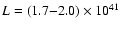
Correcting for the effect of the two absorber model components increases the intrinsic
(unabsorbed) value to
erg s-1.
Correcting for the effect of the two absorber model components increases the intrinsic
(unabsorbed) value to
 erg s-1.
The values of
erg s-1.
The values of
 and kT for the plasma component in the models Ia
and IIa
are very similar to the values determined for the extended plasma emission.
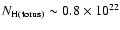
For these models we derive best fitting values for the absorbing column density of
and kT for the plasma component in the models Ia
and IIa
are very similar to the values determined for the extended plasma emission.
For these models we derive best fitting values for the absorbing column density of
 cm-2as well as
 for the photon index. Similar
values for both parameters result from fixing
and kT as described above in
the models Ib and IIb. Reducing the metal abundances of the plasma component in model Ic(IIc)
forces the power-law to contribute more strongly to the soft part of the spectrum resulting in
higher values of
for the photon index. Similar
values for both parameters result from fixing
and kT as described above in
the models Ib and IIb. Reducing the metal abundances of the plasma component in model Ic(IIc)
forces the power-law to contribute more strongly to the soft part of the spectrum resulting in
higher values of
 cm-2 and
 .
These values are still rather low. Data from other X-ray
observatories imply much higher values for
.
These values are still rather low. Data from other X-ray
observatories imply much higher values for
 as
well as for
as
well as for  (Weaver et al. 1999; Guainazzi & Antonelli
1999; Guainazzi et al. 2000).
We note that the apparent discrepancy between
previous X-ray observations and
the CHANDRA data
concerning the photon index might be due to the pile-up
degradation (30%) of the latter.
The nuclear X-ray spectrum thus might appear
artificially flattened.
The determined absorbing column density, however, is not so sensitive to the pile-up
effect, which mainly affects the
hard part of the spectrum while the amount of absorption is determined in
the soft X-ray regime.
The statistical quality of all six fits is very similar, with values of
(Weaver et al. 1999; Guainazzi & Antonelli
1999; Guainazzi et al. 2000).
We note that the apparent discrepancy between
previous X-ray observations and
the CHANDRA data
concerning the photon index might be due to the pile-up
degradation (30%) of the latter.
The nuclear X-ray spectrum thus might appear
artificially flattened.
The determined absorbing column density, however, is not so sensitive to the pile-up
effect, which mainly affects the
hard part of the spectrum while the amount of absorption is determined in
the soft X-ray regime.
The statistical quality of all six fits is very similar, with values of
 ranging from 0.76 to 0.84,
and the low photon statistics (reflected in the values of
ranging from 0.76 to 0.84,
and the low photon statistics (reflected in the values of
 )
do not allow us
to dismiss any of these models.
)
do not allow us
to dismiss any of these models.
We note that a "patchy'' absorber model in which a fraction of the central source is seen directly
and only a part of the source is covered by the absorber might be a more realistic model for
the nuclear X-ray emission of NGC 1052, given the results of
Vermeulen et al. (2003), who found that moving VLBI components in both jets show complex
light curves probably caused by substantial patchiness of the absorbing screen.
Additionally, they
find a complex H I absorption line
spectrum with compact clouds of absorbing material at different relative velocities and different
locations along the parsec-scale jet structure.
The absorbing column density derived from "patchy'' absorber models is
expected to be considerably higher (
 cm-2) than
the values derived from uniform absorber models.
However, given the low photon statistics, we omit the detailed discussion of such models with a larger
number of free parameters.
cm-2) than
the values derived from uniform absorber models.
However, given the low photon statistics, we omit the detailed discussion of such models with a larger
number of free parameters.
Table 1: Best-fitting parameters for the spectral fits to the extended jet-associated emission.
Table 2: Best-fitting parameters for the spectral fits of the core emission.
The CHANDRA data provide for the first time direct evidence for
jet-associated X-ray emission in NGC 1052.
The diffuse, extended X-ray emission can be best approximated with a thermal plasma model
with
 keV. This temperature is consistent with the thermal
component found earlier by Weaver et al. (1999) using ASCA and ROSAT data.
Its absorbed flux is only 3% of the nuclear X-ray emission but the intrinsic
(absorption corrected) extended emission might contribute up to 14% to the
total unabsorbed X-ray flux of NGC 1052.
Because of the considerable pile-up degradation of
the CHANDRA data, no firm conclusions on the photon index of the nucleus spectrum can
be deduced.
The derived column density of hydrogen towards the compact X-ray core
(depending on the applied model) of
keV. This temperature is consistent with the thermal
component found earlier by Weaver et al. (1999) using ASCA and ROSAT data.
Its absorbed flux is only 3% of the nuclear X-ray emission but the intrinsic
(absorption corrected) extended emission might contribute up to 14% to the
total unabsorbed X-ray flux of NGC 1052.
Because of the considerable pile-up degradation of
the CHANDRA data, no firm conclusions on the photon index of the nucleus spectrum can
be deduced.
The derived column density of hydrogen towards the compact X-ray core
(depending on the applied model) of
 cm-2 is in good
agreement with the absorbing column density of ionized material towards the
VLBI-jet derived by Kadler et al. (2002) and Kadler et al. (in prep.).
This suggests that the
nuclear X-ray emission of NGC 1052 might be produced on the same scales
as the parsec-scale structures imaged by VLBI at high frequencies.
cm-2 is in good
agreement with the absorbing column density of ionized material towards the
VLBI-jet derived by Kadler et al. (2002) and Kadler et al. (in prep.).
This suggests that the
nuclear X-ray emission of NGC 1052 might be produced on the same scales
as the parsec-scale structures imaged by VLBI at high frequencies.
The detection of a diffuse region of
X-ray emitting gas with a thermal spectrum and the same extent
as the kiloparsec-scale radio jet suggests that
jet-triggered shocks might play an important role in NGC 1052.
In such a model the kinetic power of the radio jet is
partially
converted into X-ray emission.
The optical morphology in the H filter substantiates
this
picture as was noted earlier by Allen et al. (1999). The alignment of
the radio jet and the optical emission cone visible in
Fig. 4 implies that the ionization cone
might be drilled out by the radio jets, resulting in a
predominantly shock-excited, conical
narrow-line region (see e.g., Dopita 2002).
Shocks might occur also on larger scales giving rise to the
soft thermal X-ray emission associated with the radio jet/lobe structure
in NGC 1052.
A rough estimate (see Kadler et al. 2003a)
shows that the soft thermal
X-ray spectrum associated with the radio jet of NGC 1052 can be explained
in terms of the kinetic jet power being partially converted into X-ray emission
originating in shocks driven into the ambient medium.
(A more detailed model of the relation between jet-driven shock-activity
and the spectral shape of the extended X-ray emission in NGC 1052
will be discussed in a forthcoming paper.)
The comparison of the large-scale
distribution of radio emission in NGC 1052 between two epochs separated by 15 years indeed shows activity on kiloparsec-scales. This
substantiates the idea that shocks in the interstellar medium form at the
working surfaces of active regions (hotspots and knots).
Moreover, recent numerical simulations (e.g., Zanni et al. 2003) show
that jets in radio galaxies can inflate over-pressured cocoons that drive shocks
into the ambient gas resulting in morphologies (in the case of weak shocks)
very similar to what is observed in NGC 1052: a cavity of hot X-ray emitting
gas in conjunction with a local deficit of X-ray emission around the hotspots.
A deeper CHANDRA observation with an improved photon statistic compared to the
observation discussed here would provide both a higher sensitivity to the weak
diffuse emission and a higher resolution.
Additionally, the full resolution of CHANDRA of 0.5 arcsec would allow one to study in more detail the connection between the
knots in the diffuse X-ray emission and the optical emission knots.
Acknowledgements
We thank G. V. Bicknell for helpful discussions and important suggestions. This research used the CHANDRA Data Archive (CDA) which is part of the CHANDRA X-ray Observatory Science Center (CXC) which is operated for NASA by the Smithsonian Astrophysical Observatory. We used CHANDRA data from an experiment planned and scheduled by G. P. Garmire. We made use of the data archive at the Space Telescope Science Institute which is operated by the Association of Universities for Research in Astronomy, Inc. under NASA contract NAS 5-26555. MERLIN is a National Facility operated by the University of Manchester at Jodrell Bank Observatory on behalf of PPARC. We made use of public MERLIN data from an experiment planned and scheduled by A. Pedlar. This research has made use of NASA's Astrophysics Data System.
 Italiana di Fisica), 219
(In the text)
Italiana di Fisica), 219
(In the text) chenko, O. K. 1995, Astron. Lett., 21, 283 [NASA ADS] (In the text)
