 Cen
Cen![[*]](/icons/foot_motif.gif)
A&A 420, 173-181 (2004)
DOI: 10.1051/0004-6361:20035634
CenA. Sollima1,2 - F. R. Ferraro1 - L. Origlia2 - E. Pancino2 - M. Bellazzini2
1 - Dipartimento di Astronomia, Università di Bologna, via Ranzani
1, 40127 Bologna, Italy
2 -
Osservatorio Astronomico di Bologna, via Ranzani 1, 40127
Bologna, Italy
Received 5 November 2003 / Accepted 27 January 2004
Abstract
We present a near-infrared J and K photometric catalog
containing more than 73 000 stars in the central region of the giant
Globular Cluster Centauri. This is the largest IR data set
ever published for this cluster and has been used to completely
characterize the morphology and the properties of the Red Giant Branch
(RGB). In particular, we concentrated our attention on (i) the
anomalous RGB (RGB-a), recently discovered in this cluster and (ii) the
RGB of the dominant metal poor population (RGB-MP) in both the infrared
(K,J-K) and optical-infrared (K,V-K) color magnitude diagrams. The
full set of morphological parameters and photometric indices has been
measured and compared with the empirical relations by Ferraro et al.
(2000). We find that the detailed photometric properties of the RGB-a
are in full agreement with the recent spectroscopic metallicity estimates
that place it at the metal-rich extreme of the stellar population mix
in Centauri.
Key words: globular clusters: individual: Cen -
stars: Population II -
stars: evolution -
techniques: photometric -
infrared: stars
The origin and star formation history in Centauri, the most
luminous and massive globular cluster in our Galaxy, is one of the most
intriguing problems of modern stellar astrophysics. Centauri
is the only known Galactic globular cluster which shows clear
variations in the metal content of its giants. This evidence
has been firmly estabilished in the past by extensive low
(Norris et al. 1996; Suntzeff & Kraft 1996) and high resolution
(Norris & Da Costa 1995; Smith et al. 2000) spectroscopic surveys.
More recently, the scenario has become more complicated due to the
discovery of an additional, metal-rich population with its own distinct
RGB (hereafter RGB-a) that contains approximately 5 of the red
giants in Cen (Lee et al. 1999; Pancino et al. 2000, 2002).
In spite of the huge observational effort carried out so far, the
global picture of the cluster formation and evolution is far from being
completely understood.
of the red
giants in Cen (Lee et al. 1999; Pancino et al. 2000, 2002).
In spite of the huge observational effort carried out so far, the
global picture of the cluster formation and evolution is far from being
completely understood.
In this framework, we have started a long-term project devoted to the
detailed study of the properties of the different stellar populations
in this cluster (see the overview of the project by Ferraro et al. 2001). Within this project a number of results have been
published, in particular on the identification of the anomalous
RGB-a, and on the definition of its chemical and kinematic properties
(see Pancino et al. 2000, 2002, 2003; Bellazzini et al. 2001; Ferraro
et al. 2002; Origlia et al. 2002).
Most of the actual observational knowledge comes
from the optical (photometric or spectroscopic) study of RGB stars.
Only sparse literature of near
infrared observations existed up to now. Two pioneering studies by
Glass & Feast (1973, 1977) and Persson et al. (1980) present J, H and
K magnitudes for a few tens of bright giants. More recently, the NICMOS
camera on board of HST has been used by Pulone et al. (1998) to obtain
extremely deep photometry of a tiny area (
 )
7 arcmin
away from the cluster center. The 2MASS survey has instead covered a
very wide area (
)
7 arcmin
away from the cluster center. The 2MASS survey has instead covered a
very wide area (
 )
around Cen, which
however does not include the central region of the cluster.
This paper presents a large J and K photometric
catalog of more than 73 000 stars in an area covering
)
around Cen, which
however does not include the central region of the cluster.
This paper presents a large J and K photometric
catalog of more than 73 000 stars in an area covering
 around the center of Cen. By combining the
IR-data set with wide field optical photometry (Pancino et al. 2000,
2003), we measured the complete set of morphological parameters defined
by Ferraro et al. (2000, hereafter F00), which fully characterize the
photometric properties of the RGB of different populations in
Centauri.
around the center of Cen. By combining the
IR-data set with wide field optical photometry (Pancino et al. 2000,
2003), we measured the complete set of morphological parameters defined
by Ferraro et al. (2000, hereafter F00), which fully characterize the
photometric properties of the RGB of different populations in
Centauri.
![\begin{figure}
\par\includegraphics[width=7.8cm,clip]{0634fig1.ps} %
\end{figure}](/articles/aa/full/2004/22/aa0634/img10.gif) |
Figure 1: Map of the region sampled by the IR observations. North is up, east on the left. Only stars with K<13 have been plotted. |
| Open with DEXTER | |
A large set of J and K images were obtained at ESO, La Silla (Chile),
during two observing runs (Run  and
and  ,
see
Table 1) at the New Technology Telescope (NTT) using the
near-IR imager/spectrometer SOFI. The observations were secured as
back-up programmes. SOFI is an
imager/spectrometer equipped with a
,
see
Table 1) at the New Technology Telescope (NTT) using the
near-IR imager/spectrometer SOFI. The observations were secured as
back-up programmes. SOFI is an
imager/spectrometer equipped with a
 Rockwell IR-array
detector. All the observations presented here were performed with a
scale of 0.292''/pixel, fixing a global FoV of
Rockwell IR-array
detector. All the observations presented here were performed with a
scale of 0.292''/pixel, fixing a global FoV of
 each field.
During  ,
we covered the central region of the cluster with a
mosaic of nine partially overlapping fields (hereafter Science fields), sampling a total area of
around the cluster center (see Fig. 1). A set of high-S/N
flatfields in each filter has been obtained with a halogen lamp,
alternately switched on and off. For each field observed in the
cluster, a corresponding sky field has also been observed (
,
we covered the central region of the cluster with a
mosaic of nine partially overlapping fields (hereafter Science fields), sampling a total area of
around the cluster center (see Fig. 1). A set of high-S/N
flatfields in each filter has been obtained with a halogen lamp,
alternately switched on and off. For each field observed in the
cluster, a corresponding sky field has also been observed ( arcmin away from the cluster center) using the same instrument
configuration. Each sky image was obtained as the median of at least 5
frames, shifted by some hundreds of pixels with respect to each other.
The final set consists of 18 sky-subtracted and flatfield corrected
images, 9 for each filter.
arcmin away from the cluster center) using the same instrument
configuration. Each sky image was obtained as the median of at least 5
frames, shifted by some hundreds of pixels with respect to each other.
The final set consists of 18 sky-subtracted and flatfield corrected
images, 9 for each filter.
During  a set of 4 additional fields (hereafter Calibration fields), entirely within the area sampled in ,
has been obtained for photometric calibration purposes. The same
pre-reduction procedure used for the Science fields has been also
applied to the Calibration fields.
a set of 4 additional fields (hereafter Calibration fields), entirely within the area sampled in ,
has been obtained for photometric calibration purposes. The same
pre-reduction procedure used for the Science fields has been also
applied to the Calibration fields.
Table 1: Observing logs.
All photometric reductions were carried out using ROMAFOT (Buonanno et al. 1983). The details of the reduction procedure have already been
reported in previous papers (Ferraro et al. 1994, 1995).
We just mention here that for the IR frames we used the PSF-fitting
routine specifically modified to deal with under-sampled stellar images
(Buonanno & Iannicola 1988). The source detection was performed
independently on each field; more than 80 000 separate stars have
been detected in total in the nine science fields observed during .
During ,
a set of nine standard stars from the Persson et al.
(1998) list was observed together with the 4 Calibration fields in the cluster. Five measurements for each standard
were secured and averaged, for each filter. The calibrating
equations linking the aperture photometry to the standard system are:

The two above equations have been used to calibrate the 4 Calibration fields in
Cen: as usual the most isolated and
brightest stars in the field have been employed to link the aperture
magnitudes to the fitting instrumental magnitudes, after normalizing for exposure time
and correcting for airmass. A catalog with more than 10 000 calibrated
stars in the cluster has been produced that has
been used to calibrate the global IR catalog, including
more than 73 000 stars.
Our calibration was compared with the previous photometric catalogues.
Unfortunately, only 8 stars were found in common between the present
catalog and the pioneering work by Persson et al. (1980), while no star
is in common with the very deep study by Pulone et al.
(1998). The average magnitude differences found are
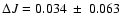 and
and
 ,
fully consistent
with there being no systematic offset between our catalog and the one by
Persson et al. (1980) within the errors. A much more
significant comparison can be achieved with the 2MASS catalog (see
also Sect. 5), showing that our calibrated magnitudes are in
very good agreement with the 2MASS photometric system (
,
fully consistent
with there being no systematic offset between our catalog and the one by
Persson et al. (1980) within the errors. A much more
significant comparison can be achieved with the 2MASS catalog (see
also Sect. 5), showing that our calibrated magnitudes are in
very good agreement with the 2MASS photometric system (
 and
and
 ).
).
![\begin{figure}
\par\includegraphics[width=8.2cm,clip]{0634fig2.ps} %
\end{figure}](/articles/aa/full/2004/22/aa0634/img25.gif) |
Figure 2: J (panel a)) and K (panel b)) photometric errors as a function of magnitude, represented by the standard deviation from the mean of repeated measurements. |
| Open with DEXTER | |
The photometrically calibrated catalog has been compared with the large
proper motion catalog by van Leeuwen et al. (2000), which lists accurate
positions for more than 10 000 red giants in Cen. We used a
software package under development at the Bologna Observatory
(Montegriffo et al. 2004, in preparation), specifically designed to
correlate populous and crowded stellar catalogs, and to obtain precise
astrometry of large fields. We thus were able to produce coordinates in
the J2000 reference frame for stars in the whole catalog, with a
typical rms of 200 mas.
Table 2: A sample of the online catalog. Only a few entries are displayed to illustrate the catalog format and contents. See text for a detailed description on the measurement procedures.
The final on-line catalog format and content is illustrated in Table 2. For each star we present, along with the star number and coordinates, the J and K magnitudes and their errors, obtained as the standard deviation from the mean of repeated measurements: when a star was measured only once, we assigned a null error value to its magnitude. Figure 2 shows the typical photometric errors for the J and K bands, as a function of the magnitude. The mean error at the Horizontal Branch (HB) magnitude level ( )
is about 0.02 mag in both bands.
Figure 3 presents the (K,J-K) color Magnitude Diagram (CMD)
obtained from the final IR
catalog.
)
is about 0.02 mag in both bands.
Figure 3 presents the (K,J-K) color Magnitude Diagram (CMD)
obtained from the final IR
catalog.
![\begin{figure}
\par\includegraphics[width=7.9cm,clip]{0634fig3.ps} %
\end{figure}](/articles/aa/full/2004/22/aa0634/img29.gif) |
Figure 3:
(K,J-K) color magnitude diagram for  73 000 stars
measured in
Cen. 73 000 stars
measured in
Cen. |
| Open with DEXTER | |
![\begin{figure}
\par\includegraphics[width=7.9cm,clip]{0634fig4.ps} %
\end{figure}](/articles/aa/full/2004/22/aa0634/img30.gif) |
Figure 4:
The combined (K, B-K) CMD for stars detected in
Cen. The B magnitudes are from Pancino et al. (2000). |
| Open with DEXTER | |
![\begin{figure}
\par\includegraphics[width=7.8cm,clip]{0634fig5.ps} %
\end{figure}](/articles/aa/full/2004/22/aa0634/img31.gif) |
Figure 5: The zoomed CMD of the RGB region. Selection boxes for the metal poor (RGB-MP) and anomalous (RGB-a) population are shown. |
| Open with DEXTER | |
The main features of the CMDs presented in Figs. 3 and 4 are listed below:
 );
);
Cen is clearly
visible, starting from the blue side, where the
dominant metal-poor population defines the main RGB
(RGB-MP);
Table 3:
Mean ridge line of the RGB-MP in
Cen.
Table 4:
Mean ridge line of the RGB-a in
Cen.
The first step to study the photometric properties of the two populations is the determination of the mean ridge lines. To do this, we applied the standard procedure, already described in Ferraro at al. (1999, 2000).
As usual, a first selection was made by eye. In particular, in the
case of RGB-MP, we took special care in excluding HB and AGB stars,
which are easily identified from the high quality CMDs shown in
Figs. 3 and 4.
The selection of the RGB samples could in principle be disturbed by the
presence of the RGB-MInt stars.
However, RGB-a stars are well separated from the remaining populations
when selected from the optical-infrared CMD of Fig. 4.
The contamination of the RGB-MP population from the RGB-MInt stars can be
quantified to be <10%, with negligible impact on the ridge line determination of the former.
Figure 5 shows the adopted
selection boxes for the RGBs of the different populations.
We used a low-order polynomial to fit the selected stars and an
iterative procedure to automatically reject stars lying more than  away from the best-fit line. The iteration was continued until
convergence to a stable fit was obtained. The
resulting mean ridge lines in various planes are reported in
Table 3 (for the RGB-MP) and Table 4 (for the
RGB-a).
away from the best-fit line. The iteration was continued until
convergence to a stable fit was obtained. The
resulting mean ridge lines in various planes are reported in
Table 3 (for the RGB-MP) and Table 4 (for the
RGB-a).
To convert the derived RGB mean ridge lines to the absolute
MK,(J-K)0 and
MK,(V-K)0 planes and to measure the photometric indices and
morphology parameters defined by F00 (see Sect. 4), we need to
make some basic assumptions for the metallicity, reddening and distance
for the sub-populations of Cen.
For the dominant metal-poor (RGB-MP) population we adopted the
metallicity obtained by the most extensive spectroscopic survey
performed in Cen by Norris et al. (1996), who provided a peak value of
![$\rm [Ca/H]=-1.4\pm0.1$](/articles/aa/full/2004/22/aa0634/img34.gif) .
Using the stars in our sample which have both [Ca/H] from Norris et al. (1996)
and [Fe/H] abundances from Suntzeff & Kraft (1996), we translated the [Ca/H] peak assumed above
into
.
Using the stars in our sample which have both [Ca/H] from Norris et al. (1996)
and [Fe/H] abundances from Suntzeff & Kraft (1996), we translated the [Ca/H] peak assumed above
into
![$\rm [Fe/H] \sim -1.6 \pm 0.1$](/articles/aa/full/2004/22/aa0634/img35.gif) .
Both high-resolution optical spectra (Pancino et
al. 2002) and medium-resolution IR spectra (Origlia et al. 2003) suggest
a significantly higher metallicity for the anomalous (RGB-a) population,
.
Both high-resolution optical spectra (Pancino et
al. 2002) and medium-resolution IR spectra (Origlia et al. 2003) suggest
a significantly higher metallicity for the anomalous (RGB-a) population,
![$\rm [Fe/H]=-0.6\pm0.15$](/articles/aa/full/2004/22/aa0634/img36.gif) .
.
Straniero & Chieffi (1991) and Salaris et al. (1993)
showed that, when computing the isochrones of Population II stars, the
contribution of the  -element enhancement can be taken into
account by simply rescaling standard models to the global metallicity
[M/H], according to the following relation
-element enhancement can be taken into
account by simply rescaling standard models to the global metallicity
[M/H], according to the following relation
![\begin{displaymath}{\rm [M/H]} =
{\rm [Fe/H]}+\log_{10}~(0.638f_{\alpha}+0.362)
\end{displaymath}](/articles/aa/full/2004/22/aa0634/img38.gif)
 is the enhancement factor for the -elements. We assumed
![$\rm [\alpha/Fe]\simeq+0.3$](/articles/aa/full/2004/22/aa0634/img40.gif) for the RGB-MP (Norris & Da Costa 1995;
Smith et al. 2000) and a lower enhancement
for the RGB-MP (Norris & Da Costa 1995;
Smith et al. 2000) and a lower enhancement
![$[\alpha\rm /Fe]\simeq+0.1$](/articles/aa/full/2004/22/aa0634/img41.gif) for the RGB-a, following Pancino et al. (2002) and Origlia et al.
(2003). Thus, we obtained a global metallicity of
for the RGB-a, following Pancino et al. (2002) and Origlia et al.
(2003). Thus, we obtained a global metallicity of
![$\rm [M/H]=-1.39\pm0.10$](/articles/aa/full/2004/22/aa0634/img42.gif) and
and
![$\rm [M/H]=-0.53\pm0.21$](/articles/aa/full/2004/22/aa0634/img43.gif) for the RGB-MP and the
RGB-a, respectively.
for the RGB-MP and the
RGB-a, respectively.
To convert the fiducial ridge lines into the absolute plane, we need to
assume a distance modulus and a reddening correction. In the following,
we adopt the distance scale presented by Ferraro et al. (1999), which
is based on the comparison between the actual level of the Zero Age
Horizontal Branch (ZAHB) and the theoretical models computed by
Straniero et al. (1997). Using the optical photometric
catalog partially published by Pancino et al. (2000) and following the
prescriptions of Ferraro et al. (1999), we obtain for Cen
 .
Assuming a metallicity of
.
Assuming a metallicity of
![$\rm [Fe/H]=-1.6$](/articles/aa/full/2004/22/aa0634/img45.gif) for
the main population (see above) and following Eq. (4) of Ferraro et al.
(1999), we obtain
for
the main population (see above) and following Eq. (4) of Ferraro et al.
(1999), we obtain
 .
Adopting
.
Adopting
 (Lub 2002), the distance modulus finally turns out to be
 ,
in nice agreement with the most recent
determinations by Thompson et al. (2001) and Caputo et al. (2002).
,
in nice agreement with the most recent
determinations by Thompson et al. (2001) and Caputo et al. (2002).
![\begin{figure}
\par\includegraphics[width=8.2cm,clip]{0634fig6.ps} %
\end{figure}](/articles/aa/full/2004/22/aa0634/img49.gif) |
Figure 6:
Fiducial ridge lines in the MK, (J-K)0 plane (panel a)) and in the MK,(V-K)0 plane (panel b)) for a few GGCs of
F00 and for the two populations of Cen. |
| Open with DEXTER | |
Cen with the lines
of a few globular clusters belonging to the sample presented by F00.
In both planes the RGB-MP ridge line is located between the metal-poor
clusters M 68 (
![$\rm [Fe/H] \sim -1.99$](/articles/aa/full/2004/22/aa0634/img50.gif) )
and M 4 (
)
and M 4 (
![$\rm [Fe/H] \sim -1.19$](/articles/aa/full/2004/22/aa0634/img51.gif) ), close to M 55
(
), close to M 55
(
![$\rm [Fe/H] \sim -1.61$](/articles/aa/full/2004/22/aa0634/img52.gif) )
as expected, given its metallicity.
The RGB-a is located between the metal-rich clusters 47 Tuc (
)
as expected, given its metallicity.
The RGB-a is located between the metal-rich clusters 47 Tuc (
![$\rm [Fe/H] \sim -0.7$](/articles/aa/full/2004/22/aa0634/img53.gif) )
and NGC 6528 (
)
and NGC 6528 (
![$\rm [Fe/H] \sim -0.38$](/articles/aa/full/2004/22/aa0634/img54.gif) ), in good agreement with the spectroscopic
constraints.
), in good agreement with the spectroscopic
constraints.
In order to quantitatively describe the morphology and properties of
the RGBs of the different populations in
Cen, we measured the
full set of photometric parameters defined by F00.
The main RGB observables measured in the IR CMDs are the following:
![\begin{figure}
\par\includegraphics[width=7.8cm,clip]{0634fig7.ps} %
\end{figure}](/articles/aa/full/2004/22/aa0634/img55.gif) |
Figure 7: RGB mean (J-K)0 colors at different magnitudes ( MK =-3,-4,-5,-5.5) as a function of global metallicity for the ten GGCs of F00 (open circles), the RGB-MP (filled circle) and the RGB-a (filled triangle). |
| Open with DEXTER | |
Table 5: Inferred (J-K)0 RGB colors at fixed magnitudes.
Table 6: Inferred (V-K)0 RGB colors at fixed magnitudes.
![\begin{figure}
\par\includegraphics[width=7.8cm,clip]{0634fig8.ps} %
\end{figure}](/articles/aa/full/2004/22/aa0634/img73.gif) |
Figure 8: RGB mean (V-K)0 colors at different magnitudes ( MK =-3,-4,-5,-5.5) as a function of global metallicity for the ten GGCs of F00 (open circles), the RGB-MP (filled circle) and the RGB-a (filled triangle). |
| Open with DEXTER | |
![\begin{figure}
\par\includegraphics[width=7.3cm,clip]{0634fig9.ps} %
\end{figure}](/articles/aa/full/2004/22/aa0634/img74.gif) |
Figure 9: MK at constant (J-K)0=0.7 (panel a)) and (V-K)0=3 (panel b)) as a function of global metallicity for the ten GGCs of F00 (open circles), the RGB-MP (filled circle) and the RGB-a (filled triangle). |
| Open with DEXTER | |
![\begin{figure}
\par\includegraphics[width=7.5cm,clip]{0634fig10.ps} %
\end{figure}](/articles/aa/full/2004/22/aa0634/img75.gif) |
Figure 10: Metallicity scales: [Fe/H] (panel a)) and [M/H] (panel b)) as a function of the derived RGB slope for the ten GGCs of F00 (open circles), the RGB-MP (filled circle) and the RGB-a (filled triangle). |
| Open with DEXTER | |
Following F00, we also measured the absolute MK magnitude at
(V-K)0=3 and
(J-K)0=0.7. In Fig. 9 the dependence of
these two parameters on global metallicity is shown; the measurements
taken on the RGB-MP and RGB-a mean lines of
Cen are
overplotted as solid symbols. At (V-K)0=3, we observe a nice
agreement between the magnitudes measured for both the RGB-MP and RGB-a
populations and the relations proposed by F00. At
(J-K)0=0.7,
the absolute MK magnitudes observed for the two RGB
populations of
Cen are instead clearly underestimated. This
discrepancy can be due to uncertaintes in the reddening assumptions: in
fact errors of a few hundredths of a magnitude produce uncertainties of
about 0.2-0.3 in K, depending on the RGB region intercepted.
To further describe the properties of the RGBs of
Cen, we have
measured the RGB slope, adopting the technique described by Kuchinski
et al. (1995) and using the RGB samples described in
Sect. 3 and shown in Fig. 5. Following the
prescriptions by Kuchinski et al. (1995), only the brightest portion of
the RGB (1 mag above the HB level) has been considered in the
fit. As already emphasized by F00, although linear fits are not the
best representation of the RGB shape, the measurement of the RGB slope
is still important since it represents a distance and reddening
independent parameter to describe the RGB morphology. The inferred
slopes for the RGB-MP and the RGB-a are consistent, within the
uncertainties, with those of clusters of similar metal content
(see Fig. 10). The adopted absolute MK magnitudes at
(V-K)0=3 and
(J-K)0=0.7 and the slopes of the RGB for the two
main populations of Cen are listed in Table 7.
Table 7:
RGB magnitudes and slopes for the RGB-MP and RGB-a of
Cen.
![\begin{figure}
\par\includegraphics[width=8.3cm,clip]{0634fig11.ps} %
\end{figure}](/articles/aa/full/2004/22/aa0634/img84.gif) |
Figure 11:
RGB fiducial ridge lines in the
 theoretical plane for five GGCs of F00 and for the two populations
of
Cen.
theoretical plane for five GGCs of F00 and for the two populations
of
Cen. |
| Open with DEXTER | |
![\begin{figure}
\par\includegraphics[width=8.3cm,clip]{0634fig12.ps} %
\end{figure}](/articles/aa/full/2004/22/aa0634/img86.gif) |
Figure 12:
 at
at
 as a function of [Fe/H] for the
ten GGCs of F00 (open circles), RGB-MP (filled circle) and the RGB-a
(filled triangle).
as a function of [Fe/H] for the
ten GGCs of F00 (open circles), RGB-MP (filled circle) and the RGB-a
(filled triangle). |
| Open with DEXTER | |
The transformation of the RGB observed colors and magnitudes onto the
theoretical plane (
 ,
)
has been performed using
the bolometric corrections and temperature scale for Population II
giants computed by Montegriffo et al. (1998). In Fig. 11 the
fiducial lines for the two populations of Cen are compared to
a sample of GGCs from F00 in the theoretical plane. From this diagram,
we can easily derive the RGB effective temperature at a given
bolometric magnitude. Figure 12 shows the effective temperature at
as a function of metallicity for the RGB-MP, the
RGB-a and for the sample of clusters of F00. We find a good consistency between the
data and the empirical relation of F00.
,
)
has been performed using
the bolometric corrections and temperature scale for Population II
giants computed by Montegriffo et al. (1998). In Fig. 11 the
fiducial lines for the two populations of Cen are compared to
a sample of GGCs from F00 in the theoretical plane. From this diagram,
we can easily derive the RGB effective temperature at a given
bolometric magnitude. Figure 12 shows the effective temperature at
as a function of metallicity for the RGB-MP, the
RGB-a and for the sample of clusters of F00. We find a good consistency between the
data and the empirical relation of F00.
![\begin{figure}
\par\includegraphics[width=8.1cm,clip]{0634fig13.ps} %
\end{figure}](/articles/aa/full/2004/22/aa0634/img88.gif) |
Figure 13: K-band cumulative (panel a)) and differential (panel b)) luminosity functions of the RGB-MP, shown as smoothed histograms. The slope variation and the RGB bump location have been marked. The contribution of the redder part of the RGB (dotted line) and of the bluer part (dashed line) to the bump is also shown in the small panel. |
| Open with DEXTER | |
To enlarge our sample, both in size and in covered area, we
correlated our catalog with that obtained in the external region of the
cluster by the 2MASS survey, which
extends to a very wide area of
.
Using 1419 common stars,
we verified the absence of any significant magnitude offset
(see Sect. 2), and then constructed an extended catalog where our
magnitudes were maintained in the overlapping regions, while in the
outer regions (r>6') the 2MASS catalog objects were added. We thus
obtained J and K magnitudes for a global sample of more than 120 000
stars which allowed us to identify with good accuracy one of the most
subtle features along the RGB: the RGB bump (Iben 1968).
The identification of the RGB bump is not an easy task because of the
need of large observational samples (Crocker & Rood 1984; Fusi Pecci
et al. 1990). Moreover, since in metal poor clusters the RGB bump
occurs at brighter luminosities, in a region that is intrinsically
poorly populated, its identification is even more difficult. To
correctly locate the bump we used both the cumulative and differential
RGB luminosity functions (LF), by detecting the slope variation in the
former and identifying the corresponding peak in the latter (Fusi Pecci
et al. 1990). We identified the RGB-MP bump with good
accuracy both in the K-band and in the V-band (using the optical
catalogue of Pancino et al. 2000) at the observed magnitudes
 and
and
 .
The absolute
values turn out to be
.
The absolute
values turn out to be
 and
and
 ,
with the adopted distance modulus and reddening
corrections.
,
with the adopted distance modulus and reddening
corrections.
Our detection of the RGB bump is illustrated in Fig. 13, where the LF of the RGB-MP in the K band is shown as a smoothed histogram. In Fig. 14 the absolute K magnitude of the bump is compared with the empirical F00 relation and with the theoretical models by Straniero et al. (1997). The location of the RGB-MP bump is in reasonable agreement with the predictions of both relations. However, the shape of the bump on the differential LF appears widened, as can be expected due to a possible residual contamination of RGB-MInt stars in our RGB-MP sample. To test this hypothesis, we have compared in Fig. 13 the position of the RGB-MP bump with the bump position computed for the blue side of the RGB-MP and the red side of the RGB-MP, separately. As expected, the red side bump appears shifted to fainter magnitudes while the blue side bump appears less widened and slightly shifted towards brighter magnitudes. The presence of multiple bumps at different magnitudes for different sub-samples of the RGB has been shown also by Rey et al. (2004, see their Fig. 10), in agreement with what is found here.
![\begin{figure}
\par\includegraphics[width=8.4cm,clip]{0634fig14.ps} %
\end{figure}](/articles/aa/full/2004/22/aa0634/img93.gif) |
Figure 14: MK at the RGB bump as a function of the metallicity [Fe/H] (panel a)) and on the global scale (panel b)) for 8 GGCs of F00 (open circles) and the RGB-MP (filled circles). The dashed line in panel b) is the theoretical prediction by Straniero et al. (1997) models at t=16 Gyr. |
| Open with DEXTER | |
We presented an extensive near IR, J and K catalog of stars in the
giant globular cluster Cen. More than 73 000 stars have been
measured allowing an accurate photometric characterization of the RGB.
In particular, the colors at different magnitude levels, the magnitude
at different colors, the RGB slope and the RGB bump position have been
measured, scaled to the absolute plane and compared to similar features
measured in clusters with different metallicities by F00. The agreement
with the F00 relations is quite good, and the photometric properties of
the newly discovered anomalous RGB (RGB-a) consistently reflect the
high metal content of this sub-population found by previous spectroscopic work.
Acknowledgements
We warmly thank Paolo Montegriffo for assistance during the catalogs cross-correlation and astrometric calibration procedure. We also thank Katia Cunha, the referee of our paper, for her precious comments and suggestions. The financial support of the Agenzia Spaziale Italiana and the Ministero della Istruzione e della Ricerca Universitaria is kindly acknowledged. This publication makes use of data product from the Two Micron All Sky Survey, which is a joint project of the University of Massachussets and the Infrared Processing Data Analysis Center/California Institute of Technology, founded by the National Aeronautics, the Space Administration and the National Science Foundation.