A&A 419, 203-213 (2004)
DOI: 10.1051/0004-6361:20034318
Constraints in the circumstellar density distribution of massive Young Stellar Objects
C. Alvarez1,2,3 -
M. Hoare1 -
P. Lucas4
1 - Physics and Astronomy Department, University of Leeds,
Leeds LS2 9JT, UK
2 -
Kapteyn Astronomical Institute, Postbus 800, 9700 AV Groningen,
The Netherlands
3 -
Max-Planck-Institut für Astronomie,
Königstuhl 17, 69117 Heidelberg, Germany
4 -
Dept. of Physical Sciences, University of Hertfordshire,
College Lane, Hatfield AL10 9AB, UK
Received 12 September 2003 / Accepted 23 January 2004
Abstract
We use a Monte Carlo code to generate synthetic near-IR reflection
nebulae that resemble those (normally associated with a bipolar
outflow cavity) seen towards massive young stellar objects (YSOs).
The 2D axi-symmetric calculations use an analytic expression for a
flattened infalling rotating envelope with a bipolar cavity
representing an outflow. We are interested in which aspects of the
circumstellar density distribution can be constrained by
observations of these reflection nebulae. We therefore keep
the line of sight optical depth constant in the model grid, as this
is often constrained independently by observations.
It is found that envelopes with density distributions corresponding to
mass infall rates of  10-4
10-4
 (for an envelope
radius of 4700 AU) seen at an inclination
angle of
(for an envelope
radius of 4700 AU) seen at an inclination
angle of
 approximately reproduce the morphology and
extension of the sub-arcsecond nebulae observed in massive YSOs.
Based on the flux ratio between the approaching and receding lobe of
the nebula, we can constrain the system inclination angle. The
cavity opening angle is well constrained from the nebula opening
angle. Our simulations indicate that to constrain the outflow cavity shape
and the degree of flattening in the envelope, near-IR imaging with
higher resolution and dynamic range than speckle imaging in
4 m-class telescopes is
needed. The radiative transfer code is also used to simulate the
near-IR sub-arcsecond nebula seen in Mon R2 IRS3. We find indications of a
shallower opacity law in this massive YSO than in the interstellar
medium, or possibly a sharp drop in the envelope density distribution
at distances of 1000 AU from the illuminating source.
approximately reproduce the morphology and
extension of the sub-arcsecond nebulae observed in massive YSOs.
Based on the flux ratio between the approaching and receding lobe of
the nebula, we can constrain the system inclination angle. The
cavity opening angle is well constrained from the nebula opening
angle. Our simulations indicate that to constrain the outflow cavity shape
and the degree of flattening in the envelope, near-IR imaging with
higher resolution and dynamic range than speckle imaging in
4 m-class telescopes is
needed. The radiative transfer code is also used to simulate the
near-IR sub-arcsecond nebula seen in Mon R2 IRS3. We find indications of a
shallower opacity law in this massive YSO than in the interstellar
medium, or possibly a sharp drop in the envelope density distribution
at distances of 1000 AU from the illuminating source.
Key words: scattering - stars: formation - techniques: high angular resolution - radiative transfer - stars: winds, outflow
1 Introduction
Bipolar outflows appear to be a ubiquitous phenomenon during the
formation of stars in all mass ranges
(Beuther et al. 2002; Henning et al. 2000; Ridge & Moore 2001; Bally & Lada 1983). Low mass young stellar
objects (YSOs) show highly collimated bipolar jets from a few
10 AU (Burrows et al. 1996) to several parsec
(Eislöffel 2000; Reipurth et al. 1997) in length. These jets are thought to be
magneto-hydrodynamically collimated in a wind formed at the inner
star-disk system (e.g. X-wind, Shu et al. 1994). The jets are thought
to drive the large scale molecular outflow (Masson & Chernin 1994).
The formation and collimation of outflows in massive YSOs is less well
understood than in low mass YSOs. There appears to be a lack of
highly collimated parsec-scale jets (Mundt & Ray 1994). In the near-IR,
searches for shock-excited
 show traces of jets in massive star
forming regions, but probably driven by low mass young stars located
in the same cluster (Wang et al. 2003; Davis et al. 1998). A recent search
for optical shock-excited emission in the outer parts of the outflow,
yielded no evidence of jet interaction (Alvarez & Hoare, in preparation). Very
close to the driving source, there is also not clear evidence that jets
are the rule in massive YSOs. In some cases, the free-free radio
emission from the inner wind shows a jet morphology (e.g. HH80-81,
Marti et al. 1993; Cep A, Torrelles et al. 1996). Such jets would have
to be magneto-hydrodynamically driven, even though the OB stars
themselves are not magnetically active. Magneto-hydrodynamics in the
infalling rotating cloud could set up bipolar flows (Tomisaka 1998).
In other cases, the ionised wind appears to be
equatorial (e.g. Hoare & Muxlow 1996; Hoare et al. 1994; Hoare 2002). Theoretical
models show that radiation pressure in massive young stars can drive
gas off the surface of a disk, producing a predominantly
equatorial wind (Drew et al. 1998; Drew & Proga 2000). Any initial flow maybe
hydrodynamically collimated into a bipolar flow by the flattened
surrounding cloud (e.g. Delamarter et al. 2000). These alternative
theories will predict different morphologies for the base of the
outflow cavities carved out. These variations in morphology occur
at scales of a few 100 AU, which at the typical distances to massive
YSOs of 1 kpc, correspond with angular sizes of 0
show traces of jets in massive star
forming regions, but probably driven by low mass young stars located
in the same cluster (Wang et al. 2003; Davis et al. 1998). A recent search
for optical shock-excited emission in the outer parts of the outflow,
yielded no evidence of jet interaction (Alvarez & Hoare, in preparation). Very
close to the driving source, there is also not clear evidence that jets
are the rule in massive YSOs. In some cases, the free-free radio
emission from the inner wind shows a jet morphology (e.g. HH80-81,
Marti et al. 1993; Cep A, Torrelles et al. 1996). Such jets would have
to be magneto-hydrodynamically driven, even though the OB stars
themselves are not magnetically active. Magneto-hydrodynamics in the
infalling rotating cloud could set up bipolar flows (Tomisaka 1998).
In other cases, the ionised wind appears to be
equatorial (e.g. Hoare & Muxlow 1996; Hoare et al. 1994; Hoare 2002). Theoretical
models show that radiation pressure in massive young stars can drive
gas off the surface of a disk, producing a predominantly
equatorial wind (Drew et al. 1998; Drew & Proga 2000). Any initial flow maybe
hydrodynamically collimated into a bipolar flow by the flattened
surrounding cloud (e.g. Delamarter et al. 2000). These alternative
theories will predict different morphologies for the base of the
outflow cavities carved out. These variations in morphology occur
at scales of a few 100 AU, which at the typical distances to massive
YSOs of 1 kpc, correspond with angular sizes of 0
 1. Therefore, high resolution techniques are fundamental to study the impact of the the outflow in the surrounding
material.
1. Therefore, high resolution techniques are fundamental to study the impact of the the outflow in the surrounding
material.
In a related paper (Alvarez et al., in preparation, hereafter Paper I), we
show high resolution near-IR speckle images which trace the
circumstellar matter around massive YSOs at
scales of a few 100 AU. The extended emission that is seen towards
some of the sources can be interpreted as scattered light in an
outflow cavity due to its monopolar morphology. This interpretation is
supported in some cases by the blue colours of the nebula
(e.g. Mon R2 IRS3, Paper I, Preibisch et al. 2002). Furthermore, polarimetric
speckle imaging of the reflection nebula in the massive star forming
region S140 IRS1 (Schertl et al. 2000) shows a centrosymmetric pattern which
is typical of scattered light.
Intuitively, one can imagine that depending on the properties
of the dust, the shape of the cavity, the density distribution and
the orientation of the system with respect to the observer, the
resulting reflection nebula will change. The morphology of the cavity
is particularly important because it is shaped by the interplay
between the infall and the outflow. For instance, it is expected that an
equatorial or wide-angled wind will produce a cavity with a wide
opening angle near the star. However, a jet is expected to open a
rather narrow cavity.
Radiative transfer simulations have been widely used to generate
synthetic nebulae that resemble the observations
(Wolf et al. 2002; Lucas & Roche 1997; Whitney & Hartmann 1992; Lazareff et al. 1990; Lucas & Roche 1998; Whitney et al. 1997; Fischer et al. 1996,1994; Kenyon et al. 1993).
The work by Lazareff et al. (1990) was based on a ray-tracing code and it was
focused mainly on the effect produced by different disc models on the
synthetic nebulae. The authors compared the general features of the
model images with previous seeing-limited images of the low
mass systems HL Tau and L 1551 IRS5.
Whitney & Hartmann (1992), Kenyon et al. (1993) and Whitney et al. (1997) developed
a Monte Carlo code to investigate how the nebula morphology and the near-IR
colours of the synthetic images vary with different model parameters.
In particular, Whitney et al. (1997) used their code to constrain the colours
of the central source, the dust model and the envelope density
distribution in a sample of 20 low mass YSOs. Fischer et al. (1994) and
Fischer et al. (1996) developed a new Monte Carlo scattering code and they
focused on exploring the effect of different dust models in
the synthetic images. Lucas & Roche (1997) and Lucas & Roche (1998)
compared synthetic nebulae produced with their Monte Carlo code with high
resolution multi-colour observations of reflection nebulae associated
with low mass YSOs. From this comparison, they could constrain
some parameters defining circumstellar density distribution as well as
the dust model for several sources. Recently, radiative transfer
Monte Carlo codes have been developed to simulate scattering by
non-spherical dust particles Whitney & Wolff (2002), Wolf et al. (2002) and Lucas (2003).
These previous models have focused predominantly on low mass YSOs. Here, we apply the Monte Carlo code of Lucas & Roche (1998) to high mass YSOs, where the infall rates are much higher. We also adopt an
observational approach, by presenting a grid of models in which as each parameter is varied, the overall density is scaled too to keep the optical depth along the line of sight constant. This is because the line of sight optical depth is often well constrained from other data such as the
optical depth of the 9.7  m silicate feature or the colour of the star. The models are decribed in Sect. 2. The grid of models is presented in Sect. 3. In
Sect. 4, we use the models to constrain the density distribution in Mon R2 IRS3. Some concluding remarks are shown in Sect. 5.
m silicate feature or the colour of the star. The models are decribed in Sect. 2. The grid of models is presented in Sect. 3. In
Sect. 4, we use the models to constrain the density distribution in Mon R2 IRS3. Some concluding remarks are shown in Sect. 5.
2 Models
We used the Monte Carlo code of Lucas & Roche (1998,1997) with a set of parameters adapted to massive YSOs. The models consist of a central star surrounded by a dusty flattened envelope. A disc characterises the density distribution near the equator. The model also includes an
empty bipolar cavity opened by the outflow in the circumstellar matter. The photons emerging from the central source are scattered off the dust grains in the envelope and disc. Each photon can suffer several scattering processes until it is either absorbed, or escapes. All photons traveling in a particular direction are binned, and projected onto the image plane.
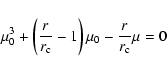
The envelope is described by a density distribution resulting from the collapse of a slowly rotating cloud (Ulrich 1976; Terebey et al. 1984). The density ( )
at any point (r, )
is given by Eq. (1),
)
at any point (r, )
is given by Eq. (1),
 |
(1) |
 |
(2) |
where  represents the mass infall rate and M is the mass of the central source.
 is the centrifugal radius, which determines the degree of flattening of the distribution. Flatter density
distributions are characterised by larger centrifugal radii.
is the centrifugal radius, which determines the degree of flattening of the distribution. Flatter density
distributions are characterised by larger centrifugal radii.
 ,
where
,
where  is the position angle of each particle with respect to the polar axis.
 represents the initial position angle of each infalling particle. The equation of motion of the infalling particles (Eq. (2)) should be satisfied at every point (see Ulrich 1976, for details).
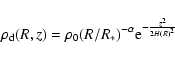
The disc plays a passive role in the models presented here. It absorbs and scatters the radiation from the central star, but it does not emit. We use Eq. (3) to describe the disc density structure,
 |
(3) |
where R and z satisfy the relation
r2 = R2 + z2,  represents the density in the midplane at the surface of the star, and R* is the radius of the star.
 is the disc scale height.
  parametrises the degree of flaring on the disc. We tried steady Keplerian discs (
 and
and  )
as well as geometrically thin and optically thick discs (
)
as well as geometrically thin and optically thick discs (
 and
and  )
(Lazareff et al. 1990; Whitney & Hartmann 1992).
)
(Lazareff et al. 1990; Whitney & Hartmann 1992).
An empty cavity represents the material evacuated by the outflow in the envelope. The shape of the cavity must be determined by the interplay between the infall and outflow processes. However, the lack of knowledge of these processes makes the choice of the cavity shape somewhat arbitrary.
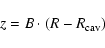
For some of the models a conical cavity was used,
 |
(4) |
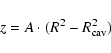
where B represents the tangent of the cavity half-opening angle. For other models, a parabolic cavity was used, which is represented by the expression,
 |
(5) |
where the constant A determines the curvature of the parabola, and
 represents the radius of the cavity at the equator. The cavity opening angle (
 )
is defined as twice the angle formed by the z axis and the line connecting the intersection between the parabola and the equator with the intersection between the parabola and the outer sphere.
)
is defined as twice the angle formed by the z axis and the line connecting the intersection between the parabola and the equator with the intersection between the parabola and the outer sphere.
For the dust, we used the mixture of Mathis et al. (1977). The values of the opacities are obtained using a dust to gas ratio by mass of 10-2. The optical constants and albedos for this mixture were chosen from Draine & Lee (1984) and Draine (1985). The values used for the opacity
 are 2.0, 3.8 and
 ,
and the values for the albedo
,
and the values for the albedo
 are 0.22,
0.34 and 0.45, in the K, H and J bands respectively. The phase function that describes the scattering is within the Rayleigh approximation in the K band, and becomes gradually forward throwing towards the J band.
are 0.22,
0.34 and 0.45, in the K, H and J bands respectively. The phase function that describes the scattering is within the Rayleigh approximation in the K band, and becomes gradually forward throwing towards the J band.
Table 1:
Grid of models.
3 Grid of models
In this section, a grid of models is presented (see Table 1) to illustrate how variations on the input parameters affect the morphology of the model images. All models shown have an outer radius
 = 4700 AU, and are assumed to be located at a distance of 1 kpc. Since we aim to compare the model predictions with typical speckle observations in 4 m-class telescopes, synthetic images are generated with a size of
 pixels at a pixel scale of 0
06. Our choice of
keeps the outer boundary of the models outside the field of view of the synthetic images. The images were convolved with a Gaussian with a FWHM = 0
2, which is the typical resolution achieved with speckle imaging in 4 m-class telescopes (see Paper I).
pixels at a pixel scale of 0
06. Our choice of
keeps the outer boundary of the models outside the field of view of the synthetic images. The images were convolved with a Gaussian with a FWHM = 0
2, which is the typical resolution achieved with speckle imaging in 4 m-class telescopes (see Paper I).
The input parameters are varied with respect to a fiducial model (K01, in Table 1). The fiducial model consists of an envelope with a centrifugal radius of 50 AU and a mass infall rate
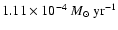 (note that
10-8-10-5
are typically inferred for low mass YSOs; e.g., Whitney et al. 1997; Lucas & Roche 1997; Kenyon et al. 1993). The mass infall rates
used in our grid are consistent with envelope models in massive stars
(Maeder & Behrend 2002; Wolfire & Cassinelli 1986). This mass infall rates, though,
would be smaller for models with a larger outer radius. The model also has a
geometrically thin but optically thick disc (
and
)
of radius
(note that
10-8-10-5
are typically inferred for low mass YSOs; e.g., Whitney et al. 1997; Lucas & Roche 1997; Kenyon et al. 1993). The mass infall rates
used in our grid are consistent with envelope models in massive stars
(Maeder & Behrend 2002; Wolfire & Cassinelli 1986). This mass infall rates, though,
would be smaller for models with a larger outer radius. The model also has a
geometrically thin but optically thick disc (
and
)
of radius
 = 250 AU and
 kg m-3. A conical cavity with a radius at the equator of 100 AU and an opening angle
=
kg m-3. A conical cavity with a radius at the equator of 100 AU and an opening angle
=
 represents
the effect of the outflow in the envelope. The central source is
assumed to be a
represents
the effect of the outflow in the envelope. The central source is
assumed to be a
 star with a radius R* = 10
 .
The
number of input photons in model K01 is
.
The
number of input photons in model K01 is
 .
Only 8.7% of these photons form part of the output (see Col. 9 in Table 1). The other 91.3% is absorbed either in the disc (9.3% of the total) or in the envelope (79.2%). There is a small fraction (2.8%) that is absorbed by the star itself after being scattered. The optical depth along the line of sight of the fiducial model in the K band (
.
Only 8.7% of these photons form part of the output (see Col. 9 in Table 1). The other 91.3% is absorbed either in the disc (9.3% of the total) or in the envelope (79.2%). There is a small fraction (2.8%) that is absorbed by the star itself after being scattered. The optical depth along the line of sight of the fiducial model in the K band (
 = 8 in Table 1) corresponds to an extinction in the
K band of AK = 8.6 mag. If the extinction law of He et al. (1995) is used, this corresponds to a visual extinction of 80 mag, i.e. an optical depth of the 9.7 m silicate feature of
= 8 in Table 1) corresponds to an extinction in the
K band of AK = 8.6 mag. If the extinction law of He et al. (1995) is used, this corresponds to a visual extinction of 80 mag, i.e. an optical depth of the 9.7 m silicate feature of
 4, (where
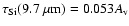 from Draine & Lee 1984 was used), which is typically observed in massive YSOs.
![\begin{figure}
\par\includegraphics[width=8.8cm,clip]{0318fi01.eps}\end{figure}](/articles/aa/full/2004/19/aa0318/Timg63.gif) |
Figure 1:
K band images for models in which the infall rate has been
varied with respect to the fiducial model (K01 in
Table 1, see Fig. 2c). a)
Model K02 with a
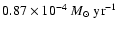 .
b)
Model K03 ( .
b)
Model K03 (
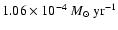 ). c) Model K04 ( ). c) Model K04 (
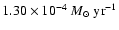 ).
d) Model K05 ( ).
d) Model K05 (
 ).
The rest of the parameters remain unchanged with respect to
model K01. In the four panels, the line of sight forms an
angle of
with respect to the
cavity axis. The 1'' bar represents a length of 1000 AU, and the resolution used is 0
2. The greyscale varies from -5% (the lightest) to 20% of the maximum brightness (the darkest). The contours are at 5, 10, 15, 30 and 50% of the maximum brightness. These contour levels have been chosen for comparison with typical near-IR speckle imaging in 4 m-class telescopes (see Paper I).
represents the optical depth along the line of sight. These and the other model images shown in this section are normalised to the brightness peak, unless otherwise stated. ).
The rest of the parameters remain unchanged with respect to
model K01. In the four panels, the line of sight forms an
angle of
with respect to the
cavity axis. The 1'' bar represents a length of 1000 AU, and the resolution used is 0
2. The greyscale varies from -5% (the lightest) to 20% of the maximum brightness (the darkest). The contours are at 5, 10, 15, 30 and 50% of the maximum brightness. These contour levels have been chosen for comparison with typical near-IR speckle imaging in 4 m-class telescopes (see Paper I).
represents the optical depth along the line of sight. These and the other model images shown in this section are normalised to the brightness peak, unless otherwise stated. |
| Open with DEXTER |
In this section, we investigate which parameters of the circumstellar density distribution can be constrained from the observed morphology of the nebula. Figure 1 shows the effect produced in the synthetic images by varying the overall optical depth in the envelope. This is done by changing the density scaling through the mass infall rate ()
in the Ulrich formula. At low optical depths (Fig. 1a), there is less dust available to scatter the light, and also to absorb the direct light from the star. Therefore, the nebula becomes relatively
fainter than at higher optical depths, and the only contribution to the image at a 5% level is the central star. However, at higher optical depths, the nebula becomes much more extended, since the
central star becomes highly obscured and there is more dust available for scattering. Hence, only a change of 50% in the mass infall rate has a dramatic change on the appearance of the system, due mainly to the exponential dependence on the line of sight optical depth of the central star brightness. Therefore, from an observational point of view, the line of sight optical depth is the most important parameter.
![\begin{figure}
\par\includegraphics[width=8.8cm,clip]{0318fi02.eps}\end{figure}](/articles/aa/full/2004/19/aa0318/Timg64.gif) |
Figure 2:
Synthetic K band images of reflection nebulae for the models at different
inclination angles ( ). The mass infall rate has been adjusted to
yield the same optical depth along the line of sight (
= 8) at
all four inclination.
is expressed in units of 10-4
and
in degrees. Panel a)
corresponds with a near-edge-on model (K06 in Table 1).
The image in panel b)
corresponds with an intermediate inclination (model K07). Panel c)
shows the fiducial model (K01), which is seen at an inclination angle of
.
d) Model with a near-pole-on inclination (K08). The contours and the greyscale in all panels are defined as in Fig. 1. ). The mass infall rate has been adjusted to
yield the same optical depth along the line of sight (
= 8) at
all four inclination.
is expressed in units of 10-4
and
in degrees. Panel a)
corresponds with a near-edge-on model (K06 in Table 1).
The image in panel b)
corresponds with an intermediate inclination (model K07). Panel c)
shows the fiducial model (K01), which is seen at an inclination angle of
.
d) Model with a near-pole-on inclination (K08). The contours and the greyscale in all panels are defined as in Fig. 1. |
| Open with DEXTER |
Figure 2 shows the K band images for different inclination angles of the line of sight with respect to the system axis (i.e. cavity axis). The overall density scaling has been adjusted in each of the four models to yield the same optical depth along the line of sight as the fiducial model (
= 8). For views near edge-on (panel a in Fig. 2), the nebula is clearly bipolar at the 5% level. The receding lobe appears less bright than the approaching lobe. In this case (model K06 in Table 1), a mass infall rate 2.3 times lower than for the fiducial model was used. Even at this near-edge-on inclination, it is possible to see the central star due to the low overall density scaling. At intermediate inclinations (panels b and c), the receding lobe is not detected any more at the 5% level. At low inclinations, (panel d) a faint monopolar nebula can still be seen.
![\begin{figure}
\par\includegraphics[width=8.8cm,clip]{0318fi03.eps}\end{figure}](/articles/aa/full/2004/19/aa0318/Timg65.gif) |
Figure 3:
a)
Variation of the approaching to receding lobe flux ratio with system inclination angle,
where the line of sight optical depth is kept constant. The system inclination angle
varies from near-edge-on ( )
to near-face-on ( )
to near-face-on ( ). b) Variation of the approaching to receding lobe flux ratio with overall opacity. ). b) Variation of the approaching to receding lobe flux ratio with overall opacity. |
| Open with DEXTER |
The contrast between the approaching and receding nebula (
 )
is a useful quantity to estimate the system inclination angle. Figure 3a shows the variation of the
with the
inclination angle. Each point in the plot represents a model whose overall density scaling has been adjusted to yield an optical depth along the line of sight of 8 at its corresponding inclination. The flux ratio has been calculated using aperture photometry with an aperture radius of 1'' in the synthetic images. The aperture on the approaching lobe was centered at 0
8 from the star along the cavity axis and it includes the star itself. The aperture on the receding lobe was
centered at 1
2 from the star also along the cavity axis and it does not include the star. This avoids sensitivity to the actual location of the apertures. For near-edge-on views (small 's),
the approaching and receding lobe have roughly the same brightness. Therefore, the
is nearly 1. As
increases, the approaching lobe becomes relatively brighter, and hence the value of
increases. The figure also shows that the ratio
becomes 100 for values of
in the range between 0.70 and 0.80 (i.e. for inclination angles in the range
)
is a useful quantity to estimate the system inclination angle. Figure 3a shows the variation of the
with the
inclination angle. Each point in the plot represents a model whose overall density scaling has been adjusted to yield an optical depth along the line of sight of 8 at its corresponding inclination. The flux ratio has been calculated using aperture photometry with an aperture radius of 1'' in the synthetic images. The aperture on the approaching lobe was centered at 0
8 from the star along the cavity axis and it includes the star itself. The aperture on the receding lobe was
centered at 1
2 from the star also along the cavity axis and it does not include the star. This avoids sensitivity to the actual location of the apertures. For near-edge-on views (small 's),
the approaching and receding lobe have roughly the same brightness. Therefore, the
is nearly 1. As
increases, the approaching lobe becomes relatively brighter, and hence the value of
increases. The figure also shows that the ratio
becomes 100 for values of
in the range between 0.70 and 0.80 (i.e. for inclination angles in the range
 and
). Hence, a 1% upper limit in the detection of the receding lobe indicates
that the system is seen under an inclination angle
and
). Hence, a 1% upper limit in the detection of the receding lobe indicates
that the system is seen under an inclination angle  .
.
Figure 3b shows the change of
due to variations in the optical depth (i.e. variations in the )
for an inclination angle of
.
At very low optical depths (
 )
the star dominates the flux. As the opacity increases (
)
the star dominates the flux. As the opacity increases (
 ), the star is
increasingly obscured, and the counter-lobe starts to show up. At larger optical depths (
), the star is
increasingly obscured, and the counter-lobe starts to show up. At larger optical depths (
 ), the approaching lobe starts to dominate the emission, while the receding lobe hardly
changes. Hence, the ratio
increases again. The contrast between the nebula lobes is less sensitive to changes in the mass infall rate than to changes in the inclination angle. Hence,
in principle, the approaching to receding lobe flux ratio can be used to constrain the inclination angle.
), the approaching lobe starts to dominate the emission, while the receding lobe hardly
changes. Hence, the ratio
increases again. The contrast between the nebula lobes is less sensitive to changes in the mass infall rate than to changes in the inclination angle. Hence,
in principle, the approaching to receding lobe flux ratio can be used to constrain the inclination angle.
![\begin{figure}
\par\includegraphics[width=8.8cm,clip]{0318fi04.eps}\end{figure}](/articles/aa/full/2004/19/aa0318/Timg73.gif) |
Figure 4:
K band images resulting from models with different centrifugal radius seen at an inclination angle of
.
The mass accretion rate for each model was set to keep the
= 8
along the line of sight at
in the K band. The rest of the parameters remain unchanged with respect to the fiducial model. In all panels, the value of
is expressed in AU and
is expressed in units of 10-4
.
a)
Model K09 in Table 1, which represents a spherical envelope
(i.e. the limiting case of a negligible centrifugal radius). b)
Model K10, which has a
= 100 AU. c)
Model K11, which has a
= 150 AU. d)
Model K12 with a
= 200 AU. The contours and the greyscale in all four panels are defined as in Fig. 1. |
| Open with DEXTER |
In Fig. 4, we investigate whether the shape of the envelope can be derived. The images show models with an increasing
centrifugal radius (i.e. flattness of the envelope), from panel a) to
panel d). The mass infall rate for each model has again been set such that the
optical depth along a line of sight at
remains the same as
for the fiducial model (i.e.
= 8 in the K band). The fiducial
model, with a centrifugal radius of 50 AU, is shown in
Fig. 2c. Figure 4a
represents the case of a spherical density distribution.
The nebula becomes less bright as the centrifugal radius
increases (panels b-d in Fig. 4).
Since the material is predominantly concentrated on the equatorial plane
and there is less dust available in the polar regions of the envelope,
where a large fraction of the scattered light is generated. However,
this is a very subtle change compared to that for the line of sight
optical depth o inclination angle. Hence, the reflection nebula tells
us little about the degree of flattening of the envelope.
Figure 5 shows the effect of varying the cavity
opening angle (
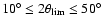 )
on the synthetic nebulae. The mass infall rate was increased with the
cavity angle to keep the same optical depth along the line of sight in
all images. Unsurprisingly, the nebula opening angle
appears to be larger for models with a wide-angled cavity.
The significant changes on the nebula shape occur for the external contours,
while the inner contours remain nearly unchanged. This is consistent
with the fact that variations in the cavity opening angle will affect
more the external regions of the envelope than the regions close to
the cavity base. At wider cavity opening angles, more stellar photons
can escape the system without being scattered. This is shown in
Col. 9 of Table 1, where the fraction of photons
(scattered and stellar) that leaves the system (
)
on the synthetic nebulae. The mass infall rate was increased with the
cavity angle to keep the same optical depth along the line of sight in
all images. Unsurprisingly, the nebula opening angle
appears to be larger for models with a wide-angled cavity.
The significant changes on the nebula shape occur for the external contours,
while the inner contours remain nearly unchanged. This is consistent
with the fact that variations in the cavity opening angle will affect
more the external regions of the envelope than the regions close to
the cavity base. At wider cavity opening angles, more stellar photons
can escape the system without being scattered. This is shown in
Col. 9 of Table 1, where the fraction of photons
(scattered and stellar) that leaves the system (
 )
is listed.
)
is listed.
![\begin{figure}
\par\includegraphics[width=8.8cm,clip]{0318fi05.eps}\end{figure}](/articles/aa/full/2004/19/aa0318/Timg75.gif) |
Figure 5:
K band images corresponding to models with different cavity opening angles seen at an inclination angle of
.
The
for each model (which is shown in units of 10-4
)
has been set to yield a K band optical depth of 8 along the line of sight. The conical cavity opening angle increases from panel a) (
 )
to panel d) ( )
to panel d) (
 )
(i.e. models from K13 to K16 in Table 1). The greyscale and contours are as in Fig. 1. )
(i.e. models from K13 to K16 in Table 1). The greyscale and contours are as in Fig. 1. |
| Open with DEXTER |
The result of varying the cavity radius at the equator from 50 to 250 AU is shown in Fig. 6. A radius of 50 AU corresponds approximately to the sublimation radius for dust in OB stars. Radiation pressure or wind interactions could increase the size of the hole. The nebula appears fainter and slightly wider for larger values of the
.
In this case,
the differences between nebulae can also be observed in the innermost
contours. This is caused by the fact that changes in
will have
a stronger impact in the regions of the envelope closer to the equator
than in the outer regions. The total number of output photons increases
by a factor of 1.4 from the model with
= 50 AU to the model with
= 250 AU (see Col. 9 in Table 1). For larger values of
,
similar number of photons are scattered of a
larger surface. Hence, the surface brightness of the nebula decreases from Figs. 6a to d.
![\begin{figure}
\par\includegraphics[width=8.8cm,clip]{0318fi06.eps}\end{figure}](/articles/aa/full/2004/19/aa0318/Timg76.gif) |
Figure 6:
Variation of the nebula shape with the cavity radius at the equator (models K17 to K20 in Table 1). The mass infall rate was adjusted to yield the same optical depth along the line of sight in all four images. The values for
are expressed in AU. All panels represent a line of sight at
.
The greyscale and contours are as in Fig. 1. |
| Open with DEXTER |
We now investigate the effect of the detailed shape of the base of the
cavity. A parabolic cavity might be expected if the central wind is
initially equatorial, whilst a conical cavity would arise from a
jet-driven flow in low mass stars (Bachiller et al. 1995).
Figure 7a shows the K band image for a model with a
parabolic cavity compared with a conical nebula in
Fig. 7b. The other parameters have
the same values as for the fiducial model, except the overall opacity
scaling, which has been enhanced by a factor of 1.4 to yield the same
optical depth along the line of sight as in the fiducial model. The
parabolic shape is clearly seen in the resulting nebula, as expected
(Fig. 2). A larger fraction of photons escape from the
parabolic model than from the conical model because the parabolic
cavity is broader near the star than the conical cavity. The concave shape
of the cavity walls, favours the scattering in the outer regions of the
envelope, which also contributes to make the parabolic nebula more extended.
![\begin{figure}
\par\includegraphics[width=8.8cm,clip]{0318fi07.eps}\end{figure}](/articles/aa/full/2004/19/aa0318/Timg77.gif) |
Figure 7:
a) Model with a parabolic cavity (K26 in Table 1) compared with the fiducial model at an inclination of
.
The cavity opening angle is the same as for the conical cavity in the fiducial model (
=
).
b) Fiducial model at an inclination of
.
This is the same image as shown in Fig. 2c. The greyscale and contours are as in Fig. 1. The density scaling is a factor of 1.4 larger in the model with the parabolic cavity than in the conical cavity model. |
| Open with DEXTER |
All models shown up to this point included an optically thick, and
geometrically thin flat disc of radius
= 250 AU. To investigate
any dependence of the model images on the disc radius, we have
generated models with the same parameters as the fiducial model (K01,
Fig. 2a) but with varying disc radius
(
 ). No significant
differences were found between the images resulting from these models
and the fiducial model. We also investigated whether the introduction of a
flaring disc may change the morphology of the reflection
nebulae. Model K25 in Table 1 has the same parameters as
the fiducial model except for a flaring in the inner disc.
The values used for
). No significant
differences were found between the images resulting from these models
and the fiducial model. We also investigated whether the introduction of a
flaring disc may change the morphology of the reflection
nebulae. Model K25 in Table 1 has the same parameters as
the fiducial model except for a flaring in the inner disc.
The values used for  and
in the disc equation
(Eq. (3)) were 15/8 and 9/8 respectively (i.e. a Keplerian disc).
No relevant differences were appreciated between these images and the
fiducial model. The reason is that the disc flaring angle for the
value of
is small compared with the line of sight
inclination angle. The envelope density dominates the disc density for all
inclinations
and
in the disc equation
(Eq. (3)) were 15/8 and 9/8 respectively (i.e. a Keplerian disc).
No relevant differences were appreciated between these images and the
fiducial model. The reason is that the disc flaring angle for the
value of
is small compared with the line of sight
inclination angle. The envelope density dominates the disc density for all
inclinations
 (
(
 ).
).
3.2 Dependence with wavelength
![\begin{figure}
\par\includegraphics[width=8.8cm,clip]{0318fi08.eps}\end{figure}](/articles/aa/full/2004/19/aa0318/Timg82.gif) |
Figure 8:
Multi-band models. The two panels represent the fiducial model in the J and H bands, seen at an inclination angle of
.
In Table 1 they are labeled as
J01 (panel a)), H01 (panel b)).  is the optical depth at an inclination of
.
The greyscale and the contours are the same as in Fig. 1, and the grey cross indicates the position of the star.
is the optical depth at an inclination of
.
The greyscale and the contours are the same as in Fig. 1, and the grey cross indicates the position of the star. |
| Open with DEXTER |
Figures 2c, 8a and 8b show the variation of the synthetic images with the wavelength (J, H and K band respectively). The geometry and
density distribution for the J and H band models are the same as for the
fiducial model. However, the opacities, the albedos and the scattering
matrix change with wavelength. The opacities correspond with an extinction
law (
 )
with
an exponent
)
with
an exponent
 .
The number of photons in the input
spectrum at H (
.
The number of photons in the input
spectrum at H (
 )
is a factor of 2.00 times the
number of photons at K (
)
is a factor of 2.00 times the
number of photons at K (
 ), and the number of photons
at J (
), and the number of photons
at J (
 )
is 2.45 times the number of photons at K. The number of input photons at each wavelength was calculated using the model stellar atmospheres from Kurucz (1979). The spectral energy distribution (SED) of model OB main sequence stars
were integrated in the J, H and K bands using the transmission
profiles of the filters J98, H98 and K98 at UKIRT. The ratio between
the number of photons emitted at two given bands approaches
asymptotically to a constant value for earlier spectral types. This
limit corresponds with a slope in the stellar SED of -2.4
(
)
is 2.45 times the number of photons at K. The number of input photons at each wavelength was calculated using the model stellar atmospheres from Kurucz (1979). The spectral energy distribution (SED) of model OB main sequence stars
were integrated in the J, H and K bands using the transmission
profiles of the filters J98, H98 and K98 at UKIRT. The ratio between
the number of photons emitted at two given bands approaches
asymptotically to a constant value for earlier spectral types. This
limit corresponds with a slope in the stellar SED of -2.4
(
 ), which is shallower than the
theoretical Rayleigh-Jeans limit (
), which is shallower than the
theoretical Rayleigh-Jeans limit (
 ).
This shallower SED is a better representation of the colours
of OB main sequence stars than the Rayleigh-Jeans approximation (see
the UKIRT web-page: http://www.jach.hawaii.edu/JACpublic/UKIRT/). Figures 2c, 8a and 8b
show that the nebula appears
more extended at short wavelengths, while the star becomes totally obscured,
due to the increase in the opacity. It can also be seen that the separation
between the star and the nebula apex decreases towards longer wavelengths,
i.e. it is possible to probe the circumstellar density distribution closer
to the star at longer wavelengths.
).
This shallower SED is a better representation of the colours
of OB main sequence stars than the Rayleigh-Jeans approximation (see
the UKIRT web-page: http://www.jach.hawaii.edu/JACpublic/UKIRT/). Figures 2c, 8a and 8b
show that the nebula appears
more extended at short wavelengths, while the star becomes totally obscured,
due to the increase in the opacity. It can also be seen that the separation
between the star and the nebula apex decreases towards longer wavelengths,
i.e. it is possible to probe the circumstellar density distribution closer
to the star at longer wavelengths.
We now address the question of how the colours of the synthetic images
vary with the different model parameters.
The H-K colour for the models can be estimated using the following expression,
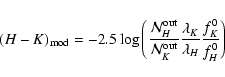 |
(6) |
where the
 's represent the number of photons within a
certain aperture
on each band. The
's represent the number of photons within a
certain aperture
on each band. The  's are the central wavelengths of the filters, and
the f0's are the zero magnitude fluxes. The values used for
are 1.65 and
's are the central wavelengths of the filters, and
the f0's are the zero magnitude fluxes. The values used for
are 1.65 and
 at H and K respectively, and
 W m
W m m-1 and
 W mm-1 are the values for
fH0 and
fK0 respectively (UKIRT web-page:
http://www.jach.hawaii.edu/JACpublic/UKIRT/). For simplicity,
the colours shown here assume that the foreground extinction is
negligible. Note that the presence of unknown foreground extinction is
an added complication when models are compared with observations.
W mm-1 are the values for
fH0 and
fK0 respectively (UKIRT web-page:
http://www.jach.hawaii.edu/JACpublic/UKIRT/). For simplicity,
the colours shown here assume that the foreground extinction is
negligible. Note that the presence of unknown foreground extinction is
an added complication when models are compared with observations.
![\begin{figure}
\par\includegraphics[width=8.8cm,clip]{0318fi09.eps}\end{figure}](/articles/aa/full/2004/19/aa0318/Timg97.gif) |
Figure 9:
a) Variation of the model H-K colour (Eq. (6)) with the line of sight inclination angle for the fiducial model. b)- d) The inclination angle is fixed at
and the overall opacity, centrifugal radius and cavity opening angle are varied. In panels c) and d) the mass infall rate was also changed to keep the opacity along the line of sight
constant. |
| Open with DEXTER |
Figure 9a shows the change in the H-K colour with the line of
sight inclination angle for the fiducial model. An aperture radius of 1'' centered at the image centre was used. The H-K colour at all
inclinations, except for the very close to pole-on, is clearly redder
than the H-K colour of the input spectrum ((H-K)
 = 0.04). At
edge-on inclinations (
= 0.04). At
edge-on inclinations (
 ), no star is seen in
either band, and the nebula at K is less extincted than the nebula at H. At intermediate inclinations, the nebula at H becomes brighter
because the stellar light passes through a less dense part of the envelope. The
star begins to appear at K but is not yet seen at H. The overall effect
is that the H-K colour becomes bluer. For
), no star is seen in
either band, and the nebula at K is less extincted than the nebula at H. At intermediate inclinations, the nebula at H becomes brighter
because the stellar light passes through a less dense part of the envelope. The
star begins to appear at K but is not yet seen at H. The overall effect
is that the H-K colour becomes bluer. For
 the
star brightens quickly at K, dominating the flux in this
band, while the star just begins to appear at H. Hence, the
H-K colour becomes redder. At face-on views (i.e.
the
star brightens quickly at K, dominating the flux in this
band, while the star just begins to appear at H. Hence, the
H-K colour becomes redder. At face-on views (i.e.
 )
the
H-K colour tends to the (H-K)
because the
star is now seen directly through the cavity. The behaviour of the
H-K colour with the inclination angle in our simulations is different
to that found by Kenyon et al. (1993) and Whitney et al. (1997). Their models
become bluer at high inclination angles, while ours become redder due
to the higher envelope optical depth (i.e. higher mass infall rate)
and due to the fact that, at high inclinations, no star is seen in
the H band.
)
the
H-K colour tends to the (H-K)
because the
star is now seen directly through the cavity. The behaviour of the
H-K colour with the inclination angle in our simulations is different
to that found by Kenyon et al. (1993) and Whitney et al. (1997). Their models
become bluer at high inclination angles, while ours become redder due
to the higher envelope optical depth (i.e. higher mass infall rate)
and due to the fact that, at high inclinations, no star is seen in
the H band.
Figure 9b illustrates how the H-K colour varies with the
overall opacity at a fixed inclination angle of
.
At large
opacities, the H-K colour is bluer because the reflection nebula
becomes relatively brighter than the star. In Fig. 9c, we
represent models with different centrifugal radii seen at a fixed
inclination of
.
The mass accretion rate was adjusted so that
all of them have an optical depth along the line of sight of 8. In the models
with a larger centrifugal radius (i.e. a flatter density distribution)
there is less dust available in the outer parts of the envelope, since
the dust is mainly concentrated at the equator. This density enhancement in
the equatorial region allows more direct light from the central star
to escape (predominantly in the K band due to the low opacity) than in
models with a small
.
The consequence is that the H-K colour becomes
slightly redder for models with large
.
Figure 9d shows variations of the H-K colour with the
cavity opening angle. All models represented in this plot are seen at
an inclination of
,
and the overall density scaling was
adjusted to yield an
= 8. The general trend is that at wide cavity
opening angles the H-K colour becomes bluer because more scattered
photons in the outer parts of the envelope (at H, not at K) can escape
from the system. This general trend is favoured by the fact that the direct
light from the star is equally extincted at all cavity opening angles
shown in Fig. 9d. The figure also illustrates that the H-K colour for models with an
>
becomes even bluer than
the H-K colour of the input spectrum. In summary, the four panels in
Fig. 9 show that the change in the H-K colour is not
higher than 1 mag within the ranges of the parameter space
investigated. Hence, the integrated colour is not particularly
sensitive to the density distribution, and is unlikely to yield unique
solutions for the model parameters.
3.3 Dust in the cavity
Up to now, we have assumed that the cavity evacuated by the outflow is
empty. However, in a more realistic situation, one would expect that
some dust may remain inside the cavity. We estimated the expected
 due to dust within the cavity from the typical
column densities in massive outflows as follows. Ridge & Moore (2001) show that the integrated CO (J=1-2) intensity in molecular outflows from 11 massive
YSOs is, on average, 200 K
due to dust within the cavity from the typical
column densities in massive outflows as follows. Ridge & Moore (2001) show that the integrated CO (J=1-2) intensity in molecular outflows from 11 massive
YSOs is, on average, 200 K
 .
If we use the expression
.
If we use the expression
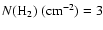

 ,
where
,
where
 represents the integrated CO (J=1-2) intensity
(Osterloh et al. 1997; Henning et al. 2000), typical column densities in the outflow of
represents the integrated CO (J=1-2) intensity
(Osterloh et al. 1997; Henning et al. 2000), typical column densities in the outflow of
 cm-2 are obtained. This
yields typical visual extinctions of 3.5 mag, if the
expression
cm-2 are obtained. This
yields typical visual extinctions of 3.5 mag, if the
expression
 10-23from Bohlin et al. (1978) is used. This implies an
 mag
which is about 200 times smaller than the AK = 8, used in our fiducial model.
mag
which is about 200 times smaller than the AK = 8, used in our fiducial model.
To see the effect that dust in the cavity has in our simulations, we have
run three models with the same parameters as our fiducial model but with
an AK along the cavity axis of 0.1, 1 and 10 mag. A dusty density
distribution within the cavity given by the expression
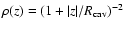 ,
which is expected
in a disc wind with a constant flow density distribution in a conical
cavity, was chosen. The output from the models with AK = 0.1 and 1 are hardly distinguishable from the fiducial model. For AK = 10, only a few photons from the
star can scape the system, and the reflection nebula is not seen at
all. However, the latter value of AK is far larger than our
previous estimate of extinction due to dust in the cavity. Therefore,
for the typical
extinction expected due to dust within the cavity in massive YSOs, no
noticeable effect on the observable properties of our scattering
models is detected. Note that this result depends on the selected
shape for the
density distribution within the cavity. If an optically thin uniform
density distribution is chosen, the resulting reflection nebula is
expected to be more extended than for an empty cavity (see Lucas & Roche 1996).
,
which is expected
in a disc wind with a constant flow density distribution in a conical
cavity, was chosen. The output from the models with AK = 0.1 and 1 are hardly distinguishable from the fiducial model. For AK = 10, only a few photons from the
star can scape the system, and the reflection nebula is not seen at
all. However, the latter value of AK is far larger than our
previous estimate of extinction due to dust in the cavity. Therefore,
for the typical
extinction expected due to dust within the cavity in massive YSOs, no
noticeable effect on the observable properties of our scattering
models is detected. Note that this result depends on the selected
shape for the
density distribution within the cavity. If an optically thin uniform
density distribution is chosen, the resulting reflection nebula is
expected to be more extended than for an empty cavity (see Lucas & Roche 1996).
In Paper I, multi-colour (H and K band) speckle images of
a pair of outflow cavities in Mon R2 IRS3 were presented. In this section,
the data for IRS3 S are used to find observational constraints to the
density distribution using the models presented in the previous
section. In Figs. 10a and b, we show
the H and K band images of Mon R2 IRS3 S shown from Paper I, with the
presumed cavity axis oriented along the vertical direction. These
images have a pixel scale of 0
057 and a resolution of 0
19,
which is comparable to the values used the simulations.
The procedure used to find a good fit model for these data is the following. A
sub-set of models
that match the morphology of IRS3 S at K are chosen amongst the grid shown
in Sect. 3. A model is searched amongst these that also
matches the morphology of the source in the H band. Finally, the H-K colour of the model is compared with the observations.
![\begin{figure}
\par\includegraphics[width=8.8cm,clip]{0318fi10.eps}\end{figure}](/articles/aa/full/2004/19/aa0318/Timg112.gif) |
Figure 10:
a), b) H and K speckle images of Mon R2 IRS3 S. These images were obtained by rotating the images shown in Paper I by an angle of
 .
The orientation is such that the presumed cavity axis is along the vertical axis. The greyscale varies from -5% (white) to 40% (black) of the brightness peak. The contour levels are at 5, 10, 15, 30 and 50% of the peak. The images are normalised to the peak brightness. c), d) Images for models K01 and HH01 seen at an inclination angle of
.
These images are also normalised to their brightness peak. The resolution,
contours and greyscale are the same as on panels a) and b). The cross in the H band images indicate the location of the embedded star. .
The orientation is such that the presumed cavity axis is along the vertical axis. The greyscale varies from -5% (white) to 40% (black) of the brightness peak. The contour levels are at 5, 10, 15, 30 and 50% of the peak. The images are normalised to the peak brightness. c), d) Images for models K01 and HH01 seen at an inclination angle of
.
These images are also normalised to their brightness peak. The resolution,
contours and greyscale are the same as on panels a) and b). The cross in the H band images indicate the location of the embedded star. |
| Open with DEXTER |
Firstly, a reasonable match to the K band image for IRS3 S was found,
which is given by the fiducial model used in the grid seen at an inclination
angle of
(Fig. 2c). A zoom into the central 2'' of this model is shown in Fig. 10d.
The H band image for the fiducial model using the opacity
 =
=
 (cf. Sect. 2) appears
to be too extended (see Fig. 8b). Other combinations
of inclination angle and mass infall rate were also too extended since
the optical depth at H was always too high. Therefore, a shallower
opacity law was used in an attempt to achieve a better fit to the IRS3 S
H band image. The new value used for
at H was
(cf. Sect. 2) appears
to be too extended (see Fig. 8b). Other combinations
of inclination angle and mass infall rate were also too extended since
the optical depth at H was always too high. Therefore, a shallower
opacity law was used in an attempt to achieve a better fit to the IRS3 S
H band image. The new value used for
at H was
 which
corresponds with an opacity law (
which
corresponds with an opacity law (
 )
with
)
with
 between
 and
and
 (instead of
the previous value of
). The exponent 1.3 was chosen to
yield an opacity law slightly flatter than than the
(instead of
the previous value of
). The exponent 1.3 was chosen to
yield an opacity law slightly flatter than than the
 inferred from studies on the interstellar extinction
in the near-IR (e.g. He et al. 1995). The model using the shallower
opacity law (HH01 in Table 1) is shown in
Fig. 10. It can be seen that this law still yields
a rather extended nebula compared with the H band image of IRS3 S.
A shallower opacity law than the one given by Draine & Lee (1984)
has been used by other authors (e.g. Lucas & Roche 1998) to explain
the small variation with wavelength of reflection nebulae in
low mass YSOs. This is possibly due to a different dust composition
or grain size distribution in the circumstellar matter of YSOs than
in the interstellar medium. Another possible
explanation relies on the fact that speckle imaging acts as a spatial
filter for diffuse extended features of the same order and larger than
the seeing. Therefore, even if the nebula in the H band was extended for
a few arcseconds, the reconstructed speckle image would only pick up
the structure closer to the nebula peak, which is dominated by the
high spatial frequencies. It may also be the case that the envelope
density distribution is truncated at a distance of 1000 from
the central source, causing both H and K images to have the same
extent.
inferred from studies on the interstellar extinction
in the near-IR (e.g. He et al. 1995). The model using the shallower
opacity law (HH01 in Table 1) is shown in
Fig. 10. It can be seen that this law still yields
a rather extended nebula compared with the H band image of IRS3 S.
A shallower opacity law than the one given by Draine & Lee (1984)
has been used by other authors (e.g. Lucas & Roche 1998) to explain
the small variation with wavelength of reflection nebulae in
low mass YSOs. This is possibly due to a different dust composition
or grain size distribution in the circumstellar matter of YSOs than
in the interstellar medium. Another possible
explanation relies on the fact that speckle imaging acts as a spatial
filter for diffuse extended features of the same order and larger than
the seeing. Therefore, even if the nebula in the H band was extended for
a few arcseconds, the reconstructed speckle image would only pick up
the structure closer to the nebula peak, which is dominated by the
high spatial frequencies. It may also be the case that the envelope
density distribution is truncated at a distance of 1000 from
the central source, causing both H and K images to have the same
extent.
Even though a reasonably good fit was found to the K band speckle image
of IRS3 S, the synthetic nebula shows some differences with respect to the
observed nebula. In particular, the observed nebula departs clearly
from the axi-symmetry, probably due to foreground extinction or the
presence of a clumpy envelope. Besides, the brightness of the synthetic nebula
(Fig. 10d) drops faster near the star than in the
case of the observed nebula (Fig. 10b). Further out,
at 1'' from the star, the brightness of the synthetic nebula appears
to drop more smoothly than observed in IRS3 S. The sub-arcsecond
nebula is the inner region of a large reflection nebula (with a diameter of 15'') that is seen in the near-IR seeing limited images of Mon R2 IRS3
(see Yao et al. 1997; Aspin & Walther 1990).
The large scale nebula is a halo of reflected light around the whole cloud
but its polarisation pattern indicates enhanced scattering along an
axis that coincides with the sub-arcsecond nebula axis (PA
)
.
![\begin{figure}
\par\includegraphics[width=8.8cm,clip]{0318fi11.eps}\end{figure}](/articles/aa/full/2004/19/aa0318/Timg121.gif) |
Figure 11:
K band profile along the cavity axis for IRS3 S. The speckle data (filled triangles) are obtained from Fig. 10b. The solid circles represent the data from the contour map shown by Aspin & Walther (1990). The solid line corresponds with an extension of the fiducial model`up to a radius of
 AU. The speckle data and the model are flux calibrated following the procedure explained in the text. The offsets are in arcseconds from the position of the star. The errors for the speckle data are smaller than the size of the plotting symbol. AU. The speckle data and the model are flux calibrated following the procedure explained in the text. The offsets are in arcseconds from the position of the star. The errors for the speckle data are smaller than the size of the plotting symbol. |
| Open with DEXTER |
To investigate if the model that matches the sub-arcsecond morphology of
IRS3 S fits the outer part of the reflection nebula, the outer radius of
the fiducial model was doubled while the mass infall rate was slightly
reduced to
 to keep a K band optical depth of 8 at an
inclination of
.
The profile along the cavity axis for this model
was compared with the profile for the K band reconstructed image of IRS3 S
and with the profile along the same
direction for the reflection nebula studied by Aspin & Walther (1990). This
comparison is shown in Fig. 11. The data for the large
scale nebula were taken from the flux-calibrated contour map shown in
Fig. 3 of Aspin & Walther (1990). The
error bars correspond to half of the contour level separation in their map
(
to keep a K band optical depth of 8 at an
inclination of
.
The profile along the cavity axis for this model
was compared with the profile for the K band reconstructed image of IRS3 S
and with the profile along the same
direction for the reflection nebula studied by Aspin & Walther (1990). This
comparison is shown in Fig. 11. The data for the large
scale nebula were taken from the flux-calibrated contour map shown in
Fig. 3 of Aspin & Walther (1990). The
error bars correspond to half of the contour level separation in their map
(
 ). The data points for the observed sub-arcsecond nebula were
calculated from a 0
2 wide line along the cavity
axis passing through the star in IRS3 S on the normalised speckle image. The
zero point offset for the magnitude scale was calculated by assigning a K magnitude of 6.6 (obtained from the 2MASS survey) to the total number
of counts within an aperture of radius 2
5 that included both
IRS3 N and S. The statistical error in the surface brightness is
). The data points for the observed sub-arcsecond nebula were
calculated from a 0
2 wide line along the cavity
axis passing through the star in IRS3 S on the normalised speckle image. The
zero point offset for the magnitude scale was calculated by assigning a K magnitude of 6.6 (obtained from the 2MASS survey) to the total number
of counts within an aperture of radius 2
5 that included both
IRS3 N and S. The statistical error in the surface brightness is

 .
.
The profile for the model was calculated from 0
2 wide line along the cavity axis in the synthetic image normalised to the brightness peak. The zero point offset for the magnitude scale was chosen such that it yields the same brightness at the peak as the flux-calibrated
speckle data.
Figure 11 shows that there may be a discrepancy of at least
 between the data from Aspin et al. and the speckle data.
A possible explanation is that speckle imaging filters out any background
smooth emission, and hence less counts in the speckle image than in the
seeing limited image of Aspin et al. appear to account for the same flux.
The profiles plotted in Fig. 11 show that the model
predicts emission from the outer parts of the nebula (at a distance
from the star >1'') that is about 2 mag brighter than
it is observed. This may be caused by a drop in the density distribution of IRS3 at a radius 1000 AU that is not included in the models (cf. Figs. 10a and b).
between the data from Aspin et al. and the speckle data.
A possible explanation is that speckle imaging filters out any background
smooth emission, and hence less counts in the speckle image than in the
seeing limited image of Aspin et al. appear to account for the same flux.
The profiles plotted in Fig. 11 show that the model
predicts emission from the outer parts of the nebula (at a distance
from the star >1'') that is about 2 mag brighter than
it is observed. This may be caused by a drop in the density distribution of IRS3 at a radius 1000 AU that is not included in the models (cf. Figs. 10a and b).
Willner et al. (1982) estimated an optical depth for the silicate absorption
feature at
 of
= 4.30, using a 27'' aperture
centered at Mon R2 IRS3. The same value is also inferred from the ISO spectrum
of the region (Jackie Keane private communication). This value can be used
as an estimate of the total extinction (foreground and through the
envelope) towards IRS3 S. This
leads to an optical extinction of
of
= 4.30, using a 27'' aperture
centered at Mon R2 IRS3. The same value is also inferred from the ISO spectrum
of the region (Jackie Keane private communication). This value can be used
as an estimate of the total extinction (foreground and through the
envelope) towards IRS3 S. This
leads to an optical extinction of
 (Draine & Lee 1984) . This corresponds with an extinction
in the K band AK = 8.6 mag (i.e.
(Draine & Lee 1984) . This corresponds with an extinction
in the K band AK = 8.6 mag (i.e.
 )
using the reddening law of He et al. (1995), which is in good agreement
with the K band optical depth for the fiducial model
(
)
using the reddening law of He et al. (1995), which is in good agreement
with the K band optical depth for the fiducial model
(
 ).
).
We found that the H-K colour of IRS3 S is redder than the H-K colour
of any of the model images. This is probably caused by the fact that
we used the SED of an OB main sequence star to define the input
spectrum. However, it is very likely that the illuminating source has
an excess in the K band due to the presence of a possible accretion
disc, and/or hot dust near the star. The inclusion of an excess of K band photons in the input spectrum may solve the discrepancy between the observed and modeled colours. High resolution photometry at longer wavelengths is required to constrain the input spectrum in the simulations.
5 Conclusions
Radiative transfer Monte Carlo simulations have been used to
investigate the density distribution in massive YSOs at scales where
the outflow is generated. The assumed density distribution consists of
a central massive star within a flattened dusty envelope, with a
cavity and an inner optically thick disc. It is found that envelopes with
density distributions corresponding to typical mass infall
rates of 10-4
seen at an inclination angle of
approximately reproduce the morphology and extension of
the sub-arcsecond nebulae observed in massive YSOs. The inclination
angle can be constrained by the measurement of the contrast between
the approaching and the receding nebular lobe, although observations
with a high dynamic range are required (e.g. adaptive optics). The
cavity opening angle is well constrained by the nebula opening angle.
The simulations indicate possibly some constraints on cavity shape and
radius at the equator, which could have implications for the
initial angle of the outflow (e.g. jet, wide-angled, equatorial). However,
higher resolution than provided by speckle imaging in 4 m-class
telescopes is needed to achieve better constraints of these two
quantities. The models do not provide significant constraints on
the flattening in the envelope or the size of the equatorial disc,
which require direct observations with millimetre interferometry.
The Monte Carlo code was also applied to the near-IR sub-arcsecond
reflection nebula seen in Mon R2 IRS3 S. An envelope
with a mass infall rate of 10-4
that includes a conical
cavity with an opening angle of
seen at an inclination
angle of
provides a reasonable match for the K band image.
However, no set of input parameters was found that reproduces both
the H and K band images of IRS3 S. An opacity law
with an exponent
(Draine & Lee 1984; Draine 1985) yields
H band nebulae that are too extended with respect to the observations.
This would also be the case for the observed interstellar extinction
law (
;
He et al. 1995).
A shallower opacity law (
)
yields a better match to
observed H band nebula, although still too extended. This
indicates that the dust in the circumstellar envelope of massive YSOs
may have a rather different optical properties to the dust that forms
part of the interstellar medium. However, a truncated density
distribution could also explain the data.
Overall, this work shows that future high resolution
(0
05) high dynamic range (>100) near-IR imaging has
the potential to constrain the inclination angle and shape of the base
of the outflow cavity. In turn, this could test hydrodynamic models of
the interplay between the infall and outflow in massive YSOs.
Acknowledgements
C.A. would like to thank to the Physics and Astronomy Department
at Leeds University for their support. C.A. is also deeply
grateful to Kapteyn Astronomical Institute for allowing him to use their
facilities during the realization of this work. We would like to
thank B. Whitney, the referee of this work, for her comments and
suggestions.
- Aspin, C., &
Walther, D. M. 1990, A&A, 235, 387 [NASA ADS]
- Bachiller,
R., Guilloteau, S., Dutrey, A., Planesas, P., & Martin-Pintado,
J. 1995, A&A, 299, 857 [NASA ADS] (In the text)
- Bally, J.,
& Lada, C. J. 1983, ApJ, 265, 824 [NASA ADS] [CrossRef]
- Beuther, H.,
Schilke, P., Sridharan, T. K., et al. 2002, A&A, 383,
892 [EDP Sciences] [NASA ADS] [CrossRef]
- Bohlin, R. C.,
Savage, B. D., & Drake, J. F. 1978, ApJ, 224,
132 [NASA ADS] [CrossRef] (In the text)
- Burrows,
C. J., Stapelfeldt, K. R., Watson, A. M.,
et al. 1996, ApJ, 473, 437 [NASA ADS] [CrossRef] (In the text)
- Davis, C. J.,
Moriarty-Schieven, G., Eislöffel, J., Hoare, M. G., &
Ray, T. P. 1998, AJ, 115, 1118 [NASA ADS] [CrossRef]
- Delamarter,
G., Frank, A., & Hartmann, L. 2000, ApJ, 530, 923 [NASA ADS] [CrossRef] (In the text)
- Draine, B. T.
1985, ApJS, 57, 587 [NASA ADS] [CrossRef] (In the text)
- Draine,
B. T., & Lee, H. M. 1984, ApJ, 285, 89 [NASA ADS] [CrossRef] (In the text)
- Drew, J. E., &
Proga, D. 2000, NewAR, 44, 21 [NASA ADS]
- Drew, J. E.,
Proga, D., & Stone, J. M. 1998, MNRAS, 296, L6 [NASA ADS] [CrossRef]
-
Eislöffel, J. 2000, A&A, 354, 236 [NASA ADS]
- Fischer, O.,
Henning, T., & Yorke, H. W. 1994, A&A, 284, 187 [NASA ADS]
- Fischer, O.,
Henning, T., & Yorke, H. W. 1996, A&A, 308, 863 [NASA ADS]
- He, L., Whittet, D.
C. B., Kilkenny, D., & Spencer Jones, J. H. 1995,
ApJS, 101, 335 [NASA ADS] [CrossRef] (In the text)
- Henning, T.,
Schreyer, K., Launhardt, R., & Burkert, A. 2000, A&A, 353,
211 [NASA ADS]
- Hoare, M. G.
2002, in The Earliest Stages of Massive Star Birth,
ed. P. A. Crowther, ASP Conf. Proc., 267, 137
- Hoare, M. G.,
Drew, J. E., Muxlow, T. B., & Davis, R. J. 1994,
ApJ, 421, L51 [NASA ADS] [CrossRef]
- Hoare,
M. G., & Muxlow, T. B. 1996, in Radio Emission from
the Stars and the Sun, ASP Conf. Ser., 93, 47
- Kenyon, S. J.,
Whitney, B. A., Gomez, M., & Hartmann, L. 1993, ApJ, 414,
773 [NASA ADS] [CrossRef]
- Kurucz, R. L.
1979, ApJS, 40, 1 [NASA ADS] [CrossRef] (In the text)
- Lazareff, B.,
Monin, J., & Pudritz, R. E. 1990, ApJ, 358, 170 [NASA ADS] [CrossRef]
- Lucas, P. W.
2003, JQSRT, 79, 921 [NASA ADS] (In the text)
- Lucas, P. W.,
& Roche, P. F. 1996, MNRAS, 280, 1219 [NASA ADS] (In the text)
- Lucas, P. W.,
& Roche, P. F. 1997, MNRAS, 286, 895 [NASA ADS]
- Lucas, P. W.,
& Roche, P. F. 1998, MNRAS, 299, 699 [NASA ADS] [CrossRef]
- Maeder, A., &
Behrend, R. 2002, Ap&SS, 281, 75 [NASA ADS]
- Marti, J., Rodriguez,
L. F., & Reipurth, B. 1993, ApJ, 416, 208 [NASA ADS] [CrossRef] (In the text)
- Masson, C. R.,
& Chernin, L. M. 1994, in Clouds, Cores, and Low Mass
Stars, ASP Conf. Ser., 65, 350
(In the text)
- Mathis, J. S.,
Rumpl, W., & Nordsieck, K. H. 1977, ApJ, 217, 425 [NASA ADS] [CrossRef] (In the text)
- Mundt, R., & Ray,
T. P. 1994, in The Nature and Evolutionary Status of Herbig
Ae/Be Stars, ASP Conf. Ser., 62, 237
(In the text)
- Osterloh, M.,
Henning, T., & Launhardt, R. 1997, ApJS, 110, 71 [NASA ADS] [CrossRef]
- Preibisch,
T., Balega, Y. Y., Schertl, D., & Weigelt, G. 2002,
A&A, 392, 945 [EDP Sciences] [NASA ADS] [CrossRef] (In the text)
- Reipurth, B.,
Bally, J., & Devine, D. 1997, AJ, 114, 2708 [NASA ADS] [CrossRef]
- Ridge,
N. A., & Moore, T. J. T. 2001, A&A, 378,
495 [EDP Sciences] [NASA ADS] [CrossRef]
- Schertl, D.,
Balega, Y., Hannemann, T., et al. 2000, A&A, 361, L29 [NASA ADS] (In the text)
- Shu, F., Najita, J.,
Ostriker, E., et al. 1994, ApJ, 429, 781 [NASA ADS] [CrossRef] (In the text)
- Terebey, S., Shu,
F. H., & Cassen, P. 1984, ApJ, 286, 529 [NASA ADS] [CrossRef]
- Tomisaka, K.
1998, ApJ, 502, L163 [NASA ADS] [CrossRef] (In the text)
- Torrelles,
J. M., Gomez, J. F., Rodriguez, L. F., et al.
1996, ApJ, 457, L107 [NASA ADS] (In the text)
- Ulrich, R. K.
1976, ApJ, 210, 377 [NASA ADS] [CrossRef]
- Wang, H., Yang, J.,
Wang, M., & Yan, J. 2003, AJ, 125, 842 [NASA ADS] [CrossRef]
-
Whitney, B. A., & Hartmann, L. 1992, ApJ, 395, 529 [NASA ADS] [CrossRef]
- Whitney,
B. A., Kenyon, S. J., & Gomez, M. 1997, ApJ, 485,
703 [NASA ADS] [CrossRef]
- Whitney,
B. A., & Wolff, M. J. 2002, ApJ, 574, 205 [NASA ADS] [CrossRef] (In the text)
- Willner,
S. P., Gillett, F. C., Herter, T. L., et al.
1982, ApJ, 253, 174 [NASA ADS] [CrossRef] (In the text)
- Wolf, S.,
Voshchinnikov, N. V., & Henning, T. 2002, A&A, 385,
365 [EDP Sciences] [NASA ADS] [CrossRef]
-
Wolfire, M. G., & Cassinelli, J. P. 1986, ApJ, 310,
207 [NASA ADS] [CrossRef]
- Yao, Y., Hirata, N.,
Ishii, M., et al. 1997, ApJ, 490, 281 [NASA ADS] [CrossRef]
Copyright ESO 2004
![\begin{figure}
\par\includegraphics[width=8.8cm,clip]{0318fi01.eps}\end{figure}](/articles/aa/full/2004/19/aa0318/img63.gif)
![\begin{figure}
\par\includegraphics[width=8.8cm,clip]{0318fi02.eps}\end{figure}](/articles/aa/full/2004/19/aa0318/img64.gif)
![\begin{figure}
\par\includegraphics[width=8.8cm,clip]{0318fi03.eps}\end{figure}](/articles/aa/full/2004/19/aa0318/img65.gif)
![\begin{figure}
\par\includegraphics[width=8.8cm,clip]{0318fi04.eps}\end{figure}](/articles/aa/full/2004/19/aa0318/img73.gif)
![\begin{figure}
\par\includegraphics[width=8.8cm,clip]{0318fi05.eps}\end{figure}](/articles/aa/full/2004/19/aa0318/img75.gif)
![\begin{figure}
\par\includegraphics[width=8.8cm,clip]{0318fi06.eps}\end{figure}](/articles/aa/full/2004/19/aa0318/img76.gif)
![\begin{figure}
\par\includegraphics[width=8.8cm,clip]{0318fi07.eps}\end{figure}](/articles/aa/full/2004/19/aa0318/img77.gif)
![\begin{figure}
\par\includegraphics[width=8.8cm,clip]{0318fi08.eps}\end{figure}](/articles/aa/full/2004/19/aa0318/img82.gif)
![\begin{figure}
\par\includegraphics[width=8.8cm,clip]{0318fi09.eps}\end{figure}](/articles/aa/full/2004/19/aa0318/img97.gif)
![\begin{figure}
\par\includegraphics[width=8.8cm,clip]{0318fi10.eps}\end{figure}](/articles/aa/full/2004/19/aa0318/img112.gif)
![\begin{figure}
\par\includegraphics[width=8.8cm,clip]{0318fi11.eps}\end{figure}](/articles/aa/full/2004/19/aa0318/img121.gif)