![[*]](/icons/foot_motif.gif)
A&A 417, 51-60 (2004)
DOI: 10.1051/0004-6361:20034458
M. Radovich1 - M. Arnaboldi1,2 - V. Ripepi1 - M. Massarotti1 - H. J. McCracken3,7 - Y. Mellier4,5 - E. Bertin4,5 - G. Zamorani7,8 - C. Adami6 - S. Bardelli7 - O. Le Fèvre6 - S. Foucaud6 - B. Garilli9 - R. Scaramella10 - G. Vettolani7 - A. Zanichelli8 - E. Zucca7
1 - INAF, Osservatorio Astronomico di Capodimonte, via Moiariello
16, 80131 Napoli, Italy
2 - INAF, Osservatorio Astronomico di Pino
Torinese, via Osservatorio 20, 10025 Torino, Italy
3 - Università degli Studi di Bologna, Dipartimento di Astronomia,
via Ranzani 1, 40127 Bologna, Italy
4 - Institut d'Astrophysique de Paris, 98bis Bd. Arago, 75014 Paris, France
5 - Observatoire de Paris, LERMA, 61 avenue de l'Observatoire, 75014 Paris,
France
6 - Laboratoire d'Astrophysique de Marseille, Traverse du Siphon,
13376 Marseille Cedex 12, France
7 - INAF, Osservatorio Astronomico di Bologna, via Ranzani 1,
40127 Bologna, Italy
8 - Istituto di Radioastronomia del CNR, via Gobetti 101, 40129 Bologna,
Italy
9 - Istituto di Astrofisica Spaziale e Fisica Cosmica del CNR,
via Bassini 15, 20133 Milano, Italy
10 - INAF, Osservatorio Astronomico di Roma, via Osservatorio 2,
00040 Monteporzio Catone (Roma), Italy
Received 6 October 2003 / Accepted 5 December 2003
Abstract
In this paper we describe the U-band imaging of the F02 deep field,
one of the fields in the VIRMOS Deep Imaging Survey. The
observations were done at the ESO/MPG 2.2 m telescope at La Silla (Chile) using
the 8k  8k Wide-Field Imager (WFI).
The field is centered at
8k Wide-Field Imager (WFI).
The field is centered at  (J2000)=02
 26
26 00
00 and
and
 (J2000
 30
30 00
00
 ,
the total covered area is 0.9
,
the total covered area is 0.9  and the limiting magnitude (50%
completeness) is
and the limiting magnitude (50%
completeness) is
 mag.
Reduction steps, including astrometry, photometry and catalogue
extraction, are first discussed. The achieved astrometric accuracy (rms) is
mag.
Reduction steps, including astrometry, photometry and catalogue
extraction, are first discussed. The achieved astrometric accuracy (rms) is 
 with reference to the I-band catalog and
 internally (estimated from overlapping sources in different exposures).
The photometric accuracy
including uncertainties from photometric calibration, is <0.1 mag.
Various tests are then performed
as a quality assessment of the data. They include: (i) the color distribution
of stars and galaxies in the field, done together with the BVRI data
available from the VIMOS survey; (ii) the comparison with previous
published results of U-band magnitude-number counts of galaxies.
internally (estimated from overlapping sources in different exposures).
The photometric accuracy
including uncertainties from photometric calibration, is <0.1 mag.
Various tests are then performed
as a quality assessment of the data. They include: (i) the color distribution
of stars and galaxies in the field, done together with the BVRI data
available from the VIMOS survey; (ii) the comparison with previous
published results of U-band magnitude-number counts of galaxies.
Key words: catalogs - surveys - galaxies: general
The VIMOS imaging survey (Paper I) represents the preparatory step of the deep
redshift survey, which is now being carried out with the VIMOS spectrograph
at the VLT UT3 at Paranal, Chile, by the VIMOS consortium. This preparatory
multi-wavelength imaging survey has been done at the Canada-France
Hawaii Telescope (CFHT) for the BVRI bands (Le Fèvre et al. 2003,
Paper I hereafter; McCracken
et al. 2003, Paper II hereafter), and at the ESO NTT telescope
for the K imaging (Iovino et al. 2003, in prep.). The near ultraviolet part
of this survey was carried out at the ESO MPI 2.2 m telescope
with the WFI 8k
8k camera, in the framework of an approved ESO Large
program (164.0-0089) scheduled since Period 63 in 1999, both in visitor
and service mode.
The survey aims at covering  in
in  with a 5
 limiting magnitude
 ,
and a
smaller
,
and a
smaller
 area reaching
 ,
i.e. the
VIMOS deep field.
In the U-band, expected 5
limiting magnitudes are
,
i.e. the
VIMOS deep field.
In the U-band, expected 5
limiting magnitudes are
 mag for the wide survey,
 mag for
the deep survey. In total the survey contains
over 106 galaxies in five colors and represents a major
advance over other previous deep multicolor surveys, probing
structures on scales of 20 h-1 Mpc at
mag for
the deep survey. In total the survey contains
over 106 galaxies in five colors and represents a major
advance over other previous deep multicolor surveys, probing
structures on scales of 20 h-1 Mpc at  .
.
Surveys in the radio continuum (Bondi et al. 2003) and with XMM (Pierre et al. 2003) were carried out on the deep field of the VIMOS imaging survey. The catalogs from the U and BVRI deep field are also foreseen to be used for the optical identification of the radio continuum survey (Ciliegi et al., in prep.).
Until the availability of data from ground-based (e.g. the CFHLS and VST surveys) or space (e.g. the GALEX project) surveys, wide-field U-band data with medium depth and large sky coverage are not available yet. The U-band is essential to study the star formation properties of field galaxies in the nearby universe, and is also particularly suited to identify starburst galaxies, AGN, and QSO at moderate redshift. These aspects, as well as the determination of the U-band luminosity function and the analysis of the morphological properties of galaxies compared to other bands, will be the subject of separate papers.
Compared to other existing
surveys, the VIRMOS F02 deep field
offers a good compromise between covered area and depth. The ESO imaging survey (EIS)
in the Chandra Deep Field South (Arnouts et al. 2001) is comparable in depth to our
F02 deep field but covers a smaller area (
 ).
The Canada-France Deep Field survey (McCracken et al. 2001) consists of four independent fields of
each, and the U-band limiting magnitude is 1 mag
deeper than the VIRMOS deep field.
The Combo-17 survey (Wolf et al. 2003) covers three fields with a total area
).
The Canada-France Deep Field survey (McCracken et al. 2001) consists of four independent fields of
each, and the U-band limiting magnitude is 1 mag
deeper than the VIRMOS deep field.
The Combo-17 survey (Wolf et al. 2003) covers three fields with a total area
 and is comparable in depth to the F02 deep field in the U-band.
Deeper surveys (e.g. the William Herschel Deep Field, Metcalfe et al. 2001
or more recently the FORS Deep Field, Heidt et al. 2003) were
carried out on smaller
areas (
and is comparable in depth to the F02 deep field in the U-band.
Deeper surveys (e.g. the William Herschel Deep Field, Metcalfe et al. 2001
or more recently the FORS Deep Field, Heidt et al. 2003) were
carried out on smaller
areas (
 )
only.
)
only.
In this paper we will describe the observations, photometric calibration, catalogue extraction and validation for the deep field. The calibration steps are strongly related to those followed in the case of the overlapping deep BVRI filters, which are described in Paper II. We refer to this paper for a detailed discussion of calibration issues when they are the same and emphasize those aspects that are peculiar to the U-band data.
![\begin{figure}
\par\includegraphics[width=6cm,angle=270,clip]{0458_f1a.ps} \includegraphics[width=6cm,angle=270,clip]{0458_f1b.ps}
\end{figure}](/articles/aa/full/2004/13/aa0458/img47.gif) |
Figure 1:
The VIRMOS F02 deep field. The images of the three pointings (P1, P2
and P3) are here combined for display purposes only: they have been treated
separately in data reduction and catalog extraction.
The full field is displayed in the upper plot. The outer solid-line
rectangle shows the position of the
field taken in the  bands. Overlaid
are the images of the three U-band pointings; masked areas at the borders
of the images were removed. Note the circular shape of the
P1 pointing, due to vignetting in the Loiano filter.
The region in the inner box, where P1 and P3 overlap,
is the one zoomed in the bottom plot: the accuracy of the astrometry can be seen
from the absence of double sources. bands. Overlaid
are the images of the three U-band pointings; masked areas at the borders
of the images were removed. Note the circular shape of the
P1 pointing, due to vignetting in the Loiano filter.
The region in the inner box, where P1 and P3 overlap,
is the one zoomed in the bottom plot: the accuracy of the astrometry can be seen
from the absence of double sources. |
| Open with DEXTER | |
The U-band deep pointing was observed during several observing runs since
1999 with the aim of covering
 of the multiwavelength
deep field planned within the VIMOS deep redshift survey. This deep
field is centred at (J2000
of the multiwavelength
deep field planned within the VIMOS deep redshift survey. This deep
field is centred at (J2000
 2600
and
(J2000
3000
(see Fig. 1)
and observations were carried out with the Wide-Field Imaging (WFI)
mosaic camera mounted on the ESO MPI 2.2 m telescope at La Silla,
Chile. The camera was mounted at the Cassegrain focus of the telescope,
giving a field of view of
2600
and
(J2000
3000
(see Fig. 1)
and observations were carried out with the Wide-Field Imaging (WFI)
mosaic camera mounted on the ESO MPI 2.2 m telescope at La Silla,
Chile. The camera was mounted at the Cassegrain focus of the telescope,
giving a field of view of
 arcmin. It consists of a mosaic
of 8 CCD detectors with narrow inter-chip gaps, yielding a filling
factor of 95.9% and a pixel size of
arcmin. It consists of a mosaic
of 8 CCD detectors with narrow inter-chip gaps, yielding a filling
factor of 95.9% and a pixel size of
 .
The WFI CCDs have
a read-out noise of 4.5 e- pix-1 and a gain of 2.2
e- ADU-1.
.
The WFI CCDs have
a read-out noise of 4.5 e- pix-1 and a gain of 2.2
e- ADU-1.
The area covered for the U deep field consists of three pointings partially overlapping (see Fig. 1). When this survey started in 1999, a standard U-band Johnson filter was not available at the ESO MPI 2.2 m telescope, so our team borrowed the one available at the Loiano observatory, and used this till a suitable U-band filter was acquired by ESO. One pointing was therefore imaged using the Loiano U filter, which is a circular filter partially vignetting the field. Pointings 2 and 3 were imaged with the ESO U/360 filter.
Table 1: Details concerning the pointings for the U deep field. Filter central wavelengths and FWHM are given before and after (in italics) the convolution with the telescope, CCD and atmosphere transmissions. The area includes only the region where sources have been included in the catalog: it does not include border regions with vignetting or a low signal to noise ratio.
The filter transmission curves are shown in Fig. 2;
central wavelengths and FWHMs are given in Table 1, together
with covered area and exposure times for each pointing. Note that,
compared to the ESO filter, the Loiano filter is shifted to the red
and also has a red leak at
 Å.
Å.
![\begin{figure}
\par\mbox{\includegraphics[width=5cm,angle=270,clip]{0458_f2.ps} }\end{figure}](/articles/aa/full/2004/13/aa0458/img57.gif) |
Figure 2: Transmission curves of the Loiano and ESO U/360 filters; curves before (dashed) and after (solid) the convolution with the CCD, telescope and atmosphere transmission are displayed. Note the red leak for the Loiano filter. |
| Open with DEXTER | |
The efficiency during the observing campaign was hampered by bad weather conditions and a problem at the primary mirror support system which caused strong astigmatism on some images.
The exposure time for each individual frame was usually 2000 s, and 1000 s when astigmatism of the ESO MPI 2.2 m telescope was severe. The total exposure time was 13.9 h for pointing P1, 20.3 h for pointing P2, and 17.8 h for pointing P3; see Table 1 for additional information on the observing log.
For each pointing, the sets of exposures were acquired in a dithered
elongated-rhombi pattern. This sequence of dithered exposures ensures
the removal of CCD gaps in the final coadded image, better flat fielding
correction, efficient removal of bad pixel and columns and a more accurate astrometric
solution in the final coadded image. The total area covered by the
three pointings is
 .
The effective area
is actually smaller,
.
The effective area
is actually smaller,
 ,
since: (a) a
fraction of P1 is overlapping with P2 and P3; (b) the border regions
of the images were masked when the noise was significantly higher
due to either vignetting (P1) or the dithering steps; (c) a small fraction
of the area in P2 and P3 is not covered in
and therefore was not
taken into account when catalogs were built.
,
since: (a) a
fraction of P1 is overlapping with P2 and P3; (b) the border regions
of the images were masked when the noise was significantly higher
due to either vignetting (P1) or the dithering steps; (c) a small fraction
of the area in P2 and P3 is not covered in
and therefore was not
taken into account when catalogs were built.
The atmospheric turbulence produced an average seeing of approximately
 .
.
Pre-reductions were carried out using the MSCRED package in IRAF.
The CCD mosaic frames were bias and dark corrected, and flatfielded.
Flatfield images were constructed combining a whole series of twilight
sky images, taken during each observing night. Once the images were
flatfielded, we noticed the presence of residual structures in the
background sky, which should be treated in order to get a flat sky
background in the final coadded images. A "super-flatfield"
image was constructed from all the dataset for each pointing, using
a 3-
rejection algorithm, for the removal of sources
in the field. The procedures for astrometry, photometry and coaddition
were approximately the same as those adopted in the analysis of BVRI data.
More details are given in Paper II; a short description follows where details
peculiar to U-band data are emphasized.
Astrometry was performed using the ASTROMETRIX tool, which is part of the
WIFIX package developed for the reduction of wide-field images.
A STROMETRIX allows to compute an astrometric solution using both
an external astrometric catalog and the constraint that the position
of overlapping sources in different CCDs must be the same (global astrometry).
One of the main goals of this survey was to provide U-band fluxes
of the sources detected in the BVRI images. As described in more detail
in Paper II, source detection for the BVRI images was done as follows.
A single  image was first built from the BVRI images, source
detection was then done using SE XTRACTOR (Bertin & Arnouts 1996)
in dual mode. This requires
that source positions in all the images match at a subpixel level.
Such level of accuracy was achieved as outlined in Paper II. The astrometric
solution was first computed for the I-band image taking the USNO A-2 (Monet et al. 1998)
as the astrometric reference catalog. A catalog of sources was
then extracted from the resampled I-band image and used as reference catalog for
the other bands (UBVR).
During the astrometric procedure, the offset of U-band detected sources
with respect to those matched in the I-band catalog was first computed for
each CCD separately.
This allowed to correct
the displacement introduced by atmospheric refraction from the I- to the
U-band. Finally, in the global astrometry step the astrometric solution
was constrained for each CCD by both the positions from
the I-band catalog and those from overlapping sources in all the other CCDs.
Even if the three pointings were then resampled and coadded separately, in the global
astrometry we used positions from all of them to increase the astrometric internal
accuracy by using the position of the same source in the overlapping region of two different
pointings (see Fig. 1).
image was first built from the BVRI images, source
detection was then done using SE XTRACTOR (Bertin & Arnouts 1996)
in dual mode. This requires
that source positions in all the images match at a subpixel level.
Such level of accuracy was achieved as outlined in Paper II. The astrometric
solution was first computed for the I-band image taking the USNO A-2 (Monet et al. 1998)
as the astrometric reference catalog. A catalog of sources was
then extracted from the resampled I-band image and used as reference catalog for
the other bands (UBVR).
During the astrometric procedure, the offset of U-band detected sources
with respect to those matched in the I-band catalog was first computed for
each CCD separately.
This allowed to correct
the displacement introduced by atmospheric refraction from the I- to the
U-band. Finally, in the global astrometry step the astrometric solution
was constrained for each CCD by both the positions from
the I-band catalog and those from overlapping sources in all the other CCDs.
Even if the three pointings were then resampled and coadded separately, in the global
astrometry we used positions from all of them to increase the astrometric internal
accuracy by using the position of the same source in the overlapping region of two different
pointings (see Fig. 1).
Table 2: Zero points, color terms and airmasses for the different pointings and filters. Date and airmass (X) refer to the image taken as reference when the relative photometry was computed. The last column gives the values to be added to the Vega-system magnitudes to obtain AB magnitudes.
![\begin{figure}
\par {\hspace*{3.5mm}\includegraphics[clip,width=6.1cm,clip]{0458...
...}}
\par\includegraphics[angle=270,clip,width=7cm,clip]{0458_f3b.ps}
\end{figure}](/articles/aa/full/2004/13/aa0458/img65.gif) |
Figure 3:
Astrometric residuals for unsaturated, point-like sources over the
full field (P1, P2 and P3). Up: radial residuals; the inner and outer
circles enclose 68% (
 )
and 90% ( )
and 90% (
 )
of the sources respectively; the cross shows the centroid, ( )
of the sources respectively; the cross shows the centroid, (
 , ,
 ,
0.03
). Bottom: residuals are
displayed versus right ascension and declination; the lines display
the residuals per coordinate (68%: ,
0.03
). Bottom: residuals are
displayed versus right ascension and declination; the lines display
the residuals per coordinate (68%:
 , ,
 ;
90%: ;
90%:
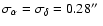 ). ). |
| Open with DEXTER | |
To compute an accurate astrometry for
U-band data is somewhat more difficult than for BVRI data because of the smaller number of
bright stars in the U-band.
This implies that the astrometric solution may heavily rely
on extended sources, for which the emission may peak at different positions
in different bands. The achieved rms astrometric accuracy, measured using
I-band selected point-like sources only, is <
(see Fig. 3). The internal rms, computed from
overlapping sources in different exposures, is much smaller,
.
Photometric calibration was done taking several Landolt fields, so that we had at least one Landolt star in each CCD. Landolt fields were imaged also in B,V to derive the filter color term, for each U-band filter used.
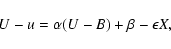
The calibration equation becomes:
 .
This allowed us to compute the extinction coefficient
.
This allowed us to compute the extinction coefficient
 :
a
value close
to that expected for La Silla was obtained. For P2 this was not possible,
so we took the average La Silla extinction coefficient for that period.
Zero points, color terms and extinction coefficients computed for
each pointing are given in Table 2. Recent photometric
investigations (Manfroid et al. 2001) showed that the
zero point changes across the WFI mosaic with a maximum difference of
0.08 mag as a consequence
of non-uniform illumination and scattered light.
As the Landolt fields are not wide enough to cover the whole WFI area and hence to compute
one zero point for each CCD independently, the zero points we obtained represent an average over
the whole mosaic from the different observed Landolt fields. The photometric
accuracy in our data is therefore limited to 0.05 mag, corresponding
to about half the maximum difference in zero
points over the entire WFI mosaic.
:
a
value close
to that expected for La Silla was obtained. For P2 this was not possible,
so we took the average La Silla extinction coefficient for that period.
Zero points, color terms and extinction coefficients computed for
each pointing are given in Table 2. Recent photometric
investigations (Manfroid et al. 2001) showed that the
zero point changes across the WFI mosaic with a maximum difference of
0.08 mag as a consequence
of non-uniform illumination and scattered light.
As the Landolt fields are not wide enough to cover the whole WFI area and hence to compute
one zero point for each CCD independently, the zero points we obtained represent an average over
the whole mosaic from the different observed Landolt fields. The photometric
accuracy in our data is therefore limited to 0.05 mag, corresponding
to about half the maximum difference in zero
points over the entire WFI mosaic.
From the knowledge of the system transmission curves we then computed the AB corrections, that are displayed in the last column of Table 2.
To account for changes in airmass and atmospheric transparency, we used the P HOTOMETRIX package in WIFIX. This package first applies the astrometric solution found for each CCD and then looks for overlapping sources in different CCDs. It then computes for each mosaic (defined as the set of 8 CCDs taken for each exposure) an additional term to the zero point (zr,i) such that the average differences in fluxes of overlapping sources are minimized. An exposure taken in photometric conditions was chosen as reference, so that for it zr,i=0: this image was taken in the same night as the Landolt fields used to make the photometry calibration. Since the P2 and P3 pointings are not connected, and P1 was taken with a different filter, we needed to run this step for each pointing separately.
After the astrometric solutions and flux scaling factors were computed,
image coaddition was done using the SW ARP tool developed by Bertin.
SW ARP allows to subtract the background, resample the images according
to the astrometric solution, apply the flux scaling factor, and
finally combine them. As in the case of the BVRI images, resampling
was done using a "Lanczos-3'' interpolation kernel, which corresponds to a sinc function
multiplied by a windowing function.
The coaddition was
done computing the median of the images to optimize the rejection
of spurious sources as cosmic rays or satellite tracks.
As a consequence of the use of two different filters for the P1 and
P2, P3 pointings, it was not possible to produce a single coadded image for the whole field.
We therefore produced one image for each pointing; the size, pixel scale
(0.205
 pix-1) and orientation of each
image was the same as that of BVRI data so that catalogs can be extracted with the
same
technique (see Paper II). This
allows to extract catalogs using SE XTRACTOR in dual mode, with the
image as reference. In SW ARP, each image may be associated
to a weight-map to properly weight pixels during the coaddition step.
This was particularly useful in the case of the Loiano filter, due
to vignetting in the outer regions. Weight maps were first created
using normalized flat fields; pixels flagged in the Bad Pixel Maps
provided for WFI by ESO
were then set to 0 in the weight map.
For the pointing P1, we also set to 0 those pixels
with a value <0.6 in the normalized flat field, thus allowing
us to remove in the coaddition the regions affected by vignetting.
Figure 4 shows the coadded weight map for P1.
pix-1) and orientation of each
image was the same as that of BVRI data so that catalogs can be extracted with the
same
technique (see Paper II). This
allows to extract catalogs using SE XTRACTOR in dual mode, with the
image as reference. In SW ARP, each image may be associated
to a weight-map to properly weight pixels during the coaddition step.
This was particularly useful in the case of the Loiano filter, due
to vignetting in the outer regions. Weight maps were first created
using normalized flat fields; pixels flagged in the Bad Pixel Maps
provided for WFI by ESO
were then set to 0 in the weight map.
For the pointing P1, we also set to 0 those pixels
with a value <0.6 in the normalized flat field, thus allowing
us to remove in the coaddition the regions affected by vignetting.
Figure 4 shows the coadded weight map for P1.
![\begin{figure}
\par\includegraphics[clip,width=8cm,clip]{0458_f4.ps}
\end{figure}](/articles/aa/full/2004/13/aa0458/img69.gif) |
Figure 4: Weight map produced after coaddition of the P1 pointing. |
| Open with DEXTER | |
A first estimate of the detection limiting magnitude for point-like sources was done
on the background rms map: this map was extracted for each pointing using SE XTRACTOR
and the median background rms ()
was then computed. The limiting
magnitude at 3
and 5
levels is
mag
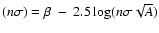 where n = 3, 5,
A is the area of an aperture whose radius is the average
FWHM of point-like sources,
where n = 3, 5,
A is the area of an aperture whose radius is the average
FWHM of point-like sources,
 is the zero point (Eq. (1)).
We obtained
is the zero point (Eq. (1)).
We obtained
 25.8 at 5
and
26.4 at 3.
25.8 at 5
and
26.4 at 3.
Table 3: Completeness and limiting magnitudes and surface brightnesses (mag arcsec-2) derived from simulated point-like and extended sources respectively. All values are in the AB system.
Because of their definition, these values for the limiting magnitudes
refer to the unrealistic case of objects with a flat radial surface
brightness profile.
A more accurate determination of the photometric limits of the survey
was then done as follows.
Catalogs were first extracted using SE XTRACTOR, where
source detection was optimized using simulations of point-like sources.
A background image was computed as outlined in Arnaboldi
et al. (2002); a population of 2000 point-like objects with the same
PSF of bright isolated stars in the field was added on this image,
following a flat magnitude distribution (
 )
and a random spatial distribution: the tasks in the ARTDATA package in
IRAF were used.
SE XTRACTOR was then run on that
image and it was measured how many objects were detected and the faintest
magnitude reached for a given detection threshold.
The number of connected pixels required for source detection was
set to 9 pixels: this gives a minimum signal-to-noise ratio of
3
for a detection threshold 1.
The same process
was repeated 20 times, giving a total of 40 000 sources and around
1500 sources per 0.25 magnitude bin. At the same time, we monitored
the number of spurious sources, by matching the output catalogue from
SE XTRACTOR with the input catalogue.
The optimal threshold was the one that minimized the number of spurious
detections with
)
and a random spatial distribution: the tasks in the ARTDATA package in
IRAF were used.
SE XTRACTOR was then run on that
image and it was measured how many objects were detected and the faintest
magnitude reached for a given detection threshold.
The number of connected pixels required for source detection was
set to 9 pixels: this gives a minimum signal-to-noise ratio of
3
for a detection threshold 1.
The same process
was repeated 20 times, giving a total of 40 000 sources and around
1500 sources per 0.25 magnitude bin. At the same time, we monitored
the number of spurious sources, by matching the output catalogue from
SE XTRACTOR with the input catalogue.
The optimal threshold was the one that minimized the number of spurious
detections with
 ,
without loosing input sources.
Following these tests, we set the detection threshold to
,
without loosing input sources.
Following these tests, we set the detection threshold to
 for the P1 pointing and
  for P2 and P3,
over at least nine connected pixels.
for P2 and P3,
over at least nine connected pixels.
Figure 5 shows the results of the simulations
(detected/input sources).
In Table 3
we list the magnitude of completeness (>90% of the modeled objects
in the input catalog are retrieved) and the limiting magnitude (50%
of the modeled objects retrieved).
The depth of P1 is comparable to that
of P2 and P3 even if the exposure time is lower, since the Loiano filter
is redder than the ESO filter and is thus somewhat more efficient, after
convolution with the atmosphere.
In order to check how many spurious detections should be expected
at different magnitudes, we then run SE XTRACTOR on the background
image before simulated sources were added. The result is displayed in the
histograms in Fig. 5, which show that
there are no spurious detections for magnitudes brighter than
the 90% completeness magnitude; the peak occurs
for magnitudes fainter than the detection limit (
 ).
Residual spurious detections for magnitudes close to the 50% limiting
magnitude are later removed by the cross correlation with the
catalog derived from the
image.
).
Residual spurious detections for magnitudes close to the 50% limiting
magnitude are later removed by the cross correlation with the
catalog derived from the
image.
![\begin{figure}
\par\includegraphics[width=8.8cm,clip]{0458_f5.ps}
\end{figure}](/articles/aa/full/2004/13/aa0458/img82.gif) |
Figure 5: Ratio of detected to input sources as a function of input magnitude: the input catalog consists of simulated point-like sources with a flat magnitude distribution. The dotted lines show the adopted 50% and 90% completeness magnitudes for each pointing. The histograms in the insets show the magnitude distribution of the spurious sources detected in the images with background only and no simulated sources. |
| Open with DEXTER | |
Similar simulations were done using extended sources, to compute the
completeness and limiting surface brightness.
Galaxies with De Vaucouleurs and exponential surface brightness laws were
used as input sources to simulate elliptical and spiral galaxies respectively;
total magnitudes of these sources were in the
range
 .
The same procedure as above was then followed, but
this time we measured the peak surface brightness (defined as the surface
brightness of the brightest pixel) of the simulated and detected sources.
The so obtained values are also given in Table 3.
.
The same procedure as above was then followed, but
this time we measured the peak surface brightness (defined as the surface
brightness of the brightest pixel) of the simulated and detected sources.
The so obtained values are also given in Table 3.
In order to easily combine the catalogs derived from the U and BVRIimages, it was decided to use the BVRI
image catalogue
as reference for the extraction of sources in the U-band.
The BVRI
image catalogue is significantly deeper than the
catalogue which can be derived using only the U-band image; the relative
depths of
the two catalogues can be judged by comparing the surface densities of
objects, 105 per square degree in the
image catalogue
(Paper II), and 104 per square degree in the U band catalogue.
On the other hand, we would measure positive (spurious)
flux in the background-subtracted U frame at the position of sources detected
in the
image even if no significant U source is detected (by
definition a positive flux would be measured in about 50% random positions).
To remove these spurious detections we adopted the following strategy.
For each pointing (P1, P2 and P3), we extracted two catalogs:
image of the BVRI dataset (see Paper II).
 )
and 25 pixels (
)
and 25 pixels (
 )
were computed. As it concerns the required number of
contiguous pixels, we used the same value that was adopted for the
images (see Paper II).
)
were computed. As it concerns the required number of
contiguous pixels, we used the same value that was adopted for the
images (see Paper II).
A cross-correlation was then done between coordinates of sources in
the two catalogs;
a maximum distance of
 was adopted for matching.
In addition, aperture magnitudes (
diameter) were also
used as a further constraint in the cross-correlation: matching sources
were rejected when the difference of U-band magnitudes obtained from
the
and single image catalogues was >0.5 mag.
was adopted for matching.
In addition, aperture magnitudes (
diameter) were also
used as a further constraint in the cross-correlation: matching sources
were rejected when the difference of U-band magnitudes obtained from
the
and single image catalogues was >0.5 mag.
After the cross correlation we computed the average difference between the
magnitudes measured in the single and images: for all the
three pointings we obtain
 mag with rms
values which change from <0.05 mag
for bright sources (
mag with rms
values which change from <0.05 mag
for bright sources (
 )
to 0.1 mag for fainter magnitudes.
Considering (1) the different depths of the U-band and images
and (2) the fact that for extended sources the peak of the emission may be
different in the U-band compared to the bands, we
decided to keep in the final catalog the magnitudes measured on the single
image rather than those computed using the parameters from the
image.
)
to 0.1 mag for fainter magnitudes.
Considering (1) the different depths of the U-band and images
and (2) the fact that for extended sources the peak of the emission may be
different in the U-band compared to the bands, we
decided to keep in the final catalog the magnitudes measured on the single
image rather than those computed using the parameters from the
image.
As a consequence of the dithering strategy, regions close to the border
of the image are covered by a small number of exposures: spurious sources
are therefore produced either by a bad rejection of cosmic rays or
by the high noise. We therefore removed from the catalogs all the
sources located within a given distance from the border. U-band magnitudes
were assigned to sources in the
catalog only when they
were detected in the single-image catalog with a magnitude brighter than
the  limiting magnitude,
 .
For magnitudes brighter than the completeness limit, unmatched sources
are mainly false detections (e.g. halos around bright stars) or sources
not found in the catalog (e.g. because of cosmetic defects).
For fainter magnitudes, spurious detections due to correlated noise are more
important in the single-image catalog (see Fig. 5)
but are removed by the cross correlation with the
catalog.
The requirement on the magnitude helps to reject these spurious
detections, removing
.
For magnitudes brighter than the completeness limit, unmatched sources
are mainly false detections (e.g. halos around bright stars) or sources
not found in the catalog (e.g. because of cosmetic defects).
For fainter magnitudes, spurious detections due to correlated noise are more
important in the single-image catalog (see Fig. 5)
but are removed by the cross correlation with the
catalog.
The requirement on the magnitude helps to reject these spurious
detections, removing  6% of sources for U < 25 mag, 10% for
fainter magnitudes.
6% of sources for U < 25 mag, 10% for
fainter magnitudes.
The separation of extended vs. point-like sources was done on the I-band
catalog, and is described in Paper II: such classification was done
in the range
 ,
that is between the I-band
saturation limit and the magnitude beyond which the separation between resolved
and unresolved sources is less reliable. We verified on the half-light
radius versus U-band magnitude plots that sources classified as point-like
fall on the expected locus. The same plots were also used
to estimate the average seeing in each pointing that is given in
Table 1.
In addition, bright nearby galaxies
which are saturated in the I-band but not in the U-band were
flagged as extended.
,
that is between the I-band
saturation limit and the magnitude beyond which the separation between resolved
and unresolved sources is less reliable. We verified on the half-light
radius versus U-band magnitude plots that sources classified as point-like
fall on the expected locus. The same plots were also used
to estimate the average seeing in each pointing that is given in
Table 1.
In addition, bright nearby galaxies
which are saturated in the I-band but not in the U-band were
flagged as extended.
Finally, we computed for each filter the correction to bring the magnitudes
to the AB system (see Table 2) and the Galactic extinction
correction. The F02 field is characterized by a low interstellar extinction
(see Paper I); according to the Schlegel et al.
(1998) maps
0.023 < E(B-V)< 0.040,
with an average value
 mag.
This translates to an average correction for extinction
mag.
This translates to an average correction for extinction
 mag.
mag.
After catalogs were extracted, for each pointing we assessed the problem of bringing the U-band photometry to a single photometric system. We decided to convert the magnitudes measured in P1 with the Loiano filter to the ESO photometric system, since the latter is closer to the Johnson system. The advantage of doing so, rather than using Eq. (1) to transform both magnitudes to the Johnson system and then computing the internal offset, is given by the fact that we can later use the ESO system transmission curve e.g. for comparison with model predictions.
As shown in Fig. 1,
the P2 and P3 fields taken with the ESO filter partially overlap with
P1. For the overlapping sources, we therefore
have photometry for both the U-band filters; in addition, B-band
photometry is available from the CFHT data.
We first extracted from the catalog bright (
20 < U < 22) point-like sources;
35 and 46 sources were found for P2 vs. P1 and P3 vs. P1 respectively.
From these we solved Eq (1) with no airmass (
 ),
taking the ESO filter as reference (magnitudes not including the AB
correction were used).
Similar results were obtained for both P2 and P3: hence we merged the
two sub-catalogs and finally obtained
),
taking the ESO filter as reference (magnitudes not including the AB
correction were used).
Similar results were obtained for both P2 and P3: hence we merged the
two sub-catalogs and finally obtained
 ,
,
 in
Eq. (1). The
color term, as expected, is intermediate between the values found for the two filters
from the calibration with standard
stars (see Table 2). In Fig. 6 we show the
differences in magnitudes of both point-like and extended sources in
the overlapping areas of the two filters before and after color correction.
The average offset in magnitude after the correction is -0.01 mag (P1 vs. P2) and
0.04 mag (P1 vs. P3), with an rms 0.1.
The same plot also provides an indirect check that photometry in P2
and P3 is consistent, as each of them is consistent with the P1 photometry
in the overlapping areas.
in
Eq. (1). The
color term, as expected, is intermediate between the values found for the two filters
from the calibration with standard
stars (see Table 2). In Fig. 6 we show the
differences in magnitudes of both point-like and extended sources in
the overlapping areas of the two filters before and after color correction.
The average offset in magnitude after the correction is -0.01 mag (P1 vs. P2) and
0.04 mag (P1 vs. P3), with an rms 0.1.
The same plot also provides an indirect check that photometry in P2
and P3 is consistent, as each of them is consistent with the P1 photometry
in the overlapping areas.
The consistency with magnitudes obtained in the Johnson system by
applying the color terms listed in Table 2 was checked as follows.
Both the ESO and Loiano magnitudes were first transformed to the
Johnson system. The same procedure as above was
then followed to compute the offset between the Loiano and ESO photometry:
we found  as expected and
 mag. Loiano magnitudes
were then transformed to the ESO system as discussed above, and then to the
Johnson system. The agreement is within
0.08 mag in the range
-2 < (U-B)<2.
mag. Loiano magnitudes
were then transformed to the ESO system as discussed above, and then to the
Johnson system. The agreement is within
0.08 mag in the range
-2 < (U-B)<2.
In order to check the data quality of the U-band photometry, we performed a series of tests where we (i) compared colors of point-like and extended sources to those expected for stars and field galaxies; (ii) checked the number counts of galaxies and compared them with existing data in literature. In this analysis, magnitudes in the P1 pointing were first transformed to the ESO filter photometric system as described in Sect. 3.3; for those sources which were observed with both the Loiano and the ESO filter, the latter magnitude data were taken. In the final catalog, magnitudes are corrected for Galactic extinction.
![\begin{figure}
\par\includegraphics[width=8.8cm,clip]{0458_f6.ps}
\end{figure}](/articles/aa/full/2004/13/aa0458/img100.gif) |
Figure 6:
Difference in aperture magnitudes (5
diameter) of
point-like and extended bright (
18 < U < 22) sources taken with both the
ESO (U360) and Loiano (UL) filters.
B-band fluxes were taken from the VIRMOS catalog.
The upper and middle panels show the differences in magnitudes before (left)
and after (right) the color correction is applied (squares: P2; dots:
P3). In the bottom panel (U-B) colors from the Loiano and ESO filters
are compared. |
| Open with DEXTER | |
We first compared the colors of bright (
 )
point-like sources
with those obtained from the convolution of stellar templates (Pickles
1998) with the system transmission curves (filter + telescope
+ CCD + atmosphere). No correction for Galactic extinction is applied
in this case.
The result is displayed in Fig. 7:
it can be seen that the agreement is good only for
)
point-like sources
with those obtained from the convolution of stellar templates (Pickles
1998) with the system transmission curves (filter + telescope
+ CCD + atmosphere). No correction for Galactic extinction is applied
in this case.
The result is displayed in Fig. 7:
it can be seen that the agreement is good only for
 .
This
is expected since for bluer colors the low-metallicity stellar population
from the halo dominates over the disk population with solar metallicity.
We therefore computed the colors produced using the Kurucz model atmospheres
(Kurucz 1979) with
.
This
is expected since for bluer colors the low-metallicity stellar population
from the halo dominates over the disk population with solar metallicity.
We therefore computed the colors produced using the Kurucz model atmospheres
(Kurucz 1979) with
 and [M/H]=0.0, -5.0
to reproduce solar and sub-solar metallicities (see also Lenz et al.
1998). As displayed again in Fig. 7, the
apparent excess in (U-B) is in agreement with the colors produced by the
low-metallicity model.
The absence of observed stars at redder colors (
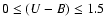
(U-B)> 2.5) is due to
the cut in the U-band magnitudes, as it is explained later in more detail.
Most of the sources outside the
stellar locus with an ultraviolet excess (
(U-B)< 0.6) are likely to be
quasars at z < 2.2.
and [M/H]=0.0, -5.0
to reproduce solar and sub-solar metallicities (see also Lenz et al.
1998). As displayed again in Fig. 7, the
apparent excess in (U-B) is in agreement with the colors produced by the
low-metallicity model.
The absence of observed stars at redder colors (
(U-B)> 2.5) is due to
the cut in the U-band magnitudes, as it is explained later in more detail.
Most of the sources outside the
stellar locus with an ultraviolet excess (
(U-B)< 0.6) are likely to be
quasars at z < 2.2.
![\begin{figure}
\par\includegraphics[angle=270,width=8.8cm,clip]{0458_f7.ps}
\end{figure}](/articles/aa/full/2004/13/aa0458/img103.gif) |
Figure 7:
Comparison of colors for bright (
)
point-like
sources (dots) with: the library from Pickles (1998)
(stars);
the Kurucz model atmospheres (Kurucz 1979) with
,
[M/H]=0 (lower curve) and [M/H]=-5.0 (upper curve). Magnitudes
in P1 were trasformed to the ESO filter photometric system. |
| Open with DEXTER | |
In order to verify whether the color distribution we obtained is consistent
with that expected in our Galaxy, we show in Fig. 8
(top) the synthetic color-magnitude (CM) diagram ((B-V) vs. I) for a region
of sky centered on P1 and a size of 0.9
(Degl'Innocenti & Cignoni,
private communication). The code and recipes described in
Castellani et al. (2002) were used to this aim: the code provides
BVRI magnitudes for a Galactic stellar population model, including
halo, disk and thick disk components.
We selected from the simulations those sources with
as this is the range where the point-like classification
was done in our data.
We expect to find only halo stars (i.e. metal
poor objects) around
 ,
a mix of halo and thick disk stars
in the interval
0.5< (B-V)<1.4, and mainly disk stars (metal rich
objects) around
,
a mix of halo and thick disk stars
in the interval
0.5< (B-V)<1.4, and mainly disk stars (metal rich
objects) around
 .
Figure 7 shows that (U-B)> 2 when (B-V)> 1:
therefore, when we compare simulated and observed color distributions we need
to take into account the selection introduced by the cut in the
U-band magnitude,
.
As the models do not provide
U-band magnitudes, we proceed as follows. The limits (U-B)> 2 and
imply that
.
Figure 7 shows that (U-B)> 2 when (B-V)> 1:
therefore, when we compare simulated and observed color distributions we need
to take into account the selection introduced by the cut in the
U-band magnitude,
.
As the models do not provide
U-band magnitudes, we proceed as follows. The limits (U-B)> 2 and
imply that
 .
From (B-V)> 1 we obtain
.
From (B-V)> 1 we obtain
 .
Finally, Fig. 15 in Paper II shows that
(V-I)> 1 when (B-V)> 1: we therefore obtain
.
Finally, Fig. 15 in Paper II shows that
(V-I)> 1 when (B-V)> 1: we therefore obtain
 .
.
![\begin{figure}
\par\includegraphics[angle=270,width=8.8cm,clip]{0458_f8a.ps}\par\includegraphics[angle=270,width=8.8cm,clip]{0458_f8b.ps}
\end{figure}](/articles/aa/full/2004/13/aa0458/img109.gif) |
Figure 8:
Comparison of simulated and observed (B-V) colors vs. Imagnitudes. Top: color-magnitude diagram. The upper panel
shows the synthetic colors expected in the F02 area.
The lower panel shows the observed colors for U-band selected
(
)
point-like sources from the three pointings; the cuts
at the faint and bright end are due to the fact that the selection
of point-like vs. extended sources was done in the range
only. The solid line indicates the separation
between halo and disk/thick disk stars.
Bottom: The same as above, but plotted as a histogram. |
| Open with DEXTER | |
![\begin{figure}
\par\includegraphics[angle=270,width=8.8cm,clip]{0458_f9.ps}
\end{figure}](/articles/aa/full/2004/13/aa0458/img110.gif) |
Figure 9:
 vs.
vs.
 colors for extended sources
with
colors for extended sources
with
 .
Colors are displayed as a grey-scale map
where the level is proportional to the number of sources in a given
color bin. Model tracks for early to late type galaxies are also displayed
(starting from right to the left);
the positions of lower and upper redshift are indicated by the filled
and open circles respectively. Magnitudes in P1 were transformed to
the ESO filter photometric system. The four panels show sources in
different bins of .
Colors are displayed as a grey-scale map
where the level is proportional to the number of sources in a given
color bin. Model tracks for early to late type galaxies are also displayed
(starting from right to the left);
the positions of lower and upper redshift are indicated by the filled
and open circles respectively. Magnitudes in P1 were transformed to
the ESO filter photometric system. The four panels show sources in
different bins of
 ,
as follows. a) ,
as follows. a)
 ,
model tracks:
0.0 < z < 0.2. b) ,
model tracks:
0.0 < z < 0.2. b)
 ,
model
tracks:
0.0 < z < 0.4. c) ,
model
tracks:
0.0 < z < 0.4. c)
 ,
model tracks:
0.0 < z < 0.8. d) ,
model tracks:
0.0 < z < 0.8. d)
 ,
model tracks:
0.0 < z
< 1.5. The value in the top left corner is the fraction of galaxies
detected in the U-band with respect to those detected in the I-band,
in each bin. ,
model tracks:
0.0 < z
< 1.5. The value in the top left corner is the fraction of galaxies
detected in the U-band with respect to those detected in the I-band,
in each bin.
|
| Open with DEXTER | |
The same diagram is plotted in
Fig. 8 for the point-like sources in the VIRMOS deep
field which were detected in the U-band. An exact match
with the number of disk stars can not be expected as the selection
due to the cut in the U-band was taken into account in an approximate way.
The position of the two clumps
centered at
and
is clearly visible
(Fig. 8, bottom). This confirms that
the (U-B) excess seen in Fig. 7 is due to the halo stars in the
F02 field.
![\begin{figure}
\par\includegraphics[angle=270,width=8.8cm,clip]{0458_f10.ps}
\end{figure}](/articles/aa/full/2004/13/aa0458/img111.gif) |
Figure 10: Galaxy magnitude-number counts from the VIRMOS U-band deep field compared with existing literature data. U-band magnitudes are in Vega system. The filled circles show the VIRMOS data (statistical error bars are displayed but are too small to be seen); magnitudes from P1 were transformed to the ESO filter photometric system. Literature data are taken from the N. Metcalfe's collection. The dotted line shows the best fit computed in the range 18.5 < U < 22.5. The dot-dashed lines show the 90% and 50% completeness limits. The histogram displays the number counts corrected for incompleteness (see text for details). |
| Open with DEXTER | |
and
colors were
compared with those obtained from model galactic spectra convolved
with the system transmission curves. This was done using the MAKE_CATALOG
tool which is part of the HYPERZ package (Bolzonella et al. 2000):
we used the built-in set of templates for early to late- type galaxies
computed from the GISSEL98 spectral evolution library of Bruzual &
Charlot (1993). As in Paper II, we divided our catalog
of U-band detected extended sources in different bins of
magnitude. Late-type galaxies are expected to increasingly
dominate in the color distribution as we go to fainter magnitudes:
early-type galaxies with faint I magnitude are too faint to be included
in the U-band catalog.
(i)
.
The brightest galaxies are clearly
dominated by a low redshift population, z < 0.2, of early to late-type
galaxies (Fig. 9a).
(ii)
.
In Paper II it is shown
that (B-V) vs. (V-I) colors for these galaxies are in agreement with
those expected for a population of galaxies with
z = 0.0-0.5. The
median redshift expected for this magnitude range is  ,
according to spectroscopic surveys like the CFRS (Crampton et al.
1995).
Consistent results are found looking at the (U-B) vs. (V-I) colors
(Fig. 9b), where early to late type galaxies are all
seen to contribute to the observed colors.
,
according to spectroscopic surveys like the CFRS (Crampton et al.
1995).
Consistent results are found looking at the (U-B) vs. (V-I) colors
(Fig. 9b), where early to late type galaxies are all
seen to contribute to the observed colors.
(iii)
.
The colors
are well reproduced by a population dominated by late type
galaxies with
 ,
with a peak at
,
with a peak at
 (Fig. 9c).
(iv)
.
The limiting magnitude
 implies that in this range we mainly
select galaxies with bluer colors (
implies that in this range we mainly
select galaxies with bluer colors (
 ):
most of these are likely to be late type galaxies at z < 1,
with some contribution from higher redshift galaxies
(Fig. 9d). Note that in this magnitude range
less than 30% of the galaxies are detected in the
U-band.
):
most of these are likely to be late type galaxies at z < 1,
with some contribution from higher redshift galaxies
(Fig. 9d). Note that in this magnitude range
less than 30% of the galaxies are detected in the
U-band.
The comparison of number counts of galaxies with literature data provides
a good check for both the efficiency of the star-galaxy separation
(done in the I-band in our case) and the quality of our photometry.
For U-band data, this is complicated by the few published number counts
and by the heterogeneity of the data (e.g. different photometric systems,
no correction for galactic reddening). A collection of U-band number
counts is provided in the Vega-system by Metcalfe
(http://star-www.dur.ac.uk/~nm/, see also
Metcalfe et al. 2001); we selected only those measurements
from CCD observations. They are displayed in Fig. 10.
The offset among the different measurements is due to both the different
U-band filters and the absence of reddening correction for some of the
literature number counts. For example, in the case of Metcalfe WHDF data
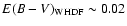 ,
so that after dereddening the WHDF number counts
should be shifted by -0.1 mag (Heidt et al. 2003).
,
so that after dereddening the WHDF number counts
should be shifted by -0.1 mag (Heidt et al. 2003).
The U-band VIRMOS number counts were normalized to the area covered by the
unmasked regions, taking into account the overlapping regions
( ). Number counts not corrected for incompleteness are
displayed as filled circles in Fig. 10.
Our data are in very good agreement with those of Arnouts et al.
(2001), which were also taken with ESO/WFI. A least-squares
fit in the range
18.5 < U <22.5 gives a slope
). Number counts not corrected for incompleteness are
displayed as filled circles in Fig. 10.
Our data are in very good agreement with those of Arnouts et al.
(2001), which were also taken with ESO/WFI. A least-squares
fit in the range
18.5 < U <22.5 gives a slope
 .
The histogram in Fig. 10 shows the number counts corrected
for the ratios of input to detected sources displayed in Fig. 5
(Sect. 3.1): after this correction, number counts are in agreement
with the extrapolation from brighter magnitudes up to
.
The histogram in Fig. 10 shows the number counts corrected
for the ratios of input to detected sources displayed in Fig. 5
(Sect. 3.1): after this correction, number counts are in agreement
with the extrapolation from brighter magnitudes up to
 (
(
 ).
).
U-band data obtained in the framework of the VIRMOS preparatory imaging
survey for the F02 deep field were presented in this paper, as a complement
to the
data presented in Paper II. Observations, data reduction
and catalog extraction issues were first discussed. Various quality
assessment tests were then performed. A good agreement is found between
the observed stellar colors and those computed from the
Kurucz model atmospheres;
a component with sub-solar metallicity is required to fit the halo stellar
population which dominates over the disk population for
(U-B)< 1.5.
This is confirmed by the comparison with the color distribution of stars
in our Galaxy based on the Castellani et al. (2002) model.
The colors of extended sources were compared with those obtained from
template spectra of galaxies. These tests also allowed to check the
photometric consistency
of U-band and
data. Number counts for extended sources were
finally computed
and compared with other U-band data in literature.
Acknowledgements
We wish to thank Scilla Degl'Innocenti for having kindly provided to us the simulated data for the Galactic stellar population. We also thank Fernando Selman and the ESO La Silla 2.2m team who sent us the transmission curve of the Loiano filter. Data analysis and plots were done using the Perl Data Language (PDL), which is freely available from "http://pdl.perl.org''; PDL is a powerful vectorized data manipulation language derived from perl. This paper made use of the NASA/IPAC Extragalactic Database (NED) which is operated by the Jet Propulsion Laboratory, California Institute of Technology, under contract with the National Aeronautics and Space Administration. M.R., Y.M. and E.B. were partly funded by the European RTD contract HPRI-CT-2001-50029 "AstroWise''. Part of this work was also supported by the Italian Ministry for University and Research (MURST) under the grant COFIN-2000-02-34.