![\begin{figure}
\par\includegraphics[width=6cm,angle=270,clip]{0458_f1a.ps} \includegraphics[width=6cm,angle=270,clip]{0458_f1b.ps}
\end{figure}](/articles/aa/full/2004/13/aa0458/img47.gif) |
Figure 1:
The VIRMOS F02 deep field. The images of the three pointings (P1, P2
and P3) are here combined for display purposes only: they have been treated
separately in data reduction and catalog extraction.
The full field is displayed in the upper plot. The outer solid-line
rectangle shows the position of the
  field taken in the
  bands. Overlaid
are the images of the three U-band pointings; masked areas at the borders
of the images were removed. Note the circular shape of the
P1 pointing, due to vignetting in the Loiano filter.
The region in the inner box, where P1 and P3 overlap,
is the one zoomed in the bottom plot: the accuracy of the astrometry can be seen
from the absence of double sources. bands. Overlaid
are the images of the three U-band pointings; masked areas at the borders
of the images were removed. Note the circular shape of the
P1 pointing, due to vignetting in the Loiano filter.
The region in the inner box, where P1 and P3 overlap,
is the one zoomed in the bottom plot: the accuracy of the astrometry can be seen
from the absence of double sources. |
| Open with DEXTER | |
In the text
![\begin{figure}
\par\mbox{\includegraphics[width=5cm,angle=270,clip]{0458_f2.ps} }\end{figure}](/articles/aa/full/2004/13/aa0458/img57.gif) |
Figure 2: Transmission curves of the Loiano and ESO U/360 filters; curves before (dashed) and after (solid) the convolution with the CCD, telescope and atmosphere transmission are displayed. Note the red leak for the Loiano filter. |
| Open with DEXTER | |
In the text
![\begin{figure}
\par {\hspace*{3.5mm}\includegraphics[clip,width=6.1cm,clip]{0458...
...}}
\par\includegraphics[angle=270,clip,width=7cm,clip]{0458_f3b.ps}
\end{figure}](/articles/aa/full/2004/13/aa0458/img65.gif) |
Figure 3:
Astrometric residuals for unsaturated, point-like sources over the
full field (P1, P2 and P3). Up: radial residuals; the inner and outer
circles enclose 68% (
 )
and 90% ( )
and 90% (
 )
of the sources respectively; the cross shows the centroid, ( )
of the sources respectively; the cross shows the centroid, (
 , ,
 ,
0.03 ,
0.03
 ). Bottom: residuals are
displayed versus right ascension and declination; the lines display
the residuals per coordinate (68%: ). Bottom: residuals are
displayed versus right ascension and declination; the lines display
the residuals per coordinate (68%:
 , ,
 ;
90%: ;
90%:
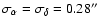 ). ). |
| Open with DEXTER | |
In the text
![\begin{figure}
\par\includegraphics[clip,width=8cm,clip]{0458_f4.ps}
\end{figure}](/articles/aa/full/2004/13/aa0458/img69.gif) |
Figure 4: Weight map produced after coaddition of the P1 pointing. |
| Open with DEXTER | |
In the text
![\begin{figure}
\par\includegraphics[width=8.8cm,clip]{0458_f5.ps}
\end{figure}](/articles/aa/full/2004/13/aa0458/img82.gif) |
Figure 5: Ratio of detected to input sources as a function of input magnitude: the input catalog consists of simulated point-like sources with a flat magnitude distribution. The dotted lines show the adopted 50% and 90% completeness magnitudes for each pointing. The histograms in the insets show the magnitude distribution of the spurious sources detected in the images with background only and no simulated sources. |
| Open with DEXTER | |
In the text
![\begin{figure}
\par\includegraphics[width=8.8cm,clip]{0458_f6.ps}
\end{figure}](/articles/aa/full/2004/13/aa0458/img100.gif) |
Figure 6:
Difference in aperture magnitudes (5
diameter) of
point-like and extended bright (
18 < U < 22) sources taken with both the
ESO (U360) and Loiano (UL) filters.
B-band fluxes were taken from the VIRMOS catalog.
The upper and middle panels show the differences in magnitudes before (left)
and after (right) the color correction is applied (squares: P2; dots:
P3). In the bottom panel (U-B) colors from the Loiano and ESO filters
are compared. |
| Open with DEXTER | |
In the text
![\begin{figure}
\par\includegraphics[angle=270,width=8.8cm,clip]{0458_f7.ps}
\end{figure}](/articles/aa/full/2004/13/aa0458/img103.gif) |
Figure 7:
Comparison of colors for bright (
 )
point-like
sources (dots) with: the library from Pickles (1998)
(stars);
the Kurucz model atmospheres (Kurucz 1979) with )
point-like
sources (dots) with: the library from Pickles (1998)
(stars);
the Kurucz model atmospheres (Kurucz 1979) with
 ,
[M/H]=0 (lower curve) and [M/H]=-5.0 (upper curve). Magnitudes
in P1 were trasformed to the ESO filter photometric system. ,
[M/H]=0 (lower curve) and [M/H]=-5.0 (upper curve). Magnitudes
in P1 were trasformed to the ESO filter photometric system. |
| Open with DEXTER | |
In the text
![\begin{figure}
\par\includegraphics[angle=270,width=8.8cm,clip]{0458_f8a.ps}\par\includegraphics[angle=270,width=8.8cm,clip]{0458_f8b.ps}
\end{figure}](/articles/aa/full/2004/13/aa0458/img109.gif) |
Figure 8:
Comparison of simulated and observed (B-V) colors vs. Imagnitudes. Top: color-magnitude diagram. The upper panel
shows the synthetic colors expected in the F02 area.
The lower panel shows the observed colors for U-band selected
(
)
point-like sources from the three pointings; the cuts
at the faint and bright end are due to the fact that the selection
of point-like vs. extended sources was done in the range
 only. The solid line indicates the separation
between halo and disk/thick disk stars.
Bottom: The same as above, but plotted as a histogram.
only. The solid line indicates the separation
between halo and disk/thick disk stars.
Bottom: The same as above, but plotted as a histogram. |
| Open with DEXTER | |
In the text
![\begin{figure}
\par\includegraphics[angle=270,width=8.8cm,clip]{0458_f9.ps}
\end{figure}](/articles/aa/full/2004/13/aa0458/img110.gif) |
Figure 9:
 vs.
vs.
 colors for extended sources
with
colors for extended sources
with
 .
Colors are displayed as a grey-scale map
where the level is proportional to the number of sources in a given
color bin. Model tracks for early to late type galaxies are also displayed
(starting from right to the left);
the positions of lower and upper redshift are indicated by the filled
and open circles respectively. Magnitudes in P1 were transformed to
the ESO filter photometric system. The four panels show sources in
different bins of .
Colors are displayed as a grey-scale map
where the level is proportional to the number of sources in a given
color bin. Model tracks for early to late type galaxies are also displayed
(starting from right to the left);
the positions of lower and upper redshift are indicated by the filled
and open circles respectively. Magnitudes in P1 were transformed to
the ESO filter photometric system. The four panels show sources in
different bins of
 ,
as follows. a) ,
as follows. a)
 ,
model tracks:
0.0 < z < 0.2. b) ,
model tracks:
0.0 < z < 0.2. b)
 ,
model
tracks:
0.0 < z < 0.4. c) ,
model
tracks:
0.0 < z < 0.4. c)
 ,
model tracks:
0.0 < z < 0.8. d) ,
model tracks:
0.0 < z < 0.8. d)
 ,
model tracks:
0.0 < z
< 1.5. The value in the top left corner is the fraction of galaxies
detected in the U-band with respect to those detected in the I-band,
in each bin. ,
model tracks:
0.0 < z
< 1.5. The value in the top left corner is the fraction of galaxies
detected in the U-band with respect to those detected in the I-band,
in each bin.
|
| Open with DEXTER | |
In the text
![\begin{figure}
\par\includegraphics[angle=270,width=8.8cm,clip]{0458_f10.ps}
\end{figure}](/articles/aa/full/2004/13/aa0458/img111.gif) |
Figure 10: Galaxy magnitude-number counts from the VIRMOS U-band deep field compared with existing literature data. U-band magnitudes are in Vega system. The filled circles show the VIRMOS data (statistical error bars are displayed but are too small to be seen); magnitudes from P1 were transformed to the ESO filter photometric system. Literature data are taken from the N. Metcalfe's collection. The dotted line shows the best fit computed in the range 18.5 < U < 22.5. The dot-dashed lines show the 90% and 50% completeness limits. The histogram displays the number counts corrected for incompleteness (see text for details). |
| Open with DEXTER | |
In the text