 Pictoris dust stream
A&A 417, 341-352 (2004)
DOI: 10.1051/0004-6361:20034379
Pictoris dust streamA. V. Krivov 1,![[*]](/icons/foot_motif.gif) -
N. A. Krivova2,
-
S. K. Solanki 2 -
V. B. Titov 3
-
N. A. Krivova2,
-
S. K. Solanki 2 -
V. B. Titov 3
1 - Institute of Physics, University of Potsdam,
PO Box 601553, 14415 Potsdam, Germany
2 -
Max-Planck-Institute for Aeronomy,
Max-Planck-Strasse 2, 37191 Katlenburg-Lindau,
Germany
3 -
Astronomical Institute, St. Petersburg University,
Stary Peterhof,
198504 St. Petersburg, Russia
Received 22 September 2003 / Accepted 26 November 2003
Abstract
The recent radar detection by Baggaley (2000) of a collimated stream of
interstellar meteoroids postulated to be sourced at Pictoris, a
nearby star with a prominent dust disk, presents a challenge to theoreticians.
Two mechanisms of possible dust ejection from Pic
have been proposed: ejection of dust by radiation pressure from comets
in eccentric orbits and by gravity of a hypothetical planet in the disk.
Here we re-examine observational data and reconsider theoretical
scenarios, substantiating them with detailed modeling
to test whether they can explain quantitatively and simultaneously
the masses, speeds, and fluxes.
Our analysis of the stream geometry and kinematics
confirms that Pic is the most likely source of the stream
and suggests that an intensive dust ejection phase took place  0.7 Myr ago.
Our dynamical simulations show that high ejection speeds retrieved from the
observations can be explained by both planetary ejection and radiation pressure
mechanisms, providing, however, several important constraints.
In the planetary ejection scenario, only a "hot Jupiter''-type planet with a
semimajor axis of less than 1 AU can be responsible for the stream, and only if
the disk was dynamically "heated'' by a more distant massive planet.
The radiation pressure scenario also requires the presence of a
relatively massive planet at several AU or more, that had heated the cometesimal
disk before the ejection occurred.
Finally, the dust flux measured at Earth can be brought into reasonable
agreement with both scenarios, provided that Pic's
protoplanetary disk recently passed through an intensive short-lasting
(0.1 Myr) clearance stage by nascent giant planets, similar to what
took place in the early solar system.
0.7 Myr ago.
Our dynamical simulations show that high ejection speeds retrieved from the
observations can be explained by both planetary ejection and radiation pressure
mechanisms, providing, however, several important constraints.
In the planetary ejection scenario, only a "hot Jupiter''-type planet with a
semimajor axis of less than 1 AU can be responsible for the stream, and only if
the disk was dynamically "heated'' by a more distant massive planet.
The radiation pressure scenario also requires the presence of a
relatively massive planet at several AU or more, that had heated the cometesimal
disk before the ejection occurred.
Finally, the dust flux measured at Earth can be brought into reasonable
agreement with both scenarios, provided that Pic's
protoplanetary disk recently passed through an intensive short-lasting
(0.1 Myr) clearance stage by nascent giant planets, similar to what
took place in the early solar system.
Key words: meteors, meteoroids -
stars: individual: Pic -
stars: circumstellar matter -
stars: planetary systems -
celestial mechanics -
methods: N-body simulations
After the discovery of circumstellar dust around Vega by IR excess
(Harvey et al. 1984; Blackwell et al. 1983) and the first images
of an extended dust disk around Pictoris (Smith & Terrile 1984) it
was quickly realized (Weissman 1984) that dust disks around
main-sequence stars are not primordial and are signposts of cometary or
asteroidal bodies.
This led to a direct analogy with our solar system, the
only planetary system known at that time.
The question of whether planets or protoplanets exist in these systems
was raised by the first detection of an extrasolar planet
orbiting a main-sequence star (Mayor & Queloz 1995).
The general view that extrasolar planetary systems,
like our solar system, must comprise both planets and minor body populations
is now widely recognized, conforming both to observational facts and planetary
formation theories (Krivova 2002).
Pictoris, a  year-old (Ortega et al. 2002)
main-sequence star with a
prominent extended dust disk provides a good example.
It is now widely believed (Lecavelier des Etangs 2000; Artymowicz 1997)
that Pic is most likely a planetary
system at a late stage of planet formation, comprising
populations of km-sized solids (planetesimals and/or cometesimals that act
as a source of visible dust) and one (or several) giant planets or
protoplanets (although the direct evidence for these is still lacking).
year-old (Ortega et al. 2002)
main-sequence star with a
prominent extended dust disk provides a good example.
It is now widely believed (Lecavelier des Etangs 2000; Artymowicz 1997)
that Pic is most likely a planetary
system at a late stage of planet formation, comprising
populations of km-sized solids (planetesimals and/or cometesimals that act
as a source of visible dust) and one (or several) giant planets or
protoplanets (although the direct evidence for these is still lacking).
Although the Pic system seems to be unique in many respects
among a hundred known stars with debris disks (Lecavelier des Etangs 2000),
it came as a surprise when Baggaley (2000),
using the Advanced Meteor Orbit Radar (AMOR) in New Zealand,
detected a collimated stream of interstellar radio meteors
and identified its source as Pic.
Confirmation of the Pic source would
offer a powerful tool for studies
of other planetary systems: in situ measurements of material coming from
other suns.
The issue has become unclear, however, with the realization that (i) a detectable dust flux at Earth inevitably translates to a high
mass loss rate at the source, and (ii) measured speeds of the stream
particles at Earth translate to very high (
 )
ejection speeds of dust grains from the source.
)
ejection speeds of dust grains from the source.
So far, two mechanisms have been suggested.
Grün & Landgraf (2001) have proposed a radiation pressure ejection of
material from highly eccentric parent bodies (comets or cometesimals)
in the circumstellar disk near periastra of their orbits.
Krivova & Solanki (2003) have
conjectured ejection of dust by a nascent planet in the Pictoris
disk.
Note that the radiation pressure scenario is not "planet-free'' either:
a planet is required to force parent bodies of the ejected dust into nearly
star-grazing orbits. Furthermore, a planet is needed anyway to explain
observed falling-evaporating bodies (FEBs), introduced as an
interpretation of frequent, transient, mostly
redshifted spectral events observed for many years
(Thébault & Beust 2001; Beust & Morbidelli 1996,2000; Beust et al. 1989,1996; Lagrange et al. 1987; Beust et al. 1991).
The goal of this paper is to reconsider both the observational data
and the theoretical scenarios in an attempt to explain the phenomenon.
In Sect. 2, observational data about the meteoroid stream and the
Pic system are discussed.
Then we consider the "speed'' problem, checking both the planetary ejection
(Sect. 3) and the radiation pressure ejection scenarios (Sect. 4)
and finding constraints on the presumed planet(s) and dust
parent bodies in the Pic system.
Section 5 addresses the "flux problem''.
Our conclusions are presented in Sect. 6.
The following properties of the stream have been derived
(Baggaley & Galligan 2001; Baggaley 2000):
(i) the dust particles are large, with masses 
 or radii
 .
(ii) Analysis of heliocentric velocities and local stellar kinematics implies
ejection from the Pictoris system at speeds
,
so that,
for a distance to Pic of 19.3 pc
(Crifo et al. 1997), they must have left the
system about 1 Myr ago.
(iii) The flux is hard to quantify, given the uncertainties
in the absolute radar detection calibration arising from the plasma creation
dependence on meteoroid speed and mass,
corrections for reflection process and the radar response function.
Based upon 3 detections per day (which is an upper
limit suggested by the data available for several years) and an
effective radar collecting area of
.
(ii) Analysis of heliocentric velocities and local stellar kinematics implies
ejection from the Pictoris system at speeds
,
so that,
for a distance to Pic of 19.3 pc
(Crifo et al. 1997), they must have left the
system about 1 Myr ago.
(iii) The flux is hard to quantify, given the uncertainties
in the absolute radar detection calibration arising from the plasma creation
dependence on meteoroid speed and mass,
corrections for reflection process and the radar response function.
Based upon 3 detections per day (which is an upper
limit suggested by the data available for several years) and an
effective radar collecting area of
 for the radar
antenna configuration (Baggaley, pers. comm.),
the estimated flux at Earth is
for the radar
antenna configuration (Baggaley, pers. comm.),
the estimated flux at Earth is
 .
Of course, this value refers to particles with radii
above
,
which fall into the sensitivity range of the radar.
.
Of course, this value refers to particles with radii
above
,
which fall into the sensitivity range of the radar.
We now check the conclusion that Pic is the likely source of the
meteoroid stream on the basis of stellar and dust kinematics calculations.
The idea is to write down and solve simple equations of dust
propagation between a candidate star and the Sun and to check whether
that star is compatible with being the source of the observed stream.
![\begin{figure}
\par\includegraphics[width=5.6cm,clip]{0379fig1.eps}
\end{figure}](/articles/aa/full/2004/13/aa0379/img32.gif) |
Figure 1: Geometry of propagation of dust (D) between the source star (B) and the Sun (S) in the heliocentric reference frame. The symbols are explained in the text. |
| Open with DEXTER | |
Consider the candidate star, the Sun, and a dust grain
(Fig. 1).
Kinematical quantities related to them will be marked by subscripts B, S and D, respectively. To distinguish between the moment of dust ejection t0 and the moment of observation (i.e., the present time) t1 we will add "0'' and "1'' to these subscripts, when
necessary. The radius vector and velocity of an object "P''
relative to object "Q'' will be denoted by
 and
and
 .
We assume a rectilinear motion
of B, S, and D with a constant speed.
This is a good approximation
for B and S on timescales of
.
We assume a rectilinear motion
of B, S, and D with a constant speed.
This is a good approximation
for B and S on timescales of  1 Myr
(Ortega et al. 2002) as well as for the dust particles.
Indeed, the dust grains, owing
to their relatively large sizes, are not subject to any non-gravitational
forces (Baggaley & Neslusan 2002).
The gravity of other stars is not likely to bend the dust grain trajectories
either. To deflect a grain trajectory by several degrees, a star
of a solar mass should pass by the grain during its flight from Pic at
a distance of
1 Myr
(Ortega et al. 2002) as well as for the dust particles.
Indeed, the dust grains, owing
to their relatively large sizes, are not subject to any non-gravitational
forces (Baggaley & Neslusan 2002).
The gravity of other stars is not likely to bend the dust grain trajectories
either. To deflect a grain trajectory by several degrees, a star
of a solar mass should pass by the grain during its flight from Pic at
a distance of
 .
Given the stellar density in the neighborhood of
the Sun of 0.1 pc-3, typical stellar velocities of
.
Given the stellar density in the neighborhood of
the Sun of 0.1 pc-3, typical stellar velocities of
 ,
and the propagation time of the dust stream of 1 Myr, the probability of such an event is about 10-7.
The equations of motion of the objects give:
,
and the propagation time of the dust stream of 1 Myr, the probability of such an event is about 10-7.
The equations of motion of the objects give:
 .
Note that our method is different from that of Baggaley (2000).
Instead of considering the motion of the candidate stars and the Sun
with respect to the LSR which are not free of large uncertainties, we use
U,V,W components of the star's velocity with respect to the Sun, which are
direct observables:
.
Note that our method is different from that of Baggaley (2000).
Instead of considering the motion of the candidate stars and the Sun
with respect to the LSR which are not free of large uncertainties, we use
U,V,W components of the star's velocity with respect to the Sun, which are
direct observables:
 .
The
.
The  in each component is typically
 ,
so we independently vary all three within a
,
so we independently vary all three within a  range when solving the equations.
We also use the observed location (uncertainty
range when solving the equations.
We also use the observed location (uncertainty  )
of the centroid of the far-Sun upstream inflow directions (solar gravity
removed) on the celestial sphere: ecliptic latitude
)
of the centroid of the far-Sun upstream inflow directions (solar gravity
removed) on the celestial sphere: ecliptic latitude  and
longitude
and
longitude  and observed angular size about
  ,
as
reported by Baggaley (2000).
Next, the heliocentric entry speed of the particles derived from
the observations, from 9 to
,
as
reported by Baggaley (2000).
Next, the heliocentric entry speed of the particles derived from
the observations, from 9 to
 ,
is used as input.
Both the location of the meteoroid "spot'' on the celestial sphere and the
heliocentric speed of the meteoroids determine the velocity vector
,
is used as input.
Both the location of the meteoroid "spot'' on the celestial sphere and the
heliocentric speed of the meteoroids determine the velocity vector
 in Eq. (1).
Finally, we calculate
in Eq. (1).
Finally, we calculate
 in the same equation from the
right ascension and declination of the candidate star and a distance to
it, as given in catalogues.
in the same equation from the
right ascension and declination of the candidate star and a distance to
it, as given in catalogues.
Equation (1) shows that a candidate star is compatible with
being the source of the stream if and only if the vector
is parallel to the vector
 .
Thus the angle between the two can be used
as a measure of compatibility of the star with being the source.
We have checked:
(i)
.
Thus the angle between the two can be used
as a measure of compatibility of the star with being the source.
We have checked:
(i)  Pic (a star close to Pic on the celestial sphere);
(ii) several stars with debris disks;
(iii) some members of the recently discovered Beta Pictoris Moving Group
(BPMG, see Sect. 2.2).
Importantly, for the BPMG stars (including Pic) we used up-to-date
values of distance and velocity components, based on PPM and Hipparcos
catalogues (see Zuckerman et al. 2001). For Pic and
the stars with debris disks, we used the "Preliminary Version of the Third
Catalogue of Nearby Stars'' by Gliese & Jahreiss
(Astron. Rechen-Institut, Heidelberg, 1991) available at
http://vizier.u-strasbg.fr.
Pic (a star close to Pic on the celestial sphere);
(ii) several stars with debris disks;
(iii) some members of the recently discovered Beta Pictoris Moving Group
(BPMG, see Sect. 2.2).
Importantly, for the BPMG stars (including Pic) we used up-to-date
values of distance and velocity components, based on PPM and Hipparcos
catalogues (see Zuckerman et al. 2001). For Pic and
the stars with debris disks, we used the "Preliminary Version of the Third
Catalogue of Nearby Stars'' by Gliese & Jahreiss
(Astron. Rechen-Institut, Heidelberg, 1991) available at
http://vizier.u-strasbg.fr.
Table 1: Compatibility of selected stars with being the source of the stream.
The results are shown in Table 1. For each star in our
selection, it provides the best value of the "compatibility'' angle,
obtained by varying the star's U, V, W and the heliocentric entry
speed of the meteoroids as described above.
The smaller the angle, the higher the compatibility of the star being the
source of the dust stream.
The conclusion is unambiguous: of all the stars checked, only Pic
is consistent with the dynamics.
The best value of the "compatibility'' angle for Pic is
 ,
much smaller than the precision of the
AMOR observations (several degrees).
Even the value obtained without varying the parameters, i.e. just assuming
the nominal U, V, W and the heliocentric entry speed of
,
much smaller than the precision of the
AMOR observations (several degrees).
Even the value obtained without varying the parameters, i.e. just assuming
the nominal U, V, W and the heliocentric entry speed of
 ,
falls within the observational uncertainty:
,
falls within the observational uncertainty:  .
.
The solution of the same equations for Pic simultaneously gave
other quantities of interest: most notably,
the ejection speed of the meteoroids
 ,
their propagation time
,
their propagation time  ,
and the position of the star with respect to the Sun at the moment of
ejection
,
and the position of the star with respect to the Sun at the moment of
ejection
 .
The results, corresponding to the best value of the compatibility angle,
are listed in Table 2.
.
The results, corresponding to the best value of the compatibility angle,
are listed in Table 2.
Table 2:
Kinematic results for the stream with Pic as the source.
Input data used:
distance to Pic, 19.3 pc (Crifo et al. 1997);
equatorial coordinates of Pic,
Dec =
 and RA =
 (Zuckerman et al. 2001);
galactic velocity components of Pic relative to the Sun,
(Zuckerman et al. 2001);
galactic velocity components of Pic relative to the Sun,
 with
with
 in each component (Zuckerman et al. 2001);
heliocentric entry speed of meteoroids, 9 to 15
in each component (Zuckerman et al. 2001);
heliocentric entry speed of meteoroids, 9 to 15
 (Baggaley 2000);
ecliptic coordinates of the meteoroid "spot'',
LAT =
and LON =
(Baggaley 2000).
(Baggaley 2000);
ecliptic coordinates of the meteoroid "spot'',
LAT =
and LON =
(Baggaley 2000).
![\begin{figure}
\par\includegraphics[width=11.25cm,clip]{0379fig2.eps}
\end{figure}](/articles/aa/full/2004/13/aa0379/img60.gif) |
Figure 2:
The ratio of the fluxes of meteoroids in hyperbolic and closed orbits
over the sky (Baggaley 2000) and the trajectory of
Pic on the celestial sphere.
The bright white spot at the bottom right is the " Pic dust
stream''. The cross marks the location of the "brightness'' maximum.
The closed oval around the cross consists of points
which are  away from the cross.
A comparison of the oval and the spot suggests that the spot appears
somewhat elliptic.
The solid line depicts the path of Pic on the sky from its
present position (marked with a star) back in time to its probable
birthplace about 12 Myr ago, with intermediate time stamps.
Two dashed lines correspond to a
uncertainty.
The direction of the long axis of the meteoroid spot is approximately
aligned with the direction of Pic's motion.
away from the cross.
A comparison of the oval and the spot suggests that the spot appears
somewhat elliptic.
The solid line depicts the path of Pic on the sky from its
present position (marked with a star) back in time to its probable
birthplace about 12 Myr ago, with intermediate time stamps.
Two dashed lines correspond to a
uncertainty.
The direction of the long axis of the meteoroid spot is approximately
aligned with the direction of Pic's motion. |
| Open with DEXTER | |
For any realistic mechanism of dust ejection from
Pic, one should expect a dispersion of ejection velocities
 (or
).
This means that dust particles currently detected by the radar
were ejected at somewhat different velocities and therefore at
moments of time, differing by a certain
(or
).
This means that dust particles currently detected by the radar
were ejected at somewhat different velocities and therefore at
moments of time, differing by a certain  .
If the velocity vectors
.
If the velocity vectors
 and
are not
collinear (which in the case of Pic they are not), this should lead
to an "aberration'' effect: grains with different speeds must be
reaching the observer from different directions. In other words, the
"dust spot'' on the sky should be somewhat elongated
along the path of the star on the celestial sphere at the
period of ejection.
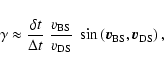
Differentiating Eq. (1) and assuming
and
are not
collinear (which in the case of Pic they are not), this should lead
to an "aberration'' effect: grains with different speeds must be
reaching the observer from different directions. In other words, the
"dust spot'' on the sky should be somewhat elongated
along the path of the star on the celestial sphere at the
period of ejection.
Differentiating Eq. (1) and assuming
 ,
it is easy to get an estimate
of the angular extent of the dust spot:
,
it is easy to get an estimate
of the angular extent of the dust spot:
Pic dust stream under study.
The best-fit location of the radiant,
 ,
is marked
with a cross. A closed oval-shaped curve
around the cross is a geometrical place of points on the celestial sphere
whose angular separation from the cross is ,
close to the
precision of AMOR observations and data reduction.
In terms of spherical geometry, this curve is a small circle on a
sphere, but it is not a perfect circle in the figure, which is
an effect of projecting a sphere onto a plane.
This oval can be used to visually judge whether or not the meteoroid spot is
elongated. A comparison suggests that the spot does appear elongated
from bottom to top (and slightly from the right to the left).
We now check whether the ellipticity of the spot may be attributed to the
aberration effect discussed above.
For this purpose, we overplot the trajectory of Pic from its
present location (indicated by a small star) backward in
time. The solid line represents the trajectory calculated with the
"nominal'' U, V, W of Pic, while two dashed lines around it
approximately correspond to a
uncertainty in
U, V, W, so that the true path of the star most likely lies somewhere
between the two dashed lines.
Also shown are time stamps, identifying the position of the star 0.3, 0.5,
1, 2 and 12 Myr ago, the last value being close to the age of Pic
(see Sect. 2.2).
As expected, the star crossed the position of the spot about 0.75 Myr ago,
which demonstrates again that Pic is compatible with the
source of the dust stream. What is more, the direction in which the spot is
stretched does not differ much from the direction along the trajectory of
the star.
If this is caused by the aberration effect, then we can
compare the extent of the spot with the time stamps on the trajectory
of the star in the figure.
We find that the upper edge of the spot would correspond to grains
ejected 0.85 Myr ago at a speed of
,
is marked
with a cross. A closed oval-shaped curve
around the cross is a geometrical place of points on the celestial sphere
whose angular separation from the cross is ,
close to the
precision of AMOR observations and data reduction.
In terms of spherical geometry, this curve is a small circle on a
sphere, but it is not a perfect circle in the figure, which is
an effect of projecting a sphere onto a plane.
This oval can be used to visually judge whether or not the meteoroid spot is
elongated. A comparison suggests that the spot does appear elongated
from bottom to top (and slightly from the right to the left).
We now check whether the ellipticity of the spot may be attributed to the
aberration effect discussed above.
For this purpose, we overplot the trajectory of Pic from its
present location (indicated by a small star) backward in
time. The solid line represents the trajectory calculated with the
"nominal'' U, V, W of Pic, while two dashed lines around it
approximately correspond to a
uncertainty in
U, V, W, so that the true path of the star most likely lies somewhere
between the two dashed lines.
Also shown are time stamps, identifying the position of the star 0.3, 0.5,
1, 2 and 12 Myr ago, the last value being close to the age of Pic
(see Sect. 2.2).
As expected, the star crossed the position of the spot about 0.75 Myr ago,
which demonstrates again that Pic is compatible with the
source of the dust stream. What is more, the direction in which the spot is
stretched does not differ much from the direction along the trajectory of
the star.
If this is caused by the aberration effect, then we can
compare the extent of the spot with the time stamps on the trajectory
of the star in the figure.
We find that the upper edge of the spot would correspond to grains
ejected 0.85 Myr ago at a speed of
 and the lower edge to particles that
left the Pic system 0.65 Myr ago with a speed of
and the lower edge to particles that
left the Pic system 0.65 Myr ago with a speed of
 .
Thus a duration of the ejection period that corresponds to the observed
spot is
.
Thus a duration of the ejection period that corresponds to the observed
spot is
 Myr.
Approximately the same result follows from Eq. (3)
with
Myr.
Approximately the same result follows from Eq. (3)
with
 Myr and
 :
:
 Myr.
Myr.
Obviously, the precision of the AMOR measurements at present is not high
enough to reliably prescribe a slight stretch of the spot to the aberration
effect.
Nevertheless, our consideration does set an important constraint on
the system's past: we can conclude that the ejection phase in
the Pic system did not start earlier than 0.85 Myr ago.
And indeed, for any realistic mechanism of dust ejection, the ejection speed
distribution should have a negative slope:
the higher the ejection speed, the less the flux of the ejected particles.
In other words, many more particles slower than those responsible for the
observed stream are expected.
Therefore, did the ejection start earlier, the meteoroid spot would be
much more extended vertically and would have a pronounced brightness
gradient towards higher ecliptic latitudes.
For instance, if the ejection process were at work as early as
1-2 Myr ago, then (presumably more abundant) particles ejected at
speeds of 10-
 would now be arriving at the Earth and creating a bright spot between
the ecliptic latitudes
would now be arriving at the Earth and creating a bright spot between
the ecliptic latitudes  and
and  ,
which is not observed (see Fig. 2).
Some caution is required, however, since the hyperbolic dust component near
the ecliptic would be difficult to separate from the overwhelming
population of closed-orbit interplanetary meteoroids, strongly concentrated
towards the ecliptic (given the inherent 5% uncertainty in radar
meteor speed determination). In any case, very early ejection (>2 Myr
ago) can be ruled out with full certainty.
,
which is not observed (see Fig. 2).
Some caution is required, however, since the hyperbolic dust component near
the ecliptic would be difficult to separate from the overwhelming
population of closed-orbit interplanetary meteoroids, strongly concentrated
towards the ecliptic (given the inherent 5% uncertainty in radar
meteor speed determination). In any case, very early ejection (>2 Myr
ago) can be ruled out with full certainty.
Unfortunately, using the same line of reasoning we cannot constrain the
duration of the ejection phase. If the ejection process was still
working, say, 0.5 Myr ago, then only very fast grains ejected at
 would have enough time to reach the Earth,
having heliocentric entry speeds of
would have enough time to reach the Earth,
having heliocentric entry speeds of
 - the slower
ones would still be on the way to Earth. One may think of an additional
observational test: it would be interesting to analyze a distribution
of a (scarce) population of very fast meteoroids detected by AMOR
to see if some of them are indeed in the lower right portion of
Fig. 2.
A positive result would indicate a longer ejection phase.
A negative result, however, would be inconclusive - either the ejection phase
was short-lasting or the ejection speed distribution is so steep that
a population of fast particles is too scarce.
In Sect. 5, we will show that a short duration of the ejection phase,
0.1 Myr, is favored by the analysis of the observed flux of
Pic meteoroids.
Of course, the above discussion of the ejection phase duration only
applies to particles large enough to be detected by AMOR. It is possible that
the Pic system, as every other (proto)planetary system, continuously
loses smaller grains resulting from collisions and evaporation of
cometesimals.
- the slower
ones would still be on the way to Earth. One may think of an additional
observational test: it would be interesting to analyze a distribution
of a (scarce) population of very fast meteoroids detected by AMOR
to see if some of them are indeed in the lower right portion of
Fig. 2.
A positive result would indicate a longer ejection phase.
A negative result, however, would be inconclusive - either the ejection phase
was short-lasting or the ejection speed distribution is so steep that
a population of fast particles is too scarce.
In Sect. 5, we will show that a short duration of the ejection phase,
0.1 Myr, is favored by the analysis of the observed flux of
Pic meteoroids.
Of course, the above discussion of the ejection phase duration only
applies to particles large enough to be detected by AMOR. It is possible that
the Pic system, as every other (proto)planetary system, continuously
loses smaller grains resulting from collisions and evaporation of
cometesimals.
As noted above, the location of the meteoroid source on the celestial sphere
was deduced by Baggaley (2000) after applying a correction for the
gravitational bending of the grain trajectories by the gravity of the Sun.
It is known, however, that for any collimated stream of interstellar
particles penetrating the solar system and at any moment in time,
there are two Earth-collision geometries (two "branches'' of the stream):
the Earth is hit by particles on their first node
crossing and by those on their second one (Baggaley & Neslusan 2002).
In the first case, grains strike the Earth before the perihelion
passage, and in the second they first travel around the Sun and only then
reach the Earth.
This is illustrated in Fig. 3.
Our calculations (see Eqs. (11)-(14) below)
show that the dust flux in the second branch is lower than in the first
by only a factor of 1.6 to 2.5, depending on the season
(the angle
in Fig. 3).
We found, however, that particles of the second branch should
arrive at Earth from geocentric declinations ranging
from  (in northern winter) to
  (in northern summer).
Since AMOR, located at temperate southern latitudes, can cover the range
(in northern summer).
Since AMOR, located at temperate southern latitudes, can cover the range
 (Baggaley 2000),
it only detects the first branch.
Observations of the second one require a radar located in the
equatorial region or in the northern hemisphere.
If such an instrument is available in the future, a detection of the
second branch will be a crucial test of Pic as the source
of the dust particles.
(Baggaley 2000),
it only detects the first branch.
Observations of the second one require a radar located in the
equatorial region or in the northern hemisphere.
If such an instrument is available in the future, a detection of the
second branch will be a crucial test of Pic as the source
of the dust particles.
![\begin{figure}
\par\includegraphics[width=8cm,clip]{0379fig3.eps}
\end{figure}](/articles/aa/full/2004/13/aa0379/img86.gif) |
Figure 3:
Deflection of the meteoroid trajectories by the gravity of the Sun.
The meteoroids are coming from the left.
The Sun and Earth are not to scale.
The position of the Earth shown corresponds to the beginning of January,
shortly after a winter solstice (solar longitude of ).
At this moment,
(the angle between the heliocentric radius vector
of the Earth and the velocity vectors of the stream particles far from the
Sun, depicted with dashed arrows) reaches a minimum possible value of  .
Both ecliptic and equatorial planes are seen nearly edge-on, whereas
the direction to the vernal equinox (not shown) is nearly perpendicular
to the figure plane towards the reader.
This geometry is determined by the far-Sun ecliptic latitude and longitude
of the meteoroid source,
and .
The Earth is hit by two hyperbolic trajectories ("first branch''
and "second branch''), coming to the Earth from nearly opposite
directions. For the particular season shown,
the impact parameters of the two trajectories are .
Both ecliptic and equatorial planes are seen nearly edge-on, whereas
the direction to the vernal equinox (not shown) is nearly perpendicular
to the figure plane towards the reader.
This geometry is determined by the far-Sun ecliptic latitude and longitude
of the meteoroid source,
and .
The Earth is hit by two hyperbolic trajectories ("first branch''
and "second branch''), coming to the Earth from nearly opposite
directions. For the particular season shown,
the impact parameters of the two trajectories are
 and
and
 and the perihelion distances are
 and
and
 ,
respectively. Only the first branch can be observed from New Zealand which, for the
season shown here, is also obvious from the figure. ,
respectively. Only the first branch can be observed from New Zealand which, for the
season shown here, is also obvious from the figure. |
| Open with DEXTER | |
Pictoris system
Earlier estimates proposed a wide range of possible ages from about 10
up to more than 300 Myr, before Barrado y Navascués et al. (1999) found two
other stars comoving with Pic in space, allowing them to narrow the
estimates to the values 20  10 Myr. Subsequently, the number of
members of this Beta Pictoris Moving Group was increased
to 28 stars and brown dwarfs by Zuckerman et al. (2001).
The re-analysis of the BPMG evolutionary age by means of the H-R diagram
yielded
12+8-4 Myr. Recently, Ortega et al. (2002)
retraced the 3D orbits of the group members in the Galaxy and found
the maximum concentration to occur 11.5 Myr ago, which suggests this
value to be the kinematic age of Pic and other members of the BPMG.
10 Myr. Subsequently, the number of
members of this Beta Pictoris Moving Group was increased
to 28 stars and brown dwarfs by Zuckerman et al. (2001).
The re-analysis of the BPMG evolutionary age by means of the H-R diagram
yielded
12+8-4 Myr. Recently, Ortega et al. (2002)
retraced the 3D orbits of the group members in the Galaxy and found
the maximum concentration to occur 11.5 Myr ago, which suggests this
value to be the kinematic age of Pic and other members of the BPMG.
A dozen asymmetries and individual features of different types have been
identified on the disk images
(Kalas et al. 2001; Wahhaj et al. 2003; Kalas et al. 2000; Kalas & Jewitt 1995). Whereas the clumps in the outermost part of the NE wing
(500 to
 )
have been attributed to a recent stellar encounter
(Kalas et al. 2001,2000), many authors have invoked planets
in the Pic system to explain a number of other intricate features
observed in the disk. Artymowicz et al. (1989) and Lagage & Pantin (1994)
reported a brightness gap in the disk inside about 10 to
)
have been attributed to a recent stellar encounter
(Kalas et al. 2001,2000), many authors have invoked planets
in the Pic system to explain a number of other intricate features
observed in the disk. Artymowicz et al. (1989) and Lagage & Pantin (1994)
reported a brightness gap in the disk inside about 10 to
 from the star, which stimulated
intensive discussions of an alleged planetary perturber that could clear up the inner region
(Lagage & Pantin 1994; Liou & Zook 1999; Lazzaro et al. 1994; Scholl et al. 1993; Roques et al. 1994; Lecavelier des Etangs et al. 1996a). The basic idea is that the dust
migrating towards the star due to the Poynting-Robertson effect is ejected
out of the system during close encounters with planets, possibly after
trapping into outer mean-motion resonances (MMRs) and subsequent eccentricity pumping.
Warps of the inner disk (see, e.g., Heap et al. 2000; Mouillet et al. 1997)
can also be attributed to the presence of a planet. Mouillet et al. (1997) inferred a planet in a slightly inclined orbit at about 3 to
with a mass comparable to that of Jupiter, and
Augereau et al. (2001) have shown that the same planet could account for the so-called butterfly asymmetry of the disk. Finally, recently imaged dust rings and "new'' warps in the inner disk (Wahhaj et al. 2003; Weinberger et al. 2003) seem to directly indicate
the presence of several planets between about 15 and
from the star, which stimulated
intensive discussions of an alleged planetary perturber that could clear up the inner region
(Lagage & Pantin 1994; Liou & Zook 1999; Lazzaro et al. 1994; Scholl et al. 1993; Roques et al. 1994; Lecavelier des Etangs et al. 1996a). The basic idea is that the dust
migrating towards the star due to the Poynting-Robertson effect is ejected
out of the system during close encounters with planets, possibly after
trapping into outer mean-motion resonances (MMRs) and subsequent eccentricity pumping.
Warps of the inner disk (see, e.g., Heap et al. 2000; Mouillet et al. 1997)
can also be attributed to the presence of a planet. Mouillet et al. (1997) inferred a planet in a slightly inclined orbit at about 3 to
with a mass comparable to that of Jupiter, and
Augereau et al. (2001) have shown that the same planet could account for the so-called butterfly asymmetry of the disk. Finally, recently imaged dust rings and "new'' warps in the inner disk (Wahhaj et al. 2003; Weinberger et al. 2003) seem to directly indicate
the presence of several planets between about 15 and
 .
To summarize, all these considerations indicate the presence of a few planets with semimajor axes in the range from several to several tens of AU. Nothing is known, however, about presence or absence of planets inside
several AU from the star.
.
To summarize, all these considerations indicate the presence of a few planets with semimajor axes in the range from several to several tens of AU. Nothing is known, however, about presence or absence of planets inside
several AU from the star.
As noted by Beust & Morbidelli (2000),
all of the mechanisms proposed so far to explain the FEB phenomenon
involve gravitational perturbations
by at least one planet: close encounters (Beust et al. 1991),
the Kozai mechanism (Bailey et al. 1992), trapping in MMRs.
Some mechanisms, such as secular resonances, require more than one planet.
See Beust & Morbidelli (1996,2000), Thébault & Beust (2001)
for a review of different mechanisms.
The most advocated mechanism is an eccentricity pumping of a cometesimal
trapped into a 4:1 or 3:1 MMR with a Jupiter-like planet in a
moderately-eccentric (
 )
orbit at 5 to
from the star
(Thébault & Beust 2001; Beust & Morbidelli 1996,2000; Quillen & Holman 2000).
It could, in particular, be the same planet as the one responsible for the
"classical'' warp (Thébault & Beust 2001).
The main difficulty of the mechanism is refilling the resonant locations
with cometesimals. Either planet migration (Beust & Morbidelli 1996,2000)
or collisions between the planetesimals (Thébault & Beust 2001) could be a key.
)
orbit at 5 to
from the star
(Thébault & Beust 2001; Beust & Morbidelli 1996,2000; Quillen & Holman 2000).
It could, in particular, be the same planet as the one responsible for the
"classical'' warp (Thébault & Beust 2001).
The main difficulty of the mechanism is refilling the resonant locations
with cometesimals. Either planet migration (Beust & Morbidelli 1996,2000)
or collisions between the planetesimals (Thébault & Beust 2001) could be a key.
Little is known about size/mass and orbital distributions of small bodies in the disk and the dust material they produce. Attempts to constrain orbital distributions of dust grains from the observed brightness profiles give non-unique results (Lecavelier des Etangs et al. 1996b). Theoretical approaches to clarify this question are hampered by a variety of counteracting dynamical processes that are hard to describe (mutual collisions, radiation pressure dynamics of particles with poorly known properties, resonant influence of planets with unknown masses and orbits, drag forces by a poorly known gas component). In particular, it is not known how large the typical eccentricities of both parent bodies and dust grains are. (Note a close relation between them: orbits of dust grains are essentially those of the parent bodies, somewhat modified by direct radiation pressure upon release from the sources, Burns et al. 1979.) It is difficult to decide whether the cometesimal disk and the disk of larger dust grains are rather "circular'' or "eccentric''. Most probably, the distribution of eccentricities is broad, including both near-circular and eccentric populations.
The same applies to the size distribution of dust. Observations suggest that grains in a broad size range from submicrometers to millimeters are present, but do not give information on the relative contribution of particles with different sizes (Krivova et al. 2000). Dynamical modeling confirms that the size distribution is broad and suggests several tens of micrometers as a typical size of grains, but should be considered with caution, because of a number of simplifying assumptions in the model and poorly known model parameters (Krivov et al. 2000).
One of the parameters of the stream most difficult to explain is the very high ejection speed of the stream particles. This places severe constraints on the mass and orbit of a planetary ejector. Prior to any calculations, it can be expected that sufficiently high ejection speeds can only be obtained in "violent'' scenarios. To demonstrate this, we make use of Öpik's (1976) theory of planetary encounters.
![\begin{figure}
\par\includegraphics[width=8cm,clip]{0379fig4.eps}
\end{figure}](/articles/aa/full/2004/13/aa0379/img92.gif) |
Figure 4: Illustration of the geometry underlying Öpik's theory. |
| Open with DEXTER | |
The Öpik theory considers a star,
a planet, and a massless particle (or a disk of non-interacting particles)
initially placed in a planet-crossing orbit (Fig. 4).
The basic quantity in the theory is the
planetocentric grain velocity  .
In units of
.
In units of
 ,
the averaged planet
orbital velocity, U is a dimensionless quantity.
The idea is to assume each encounter of the particle with the planet to be
an impulse in ,
so that
,
the averaged planet
orbital velocity, U is a dimensionless quantity.
The idea is to assume each encounter of the particle with the planet to be
an impulse in ,
so that
 is treated as a stochastic
process. In the particular case of a circular planetary orbit,
U is related to the Tisserand constant T:
is treated as a stochastic
process. In the particular case of a circular planetary orbit,
U is related to the Tisserand constant T:
 .
Therefore,
.
Therefore,
 = const.
For an elliptic planetary orbit,
grows with
time (dynamical heating of the disk).
Ejection out of the system becomes possible when U grows to the value
= const.
For an elliptic planetary orbit,
grows with
time (dynamical heating of the disk).
Ejection out of the system becomes possible when U grows to the value
 and occurs if and only if
falls into
the cone with an opening angle
and occurs if and only if
falls into
the cone with an opening angle
 around
 .
When U=1, the probability that an encounter results in ejection is 1/2
(
.
When U=1, the probability that an encounter results in ejection is 1/2
(
 ).
Finally, for
).
Finally, for
 ejection is the only
possible outcome of any encounter with the planet (
ejection is the only
possible outcome of any encounter with the planet (
 ).
).
For each instant in time, the theory allows the calculation of U and a number of other quantities of interest: the probability of ejection, that of collision with the planet, the rms speed of ejected particles at infinity, etc. For the algorithm, the reader is referred to Öpik's (1976) original book or, alternatively, to Farinella et al. (1990), where a concise description of the algorithm can be found.
![\begin{figure}
\par\includegraphics[width=14.5cm,clip]{0379fig5.epsi}
\end{figure}](/articles/aa/full/2004/13/aa0379/img104.gif) |
Figure 5:
Results obtained with Öpik's theory for different parameters of a
hypothetical planet in the Pic disk.
Top row: rms encounter velocity,
middle row: upper limits on the speed of the ejected particles at infinity,
bottom row: the probability of a particle's survival against ejection
(solid) and collision with the planet (dashed).
Left column: dependence on planet's semimajor axis  (its mass and eccentricity remain fixed),
middle column: dependence on planet's mass (its mass and eccentricity remain fixed),
middle column: dependence on planet's mass  (semimajor axis and eccentricity fixed),
right column: dependence on planet's eccentricity (semimajor axis and eccentricity fixed),
right column: dependence on planet's eccentricity  (its semimajor axis and mass fixed).
See legend for adopted parameter values (semimajor axis in AU,
mass in Jupiter masses).
The critical value of U for ejection is indicated by the dotted line in
the top panels. The dotted line in the middle panels depicts the ejection speed of
inferred from the radar measurements. (its semimajor axis and mass fixed).
See legend for adopted parameter values (semimajor axis in AU,
mass in Jupiter masses).
The critical value of U for ejection is indicated by the dotted line in
the top panels. The dotted line in the middle panels depicts the ejection speed of
inferred from the radar measurements. |
| Open with DEXTER | |
Figure 5 depicts results of
calculations that we made following Öpik
for different parameters of the planetary perturber
in the Pic disk.
For the disk itself, we assumed initially circular orbits of grains
with initial inclinations uniformly distributed within
![$[0^\circ ,7^\circ ]$](/articles/aa/full/2004/13/aa0379/img21.gif) ,
in accordance with the observed half-opening angle of the disk
of
,
in accordance with the observed half-opening angle of the disk
of  .
The panels from top to bottom show the rms encounter velocity,
an upper limit on the speed of the ejected particles at infinity, and
the probabilities of a particle's survival against ejection and
collision with the planet.
The columns from left to right illustrate the dependence of the results on
the planet's semimajor axis, mass, and orbital eccentricity.
Altogether, Öpik's theory predicts that faster ejecta require either large
planetary masses, small semimajor axes, or substantial eccentricity of the
planetary orbit. It is also seen that ejection is always more probable than collision with
the planet.
.
The panels from top to bottom show the rms encounter velocity,
an upper limit on the speed of the ejected particles at infinity, and
the probabilities of a particle's survival against ejection and
collision with the planet.
The columns from left to right illustrate the dependence of the results on
the planet's semimajor axis, mass, and orbital eccentricity.
Altogether, Öpik's theory predicts that faster ejecta require either large
planetary masses, small semimajor axes, or substantial eccentricity of the
planetary orbit. It is also seen that ejection is always more probable than collision with
the planet.
As Öpik's theory is only a crude approximation (see, e.g., Weidenschilling 1975, for a detailed discussion), these results can only be used as guidelines for more accurate numerical simulations. These are described in the following section.
We performed numerical integrations with (a slightly adapted) Duncan and Levison's SWIFT/SyMBA v2.0 package (Duncan et al. 1998). Cometesimals are initially placed in planet-crossing orbits to speed up the ejection outcome. Another reason to do this is that our model does not take into account processes with longer timescales (migration of planets, mutual collisions between cometesimals etc.).
"Conventional'' planet.
As noted above, there is a considerable body of indirect evidence of the
presence of planets in the Pic system.
It was deduced from the analysis of disk's asymmetries, warps
(see, e.g., Heap et al. 2000; Mouillet et al. 1997)
as well as recently discovered
dust rings and warps in the innermost part of the disk
(Wahhaj et al. 2003; Weinberger et al. 2003).
All these considerations suggest several planets with semimajor axes between
several and almost a hundred  .
Note that symmetry of the isolated C- and D-dust features observed
at 50 and
(Wahhaj et al. 2003) seems to favor low
eccentricities of the outer planets possibly located at these distances.
The alleged planets closer to the star could be on eccentric orbits,
however. In both cases, there appears to be no direct upper limit on the
planetary masses.
We will first check whether these "conventional'' planets can be
responsible for the observed stream.
.
Note that symmetry of the isolated C- and D-dust features observed
at 50 and
(Wahhaj et al. 2003) seems to favor low
eccentricities of the outer planets possibly located at these distances.
The alleged planets closer to the star could be on eccentric orbits,
however. In both cases, there appears to be no direct upper limit on the
planetary masses.
We will first check whether these "conventional'' planets can be
responsible for the observed stream.
Planet at an intermediate distance.
The second idea is to "place'' a planet yet closer to the star, at about
 ,
i.e. at the outer edge of the region where many extrasolar planets
have been discovered by radial velocity (RV) measurements. The planets
of this kind detected so far have substantial orbital eccentricities
(Marcy & Butler 2000), which makes them potentially efficient "ejectors'' of
material.
,
i.e. at the outer edge of the region where many extrasolar planets
have been discovered by radial velocity (RV) measurements. The planets
of this kind detected so far have substantial orbital eccentricities
(Marcy & Butler 2000), which makes them potentially efficient "ejectors'' of
material.
Close-in planet.
Finally, we will consider "hot Jupiters'', representing roughly half of
all planets discovered so far. Such planets have a semimajor axis of several tenths
of an .
Their proximity to the star would make material ejection quite efficient.
However, this is counteracted somewhat by the fact that these close-in
companions all have small eccentricities
 (Marcy & Butler 2000), which is unfavorable for high-speed
ejection.
What is more, such a planet cannot be too massive in the case of Pic,
otherwise it would be evident in RV measurements. For FGKM stars usually
searched with the RV method, the "threshold'' RV amplitude is
(Marcy & Butler 2000), which is unfavorable for high-speed
ejection.
What is more, such a planet cannot be too massive in the case of Pic,
otherwise it would be evident in RV measurements. For FGKM stars usually
searched with the RV method, the "threshold'' RV amplitude is
 (see, e.g., Ksanfomaliti 2000, and references therein).
For the Pictoris mass
(but assuming slow rotation of the star and no appreciable photospheric
jitter, similar to main-sequence FGKM stars),
the maximum nondetectable planet's mass
is related to its orbital
semimajor axis
as:
(see, e.g., Ksanfomaliti 2000, and references therein).
For the Pictoris mass
(but assuming slow rotation of the star and no appreciable photospheric
jitter, similar to main-sequence FGKM stars),
the maximum nondetectable planet's mass
is related to its orbital
semimajor axis
as:
Pictoris is an A3V star,
so the threshold must be appreciably higher:
Mouillet et al. (1997), for instance, refer to threshold values as large
as
 ,
increasing the factor in (4) from 0.5to 50. In what follows, we assume that a Jupiter-mass planet at
,
increasing the factor in (4) from 0.5to 50. In what follows, we assume that a Jupiter-mass planet at
 from the
star would not show up in any RV searches.
from the
star would not show up in any RV searches.
Typical results are collected in Table 3. The left two columns are for the conventional planet case, the middle two for planets at intermediate distance, and the right two ones represent close-in planets.
Table 3:
Outcome of the numerical runs.
Columns from left to right:
distant massive planet in near-circular orbit, initially cold
disk (in the dynamical sense);
distant massive planet in eccentric orbit, initially hot disk;
Jupiter-mass planet in eccentric orbit at intermediate distance,
hot disk;
massive planet in eccentric orbit at intermediate distance, hot disk;
close-in Neptune-mass planet in near-circular orbit, very hot disk;
close-in Jupiter-mass planet in near-circular orbit, very hot disk.
Initial inclination distribution: from within
("wedged disk'').
Integration interval: 30 000 years.
Number of particles in each run: 1000.
All percentages are with respect to this number.
The conventional planets can hardly account for the high-speed ejection, even
if the planetary orbit has a substantial eccentricity, the planet is massive,
and the cometesimal disk is dynamically hot. The same applies to planets at
.
Speeds of several
are the maximum possible in these
cases.
On the other hand, the close-in planet case seems to work quite well,
ejecting the planet-crossing solids rapidly and at high speeds. Several
percent of all particles were ejected at speeds of tens
.
A substantial fraction of the material, especially in less "violent'' scenarios, only reaches the periphery of the system, where it remains ("Oort cloud formation''). Also, an appreciable amount of star-grazers (several to several tens of percent) is always produced. In contrast, collisions with a planet are rare (several percent at most).
A particle placed in a hyperbolic trajectory can, in principle, be lost by grain-grain collisions before it can leave the system. Simple estimates based on collisional probabilities (cf. Krivov et al. 2000) show that this effect is statistically unimportant. A rather low upper limit on the molecular hydrogen contents in the disks recently obtained (Lecavelier des Etangs et al. 2001) shows that the gas drag force is not important either.
To explain the dust stream phenomenon, Grün & Landgraf (2001) have
proposed a radiation pressure ejection of dust material released from
cometesimals. The same mechanism has long been known to work in the
solar system, accounting for the so-called -meteoroids in
interplanetary space (Zook & Berg 1975).
The -meteoroids in the solar system are
thought to be produced mostly by catastrophic fragmentation of larger
interplanetary dust particles (IDPs).
Tiny submicrometer-sized grains produced by these collisions
can easily get into escape orbits even from initially circular orbits of
the source IDPs.
In contrast, the stream meteoroids detected by radar measurements
are large (
), so that
the radiation pressure to gravity ratio
 .
This makes a hyperbolic ejection only possible near periastra of
cometesimals, and only if these are moving in highly eccentric
orbits (Fig. 6).
.
This makes a hyperbolic ejection only possible near periastra of
cometesimals, and only if these are moving in highly eccentric
orbits (Fig. 6).
![\begin{figure}
\par\includegraphics[width=5cm,clip]{0379fig6.eps}
\end{figure}](/articles/aa/full/2004/13/aa0379/img138.gif) |
Figure 6: Illustration of ejection by radiation pressure. |
| Open with DEXTER | |
We now estimate the condition for the ejection of these extrasolar
-meteoroids and the asymptotic speed.
Consider a dust grain with a certain -ratio
 (the case
 is not of interest, because it applies
for too small particles). Let the grain be ejected from a parent
body that moves in an elliptic orbit with eccentricity
is not of interest, because it applies
for too small particles). Let the grain be ejected from a parent
body that moves in an elliptic orbit with eccentricity
 .
Assume that the ejection takes place at the pericenter of the parent body
orbit. Denote the distance of this point to the star by r0.
The grain will be ejected out of the system (in a hyperbolic orbit) if
and only if:
.
Assume that the ejection takes place at the pericenter of the parent body
orbit. Denote the distance of this point to the star by r0.
The grain will be ejected out of the system (in a hyperbolic orbit) if
and only if:
 |
(5) |
 ,
we get a final estimate:
,
we get a final estimate:
 |
(7) |
Pic,
 |
(8) |
 ,
plausible materials and grain
compositions give
values between about 0.05 and 0.35(Krivov et al. 1998).
Here we have multiplied the values, given in that paper
for the solar system dust, by
,
plausible materials and grain
compositions give
values between about 0.05 and 0.35(Krivov et al. 1998).
Here we have multiplied the values, given in that paper
for the solar system dust, by
 ,
where
,
where  and
and  are stellar luminosity and mass, respectively, both in solar units. Such grains are ejected at a speed
when ejection occurs from
several tenths of an .
We stress that high eccentricities are imperative for the radiation
pressure mechanism to work. Equation (6) shows that for e < 0.3 to 0.9 (depending on the value adopted), ejection by radiation pressure is not possible at all.
are stellar luminosity and mass, respectively, both in solar units. Such grains are ejected at a speed
when ejection occurs from
several tenths of an .
We stress that high eccentricities are imperative for the radiation
pressure mechanism to work. Equation (6) shows that for e < 0.3 to 0.9 (depending on the value adopted), ejection by radiation pressure is not possible at all.
The estimate of the absolute dust flux at Earth quoted in Sect. 2.1,
,
allows estimation of
the mass loss rate from the Pic system.
First, one has to correct the flux for the gravitational focusing by the
Sun (a similar effect caused by the Earth is unimportant).
Consider a point with the radius vector  and let
be the angle between
and the direction of the stream
(Fig. 3).
The number density of the focused dust at this point is given by
(Fessenkov 1947; Fahr 1968):
and let
be the angle between
and the direction of the stream
(Fig. 3).
The number density of the focused dust at this point is given by
(Fessenkov 1947; Fahr 1968):
 and
and  are respectively the number density and
velocity (with respect to the Sun) of the far-Sun meteoroids
and GM is the gravitational parameter of the Sun.
The indices 1, 2 in the above equations correspond to the first
and second "branches'', discussed in Sect. 2.1 and shown
in Fig. 3.
are respectively the number density and
velocity (with respect to the Sun) of the far-Sun meteoroids
and GM is the gravitational parameter of the Sun.
The indices 1, 2 in the above equations correspond to the first
and second "branches'', discussed in Sect. 2.1 and shown
in Fig. 3.
Not only does the gravity of the Sun increase the number density, it also
increases the speed of meteoroids.
At the same point with the radius vector ,
the speed is
 is the escape velocity at the distance r.
The relation between the dust fluxes at the point
is the escape velocity at the distance r.
The relation between the dust fluxes at the point
 and at
infinity is obviously
,
deduced from the AMOR observations, the angle
varies
between
and
and at
infinity is obviously
,
deduced from the AMOR observations, the angle
varies
between
and
 ,
as the Earth
orbits the Sun. The distance
,
as the Earth
orbits the Sun. The distance
 .
Taking into account the first branch only
(the second one is not detectable with AMOR, see Sect. 2.1),
Eq. (14) gives
.
Taking into account the first branch only
(the second one is not detectable with AMOR, see Sect. 2.1),
Eq. (14) gives
 .
.
Next, we correct the flux for the relative velocity between
Pic and the Sun. With the ejection speed from Pic
of
and the heliocentric speed of the grains
entering the solar system of
(Table 2), the corrected flux is
 .
.
Finally, we assume a standard "wedged'' Pic disk with a
half-opening angle of 0.1 radian seen edge-on and a distance to
the star of 19.3 pc to get the mass loss rate in the form of
-mass meteoroids
(the AMOR threshold) of
 .
.
This is probably an underestimate of the total loss rate,
because it implies that all the material is lost in the form of
-mass (or
-sized) dust grains, as detected at Earth.
And here is perhaps the most uncertain part of the whole estimation:
one has to invoke a mass/size distribution in the disk, which is actually
unknown. Assuming a two-slope distribution with the mass distribution index 1/3 for grains <
 and 4/3 for more massive ones, as suggested by the
modeling (Krivov et al. 2000),
we find that the total mass loss rate from the disk is about 40 times the
mass loss rate in the form of grains with masses of
,
or
and 4/3 for more massive ones, as suggested by the
modeling (Krivov et al. 2000),
we find that the total mass loss rate from the disk is about 40 times the
mass loss rate in the form of grains with masses of
,
or
 .
.
One can speculate, however, that the ejection mechanism can be strongly selective
about the particle masses. For instance, the radiation pressure only ejects grains
smaller than several tens of
 ,
so the larger solids would stay in
the disk. This would mean that most of the mass is lost in the form
of ten-
grains, which is coincidentally the detection range of
the radar.
Even for size-independent mechanisms, such as the planetary ejection, it
may be that larger solids could not leave the system -
for example, they could have been destroyed by collisions before they
could leave, as suggested by Stern & Weissman (2001) for the Oort cloud
formation phase in the early solar system.
Thus, the "uncorrected'' estimate,
,
could be close to the total mass loss rate.
We are left with a range from
up to
.
,
so the larger solids would stay in
the disk. This would mean that most of the mass is lost in the form
of ten-
grains, which is coincidentally the detection range of
the radar.
Even for size-independent mechanisms, such as the planetary ejection, it
may be that larger solids could not leave the system -
for example, they could have been destroyed by collisions before they
could leave, as suggested by Stern & Weissman (2001) for the Oort cloud
formation phase in the early solar system.
Thus, the "uncorrected'' estimate,
,
could be close to the total mass loss rate.
We are left with a range from
up to
.
Similar to the correction for a mass distribution, a correction for a
speed distribution of the particles has to be made.
Namely, the total mass loss rate derived above must be divided by a
fraction of ejected grains whose ejection speeds are high enough to satisfy
the kinematic conditions,
.
However, this fraction cannot be estimated in any reliable way
for both planetary and radiation pressure ejection scenarios.
In the planetary ejection scenario, it could be 1% as suggested by
the numerical runs (see Table 3), but could be quite
different for different parameters of the planet and the disk.
In the radiation pressure ejection scenario, the fraction in question
is largely controlled by the ejection distance r0(see Eq. (9)), which is not known either.
Asserting, somewhat arbitrarily, the fraction to be 0.01-0.1, we finally
get the mass loss rate in the range from
 to
to
 .
.
This immediately shows that the ejection process could not take place on
timescales comparable with the stellar age: the mass loss over
 would be
 to
to
 ,
i.e. comparable to, or more than a primordial
Pic protoplanetary disk could have contained.
We note that such a long timescale is already refuted by
stream geometry arguments: as we saw in Sect. 2.1, the ejection process
started working not earlier than
,
i.e. comparable to, or more than a primordial
Pic protoplanetary disk could have contained.
We note that such a long timescale is already refuted by
stream geometry arguments: as we saw in Sect. 2.1, the ejection process
started working not earlier than
 ago.
The resulting mass loss, reduced by an order of magnitude, still appears
quite large. Krivova & Solanki (2003) suggested to mitigate the problem by assuming
that the process took place during a recent intensive clearance phase of the
primordial disk, with a probable duration of
ago.
The resulting mass loss, reduced by an order of magnitude, still appears
quite large. Krivova & Solanki (2003) suggested to mitigate the problem by assuming
that the process took place during a recent intensive clearance phase of the
primordial disk, with a probable duration of
 ,
and that we
are currently observing the system soon after this phase took place.
The low age of Pic, a high dustiness of its disk, as well as the low
hydrogen contents insufficient for a Jupiter-like planet formation are all
in favor of the idea, suggesting that the system is, or recently
was, at a fairly advanced planetary accretion phase.
With an ejection phase of that duration, the total mass loss could be as low
as
,
and that we
are currently observing the system soon after this phase took place.
The low age of Pic, a high dustiness of its disk, as well as the low
hydrogen contents insufficient for a Jupiter-like planet formation are all
in favor of the idea, suggesting that the system is, or recently
was, at a fairly advanced planetary accretion phase.
With an ejection phase of that duration, the total mass loss could be as low
as
 .
Quantitatively, such a value is also consistent with the likely total
mass of the primordial disk of
.
Quantitatively, such a value is also consistent with the likely total
mass of the primordial disk of
 (assuming a disk radius
of
(assuming a disk radius
of
 and a linear density of
 ,
see Thébault & Beust 2001).
,
see Thébault & Beust 2001).
Finally, as we have shown here, the only "channel''
for high-speed ejection of material (in both scenarios, planetary ejection and
radiation pressure blowout) is active in close vicinity of the star,
.
In other words, a sufficient fraction of the primordial disk mass had to
be placed, by whatever processes, into FEB-like orbits before it got ejected
into interstellar space.
This still appears to be realistic, but only if the mass loss rate was close
to the lower limit,
 .
Provided this is the case, the theoretical scenarios can account for both
the deduced ejection speed and the observed flux at Earth.
.
Provided this is the case, the theoretical scenarios can account for both
the deduced ejection speed and the observed flux at Earth.
Pictoris system is the likely source of the
stream of interstellar meteoroids observed with the AMOR radar
(Baggaley 2000).
We find that the dust grains must have been ejected from Pic
about 0.7 Myr ago at speeds
.
Further observational tests to prove that Pic is the source of the
stream are pointed out.
On any account, dust had to be ejected from the close (
)
vicinity of the star and from orbits with high eccentricities.
Evidence that the system does contain a population of comets
(and therefore dust grains) in eccentric orbits comes from the
observed FEB phenomenon.
It is some of these comets, those with especially high orbital
eccentricities and with favorable orientation of the orbits, that
may cause the FEB events.
It would be interesting to compare our estimates of the mass loss rate
with those derived from the observed FEB statistics
(frequencies of the events, estimates of probable mass loss per comet per
periastron passage etc.).
Unfortunately, such a quantitative analysis is not possible, because
the FEB events are observed now and not 1 Myr ago when the
stream particles were ejected and when the system was most likely in
a different state than at present.
0.1 Myr) clearance phase of
Pic's protoplanetary disk
and that the mass and speed distributions of the ejected solids are
"favorable''.
The latter means that at least a percent or so of the ejected mass
was accounted for by grains several tens of micrometers in size, having
ejection speeds
.
In this respect, the radiation pressure ejection can be somewhat favored to
the ejection by a close-in planet (more distant planets would fail to explain
the high ejection speeds), because it is size-selective and easily yields
higher ejection speeds.
We stress, however, that the radiation pressure scenario also requires
a massive planet in the system to supply a population of dust parent
bodies in eccentric orbits.
Pic system and that
(ii) the Pic disk has recently passed through an intensive
"clearance stage''.
Acknowledgements
We are most grateful to Jack Baggaley for numerous stimulating discussions and for commenting on earlier versions of the manuscript, and to Markus Landgraf for a speedy and thorough review. It is our pleasure to thank Sho Sasaki who attracted our attention to an "aberration'' effect discussed in Sect. 2.1. Useful discussions with Amara Graps, Eberhard Grün, Hal Levison, Alessandro Morbidelli, Frank Spahn and Miodrag Sremcevic are appreciated. We used a distribution of the SWIFT package from Hal Levison's web page, http://www.boulder.swri.edu/~hal. Miodrag Sremcevic generously helped us with visualization of results presented in Fig. 2.
![\begin{displaymath}%
{\vec r}_{{\rm B1S1}} = [{\vec v}_{{\rm BS}} - {\vec v}_{{\rm DS}}] \Delta t,
\end{displaymath}](/articles/aa/full/2004/13/aa0379/img38.gif)

![\begin{displaymath}%
m_{\rm p}[M_{\rm J}] \approx 0.5\sqrt{a_{\rm p}[\hbox{AU}]}.
\end{displaymath}](/articles/aa/full/2004/13/aa0379/img110.gif)


