A&A 416, 595-602 (2004)
DOI: 10.1051/0004-6361:20034212
Constraints on the diffusive shock acceleration from
the nonthermal X-ray thin shells in SN 1006 NE rim
R. Yamazaki1
- T. Yoshida2
- T. Terasawa3
- A. Bamba1
- K. Koyama1
1 - Department of Physics, Kyoto University, Kyoto 606-8502, Japan
2 -
Faculty of Science, Ibaraki University, Mito 310-8512, Japan
3 -
Earth & Planetary Science, Graduate School of Science,
University of Tokyo, 7-3-1 Hongo, Bunkyo-ku, 113 Tokyo, Japan
Received 20 August 2003 / Accepted 6 November 2003
Abstract
Characteristic scale lengths of nonthermal X-rays from
the SN 1006 NE rim, which are observed by Chandra,
are interpreted in the context of diffusive shock acceleration
with the assumption
that the observed spatial profile of nonthermal X-rays
corresponds to that of accelerated electrons with energies of a few
tens of TeV.
To explain the observed scale lengths,
we construct two simple models
with a test particle approximation,
where the maximum energy of accelerated electrons is determined
by the age of SN 1006 (age-limited model)
or the energy loss (energy loss-limited model),
and constrain the magnetic field configuration
and the diffusion coefficients of accelerated electrons.
When the magnetic field is nearly parallel to the shock normal,
the magnetic field should be in the range of 20-85
 and
highly turbulent both upstream and downstream,
which means that the mean free path of accelerated electrons
is of the order of their gyro-radius (Bohm limit).
This situation can be realized both in the
age-limited and energy loss-limited model.
On the other hand,
when the magnetic field is nearly perpendicular
to the shock normal, which can exist only in the age-limited case,
the magnetic field is several
upstream and
14-20
downstream, and the upstream magnetic field
is less turbulent than the downstream.
and
highly turbulent both upstream and downstream,
which means that the mean free path of accelerated electrons
is of the order of their gyro-radius (Bohm limit).
This situation can be realized both in the
age-limited and energy loss-limited model.
On the other hand,
when the magnetic field is nearly perpendicular
to the shock normal, which can exist only in the age-limited case,
the magnetic field is several
upstream and
14-20
downstream, and the upstream magnetic field
is less turbulent than the downstream.
Key words: acceleration of particles -
ISM: supernova remnants - X-rays: individual: SN 1006
Galactic cosmic rays with energies of less than 1015.5 eV
(the "knee'' energy) are commonly believed to be generated by
supernova remnants (SNRs).
SN 1006 is one of the SNRs thought to be an accelerator
of such high energy particles.
Koyama et al. (1995) discovered synchrotron X-rays from the rim
of this SNR, indicating the existence of
accelerated electrons with an energy of more than a few tens of TeV.
The detection of TeV  -rays from the northeastern (NE) rim
of SN 1006 (Tanimori et al. 1998) implies
the presence of high energy particles,
since TeV -rays arise from the Inverse Compton (IC) process,
in which cosmic microwave background (CMB) photons are
up-scattered by high energy electrons (Tanimori et al. 2001),
or the hadronic process,
in which
-rays from the northeastern (NE) rim
of SN 1006 (Tanimori et al. 1998) implies
the presence of high energy particles,
since TeV -rays arise from the Inverse Compton (IC) process,
in which cosmic microwave background (CMB) photons are
up-scattered by high energy electrons (Tanimori et al. 2001),
or the hadronic process,
in which  particles made by collisions between
accelerated and interstellar protons decay into -ray photons
(Berezhko et al. 2002; Aharonian & Atoyan 1999).
particles made by collisions between
accelerated and interstellar protons decay into -ray photons
(Berezhko et al. 2002; Aharonian & Atoyan 1999).
The mechanism for cosmic ray acceleration has also been studied
for a long time and the most plausible process is a diffusive
shock acceleration (DSA)
(Bell 1978; Blandford & Ostriker 1978; Drury 1983;
Blandford & Eicher 1987; Jones & Ellison 1991;
Malkov & Drury 2001).
Many authors have explained the observed properties of
SN 1006 in the context of the DSA but
the conclusions are different due to arbitrary assumptions
for unknown physical parameters,
such as the magnetic field configuration,
the diffusion coefficient, the injection rate, and
the electron to proton ratio
(Ellison et al. 2000;
Berezhko et al. 2002;
Völk et al. 2003;
Aharonian & Atoyan 1999; Reynolds 1998; Dyer et al. 2001;
Allen et al. 2001; Achterberg et al. 1998).
For example, at present the origin of TeV -rays
can be explained by both leptonic and hadronic models.
This comes from an insufficient theoretical understanding;
apart from a globally successful picture of the DSA,
detailed but important processes,
such as the injection or the reflection of accelerated particles
that determine the above unknown quantities,
are not well understood.
Worse yet,
previous observations in the hard X-ray band had
insufficient spatial resolution
to resolve small-scale structures near the shock front,
and could not strongly constrain the theoretical parameters.
Recently, Bamba et al. (2003a,b)
reported results for spectral and spatial studies of
thermal and non-thermal shock structure in the NE rim of SN 1006
with the excellent spatial resolution of Chandra.
Similar results are also reported by Long et al. (2003)
with Chandra data.
Bamba et al. (2003a) estimated the scale length of thermal and
non-thermal X-rays
upstream and downstream of the shock front,
which means that the direct measurement of the diffusion
coefficients has become possible.
In this paper,
we show that the important physical parameters for
the magnetic field in the acceleration site can be constrained
by the spatial distribution of observed nonthermal X-rays.
Section 2 summarized
results of data analyses by Bamba et al. (2003a).
We construct two models in Sect. 3;
one assumes that the maximum energy of
accelerated electrons is determined by the age of SNR,
while the other is by the energy loss process such as
synchrotron or IC cooling.
Finally, Sect. 4 is devoted to the discussion
of the validity of our estimation.
Throughout the paper, indices
"u'' and "d'' represent upstream and downstream, respectively.
2 Observed properties of the nonthermal NE shell
We used the Chandra archival data of the
ACIS![[*]](/icons/foot_motif.gif) ,
which has the spatial resolution of 0.5 arcsec,
on the NE shell of SN 1006 (Observation ID = 00732)
observed on July 10-11, 2000 with the targeted position at
(RA, Dec) = (
,
which has the spatial resolution of 0.5 arcsec,
on the NE shell of SN 1006 (Observation ID = 00732)
observed on July 10-11, 2000 with the targeted position at
(RA, Dec) = (
 ,
,
 )
in J2000 coordinates.
Bamba et al. (2003a,b) and Long et al. (2003) report that
there are very thin filaments in the hard X-ray band image,
which must be
the acceleration sites of high energy electrons.
Details of the observation and the analysis are found in these papers.
)
in J2000 coordinates.
Bamba et al. (2003a,b) and Long et al. (2003) report that
there are very thin filaments in the hard X-ray band image,
which must be
the acceleration sites of high energy electrons.
Details of the observation and the analysis are found in these papers.
As shown in Fig. 2 of Bamba et al. (2003a),
they made profiles of six filaments and found that
the upstream scale length  ranges between 0.01 and 0.1 pc,
while the downstream scale length
ranges between 0.01 and 0.1 pc,
while the downstream scale length  varies from 0.06 to 0.4 pc
using the exponential function
with an adopted distance of 2.18 kpc (Winkler et al. 2003).
The mean values of
and
are
0.05 pc and 0.2 pc, respectively.
varies from 0.06 to 0.4 pc
using the exponential function
with an adopted distance of 2.18 kpc (Winkler et al. 2003).
The mean values of
and
are
0.05 pc and 0.2 pc, respectively.
Bamba et al. (2003a) also fitted the X-ray spectra for the
six filaments with an srcut model in the XSPEC package
(Reynolds 1998; Reynolds & Keohane 1999).
The radio spectral index of 0.57 was adopted from
the result of Allen et al. (2001).
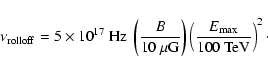
As a result, the best-fit roll-off frequency
 (1.9-3.3)
 Hz was derived.
The quantity
Hz was derived.
The quantity
 is written in terms of magnetic field (B)
and the maximum energy of accelerated electrons (
is written in terms of magnetic field (B)
and the maximum energy of accelerated electrons (
 )
as
(Reynolds & Keohane 1999)
)
as
(Reynolds & Keohane 1999)
 |
(1) |
Since most of the nonthermal X-ray photons are observed downstream,
the synchrotron radiation is mainly due to the downstream region.
Therefore, it is possible to adopt B in Eq. (1)
with the downstream magnetic field  .
.
3 Interpretation of the observed width of
nonthermal X-ray filaments
Two simple models are considered in the context of
DSA with a test-particle approximation.
We assume that the spatial distribution of
nonthermal X-rays coincides with that of the accelerated electrons
to the maximum energy, while thermal X-rays trace the
spatial profile of a background plasma and hence
a magnetic field.
For a steady state, there is no spatial structure of accelerated
particles downstream (Blandford & Ostriker 1978).
However, one should consider the finite-time
or energy-loss effect, which makes the spatial profile
in the downstream region.
For simplicity, we assume magnetic fields are
spatially uniform both upstream and downstream at least in
the nonthermal X-ray emitting region.
Since the fraction of magnetic pressure to ram pressure
is estimated as
 ,
where we assume the number density of thermal plasma
,
where we assume the number density of thermal plasma
 cm-3 and the shock velocity
 km s-1,
the magnetic pressure does not affect the dynamics of SNR.
We therefore can adopt the self-similar solution derived by
Ratkiewicz et al. (1994).
Our assumption of a spatially uniform magnetic
field is a good approximation
in the narrow range around the shock front.
km s-1,
the magnetic pressure does not affect the dynamics of SNR.
We therefore can adopt the self-similar solution derived by
Ratkiewicz et al. (1994).
Our assumption of a spatially uniform magnetic
field is a good approximation
in the narrow range around the shock front.
Since the wide-band spectrum shows a break on the
X-ray band, electrons accelerated near the
maximum energy
contribute to nonthermal X-ray emission.
The quantity
is determined by the age of the SNR or by
the balance of the acceleration and the energy-loss efficiencies.
To discuss this, we consider three time scales;
the acceleration time scale
 ,
the energy loss time scale
,
the energy loss time scale
 ,
and the age of SN 1006
,
and the age of SN 1006
 .
The energy loss of high energy electrons can be neglected when
.
The energy loss of high energy electrons can be neglected when
 .
Then,
is determined by
.
Then,
is determined by
 .
On the other hand,
is limited by the energy loss if
.
On the other hand,
is limited by the energy loss if
 .
We investigate these two cases separately
in the following subsections.
.
We investigate these two cases separately
in the following subsections.
![\begin{figure}
\par\includegraphics[width=16.8cm,clip]{0212fig1.eps}
\end{figure}](/articles/aa/full/2004/11/aa0212/Timg36.gif) |
Figure 1:
Contour maps of the functions
 (left panel)
and
(left panel)
and
 (right).
 |
| Open with DEXTER |
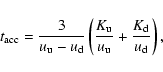
The acceleration time is given by Drury (1983) as
 |
(2) |
where u and K are
the velocity of bulk flow in the shock frame
and the diffusion coefficients for accelerated electrons
at the maximum energy, respectively.
The diffusion coefficients are given by quasi-linear theory
(Skilling 1975; Blandford & Eichler 1987).
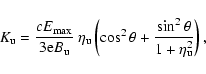
Let the mean free path of accelerated electrons parallel to the
magnetic field be a constant factor  times the gyro radius
 both upstream and downstream.
Then the diffusion coefficients in upstream and downstream regions
can be written in terms of
both upstream and downstream.
Then the diffusion coefficients in upstream and downstream regions
can be written in terms of
 ,
,
 ,
and the angle
between the upstream magnetic field and the shock normal
,
and the angle
between the upstream magnetic field and the shock normal  (Jokipii 1987),
 |
(3) |
 |
|
|
(4) |
where r is the compression ratio.
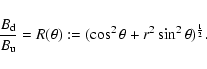
In this paper, since we assume that the shock is sufficiently strong
and that shock structure is not affected by the cosmic-ray pressure,
r should be 4 and the upstream and downstream magnetic field are
related as
 |
(5) |
Upstream and downstream velocities are related as
 ,
and throughout the paper,
we adopt
,
and throughout the paper,
we adopt
 km s-1 (Ghavamian et al. 2002).
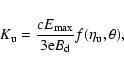
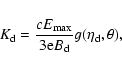
It is convenient to rewrite diffusion coefficients
using Eqs. (3)-(5)
as
km s-1 (Ghavamian et al. 2002).
It is convenient to rewrite diffusion coefficients
using Eqs. (3)-(5)
as
 |
(6) |
 |
(7) |
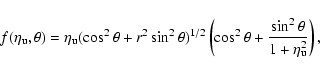
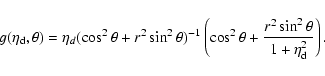
where
and
are given by
 |
(8) |
 |
(9) |
Note that the downstream magnetic field
is used both in
Eqs. (6) and (7).
Figure 1 shows the contour plots of
and
.
If
 ,
f can be smaller than unity in the case of
,
f can be smaller than unity in the case of
 .
The quantity g is smaller than 0.1 for
.
The quantity g is smaller than 0.1 for
 and
and
 .
.
Next, we consider the energy loss time scale.
Two processes cause the energy loss of electrons:
synchrotron radiation and the IC effect by cosmic
microwave background photons.
In the following calculations, the latter process can be neglected.
Then, we can simply write
When one compares
with
,
the mean value of the magnetic field
that accelerated electrons experience should be adopted.
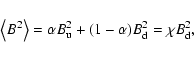
We can estimate the mean magnetic field as
 |
(11) |
where
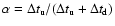 is the
time fraction that accelerating electrons are upstream.
For the particles in the acceleration process, we can estimate
is the
time fraction that accelerating electrons are upstream.
For the particles in the acceleration process, we can estimate
 from Eqs. (6) and (7).
Then, we obtain
from Eqs. (6) and (7).
Then, we obtain
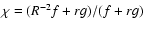 ,
which ranges between 0 and 1,
where R is defined in Eq. (5).
,
which ranges between 0 and 1,
where R is defined in Eq. (5).
3.1 Age-limited case
First, we investigate the case in which
the acceleration time
is nearly equal to the age of SN 1006
 .
This condition implies that the observed nonthermal X-rays
are emitted by electrons that have been accelerated up to now.
.
This condition implies that the observed nonthermal X-rays
are emitted by electrons that have been accelerated up to now.
![\begin{figure}
\par\includegraphics[width=15.8cm,clip]{0212fig2.eps}
\end{figure}](/articles/aa/full/2004/11/aa0212/Timg63.gif) |
Figure 2:
Points in the shaded regions surrounded by dotted and dot-dashed lines
satisfy Eqs. (1),
(5), (12), and (13)
for fixed
in the age-limited case.
Dotted lines represent Eq. (A.1) with
 or 40, while
dot-dashed lines Eq. (A.4) with
or 40, while
dot-dashed lines Eq. (A.4) with
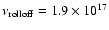 Hz,
the region above which is forbidden since Hz,
the region above which is forbidden since
 . . |
| Open with DEXTER |
![\begin{figure}
\par\includegraphics[width=16.1cm,clip]{0212fig3.eps}
\end{figure}](/articles/aa/full/2004/11/aa0212/Timg64.gif) |
Figure 3:
Points in the shaded regions surrounded by dotted and dot-dashed lines
satisfy Eqs. (1),
(5), (17), (18), (19),
and
 for fixed
in the energy loss-limited case.
Dotted lines represent Eq. (A.14) with
or 40, while
dot-dashed lines Eq. (A.13) with
or for fixed
in the energy loss-limited case.
Dotted lines represent Eq. (A.14) with
or 40, while
dot-dashed lines Eq. (A.13) with
or
 Hz. Hz. |
| Open with DEXTER |
The particles in the diffusive shock acceleration process
are transported upstream by the diffusion,
and are advected downstream.
The diffusion and advection time scales to move a scale-length ware
 and
and
 .
In the upstream region, the accelerated particles can reach
the point where the advection is balanced by diffusion,
i.e.
.
In the upstream region, the accelerated particles can reach
the point where the advection is balanced by diffusion,
i.e.
 .
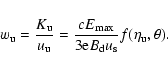
Therefore, the observed upstream-width of nonthermal X-rays
can be written as
.
Therefore, the observed upstream-width of nonthermal X-rays
can be written as
 |
(12) |
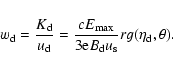
In the downstream region, if the particles are advected too far
from the shock front, they cannot return upstream
to obtain further energy.
Therefore, the particles being accelerated should stay in the
region where
 is smaller than
 .
Thus, we obtain the same equation as upstream,
.
Thus, we obtain the same equation as upstream,
 |
(13) |
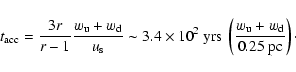
Then, Eq. (2) becomes
 |
(14) |
Since
is comparable to the age of the SN 1006,
our assumption
is justified.
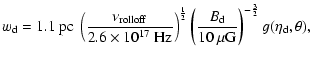
Eliminating
with Eq. (1),
we can rewrite (12) and (13) as
 |
|
|
(15) |
 |
|
|
(16) |
respectively.
Let us take
 pc,
pc,
 pc,
and
pc,
and
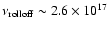 Hz as typical observed quantities
(Bamba et al. 2003a).
Then, Eqs. (15) and (16) give
Hz as typical observed quantities
(Bamba et al. 2003a).
Then, Eqs. (15) and (16) give
 .
In the case of
.
In the case of
 ,
the value of
can be determined as follows.
We see that since
,
the value of
can be determined as follows.
We see that since
 ,
f should be greater than
,
f should be greater than  1, i.e.

 G.
Independently of this,
the condition
G.
Independently of this,
the condition
 gives the upper limit of as
 G (see Eq. (A.5)).
Therefore, we obtain
G (see Eq. (A.5)).
Therefore, we obtain
 G.
This argument has been used in Bamba et al. (2003b).
On the other hand, as we have mentioned before,
cases of
G.
This argument has been used in Bamba et al. (2003b).
On the other hand, as we have mentioned before,
cases of  can be realized if
 ,
i.e. the magnetic field is
nearly perpendicular to the shock normal.
Then
may be smaller than 30 G.
,
i.e. the magnetic field is
nearly perpendicular to the shock normal.
Then
may be smaller than 30 G.
Let us vary the observed quantities ,
,
and
in the range of the observed errors (at a 90% confidence level).
We have six unknown parameters
,
 ,
,
,
,
and .
Conditions
(1), (5),
(12), (13), and
are used to relate these quantities.
Details are summarized in the Appendix A.
Figure 2 shows the allowed regions of
or
for fixed .
When we take
,
,
,
,
and .
Conditions
(1), (5),
(12), (13), and
are used to relate these quantities.
Details are summarized in the Appendix A.
Figure 2 shows the allowed regions of
or
for fixed .
When we take
 ,
the case of
,
the case of
 (Bohm limit both upstream and downstream) is
marginally acceptable,
since
should satisfy
(Bohm limit both upstream and downstream) is
marginally acceptable,
since
should satisfy
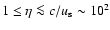 (Jokipii 1987).
Then the magnetic field has values of
(Jokipii 1987).
Then the magnetic field has values of
 -78
.
Equation (A.5) shows that the
maximum value of magnetic fields is achieved when the observed
quantities
,
,
and
have the minimum values.
On the other hand, when
-78
.
Equation (A.5) shows that the
maximum value of magnetic fields is achieved when the observed
quantities
,
,
and
have the minimum values.
On the other hand, when
 ,
small magnetic fields are possible.
If we choose
,
small magnetic fields are possible.
If we choose
 pc,
pc,
 pc,
and
pc,
and
 Hz, then
 and
and
 ,
the magnetic fields are
,
the magnetic fields are
 -20
.
This result has been suggested by Bamba et al. (2003a).
-20
.
This result has been suggested by Bamba et al. (2003a).
The left panel of Fig. 4
represents the allowed region of
and (see Eqs. (A.6) and (A.7)).
The solid lines describe Eq. (1) with
 -3.3
-3.3
 Hz, while the
dashed lines a boundary of the region
in which a gyro-radius of accelerated electrons in the downstream
Hz, while the
dashed lines a boundary of the region
in which a gyro-radius of accelerated electrons in the downstream
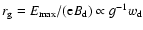 .
In order to satisfy
.
In order to satisfy
 and all of the other conditions, the quantity
 should range between 0.09 and 27.
3.2 Energy loss-limited case
If the maximum energy
of accelerated electrons
is determined by
 |
(17) |
the motion of
accelerated particles toward the upstream region might be obstructed
by the energy loss effect as well as the advection.
Let us consider in the upstream region, the energy loss time scale
 in addition to the advection time scale
 and the diffusion time scale
 .
If
.
If
 ,
the observed width of nonthermal
X-rays in the upstream is given by
,
the observed width of nonthermal
X-rays in the upstream is given by
 as well as the age-limited case,
while in the case of
as well as the age-limited case,
while in the case of
 ,
is given by
,
is given by
 .
Therefore, we can write
.
Therefore, we can write
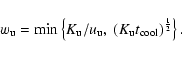 |
(18) |
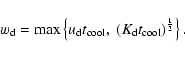
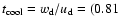
On the other hand, the observed scale length of nonthermal X-ray
filaments
in the downstream
is determined by the cooling time scale as
 |
(19) |
We can now use five equations (1), (5),
(17), (18), and (19)
for six unknown parameters
,
,
,
,
,
and ,
and solve these equations with fixed under the condition of
.
We summarize the detailed calculation procedure
in Appendix A.
Figure 3 shows the results for individual .
We consider, as well as the age-limited case,
the errors associated with the analysis
of Bamba et al. (2003a).
When
,
the case of
is
again acceptable.
Then, the magnetic field is in the range of
 -85
.
If
-85
.
If
 ,
the downstream magnetic field can be in the Bohm limit
,
the downstream magnetic field can be in the Bohm limit
 ,
then
,
then
 -8 and
 -85
.
However, if
is larger than
-85
.
However, if
is larger than
 ,
then
,
then
 and
and
 .
This implies that the upstream magnetic field is more turbulent
than the downstream, which seems to be unrealistic.
.
This implies that the upstream magnetic field is more turbulent
than the downstream, which seems to be unrealistic.
Indeed, as shown in A.2,
scale lengths are given by
and
 .
Then,
and
are given by
Eqs. (A.10) and (A.11), respectively.
The right panel of Fig. 4 represents the
allowed region of
and
when
.
Then,
and
are given by
Eqs. (A.10) and (A.11), respectively.
The right panel of Fig. 4 represents the
allowed region of
and
when
 -0.4 pc and
-3.
-0.4 pc and
-3.
 Hz.
All the points in the region satisfy other conditions.
Vink & Laming (2003) discussed similar arguments for Cas A.
Hz.
All the points in the region satisfy other conditions.
Vink & Laming (2003) discussed similar arguments for Cas A.
![\begin{figure}
\par\includegraphics[width=15.7cm,clip]{0212fig4.eps}\par
\end{figure}](/articles/aa/full/2004/11/aa0212/Timg126.gif) |
Figure 4:
The shaded areas indicate the most likely values of
magnetic fields just behind the shock front
and
the maximum energy of shock-accelerated electrons
.
The left panel is for the age-limited case, while
the right gives the energy loss-limited model.
These areas are formed by the two solid lines for
a roll-off energy of
-3.3)
Hz,
and the two dashed lines from
the observed width of nonthermal X-rays;
in the age-limited case,
a gyro-radius of accelerated electrons in the downstream
should be
 -20 -20
 pc,
while in the energy loss-limited case,
cooling time of accelerated electrons
should be pc,
while in the energy loss-limited case,
cooling time of accelerated electrons
should be
 -5.4 -5.4
 yrs. yrs. |
| Open with DEXTER |
4 Discussion
We have argued the limitations of the model of DSA
from the recently observed scale length of the
nonthermal X-ray emitting region of NE shell of SN 1006
based on the assumption that
the observed spatial structure of nonthermal X-ray filaments
reflects that of electrons accelerated to the maximum energy.
A test particle approximation has been adopted, where
the back reactions of accelerated particles are neglected,
although one might have to consider corrections due to
nonlinear effects to explain the wide-band spectrum
from radio to TeV -rays.
Two models have been discussed: age-limited and
energy loss-limited models.
Note that in each model, the value and configuration of a magnetic
field in the acceleration site can be discussed using only
the spatial distribution of the synchrotron X-rays,
which are emitted by accelerated electrons with an energy of
several tens of TeV, and the roll-off frequency,
which is derived by the
fitting of the wide band spectrum from the radio to X-rays.
When a magnetic field is nearly parallel to the shock normal,
and
should be nearly unity,
which means that the magnetic field is highly turbulent
(near the Bohm limit),
and the magnetic field is in the range of 20-85
.
Relatively strong parallel magnetic fields
are considered by several authors
(Berezhko et al. 2002; Ellison et al. 2000).
The derived value of the magnetic field seems to be higher than the
usual interstellar value of a few micro Gauss.
However, the mechanism proposed by Lucek & Bell (2000)
may be able to amplify the magnetic field.
These situation can be realized both in the
age-limited and energy loss-limited model.
When the magnetic field is nearly perpendicular
to the shock normal, relatively small values of
 -20
are allowed,
which can exist only in the age-limited model.
This value is consistent with the interstellar magnetic field
and the value assumed in Bamba et al. (2003a) or others
(Allen et al. 2001; Reynolds 1998)
but slightly larger than that derived by CANGAROO observation
(Tanimori et al. 1998, 2001),
which assumes TeV -rays are emitted by the IC process.
This discrepancy may be solved if the filaments 1-6 are not the
main sites of TeV -rays generated by the leptonic process.
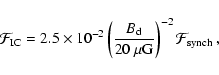
The observed flux of TeV -rays which are up-scattered CMB
photons by synchrotron-emitting electrons is
-20
are allowed,
which can exist only in the age-limited model.
This value is consistent with the interstellar magnetic field
and the value assumed in Bamba et al. (2003a) or others
(Allen et al. 2001; Reynolds 1998)
but slightly larger than that derived by CANGAROO observation
(Tanimori et al. 1998, 2001),
which assumes TeV -rays are emitted by the IC process.
This discrepancy may be solved if the filaments 1-6 are not the
main sites of TeV -rays generated by the leptonic process.
The observed flux of TeV -rays which are up-scattered CMB
photons by synchrotron-emitting electrons is
 |
(20) |
where
 is the observed flux of synchrotron
X-rays estimated as
is the observed flux of synchrotron
X-rays estimated as
 ergs s-1 cm-2
in the 0.5-10.0 keV band by Bamba et al. (2003a).
Then, the contribution of the IC -rays
generated in the filaments 1-6 is only 0.5%
of the whole flux coming from SN 1006.
This shows that the IC -ray emitting sites
have a smaller magnetic field, hence radiate fewer
synchrotron X-rays than in the filaments 1-6.
Alternatively, the TeV -rays may be
emitted by the hadronic process.
The most plausible position of the -ray emission
determined by CANGAROO is north (and outside) of
filament 1 (Tanimori et al. 1998, 2001).
However, the region where the significance is higher than
half the maximum value extends over
ergs s-1 cm-2
in the 0.5-10.0 keV band by Bamba et al. (2003a).
Then, the contribution of the IC -rays
generated in the filaments 1-6 is only 0.5%
of the whole flux coming from SN 1006.
This shows that the IC -ray emitting sites
have a smaller magnetic field, hence radiate fewer
synchrotron X-rays than in the filaments 1-6.
Alternatively, the TeV -rays may be
emitted by the hadronic process.
The most plausible position of the -ray emission
determined by CANGAROO is north (and outside) of
filament 1 (Tanimori et al. 1998, 2001).
However, the region where the significance is higher than
half the maximum value extends over
 ,
which is almost the same as the standard deviation of the
point-spread function of the CANGAROO telescope.
We need stereoscopic observations of TeV gamma-ray emissions
by imaging atmospheric Cherenkov telescopes
(for example, CANGAROO-III, HEGRA, and H.E.S.S.)
to establish the position and extent of the emission region.
,
which is almost the same as the standard deviation of the
point-spread function of the CANGAROO telescope.
We need stereoscopic observations of TeV gamma-ray emissions
by imaging atmospheric Cherenkov telescopes
(for example, CANGAROO-III, HEGRA, and H.E.S.S.)
to establish the position and extent of the emission region.
We briefly discuss how our results may change if the test particle
approximation is dropped.
Although we should consider the spatial structure modified,
for example, in the upstream precursor region,
we present the cases of r>4 that are thought to be caused
by nonlinear effects.
Berezhko et al. (2002) showed that the
present value of the total compression ratio is about 6.
In the age-limited case, we observe that
the inferred magnitude of the upstream magnetic field
becomes smaller than that of the r=4 case
as r is made larger (up to 7). However,
the overall shapes and total areas of the allowed
regions are changed only slightly for any case of .
Thus the nonlinear effect would not be large.
On the other hand, in the energy loss-limited case, the allowed region
in the
-
plane becomes narrow and only the cases of
 -10
-10 can be exist for
  while
no allowed region exists for
while
no allowed region exists for  .
This comes from the fact that another restriction,
Eq. (A.24), emerges.
The larger r, the stronger the constraint
because of the less efficient advection for a fixed
shock velocity
.
This comes from the fact that another restriction,
Eq. (A.24), emerges.
The larger r, the stronger the constraint
because of the less efficient advection for a fixed
shock velocity  .
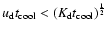
Furthermore, it can be shown that there exists no case in which
is given by
.
Furthermore, it can be shown that there exists no case in which
is given by
 ,
since
the condition
,
since
the condition
 is incompatible with
the condition
is incompatible with
the condition
 in the parameter
range of interest.
in the parameter
range of interest.
It is important to determine the magnetic field configurations
to discuss the acceleration and/or injection efficiency.
In this paper, using the spatial distribution of nonthermal X-rays,
we have shown that roughly two cases can exist:
high and parallel, and low and perpendicular magnetic field.
In the latter case, the back reaction of accelerated particles is
small and thus a test-particle treatment is a good approximation.
The magnetic field amplification process discussed by
Lucek & Bell (2000) does not work well.
In the former case, nonlinear effects are so efficient that
the magnetic field can be large.
The difference between these cases probably comes from the fact that
the (proton) injection rate depends strongly on the shock obliquity
and diminishes as
increases
(Völk et al. 2003).
In addition to our result, radio polarization data with high spatial
resolution may provide further information about the magnetic field
configuration.
In this paper, we have adopted the plane shock approximation.
For further details, it might be important to consider the
curvature effect as discussed in
Berezhko et al. (2003)
to produce a more realistic scenario.
Acknowledgements
Our particular thanks are due to T. Nakamura, M. Hoshino, and
T. Tanimori for their fruitful discussions and comments.
R.Y. and A.B. are supported by JSPS Research Fellowships
for Young Scientists.
This work is supported by a Grant-in-Aid for Scientific Research,
No. 14340066 from the Ministry of Education, Culture, Sport,
Science, and Technology of Japan,
and also supported by a Grant-in-Aid for for the 21st Century COE
"Center for Diversity and Universality in Physics''.
Appendix A: Detailed calculations
We summarize a procedure for practical calculation of
and  from observed quantities.
Once (f,g) is given for fixed ,
the allowed region of
from observed quantities.
Once (f,g) is given for fixed ,
the allowed region of
 is derived by
Eqs. (8) and (9).
Relations of f and g in the age-limited case
and energy loss-limited case are different.
is derived by
Eqs. (8) and (9).
Relations of f and g in the age-limited case
and energy loss-limited case are different.
A.1 Age-limited case
One can derive from Eqs. (12) and (13)
 |
(A.1) |
The condition
gives the additional inequalities.
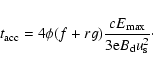
Substituting Eqs. (6) and (7) into
Eq. (2), we derive
 |
(A.2) |
Where
 .
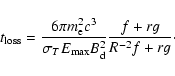
The energy loss timescale that should be compared with
is given by
.
The energy loss timescale that should be compared with
is given by
 |
(A.3) |
Using Eq. (1), we can eliminate
and ,
and obtain
 |
|
|
(A.4) |
The quantities f and g should satisfy Eqs. (A.1)
and (A.4).
The condition
gives also
the upper limit of .
In the age-limited case, one can derive
 .
Then using Eqs. (10) and (14), we derive
.
Then using Eqs. (10) and (14), we derive
 |
|
|
(A.5) |
where we eliminate
with Eq. (1).
Additionally, using Eqs. (1) and (13),
one can show
and
can be expressed in terms of g as
 |
|
|
(A.6) |
 |
|
|
(A.7) |
respectively.
A.2 Energy loss-limited case
For our parameters,
and
are given by
 |
(A.8) |
 |
(A.9) |
We can calculate
and
from Eqs. (1) and
(A.9) as
 |
|
|
(A.10) |
 |
|
|
(A.11) |
Then, from Eqs. (6) and (A.8), we derive
 |
|
|
(A.12) |
The condition
 gives
gives
 |
|
|
(A.13) |
Eliminating
from Eqs (A.12) and (A.13),
we derive
![\begin{displaymath}\frac{g}{f}=
\frac{1}{4}\left[\phi^{-1}\frac{w_{\rm d}}{w_{\rm u}}-
\left(\frac{r}{4}\right)^{-1}R(\theta)^{-2}
\right] \cdot
\end{displaymath}](/articles/aa/full/2004/11/aa0212/img158.gif) |
(A.14) |
Equations (A.13) and (A.14) determine (f,g).
We can show that
the condition
is always satisfied.
Substituting Eqs. (A.10) and (A.11) into
Eq. (A.3), we obtain
 |
|
|
(A.15) |
Then,
reduces
 |
|
|
(A.16) |
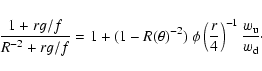
Using Eq. (A.14), we rewrite
the left hand side of Eq. (A.16) as
 |
(A.17) |
Substituting Eq. (A.17) into Eq. (A.16),
we derive
 |
|
|
(A.18) |
This equation is always satisfied since
and
range between
0.01-0.1 pc and 0.06-0.4 pc, respectively.
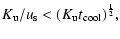
Finally in order to validate Eqs. (A.8) and (A.9),
we confirm the conditions
 |
|
|
(A.19) |
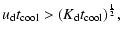 |
|
|
(A.20) |
are always satisfied for our parameters of interest.
Using Eqs. (1), (6) and (10),
Eq. (A.19) can be rewritten as
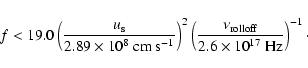 |
(A.21) |
This equation, together with Eq. (A.12), reduces to
 |
(A.22) |
which is always satisfied since
 -0.1 pc and
-0.4 pc.
On the other hand, from Eqs. (1), (7),
(10), and (A.20), we derive
-0.1 pc and
-0.4 pc.
On the other hand, from Eqs. (1), (7),
(10), and (A.20), we derive
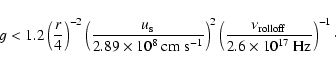 |
(A.23) |
Combining this equation and Eq. (A.13), we eliminate
and
as
![\begin{displaymath}\left[1-\left(\frac{r}{4}\right)^{-1}\phi\right]g<
\frac{1}{4}\left(\frac{r}{4}\right)^{-2}\phi~R(\theta)^{-2}~f .
\end{displaymath}](/articles/aa/full/2004/11/aa0212/img169.gif) |
(A.24) |
As long as  ,
this is always satisfied since
,
this is always satisfied since
 .
.
-
Achterberg, A., Blandford, R. D., & Reynolds, S. P. 1994,
A&A, 281, 220 [NASA ADS]
-
Aharonian, F. A., & Atoyan, A. M. 1999, A&A, 351, 330 [NASA ADS] (In the text)
- Allen, G. E.,
Petre, R., & Gotthelf, E. V. 2001, ApJ, 558, 739 [NASA ADS] [CrossRef] (In the text)
- Bamba, A.,
Yamazaki, R., Ueno, M., & Koyama, K. 2003a, ApJ, 589, 827 [NASA ADS] [CrossRef] (In the text)
- Bamba, A.,
Yamazaki, R., Ueno, M., & Koyama, K. 2003b, Adv. Space Res., in
press [astro-ph/0308322]
- Bell, A. R. 1978,
MNRAS, 182, 443 [NASA ADS] (In the text)
- Berezhko,
E. G., Ksenofontov, L. T., & Völk, H. J. 2002, A&A,
395, 943 [NASA ADS] [EDP Sciences] [CrossRef] (In the text)
- Berezhko,
E. G., Ksenofontov, L. T. & Völk, H. J. 2003, in Proc. of
28th ICRC, 2441
(In the text)
-
Blandford, R. D., & Eichler, D. 1987, Phys. Rep., 154, 1 [NASA ADS] (In the text)
-
Blandford, R. D., & Ostriker, J. P. 1978, ApJ, 221, L29 [NASA ADS] [CrossRef] (In the text)
- Drury, L. O' C.
1983, Rep. Prog. Phys., 46, 973 [NASA ADS] [CrossRef] (In the text)
- Dyer, K. K.,
Reynolds, S. P., Borkowski, K. J., Allen, G. E., & Petre, R.
2001, ApJ, 551, 439 [NASA ADS] (In the text)
- Ellison, D.
C., Berezhko, E. G., & Baring, M. G. 2000, ApJ, 540, 292 [NASA ADS] [CrossRef] (In the text)
-
Ghavamian, P., Winkler, P. F., Raymond, J. C., & Long, K. S.
2002, ApJ, 572, 888 [NASA ADS] [CrossRef] (In the text)
- Jones, F. C.,
& Ellison, D. C. 1991, Space Sci. Rev., 58, 259 [NASA ADS] (In the text)
- Jokipii, J.
R. 1987, ApJ, 313, 842 [NASA ADS] [CrossRef] (In the text)
- Koyama, K.,
Petre, R., Gotthelf, E. V., et al. 1995, Nature, 378, 255 [NASA ADS] [CrossRef] (In the text)
- Long, K. S.,
Reynolds, S. P., Raymond, J. C., et al. 2003, ApJ, 586, 1162 [NASA ADS] [CrossRef] (In the text)
- Lucek, S. G.,
& Bell, A. R. 2000, MNRAS, 314, 65 [NASA ADS] [CrossRef] (In the text)
- Malkov, E.,
& Drury, L. O'C. 2001, Rep. Prog. Phys., 64, 429 [NASA ADS] [CrossRef] (In the text)
-
Ratkiewicz, R., Axford, W. I., & McKenzie, J. F. 1994, A&A,
291, 935 [NASA ADS] (In the text)
- Reynolds,
S. P. 1998, ApJ, 493, 375 [NASA ADS] [CrossRef] (In the text)
- Reynolds,
S. P., & Keohane, J. W. 1999, ApJ, 525, 368 [NASA ADS] [CrossRef] (In the text)
- Skilling,
J. 1975, MNRAS, 172, 557 [NASA ADS] (In the text)
- Tanimori,
T., Hayami, Y., Kamei, S., et al. 1998, ApJ, 497, L25 [NASA ADS] [CrossRef] (In the text)
- Tanimori,
T., Naito, T., Yoshida, T., & CANGAROO collaboration 2001, in
Proc. of 27th ICRC (Hamburg), 2465
(In the text)
- Vink, J., &
Laming, J. M. 2003, ApJ, 584, 758 [NASA ADS] [CrossRef] (In the text)
- Völk, H. J.,
Berezhko, E. G., & Ksenofontov, L. T. 2003, A&A, 409,
563 [NASA ADS] [EDP Sciences] [CrossRef] (In the text)
- Winkler, P.
F., Gupta, G., & Long, K. S. 2003, ApJ, 585, 324 [NASA ADS] [CrossRef] (In the text)
Copyright ESO 2004
![\begin{figure}
\par\includegraphics[width=16.8cm,clip]{0212fig1.eps}
\end{figure}](/articles/aa/full/2004/11/aa0212/img36.gif)


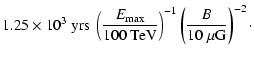
![\begin{figure}
\par\includegraphics[width=15.8cm,clip]{0212fig2.eps}
\end{figure}](/articles/aa/full/2004/11/aa0212/img63.gif)
![\begin{figure}
\par\includegraphics[width=16.1cm,clip]{0212fig3.eps}
\end{figure}](/articles/aa/full/2004/11/aa0212/img64.gif)
![\begin{figure}
\par\includegraphics[width=15.7cm,clip]{0212fig4.eps}\par
\end{figure}](/articles/aa/full/2004/11/aa0212/img126.gif)