![\begin{figure}
\par\includegraphics[width=8.8cm,clip]{h4600f1.ps}
\end{figure}](/articles/aa/full/2004/10/aah4600/img17.gif) |
Figure 1:
Positions of the target stars. The background shows the
60  IRAS emission map (see intensity scale at right).
 |
| Open with DEXTER | |
In the text
![\begin{figure}
\par\includegraphics[width=18cm,clip]{h4600f2.ps}
\end{figure}](/articles/aa/full/2004/10/aah4600/img20.gif) |
Figure 2:
Absorption lines from the seven target star spectra.
The sample portions are binned (to  8.4 km s-1),
but not normalised to a continuum.
The Ar I line at 1048 Å is located in the left wing of
a strong H2 absorption feature.
Stellar wind features affect the continuum in the WR star
HD 152270.
For some sight lines (HD 152249, HD 152270,
HD 326329) a second blueward velocity component is
clearly visible, while it is much weaker in the others.
The dashes above the spectra mark the positions of the main
velocity component at -8 km s-1 and of the weaker
second component at -40 km s-1.
At the left end of the box of the N I line the transition of
N I (1134.4 Å) can be seen, shortwards of the HD R(0) line
a blend of the H2 transitions R(3), 4-0 and R(6), 5-0. 8.4 km s-1),
but not normalised to a continuum.
The Ar I line at 1048 Å is located in the left wing of
a strong H2 absorption feature.
Stellar wind features affect the continuum in the WR star
HD 152270.
For some sight lines (HD 152249, HD 152270,
HD 326329) a second blueward velocity component is
clearly visible, while it is much weaker in the others.
The dashes above the spectra mark the positions of the main
velocity component at -8 km s-1 and of the weaker
second component at -40 km s-1.
At the left end of the box of the N I line the transition of
N I (1134.4 Å) can be seen, shortwards of the HD R(0) line
a blend of the H2 transitions R(3), 4-0 and R(6), 5-0. |
| Open with DEXTER | |
In the text
![\begin{figure}
\par\includegraphics[width=17.4cm,clip]{h4600f3.ps}
\end{figure}](/articles/aa/full/2004/10/aah4600/img21.gif) |
Figure 3: Sample curves of growth. Curves of growth were only used to determine an initial preliminary b value for the fitting process; this b value was then subject to some adjustment during the fit. Shown are single-component curves of growth for the b values that resulted from the fit, but the equivalent widths plotted are sums over the full absorption features, i.e. sums over the equivalents widths of the individual blended velocity components. For this reason a discrepancy between equivalent widths and the curve of growth is visible for the curve of the two-component sight line HD 152270. |
| Open with DEXTER | |
In the text
![\begin{figure}
\par\includegraphics[angle=-90,width=11.2cm,clip]{h4600f4.ps}
\end{figure}](/articles/aa/full/2004/10/aah4600/img24.gif) |
Figure 4: Sample portion of the HD 152234 spectrum with a one-component fit, in which the positions of the fitted transitions are indicated. The continuum count rate in this region of the spectrum is ca. 6000 (binned). The full wealth of H2 transitions mainly of the (4-0) vibrational states is visible. Also visible is a strong HD line of the J=0 state (HD R(0), 4-0). For the J=1 state of HD we measure only upper limits. The Ar I transition at 1048 Å (see also Fig. 2) is affected by some unknown absorption on its left wing, maybe by a weak second component bluewards. Also other lines hint at the presence of a weak second component. |
| Open with DEXTER | |
In the text
![\begin{figure}
\includegraphics[width=12cm,clip]{h4600f5.ps}
\end{figure}](/articles/aa/full/2004/10/aah4600/img182.gif) |
Figure 5: Element depletions as derived from the seven sight lines observed. The width of the error boxes varies for better readability only. The bold lines represent the values typically found in the interstellar medium in warm ( upper bold line) and cool ( lower bold line) gas (Savage & Sembach 1996). The scatter especially in Ar, O, and Si is due to difficulties in determining the column densities for these metals. |
| Open with DEXTER | |
In the text
![\begin{figure}
\par\includegraphics[width=8.4cm,clip]{h4600f6.ps}
\end{figure}](/articles/aa/full/2004/10/aah4600/img227.gif) |
Figure 6:
Measured H2 excitation and excitation model for
HD 152234.
Testing of various models restricts the parameters to a hydrogen
density n of not more than 1000 cm-3 and a radiation
field at
 Å with Å with
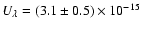 erg cm-3 Å-1.
Shown is the fit for n=100 cm-3. erg cm-3 Å-1.
Shown is the fit for n=100 cm-3. |
| Open with DEXTER | |
In the text