A&A 416, 19-34 (2004)
DOI: 10.1051/0004-6361:20034284
Astrometric microlensing of quasars
Dependence on surface mass density and external shear
M. Treyer1 -
J. Wambsganss2
1 -
Laboratoire d'Astrophysique de Marseille,
Traverse du Siphon,
13376 Marseille,
France
2 -
Universität Potsdam,
Institut für Physik,
Am Neuen Palais 10,
14467 Potsdam,
Germany
Received 5 September 2003 / Accepted 9 November 2003
Abstract
A small fraction of all quasars are strongly lensed
and multiply imaged,
with
usually a galaxy acting as the main lens.
Some, or maybe all of these quasars are also affected by microlensing,
the effect of
stellar mass objects in the lensing galaxy.
Usually
only the photometric aspects of microlensing are considered:
the apparent magnitudes of the quasar images vary independently because
the relative motion between source, lens and observer leads
to uncorrelated magnification changes as a function of time.
However,
stellar microlensing on quasars has yet another effect,
which was first explored
by Lewis & Ibata (1998):
the position of the quasar - i.e. the center-of-light of the many
microimages - can shift
by tens of microarcseconds due to the relatively
sudden (dis-)appearance
of a pair of microimages when a caustic is being crossed.
Here we explore quantitatively the astrometric effects of
microlensing on quasars for different
values of the
lensing parameters  and
and  (surface mass density and external shear)
covering
most of
the known multiple quasar systems.
We show examples of microlens-induced quasar motion
(i.e. astrometric changes) and the
corresponding light curves
for different quasar sizes.
We evaluate statistically the occurrence of large
"jumps'' in angular position and their correlation with
apparent brightness fluctuations.
We also show statistical relations between positional offsets and
time from random starting points.
As the amplitude of the astrometric offset
depends on the source size,
astrometric microlensing signatures of quasars
- combined with the photometric variations -
will provide very good constraints on the sizes of quasars as
a function of wavelength.
We predict that such signatures will be detectable
for realistic microlensing scenarios
with near future technology in the infrared/optical
(Keck-Interferometry, VLTI, SIM, GAIA).
Such detections will show that not even high
redshift quasars define a "fixed'' coordinate system.
(surface mass density and external shear)
covering
most of
the known multiple quasar systems.
We show examples of microlens-induced quasar motion
(i.e. astrometric changes) and the
corresponding light curves
for different quasar sizes.
We evaluate statistically the occurrence of large
"jumps'' in angular position and their correlation with
apparent brightness fluctuations.
We also show statistical relations between positional offsets and
time from random starting points.
As the amplitude of the astrometric offset
depends on the source size,
astrometric microlensing signatures of quasars
- combined with the photometric variations -
will provide very good constraints on the sizes of quasars as
a function of wavelength.
We predict that such signatures will be detectable
for realistic microlensing scenarios
with near future technology in the infrared/optical
(Keck-Interferometry, VLTI, SIM, GAIA).
Such detections will show that not even high
redshift quasars define a "fixed'' coordinate system.
Key words: cosmology: observations - gravitational lensing - galaxies: quasars: general - astrometry
Gravitational lensing acts on quasars in a number of ways. The
best known effect is strong lensing which produces
multiply imaged quasars.
Only a small
fraction of all quasars (about 1 in 500)
are multiply imaged
with galaxies acting as the main lenses
(for an updated list, see
the CASTLES web page http://cfa-www.harvard.edu/glensdata/).
Most of these quasars
- and possibly some "single'' quasars as well -
are also affected by microlensing: the coherent effects of
stellar mass objects in the lensing galaxy.
Microlensing is well known
to affect the apparent brightness of the quasar,
which changes due to the relative motion between lens,
source and observer
(see, e.g.,
Paczynski 1986;
Wambsganss et al. 1990;
Lewis et al. 1998;
Wyithe et al. 2000a;
Wambsganss 2001;
Wozniak et al. 2000a,b).
However, stellar microlensing has yet another effect,
which was first explored
by Lewis & Ibata (1998):
when the quasar crosses a (micro-)caustic, a new
pair of microimages is created or destroyed.
The relatively sudden (dis-)appearance of
a highly magnified image pair does not just produce a strong
fluctuation
in apparent brightness, it
can also shift the center-of-light of the quasar
(the weighted sum of all the microimages)
by tens of microarcseconds.
Such a positional change is in principle detectable
with current VLBI techniques in the radio regime, and will be
measurable
in the infrared and optical wavebands as well
with (near) future
technology (Keck-Interferometry, VLTI, SIM, GAIA).
Table 1:
Summary of scales for the "typical'' lensing case (
 ,
,
 )
and for the special case of Q2237+0305 (
)
and for the special case of Q2237+0305 (
 ,
,
 ).
).
Table 2:
Source sizes (Gaussian widths  )
used in our microlensing simulations in units of pixels, Einstein radii and in physical units for the typical lensed quasar and for the special case of Q2237+0305.
)
used in our microlensing simulations in units of pixels, Einstein radii and in physical units for the typical lensed quasar and for the special case of Q2237+0305.
![\begin{figure}
\par\includegraphics[width=10.35cm,clip]{treyer1.ps}\end{figure}](/articles/aa/full/2004/10/aa0284/Timg61.gif) |
Figure 1:
Illustration of source position in magnification pattern/source plane ( left) and corresponding microimage configuration in the image plane, for cases
 , ,
 , ,
 ,
and ,
and
 (from top to bottom) and no external shear (
 ). The center-of-light position is marked with a plus sign. The horizonal bar indicates a length of two Einstein radii ( ). The center-of-light position is marked with a plus sign. The horizonal bar indicates a length of two Einstein radii (
 ). Note the change in scale in the right hand panels. ). Note the change in scale in the right hand panels. |
| Open with DEXTER |
![\begin{figure}
\par\includegraphics[width=10.5cm,clip]{treyer2.ps}\end{figure}](/articles/aa/full/2004/10/aa0284/Timg62.gif) |
Figure 2:
Same as Fig. 1, here for the cases with external shear in the X-axis direction:
 ,
= 0.4, = 0.6, and = 0.8 (from top to bottom); the center-of-light position is marked with a plus sign, the horizonal bar indicates a length of two Einstein radii. ,
= 0.4, = 0.6, and = 0.8 (from top to bottom); the center-of-light position is marked with a plus sign, the horizonal bar indicates a length of two Einstein radii. |
| Open with DEXTER |
![\begin{figure}
\par\includegraphics[width=14cm,clip]{treyer3.ps}\end{figure}](/articles/aa/full/2004/10/aa0284/Timg63.gif) |
Figure 3:
Illustration of the ray shooting method, here for
case
,
 .
Top left:
magnification pattern in the source (quasar) plane
with side length .
Top left:
magnification pattern in the source (quasar) plane
with side length
 (B configuration).
The large square indicates the region
in the source plane for which all source positions
were evaluated.
Top right:
corresponding microimage configuration of
the large square "source'' on the left,
side length is 40
(B configuration).
The large square indicates the region
in the source plane for which all source positions
were evaluated.
Top right:
corresponding microimage configuration of
the large square "source'' on the left,
side length is 40
 :
these are
the parts of the sky (image plane) where
light bundles originated from the square. Note the
strong effect of shear in the Y-axis direction.
Bottom left:
the square here corresponds to the small square in the top
panel, zoomed in 8 times.
Bottom right:
corresponding micro-image configuration for
the square on the left. :
these are
the parts of the sky (image plane) where
light bundles originated from the square. Note the
strong effect of shear in the Y-axis direction.
Bottom left:
the square here corresponds to the small square in the top
panel, zoomed in 8 times.
Bottom right:
corresponding micro-image configuration for
the square on the left. |
| Open with DEXTER |
![\begin{figure}
\par\includegraphics[width=14cm,clip]{treyer4.ps}\end{figure}](/articles/aa/full/2004/10/aa0284/Timg64.gif) |
Figure 4:
Illustration of a quasar microlensing scenario
(here for lensing parameters
and
 ,
sidelength about 10 ,
sidelength about 10  ):
the gray scale indicates regions of different magnifications
in the source plane.
The straight vertical line marks the track of the
quasar relative to the magnification pattern.
The total length of the track is 2.0 . ):
the gray scale indicates regions of different magnifications
in the source plane.
The straight vertical line marks the track of the
quasar relative to the magnification pattern.
The total length of the track is 2.0 . |
| Open with DEXTER |
![\begin{figure}
\par\includegraphics[width=14cm,clip]{treyer5.ps} \end{figure}](/articles/aa/full/2004/10/aa0284/Timg69.gif) |
Figure 5:
The four lines indicate from top to bottom:
a)
 ,
the X-coordinate
of the quasar relative to the starting position
as a function of time;
b) same for the Y-coordinate;
c) the absolute value of the positional shift ,
the X-coordinate
of the quasar relative to the starting position
as a function of time;
b) same for the Y-coordinate;
c) the absolute value of the positional shift
 relative to the starting position as a function of time;
and
d) the corresponding light curve of the quasar
for the example track shown in Fig. 4.
The solid lines correspond
to a source size relative to the starting position as a function of time;
and
d) the corresponding light curve of the quasar
for the example track shown in Fig. 4.
The solid lines correspond
to a source size
 (typically about
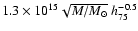 cm) the dashed lines to cm) the dashed lines to
 (typically about
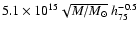 cm). cm). |
| Open with DEXTER |
A number of studies have explored
astrometric microlensing in a different regime,
namely stars in the Milky Way
(or dark matter objects in its
halo) acting on background stars either in the Magellanic
Clouds or in the bulge of the Milky Way
(e.g.,
Miyamoto & Yoshii 1995;
Miralda-Escude 1996;
Mao & Witt 1998;
Boden et al. 1998;
Goldberg & Wozniak 1998;
Paczynski 1998;
Han et al. 1999;
Han & Kim 1999;
Han & Jeong 1999;
Safizadeh et al. 1999;
Dominik & Sahu 2000;
Gould & Han 2000;
Han & Kim 2000;
Salim & Gould 2000;
Delplancke et al. 2001;
Belokurov & Evans 2002;
Dalal & Lane 2003).
The effects of Milky Way stars on background quasars were
studied by
Hosokawa et al. (1997);
Sazhin et al. (1998) and Honma & Kurayama (2002).
Williams & Saha (1995) had
discussed large image shifts produced by substructure in
the lensing galaxy.
However,
not much work has yet been done on cosmological
astrometric microlensing - stars in lensing galaxies acting on even
more distant quasars - beyond Lewis & Ibata (1998), with the recent
exception of Salata & Zhdanov (2003).
The present paper aims to explore this further.
We study quantitatively eight different cases with
various values of the
surface mass density, with and without external shear.
We present example microlensing lightcurves with the
corresponding center-of-light shifts and we
investigate the correlation
between high-magnification photometric events
and large-offset astrometric events.
As first pointed out by Lewis & Ibata (1998),
large offset events are typically
correlated with high-magnification
events, whereas the inverse is much less true.
The reason for this is that
the location of the newly appearing bright image pair
during
a caustic crossing is unrelated to
the previous center-of-light of the microimages.
In rare cases,
the new image pair may appear at or close to
the center-of-light of the pre-existing microimages.
Such a situation would correspond
to a large change in brightness with very little change in position.
In most cases, however, the new bright image pair will appear at a location
which is unrelated to the previous center-of-light, and hence
produce a sudden jump.
Since the positional offset is preferentially
perpendicular to
the direction of the external shear, the shear direction
can be inferred this way.
After introducing the microlensing length and time scales
(Sect. 2), we describe our simulations (Sect. 3).
In Sect. 4,
we illustrate the effect of astrometric and photometric
fluctuations and present
statistical correlations between positional offsets,
magnitude fluctuations and time intervals between the measurements
for four microlensing
situations with different surface mass densities
(
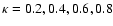 ), with and without
external shear (
), with and without
external shear (
 or 0).
Finally we discuss the possibilities of real detections of this
phenomenon in the near future.
or 0).
Finally we discuss the possibilities of real detections of this
phenomenon in the near future.
The lensing effects of cosmologically distant
compact objects in the mass range
 on background sources is usually called "cosmological microlensing".
The source is typically a distant quasar, but in principle other
objects can be microlensed as well,
e.g. high-redshift supernovae (e.g., Rauch 1991)
or
gamma-ray sources/bursters (Torres et al. 2003;
Koopmans & Wambsganss 2001).
The only condition is that the source size
be comparable to or smaller than the Einstein radius of the
foreground lens.
on background sources is usually called "cosmological microlensing".
The source is typically a distant quasar, but in principle other
objects can be microlensed as well,
e.g. high-redshift supernovae (e.g., Rauch 1991)
or
gamma-ray sources/bursters (Torres et al. 2003;
Koopmans & Wambsganss 2001).
The only condition is that the source size
be comparable to or smaller than the Einstein radius of the
foreground lens.
The microlenses can be ordinary stars,
brown dwarfs, planets, black holes,
molecular clouds, or other compact mass concentrations.
In most practical cases, the microlenses are part of a galaxy which
acts as the main (macro-)lens. However, microlenses could also
be located in, say, clusters of galaxies
(Tadros et al. 1998; Totani 2003)
or they could even be
imagined "floating" freely and filling intergalactic space
(Hawkins 1996; Hawkins & Taylor 1997).
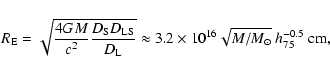
The relevant length scale for microlensing is the
Einstein radius in the source plane:
 |
(1) |
where "typical" lens and source redshifts of
 and
and
 were assumed for the expression
on the right hand side (G and c are the gravitational
constant and the velocity of light, respectively; M is the mass of
the lens,
were assumed for the expression
on the right hand side (G and c are the gravitational
constant and the velocity of light, respectively; M is the mass of
the lens,  ,
,
 ,
and
,
and
 are the angular diameter distances
between observer
- lens, observer - source, and lens - source, respectively,
and a concordance cosmological model is assumed with
are the angular diameter distances
between observer
- lens, observer - source, and lens - source, respectively,
and a concordance cosmological model is assumed with
 ,
,
 ,
,
 ).
).
This length scale translates into an angular scale of:
 |
(2) |
It is obvious that image splitting on such small
angular scales cannot be observed directly.
What makes microlensing observable
in the first place is the fact that observer,
lens(es) and source move relative to each
other. Due to this relative motion, the microimage configuration
changes with time, and so does the total magnification, i.e. the
combined fluxes of all the microimages which make up
the macro-image. This change
in magnification over time (lightcurve) can be measured:
microlensing is a dynamical phenomenon.
There are two time scales involved: the standard lensing
time scale  is the time it takes the lens (or the source)
to cross a length equivalent to the
Einstein radius, i.e.
is the time it takes the lens (or the source)
to cross a length equivalent to the
Einstein radius, i.e.
 |
(3) |
where the same typical assumptions are made as above,
and the relative transverse velocity![[*]](/icons/foot_motif.gif) v600 is parametrized in
units of
v600 is parametrized in
units of
 km s-1 and for a Hubble constant
H0 = 75 h75 km s-1 Mpc-1.
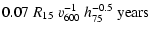
This time scale results in relatively large values.
However, microlensing fluctuations are expected (and observed, see
Wozniak et al. 2000a,b) on much shorter time scales.
The magnification distribution is highly non-linear with
sharp caustic lines separating regions of low and high magnification.
Often, the density of caustics is quite high, so that a source
may encounter half a dozen or more caustic lines within the
length of one Einstein radius.
When a source crosses a caustic, we can
expect a large change in magnification (and correspondingly in
position) within
the time it takes the source to
cross its own radius.
So the relevant time scale is the "crossing time'':
km s-1 and for a Hubble constant
H0 = 75 h75 km s-1 Mpc-1.
This time scale results in relatively large values.
However, microlensing fluctuations are expected (and observed, see
Wozniak et al. 2000a,b) on much shorter time scales.
The magnification distribution is highly non-linear with
sharp caustic lines separating regions of low and high magnification.
Often, the density of caustics is quite high, so that a source
may encounter half a dozen or more caustic lines within the
length of one Einstein radius.
When a source crosses a caustic, we can
expect a large change in magnification (and correspondingly in
position) within
the time it takes the source to
cross its own radius.
So the relevant time scale is the "crossing time'':
Here the quasar size R15 is parametrized in units of 1015 cm.
The quadruple quasar Q2237+0305
(Huchra et al. 1985; Irwin et al. 1989;
Wambsganss et al. 1990; Wyithe et al. 2000a,b;
Wozniak et al 2000a,b)
is a very special and favorable case and of particular
interest to microlensing studies. It was the first system
in which microlensing was discovered (Irwin et al. 1989). Subsequently
it received a lot of attention, both
observational
(Corrigan et al. 1991; Ostensen et al. 1996;
Wozniak et al 2000a,b) and
theoretical
(Wambsganss et al. 1990; Wyithe et al. 2000a,b; Yonehara 2001).
Due to the fact that the lensing galaxy is so close
(
 ,
Huchra et al. 1985),
the physical and angular Einstein
radii are considerably different from
the standard case treated above:
,
Huchra et al. 1985),
the physical and angular Einstein
radii are considerably different from
the standard case treated above:
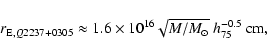 |
(5) |
 |
(6) |
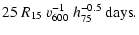
The resulting time scales (Einstein time and crossing time)
are much shorter than in almost all other
multiple quasars:
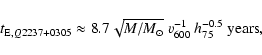 |
(7) |
For that reason,
this quadruple system is ideally
suited for microlensing studies.
The length, time and angular scales for the "typical case'' as
well as for the special case of Q2237+0305 are
summarized in Table 1.
![\begin{figure}
\par\includegraphics[width=14cm,clip]{treyer6.ps} \end{figure}](/articles/aa/full/2004/10/aa0284/Timg98.gif) |
Figure 6:
Effect of the source size on the centroid shift
for the example track shown in Figs. 4
and 5 (
and
).
The two panels show the astrometric tracks that would
occur for the linear quasar motion shown in Fig. 4
for two different source sizes:
 0.04 and 0.16
(4 and 16 pixels in configuration B, respectively).
The total length of the track is
0.04 and 0.16
(4 and 16 pixels in configuration B, respectively).
The total length of the track is
 or about 15 years for the quasar Q2237+0305.
The labels t0, t1 and t2 correspond
to the starting, central and final positions, respectively.
or about 15 years for the quasar Q2237+0305.
The labels t0, t1 and t2 correspond
to the starting, central and final positions, respectively. |
| Open with DEXTER |
![\begin{figure}
\par\includegraphics[width=14cm,clip]{treyer7.ps} \end{figure}](/articles/aa/full/2004/10/aa0284/Timg100.gif) |
Figure 7:
Top: three snapshots of the ensemble of microimages
assuming
.
All bright microimages
are plotted
up to a radius of 3
(due to the finite resolution
of the plotting routine, some of the faint microimages
are represented as larger than they actually are).
Left to right: starting, middle et final positions of the track
in Fig. 4, corresponding to t=0.0, 1.0
and
,
respectively
(note the angular scale: the microimage distribution
covers about 30
 !).
Bottom: zoomed central regions;
the respective positions of the center-of-light for
the three
epochs are marked as crosses on the track of
the center-of-light. !).
Bottom: zoomed central regions;
the respective positions of the center-of-light for
the three
epochs are marked as crosses on the track of
the center-of-light. |
| Open with DEXTER |
![\begin{figure}
\par\includegraphics[width=14cm,clip]{treyer8.ps} \end{figure}](/articles/aa/full/2004/10/aa0284/Timg103.gif) |
Figure 8:
Offset in position
versus
offset in apparent brightness
 ,
for two simulated measurements separated
by ,
for two simulated measurements separated
by
 .
This time interval corresponds to
about half a year for the "typical'' lensing case and
to two months for the case of Q2237+0305 (cf. Table 1).
From top to bottom, the panels represent
the cases .
This time interval corresponds to
about half a year for the "typical'' lensing case and
to two months for the case of Q2237+0305 (cf. Table 1).
From top to bottom, the panels represent
the cases
 0.2, 0.4, 0.6 and 0.8, respectively, without
external shear (
).
The source sizes
are
0.2, 0.4, 0.6 and 0.8, respectively, without
external shear (
).
The source sizes
are
 (left column),
and 0.16
(right column).
The median of the
distribution as
a function of
is shown as a thick
line (points marked as crosses), the 95th-percentile is indicated as a thin line (and squares).
(left column),
and 0.16
(right column).
The median of the
distribution as
a function of
is shown as a thick
line (points marked as crosses), the 95th-percentile is indicated as a thin line (and squares). |
| Open with DEXTER |
![\begin{figure}
\par\includegraphics[width=14cm,clip]{treyer9.ps} \end{figure}](/articles/aa/full/2004/10/aa0284/Timg105.gif) |
Figure 9:
Same as Fig. 8, but here for two measurements separated
by a larger time interval
 (corresponding to about four years in the "typical''
case, and 1.5 years for the case of Q2237+0305, cf. Table 1):
source sizes are
(left column),
and 0.16
(right column);
median of
as
function of
is thick
line (points are crosses), 95th-percentile is thin line (squares). (corresponding to about four years in the "typical''
case, and 1.5 years for the case of Q2237+0305, cf. Table 1):
source sizes are
(left column),
and 0.16
(right column);
median of
as
function of
is thick
line (points are crosses), 95th-percentile is thin line (squares). |
| Open with DEXTER |
![\begin{figure}
\par\includegraphics[width=14cm,clip]{treyer10.ps} \end{figure}](/articles/aa/full/2004/10/aa0284/Timg106.gif) |
Figure 10:
Same as Fig. 8, but here for the
cases with external shear
 from top to bottom:
source sizes are
(left column),
and 0.16
(right column);
median of
as
function of
is thick
line (points are crosses),
95th-percentile is thin line (squares).
from top to bottom:
source sizes are
(left column),
and 0.16
(right column);
median of
as
function of
is thick
line (points are crosses),
95th-percentile is thin line (squares). |
| Open with DEXTER |
![\begin{figure}
\par\includegraphics[width=14cm,clip]{treyer11.ps} \end{figure}](/articles/aa/full/2004/10/aa0284/Timg107.gif) |
Figure 11:
Same as Fig. 10, but here for the
two measurements separated
by a larger time interval
:
source sizes are
(left column),
and 0.16
(right column);
median of
as
function of
is thick
line (points are crosses), 95th-percentile is thin line (squares). |
| Open with DEXTER |
To explore astrometric microlensing
for a variety of realistic scenarios,
we consider eight different cases, with the following
values of the dimensionless surface mass density:
 and 0.8.
Each one of these we treated both without external shear
(
and 0.8.
Each one of these we treated both without external shear
(
 )
and with external shear
equal to the surface mass density
(
), corresponding to an isothermal sphere model
for the lensing galaxy. The shear always acts along the X-axis in the simulations. This means that the caustics are expanded in the X-direction and compressed in the Y-direction, as can be seen for example in the top left panel of Fig. 3.
Horizontal "bands'' appear on large scales (many Einstein radii). The effect is not always obvious on small scales however (sub-Einstein radii, bottom left panel of Fig. 3).
Inversely, if we follow the light rays forward from source to
observer (as opposed to backwards as in the simulations, which is
explained below),
the micro-image configuration of a source will appear
smaller/compressed in the X-direction
and larger/expanded in the Y-direction (see in the right hand panels of Fig. 3).
)
and with external shear
equal to the surface mass density
(
), corresponding to an isothermal sphere model
for the lensing galaxy. The shear always acts along the X-axis in the simulations. This means that the caustics are expanded in the X-direction and compressed in the Y-direction, as can be seen for example in the top left panel of Fig. 3.
Horizontal "bands'' appear on large scales (many Einstein radii). The effect is not always obvious on small scales however (sub-Einstein radii, bottom left panel of Fig. 3).
Inversely, if we follow the light rays forward from source to
observer (as opposed to backwards as in the simulations, which is
explained below),
the micro-image configuration of a source will appear
smaller/compressed in the X-direction
and larger/expanded in the Y-direction (see in the right hand panels of Fig. 3).
For each of these eight cases, we produced a magnification pattern
in the source plane with a
side length of
 ,
sampled on
a 10002 pixel grid, i.e.
,
sampled on
a 10002 pixel grid, i.e.
 is
covered by 50 pixels, or
is
covered by 50 pixels, or
 .
This is our starting configuration A.
The minimum source size we can consider is given by
the pixel scale.
In order to explore smaller source
sizes as well (at the cost of smaller
magnification patterns which may not be representative),
we zoom in into the central part of the
first configuration.
We do higher resolution simulations (all on 10002 pixel grids)
in three steps of factors of two (configurations B, C and D, respectively),
resulting in magnification patterns with side lengths of
.
This is our starting configuration A.
The minimum source size we can consider is given by
the pixel scale.
In order to explore smaller source
sizes as well (at the cost of smaller
magnification patterns which may not be representative),
we zoom in into the central part of the
first configuration.
We do higher resolution simulations (all on 10002 pixel grids)
in three steps of factors of two (configurations B, C and D, respectively),
resulting in magnification patterns with side lengths of
 ,
,
 ,
and
,
and
 ,
respectively.
For the highest resolution simulation
(configuration D), this means
,
respectively.
For the highest resolution simulation
(configuration D), this means
 pixels,
or 1 pix
pixels,
or 1 pix
 .
.
We used a modified version of the ray shooting
code described in Wambsganss (1990,1999).
In the original version, rays are followed backwards from
the observer through the lens plane (where all the deflections
are determined) to the source plane (where the light
rays are "collected'' in pixels).
The density of rays then indicates the magnification
as a function of position in the source plane, often
displayed as color coded magnification patterns.
Lightcurves can be obtained by
convolving a given source profile with this two-dimensional
magnification map. However, all information about where
the rays originated from in the lens/image plane
is lost in this original algorithm.
For the exploration of the centroid shift of the collection
of microimages,
it is exactly this information that is required.
Hence we modified the code to record the positions of all the
individual microimages brighter than a given magnification threshold.
To do this, we defined a second,
larger regular grid of 40002 rays, which covers in the image plane
a region
of four times the angular side length of the magnification pattern
(i.e.
 for configuration A).
For a set of
for configuration A).
For a set of
 test rays,
we keep track of the positions in the
image plane as well as in the source plane. In this way, we
can find all the positions in the image plane that are
mapped onto a certain area in the source plane, and hence
identify all the microimages corresponding to a particular
source position and size.
test rays,
we keep track of the positions in the
image plane as well as in the source plane. In this way, we
can find all the positions in the image plane that are
mapped onto a certain area in the source plane, and hence
identify all the microimages corresponding to a particular
source position and size.
In order to get information on both
the magnification and the
microimage locations of a finite source at a given
position, we convolved the
magnification pattern with a luminosity profile.
We used circular sources with Gaussian widths
2, 4, 8 and 16 pixels,
corresponding to physical sizes between
 and
and
 in
the starting configuration A, or
in
the starting configuration A, or
 cm to
cm to
 cm in the typical case described in Sect 2.1.
We did the same with the higher resolution magnification patterns,
configurations B, C and D.
However, it turned out that the high resolution cases, although well
suited for studying individual caustic crossings for
small sources, are not quite large enough for statistical
investigations.
For this reason, we
restricted ourselves to cases A and B for the statistical
evaluations below.
The numerical values corresponding to the different
source sizes we used are tabulated in Table 2.
cm in the typical case described in Sect 2.1.
We did the same with the higher resolution magnification patterns,
configurations B, C and D.
However, it turned out that the high resolution cases, although well
suited for studying individual caustic crossings for
small sources, are not quite large enough for statistical
investigations.
For this reason, we
restricted ourselves to cases A and B for the statistical
evaluations below.
The numerical values corresponding to the different
source sizes we used are tabulated in Table 2.
Using these simulations, we determined the
positions of the individual microimages,
the center-of-light and the total
magnification
of the macro-image corresponding to a particular
source position and profile.
In Figs. 1 and 2,
a microimage situation is shown for each of the
eight cases considered:
and 0.8 with
(Fig. 1), and with
acting along the X-axis direction (Fig. 2).
In the left columns, a small part of the magnification
pattern is shown, with the source position and profile
superimposed. The panels on the right hand side show
the particular microimage configurations, with the
light centroid indicated by a plus sign
(cf. Paczynski 1986).
In Fig. 3, the method is illustrated for
and
.
The top left panel shows the
magnification pattern in the source (quasar) plane
with side length L = 10
(B configuration).
The grey scale indicates regions of different magnifications
in the source plane: the lighter the grey,
the higher the magnification.
The large square indicates the region in the source plane
for which all source positions were evaluated.
The top right panel shows the corresponding microimage
configuration in the image plane: the
white regions are the parts of the image plane
where light bundles appear which originated from within the
square on the left (side length is 40
).
In other words, it shows what a large square shaped source
would look like to the observer.
The bottom panels show the same for
the smaller square region indicated
in the top left panel, zoomed eight times.
The many isolated light patches indicate that microimages are
spread over a very large area in the image plane.
Figure 4 shows a quasar microlensing scenario
with microlensing parameters
and
,
and side length 10
(B configuration).
The straight vertical white line marks the track of the
quasar motion relative to the magnification pattern; the length of
the path is 2.0 .
For this particular track (followed from the lowest part upwards),
Fig. 5 shows from top to bottom:
the X- and Y-coordinates
of the quasar relative to the starting position
(
and
 )
as a function of time;
the absolute value of the positional shift
(
)
relative to the starting position as a function of time;
and the corresponding light curve (
)
as a function of time;
the absolute value of the positional shift
(
)
relative to the starting position as a function of time;
and the corresponding light curve ( )
of the quasar.
The solid and dotted lines correspond
to two different values of the source size:
(4 pixels in B configuration) and
(16 pixels in B configuration), respectively.
The track in Fig. 4
starts in a region of low
magnification which is taken as the zero point of the magnitude
scale on the lowest panel in Fig. 5.
)
of the quasar.
The solid and dotted lines correspond
to two different values of the source size:
(4 pixels in B configuration) and
(16 pixels in B configuration), respectively.
The track in Fig. 4
starts in a region of low
magnification which is taken as the zero point of the magnitude
scale on the lowest panel in Fig. 5.
The two panels in Fig. 6 represent
the centroid shift for the two different source sizes.
The whole track has a length of
( 50 and 15 years for the "typical'' lensing case
and the Q2237+0305 case, respectively). The labels
t0, t1 and t2 correspond
to the starting, middle and final positions, respectively.
Snapshots of the ensemble of microimages at times
t0, t1 and t2
are shown in Fig. 7 assuming
50 and 15 years for the "typical'' lensing case
and the Q2237+0305 case, respectively). The labels
t0, t1 and t2 correspond
to the starting, middle and final positions, respectively.
Snapshots of the ensemble of microimages at times
t0, t1 and t2
are shown in Fig. 7 assuming
 .
All microimages are plotted - without accounting for
the declining source profile - up to a radius of 3.
On average, the brightness of the macroimage declines as
the fourth power of distance to the center of light
(Katz et al. 1986).
On our plots, due to the finite resolution, some of the
distant and faint microimages appear "bigger'' than
they are.
This figure simply aims at illustrating the very
large spatial spread of the microimages,
covering roughly 30
.
All microimages are plotted - without accounting for
the declining source profile - up to a radius of 3.
On average, the brightness of the macroimage declines as
the fourth power of distance to the center of light
(Katz et al. 1986).
On our plots, due to the finite resolution, some of the
distant and faint microimages appear "bigger'' than
they are.
This figure simply aims at illustrating the very
large spatial spread of the microimages,
covering roughly 30
 .
The lower panels show enlargements of the central parts with the
path of the center-of-light superimposed.
.
The lower panels show enlargements of the central parts with the
path of the center-of-light superimposed.
In order to evaluate the correlations between
the magnitude changes and the positional changes of a
microlensed quasar,
we simulated pairs of measurements separated by
time intervals of
 (Figs. 8 and 10) and
 (Figs. 9 and 11), respectively.
These values correspond
to about half a year and four years in the "typical'' case, and
to two months and 1.5 years in the case of Q2237+0305 (cf. Table 1).
We placed the source at a random position in the magnification pattern
and chose a second position at a distance
of 0.02
or 0.16
either parallel or perpendicular to
the action of the external shear (X-axis).
We determined differences in the magnifications
and the center-of-light positions
between these
two source positions. Each pair of measurements
(
,
)
is represented
as a point in the various panels of
Figs. 8 to 11.
In each panel, the offset in position
is shown against the corresponding offset in magnitude
for about 20000 such measurement pairs.
In the left columns of all four figures,
a small Gaussian source size of
is assumed, in the right column the
source size is
.
In each panel, the thick (lower) line indicates the median of
as a function of
,
and the thin (upper)
line shows the 95th-percentile: 5% of all simulations
for a given
would result in offsets
which are above this thin line.
(Figs. 9 and 11), respectively.
These values correspond
to about half a year and four years in the "typical'' case, and
to two months and 1.5 years in the case of Q2237+0305 (cf. Table 1).
We placed the source at a random position in the magnification pattern
and chose a second position at a distance
of 0.02
or 0.16
either parallel or perpendicular to
the action of the external shear (X-axis).
We determined differences in the magnifications
and the center-of-light positions
between these
two source positions. Each pair of measurements
(
,
)
is represented
as a point in the various panels of
Figs. 8 to 11.
In each panel, the offset in position
is shown against the corresponding offset in magnitude
for about 20000 such measurement pairs.
In the left columns of all four figures,
a small Gaussian source size of
is assumed, in the right column the
source size is
.
In each panel, the thick (lower) line indicates the median of
as a function of
,
and the thin (upper)
line shows the 95th-percentile: 5% of all simulations
for a given
would result in offsets
which are above this thin line.
In Fig. 8, the four lensing situations
without external shear are considered:
(from top to bottom) with a small time step
.
In all panels, the majority of the points cluster near the
origin.
This is easily understandable:
the position of the source relative to the caustics has
not changed by much during the
short time interval, so the changes both in magnification
and in the centroid position tend to be small.
For small sources (left panels), however,
and
can reach relatively
large values with
the median lines indicating an almost linear statistical
relation.
The slope of these median lines
slightly increases with increasing surface mass density .
The time step
corresponds roughly to the crossing time:
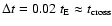 ,
and there are indeed
cases with easily measurable magnitude fluctuations
(
,
and there are indeed
cases with easily measurable magnitude fluctuations
(
 mag), which result in center-of-light offsets of
about 0.5
.
In the right panel, there are no significant changes in either
magnification or center-of-light position, because the
source has moved only a fraction of its own diameter
(
mag), which result in center-of-light offsets of
about 0.5
.
In the right panel, there are no significant changes in either
magnification or center-of-light position, because the
source has moved only a fraction of its own diameter
(
 ).
).
In Fig. 9, the same is shown for a larger
time step
.
Many more
points are now spread towards larger offsets and
larger magnification changes.
For the small source, median
values of
 are reached
in the highest surface
mass density cases. In fact, the 95th-percentile line for
the
case indicates that for magnitude
changes
are reached
in the highest surface
mass density cases. In fact, the 95th-percentile line for
the
case indicates that for magnitude
changes
 mag, 5% of the all cases
result in center-of-light offsets larger than 4
.
For the large source (right column) the expected
offsets are still quite moderate, with median values of
about 0.5
.
This is not too surprising, because the time interval
corresponds to just about the crossing time for the
source.
mag, 5% of the all cases
result in center-of-light offsets larger than 4
.
For the large source (right column) the expected
offsets are still quite moderate, with median values of
about 0.5
.
This is not too surprising, because the time interval
corresponds to just about the crossing time for the
source.
Figures 10 and 11
contain the same diagrams
for the cases with external shear,
 (from top to bottom).
Larger offsets are reached here than in the corresponding
scenarios without shear.
Especially the two middle rows with
(from top to bottom).
Larger offsets are reached here than in the corresponding
scenarios without shear.
Especially the two middle rows with
 and 0.6 - which best represent the typical values of
convergence and shear of a multiply imaged quasar - produce
values of positional offset a factor of two higher than
the corresponding cases without shear:
for short time steps and small sources,
medians of
and 0.6 - which best represent the typical values of
convergence and shear of a multiply imaged quasar - produce
values of positional offset a factor of two higher than
the corresponding cases without shear:
for short time steps and small sources,
medians of
 and 95th-percentiles
of
and 95th-percentiles
of
 (small source, left
column) are reached.
For smaller values of the surface mass density, the
caustic density and hence the number of microimages
is not large enough to produce big positional offsets, whereas
for higher values of ,
the density of
caustics is so high that an additional microimage pair only
produces a small fluctuation.
(small source, left
column) are reached.
For smaller values of the surface mass density, the
caustic density and hence the number of microimages
is not large enough to produce big positional offsets, whereas
for higher values of ,
the density of
caustics is so high that an additional microimage pair only
produces a small fluctuation.
Results are even more dramatic when assuming
a larger time step (
), as displayed
in Fig. 11:
median values of
between
0.5
and
3
for the small source size (left column), and
significant median values of
 to
to
 even for the large source (right column).
We evaluated the shifts in center-of-light positions for
time intervals intermediate between
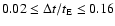 assuming a threshold for
the magnitude fluctuations.
In Figs. 12 and 13, the
median and 95th-percentile offsets are shown as
a function of increasing time step
assuming a threshold for
the magnitude fluctuations.
In Figs. 12 and 13, the
median and 95th-percentile offsets are shown as
a function of increasing time step  ,
for
,
for
 mag (left panels) and
 mag (right panels).
This was done with the following idea in mind: since
very accurate measurements of quasar image positions are
"expensive", it is unlikely that all lensed quasar candidates
can be astrometrically monitored. However, photometric monitoring
is comparably cheaper.
So ideally, one could determine the positions of
the most promising multiple quasars with high accuracy once,
then monitor them photometrically, and whenever a large
microlens-induced magnitude change has been detected,
a second astrometric measurement should be performed.
mag (right panels).
This was done with the following idea in mind: since
very accurate measurements of quasar image positions are
"expensive", it is unlikely that all lensed quasar candidates
can be astrometrically monitored. However, photometric monitoring
is comparably cheaper.
So ideally, one could determine the positions of
the most promising multiple quasars with high accuracy once,
then monitor them photometrically, and whenever a large
microlens-induced magnitude change has been detected,
a second astrometric measurement should be performed.
In each panel of Fig. 12, the two sets of curves
show the median (thick lines) and the 95th-percentile (thin lines)
of the
distribution
as a function of
for
the small source (
,
solid) and
the large source (
,
dotted). All curves show
basically the same behaviour: the
values first increase with increasing ,
then
flatten out. This behaviour shows that many or most
jumps in magnitude and position are dominated by
one fold-caustic crossing.
The
time scale is dominated by
 .
For a slightly
larger time interval, the offset does not increase significantly
any more.
Only for much larger 's
allowing for additional caustic crossings,
would another increase in
be expected. Offsets of more than
100
.
For a slightly
larger time interval, the offset does not increase significantly
any more.
Only for much larger 's
allowing for additional caustic crossings,
would another increase in
be expected. Offsets of more than
100  arcsec could indeed be reached this way,
but the characteristic time scale would be depressingly
large (many decades!).
arcsec could indeed be reached this way,
but the characteristic time scale would be depressingly
large (many decades!).
![\begin{figure}
\par\includegraphics[width=14cm,clip]{treyer12.ps}\end{figure}](/articles/aa/full/2004/10/aa0284/Timg142.gif) |
Figure 12:
The median (thick lines with cross symbols) and
95th-percentile (thin lines with square symbols)
of the
distribution as a function of
for
( left panels) and
 ( right panels).
The solid and dotted lines represent the two source sizes
and 0.16 ,
respectively.
From top to bottom, the panels correspond to
increasing surface mass density:
0.2, 0.4, 0.6 and 0.8, respectively, with
no external shear ().
( right panels).
The solid and dotted lines represent the two source sizes
and 0.16 ,
respectively.
From top to bottom, the panels correspond to
increasing surface mass density:
0.2, 0.4, 0.6 and 0.8, respectively, with
no external shear (). |
| Open with DEXTER |
![\begin{figure}
\par\includegraphics[width=14cm,clip]{treyer13.ps}\end{figure}](/articles/aa/full/2004/10/aa0284/Timg144.gif) |
Figure 13:
Same as Fig. 12, here for the cases
with external shear
 (from
top to bottom):
median (thick lines, crosses) and
95th-percentile (thin lines, squares)
of
distribution as a function of
for
( left panels) and
( right panels);
solid lines for small source (
),
dotted lines for large source (
(from
top to bottom):
median (thick lines, crosses) and
95th-percentile (thin lines, squares)
of
distribution as a function of
for
( left panels) and
( right panels);
solid lines for small source (
),
dotted lines for large source (
 ), respectively. ), respectively. |
| Open with DEXTER |
The qualitative behaviour of the cases with external
shear displayed in Fig. 13 is similar to
those without shear.
However, the expected offset values are significantly higher
here, as already seen in Figs. 10 and
11:
again, the cases
and 0.6 appear most promising
(second/third row), with median values of between 1
and 2
,
and
95th-percentiles of 4
or higher.
These values translate into about 7 to 15 arcsec (median)
and >30 arcsec (95th-percentile) when applied to the
quadruple quasar Q2237+0305 (cf. Table 1).
In fact, brightness fluctuations of more than one magnitude
have been measured in Q2237+0305 on time scales
of a few months (Wozniak 2000a,b), so these events do occur and
seem not to be very rare.
We explored astrometric microlensing effects on short timescales
(of order months to years) for a set
of parameter values
and .
We find that the relevant time scale for measuring relatively
large jumps of occasionally many tens of microarcseconds can be
as short as a few months.
Such sudden changes of position - produced by caustic
crossings - are statistically
related to fluctuations in the apparent brightness of the quasar.
Therefore,
a good strategy for detecting this centroid shift would be to
measure the positions of the most promising lensed quasars
very accurately once, then
to monitor the quasars in the optical, and - when a
photometric microlensing event is detected - to perform
one or a few more accurate astrometric measurements.
We found that the effect is most pronounced for values of
the surface mass density and shear
or 0.6.
These parameters happen to be applicable to many
of the lensed quasar images.
The most favorable case is the quadruple lens Q2237+0305:
because of the closeness of the lensing galaxy, the
time scale is relatively short (cf. also Wozniak 2000a,b).
We also investigated the positional shift of the image
as a function of source size: whereas a quasar with a typical size
of 0.16
produces median offsets of order
(and 95th-percentiles
of about 2
), smaller sources
(0.02
)
reach median values of 2.5
and 95th-percentiles larger than 5
(where
in the case of Q2237+0305,
 ,
cf. Table 1).
,
cf. Table 1).
Lewis & Ibata (1998) had investigated the astrometric microlensing
effect specifically on Q2237+0305.
They had found that substantial
image shifts of  100 arcsec are possible within months.
We can confirm this in some rare cases.
For typical caustic crossings with
photometric fluctuations of about 0.5 mag,
we find values between 20 and 40 arcsec.
Salata & Zhdanov (2003) have looked
into the question of rms fluctuations of the quasar position; however,
they only considered large sources (
100 arcsec are possible within months.
We can confirm this in some rare cases.
For typical caustic crossings with
photometric fluctuations of about 0.5 mag,
we find values between 20 and 40 arcsec.
Salata & Zhdanov (2003) have looked
into the question of rms fluctuations of the quasar position; however,
they only considered large sources (
 )
and cases with
)
and cases with
 .
.
Ground-based differential astrometry in the near infrared is able to
achieve measurement uncertainties of better than 10 arcsec, as
was reported very recently from the Palomar Testbed Interferometer
(Lane & Muterspaugh 2003). This is only feasible
for bright objects so far,
but it is a very exciting result which opens up promising opportunities
for the coming years.
Another instrument promising extremely high astrometric
precision in the near future
(with planet detection as
one of its main scientific drivers)
is the PRIMA instrument at the ESO VLTI. It
should become efficient in 2004 (Paresce et al. 2003;
see also Delplancke et al. 2001).
The current goal at ESO is to achieve
50 arcsec accuracy with PRIMA
in the H and K bands in 2005-2008
and 10 arcsec accuracy in 2008-2010 (Henning, private communication).
A number of space-based astrometric projects are also underway:
the Space Interferometric Mission (SIM) is
a five year mission
scheduled for launch in 2009 (http://sim.jpl.nasa.gov). The
mission's goal is to reach an astrometric accuracy of
about 1 arcsec for a predefined grid
of objects brighter than 13 mag in the visible,
which is quasi-inertially tied to a set of distant QSOs.
For slightly fainter objects (the four images of the lensed quasar
Q2237+0305 have magnitudes 17),
SIM is expected to yield 4 arcsec absolute
positions (Unwin et al. 2002).
In order to detect center-of-light
offsets for multiple quasars, in fact only relative astrometry between
the quasar images is required.
SIM will also be able to
measure such positional shifts as a function of color, which
will give us hints on the physical structure of the continuum
emission region: presumably the cooler/redder part is more
extended
than the hotter/bluer part, which means that we expect
larger changes in the center-of-light at shorter wavelengths.
The GAIA satellite is an ESA mission currently scheduled for
launch in June 2010 (see http://sci.esa.int/gaia; Perryman et al. 2001;
Perryman 2002).
With a nominal precision of a few microarcseconds for bright
objects (about 10 arcsec for 15th mag objects),
it will measure accurate positions of 500 000 quasars.
So GAIA is expected to be an extremely useful instrument
for astrometric microlensing purposes.
It will provide many positional shifts of quasar images,
along with their lightcurves in many filters.
We analyzed the shifts in the center-of-light positions
of gravitationaly lensed quasar images and the corresponding
flux variability due to the microlensing effect
of stars in the lensing galaxy. We found the following results:
- 1.
- The center-of-light of multiply imaged quasars is expected to vary on
time scales of months to years, due to
astrometric microlensing effects.
- 2.
- This effect depends
on the size of the lensed quasar, which we
modelled with a Gaussian profile:
it is larger for smaller sources.
This means that
measuring centroid shifts will allow us
to constrain the size of the quasar.
- 3.
- We studied eight cases, four without external shear
(
;
)
and
four with shear
(
). The strongest
effects are seen in the cases
and 0.6, which in fact are very typical parameter
values for many lensed quasar images.
- 4.
- The effect of center-of-light shift of quasars is not limited
to multiply imaged quasars:
single quasars may occasionally be microlensed too
(as was suggested by Hawkins 1996).
The offsets should be relatively small, however,
due to the fact that the values of
and
will be lower for single
quasars than for multiply imaged ones.
Our simulation with
comes closest
to describing these cases with very low convergence.
- 5.
- The centroid shift effect is statistically strongly correlated with
changes in the apparent brightness of the quasar.
Both occur during the crossing of a (micro-)caustic:
photometric fluctuations
 0.5 mag
produce offsets
2
in 50% of
the cases, and
5
in 5% of the cases.
These values correspond to about 15
and 35 arcsec, respectively, for the
lensed quasar Q2237+0305.
0.5 mag
produce offsets
2
in 50% of
the cases, and
5
in 5% of the cases.
These values correspond to about 15
and 35 arcsec, respectively, for the
lensed quasar Q2237+0305.
- 6.
- The best strategy for measuring centroid shifts is therefore
to monitor the
apparent brightness of multiple quasars with ground
based telescopes and to determine the relative
positions of the various quasar images occasionally,
ideally before, during and after a
high magnification event.
- 7.
- In the cases with external shear, the center-of-light shift
depends strongly on the direction of the shear, which
can hence be determined in a statistical sense.
With the next generation of astrometric instruments providing
an accuracy of the order of 10 arcsec, the
astrometric microlensing effect of stars
acting on background quasars will become detectable.
- Belokurov, V. A., & Evans, N. W. 2002, MNRAS, 341, 569
In the text
NASA ADS
- Boden, A. F., Shao, M., & van Buren, D. 1998, ApJ, 502, 538
In the text
NASA ADS
- Corrigan, R. T., Irwin, M. J., Arnaud, J., et al. 1991, AJ, 102, 34
In the text
NASA ADS
- Dalal, N., & Lane, B. F. 2003, ApJ, 589, 199
In the text
NASA ADS
- Delplancke, F., Górski, K. M., & Richichi, A. 2001, A&A., 375, 701
In the text
NASA ADS
- Dominik, M., & Sahu, K. C. 2000, ApJ, 524, 213
In the text
NASA ADS
- Goldberg, D. M., & Wozniak, P. R. 1998, Acta Astron., 48, 19
In the text
NASA ADS
- Gould, A., & Han, C. 2000, Apj, 538, 653
In the text
NASA ADS
- Han, C., & Chang, K. 1999, MNRAS, 304, 845
NASA ADS
- Han, C., Chun, M.-S., & Chang, K. 1999, ApJ, 526, 405
In the text
NASA ADS
- Han, C., & Jeong, Y. 1999, MNRAS, 309, 404
NASA ADS
- Han, C., & Kim , T.-W. 1999, MNRAS, 305, 795
NASA ADS
- Han, C., & Kim , T.-W. 2000, ApJ, 528, 687
In the text
NASA ADS
- Han, C., & Lee, C. 2002, MNRAS, 329, 163
NASA ADS
- Hawkins, M. R. S. 1996, MNRAS 278, 787
In the text
NASA ADS
- Hawkins, M. R. S., & Taylor, A. N. 1997, ApJ, 482, L5
In the text
NASA ADS
- Honma, M., & Kurayama, T. 2002, ApJ, 568, 717
In the text
NASA ADS
- Hosokawa, M., Ohnishi, K., Fukushima, T. 1997, AJ, 114, 1508
In the text
NASA ADS
- Huchra, J., Gorenstein, M., Kent, S., et al. 1985, AJ, 90, 691
In the text
NASA ADS
- Irwin, M. J., Webster, R., Hewett, P. C., Corrigan, R. T., & Jedrzejewski, R. I. 1989, AJ, 98, 1989
In the text
NASA ADS
- Katz, N., Balbus, S., & Paczynski, B. 1986, ApJ, 306, 2
In the text
NASA ADS
- Koopmans, L. V. E., & Wambsganss, J. 2001, MNRAS, 325, 1317
In the text
NASA ADS
- Lane, B. F., & Muterspaugh, M. W. 2003, preprint [astro-ph/0308381]
In the text
- Lewis, G. F., & Ibata, R. A. 1998, ApJ, 501, 478
In the text
NASA ADS
- Lewis, G. F., Irwin, M. J., Hewett, P. C., & Foltz, C. B. 1998, MNRAS, 295, 573
NASA ADS
- Mao, S., & Witt, H. J. 1998, MNRAS, 300, 1041
In the text
NASA ADS
- Miralda-Escude, J. 1996, ApJ, 470, L113
In the text
NASA ADS
- Miyamoto, M., & Yoshii, Y. 1995, AJ, 110, 1427
In the text
NASA ADS
- Ostensen, R., Refsdal, S., Stabell, R., et al. 1996, A&A, 309, 59
In the text
NASA ADS
- Paczynski, B. 1986, ApJ, 301, 503
In the text
NASA ADS
- Paczynski, B. 1998, ApJ, 494, L23
In the text
NASA ADS
- Paresce, F., Delplancke, F., Derie, F., et al. 2003, Proc. SPIE, 4838, 486
In the text
- Perryman, M. A. C., de Boer, K. S., Gilmore, G., et al. 2001, A&A, 369, 339
In the text
NASA ADS
- Perryman, M. A. C. 2002, Ap&SS, 280, 1
In the text
NASA ADS
- Rauch, K. P. 1991, ApJ, 374, 83
In the text
NASA ADS
- Safizadeh, N., Dalal, N., & Griest, K. 1999, ApJ, 522, 512
In the text
NASA ADS
- Salata, S. A., & Zhdanov, V. I. 2003, AJ, 125, 1033
In the text
NASA ADS
- Salim, S., & Gould, A. 2000, Apj, 539, 241
In the text
NASA ADS
- Sazhin, M. V., Zharov, V. E., Volynkin, A. V., & Kalinina, T. A. 1998, MNRAS, 300, 287
In the text
NASA ADS
- Tadros, H., Warren, S., & Hewett, P. 1998, New Astron. Rev., 42, 115
In the text
NASA ADS
- Torres, D. F., Romero, G. E., Eiroa, E. F., Wambsganss, J., & Pessah, M. E. 2003, MNRAS, 339, 335
In the text
NASA ADS
- Totani, T. 2003, ApJ, 586, 735
In the text
NASA ADS
- Unwin, S. C., Wehrle, A. E., Jones, D. L., Meier, D. L., & Piner, B. G. 2002, PASA, 19, 5
In the text
NASA ADS
- Wambsganss, J. 1990, Ph.D. Thesis, Munich University, also available as preprint MPA 550
In the text
- Wambsganss, J. 1999, J. Comput. Appl. Math., 109, 353
In the text
- Wambsganss, J. 2001, PASA, 18, 207
In the text
NASA ADS
- Wambsganss, J., Paczynski, B., & Schneider, P. 1990, ApJ, 358, L33
NASA ADS
- Williams, L. L. R., & Saha, P. 1995, AJ, 110, 1471
In the text
NASA ADS
- Wozniak, P. R., Alard, C., Udalski, A., et al. 2000a, ApJ, 529, 88
In the text
NASA ADS
- Wozniak, P. R., Udalski, A., Szymanski, M., et al. 2000b, ApJ, 540, L65
NASA ADS
- Wyithe, J. S. B., Webster, R. L., & Turner, E. L. 2000a, MNRAS, 315, 51
In the text
NASA ADS
- Wyithe, J. S. B, Webster, R. L., Turner, E. L., & Mortlock, D. J. 2000b, MNRAS, 315, 62
NASA ADS
- Yonehara, A. 2001, ApJ, 548, L127
In the text
NASA ADS
Copyright ESO 2004
![\begin{figure}
\par\includegraphics[width=10.35cm,clip]{treyer1.ps}\end{figure}](/articles/aa/full/2004/10/aa0284/img61.gif)
![\begin{figure}
\par\includegraphics[width=10.5cm,clip]{treyer2.ps}\end{figure}](/articles/aa/full/2004/10/aa0284/img62.gif)
![\begin{figure}
\par\includegraphics[width=14cm,clip]{treyer3.ps}\end{figure}](/articles/aa/full/2004/10/aa0284/img63.gif)
![\begin{figure}
\par\includegraphics[width=14cm,clip]{treyer4.ps}\end{figure}](/articles/aa/full/2004/10/aa0284/img64.gif)
![\begin{figure}
\par\includegraphics[width=14cm,clip]{treyer5.ps} \end{figure}](/articles/aa/full/2004/10/aa0284/img69.gif)






![\begin{figure}
\par\includegraphics[width=14cm,clip]{treyer6.ps} \end{figure}](/articles/aa/full/2004/10/aa0284/img98.gif)
![\begin{figure}
\par\includegraphics[width=14cm,clip]{treyer7.ps} \end{figure}](/articles/aa/full/2004/10/aa0284/img100.gif)
![\begin{figure}
\par\includegraphics[width=14cm,clip]{treyer8.ps} \end{figure}](/articles/aa/full/2004/10/aa0284/img103.gif)
![\begin{figure}
\par\includegraphics[width=14cm,clip]{treyer9.ps} \end{figure}](/articles/aa/full/2004/10/aa0284/img105.gif)
![\begin{figure}
\par\includegraphics[width=14cm,clip]{treyer10.ps} \end{figure}](/articles/aa/full/2004/10/aa0284/img106.gif)
![\begin{figure}
\par\includegraphics[width=14cm,clip]{treyer11.ps} \end{figure}](/articles/aa/full/2004/10/aa0284/img107.gif)
![\begin{figure}
\par\includegraphics[width=14cm,clip]{treyer12.ps}\end{figure}](/articles/aa/full/2004/10/aa0284/img142.gif)
![\begin{figure}
\par\includegraphics[width=14cm,clip]{treyer13.ps}\end{figure}](/articles/aa/full/2004/10/aa0284/img144.gif)