![[*]](/icons/foot_motif.gif) ,
,
A&A 416, 41-55 (2004)
DOI: 10.1051/0004-6361:20034020
,E. M. Xilouris - S. C. Madden - F. Galliano - L. Vigroux - M. Sauvage
DAPNIA/Service d'Astrophysique, CEA/Saclay, 91191 Gif-sur-Yvette Cedex, France
Received 27 June 2003 / Accepted 24 November 2003
Abstract
We present mid-infrared (MIR) maps for a sample of 18 early-type galaxies observed
at 4.5, 6.7 and 15
 with the ISOCAM
instrument on board the ISO satellite with a 6'' spatial resolution.
We model the Spectral Energy Distribution (SED)
of these galaxies using
the stellar evolutionary synthesis model PÉGASE and we derive the MIR
excess over the stellar component.
We then explore the nature of this excess in terms of dust and Polycyclic
Aromatic Hydrocarbon molecules (PAHs).
We find that out of 18 galaxies, 10 show excess at 6.7
(due to the
presence of PAH features) and 14 show excess at 15
(due to the presence
of warm dust). In two galaxies, where a more complete wavelength coverage
exists, an excess around 9.7
is seen (presumably due to silicate dust emission),
while two other galaxies are totally devoid of dust.
We also examine the morphology of the galaxies in these wavelengths by plotting the
azimuthally averaged radial profiles as well as the MIR color profiles.
We find that for the majority of the galaxies the 4.5
emission is well
described by a de Vaucouleurs profile. The 6.7
and 15
emission
is smoothly distributed throughout the galaxy while only a few galaxies show
MIR emission which is more concentrated close to the center. Two dwarf
galaxies in our sample show patchy distributions of the MIR emission while
two other galaxies show edge-on disks.
With color-color
diagrams we delineate the regions occupied by late-type and early-type galaxies.
Finally we show that the MIR excess found in strong radio galaxies like NGC 4486 (M87)
can be explained by synchrotron emission.
with the ISOCAM
instrument on board the ISO satellite with a 6'' spatial resolution.
We model the Spectral Energy Distribution (SED)
of these galaxies using
the stellar evolutionary synthesis model PÉGASE and we derive the MIR
excess over the stellar component.
We then explore the nature of this excess in terms of dust and Polycyclic
Aromatic Hydrocarbon molecules (PAHs).
We find that out of 18 galaxies, 10 show excess at 6.7
(due to the
presence of PAH features) and 14 show excess at 15
(due to the presence
of warm dust). In two galaxies, where a more complete wavelength coverage
exists, an excess around 9.7
is seen (presumably due to silicate dust emission),
while two other galaxies are totally devoid of dust.
We also examine the morphology of the galaxies in these wavelengths by plotting the
azimuthally averaged radial profiles as well as the MIR color profiles.
We find that for the majority of the galaxies the 4.5
emission is well
described by a de Vaucouleurs profile. The 6.7
and 15
emission
is smoothly distributed throughout the galaxy while only a few galaxies show
MIR emission which is more concentrated close to the center. Two dwarf
galaxies in our sample show patchy distributions of the MIR emission while
two other galaxies show edge-on disks.
With color-color
diagrams we delineate the regions occupied by late-type and early-type galaxies.
Finally we show that the MIR excess found in strong radio galaxies like NGC 4486 (M87)
can be explained by synchrotron emission.
Key words: ISM: dust, extinction - galaxies: elliptical and lenticular, cD - galaxies: ISM - infrared: galaxies - infrared: ISM
One of the discoveries of Infrared Astronomical Satellite (IRAS) was that a significant fraction of early-type galaxies (ellipticals and lenticulars) contain non negligible amounts of dust (Jura et al. 1987; Knapp et al. 1989) although the detection rate drops significantly when active galactic nuclei (AGN), peculiar systems and background contamination are excluded (Bregman et al. 1998). This was a surprising result since early-type galaxies were thought to be relatively devoid of interstellar medium (ISM). Recent high resolution images from the Hubble Space Telescope (HST) verify that about 78% of the early-type galaxies contain nuclear dust (van Dokkkum & Franx 1995).
These discoveries have lead a number of groups over the last few years to examine the physical conditions and nature of the ISM in early-type galaxies. The Infrared Space Observatory (ISO), with greater sensitivity and better spatial resolution compared to IRAS, has proven to be a very useful tool to probe the dust content in these galaxies. Mid-infrared (MIR) observations made by ISO have shown that even though the evolved stellar population can be a dominant contributor in this part of the spectrum (Boselli et al. 1998), dust in the form of either small hot grains and/or Polycyclic Aromatic Hydrocarbon molecules (PAHs) can also be present in some cases (Madden et al. 1999; Malhotra et al. 2000; Athey et al. 2002; Ferrari et al. 2002).
One interesting question pertains to the origin of dust in early-type galaxies. Possible scenarios for the origin of the dust in early-type galaxies include: 1) merging events resulting in galaxies donating large amounts of dust and gas, often seen in dust patches and dust lanes 2) cooling flow condensations (e.g. Fabian et al. 1991) often accounting for dust centrally concentrated and 3) mass loss from late-type stars (Knapp et al. 1992) which would result in dust more widely distributed throughout the galaxy.
The evolution of the dust grains in the hot X-ray environment of some elliptical galaxies is also of great interest. It is remarkable that despite the fact that thermal sputtering destroys the grains, these galaxies can harbor a substantial amount of dust (Tsai & Mathews 1995).
In this paper we study the MIR emission of 18 early-type galaxies observed with
the ISOCAM instrument on board the ISO satellite for which we have
obtained broad band imaging at 4.5, 6.7 and 15
and which are well studied
at many wavelengths.
For each galaxy we perform detailed modelling of the Spectral Energy Distribution (SED)
using the PÉGASE stellar evolutionary synthesis model (Fioc & Rocca-Volmerange 1997).
We use this model to fit the available data from the ultra-violet (UV) to near-infrared
(NIR) part of the spectrum. Extrapolating the modelled SED to the MIR wavelengths
we then determine the MIR excess over the old stellar component.
We examine the MIR colors
as a function of the radius of the galaxy and we present diagnostic color-color diagrams
of MIR and far-infrared (FIR) colors in order to delineate regions occupied by
different types of galaxies. We also examine the morphology of these galaxies
using their azimuthally averaged radial profiles.
The paper is structured as follows. In Sect. 2, we describe the galaxy sample and the observations. In Sect. 3, we describe our data reduction procedure. In Sect. 4, we give a brief description of the MIR extragalactic spectra and what features can be present in the ISOCAM bands. The results of this study are presented in Sect. 5 and a discussion follows in Sect. 6. We summarize the main points of this study in Sect. 7.
The observations were carried out with the ISOCAM 32  32 LW imaging array (Cesarsky et al. 1996) on board the ISO satellite (Kessler et al. 1996). The galaxy images
were constructed in raster mode with individual frames slightly shifted (usually
32 LW imaging array (Cesarsky et al. 1996) on board the ISO satellite (Kessler et al. 1996). The galaxy images
were constructed in raster mode with individual frames slightly shifted (usually  10'') and combined into a 2
2 raster configuration.
10'') and combined into a 2
2 raster configuration.
Table 1: Observational information of the galaxies.
Each galaxy was observed in three broadband filters, LW1 centered at (
(
 -
-
 ),
LW2 centered at
),
LW2 centered at
 (
(
 )
and LW3 centered at
)
and LW3 centered at
 (
(
 ). We shall hereafter refer to them by their central wavelength. The
observations were performed using a 6'' pixel size with a beam FWHM of
5.2'', 6.0'', 6.5'' for the 4.5, 6.7, 15
observations respectively.
At the mean distance to our sample of galaxies (20 Mpc) the pixel
scale corresponds to 0.6 kpc.
For the closest galaxies in our sample (the two dwarf elliptical galaxies
NGC 185 and NGC 205) the pixel scale is 18 pc.
Additional observations for NGC 1399 and
for NGC 5102 in the LW4 (
). We shall hereafter refer to them by their central wavelength. The
observations were performed using a 6'' pixel size with a beam FWHM of
5.2'', 6.0'', 6.5'' for the 4.5, 6.7, 15
observations respectively.
At the mean distance to our sample of galaxies (20 Mpc) the pixel
scale corresponds to 0.6 kpc.
For the closest galaxies in our sample (the two dwarf elliptical galaxies
NGC 185 and NGC 205) the pixel scale is 18 pc.
Additional observations for NGC 1399 and
for NGC 5102 in the LW4 (
 ),
LW5 (
),
LW5 (
 ),
LW6 (
),
LW6 (
 ),
LW7 (
),
LW7 (
 ),
LW8 (
),
LW8 (
 ),
LW9 (
),
LW9 (
 )
and with a 6'' pixel size already presented in
Athey et al. (2001) are re-analyzed and presented here. Table 1
gives basic data about the galaxies in the sample. Distances
are from O' Sullivan et al. (2001).
)
and with a 6'' pixel size already presented in
Athey et al. (2001) are re-analyzed and presented here. Table 1
gives basic data about the galaxies in the sample. Distances
are from O' Sullivan et al. (2001).
Data reduction was performed using the CAM Interactive
Reduction package (CIR; Chanial 2003). The analysis (which is similar to that described
in great detail in Madden et al. 2004) proceeded as follows.
First, the dark current subtraction was done using a method based on the Biviano
et al. (1998) model. Then, the borders of the detector,
which are insufficiently illuminated,
were masked out in order to allow for proper photometric analysis.
The cosmic ray removal was done in two
steps. In the first step, an automatic method based on the
Multiresolution Median Transform (Starck et al. 1999)
was used to correct for the major cosmic ray events. Then a very
careful visual inspection of the time history of each pixel
was made and a mask was applied to pixels that showed
deviations from the mean value for a given configuration
(i.e. for the same pointing, the same pixel size and the same filter).
Transient corrections were made in order
to account for memory effects using the Fouks-Schubert method (Coulais
& Abergel 2000).
After averaging all frames of the same
configuration (same filter and pixel size) we corrected for the flat-fielding
effects.
Because of the large extent of our objects
we used two different
methods to do the flat-field correction. In most cases the flat-field
response was calculated by averaging the values of those pixels that
were illuminated by the background emission (after masking the source)
and taking interpolated values from the neighboring pixels and the
default calibration flat-field for the masked pixels.
For observations where the object was quite extended (i.e. little
background is present in the maps) the raw calibration flats
were used (see Roussel et al. 2001, for a more detailed
description).
After flat-fielding the images, the final map was
constructed by projecting together all the individual images
of the same configurations. Then, the conversion from electronic
units to flux density units was made, using the in-flight
calibration data base.
The sky background was determined in the galaxy frames by calculating
the median value of the sky pixels (after masking the source).
In some cases (all the 4.5
observations and the NGC 4486
and NGC 5363 6.7
observations) the field of view was smaller than
the size of the galaxy and the background was not present in the images. In those cases
we created azimuthally averaged profiles of the galaxies and fitted these
with a de Vaucouleurs profile (de Vaucouleurs 1953) allowing for the background value to
vary as a free parameter. An example is shown in Fig. 1 with the
azimuthally averaged radial profile of the 4.5
observations of NGC 1399
(points) fitted with a de Vaucouleurs profile (dot-dashed line)
and a constant background (dashed line). The solid line gives the best fit to
the data (with the innermost part of the profile not fitted).
The MIR wavelengths trace a variety of environments such as ionized gas
(traced by the ionic lines), photodissociation regions (traced by the PAHs)
as well as emission from stellar photospheres and warm dust found throughout
a galaxy.
More specifically, the three ISOCAM filters used in this survey (4.5, 6.7 and 15
)
can be used to trace the following possible components:
(LW1): The Rayleigh-Jeans tail of the evolved stellar population.
(LW2): The PAH features at 6.3, 7.7 and 8.6
,
if present
and excited, can dominate the emission in this filter. These bands are proposed to be
of carbonaceous origin with sizes from 0.4 nm to 1.2 nm, stochastically heated to high temperatures
(Léger & Puget 1984; Allamandola et al. 1990; Désert et al. 1990).
Low level continuum emission from the evolved stellar population may also be present.
In the special cases of AGNs, very warm circumnuclear dust can also contribute
to this band.
(LW3): Continuum emission in this band is seen in HII regions and IR luminous galaxies, thought to originate in very small grains (VSGs; with sizes from 1.2 nm to 15 nm) which are transiently
heated to high temperatures, i.e. 100 to 200 K (Désert et al. 1990). The PAHs at 11.3 and 12.8
can also be present in this filter as well as
emission from nebular lines, e.g. NeII, NeIII. Non-thermal emission associated with AGNs and central radio sources can also dominate the emission in this band.
If no dust were present, the 6.7 and 15
bands would only contain the
diminishing emission of the old stellar population.
![\begin{figure}
\par\includegraphics[width=8.1cm,clip]{0020.f1.eps}\end{figure}](/articles/aa/full/2004/10/aa0020/img32.gif) |
Figure 1:
Azimuthally averaged radial profile of NGC 1399 at
 (points).
The solid line gives the best fit to the data while the dot-dashed line gives
the de Vaucouleurs profile for the galaxy and the dashed line gives the
constant value of the background determined from the fit.
(points).
The solid line gives the best fit to the data while the dot-dashed line gives
the de Vaucouleurs profile for the galaxy and the dashed line gives the
constant value of the background determined from the fit. |
| Open with DEXTER | |
For each galaxy, we present the ISOCAM 4.5, 6.7 and
 observations in
Figs. A.1-A.9 of Appendix A.
The background image overlaid with the
contours
in the top panel, is an optical map from the Digitized
Sky Survey (except for NGC 4486 (M87) where a WFPC-2 HST image is presented in order
to show a clear picture of the jet as well as the main body of the galaxy).
In the middle and bottom panels the 6.7
and 15
maps (6'' pixel size)
are shown respectively, along with
contours of the same maps overlaid to emphasize the shape of the MIR images.
The contour levels were chosen to provide a good idea of the flux distribution
in the fainter extended regions as well as the central regions where the
flux peaks.
The contour levels for each galaxy are given in the figure captions of
Figs. A.1-A.9.
observations in
Figs. A.1-A.9 of Appendix A.
The background image overlaid with the
contours
in the top panel, is an optical map from the Digitized
Sky Survey (except for NGC 4486 (M87) where a WFPC-2 HST image is presented in order
to show a clear picture of the jet as well as the main body of the galaxy).
In the middle and bottom panels the 6.7
and 15
maps (6'' pixel size)
are shown respectively, along with
contours of the same maps overlaid to emphasize the shape of the MIR images.
The contour levels were chosen to provide a good idea of the flux distribution
in the fainter extended regions as well as the central regions where the
flux peaks.
The contour levels for each galaxy are given in the figure captions of
Figs. A.1-A.9.
 m emission maps and dust seen in extinction
It is possible that the MIR emission of early-type galaxies is associated with continuum emission of very small grains (VSGs) which, if present, are heated to temperatures of a few hundred degrees (Madden et al. 1999; Ferrari et al. 2002). VSGs together with other types of dust grains, e.g. PAHs and bigger grains (with sizes from 15 nm to 110 nm, Désert et al. 1990) which peak at FIR wavelengths, should also contribute to the extinction of the optical light and thus show up as extinction features. Comparing optical and MIR images of spiral galaxies has been proven to be a very useful tool for mapping the distribution of dust grains of all sizes throughout the images of the galaxies (Block et al. 1997; Block & Sauvage 2000). A major difficulty in comparing extinction features and the MIR emission in early-type galaxies is the uncertainty of the way that dust is distributed inside those galaxies. As an example one can think of the dust distributed in a smooth and homogeneous way relative to the stars and thus being invisible when looking at the extinction of the starlight. In some galaxies though, HST has revealed extinction features in the cores of early-type galaxies (van Dokkum & Franx 1995).
![\begin{figure}
\par\includegraphics[width=7.55cm,clip]{0020.f2.eps}\end{figure}](/articles/aa/full/2004/10/aa0020/img34.gif) |
Figure 2:
Optical HST image (background image) with the 6'' 15
emission map (contours) overlaid for the central region of NGC 1316.
The contour levels are 0.3, 0.35, 0.4, 0.6, 0.7, 1.0, 1.2, 4.0, 6.0, 12.0 mJy/pixel.
Regions A, B and C show extinction features in the optical image that are traced
nicely by the 15
contours. |
| Open with DEXTER | |
ISO is still the most sensitive instrument
to date for MIR mapping. In Fig. 2, we compare the MIR emission at 15
with extinction features that we see in the optical. The background image
is an HST observation of the core of the galaxy Fornax-A (NGC 1316).
We compare this image with
the MIR emission from this galaxy by overplotting the 15
contours.
We see that the 15
emission is clearly
associated with the dust extinction features.
The outer right part of the image shows a large arc-like
structure (region A) traced by the 15
emission. In regions B and C, optical dust patches are shown to be well correlated with the shape of the overlaid 15
emission contours. A much more obvious correlation between the 15
emission and the dust as seen in extinction is shown in the galaxy NGC 5266 (Fig. 3) where large scale extinction
lanes indicate the presence of a dust disk. This dust disk is very
obvious in the 15
contours.
![\begin{figure}
\par\includegraphics[width=8.2cm,clip]{0020.f3.eps}\end{figure}](/articles/aa/full/2004/10/aa0020/img35.gif) |
Figure 3:
Optical DSS image (background image) of NGC 5266 with the 6'' 15
emission map (contours) overlaid. |
| Open with DEXTER | |
In order to broaden our understanding of the nature and the properties of the ISM in early-type galaxies it is important to properly model the Interstellar Radiation Field (ISRF) and thus to infer any excess that may be present in the MIR. We do that by modelling the SED of all the galaxies in this sample using all the available data from the UV to the FIR and the stellar evolutionary model PÉGASE (Fioc & Rocca-Volmerange 1997).
Optical and NIR data were obtained from databases where aperture photometry has been reported.
For all the galaxies (except for NGC 185 and NGC 205) the optical data (in most
cases a full set of U, B, V, R and I aperture photometry)
were taken from Prugniel & Heraudeau (1998).
For NGC 185, B, V and R aperture photometry were taken from Sandage & Visvanathan (1978)
while for NGC 205, V, J, H and K aperture photometry were obtained from Frogel et al. (1978).
Near-infrared J, H and K aperture photometry were then taken
from Persson et al. (1979) for the galaxies NGC 1316, NGC 1399, NGC 4374, NGC 4473,
NGC 4486, NGC 5018, NGC 5102, NGC 5363 and from Frogel et al. (1978) for NGC 2300,
NGC 4278 and NGC 4649.
For the galaxies NGC 1052, NGC 3928, NGC 5173 and NGC 5866 we obtained J, H and K aperture
photometry from the 2MASS database. Both the optical
and NIR observations were then corrected for foreground galactic extinction by applying a
galactic extinction law with values of the B-band Galactic extinction taken from
the RC3 catalogue (de Vaucouleurs et al. 1991).
The FIR data at 60 and 100
was taken from the IRAS catalogue.
The NED and SIMBAD databases were used extensively to obtain the data.
For the MIR data, presented in this work, the integrated flux was measured for all the galaxies and all the filters in concentric apertures centered at the maximum flux (the galaxy center) with an increasing radius of one pixel. In this way, a growth curve of the galaxy's flux was constructed out to distances limited by the frame size. The photometric errors were calculated by taking into account the errors introduced by the photon noise, the readout noise, the memory effects as well as a 5% error due to flux density calibration uncertainties (ISOCAM handbook) and an additional 5% variation along each orbit (ISOCAM handbook). A more detailed description of the evaluation of the photometric errors is given in Roussel et al. (2001). The total fluxes (integrated within the field of view of ISOCAM) for each galaxy are given in Table 2.
Table 2:
Total integrated MIR (4.5
,
6.7
and 15
)
fluxes inside the field of view for the
galaxies in the sample.
After having collected all the data described above, a common aperture was chosen for each galaxy (mainly introduced from the NIR data which, in many cases, were limited to a few aperture sizes). This common aperture is 60'' (NGC 185), 48'' (NGC 205), 75'' (NGC 1052), 56'' (NGC 1316), 56'' (NGC 1399), 32'' (NGC 2300), 42'' (NGC 3928), 32'' (NGC 4278), 56'' (NGC 4374), 56'' (NGC 4473), 56'' (NGC 4486), 48'' (NGC 4649), 56'' (NGC 5018), 56'' (NGC 5102), 22'' (NGC 5173), 87'' (NGC 5266), 56'' (NGC 5363) and 99''(NGC 5866). In order to find the flux values corresponding to this aperture an interpolation routine was applied to the flux growth curve for each filter. This was not possible for the IRAS-FIR data where only one flux measurement for the total galaxy was available. The aperture fluxes for each galaxy are shown in Fig. 4 (points) together with the modelling that was applied to these points (see below).
![\begin{figure}
\par\includegraphics[width=16.1cm,clip]{0020.f4_1.eps}\end{figure}](/articles/aa/full/2004/10/aa0020/img37.gif) |
Figure 4:
SEDs of the early-type galaxies in the sample.
The points give the observations within a specific aperture while the lines
give the modelled stellar radiation field (the left profile), the FIR dust emission (the right profile)
and the total SED (overlaid as the sum of the components).
For each galaxy the relative difference between observation
and model is given in the bottom panel which is a means to quantify the MIR dust and/or PAH
excess between 6 and 18
. |
| Open with DEXTER | |
![\begin{figure}
\addtocounter{figure}{-1}
\par\includegraphics[width=16.2cm,clip]{0020.f4_2.eps}\end{figure}](/articles/aa/full/2004/10/aa0020/img38.gif) |
Figure 4: continued. |
| Open with DEXTER | |
![\begin{figure}
\addtocounter{figure}{-1}
\par\includegraphics[width=16.2cm,clip]{0020.f4_3.eps}\end{figure}](/articles/aa/full/2004/10/aa0020/img39.gif) |
Figure 4: continued. |
| Open with DEXTER | |
![\begin{figure}
\par\includegraphics[height=18cm,width=17.2cm,clip]{0020.f5.eps}\end{figure}](/articles/aa/full/2004/10/aa0020/img40.gif) |
Figure 5:
Azimuthally averaged profiles of the galaxies in the sample.
The circles trace the 4.5
flux, the rectangles the 6.7
flux and the stars the 15
flux.
The radial distance is measured along the major axis and it is
given in kpc to the power of 1/4. In this configuration,
a de Vaucouleurs profile would appear as a straight line.
The fluxes are given in units of mJy. For clarity reasons the 6.7
profiles of NGC 1052, NGC 5173, NGC 5266, NGC 5363,
NGC 5866 are shifted by -0.1, -0.4, -0.3, -0.2, -0.4 dex respectively while the
15
profiles of NGC 185, NGC 1052, NGC 3928, NGC 5018, NGC 5173, NGC 5266, NGC 5363,
NGC 5866 are shifted by -0.4, -0.8, +0.5, -0.3, -0.9, -0.7, -0.4, -0.7 dex respectively. |
| Open with DEXTER | |
![\begin{figure}
\par\includegraphics[height=18cm,width=17.2cm,clip]{0020.f6.eps}\end{figure}](/articles/aa/full/2004/10/aa0020/img43.gif) |
Figure 6:
Azimuthally averaged MIR flux ratio profiles. The
 ratio
is plotted with boxes while the
ratio
is plotted with boxes while the
 ratio is plotted with stars. The
arrows on the right side of the plot indicate the value of the flux ratios of
and
for a black-body of a temperature
of 3000 K for which the ratio
is 0.55 (indicated by the solid arrow)
while the ratio
is 0.14 (indicated by the open arrow).
The radial distance is given in kpc to the power of 1/4.
ratio is plotted with stars. The
arrows on the right side of the plot indicate the value of the flux ratios of
and
for a black-body of a temperature
of 3000 K for which the ratio
is 0.55 (indicated by the solid arrow)
while the ratio
is 0.14 (indicated by the open arrow).
The radial distance is given in kpc to the power of 1/4. |
| Open with DEXTER | |
Table 3:
Model parameters. The age and metallicity as calculated from
the PÉGASE stellar evolutionary model, and the dust mass and dust temperature
as derived from black-body fits, assuming an emissivity index of  .
.
The optical light of early-type galaxies originates primarily from evolved stars.
Fits to the
optical and NIR data points have shown that the stellar component of these galaxies
can be approximated by simple black bodies with temperatures ranging
from
 K to
K to
 K (Ferrari et al. 2002; Athey et al. 2002).
In order to have a more detailed description of the stellar and dust
content of early-type galaxies,
we model the SEDs from the UV to the MIR
using the PÉGASE
evolutionary synthesis model (Fioc & Rocca-Volmerange 1997). Given
a certain age for the stellar population, an initial mass function (IMF)
and a metallicity,
PÉGASE computes the stellar SED. For the formation of the stars
we assume an instantaneous burst event. Extinction of the stellar
light by the dust is not taken into account since we assume that the amount
of dust in these galaxies is insufficient to produce any
serious obscuration effects. We caution the reader however that in some
cases (e.g. NGC 5266 and NGC 5866) where the dust is seen in absorption,
forming large scale disks, the extinction effects may be significant
and thus proper treatment using a radiative transfer model is needed.
In order to model the stellar SED
that best fits our data, we minimize the
K (Ferrari et al. 2002; Athey et al. 2002).
In order to have a more detailed description of the stellar and dust
content of early-type galaxies,
we model the SEDs from the UV to the MIR
using the PÉGASE
evolutionary synthesis model (Fioc & Rocca-Volmerange 1997). Given
a certain age for the stellar population, an initial mass function (IMF)
and a metallicity,
PÉGASE computes the stellar SED. For the formation of the stars
we assume an instantaneous burst event. Extinction of the stellar
light by the dust is not taken into account since we assume that the amount
of dust in these galaxies is insufficient to produce any
serious obscuration effects. We caution the reader however that in some
cases (e.g. NGC 5266 and NGC 5866) where the dust is seen in absorption,
forming large scale disks, the extinction effects may be significant
and thus proper treatment using a radiative transfer model is needed.
In order to model the stellar SED
that best fits our data, we minimize the  allowing for
a variation of the initial metallicity and the age of the galaxy.
Although this method gives uncertainties in the ages and the metallicities
of the galaxies (compared to a more direct determination
of these parameters from the actual spectra of the galaxies, e.g.
Caldwell et al. 2003), it does provide an indication of the range
of the values of these parameters. The MIR domain of the stellar SED
though (
allowing for
a variation of the initial metallicity and the age of the galaxy.
Although this method gives uncertainties in the ages and the metallicities
of the galaxies (compared to a more direct determination
of these parameters from the actual spectra of the galaxies, e.g.
Caldwell et al. 2003), it does provide an indication of the range
of the values of these parameters. The MIR domain of the stellar SED
though (
 ), where we
investigate the MIR excess, is somewhat insensitive to these
parameters.
In each galaxy, the data set that was considered to be representative
of the stellar contribution to the SED contained all of the available
observations ranging from UV to 4.5
.
The FIR observations were fitted with a modified black-body
with the emissivity index
(which is the value that is often used
for
), where we
investigate the MIR excess, is somewhat insensitive to these
parameters.
In each galaxy, the data set that was considered to be representative
of the stellar contribution to the SED contained all of the available
observations ranging from UV to 4.5
.
The FIR observations were fitted with a modified black-body
with the emissivity index
(which is the value that is often used
for
 ;
see Alton et al. 1998) allowing for the determination
of dust temperatures as well as dust masses.
The SEDs are shown in Fig. 4. The points represent the fluxes in a given aperture
while the models for the stellar radiation field (left curve) and for the
emission of the dust in the FIR (right curve) as well as the total SED
(on top of the other components) are shown
with solid lines. Also the relative difference between observation and model is given
in the bottom panel for each galaxy.
In Table 3 the model parameters obtained from PÉGASE (age and metallicity) and by
modelling the FIR (dust temperatures and dust masses) are reported.
;
see Alton et al. 1998) allowing for the determination
of dust temperatures as well as dust masses.
The SEDs are shown in Fig. 4. The points represent the fluxes in a given aperture
while the models for the stellar radiation field (left curve) and for the
emission of the dust in the FIR (right curve) as well as the total SED
(on top of the other components) are shown
with solid lines. Also the relative difference between observation and model is given
in the bottom panel for each galaxy.
In Table 3 the model parameters obtained from PÉGASE (age and metallicity) and by
modelling the FIR (dust temperatures and dust masses) are reported.
The IR SED traces various compositions and size distributions of dust and also reflects
the environments in which dust is embedded. In the FIR wavelength regime,
dust grains with typical sizes thought to range from 0.015 to 0.110
in
our Galaxy (Désert et al.
1990) are heated to a range of temperatures approximated here by an "average''
black-body modified by an emissivity index
with temperature ranging from 20 to 40 K.
The FIR SED is limited in wavelength coverage only to the IRAS bands (except
for NGC 205 where ISO observations in the FIR from Haas 1998 are also presented)
and thus could be missing colder dust traced by submillimeter and millimeter
observations
(Wiklind & Henkel 1995). Thus, our derived dust masses (listed in Table 3) are lower limits to the dust masses.
Sampling these galaxies at submillimeter wavelenghts would give us a more
accurate picture of any colder dust that might be present (i.e. Klaas et al. 2001;
Galliano et al. 2003; Galliano et al. 2004).
The MIR part of the SED on the other hand is a more complex regime (see Sect. 4) where a smooth turnover from stellar emission to emission from thermally fluctuating PAHs and very small dust grains takes place (see Désert et al. 1990).
Table 4:
The MIR excess at
 and
for each galaxy.
The excess is quantified as the excess beyond the stellar component which is modelled using the stellar evolutionary synthesis model PÉGASE.
and
for each galaxy.
The excess is quantified as the excess beyond the stellar component which is modelled using the stellar evolutionary synthesis model PÉGASE.
After accounting for the stellar contribution in the MIR we find a clear
excess of emission in the 15
band in most of our galaxies.
The MIR excess is plotted in relative values in the panel below the
individual SEDs of Fig. 4.
We also report the absolute 6.7 and 15
excess for each galaxy in Table 4.
The excess is given in mJy and the associated error is the photometric error
for each measurement. This means for example that the 6.7
excess
over the stellar emission for NGC 185 is between 6.26 mJy and 12.14 mJy if we take into
account the photometric errors.
In NGC 1399 and NGC 5102 where a much more complete set of data
is available (Fig. 4) we see an emission excess from 9.6-15
which
coincides with the 9.7
silicate dust band (see also Athey et al. 2002).
If we now consider only those measurements
that show a clear excess we conclude that out of the 18 galaxies in this
sample, 10 show excess at 6.7
and thus possible emission from
PAH features and 14 show excess at 15
,
presumably from small hot grains.
Examining the morphology of the MIR maps provide us with significant
information on the origin of the dust. If dust has an internal origin
(i.e. coming from mass loss from asymptotic giant branch (AGB) stars), then
the spatial distribution of the dust should resemble that of the
stars. The purely stellar distribution (traced by the 4.5
observations) in early-type galaxies generally
follows a de Vaucouleurs law (de Vaucouleurs 1953). Any deviation from
this behavior of the MIR emission should in principle, indicate another anomalous distribution
of dust (e.g. disks, dust lanes, dust patches, etc.) and thus
an external origin of the dust (i.e. due to merging and interaction
events). We investigate this by plotting the MIR (4.5
,
6.7
,
15
)
azimuthally
averaged radial profiles of the galaxies,
using the 4.5
distribution
as a reference of the purely stellar content of the galaxy.
We do this by using the fit/ell3 task of MIDAS which is based
on the formulas of Bender & Möllenhof (1987).
This routine computes the elliptical isophotes of the
galaxy and averages the flux over the ellipses. Then, the averaged
flux is given as a function of the distance to the major axis
of the galaxy. This is presented in Fig. 5 with the radial profiles
for each galaxy and for the three bands: 4.5
(circles)
6.7
(boxes) and 15
(stars) plotted against
the distance to the major axis in the power of 1/4 (in kpc). The fluxes are given
in mJy but for reasons of clarity, a few profiles have been shifted
(see figure caption of Fig. 5). In this configuration, a de Vaucouleurs profile is
a straight line. In Fig. 6 we present the azimuthally averaged MIR flux ratio profiles.
The
ratio is plotted with boxes while the
ratio is plotted with stars for each galaxy.
We normalize the MIR flux to the stellar flux
(in this case the 4.5
flux) to trace the ISM.
For example if the
ratio increases
in the center compared to the outskirts of the galaxy
this would indicate that the dust is concentrated toward the center.
Furthermore, these MIR flux ratios are good indicators of the stellar
contribution in these galaxies. In regions where galaxies are totally
devoid of ISM emitting in the MIR (and thus showing no excess
over the stellar component), these ratios should take values characteristic
of old stellar populations. In each of the plots of Fig. 6 we indicate
the values of these ratios for a black-body of 3000 K for example. The
ratio
is 0.55, for a black-body of 3000 K and
is indicated by a solid arrow while the
ratio is 0.14 and
is indicated by an open arrow.
From these plots we see that:
observations, except for NGC 4486 (M87)
and NGC 5866, can be well described with a de Vaucouleurs profile.
This is also evident in the 4.5
maps overlaid on the optical image
of the galaxy (see the figures in Appendix A) where in all of the cases,
there is a very good correlation between the morphology of the optical
image and the 4.5
emission contours. In the case of
NGC 4486 the jet is very prominent in the 4.5
image, while NGC 5866 shows an edge-on
disk.
emission. This can be seen in both the radial profiles (Fig. 5) and the flux ratio profiles (Fig. 6) as well as in the individual maps shown in Fig. A.1. The emission is
associated with individual dust patches seen in extinction
(Welch et al. 1998; Martinez-Delgado et al. 1999).
due to a compact central source (believed to be an AGN). This becomes more evident in
Fig. 6 where there is a large excess of the flux ratios close to the center.
observations which are close to the de Vaucouleurs profile (Fig. 5).
They also show more or less flat MIR flux ratio profiles (Fig. 6)
indicating that in those galaxies where dust exists, the distribution follows the stellar distribution.
Summarizing all the above considerations, we can conclude that out of 18 galaxies studied here, 2 dwarf ellipticals show a clumpy distribution of dust, 2 galaxies show large scale disks, 2 galaxies are devoid of dust, 1 shows compact MIR emission due to an AGN, 1 shows emission associated with a jet, 3 show MIR emission which is more centrally concentrated and the remaining 7 galaxies show smooth distributions of the dust throughout the galaxy. Considering the small number of galaxies and the variety of types of galaxies in this sample we definitely can not draw any general statistical conclusion about the dust distribution. We show, however, many different morphologies that an early-type galaxy may exhibit in the MIR wavelengths supporting all different scenarios of the origin of the dust (already mentioned in the introduction).
![\begin{figure}
\par\includegraphics[width=8.1cm,clip]{0020.f7.eps}\end{figure}](/articles/aa/full/2004/10/aa0020/img54.gif) |
Figure 7:
The
 ratio
versus the
ratio
versus the
 / /
 ratio for
the Dale et al. (2000) sample of normal star-forming galaxies (solid
circles), the Roussel et al. (2001) sample of spiral galaxies
(open squares) and the early-type sample of galaxies from this paper (red triangles).
The cross on the top left part of the diagram indicates a typical
error bar associated with the early-type galaxies analyzed in this work.
ratio for
the Dale et al. (2000) sample of normal star-forming galaxies (solid
circles), the Roussel et al. (2001) sample of spiral galaxies
(open squares) and the early-type sample of galaxies from this paper (red triangles).
The cross on the top left part of the diagram indicates a typical
error bar associated with the early-type galaxies analyzed in this work. |
| Open with DEXTER | |
The ratio of the total 6.7
flux over the 15
flux has been used
to interpret the activity of the ISM in galaxies (Madden et al. 1999;
Dale et al. 2000; Vaisanen et al. 2002). In these studies a large sample
of galaxies with only a small sub-sample of early-type galaxies is
used to delineate regions of different groups of galaxies and thus
infer diagnostics for the behavior of the ISM.
We repeat this kind of diagnostic color-color diagrams but now
with more data of early-type galaxies in order to investigate
their properties in terms of their infrared colors and how they differ
from other types of galaxies.
In Fig. 7 we compare the
ratio with the
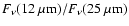 ratio for three samples of galaxies. The first sample (solid circles) is a sample
of normal star-forming galaxies (Dale et al. 2000), the second sample
(open squares) is another sample (complementary to the first one) containing
spiral galaxies (Roussel et al. 2001) while the third sample (red triangles)
consists of the sample of early-type galaxies presented in this work.
A cross on the top left part of the diagram shows a typical error bar
associated with the early-type galaxies.
As we can see there is a clear trend with the type of the galaxy becoming
earlier when going upwards along the diagonal. This is to be expected and
it is indicative of the dearth of ISM relative to the importance
of the stellar contribution in the MIR in early-type systems
compared to late-type ones.
Late-type galaxies show
larger values of
ratio for three samples of galaxies. The first sample (solid circles) is a sample
of normal star-forming galaxies (Dale et al. 2000), the second sample
(open squares) is another sample (complementary to the first one) containing
spiral galaxies (Roussel et al. 2001) while the third sample (red triangles)
consists of the sample of early-type galaxies presented in this work.
A cross on the top left part of the diagram shows a typical error bar
associated with the early-type galaxies.
As we can see there is a clear trend with the type of the galaxy becoming
earlier when going upwards along the diagonal. This is to be expected and
it is indicative of the dearth of ISM relative to the importance
of the stellar contribution in the MIR in early-type systems
compared to late-type ones.
Late-type galaxies show
larger values of
 and
compared
to the
and
compared
to the
 and
respectively, due to
larger contribution from higher temperature dust as a result of
more active star formation.
and
respectively, due to
larger contribution from higher temperature dust as a result of
more active star formation.
![\begin{figure}
\par\includegraphics[width=8.1cm,clip]{0020.f8.eps}\end{figure}](/articles/aa/full/2004/10/aa0020/img60.gif) |
Figure 8:
The
ratio
versus the
 / /
 ratio.
The symbol coding is the same as in Fig. 7.
The cross on the top right part of the diagram indicates a typical
error bar associated with the early-type galaxies analyzed in this work.
ratio.
The symbol coding is the same as in Fig. 7.
The cross on the top right part of the diagram indicates a typical
error bar associated with the early-type galaxies analyzed in this work. |
| Open with DEXTER | |
In Fig. 8 we present the same samples (with the same symbol coding as in Fig. 7)
but now the MIR color
is plotted with the FIR color
 for each galaxy.
The cross on the top right part of the diagram shows a typical error bar
associated with the early-type galaxies.
Here, it is interesting to notice the clear trend for
the spiral galaxies (already discussed in Dale et al. 2000) with the MIR
color being roughly constant and near unity going from quiescent to mildly
active galaxies (close to the point where the FIR color reaches
the value of -0.2) and then the drop of the MIR color when
going to more active galaxies (with FIR color larger than -0.2).
It is interesting to notice in this diagram that, except for the
dustier early-type galaxies, all the rest of the early-type galaxies
lie in an area which is above that occupied by the spirals, due to the diminishing 15
flux, which is again indicative of the lack of the ISM in these galaxies with respect to the disk galaxies.
for each galaxy.
The cross on the top right part of the diagram shows a typical error bar
associated with the early-type galaxies.
Here, it is interesting to notice the clear trend for
the spiral galaxies (already discussed in Dale et al. 2000) with the MIR
color being roughly constant and near unity going from quiescent to mildly
active galaxies (close to the point where the FIR color reaches
the value of -0.2) and then the drop of the MIR color when
going to more active galaxies (with FIR color larger than -0.2).
It is interesting to notice in this diagram that, except for the
dustier early-type galaxies, all the rest of the early-type galaxies
lie in an area which is above that occupied by the spirals, due to the diminishing 15
flux, which is again indicative of the lack of the ISM in these galaxies with respect to the disk galaxies.
The exact knowledge of the quantity and the characteristics of the MIR excess is an important diagnostic to address the existence, nature and composition of the dust. Complications arise when examining active galaxies where the MIR excess could be attributed to several components such as the galactic dust, emission from stellar photospheres, thermal emission from the nuclear torus and synchrotron emission from jets that are hosted inside the galaxies. In this section we examine the possibility that synchrotron emission may contribute to the MIR flux by modelling the SED of the well known galaxy NGC 4486 (M87) which hosts a very powerful jet in its center (see Sect. 6.5 for more details).
We have gathered all the available radio observations (mainly using the
NED database) and plotted together with all the other observations (UV, optical,
NIR, MIR, FIR)
as described in Sect. 5.3.1 (see Fig. 9).
We then used a simple power-law in order
to account for the radio emission and we extrapolate from the radio to the MIR regime.
This extrapolation is valid from a theoretical point of view and it has been
used in order to explain the emission of jets in a wide range of wavelengths
(Perlman et al. 2001; Cheung 2002; Marshall et al. 2002).
In Fig. 9 we show the stellar radiation field (as computed by PÉGASE; see
Sect. 5.3.2), the modified black-body law which models the emission of the warm dust
detected by IRAS, the radio emission using a simple power law, namely
 ,
as well as the total predicted SED which is the sum of all of the
components of the SED.
For the power-law component we derive a value of
,
as well as the total predicted SED which is the sum of all of the
components of the SED.
For the power-law component we derive a value of
 which
is indicative of synchrotron emission (Condon 1992) while a temperature of 58 K is found
for the modified black-body peaking in the FIR in order to fit the FIR data.
which
is indicative of synchrotron emission (Condon 1992) while a temperature of 58 K is found
for the modified black-body peaking in the FIR in order to fit the FIR data.
It is obvious that in this galaxy the MIR excess could easily be explained by the contribution of the synchrotron radiation. This is also nicely presented in the lower panel where the relative difference between the total SED model and the observations is given. We can see now that this three component model (evolved stellar population + dust emission described by a modified black-body + radio emission described by a power law) fits all of the data, including the MIR, in contrast to that presented in Fig. 4. With this example we want to emphasize the fact that synchrotron radiation may play a very significant role even in the IR spectrum of strong radio galaxies.
![\begin{figure}
\par\includegraphics[width=8.4cm,clip]{0020.f9.eps}\end{figure}](/articles/aa/full/2004/10/aa0020/img64.gif) |
Figure 9: The SED of the radio galaxy NGC 4486 (M87). The points are fitted with three components: a stellar radiation field modelled by PÉGASE, a modified black-body law representing dust peaking in the FIR and a power-law describing the synchrotron emission. On top of these three different component the composite spectrum is shown. The bottom panel in each plot shows the relative difference of the observations from the modelled spectrum. |
| Open with DEXTER | |
NGC 185.
This dwarf elliptical galaxy is of great interest not only because of its
proximity to us (only 0.7 Mpc away) but also because it contains
optical dust clouds (Martinez-Delgado et al. 1999) and luminous blue stars
(Baade 1944; Lee et al. 1993) indicating current star formation activity.
This galaxy shows a centrally concentrated distribution for the atomic hydrogen which
extends further to the northeast while CO observations show that the molecular
gas is closely associated with the optical dust clouds (Welch et al. 1996; Young & Lo
1997; Young 2001). The
map presented in this work (Fig. A.1) is mainly
associated with the dust clouds and the molecular gas but also shows a central
concentration.
NGC 205.
This is also a dwarf elliptical galaxy which shows similar characteristics to
NGC 185. The bright blue stars observed in this galaxy (Hodge 1973) as well as
detailed study of the color profiles (Peletier 1993), show that star formation
activity is still taking place in this galaxy.
The atomic hydrogen in this galaxy is distributed in an elongated
structure which is curved and extends about twice as far to the south of the optical center
as it does to the north of the optical center (Young & Lo 1997). CO observations
show that the molecular gas is associated with the dust clouds (Welch et al. 1998;
Young & Lo 1996; Young & Lo 1997). The
emission (Fig. A.1) is associated with the dust clouds.
NGC 1052.
This giant elliptical galaxy which is classified as a low-ionization nuclear emission-line
region (LINER) galaxy (Ho et al. 1997) hosts a double-sided radio jet with a size of
a few milliarcseconds (Kameno et al. 2002). HST observations
have revealed dust absorption features in the center of this galaxy (van Dokkum et al. 1995).
In the MIR maps of Fig. A.2 it is clearly seen that
the
emission is concentrated in a very compact region
close to the center and is dominated by the central source which, in this case, is an
active nucleus in agreement with the findings of
Knapp et al. (1992). This is also seen in the 6.7 and
radial profiles (Fig. 5)
as well as in the MIR flux ratio profiles (Fig. 6)
where a steep turnover is present at a distance close to the nucleus.
NGC 1316.
This is a giant elliptical galaxy in the Fornax cluster showing evidence
of recent merging events (e.g. dust patches,
 filaments, ripples and loops;
see, e.g. Schweizer 1980).
Observations of atomic and molecular gas indicate an absence of neutral atomic gas in the
galaxy (except for four bright HII regions) while there was a significant amount
of molecular gas (5
filaments, ripples and loops;
see, e.g. Schweizer 1980).
Observations of atomic and molecular gas indicate an absence of neutral atomic gas in the
galaxy (except for four bright HII regions) while there was a significant amount
of molecular gas (5
 )
which is mainly associated with the dust
patches which are oriented along the minor axis (Horellou et al. 2001).
ROSAT observations have shown that the X-ray emission is extended and flattened along the major
axis of the galaxy which indicates the presence of a hot gas component (Kim et al. 1998).
The 15
emission is oriented along the minor axis of the galaxy and traces
the dust patches quite well in the outer parts (see Fig. 2).
)
which is mainly associated with the dust
patches which are oriented along the minor axis (Horellou et al. 2001).
ROSAT observations have shown that the X-ray emission is extended and flattened along the major
axis of the galaxy which indicates the presence of a hot gas component (Kim et al. 1998).
The 15
emission is oriented along the minor axis of the galaxy and traces
the dust patches quite well in the outer parts (see Fig. 2).
NGC 1399.
This is the central dominant galaxy of the Fornax cluster which has been extensively studied
in a wide range of wavelengths. It hosts a low-luminosity radio jet which is confined
within the optical image (Killeen et al. 1988) and it shows an extended and asymmetric
gaseous halo in X-rays (Paolillo et al. 2002). Although there is no detection of
dust seen by optical obscuration (van Dokkum & Franx 1995), we observe
a MIR excess between the 9.62 and 15
bands
(Fig. 4). This excess (as already reported in Athey et al. 2002)
coincides with the 9.7
silicate dust band that originates in the
circumstellar envelopes of AGB stars.
NGC 2300. HST observations show no signs of dust in this galaxy. Our analysis shows that there is no significant excess observed in the MIR bands supporting the lack of ISM in this galaxy.
NGC 3928. NGC 3928 is an early type gas-rich starburst galaxy with CO detected in a rotating disk. The MIR spectrum of this galaxy shows a striking excess over the stellar emission, suggesting a large content of warm dust and PAHs.
NGC 4278.
This elliptical galaxy shows
a complex dust structure in its core
(van Dokkum & Franx 1995). We do not detect any excess at 6.7
but we
detect a 15
excess indicating the presence of warm dust in this galaxy.
NGC 4374.
NGC 4374 is a giant elliptical galaxy which show strong radio emission and a two-sided
jet emerging from its compact core. HST images reveal dust lanes in the core of the galaxy
while no significant amount of diffusely distributed cold dust was detected at submillimeter
wavelengths (Leeuw et al. 2000).
As in NGC 4278 we do not detect any excess at 6.7
but we
detect 15
excess.
NGC 4473.
Although there is no detection of dust seen in optical absorption for this galaxy
(van Dokkum & Franx 1995) we detect extended MIR emission at 15
which could be
associated with a smooth dust component, preventing detection in the optical.
NGC 4486. This giant elliptical galaxy which is located at the center of the Virgo cluster, hosts a very strong central radio source and a synchrotron jet which is visible from radio to X-ray wavelengths (Marshall et al. 2002). The nucleus of this galaxy show no direct signatures of dust (van Dokkum & Franx 1995) while both molecular and atomic gas components are absent from the center of this galaxy (Braine & Wiklind 1993). The MIR maps of this galaxy presented in Fig. A.6, show a central emission component as well as a separate component that traces the jet morphology. We have shown that all the MIR excess and most of the FIR output of this galaxy as a whole (galaxy + radio jet) can be attributed to a single synchrotron emission component as seen in Fig. 9.
NGC 4649.
NGC 4649 shows no clear excess in the MIR (see Fig. 4 and Table 4).
IRAS fluxes indicate a dust mass of 4.5
 (see Table 3) although, as already stated in the introduction, background contamination and other uncertainties may lead to an overestimation of the FIR output of early-type galaxies (Bregman et al. 1998).
The absence of any
significant amount of dust is also demonstrated by recent ISO observations
at 60, 90 and 180
where this galaxy show no emission (Temi et al. 2003).
(see Table 3) although, as already stated in the introduction, background contamination and other uncertainties may lead to an overestimation of the FIR output of early-type galaxies (Bregman et al. 1998).
The absence of any
significant amount of dust is also demonstrated by recent ISO observations
at 60, 90 and 180
where this galaxy show no emission (Temi et al. 2003).
NGC 5018.
This is a luminous metal-poor giant elliptical (Bertola et al. 1993). HST images
reveal complex but very localized dust structures.
With our analysis we detect both 6.7 and 15
excesses from this galaxy.
NGC 5102.
NGC 5102 is a gas-rich lenticular galaxy that shows evidence for recent
star formation activity in the central region (Danks et al. 1979; Deharveng et al.
1997). HST observations show dust signatures in the core of this galaxy
(van Dokkum & Franx 1995).
In the SED of this galaxy (with a wide range of observations available) presented in
Fig. 4 we see a clear excess over
the stellar emission between the 9.62 and the 15
bands.
As in the case of NGC 1399 this coincides with the
9.7
silicate dust band (see also Athey et al. 2002).
NGC 5173. This galaxy shows an extended emission in the MIR distributed in a smooth way and peaked at the center. HST observations show a high filamentary structure in the core of this galaxy (van Dokkum & Franx 1995). From its SED (Fig. 4) we see prominent dust excess over the stellar emission.
![\begin{figure}
\par\includegraphics[width=7.6cm,clip]{0020.f10.eps}\end{figure}](/articles/aa/full/2004/10/aa0020/img68.gif) |
Figure 10:
Major-axis profiles of the MIR emission (6.7
and 15
shown
as dashed and solid line respectively) for the edge-on lenticular galaxy NGC 5866. The emission peaks at the nucleus and secondary maxima at  4 kpc either side of the center are present. 4 kpc either side of the center are present. |
| Open with DEXTER | |
NGC 5266.
NGC 5266 is an HI-rich elliptical galaxy with a dust ring along the minor
axis of the galaxy (Varnas et al. 1987; Morganti et al. 1997). From the
MIR maps of Figs. 3 and A.8 we can see a disk at 15
(slightly warped) which
is aligned with the minor axis of the galaxy.
The SED shows a clear excess of the MIR emission over the stellar component.
NGC 5363.
This elliptical galaxy shows a dust lane along its minor axis. This is also
shown in the MIR maps (Fig. A.9) with the 15
emission being aligned
with the minor axis. The MIR SED
shows a clear excess over the stellar emission.
NGC 5866.
This edge-on lenticular galaxy shows a remarkable dust disk which is oriented
exactly along the major axis of the galaxy. This is also shown with
the MIR observations of Fig. A.9. The MIR SED shows a clear excess in
both the 6.7 and 15
bands.
The PHT-S spectrum of this galaxy shows a broad emission feature
that peaks at 7.9
(Lu et al. 2003).
In Fig. 10 we present the MIR profiles along the major-axis for both the 6.7
(dashed line) and the 15
(solid line) emission. The profiles are very similar at both wavelengths with peak emission at the nucleus and secondary maxima at 4 kpc from either
side of the center. This symmetrical secondary peak may be an indication of
a ring-like distribution of dust in this galaxy.
Eighteen early-type galaxies observed with ISOCAM at 4.5, 6.7 and 15
were
analyzed in this study aiming to determine the characteristics of the ISM in these
galaxies. We have modelled the SED of these galaxies using the stellar evolutionary synthesis model,
PÉGASE, to fit the stellar component and a modified black-body to fit the FIR
part of the SED. The excess of the MIR emission (at 6.7 and 15
)
over the
stellar component is then quantified and it is found that out of 18 galaxies
10 show excess at 6.7
and 14 at 15
.
Thus the presence of PAHs and small dust grains is established in early-type
galaxies. In two galaxies (NGC 1399 and NGC 5102) the excess at 9.7
,
due to silicate dust emission is also seen.
The morphology of the galaxies is examined by visual inspection of the emission
maps at the three bands (4.5, 6.7 and 15
)
and by plotting the
azimuthally averaged radial profiles as well as the MIR flux ratio
profiles. From this analysis we conclude that:
emission
follows quite well the de Vaucouleurs profile for all the galaxies (except
NGC 4486 where a jet is seen and NGC 5866 which has an edge-on configuration).
With ISOCAM-IRAS color-color diagnostic diagrams, we delineate the regions occupied by different types of galaxies. Early-type galaxies, in general, occupy areas which favor the dust poor galaxies while the spiral galaxies occupy the regions where the ISM-rich galaxies are located.
Finally, for one of the galaxies, the strong radio galaxy NGC 4486 (M87), we show that the MIR excess as well as most of its FIR output is coming from synchrotron emission emerging from its powerful jet.
Acknowledgements
We thank Suvi Gezari and Pierre Chanial for their help in the earliest stages of the data reduction. We are also greatful to René Gastaud and Koryo Okumura for their help in the data reduction and for useful discussions. This research has made use of the NASA/IPAC Extragalactic Database (NED) which is operated by the Jet Propulsion Laboratory, California Institute of Technology, under contract with the National Aeronautics and Space Administration. We have made extensive use of the SIMBAD database, operated at CDS, Strasbourg, France.
![\begin{figure}
\par\includegraphics[width=13cm,clip]{0020.f12.eps}\end{figure}](/articles/aa/full/2004/10/aa0020/img70.gif) |
Figure A.2:
Same as in Fig. A.1. but for the galaxies NGC 1052 (left) and NGC 1316 (right).
For NGC 1052 the contour levels are 0.2, 0.4, 0.6, 0.8, 1.0, 1.2, 1.4, 1.8, 2.4,
3.0, 4.0, 5.0, 6.0, 7.0, 8.0, 9.0, 10.0, 12.0, 14.0, 16.0, 18.0 mJy/pixel for the 4.5
map (top), 0.1, 0.3, 0.6, 1.0, 2.0, 4.0, 10.0, 20.0 mJy/pixel for the
map (middle) and 0.6, 1.0, 2.0, 4.0, 10., 20., 30., 40., 50.0 mJy/pixel for the
map (bottom).
For NGC 1316 the contour levels are 0.5, 1.0, 2.0, 3.0, 5.0, 8.0, 12.0, 20.0, 30.0 mJy/pixel for the 4.5
map (top), 0.3, 0.6, 1.0, 1.5, 2.0, 3.0, 5.0, 10.0, 15.0 mJy/pixel for the
map (middle) and 0.2, 0.5, 1.0, 1.5, 2.0, 3.0, 5.0, 10.0 mJy/pixel for the
map (bottom). |
![\begin{figure}
\par\includegraphics[width=13cm,clip]{0020.f13.eps}\end{figure}](/articles/aa/full/2004/10/aa0020/img71.gif) |
Figure A.3:
Same as in Fig. A.1. but for the galaxies NGC 1399 (left) and NGC 2300 (right).
For NGC 1399 the contour levels are 0.3, 0.5, 1.0, 2.0, 4.0, 10.0, 16.0 mJy/pixel for the 4.5
map (top), 0.2, 0.3, 0.5, 1.0, 2.0, 4.0, 10.0 mJy/pixel for the
map (middle) and 0.4, 0.6, 1.0, 2.0, 4.0, 10.0 mJy/pixel for the
map (bottom).
For NGC 2300 the contour levels are 0.3, 0.5, 1.0, 2.0, 4.0, 10.0 mJy/pixel for the 4.5
map (top), 0.2, 0.3, 0.5, 1.0, 2.0, 4.0, 6.0 mJy/pixel for the
map (middle) and 0.3, 0.5, 0.7, 1.0, 1.5, 2.0 mJy/pixel for the
map (bottom). |
![\begin{figure}
\par\includegraphics[width=13cm,clip]{0020.f14.eps}\end{figure}](/articles/aa/full/2004/10/aa0020/img72.gif) |
Figure A.4:
Same as in Fig. A.1. but for the galaxies NGC 3928 (left) and NGC 4278 (right).
For NGC 3928 the contour levels are 0.5, 0.7, 1.0, 1.5, 2.0, 3.0, 4.0 mJy/pixel for the 4.5
map (top), 0.3, 0.5, 1.0, 2.0, 3.0, 5.0, 10.0, 15.0, 20.0 mJy/pixel for the
map (middle) and 0.5, 1.0, 2.0, 3.0, 5.0, 10.0, 15.0, 20.0, 23.0 mJy/pixel for the
map (bottom).
For NGC 4278 the contour levels are 0.3, 0.5, 1.0, 2.0, 5.0, 10.0, 15.0 mJy/pixel for the 4.5
map (top), 0.3, 0.5, 1.0, 2.0, 5.0, 10.0 mJy/pixel for the
map (middle) and 0.2, 0.3, 0.5, 1.0, 2.0, 4.0 mJy/pixel for the
map (bottom). |
![\begin{figure}
\par\includegraphics[width=13cm,clip]{0020.f15.eps}\end{figure}](/articles/aa/full/2004/10/aa0020/img73.gif) |
Figure A.5:
Same as in Fig. A.1. but for the galaxies NGC 4374 (left) and NGC 4473 (right).
For NGC 4374 the contour levels are 0.6, 1.0, 2.0, 5.0, 10.0, 15.0, 20.0 mJy/pixel for the 4.5
map (top), 0.6, 1.0, 2.0, 5.0, 10.0, 15.0 mJy/pixel for the
map (middle) and 0.5, 0.7, 1.0, 1.5, 2.0, 3.0, 5.0, 6.0 mJy/pixel for the
map (bottom).
For NGC 4473 the contour levels are 0.7, 1.0, 1.5, 3.0, 5.0, 10.0, 15.0 mJy/pixel for the 4.5
map (top), 0.3, 0.5, 0.7, 1.0, 1.5, 3.0, 5.0, 7.0, 9.0 mJy/pixel for the
map (middle) and 0.7, 1.0, 1.5, 3.0 mJy/pixel for the
map (bottom). |
![\begin{figure}
\par\includegraphics[width=13.4cm,clip]{0020.f16.eps}\end{figure}](/articles/aa/full/2004/10/aa0020/img74.gif) |
Figure A.6:
Same as in Fig. A.1. but for the galaxies NGC 4486 (left) and NGC 4649 (right).
For NGC 4486 the contour levels are 7.0, 8.0, 9.0, 10.0, 12.0, 15.0, 17.0, 19.0 mJy/pixel for the 4.5
map (top), 2.0, 3.0, 4.0, 5.0, 6.0, 7.0, 8.0, 9.0, 10.0, 12.0 mJy/pixel for the
map (middle) and 2.0, 3.0, 4.0, 5.0, 6.0, 7.0, 8.0, 9.0 mJy/pixel for the
map (bottom).
For NGC 4649 the contour levels are 1.0, 1.5, 2.0, 3.0, 5.0, 8.0, 10.0, 15.0 mJy/pixel for the 4.5
map (top), 0.7, 1.0, 1.5, 2.0, 3.0, 5.0, 8.0, 10.0 mJy/pixel for the
map (middle) and 1.0, 1.5, 2.0, 3.0, 4.0 mJy/pixel for the
map (bottom). |
![\begin{figure}
\par\includegraphics[width=13cm,clip]{0020.f17.eps}\end{figure}](/articles/aa/full/2004/10/aa0020/img75.gif) |
Figure A.7:
Same as in Fig. A.1. but for the galaxies NGC 5018 (left) and NGC 5102 (right).
For NGC 5018 the contour levels are 0.7, 1.0, 2.0, 4.0, 8.0, 15.0 mJy/pixel for the 4.5
map (top), 0.5, 1.0, 2.0, 4.0, 8.0, 12.0 mJy/pixel for the
map (middle) and 0.5, 1.0, 2.0, 4.0, 6.0 mJy/pixel for the
map (bottom).
For NGC 5102 the contour levels are 0.5, 0.7, 1.0, 2.0, 4.0, 7.0 mJy/pixel for the 4.5
map (top), 0.2, 0.4, 0.7, 1.0, 2.0, 4.0, 7.0 mJy/pixel for the
map (middle) and 0.4, 0.7, 1.0, 2.0, 4.0, 7.0 mJy/pixel for the
map (bottom). |
![\begin{figure}
\par\includegraphics[width=13cm,clip]{0020.f18.eps}\end{figure}](/articles/aa/full/2004/10/aa0020/img76.gif) |
Figure A.8:
Same as in Fig. A.1. but for the galaxies NGC 5173 (left) and NGC 5266 (right).
For NGC 5173 the contour levels are 0.3, 0.5, 1.0, 2.0, 3.0 mJy/pixel for the 4.5
map (top), 0.5, 1.0, 2.0, 3.0, 3.7 mJy/pixel for the
map (middle) and 0.6, 1.0, 2.0, 3.0, 3.7 mJy/pixel for the
map (bottom).
For NGC 5266 the contour levels are 0.3, 0.5, 0.7, 1.0, 2.0, 3.0, 6.0, 10.0 mJy/pixel for the 4.5
map (top), 0.5, 0.7, 1.0, 2.0, 3.0, 6.0, 10.0 mJy/pixel for the
map (middle) and 0.7, 1.0, 2.0, 3.0, 4.0, 6.0, 8.0 mJy/pixel for the
map (bottom). |
![\begin{figure}
\par\includegraphics[width=13cm,clip]{0020.f19.eps}\end{figure}](/articles/aa/full/2004/10/aa0020/img77.gif) |
Figure A.9:
Same as in Fig. A.1. but for the galaxies NGC 5363 (left) and NGC 5866 (right).
For NGC 5363 the contour levels are 1.0, 1.5, 2.0, 3.0, 5.0, 10.0, 13.0 mJy/pixel for the 4.5
map (top), 0.7, 1.0, 1.5, 2.0, 3.0, 5.0, 10.0, 15.0 mJy/pixel for the
map (middle) and 0.8, 2.0, 5.0, 10.0 mJy/pixel for the
map (bottom).
For NGC 5866 the contour levels are 0.5, 1.0, 2.0, 4.0, 8.0, 10.0 mJy/pixel for the 4.5
map (top), 0.3, 0.5, 1.0, 2.0, 4.0, 8.0, 12.0 mJy/pixel for the
map (middle) and 0.5, 1.0, 2.0, 4.0, 6.0, 8.0, 12.0 mJy/pixel for the
map (bottom). |
![\begin{figure}
\par\includegraphics[width=13cm,clip]{0020.f11.eps}\end{figure}](/articles/aa/full/2004/10/aa0020/img69.gif)